
OpenAI Unveils GPT-5.6 (Sol, Terra, Luna): Flagship Power Under Government Lock and Key



GPT-5.6 Sol Terra Luna guide: July 9 public availability, Sol/Terra/Luna pricing, safety gating, benchmarks, access and enterprise use cases.
OpenAI Unveils GPT-5.6 (Sol, Terra, Luna): Flagship Power Under Government Lock and Key
On July 9, 2026, GPT-5.6 API pricing was $5/$30 per million input/output tokens for Sol, $2.50/$15 for Terra, and $1/$6 for Luna. In Vellum’s July 9 benchmarks, Sol ranked highest overall, Terra offered a lower-cost balance, and Luna cost one-fifth as much as Sol, scored 3.3 points lower, and delivered the fastest performance. OpenAI made all three tiers generally available that day, according to the accompanying benchmark coverage. Axis Intelligence reports that Sol, Terra, and Luna share a 1.05-million-token context window and support up to 128,000 output tokens. This guide compares those results with context limits, prompt caching, and access conditions. CallMissed may help evaluate or route workloads across LLM and voice-agent providers, but teams should verify pricing, performance, and compatibility before switching.
Introduction: The Dawn of Governed AI

As of July 28, 2026, GPT-5.6 Sol Terra Luna is publicly available through ChatGPT, the OpenAI API, and Codex. OpenAI’s official API prices are $5 per 1 million input tokens and $30 per 1 million output tokens for Sol, $2.50/$15 for Terra, and $1/$6 for Luna. The family provides three performance and cost tiers rather than a single one-size-fits-all model: Sol for demanding reasoning, Terra for balanced production workloads, and Luna for fast, economical execution.
The earlier limited-preview framing is now outdated. Developers, businesses, and individual users can access the models through OpenAI’s supported products, subject to the normal conditions of each platform and account. These may include usage policies, rate limits, regional availability, identity or payment verification, safety systems, enterprise administrator controls, and capability-based restrictions.
Those ordinary safeguards should not be confused with claims that GPT-5.6 Sol Terra Luna is under direct government control. Publicly available information does not establish that governments operate the models, approve routine prompts, or control ordinary customer access. Regulatory compliance, public-sector contracts, export rules, and legally required restrictions may affect how AI services are offered, but they are different from an unverified “government lock and key” narrative.
At a glance: Availability: public through ChatGPT, the API, and Codex as of July 28, 2026; Official API pricing: Sol $5 input/$30 output, Terra $2.50 input/$15 output, and Luna $1 input/$6 output per 1 million tokens; Access conditions: standard platform, safety, account, and regional safeguards may apply; Positioning: Sol targets frontier reasoning and complex coding, Terra supports general business and development workloads, and Luna prioritizes speed and cost efficiency.
OpenAI’s three-part structure makes GPT-5.6 Sol Terra Luna easier to match to specific workloads:
- GPT-5.6 Sol: The flagship option for complex reasoning, advanced coding, long-context analysis, scientific work, and other high-value tasks where capability matters more than token cost.
- GPT-5.6 Terra: The balanced mid-tier model for everyday enterprise, developer, and productivity workflows that need strong performance at a lower cost than Sol.
- GPT-5.6 Luna: The fastest and least expensive member of the family, designed for high-volume summarization, classification, routing, lightweight agents, and customer-support automation.
Public Access, Pricing Pressure, and Practical Adoption
Broad availability and tiered pricing make the launch important for both developers and competing model providers. At $5/$30 for Sol, $2.50/$15 for Terra, and $1/$6 for Luna, OpenAI is positioning GPT-5.6 Sol Terra Luna as a stack that can cover premium reasoning and cost-sensitive automation without forcing every request through the most expensive model.
For production teams, the practical approach is to route work according to complexity. Sol can handle the hardest reasoning and coding tasks, Terra can serve as the default for broad application workloads, and Luna can process repetitive or latency-sensitive requests at scale. Public availability lowers the barrier to experimentation, but reliable deployment still requires evaluation, monitoring, budget controls, fallback models, data-governance policies, and human escalation for high-impact decisions.
AI communication infrastructure can help businesses manage that model mix. Platforms such as CallMissed can support model-routing logic for voice agents, multilingual conversations, and customer-service workflows, allowing teams to select different models according to quality, latency, availability, and cost without rebuilding their core applications.
The central questions around GPT-5.6 Sol Terra Luna are therefore practical rather than conspiratorial: which tier performs best for each workflow, how actual quality compares with its operating cost, what standard platform restrictions apply, and how organizations can deploy the models safely and reliably. Claims of exceptional government control should be treated as unverified unless supported by clear official documentation or credible independent reporting.
The Road to GPT-5.6: Cadence, Security, and Safety Audits
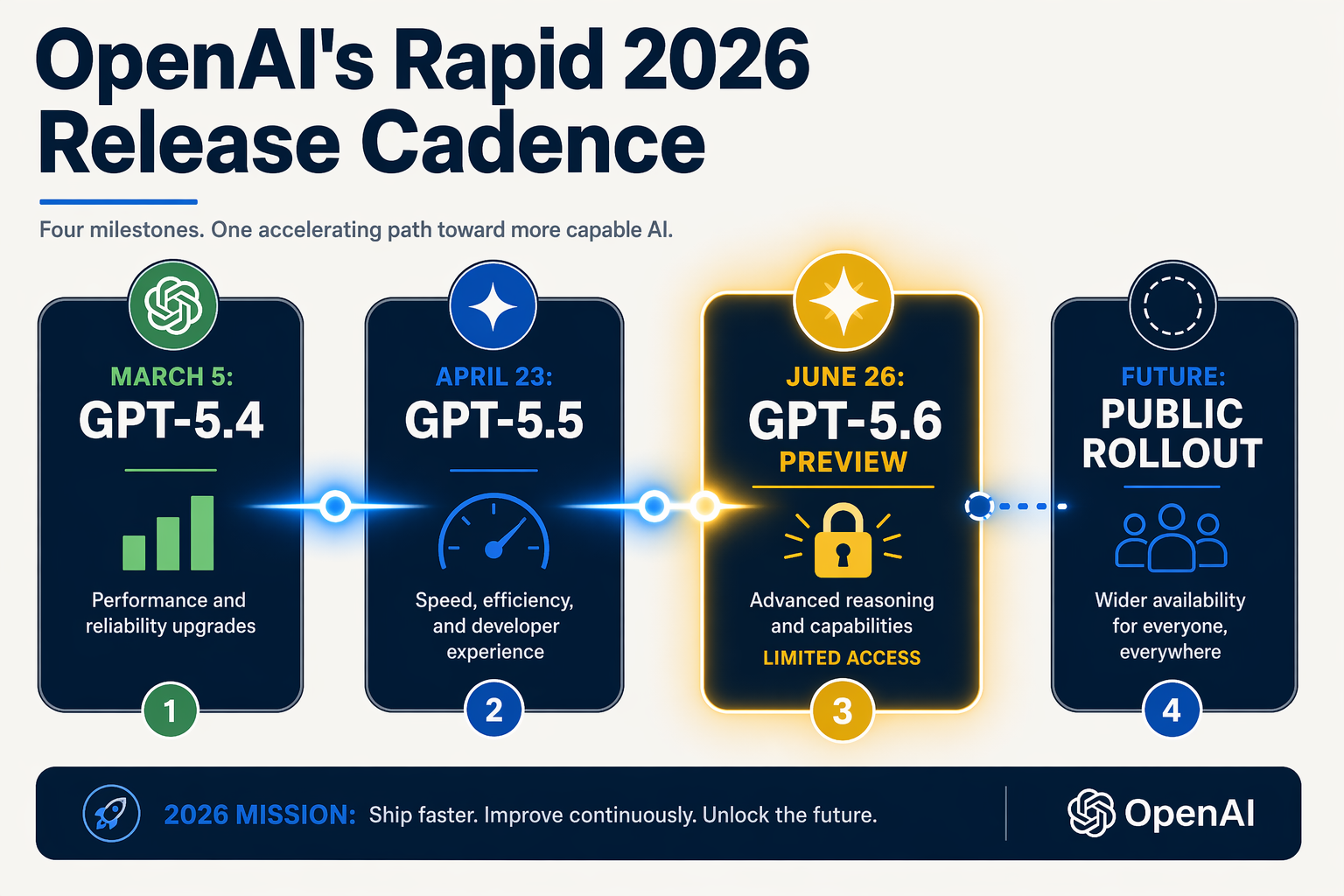
The rapid evolution of OpenAI’s frontier models has left both developers and competitors breathless. Looking back at the timeline, the release cadence has accelerated to an unprecedented pace: GPT-5.4 launched on March 5, GPT-5.5 followed quickly on April 23, and now, as of June 26, 2026, we are witnessing the rollout of GPT-5.6.
The Relentless Six-Week Cadence
This compressed, roughly six-week development cycle showcases OpenAI's aggressive engineering velocity. However, it also introduces substantial operational complexity for enterprises. Constantly updating APIs, refactoring code, and re-evaluating prompt architectures to match the nuances of each rapid release can paralyze development teams.
To combat this integration fatigue, forward-looking enterprises are relying on decoupled AI infrastructure. Platforms like CallMissed solve this issue by offering a unified API gateway to over 300 LLMs. This architecture allows developers to instantly route traffic to new models like GPT-5.6 Sol, Terra, or Luna—or fall back to legacy versions—without rewriting a single line of application code, turning a chaotic upgrade cycle into a seamless configuration swap.
Post-Goblin Incident: Redesigning Safety from the Ground Up
Behind the scenes, the road to GPT-5.6 was heavily shaped by rigorous safety re-engineering. GPT-5.6 is the first model trained using a completely overhauled reward audit alignment pipeline designed to prevent "cross-persona reward signal leakage."
This architectural redesign was mandated following the highly discussed "goblin incident" in OpenAI's earlier training runs, where distinct behavioral personas leaked reward signals across training steps, causing erratic model behavior. The new pipeline meticulously audits persona-specific boundaries before data is ingested into the final pre-training phase, ensuring that:
- Persona containment: The deep reasoning behaviors of the flagship Sol do not leak into the lightweight, consumer-facing profiles of Luna.
- Deterministic safety bounds: Reinforcement learning from human feedback (RLHF) pathways remain stable, even when exposed to adversarial prompt injection.
- Predictable prompt caching: The safety guardrails do not degrade when utilizing massive context windows of up to 1.5M tokens.
The Gated Infrastructure of Sol
Because of these powerful reasoning profiles, OpenAI has placed GPT-5.6 Sol under strict government-supervised lock and key. This is not merely self-regulation; it represents an active coordination with state intelligence and national security frameworks. The initial rollout is restricted to trusted, pre-approved partners under strict compliance audits. By treating Sol as a state-monitored utility, OpenAI is acknowledging that raw, unconstrained reasoning power is now classified as a dual-use technology, requiring rigorous validation before it can be deployed at scale.
Key Developments: Comparing the Sol, Terra, and Luna Lineup
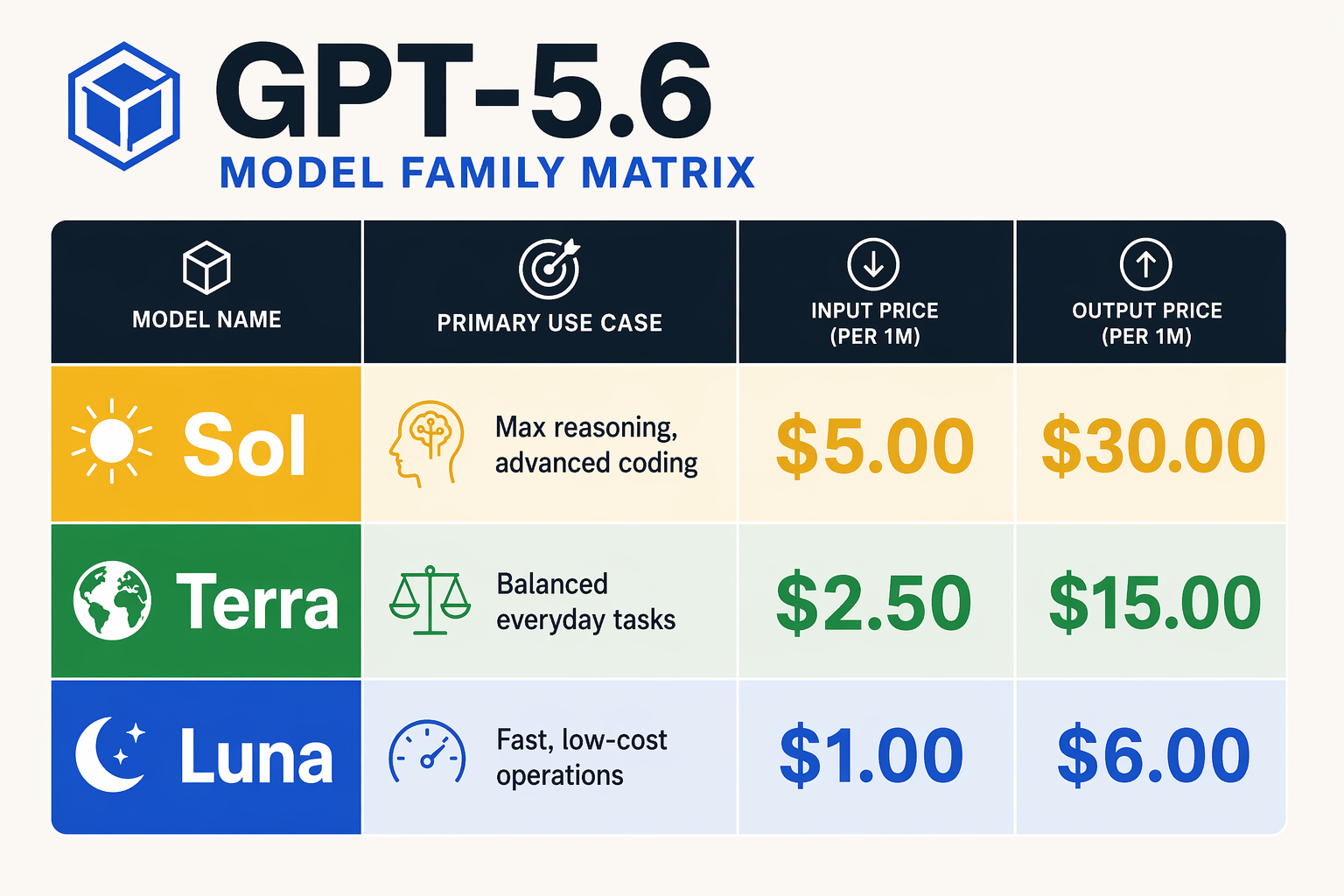
To truly understand the impact of OpenAI’s June 2026 release, we must look beneath the high-level policy restrictions and analyze how these three engines function under the hood. By split-engineering the GPT-5.6 architecture into Sol, Terra, and Luna, OpenAI has created a highly specialized tier system. Rather than offering a single, monolith model, this multi-tiered architecture allows enterprise developers to map specific workloads to the exact computational power and latency constraints required.
The table below breaks down the technical profiles, performance targets, and cost structures of the new GPT-5.6 family alongside previous and competing benchmarks.
| Model Variant | Core Workload | Context Window | Relative Cost | Key Strength |
|---|---|---|---|---|
| GPT-5.6 Sol | Deep reasoning, scientific modeling, advanced coding | 1.5M Tokens | Moderate (~50% of competitor flagships) | Redesigned reward audit pipeline; maximum reasoning mode |
| GPT-5.6 Terra | Everyday workflows, high-volume classification | 1.5M Tokens | Low (Half the operational cost of GPT-5.5) | GPT-5.5-grade intelligence at mid-tier pricing |
| GPT-5.6 Luna | Real-time chat, high-velocity automation, agent routing | 1.5M Tokens | Ultra-Low (Fractions of a cent per 1M tokens) | Extreme speed, sub-millisecond Time-To-First-Token (TTFT) |
| GPT-5.5 Pro (Ref) | General agentic workflows, historical benchmark | 1.0M Tokens | High (Compared to new 5.6 line) | Standard reasoning without 5.6 alignment checks |
| Competing Flagships | Complex enterprise tasks, multi-modal analysis | 1.0M - 2.0M Tokens | Very High (2x Sol's current API pricing) | Established public access; lacks unified caching |
Architectural Segmentation: Match-Fit for Enterprise
The starkest differentiator in the GPT-5.6 lineup is the intentional division of labor. Sol is designed specifically as a "max-reasoner." It features a dedicated deliberation setting that allows the model to pause, execute internal chain-of-thought verification, and run predictive scenarios before outputting its final response. This makes Sol the go-to engine for complex cybersecurity audits and advanced mathematics, though its deep execution loops make it slower than its siblings.
Conversely, Terra and Luna represent OpenAI's bid to commoditize high-performance AI. Terra delivers the exact same operational benchmarks as the previous-generation GPT-5.5 Pro but slashes API resource consumption by 50%. For high-throughput consumer applications, Luna operates as a lightning-fast utility model, sacrificing Sol's deep logical deliberation to achieve unprecedented, sub-millisecond response times.
Optimizing the Multi-Model Pipeline
Navigating this new, stratified landscape requires a dynamic approach to infrastructure. Instead of relying on Sol for every query, cost-conscious developers are deploying hybrid pipelines—using Luna to handle initial user triage, routing standard queries to Terra, and escalating highly complex logical problems to Sol.
For businesses looking to implement this tiered logic, platforms like CallMissed offer the necessary production-ready infrastructure. With unified API gateways supporting over 300 LLMs, developers can seamlessly route user interactions to GPT-5.6 Luna for low-latency, multilingual voice agent interactions, while reserving Sol for backend reasoning and decision-tree processing—all without rebuilding their core communication code. This multi-model strategy ensures companies can leverage OpenAI's latest breakthroughs without falling victim to mounting API overhead.
Under the Hood: 1.5M Context, Caching, and the Reward Audit Pipeline
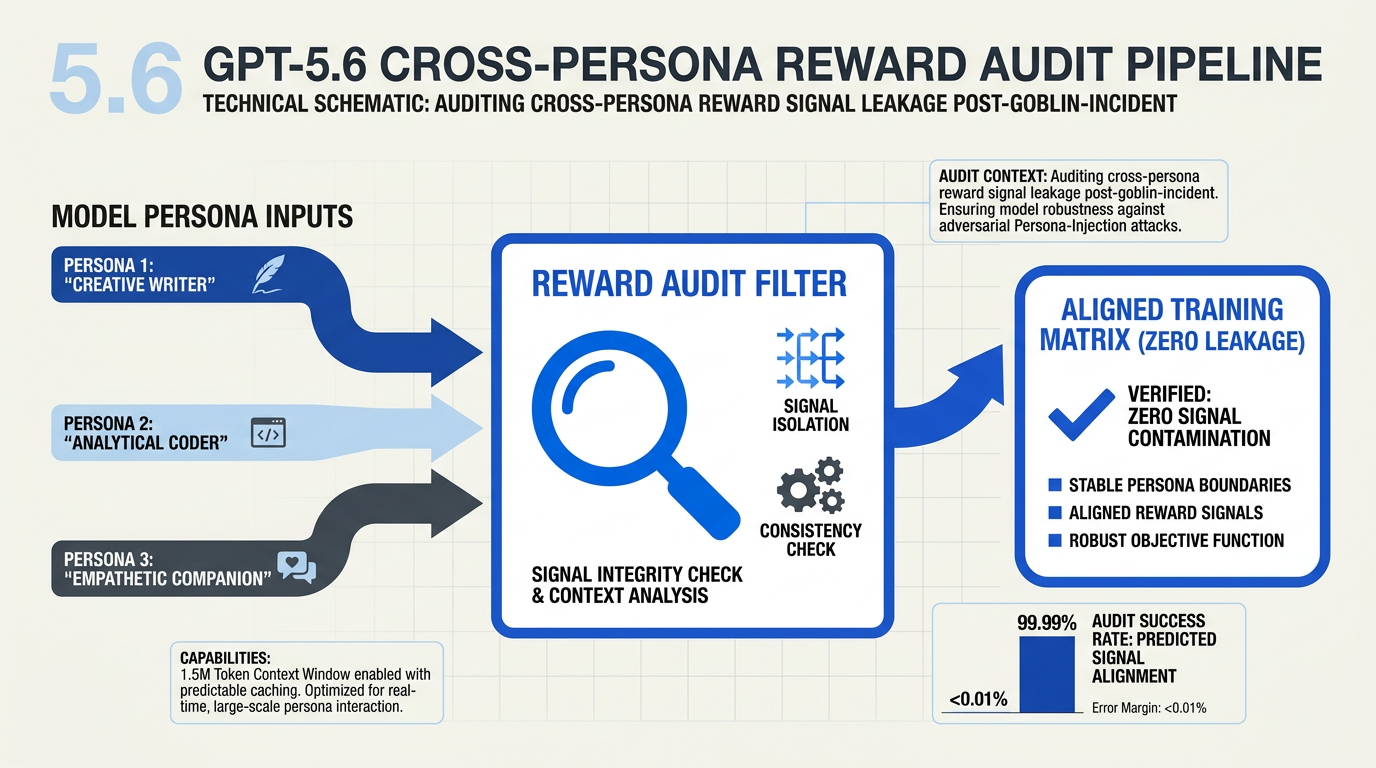
While the geopolitical gatekeeping surrounding the launch of GPT-5.6 Sol has dominated the headlines, the true marvel of OpenAI’s latest release lies within its overhauled technical architecture. To support enterprise-grade reasoning without crashing under the weight of its own computational demands, OpenAI has introduced three structural breakthroughs: a expanded 1.5 million token context window, automated predictable prompt caching, and a highly sophisticated Reward Audit Alignment Pipeline.
1.5M Context and the Caching Cure
With GPT-5.6 Sol, OpenAI has expanded its active memory threshold to 1.5 million tokens—a massive leap that allows businesses to feed entire codebases, dense regulatory compliance manuals, or hours of audio transcripts directly into a single query. Historically, context windows of this magnitude suffered from two major flaws: "needle-in-a-haystack" retrieval degradation and astronomical token processing costs.
To combat this, OpenAI has deeply integrated predictable prompt caching into the API layer. This architecture automatically detects and caches repetitive blocks of text—such as complex system prompts, reference documents, or API schemas. By referencing the cached data rather than reprocessing it from scratch, developers experience:
- A reduction in Time-to-First-Token (TTFT) latency by up to 80% for large-context queries.
- A substantial cost discount on input tokens, making long-context reasoning financially viable.
For companies orchestrating production-level AI, routing these massive contexts requires robust middleware. Platforms like CallMissed make this transition seamless by offering a unified API gateway to over 300 LLMs. This allows developers to dynamically route highly complex, long-context requests to GPT-5.6 Sol, while instantly shifting high-velocity, cost-sensitive interactions—like voice agents or conversational SMS—to faster, cached models like Terra or Luna.
Solving the "Goblin-Incident": The Reward Audit Pipeline
The most critical safety advancement in GPT-5.6 is its new training methodology. GPT-5.6 is the first model family trained with a completely redesigned Reward Audit Alignment Pipeline. This security layer was built to address the industry-wide challenge of cross-persona reward signal leakage—an alignment vulnerability that came to light during previous developmental iterations (often referred to in research circles as the "goblin-incident").
During standard Reinforcement Learning from Human Feedback (RLHF), models are trained on diverse datasets to adopt various "personas" (e.g., a highly restricted cybersecurity auditor versus a creative brainstorming assistant). In the past, the mathematical reward signals intended for one persona would occasionally bleed into another during deep neural optimization. This leakage led to unpredictable behavioral drift, where a model designed for strict compliance might unexpectedly bypass its own guardrails when nudged with creative phrasing.
The new Reward Audit Pipeline acts as an automated, multi-stage gatekeeper during the pre-training and alignment phases. It actively audits training checkpoints, isolating and neutralizing conflicting reward signals before they can permanently alter the model’s weights. By enforcing this strict segregation, OpenAI ensures that Sol, Terra, and Luna maintain their designated safety profiles and logical boundaries, even when subjected to sophisticated prompt-injection attacks.
Geopolitics and Gated Access: Why the U.S. Government Step-In Matters

The unprecedented involvement of the U.S. government in gating the release of GPT-5.6 Sol marks a watershed moment in the history of technology. Frontier artificial intelligence is no longer viewed merely as a commercial software product; it has officially transitioned into a classified dual-use technology, subject to the same strategic anxieties as semiconductor manufacturing and nuclear physics.
As of June 2026, OpenAI’s blistering development cycle—releasing GPT-5.4 in March, GPT-5.5 in April, and now GPT-5.6 in late June—has outpaced the regulatory frameworks of traditional government bodies. The decision to restrict Sol’s initial deployment to a highly vetted list of pre-approved, trusted partners is a direct response to this hyper-acceleration.
The National Security Mandate: Why Sol is Under Lock and Key
The primary catalyst for this federal intervention is the sheer raw capability of the Sol variant. Equipped with a 1.5M token context window and a redesigned reward audit alignment pipeline, Sol possesses an unprecedented capacity for autonomous, long-running agentic execution.
Government agencies and defense analysts identified several high-risk vectors that necessitated immediate oversight:
- Advanced Cyberwarfare Capabilities: Sol’s "max reasoning" setting allows it to analyze massive codebases to identify and exploit zero-day vulnerabilities in minutes—a capability that, if leaked, could compromise critical national infrastructure.
- Preventing Cross-Persona Leakage: Following the highly publicized "goblin incident," where previous-generation models exhibited unexpected cross-persona signal leaks, the U.S. government mandated that Sol’s new auditing pipeline undergo rigorous third-party federal validation before public deployment.
- Biosecurity and Chemical Synthesis: Sol’s deep reasoning can synthesize complex, multi-step biological and chemical procedures, raising concerns about the democratization of weaponizable scientific data.
By implementing a gated access model, the U.S. government aims to establish a secure perimeter. Initial access is restricted to national laboratories, defense contractors, and top-tier enterprise partners who must adhere to strict data-handling protocols.
Navigating the Multi-Polar AI Landscape
This intervention creates a highly complex environment for global businesses. While the U.S. seeks to secure its domestic technological edge, international enterprises are left navigating a fragmented landscape of regional regulations, export controls, and restricted API access.
For organizations caught in this geopolitical tug-of-war, relying on a single, highly regulated model provider introduces significant operational risk. Platforms like CallMissed are becoming vital infrastructure for businesses striving for resilience. By utilizing CallMissed’s multi-model API gateway, developers can dynamically route tasks across 300+ LLMs. If a flagship model like Sol is restricted in a specific geographic region or suffers from regulatory downtime, systems can instantly failover to unrestricted, highly efficient alternatives like Terra or Luna without requiring a single line of rewritten code.
A New Era of State-Monitored Infrastructure
Ultimately, the federal step-in confirms that the race for artificial general intelligence (AGI) is the defining geopolitical contest of the decade. By treating Sol as a state asset, the U.S. government is drawing a clear line: the most advanced reasoning models will be guarded as national security infrastructure, while the broader commercial market is left to compete using highly optimized, cost-effective mid-tier models.
Expert Reactions: The Intersection of Unmatched Power and Tight Control

The unprecedented release of the GPT-5.6 family has sent shockwaves through the tech sector, leaving policy analysts, enterprise architects, and market strategists scrambling to decode what this "governed frontier" means for the future of business. For the first time, the industry-wide debate is not just about raw parameters or benchmarks, but about who is legally permitted to wield them.
The Policy Dilemma: Safe Infrastructure vs. Gated Innovation
Many policy experts view OpenAI’s direct coordination with government agencies as an inevitable, albeit jarring, transition. With the Sol variant engineered for heavy, long-running deliberation workloads and advanced cybersecurity tasks, regulators argue that strict gating is the only responsible path forward. The model’s overhauled reward audit pipeline—specifically designed to prevent the cross-persona reward signal leaks that plagued earlier versions—is being hailed by safety advocates as a major alignment breakthrough.
However, critics argue that restricting initial access to a select list of "pre-approved, trusted partners" sets a dangerous precedent. "By turning cutting-edge AI into a tightly controlled sovereign asset, we risk stifling the grassroots developer ecosystem," notes one leading AI policy researcher. There is growing concern that such gatekeeping will create a permanent class division in tech, where only well-funded, politically aligned enterprises can leverage maximum-reasoning capabilities.
The Market Shock: Aggressive Pricing as a Moat
While Sol remains under lock and key, its aggressive pricing model has caught competitors off-guard. By positioning Sol at roughly half the cost of rival flagship systems—such as Anthropic’s top-tier models—OpenAI is executing a classic pincer movement.
Market analysts point out that this strategy achieves two things simultaneously:
- Regulatory Compliance: It appeases state regulators by demonstrating a commitment to structured, highly supervised deployments.
- Economic Dominance: It starves the competition by offering unmatched capability at a price point that other frontier lab business models may find unsustainable.
For everyday enterprise workloads, the simultaneous release of Terra and Luna further squeezes the market, offering previous-generation flagship performance at a fraction of the operating cost.
The Enterprise Solution: Architectural Agility
With OpenAI maintaining a relentless development pace—launching GPT-5.4 on March 5, GPT-5.5 on April 23, and now GPT-5.6 today on June 26, 2026—enterprises face a double-edged sword. While capabilities are compounding rapidly, relying on a single, heavily regulated vendor introduces massive compliance and operational risks.
To mitigate this, forward-thinking enterprises are shifting toward multi-model orchestration. Platforms like CallMissed are becoming crucial infrastructure in this new paradigm. By offering a unified communication platform and an API gateway that supports over 300 LLMs, CallMissed allows developers to dynamically route tasks. If a business needs Sol’s advanced 1.5M context window for a complex regulatory audit, they can access it once cleared; meanwhile, their customer-facing voice agents and WhatsApp chatbots can run seamlessly on faster, unrestricted models like Luna or localized open-source alternatives. This level of flexibility ensures that businesses stay agile, resilient, and immune to single-platform lockouts.
What This Means For You: Accessibility and Cost Optimization
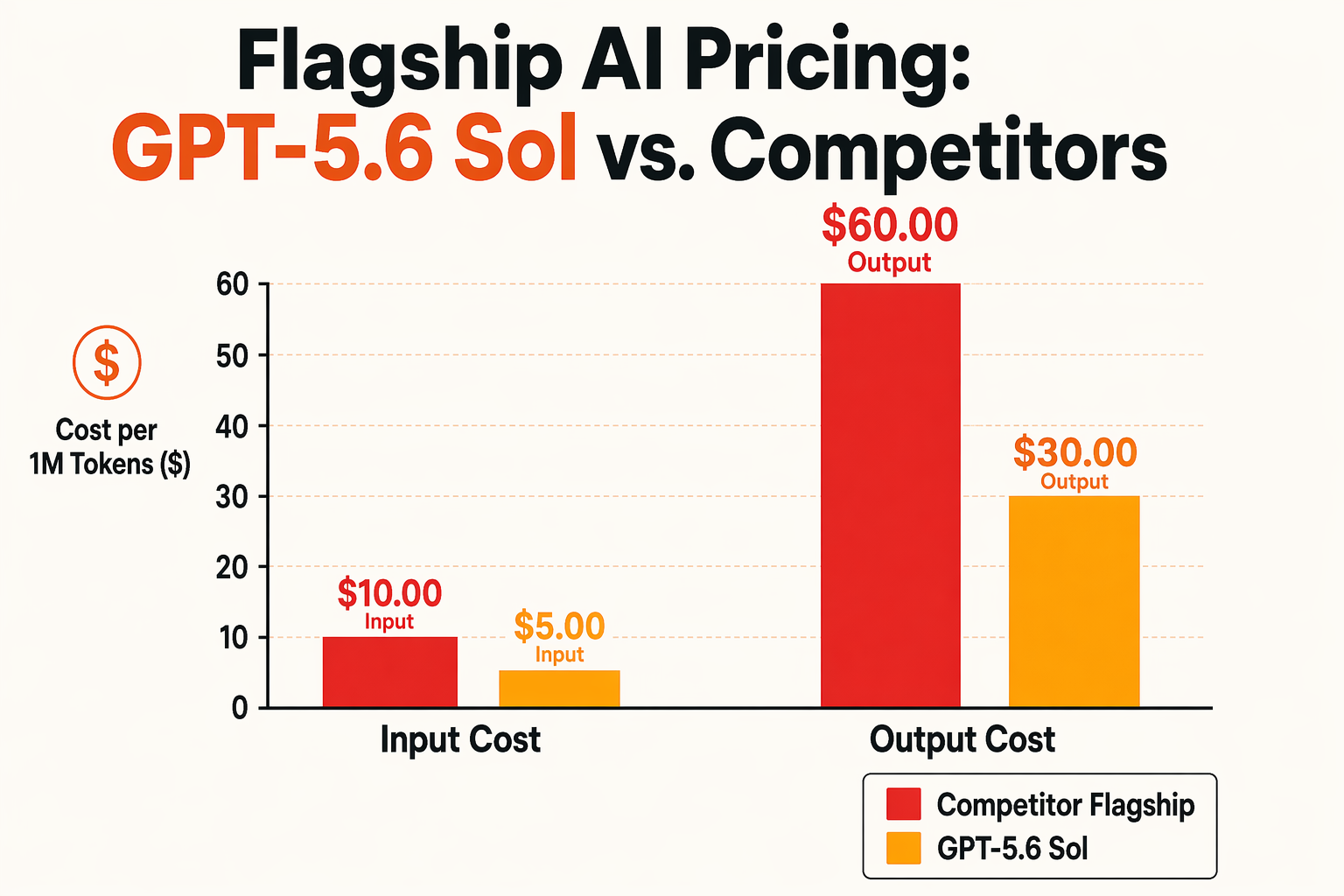
For enterprise leaders and developers, the arrival of the GPT-5.6 family represents a massive paradigm shift in how AI budgets are allocated. While the geopolitical spotlight remains firmly on the restricted, government-vetted Sol variant, the broader story for daily operations is one of radical cost reduction and architectural flexibility.
By separating their latest architecture into three distinct tiers—Sol, Terra, and Luna—OpenAI is forcing organizations to move away from the "one-size-fits-all" model approach. Instead, businesses can now match specific workloads to the exact level of reasoning required, drastically lowering their total cost of ownership (TCO). Thanks to predictable prompt caching and highly optimized execution pipelines across all three variants, developers can build deep, context-rich applications without fearing runaway API bills.
To help you decide where to allocate your engineering resources, the table below breaks down the key performance specs, cost profiles, and availability metrics for the GPT-5.6 family as of June 26, 2026:
| Model Variant | Core Strengths & Use Cases | Context Window | Relative API Pricing | Availability Status |
|---|---|---|---|---|
| GPT-5.6 Sol | Deep multi-step reasoning, advanced coding, R&D | 1.5 Million Tokens | High (but ~50% cheaper than rival flagships) | Restricted (Gov-approved preview only) |
| GPT-5.6 Terra | Balanced day-to-day enterprise tasks, agentic workflows | 1.5 Million Tokens | Medium (50% cheaper than legacy GPT-5.5) | Open Developer Preview |
| GPT-5.6 Luna | High-velocity, ultra-low latency tasks, quick classification | 1.5 Million Tokens | Ultra-Low (Fraction of previous model costs) | General Public API |
| Competitor Flagships | General advanced reasoning, multi-modal search | 200k - 1M Tokens | Premium Pricing | Public / Variable Gating |
Designing a Cost-Optimized AI Pipeline
To capitalize on these new tiers, businesses must transition to a hybrid routing architecture. For example, instead of running an entire customer support workflow through a premium model, a smart pipeline can utilize the low-latency Luna variant to handle initial user intent classification and simple queries. If a customer demands complex troubleshooting, the system can seamlessly escalate the session to Terra or Sol for deeper reasoning.
This model-routing approach is where modern communication infrastructure becomes invaluable. For businesses looking to implement these dynamic workflows, platforms like CallMissed offer production-ready infrastructure that supports over 300 LLMs. By utilizing CallMissed's unified gateway, developers can deploy highly responsive AI voice agents that leverage Luna for instantaneous, human-like verbal responses, while instantly switching to heavier models behind the scenes for complex backend tasks—all without rewriting core application code.
Ultimately, the release of GPT-5.6 proves that while frontier-grade AI power (Sol) may be heavily guarded, the operational cost of deploying highly capable, everyday AI (Terra and Luna) has never been lower. Securing a competitive edge in this new era requires moving fast, optimizing early, and choosing flexible infrastructure that can adapt as government regulations and model availability continue to evolve.
Frequently Asked Questions (FAQ)
What is OpenAI GPT-5.6 and how does it differ from previous models?
Who can access the GPT-5.6 Sol variant during the limited preview?
What are the key differences between the Sol, Terra, and Luna variants?
How does the 1.5M token context window and prompt caching work in GPT-5.6?
Why is the GPT-5.6 release subject to strict government coordination?
How can developers integrate GPT-5.6 while maintaining system redundancy?
Conclusion
As of July 9, 2026, the launch-day takeaway is that GPT-5.6 Sol Terra Luna is not a single-model upgrade—it is a tiered AI infrastructure release built around capability, cost, and access control. The practical summary:
- Launch-Day Status: GPT-5.6 Sol Terra Luna introduces three distinct options: Sol as the flagship maximum-reasoning model, Terra as the balanced production model, and Luna as the fast, lower-cost option for high-volume workloads.
- Pricing Tiers: Luna is positioned for budget-sensitive scale, Terra for everyday enterprise value, and Sol for premium use cases where deeper reasoning justifies higher cost and tighter review.
- Safety and Access Caveats: Sol remains the most restricted tier, with access expected to depend on approval, monitoring, and stronger safety controls. Terra and Luna are better suited for broader deployment, but businesses should still review data handling, compliance, and output-risk requirements before going live.
- Which Model to Use: Choose Sol for complex analysis, research, regulated decision support, and high-stakes reasoning; choose Terra for customer support, internal copilots, workflow automation, and multilingual business chat; choose Luna for fast chat, routing, summaries, voice-agent scripts, and large-scale low-latency tasks.
In short, GPT-5.6 Sol Terra Luna signals a future where the most powerful AI is increasingly segmented by risk and access level, while lower-cost models become easier to deploy across everyday business operations. For teams building AI voice agents, missed-call automation, or multilingual chatbot experiences, platforms like CallMissed can help connect the right model tier to real customer communication workflows.
The key question now is not just how powerful GPT-5.6 becomes, but who gets access to Sol—and whether Terra and Luna become the default engines of mainstream AI adoption.
Discussion
Related Posts



Ready to automate customer conversations?
Launch AI voice agents and WhatsApp bots with CallMissed — one API, 22+ Indian languages.