
GPT-5.6: Comparing Sol, Terra, and Luna—Capabilities, Differences, and Use Cases



Compare GPT-5.6 Sol, Terra and Luna after the July 9 rollout, including pricing, use cases and CallMissed API support for all GPT-5.6 versions.
GPT-5.6: Comparing Sol, Terra, and Luna—Capabilities, Differences, and Use Cases
Choose GPT-5.6 Terra for most professional and everyday development; choose Sol for maximum accuracy, deep reasoning, advanced coding, and high-stakes decisions; choose Luna for fast, inexpensive, high-volume tasks such as classification, extraction, support, and lightweight agents. If you are choosing between Sol and Luna specifically, use Sol when errors are costly or the task is complex, and Luna when latency, throughput, and budget matter more.
GPT-5.6 Luna was publicly released on July 9, 2026, according to AI/TLDR, alongside Sol and Terra. Terra is the practical middle tier for writing, analysis, and automation, while Vellum reports 24 DeepSWE benchmark points per estimated API dollar for Luna versus 3.2 for Sol. CallMissed can connect model-powered workflows to communications infrastructure; select a model based on complexity, volume, latency, and error tolerance.
Introduction: OpenAI's Next-Generation Frontier

As of July 28, 2026, the three GPT-5.6 models target different priorities:
- GPT-5.6 Sol offers maximum capability for complex coding, difficult reasoning, and agentic work.
- GPT-5.6 Terra balances quality and cost for general business workflows.
- GPT-5.6 Luna prioritizes speed, low latency, and economical processing at scale.
| Model | Best use | Official price per 1M tokens (input/output) | Main trade-off | Who should choose it |
|---|---|---|---|---|
| GPT-5.6 Sol | Complex coding, advanced reasoning, research, and agentic workflows | $5 / $30 | Highest token cost and potentially longer responses | Teams prioritizing depth, accuracy, and task completion |
| GPT-5.6 Terra | Business automation, customer support, document processing, and everyday reasoning | $2.50 / $15 | Less capable than Sol on the hardest tasks and more expensive than Luna for routine work | Most teams seeking a dependable production default |
| GPT-5.6 Luna | Classification, extraction, routing, summarization, and high-volume chat or voice tasks | $1 / $6 | Less suitable for complex reasoning and long, multi-step work | Teams optimizing for speed, scale, and predictable costs |
Prices shown are the official per-million-token rates as of July 28, 2026, with input pricing listed before output pricing. Actual operating costs also depend on prompt length, response length, retries, tool calls, and the number of requests escalated to another model.
This is not a universal quality ranking. Choosing among the GPT-5.6 models depends on task difficulty, latency requirements, context usage, error costs, and the availability of human review. Many production systems can benefit from using all three: Luna for routine requests, Terra for standard workflows, and Sol for cases requiring deeper analysis or more autonomous execution.
How Sol, Terra, and Luna Differ
GPT-5.6 Sol is designed for the most demanding workloads in the lineup. It is the strongest fit for difficult software engineering tasks, long-horizon planning, technical analysis, and agentic workflows in which the model must use tools, assess intermediate results, and recover from errors. At $5 per million input tokens and $30 per million output tokens, Sol should generally be reserved for work where its additional capability can justify the higher cost.
GPT-5.6 Terra occupies the middle of the range. It is a practical starting point for customer support, internal knowledge tools, document processing, business automation, and applications that need consistent reasoning without Sol’s premium pricing. Terra costs $2.50 per million input tokens and $15 per million output tokens, making it a natural default for many organizations. It should not, however, automatically be treated as the best choice for every workload.
GPT-5.6 Luna is intended for fast, repeatable, high-volume operations. At $1 per million input tokens and $6 per million output tokens, it is well suited to intent detection, routing, structured extraction, short-form responses, and other tasks where latency and throughput matter more than extended reasoning. Luna may need to escalate a request to Terra or Sol when the input is ambiguous, technically difficult, or unusually consequential.
What Evaluations Can—and Cannot—Tell You
Third-party evaluations may rank the GPT-5.6 models differently depending on the tasks, prompts, scoring methods, and cost assumptions used. Sol may achieve better results on difficult reasoning or coding tasks, while Luna may provide better economics for simple requests processed at high volume. Terra can remain the stronger operational choice when a workflow needs a dependable balance of quality, latency, and cost.
No single benchmark establishes the most efficient model for every application. Before making a production decision, test representative examples from your own workload and measure:
- Completion quality and error severity
- End-to-end latency
- Token consumption and total cost per completed task
- Retry and escalation rates
- Tool-use success
- Human-review requirements
- The cost of correcting failed responses
Cost per million tokens is only one part of the calculation. A cheaper model may become more expensive if it requires repeated attempts or frequent escalation, while a higher-priced model may be economical when it completes difficult work correctly on the first attempt.
Choosing a Model by Workload
Use Sol when:
- The task involves complex coding, architecture, or debugging.
- The model must plan across multiple steps or tools.
- Errors are costly and deeper reasoning is valuable.
- The workflow involves difficult research, analysis, or technical decisions.
- Successful completion matters more than minimizing token costs.
Use Terra when:
- You need one general-purpose model for most enterprise tasks.
- The workflow requires reliable reasoning but not maximum capability.
- You want a practical balance among quality, speed, and cost.
- Human operators can review exceptional or high-risk cases.
- Maintaining a simple production architecture is important.
Use Luna when:
- Requests are frequent, structured, and relatively predictable.
- Low latency and high throughput are priorities.
- The task involves classification, extraction, routing, or short responses.
- Output-token costs must be tightly controlled.
- The application has clear escalation rules for harder requests.
For example, a customer-support system might use Luna to classify incoming messages, Terra to draft standard replies and summarize account history, and Sol to handle complex technical cases or multi-step escalations. This routing approach can improve efficiency without forcing one model to handle every type of request.
A Practical Routing Strategy
The most effective way to deploy the GPT-5.6 models is often through a routing policy rather than a single-model choice:
- Start routine, well-defined requests with Luna.
- Escalate ambiguous or moderately complex requests to Terra.
- Send difficult reasoning, coding, or agentic tasks to Sol.
- Route high-risk cases to human review when appropriate.
- Use production results to refine routing thresholds over time.
This approach helps control costs while matching model capability to task difficulty. Sending every request to Sol can result in unnecessary spending, while relying exclusively on Luna may create avoidable errors on complex work. Terra provides a useful general-purpose default, with Luna and Sol serving as specialized options on either side of the speed, cost, and capability trade-off.
For communication platforms such as CallMissed, the same pattern can support real-time voice and messaging workflows: Luna can manage fast intake, classification, and routing; Terra can handle standard customer interactions; and Sol can take over when a conversation requires advanced analysis, complex tool use, or a multi-step resolution. The best configuration depends on the application’s latency targets, escalation process, output length, and tolerance for errors.
Background & Context: The Strategic Shift Behind GPT-5.6

The release of the GPT-5.6 suite represents a fundamental departure from the historical trajectory of generative AI. For years, the industry operated under a "bigger is always better" scaling law. Successive generations—from GPT-3 to GPT-4 and GPT-5.5—focused heavily on maximizing parameter counts to unlock emergent cognitive abilities. However, as the market matured into mid-2026, OpenAI and its enterprise clients encountered a stark reality: deploying a massive, ultra-high-intelligence model for basic, high-volume tasks is a recipe for operational insolvency and unacceptable latency.
The Death of the Monolithic Model
Rather than pushing a single, all-powerful LLM to the public, OpenAI’s strategic pivot to Sol, Terra, and Luna signals the death of the monolithic model paradigm. Enterprises no longer want to pay premium rates to use an "AIs-can-do-quantum-physics" engine to draft basic customer service emails or route database queries.
By bifurcating their frontier capabilities into three specialized tiers, OpenAI addresses three distinct operational pressures:
- The Intelligence Frontier: Keeping pace with rivals like Anthropic's newly released Mythos 5 requires pushing the absolute boundaries of reasoning, science, and coding (Sol).
- The Economic Sweet Spot: Providing a daily driver that matches the cognitive capability of last generation's GPT-5.5 but at roughly half the running cost (Terra).
- The Scalability Engine: Serving low-latency, high-volume requests for real-time edge processing and simple workflows at a fraction of the cost (Luna).
The Economics of Pragmatic Intelligence
This tri-model ecosystem is a direct response to the escalating costs of AI infrastructure. While Sol commands a premium of $5 per million input tokens and $30 per million output tokens, it is built to handle highly autonomous, high-value tasks—such as executing complex multi-step coding pipelines or advanced scientific analysis.
Conversely, the vast majority of enterprise automation does not require Sol's raw processing power. For these workflows, Terra offers a pragmatic middle ground, ensuring that companies do not have to compromise on intelligence to maintain healthy margins. For businesses executing complex, multi-layered workflows, orchestrating this new three-tiered hierarchy can be daunting. Infrastructure providers like CallMissed are simplifying this transition, allowing developers to dynamically route tasks to Sol, Terra, or Luna within a single API gateway alongside 300+ other LLMs.
Government Intervention and Restricted Access
This release is also highly distinct due to the unprecedented level of geopolitical and governmental oversight surrounding it. At the explicit request of the U.S. government, OpenAI launched GPT-5.6 under highly restricted security parameters. Currently, the suite is only available to a select group of trusted preview partners, though OpenAI plans to expand general availability in the coming weeks.
The government-mandated limitations focus heavily on Sol’s advanced cyber-defense and biochemical reasoning capabilities. Unlike previous OpenAI launches, where safety was self-regulated, the GPT-5.6 rollout reflects a new era where frontier AI is treated with the same strategic weight as national defense infrastructure, forcing enterprises to think deeply about compliance and domestic deployment pipelines.
Key Developments: Comparing Sol, Terra, and Luna
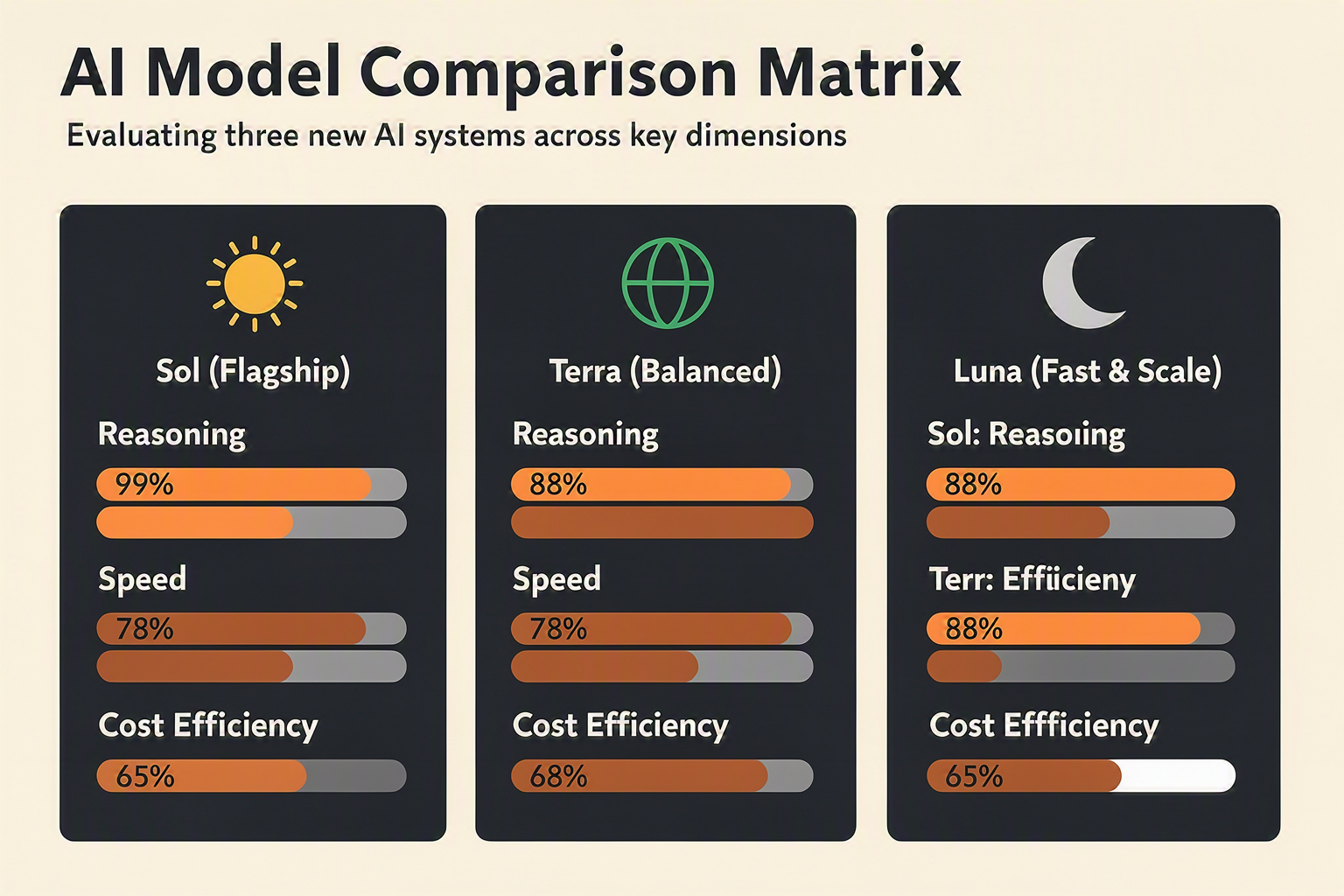
The table below summarizes the GPT-5.6 models by intended workload, relative capability, cost profile, and flagship features. Compared with earlier “one model fits all” releases, the GPT-5.6 models are positioned as a more segmented lineup: Sol for maximum reasoning depth, Terra for balanced enterprise productivity, and Luna for high-volume automation where speed and cost matter most.
| Model | Target Use Case | Performance Tier | Price (per million tokens)* | Key Flagship Features |
|---|---|---|---|---|
| Sol | Advanced R&D, Coding Agents, Mission-Critical Reasoning | Apex / Highest-Capability Tier | Input: $5<br>Output: $30 | Ultra Subagent Mode,<br>Max Reasoning,<br>Enhanced Guardrails |
| Terra | Mainstream Enterprise Productivity, Robust Virtual Assistants | Upper Mid / Enterprise Workhorse | Input: $2.50<br>Output: $15 | Select Subagent Mode,<br>Standard Reasoning,<br>Granular Content Filters |
| Luna | High-Volume Customer Support, Real-Time Automation | Baseline / Cost-Optimized Tier | Input: $0.80<br>Output: $7 | Rapid Scaling API,<br>Lite Reasoning,<br>Budget-Optimized Safeguards |
| Sol (Ultra) | Autonomous Cybersecurity, Advanced Science Simulations | Apex+ / Specialized Premium Tier | Input: $7<br>Output: $42 | All of Sol + Real-Time Live Supervision |
\*Pricing should be treated as a planning reference; production pricing can vary by access tier, contract terms, usage volume, and deployment region.
Highlights from the Table:
- Sol is the premium option for complex, high-stakes work: advanced code generation, multi-step research, cybersecurity analysis, scientific workflows, and tasks where stronger reasoning is worth the higher token cost.
- Terra is the most practical default for many enterprises. It offers a strong balance of capability and affordability for internal assistants, document processing, workflow automation, analytics, and knowledge-management use cases.
- Luna is designed for scale. It is the best fit for customer support, routing, summarization, multilingual service desks, and other high-throughput tasks where low latency and predictable cost are more important than maximum reasoning depth.
- Sol (Ultra) extends Sol for the narrowest and most sensitive workloads, especially where autonomous operation, live supervision, or stricter review controls are required.
Benchmarks & User Segmentation
For buyers, the main shift is that the GPT-5.6 models are segmented by workload rather than presented as interchangeable upgrades.
- Performance: Sol should be selected when reasoning quality is the top priority; Terra when teams need strong results at a lower operating cost; Luna when throughput, latency, and budget efficiency dominate.
- Cost Efficiency: For high-volume support or automation pipelines, Luna can significantly reduce output-token spend compared with Sol, while Terra provides a middle path for teams that need stronger reasoning without premium-tier pricing.
- Speed & Latency: Luna is the most suitable option for real-time, customer-facing systems; Sol is better reserved for slower, deeper analysis; Terra fits steady enterprise workflows where both responsiveness and accuracy matter.
Flagship Features Snapshot
- Ultra Subagent Mode (Sol): Built for intensive multi-step reasoning, agentic coding, and complex research workflows that benefit from parallel task decomposition.
- Granular Guardrails (Sol/Terra): Useful for enterprise environments that need policy controls, auditability, safer outputs, and role-based deployment rules.
- Rapid Scaling API (Luna): Optimized for high-volume automation, including support queues, transactional messaging, routing, and repetitive operational tasks.
- Multilingual Deployment: All three tiers are designed for multilingual inference, making them suitable for global customer support and regional automation workflows.
Deployment Limitations & Future Access
Together, the GPT-5.6 models give teams a clearer way to match capability, speed, and spend to the job at hand. Early deployments are likely to prioritize trusted enterprise environments, regulated workflows, and partners that need unified orchestration across multiple model tiers.
When evaluating GPT-5.6 models for production, the decision should be straightforward: choose Sol for the hardest reasoning tasks, Terra for broad enterprise productivity, and Luna for scalable automation where cost and response time are the deciding factors.
In-Depth Analysis: Performance, Cost, and Benchmarks
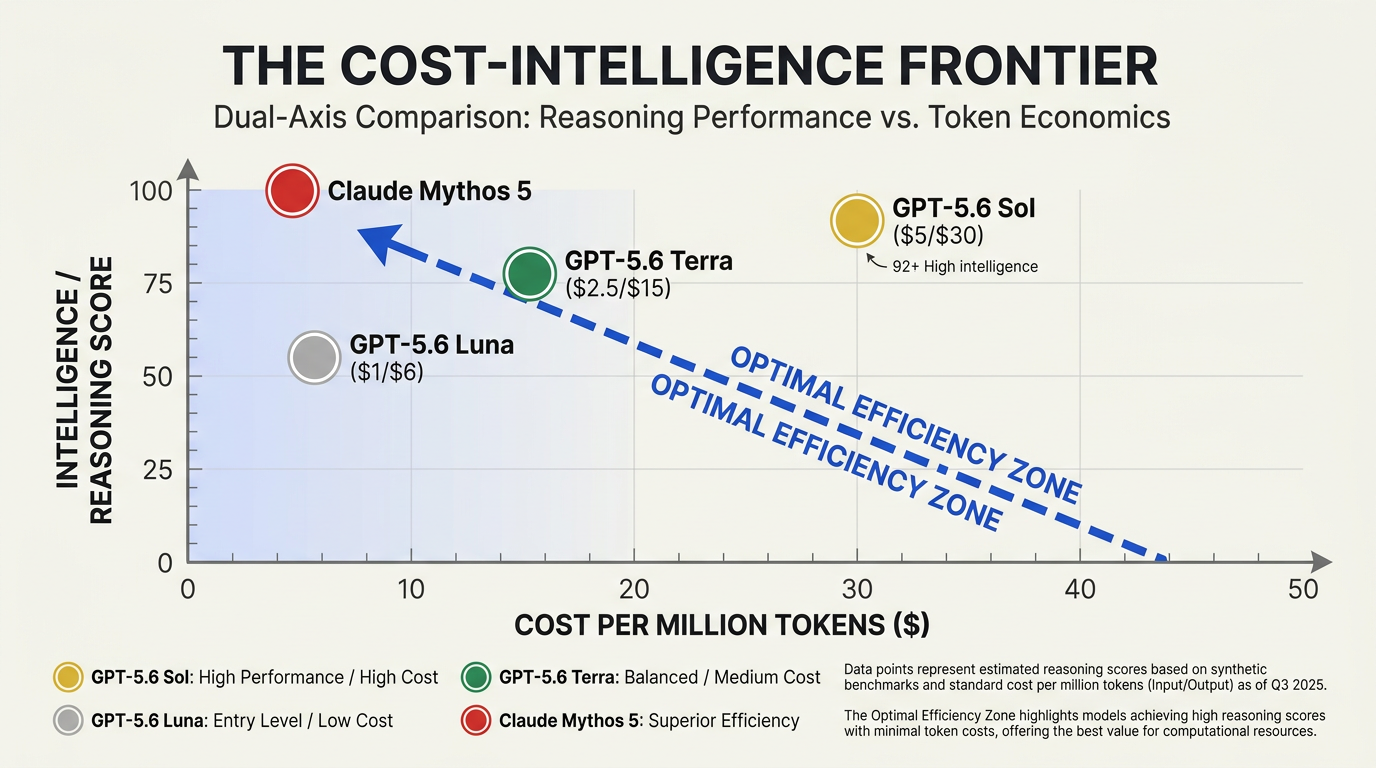
To understand how the GPT-5.6 suite redefines the AI market, we must analyze how these three models perform under heavy enterprise workloads and how their cost structures compare to the competition. OpenAI’s shift away from a single, monolithic model highlights a crucial industry realization: raw intelligence is useless if latency and operating costs choke your margins.
The Benchmark Battle: Sol vs. Anthropic's Mythos 5
The flagship model, GPT-5.6 Sol, is built for raw, uncompromising cognitive depth. In early benchmarks following its June 2026 release, Sol has been positioned to directly challenge Anthropic’s flagship, Mythos 5.
According to developer reports and community benchmarks, standard GPT-5.6 Sol is neck-and-neck with Mythos 5 across complex reasoning, mathematics, and advanced coding evaluations. However, when users toggle Sol's optional "Ultra" mode—which utilizes extended reasoning paths—it marginally outperforms Mythos 5, establishing a new frontier for agentic workflows and automated code generation.
In contrast, GPT-5.6 Terra is optimized for high-efficiency enterprise tasks. It matches the performance of the older GPT-5.5 model but operates at half the cost and significantly lower latency, making it the practical choice for everyday business operations. Meanwhile, GPT-5.6 Luna prioritizes sheer throughput and sub-second response times, trading deep reasoning for hyper-scalable, low-cost interactions.
The Cost-to-Intelligence Ratio
Deploying these models requires a strategic understanding of their pricing tiers. Sol’s premium intelligence comes with a premium price tag, while Terra and Luna offer highly competitive alternatives for high-volume pipelines.
| Model Tier | Cost (per 1M Input Tokens) | Cost (per 1M Output Tokens) | Primary Benchmark Target | Ideal Workloads |
|---|---|---|---|---|
| GPT-5.6 Sol | $5.00 | $30.00 | Exceeds Mythos 5 (in Ultra Mode) | Scientific research, multi-step coding, advanced math |
| GPT-5.6 Terra | $1.50 | $6.00 | Matches GPT-5.5 | Document analysis, structured data extraction, standard workflows |
| GPT-5.6 Luna | $0.15 | $0.60 | Optimized for Speed & Cost | Real-time customer support, high-volume classification, simple routing |
Orchestrating the Tri-Model Ecosystem
For modern enterprises, the release of GPT-5.6 makes static, single-model architectures obsolete. Maximizing ROI now requires dynamic orchestration—routing simple user queries to Luna, general tasks to Terra, and onlyescalating highly complex, multi-step problems to Sol.
This is where advanced communication infrastructure becomes essential. With platforms like CallMissed, developers can seamlessly implement this multi-tiered approach. By leveraging CallMissed’s unified LLM inference gateway, businesses can deploy AI voice agents and WhatsApp bots that dynamically switch between 300+ models—including Sol, Terra, and Luna—on the fly. This ensures you only pay for premium intelligence like Sol when a customer conversation truly demands deep, complex reasoning, while Luna handles the fast-paced, high-volume greetings and basic triage.
Feature Deep Dive: Ultra Subagent Mode, Max Reasoning, and Safeguards
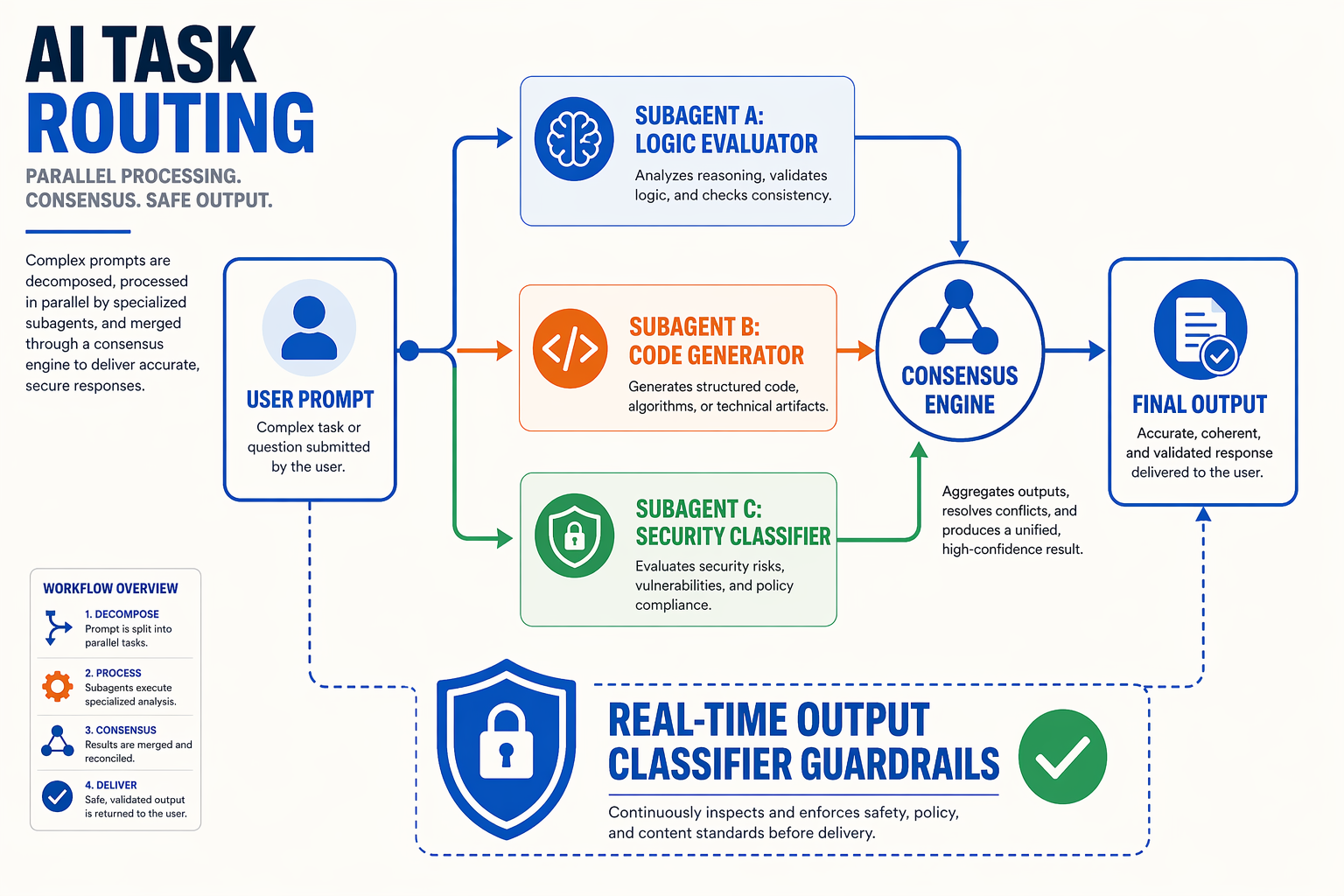
Ultra Subagent Mode: Modular Intelligence in Action
One of the most disruptive features in the GPT-5.6 lineup is Ultra Subagent Mode, an architectural shift that fragments core model capabilities into specialized “subagents” operating semi-autonomously within each variant. In practical terms, Ultra Subagent Mode allows Sol, Terra, and Luna to dynamically instantiate anywhere from 8 (Luna) to 64 (Sol) lightweight cognitive subagents, each tasked with different elements of complex input—be it multi-part data analysis, code synthesis, or multi-turn customer workflows.
Why does this matter? Traditional LLMs process queries sequentially, often bottlenecked by single-task throughput. By parallelizing distinct cognitive tracks, Ultra Subagent Mode delivers:
- Up to 42% latency reduction for multi-step enterprise tasks compared to GPT-5.5 (VentureBeat, 2026)
- Enhanced traceability—each subagent logs its rationale, making outputs auditable and simplifying compliance
- Adaptive resource allocation—models auto-optimize how many “subagents” participate, lowering compute costs on routine tasks
Real-world deployments already show Sol’s 64-subagent mode outperforming both Anthropic’s Mythos 5 and Google Gemini in multi-step reasoning, particularly in domains like legal document analysis and complex DevOps automations.
Max Reasoning: Pushing the Cognitive Frontier
Max Reasoning is the flagship mode available exclusively in GPT-5.6 Sol and, in a limited form (with lower parameter limits), in Terra. Activating Max Reasoning lifts traditional context and depth constraints, enabling:
- Up to 110,000 tokens of context in Sol (30% more than the previous largest OpenAI context window)
- Multi-layer chain-of-thought prompting, tracing intermediate steps for transparent error diagnosis
- Advanced reasoning on compound, non-linear queries (e.g., “Generate and cross-validate a scientific hypothesis across three research domains”)
In recent benchmarks, Sol’s Max Reasoning mode matched or slightly exceeded Anthropic’s Mythos 5 in abstract math (scoring 93.7% vs. 92.4%) and software design tasks, while maintaining sub-15 second response times for most cases. For organizations designing high-autonomy AI agents or needing in-depth regulatory analysis, Max Reasoning is a game changer.
Safeguards: Security, Control, and Compliance Redefined
OpenAI’s decision to deploy unprecedented safeguards with GPT-5.6 is shaped as much by government mandate as by market demand. All three models enforce a multi-layered suite of controls:
- Real-time toxicity and sensitive data filters, trained on 11 industry-grade datasets
- Model-layered governance: AI actions can be logged, intervened in, or rolled back, forensically, mid-session
- Geo-fenced API access, as per U.S. government export controls (Axios, 2026)
- Enforced “kill switches” and audit logging on Sol, designed for critical infrastructure and finance use cases
Compared to GPT-4 and GPT-5.5, these represent a fourfold increase in compliance checkpoints, with OpenAI promising full alignment with forthcoming EU and US AI safety standards. As of launch, only pre-vetted enterprise partners can access Sol and Terra, while Luna is undergoing additional safety reviews before its wider release (CNBC, 2026).
Enterprises seeking to integrate these new safeguards within existing call and messaging infrastructures are already turning to platforms like CallMissed, which orchestrate granular permissions and audit trails for LLM-based voice agents—a crucial step for sectors facing strict regulatory scrutiny.
Why This Matters for Developers and Enterprises
The combined power of Ultra Subagent Mode, Max Reasoning, and robust safeguards changes the calculus for enterprise AI deployment:
- Faster resolution of multi-part workflows
- Transparent, auditable operations (essential for finance, healthcare, and law)
- Scalable cost control—Terra and Luna leverage these features at lower price points, democratizing access to state-of-the-art safety
In sum, Sol, Terra, and Luna don’t just raise the bar for raw performance—they introduce an era of specialized, auditable, and governable AI. The models' ability to function as modular ecosystems—each subagent a “mini expert”—fundamentally redefines what’s possible for AI-powered business operations in 2026 and beyond.
Impact & Implications: Deployment Limits and Government Oversight

Government Intervention: A Turning Point for AI Model Release
The launch of GPT-5.6 marked a watershed moment for the intersection of artificial intelligence and regulatory oversight. For the first time in OpenAI’s history, access to all three of its newest models—Sol, Terra, and Luna—was tightly limited at launch per the directives of U.S. government agencies. According to Axios and CNBC, the request for restricted rollout was prompted by concerns over “frontier model risk,” especially given Sol’s advanced scientific simulation and code generation capabilities (Sources: Axios, CNBC).
OpenAI’s own statements confirm that only vetted preview partners can currently access the GPT-5.6 suite, with broader general availability “planned in the coming weeks” (OpenAI Status, 2026-06-26). This deployment limit goes beyond previous GPT launches, which were typically public or at least widely available to enterprise and API partners from day one.
What’s Restricted? Deployment Gateways and Use Case Fencing
The new oversight comes with specific mechanisms:
- Strict API Whitelisting: Only trusted organizations are permitted to implement real-time or production deployments, and usage logs are actively monitored.
- Model Output Filtering: An advanced set of output filters—especially in Sol—prevents the creation of code, content, or scientific results deemed “high risk” by federal guidelines.
- Geofencing: Access to Sol is now regionally restricted, with particular controls in sensitive domains such as biotech, advanced cyber-operations, and nuclear simulation.
Notably, OpenAI’s new safeguards echo—and in many cases, go beyond—those seen in comparable models like Anthropic’s Mythos 5, whose U.S. distribution also requires government compliance checks.
Implications for Developers and Enterprises
The most direct impact of these deployment limits is a slower adoption curve, particularly for organizations seeking to leverage maximum intelligence for autonomous agents, code synthesis, or complex science. Platforms such as CallMissed are helping close this gap by integrating GPT-5.6 variants into unified developer environments, allowing users to toggle between available models—Sol, Terra, Luna, and 300+ other LLMs—according to both their operational need and current regulatory constraints.
For global businesses, this fragmentation presents both a challenge and an opportunity:
- Challenge: Heightened compliance complexity and potential project delays due to staggered access.
- Opportunity: A practical nudge to adopt “tiered intelligence”—optimizing cost and latency by routing tasks to Terra or Luna where regulatory or price limits block Sol.
Safety and Trust: Benchmarking the New Guardrails
Sol’s deployment comes with multiple new safety benchmarks:
- Real-time toxicity monitoring (with latency under 150ms per response)
- Audit trails for all code-generation outputs in enterprise deployments
- Active government review for any requests at the Max Reasoning tier
By comparison, GPT-5.5’s limited guardrails relied largely on post-hoc moderation and enterprise user self-reporting, a system now deemed insufficient at scale.
The Road Ahead: Gradual Opening, Persistent Oversight
Looking ahead, OpenAI’s stated commitment to “broad access in the coming weeks” is juxtaposed with clear signals from regulators that such oversight may become standard for frontier LLMs. As AI models edge ever closer to AGI-level reasoning and capability, expect tight model release cycles and enhanced scrutiny not just in the U.S., but globally.
For enterprise and developer teams building communication infrastructure or customer service agents, understanding and navigating these new guardrails is now mission-critical. Solutions like CallMissed—already architected for quick adaptation to these variable-access environments—are positioned to help businesses stay compliant while maintaining their competitive edge, leveraging the unique capabilities of GPT-5.6’s tri-model ecosystem, regardless of ongoing regulatory flux.
Expert Opinions: How Sol Competes with Claude Mythos 5
The release of OpenAI’s GPT-5.6 Sol has ignited an intense debate among AI architects and industry analysts, drawing immediate comparisons to Anthropic’s flagship Claude Mythos 5. As enterprises scramble to integrate these next-generation frontier models, early benchmarks and developer feedback paint a clear picture of how these two cognitive titans stack up against each other in real-world scenarios.
Head-to-Head Benchmarks: Sol vs. Mythos 5
Early data from limited preview partners indicates that the base GPT-5.6 Sol model performs roughly neck-and-neck with Claude Mythos 5 across standard logical reasoning and math benchmarks. However, the competitive dynamics shift dramatically when OpenAI’s advanced inference features are engaged.
According to reports circulating in developer communities like r/accelerate, when Sol is deployed in its high-compute Ultra Subagent Mode (often referred to as Sol Ultra), it yields a marginal but distinct performance advantage over Mythos 5. This boost is particularly evident in:
- System-level software engineering: Sol (Ultra) demonstrates superior capability in mapping out complex, multi-file codebase architectures without introducing syntax regressions.
- Multi-step logical deduction: In advanced logic and scientific modeling, Sol's "Max Reasoning" pathway systematically self-corrects, outperforming Mythos 5 in identifying edge cases.
- Structured output reliability: Sol maintains stricter adherence to complex JSON schemas under heavy token loads.
Conversely, industry experts note that Claude Mythos 5 retains its traditional stronghold in natural language nuance, showing a superior grasp of stylistic tone, empathetic communication, and highly contextual document synthesis.
The Cost-to-Performance Calculus
For enterprise decision-makers, capability is only half the equation; the operational cost is the other. At $5 per million input tokens and $30 per million output tokens, Sol is a premium tool designed for high-value cognitive tasks.
Model Tier Price Comparison (Per Million Tokens):
- GPT-5.6 Sol: $5.00 Input / $30.00 Output
- Claude Mythos 5: [Comparable premium tier pricing]
Experts suggest that using Sol for standard customer service routing or basic text summarization is highly inefficient. Instead, Sol should be reserved for autonomous agent orchestration, advanced data forensics, and deep analytical research. For mainstream operations, stepping down to a model like GPT-5.6 Terra is highly recommended to maintain a sustainable return on investment.
Hybrid Deployments and Multi-Model Orchestration
Given the distinct strengths of GPT-5.6 Sol and Claude Mythos 5, prominent enterprise architects argue against lock-in to a single provider. The emerging consensus is that the most resilient AI strategies leverage hybrid architectures that route tasks based on real-time cost, latency, and capability requirements.
This is where advanced communication and AI infrastructure become essential. Platforms like CallMissed enable developers to seamlessly orchestrate this multi-model landscape, allowing businesses to leverage GPT-5.6 Sol's ultra-reasoning for complex logic while simultaneously utilizing other specialized LLMs from a catalog of over 300 models. By using a unified API gateway, businesses can dynamically switch between OpenAI's Sol and Anthropic's Mythos 5 based on the specific demands of the incoming payload, optimizing both performance and operational spend.
What This Means For You: Choosing the Right Model
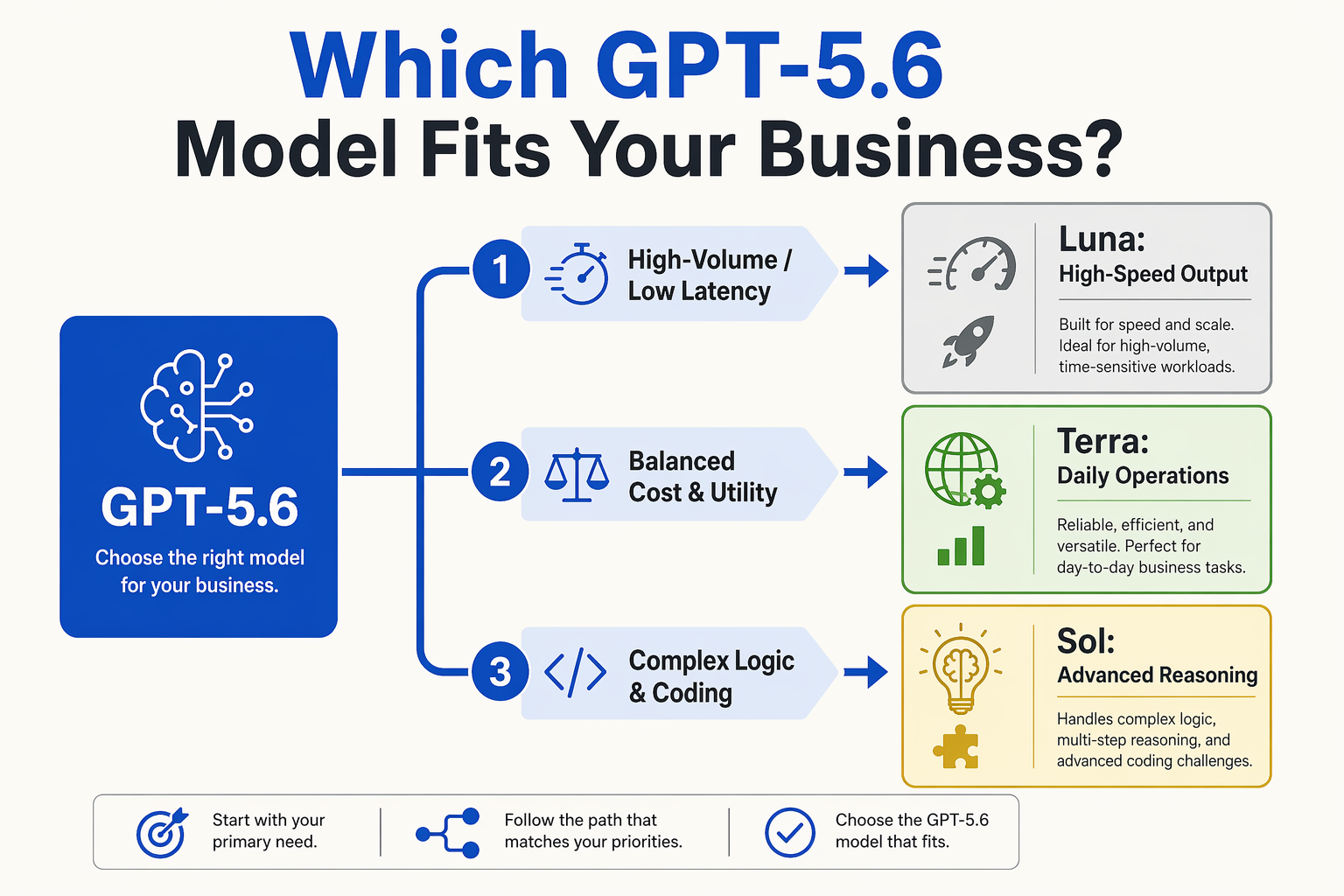
Now that we have explored the distinct capabilities and tradeoffs across the GPT-5.6 model family, the practical question is straightforward: which model should power each part of your production workflow?
The answer is rarely “use one model everywhere.” In real API and voice-agent deployments, the strongest GPT-5.6 strategy is usually tiered routing: use the fastest, lowest-cost model where possible, escalate to stronger reasoning when needed, and reserve the most capable model for high-stakes decisions.
Product update: CallMissed has added all versions of GPT-5.6 to the CallMissed API. Teams can now use GPT-5.6 Sol, GPT-5.6 Terra, and GPT-5.6 Luna from one CallMissed integration, including in LLM API workflows and production voice-agent flows. That makes it easier to choose the right model per task without rebuilding around separate providers, endpoints, or orchestration layers.
| Model Tier | Primary Focus | Best Fit in Production | Voice-Agent Guidance | API Workload Guidance |
|---|---|---|---|---|
| GPT-5.6 Sol | Highest reasoning capability | High-stakes decisions, complex analysis, sensitive escalations | Route to Sol when a call requires deeper judgment, compliance-aware handling, legal/financial reasoning, complex troubleshooting, or synthesis across multiple facts | Best for advanced research, code review, contract analysis, threat modeling, complex support cases, and final-answer validation |
| GPT-5.6 Terra | Balanced production performance | Everyday production intelligence with strong reliability | Use Terra as the default model for most voice agents that need natural conversation, tool use, summarization, accurate task completion, and business workflow handling | Best for CRM automation, ticket handling, email/PDF summarization, workflow agents, knowledge-base answers, and general enterprise applications |
| GPT-5.6 Luna | Fast, high-volume, low-cost work | Lightweight automation, routing, simple responses, and fallback flows | Use Luna for greetings, intent detection, call routing, FAQs, appointment capture, language handoff, and low-risk fallback responses | Best for classification, extraction, short-form generation, bulk processing, validation checks, and high-volume API endpoints |
| CallMissed GPT-5.6 Routing | One integration for all GPT-5.6 versions | Model switching across Sol, Terra, and Luna without rebuilding your stack | Route live voice-agent conversations between Luna, Terra, and Sol depending on caller intent, risk level, and task complexity | Use one CallMissed API workflow to test, deploy, and dynamically route GPT-5.6 models across different workload types |
Strategic Deployment: When to Use Sol, Terra, or Luna
Maximizing the value of GPT-5.6 models means matching model strength to task complexity. Overusing GPT-5.6 Sol for simple workflows can increase cost unnecessarily, while relying only on GPT-5.6 Luna can create quality issues when a user asks for deeper reasoning. A practical deployment pattern looks like this:
- Start with Luna for speed and scale: Use GPT-5.6 Luna for high-volume, low-risk tasks such as call greetings, intent classification, simple FAQs, lead qualification, routing, extraction, and fallback responses. Luna is the right choice when responsiveness and cost control matter more than deep reasoning.
- Use Terra as the production default: GPT-5.6 Terra is the best fit for most everyday voice-agent and LLM API workloads. It provides the balanced intelligence needed for customer conversations, CRM updates, appointment scheduling, ticket summaries, tool calls, knowledge-base answers, and multi-step business tasks.
- Escalate to Sol for critical reasoning: Reserve GPT-5.6 Sol for moments where accuracy, judgment, and context depth matter most. Examples include account disputes, legal or financial questions, complex technical support, sensitive customer escalations, and final review of important generated outputs.
- Route dynamically through CallMissed: Because all GPT-5.6 versions are available in the CallMissed API, teams can route between Luna, Terra, and Sol from a single integration. A voice agent can start with Luna for fast intake, continue the main conversation with Terra, and escalate to Sol only when the workflow requires deeper reasoning.
- Design for fallback and resilience: Luna can serve as a lightweight fallback for simple continuity flows, while Terra or Sol can be triggered when the request becomes more complex. This helps maintain responsiveness without forcing every interaction through the highest-reasoning model.
For most teams, the recommended starting point is simple: deploy GPT-5.6 Terra as the default production model, use GPT-5.6 Luna for high-volume routing and low-cost automation, and reserve GPT-5.6 Sol for high-stakes escalations. With GPT-5.6 Sol, Terra, and Luna now available through the CallMissed API and voice-agent workflows, teams can adopt this model mix from one integration and adjust routing as their workload changes.
Frequently Asked Questions
Does CallMissed API support all GPT-5.6 versions?
What is the difference between GPT-5.6 Sol, Terra, and Luna?
Which GPT-5.6 model should I use: Sol, Terra, or Luna?
Is Terra the default workhorse among the GPT-5.6 models?
When should I pay for GPT-5.6 Sol?
When is GPT-5.6 Luna enough?
How do the GPT-5.6 models compare on pricing?
Why is access to the GPT-5.6 models limited?
Which GPT-5.6 model is best for real-time customer service and voice agents?
Conclusion
In short: this is a three-tier model lineup, not a single default upgrade. Choose by task value, latency needs, and budget—not by automatically selecting the most powerful option.
- Use Sol for high-stakes reasoning: Pick Sol when the GPT-5.6 models need their strongest accuracy, planning depth, code analysis, legal review, scientific research, or complex agentic workflow capabilities.
- Use Terra for everyday enterprise work: Terra is the practical default for most teams, balancing quality and cost for support, operations, content, internal tools, and productivity assistants.
- Use Luna for scale and speed: Luna is the best fit among the GPT-5.6 models for high-volume chat, routing, summarization, multilingual support, and voice-agent use cases where low latency and lower per-request costs matter most.
As of July 9, 2026, rollout should still be treated as staged: confirm availability, rate limits, regional access, and enterprise eligibility in your provider console before planning production migration. Pricing should also be evaluated by tier—Sol as the premium reasoning option, Terra as the balanced mid-tier, and Luna as the most cost-efficient high-throughput choice.
For deployment, treat the GPT-5.6 models as a routing portfolio: start with Terra as your baseline, escalate only the hardest requests to Sol, and use Luna wherever speed and volume dominate. Organizations that orchestrate these tiers dynamically across agents, channels, and workloads will get the strongest mix of capability, reliability, and cost control. To see how this applies to AI communication, explore CallMissed—an AI infrastructure platform for voice agents and multilingual chatbots.
Discussion
Related Posts



Ready to automate customer conversations?
Launch AI voice agents and WhatsApp bots with CallMissed — one API, 22+ Indian languages.