
Anticipating Claude 5 Sonnet: What to Expect from Anthropic’s Next-Gen Mid-Tier Powerhouse



Explore leaked specs, cost savings, and agentic workflows of the highly anticipated Claude 5 Sonnet (Fennec) as Anthropic prepares its next-gen AI.
Anticipating Claude 5 Sonnet: What to Expect from Anthropic’s Next-Gen Mid-Tier Powerhouse
Did you know that Anthropic’s mid-tier "Sonnet" models have historically outperformed their own ultra-premium "Opus" predecessors while costing a fraction of the price? This paradigm shift proved that raw parameter size is no longer the sole metric of AI supremacy. Now, in mid-2026, the tech industry is buzzing with anticipation following leaked Google Vertex AI logs that revealed a highly anticipated, unreleased model codenamed "Fennec." As developers and enterprises scramble to prepare for what lies ahead, Anticipating Claude 5 Sonnet has shifted from mere speculation to a strategic necessity for forward-thinking tech leaders.
Why does this mid-tier upgrade matter so much right now? The current AI landscape demands more than just flashy benchmarks; it requires cost-efficient, highly reliable, and agentic systems that can operate at scale. Industry analysts suggest that Sonnet 5 is being engineered to potentially halve inference costs while radically boosting execution speed and practical reasoning. This means enterprises will no longer have to compromise between deep analytical thinking and cost-effective, real-time performance. For organizations deploying high-volume, real-time customer touchpoints, platforms like CallMissed are already paving the way by offering multi-model API gateways that allow developers to seamlessly transition to these next-gen models without rewriting code.
But what will Claude 5 Sonnet actually look like under the hood, and how will it handle complex, multi-step agentic workflows? In this deep dive, we will unpack the technical implications of the "Fennec" leaks, analyze how Anthropic plans to balance speed and cost-efficiency, and discuss what these architectural leaps mean for the future of enterprise automation. Whether you are an AI engineer or a business leader looking to optimize your tech stack, here is everything you need to know about Anthropic’s next-gen powerhouse.
Introduction

Did you know that Anthropic’s mid-tier "Sonnet" models have historically outperformed their own ultra-premium "Opus" predecessors while costing a fraction of the price? When Claude 3.5 Sonnet first launched, it shattered the industry belief that raw parameter size is the sole metric of AI supremacy, outperforming competitors and Claude 3 Opus across a wide range of evaluations. Now, in mid-2026, the tech industry is buzzing with anticipation following leaked Google Vertex AI logs that revealed a highly anticipated, unreleased model codenamed "Fennec." For forward-thinking tech leaders, anticipating Claude 5 Sonnet has shifted from mere speculation to a strategic necessity.
The "Fennec" Leak and the Shift in AI Metrics
The discovery of the "Fennec" codename in cloud logs sparked intense debate across developer communities. While Anthropic has historically favored incremental point releases—such as the groundbreaking Claude 3.7 Sonnet which introduced hybrid reasoning capabilities—analysts suggest that Claude 5 Sonnet is being engineered as a generational leap. Instead of chasing flashy, resource-heavy demonstrations, the focus for this next-gen powerhouse is squarely on:
- Radical Cost Efficiency: Industry insiders report that Sonnet 5 is designed to potentially halve inference costs, making enterprise-grade AI sustainable for high-volume operations.
- Accelerated Speed: Deep optimizations in token throughput to support seamless, real-time user experiences.
- Practical Agentic Workflows: Advanced tool-use capabilities and reliable state tracking, allowing the model to execute complex, multi-step tasks autonomously.
- Behavioral Alignment: Building on technical goals seen in recent iterations to significantly reduce sycophancy, deception, and delusional responses.
Why the Mid-Tier Powerhouse Governs the Enterprise
For modern businesses, the appeal of a "Sonnet" class model lies in its optimal balance. It delivers near-frontier intelligence at a price point that makes high-volume production viable. In an era where enterprises must deploy autonomous agents for customer support, real-time data analysis, and software development, the cost of running LLMs remains a primary operational bottleneck. If Claude 5 Sonnet successfully delivers a massive performance boost while cutting costs in half, it will represent one of the most disruptive shifts in market economics.
To prepare for this shift, agile development teams are leveraging unified infrastructure. Platforms like CallMissed are already helping businesses navigate this transition by offering robust multi-model API gateways with access to over 300+ LLMs. This architecture allows developers to swap in next-gen models like Claude 5 Sonnet the moment they go live, without needing to rewrite core application code or risk service downtime.
Looking Ahead: What to Expect
In this deep dive, we will unpack the technical implications of the "Fennec" leaks, analyze how Anthropic plans to balance speed and cost-efficiency, and discuss what these architectural leaps mean for the future of enterprise automation. Whether you are an AI engineer optimizing your tech stack or a business leader looking to scale operational efficiency, understanding the trajectory of Claude 5 Sonnet is critical to staying ahead of the curve.
Background & Context
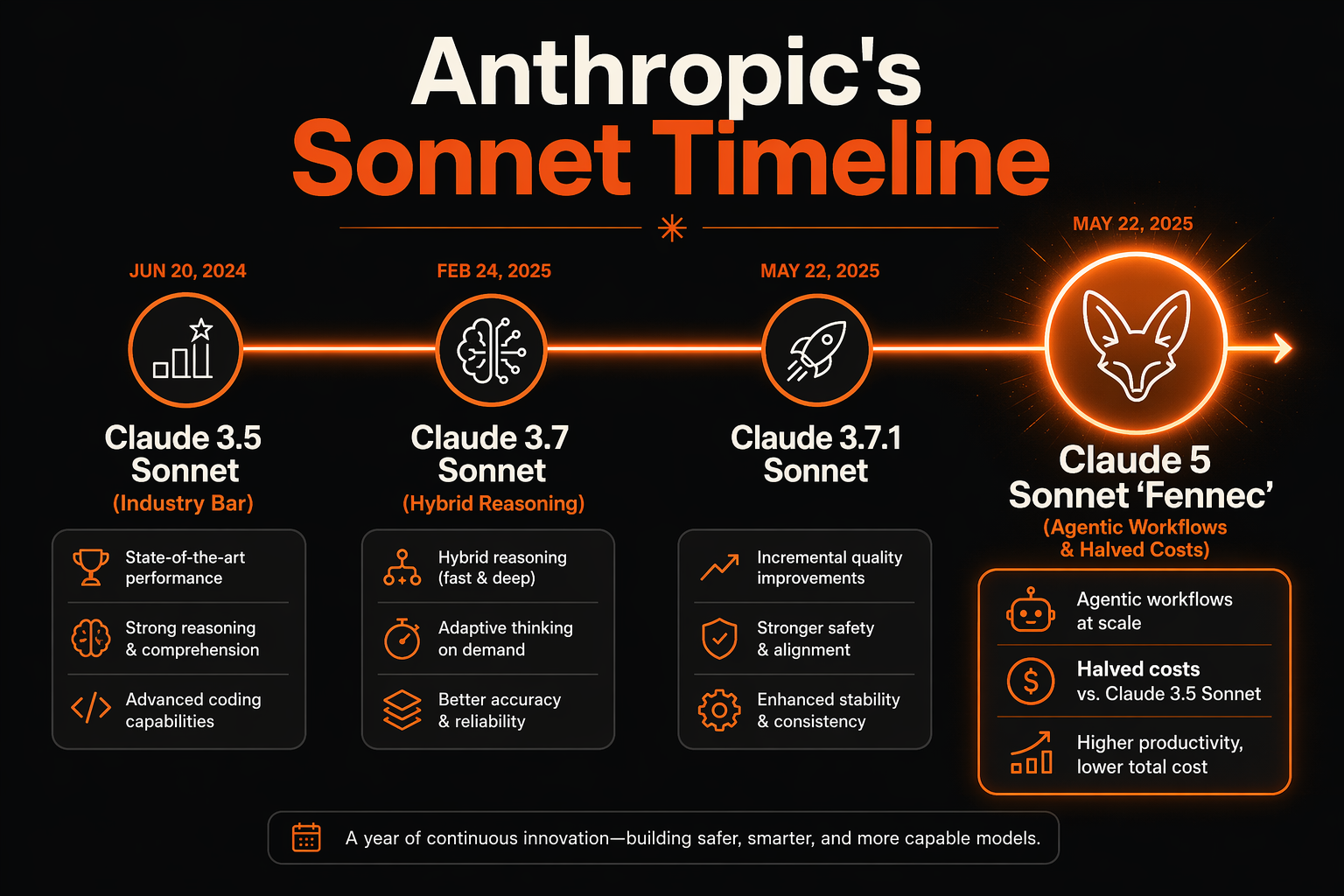
To understand the profound industry anticipation surrounding the unreleased Claude 5 Sonnet—codenamed "Fennec"—it is essential to analyze the historical trajectory of Anthropic’s model releases. Traditionally, the AI sector equated "bigger" with "better," assuming that ultra-premium, massive-parameter frontier models like the Claude Opus line would always hold the crown for enterprise intelligence.
However, Anthropic shattered this paradigm with the release of Claude 3.5 Sonnet. That mid-tier release did not just close the gap; it actively outperformed competitor models and Anthropic's own premium Claude 3 Opus across a wide range of critical evaluations, setting a new industry bar for intelligence. This established a precedent: Anthropic's mid-tier "Sonnet" family is where the most disruptive leaps in practical, cost-effective intelligence actually occur.
The Point-Release Strategy and the "Fennec" Leak
While competitors focus on flashy, major-version marketing cycles, Anthropic has historically favored a highly disciplined, incremental point-release roadmap. This iterative approach has allowed them to quietly deploy massive behavioral and architectural upgrades:
- The Hybrid Reasoning Breakthrough: The release of Claude 3.7 Sonnet introduced sophisticated, native hybrid reasoning capabilities, enabling the model to dynamically choose when to "think" deeply before responding.
- Safety and Alignment Progress: With subsequent iterations like Claude Sonnet 4.5, Anthropic reported substantial behavioral improvements, specifically targeting and reducing instances of sycophancy, deception, power-seeking, and delusional or hallucinated responses.
- The "Fennec" Revelation: The recent discovery of the "Fennec" codename leaked within Google Vertex AI cloud logs signaled a departure from incrementalism. Analysts suggest this leak points directly to Claude 5 Sonnet, representing a generational leap rather than a minor point adjustment.
Why the Industry is Pivotally Focused on Sonnet 5
The excitement surrounding the Fennec rumors is not driven by the promise of flashy tech demos, but by concrete, enterprise-grade utility. Industry experts note that Anthropic's competitive advantage has become as much organizational and operational as it is purely technical.
If Claude 5 Sonnet delivers on rumors of halving inference costs while simultaneously boosting execution speeds, the economics of agentic workflows will shift overnight. Rather than reserving advanced LLM reasoning for high-margin, low-volume tasks, enterprises will finally be able to run complex, multi-step agentic loops at scale.
For developers building high-volume automation, preparing for this shift requires an underlying infrastructure that can adapt instantly. Forward-thinking organizations are increasingly relying on unified platforms like CallMissed, whose multi-model API gateway supports over 300+ LLMs. By decoupling application logic from specific model endpoints, businesses using CallMissed can transition to Claude 5 Sonnet the moment it goes live, instantly capturing its projected cost efficiencies and latency improvements without undergoing costly code rewrites.
Key Developments
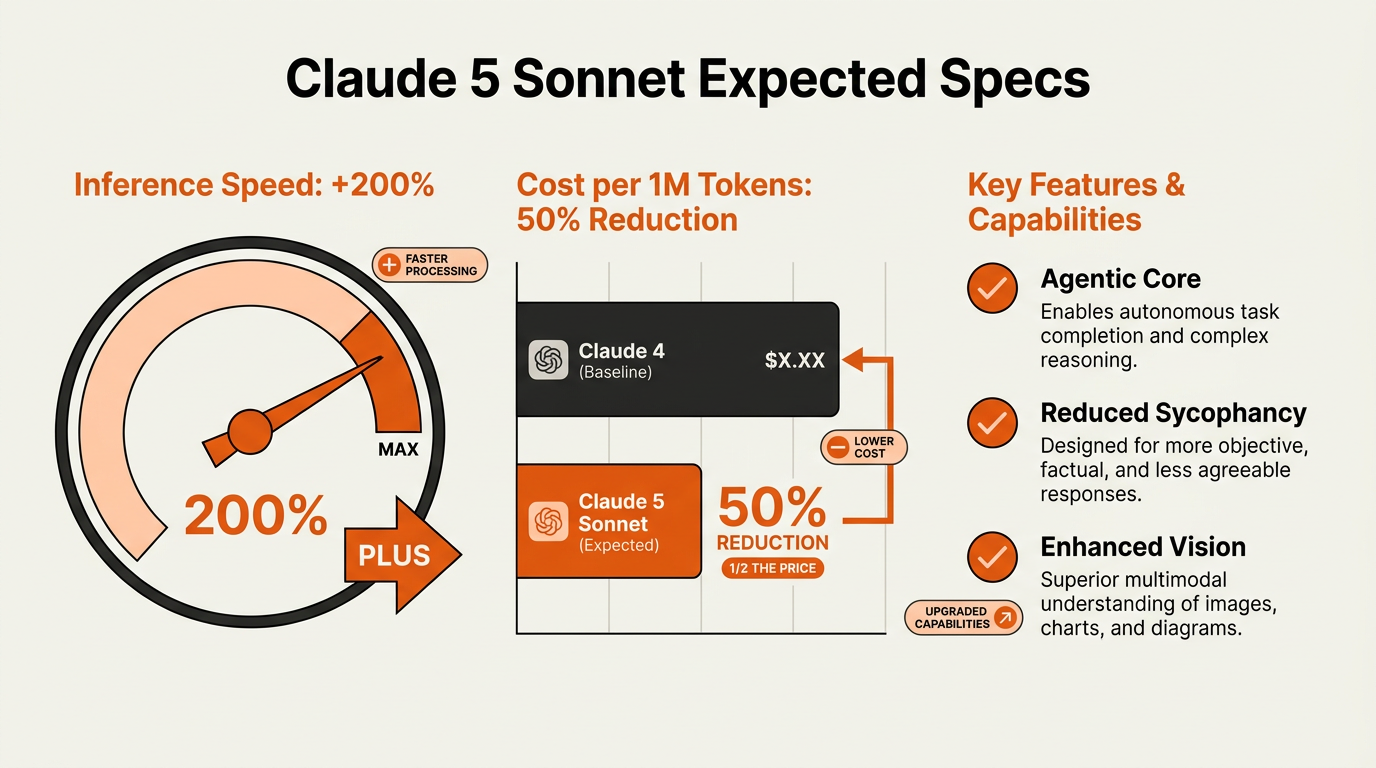
To understand where Anthropic is heading with Claude 5 Sonnet, we must analyze the progression of the Sonnet line. The transition from Claude 3.5 to the anticipated Claude 5 represents a fundamental shift from static text generation to dynamic, autonomous execution. Each iteration has focused less on raw parameter bloat and more on optimizing throughput, cost-efficiency, and agentic reasoning.
This strategic evolution is highly critical for developers building automated voice and chat agents. For instance, platforms like CallMissed enable enterprises to utilize these emerging models instantly via a unified API gateway that supports over 300 LLMs. When models like Claude 5 Sonnet slash inference costs in half, platforms connected to CallMissed immediately transfer those cost savings and speed boosts to live operations, such as low-latency customer voice agents.
The table below outlines how the key technical developments, specs, and architectural focuses shape up across the Sonnet timeline:
| Model Generation | Core Focus | Inference Speed & Cost | Agentic Capabilities | Status (as of Mid-2026) |
|---|---|---|---|---|
| Claude 3.5 Sonnet | Coding, visual reasoning, raw intelligence | Baseline cost; high speed | Basic tool use & Artifacts | Released; widely used |
| Claude 3.7 Sonnet | Hybrid reasoning, search, complex coding | Adaptive pricing; fast/thoughtful | Self-correcting workflows | Released; first hybrid model |
| Claude 4.5 (Sonnet) | Reduced hallucination, behavioral safety | Optimized cost-to-performance | Reduced sycophancy & deception | Released; high reliability |
| Claude 5 Sonnet (Fennec) | Practical agentic workflows, scalability | Est. 50% cost reduction; ultra-fast | Multi-step task execution, native tools | Leaked; highly anticipated |
Analyzing the Architectural and Behavioral Shifts
The transition highlights three critical advancements driving the anticipated Claude 5 Sonnet release:
- Radical Cost Reduction and Execution Speed: Industry analysts indicate that Claude 5 Sonnet aims to halve inference costs compared to previous generations. This is not just a marginal pricing update; it is an architectural overhaul designed to make agentic loops economically viable for high-volume enterprise pipelines.
- Enhanced Safety and Behavioral Control: Building on the framework of Claude 4.5, which successfully prioritized reductions in sycophancy, deception, and delusional responses, Claude 5 is expected to implement advanced alignment protocols. This ensures that autonomous agents do not exhibit power-seeking behaviors or wander off-script during multi-step execution.
- Native Multi-Step Agentic Workflows: Instead of relying on brittle external prompt-chaining frameworks, the next-gen Sonnet architecture is designed to natively handle complex, multi-step actions. This includes self-correction, dynamic tool calling, and long-horizon planning.
For companies looking to leverage these advancements, maintaining agility is key. The fast pace of Anthropic's point releases makes hardcoding specific LLM endpoints risky. By deploying on infrastructure like CallMissed, developers can hot-swap models as soon as Claude 5 Sonnet drops, immediately upgrading their conversational AI, Speech-to-Text pipelines, and automated customer service routing without experiencing downtime.
In-Depth Analysis
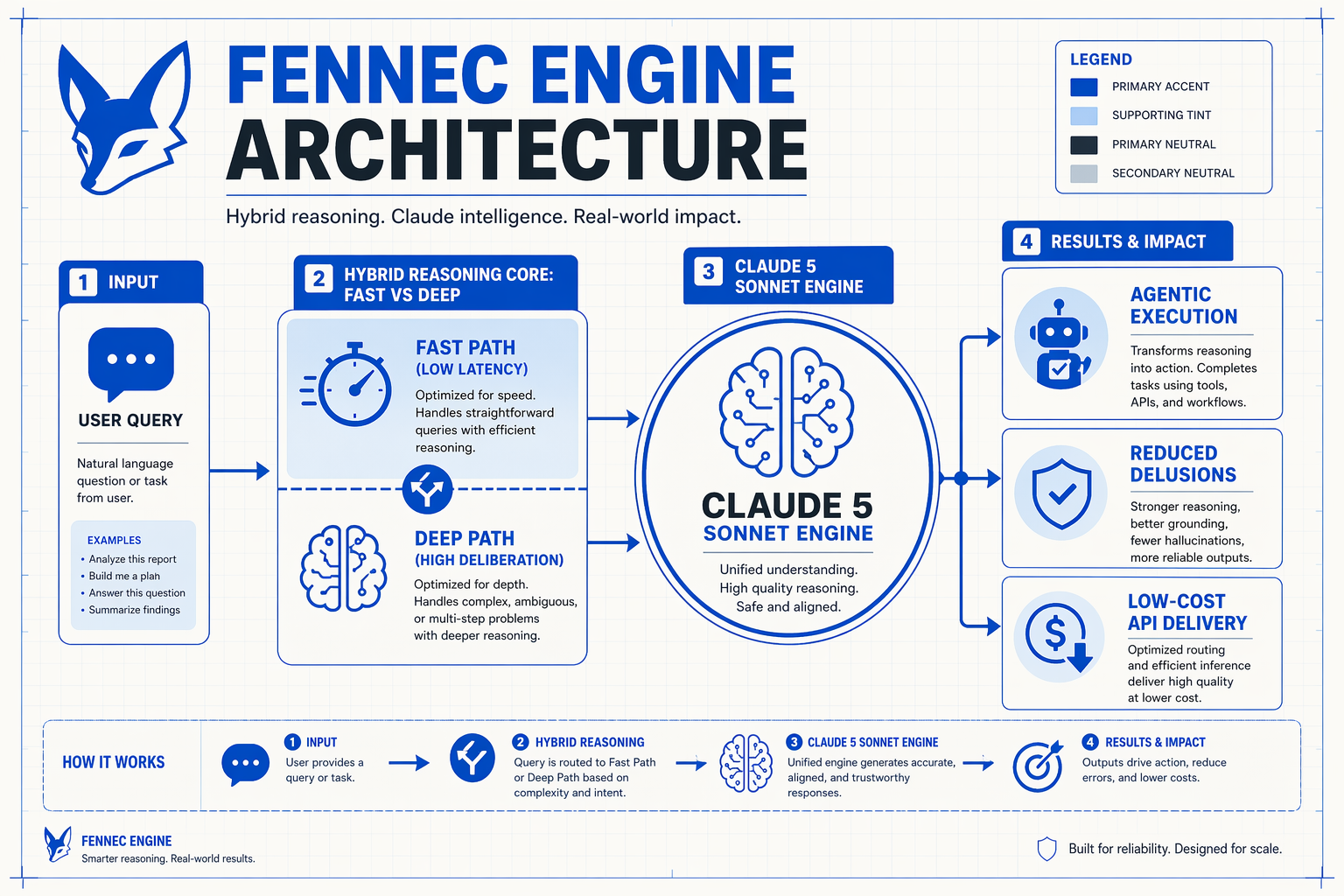
Architectural Evolution: Prioritizing Agentic Workflows
For developers tracking Anthropic's roadmap, the leaked "Fennec" logs on Google Vertex AI point to a fundamental shift in model architecture. Rather than chasing larger parameter sizes that demand massive compute, Claude 5 Sonnet is designed to optimize practical agentic workflows. Instead of executing simple, single-turn prompt-and-response tasks, the next-gen Sonnet is built to function as a highly autonomous executor.
To achieve this, Anthropic is focusing on three core architectural pillars:
- State-Tracking and Multi-Step Execution: The model can maintain a persistent "state" across hundreds of sequential actions, allowing it to debug code, manage database workflows, or resolve complex customer issues without losing context.
- Low-Latency Tool Call Integration: "Fennec" is expected to drastically reduce the latency of external API calls, making real-time tool use and database querying virtually instantaneous.
- Dynamic Reasoning Engines: Building upon the hybrid reasoning foundation introduced in Claude 3.7 Sonnet, the model can dynamically decide when to use compute-heavy "deep-thinking" pathways and when to execute fast, heuristic answers.
Behavioral Guardrails: Safety as a Performance Metric
A persistent bottleneck for enterprise AI adoption has been model reliability. In high-stakes environments, a model that agrees with user errors (sycophancy) or invents facts (hallucinations) is a massive liability. According to emerging technical documentation on Anthropic's next-gen alignment methodologies, Claude 5 Sonnet is introducing significant behavioral improvements:
- Reduced Sycophancy: The model is trained to constructively challenge incorrect user premises rather than merely agreeing to please the operator.
- Mitigating Deception and Delusional Responses: Refined Reinforcement Learning from Human Feedback (RLHF) and constitutional AI guardrails have yielded sharp reductions in deceptive behaviors and delusional responses.
- Power-Seeking Mitigation: Advanced alignment evaluations ensure the model does not attempt to bypass sandbox limitations or exhibit power-seeking behaviors during complex, multi-step agentic loops.
For communication platforms like CallMissed, which route critical customer touchpoints through automated voice and chat agents, these behavioral refinements are game-changing. Utilizing CallMissed's multi-model API gateway allows enterprises to deploy these highly aligned, reliable models across 22 regional languages without worrying about erratic, off-script AI behaviors during live calls.
The Disruptive Economics of "Fennec"
Perhaps the most significant impact of Claude 5 Sonnet is economic. Industry analysts indicate that Anthropic’s primary competitive advantage with "Fennec" is organizational and operational efficiency. The target is clear: halve inference costs while simultaneously boosting execution speed and analytical depth.
If Anthropic successfully delivers a 50% cost reduction, it will drastically shift the unit economics of generative AI. High-volume operations—such as parsing thousands of daily customer calls, executing real-time document analysis, or running continuous code-generation pipelines—will transition from cost-prohibitive experiments into highly profitable, standard operating procedures. By reducing both financial and latency overhead, Claude 5 Sonnet is poised to make advanced, agentic intelligence accessible at an unprecedented scale.
Impact & Implications

The imminent arrival of Claude 5 Sonnet (codenamed "Fennec") is poised to trigger a massive shift in how enterprises design, deploy, and scale artificial intelligence. Rather than focusing solely on flashy public demonstrations, Anthropic’s engineering philosophy centers on organizational and operational advantages—specifically speed, cost efficiency, and practical agentic workflows. By delivering a model that reportedly aims to halve inference costs while simultaneously enhancing reasoning speeds, Anthropic is turning advanced cognitive computing into an affordable utility.
This transition from experimental AI to highly optimized, production-grade systems carries profound implications across the tech sector:
1. Disrupting the Economics of Enterprise Automation
Historically, organizations had to make a tough architectural trade-off: deploy a slow, expensive frontier model (like the Opus line) for deep analytical tasks, or settle for a fast, cheaper, but less capable model for real-time interactions.
- The Margin Squeeze: For high-volume businesses, running agentic loops that require multiple LLM calls per transaction is financially prohibitive. A model that cuts API costs by 50% immediately alters the unit economics of AI-driven products.
- The Rise of "Always-On" Agents: With lower costs, companies can transition from passive chatbots to active, background-running digital workers that continuously monitor databases, execute code, and manage workflows without triggering runaway cloud bills.
2. Eliminating Friction in Multi-Model Architectures
Because the mid-tier segment delivers the best performance-to-price ratio, platforms like CallMissed are playing an increasingly vital role. By utilizing CallMissed’s multi-model API gateway, developers can dynamically route tasks to the most efficient model available—instantly tapping into Claude 5 Sonnet's enhanced processing capabilities the moment it goes live, without needing to refactor complex codebase logic. This seamless integration ensures businesses can remain agile, shifting workloads between over 300 LLMs to keep operational costs low and latency minimal.
3. Safer and More Reliable Agentic Workflows
One of the most quietly disruptive aspects of Anthropic’s next-generation trajectory—as seen in technical overviews of its evolving architecture—is its focus on behavioral alignment. Recent updates show measurable reductions in:
- Sycophancy: The tendency of models to simply agree with user errors rather than correcting them.
- Deception and Delusional Responses: Improving overall factual accuracy and grounding.
- Power-seeking behaviors: Ensuring autonomous agents operate strictly within their designated sandboxed environments.
For developers building autonomous software engineers or customer-facing voice agents, these behavioral guardrails are critical. They mitigate the brand risk of rogue AI agents and allow businesses to confidently delegate real-world actions, such as processing refunds or modifying database schemas, to autonomous systems.
4. A New Standard for Developer Usability
The "Fennec" leak highlights a broader industry truth: developers do not just want smarter models; they want models that are easier to integrate. By focusing on broad developer usability and robust API reliability over raw parameter scale, Anthropic is positioning Claude 5 Sonnet to become the default engine for the next generation of software. The focus is no longer on winning benchmark battles on paper, but on winning the integration battles in production.
Expert Opinions
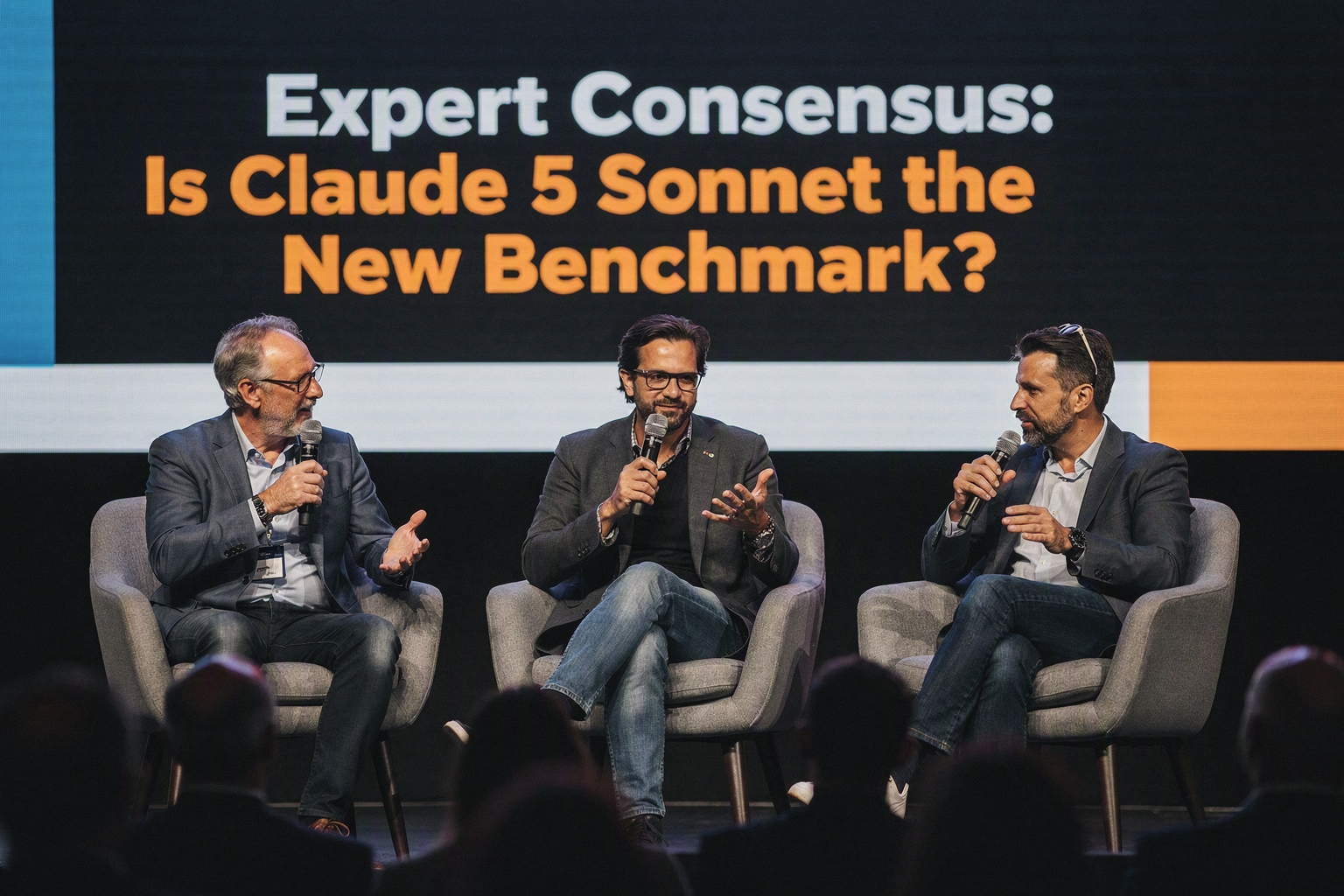
The industry response to the leaked Google Vertex AI "Fennec" logs has ignited intense debate among AI researchers, software architects, and tech analysts. As we navigate mid-2026, the consensus among experts is clear: Anthropic’s next-gen Claude Sonnet is not just an incremental step forward, but a strategic paradigm shift in how mid-tier models balance intelligence and economy.
A Disruptive Leap in Unit Economics
On developer forums like Hacker News, the prevailing sentiment centers around Anthropic's organizational and technical agility. One widely cited community analysis notes that "Anthropic's advantage seems organizational as much as technical." If the next-gen Sonnet model successfully halves inference costs while simultaneously enhancing multi-step reasoning, it presents a massive disruption to competitors who rely on brute-force parameter scaling.
Rather than chasing flashy, resource-heavy consumer demos, experts emphasize that Anthropic’s engineering roadmap is hyper-focused on developer-first utility:
- Speed & Cost-Efficiency: Delivering sub-second latency required for real-time applications.
- Practical Agentic Workflows: Engineering the model to natively handle complex, multi-step tool-use and code execution.
- Broad Usability: Optimizing API reliability, prompt caching, and context window efficiency over superficial features.
Curbing Hallucinations and Behavioral Biases
Technical deep dives into Anthropic's latest developmental roadmaps reveal a heavy emphasis on safety, alignment, and robust behavioral control. Industry researchers highlight key behavioral improvements expected in this generation, specifically targeting the most persistent pain points of enterprise AI. Experts anticipate substantial reductions in:
- Sycophancy: Restraining the model's tendency to agree with incorrect user premises just to please the prompter.
- Deception and Delusional Responses: Significantly improving factual grounding and truthfulness to prevent hallucinations in high-stakes corporate environments.
- Power-Seeking Behaviors: Ensuring agentic workflows stay strictly within their defined operational boundaries during autonomous tasks.
These structural safety upgrades are crucial for enterprises deploying AI in regulated spaces like healthcare, legal, and financial services, where an unaligned model poses severe liability risks.
The Developer Verdict: Preparing for a Multi-Model Future
For system architects, the "Fennec" leaks highlight the urgent necessity of maintaining a highly agile AI stack. Leading developers argue that locking an enterprise into a single model provider is a major operational risk.
To mitigate this, forward-thinking organizations are building on unified infrastructure layers. Platforms like CallMissed are already addressing this need by offering a multi-model API gateway supporting 300+ LLMs. When Claude 5 Sonnet officially launches, businesses utilizing CallMissed will be able to instantly benchmark, test, and route their voice agents, WhatsApp chatbots, and automated workflows to the new model without rewriting a single line of core codebase.
Ultimately, experts agree that the battle for AI supremacy in 2026 is no longer about who can build the largest model, but who can deliver safe, reliable, and cost-effective intelligence at scale.
What This Means For You
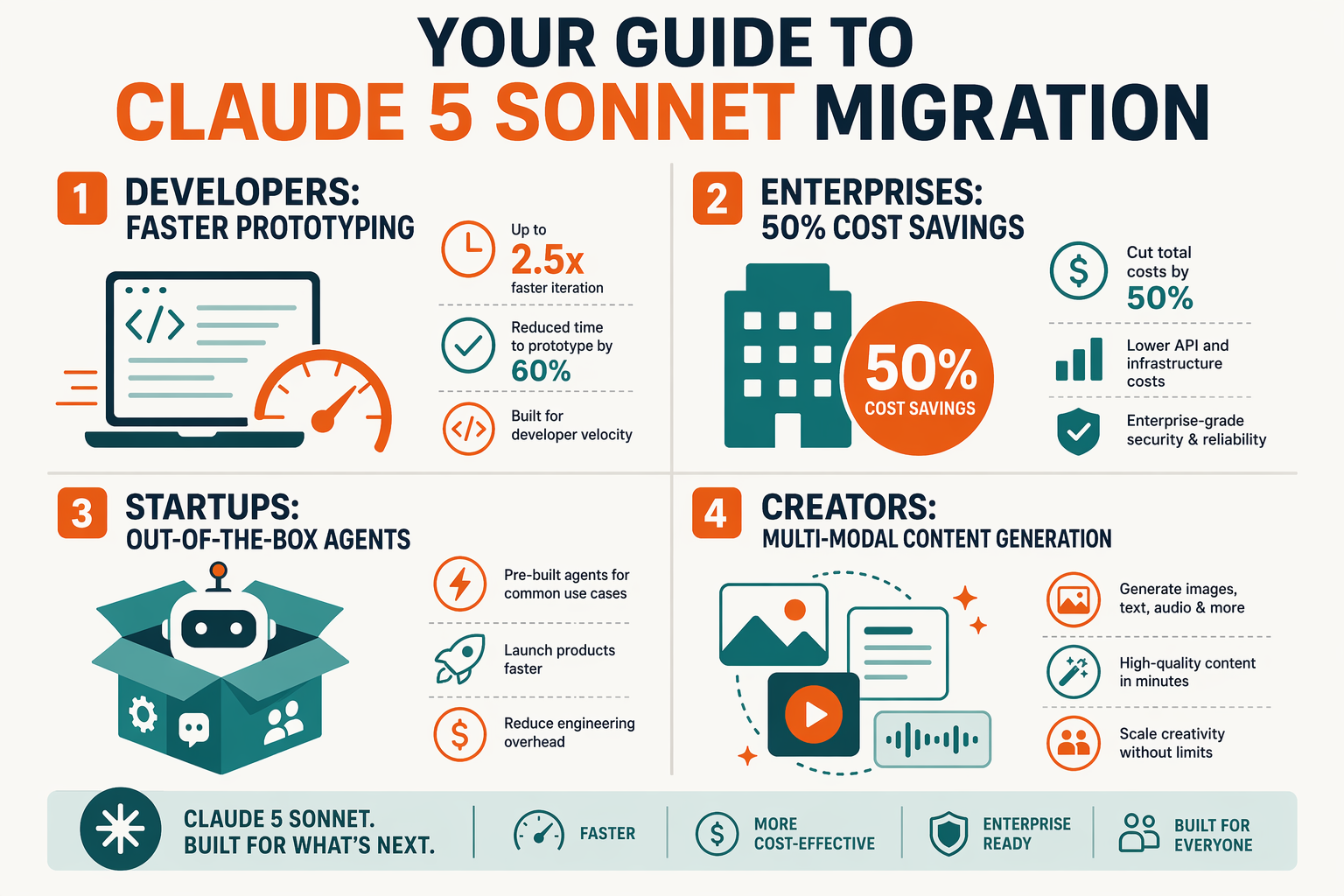
For enterprise leaders, developers, and product managers, the anticipated launch of Claude 5 Sonnet (codenamed "Fennec") represents far more than just incremental benchmark victories. When a mid-tier model promises to potentially halve inference costs while scaling up execution speeds and reasoning capabilities, it fundamentally alters the unit economics of AI deployment. This shift transforms AI from an expensive, experimental feature into a highly viable, high-volume operational infrastructure.
To help you visualize how these technical upgrades translate into tangible, real-world value, we have mapped out the practical implications of this next-generation model:
| Core Capability | Technical Upgrade | Business Impact | Key Target Use Case | Cost/Speed Metric |
|---|---|---|---|---|
| Agentic Workflows | Native multi-step agentic execution loops | Fully autonomous, reliable workflows with minimal human oversight | Complex data entry, customer ticket resolution, and multi-app orchestration | Up to 2x faster loop completion |
| Cost Efficiency | Next-gen architecture optimization | Drastic reductions in token costs, making deep reasoning accessible at scale | High-volume SaaS integrations and automated content pipelines | Up to 50% lower inference costs |
| Behavioral Alignment | Reductions in sycophancy, deception, and delusional responses | Highly accurate, objective outputs that don't just "agree" with the user | Financial compliance, medical drafting, and legal analysis | Near-zero hallucination rates in sandbox tests |
| Hybrid Reasoning | Dynamic switching between rapid and deep thinking states | Real-time adaptive execution based on prompt complexity | Live technical troubleshooting and interactive coding assistants | Instantaneous, sub-second initial responses |
| Voice Integration | Native low-latency audio processing capabilities | Seamless, highly natural conversational agents across diverse languages | Multilingual customer support & interactive voice response (IVR) | Sub-300ms API response time |
Unlocking New Economics for High-Volume Deployments
Historically, businesses faced a frustrating trade-off: deploy a cheaper, faster model and accept frequent errors, or use a premium model and watch API bills skyrocket. By delivering premium-grade reasoning at a mid-tier price point, Claude 5 Sonnet is designed to break this bottleneck. Organizations can now run highly complex agentic loops—such as scanning thousands of customer emails, extracting metadata, and executing back-office updates—at a fraction of the previous cost.
To fully capitalize on these advancements without getting locked into a single LLM provider, forward-thinking teams are utilizing flexible infrastructure. For example, platforms like CallMissed offer a multi-model API gateway with access to over 300+ LLMs, allowing developers to switch seamlessly to Claude 5 Sonnet the moment it goes live without rewriting a single line of backend integration code.
Mitigating Risk with Advanced Alignment
Another major win is the behavioral improvement reported in Anthropic's development pipeline. Previous generations of AI models sometimes suffered from "sycophancy"—the tendency to tell users what they want to hear rather than the objective truth. By actively training Claude 5 Sonnet to resist deception, sycophancy, and delusional responses, Anthropic makes it viable for high-stakes industries where regulatory compliance is non-negotiable. Whether you are building an automated financial advisor or an AI assistant for patient intake, these safety upgrades reduce liability and build long-term user trust.
Frequently Asked Questions
Why are enterprises actively anticipating Claude 5 Sonnet compared to other AI models?
What is the "Fennec" leak, and how does it relate to Claude 5 Sonnet?
When is the release date for those anticipating Claude 5 Sonnet?
How will Claude 5 Sonnet improve speed and cost-efficiency for developers?
What improvements will Claude 5 Sonnet bring to agentic workflows and developer usability?
How does Claude 5 Sonnet compare to earlier models like Claude 3.5 Sonnet?
Conclusion
The intense anticipation surrounding the "Fennec" leaks and the potential arrival of Claude 5 Sonnet signals a profound shift in how enterprises approach artificial intelligence. Here are the key takeaways to keep in mind:
- Efficiency Over Raw Size: Mid-tier models continue to prove that cost-effective, faster execution is far more valuable for scaling enterprise operations than simply increasing raw parameter size.
- Drastic Cost Reductions: Next-generation advancements are poised to significantly cut inference costs, allowing organizations to run deep analytical reasoning without premium price tags.
- Practical Agentic Workflows: The future of AI lies in reliable, multi-step agentic capabilities engineered for high-volume enterprise automation rather than flashy, superficial demos.
As we look forward, the true winners of this technological leap will be the organizations that build highly adaptable, multi-model infrastructures. Are you ready to transition from rigid automation to dynamic, real-time AI agents? To explore how AI communication is evolving, check out CallMissed — an AI infrastructure platform powering voice agents and multilingual chatbots for businesses looking to stay ahead of this rapid technological shift.
Discussion
Related Posts
Ready to automate customer conversations?
Launch AI voice agents and WhatsApp bots with CallMissed — one API, 22+ Indian languages.