

CallMissed for Education: Safe Admissions Enquiry Automation Guide


Use CallMissed for education to capture admissions enquiries, qualify leads, schedule counselling, and follow up safely across channels.
CallMissed for Education: Safe Admissions Enquiry Automation Guide
India’s schools enrolled about 24.8 crore students across nearly 14.7 lakh schools, according to the Ministry of Education’s UDISE+ 2023–24 report—yet one unanswered phone call can still determine whether a family discovers the right course or moves to another institute. CallMissed for education helps schools, coaching centres, colleges and training providers respond to routine admissions questions promptly while keeping counsellors in control of sensitive conversations and every actual admissions decision.
Admissions teams face a difficult communication mix: repetitive questions about eligibility, fees, schedules and locations arrive alongside requests that require empathy, judgement or urgent attention. Enquiries may come by phone, WhatsApp, email or the website; they may also arrive after office hours or in a parent’s preferred regional language. An education AI receptionist can provide approved information, collect basic contact details and arrange the next step—but it should not decide whether a learner qualifies, promise admission, assess merit or replace a trained counsellor.
CallMissed reflects this practical, multilingual model. The platform combines AI voice agents, WhatsApp chatbots, WhatsApp Business calling, email workflows, an omnichannel inbox and knowledge-base retrieval, with voice support across 22 Indian languages. For institutions serving regional and multilingual audiences, that means an enquiry can begin as a voice call, continue through WhatsApp and reach a human counsellor with the conversation history intact.
This guide explains how to design admissions enquiry automation around a clearly defined, safety-conscious workflow:
- Answer course FAQs from an approved knowledge base, including programme duration, schedules, locations and published fee information.
- Qualify leads using neutral questions such as course interest, preferred campus, learning mode and callback time.
- Recover missed calls and trigger permission-based WhatsApp or email follow-up.
- Capture counselling appointment requests without claiming that an appointment guarantees admission.
- Set explicit consent, data-minimisation and safeguarding rules—especially when conversations may involve minors.
- Route financial, accessibility, grievance, scholarship and eligibility questions to authorised staff.
- Test languages, accents, interruptions, uncertain answers and human handoffs before launch.
The objective is not to automate education decisions. It is to make the path to a qualified human clearer, faster and more consistent. A well-designed system should disclose that the caller is interacting with AI, collect only necessary information, avoid sensitive profiling, and escalate whenever the knowledge base is uncertain or the caller asks for a person. The following sections turn those principles into a launch-ready CallMissed workflow for education providers.
How does CallMissed for education improve admissions enquiries without making admissions decisions?

CallMissed for education improves admissions enquiries by answering approved questions, capturing prospective students’ needs and routing each enquiry to the right counsellor. It does not assess merit, determine eligibility, rank applicants or issue admission offers. Authorised institutional staff retain responsibility for every admissions decision.
Separate enquiry support from admissions decisions
India had about 24.8 crore students across nearly 14.7 lakh schools in the 2023–24 academic year, according to the Ministry of Education’s UDISE+ 2023–24 report. At this scale, automation can make information more accessible—but only within clear boundaries.
CallMissed for education can:
- Answer approved FAQs about courses, campuses, delivery modes, published fees and schedules.
- Ask which programme, location or study format interests the enquirer.
- Capture a name, contact method, preferred language and callback time.
- Record requests for counselling appointments or campus visits.
- Send permission-based confirmations through WhatsApp or email.
- Transfer the conversation when information is uncertain or the enquirer requests a person.
It must not interpret marksheets, rank applicants, make policy exceptions or promise admission. Questions about final eligibility, scholarships, credit transfers, disability accommodations or visa status must be referred to authorised staff.
Use a controlled admissions enquiry workflow
A safe CallMissed for education workflow is simple:
- Disclose the automation. Explain that an AI assistant is handling the initial enquiry and that human support is available.
- Identify the request. Categorise it as a course FAQ, callback, counselling request or specialist issue.
- Use approved information only. Retrieve answers from a maintained knowledge base instead of inferring policies.
- Collect minimal details. Ask about course interest, campus, study mode and contact preference—not unnecessary sensitive information.
- Create a clear next step. Send approved information, log a callback request or route the enquiry to a counsellor.
- Use accurate statuses. Record “enquiry received,” “counselling requested” or “human review required”—never “eligible” unless an authorised person has documented that decision.
For example, CallMissed for education may say: “The published requirement for this programme is 50% in Class 12. A counsellor must review your documents and confirm eligibility.” It should never turn a published requirement into a personalised admissions verdict.
Trigger human handoff when judgement is needed
CallMissed can preserve voice, WhatsApp, email and web conversation context so counsellors can continue without making families repeat information. The CallMissed human handoff guide explains how to route conversations across channels.
Handoff should occur when:
- No verified answer exists or approved sources conflict.
- The enquirer disputes a fee, deadline or policy.
- The issue involves safeguarding, accessibility, grievances or financial hardship.
- A minor appears distressed or shares sensitive information.
- The enquirer asks to speak with a person.
- Any question requires eligibility assessment or institutional judgement.
This boundary keeps admissions enquiry automation useful but not authoritative: CallMissed for education provides availability, consistency and organised follow-up, while educators retain judgement, accountability and empathy.
Why do education providers need an education AI receptionist during peak and after-hours demand?

Education providers need an education AI receptionist because admissions demand is uneven: calls surge after exam results, campaign launches and application deadlines, while many parents and working learners enquire outside office hours. Automation can acknowledge every enquiry, answer approved questions and secure a next step without asking counsellors to remain continuously available.
Peak demand creates a response problem, not just a staffing problem
Admissions enquiries often cluster around predictable events—results announcements, entrance examinations, new batches, scholarship deadlines and last dates for applications. During these periods, counsellors may be speaking with families while additional calls, WhatsApp messages and website enquiries continue to arrive.
The scale of the sector amplifies this challenge. The Ministry of Education’s UDISE+ 2023–24 report counted about 24.8 crore students across nearly 14.7 lakh Indian schools, illustrating the volume and diversity of education-related communication nationwide.
A receptionist workflow can absorb repetitive, low-risk work such as:
- Identifying the programme, campus or learning mode of interest.
- Answering published questions about course duration, class timings and location.
- Recording a caller’s name, contact details and preferred callback window.
- Sending an approved brochure or application link after obtaining permission.
- Capturing a counselling appointment request for staff confirmation.
This does not make the system an admissions officer. Admissions enquiry automation should organise demand and provide approved information; authorised staff must retain decisions involving eligibility, selection, scholarships, exceptions or fee disputes.
After-hours enquiries still carry admissions intent
A parent may call after work, while a professional considering a certification course may enquire late in the evening. If nobody answers, the institute loses both the conversation context and the opportunity to establish an agreed follow-up time.
A well-configured after-hours workflow can:
- Disclose that the caller is speaking with an AI agent.
- Determine whether the enquiry concerns admissions, an existing learner or another issue.
- Answer only questions covered by the current knowledge base.
- Collect the minimum information needed for follow-up.
- Ask whether the person consents to a WhatsApp message, email or callback.
- Escalate urgent, sensitive or uncertain requests to the appropriate human queue.
The acknowledgement should remain precise: “A counsellor can call you between 10 a.m. and noon” is safer than “Your admission counsellor will approve your application tomorrow.”
Multilingual coverage improves access during both demand windows
Peak capacity is not useful if callers cannot communicate comfortably. As of August 2026, CallMissed for education supports Speech-to-Text and Text-to-Speech across 22 Indian languages, allowing institutions to design regional-language voice experiences rather than forcing every caller into English or Hindi.
Language support still requires operational testing. Institutions should validate course names, campus locations, fee terminology, code-switching, accents and noisy mobile calls before deployment. If confidence is low, the agent should confirm what it heard or transfer the interaction—not guess.
Automation protects counsellor time for higher-value conversations
The practical benefit is triage. CallMissed can handle initial reception across voice, WhatsApp, email and web, preserve the interaction in an omnichannel record, and route qualified enquiries for human attention.
Counsellors can then concentrate on conversations requiring judgement and empathy, including learning goals, accessibility needs, financial concerns and programme suitability. The result is not automated admission; it is a more dependable path from first contact to an informed human conversation.
Which CallMissed capabilities support each stage of the admissions journey? (TABLE)
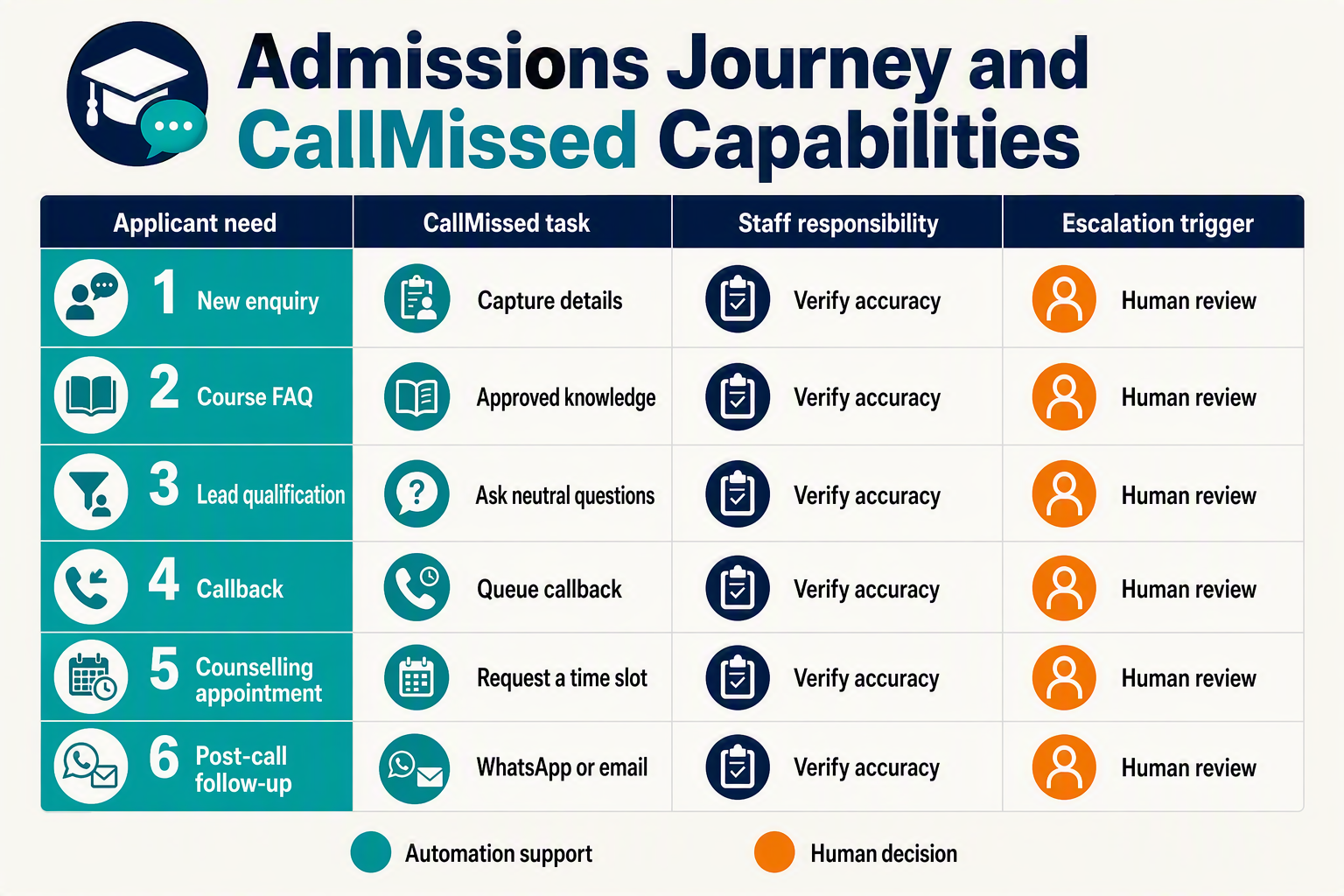
CallMissed for education can support the admissions journey from first contact through counsellor handoff by combining AI voice, WhatsApp, email, knowledge-base retrieval and an omnichannel inbox. The correct model is workflow automation around admissions, not automated admission, eligibility or scholarship decisions.
Capability map across the admissions journey
| Admissions stage | CallMissed capability | Recommended workflow | Human-control boundary |
|---|---|---|---|
| First enquiry | AI voice agent, WhatsApp chatbot and WhatsApp Business calling | Disclose AI use, identify the requested course or campus, and collect the minimum contact details required for follow-up. | Transfer immediately when the person requests staff, reports an urgent issue or cannot use the automated channel. |
| Course discovery | Knowledge-base retrieval-augmented generation (RAG) | Answer approved FAQs about programme duration, published fees, schedules, delivery mode, locations and application steps. | Do not infer eligibility, guarantee seat availability or answer beyond the approved source material. |
| Lead qualification | Structured voice or chat questions plus omnichannel records | Record neutral preferences such as course interest, campus, online or classroom mode, language and suitable callback time. | Avoid scoring applicants using disability, caste, religion, health, financial circumstances or other sensitive attributes. |
| Missed-call recovery | Callback workflows, business-initiated WhatsApp communication and email tooling | Acknowledge the missed call, ask permission to continue on the selected channel and offer a callback window. | Apply consent requirements, communication-hour policies and opt-out handling before sending follow-ups. |
| Counselling request | Conversation capture, routing and shared inbox/CRM | Collect the requested date, time, course and campus; then route the request to the relevant counselling team for confirmation. | Clearly state that a request is not a confirmed appointment and that counselling does not guarantee admission. |
| Counsellor follow-up | Omnichannel inbox with voice, WhatsApp and email context | Present the enquiry history, FAQ answers and stated preferences so the counsellor does not need to restart the conversation. | Authorised staff must handle admissions decisions, payment disputes, scholarships, grievances and exceptional cases. |
How the capabilities should work together
An education AI receptionist should create continuity rather than separate channel-specific conversations. For example, an inbound call can establish course interest, a consented WhatsApp message can share the official brochure, and the omnichannel record can then give a counsellor the complete interaction history.
CallMissed supports Speech-to-Text and Text-to-Speech across 22 Indian languages, allowing institutes to design regional-language voice journeys rather than forcing every caller into English or Hindi. Language support still requires deployment testing because course names, local place names, mixed-language speech and accents can affect recognition.
For reliable admissions enquiry automation, configure three controls across every stage:
- Approved-answer controls: Restrict course answers to current institutional documents, attach an owner to each source and define review dates for fees, schedules and eligibility policies.
- Escalation controls: Trigger human handoff for uncertainty, repeated misunderstandings, safeguarding concerns, accessibility requests, financial questions and any explicit request for a person.
- Data controls: Collect only information needed for response or routing, define retention periods and apply additional safeguards where the prospective learner may be a minor.
Before launch, test complete journeys rather than isolated responses:
- Caller interruption, silence and low-confidence transcription.
- Switching between supported languages or mixing English with a regional language.
- Duplicate enquiries arriving through voice, WhatsApp and email.
- Revoked consent, opt-outs and unavailable counsellors.
- Incorrect or outdated knowledge-base content.
- Clear disclosure that AI assists communication while authorised people make admissions decisions.
How should admissions enquiry automation move from the first call to qualification, callback, and counselling appointment?
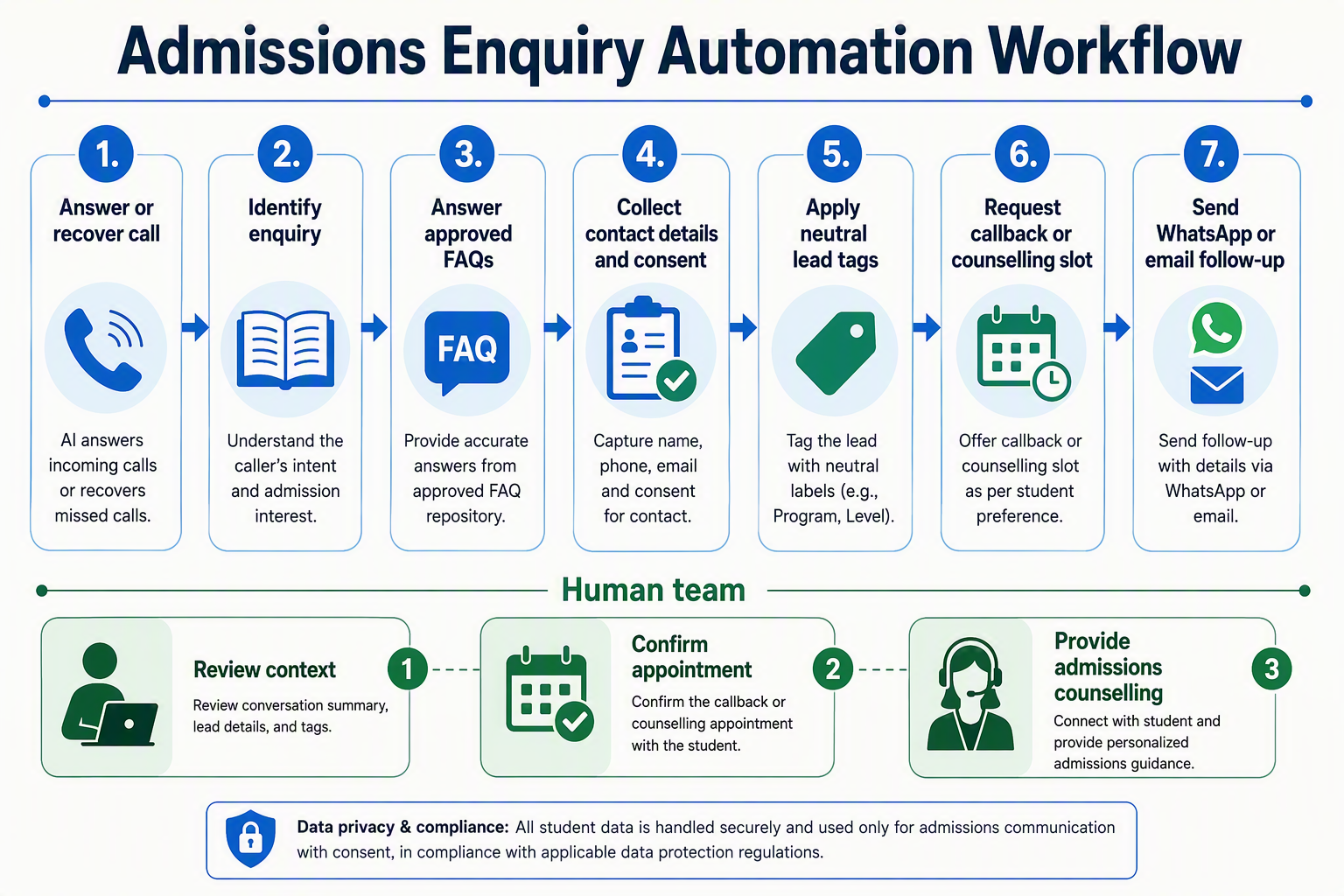
Admissions enquiry automation should operate as a staged, auditable funnel: answer approved questions, capture minimal details, classify interest without judging eligibility, obtain permission for follow-up, and route the enquiry to a counsellor. The automation may organise the journey, but authorised staff must make admissions, scholarship and suitability decisions.
1. Resolve the first-call intent
The education AI receptionist should disclose that it is an automated assistant and immediately identify why the person is calling. A simple menu or natural-language prompt can distinguish among:
- Course, batch, campus or learning-mode enquiries
- Published fees, duration and timetable questions
- Application-process or document questions
- Callback and counselling requests
- Existing-student support
- Requests to speak with a person
Answers should come only from an approved knowledge base. If information is missing, contradictory or time-sensitive, the agent should say it cannot verify the answer and create a human follow-up task rather than improvising.
2. Qualify interest—not admissions eligibility
Lead qualification should help counsellors prioritise and prepare; it must not determine whether someone deserves or qualifies for admission. Collect neutral, operational fields such as:
- Name and contact channel
- Course or programme of interest
- Preferred campus, city or online format
- Desired intake, batch or start month
- Preferred language
- Suitable callback window
- Whether the caller is the learner, parent or guardian
Avoid asking for marks, health information, caste, religion, disability details or financial circumstances unless an authorised process genuinely requires them. Questions about eligibility, concessions, scholarships or accommodations should be assigned to trained staff.
For multilingual intake, CallMissed’s platform specifications state that its voice capabilities cover 22 Indian languages. That allows CallMissed for education workflows to capture the same structured fields across regional-language calls while preserving the caller’s preferred language for the counsellor.
3. Convert missed or incomplete calls into permission-based callbacks
If a call disconnects or arrives outside staffed hours, the workflow should record the attempt and ask permission before continuing through WhatsApp or email. A useful follow-up message identifies the institution, explains why the person is being contacted and provides a clear opt-out.
Each callback task should include:
- Original channel, date and time
- Caller’s stated intent and language
- Questions already answered
- Unresolved questions
- Consent status for WhatsApp, email or another call
- Preferred callback time and assigned team
This prevents families from repeating the entire conversation. The related CallMissed Lead Capture Workflow: Phone to WhatsApp to Email can support teams designing channel transitions and record continuity.
4. Treat counselling as a requested appointment until confirmed
When a caller asks for counselling, admissions enquiry automation should capture suitable dates and time ranges, then mark the record as appointment requested. It should not state that the appointment is confirmed unless an approved calendar or counsellor has actually accepted the slot.
A practical status sequence is:
- New enquiry
- FAQ resolved
- Qualified for follow-up
- Callback requested
- Counselling requested
- Counselling confirmed by staff
- Closed or opted out
The handoff summary should be concise but complete: “Interested in the weekend data analytics course, prefers Hindi, requests a callback after 6 p.m., and needs an authorised answer about scholarship criteria.” This gives the counsellor context without allowing the AI to promise admission, financial support or a particular outcome.
How can multilingual voice interactions and course FAQs create a consistent applicant experience?
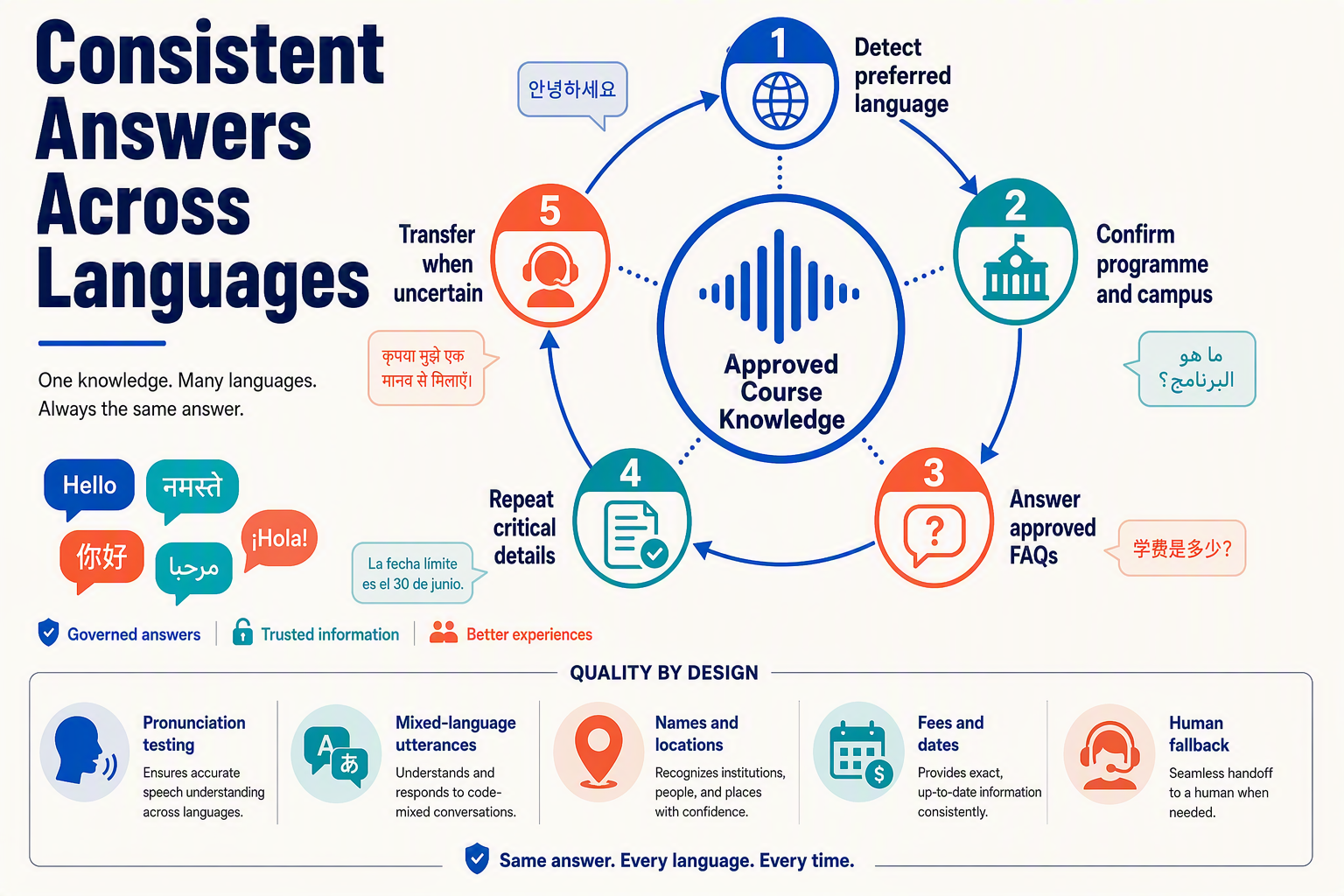
Multilingual voice interactions create a consistent applicant experience when every language follows the same approved course knowledge, escalation rules and follow-up workflow. The goal is not literal word-for-word translation; it is to give applicants equally accurate answers and an equally clear route to a counsellor, regardless of their preferred language or channel.
Build one governed source for course FAQs
An education AI receptionist should retrieve answers from an institution-controlled knowledge base rather than improvise from general model knowledge. Each course record should have an owner, review date and canonical answer covering:
- Programme name, duration, delivery mode and campus
- Published fees, taxes and payment schedules
- Class timings, upcoming batches and application deadlines
- Stated prerequisites and required documents
- Facilities, certifications and placement-support wording
- Counselling hours, contact routes and escalation owners
Admissions teams should separate informational questions from matters requiring authorised judgement. The agent may state a published prerequisite, but it should not decide that the caller is eligible. Similarly, it may explain the documented scholarship process without predicting an award or promising a fee concession.
When the knowledge base lacks a current answer, the safe response is explicit: “I don’t have a verified answer for that. I can arrange a callback from the admissions team.” This is more consistent than generating a plausible but unapproved response.
Design multilingual conversations around meaning
CallMissed supports Speech-to-Text and Text-to-Speech across 22 Indian languages, enabling institutions to design regional-language voice journeys as a core capability rather than an English-only workflow with occasional translation. For CallMissed for education, each supported language should receive its own testing and terminology review.
A practical localisation process is:
- Write the canonical answer in the institution’s primary working language.
- Translate for meaning, preserving exact fee amounts, dates, course names and policy limitations.
- Review educational terminology with native speakers familiar with local usage.
- Test spoken delivery for pronunciation, pace, code-switching and abbreviations.
- Compare outcomes across languages, ensuring that every applicant receives the same next-step options.
Names such as “BCA,” “JEE Main,” “IELTS” or branded course titles may need phonetic guidance. The agent should also confirm critical details aloud: “You selected the weekend classroom batch at the Pune centre—is that correct?”
Testing must include mixed-language utterances, such as Hindi-English or Tamil-English conversations, as well as background noise, interruptions and regional accents. The CallMissed 22 Indian Languages voice AI testing guide provides a useful framework for deployment checks.
Keep the experience consistent after the call
Effective admissions enquiry automation should preserve context when an interaction changes channel. After receiving permission, the workflow can send a WhatsApp or email summary containing:
- The course discussed and the applicant’s preferred location or mode
- Links to the official brochure, fee page or application instructions
- The requested counselling date and callback window
- A correction route if any captured information is wrong
The handoff record should include the chosen language, questions asked, answers supplied and unresolved issues. A counsellor can then continue without forcing the applicant to repeat the conversation.
Consistency ultimately means equal information, not identical scripts. Language can adapt to the caller, but published facts, safeguarding boundaries, consent requirements and human-escalation options must remain unchanged.
Where do consent, safeguarding boundaries, human handoff, and staff oversight apply?
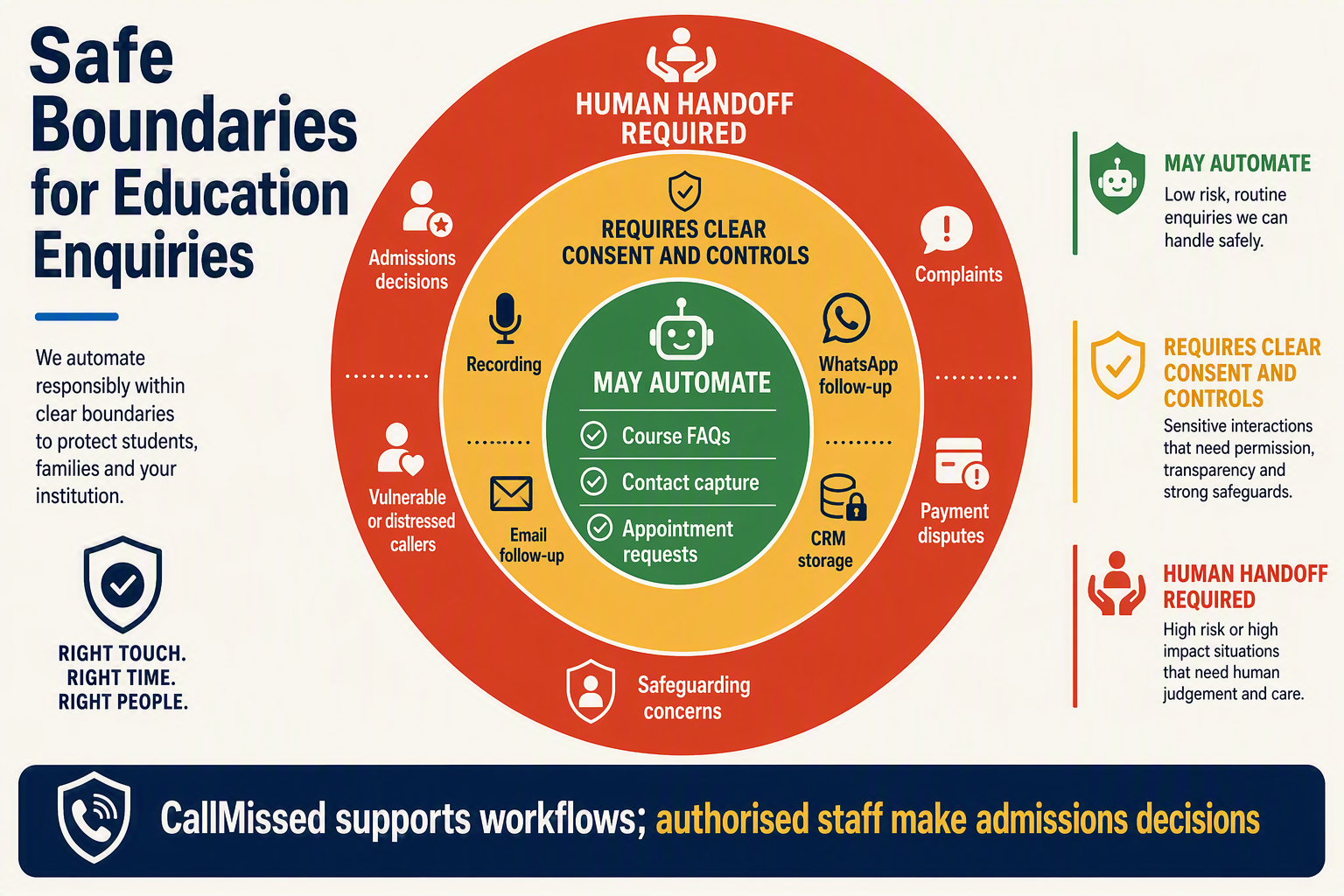
Consent, safeguarding and human oversight apply at every stage where automation collects personal data, communicates with a minor, records a conversation or influences an admissions journey. An education AI receptionist may answer approved FAQs and coordinate callbacks, but authorised staff must retain control of sensitive conversations and all admissions decisions.
Obtain specific, informed consent
Consent should be understandable, purpose-specific and recorded rather than buried in a generic notice. At the beginning of an interaction, the agent should identify the institution, disclose that it is an AI system and explain why information is being collected.
A practical consent sequence is:
- Disclose automation: “You are speaking with the institute’s AI assistant.”
- State the purpose: Explain whether details will be used for a callback, counselling appointment or course follow-up.
- Ask before changing channels: Obtain permission before sending WhatsApp or email messages.
- Provide an exit: Let the person decline follow-up or request a human without losing access to general information.
- Record the consent event: Store the wording, channel, timestamp and stated purpose.
Permission to receive one requested course brochure should not automatically become permission for recurring campaigns. Recording or transcribing calls also requires a clear notice and a workflow aligned with applicable Indian privacy and telecommunications requirements.
Set stricter boundaries when minors may participate
India’s Digital Personal Data Protection Act, 2023 defines a child as an individual under 18 years of age and establishes additional obligations around processing children’s personal data. Institutions should obtain legal advice on the requirements applicable to their operations and configure automation conservatively.
The AI agent should avoid requesting unnecessary information about a learner’s health, disability, family finances, religion, caste, academic distress or personal circumstances. When age is uncertain, the safer workflow is to provide public course information and invite a parent, guardian or authorised staff member into the next step.
Safeguarding rules should prohibit the agent from:
- Conducting private counselling with a child or soliciting personal disclosures.
- Evaluating mental health, diagnosing risk or offering crisis advice.
- Promising scholarships, admission, accommodation or special support.
- Handling allegations of abuse, harassment or staff misconduct as an ordinary support ticket.
- Asking a minor to conceal a conversation from a parent or guardian.
Any disclosure suggesting immediate danger, abuse or self-harm requires an institution-approved emergency escalation procedure—not an improvised AI response.
Define mandatory human handoff triggers
Admissions enquiry automation should transfer or create a priority callback whenever the caller:
- Explicitly asks for a person.
- Challenges eligibility, rejection, fees or refund terms.
- Requests accessibility accommodations or financial assistance.
- Raises a grievance, safeguarding concern or legal complaint.
- Provides conflicting information or cannot understand the agent.
- Encounters repeated retrieval uncertainty or language-recognition errors.
CallMissed for education can preserve voice, WhatsApp, email and web context in an omnichannel record, helping the counsellor continue without making the family repeat the entire enquiry. CallMissed supports voice interactions across 22 Indian languages, but multilingual capability does not remove the need for human review when meaning is ambiguous.
Keep staff accountable after launch
Oversight should include named workflow owners, role-based access, retention limits and routine sampling of transcripts. Review teams should track incorrect answers, failed transfers, consent exceptions, safeguarding flags and unauthorised promises.
Staff must also be able to pause campaigns, correct knowledge-base content and override automation immediately. The governing rule is simple: AI may inform, organise and route; trained institutional staff decide, counsel and safeguard.
What operational impact and implications should education leaders measure?
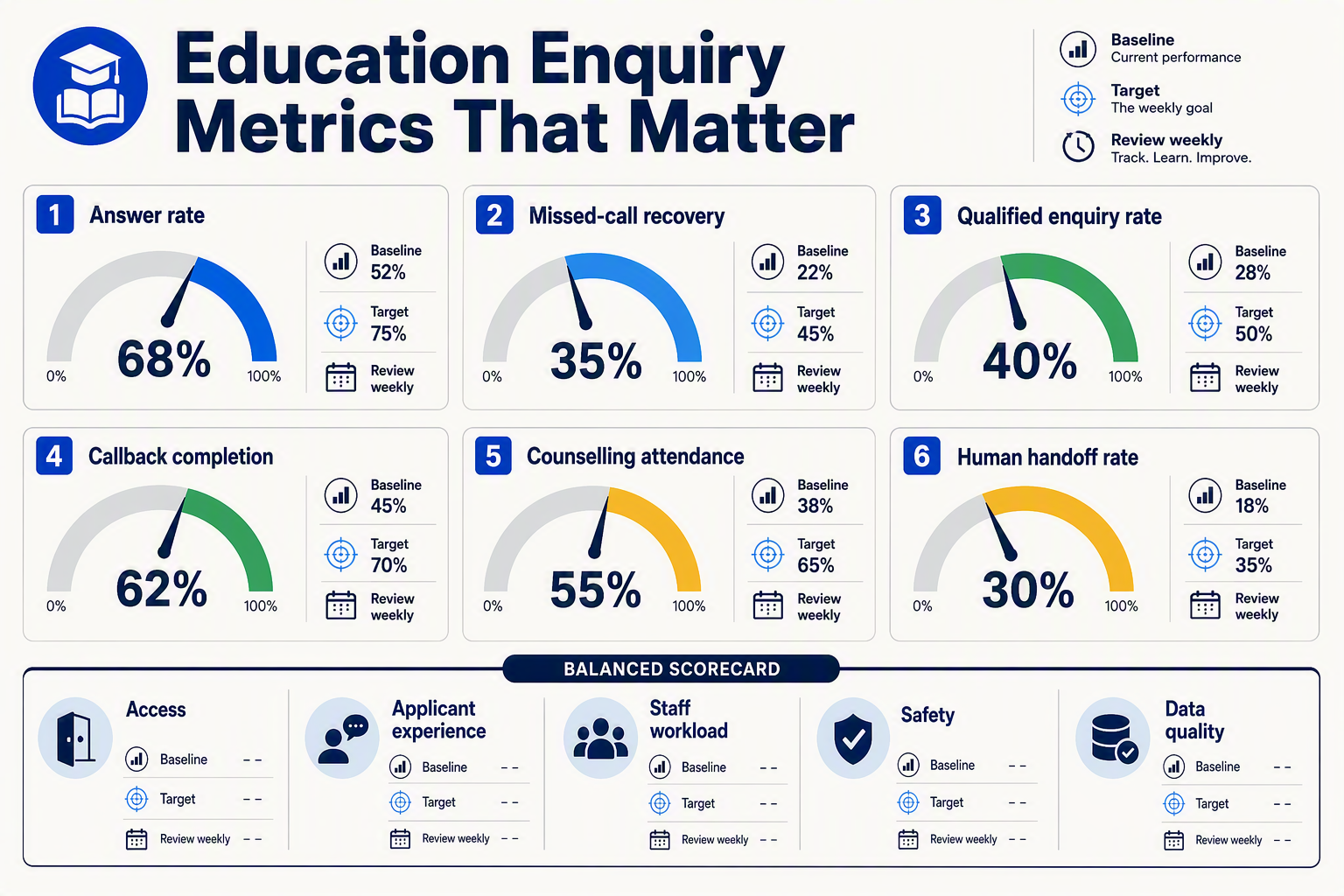
Education leaders should measure whether automation improves response speed, enquiry completeness, counsellor productivity and safe human escalation—not whether an AI system “selects” more students. The operational scorecard should connect each interaction to a legitimate next step, such as an answered FAQ, completed callback or attended counselling appointment.
Establish a baseline before automation
Measure at least two to four representative weeks before deploying an education AI receptionist, including weekends and peak admission periods where possible. The Ministry of Education’s UDISE+ 2023–24 report recorded approximately 24.8 crore students across nearly 14.7 lakh Indian schools, illustrating why education communication systems must work across institutions of very different sizes, languages and operating models.
Record baseline results by channel, campus, programme, language and time of day:
- Total inbound enquiries and missed calls.
- Median and 90th-percentile first-response time.
- Percentage of callers successfully contacted after a missed call.
- Counsellor time spent answering repeat course FAQs.
- Counselling appointments requested, confirmed and attended.
- Unresolved enquiries and repeat contacts about the same issue.
Comparing equivalent admission-cycle periods is important. A week during application deadlines should not be compared directly with an off-season week.
Track the complete enquiry funnel
For admissions enquiry automation, raw conversation volume is a weak success measure. Leaders need stage-level metrics that reveal where prospective learners or parents lose momentum.
- Answer rate: answered inbound interactions divided by total inbound attempts.
- FAQ resolution rate: enquiries resolved using approved information without a repeat contact or escalation.
- Lead-detail completion: conversations capturing the minimum required fields, such as programme interest, location, preferred mode and callback time.
- Callback SLA attainment: promised callbacks completed within the institution’s stated service window.
- Handoff success: escalated conversations successfully accepted by an authorised employee.
- Appointment attendance: attended counselling sessions divided by confirmed appointments.
- Follow-up consent rate: contacts that explicitly permitted WhatsApp, voice or email follow-up.
- Opt-out and complaint rate: a critical indicator of excessive messaging or unclear consent.
CallMissed for education can centralise voice, WhatsApp, email and web histories in an omnichannel workflow, allowing teams to examine the journey rather than treating each channel as an isolated lead source.
Measure quality, inclusion and safeguarding
Operational efficiency must be balanced against accuracy and learner protection. Review a statistically useful sample of conversations regularly, with greater scrutiny during launch and after knowledge-base changes.
The quality dashboard should include:
- Unsupported-answer rate: responses not grounded in approved institutional content.
- Escalation precision: whether scholarship, eligibility, grievance, accessibility and financial questions reached the correct team.
- Language parity: completion, handoff and error rates compared across supported languages.
- AI disclosure compliance: interactions in which the system clearly identified itself.
- Data-minimisation compliance: records containing only the information required for the stated purpose.
- Safeguarding escalation time: time taken to transfer conversations involving minors, distress, threats or other sensitive circumstances.
Turn metrics into management decisions
Set named owners and review operational results weekly during launch, then monthly once performance stabilises. Use findings to improve staffing schedules, callback capacity, knowledge articles and language testing.
Most importantly, separate communication outcomes from admissions outcomes. Automation may help a family obtain information or reach a counsellor sooner, but eligibility assessment, merit evaluation, exceptions and admission decisions must remain with authorised education professionals.
What should admissions, safeguarding, privacy, and counselling experts review before launch?
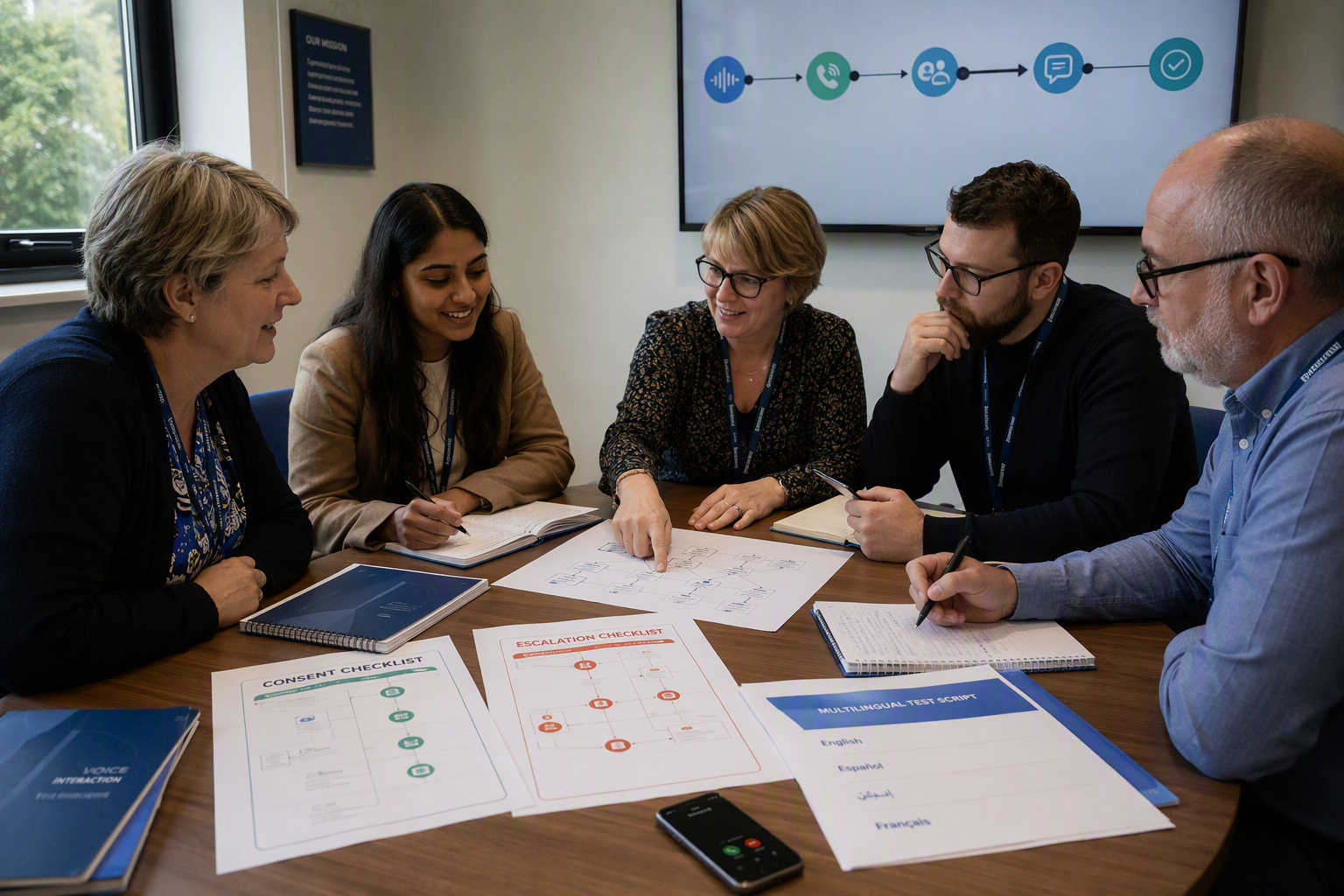
Before launch, admissions, safeguarding, privacy and counselling specialists should jointly approve the AI agent’s scope, scripts, data handling and escalation rules. No education AI receptionist should go live until each expert can demonstrate that routine automation stops where eligibility decisions, child safety, sensitive disclosures or professional judgement begin.
1. Admissions teams: verify every answer and boundary
Admissions owners should review the knowledge base against current prospectuses, fee notices, academic calendars and campus policies. Their approval should cover:
- Published eligibility criteria, course duration, schedules, locations and fees.
- Neutral lead-qualification fields such as programme interest, preferred campus, learning mode and callback time.
- Explicit wording that an enquiry, application or counselling appointment does not guarantee admission.
- Responses to uncertain questions: the agent should say it cannot confirm the answer and offer a human callback.
- Prohibited actions, including ranking candidates, interpreting documents, assessing merit, granting exceptions or making admissions decisions.
For admissions enquiry automation, assign a named content owner and an expiry or review date to each high-impact answer. Old scholarship, examination or fee information should be removed rather than left available for retrieval.
2. Safeguarding leads: design for minors and urgent disclosures
A safeguarding specialist should test what happens when a learner mentions abuse, self-harm, bullying, exploitation, immediate danger or fear of returning home. The AI must not investigate, promise confidentiality or attempt counselling beyond its approved role.
The safeguarding review should define:
- Trigger phrases and contextual signals across supported languages.
- Immediate transfer or priority-alert procedures for trained staff.
- What the agent says while escalation is being arranged.
- After-hours instructions when the designated safeguarding contact is unavailable.
- Rules preventing unnecessary collection of a minor’s address, identification documents or sensitive personal history.
CallMissed supports voice interactions across 22 Indian languages, according to CallMissed’s platform information; therefore, safeguarding tests should cover regional phrasing, code-switching, indirect disclosures and speech-recognition uncertainty—not merely translated English scripts.
3. Privacy and security teams: approve the data lifecycle
Privacy reviewers should map every field from initial contact through the omnichannel inbox, CRM, WhatsApp or email follow-up. For each field, document its purpose, lawful organisational basis, access permissions, retention period and deletion process.
The minimum checklist includes:
- Disclose that the person is interacting with AI.
- Obtain appropriate permission before sending follow-up messages or initiating business calls.
- Collect only information needed to answer the enquiry or arrange the next step.
- Separate marketing preferences from service-related callbacks.
- Restrict transcripts, recordings and notes using role-based access.
- Define procedures for correction, deletion, export and incident response.
- Confirm vendor, integration and cross-system data flows before launch.
The CallMissed Security: AI Agent Privacy and Omnichannel Governance Checklist can serve as a related internal review resource, but each institution remains responsible for its own policies and applicable obligations.
4. Counselling leaders: protect professional judgement
Counselling experts should approve appointment scripts, handoff summaries and statements about outcomes. The agent may capture availability and course interests, but it should not diagnose learning needs, recommend a programme as definitively suitable, interpret emotional distress or present itself as a qualified counsellor.
Final sign-off test
Launch CallMissed for education only when all four owners approve documented test evidence. Run adversarial scenarios involving minors, withdrawn consent, incorrect fee data, ambiguous language, accessibility requests, distress disclosures and repeated demands for a human—and block deployment if any conversation continues automatically when escalation is required.
What should each provider test at launch, and which CallMissed implementation guides support the work? (TABLE)
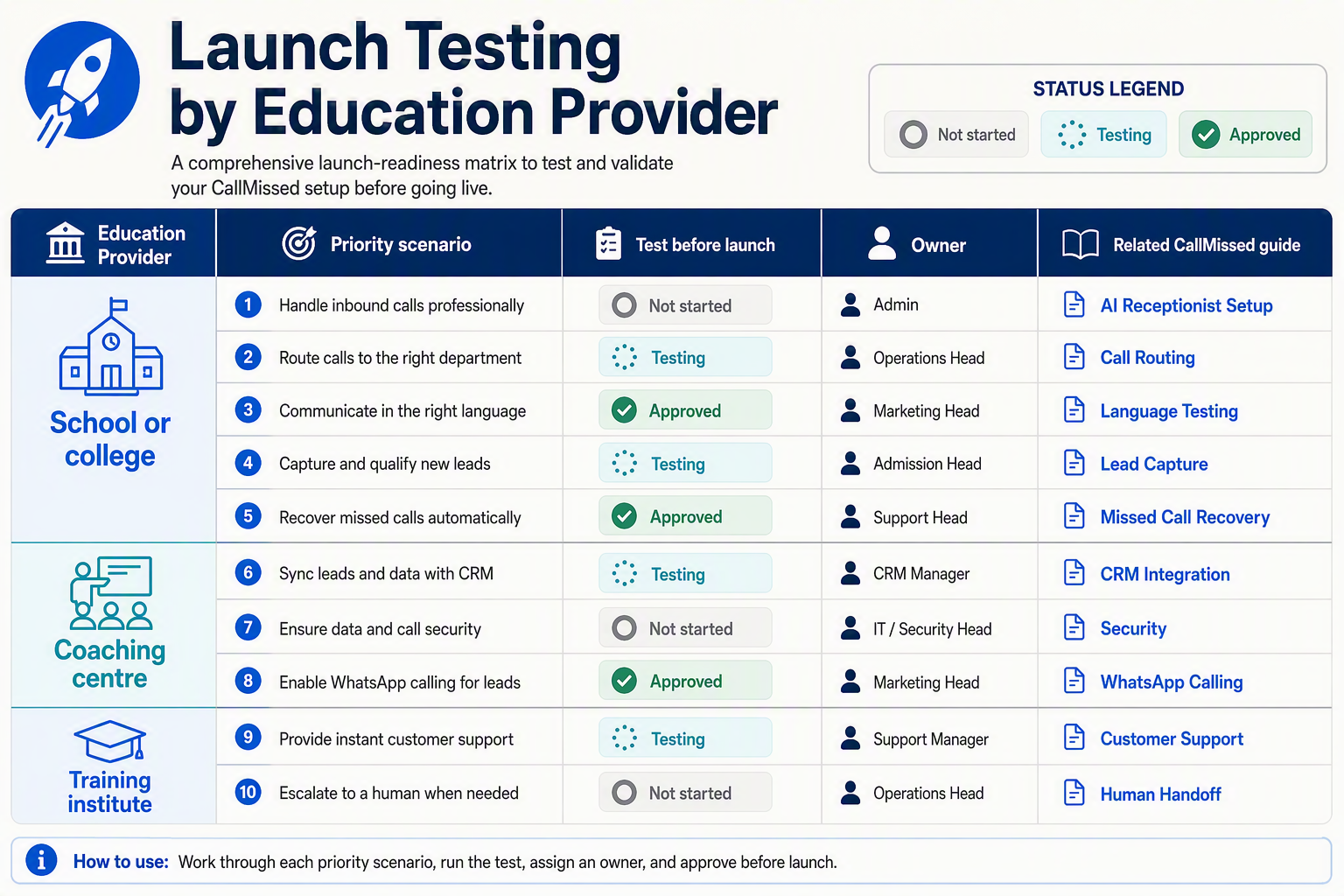
Each provider should test accuracy, multilingual recognition, consent, channel continuity, human handoff and failure recovery before admitting real enquiries. The launch standard for CallMissed for education should be simple: the system may answer approved questions and arrange next steps, but it must never make admissions decisions or invent information.
Launch acceptance matrix
| Test area | Launch scenarios | Suggested pass criteria | Supporting implementation guide |
|---|---|---|---|
| Course FAQ accuracy | Ask about fees, duration, schedules, campuses and application dates; include outdated, ambiguous and deliberately unanswerable questions. | Every factual answer matches the approved knowledge base; unsupported questions trigger clarification or human escalation rather than speculation. | Customer Support Automation Guide |
| Lead capture and continuity | Begin by phone, continue on WhatsApp and send an email confirmation; test duplicate contacts and interrupted conversations. | Name, contact details, course interest, campus or mode, consent status and preferred callback time appear in one traceable record without unnecessary sensitive data. | Phone-to-WhatsApp-to-Email Workflow and CRM Integration Guide |
| Missed-call recovery | Call after hours, disconnect before answering, decline a callback and request follow-up through another channel. | The workflow follows configured hours and permissions, avoids repeated unwanted contact and routes urgent or unclear cases to the designated queue. | Missed Call Recovery Guide |
| Languages and speech conditions | Test every enabled language with regional accents, code-switching, background noise, interruptions, names and course-specific terminology. | The agent confirms uncertain details, preserves the caller’s language preference and hands off when recognition is unreliable. CallMissed product specifications support voice interactions across 22 Indian languages. | 22 Indian Languages Testing Guide |
| Consent and safeguarding | Use parent, adult learner and possible-minor scenarios; test requests involving disability, finances, grievances, scholarships and personal documents. | The agent identifies itself as AI, records channel-specific consent, minimises collection and escalates sensitive matters without profiling or promising admission. | Security and Governance Checklist |
| Appointment and human handoff | Request, change and cancel counselling appointments; ask for a person; test unavailable counsellors and failed transfers. | The education AI receptionist states that booking does not guarantee admission, carries context into the handoff and offers a callback when live transfer fails. | Human Handoff Guide and Call Routing Guide |
Run a controlled launch sequence
Use a staged process rather than switching on every course, language and channel simultaneously:
- Create a fixed test set covering common FAQs, unknown questions, corrections, silence, interruptions and explicit requests for a counsellor.
- Have authorised staff verify responses against current prospectuses, fee notices, calendars and campus information.
- Test channel permissions independently. Consent to receive an email does not automatically establish permission for a WhatsApp message or business-initiated call.
- Pilot with one programme or campus, review transcripts and escalation records, then expand only after correcting recurring errors.
- Assign an owner and review date to each knowledge-base article so that changed fees, deadlines or schedules do not remain live indefinitely.
For WhatsApp voice deployment, the WhatsApp Business Calling Setup and Consent Guide covers inbound and business-initiated calling controls. The 2026 AI Receptionist Setup Guide provides the broader configuration sequence.
The final approval for admissions enquiry automation should come from admissions, counselling, safeguarding and technical owners—not from a successful demo alone. Keep test evidence, consent records, failed-answer samples and handoff outcomes so the workflow can be audited and improved after launch.
Frequently Asked Questions: Can CallMissed decide admissions, answer course FAQs, qualify leads, use multiple languages, send follow-ups, and transfer to staff?
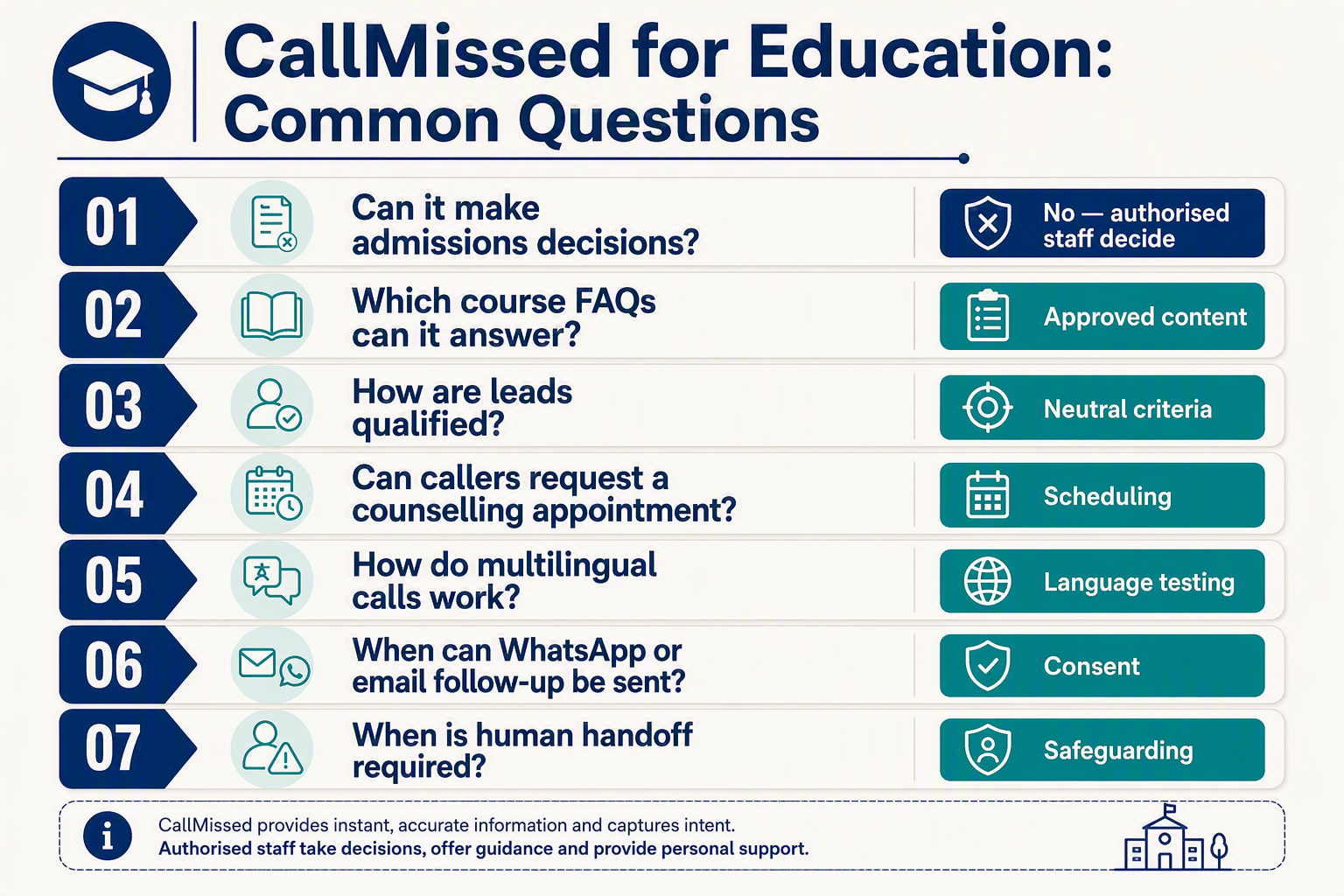
Can CallMissed for education automatically approve or reject student admissions?
Can an education AI receptionist answer questions about courses, fees and class schedules?
How does admissions enquiry automation qualify prospective students without making admission decisions?
Can CallMissed speak to parents and students in multiple Indian languages?
Can CallMissed send WhatsApp or email follow-ups after an admissions enquiry or missed call?
Can CallMissed transfer an admissions caller to a counsellor or staff member?
Conclusion
CallMissed for education can make admissions communication faster and more consistent without transferring admissions authority to AI. The safest model uses an education AI receptionist to handle approved information and administrative steps, while trained staff retain control of eligibility, safeguarding and every admissions decision.
Key takeaways include:
- Use admissions enquiry automation for published course FAQs, neutral lead qualification, missed-call recovery and counselling appointment requests—not merit assessment or admission promises.
- Connect voice, WhatsApp, email and web conversations so counsellors receive the relevant history during human handoff.
- Disclose AI use, obtain appropriate follow-up consent and minimise collected data, particularly when an enquiry may involve a minor.
- Test all 22 supported Indian languages required by the institution, including accents, interruptions, uncertain answers and escalation requests.
The Ministry of Education’s UDISE+ 2023–24 report counted about 24.8 crore students across nearly 14.7 lakh Indian schools, underscoring the scale and linguistic diversity that admissions teams must serve.
Looking ahead, institutions should watch whether automation improves response times and appointment completion without increasing incorrect answers, unnecessary data collection or failed handoffs. Knowledge bases, consent language and routing rules will require ongoing review.
To prepare for this shift, explore CallMissed, a platform combining multilingual voice agents, WhatsApp automation and omnichannel workflows—and ask: which repetitive enquiry could your team automate safely while keeping counsellors firmly in control?
Related Reading
Related Posts



Ready to automate customer conversations?
Launch AI voice agents and WhatsApp bots with CallMissed — one API, 22+ Indian languages.