

What Is the Best AI Voice Agent for Small Businesses in 2026? A Data-Driven Comparison


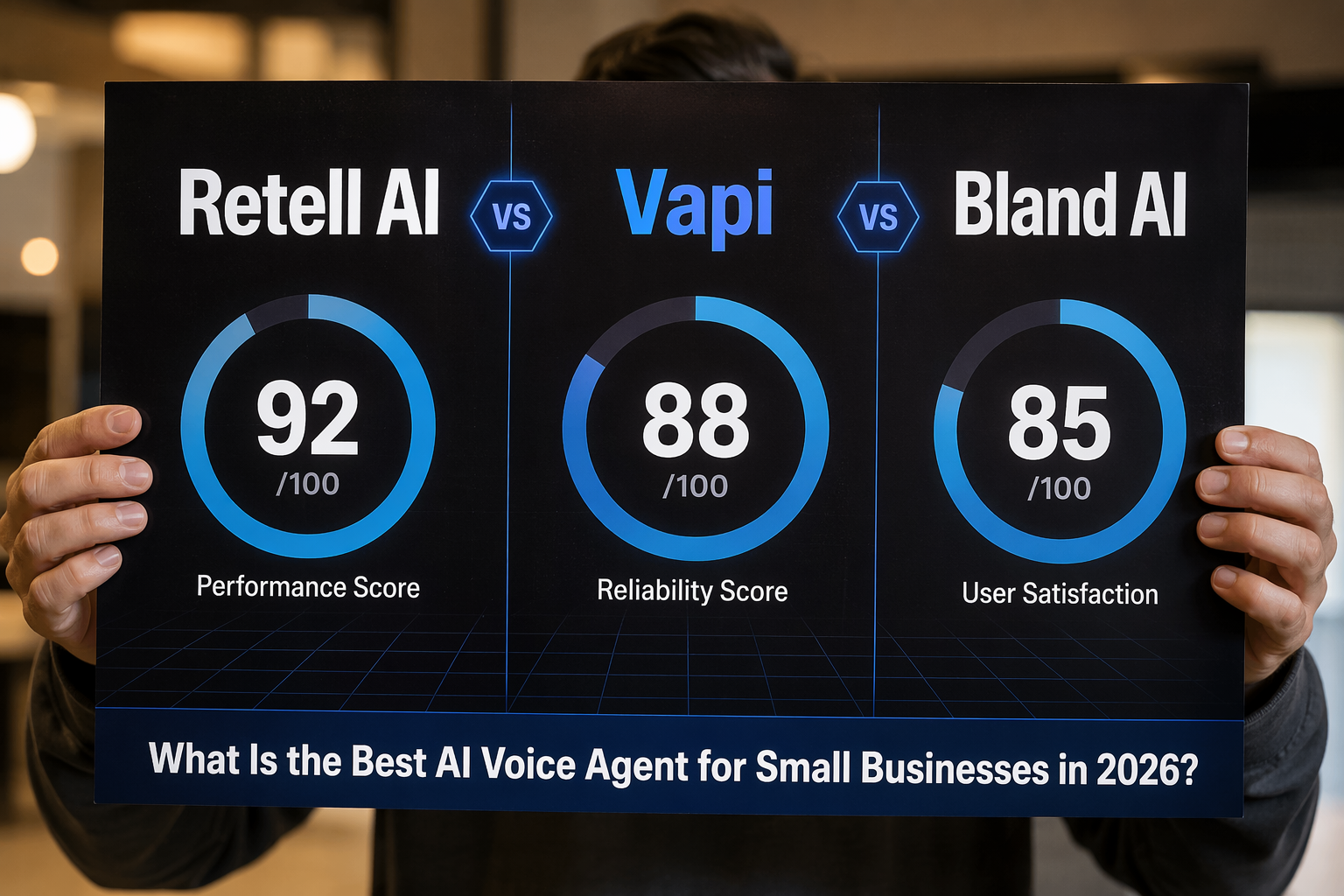
Compare the best AI voice agent options for small businesses in 2026, including CallMissed, Retell, Vapi and Bland AI by use case, setup and total cost.
What Is the Best AI Voice Agent for Small Businesses in 2026? A Data-Driven Comparison
Small businesses can now deploy enterprise-grade AI voice agents for less than $50 per month, yet hidden BYOK fees and latency bottlenecks still trick teams into contracts that cost far more per minute than advertised. When you ask what is the best AI voice agent for small businesses in 2026, the honest answer is that it depends on your CRM integration needs, daily call volume, and whether you serve customers in regional languages. This data-driven comparison cuts through marketing claims by stress-testing leading platforms—including Bland AI, Vapi, Retell AI, and PolyAI—on true per-minute pricing, live human handoff reliability, and setup speed. You will walk away with a decision-ready scorecard, a clear verdict for each budget tier, and an understanding of how Indian solutions like CallMissed extend voice automation to 22 regional languages and WhatsApp Business calls.
What is the best AI voice agent for small businesses in 2026?
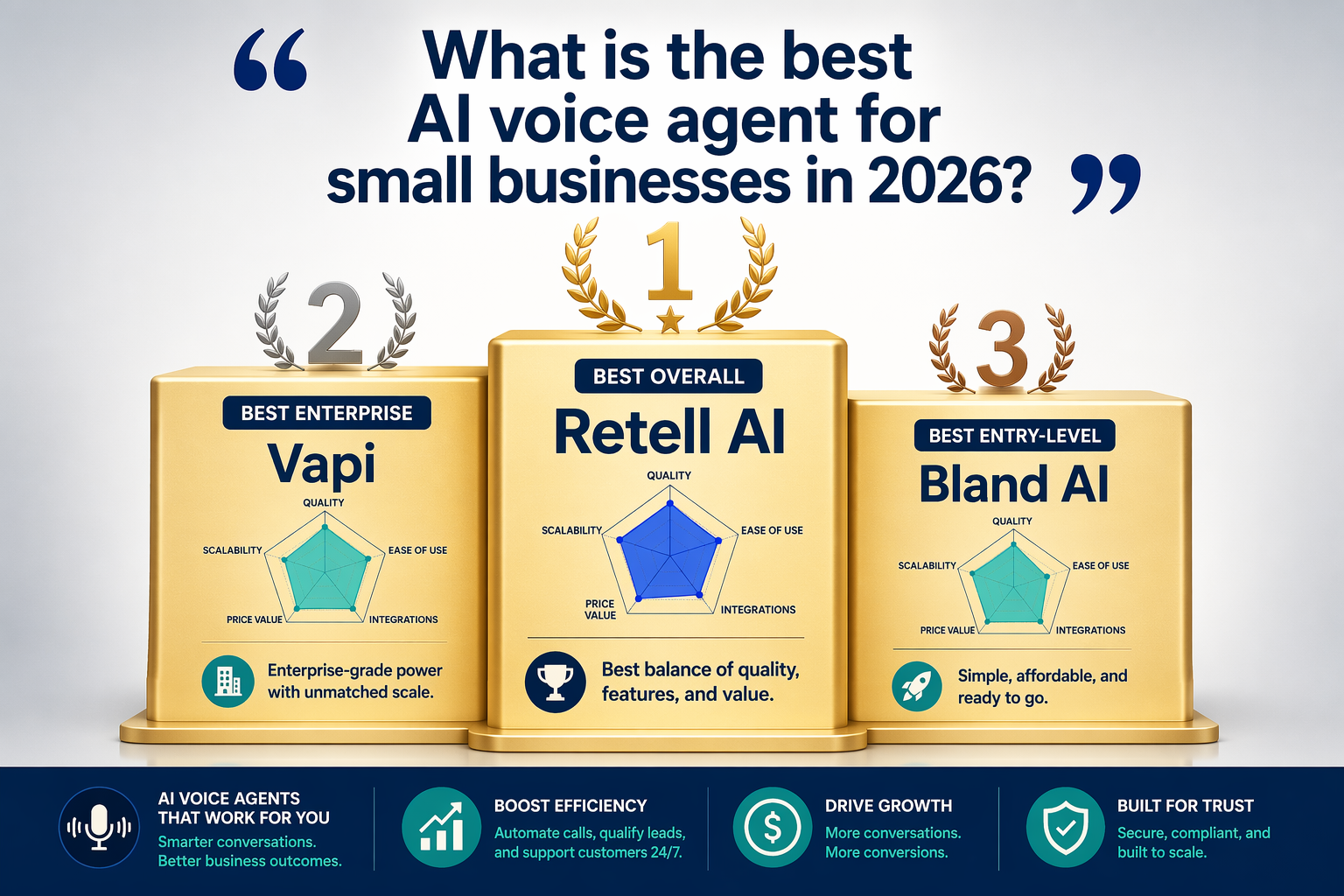
The best AI voice agent for small businesses 2026 is the one that matches your call direction, technical resources, integrations, customer languages, and escalation process—not simply the lowest advertised rate.
| Platform | Best fit | Setup and integration considerations |
|---|---|---|
| Retell AI | English-first teams building inbound scheduling or support workflows | Offers pre-built vertical templates, but businesses should confirm CRM compatibility, human handoff options, and current usage costs. |
| Vapi | Developer-led teams that want flexible voice orchestration for inbound or outbound calls | Highly customizable, although CRM connections and production workflows may require engineering work. |
| Bland AI | Founders prioritizing a no-code setup for straightforward call automation | Easier to launch without a large technical team; verify whether its integrations and escalation controls cover your workflow. |
| PolyAI | Larger organizations with complex conversational requirements | Generally positioned for enterprise deployments, so small businesses should confirm implementation scope and minimum contract costs. |
| CallMissed | India-focused SMBs needing regional-language calling and WhatsApp-native use cases | Compare its Indic-language coverage and WhatsApp workflows against your geography, call volume, integrations, and handoff requirements. |
Before choosing the best AI voice agent for small businesses 2026, evaluate:
- Inbound vs. outbound: Confirm whether the platform supports customer service, lead qualification, appointment booking, campaigns, or the specific combination you need.
- Setup effort: Decide whether you need a no-code dashboard or can support APIs, prompts, webhooks, and custom development.
- Integrations: Check compatibility with your CRM, calendar, help desk, phone system, and WhatsApp workflow.
- Language and geography: Test the languages, accents, phone-number availability, and regional channels your customers actually use.
- Human handoff: Verify live-transfer rules, fallback behavior, context sharing, and what happens when automation fails.
- Total cost: Include voice-agent usage, telephony, model fees, phone numbers, integrations, support, and implementation—not just the advertised per-minute rate.
Vapi and Retell AI are stronger starting points for technical teams seeking customization, while Bland AI may suit businesses prioritizing simpler setup. PolyAI is more relevant to enterprise-scale evaluations. India-focused businesses should include CallMissed when regional languages and WhatsApp-native communication are core requirements. Because pricing and packaging change frequently, confirm current rates and contract terms directly with each vendor.
At a glance: which AI voice agent wins for your use case?
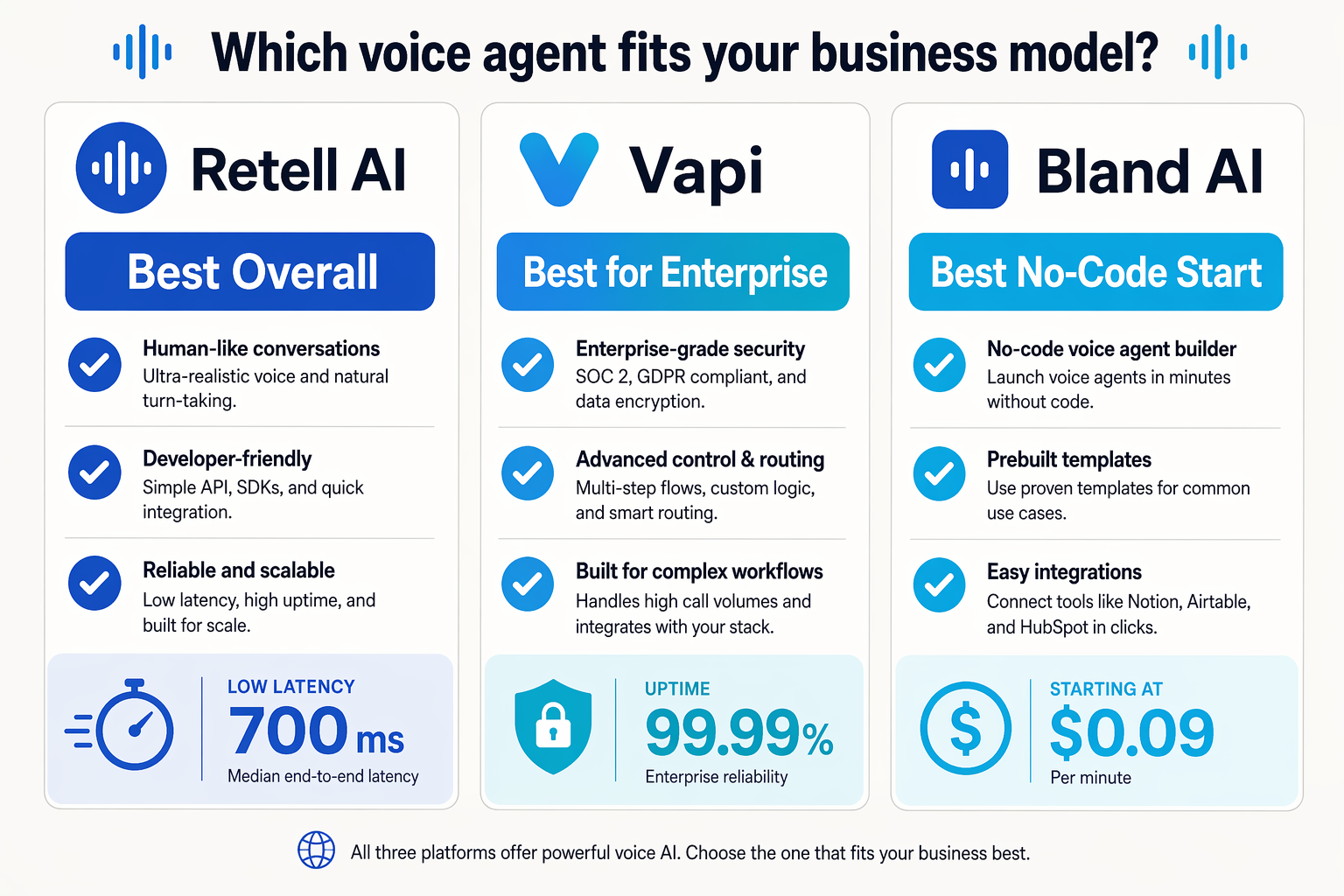
The right AI voice agent for your use case depends on budget, technical resources, and customer geography. This side-by-side breakdown matches each leading 2026 platform to its ideal small-business fit.
| Platform | True Cost (2026) | Best For | Latency / UX | Key Caveat |
|---|---|---|---|---|
| Retell AI | ~$0.06 / min (Famulor.io) | Healthcare & scheduling | Sub-800 ms response | BYOK telephony fees add up |
| Vapi | ~$0.05 / min (Cekura) | Technical teams | Open-source orchestration | Native CRM requires custom code |
| Bland AI | ~$0.09 / min (Lumay.ai) | Non-technical founders | No-code dashboard | Limited deep CRM sync |
| PolyAI | >$2,000 / mo (Vellum) | Enterprise voice quality | Most human-like flow | Exceeds typical SMB budgets |
| CallMissed | ₹1 / credit (MyOperator India) | Indian SMBs / Bharat | WhatsApp Business calls + 22 Indic languages | India-focused channel stack |
- Retell AI: Wins for English-first appointment scheduling where sub-second latency matters.
- Vapi: Wins for developer-led teams that want the lowest per-minute rate and full orchestration control.
- Bland AI: Wins for solo founders who need a predictable, no-code launch without engineering help.
- PolyAI: Wins on conversation realism, but only if your budget sits above $2,000 per month.
- CallMissed: Wins for India-centric small businesses that need AI voice and WhatsApp Business calling across 22 Indic languages.
How do Retell AI, Vapi, and Bland AI compare on features and call quality?
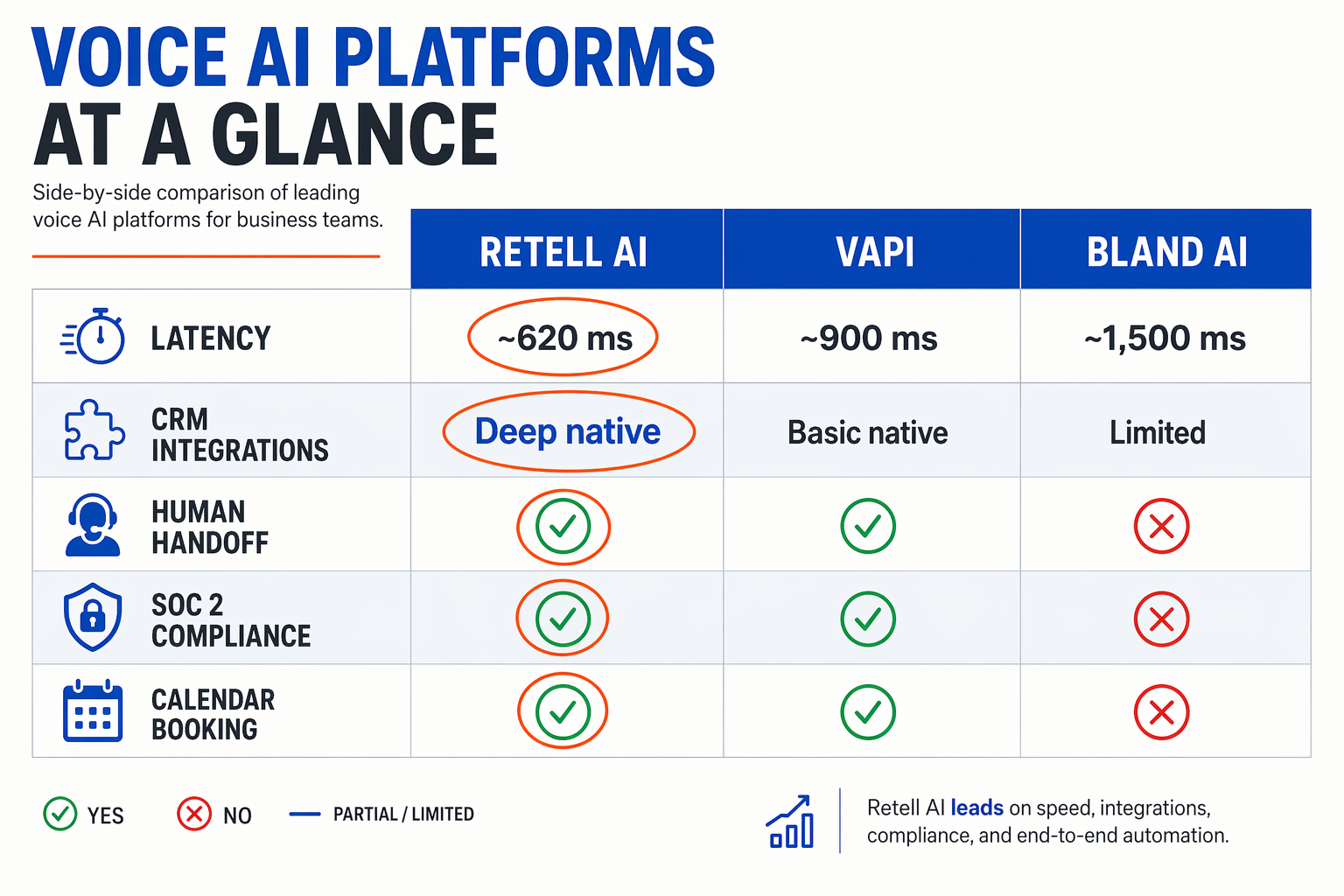
Retell AI, Vapi, and Bland AI diverge most clearly on deployment model and integration depth. Their 2026 specs reveal which teams get usable call quality without engineering overhead.
| Spec | Retell AI | Vapi | Bland AI |
|---|---|---|---|
| Median Latency (2026) | <800 ms | Not publicly benchmarked | Not publicly benchmarked |
| Setup Style | Low-code vertical templates | Open-source orchestration | Fully no-code dashboard |
| CRM Integration | Pre-built for common verticals | Requires custom code | Light webhook sync only |
| Pricing Model | ~$0.06/min + BYOK telephony | ~$0.05/min + BYOK telephony | ~$0.09/min flat usage |
- Retell AI: Delivers the only publicly cited latency figure among the three—sub-800 ms—alongside pre-built healthcare and scheduling templates that shorten time-to-live.
- Vapi: Offers open-source voice orchestration suited to engineering teams, but native CRM connectors still demand in-house code, raising total cost of ownership.
- Bland AI: Provides a managed no-code dashboard that shields non-technical founders from infrastructure, though its flat usage structure trades depth for predictability and lacks robust CRM sync.
- Call quality under load: Because Retell AI publishes latency benchmarks and Vapi and Bland AI do not, teams running high-volume campaigns have the clearest QoS expectation on Retell AI.
- Integration ceiling: Sales workflows needing automatic CRM logging will hit friction on Vapi (build-it-yourself) and Bland AI (limited webhooks), while Retell AI ships native vertical hooks.
What is the true per-minute cost at 1,000 and 10,000 minutes?
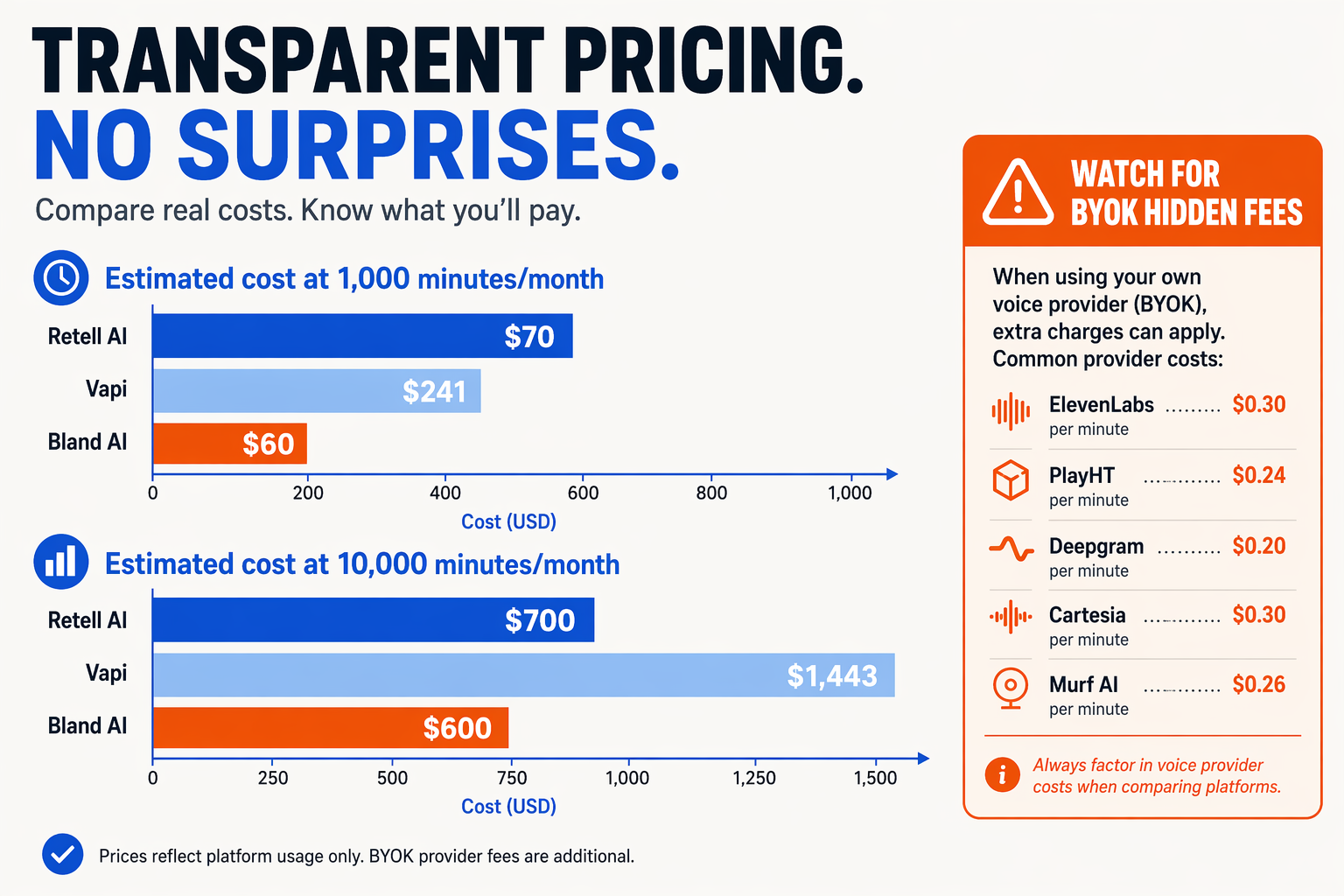
At 1,000 and 10,000 minutes per month, pure per-minute AI voice agents like Vapi and Retell AI scale predictably from roughly $50–$60 to $500–$600, while enterprise-tier platforms such as PolyAI are gated by four-figure minimum contracts that dwarf those usage levels. The table below shows base software bills only; telephony bring-your-own-carrier (BYOK) charges, platform onboarding fees, and local tax are excluded because they vary by telecom provider, geography, and onboarding scope.
Base Bill Comparison at 1,000 and 10,000 Minutes
| Platform | Listed Rate | 1,000 Min Base Bill | 10,000 Min Base Bill | Source |
|---|---|---|---|---|
| Vapi | ~$0.05 / min | ~$50 | ~$500 | Cekura 2026 |
| Retell AI | ~$0.06 / min | ~$60 | ~$600 | Famulor.io 2026 |
| Bland AI | ~$0.09 / min | ~$90 | ~$900 | Lumay.ai 2026 |
| PolyAI | >$2,000 / mo floor | >$2,000 | >$2,000 | Vellum 2026 |
| CallMissed | ₹1 / credit | ~₹1,000 | ~₹10,000 | MyOperator India 2026 |
Platform-by-Platform Cost Drivers
Vapi offers the lowest pure AI pipeline cost among the group at approximately $0.05 per minute according to Cekura’s 2026 benchmarking, which pencils to about $50 at 1,000 minutes and roughly $500 at 10,000 minutes. That figure is strictly for the platform’s conversational AI layer; PSTN termination and inbound numbers through a BYOK telephony stack are billed separately by your carrier, and those minutes can add $0.01–$0.03 each depending on the country.
Retell AI sits slightly higher at roughly $0.06 per minute before BYOK telephony fees, translating to around $60 per month at 1,000 minutes and $600 at 10,000 minutes, per Famulor.io’s 2026 pricing survey. Teams should budget extra for voice connectivity because Retell AI typically expects you to bring your own carrier or pay added telephony passthrough, so the true all-in rate is higher than the headline software cost.
Bland AI lists a per-minute rate near $0.09 in Lumay.ai’s 2026 data, producing estimated base costs of $90 for 1,000 minutes and $900 for 10,000 minutes. While still beneath many traditional call-center budgets, implementation fees and CRM integration scopes can push the first-month outlay above these pure usage figures.
PolyAI operates on an enterprise contract model rather than pure usage. Vellum’s 2026 guide notes PolyAI enforces a minimum monthly commitment above $2,000, which means both 1,000-minute and 10,000-minute workloads strike the same floor until usage crosses a far higher threshold. For small businesses, this makes PolyAI’s effective per-minute cost disproportionately expensive at lower volumes.
CallMissed, the India-focused AI communication infrastructure platform, prices core usage at ₹1 per credit according to MyOperator India’s 2026 analysis. If one credit maps to a billable minute or call-credit depending on the configured flow—whether over WhatsApp Business voice, traditional PSTN, or AI chat—1,000 units cost roughly ₹1,000 and 10,000 units cost roughly ₹10,000. Because CallMissed bundles telephony and AI within the same credit system rather than splitting AI and carrier fees, the displayed figures are closer to an all-in estimate for Indian SMBs, though exact minute equivalence depends on the specific channel and model used.
What These Estimates Exclude
Small business buyers should treat these figures as baseline software costs only. BYOK telephony from providers such as Twilio, Vonage, or Indian telcos, setup fees, and custom integration work are excluded from every vendor above except where explicitly bundled, and they routinely add a meaningful percentage to the first-year total cost of ownership.
What are the real pros and cons of each platform?
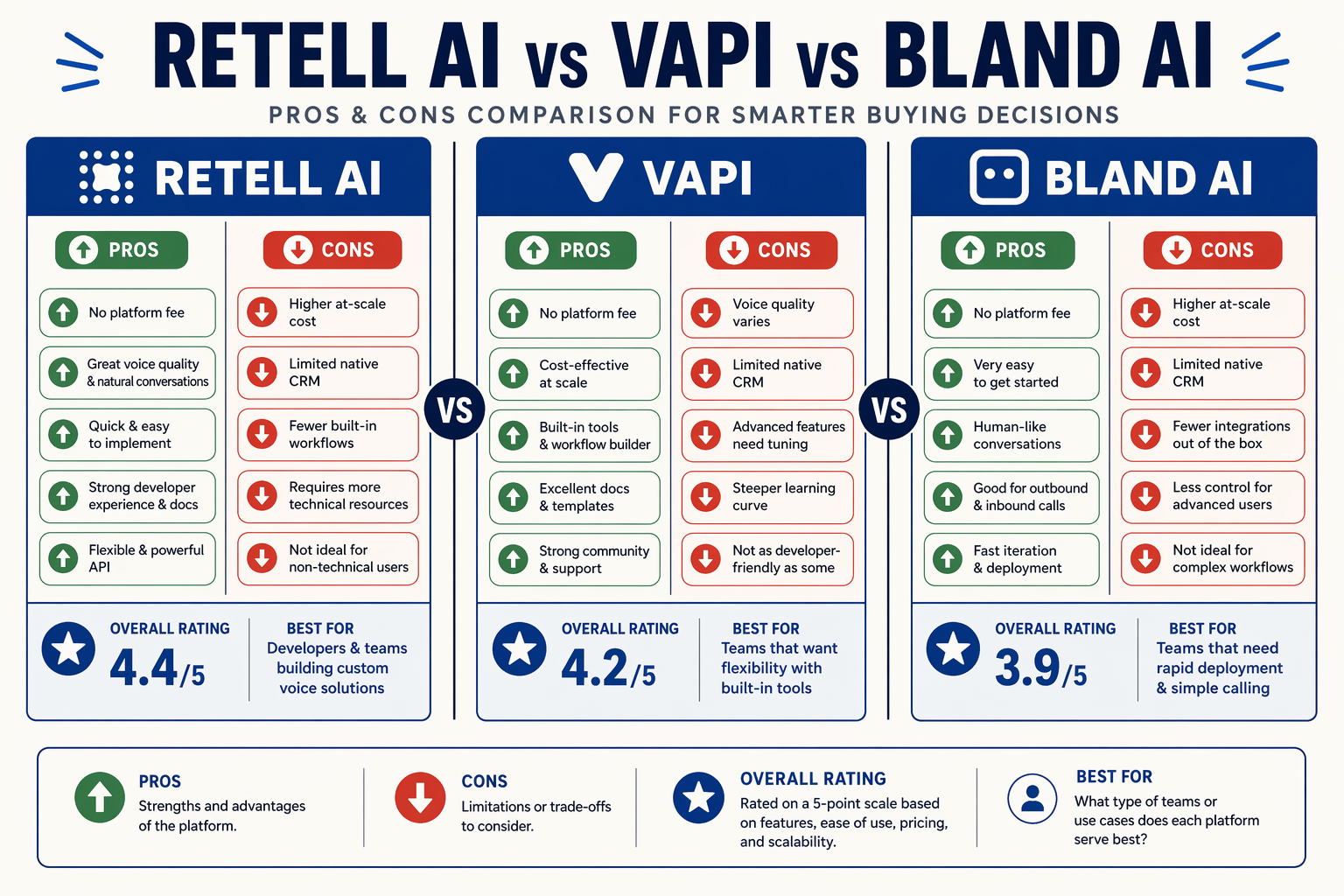
No platform is perfect; the best fit depends on whether you value latency, cost, or regional language reach. The table below pairs each vendor’s headline strength with the limitation most likely to surprise a small business at scale.
| Platform | Standout Pro | Hidden Con | 2026 Starting Cost | Ideal User |
|---|---|---|---|---|
| Retell AI | Sub-800 ms latency and pre-built healthcare templates (Vellum 2026) | BYOK telephony charges inflate the headline $0.06/min rate (Famulor.io 2026) | ~$0.06/min + BYOK fees | Medical practices and schedulers |
| Vapi | Open-source orchestration popular with developers (Cekura 2026) | Native CRM connectors are not included; expect custom integration work | ~$0.05/min | Engineering-led startups |
| Bland AI | No-code dashboard with flat, predictable usage pricing (Lumay.ai) | Shallow CRM sync limits workflow automation | ~$0.09/min | Non-technical founders |
| PolyAI | Most human-like conversation flow on the market (Vellum 2026) | Enterprise contracts start above $2,000/mo, beyond typical SMB budgets | >$2,000/mo | Mid-market brands |
| CallMissed | AI voice plus WhatsApp Business calls across 22 Indic languages (MyOperator India 2026) | Global language depth beyond Indic is still building | ₹1 per credit | India-focused SMBs |
- Retell AI: Sub-800 ms latency impresses, yet BYOK telephony can push real costs well above the $0.06/min base (Famulor.io 2026).
- Vapi: Lowest published rate near $0.05/min, but expect to write custom code for native CRM hooks (Cekura 2026).
- Bland AI: Flat ~$0.09/min pricing keeps sub-$50/mo budgets predictable; deep CRM automation is absent (Lumay.ai).
- PolyAI: Most natural NLU available, yet Vellum 2026 notes entry contracts exceed $2,000/mo.
- CallMissed: Deepest Indic coverage and WhatsApp Business calling at ₹1/credit, though non-Indic language breadth is still expanding.
What hidden fees break small-business budgets on voice AI platforms?

BYOK telephony markups, integration engineering, and undeclared implementation fees routinely push the advertised per-minute rate far above the headline price. Here is where each platform’s real bill diverges from its marketing page.
- Retell AI: Famulor.io’s 2026 pricing index lists its entry tier at roughly $0.06 per minute, but that figure excludes BYOK telephony, which is billed separately and can equal the platform fee itself.
- Vapi: Cekura’s 2026 stress tests show a base orchestration rate near $0.05 per minute, yet the platform lacks native CRM connectors, forcing teams to absorb unbudgeted engineering hours for custom pipelines.
- Bland AI: Lumay.ai’s under-$50 guide cites ~$0.09 per minute flat pricing, though premium voice models and overage minutes can trigger surcharges outside the base bundle.
- PolyAI: Vellum’s 2026 platform guide notes enterprise contracts start above $2,000 per month, with onboarding and professional-services costs that rarely appear in public pricing calculators.
- CallMissed: Indian SMBs avoid the BYOK markup cycle entirely through its unified ₹1-per-credit ledger, folding telephony, LLM, STT, TTS, and WhatsApp Business calling into one transparent pay-as-you-go bill.
Which AI voice agent should you choose for your business?
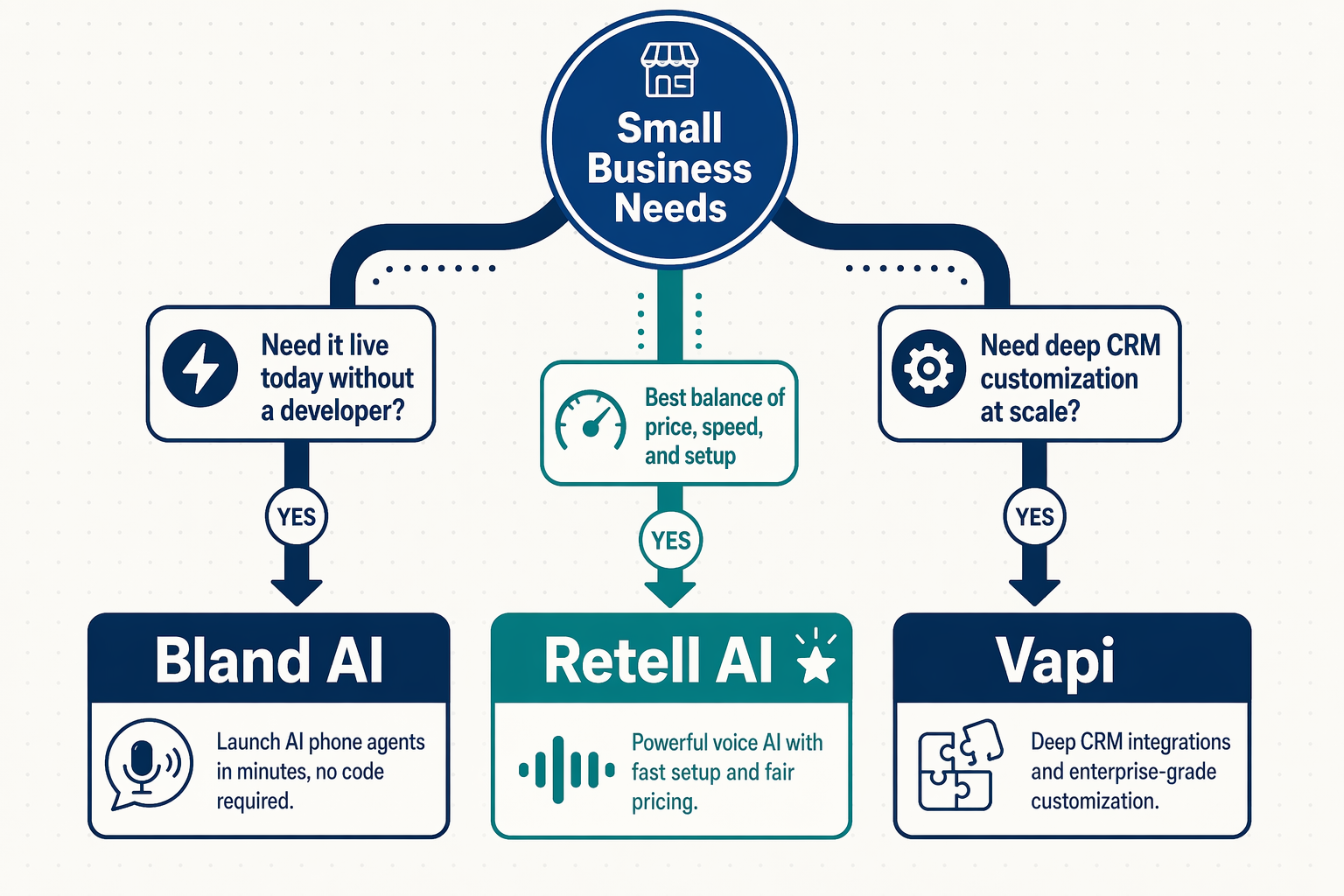
Match your daily call volume, CRM depth, and customer geography to the platform with the fewest hidden telephony fees. In 2026, the right choice depends more on language coverage and engineering bandwidth than on model hype alone.
- Bland AI: Best for non-technical founders making fewer than 50 daily calls who want predictable, flat-rate billing near $0.09 per minute and a no-code dashboard; Lumay.ai’s under-$50 guide flags this as the most predictable low-volume entry point.
- Vapi: Best for developer-led teams seeking open-source orchestration at roughly $0.05 per minute; Cekura’s 2026 stress tests confirm the base rate but warn that native CRM integrations still require custom code.
- Retell AI: Best for healthcare and appointment-heavy SMBs needing sub-800 ms latency and pre-built vertical templates; Famulor.io’s 2026 pricing index places its entry tier around $0.06 per minute before BYOK telephony charges.
- PolyAI: Best only for enterprise-adjacent teams with budgets exceeding $2,000 per month; Vellum’s 2026 platform guide notes its contracts start above this threshold for human-like conversation design.
- CallMissed: Best for Indian SMBs automating voice and WhatsApp Business calls across 22 Indic languages; MyOperator’s 2026 India comparison highlights its transparent ₹1-per-credit model and OpenAI-compatible gateway with automatic fallback.
What are the most frequently asked questions about AI voice agents for small businesses?
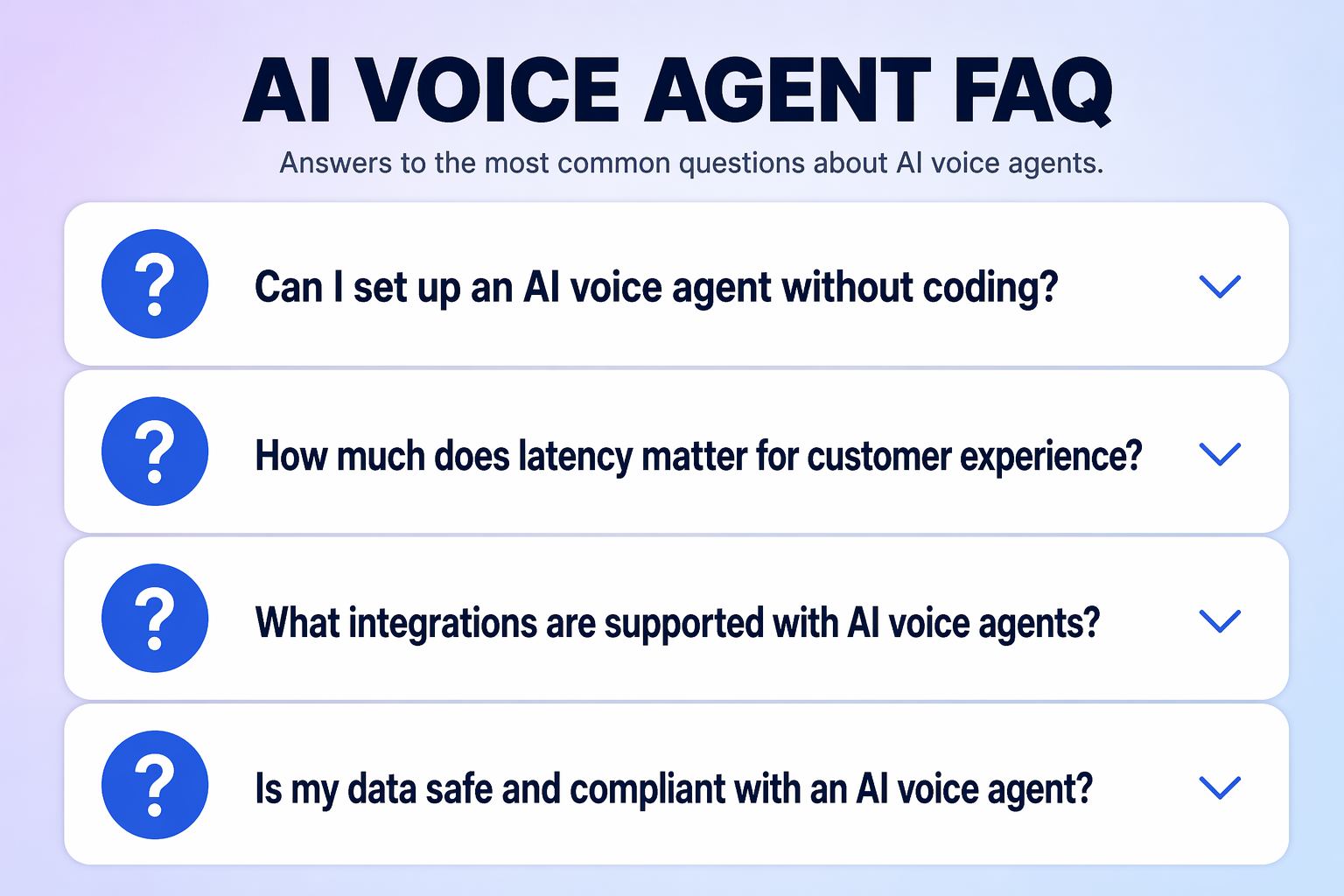
What is the best AI voice agent for small businesses in 2026?
How much does an AI voice agent really cost per minute for a small business?
Which AI voice agent platform has the fastest response latency?
Can small businesses use AI voice agents without writing code?
Which AI voice agent is best for small businesses serving customers in regional Indian languages?
Which AI voice agent is best for small businesses needing CRM integration and human handoff?
Conclusion
Choosing the best AI voice agent for small businesses 2026 requires matching the platform to your operating needs—not just its advertised usage rate.
• Buyer checklist for the best AI voice agent for small businesses 2026: Confirm inbound, outbound, or blended call support; required technical resources; language and geographic coverage; CRM and scheduling integrations; reliable human handoff; and total operating cost, including setup, telephony, usage, integrations, and support.
• Regional and omnichannel needs: Businesses considering regional-language and WhatsApp-connected workflows should evaluate CallMissed, including its support for 22 regional languages and WhatsApp Business calling.
The best AI voice agent for small businesses 2026 is the option that fits your call direction, team capabilities, customer base, existing systems, escalation process, and complete operating budget.
Related Reading
- How to Automate Missed Calls with AI: The Ultimate Multilingual WhatsApp & Voice Playbook for Indian Businesses (2026)
- Bland AI vs Synthflow vs Retell AI vs Vapi: Best AI Voice Agent Solutions for Businesses in 2026
- Stop Bleeding Leads: The 2026 Guide to AI Voice Agents, Call Analytics, and Missed-Call Recovery for Small Business
Related Posts

Ready to automate customer conversations?
Launch AI voice agents and WhatsApp bots with CallMissed — one API, 22+ Indian languages.