

Aura-2 TTS Quality Compared to ElevenLabs Turbo v3: 2026 Verification Guide


Compare Aura-2 TTS quality with ElevenLabs Turbo v3 using verified sources, honest trade-offs, and a controlled test plan for sound, speed, and value.
Aura-2 TTS Quality Compared to ElevenLabs Turbo v3: 2026 Verification Guide
Can anyone honestly declare a winner in Aura-2 TTS quality compared to ElevenLabs Turbo v3 without verified documentation or controlled audio tests? Based on the available research, no definitive quality winner can be established: authoritative Aura-2 and ElevenLabs Turbo v3 benchmark pages, pricing pages, and live search evidence were not retrieved, so any precise superiority claim would be speculative.
This matters because TTS quality is multidimensional: a voice that sounds excellent in narration may perform poorly in a real-time agent because of latency, streaming behavior, pronunciation, or consistency. This source-first guide separates what is verified from what still needs testing, then provides a repeatable head-to-head method using identical scripts, multiple voices, difficult names, numbers, accents, emotional prompts, interruptions, and repeated renders. You’ll also find feature and pricing tables, workload-specific recommendations, and a conditional verdict for narration, customer support, multilingual delivery, and production-scale use.
Which sounds better: Aura-2 or ElevenLabs Turbo v3?
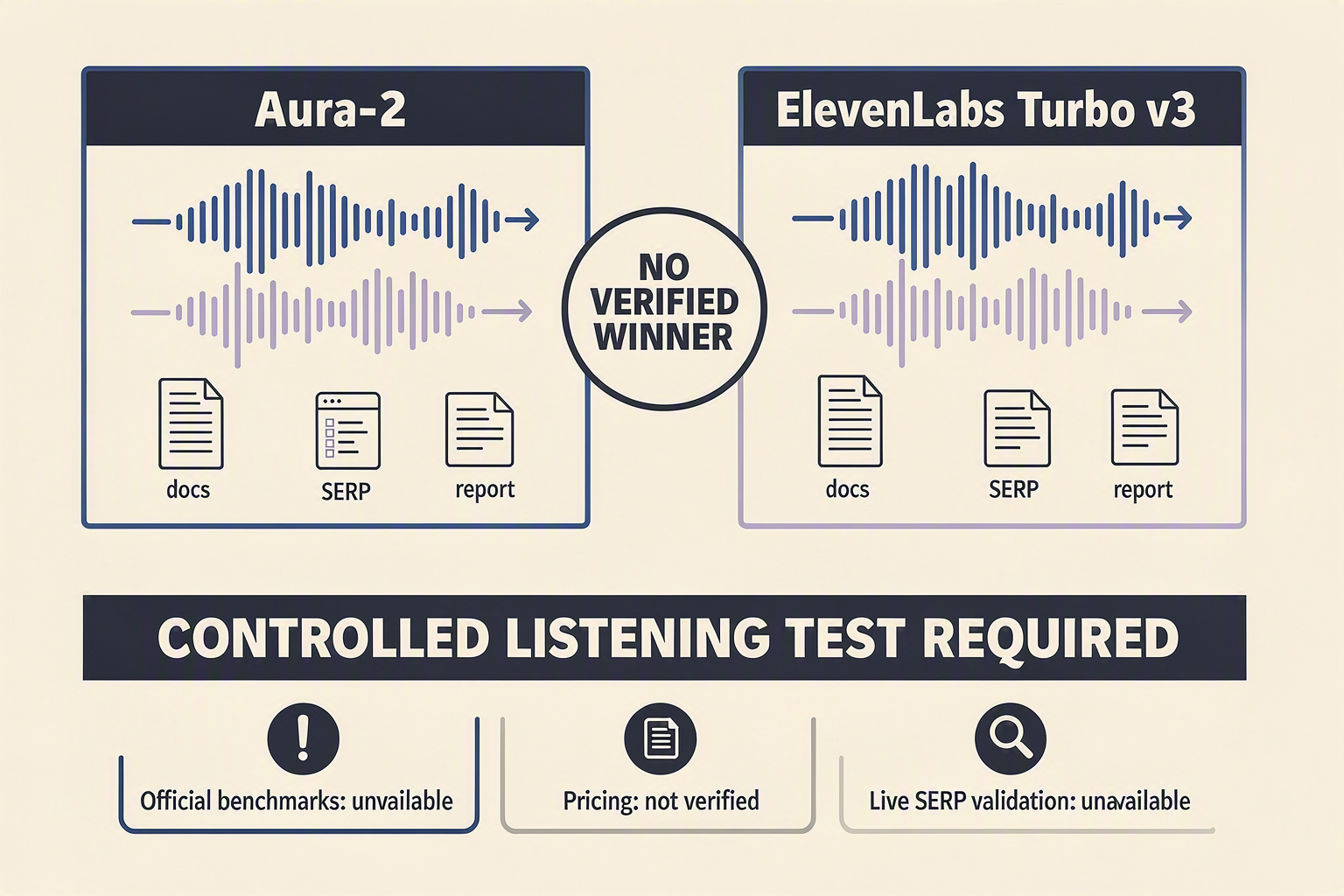
The available research does not support a definitive quality winner between Aura-2 and ElevenLabs Turbo v3. No authoritative model documentation, benchmark pages, pricing pages, or live search results were retrieved in the supplied research, so a controlled listening and API test is required before declaring either system better.
What should you compare in a TTS quality test?
Compare both systems using the same scripts, voice direction, output format, and relevant sampling or generation settings wherever each platform allows. Do not judge quality from isolated promotional samples; test the conditions in which the speech will actually be used.
- Naturalness: Does the speech sound human over short and extended passages, or does pacing become mechanical?
- Intelligibility: Can listeners understand every word at normal playback speed, including in phone-quality audio?
- Pronunciation: Include names, acronyms, abbreviations, currencies, dates, decimals, phone numbers, technical terms, and words with multiple accepted pronunciations. Score pronunciation accuracy separately from general clarity.
- Prosody: Check whether pauses, stress, rhythm, pitch movement, and sentence endings match the meaning of the text.
- Emotion and instruction-following: Use neutral narration, empathetic support, urgency, and persuasive explanation. Record whether emotional delivery sounds controlled rather than exaggerated.
- Artifacts and stability: Listen for clicks, distortions, skipped words, unnatural breaths, abrupt pitch changes, or inconsistent volume.
Use multiple voices and text styles where possible. A voice that performs well in narration may not be the right choice for customer support, IVR, or an AI agent.
How should you test real-time performance?
Subjective audio quality and API performance are separate evaluation dimensions. Measure time to first audio, complete-response latency, streaming smoothness, interruption handling, and recovery when a speaker cuts in. A system can sound better in a prepared narration sample while another is more suitable for real-time conversation because it responds sooner or handles barge-in more cleanly.
Run the same conversational exchange through both APIs, including:
- A user interruption during the first response.
- A correction or follow-up that changes the requested answer.
- A long response delivered through streaming audio.
- Repeated requests using the same voice and instructions.
Repeat each relevant render and compare pronunciation, pacing, pauses, emotional intensity, and audio artifacts. Consistency matters for IVR, support automation, and high-volume production.
Which model should you choose?
Choose the measured winner for the workload rather than assuming a universal champion. Long-form narration should prioritize sustained naturalness and expressive control; voice agents should prioritize latency, streaming, and interruption recovery; multilingual deployments should test the required languages and accents directly. Production teams should also verify controls, reliability, usage limits, and current pricing from each provider’s authoritative documentation.
The defensible conclusion is therefore test first, then choose: the supplied evidence cannot establish whether Aura-2 or ElevenLabs Turbo v3 sounds better overall. A result supported by identical scripts, recorded settings, listener scores, API measurements, and workload-specific requirements would be more reliable than an unsupported benchmark or reputation-based claim.
What can the available evidence actually prove about this TTS comparison?
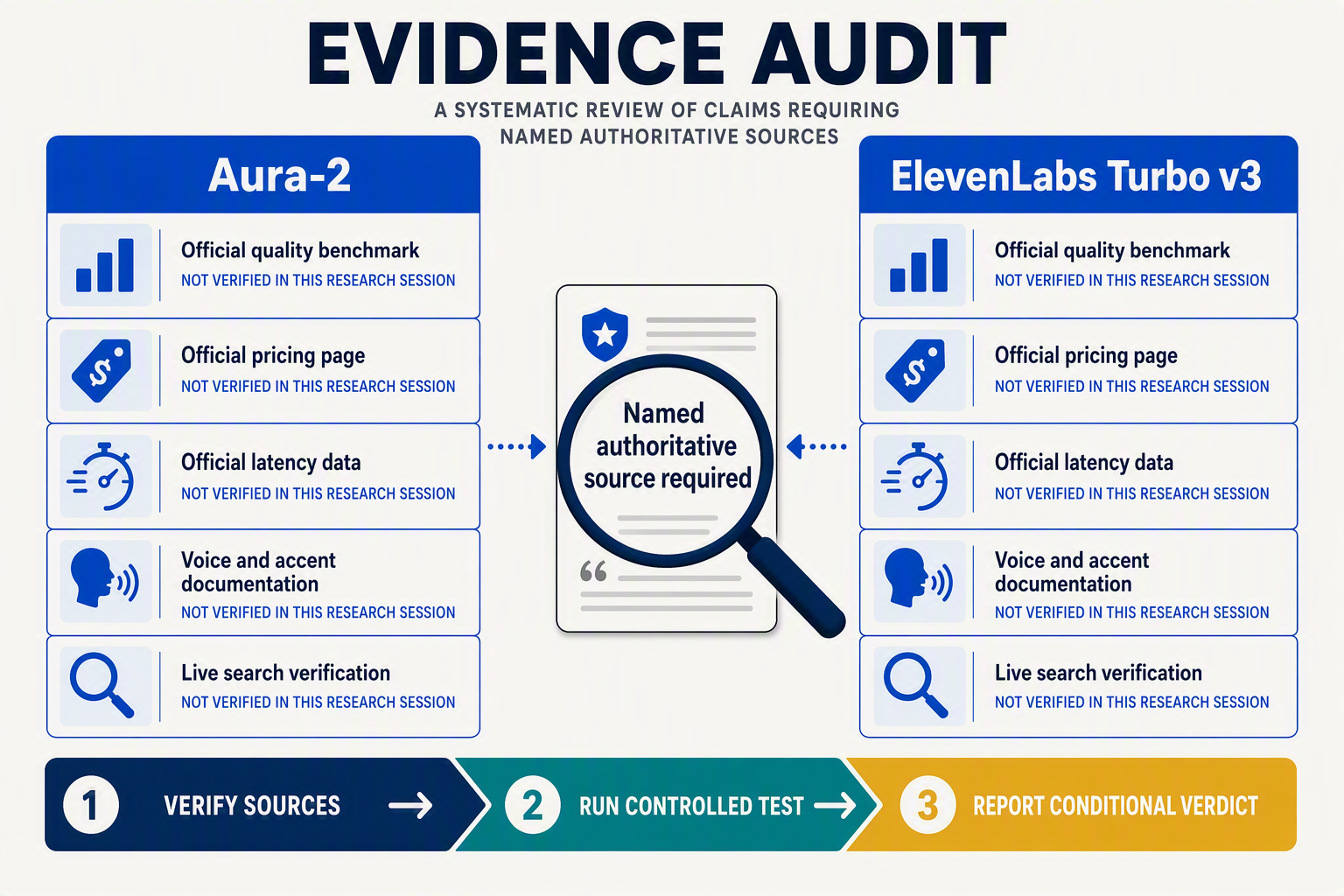
The available evidence does not establish a definitive Aura-2 or ElevenLabs Turbo v3 quality winner. The supplied research retrieved no authoritative model documentation, benchmark pages, pricing pages, or live search results for either system, so a controlled audio and API test remains necessary.
Evidence boundary
- Aura-2: Naturalness, pronunciation, prosody, emotional control, artifacts, latency, streaming behavior, and consistency remain unverified against Turbo v3.
- ElevenLabs Turbo v3: A general reputation for natural speech cannot prove superiority for every workload, especially real-time agents, IVR, or multilingual support.
- What the evidence can prove: Only that no defensible head-to-head conclusion is available from the supplied research; unsupported claims about voice quality, speed, voice count, language coverage, or price should be treated as speculation.
- What a fair test requires: Use identical scripts, matched output formats, equivalent settings, and multiple voices; test neutral narration, expressive delivery, conversational exchanges, and repeated renders.
- Text coverage: Include proper names, acronyms, Indian and international place names, currencies, dates, decimals, phone numbers, abbreviations, and words with multiple pronunciations.
- Separate scores: Rate naturalness, intelligibility, pronunciation accuracy, prosody, emotional control, audio artifacts, time to first audio, complete-response latency, interruption handling, and consistency independently.
- Evidence that could change the verdict: Verified vendor documentation, reproducible benchmark data, authoritative pricing, and blinded listening tests across narration, customer support, voice agents, multilingual delivery, and high-volume production.
How do Aura-2 and Turbo v3 compare across TTS quality features? (TABLE)
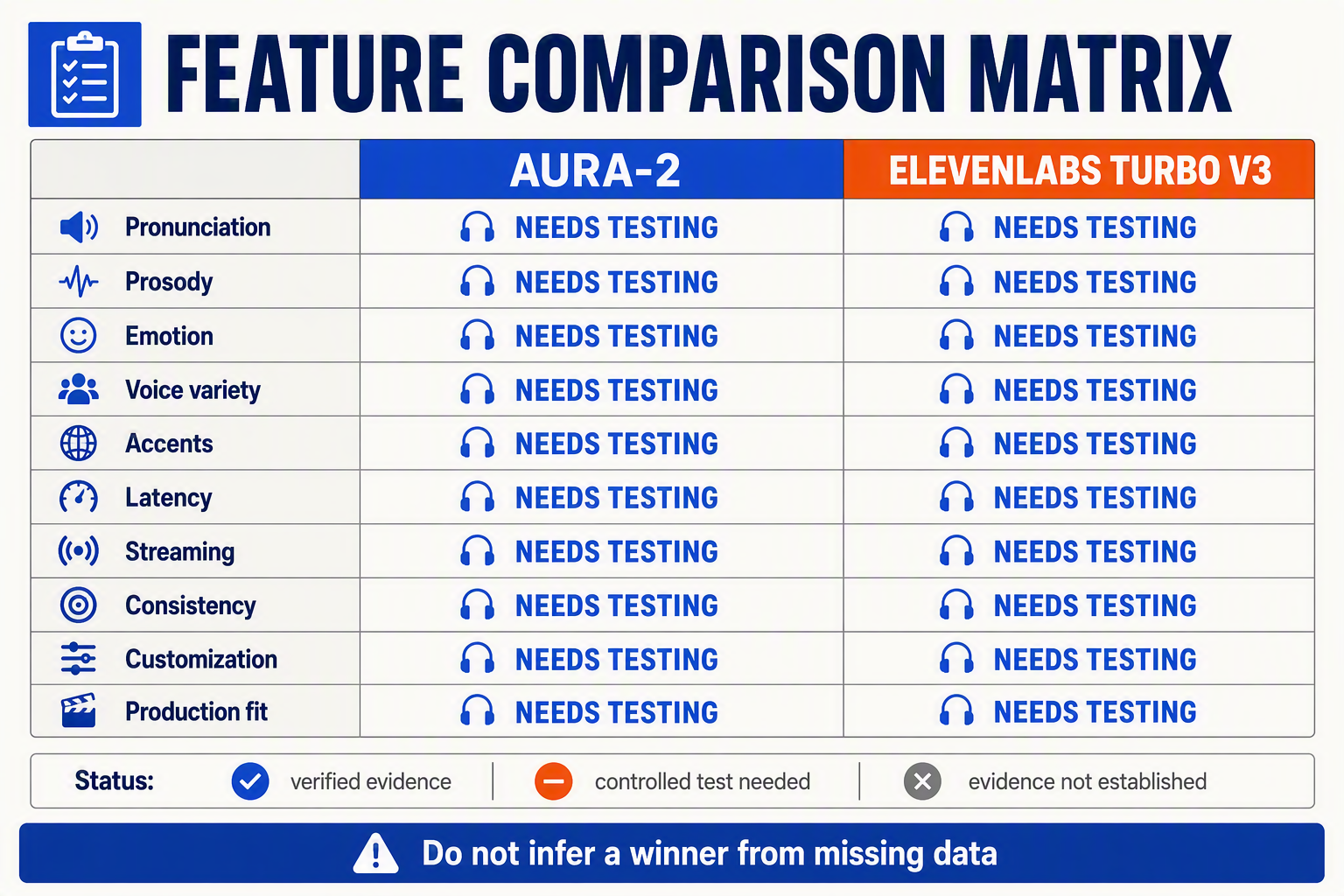
The available research does not establish a definitive TTS quality winner between Aura-2 and ElevenLabs Turbo v3. No authoritative Aura-2 or Turbo v3 benchmark, documentation, pricing page, or live search result was retrieved in the supplied research, so a controlled, matched audio test is required before choosing either model.
Which TTS quality features should you compare?
The table separates documented evidence from hypotheses that require measurement. “Not established” means the supplied research does not support a conclusion; “Not verified” means the relevant product detail was not confirmed; and “Needs testing” identifies a result that must be measured with identical inputs.
| Quality dimension | Aura-2 | ElevenLabs Turbo v3 | Source-first status | Recommended verification |
|---|---|---|---|---|
| Pronunciation | Not established | Not established | Needs testing | Test names, acronyms, abbreviations, numbers, dates, currencies, and phone numbers |
| Prosody | Not established | Not established | Needs testing | Compare pauses, emphasis, rhythm, sentence-final intonation, and long-form pacing |
| Emotion | Not established | Not established | Needs testing | Render neutral, urgent, empathetic, persuasive, and apologetic scripts |
| Voice variety | Not verified | Not verified | Not verified | Confirm current voice catalogs, voice types, licensing, and language availability |
| Accents | Not verified | Not verified | Needs testing | Use matched regional and international samples, including Indian English where relevant |
| Consistency | Not established | Not established | Needs testing | Repeat identical renders and score pronunciation drift, timing changes, and artifacts |
| Latency | Not verified | Not verified | Needs testing | Measure time to first audio, complete-response latency, and interruption recovery |
| Streaming | Not verified | Not verified | Needs testing | Check chunk delivery, continuity, buffering, and behavior during user barge-in |
| Customization | Not verified | Not verified | Needs testing | Compare controls for voice instructions, style, speed, pronunciation, and pauses |
| Production fit | Not established | Not established | Needs testing | Evaluate quality, reliability, controls, observability, and cost for the target workload |
What does this comparison mean in practice?
- Aura-2: The supplied research contains no verified evidence establishing an advantage in naturalness, pronunciation, latency, voice variety, or production readiness.
- ElevenLabs Turbo v3: A positive reputation or isolated demonstration is not a substitute for controlled evidence across pronunciation, prosody, emotion, artifacts, and repeatability.
- Subjective quality and API performance are separate: One model may sound more natural in narration, while another may suit a real-time agent because of measured latency, streaming behavior, interruption handling, or controls.
- Production fit is workload-specific: Long-form narration, conversational voice agents, IVR, customer support, multilingual delivery, and high-volume generation should be evaluated separately rather than with one overall score.
A fair test should use identical scripts, matched output formats and sampling settings where each API permits, multiple voices, neutral and expressive instructions, difficult proper nouns, multilingual or accented text, conversational interruptions, and repeated renders. Score naturalness, intelligibility, pronunciation accuracy, prosody, emotional control, artifacts, latency, streaming stability, and consistency as separate dimensions.
Until authoritative sources or reproducible measurements are available, the defensible verdict is not established for both models. Choose only after testing the model against the actual voices, languages, latency targets, and failure tolerance required by the production workload.
How much do Aura-2 and Turbo v3 cost, and can their value be compared? (TABLE)
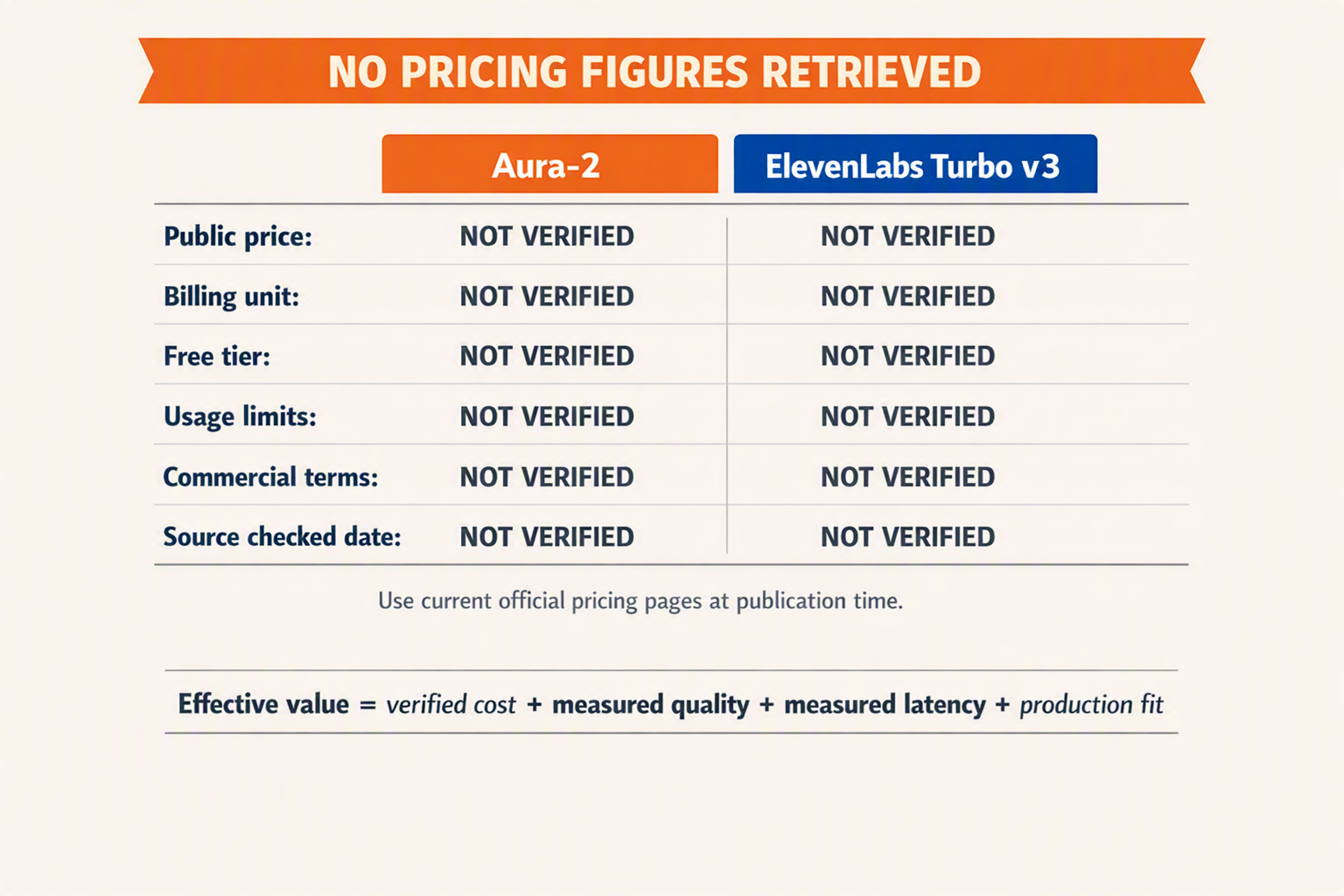
Aura-2 and ElevenLabs Turbo v3 cannot be compared defensibly on price or value from the supplied research. No authoritative Aura-2 or Turbo v3 pricing figures, billing units, or latency benchmarks were retrieved, so the correct verdict is “not verified” until both models are tested against the same workload.
What is verified about Aura-2 and Turbo v3 pricing?
The table below preserves the available evidence without treating estimates, third-party claims, or plan-level prices as model-specific costs.
| Comparison point | Aura-2 | ElevenLabs Turbo v3 | Value implication | Source status |
|---|---|---|---|---|
| Public price | Not verified | Not verified | No defensible per-character, per-minute, or per-request comparison | No named authoritative pricing source retrieved |
| Billing unit | Not verified | Not verified | Confirm whether billing uses characters, tokens, seconds, requests, or another unit | No named authoritative API source retrieved |
| Free allowance | Not verified | Not verified | Prototype economics cannot be calculated without confirmed quotas and limits | No named authoritative pricing source retrieved |
| Overage or regional billing | Not verified | Not verified | Production cost may vary by usage tier, currency, region, or account plan | No named authoritative pricing source retrieved |
| Effective production cost | Not verified | Not verified | Measure successful output, retries, regeneration, and unused audio | Requires a controlled API test |
| Latency-related value | Not verified | Not verified | Faster first audio may matter more for agents than for long-form narration | No authoritative benchmark retrieved |
- Aura-2: Do not assign a per-character, per-minute, or per-request price unless an official Aura-2 pricing or API document is available at publication time.
- ElevenLabs Turbo v3: Do not convert an ElevenLabs subscription or plan price into Turbo v3’s effective unit cost without confirming model availability, included quotas, overage rules, output format, and regional billing.
How should you compare total cost?
Calculate cost per successful interaction, rather than relying only on an advertised generation rate. Include:
- Audio generated for approved output, failed requests, retries, and regenerated passages
- Long pauses, interruptions, discarded audio, and unused streamed output
- Storage, orchestration, monitoring, and telephony charges where applicable
- Engineering or editorial time required to fix pronunciation, prosody, artifacts, or inconsistent renders
For an India-focused workflow using a platform such as CallMissed, keep gateway, voice-model, telephony, and messaging charges as separate line items. This prevents an AI-infrastructure bill from being incorrectly presented as Aura-2 or Turbo v3’s native model price.
What is the recommended pricing test?
- Render identical scripts with matched audio formats, sample rates, voices, and settings wherever the APIs permit.
- Record time to first audio, full-response latency, generated duration, request failures, and retry counts.
- Repeat each script to measure consistency and calculate the cost per approved minute or completed call.
- Label every result with the model version, test date, region, currency, settings, and named source.
- Report quality-adjusted cost separately from raw generation cost.
A lower nominal rate is not automatically better value if the output requires more corrections. The verdict should change only when official pricing documentation and reproducible measurements for quality, latency, reliability, and failure rates are available.
What are the honest pros and cons of Aura-2 versus Turbo v3? (TABLE)
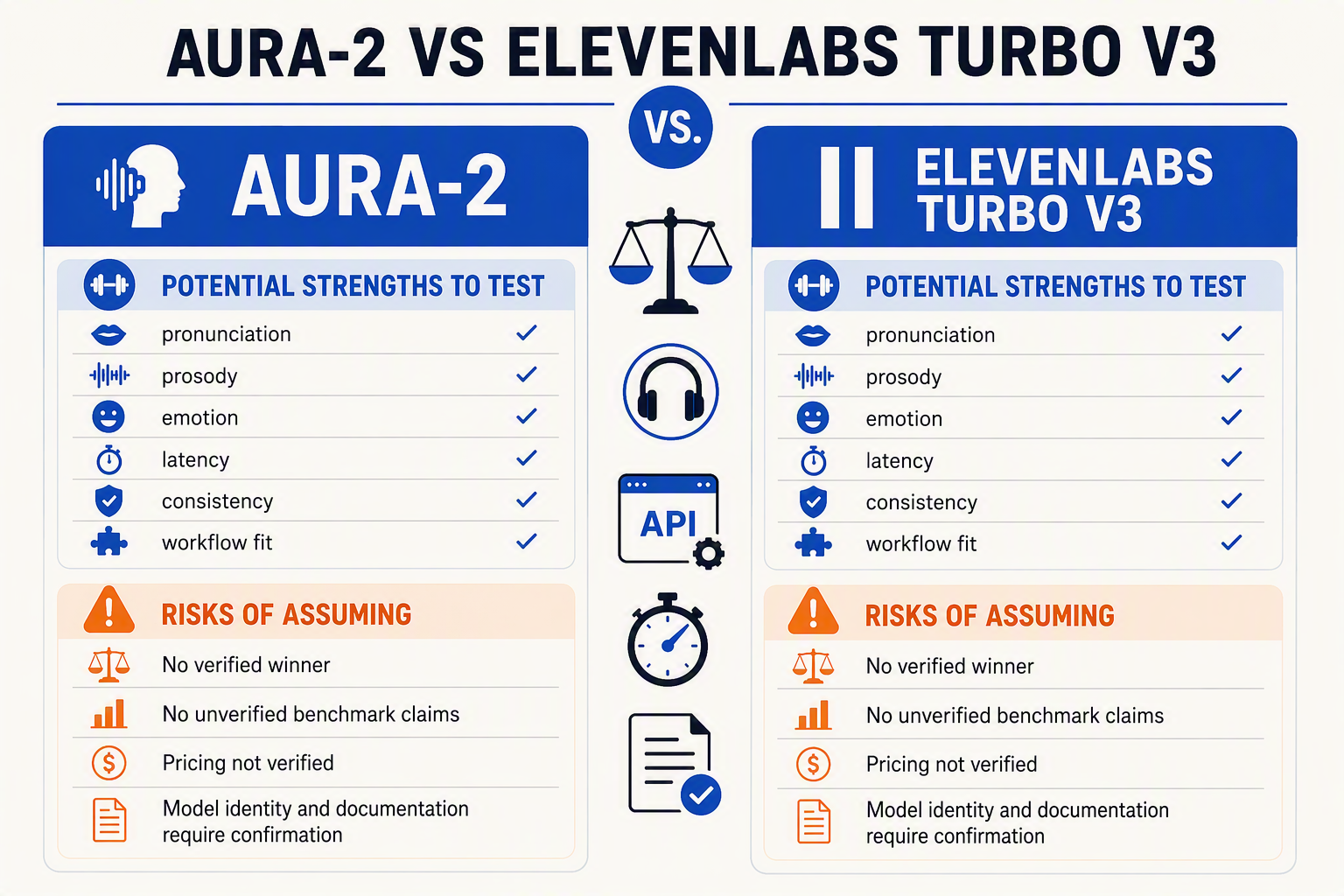
The available research does not establish a definitive quality winner between Aura-2 and ElevenLabs Turbo v3. The honest conclusion is conditional: both require controlled audio testing across the dimensions below before selection.
| Quality dimension | Aura-2 | ElevenLabs Turbo v3 | Evidence status |
|---|---|---|---|
| Naturalness | Not verified from supplied research | Not verified from supplied research | Controlled listening test required |
| Pronunciation | Needs testing with names, acronyms, dates, and numbers | Needs testing with the same text | No authoritative benchmark retrieved |
| Prosody and emotion | Needs testing across neutral, urgent, and empathetic prompts | Needs testing across identical prompts | No comparable evidence retrieved |
| Voice variety and accents | Not established | Not established | Verify current documentation and samples |
| Latency and streaming | Not verified | Not verified | Measure time to first audio and interruption recovery |
| Consistency | Repeat-render stability needs testing | Repeat-render stability needs testing | Run identical prompts multiple times |
| Production fit | Depends on measured quality, controls, and cost | Depends on measured quality, controls, and cost | Workload-specific decision |
- Aura-2: May be suitable if controlled tests show strong pronunciation, stable delivery, and acceptable real-time behavior; no supplied evidence proves those outcomes.
- Turbo v3: Should not be declared faster or more natural without verified latency measurements and matched audio comparisons.
- Narration: Prioritize naturalness, prosody, emotional control, and long-form consistency rather than assuming a real-time model is best.
- Voice agents and IVR: Measure time to first audio, streaming smoothness, interruption handling, and recovery after user cut-ins.
- Multilingual delivery: Test each required language or accent separately; performance in one language cannot establish performance across others.
- Pricing: No authoritative Aura-2 or Turbo v3 pricing figures were retrieved in the supplied research, so cost-based claims remain unverified.
- Decision rule: Choose the model with the higher task-specific score after identical scripts, matched output settings, difficult text, and repeated renders—not the model with the stronger reputation.
Which model should you choose for narration, agents, IVR, multilingual delivery, or scale?
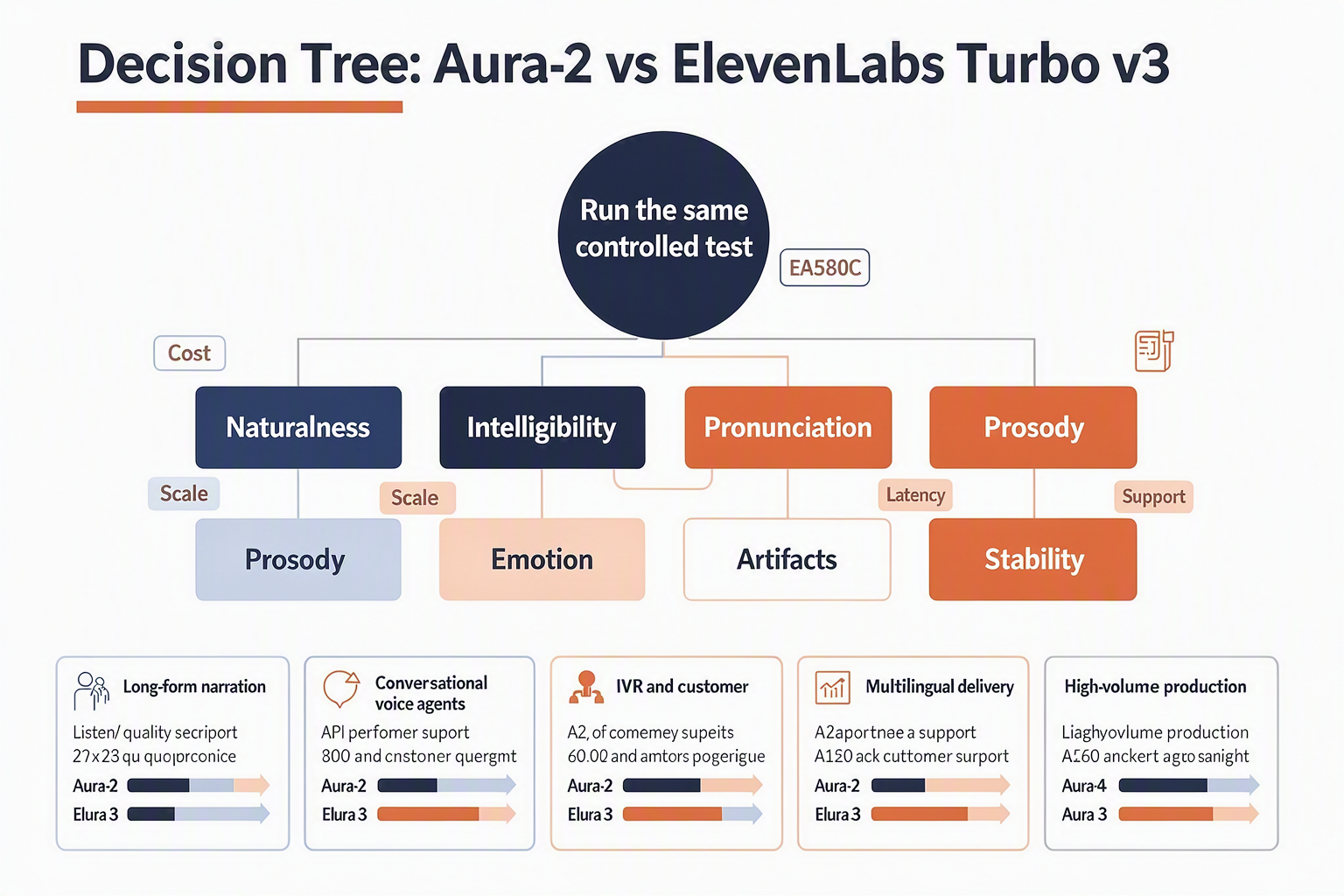
The available research does not establish a definitive quality winner between Aura-2 and ElevenLabs Turbo v3. Choose only after a controlled test measures both audio quality and API behavior against your workload; no authoritative Aura-2 or Turbo v3 benchmark, pricing, or latency figures were retrieved in the supplied research.
Practical choice by workload
- Long-form narration: Prefer the model that scores higher on naturalness, sustained prosody, character consistency, and artifact rate across repeated chapters—not the model with the most impressive isolated demo.
- Conversational voice agents: Choose the system with lower measured time to first audio, smooth streaming, reliable turn-taking, and fast interruption recovery. A narration-quality winner may still be the weaker agent platform.
- IVR and customer support: Prioritize intelligible pronunciation of names, account numbers, dates, currencies, acronyms, and phone numbers, plus consistent delivery across short prompts and repeated calls.
- Multilingual delivery: Test every target language and accent separately; do not infer multilingual quality from English samples. For Indian-language deployments, platforms such as CallMissed support voice and chat across 22 Indian languages, providing a relevant benchmark for regional customer engagement.
- High-volume production: Compare verified per-character or per-minute pricing, concurrency limits, failure rates, fallback behavior, and output consistency. Aura-2 and Turbo v3 pricing remains not verified from the supplied research, so no cost winner can be stated.
- Decision rule: Select Aura-2 if it wins your weighted score for the required voices, languages, latency, and cost; select Turbo v3 if it does. Record model version, date, voice ID, settings, and test outputs so the decision remains reproducible.
What do readers still ask about Aura-2 TTS quality compared to ElevenLabs Turbo v3?
- Q: Which model sounds more natural, Aura-2 or ElevenLabs Turbo v3?
A: Available evidence does not establish a winner. Compare both models with identical scripts and evaluate pronunciation, prosody, emotion, artifacts, and consistency across repeated renders.
- Q: Which model has lower latency?
A: No verified head-to-head latency result is available. Measure time to first audio, total generation time, streaming stability, and recovery after interruptions under identical network and output conditions.
- Q: Which TTS model is better for conversational AI agents?
A: Neither can be declared better without workload-specific testing. For voice agents, test turn-taking, barge-in recovery, short-response naturalness, pronunciation of customer data, and performance during long sessions.
- Q: Is Aura-2 or ElevenLabs Turbo v3 better for narration?
A: The available research does not prove narration superiority. Run separate tests for long-form pacing, expressive range, paragraph transitions, pronunciation, and voice consistency; narration results should not be generalized to live agents.
- Q: How should multilingual quality be tested?
A: Use native listeners and matched scripts for every target language and accent. Include names, places, dates, currencies, acronyms, code-switching, and difficult phonemes, then record pronunciation errors and consistency across repeated generations.
- Q: How does Aura-2 pricing compare with ElevenLabs Turbo v3?
A: No verified price comparison is available here. Check each provider’s current official pricing for character or usage charges, plan limits, streaming fees, voice-related costs, and overage rules before estimating production cost.
- Q: How do I run a blind listening test for Aura-2 and ElevenLabs Turbo v3?
A: Generate the same scripts with comparable voices and settings, normalize audio loudness and format, randomize unlabeled samples, and ask listeners to score naturalness, intelligibility, pronunciation, prosody, and preference. Keep latency and cost results separate from listening scores.
Conclusion
The evidence supports a conditional verdict: available research does not establish whether Aura-2 or ElevenLabs Turbo v3 delivers higher TTS quality. Only controlled, identical tests can separate perception from measurable API performance.
- Compare pronunciation, prosody, emotion, latency, streaming, artifacts, and consistency—not naturalness alone.
- Treat narration, voice agents, IVR, multilingual delivery, and production scale as separate workloads.
- Regard pricing and benchmark claims as unverified until authoritative sources are available.
Watch for published documentation, reproducible benchmarks, and real-world audio tests that could change this verdict. To explore how AI communication is evolving, visit CallMissed, an AI infrastructure platform for voice agents and multilingual chatbots. Which result would matter most for your workload?
Related Reading
Related Posts
Ready to automate customer conversations?
Launch AI voice agents and WhatsApp bots with CallMissed — one API, 22+ Indian languages.