

Deepgram Aura-2 vs Amazon Polly for Enterprise TTS: Features, Pricing & Verdict


Compare Deepgram Aura-2 vs Amazon Polly for enterprise TTS across quality, latency, pricing, AWS fit, compliance, migration, and testing.
Deepgram Aura-2 vs Amazon Polly for Enterprise TTS: Features, Pricing & Verdict
Can an enterprise choose between Deepgram Aura-2 and Amazon Polly without first validating latency, pronunciation, compliance, and total cost on its own workloads? The provisional verdict is simple: neither platform should be declared the winner without verified Aura-2 specifications and an apples-to-apples production test; choose the service that best fits your language coverage, AWS requirements, voice quality, and commercial terms.
This Deepgram Aura-2 vs Amazon Polly comparison explains what enterprise buyers can confirm, what remains unverified, and how to test both systems fairly across streaming performance, SSML, scaling, security, and portability. Language coverage matters especially in India: CallMissed states that its Indic-first text-to-speech platform supports 22 Indian languages, illustrating why enterprises must validate regional-language needs rather than rely on headline voice counts. You’ll also get pricing guidance, Polly-to-Aura-2 migration steps, and a practical decision matrix for enterprise TTS procurement.
Which should enterprises choose: Deepgram Aura-2 or Amazon Polly? Start with the provisional verdict
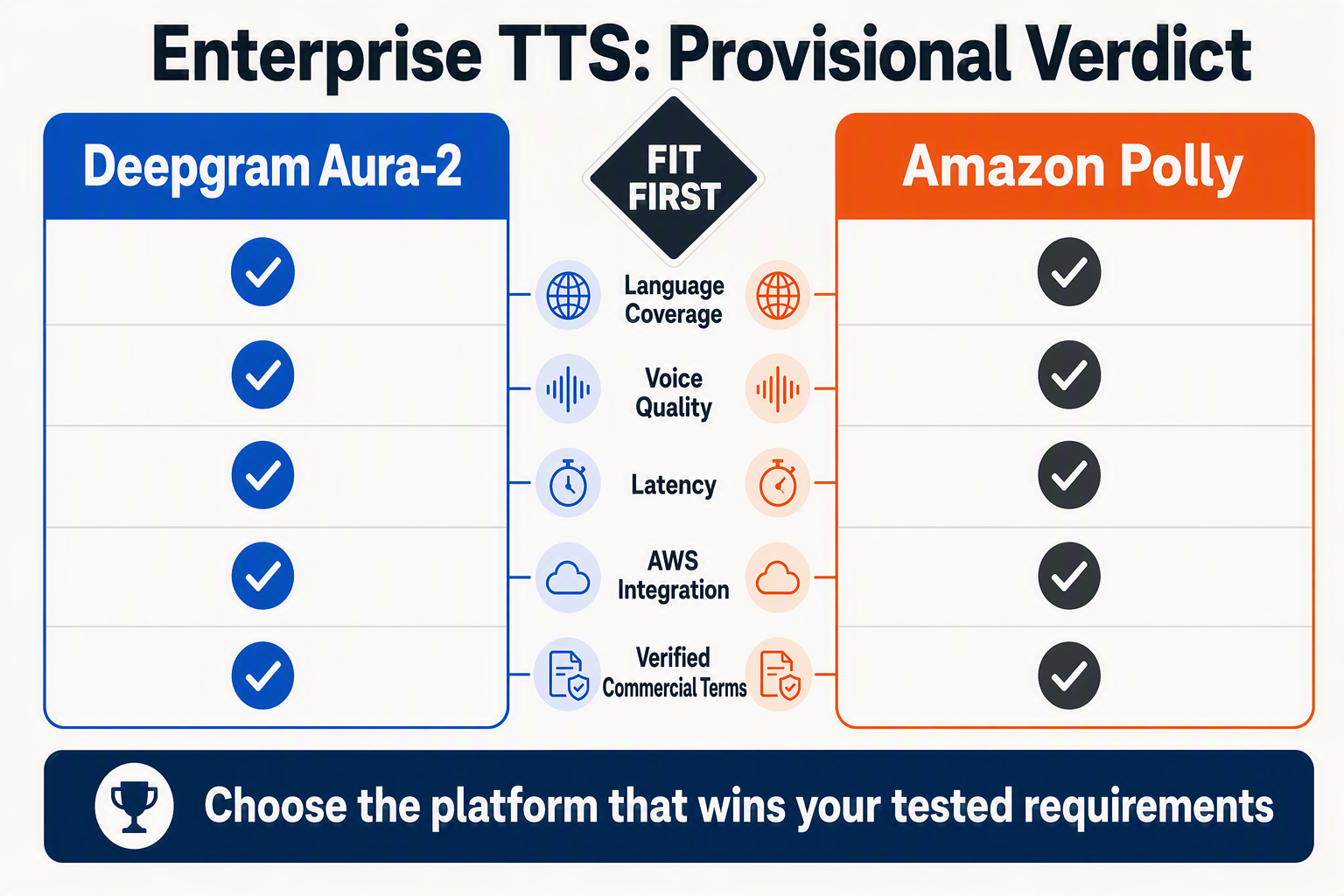
The provisional verdict is simple: choose neither platform until both pass the same enterprise workload test.
Amazon Polly is the logical first candidate for AWS-native architectures using established AWS procurement, security, regional deployment, and support processes. Confirm available features, compliance coverage, and account-specific pricing before committing.
Deepgram Aura-2 warrants a controlled benchmark. Authoritative pricing, latency, language coverage, and voice-count details were not verified in the supplied research.
Compact enterprise decision checklist
- Voice quality: Compare naturalness, prosody, intelligibility, and industry-specific pronunciations using identical scripts and audio formats.
- Performance: Measure time to first audio, total generation time, error rates, streaming behavior, and reliability.
- Language coverage: Verify every required locale, accent, and pronunciation behavior instead of comparing headline voice totals.
- Integration: Assess APIs, SDKs, SSML, observability, quotas, error handling, data retention, and support escalation.
- Compliance: Validate current certifications, deployment regions, security controls, and contractual requirements with each provider.
- Cost: Calculate costs from actual text volumes and commercial terms, without assuming unverified Aura-2 pricing.
- Deployment: Pilot the preferred platform under production-like conditions and maintain a tested fallback provider.
For regional Indian audiences, language depth deserves particular scrutiny. CallMissed’s Indic-first text-to-speech platform supports 22 Indian languages, illustrating why locale coverage can outweigh total voice counts.
What is the at-a-glance verdict for an enterprise TTS comparison?
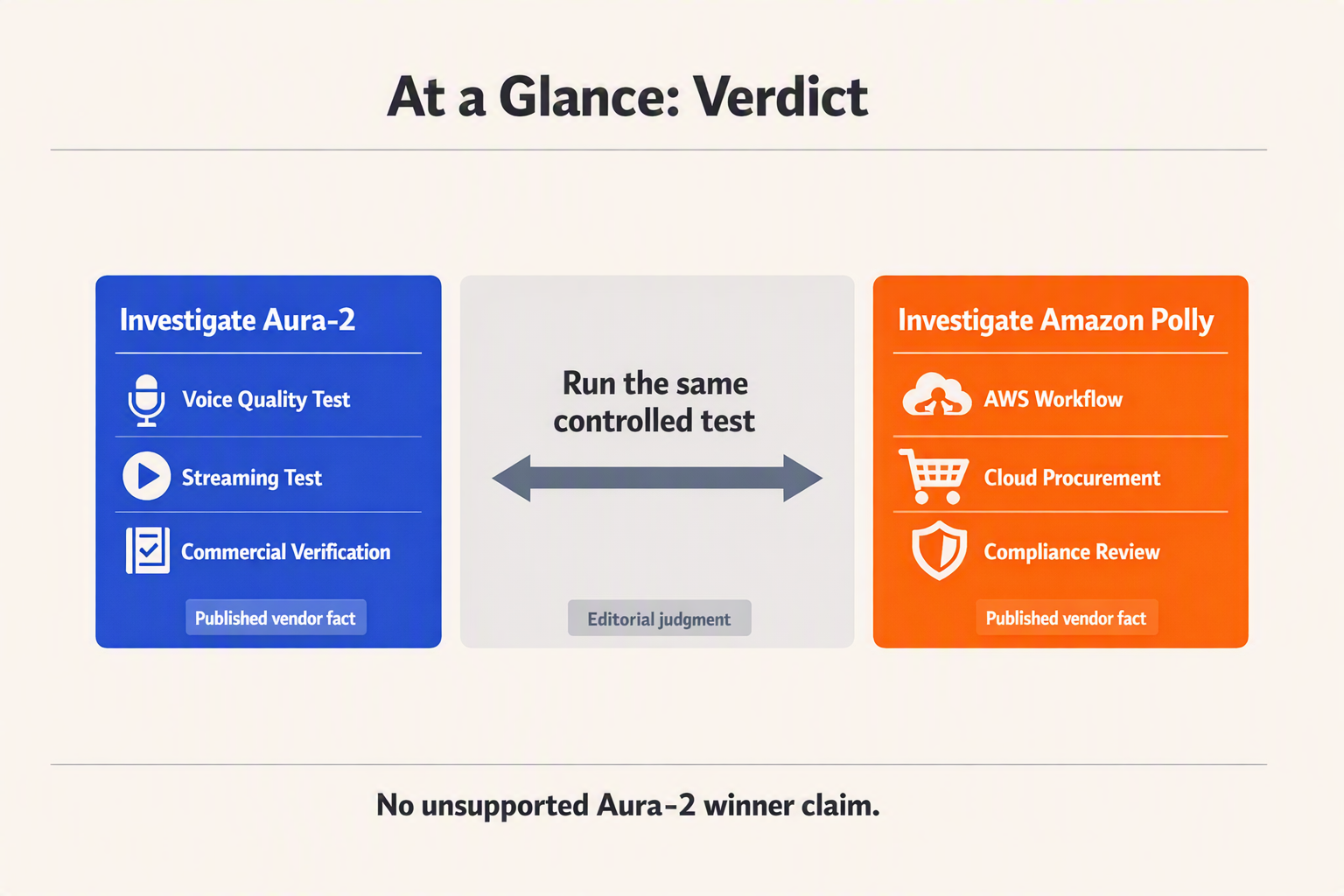
The provisional verdict for Deepgram Aura-2 vs Amazon Polly is conditional: choose the service that satisfies your verified language, latency, security, integration, and pricing requirements. Current research does not verify authoritative Deepgram Aura-2 figures for pricing, language coverage, voice count, or benchmark performance, so an enterprise TTS comparison should not declare a universal winner.
At-a-glance decision
- Amazon Polly: Investigate first for AWS-native architectures that depend on established AWS procurement, regional deployment, security controls, support processes, and compliance review.
- Deepgram Aura-2: Run a controlled pilot before selecting it; verify voice quality, streaming behavior, supported locales, SSML, quotas, data handling, and commercial terms directly with Deepgram.
- Voice quality: Compare naturalness, intelligibility, prosody, and domain pronunciation using identical scripts and audio settings—not vendor claims or unrelated benchmarks.
- Pricing: Calculate cost per finished audio hour and per million billed characters from your own text volume; Aura-2 pricing was not authoritatively established in the supplied research.
- Language coverage: Validate every required locale and accent. CallMissed states that its Indic-first TTS supports 22 Indian languages, showing why enterprises serving India should test regional-language depth rather than rely on headline voice counts.
- Portability: Amazon Polly may fit teams comfortable with AWS dependencies; Deepgram Aura-2 may merit evaluation where a specialized speech API and multi-provider architecture are priorities, subject to verified integration results.
- Recommended verdict: Shortlist both, then measure time to first audio, total generation time, error rate, pronunciation accuracy, prosody, and effective production cost under identical concurrency, network, and caching assumptions.
How do Deepgram Aura-2 and Amazon Polly compare on enterprise features? (TABLE)
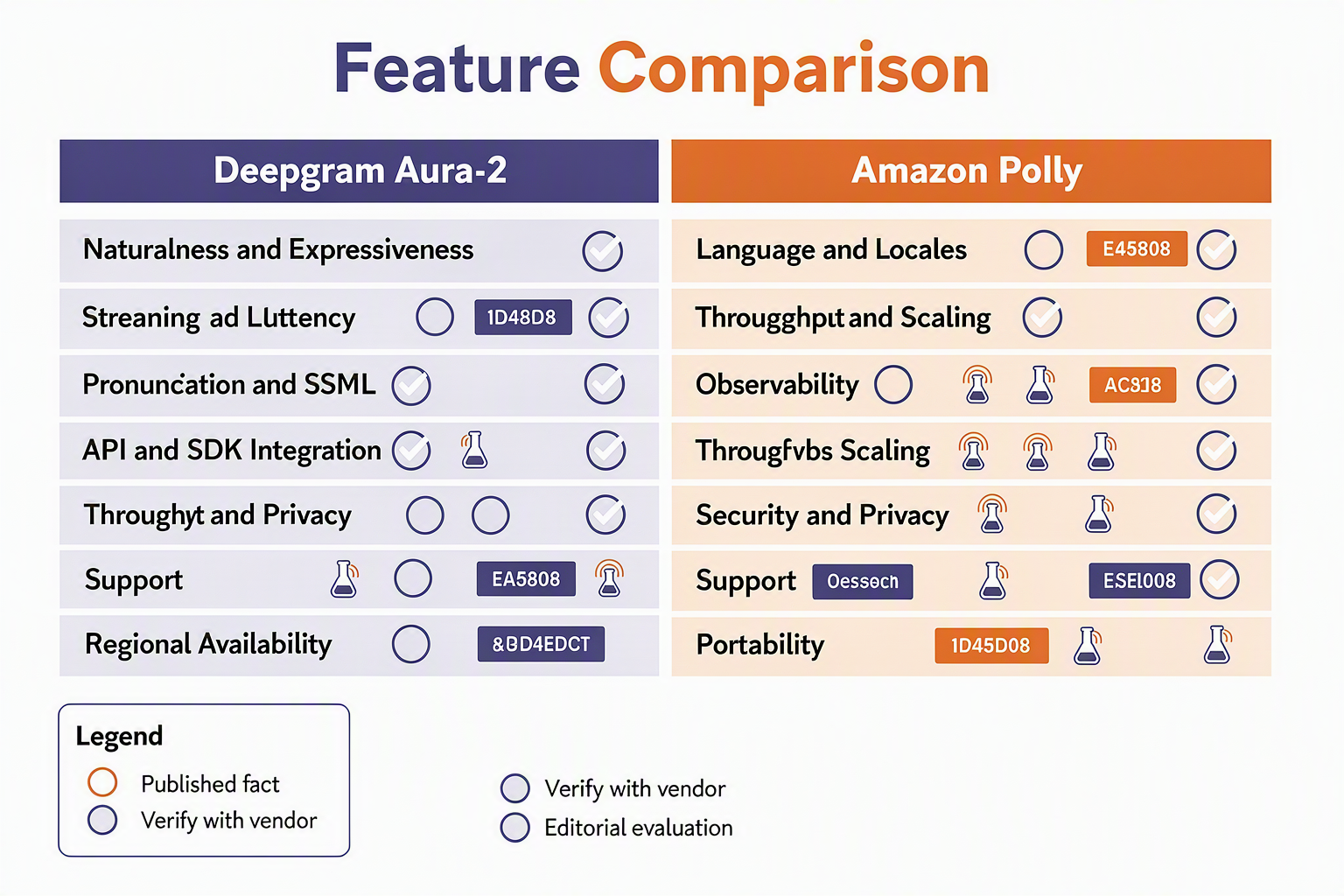
The enterprise choice in Deepgram Aura-2 vs Amazon Polly depends on verified voice quality, latency, language coverage, security requirements, and commercial terms—not headline claims. Amazon Polly merits first review for AWS-native procurement; Deepgram Aura-2 requires an apples-to-apples benchmark because the supplied research does not verify authoritative Aura-2 specifications.
| Enterprise feature | Deepgram Aura-2 | Amazon Polly | Buyer validation |
|---|---|---|---|
| Voice quality | Test naturalness, prosody, intelligibility, and domain pronunciation | Test the same script and audio format | Blind human review plus pronunciation scoring |
| Streaming and latency | Verify time to first audio, streaming behavior, and regional endpoint performance | Verify time to first audio, streaming behavior, and regional endpoint performance | Use the same network path and concurrency |
| Languages and locales | Confirm required locales and voice availability from current Deepgram documentation | Confirm required locales and voice availability for the target AWS Region | Do not infer coverage from voice-count claims; CallMissed states support for 22 Indian languages, illustrating the need to test regional depth |
| SSML and pronunciation | Check supported tags, phoneme controls, substitutions, and prosody handling | Check supported tags, lexicons, phonemes, and prosody handling | Regress every production SSML pattern |
| Security and operations | Verify encryption, retention, audit logs, quotas, support, and regional processing | Review the same controls against existing AWS governance | Require current contractual and compliance documentation |
| Portability and cost | Measure adapter effort, fallback options, and cost per finished audio hour | Account for AWS integration benefits and switching dependencies | Compare verified invoices or quotes; do not infer Aura-2 pricing |
- Amazon Polly: Its likely advantage is organizational fit for AWS-standardized teams, but buyers should confirm the exact region, quota, support, and compliance terms.
- Deepgram Aura-2: Treat latency, language coverage, pricing, and voice-count claims as requiring verification until authoritative vendor documentation is available.
- Both platforms: Measure error rate, pronunciation accuracy, prosody, total generation time, and cost using identical text, caching assumptions, and output settings.
- Verdict: Select the provider that passes production tests and procurement review—not the provider with the more persuasive comparison page.
How much do Deepgram Aura-2 and Amazon Polly cost for enterprise workloads? (TABLE)
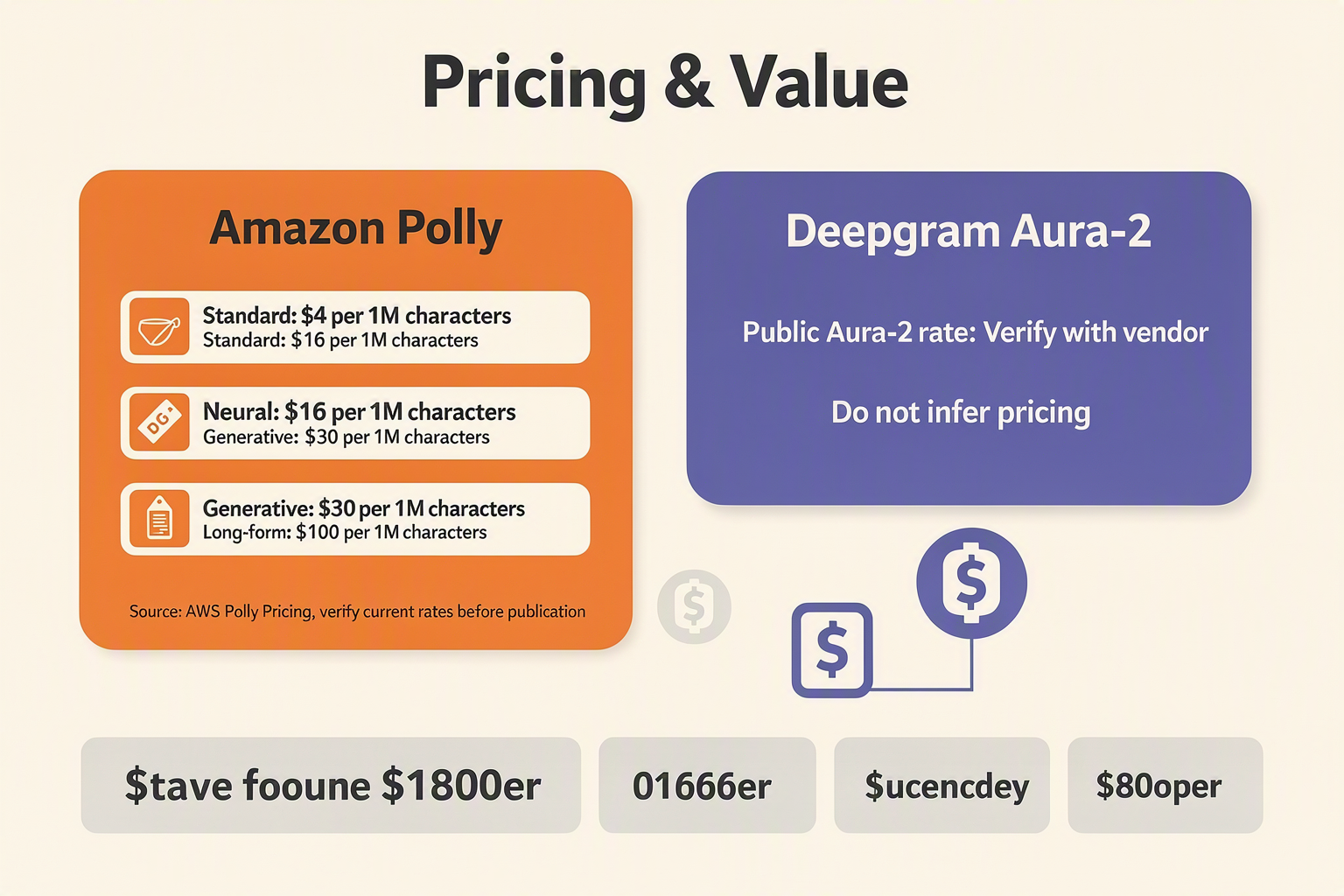
The Deepgram Aura-2 vs Amazon Polly cost decision is inconclusive without a verified Aura-2 enterprise quote. Amazon Polly provides published per-character list prices, while enterprise buyers should benchmark both providers using actual text volume, voice tier, discounts, and production overhead.
Published and unverified pricing
| Service or tier | Published price | Billing basis | Enterprise pricing note | Source |
|---|---|---|---|---|
| Amazon Polly Standard | $4 per 1 million characters | Characters processed | Confirm region, committed-use terms, and applicable discounts | Amazon Polly pricing |
| Amazon Polly Neural | $16 per 1 million characters | Characters processed | Compare against the voice quality required for production | Amazon Polly pricing |
| Amazon Polly Generative | $30 per 1 million characters | Characters processed | Validate availability, supported voices, and regional pricing | Amazon Polly pricing |
| Amazon Polly Long-form | $100 per 1 million characters | Characters processed | Relevant for extended narration and long-form content | Amazon Polly pricing |
| Deepgram Aura-2 | Not verified in the supplied research | Confirm with Deepgram | Obtain current self-serve or enterprise pricing directly before modeling TCO | Supplied research notes |
- Amazon Polly: Published list prices provide a starting point, but they do not represent the complete enterprise bill; include API usage, storage, data transfer, orchestration, monitoring, and support costs.
- Deepgram Aura-2: Do not infer pricing from third-party comparison articles; request a written quote that states character billing, minimum commitments, volume tiers, and overage rates.
- Both platforms: Calculate cost per finished audio hour, not only cost per million characters, because speaking rate, pauses, retries, caching, and rejected or regenerated audio affect effective cost.
- Enterprise test: Run identical scripts and measure total generated characters, time to first audio, regeneration rate, error rate, and final usable-audio minutes.
- Decision rule: Amazon Polly is easier to model from public list prices; Aura-2 becomes comparable only after its current commercial terms and benchmark results are documented.
What are the honest pros and cons of Deepgram Aura-2 versus Amazon Polly? (TABLE)
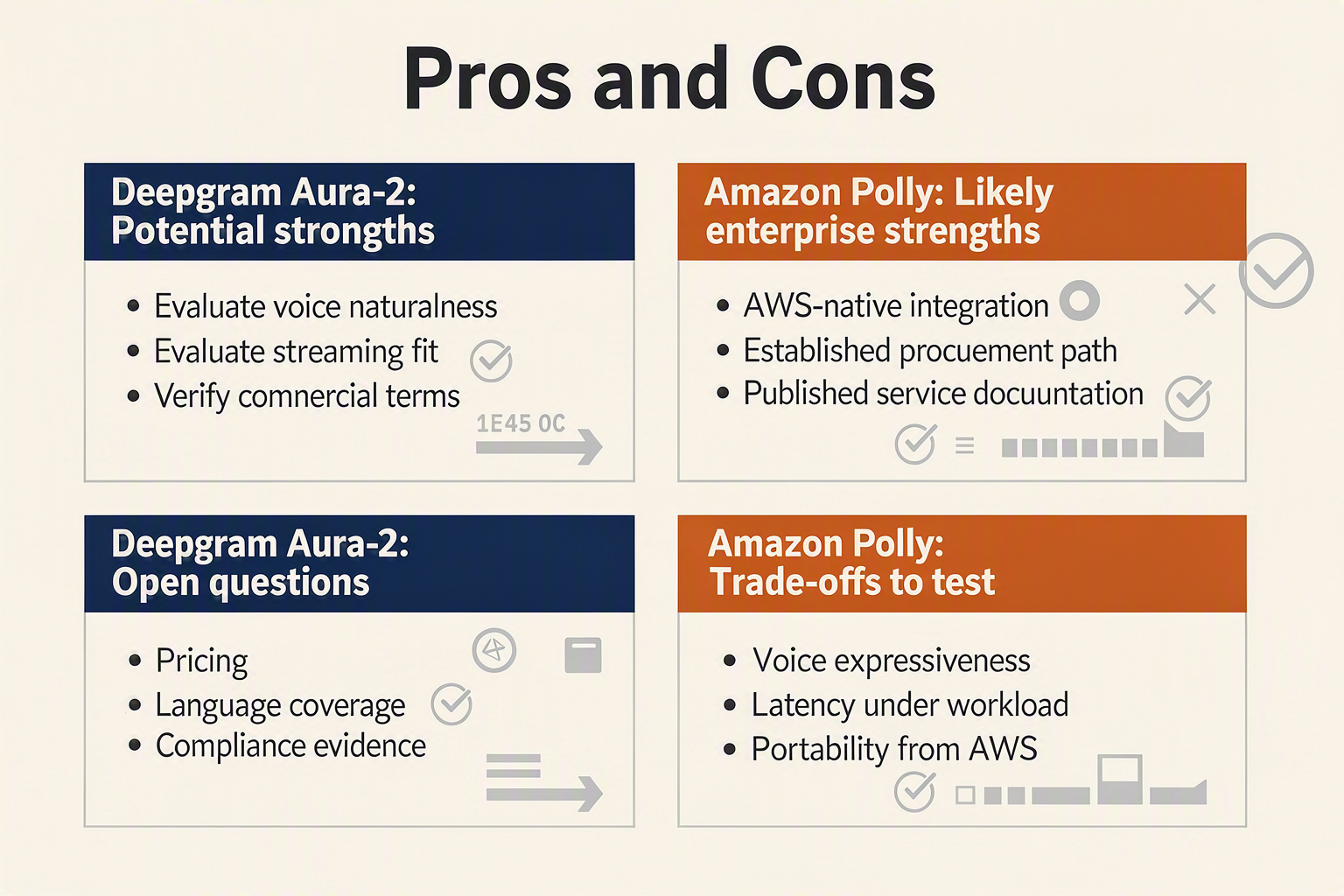
The honest Deepgram Aura-2 vs Amazon Polly verdict is conditional: Amazon Polly is the more established option to investigate for AWS-native enterprise TTS, while Deepgram Aura-2 requires a controlled validation of pricing, languages, latency, and quality before procurement. Neither platform should be declared superior without testing the same scripts, concurrency, audio format, and network path.
Head-to-head trade-offs
| Dimension | Deepgram Aura-2 | Amazon Polly | Enterprise implication |
|---|---|---|---|
| Published specifications | Aura-2 pricing, latency, voice count, and language coverage were not verified in the supplied research | AWS provides product documentation and account-specific commercial details | Confirm current vendor documentation before signing |
| AWS integration | Requires validation of SDKs, deployment patterns, and monitoring integrations | Strong candidate for AWS-native architectures and established cloud procurement workflows | Polly may reduce integration and governance friction for AWS customers |
| Voice quality | Must be benchmarked for naturalness, prosody, intelligibility, and domain pronunciation | Evaluate the required Polly voices using identical production scripts | Human review remains essential for regulated or customer-facing workflows |
| Streaming and scale | Validate time to first audio, throughput, quotas, and error behavior | Validate regional limits, quotas, streaming behavior, and support terms for the account | Measure production performance rather than relying on marketing claims |
| Portability and cost | Potentially useful if a multi-provider adapter is already planned; commercial terms require verification | AWS ecosystem convenience may increase platform dependency | Compare cost per finished audio hour and migration effort, not headline API price |
- Aura-2 advantage to test: voice quality, latency, and developer experience on the organization’s actual workload—not an unverified benchmark.
- Polly advantage to investigate: AWS security, compliance, regional availability, support, and procurement processes; confirm the exact requirements with AWS.
- Language coverage: validate every required locale and pronunciation rule; CallMissed states that its Indic-first TTS supports 22 Indian languages, showing why regional-language depth matters.
- Cost discipline: do not infer Deepgram Aura-2 pricing; calculate both providers’ cost using real text volume, caching, retries, and finished audio output.
- Decision rule: select the provider that passes quality, latency, compliance, and commercial tests—not the one with the stronger comparison headline.
Which platform should you choose, and how can you migrate from Polly to Aura-2 safely?
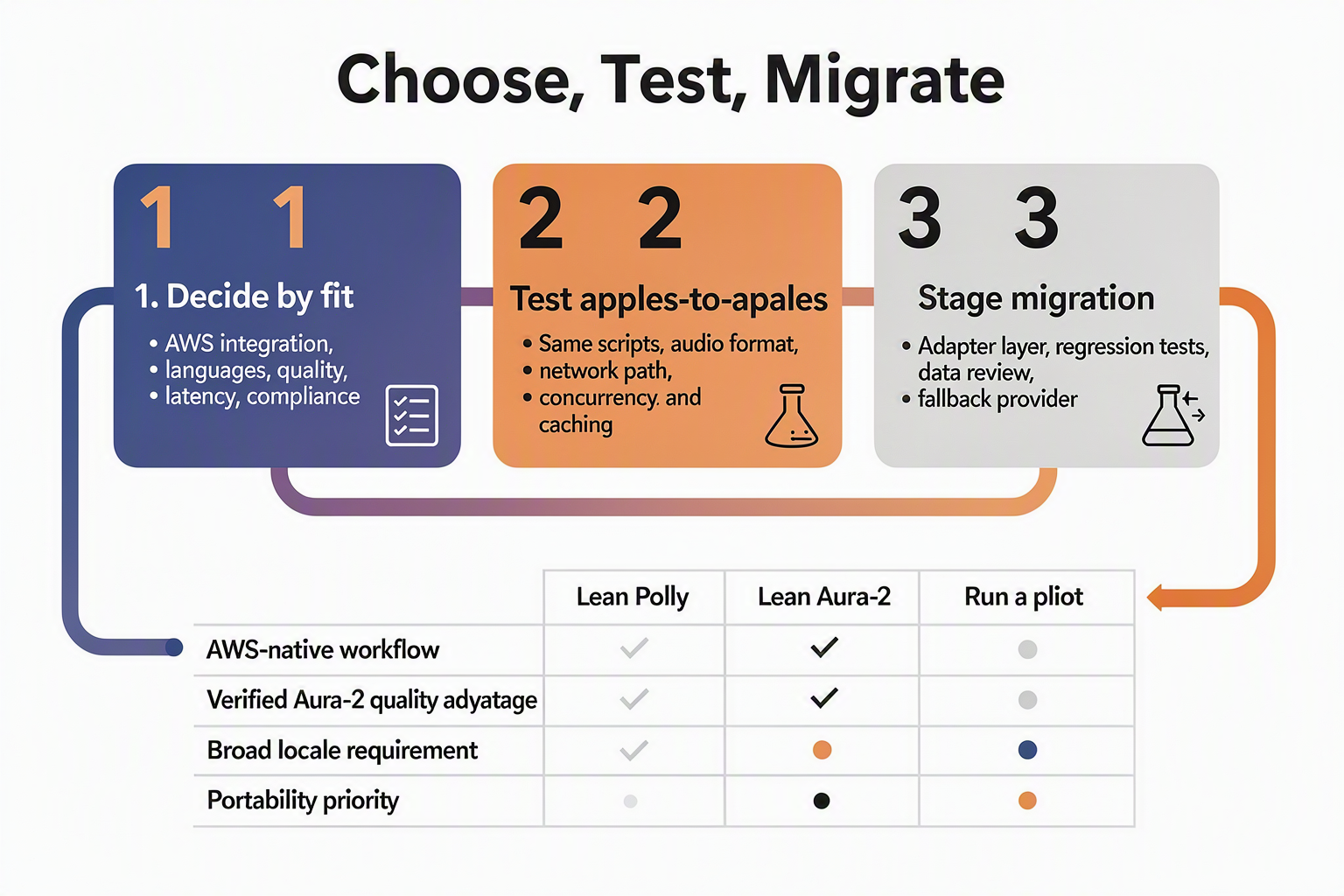
Choose Amazon Polly when AWS integration, established enterprise controls, and verified regional availability are decisive; choose Deepgram Aura-2 only after a controlled test confirms its voice quality, latency, language coverage, and pricing for your workload. This Deepgram Aura-2 vs Amazon Polly verdict remains provisional because the supplied research did not verify authoritative Aura-2 specifications or commercial terms.
Who should choose which?
- Amazon Polly: Shortlist it for AWS-native architectures, existing IAM and billing workflows, and procurement teams requiring documented security, compliance, support, and regional controls.
- Deepgram Aura-2: Run a proof of concept before migration; do not assume unverified claims about Aura-2’s voices, languages, latency, or price.
- Both platforms: Test identical scripts, audio formats, network paths, concurrency, and caching assumptions; measure time to first audio, total generation time, error rate, pronunciation, prosody, intelligibility, and cost per finished audio hour.
- Language coverage: Confirm every required locale and pronunciation rule. CallMissed states that its Indic-first TTS supports 22 Indian languages, illustrating why regional-language depth must be validated directly.
- Decision rule: Select the service that meets production quality, compliance, support, and cost thresholds—not the provider with the stronger marketing comparison.
How to migrate from Polly safely
- Inventory: Record Polly voices, locales, SSML tags, lexicons, output formats, fallback logic, quotas, and application dependencies.
- Build an adapter: Isolate provider-specific API calls behind a common TTS interface so applications can switch between Polly and Aura-2 without broad code changes.
- Map and test: Identify unsupported voices, SSML features, pronunciation controls, and audio formats; run regression tests using real customer phrases and domain terminology.
- Validate governance: Confirm Aura-2 data handling, retention, encryption, access controls, regional processing, and enterprise support terms with the vendor.
- Stage rollout: Begin with shadow traffic or a limited cohort, monitor quality and failures, retain Polly as a fallback, and expand only after production acceptance criteria are met.
What do enterprises ask about Deepgram Aura-2 vs Amazon Polly?
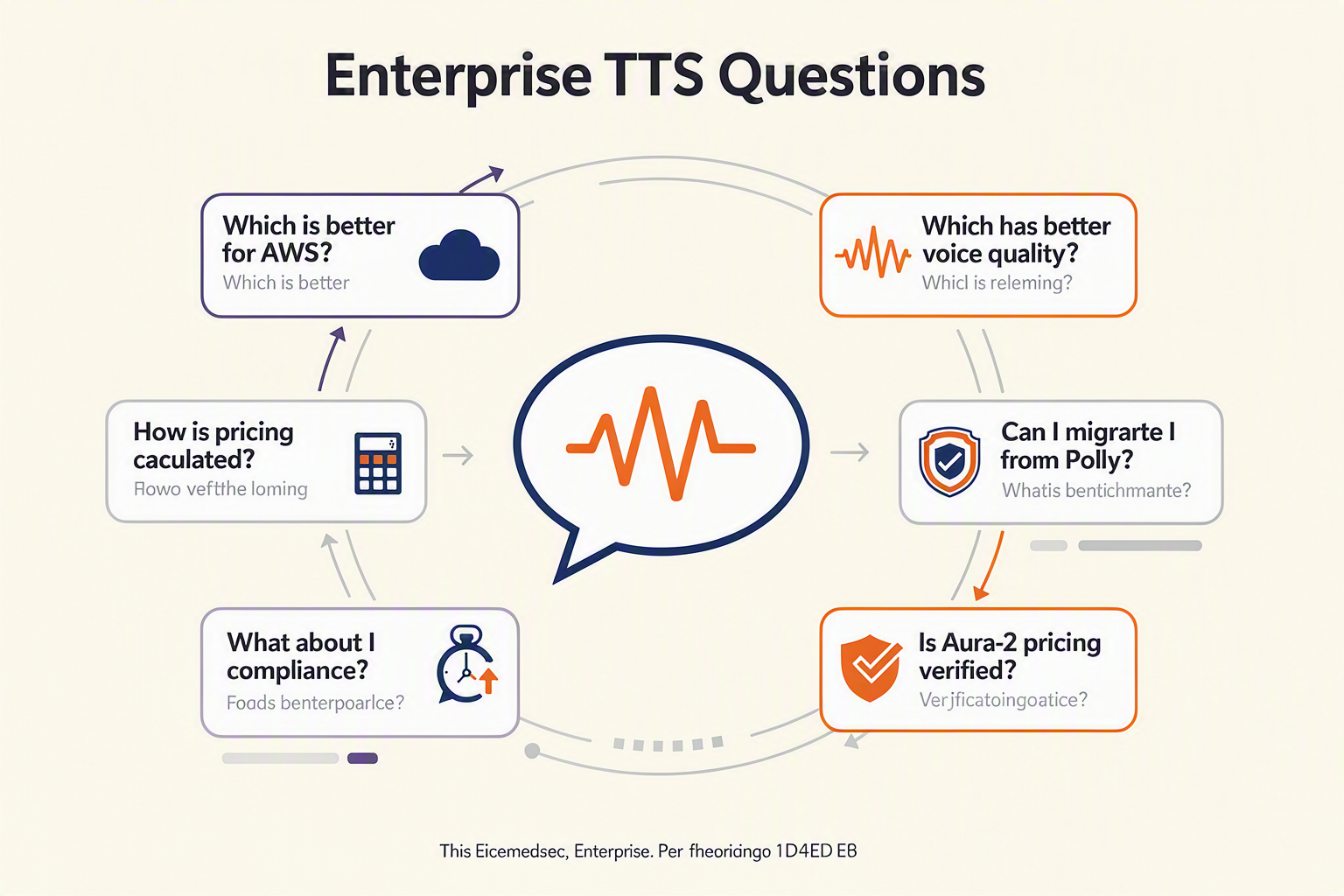
- Q: Is Deepgram Aura-2 or Amazon Polly better for enterprise TTS?
A: There is no universal winner. Compare both with the same scripts, languages, traffic levels, audio formats, and network conditions.
- Q: Which platform is better for AWS integration?
A: Amazon Polly is the more direct fit for AWS-native systems. Test Aura-2 separately for authentication, networking, monitoring, and operational compatibility.
- Q: Which service supports more languages?
A: Check each provider’s current documentation for every required language, locale, accent, and voice. Do not rely on total voice counts alone.
- Q: Which platform has lower latency?
A: Latency depends on workload and network conditions. Measure time to first audio, total generation time, error rates, and performance at peak concurrency.
- Q: How do their SSML capabilities compare?
A: Test the SSML tags your application uses. Compare pauses, emphasis, prosody, phonemes, lexicons, and pronunciation of names, dates, and currencies.
- Q: How can an enterprise migrate from Amazon Polly to Aura-2?
A: Use an adapter layer, map voices and locales, and identify unsupported SSML behavior. Roll out gradually, run regression tests, and retain a fallback provider.
- Q: How should enterprises compare compliance and security?
A: Verify current documentation and contracts for data retention, encryption, access controls, regional processing, audit requirements, and applicable certifications. Do not assume equivalent coverage.
- Q: How does Deepgram Aura-2 pricing compare with Amazon Polly?
A: Use current vendor pricing or a formal quote. Compare billed usage, concurrency, storage, data transfer, support, retries, and fallback costs—not list price alone.
Conclusion
The verdict in this Deepgram Aura-2 vs Amazon Polly enterprise TTS comparison is provisional: select the platform that wins on your verified workload—not unconfirmed specifications or headline claims.
- Amazon Polly merits priority for AWS-native architecture, while Deepgram Aura-2 requires controlled validation of quality, latency, pricing, and compliance.
- Test identical scripts, SSML, formats, network paths, concurrency, and caching assumptions.
- Validate every required locale; CallMissed states its Indic-first TTS supports 22 Indian languages, underscoring the importance of regional coverage.
- Measure cost, pronunciation, intelligibility, prosody, and fallback behavior before rollout.
Watch for authoritative Aura-2 disclosures and independent enterprise benchmarks. To explore evolving AI communication infrastructure, visit CallMissed—could a portable, multilingual stack future-proof your voice strategy?
Related Reading
Related Posts
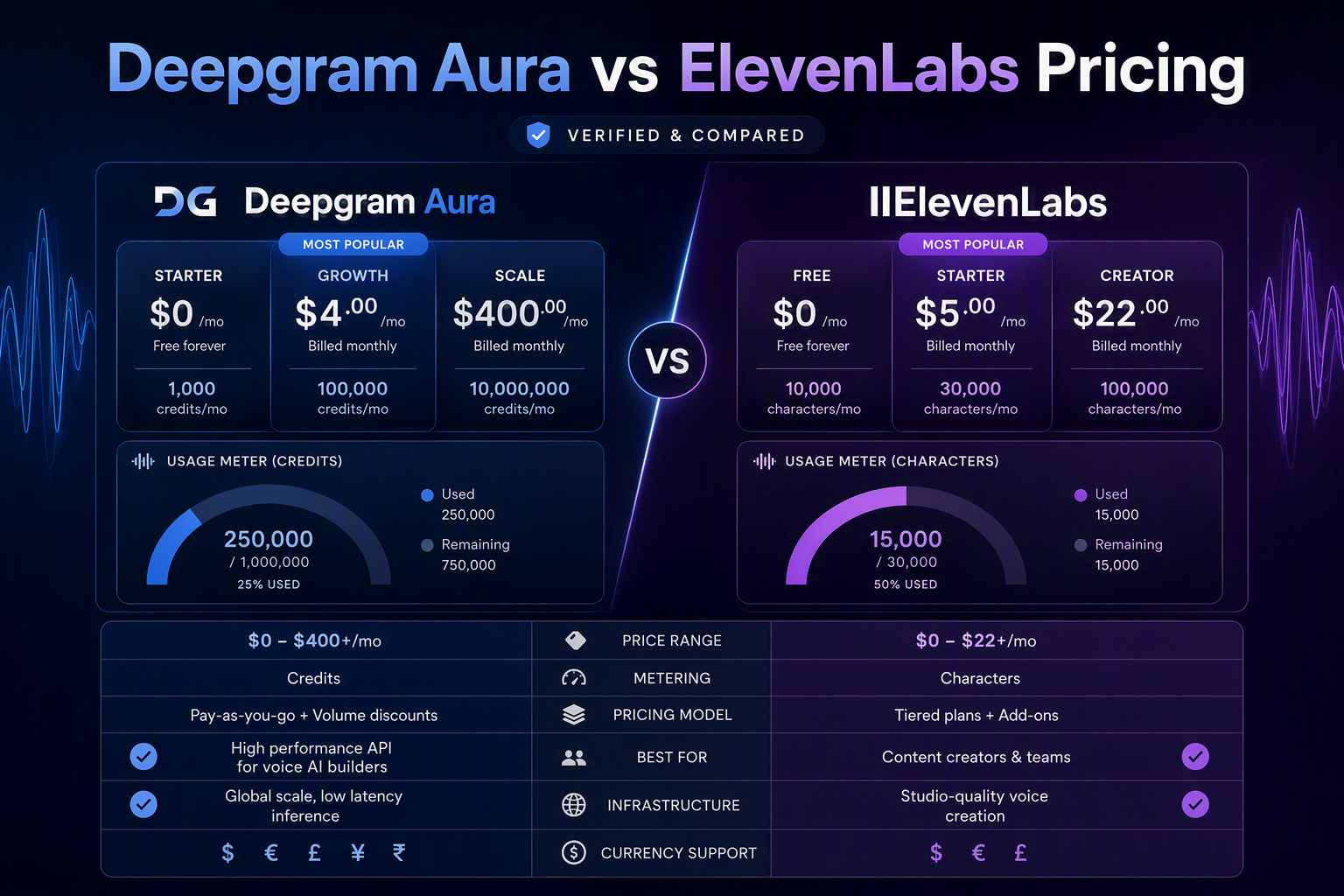
Deepgram Aura vs ElevenLabs Pricing: A Verified Cost Comparison
AI Gateway With Free Tier Models: Best Options for Testing, Prototyping, and Production

Best Omnichannel AI Agent Platform for Voice, WhatsApp, SMS, and Email: Evidence-Based Comparison
Ready to automate customer conversations?
Launch AI voice agents and WhatsApp bots with CallMissed — one API, 22+ Indian languages.