
Claude Opus 5 Released: Launch Date, Pricing, Specs & Honeycomb



Claude Opus 5 launched July 24, 2026. See official pricing, 1M context, 128k output, model availability, and what the Honeycomb leak got right.
Claude Opus 5 Released: Launch Date, Pricing, Specs & Honeycomb
Claude Opus 5 launched on July 24, 2026. Anthropic’s official announcement confirms that the model is available across its platforms as claude-opus-5, priced at $5 per million input tokens and $25 per million output tokens. The strongest evidence behind the Claude Opus 5 release date rumors in July 2026 is a brief Cursor appearance of an unannounced model labeled “Claude Honeycomb EAP”—not a confirmed product launch.
The Honeycomb leak matters because it included unusually specific signals. According to Explainx.ai, the Cursor listing showed a 1-million-token context window and an “xhigh” effort mode, features widely interpreted as clues to a forthcoming Anthropic flagship. ByteIota reported the model’s appearance on July 8, 2026, while Kie.ai reported it on July 9, suggesting that the listing was visible only briefly or was observed at different times. Neither report constitutes confirmation from Anthropic.
So, when will Claude Opus 5 launch? The defensible answer is: there is no confirmed date. Some online speculation pointed to July 20–21, but AIReiter reported that this window had passed without an official release. Meanwhile, Explainx.ai reported that Polymarket priced the probability of a Claude Opus 5 launch by December 2026 at 93%—a measure of market expectation, not evidence of an Anthropic commitment. Valletta Software also stated that Anthropic had made no on-the-record announcement.
This explainer separates the confirmed facts from the Claude Opus 5 leaks, including what “Honeycomb EAP” may mean, which leaked specifications are credible, and which claims remain unverified. It also compares the rumored 1M context window and high-effort reasoning mode with Anthropic’s publicly documented models, while clearly labeling any missing information on pricing, modalities, benchmarks, and API availability.
That distinction is important because Claude Sonnet 5 did officially launch on June 30, 2026, according to Simplified, making a near-term Opus release plausible—but not guaranteed. For developers evaluating models today, OpenAI-compatible gateways such as CallMissed can provide access to multiple available AI models through one API while the industry waits for verified Opus 5 details.
When will Claude Opus 5 launch, and what do the leaks reveal?
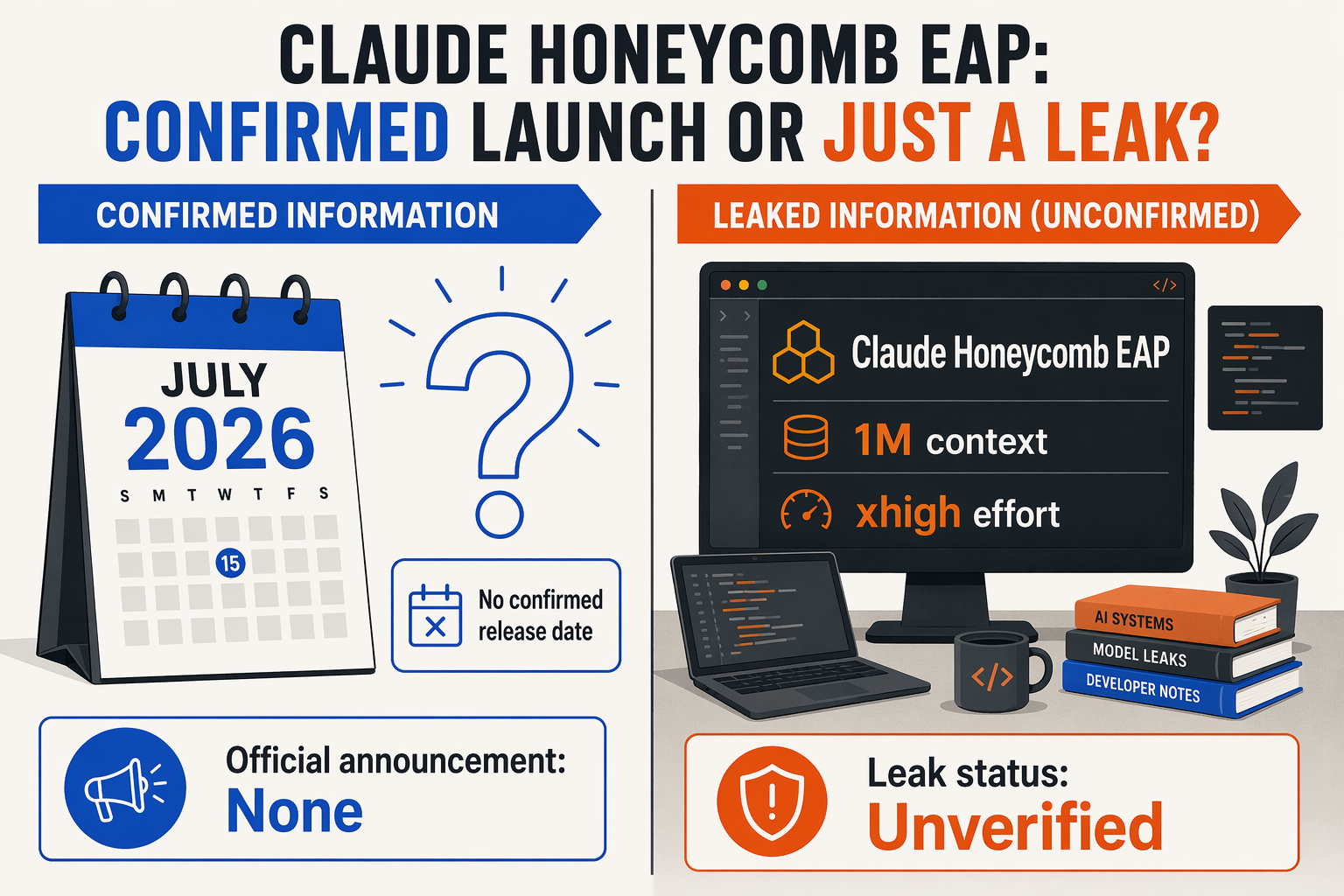
As of July 25, 2026, Claude Opus 5 has officially launched. Anthropic released the model on July 24, 2026, ending the earlier release-date speculation surrounding the “Claude Honeycomb EAP” listing.
According to Anthropic’s Claude Opus 5 launch announcement and its platform release notes, Opus 5 is available through Claude and the Anthropic API under the model ID claude-opus-5.
What are the official Claude Opus 5 specifications?
| Feature | Official Claude Opus 5 detail |
|---|---|
| Release date | July 24, 2026 |
| API model ID | claude-opus-5 |
| Context window | 1 million tokens |
| Maximum output | 128,000 tokens |
| Input-token price | $5 per million tokens |
| Output-token price | $25 per million tokens |
| Thinking behavior | Enabled by default |
| Primary use cases | Long-running agents, coding, and professional work |
The 1-million-token context window allows Opus 5 to work across large codebases, extensive document collections, lengthy agent histories, and other high-volume inputs. Its 128,000-token maximum output also supports unusually long generated responses, although actual limits and usage may depend on the product surface and account configuration.
Anthropic positions Claude Opus 5 as its most capable model for long-running agents, complex software-development work, and demanding professional tasks. Thinking is turned on by default, reflecting the model’s focus on multi-step reasoning rather than only low-latency responses.
Where is Claude Opus 5 available?
Claude Opus 5 is officially available through Anthropic’s supported Claude products and developer platform. API users can request the model with:
claude-opus-5Developers should use Anthropic’s official documentation and platform release notes to confirm account eligibility, regional availability, rate limits, cloud-platform access, and any product-specific restrictions.
API pricing is officially listed at:
- $5 per million input tokens
- $25 per million output tokens
These are base token rates. Features such as prompt caching, batch processing, or third-party cloud access may have separate pricing terms.
Was Claude Honeycomb EAP actually Opus 5?
The “Claude Honeycomb EAP” reports now appear to have been a pre-launch signal, but they should not be treated as the authoritative specification for Claude Opus 5.
In early July, third-party reports said that a model carrying the Honeycomb label briefly appeared in Cursor. Those reports mentioned a 1-million-token context window and an “xhigh” effort setting, prompting speculation that Honeycomb was an internal or early-access version of Opus 5.
Anthropic’s official launch materials now supersede those leaks. They confirm Opus 5’s name, release date, model ID, pricing, context window, output limit, and default thinking behavior. Anthropic has not needed to establish “Claude Honeycomb EAP” as the model’s official public identity, and temporary interface labels should not be used in place of the documented claude-opus-5 model ID.
What happened to the earlier release-date rumors?
The earlier rumored July 20–21, 2026 launch window was incorrect. Claude Opus 5 ultimately launched on July 24, 2026.
This illustrates the difference between pre-release signals and a confirmed product launch. Cursor listings, screenshots, prediction markets, and unnamed sources can indicate testing activity, but only Anthropic’s announcement, documentation, pricing, and public model identifier establish official availability.
FAQ: Claude Opus 5 launch
When did Claude Opus 5 launch?
What is the Claude Opus 5 API model ID?
claude-opus-5.How much does Claude Opus 5 cost?
Does Claude Opus 5 have a 1-million-token context window?
What is Claude Opus 5’s maximum output length?
Is thinking enabled by default?
Is Claude Honeycomb EAP the same model as Claude Opus 5?
claude-opus-5. Official documentation should take precedence over the earlier Honeycomb listing.What is Claude Opus 5 designed for?
What is confirmed about Claude Opus 5, and what remains rumor?

Anthropic launched Claude Opus 5 on July 24, 2026, so earlier speculation about a July release window is now obsolete. The authoritative details come from Anthropic’s launch announcement, model documentation, API reference, and pricing page—not from the pre-launch “Claude Honeycomb EAP” sightings.
What has Anthropic officially confirmed about Claude Opus 5?
Anthropic’s published materials confirm the following:
- Release date: July 24, 2026
- Availability: Claude Opus 5 is available through Anthropic’s Claude products and API, with access subject to the plan, platform, and account
- API model ID:
claude-opus-5-20260724 - API pricing: $5 per million input tokens and $25 per million output tokens
- Context window: Up to 1 million tokens
- Maximum output: Up to 128,000 tokens
- Thinking behavior: Thinking is enabled by default, with controls documented by Anthropic for supported API requests
Developers should consult Anthropic’s current API documentation before deployment because availability, usage tiers, rate limits, regional access, and platform-specific settings can differ.
| Claim about Claude Opus 5 | Current status | Evidence or source |
|---|---|---|
| Claude Opus 5 launched on July 24, 2026 | Confirmed | Anthropic launch announcement |
The API model ID is claude-opus-5-20260724 | Confirmed | Anthropic API documentation |
| Pricing is $5/M input tokens and $25/M output tokens | Confirmed | Anthropic pricing documentation |
| The model supports a 1M-token context window | Confirmed | Anthropic model documentation |
| Maximum output is 128k tokens | Confirmed | Anthropic model documentation |
| Thinking is enabled by default | Confirmed | Anthropic model and API documentation |
| “Honeycomb” was the internal codename for Opus 5 | Still unverified | Anthropic has not publicly established the connection |
| Third-party benchmark results prove a specific performance lead | Interpretation, not official fact | Depends on test design, settings, prompts, and independent replication |
What remains unverified about the Honeycomb leak?
Before launch, ByteIota, Kie.ai, and Explainx.ai reported that a “Claude Honeycomb EAP” entry had appeared in Cursor. Some reported details—notably the 1-million-token context window—now resemble official Claude Opus 5 specifications.
That overlap does not prove that Honeycomb was Claude Opus 5. Anthropic has not publicly confirmed that:
- Honeycomb was an internal Opus 5 codename
- The reported Cursor entry represented an Anthropic-authorized early-access program
- Every setting shown in the listing shipped unchanged
- The reported “xhigh” effort mode maps directly to Claude Opus 5’s final thinking controls
- Third-party screenshots or listings accurately represented the production model
The Honeycomb reports therefore remain useful as historical context, but they are no longer the appropriate source for Claude Opus 5’s release date, pricing, context window, output limit, or API identity.
Which Claude Opus 5 performance claims still require caution?
Anthropic’s own launch materials may include benchmark scores, but vendor-reported results should be identified as Anthropic-reported benchmarks unless independently reproduced. Claims from outside analysts also require context.
Benchmark comparisons can change depending on:
- Prompt and system-instruction design
- Thinking or effort settings
- Tool access and scaffolding
- Sampling parameters
- Context length
- Pass@1 versus multi-attempt scoring
- Model snapshot and test date
- Whether results were independently replicated
Accordingly, broad claims that Claude Opus 5 is definitively “best” at coding, reasoning, agents, or tool use remain interpretations unless supported by transparent, reproducible testing.
FAQ: What is confirmed about Claude Opus 5?
Has Claude Opus 5 launched?
What is the Claude Opus 5 API model ID?
claude-opus-5-20260724.How much does Claude Opus 5 cost?
Does Claude Opus 5 have a 1-million-token context window?
What is the maximum output length?
Is Claude Honeycomb EAP confirmed to have been Claude Opus 5?
Are third-party Claude Opus 5 benchmarks official?
What happened in the Claude Honeycomb EAP leak?

The Claude Opus 5 launch date remains unconfirmed as of July 24, 2026. Reports about a brief “Claude Honeycomb EAP” entry in Cursor on July 8–9 have intensified the Claude Opus 5 release date rumors, but the leak does not establish that Honeycomb is Opus 5 or that Anthropic has scheduled a public release.
How did the Claude Honeycomb EAP leak appear?
ByteIota reported seeing “Claude Honeycomb EAP” in Cursor on July 8, 2026, while Kie.ai reported the appearance on July 9, 2026. The differing dates may reflect separate observations or reporting of a short-lived listing; neither source establishes exactly how long the entry was visible.
The reported label has prompted several interpretations:
- “Honeycomb” may be an internal codename or identifier rather than a final Claude product name.
- “EAP” commonly refers to an early-access program, so some observers interpret the label as a sign of restricted testing.
- Because the entry reportedly appeared in Cursor, commentators have speculated that Cursor may have had model configuration or routing information. However, the listing alone does not establish third-party access, production configuration, user availability, or an official Anthropic partnership.
A Cursor entry is also not equivalent to an Anthropic announcement. It does not confirm the final product branding, API access, pricing, launch date, or whether the model was exposed to a meaningful number of users.
What do the Claude Opus 5 leaks actually reveal?
The reported Claude Opus 5 leaks point to a possible model with a very large context window and configurable reasoning effort, but these details remain unverified. Explainx.ai reported a 1-million-token context window and an “xhigh” effort mode associated with Honeycomb.
| Evidence | Reported detail | Possible interpretation | What it does not prove |
|---|---|---|---|
| Cursor listing | July 8–9, 2026 | A temporary model entry may have been visible | Public launch or API access |
| Model label | “Claude Honeycomb EAP” | Possible codename or early-access label | Honeycomb equals Claude Opus 5 |
| Context window | 1,000,000 tokens | Potential long-document or codebase processing | Final production limit |
| Effort setting | “xhigh” | Possible higher-compute reasoning mode | Benchmark leadership or final interface |
| Prediction market | 93% for December 2026 | Strong market expectation | Anthropic’s committed release date |
Polymarket showed a 93% probability for a Claude release by December 2026, according to Explainx.ai; that figure reflects market sentiment rather than technical evidence or an official Anthropic timetable.
Are Claude Opus 5 specs, benchmarks, and pricing confirmed?
No. Available reporting provides no verified official benchmarks, pricing, modalities, or public API details for Claude Opus 5. Coding, reasoning, mathematics, instruction-following, and agentic-task scores have not been confirmed; image, video, audio, tool-use, and production context limits are also unknown.
Timing comparisons are suggestive but inconclusive. AIToolsRecap reported that an earlier “Fable 5 EAP” appeared in Cursor approximately two weeks before the reported June 9 public launch, while Simplified reported that Claude Sonnet 5 launched on June 30, 2026. That reported precedent may make a Honeycomb release plausible, but it does not establish when Claude Opus 5 will launch.
What are the leaked Claude Opus 5 specs and benchmarks?
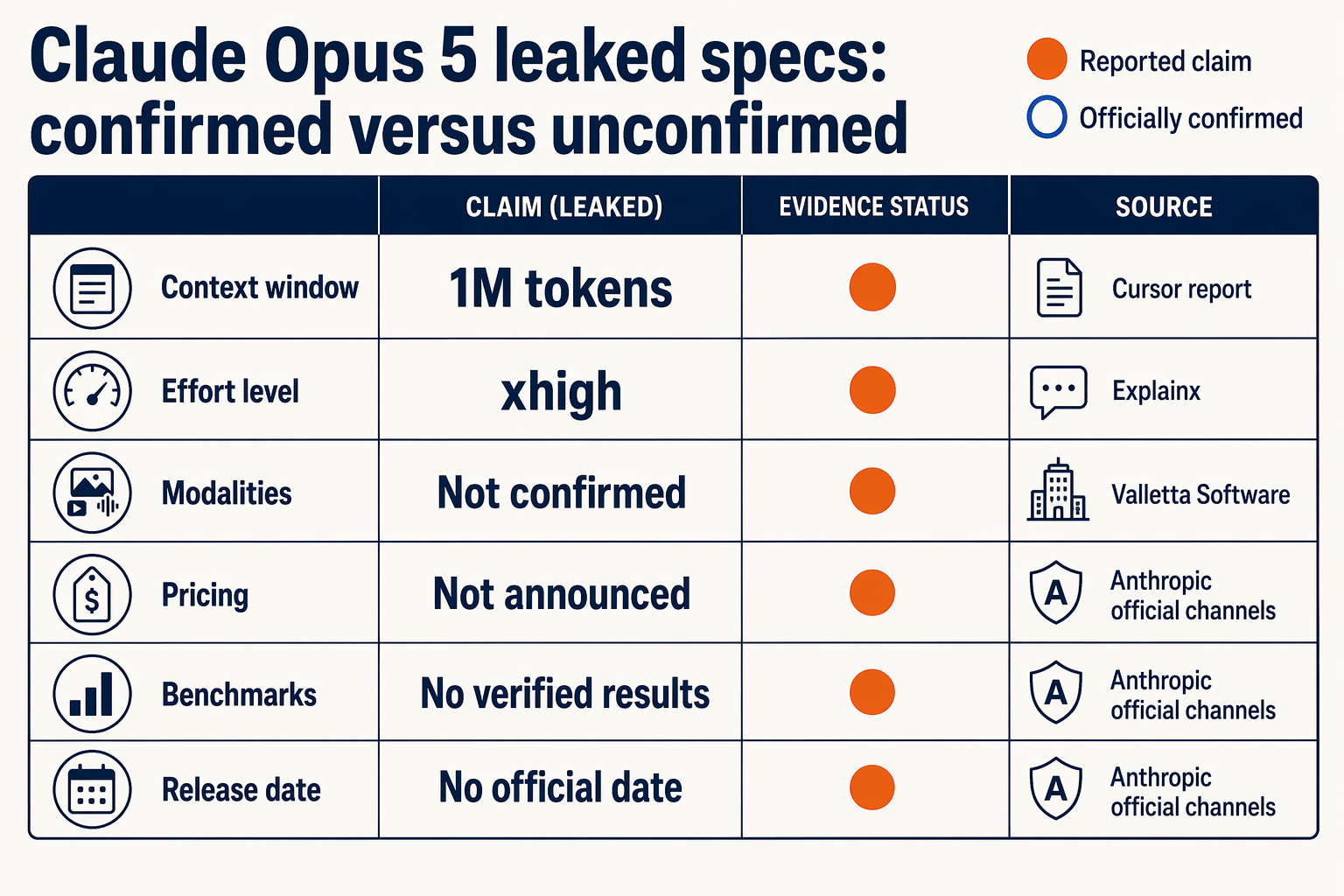
The Claude Opus 5 leaked specs circulating online are based on third-party reports about a brief “Claude Honeycomb EAP” listing in Cursor. Anthropic has not confirmed that Honeycomb is Claude Opus 5—or announced any Opus 5 specifications, benchmarks, pricing, API identifiers or release date.
What does the Claude Honeycomb leak actually claim?
Explainx.ai and ByteIota reported that the alleged Cursor listing showed a 1-million-token context window and an “xhigh” effort setting. ByteIota published its report on July 8, 2026, while Kie.ai reported the listing on July 9, 2026. These are third-party observations, not Anthropic documentation.
| Claim | Evidence | Status | Safe conclusion |
|---|---|---|---|
| “Claude Honeycomb EAP” appeared in Cursor | Reported by Explainx.ai, ByteIota and Kie.ai | Third-party observation | A model listing may have appeared briefly, but Anthropic has not authenticated it |
| Honeycomb is Claude Opus 5 | Inference made in online coverage and discussion | Unverified rumor | The listing cannot reliably be identified as Opus 5 |
| 1,000,000-token context window | Attributed to the alleged listing by Explainx.ai and ByteIota | Unverified configuration | It may describe the listed model, but it is not a confirmed Opus 5 specification |
| “xhigh” reasoning-effort mode | Attributed to the alleged listing by Explainx.ai and ByteIota | Unverified configuration | The label may indicate a higher-compute setting, but its behavior and availability are unknown |
| Opus 5 benchmark performance | No official scores or reproducible evaluation results have been published | Not available | No credible performance comparison can yet be made |
| Pricing, modalities and API access | No verified prices, model IDs, endpoints or capability documentation | Not available | Developers cannot estimate costs or plan an Opus 5 integration |
| Public launch date | Anthropic has not announced Claude Opus 5 | Not announced | There is no reliable Opus 5 release date as of July 24, 2026 |
Does the leak include Claude Opus 5 benchmark results?
No. There are zero verified Claude Opus 5 benchmark scores. A claimed 1M-token context window would describe input capacity, not accuracy, latency, cost, reasoning quality or reliable retrieval across the entire context. Likewise, “xhigh” is only a reported configuration label—not a result on coding, mathematics, long-context or agentic benchmarks.
The evidence should therefore be separated into three categories:
- Reported observation: Third-party sites said a “Claude Honeycomb EAP” entry appeared in Cursor.
- Reported configuration: Some reports attributed a 1M-token context window and “xhigh” effort mode to that entry.
- Unverified interpretation: Online discussion connected Honeycomb with Claude Opus 5, but Anthropic has not confirmed that relationship.
Until Anthropic publishes an announcement or technical documentation, the Honeycomb reports should not be treated as a final Claude Opus 5 specification sheet. Any claims about benchmark leadership, pricing, API availability or launch timing remain speculative as of July 24, 2026.
For teams evaluating currently available models while the Claude Opus 5 release date rumors remain unresolved, CallMissed offers an OpenAI-compatible gateway for accessing multiple model providers through one integration.
How credible are the Claude Opus 5 leaks, and what do they actually prove?
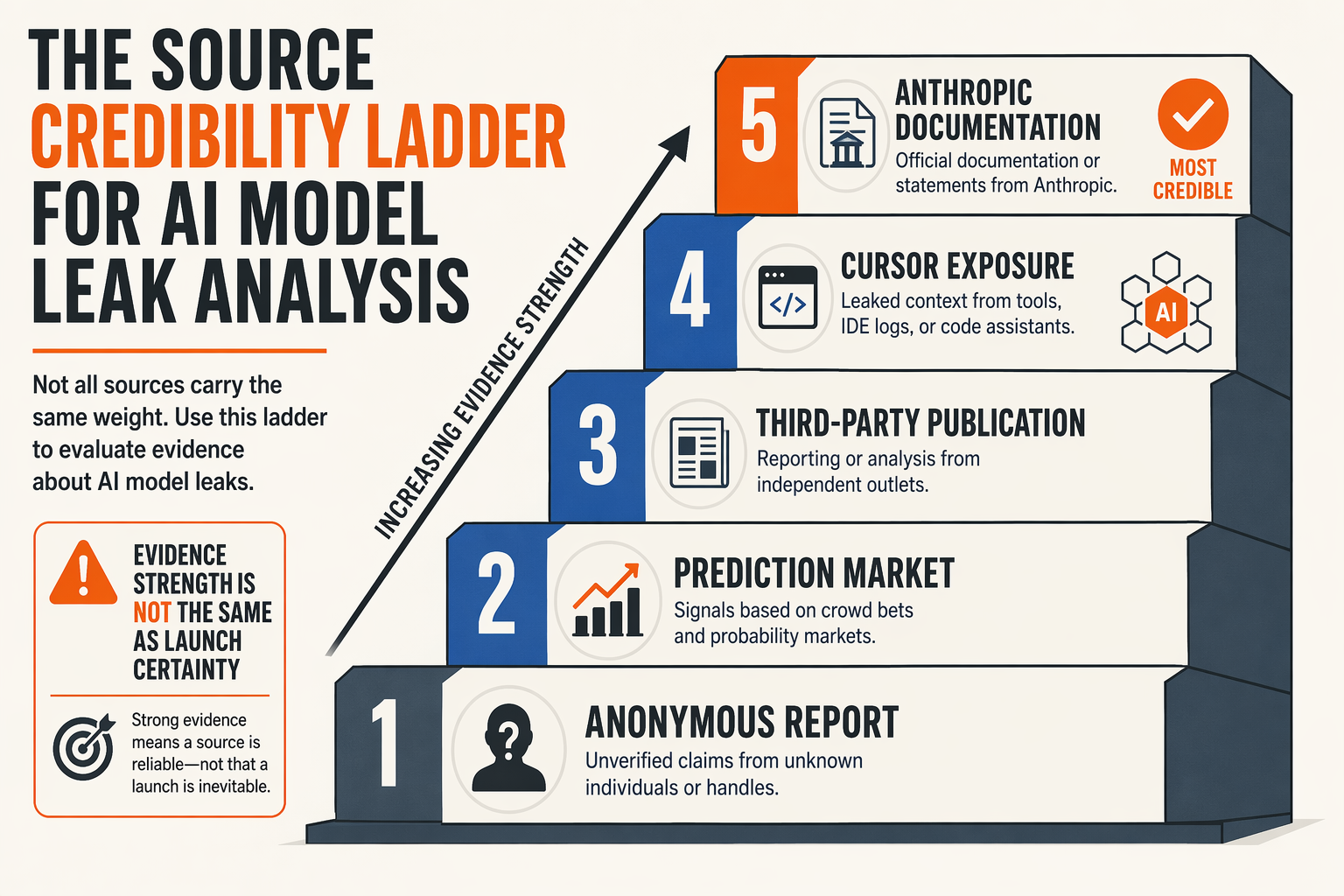
The Claude Opus 5 leaks are moderately credible as evidence that Anthropic is testing an unreleased model, but they do not prove a launch date, final model name, or production specifications. The strongest clue is the brief appearance of “Claude Honeycomb EAP” in Cursor, while claims about Claude Opus 5 benchmarks, pricing, modalities, and API availability remain unverified as of July 24, 2026.
What does the Honeycomb EAP leak actually prove?
The leak proves that a model labeled Claude Honeycomb EAP was visible through Cursor during July 2026, according to multiple reports. ByteIota reported the listing on July 8, 2026, while Kie.ai reported it on July 9, 2026; the one-day difference may reflect different observation times rather than two separate leaks.
According to Explainx.ai, the Cursor configuration associated with Honeycomb included:
- A 1-million-token context window
- An “xhigh” effort mode, suggesting an additional or more intensive reasoning setting
- The label “EAP,” commonly read as an early-access-program designation
These details make Honeycomb a meaningful signal of Anthropic development activity. However, the listing appeared in a third-party coding tool rather than in an Anthropic announcement, model card, or public API changelog. It therefore cannot independently establish that Honeycomb is the final Claude Opus 5 product.
| Evidence | What it supports | What it does not prove | Source |
|---|---|---|---|
| “Claude Honeycomb EAP” appeared in Cursor | Anthropic-related testing or early access was likely underway | That Honeycomb is officially named Opus 5 | ByteIota, Kie.ai |
| 1M-token context value | A very large context configuration was associated with the listing | That the capability will ship publicly or work at full production limits | Explainx.ai |
| “xhigh” effort mode | A high-compute reasoning option may be under evaluation | Final reasoning quality or benchmark performance | Explainx.ai |
| July 20–21 launch speculation passed without release | The specific date prediction was unsuccessful | That Opus 5 will not launch later in 2026 | AIReiter, July 2026 |
Which Claude Opus 5 claims remain speculation?
The Claude Opus 5 release date rumors in July 2026 are not supported by an official Anthropic statement. Valletta Software reported that Anthropic had made no on-the-record announcement, and AIReiter noted that the widely discussed July 20–21 window passed without a public launch.
The market’s expectations should also be separated from evidence. Explainx.ai reported that Polymarket priced the probability of a Claude Opus 5 launch by December 2026 at 93%. That figure reflects trader sentiment, not an Anthropic commitment or a verified schedule.
No reliable source in the current evidence establishes:
- Claude Opus 5’s final pricing
- Public API access
- Supported modalities, such as image input or audio
- Independent benchmarks
- Whether the 1-million-token context window will be generally available
The June 30, 2026 launch of Claude Sonnet 5, reported by Simplified, makes a later Opus release plausible, but product sequencing is not proof of timing. Until Anthropic publishes release notes or documentation, developers should treat Honeycomb as a promising pre-release signal—not as a launch announcement. Teams testing available models today can use multi-model gateways such as CallMissed to evaluate alternatives through one OpenAI-compatible integration while awaiting verified Opus 5 details.
Does Claude Sonnet 5’s June 30 launch make an Opus 5 launch more likely?

Yes—Claude Sonnet 5’s June 30, 2026 launch makes a later Claude Opus 5 release more plausible, but it does not establish a launch date. As of July 24, 2026, Anthropic has not confirmed Claude Opus 5, and the available evidence still consists of the “Claude Honeycomb EAP” Cursor leak, not an official product announcement.
Why does Sonnet 5’s launch matter?
Anthropic’s June 30 release of Claude Sonnet 5, reported by Simplified, demonstrates that the Claude 5 generation is already entering public distribution. That makes an Opus 5 model a reasonable product-line expectation: Anthropic may use Sonnet for broad availability before introducing a more capable, higher-cost flagship.
However, product sequencing is not a schedule. Anthropic has not said that Sonnet 5 will be followed by Opus 5 within days or weeks, and the rumored July 20–21 launch window passed without an official release, according to AIReiter.
The strongest argument for a future Opus 5 launch is therefore indirect:
| Evidence | Date or figure | What it suggests | Confidence |
|---|---|---|---|
| Claude Sonnet 5 public launch | June 30, 2026 | The Claude 5 model family is active | Confirmed by Simplified |
| “Claude Honeycomb EAP” appeared in Cursor | July 8–9, 2026 | Anthropic may be testing an unreleased model | Reported by ByteIota and Kie.ai |
| Reported Honeycomb context window | 1 million tokens | A flagship-scale capability may be in testing | Reported by Explainx.ai |
| Reported Honeycomb effort mode | “xhigh” | The model may support more intensive reasoning | Reported by Explainx.ai |
| Probability of launch by December 2026 | 93% | Market participants expect a launch this year | Polymarket figure cited by Explainx.ai |
Does the Honeycomb leak indicate an imminent Opus 5 release?
It indicates pre-release activity more convincingly than it indicates timing. Explainx.ai described the Cursor entry as “Claude Honeycomb EAP,” while ByteIota and Kie.ai independently placed the listing’s appearance on July 8 and July 9, respectively. The short visibility window is consistent with an internal experiment, early-access program, or accidental exposure.
A separate pattern may support—but cannot prove—a near-term launch. AIToolsRecap reported that an earlier unreleased “Fable 5 EAP” appeared in Cursor approximately two weeks before a June 9 public launch. If Anthropic follows a similar development and rollout process, Honeycomb could precede Opus 5 by a comparable interval. Yet one prior timing pattern is not a reliable release calendar, especially because Honeycomb has not been publicly identified by Anthropic as Opus 5.
What should developers conclude?
Developers should treat Sonnet 5 as evidence that Claude 5 products are shipping, and Honeycomb as evidence that another model may be under evaluation—not as confirmation of when Claude Opus 5 will launch. Pricing, modalities, benchmarks, API access, and the relationship between “Honeycomb” and “Opus 5” remain unverified.
Until Anthropic publishes documentation, teams can test currently available models through multi-model gateways such as CallMissed, whose OpenAI-compatible API provides one integration path across LLM, speech, image, and search models while release rumors develop.
What is the timeline of the Claude Opus 5 rumors?
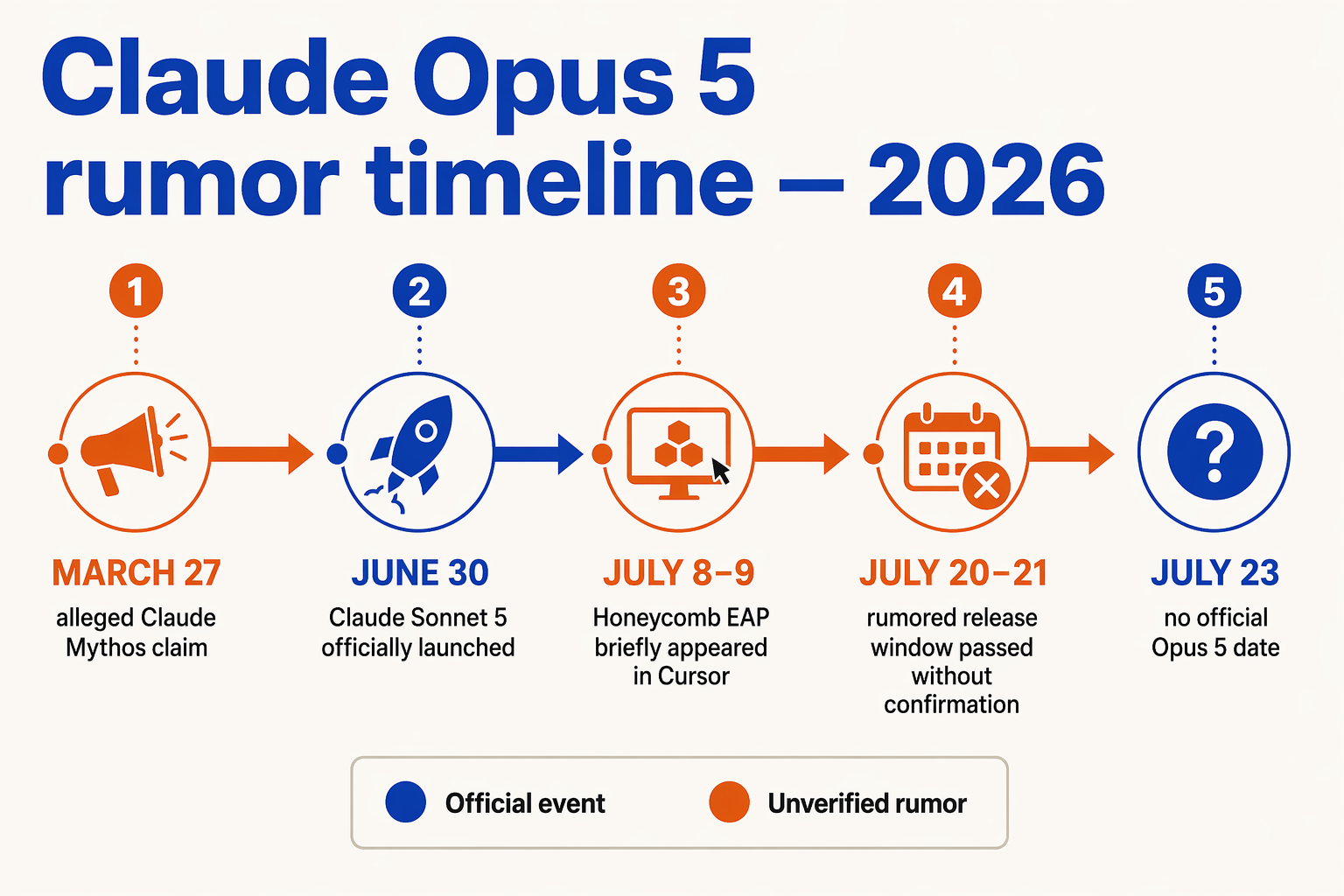
As of July 24, 2026, Claude Opus 5 has no confirmed launch date. The strongest Claude Opus 5 release-date rumor in July 2026 is tied to an unannounced Cursor model named “Claude Honeycomb EAP,” but the leak does not prove that Honeycomb is Opus 5 or that a public release is imminent.
What is the documented timeline of Claude Opus 5 rumors?
The timeline shows a progression from a real product release to an unverified model listing, followed by missed launch predictions. No event so far confirms that Claude Opus 5 is publicly available.
| Date or window | Reported event | Source and details | Status |
|---|---|---|---|
| June 30, 2026 | Claude Sonnet 5 launched | Simplified reported that Claude Sonnet 5 officially launched on June 30, 2026. | Confirmed launch of Sonnet 5; not Opus 5 |
| July 8, 2026 | “Claude Honeycomb EAP” appeared in Cursor | ByteIota reported an unannounced Anthropic model listing with a 1-million-token context window and “xhigh” effort mode. | Reported leak; not confirmed by Anthropic |
| July 9, 2026 | Honeycomb listing was independently reported | Kie.ai also reported seeing “Claude Honeycomb EAP” in Cursor on July 9, 2026. | Corroborated observation, but model identity remains unverified |
| July 20–21, 2026 | Speculative Opus 5 launch window | AIReiter reported that the rumored July 20–21 window passed without an official Claude Opus 5 release. | Prediction not fulfilled |
| By July 24, 2026 | No Opus 5 announcement or public launch | Valletta Software stated that Anthropic had made no on-the-record announcement, while Explainx.ai reported a 93% Polymarket probability of a launch by December 2026. | No confirmed date; market expectation only |
What do the Honeycomb EAP leaks actually establish?
The Claude Honeycomb EAP Cursor leak establishes that a model using an Anthropic-associated name was reportedly visible to some Cursor users. According to Explainx.ai, the listing showed a 1M-token context window and an “xhigh” effort setting, specifications that could fit a future high-end reasoning model.
However, the leak does not establish the following:
- That “Honeycomb” is the final name for Claude Opus 5.
- That the model is ready for public API access.
- That the 1M context window will remain in the production version.
- The model’s pricing, benchmarks, supported modalities, or rate limits.
- Whether Anthropic plans a July, August, or December 2026 release.
The two reports dated July 8 and July 9 may indicate that the listing was available briefly or observed at different times; they are not separate official confirmations. Developers should therefore treat the leaked specifications as provisional, not as a product sheet.
What is the most defensible launch prediction?
The most defensible answer is “unknown, but likely before the end of 2026 according to current market expectations.” Explainx.ai reported that Polymarket priced the probability of a Claude Opus 5 launch by December 2026 at 93%, but prediction-market pricing measures sentiment rather than Anthropic’s commitment.
Until Anthropic publishes release notes, API documentation, or an official announcement, the Honeycomb evidence supports interest in an upcoming flagship model—not a confirmed Claude Opus 5 release date.
How can you try Anthropic’s latest model through the API today?

Claude Opus 5 is not available through a public API as of July 24, 2026, because Anthropic has announced neither a launch date nor an official model listing. Developers can test a publicly released Claude model—most notably Claude Sonnet 5, which Simplified reports launched on June 30, 2026—but “Claude Honeycomb EAP” is not a confirmed Opus 5 API endpoint.
Which Claude model can developers try through an API today?
The practical approach is to use Anthropic’s official API or an authorized model gateway with a publicly documented Claude model. Before moving an experiment into production, verify the current model ID, context limit, rate limits, pricing, and feature support in the provider’s documentation.
The available evidence supports this workflow:
- Start with Claude Sonnet 5: Simplified identifies Claude Sonnet 5 as an officially launched model on June 30, 2026.
- Do not target Honeycomb EAP directly: Explainx.ai reported that “Claude Honeycomb EAP” appeared with a 1-million-token context window and an “xhigh” effort mode, but neither Anthropic nor the cited reports confirmed public API access.
- Treat Opus 5 specifications as unverified: No source in the current reporting confirms Claude Opus 5’s final price, modalities, benchmark scores, production context limit, or API model name.
- Monitor the official release channel: A Cursor appearance can indicate testing or an early-access integration, but it does not establish a general-availability launch.
| Model or listing | Reported date | Context signal | API status |
|---|---|---|---|
| Claude Sonnet 5 | June 30, 2026 — Simplified | Not established in the provided reports | Officially launched; verify current API documentation |
| Claude Honeycomb EAP | July 8, 2026 — ByteIota | 1 million tokens — Explainx.ai | Unconfirmed early-access listing |
| Claude Honeycomb EAP | July 9, 2026 — Kie.ai | “xhigh” effort mode — Explainx.ai | Not confirmed as public API access |
| Claude Opus 5 | No announced date — Valletta Software | Final specification unknown | Not publicly confirmed |
Can a gateway simplify testing while Opus 5 remains unreleased?
Yes. An OpenAI-compatible gateway such as CallMissed can let developers test different available LLMs through one integration rather than rewriting application code for every provider. CallMissed combines a multi-model catalog with one API key, one billing account, transparent credit pricing—1 credit equals ₹1—and same-tier fallbacks where supported.
That is useful for teams building agent workflows before Claude Opus 5 arrives. Developers can benchmark currently available models against their own prompts, then switch providers or models when Anthropic publishes verified Opus 5 documentation. The key limitation is that a gateway cannot provide Honeycomb EAP or Opus 5 before an authorized provider exposes the model.
For now, the defensible API conclusion is simple: test a documented Claude release today, but do not treat the Honeycomb EAP leak as an accessible Opus 5 preview.
What should readers watch for before believing a Claude Opus 5 launch announcement?
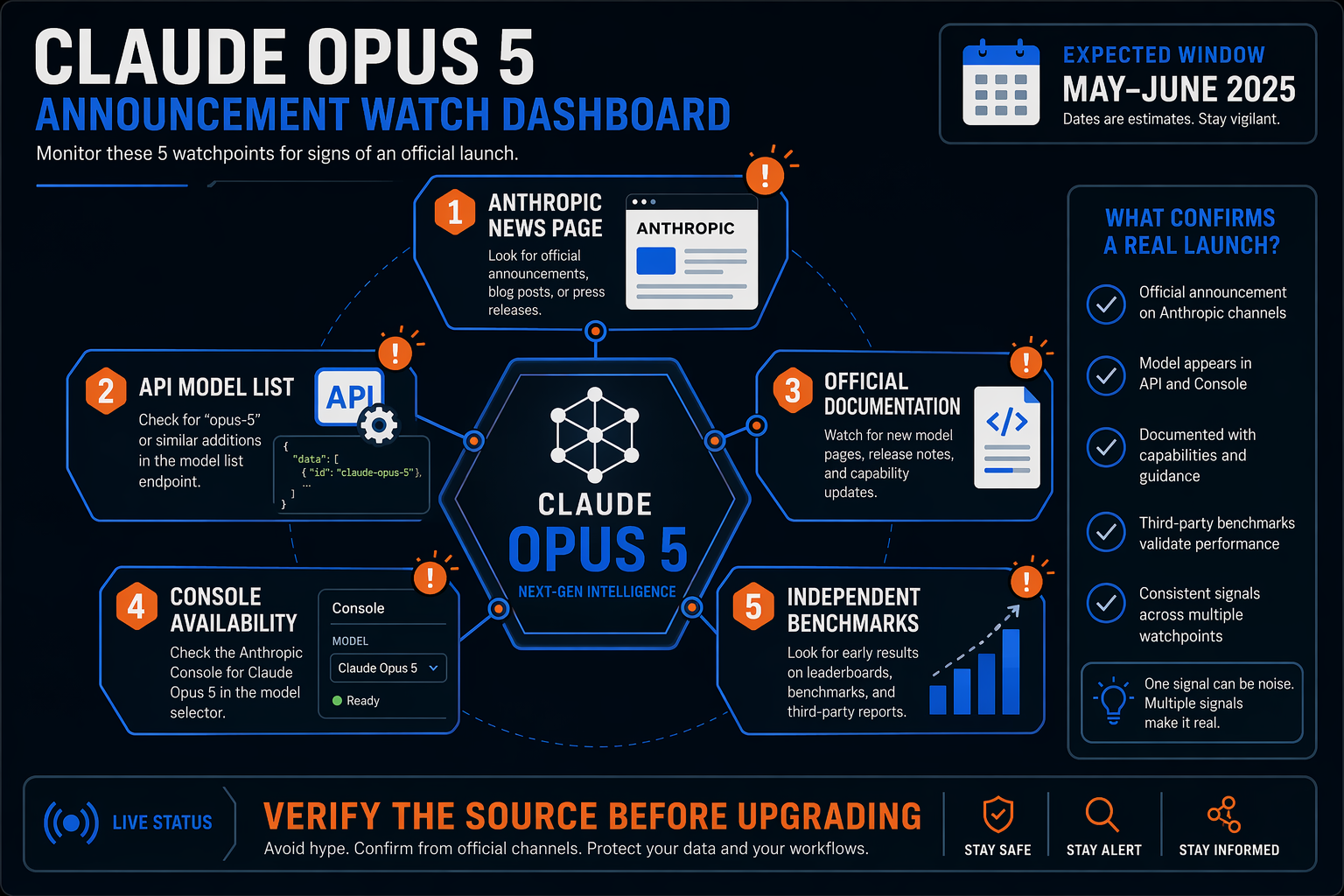
The safest way to evaluate a Claude Opus 5 launch announcement is to look for a first-party Anthropic release, documentation, and a working API model identifier—not screenshots or prediction-market odds. As of July 24, 2026, the Claude Opus 5 release date remains unconfirmed, and the “Claude Honeycomb EAP” Cursor appearance is evidence of testing or early access, not proof of a public launch.
Which signals would confirm a real Claude Opus 5 launch?
A credible announcement should satisfy several independent checks:
- Anthropic publishes the announcement. An official post on Anthropic’s website, documentation, or verified developer channels should identify the model as Claude Opus 5 and state its availability.
- The API exposes a documented model ID. Developers should be able to find the model name, endpoint, region availability, and access requirements in Anthropic’s API documentation.
- Pricing and limits are published. A real launch should specify input and output token prices, rate limits, context limits, maximum output tokens, and whether prompt caching or batch processing is supported.
- Independent users can test it. Reproducible API calls, console access, or an announced partner integration are stronger evidence than a temporary interface label.
- Specifications are consistent across sources. Context size, reasoning controls, modalities, and benchmark results should match between Anthropic’s documentation and independent testing.
| Signal to verify | What credible evidence looks like | What remains unverified |
|---|---|---|
| Model identity | Anthropic names “Claude Opus 5” in official documentation | Whether “Honeycomb” is the final product name |
| Context window | Published technical documentation and API limits | The leaked 1-million-token context claim |
| Reasoning controls | Documented effort or thinking settings | Whether Cursor’s “xhigh” mode maps to Opus 5 |
| Commercial access | Public pricing, console access, and API model ID | Claude Opus 5 pricing and availability |
| Performance | Anthropic benchmarks plus reproducible third-party tests | Claude Opus 5 benchmarks of any kind |
How should readers interpret the Honeycomb EAP leak?
The Claude Opus 5 Honeycomb EAP Cursor leak deserves attention because it reportedly exposed concrete configuration details. Explainx.ai reported a 1-million-token context window and an “xhigh” effort mode, while ByteIota and Kie.ai placed the Cursor sighting on July 8 and July 9, 2026, respectively.
However, “EAP” commonly suggests an early-access or evaluation pathway; it does not establish final branding, public access, or shipping specifications. The leak also does not verify pricing, image or audio capabilities, benchmark scores, safety behavior, or whether the model is available through Anthropic’s API.
What should developers do while waiting?
Developers should avoid building production workflows around an unannounced model identifier. Instead, teams can:
- Keep model selection configurable rather than hard-coded.
- Test long-context workloads with currently documented models.
- Record token usage, latency, output quality, and fallback behavior.
- Treat late-July Claude 5 release date rumors as speculation until Anthropic confirms them.
For teams comparing available models now, CallMissed’s OpenAI-compatible gateway provides one integration for multiple LLM, speech, image, and search models, helping developers evaluate alternatives without repeatedly rewriting provider-specific code.
Frequently asked questions about the Claude Opus 5 launch and leaks
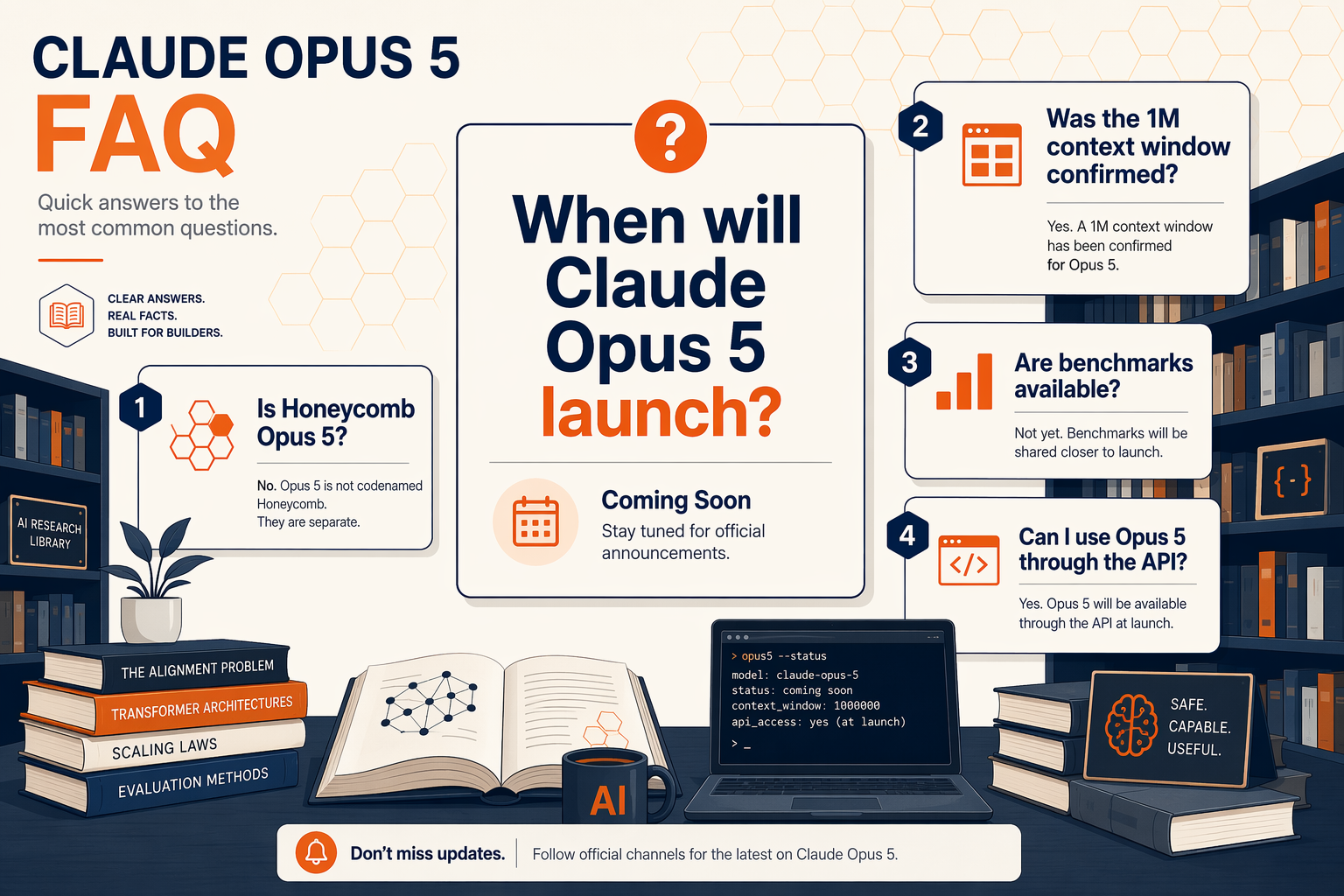
When will Claude Opus 5 launch?
What do the Claude Opus 5 leaks reveal about the model?
What is the Claude Opus 5 Honeycomb EAP Cursor leak?
Will Claude Opus 5 definitely have a 1-million-token context window?
Are there official Claude Opus 5 benchmarks, pricing, or API details?
How can developers use advanced AI models while waiting for Claude Opus 5?
Conclusion
As of July 24, 2026, Claude Opus 5 has not launched, and Anthropic has announced no official release date. The strongest evidence behind the Claude Opus 5 release date rumors is a brief Cursor listing for an unannounced model called “Claude Honeycomb EAP.” It is a meaningful clue, but it does not confirm that Honeycomb is Opus 5 or establish when a public release might occur.
According to Explainx.ai, the listing showed a 1-million-token context window and an “xhigh” effort mode, potentially indicating a high-end Anthropic model intended for long-context tasks and more intensive reasoning. ByteIota reported the listing on July 8, 2026, while Kie.ai reported it on July 9, possibly reflecting limited visibility or different observation times. Neither report is an on-the-record Anthropic announcement.
The rumored July 20–21 launch window has passed, according to AIReiter, without an official release. Explainx.ai also reported that Polymarket assigned a 93% probability to an Opus 5 launch by December 2026, but prediction-market odds reflect expectations, not a confirmed schedule. The Claude Opus 5 release date rumors do not prove the model’s name, launch date, pricing, modalities, benchmarks, or public API availability.
Key takeaways:
- Claude Opus 5 has no confirmed release date.
- Honeycomb EAP may be an early-access or internal codename, but its connection to Opus 5 remains unverified.
- The most specific leaked capabilities are a 1M-token context window and xhigh effort mode.
- Claude Sonnet 5 officially launched on June 30, 2026, according to Simplified, making an Opus release plausible—but not guaranteed.
Primary-source verification checklist for the Claude Opus 5 release date rumors:
- Check Anthropic’s official announcements and documentation.
- Look for Claude Opus 5 in Anthropic’s public model listings.
- Confirm pricing, context limits, modalities, and benchmarks directly from Anthropic.
- Verify public API availability before treating third-party listings or countdowns as launch confirmation.
Until Anthropic publishes those details, developers should treat every claimed date as unverified. Platforms such as CallMissed can help teams explore the broader AI infrastructure trend through one OpenAI-compatible gateway for multiple available models. CallMissed also supports AI voice agents and WhatsApp engagement across 22 Indian languages, giving businesses a practical way to keep building while the Claude Opus 5 release date rumors develop.
The central question is no longer whether Honeycomb is interesting, but whether Anthropic will officially connect that leaked capability profile to a public Claude Opus 5 product. Until that happens, the evidence supports continued monitoring—not a claimed launch.
Related Reading
- Claude Fable 5 vs Claude Mythos 5 vs Claude Opus 5: Which Should You Choose?
- Gemini 3.5 Flash-Lite vs Claude Opus 4.8: Cost, Speed & Quality
- Gemini 3.6 Flash vs Claude Opus 4.8: Price, Speed, Limits and Best Uses
Sources
Discussion
Ready to automate customer conversations?
Launch AI voice agents and WhatsApp bots with CallMissed — one API, 22+ Indian languages.