

Kimi K3 vs Claude Sonnet 5: Coding, Agents, Pricing, and Enterprise Verdict


Compare Kimi K3 vs Claude Sonnet 5 for coding, agents, 1M-token context, API cost, documentation, and enterprise deployment using verified sources.
Kimi K3 vs Claude Sonnet 5: Coding, Agents, Pricing, and Enterprise Verdict
Kimi K3 and Claude Sonnet 5 both advertise 1-million-token context windows, yet context size alone says little about which model will finish a coding task reliably—or economically. This Kimi K3 vs Claude Sonnet 5 comparison matters now because Anthropic lists Claude Sonnet 5 at $3 per million input tokens and $15 per million output tokens, while Moonshot AI positions Kimi K3 for long-horizon coding and end-to-end knowledge work; however, some Kimi pricing and launch details still require careful evidence labeling.
As of July 16, 2026, we examine coding quality, autonomous agents, long-context behavior, API costs, documentation maturity, and enterprise deployment using primary vendor documentation wherever possible. You will also get evidence-status and pricing tables, a reproducible bake-off methodology, and cautious recommendations for startups and enterprise teams. Multi-model gateways such as CallMissed’s OpenAI-compatible API reflect why this comparison matters: developers increasingly want model choice without rebuilding integrations.
Which is better: Kimi K3 or Claude Sonnet 5? Our answer-first verdict
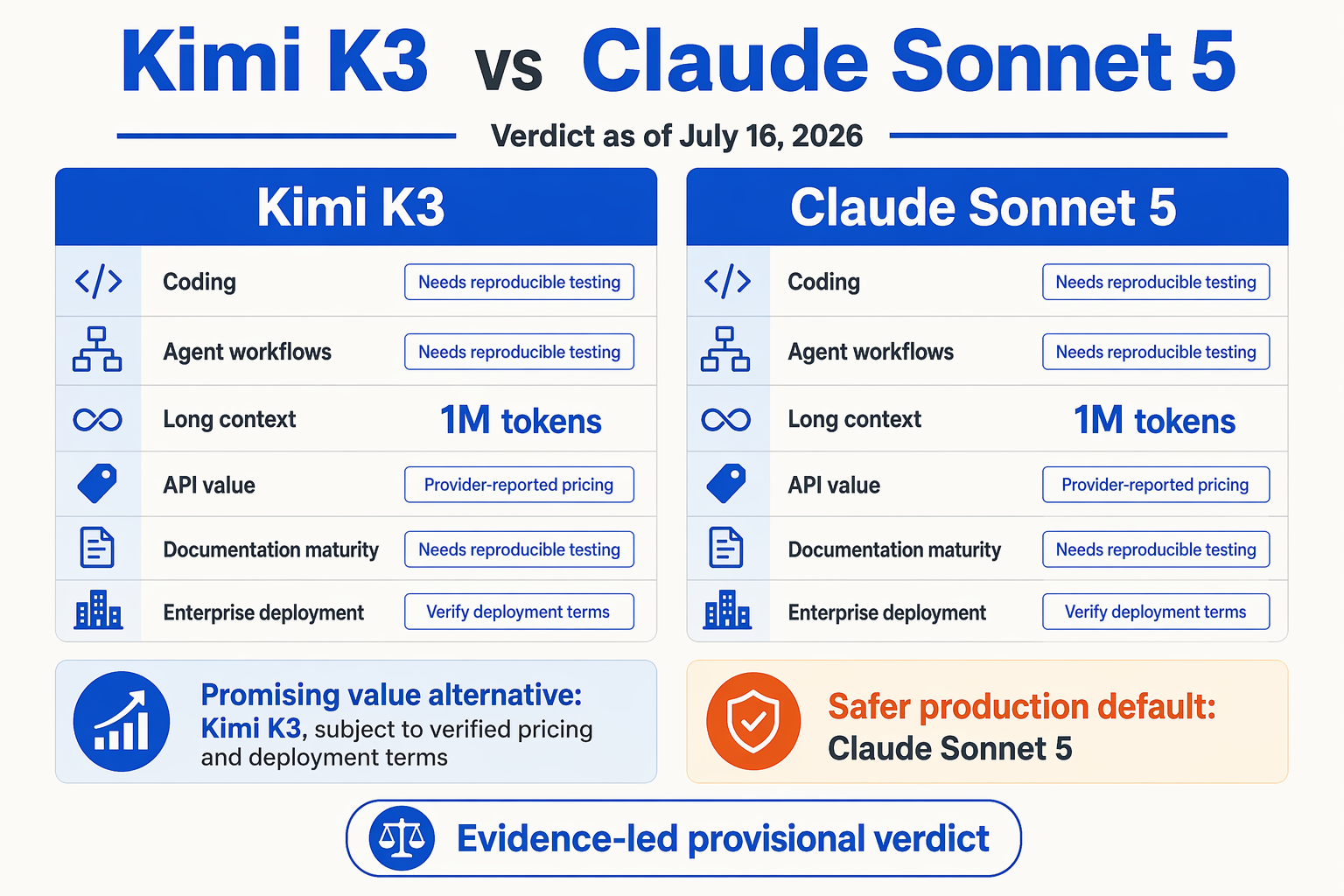
Claude Sonnet 5 is the safer documented default for production coding agents and enterprise evaluation, while Kimi K3 is the more exploratory option for long-horizon coding and knowledge work. Neither model is a universal winner as of July 16, 2026; teams should decide through workload-specific testing, especially because Kimi K3’s documentation and pricing details remain less consistent.
Verdict by workload
- Production coding and agents: Claude Sonnet 5. Anthropic’s Claude Platform documentation provides explicit model identifiers, context-window guidance, token accounting, and deployment information. That documentation maturity reduces integration and procurement uncertainty, but it does not prove that Claude Sonnet 5 will complete every coding task more accurately or cheaply.
- Long-horizon experimentation: Kimi K3. Moonshot AI’s Kimi Platform describes Kimi K3 as its flagship model for “long-horizon coding and end-to-end knowledge work.” Kimi K3 deserves a controlled evaluation for repository-scale coding, extended tool use, and research workflows, but the supplied primary sources do not establish a reproducible benchmark victory over Claude Sonnet 5.
- Long context: advertised tie. Moonshot AI documents a 1-million-token context window for Kimi K3, while Anthropic documents the same 1-million-token window for Claude Sonnet 5. Maximum context capacity is not equivalent to reliable recall: test retrieval accuracy, instruction retention, latency, and cost at realistic context depths.
- Documentation maturity: Claude Sonnet 5. Anthropic maintains dedicated model-overview, pricing, release, and context-window pages. Some Moonshot AI pages describing Kimi K3 retain legacy Kimi K2.x paths or identifiers, creating questions that developers should resolve before production deployment.
- Enterprise evaluation: Claude Sonnet 5 carries less documented uncertainty. The available Anthropic materials provide clearer platform identifiers and deployment guidance. The supplied primary evidence does not confirm Kimi K3’s licence, downloadable weights, self-hosting support, data residency, retention terms, audit controls, service-level commitments, or regional availability.
Important Claude Sonnet 5 pricing clarification
Anthropic’s live Claude Platform pricing page lists Claude Sonnet 5 at $2 per million input tokens and $2.50 per million output tokens through August 31, 2026. Those are the applicable published rates to use for calculations dated July 16, 2026.
However, Anthropic’s separate “What’s new in Claude Sonnet 5” release page states $3 per million input tokens and $15 per million output tokens. Because Anthropic’s own pages conflict, the $3/$15 figures should not be presented as the current standard rate on July 16. They may reflect launch-page or longer-term pricing, but Anthropic’s materials do not provide enough context here to resolve that conclusively.
For procurement and forecasting:
- Record the pricing-page access date.
- Use $2 input and $2.50 output per million tokens through August 31, 2026 for current estimates.
- Recheck Anthropic’s live pricing page before deployment or contract approval.
- Model post-promotion costs separately rather than assuming either published rate will continue.
Kimi K3’s exact token rates should remain unverified until Moonshot AI’s live pricing table unambiguously maps prices to the Kimi K3 model identifier.
Practical recommendation
Run both models with the same repository, prompts, tools, retry policy, and token budget. Compare accepted-task rate, tool-call accuracy, regressions, latency, human corrections, and total cost per solved issue. An OpenAI-compatible gateway such as CallMissed can simplify multi-model evaluation without requiring teams to rewrite the core integration.
Which Kimi K3 and Claude Sonnet 5 claims are confirmed by primary sources? (TABLE)
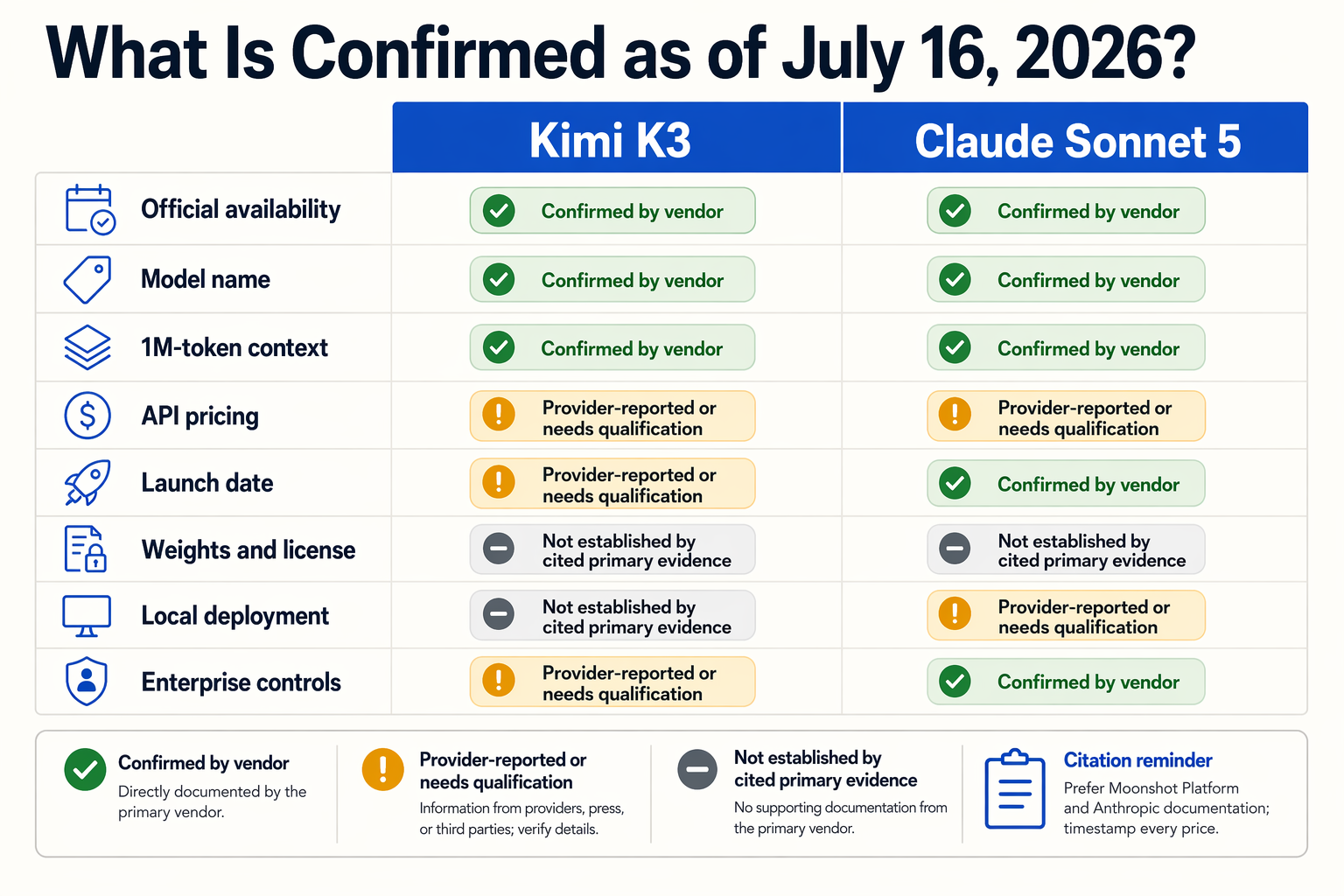
Primary vendor documentation confirms that Kimi K3 and Claude Sonnet 5 are released models with 1-million-token context windows, but it does not establish a coding-agent winner. Pricing requires special caution: Anthropic’s primary pages show conflicting, date-sensitive Claude Sonnet 5 rates, while the supplied Moonshot AI documentation does not clearly establish Kimi K3’s current token price.
| Claim | Kimi K3 primary evidence | Claude Sonnet 5 primary evidence | Verdict as of July 16, 2026 |
|---|---|---|---|
| Model positioning | Moonshot AI’s Kimi Platform describes Kimi K3 as its flagship for “long-horizon coding and end-to-end knowledge work.” | Anthropic’s Claude Platform documents Claude Sonnet 5 as a released model. | Confirmed for both |
| Maximum context window | Moonshot AI specifies a 1-million-token context window. | Anthropic’s context-window documentation specifies 1 million tokens for Claude Sonnet 5. | Confirmed for both |
| API pricing | The supplied Moonshot AI pages do not clearly map a stable input/output price to Kimi K3; one pricing excerpt mixes Kimi K3 positioning with a kimi-k2.6 price row. | Anthropic’s “What’s new in Claude Sonnet 5” states $3 per million input tokens and $15 per million output tokens, while Anthropic’s pricing page lists $2 input and $2.50 output per million tokens through August 31, 2026. | Conflicting/date-sensitive for Claude; unresolved for Kimi—verify live pricing |
| Coding and agent superiority | Moonshot AI provides workload positioning but no supplied reproducible Kimi K3-versus-Claude Sonnet 5 evaluation. | Anthropic documents capabilities but does not publish a controlled head-to-head win over Kimi K3. | No winner confirmed |
| Documentation and managed deployment | Moonshot AI publishes API pricing, quickstart, and model-guide pages, confirming managed API access. | Anthropic documents pricing, model identifiers, context behavior, and the Google Cloud model ID claude-sonnet-5. | Both documented; different levels of deployment detail |
| Weights, licence, and self-hosting | The supplied evidence does not safely confirm downloadable Kimi K3 weights, licence terms, or supported on-premises deployment. | Anthropic’s supplied documentation covers managed API and cloud availability, not downloadable Sonnet 5 weights. | Do not claim local deployment |
Pricing evidence must be treated as time-sensitive
- Anthropic’s “What’s new in Claude Sonnet 5” page lists $3 per million input tokens and $15 per million output tokens as of the material reviewed on July 16, 2026.
- Anthropic’s Claude Platform pricing page lists Claude Sonnet 5 at $2 per million input tokens and $2.50 per million output tokens through August 31, 2026, as viewed on July 16, 2026.
- These primary-source figures are not interchangeable. The dated pricing-page rate may be a temporary offer, while the model announcement may describe standard pricing; buyers should check the live billing page and account-specific terms immediately before deployment.
- Kimi K3 pricing should remain unresolved until Moonshot AI displays a price row explicitly tied to the Kimi K3 model identifier.
Evidence boundaries that affect the comparison
A 1-million-token context window describes maximum request capacity, not guaranteed recall or reasoning quality across every token. Teams should test retrieval accuracy, instruction retention, latency, tool-call reliability, and cost per completed task.
Moonshot AI’s phrase “industry-leading intelligence” is vendor positioning, not an independently reproduced benchmark. Likewise, neither vendor’s documentation proves superiority in coding or agents; a defensible comparison requires identical repositories, prompts, tools, token budgets, retry policies, and human-review criteria. Claims about Kimi K3’s exact launch date, benchmark wins, licence, downloadable weights, or on-premises support should remain unconfirmed unless Moonshot AI publishes explicit primary documentation.
How do Kimi K3 and Claude Sonnet 5 compare for coding, agents, long context, documentation, and deployment? (TABLE)
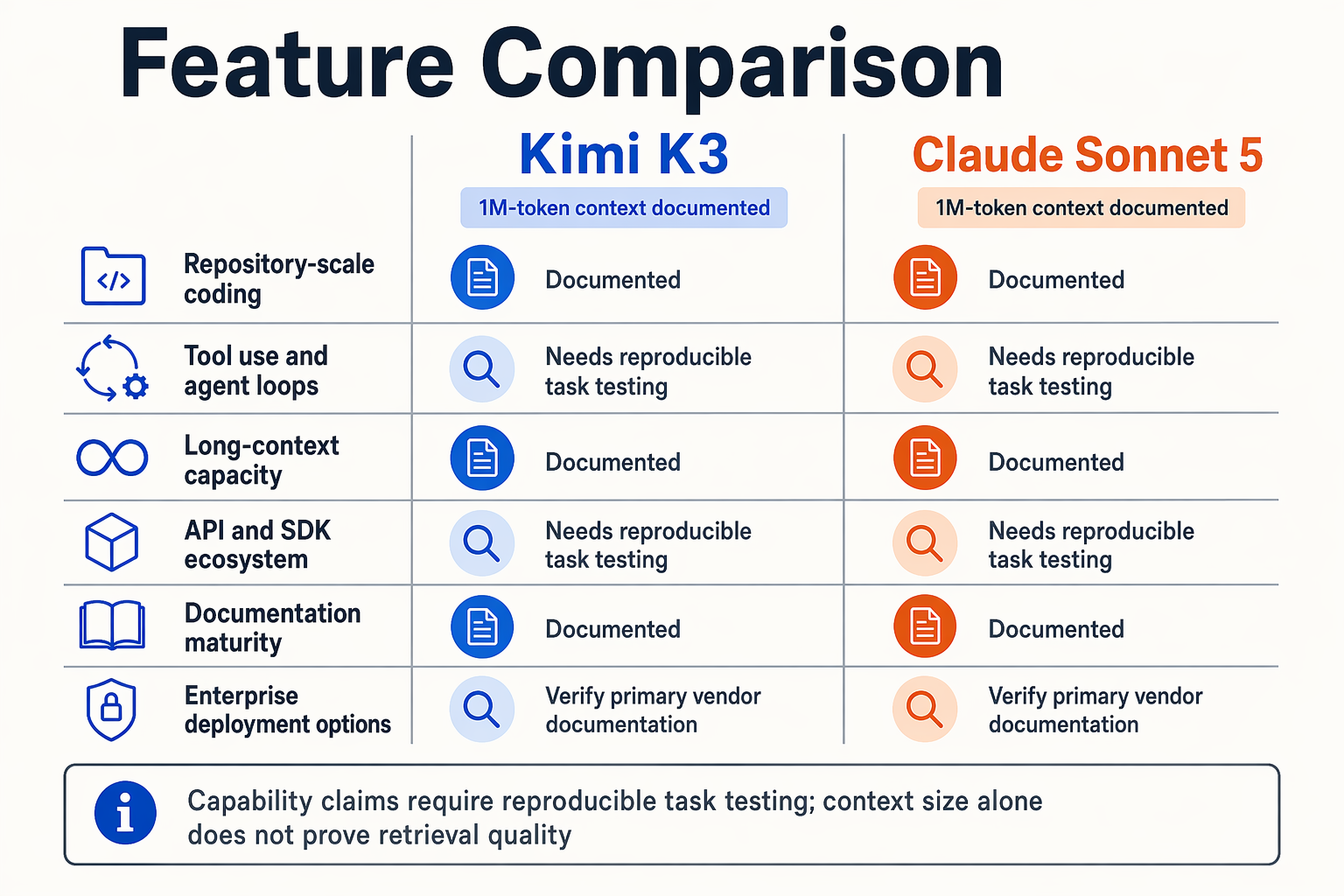
Claude Sonnet 5 currently offers clearer documentation and enterprise-cloud evidence, while Kimi K3 is positioned by Moonshot AI for long-horizon coding and knowledge-work agents. Both advertise a 1-million-token context window, but neither vendor’s claims replace workload-specific testing, and Anthropic’s conflicting pricing pages require confirmation before budgeting.
Evidence-based capability and deployment comparison
| Criterion | Kimi K3 | Claude Sonnet 5 | Assessment as of July 16, 2026 |
|---|---|---|---|
| Coding | Moonshot AI describes Kimi K3 as its flagship model for “long-horizon coding.” The supplied primary sources do not establish a head-to-head benchmark victory. | Anthropic positions Claude Sonnet 5 for coding workflows and provides consolidated platform documentation. | Run identical repository-level tasks; vendor positioning is not equivalent to independently reproduced results. |
| Agent workflows | Moonshot AI positions Kimi K3 for “end-to-end knowledge work” involving extended, multi-step tasks. | Anthropic documents context management, token accounting, model identifiers, and platform behavior in greater detail. | Claude presents lower documentation-related integration uncertainty; Kimi remains suitable for controlled agent trials. |
| Long context | Kimi K3 supports a 1-million-token context window, according to Moonshot AI’s Kimi Platform documentation available July 16, 2026. | Claude Sonnet 5 supports a 1-million-token context window, according to Anthropic’s Context Windows documentation available July 16, 2026. | The advertised capacity is tied. Test retrieval accuracy, instruction retention, latency, and cost at progressively larger inputs. |
| API pricing | The supplied Moonshot AI pages do not unambiguously confirm Kimi K3’s exact input and output prices; figures labeled for Kimi K2.6 should not be transferred to K3. | Anthropic’s Sonnet 5 release page states $3 per million input tokens and $15 per million output tokens, while Anthropic’s current pricing page lists $2/MTok input and $2.50/MTok output through August 31, 2026. | Claude pricing is date-sensitive and internally conflicting across primary pages. Obtain the applicable rate in writing and verify the API billing console before forecasting costs. |
| Documentation | Kimi Platform provides pricing, quickstart, and guide pages, although surfaced page labels and URLs sometimes reference earlier Kimi generations. | Claude Platform consolidates model IDs, context-window rules, token accounting, and pricing documentation. | Claude has the more mature documentation footprint in the supplied evidence, but its pricing discrepancy remains material. |
| Deployment | Moonshot AI documents access through the Kimi API Platform; the supplied evidence does not establish self-hosting, downloadable weights, or local deployment. | Anthropic documents direct Claude Platform access and the Google Cloud model identifier claude-sonnet-5. | Claude has clearer enterprise-cloud evidence. Neither table entry alone establishes regional availability, residency guarantees, or contractual data controls. |
What teams should verify in a bake-off
- Coding quality: Measure accepted fixes, passing tests, regressions, human interventions, and total cost per merged change.
- Agent reliability: Record tool-call validity, recovery from failed actions, completion rates, and wall-clock duration.
- Long-context performance: Test at 100,000, 500,000, and 1 million tokens; a capacity ceiling does not prove reliable use of every token.
- Pricing: Capture invoices or billing-console results because temporary promotions, caching, and provider-specific rates can change effective cost.
- Enterprise readiness: Compare identity controls, audit logs, retention, data residency, service commitments, cloud regions, and incident-response processes.
For multi-model evaluations, an OpenAI-compatible gateway such as CallMissed can help teams run a shared coding or agent harness across providers without maintaining a separate integration for every model.
How much do Kimi K3 and Claude Sonnet 5 APIs cost in real coding-agent workloads? (TABLE)
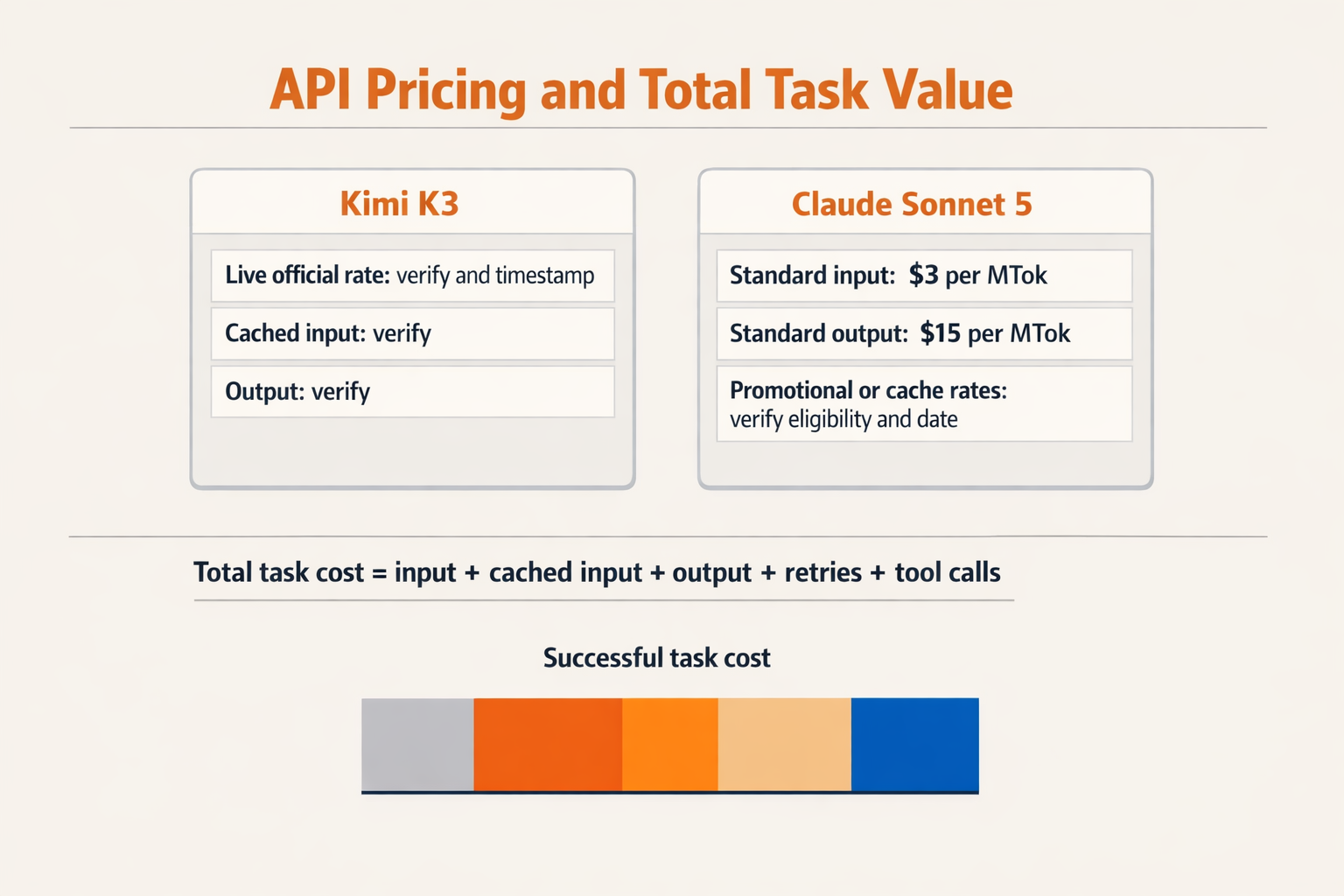
Claude Sonnet 5 currently offers the more predictable coding-agent budget because Anthropic publishes standard rates of $3 per million input tokens and $15 per million output tokens. Kimi K3 costs should remain formula-based until an exact K3 price row is confirmed in Moonshot AI’s primary documentation.
Estimated workload cost
| Workload | Input / output tokens | Kimi K3 cost* | Claude Sonnet 5 cost |
|---|---|---|---|
| Published standard rate | 1M / 1M | Ki + Ko | $3 + $15 |
| Small bug fix | 100K / 10K | 0.10Ki + 0.01Ko | $0.45 |
| Repository-scale task | 500K / 30K | 0.50Ki + 0.03Ko | $1.95 |
| Long-context agent run | 900K / 100K | 0.90Ki + 0.10Ko | $4.20 |
| Ten repository runs | 5M / 300K | 5Ki + 0.30Ko | $19.50 |
\*Ki and Ko represent Kimi K3’s verified input and output prices per million tokens.
- Claude Sonnet 5: Anthropic’s July 2026 documentation lists $3 per million input tokens and $15 per million output tokens, unchanged from Claude Sonnet 4.6.
- Kimi K3: Moonshot AI’s documentation confirms Kimi K3 and its 1-million-token context window, but the supplied primary-source extract does not establish an exact K3 input/output rate.
- Output matters: At Claude Sonnet 5’s standard rates, one output token costs five times one input token, making verbose reasoning, logs, and generated tests material cost drivers.
- Retries matter: A repository task costing $1.95 per attempt becomes $5.85 after three full attempts, before orchestration, sandbox, search, or storage charges.
- Measure solved-task cost: Compare
total API spend ÷ accepted issues, including retries, failed tool calls, context rebuilding, caching discounts, and human corrections—not list price alone.
How should you run a fair Kimi K3 vs Claude Sonnet 5 coding-agent bake-off?
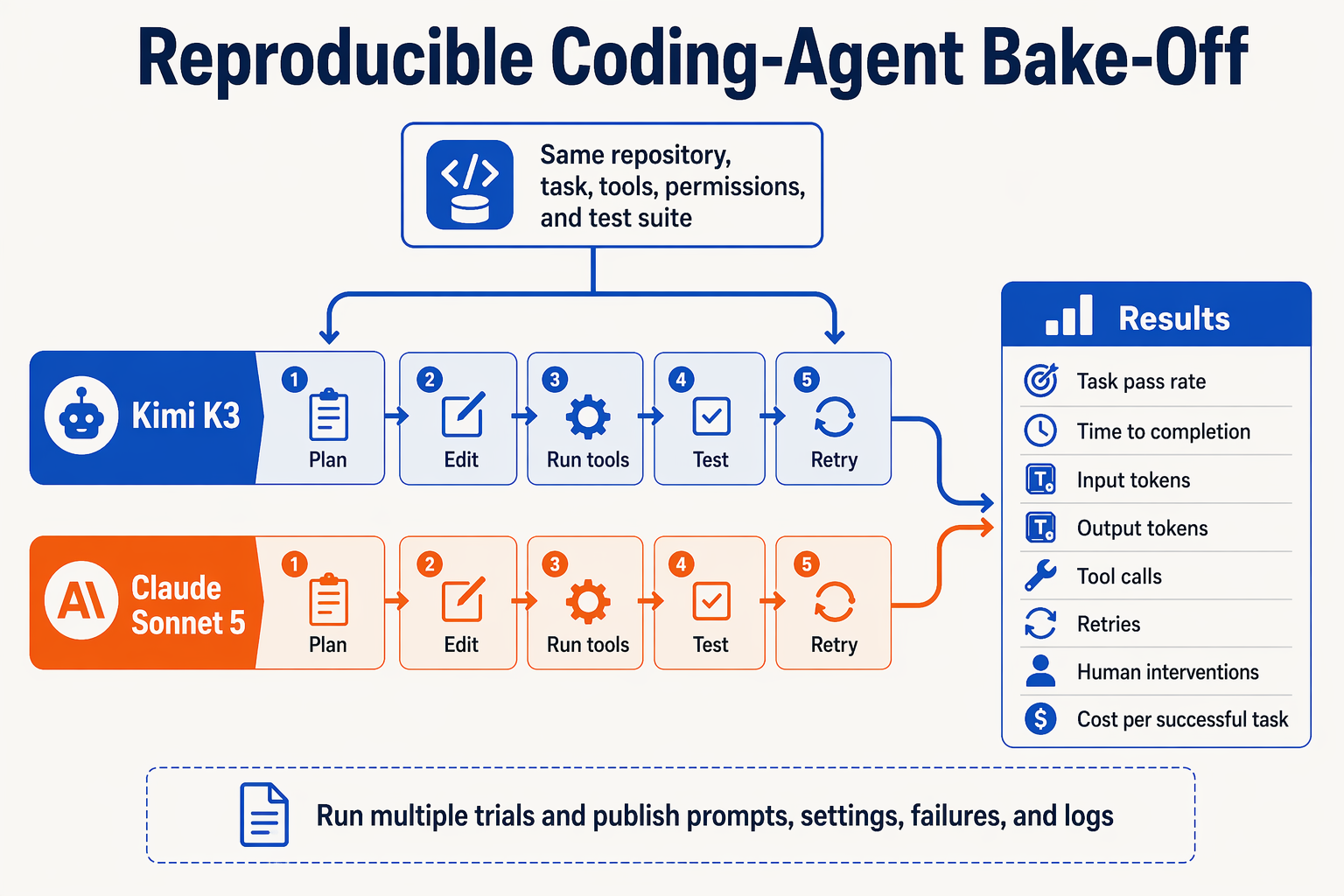
A fair bake-off uses the same repository, prompts, tools, token budgets, stopping rules, and clean execution environment, then ranks models by solved-task rate and total cost—not a single benchmark score.
Test design and controls
- 1. Workload set: Select at least 30–50 blinded tasks spanning bug fixes, feature implementation, refactoring, test generation, dependency upgrades, code review, and repository-scale questions; stratify results by task type and difficulty instead of averaging unlike jobs.
- 2. Model configuration: Record exact model IDs, API dates, temperature, maximum output tokens, tool schemas, system prompts, retry policies, and context-management settings; Anthropic’s Claude Platform documentation assigns Claude Sonnet 5 a 1-million-token context window, and Moonshot AI’s Kimi Platform documentation states the same capacity for Kimi K3.
- 3. Agent harness: Give Kimi K3 and Claude Sonnet 5 identical access to the repository, terminal, test runner, search, and patch tools; cap wall-clock time, tool calls, retries, and generated tokens so one model cannot buy success through unlimited attempts.
- 4. Context tracks: Run every eligible task in three modes—minimal relevant files, retrieval-assisted context, and progressively larger repository snapshots up to the practical limit; measure retrieval precision and instruction retention rather than treating the advertised 1 million tokens as proof of equivalent long-context performance.
Metrics, economics, and reporting
- 5. Correctness: Make hidden tests and human review the primary judges; report pass@1, solved-task percentage, regressions introduced, security defects, unnecessary file changes, and the proportion of patches accepted without human editing.
- 6. Agent reliability: Track valid tool-call rate, failed commands, repeated actions, premature completion, recovery after tool errors, human interventions, and median steps per solved task; Moonshot AI describes Kimi K3 as designed for “long-horizon coding and end-to-end knowledge work,” but that positioning should be validated on your workflows.
- 7. Cost and latency: Calculate total task cost = uncached input + cached input/read charges + output + retries + supporting infrastructure; Anthropic lists Claude Sonnet 5’s standard price as $3 per million input tokens and $15 per million output tokens, while any Kimi K3 rate should be captured from Moonshot AI’s primary pricing page on the test date and labeled separately if provider-reported.
- 8. Reproducibility: Publish task definitions, commit hashes, harness version, prompts, five-run distributions, median and p95 latency, confidence intervals, failure transcripts, and pricing timestamps; declare a winner only when the advantage persists across repeated runs and remains meaningful after accounting for human-review time and cost per accepted patch.
What are the practical pros and cons of Kimi K3 and Claude Sonnet 5? (TABLE)
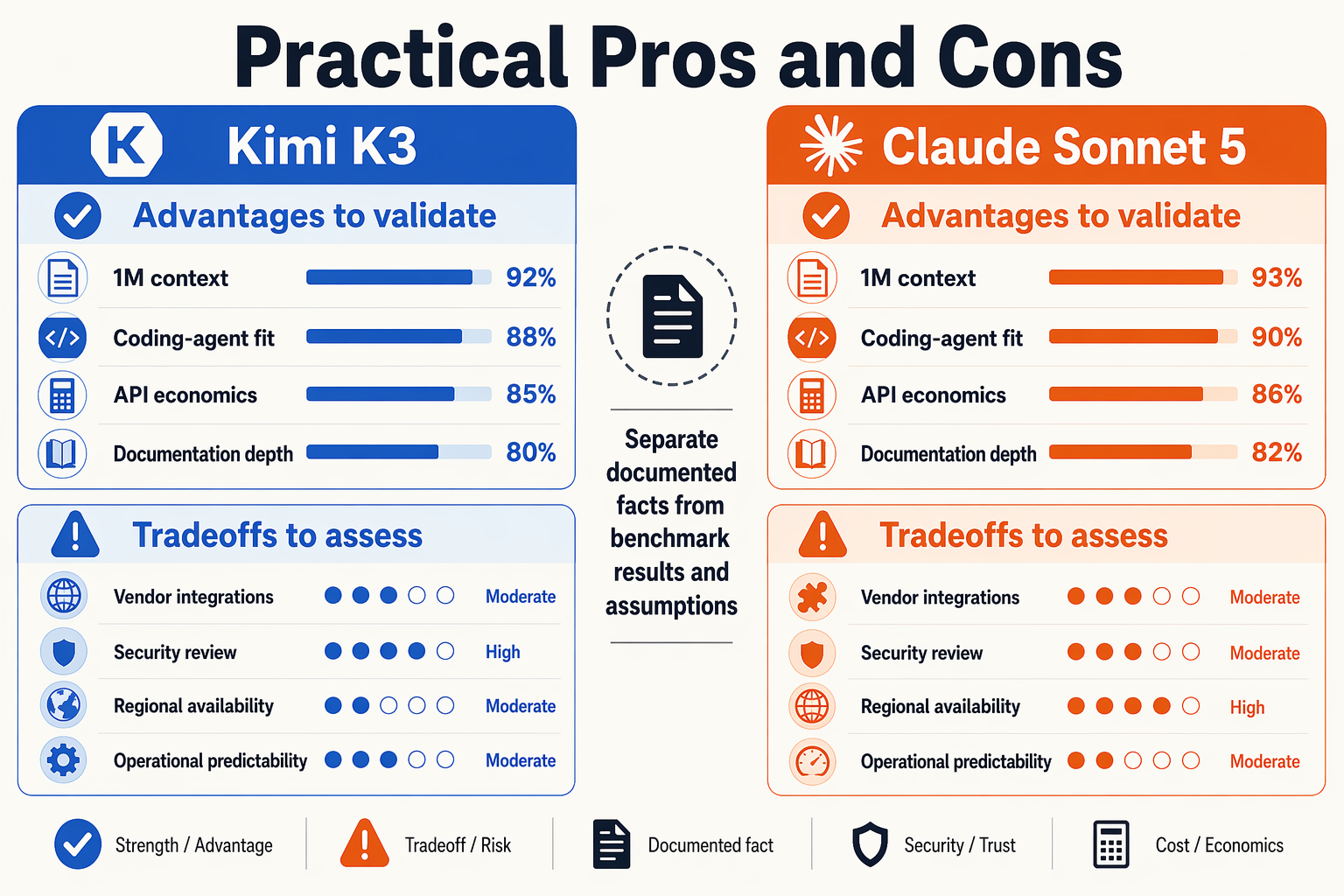
Claude Sonnet 5 offers fewer operational unknowns, while Kimi K3 offers an appealing but less fully documented option for experimental long-horizon workflows. The practical trade-off is production confidence versus exploration—not a proven difference in raw capability.
Practical trade-offs
| Area | Kimi K3: practical pros | Kimi K3: practical cons | Claude Sonnet 5: practical pros | Claude Sonnet 5: practical cons |
|---|---|---|---|---|
| Coding | Moonshot AI explicitly targets long-horizon coding and end-to-end work. | No supplied primary source establishes a reproducible coding win over Sonnet 5. | Suitable for production coding workflows where documented behavior matters. | Published pricing can make output-heavy code generation expensive. |
| Agents | Positioning fits extended tool-driven and multi-step tasks. | Tool reliability, retry behavior and solved-task cost require independent testing. | Anthropic provides detailed guidance for context use, token accounting and model selection. | Strong documentation does not guarantee success on a specific agent harness. |
| Long context | Moonshot AI documents a 1-million-token context window. | Maximum capacity does not prove accurate retrieval near one million tokens. | Anthropic documents a 1-million-token context window for Sonnet 5. | Large prompts can increase latency and input-token expenditure. |
| API economics | Kimi may be worth evaluating where cost sensitivity is high. | Exact K3 token prices should not be assumed from pages referring to earlier Kimi models. | Anthropic lists standard pricing of $3/MTok input and $15/MTok output. | One million input tokens plus 100,000 output tokens costs about $4.50 before caching or other adjustments. |
| Documentation | Official Kimi Platform guides cover K3 positioning and context capacity. | Some documentation paths and snippets still reference Kimi K2.x, creating version ambiguity. | Claude Platform documentation specifies pricing, context behavior and model identifiers. | Teams must still monitor dated promotions, regional availability and platform-specific terms. |
| Enterprise deployment | A hosted API reduces the need to operate model infrastructure directly. | The supplied primary evidence does not establish downloadable weights, local deployment or a specific enterprise compliance portfolio. | Anthropic documents the claude-sonnet-5 identifier for Google Cloud alongside Claude Platform access. | Governance, residency and procurement requirements remain deployment-specific. |
What these trade-offs mean in practice
- Kimi K3: Moonshot AI described Kimi K3 as its flagship model for “long-horizon coding and end-to-end knowledge work” as of July 16, 2026, making it a credible candidate for controlled agent trials.
- Claude Sonnet 5: Anthropic documented $3 per million input tokens and $15 per million output tokens on July 16, 2026, giving engineering teams a clear basis for cost forecasting.
- Kimi K3: Moonshot AI documented a 1-million-token context window by July 16, 2026, but teams should measure retrieval accuracy at 100,000, 500,000 and 1 million tokens rather than treating capacity as quality.
- Claude Sonnet 5: Anthropic documented the same 1-million-token capacity for Claude Sonnet 5, although production tests must still capture latency, instruction loss and irrelevant-context sensitivity.
- Enterprise teams: Prefer Claude Sonnet 5 when model identifiers, documented pricing and established cloud deployment paths are procurement requirements; evaluate Kimi K3 behind a limited-data pilot until governance evidence is verified.
- Development teams: Route identical repository tasks to both models and compare successful completion, regressions, tool-call errors, human corrections and total cost per accepted change, not tokens alone.
Which model should you choose for coding teams, agent startups, long documents, or enterprise deployment?
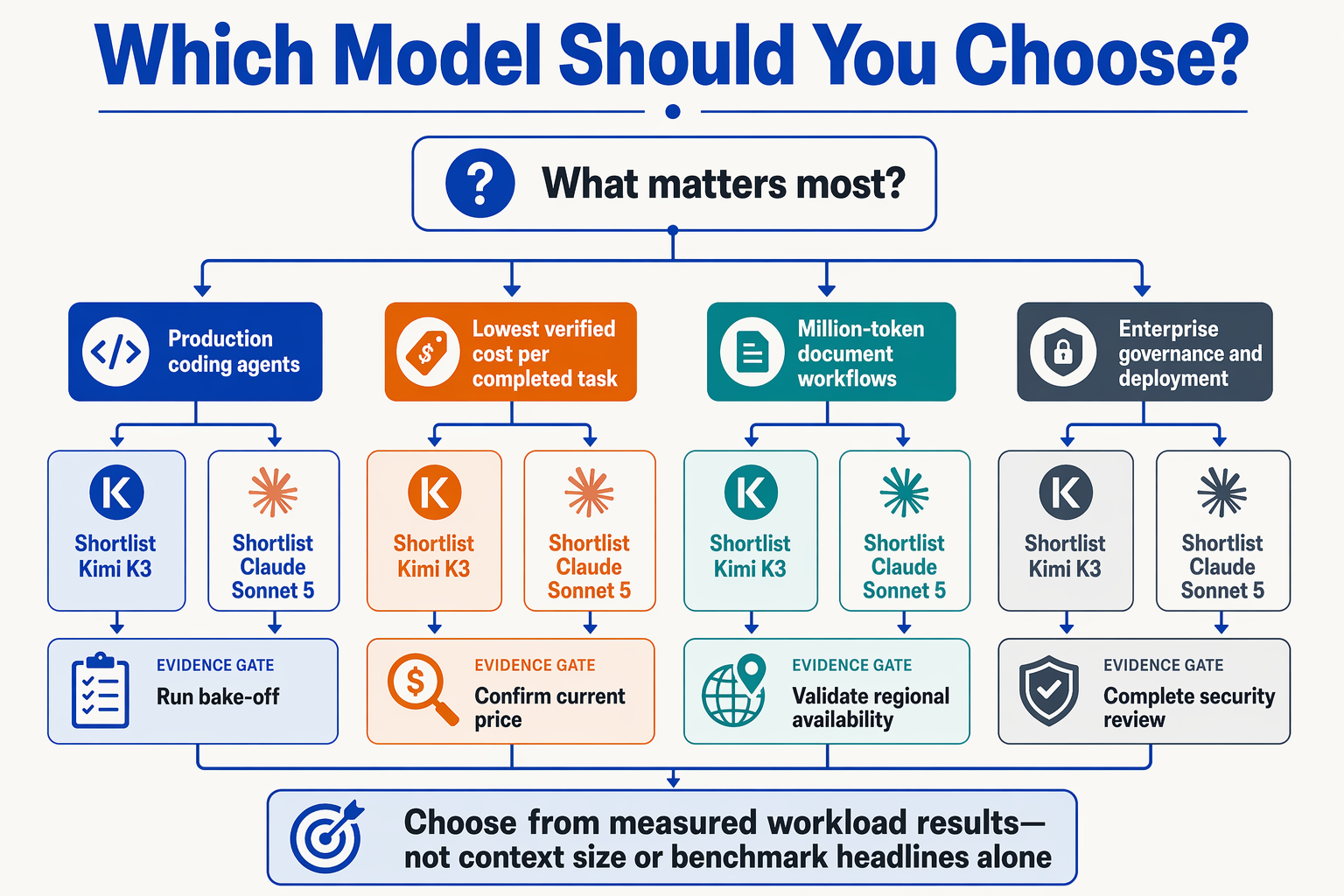
Choose Claude Sonnet 5 for production environments that prioritize predictable costs, mature documentation, and enterprise controls; pilot Kimi K3 when long-horizon coding or knowledge-work performance could justify additional validation.
Workload-specific recommendations
- Coding teams: Start with Claude Sonnet 5 for repository maintenance, pull-request review, and regression-sensitive workflows; require both models to pass the same unit tests and measure cost per merged issue, not tokens alone.
- Agent startups: Evaluate Kimi K3 for extended tool-use loops, but gate deployment on tool-call validity, recovery from failed actions, p95 latency, and successful completion across at least 100 representative tasks.
- Long-document workflows: Test both 1-million-token models at 25%, 50%, 75%, and 100% of the advertised window; score citation accuracy, fact retrieval, cross-document synthesis, and instruction retention rather than assuming equal usable context.
- Cost-sensitive applications: Claude Sonnet 5 has a documented standard price of $3 per million input tokens and $15 per million output tokens, according to Anthropic’s July 2026 model documentation; confirm caching and promotional rates separately.
- Kimi K3 budgeting: Request a current Moonshot AI quote or verify the live Kimi Platform pricing page before forecasting; do not substitute Kimi K2.6 prices or third-party figures for confirmed Kimi K3 rates.
- Documentation-led teams: Prefer Claude Sonnet 5 when engineers need explicit guidance for model identifiers, context handling, token accounting, and migration; Anthropic’s Claude Platform documentation currently provides the clearer operational trail.
- Enterprise deployment: Run security, data-residency, retention, audit-log, identity-management, regional-availability, and contractual-SLA reviews for both vendors before processing regulated or customer-identifiable data.
- Multi-model teams: Keep prompts, tool schemas, evaluations, and observability vendor-neutral so Kimi K3 and Claude Sonnet 5 can be routed by workload or used as fallbacks without rewriting the application.
Frequently asked questions about release status, 1M context, pricing, Claude Code compatibility, and enterprise use
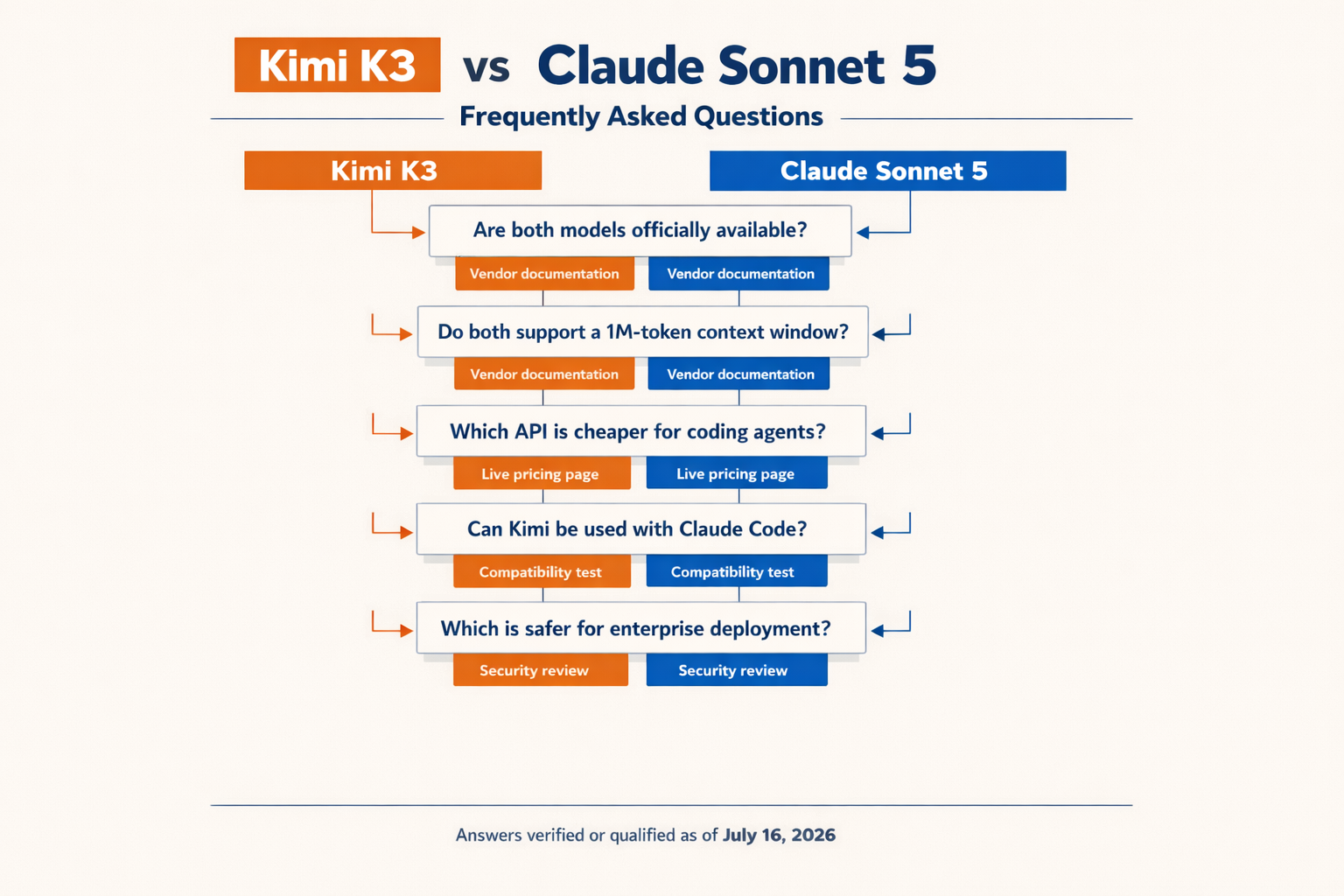
- Q: Are Kimi K3 and Claude Sonnet 5 officially released as of July 16, 2026?
A: Yes, both appear in their vendors’ official platform documentation as available models. Moonshot AI documents Kimi K3 as its flagship model, but its exact launch date should not be asserted without a dated primary announcement.
- Q: Does Kimi K3 vs Claude Sonnet 5 provide the same 1M-token context window?
A: Both officially advertise a 1-million-token context window. Moonshot AI and Anthropic documentation confirm the limit, but usable recall, latency, and instruction retention must be tested near capacity.
- Q: What is the Kimi K3 vs Claude Sonnet 5 API pricing difference?
A: Anthropic’s “What’s new in Claude Sonnet 5” documentation lists $3 per million input tokens and $15 per million output tokens. Exact Kimi K3 token prices remain unverified here unless Moonshot AI’s primary pricing page explicitly associates them with Kimi K3.
- Q: Can Claude Code use Kimi K3?
A: Do not assume compatibility merely because Kimi exposes an API. Claude Code integration requires confirmed endpoint, authentication, tool-calling, streaming, and message-format support; Moonshot AI documentation should be checked before production use.
- Q: Which model is safer for enterprise deployment?
A: Claude Sonnet 5 is the more conservative choice because Anthropic documents model identifiers, pricing, context behavior, and cloud deployment identifiers, including Google Cloud. Kimi K3 merits a pilot, but teams should verify data residency, retention, security certifications, service-level commitments, and regional availability.
- Q: Which is better for coding agents, Kimi K3 vs Claude Sonnet 5?
A: No primary-source, reproducible head-to-head test establishes a universal winner. Evaluate both on solved issues, regression rate, tool-call accuracy, human corrections, latency, and total cost per completed task.
Conclusion
As of July 16, 2026, Claude Sonnet 5 is the safer production default, while Kimi K3 remains a promising challenger worth testing.
- Both advertise 1-million-token context windows, but usable recall matters more than capacity.
- Claude offers clearer documentation, enterprise deployment paths, and published $3/$15 per million-token pricing.
- Kimi K3 merits controlled trials for long-horizon coding and agentic knowledge work.
- Final selection should depend on reproducible task completion, reliability, latency, and cost.
Watch for independent benchmarks and firmer Kimi pricing evidence. Explore multi-model testing through CallMissed—which model best fits your real workload?
Related Reading
Related Posts
Ready to automate customer conversations?
Launch AI voice agents and WhatsApp bots with CallMissed — one API, 22+ Indian languages.