

Kimi K2.7 Code vs Kimi K3: Features, Pricing & Verdict (July 2026)


Compare Kimi K2.7 Code with Kimi K3 on context, agentic coding, API fit, pricing evidence, and tests to choose the right model.
Kimi K2.7 Code vs Kimi K3: Features, Pricing & Verdict (July 2026)
What if your next coding model could inspect four times more context—but still be the wrong choice for everyday software engineering? The Kimi K3 vs Kimi K2.7 Code decision is not simply “new model versus old model”: Kimi K3 is the flagship, broadly capable option for long-context reasoning and agentic workloads, while Kimi K2.7 Code is purpose-built for coding-focused agents, repository work and tool-driven development.
As of July 16, 2026, the official Kimi Platform describes Kimi K3 as a flagship model for long-horizon coding with a 1-million-token context window. Kimi’s product materials also position Kimi K3 across coding, reasoning, visual understanding and agent-swarm tasks. However, Moonshot AI had scheduled the model’s full-weight release for July 27, 2026, so Kimi K3’s downloadable weights, final licence terms and independently reproducible parameter details were not yet available on the comparison date. Although Kimi’s app listing and technical blog report 2.8 trillion parameters, that remains a provider-reported figure rather than a specification readers could fully verify from released weights on July 16.
Kimi K2.7 Code, meanwhile, has a 256K-token context window and a narrower coding-first identity. Kimi’s official documentation says the model can process text, images and video, supports thinking mode, and is designed for conversations and agent tasks. Kimi’s launch resource also claims stronger long-horizon coding and agent capabilities, while the official MoonshotAI Hugging Face card documents evaluation settings such as thinking mode, Kimi Code CLI, temperature 1.0 and top-p 0.95—details that matter when assessing published Kimi K2.7 Code benchmarks.
That distinction matters because context capacity alone does not determine coding value. Teams must also compare instruction adherence, tool calling, edit reliability, latency, deployment options and the total cost of repeated agent loops. Kimi K3’s 1M-token window is approximately 3.9 times Kimi K2.7 Code’s 256K window, but a specialised coding model may remain more economical or predictable for bounded repository workflows. Provider-reported API prices also require careful normalization by input tokens, output tokens, cache usage and thinking-token consumption.
This comparison separates confirmed specifications from marketing claims, examines Kimi K2.7 Code pricing, API fit, tool use and local-running considerations, and provides an evidence-based test plan and verdict. It also explains where multi-model gateways such as CallMissed’s OpenAI-compatible API fit: developers can evaluate models behind one integration while retaining fallbacks for production workloads.
Which model is better? Choose Kimi K3 for broader flagship work and a 1M-token context; choose Kimi K2.7 Code for coding-focused agent workflows
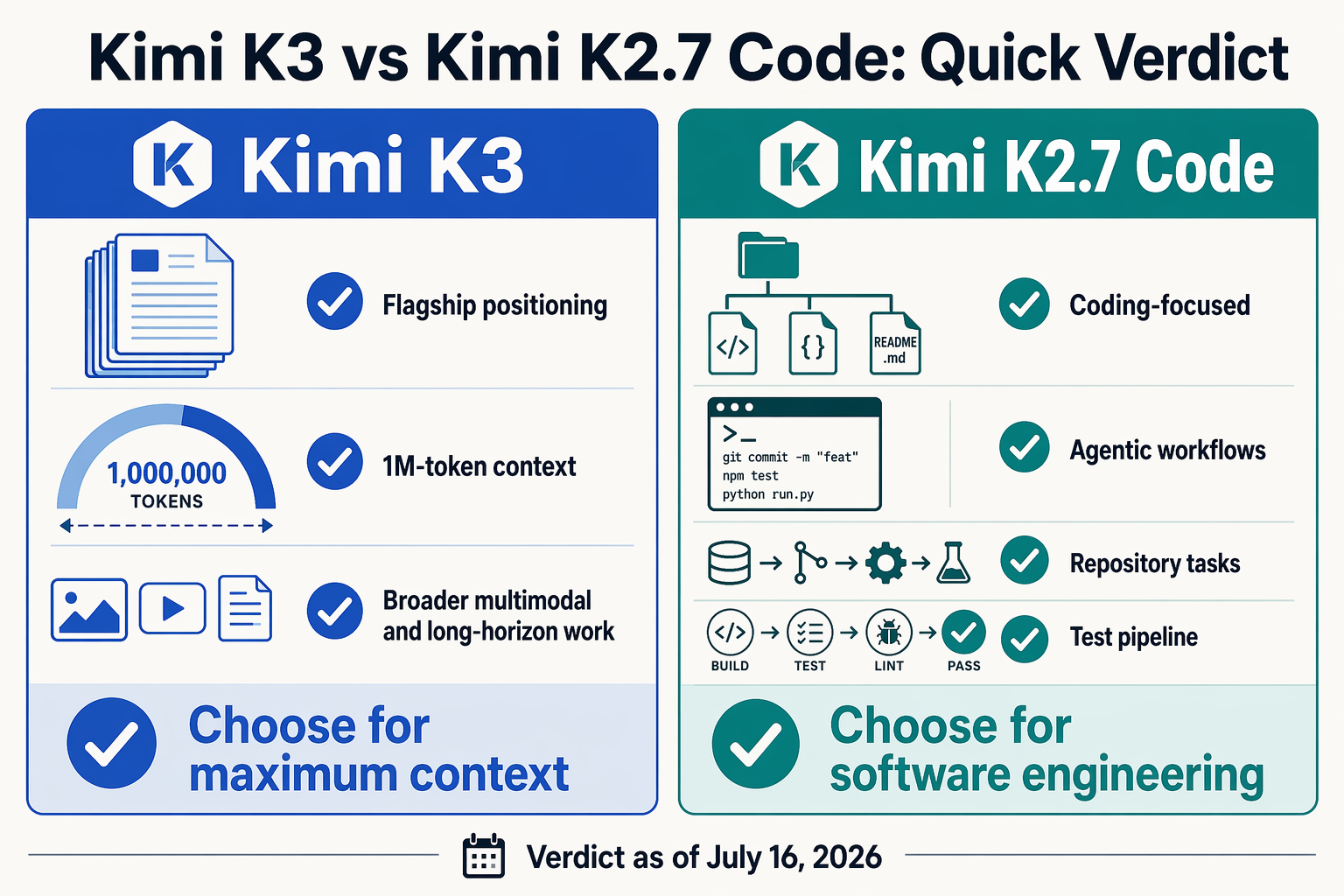
Choose Kimi K3 when context capacity and broad multimodal reasoning matter most; choose Kimi K2.7 Code when the workload is primarily repository editing, tool use and iterative software-engineering agents.
Decision criteria
- Kimi K3: The official Kimi Platform listed Kimi K3 as its flagship long-horizon coding model with a 1-million-token context window on July 16, 2026, making it the stronger fit for very large repositories, extensive documentation and long-running agent sessions.
- Kimi K2.7 Code: The official Kimi Platform documents a 256K-token context window, sufficient for many bounded repository tasks while offering a coding-specific design for instruction following and multi-step programming work.
- Kimi K3: Kimi’s app materials position the model across coding, reasoning, visual understanding and agent-swarm tasks, so it is the more versatile choice for workflows extending beyond software development.
- Kimi K2.7 Code: Kimi’s official launch resource describes Kimi K2.7 Code as a coding-focused agentic model with improved long-horizon coding and stronger agent capabilities.
- Kimi K3: Local deployment remained an unverified choice on July 16, 2026, because Kimi’s technical blog scheduled full-weight publication for July 27, 2026; final downloadable weights and licence terms were therefore still unknown.
- Kimi K2.7 Code: Benchmark comparisons should reproduce MoonshotAI’s documented settings—thinking mode enabled, Kimi Code CLI, temperature 1.0 and top-p 0.95—before treating provider results as directly comparable.
- Practical verdict: Select Kimi K3 for workloads that may exceed 256K tokens or combine coding with broad reasoning and visual inputs; select Kimi K2.7 Code when predictable, coding-centred agent behaviour matters more than the approximately 3.9× larger Kimi K3 context window.
How do Kimi K3’s flagship positioning and Kimi K2.7 Code’s coding specialization differ?
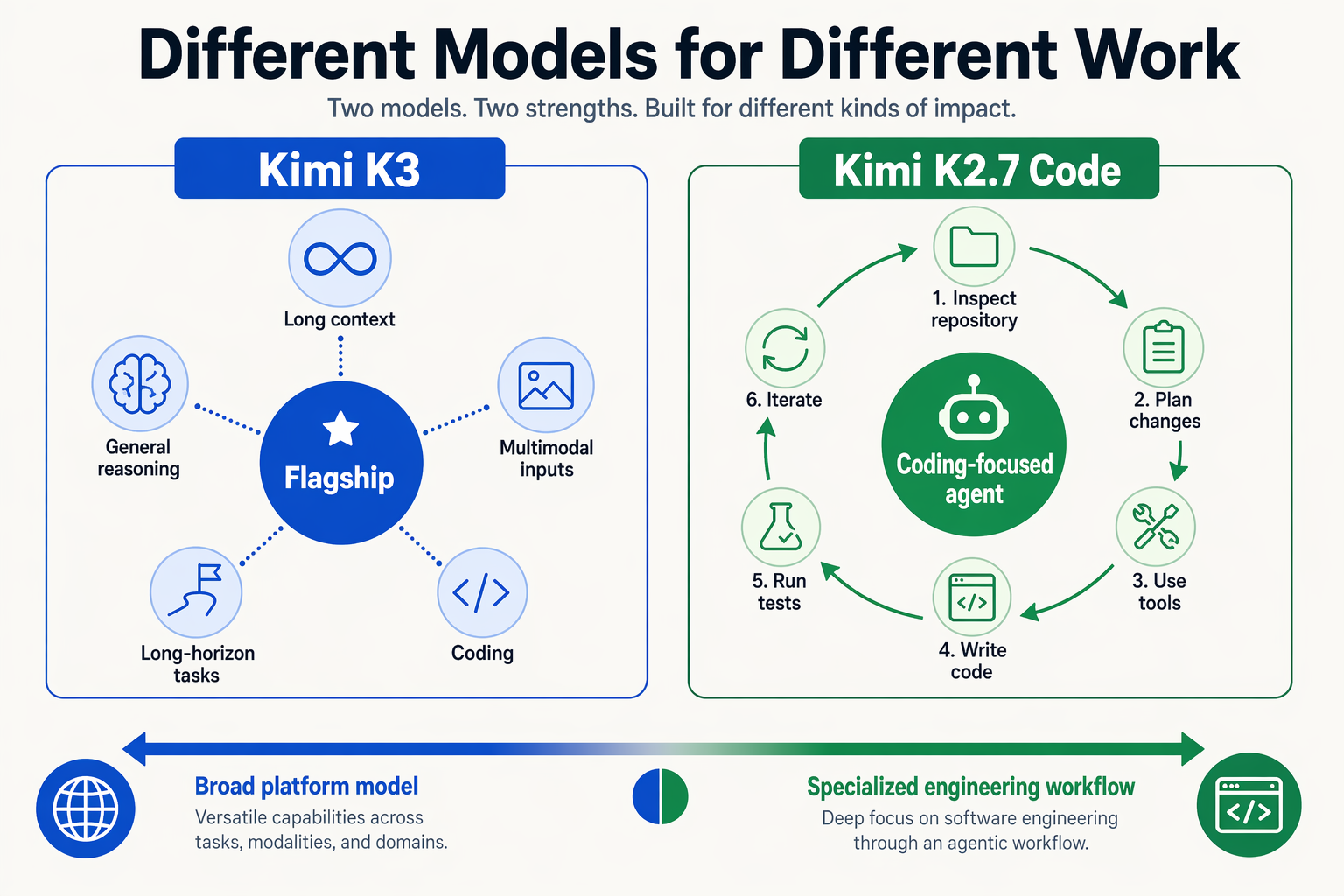
Kimi K3 is the broad flagship for complex, long-running workloads, whereas Kimi K2.7 Code is the specialist for software-engineering agents. The practical distinction is breadth and context headroom versus coding-specific optimisation and currently inspectable deployment evidence.
- Kimi K3 — product role: The official Kimi Platform pricing documentation called Kimi K3 its “flagship model for long-horizon coding” as of July 16, 2026, while Kimi’s product listing also positioned it for reasoning, visual understanding and multi-agent swarm tasks beyond software development.
- Kimi K2.7 Code — product role: Kimi’s official launch resource describes Kimi K2.7 Code as a “coding-focused agentic model” with improved long-horizon coding and stronger agent capabilities, making repository navigation, iterative editing, debugging and tool-driven implementation its primary evaluation targets rather than secondary use cases.
- Kimi K3 — context advantage: The official Kimi Platform specifies a 1-million-token context window, giving Kimi K3 room for very large repositories, extensive documentation, long execution histories and multi-agent state; that capacity is useful when an agent must preserve information across an unusually broad task rather than solve one bounded coding ticket.
- Kimi K2.7 Code — instruction specialisation: Kimi Platform documentation says Kimi K2.7 Code follows instructions more reliably in long contexts and completes programming tasks with a higher success rate, although those are provider claims that should be validated against each team’s repositories, coding standards, tools and acceptance tests.
- Kimi K3 — broader multimodal scope: Kimi’s official app listing associates Kimi K3 with coding, agentic tasks, long-horizon reasoning, visual understanding and agent swarms, suggesting a better conceptual fit for workflows combining architecture documents, screenshots, research, planning and code rather than coding alone.
- Kimi K2.7 Code — defined agent inputs: The official Kimi Platform quick-start confirms support for text, image and video input, thinking mode, conversations and agent tasks, so the “Code” label does not mean text-only operation; a coding agent can inspect interface imagery or recorded behaviour alongside source files.
- Kimi K3 — evidence limitation: Kimi’s technical blog reported 2.8 trillion parameters, but full weights were scheduled for July 27, 2026; consequently, on July 16, independent teams could not yet verify the final architecture, licence or self-hosting characteristics from a complete public release.
- Kimi K2.7 Code — reproducibility advantage: The official MoonshotAI Hugging Face card discloses benchmark conditions including Kimi Code CLI, thinking mode, temperature 1.0 and top-p 0.95, giving evaluators a clearer starting point for reproducing coding tests—even though production results will still depend on prompts, tool schemas and agent-loop design.
How do their context windows, API fit, modalities, tool use, weights, licenses, and evidence compare? (TABLE)
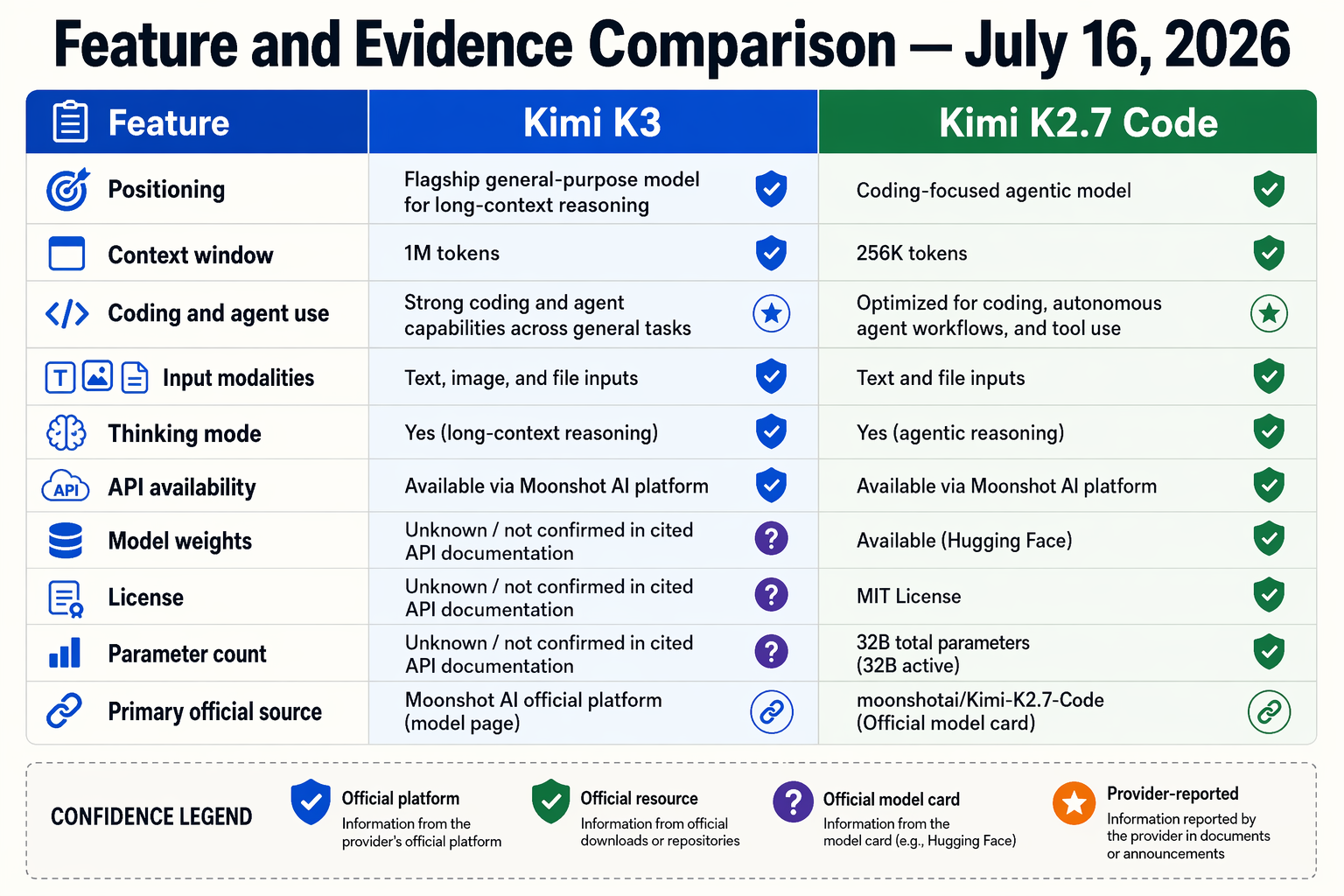
Kimi K3 offers the larger context and broader flagship scope, while Kimi K2.7 Code has stronger public documentation for coding-agent deployment. As of July 16, 2026, several Kimi K3 implementation details remained unverified because its full-weight release was scheduled for July 27.
- Kimi K3: Best matched to long-context, multimodal and general agentic workloads where a 1-million-token window is valuable.
- Kimi K2.7 Code: Better documented for repository editing, coding agents and repeatable tool-driven workflows through Kimi Code CLI.
| Dimension | Kimi K3 | Kimi K2.7 Code | Evidence status on July 16, 2026 |
|---|---|---|---|
| Positioning | Flagship for long-horizon coding, reasoning and agentic work | Coding-focused agentic model | Official Kimi Platform and kimi.com descriptions |
| Context window | 1M tokens | 256K tokens | Official provider specifications |
| Modalities | Visual understanding is advertised; exact API input support was not fully documented | Text, image and video input | Kimi app materials; Kimi Platform quick-start |
| API and tools | Available through Kimi Platform; detailed tool schema and reproducible agent settings require verification | Conversations, thinking mode and agent tasks; evaluated with Kimi Code CLI | Official API documentation and Hugging Face card |
| Weights and parameters | 2.8T parameters, provider-reported; full weights scheduled for July 27, 2026 | Official MoonshotAI Hugging Face repository exists; kimi.com labels it open source | Kimi K3 technical blog; MoonshotAI model card |
| Licence and reproducibility | Final downloadable-weight licence was unavailable | Check the repository’s current licence before commercial or derivative use | K3 terms unknown; K2.7 has stronger public artefacts |
- Context: Kimi K3’s 1M-token context is approximately 3.9 times Kimi K2.7 Code’s 256K window, based on official Kimi Platform specifications available July 16, 2026.
- Modalities: Kimi Platform explicitly documents text, image and video inputs for Kimi K2.7 Code; Kimi’s K3 materials advertise visual understanding but do not establish identical API modality support.
- Tool use: The official MoonshotAI Hugging Face card reports Kimi K2.7 Code testing with thinking mode, Kimi Code CLI, temperature 1.0 and top-p 0.95, making its published results easier to reproduce.
- Weights: Kimi’s technical blog says Kimi K3 has 2.8 trillion parameters and that full weights would arrive by July 27, 2026; neither claim was independently verifiable from released weights on July 16.
- Licensing: “Open source” positioning should not replace legal review; teams should inspect the exact Kimi K2.7 Code repository licence and wait for Kimi K3’s final weight terms.
- Evidence quality: Treat Kimi K3 performance and pricing as provider-reported until weights, licence files, benchmark harnesses and independent evaluations become available.
How much do Kimi K3 and Kimi K2.7 Code cost, and which offers better API value? (TABLE)
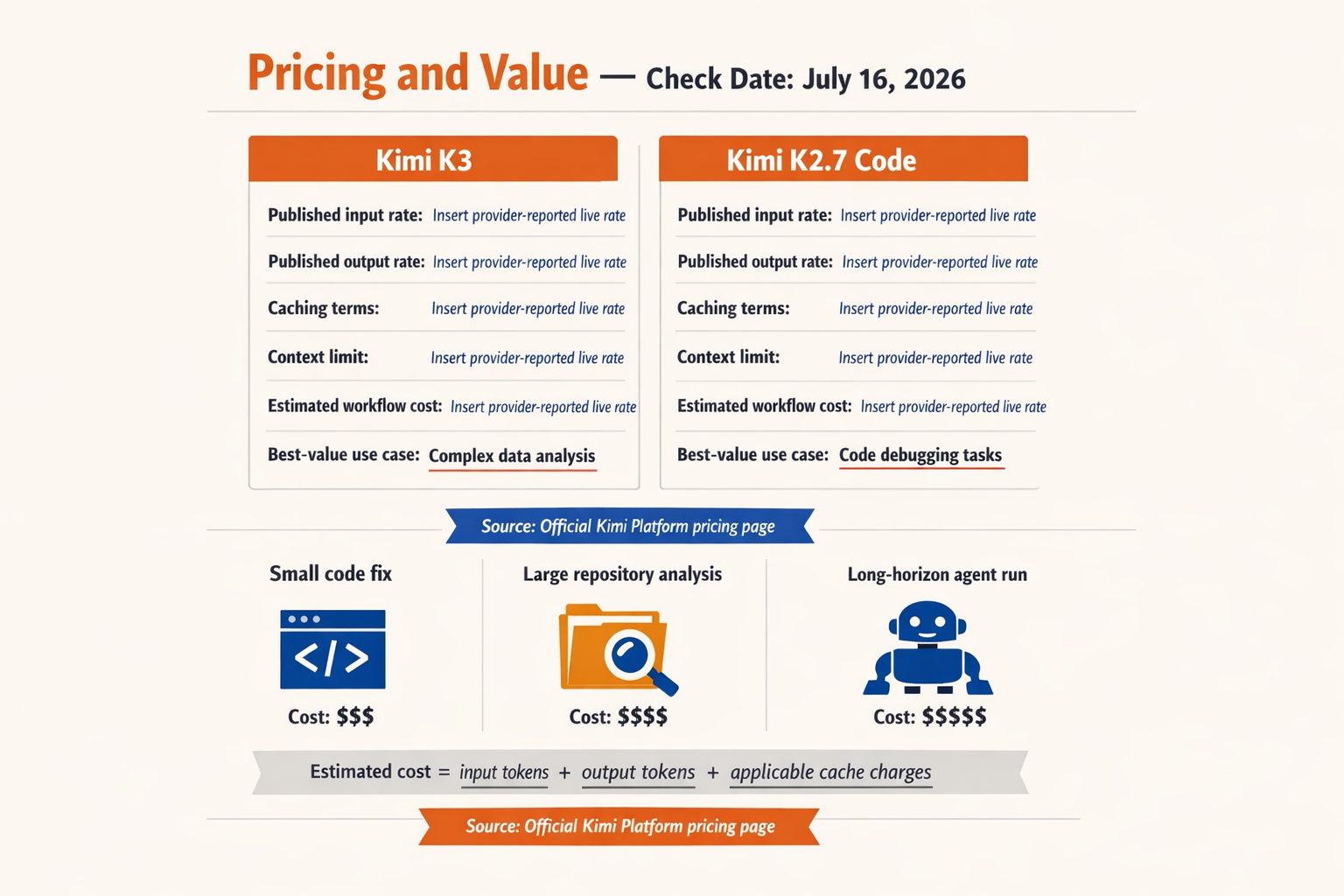
The official Kimi Platform pricing page is the source of record, but its retrieved July 16, 2026 materials do not provide enough numeric rates to publish a verified per-million-token total here. API value therefore depends on live input, output, cache and thinking-token charges—not context size alone.
- Kimi K3: Provider-reported pricing should be checked in the Kimi Platform console immediately before deployment; do not infer its rates from Kimi K2.7 Code.
- Kimi K2.7 Code: Kimi’s official launch page advertises “30% lower” consumption, but teams should validate the comparison baseline and actual token usage with their own coding-agent traces.
- Cost formula: Estimate each run as input tokens × input rate + output/thinking tokens × output rate + cache charges, then multiply by retries and agent steps.
- API value: Kimi K3 can reduce retrieval and chunking complexity with 1M tokens, while Kimi K2.7 Code’s 256K tokens may be more economical for bounded repository tasks.
- Budget risk: Thinking mode, tool feedback, test logs and repeated file edits can make output-token consumption more important than the headline input price.
API cost and value evidence
| Cost factor | Kimi K3 | Kimi K2.7 Code | Buying implication |
|---|---|---|---|
| Published numeric rate | Verify live Kimi Platform rate | Verify live Kimi Platform rate | Avoid copying stale third-party prices |
| Context capacity | 1M tokens | 256K tokens | K3 holds approximately 3.9× more context |
| Positioning | Flagship, long-horizon model | Coding-focused agentic model | Match spend to workload |
| Efficiency claim | No comparable verified claim supplied | “30% lower,” according to Kimi’s launch resource | Benchmark token consumption directly |
| Main value case | Large repositories and mixed-modal context | Iterative coding, tools and repository edits | Compare cost per completed task |
| Price provenance | Provider-reported | Provider-reported | Record rates and date in procurement tests |
What are the practical pros and cons of Kimi K3 and Kimi K2.7 Code? (TABLE)
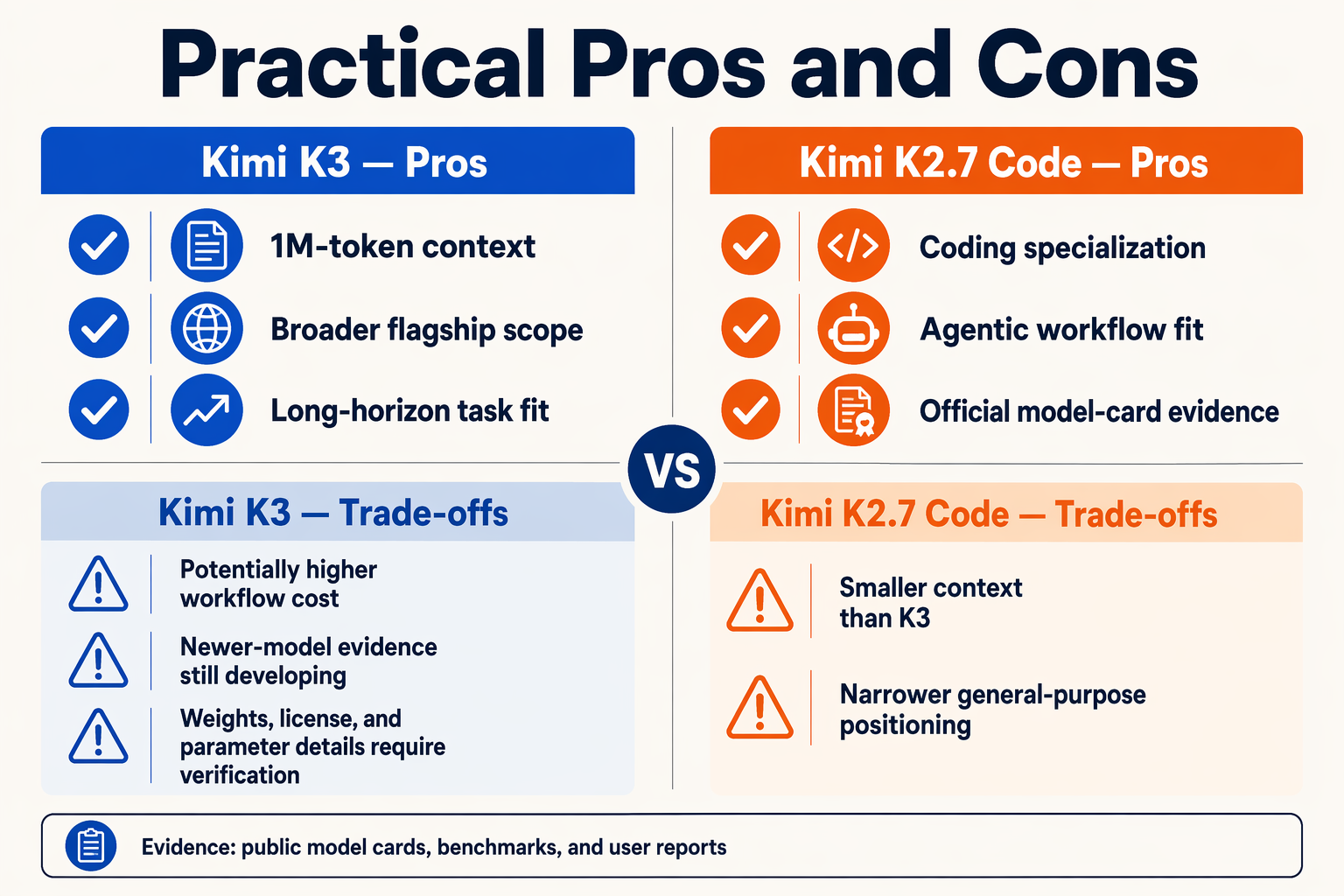
Kimi K3 offers greater workload breadth and context capacity, while Kimi K2.7 Code offers a more focused, better-documented path for coding agents. The practical trade-off is flexibility versus coding specialization and reproducibility.
| Practical factor | Kimi K3 | Kimi K2.7 Code | Operational implication |
|---|---|---|---|
| Best fit | Flagship model for coding, reasoning, visual understanding and agent-swarm tasks | Coding-focused agentic model for repository work and software-engineering tools | Match the model to workload breadth rather than release recency |
| Context capacity | 1 million tokens | 256K tokens | Kimi K3 can inspect approximately 3.9× more context, although larger prompts may increase cost and latency |
| Coding workflow | Long-horizon coding within a broader general-purpose model | Improved instruction following and task completion in long-context programming, according to Kimi Platform | Kimi K2.7 Code may be easier to constrain for repeatable edit-test-debug loops |
| Input and agents | Kimi materials promote multimodal reasoning and agent-swarm capabilities | Official documentation confirms text, image and video input, thinking mode, conversations and agent tasks | Kimi K2.7 Code has clearer published implementation details as of July 16, 2026 |
| Reproducibility | Full weights were scheduled for July 27, 2026; licence and independently verifiable architecture details remained unavailable | Official MoonshotAI Hugging Face model card provides weights and evaluation settings | Kimi K2.7 Code was the safer choice for local evaluation on the comparison date |
| Cost planning | Official Kimi Platform lists provider-reported API pricing, but real spend depends on prompt, output and cache usage | Pricing must also include thinking tokens and repeated tool loops | Benchmark cost per completed task, not simply the advertised per-token rate |
Kimi K3: practical advantages and limitations
- Pro — context headroom: Kimi Platform identifies Kimi K3 as its flagship long-horizon coding model with a 1M-token context window, useful for very large repositories, documentation sets and multi-agent histories.
- Pro — workload breadth: Kimi’s official app listing positions Kimi K3 across coding, reasoning, visual understanding and agent-swarm tasks, reducing the need to switch models across mixed workflows.
- Pro — consolidation: One model can potentially examine specifications, screenshots, code and lengthy execution traces within the same workflow.
- Con — pre-release uncertainty: Kimi’s technical blog scheduled full-weight publication for July 27, 2026, eleven days after this article’s cutoff.
- Con — unverified scale: Kimi reports 2.8 trillion parameters, but that figure could not yet be independently checked against downloadable weights on July 16.
- Con — resource exposure: A 1M-token limit is capacity, not a recommendation; repeatedly sending oversized contexts can increase latency and token charges.
Kimi K2.7 Code: practical advantages and limitations
- Pro — coding specialization: Kimi describes Kimi K2.7 Code as an agentic coding model with stronger long-horizon coding, agent capabilities and instruction adherence.
- Pro — evaluation transparency: The official MoonshotAI Hugging Face card documents thinking mode, Kimi Code CLI, temperature 1.0 and top-p 0.95, enabling closer benchmark reproduction.
- Pro — deployment evidence: Published model artifacts make local testing and controlled infrastructure evaluation more practical than with unreleased Kimi K3 weights.
- Con — smaller context: Its 256K-token window may require repository indexing, retrieval or staged prompting for codebases that fit inside Kimi K3’s larger window.
- Con — narrower positioning: Kimi K2.7 Code is optimized around software-engineering agents rather than serving as the default for every reasoning or multimodal workload.
- Con — agentic cost variability: Thinking tokens, retries, tool calls and test runs can make the final cost per resolved issue substantially different from headline API pricing.
How should you test Kimi K3 vs Kimi K2.7 Code on your own repositories and agent workflows?
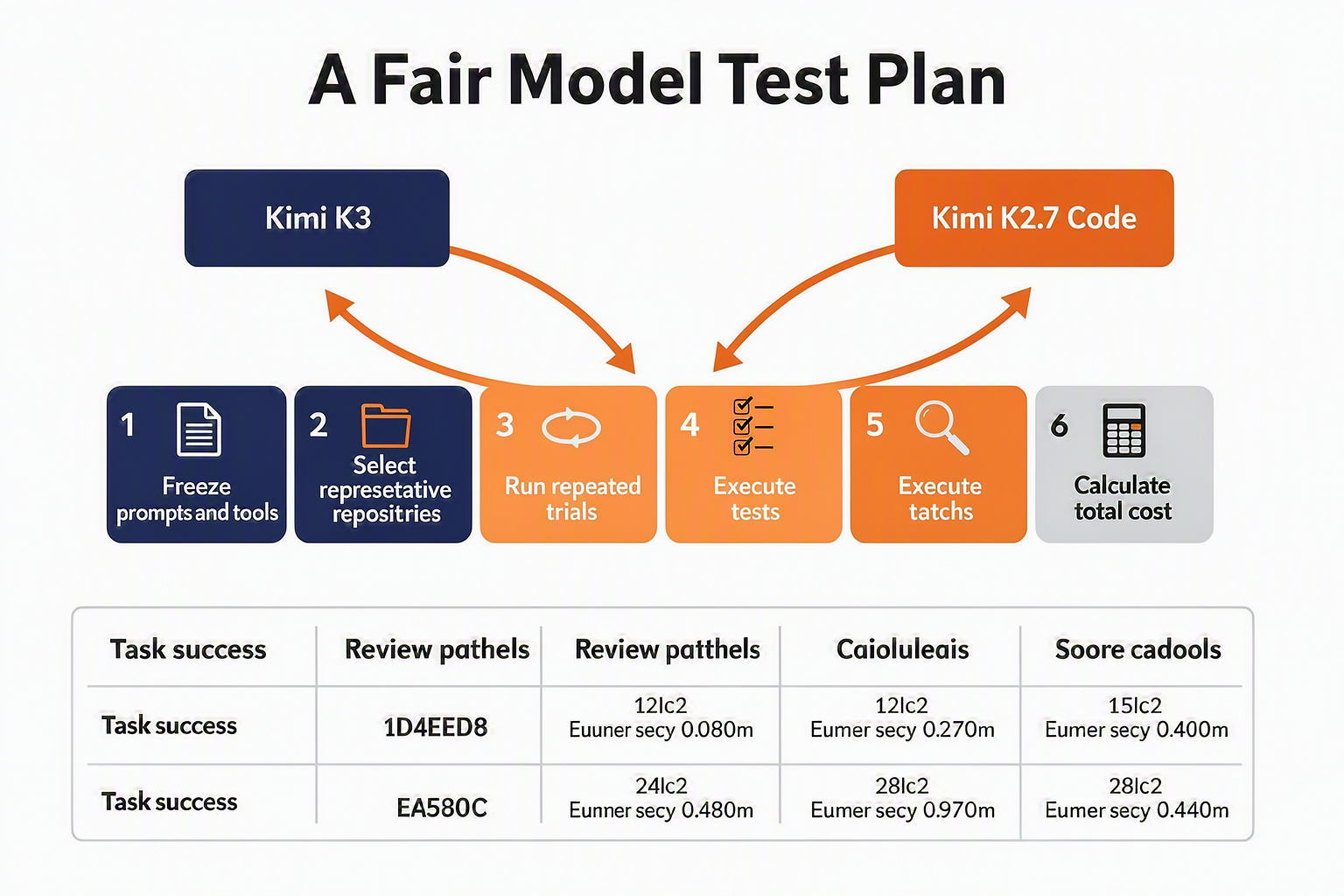
Test both models on the same pinned repository snapshot, tasks and tool permissions; measure completed outcomes rather than relying only on provider benchmarks. Run each task at least three times to expose variance in agent behaviour.
Repository and agent test matrix
- Task set: Select 30–50 representative issues across bug fixing, feature implementation, refactoring, test generation and code review; keep hidden unit or integration tests as the pass/fail judge.
- Kimi K3: Include repository-scale tasks at 256K, 500K and 1M input-token tiers to determine whether additional context improves results or merely raises latency and cost; Kimi Platform documented the 1M-token window as of July 16, 2026.
- Kimi K2.7 Code: Test bounded coding tasks below 256K tokens, including multi-file edits and long tool loops; the official Kimi documentation specifically describes stronger instruction following and programming-task success in long contexts.
- Agent controls: Give both models identical tools—repository search, file editing, terminal, test runner and Git diff—and cap each run at the same tool-call count, wall-clock duration and retry budget.
- Inference settings: Record model ID, thinking mode, temperature, top-p and token limits; MoonshotAI’s official Hugging Face evaluations used thinking mode, Kimi Code CLI, temperature 1.0 and top-p 0.95, so reproductions should disclose any deviation.
- Scorecard: Track hidden-test pass rate, first-pass success, regressions introduced, valid tool calls, unnecessary changed lines, input/output tokens, cache usage, latency and cost per accepted task.
- Production simulation: Run at least three repeated trials per task inside an isolated container, then manually inspect the final diff for security, maintainability and instruction compliance; calculate confidence intervals rather than declaring a winner from one successful run.
Which should you choose for API applications, large repositories, autonomous coding, or local deployment?
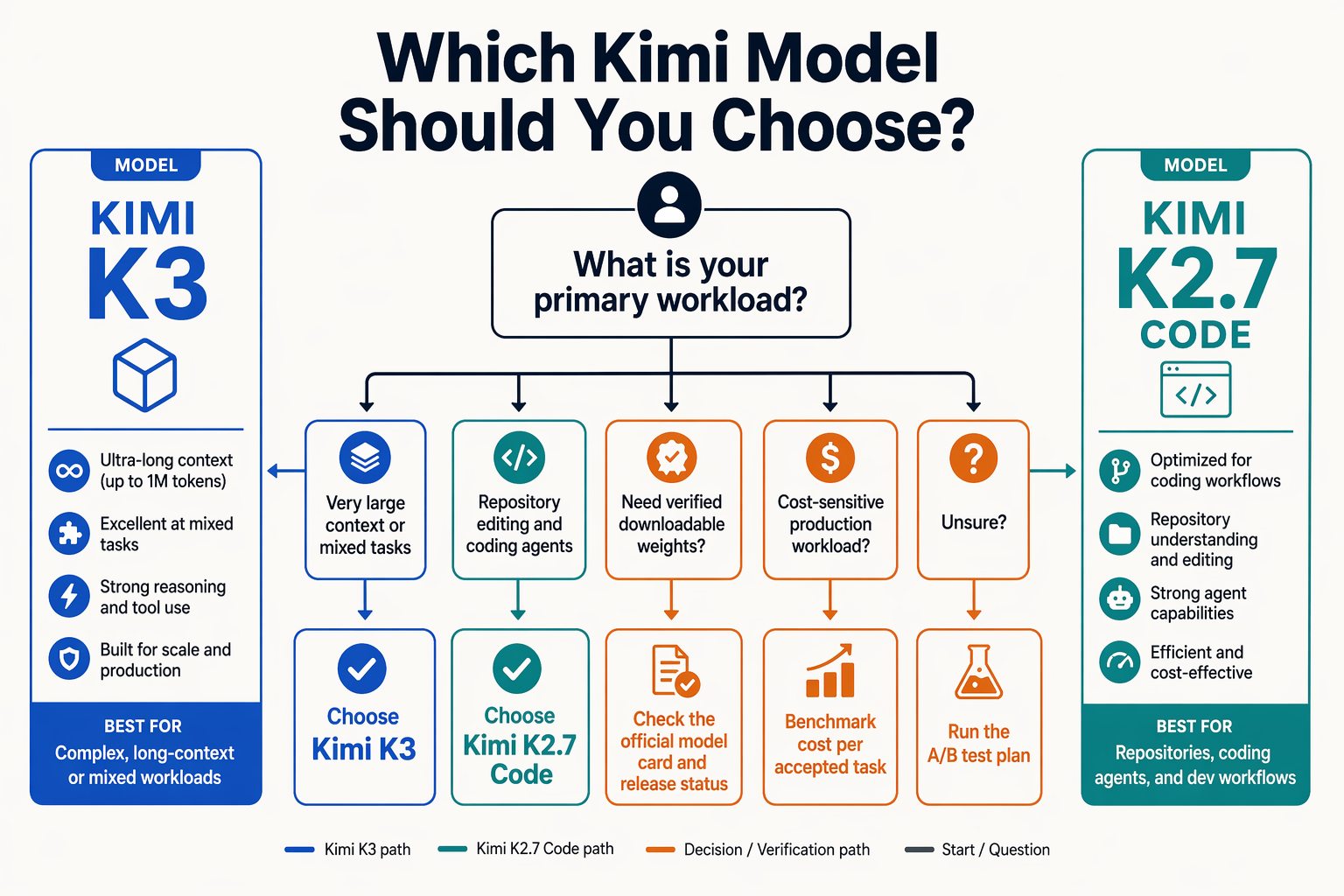
Choose Kimi K3 when an API application needs a 1-million-token context window, multimodal reasoning, or broad agent capabilities; choose Kimi K2.7 Code when the primary workload is repository editing, debugging, testing, and autonomous coding. For local deployment, Kimi K2.7 Code has official model artifacts, while Kimi K3’s weights and licence remained unresolved as of July 16, 2026.
API applications and long-context workloads
- General-purpose API applications — Kimi K3: Kimi positions K3 as its flagship for coding, agentic tasks, long-horizon reasoning, visual understanding, and agent-swarm workflows. The Kimi app listing described Kimi K3 as a 2.8-trillion-parameter model as of July 16, 2026, but this figure was provider-reported and had not yet been independently verified through released weights.
- Very large repositories — Kimi K3: Kimi Platform documents a 1-million-token context window for Kimi K3, approximately 3.9 times Kimi K2.7 Code’s 256K context window. That capacity makes K3 the more natural candidate for monorepo-wide analysis, extensive documentation, cross-service dependency tracing, and long-running agent state.
- Use retrieval even with 1 million tokens: A larger context window does not guarantee better repository understanding. Teams should still retrieve relevant files, remove generated assets and duplicate code, and measure whether extra context improves task completion enough to justify its cost and latency.
Coding agents and repository editing
- Coding-first APIs — Kimi K2.7 Code: Kimi Platform explicitly identifies Kimi K2.7 Code as a coding model that follows instructions more reliably in long contexts and completes programming tasks with a higher success rate. It supports text, image, and video inputs, thinking mode, conversations, and agent tasks.
- Bounded repository work — Kimi K2.7 Code: Its 256K-token context window can hold selected source files, tests, issue history, architectural notes, and repository maps. Coding-first specialization may matter more than maximum context when an agent repeatedly searches, patches, executes tests, and repairs failures.
- Autonomous coding — Kimi K2.7 Code: Start with K2.7 Code for inspect–edit–execute–repair loops. The official MoonshotAI Hugging Face model card states that, unless otherwise noted, evaluations used thinking mode through Kimi Code CLI, temperature 1.0, and top-p 0.95, providing a documented baseline for reproduction.
Local deployment and production testing
For local or self-hosted deployment, begin with the official MoonshotAI Kimi K2.7 Code Hugging Face model card and artifacts. Before deployment, verify:
- Applicable licence obligations and permitted uses
- Quantization and inference-engine support
- Accelerator memory and storage requirements
- Tool-calling behavior under the intended serving stack
Do not transfer Kimi K2.7 Code’s weights, licence, hardware assumptions, benchmarks, or pricing to Kimi K3. Kimi’s technical blog said that Kimi K3’s full weights would be released by July 27, 2026; therefore, on the July 16, 2026 cutoff date, K3’s final local-deployment terms and licence were not yet verifiable.
For production selection, compare both models through their documented API options using the same repository snapshot, prompts, tools, and retry limits. Record token cost, end-to-end latency, tool-call validity, patch acceptance, test-pass rate, and complete task success before choosing either model.
Frequently Asked Questions about Kimi K3 and Kimi K2.7 Code
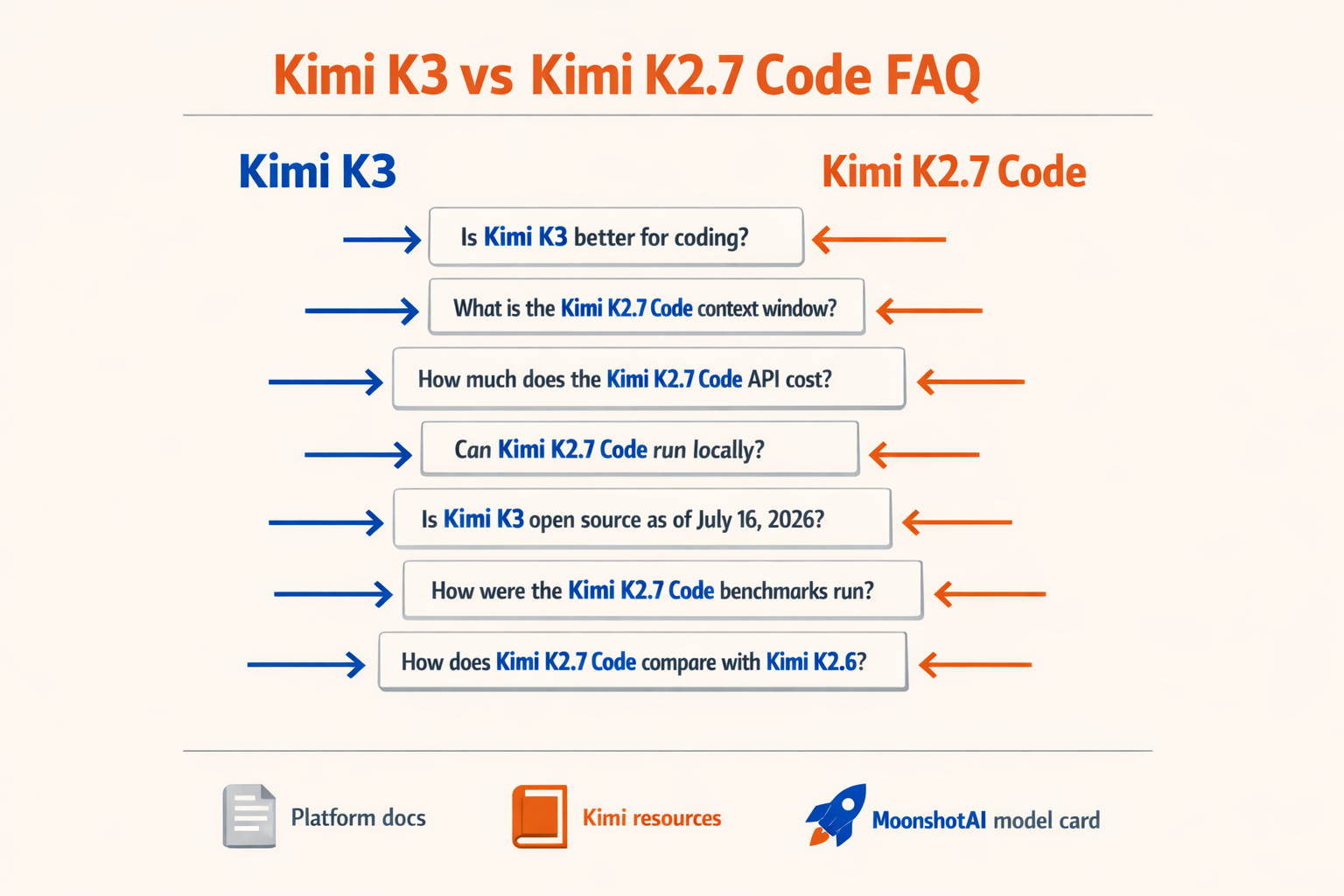
- Q: Which model should I choose in Kimi K3 vs Kimi K2.7 Code?
A: Choose Kimi K3 for broad multimodal reasoning, long-horizon tasks and workloads requiring up to 1 million tokens. Choose Kimi K2.7 Code for coding-focused agents, repository editing and tool-driven software development.
- Q: What is the Kimi K2.7 Code context window?
A: Kimi K2.7 Code supports 256K tokens, while the official Kimi Platform lists Kimi K3 at 1M tokens. Kimi K3 therefore offers approximately 3.9 times the context capacity, although usable context does not guarantee better code edits or tool execution.
- Q: Is Kimi K3 more powerful than Kimi K2.7 Code for coding?
A: Not necessarily for every workflow: Kimi K3 is the flagship model for long-horizon coding and general agentic work, whereas Kimi K2.7 Code is explicitly coding-focused. Teams should test instruction adherence, patch accuracy, tool calls, latency and token consumption on their own repositories.
- Q: Are Kimi K3 weights available to run locally?
A: As of July 16, 2026, Kimi’s technical blog said full Kimi K3 weights would be released by July 27, 2026. The reported 2.8-trillion-parameter count, downloadable weights and final licence terms were therefore not independently verifiable on the comparison date.
- Q: What settings were used for Kimi K2.7 Code benchmarks?
A: The official MoonshotAI Hugging Face model card says evaluations generally used thinking mode, Kimi Code CLI, temperature 1.0 and top-p 0.95, unless otherwise stated. Reproductions should match those settings before comparing benchmark results.
- Q: How should developers compare Kimi K2.7 Code pricing with Kimi K3?
A: Normalize provider-reported prices by input, output, cached and thinking tokens, then estimate repeated agent loops rather than one request. Also measure latency, successful task completion and fallback frequency, because a lower token rate may not produce a lower cost per completed coding task.
Conclusion
- Kimi K3 is the broader flagship, pairing multimodal and agentic capabilities with a 1-million-token context window.
- Kimi K2.7 Code remains the coding-focused choice for repository work, tool use and bounded development workflows within 256K tokens.
- Pricing comparisons must normalize caching, output and thinking-token costs.
- Kimi K3’s parameters, licence and deployment claims require reassessment after its scheduled July 27, 2026 full-weight release.
Watch for reproducible benchmarks and final licensing details. Explore multi-model evaluation through CallMissed—then ask: which model performs best on your own repositories and agent loops?
Related Reading
Related Posts



Ready to automate customer conversations?
Launch AI voice agents and WhatsApp bots with CallMissed — one API, 22+ Indian languages.