Claude Fable 5 vs Kimi K3: Benchmarks, Pricing & Verdict


Claude Fable 5 vs Kimi K3 compared on API pricing, benchmarks, 1M context, coding agents, open weights, enterprise deployment and verdict.
Claude Fable 5 vs Kimi K3: Benchmarks, Pricing & Verdict
Claude Fable 5 vs Kimi K3 is now a live, post-launch comparison. As of July 16, 2026, Kimi Platform documents Kimi K3 with a 1-million-token context window and flat pay-as-you-go pricing, while current provider listings report $3 per million cache-miss input tokens, $0.30 per million cached input tokens, and $15 per million output tokens. The key question is no longer whether Kimi K3 exists, but how its early evidence compares with Claude Fable 5 on coding, agents, cost, context, and production reliability.
This matters now because the frontier-model market is moving from simple chatbot comparisons to agentic AI systems that can plan tasks, call tools, browse, write code, and work across long documents. Anthropic’s checked official material identifies Claude Fable 5 as a released model for demanding reasoning and long-horizon agentic work. It is available through the Claude API, with the announcement listing pricing of $10 per million input tokens and $50 per million output tokens. Those facts do not establish that Fable 5 beats every competing model or validate unrelated claims about a generic “Claude 5.” That is a meaningful, verifiable development—but it does not automatically validate every claim circulating under the broader label “Claude 5.”
Moonshot AI’s Kimi lineup now includes Kimi K3 in official Kimi Platform documentation. That documentation confirms a 1-million-token context window and flat pricing, while provider listings supply current availability and rate details. Architecture, parameter count, downloadable weights, license rights, and benchmark claims still require source-by-source verification; launch confirmation does not make every circulating claim accurate.
This article takes a fact-checked approach to the reported Claude Fable 5 vs Kimi K3 matchup. Rather than treating rumors as product documentation, it will distinguish between:
- Confirmed releases and capabilities published by Anthropic, Moonshot AI/Kimi, and OpenAI.
- Unverified claims, including rumored model names, release timing, context-window sizes, benchmark scores, and pricing.
- What can be compared today, using a practical framework spanning reasoning, coding, multimodal input, context handling, tool use, latency, cost, privacy, and deployment options.
- What developers and business teams should test themselves before committing a production workflow to any frontier model.
The stakes extend beyond leaderboard rankings. An enterprise choosing an AI model for customer support, software engineering, research, or voice automation must evaluate reliability, data handling, tool permissions, language support, and total operating cost—not just a single benchmark result. For Indian businesses in particular, platforms such as CallMissed illustrate the broader shift toward practical AI infrastructure: one OpenAI-compatible gateway can provide access to multiple LLM, speech, image, and search models, while AI voice and WhatsApp workflows need evaluation criteria that go far beyond a rumored model release.
By the end, readers will know which claims about Claude, Kimi, and competing AI models are supported by official evidence, which remain speculation, and how to make a defensible model-selection decision without chasing hype.
Is Claude Fable 5 vs Kimi K3 a real AI model comparison yet?
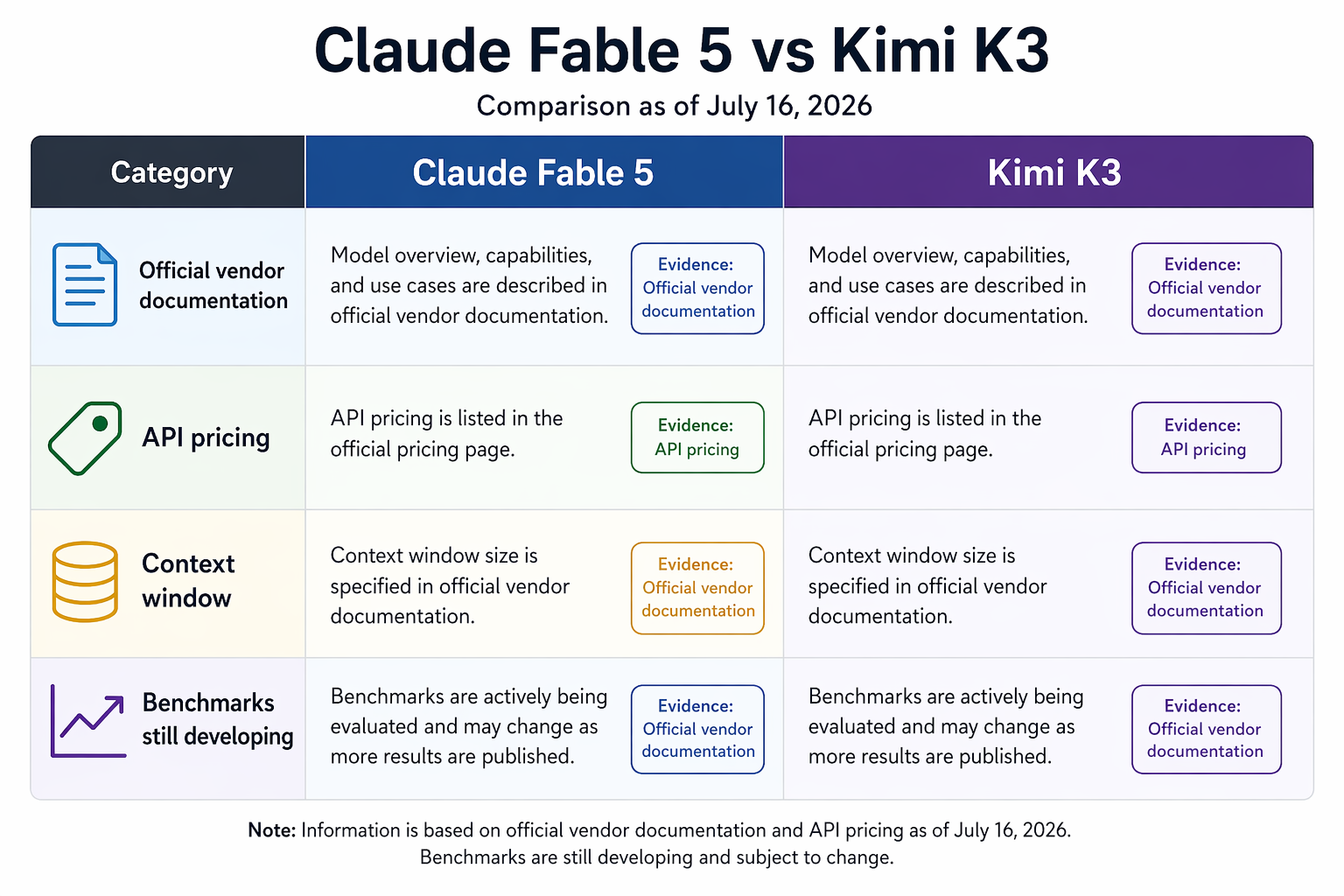
Yes. As of July 17, 2026, Claude Fable 5 vs Kimi K3 is unequivocally a real post-launch model comparison. Both models have official product documentation and API access. Kimi’s official materials also position K3 as an open-weight, 2.8-trillion-parameter model with a 1M-token context window and support for coding, multimodal and 3D reasoning, Swarm workflows, and Goal-driven tasks.
Claude Fable 5 vs Kimi K3 at a glance
| Category | Claude Fable 5 | Kimi K3 |
|---|---|---|
| Official status | Released by Anthropic with documented API access | Released and documented through Kimi’s official product pages, technical blog, and API platform |
| API price | $10/M input tokens; $50/M output tokens | $3/M cache-miss input; $0.30/M cached input; $15/M output tokens |
| Context | Use Anthropic’s current model documentation for the applicable API limit | 1M-token context window documented by Kimi |
| Scale and architecture | Anthropic does not base its positioning on a disclosed parameter count | Provider-reported 2.8T parameters |
| Deployment | Anthropic-hosted API; no verified open-weight release cited here | API access plus official open-weight positioning; verify the applicable repository, license, and hardware requirements before self-hosting |
| Capability focus | Premium reasoning, coding, tool use, and long-horizon agentic work | Coding, multimodal and 3D reasoning, large-context tasks, Swarm coordination, and Goal workflows |
| Benchmark maturity | Established product positioning, although results still depend on evaluation design | Early reports are promising, but independent K3-specific evidence remains less mature |
Compact verdict
Kimi K3 wins on published API price and deployment flexibility. Its $3 cache-miss input and $15 output rates are 70% below Claude Fable 5’s respective $10 and $50 rates. K3 also offers $0.30-per-million cached input, a documented 1M-token context window, and an open-weight path for organizations evaluating greater deployment control.
Claude Fable 5 remains the premium managed choice for teams prioritizing Anthropic’s reasoning and agent platform, established API ecosystem, and long-horizon agentic positioning. Its higher price may be justified when reliability, tool behavior, workflow integration, or performance on a buyer’s specific tasks outweigh raw token cost.
The answer-first capability verdict is therefore more conditional: choose Kimi K3 for lower costs, very large context, open-weight flexibility, and Kimi’s coding and multi-agent workflow features; choose Claude Fable 5 when Anthropic’s premium reasoning and agent ecosystem perform better in your own controlled evaluation.
How to read the Kimi K3 evidence
Kimi’s official technical blog, product pages, and platform documentation are the primary sources for K3’s release status, provider-reported 2.8T parameters, open-weight positioning, 1M-token context window, supported workflows, and API pricing. Current official rates are $3 per million cache-miss input tokens, $0.30 per million cached input tokens, and $15 per million output tokens.
Early benchmark reports sometimes show Kimi K3 competitive with—or ahead of—particular frontier models on specific tests. Those results are useful signals, not a universal ranking. Scores can change materially with model versions, prompting, reasoning budgets, tool access, context length, retry policies, sampling settings, and grading methods.
OpenRouter listings and third-party charts can help confirm provider availability or illustrate routed costs, but they should not replace first-party documentation. Likewise, a benchmark should not be treated as definitive unless it discloses the exact model version, prompts, tools, token budget, execution settings, and scoring procedure.
The comparison is now fully valid after launch: K3 has the clearer price, context, and deployment advantages on published specifications, while any claim that K3 or Fable 5 is categorically more capable still requires reproducible, workload-specific testing.
What is officially known about Anthropic, Kimi, and OpenAI model releases?

As of July 16, 2026, Claude Fable 5 and Kimi K3 are both documented products. The evidence does not come from identical source types, however: Anthropic provides a dated announcement for Claude Fable 5, while Kimi Platform provides the primary Kimi K3 product documentation and provider/index pages supply the July 16 release date and live rate snapshots.
Timeline of the confirmed releases
- July 1, 2026: Anthropic published its notice about redeploying Claude Fable 5 following the lifting of export controls and the introduction of updated cybersecurity safeguards.
- July 16, 2026: Kimi K3 became publicly documented through the Kimi Platform quickstart. Provider and model-index pages record July 16, 2026 as the release date and display their currently available API rates.
- As of July 16, 2026: No official OpenAI release identified in the checked material changes this comparison into a three-model contest. GPT-5.6 should not be treated as a confirmed participant without a matching OpenAI announcement or product document.
Anthropic: Claude Fable 5
Anthropic’s Claude Fable 5 announcement positions the model for demanding reasoning and long-horizon agentic work. Anthropic documents API availability and lists pricing of $10 per million input tokens and $50 per million output tokens.
The relevant head-to-head facts are:
- Claude Fable 5 is an officially named Anthropic model.
- Anthropic emphasizes demanding reasoning and long-running agentic tasks.
- The model is available through an API.
- Anthropic’s listed API price is $10/M input tokens and $50/M output tokens.
- The July 1 redeployment notice provides additional dated release-history context, but it is not an independent benchmark evaluation.
Moonshot AI: Kimi K3 is now officially documented
The Kimi K3 quickstart is the primary product-level source for the model. Kimi Platform documents:
- The Kimi K3 model name.
- Instructions for making API requests and beginning an integration.
- A 1-million-token context window.
- Flat pay-as-you-go pricing, rather than a claim that access requires a negotiated enterprise contract.
This documentation supersedes the earlier position that only Kimi K2.6 and Kimi K2.7 Code could be verified. Those remain separate model names; they should not be relabeled as Kimi K3.
The evidence should still be attributed carefully. Kimi Platform is the authoritative source for the quickstart, context limit, access method, and its own pricing structure. Provider and model-index pages are secondary operational sources: they report July 16, 2026 as the release date and show the input and output rates currently offered through their respective listings. Those live rates may change, include provider-specific routing or markups, and should not be presented as permanent Moonshot pricing unless they match the Kimi Platform pricing page.
OpenAI: no confirmed GPT-5.6 release in the checked evidence
No official OpenAI announcement, model card, API documentation, or pricing page identified in this research confirms GPT-5.6. It therefore has no established release date, specifications, price, or benchmark result for this comparison.
That finding does not imply that OpenAI has made no other model releases. It means only that GPT-5.6 is not supported by the official evidence checked for this section and should not be inserted into the Claude Fable 5 versus Kimi K3 comparison as a confirmed model.
| Vendor or model | Source type | Status as of July 16, 2026 | Facts supported |
|---|---|---|---|
| Anthropic Claude Fable 5 | Official Anthropic announcements | Confirmed | API access; demanding reasoning and long-horizon agentic positioning; $10/M input and $50/M output pricing |
| Moonshot AI Kimi K3 | Official Kimi Platform quickstart and pricing documentation | Confirmed | Kimi K3 model name; API quickstart; 1M-token context; flat pay-as-you-go pricing |
| Kimi K3 provider/index listings | Third-party provider or model-index pages | Current operational evidence | July 16, 2026 release date and the live input/output rates displayed by each listing; rates may be provider-specific or change over time |
| Moonshot AI Kimi K2.6 and Kimi K2.7 Code | Earlier official Moonshot material | Confirmed as separate models | Their existence does not define Kimi K3’s specifications, pricing, or benchmark performance |
| OpenAI GPT-5.6 | No matching official OpenAI source found | Unverified | No confirmed launch date, API access, specifications, pricing, or performance data |
Claude Fable 5 vs Kimi K3: verified facts and evidence status
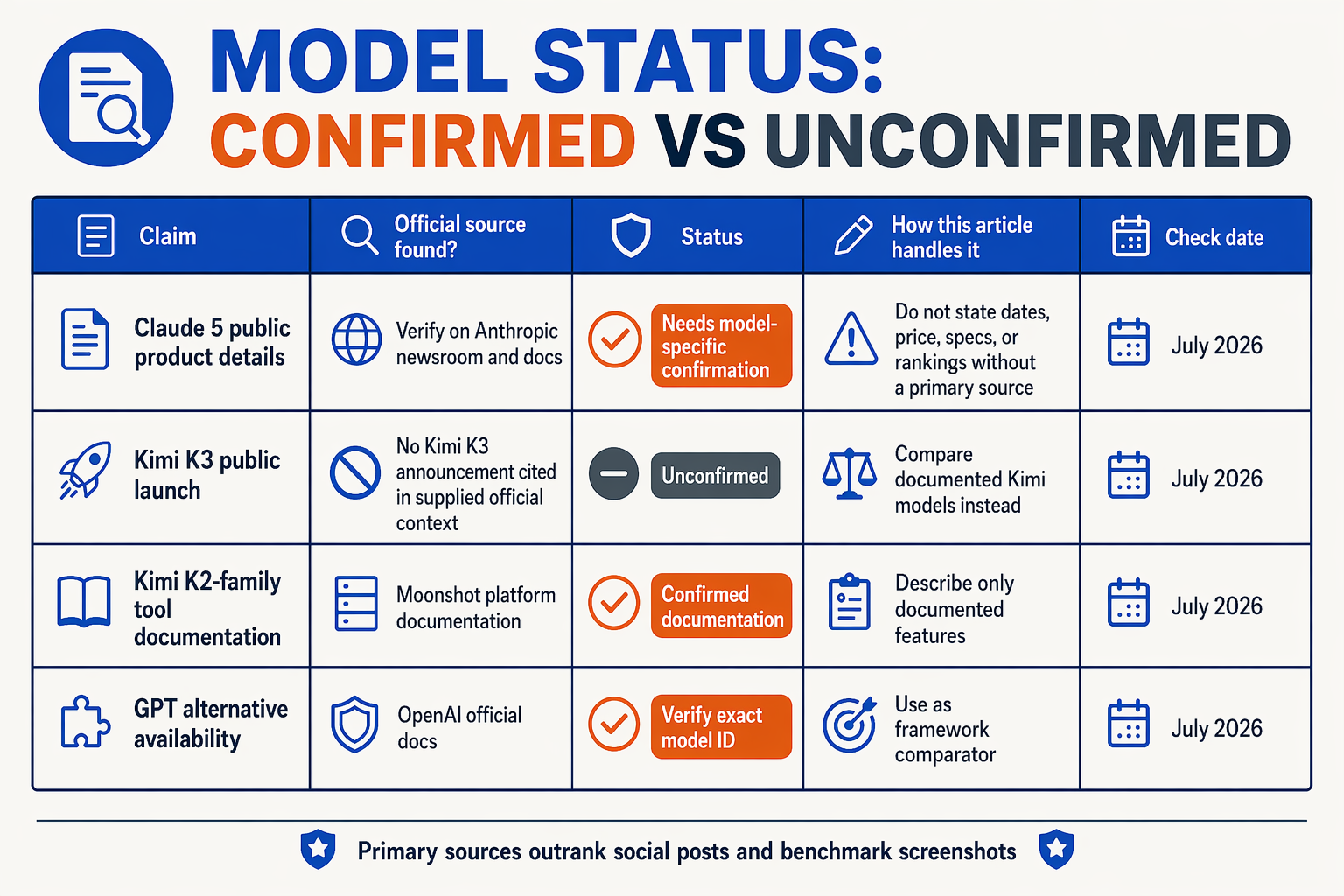
The table below separates vendor documentation from provider-reported release information, third-party findings, and details that have not yet been verified. Status labels apply to each individual claim—not to the model as a whole.
- Official: documented in the model vendor’s published materials.
- Provider-reported: stated in current provider or release materials but not independently validated.
- Third-party: reported through independent testing or analysis.
- Not yet verified: no sufficiently authoritative evidence was found for the claim.
Verified facts and evidence status
| Topic | Claude Fable 5 | Evidence status | Kimi K3 | Evidence status |
|---|---|---|---|---|
| Release and access | Anthropic named Claude Fable 5 in its June 12, 2026 model notice and subsequently published a Fable 5 redeployment update. These notices confirm the model’s existence and describe access changes, but they should not be interpreted as proof of universal availability. | Official | Current Kimi provider and release materials report a July 16, 2026 release. Availability may still vary by product, API account, region, or rollout stage. | Provider-reported |
| Standard API pricing | No verified Fable 5 input or output token rate was found in the checked Anthropic materials. | Not yet verified | Kimi’s current documentation lists flat API pricing of $3 per 1 million input tokens and $15 per 1 million output tokens. | Official |
| Cached-input pricing | No verified cached-input rate for Fable 5 was found. Pricing from another Claude model should not be applied to it. | Not yet verified | Kimi’s documentation lists $0.30 per 1 million cached-input tokens. Eligibility and cache behavior should be checked against the applicable API documentation. | Official |
| Context window | No official Fable 5 context-window figure was verified in the checked evidence. | Not yet verified | Kimi’s official documentation specifies a 1 million-token context window for Kimi K3. This limit does not by itself establish effective recall or accuracy across the entire window. | Official |
| Downloadable weights and license | No verified weight release or model license was found for Fable 5. Do not characterize it as open-weight or assign it a license without an official source. | Not yet verified | No official evidence sufficient to confirm downloadable Kimi K3 weights or a specific weight license was found in the checked material. API access is not the same as an open-weight release. | Not yet verified |
| Parameter count and architecture | Anthropic has not provided a verified parameter count or enough architectural detail in the checked sources to support a specific claim. | Not yet verified | No authoritative Kimi K3 parameter count or detailed architecture was verified. Estimates, leaks, and extrapolations from earlier Kimi models should not be presented as facts. | Not yet verified |
| Coding benchmarks | No official, reproducible Fable 5 coding benchmark numbers were verified. | Not yet verified | No official Kimi K3 coding score suitable for a direct, controlled comparison with Fable 5 was verified. Early provider or third-party results should be labeled with their source, test setup, and date rather than treated as settled rankings. | Not yet verified |
| Agent and tool use | The checked Fable 5 notices do not establish a complete, benchmarked tool-use or autonomous-agent profile. Capabilities documented for Claude Sonnet 5 should not be transferred to Fable 5. | Not yet verified | A model’s availability through an API does not by itself prove reliable tool calling or autonomous-agent performance. No sufficiently detailed Kimi K3 agent evaluation was verified for this comparison. | Not yet verified |
| Comparison caveats | Access conditions, endpoint behavior, latency, rate limits, privacy terms, and total cost can vary. These must be measured using the actual Fable 5 endpoint available to the evaluator. | Third-party editorial assessment | The 1M-token limit and listed rates are documented specifications, not proof of benchmark leadership, full-context reliability, low latency, or suitability for every workload. | Third-party editorial assessment |
How to interpret the comparison
Claude Fable 5 and Kimi K3 can now be compared on a limited set of documented facts, but the evidence is not yet complete enough for a definitive performance verdict. Anthropic has officially confirmed Fable 5 and published access-related notices. Kimi documentation provides a 1M-token context limit and flat token pricing, while current provider materials report a July 16, 2026 release.
Important gaps remain. No verified parameter count, weight license, directly comparable coding benchmark, or controlled agent-performance result is available for either model in the evidence checked here. A fair hands-on comparison should therefore use the same prompts, tools, token budgets, retry rules, and scoring method while recording latency, cache utilization, errors, privacy requirements, and total cost.
How should Claude, Kimi, and GPT models be tested fairly for reasoning, coding, and agents?

A fair Claude vs Kimi vs GPT comparison is a reproducible workload evaluation, not a collage of leaderboard screenshots. Test only models that are publicly available and version-pinned, and treat “Claude 5” or “Kimi K3” claims as untestable until the relevant vendor publishes an API model ID, documentation, pricing, and release notes.
Anthropic’s newsroom confirmed the release of Claude Sonnet 5 on June 30, 2026, describing it as its “most agentic Sonnet model yet” and stating that it can make plans and use tools such as browsers and terminals. That makes Claude Sonnet 5 eligible for a documented agent evaluation; an unconfirmed Kimi K3 configuration is not.
Start with a controlled test protocol
A credible Claude vs Kimi or GPT comparison should hold the following variables constant:
- Pin the exact model version and date. Record the provider, model ID, API region, system prompt, temperature, max tokens, tool definitions, and test date. Silent model updates can change results.
- Use identical prompts and inputs. Do not give one model extra context, a different coding environment, or a more detailed tool schema.
- Run repeated trials. Execute each stochastic task multiple times and report the median result, range, and failure rate—not only the strongest output.
- Measure end-to-end outcomes. A reasoning score alone does not show whether an agent completed a task safely, within budget, and without human repair.
- Publish failure cases. Hallucinated citations, broken code, unnecessary tool calls, loops, and policy refusals are part of production performance.
Evaluate the capabilities that matter in production
Reasoning should be tested with domain-relevant, answer-verifiable tasks: financial reconciliation, policy extraction, multi-step scheduling, or document-grounded analysis. Score factual accuracy, citation support, instruction adherence, and the rate at which the model correctly says it lacks enough information.
Coding requires executable tests rather than subjective judgments. Give Claude, Kimi, and GPT models the same repository, issue description, dependency lockfile, and test suite. Measure:
- Unit and integration tests passed
- Build success rate
- Security regressions introduced
- Time and tokens required to reach a passing patch
- Human review changes required before merge
Agent performance must include tools, permissions, and stopping criteria. Anthropic’s June 30, 2026 announcement explicitly positions Claude Sonnet 5 around planning and browser/terminal tool use, but a vendor capability statement is not equivalent to a measured success rate in a particular workflow. Test agents on a fixed set of tasks such as researching approved sources, updating a CRM record, resolving a support case, or repairing a failing deployment.
Include operational measurements, not just quality scores
For every successful and failed run, capture:
- Latency: time to first token and total task completion time.
- Cost: input tokens, output tokens, tool calls, retries, and any human escalation cost.
- Context handling: performance as relevant documents grow, including retrieval accuracy rather than advertised context-window size alone.
- Multimodal reliability: accuracy on the same images, PDFs, screenshots, or audio files where supported.
- Privacy and deployment: retention terms, regional processing, data controls, audit logs, and self-hosting or private-network options.
For Indian teams, test language and channel requirements directly. A model that performs well on English coding benchmarks may still be unsuitable for Hindi, Tamil, Marathi, or mixed-language customer conversations. Platforms such as CallMissed, which supports speech-to-text and text-to-speech across 22 Indian languages and offers multiple models through an OpenAI-compatible gateway, make this kind of side-by-side application testing more practical.
The fair conclusion is rarely “one model wins.” It is usually more useful: this pinned model, on this date, completed this defined workload at this quality, latency, cost, and safety level.
Which model capabilities matter most for your workflow?
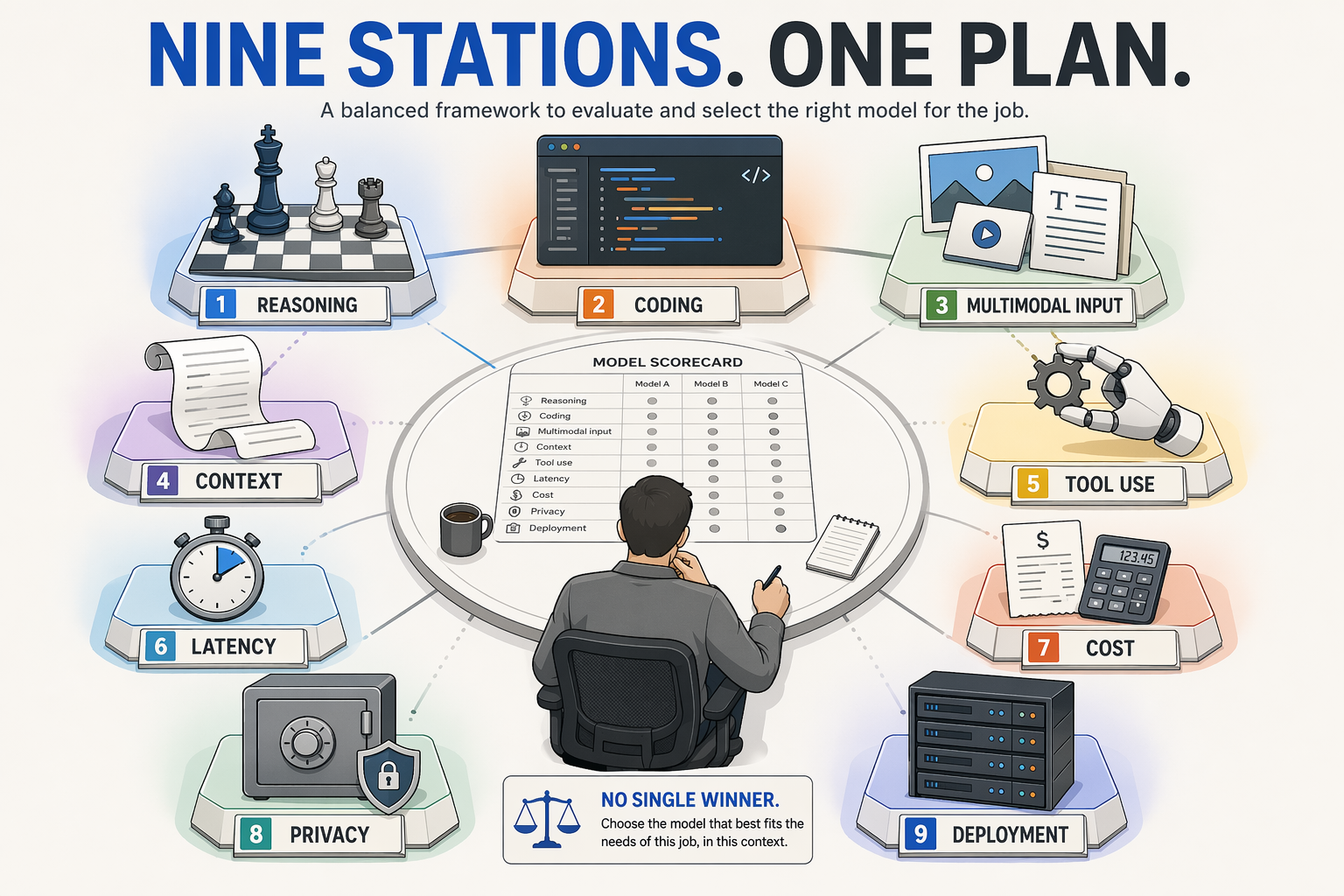
The most important model capabilities depend on the job, not a headline benchmark or an unverified model name. For a practical Claude vs Kimi evaluation, teams should test the confirmed model versions available to them against real tasks, while treating claims about “Kimi K3” specifications or rankings as unconfirmed unless Moonshot AI publishes them.
Start with the workflow’s failure cost
A customer-support assistant, an autonomous coding agent, and a research copilot can all use an LLM, but they fail in different ways. Define what a costly error looks like before comparing models:
- Customer engagement: Incorrect policy answers, unsafe tool actions, poor regional-language handling, or long response times can damage trust.
- Software engineering: The key risks are an agent changing the wrong files, failing tests, mishandling repository context, or producing insecure code.
- Research and analysis: Citation quality, factual grounding, document retrieval, and uncertainty disclosure matter more than eloquent prose.
- Internal operations: Privacy controls, auditability, permissions, and predictable spend can outweigh a small gain on a public benchmark.
Anthropic’s June 30, 2026 announcement describes Claude Sonnet 5 as its “most agentic Sonnet model yet,” designed to make plans and use tools including browsers and terminals. That official claim makes tool-use reliability a central test category for teams considering Claude Sonnet 5—not proof that it is automatically the right model for every workflow.
Evaluate nine capabilities with production-style tests
Use a scorecard that maps directly to the work your team needs completed.
- Reasoning and instruction following
Test multi-step decisions with deliberately incomplete or conflicting information. Measure whether the model identifies ambiguity, asks a useful clarification question, and avoids inventing facts.
- Coding and agentic execution
Give each candidate the same issue, repository slice, test suite, and time limit. Track:
- Tests passed without manual fixes
- Number of unnecessary file changes
- Security or regression issues introduced
- Whether the agent stops for approval before destructive actions
- Multimodal input
If teams process PDFs, screenshots, invoices, product images, or charts, test extraction accuracy on representative files. A model that writes strong text may still misread a table, handwriting, or image-based document.
- Context handling
Do not select a model based only on an advertised context-window figure. Place critical facts at the beginning, middle, and end of long documents, then test whether each fact is retrieved and applied correctly.
- Tool use and browsing
Agentic workflows should be assessed on permission boundaries as well as task completion. Test whether the model calls the correct tool, uses valid parameters, recovers from a failed call, and clearly reports what it did.
- Latency and throughput
Measure p50 and p95 response times under realistic concurrency. A highly capable model can be impractical for live chat or voice experiences if its slowest responses exceed the customer’s tolerance.
- Cost and routing
Calculate cost per successful completed task, including retries, tool calls, tokens, and human review—not merely input and output token prices.
- Privacy and deployment
Verify data-retention terms, regional processing options, access controls, logging, and whether sensitive prompts may be used for training. These are contractual and architectural questions, not benchmark questions.
- Language and channel fit
Indian businesses should test English plus the regional languages and communication channels their customers actually use. Platforms such as CallMissed support Speech-to-Text and Text-to-Speech across 22 Indian languages, making language quality, voice latency, and WhatsApp workflow reliability practical evaluation criteria alongside LLM reasoning.
Make the decision repeatable
Create a fixed evaluation set of 50–200 anonymised real tasks, score outputs with human reviewers, and rerun the suite after model or prompt changes. This approach is more defensible than declaring a winner from rumored “Claude 5 vs Kimi K3” benchmark screenshots.
For teams using multiple providers, an OpenAI-compatible gateway such as CallMissed can simplify controlled routing experiments across LLM, speech, image, and search models. The useful question is not which rumored model is “best”; it is which confirmed, accessible model meets your accuracy, safety, latency, language, and cost thresholds for a specific workflow.
What Kimi K3’s launch means for buyers, developers, and teams

Unverified AI-model rumors can cause teams to buy against capabilities, availability, or governance terms that do not exist. The practical risk is not merely an inaccurate comparison chart: it is an avoidable production dependency, budget error, or security-control gap.
Rumors can turn into costly architecture decisions
A viral post claiming a model has a certain context window, price, coding score, or API release date can influence decisions long before procurement or engineering verifies the claim. Teams may then design prompts, agent workflows, evaluation suites, or vendor contracts around an assumed feature.
Common failure modes include:
- Roadmap lock-in: A startup delays a working deployment while waiting for a rumored model launch or endpoint.
- False cost forecasts: Finance teams estimate token spend using unofficial pricing, then discover that actual usage, tool calls, caching, or regional availability changes the total cost.
- Benchmark overfitting: Developers optimize for a screenshot of one coding or reasoning benchmark instead of testing their own repositories, documents, languages, and failure cases.
- Security mismatches: An agent designed around assumed browser, terminal, or connector access may require a different approval workflow and permission model once the real product documentation is available.
- Procurement confusion: Buyers may treat similarly named models as interchangeable even when their data-retention, hosting, support, or deployment terms differ.
This is especially important for agentic systems. Anthropic announced Claude Sonnet 5 on June 30, 2026, and described it as capable of making plans and using tools such as browsers and terminals, according to Anthropic’s newsroom. Tool use can create real business value, but it also expands the test surface: teams must evaluate authorization boundaries, audit logs, prompt-injection resistance, and human approval steps—not infer them from an online model comparison.
Names alone are not product specifications
“Claude 5,” “Fable 5,” and “Kimi K3” searches demonstrate why model nomenclature needs primary-source verification. Anthropic’s official newsroom published a notice about suspending access to Claude Fable 5 and Claude Mythos 5 on June 12, 2026, and subsequently published a July 1, 2026 redeployment update citing changed export controls and updated cybersecurity safeguards. Those dated announcements are evidence of a specific operational event; they do not validate every circulating claim about benchmarks, pricing, model weights, or availability.
For Kimi K3, buyers should not convert search demand or social discussion into a product fact. Until Moonshot AI/Kimi publishes a release note, model card, API documentation, pricing page, or deployment policy, claims about Kimi K3’s specifications should remain labeled unverified.
A safer decision process for buyers and developers
Before changing a production model strategy, teams should use a short evidence-and-testing workflow:
- Separate confirmed from claimed. Record the official product name, release date, API identifier, documentation date, and commercial terms.
- Run workload-specific evaluations. Test reasoning, coding, multimodal inputs, long documents, tool use, latency, cost, privacy, and deployment requirements with representative data.
- Measure reliability, not just peak output. Track task completion, human corrections, tool-call errors, refusals, latency percentiles, and cost per completed task.
- Maintain a fallback path. Avoid tying critical workflows to a single rumored release or unsupported endpoint.
For developers, multi-model infrastructure can reduce this dependency risk. CallMissed’s OpenAI-compatible AI gateway gives teams one integration across LLM, speech-to-text, text-to-speech, image, and web-search models, with same-tier fallback options. That does not replace model evaluation, but it makes it easier to test confirmed alternatives without rewriting the application each time the AI news cycle shifts.
What do official sources, independent testers, and AI experts actually agree on?

The clearest point of agreement is that official documentation—not viral model names or screenshot benchmarks—is the minimum standard for calling an AI model released. Anthropic has officially announced Claude Sonnet 5, while the available evidence in this article does not establish a public Moonshot AI release called Kimi K3 with verified specifications, pricing, or API access.
What official sources establish
Anthropic’s June 30, 2026 newsroom announcement describes Claude Sonnet 5 as its “most agentic Sonnet model yet,” stating that it can make plans and use tools including browsers and terminals. That is a concrete vendor claim about an identified product, rather than an inference from a leaked benchmark or a social-media post.
Anthropic’s newsroom also contains separate June and July 2026 notices concerning Claude Fable 5 and Claude Mythos 5, including a June 12 access suspension and a July 1 redeployment notice following changed export controls. This distinction matters: “Fable 5” is not simply interchangeable shorthand for Claude Sonnet 5. Readers should retain the exact model name used in the primary source and avoid merging separate announcements into an invented single product family.
A careful fact-check therefore separates three categories:
- Confirmed: Anthropic publicly announced Claude Sonnet 5 on June 30, 2026 and positioned it around coding, agents, professional work, planning, and tool use.
- Reported but requiring source-level context: Anthropic published notices about Fable 5 and Mythos 5 access and redeployment in June and July 2026.
- Unconfirmed in the evidence reviewed here: a publicly documented “Kimi K3” launch, its context window, benchmark scores, API price, release date, and availability terms.
What independent testers can responsibly add
Independent testing is valuable, but it does not replace a release announcement or model card. A credible Claude vs Kimi comparison should identify the exact model version, test date, region, provider endpoint, system prompt, tool configuration, and scoring method. Without those details, a claim such as “Model X beats Model Y at coding” is not reproducible.
Experts generally treat benchmark results as signals, not purchase orders, because outcomes can change with prompting, tool access, task selection, model updates, and inference settings. For agentic workflows, a single pass-rate number also misses operational risks such as:
- Tool reliability: Does the model recover after a browser, terminal, or API tool fails?
- Permission safety: Does it request confirmation before high-impact actions?
- Latency and cost: Can the workflow meet a real service-level target at production volume?
- Data governance: Where is data processed, retained, and accessible?
- Language fit: Does performance hold for the languages customers actually use?
The practical consensus for buyers
The productive question is not “Who won the rumored Claude 5 vs Kimi K3 race?” It is: which officially available model performs best on a documented workload under your constraints? That approach applies equally to searches such as “Kimi K2.6 vs Claude Opus” or “Kimi K2.6 vs GPT-5.4 vs Claude Opus”: confirm the precise releases first, then run matched tests.
For teams that need to test several providers, solutions such as CallMissed’s OpenAI-compatible AI gateway reflect an increasingly practical approach: evaluate multiple LLMs through one integration rather than rebuilding an application for every model. The final decision should rest on reproducible task results, total cost, privacy requirements, and deployment fit—not an unverified model label.
Claude Fable 5 vs Kimi K3: which model should you choose?
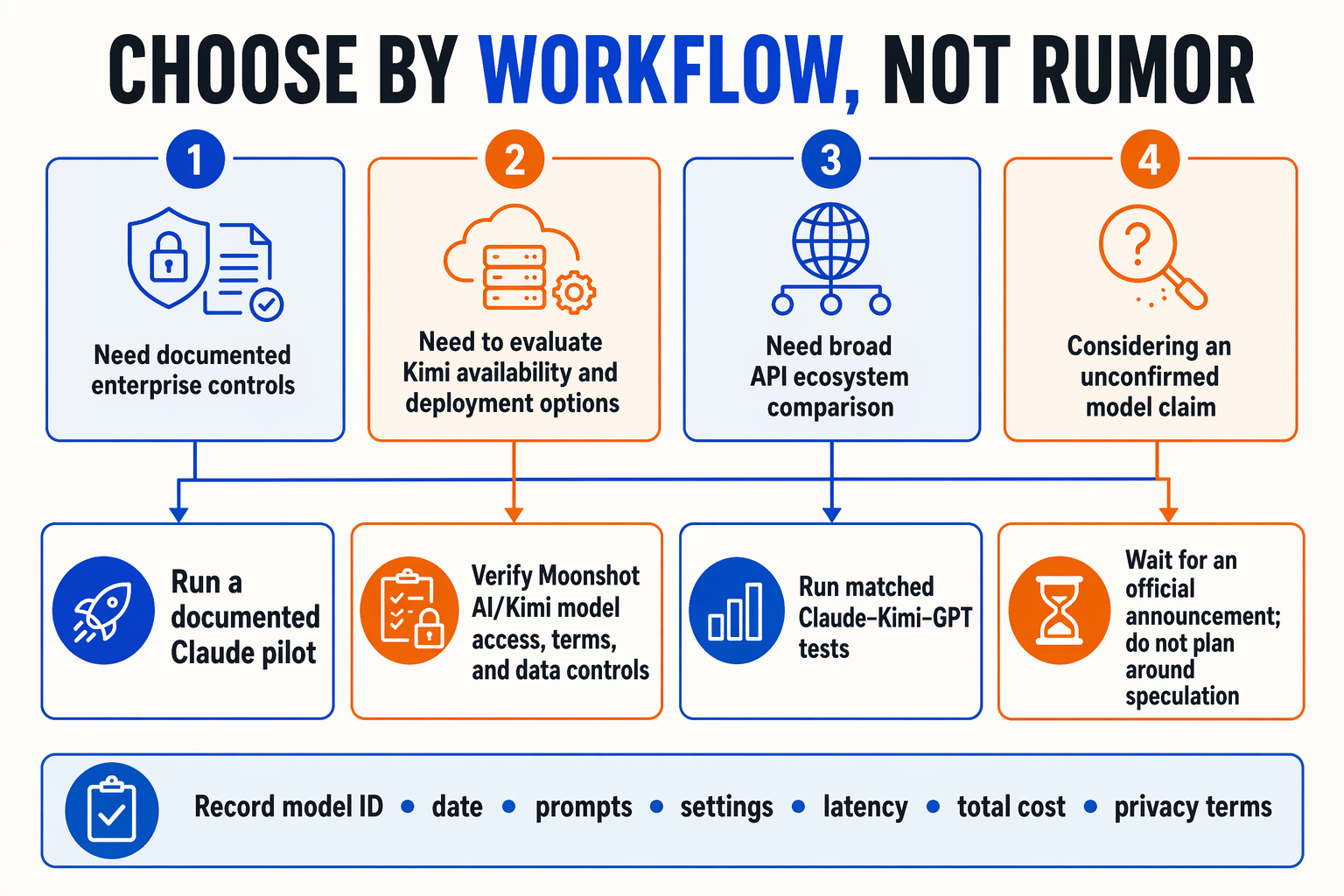
The buying verdict is straightforward: choose Kimi K3 when lower reported API pricing and an officially documented 1M-token context window directly benefit your workload. Choose Claude Fable 5 when mature documentation, established enterprise workflows, and predictable vendor support matter more than the lowest token price. In either case, make the final decision with an identical-workload production bake-off rather than benchmark headlines.
Claude Fable 5 vs Kimi K3: the practical decision table
| Choose | Best fit | API price | Main advantage | What must be verified |
|---|---|---|---|---|
| Kimi K3 | Cost-sensitive applications, long-context workflows, research, and experimentation | $3/M input tokens and $15/M output tokens, based on provider-reported rates | Lower headline price and an officially documented 1M-token context window | Confirm current pricing in Moonshot’s primary API documentation, the exact endpoint and model version, regional access, rate limits, effective context behavior, data terms, tool support, and production support. |
| Claude Fable 5 | Enterprises prioritizing mature documentation, supported integrations, governance, and established operational workflows | $10/M input tokens and $50/M output tokens, according to Anthropic’s official pricing | Mature vendor documentation and an established enterprise ecosystem | Confirm current limits, regional processing, data retention, tool support, service terms, latency, and performance on your production tasks. |
| Wait and test both | Teams without an urgent migration deadline or workloads without a clear price, context, or operational winner | Pilot cost only | Avoids committing based on specifications or reported benchmark results | Use the same prompts, context, tools, datasets, retry policies, and scoring rules for both models. |
| Keep GPT or a multi-model layer in the bake-off | Products needing task-based routing, fallback capacity, or reduced dependence on one provider | Depends on the models and providers selected | Lets each request go to the model that performs best for that workflow | Verify pricing, failover behavior, data-transfer paths, observability, latency, and total operating cost. |
Kimi K3 is officially documented for API use with a 1M-token context window. Its exact $3/M input and $15/M output pricing and July 16, 2026 release date should be treated as provider-reported unless confirmed in Moonshot’s primary documentation. By contrast, Anthropic officially lists Claude Fable 5 at $10/M input tokens and $50/M output tokens.
At those stated rates, Kimi K3’s token prices are 70% lower for both input and output. That can be significant for high-volume or context-heavy applications, but token price is not the same as cost per completed task. Lower-priced calls may not produce lower total costs if they require more retries, longer prompts, additional tool calls, or more human review.
Use this calculation during the pilot:
Cost per completed task = model usage + retries + tool calls + infrastructure + human review
Claude Fable 5 can still be the better business choice if it completes substantially more tasks correctly on the first attempt or integrates more reliably with existing systems. Kimi K3 can have a strong economic advantage when its quality, latency, and reliability are comparable for the target workflow.
No verified official K3 Hugging Face model card or MoonshotAI GitHub weights repository has been established here. Do not assume that Kimi K3 offers open weights, self-hosting, local deployment, modification rights, or a particular parameter count. Those claims should not influence the decision unless Moonshot publishes primary documentation confirming the relevant artifacts and license terms.
Five-step production bake-off checklist
- Verify the current product details. Confirm each model’s exact API endpoint, version, pricing, context limit, regional availability, rate limits, data terms, and support commitments in primary vendor documentation.
- Build a representative test set. Select 50–200 real tasks covering routine requests, difficult edge cases, long-context inputs, multilingual content, tool use, safety-sensitive scenarios, and expected failure modes.
- Run an identical-workload comparison. Give both models the same prompts, context, tools, temperature settings, retry limits, and output requirements. Test Kimi K3’s 1M-token context with realistic retrieval and reasoning tasks rather than checking only whether the API accepts a large prompt.
- Measure production outcomes. Record task success, factual accuracy, test-pass rate, latency, tool-call failures, retries, human corrections, security issues, and cost per completed task. For Indian customer workflows, separately evaluate English, mixed Hindi-English, and every required regional language.
- Complete a gated rollout. Begin with low-risk traffic, define quality and spending thresholds, monitor failures, and retain a fallback model. Expand only after the selected model consistently meets operational, security, compliance, and cost targets.
The evidence-based recommendation
Choose Kimi K3 if its reported $3/M input and $15/M output pricing materially improves your economics, its officially documented 1M-token context window benefits real tasks, and it meets your reliability and support requirements in testing.
Choose Claude Fable 5 if mature documentation, established enterprise workflows, vendor support, and lower adoption risk matter more than minimum token price—and if its production performance justifies Anthropic’s official $10/M input and $50/M output pricing.
Do not choose either model solely because of reported benchmark wins. If neither clearly leads on quality, reliability, latency, and cost per completed task under an identical workload, keep both in evaluation or use a multi-model routing layer until production evidence identifies the better option.
Frequently Asked Questions
Is Kimi K3 released?
What is the Kimi K3 release date?
How much does the Kimi K3 API cost?
Does Kimi K3 offer cached-input pricing?
What is the Kimi K3 context window?
Is Kimi K3 open weight or available for self-hosting?
How many parameters does Kimi K3 have?
How good are the Kimi K3 benchmarks?
Is Kimi K3 better than Claude Fable 5 for coding?
How can I access Kimi K3?
Conclusion
The post-launch verdict on Claude Fable 5 vs Kimi K3 is straightforward: both models are available, but neither is an automatic winner.
- Price: Published API rates position Kimi K3 as the lower-cost option, while Claude Fable 5 commands a premium. Compare effective costs—including output tokens, caching, tool calls, and retries—not headline rates alone.
- Context: Both offer long-context capabilities, but advertised limits do not guarantee equal recall, reasoning quality, latency, or cost across an entire prompt.
- Benchmarks: Claude Fable 5 has the more mature evaluation record. The Kimi K3 API, pricing, and benchmarks are now documented, but independent testing remains less extensive and early scores may not reflect production reliability.
- Verdict: Run a controlled bake-off using the same prompts, tools, retrieval pipeline, latency targets, and scoring rubric. Choose Claude Fable 5 when consistency and agentic execution justify the premium; choose Kimi K3 when cost efficiency and long-context throughput perform better on your workload.
Platforms such as CallMissed can reduce lock-in by helping teams evaluate multiple models while building voice and WhatsApp workflows for multilingual audiences. The best model is the one that wins on your real tasks—not the one with the strongest launch-day leaderboard.