

Inkling Open-Weights Model: What Thinking Machines Lab’s 2026 Announcement Means



Inkling is Thinking Machines Lab’s 975B open-weights multimodal model. Review its specs, Apache 2.0 license, Tinker access, benchmarks, and caveats.
Inkling Open-Weights Model: What Thinking Machines Lab’s 2026 Announcement Means
What if a newly announced AI model offered 975 billion total parameters, yet activated only 41 billion for a given response? That is the central architectural detail behind Thinking Machines Lab Inkling, the Inkling open-weights model announced on July 15, 2026.
Thinking Machines Lab describes Inkling as its first open-weights model: a multimodal Mixture-of-Experts transformer designed to support controllable reasoning effort and customization through fine-tuning. The announcement matters because open weights can give researchers and developers more control than a conventional closed-model API—although “open weights” does not automatically mean fully open source, unrestricted self-hosting, or zero-cost deployment.
The official Inkling model card states that the model has 975B total parameters, 41B active parameters, and a context window of up to 1 million tokens. A 1M-token context window describes how much information the model can process in principle; it does not guarantee low inference costs, low latency, or consistently strong results on every long-context task. Likewise, the parameter count alone says nothing conclusive about real-world quality without independent benchmarks and representative workloads.
This announcement also raises practical questions. Thinking Machines Lab says Inkling is available for fine-tuning through Tinker, creating a potential path for developers to adapt the model to specialized tasks, domains, or response styles. However, readers should distinguish between fine-tuning access, downloadable weights, hosted inference, API availability, pricing, licensing, and permission to deploy the model independently. The official announcement does not make those terms interchangeable, and undisclosed deployment details could determine who can use Inkling economically.
That distinction is especially important for businesses. Open-weight systems may enable deeper customization and greater infrastructure control, but they can also require substantial compute, engineering, evaluation, security, and maintenance investment. By contrast, closed AI models typically abstract away much of that operational burden through managed APIs, while limiting access to internal weights and sometimes restricting customization.
This analysis examines what Thinking Machines Lab’s new model actually includes, what remains undisclosed, and why the release could influence the next phase of multimodal AI development. It will cover the meaning of controllable reasoning effort, the practical significance of a 1M-token context window, the difference between open weights and open source, and the questions developers should ask before planning production use. Platforms such as CallMissed reflect the same broader movement toward making advanced AI capabilities more accessible through developer-friendly infrastructure, though Inkling’s own licensing and deployment terms still need careful review. The official announcement is available at Thinking Machines Lab.
What Did Thinking Machines Lab Announce About Inkling on July 15, 2026?
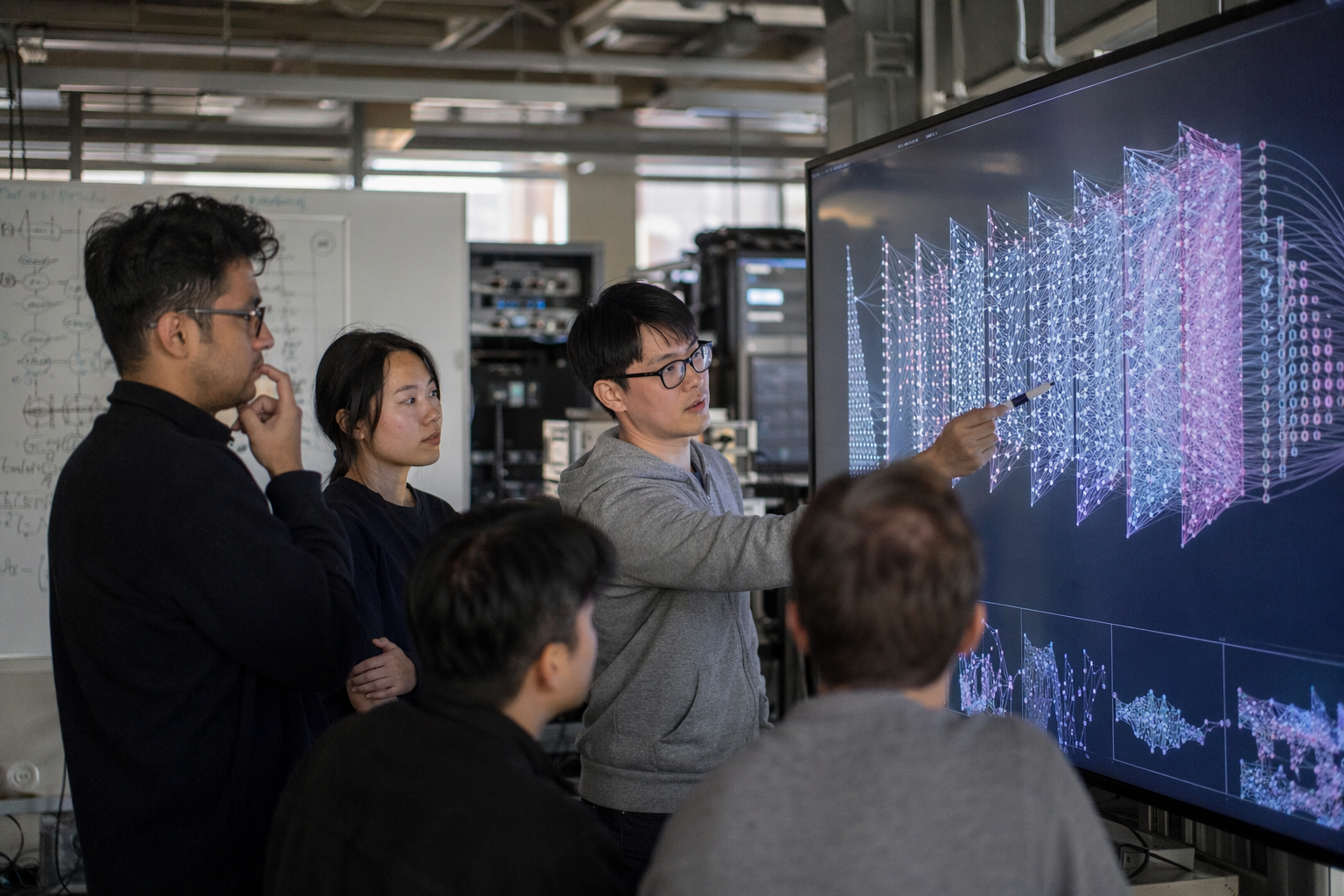
Thinking Machines Lab announced Thinking Machines Lab Inkling on July 15, 2026, describing it as the company’s first open-weights AI model. The official announcement presents Inkling as a multimodal Mixture-of-Experts (MoE) transformer with controllable reasoning effort, a context window of up to 1 million tokens, and fine-tuning access through Tinker.
What the official announcement confirms
The Inkling open-weights model is designed to give developers and researchers more control over adaptation than a conventional closed-model API. Thinking Machines Lab says Inkling can be fine-tuned through Tinker, the company’s platform for customizing and working with AI models.
The official announcement and Inkling model card identify the following specifications:
| Fact | Officially stated detail |
|---|---|
| Announcement date | July 15, 2026 |
| Model type | Multimodal Mixture-of-Experts transformer |
| Total parameters | 975 billion |
| Active parameters | 41 billion per response |
| Maximum context | Up to 1 million tokens |
The model’s 975 billion total parameters represent the full collection of expert and shared parameters, while 41 billion active parameters indicates the approximate portion used for an individual response. In an MoE architecture, this selective activation can support a large model capacity without executing every parameter for every token, although actual cost, throughput, and hardware requirements depend on the implementation and deployment environment.
What “controllable reasoning effort” means
Thinking Machines Lab also highlights controllable reasoning effort as a core Inkling capability. In practical terms, this suggests that developers may be able to adjust how much computation or deliberation the model applies to a task—for example, using a lower effort setting for simple classification and a higher setting for complex analysis.
The announcement does not, however, establish that Inkling outperforms competing models, achieves a particular benchmark score, or delivers a fixed latency or cost advantage. Those conclusions require independent evaluations across representative workloads.
The stated 1 million-token context window describes the amount of information Inkling can process in a single context. It does not guarantee low inference cost, low latency, reliable retrieval from every position in a long document, or consistently strong performance on all million-token tasks.
What remains unclear about access
“Open weights” is narrower than “fully open source.” Depending on the license and release terms, open weights may support inspection, fine-tuning, or third-party deployment—but those permissions cannot be assumed automatically.
Readers should separately verify:
- Whether Inkling weights can be downloaded and self-hosted
- Which commercial and redistribution rights the license grants
- Whether hosted API access is generally available
- Tinker pricing, quotas, and regional availability
- Hardware, software, and operational requirements for deployment
The official announcement is available at Thinking Machines Lab, while the model card records the July 15, 2026 release date. Platforms such as CallMissed, with a unified developer gateway for multiple AI model types, represent the parallel industry trend toward simplifying access; Inkling’s own deployment terms still require direct confirmation from Thinking Machines Lab.
What Is Inkling, and What Do the Official Sources Actually Disclose?

Thinking Machines Lab announced Inkling on July 15, 2026, describing it as the American AI company’s first open-weights model. The official announcement and Inkling model card describe Inkling as a general-purpose, multimodal Mixture-of-Experts transformer that natively handles and reasons across text, images, and audio, while generating text outputs.
The materials also describe controllable thinking—or reasoning—effort. This gives users a way to adjust how much reasoning the model applies, helping them trade off response depth or potential quality against efficiency for a particular task. It should not be interpreted as a guarantee of faster responses, lower costs, better results, or a benchmark advantage at every setting.
Thinking Machines Lab states that Inkling is available for fine-tuning through Tinker, making Tinker an official access and customization path. The announcement and model card establish Inkling’s broad capabilities and intended workflow, but they do not necessarily establish every detail about licensing, pricing, APIs, downloads, self-hosting, deployment requirements, or training-data transparency.
What Thinking Machines Lab has confirmed
| Category | Official disclosure |
|---|---|
| Model identity | Inkling is Thinking Machines Lab’s first open-weights model |
| Developer | Thinking Machines Lab, an American AI company |
| Announcement date | July 15, 2026 |
| Intended use | General-purpose model |
| Modalities | Text, images, and audio |
| Inputs | Text, images, and audio |
| Outputs | Text |
| Architecture | Mixture-of-Experts transformer |
| Parameters | 975 billion total; 41 billion active |
| Context window | Up to 1 million tokens |
| Thinking/reasoning | Controllable thinking or reasoning effort |
| Customization | Fine-tuning available through Tinker |
The 975-billion total-parameter figure describes the complete Mixture-of-Experts system, while 41 billion active parameters refers to the parameters activated for a particular computation path. Those figures describe the architecture; they do not, by themselves, establish Inkling’s real-world cost, speed, or quality.
Inkling’s adjustable thinking effort allows users to configure the model’s reasoning behavior for different tasks. A higher-effort setting may be appropriate when a task benefits from deeper analysis, while a lower-effort setting may be preferable when efficiency matters. The official materials do not establish that one setting will improve every answer or specify the same performance, latency, or cost tradeoffs across all use cases.
The announcement and model card identify text, images, and audio as modalities Inkling can handle and text as its output format. They do not establish video-input support, so Inkling should not be described as a video-input model based on these sources alone.
What the 1-million-token context window means
The official materials state that Inkling supports a context window of up to 1 million tokens. This is a capacity specification: it describes the maximum supported amount of input and conversation context under applicable conditions.
It is not, by itself, a guarantee of:
- Low inference cost for million-token requests
- Low latency at the maximum context length
- Uniformly accurate retrieval across long documents
- Strong performance on every long-context workflow
- Identical limits or behavior across all interfaces and configurations
Organizations evaluating Inkling should test representative documents, multimodal inputs, conversation histories, retrieval tasks, and latency requirements rather than treating the context-window figure as a complete performance assessment.
What “open weights” does—and does not—confirm
The phrase open weights generally means that model parameters are made available under stated terms. It is not automatically equivalent to fully open-source software. Open-source availability can involve additional components, such as source code, build tools, data, documentation, and permissive licensing, while the permissions for an open-weights model depend on its published license and release terms.
Inkling’s open-weights label therefore does not, by itself, confirm that the model can be freely self-hosted, downloaded, commercially redistributed, or used without infrastructure or other restrictions. The current announcement and model card should not be treated as confirmation of particular pricing, API access, deployment arrangements, or training-data transparency unless Thinking Machines Lab states those details in separate official documentation.
Developers should review the official Inkling announcement, model card, license and release terms, and Tinker documentation at thinkingmachines.ai before evaluating, fine-tuning, deploying, or integrating the model.
Which Inkling Specifications Are Confirmed in the Announcement and Model Card? (TABLE)
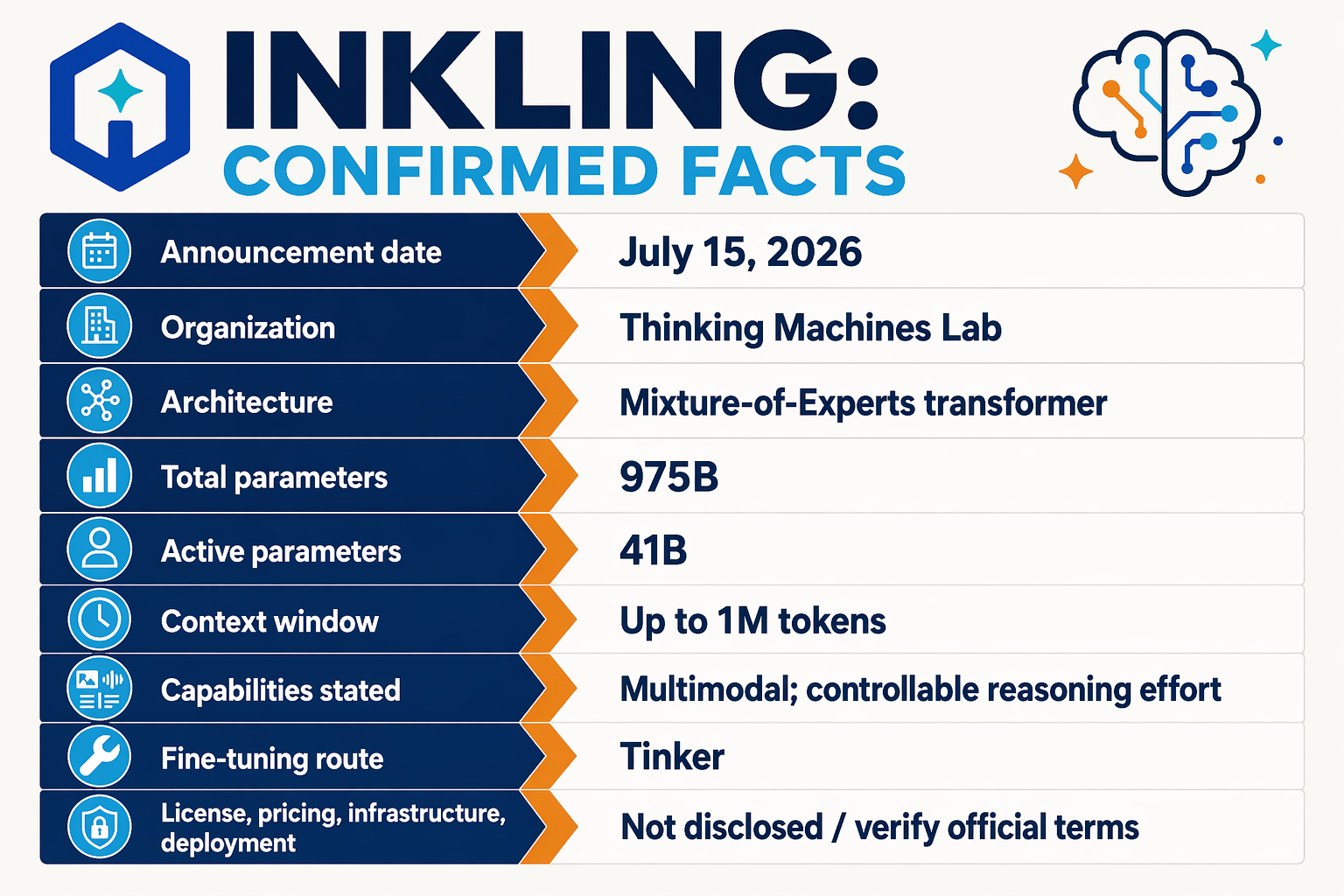
Thinking Machines Lab announced Inkling on July 15, 2026, describing it as its first open-weights model. The official announcement and Inkling model card confirm the following specifications.
Confirmed Inkling specifications
| Specification | Confirmed detail |
|---|---|
| Model architecture | Multimodal Mixture-of-Experts transformer |
| Total parameters | 975 billion |
| Active parameters | 41 billion |
| Inputs and outputs | Text, image, and audio inputs; text output |
| Context window | Up to 1 million tokens |
| Numerical formats | BF16, MXFP8, and NVFP4 support |
| License | Apache 2.0 |
| Fine-tuning | Available through Tinker |
The 975B total-parameter figure is not the same as the 41B active-parameter figure. Inkling’s Mixture-of-Experts architecture routes computation through selected expert components rather than necessarily activating all 975 billion parameters for every response. These figures alone do not establish latency, hardware requirements, throughput, inference cost, or model quality.
The stated 1-million-token context window describes the maximum context supported in the documented configuration. It is not a guarantee of low-cost inference, low latency, perfect retrieval, or consistently strong performance on every long-context task.
The official model card confirms text, image, and audio inputs with text output. It does not establish video input, so video should not be treated as a confirmed Inkling capability.
What “open weights” does and does not confirm
Inkling is released under the Apache 2.0 license, and the official materials describe fine-tuning through Tinker. However, “open weights” does not necessarily mean that every training detail, dataset, training recipe, evaluation artifact, hosted service, or deployment pathway is open or freely available. Developers should review the published license, release files, Tinker terms, and any operational requirements before using Inkling in production.
The announcement and model card also do not, by themselves, establish public API quotas, hosted-inference pricing, production throughput, independent benchmark results, or comparative performance. Claims about those topics from third-party reporting or testing should be identified as third-party claims rather than confirmed Inkling specifications.
Sources: Thinking Machines Lab announcement · Inkling model card
Why Do Open Weights Matter for Customization and Deployment?
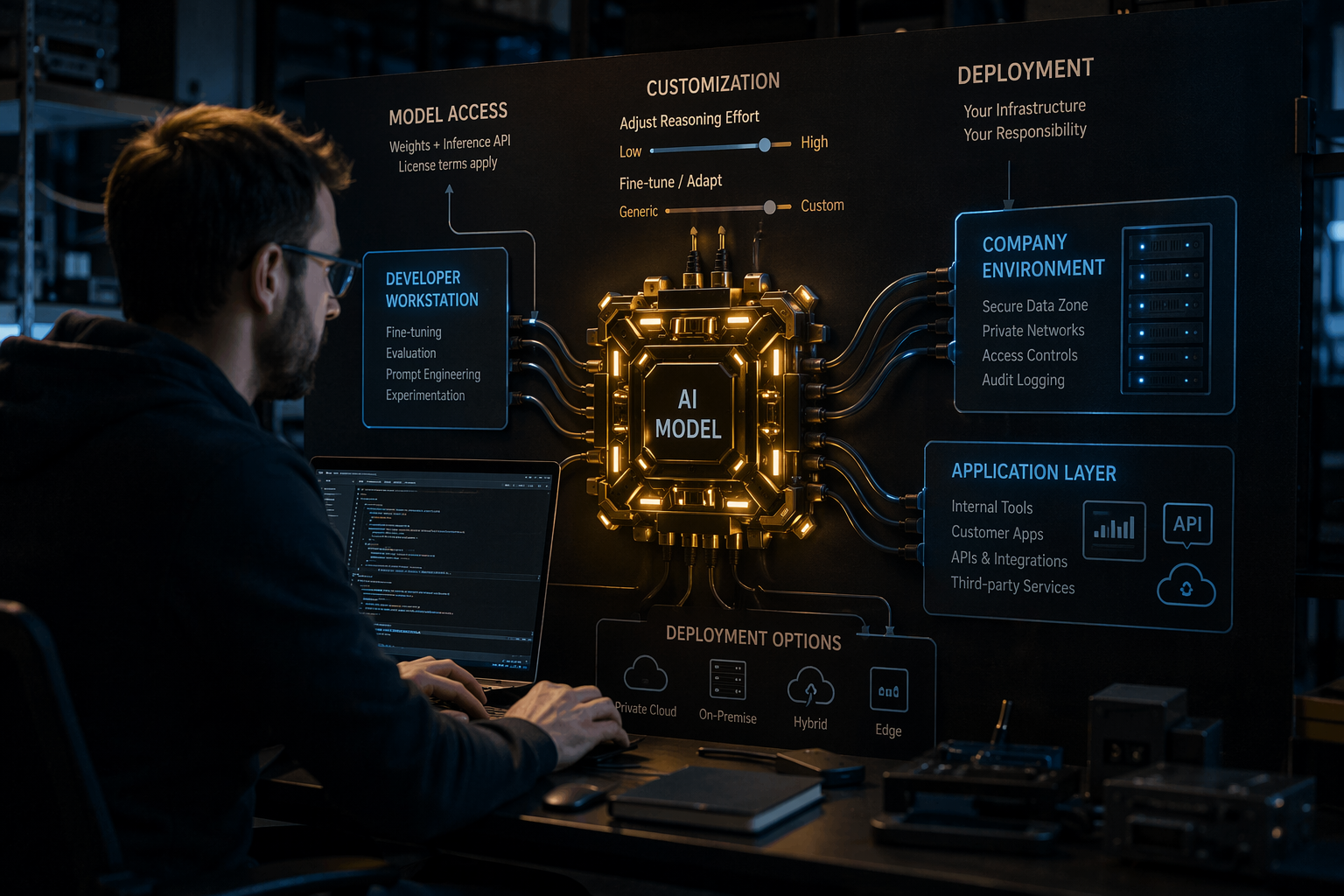
Open weights matter because they can give developers more control over how an AI model is adapted, evaluated, and deployed—but the benefits depend on the license, available tooling, and hardware requirements. For Thinking Machines Lab Inkling, the July 15, 2026 announcement creates a potential customization path through fine-tuning on Tinker, while leaving several independent-deployment questions open.
What Can Developers Customize?
A conventional closed-model API generally exposes inputs, outputs, and a defined set of controls. Open weights can provide a deeper layer of access: developers may be able to adapt model behavior to a company’s terminology, workflows, formatting requirements, or specialized domain data.
The official Inkling model card says the model is released with open weights to support research, fine-tuning, and integration into third-party products. Thinking Machines Lab also states that Inkling is available for fine-tuning through Tinker, which could lower the engineering barrier for teams that want to customize the model without building every training component themselves.
Potential customization use cases include:
- Teaching consistent response structures for regulated or operational workflows
- Adapting outputs to industry-specific vocabulary and internal documentation
- Improving handling of specialized text, image, or other supported multimodal inputs
- Adjusting how much reasoning effort is used for different task types
- Creating product-specific assistants rather than relying solely on generic prompting
The last point connects to Inkling’s advertised controllable reasoning effort. In practical terms, developers may be able to trade off response depth, latency, and compute usage according to task requirements. The announcement does not establish a universal quality improvement or benchmark advantage, so organizations would need to test those trade-offs on their own workloads.
Does Open Weights Mean Self-Hosting?
No. “Open weights” does not automatically mean unrestricted self-hosting, fully open-source software, or inexpensive production deployment. Those conclusions require separate evidence about the license, runtime, infrastructure, and distribution terms.
For the Inkling open-weights model, teams should verify:
- License permissions: whether commercial use, modification, redistribution, and derivative models are allowed.
- Weight access: whether the weights can be downloaded directly, accessed through a controlled service, or obtained under specific conditions.
- Inference requirements: whether serving a 975-billion-parameter Mixture-of-Experts model is practical on available hardware.
- Operational tooling: whether compatible runtimes, quantization options, monitoring, and security controls are provided.
- Commercial terms: whether fine-tuning, hosted inference, API usage, or third-party integration carry separate pricing or restrictions.
The Thinking Machines Lab new model has 975B total parameters and 41B active parameters, according to the official model card dated July 15, 2026. The active-parameter figure may affect per-token computation, but it does not by itself determine total memory, serving cost, latency, or production complexity. Businesses should not equate sparse activation with low-cost deployment without hardware and workload measurements.
Why This Matters for Businesses
Open-weight systems can shift more responsibility—and more control—to the deploying organization. That can support data-governance strategies, specialized behavior, and closer integration with internal systems, but it also introduces evaluation, infrastructure, patching, abuse prevention, and reliability obligations.
Closed AI models remain attractive when teams prioritize managed scaling and simpler operations. Developer platforms such as CallMissed represent another approach: giving teams access to multiple AI capabilities through an OpenAI-compatible gateway instead of requiring them to operate large models directly. Inkling’s significance will become clearer as its license, access model, deployment tooling, and independent evaluations are disclosed.
How Does the Inkling Open-Weights Model Differ From Closed AI Models?
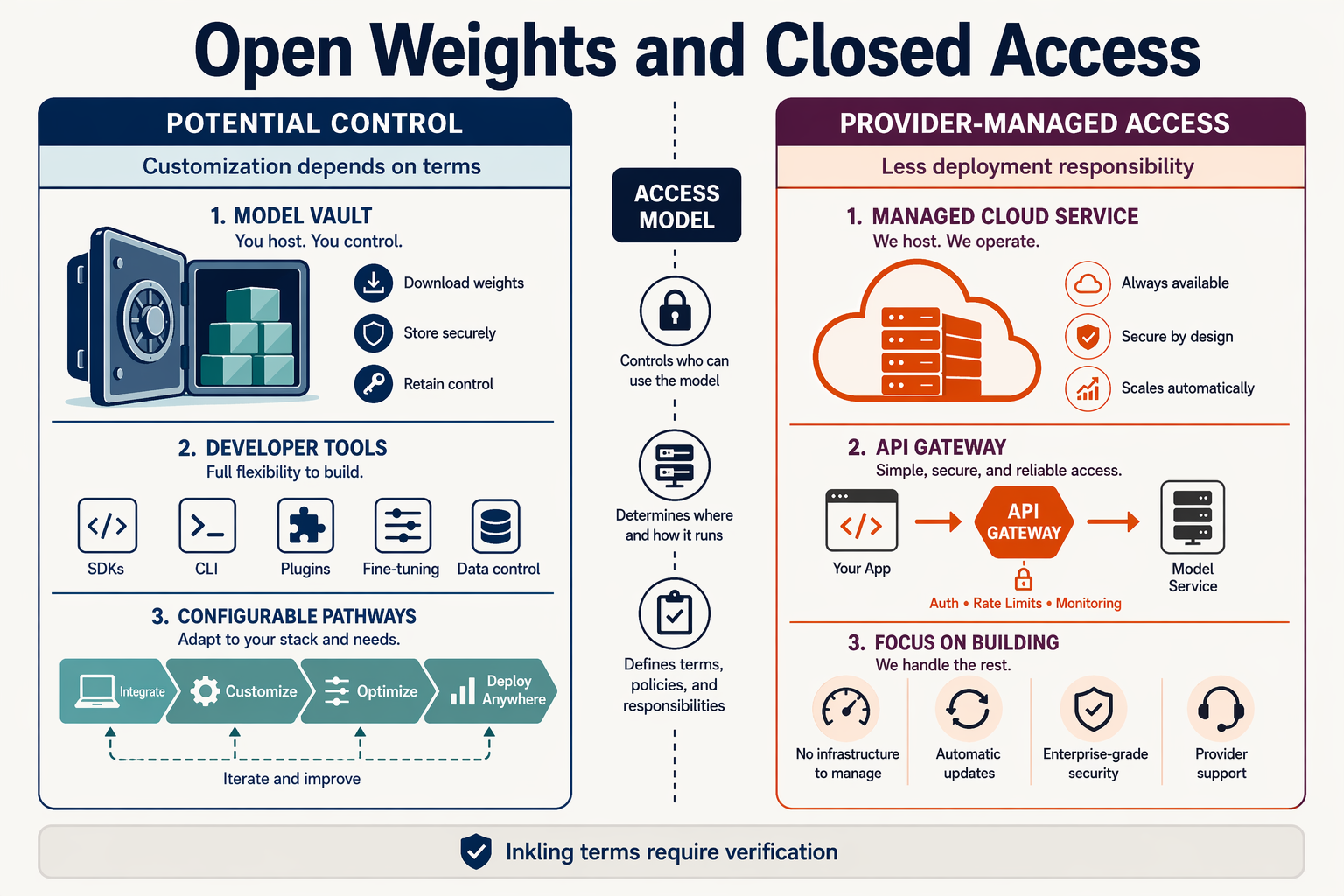
Thinking Machines Lab Inkling differs from closed AI models primarily through access and customization: Thinking Machines Lab announced the Inkling open-weights model on July 15, 2026, presenting it as the lab’s first model whose weights are released for research, fine-tuning, and third-party integration. That does not automatically make Inkling fully open source, freely self-hostable, or cheaper to operate than a managed API.
Open weights versus closed access
In a typical closed model, users interact through a hosted interface or API while the model provider retains control of the underlying weights. Developers can usually adjust prompts, system instructions, tools, and sometimes fine-tuning settings, but they cannot inspect or independently deploy the core model unless the provider explicitly enables those capabilities.
Open weights change that control boundary. If the license, hardware requirements, and release package permit it, developers may be able to:
- Fine-tune the model for a domain, task, language, or response style.
- Inspect model files and integrate them into third-party systems.
- Run inference through their own infrastructure or a qualified hosting provider.
- Build specialized evaluation, safety, and serving layers around the model.
- Reduce dependence on a single provider’s API roadmap or pricing.
For Inkling, the confirmed customization path is fine-tuning through Tinker, according to Thinking Machines Lab’s announcement. The official materials should still be read carefully before assuming that downloadable weights, independent self-hosting, hosted API access, pricing, and commercial redistribution all carry identical permissions.
What Inkling’s architecture adds
The Thinking Machines Lab new model is described as a multimodal Mixture-of-Experts transformer with 975 billion total parameters and 41 billion active parameters. In practical terms, a Mixture-of-Experts design can route each input through selected expert components rather than activating every parameter for every response; however, those figures alone do not establish deployment cost, speed, or performance.
Inkling also supports controllable reasoning effort. This suggests that developers or users may be able to choose a trade-off between faster, lighter responses and more deliberate processing, depending on the task. The announcement does not establish that every reasoning setting performs equally well, nor does it provide a basis for claiming benchmark leadership over closed systems.
The model supports a context window of up to 1 million tokens, meaning it can potentially process very large prompts or document collections in one interaction. A 1M-token context window is not a guarantee of low latency, low cost, or reliable retrieval from every part of a long input.
| Dimension | Inkling open-weights model | Typical closed AI model |
|---|---|---|
| Core weights | Released under terms requiring review | Retained by the provider |
| Customization | Fine-tuning available through Tinker | Usually provider-controlled |
| Deployment | Depends on license, hardware, and release terms | Generally provider-hosted |
| Operations | More control, but more infrastructure responsibility | Lower deployment burden, less internal control |
The central distinction is therefore potential control versus operational simplicity. Platforms such as CallMissed, the OpenAI-compatible AI gateway, represent the managed-infrastructure alternative: developers can access multiple AI capabilities through one integration without operating large models themselves. Inkling’s significance will depend on whether its licensing, serving options, and economics make that additional control practical beyond research environments.
What Could Inkling Mean for Business Owners, Developers, and Technical Teams? (TABLE)
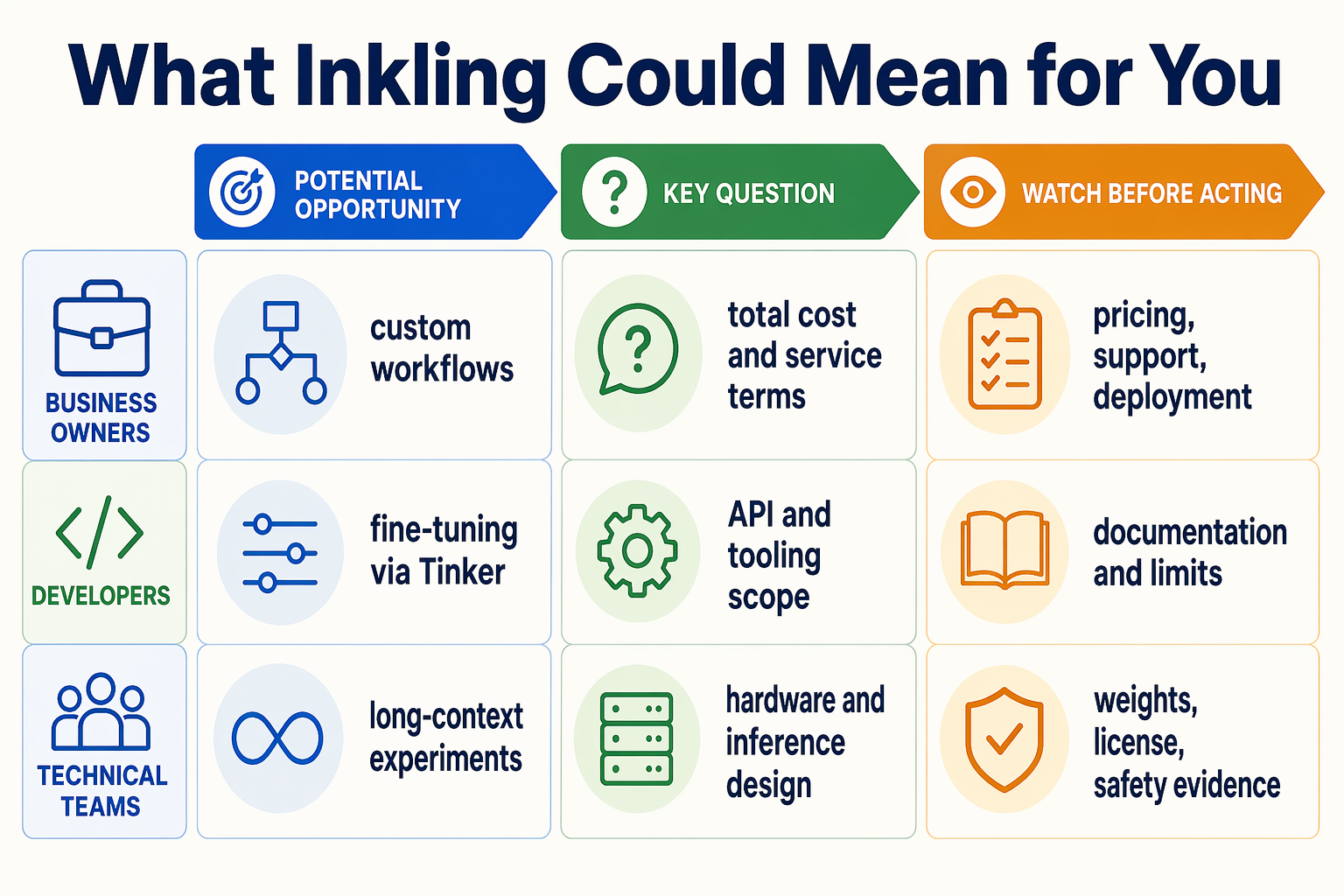
Thinking Machines Lab Inkling could give technical teams a new route to customized multimodal AI, but its practical value will depend on licensing, access terms, infrastructure requirements, and independent testing. For business owners, the announcement is more a signal of future deployment flexibility than an immediate replacement for managed AI APIs.
Potential impact by audience
| Audience | Potential opportunity | Key uncertainty | Sensible next step |
|---|---|---|---|
| Business owners | Explore domain-specific assistants, document workflows, and multimodal customer support | Total operating cost, service availability, licensing, and integration effort remain unclear | Wait for commercial terms; define a narrow pilot use case and success metrics |
| Application developers | Fine-tune responses, formats, or behaviors for specialized products through Tinker | Fine-tuning access is not automatically the same as downloadable weights or unrestricted deployment | Review Tinker eligibility, supported workflows, quotas, and output rights |
| ML engineers | Evaluate a 975B-parameter Mixture-of-Experts model with 41B active parameters for specialized workloads | Hardware needs, inference latency, quantization options, and reproducibility have not been fully established | Build a cost-and-latency test plan using representative prompts and modalities |
| Platform teams | Consider greater control over model behavior and deployment architecture if the license permits | Hosting, security, observability, upgrades, and model-serving complexity could be substantial | Compare managed access with self-managed infrastructure only after terms are published |
| Researchers | Study controllable reasoning effort, multimodal processing, and open-weight adaptation | Independent benchmarks and broader evaluations are not yet available in the announcement context | Inspect the model card, license, evaluation materials, and reproducibility documentation |
The Inkling open-weights model was announced by Thinking Machines Lab on July 15, 2026, and the official materials describe it as a multimodal Mixture-of-Experts transformer. The Inkling model card lists 975 billion total parameters, 41 billion active parameters, and a context window of up to 1 million tokens. Those figures describe architecture and capacity; they do not establish production cost, response speed, or performance leadership.
What teams should verify before committing
The most important distinction is between what Inkling demonstrates technically and what organizations can deploy commercially. Thinking Machines Lab says Inkling is available for fine-tuning through Tinker, which creates a potential path for adapting the model to company-specific data or behavior. However, fine-tuning access does not by itself confirm permission to download weights, self-host the model, redistribute derivatives, or use it without additional restrictions.
Teams should verify:
- License scope: commercial use, redistribution, derivative models, and geographic restrictions.
- Access model: Tinker availability, API or hosted inference options, quotas, and pricing.
- Infrastructure: GPU memory, serving framework support, throughput, and quantization.
- Evaluation: accuracy, safety, hallucination rates, and long-context reliability on real workloads.
- Operational ownership: monitoring, upgrades, data governance, and incident response.
The 1-million-token context window may help teams analyze large documents or extended multimodal workflows, but a larger context does not guarantee that every relevant detail will be retrieved accurately or economically. Businesses comparing Inkling with managed providers should therefore evaluate total cost of ownership rather than parameter count alone.
For perspective, infrastructure platforms such as CallMissed take a different route: the CallMissed OpenAI-compatible gateway gives developers access to multiple AI capabilities through one integration, while its India-focused platform supports AI voice and chat across 22 Indian languages. Inkling represents the customization-and-control direction; managed gateways represent the abstraction-and-speed direction. Both approaches may coexist as organizations match deployment choices to their technical capacity and risk profile.
What Do the Official Claims and Available Evidence Tell Us So Far?
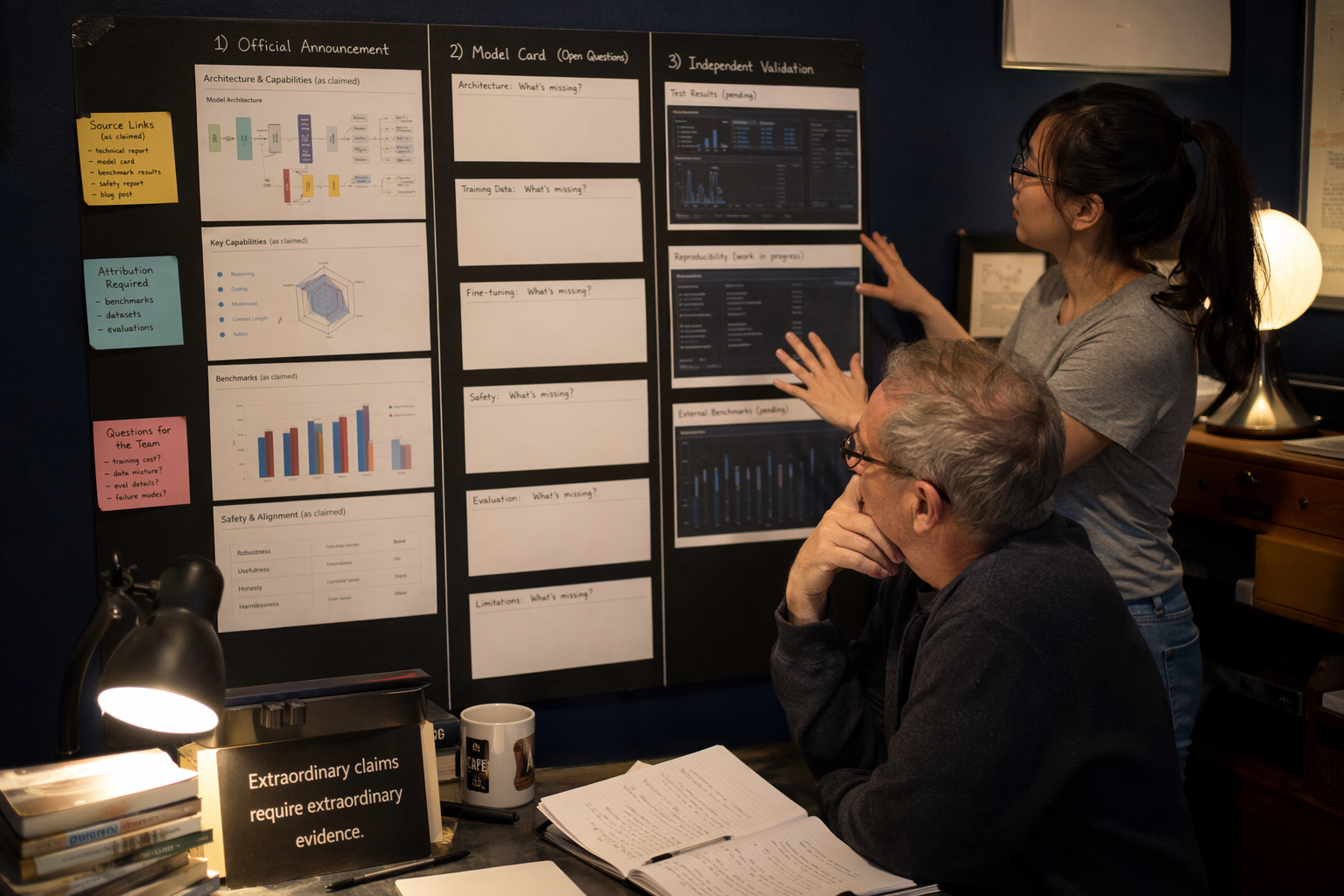
The available evidence supports a substantial release, but it does not yet establish Inkling as a fully characterized production offering. On July 15, 2026, Thinking Machines Lab announced Thinking Machines Lab Inkling as its first open-weights AI model. The company’s announcement and model card confirm its multimodal Mixture-of-Experts architecture, controllable reasoning effort, and fine-tuning availability through Tinker.
Confirmed facts from Thinking Machines Lab
The strongest primary sources currently available are Thinking Machines Lab’s announcement and the Inkling model card, both dated July 15, 2026. They report the following:
| Confirmed detail | What the official materials state |
|---|---|
| First open-weights model | Inkling is Thinking Machines Lab’s first release presented as an open-weights model |
| Multimodal Mixture-of-Experts transformer | The model uses a multimodal MoE architecture that routes computation through selected experts |
| 975B total and 41B active parameters | The model card reports 975 billion total parameters and 41 billion active parameters |
| Up to 1M-token context | The model card reports a supported context window of up to 1 million tokens |
| Controllable reasoning effort | The announcement describes controls for adjusting the model’s reasoning effort |
| Fine-tuning through Tinker | Thinking Machines Lab identifies Tinker as the official path for fine-tuning Inkling |
These disclosures describe the model and its intended access path, but they do not by themselves establish how Inkling will perform in every workload. For example, controllable reasoning effort may allow users to trade off response quality, latency, and resource consumption, but the available announcement does not prove that maximum reasoning effort is best for every task.
Company-reported evaluation claims
Thinking Machines Lab reports that Inkling delivers competitive performance on selected coding and agentic tasks. That is a company-reported evaluation claim, not an independent conclusion that Inkling is state-of-the-art or superior across general benchmarks and real-world deployments.
For the coding evaluations, the company’s stated methodology includes effort 0.99, temperature 1.0, and a 256K maximum-token trajectory limit. These are details of the company’s evaluation setup and should be considered when interpreting its results. They do not automatically predict performance under different effort settings, temperatures, context limits, tools, prompts, or deployment conditions.
The available materials do not justify describing Inkling as state-of-the-art without a cited, independently verifiable comparison. They also do not establish that the company-reported results have been replicated by independent evaluators.
What remains independently unverified or undisclosed
“Open weights” describes access to trained model parameters; it does not automatically mean that the model is fully open source or that unrestricted commercial use, self-hosting, modification, or redistribution is permitted. Those rights depend on the license and release conditions.
As of July 15, 2026, the following practical questions remain unresolved or insufficiently documented in the available materials:
- Are the weights downloadable by the general public, or available only through selected channels?
- What hardware, memory, storage, and networking requirements apply to inference?
- Can organizations run Inkling independently, or must they use an approved service?
- Is hosted API access available, and who is eligible to use it?
- What pricing, rate limits, service-level terms, and geographic restrictions apply?
- Does the license permit commercial deployment, modification, and redistribution?
- How do Inkling’s reported results compare with other leading models under independently reproduced, like-for-like tests?
- What are its real-world latency, reliability, safety, and operating-cost characteristics?
The official materials support the claim that Inkling is available for fine-tuning through Tinker. That should not be treated as proof that downloadable weights, independent deployment, a general-purpose API, and hosted inference all have identical access terms.
This distinction will determine Inkling’s practical impact. A customizable model may be valuable for research and domain-specific applications, while managed gateways such as CallMissed’s OpenAI-compatible infrastructure offer a different approach: accessing multiple AI capabilities through one developer integration without operating model infrastructure directly. For Inkling, the next important evidence will be the license, deployment documentation, pricing, independently reproduced evaluations, and details about production support.
What Should Readers Watch Next After the Inkling Announcement?
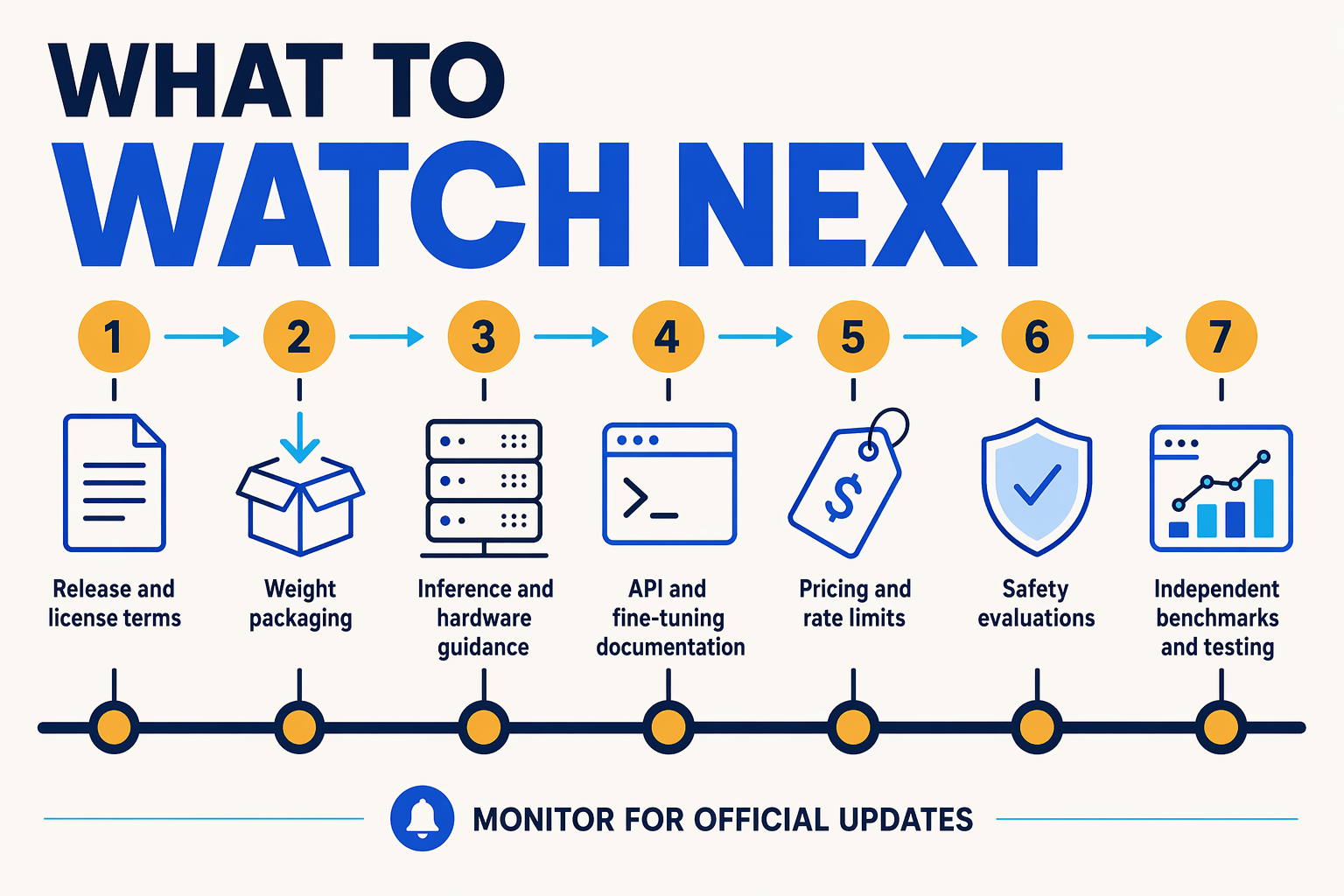
The next signals will determine whether Thinking Machines Lab Inkling becomes a broadly usable platform or mainly a research and fine-tuning release. Readers should verify access, licensing, infrastructure, independent evaluations, and deployment evidence—not parameter count alone.
1. Are the official weights, downloads, and repository available?
Status: Details may require checking the official model card or release documentation.
The official materials describe Inkling as an open-weights model and state that the release is intended to support “research, fine-tuning and integration into third-party products.” Readers should still verify:
- Whether the weights can be downloaded directly
- The official repository or model-hosting location
- Which model sizes, checkpoints, and files are available
- Whether access requires an application, account, or approval
- Whether code, tokenizer files, configuration files, and inference examples are included
- Whether self-hosting is explicitly supported
“Open weights” does not by itself confirm that every component is freely downloadable or that the model can be operated without a hosted service.
2. What are the exact license terms?
Status: The broad intended uses are described in official materials; exact legal terms may require checking the model card or release documentation.
Readers should locate the complete license and confirm its rules for:
- Commercial use and redistribution
- Downloading and self-hosting
- Distillation, derivative models, and model merging
- Fine-tuned model distribution
- Safety restrictions and acceptable-use requirements
- Attribution, notice, and reporting obligations
- Differences between model sizes, checkpoints, or access routes
Tinker fine-tuning access, hosted inference, API access, and downloadable weights should be treated as separate offerings until the official terms explain how they relate.
3. What inference hardware and infrastructure does Inkling require?
Status: Details may require checking the official model card or release documentation.
Thinking Machines Lab describes Inkling as a multimodal Mixture-of-Experts transformer with 975 billion total parameters and 41 billion active parameters. Those figures describe the architecture, but they do not establish the hardware needed for practical inference.
The release documentation should clarify:
- Supported accelerators and minimum memory requirements
- Whether quantized, sharded, or optimized checkpoints are available
- Recommended hardware for different batch sizes and context lengths
- Networking and storage requirements
- Expected throughput, latency, and serving configuration
- Whether the full up to 1 million-token context window requires additional infrastructure
A large context window and sparse activation may affect deployment economics, but neither guarantees low-cost or low-latency inference.
4. Is hosted or API access available, and what does it cost?
Status: Details may require checking the official model card or release documentation.
Readers should verify whether Thinking Machines Lab offers hosted inference, an API, or another managed access route. If so, the important details include:
- Pricing by input and output tokens, requests, time, or compute
- Rate limits and service-level commitments
- Supported modalities and context lengths
- Data-retention and privacy policies
- Availability of controllable reasoning settings
- Whether hosted access has different terms from self-hosted weights
No assumption should be made about Inkling’s pricing or API availability until those details are published by an official source.
5. Can independent evaluations reproduce the reported performance?
Status: Independent replication details may require checking the model card, release documentation, and later third-party evaluations.
The next useful evidence should cover:
- Reasoning and coding
- Multimodal understanding
- Long-context retrieval at multiple context lengths
- Tool use and structured output
- Indian and other multilingual workloads
- Hallucination, refusal, and safety behavior
- Latency, throughput, and cost under realistic serving conditions
Benchmark results should identify the exact checkpoint, prompting method, tools, inference settings, and comparison models. The stated context window of up to 1 million tokens should also be tested at increasing prompt lengths rather than treated as proof that every item will be retrieved accurately.
6. What safety and evaluation documentation will be published?
Status: Details may require checking the official model card or release documentation.
Readers should look for a model card, risk assessment, evaluation methodology, known limitations, and deployment guidance covering:
- Dangerous or abusive requests
- Privacy and memorization risks
- Bias and multilingual performance
- Prompt injection and tool-use risks
- Refusal consistency and over-refusal
- Monitoring, red-teaming, and incident-response guidance
The existence of an open-weights release does not by itself establish how the model was evaluated or what safeguards are recommended for production use.
7. Does Inkling support fine-tuning and deployment beyond Tinker?
Status: Details may require checking the model card or release documentation.
Official materials indicate that the release is intended to support fine-tuning and integration into third-party products. Readers should confirm whether that support extends beyond Tinker and includes:
- Documented fine-tuning methods and example recipes
- Supported training frameworks and hardware
- LoRA, adapter, or full-parameter training options
- Exporting and serving fine-tuned checkpoints
- Compatibility with established inference servers
- Tool calling, structured output, and multimodal deployment interfaces
- Permission to distribute or commercially deploy derivative models
Real integrations will be easier to assess when developers publish reproducible recipes, evaluation harnesses, deployment costs, and production case studies. Compatibility with gateways or infrastructure providers may simplify access, but Inkling’s own compatibility, pricing, and deployment options still require confirmation from official documentation at Thinking Machines Lab.
Information checked July 15, 2026. Details marked as requiring a check should be confirmed against the official model card, repository, license, and release documentation before deployment.
What Are the Most Common Questions About Thinking Machines Lab Inkling?
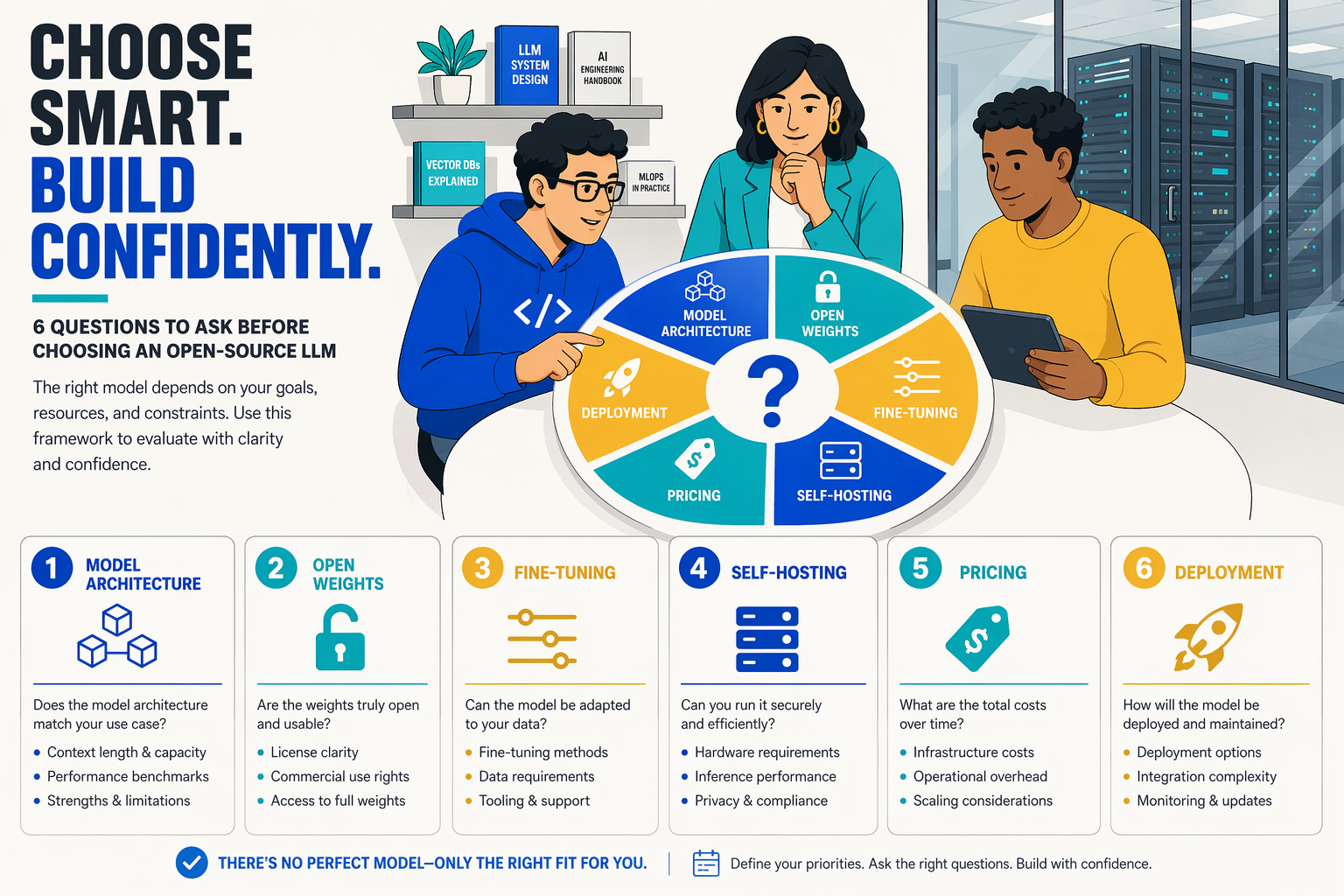
Inkling FAQ
What is Thinking Machines Lab Inkling?
How large is the Inkling open-weights model?
What does “open weights” mean for Thinking Machines Lab Inkling?
Can developers fine-tune the Inkling open-weights model?
What does Inkling’s 1-million-token context window mean?
Why does the Thinking Machines Lab new model matter to businesses and developers?
Conclusion
Thinking Machines Lab Inkling is a significant open-weights release, but its practical impact will depend on licensing, access, infrastructure requirements, and independent evaluation—not parameter count alone. Announced on July 15, 2026, the Inkling open-weights model is presented as a multimodal Mixture-of-Experts transformer with 975 billion total parameters, 41 billion active parameters, a context window of up to 1 million tokens, controllable reasoning effort, and fine-tuning through Tinker, according to Thinking Machines Lab’s official announcement and Inkling model card.
The key takeaways are:
- Open weights expand customization possibilities, but they do not automatically mean open source, unrestricted self-hosting, free deployment, or identical terms for weights, APIs, and hosted inference.
- A 1M-token context window describes capacity, not guaranteed low latency, low cost, or reliable performance across every long-context workload.
- Controllable reasoning and fine-tuning could support specialized applications, provided developers can access the necessary tools, documentation, compute, and permissions.
- Businesses should evaluate operational trade-offs carefully, comparing customization and control with the convenience of managed closed-model APIs.
Next, watch for clearer licensing and deployment terms, pricing, access scope, independent benchmarks, and real-world fine-tuning results. To explore how AI communication is evolving, check out CallMissed, an AI infrastructure platform powering voice agents and multilingual chatbots for businesses. Will Inkling make advanced customization practical—or mainly broaden the research frontier?
Related Reading
Related Posts



Ready to automate customer conversations?
Launch AI voice agents and WhatsApp bots with CallMissed — one API, 22+ Indian languages.