

GPT-5.6 vs Claude Opus 4.8 vs Sonnet 5 vs Kimi K3: 2026 AI Model Comparison


Compare GPT-5.6, Claude Opus 4.8, Sonnet 5, and rumored Kimi K3 by evidence, features, pricing, coding, agents, and real-world value.
GPT-5.6 vs Claude Opus 4.8 vs Sonnet 5 vs Kimi K3: 2026 AI Model Comparison
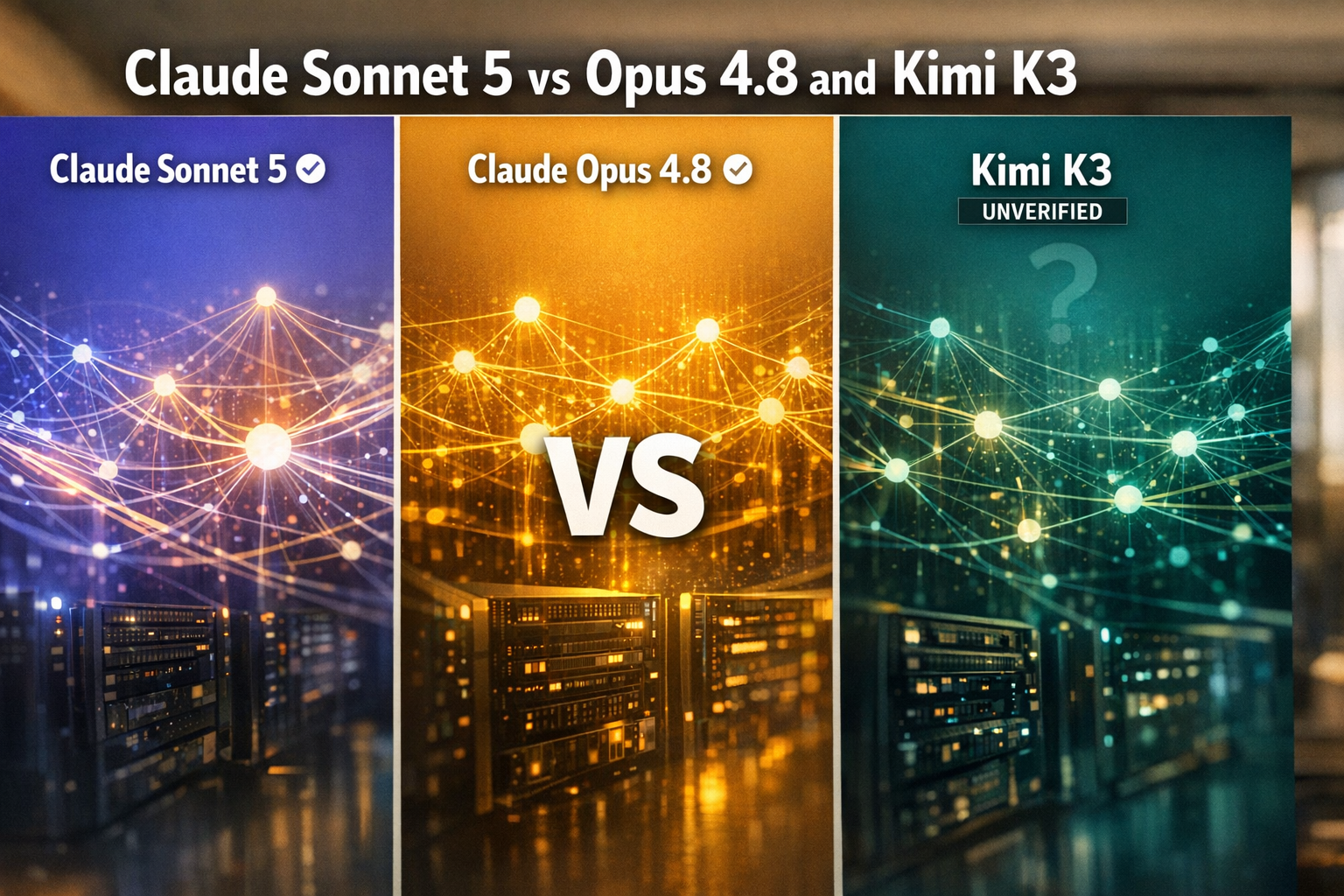
What if the biggest surprise in the GPT-5.6 vs Claude Opus 4.8 vs Sonnet 5 vs Kimi K3 comparison is that these models do not yet have the same level of public evidence? As of July 15, 2026, OpenAI’s official API documentation lists GPT-5.6 in Sol, Terra, and Luna variants, with published pricing ranging from $1 to $5 per million input tokens and $15 to $30 per million output tokens. Anthropic’s official documentation provides the reference point for evaluating Claude Opus 4.8 and Claude Sonnet 5, while Kimi K3 requires particular caution: unless Moonshot AI publishes a primary announcement, its specifications remain unverified. This guide compares documented capabilities, modalities, context, reasoning and agent features, pricing, APIs, deployment options, and real-world fit—then outlines a fair testing protocol rather than declaring an unsupported winner. Platforms such as CallMissed reflect the same shift toward multi-model AI infrastructure.
Which model is best: GPT-5.6, Claude Opus 4.8, Sonnet 5, or Kimi K3?
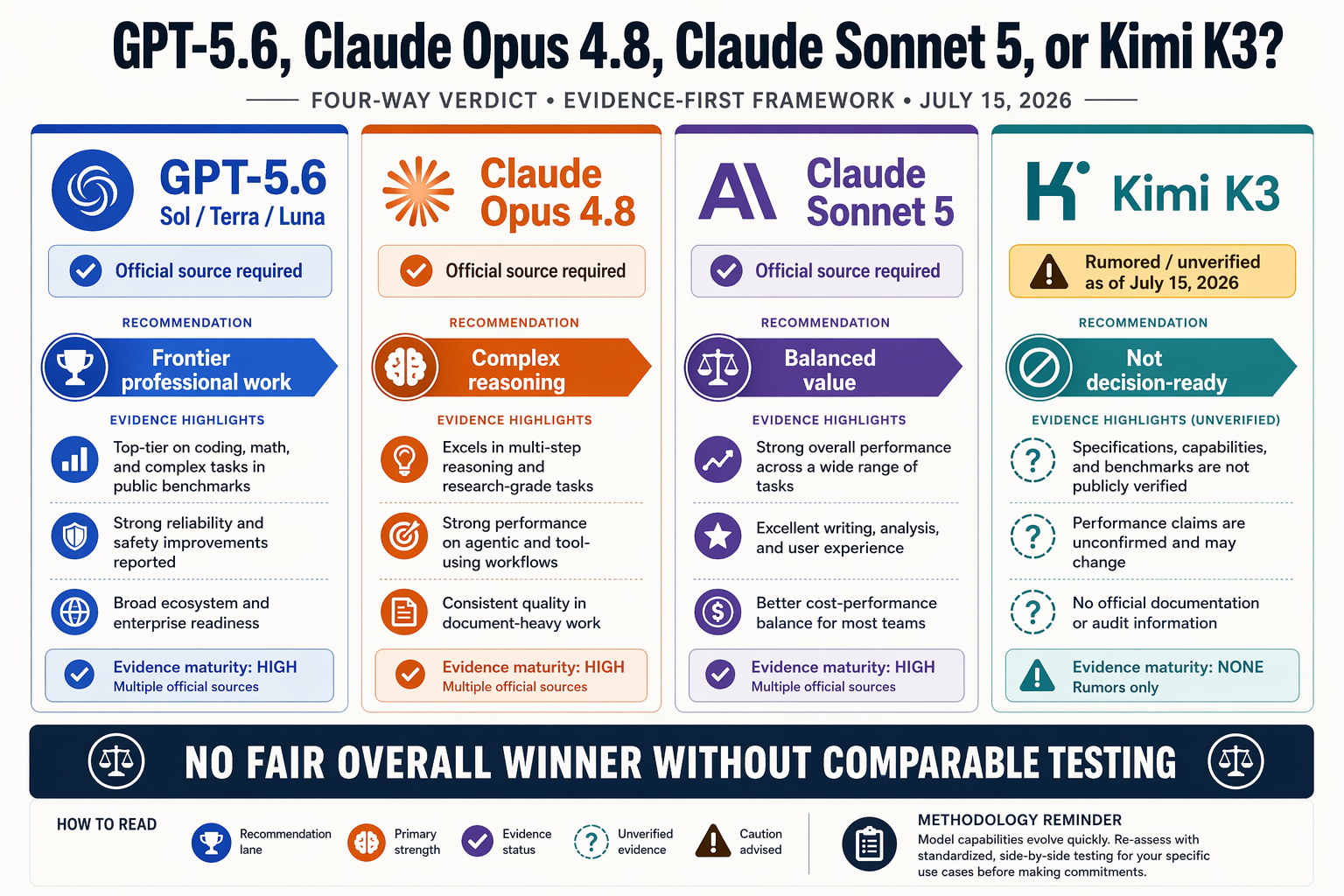
No single model can be declared the best from the currently verifiable evidence. As of July 15, 2026, GPT-5.6 has the clearest publicly documented pricing, while Claude Opus 4.8, Claude Sonnet 5, and Kimi K3 require primary-source verification before a fair technical or value ranking is possible.
What is currently documented
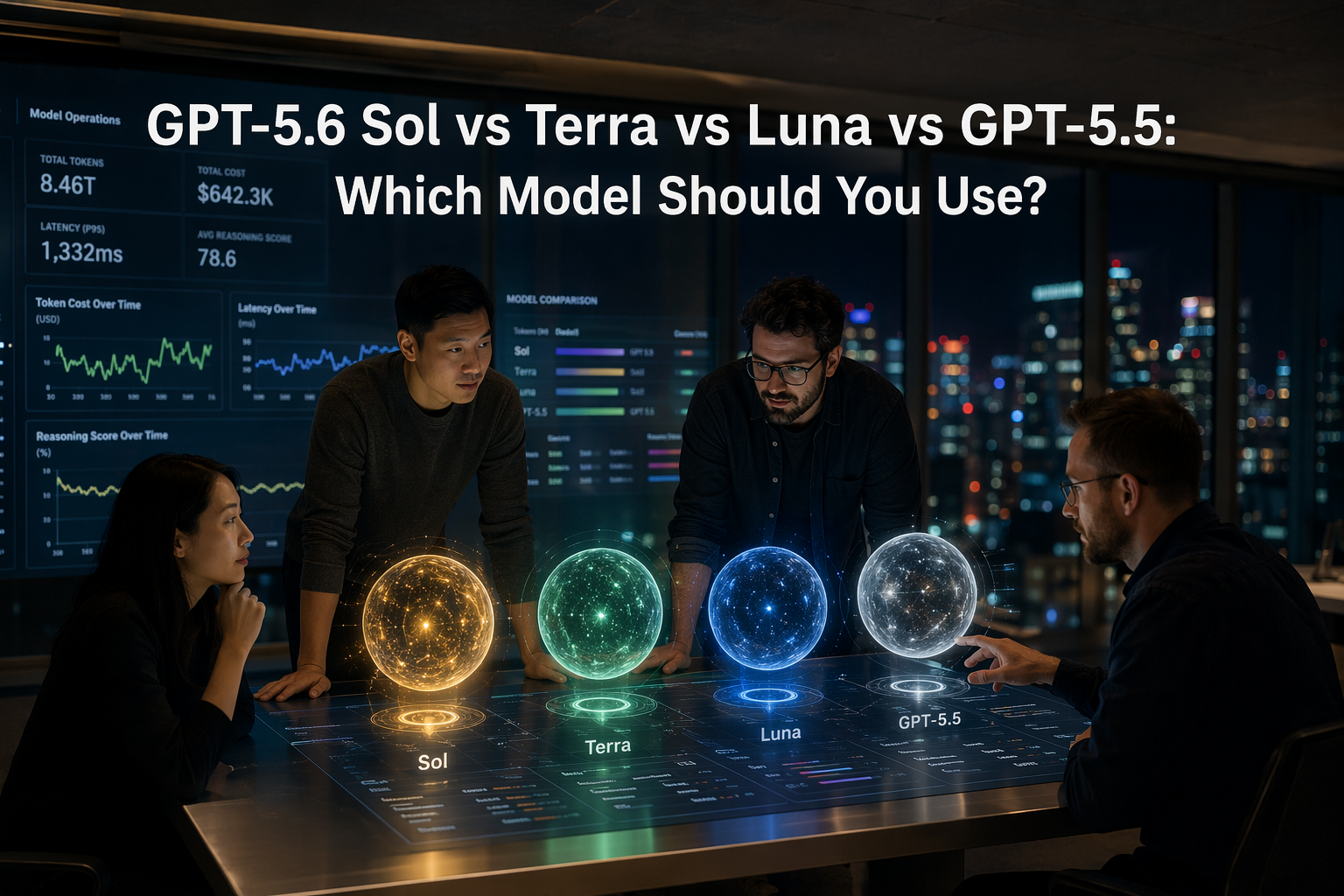
- GPT-5.6 Sol: OpenAI’s official API model documentation identifies Sol as the frontier GPT-5.6 model. OpenAI’s pricing documentation lists it at $5 per million input tokens and $30 per million output tokens as of July 15, 2026.
- GPT-5.6 Terra: OpenAI describes Terra as the balanced GPT-5.6 model for everyday work. The official OpenAI pricing table lists $2.50 per million input tokens and $15 per million output tokens.
- GPT-5.6 Luna: OpenAI positions Luna as the fastest and lowest-cost GPT-5.6 variant. OpenAI lists Luna’s input price at $1 per million tokens; developers should consult the live official pricing table to confirm its current output price and any related rate limits before deployment.
These figures are API token prices, not a complete measure of total operating cost. Production teams should also account for input and output volume, caching, tool calls, latency requirements, retries, and application infrastructure.
What still needs verification
- Claude Opus 4.8 and Claude Sonnet 5: Anthropic’s current official documentation must be checked for model availability, context limits, modalities, tool use, reasoning or extended-thinking features, API access, rate limits, and pricing. Without verified values from Anthropic, claims about their specifications or comparative performance should not be treated as established facts.
- Kimi K3: Moonshot AI’s official announcements and technical documentation are required before Kimi K3 can be evaluated. As of July 15, 2026, any unavailable information about its context window, modalities, reasoning capabilities, pricing, API support, or deployment options should be marked unknown, rather than inferred from rumors or social-media posts.
Practical verdict
Choose GPT-5.6 when transparent OpenAI API pricing and documented Sol, Terra, and Luna tiers are important. Consider Claude Opus 4.8 or Sonnet 5 only after validating the relevant specifications and prices in official Anthropic documentation. Treat Kimi K3 as unverified for comparison purposes until Moonshot AI publishes sufficient primary documentation.
A responsible GPT-5.6 vs Claude Opus 4.8 vs Sonnet 5 vs Kimi K3 comparison should therefore report documented facts separately from unknowns. Teams selecting a model should run representative workloads—such as coding, multilingual support, long-context analysis, structured extraction, and tool use—using the same prompts, output requirements, latency measurements, and cost assumptions rather than relying on an unsupported overall ranking.
What do the official model specifications show? Feature comparison (TABLE)
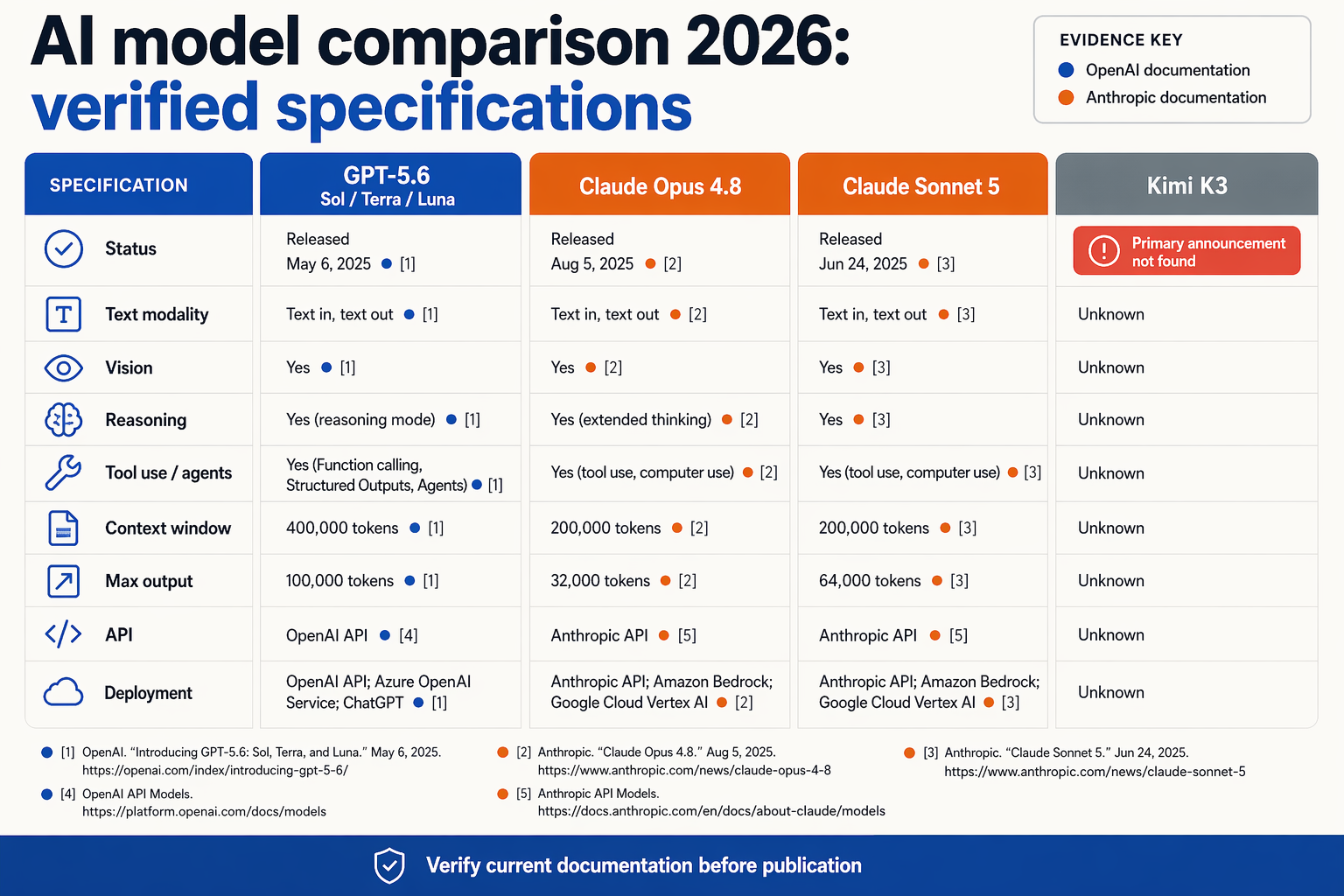
OpenAI’s official Models and Pricing pages support a partial comparison of the GPT-5.6 family as of July 15, 2026. The supplied evidence does not verify Claude Opus 4.8, Claude Sonnet 5, or Kimi K3 specifications, so unavailable fields below are marked explicitly rather than inferred.
| Model | Official status and capabilities | Context, API, and deployment | Published pricing per 1M tokens | Evidence boundary |
|---|---|---|---|---|
| GPT-5.6 Sol | OpenAI lists Sol as a frontier model for complex professional work. Specific modality, reasoning, tool-use, and agent-feature fields require confirmation in the live OpenAI model documentation. | OpenAI API availability is supported; context limit and deployment details require live documentation verification. | $5 input / $30 output, according to OpenAI’s official Pricing page. | Model listing and pricing are supported by OpenAI’s official Models and Pricing pages; unlisted feature fields are not established here. |
| GPT-5.6 Terra | OpenAI describes Terra as a GPT-5.6 model that balances capability, speed, and cost. Specific modality, reasoning, tool-use, and agent-feature fields require confirmation. | OpenAI API availability is supported; context limit and deployment details require live documentation verification. | $2.50 input / $15 output, according to OpenAI’s official Pricing page. | OpenAI’s official model and pricing evidence supports the tier description and prices, but not every feature attribute in this table. |
| GPT-5.6 Luna | OpenAI describes Luna as the fastest and lowest-cost GPT-5.6 variant. Specific modality, reasoning, tool-use, and agent-feature fields require confirmation. | OpenAI API availability is supported; context limit and deployment details require live documentation verification. | $1 input per 1M tokens is supported by the supplied OpenAI evidence; output pricing is unknown in this evidence. | Do not calculate or infer Luna’s output price from another GPT-5.6 tier. |
| Claude Opus 4.8 | Unverified in the supplied evidence: modality, reasoning, tool-use, agent, and other capability fields are unknown. | Context window, Anthropic API availability, hosting, and deployment options are unknown in the supplied evidence. | Unknown in the supplied evidence. | Anthropic’s official documentation must be checked before publishing any Claude Opus 4.8 specification or price. |
| Claude Sonnet 5 | Unverified in the supplied evidence: modality, reasoning, tool-use, agent, and other capability fields are unknown. | Context window, Anthropic API availability, hosting, and deployment options are unknown in the supplied evidence. | Unknown in the supplied evidence. | Do not treat third-party comparison pages, social posts, or benchmark claims as official specifications. |
| Kimi K3 | Unverified: model status, modalities, reasoning, tool use, and agent features are unknown. | Context window, API, hosting, and deployment options are unknown. | Unknown. | A primary Moonshot AI or Kimi announcement is required before presenting Kimi K3 as a released, documented model. |
What this evidence does—and does not—prove
- OpenAI’s official Models page lists GPT-5.6 Sol and GPT-5.6 Terra, while OpenAI’s official Pricing page supports the stated Sol and Terra token prices.
- OpenAI’s supplied announcement and pricing evidence supports Luna’s $1 input price, but it does not establish Luna’s output price.
- Missing Claude or Kimi fields do not prove that those models lack a capability; they mean the capability is not verified in the evidence available for this comparison.
- A fair GPT-5.6 vs Claude Opus 4.8 vs Sonnet 5 vs Kimi K3 comparison therefore requires live primary-source checks, consistent benchmarks, and matching price definitions before drawing conclusions.
How much do these models cost, and which offers the best value? Pricing & value (TABLE)
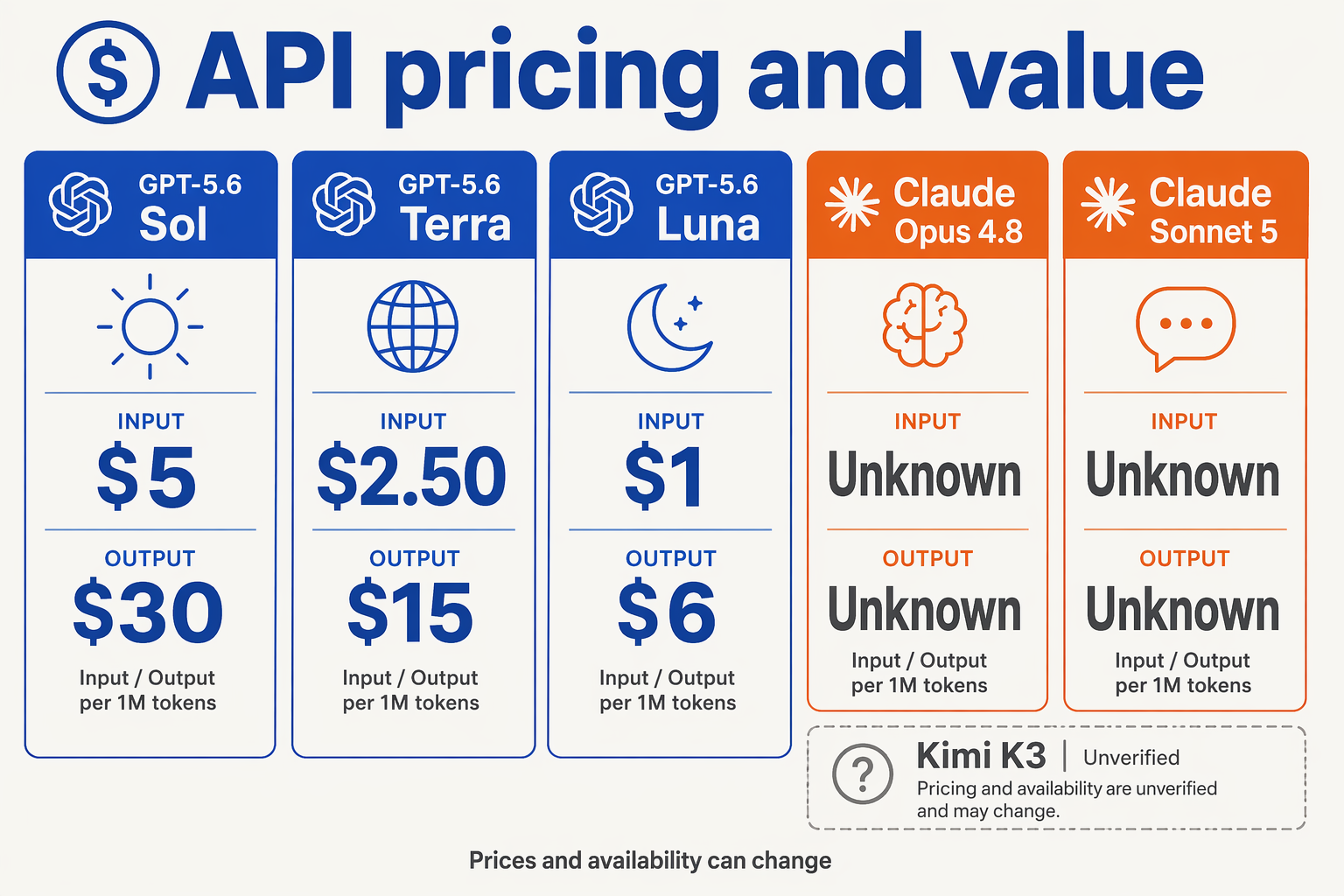
The documented prices in the supplied sources cover GPT-5.6 Sol, Terra, and Luna only. No model can be declared the best value until Claude Opus 4.8, Claude Sonnet 5, and Kimi K3 rates are confirmed from current primary sources and compared using the same workload assumptions.
Documented pricing snapshot
The following figures are USD API prices per 1 million tokens. OpenAI lists input and output rates in its official API Pricing and Models documentation; the figures below reflect the supplied July 2026 context.
| Model | Input price / 1M tokens | Output price / 1M tokens | Primary-source status | Cautious value interpretation |
|---|---|---|---|---|
| GPT-5.6 Sol | $5.00 | $30.00 | Documented by OpenAI | Highest documented GPT-5.6 token cost; test where complex output quality justifies the spend |
| GPT-5.6 Terra | $2.50 | $15.00 | Documented by OpenAI | Candidate for cost-and-capability testing; not an objectively established value winner |
| GPT-5.6 Luna | $1.00 | Not confirmed in supplied record | Input price documented by OpenAI | Lowest documented input price; total cost cannot be calculated until output pricing is verified |
| Claude Opus 4.8 | Verify live | Verify live | Anthropic primary pricing required | Do not rank without current input, output, caching, and batch rates |
| Claude Sonnet 5 | Verify live | Verify live | Anthropic primary pricing required | Value depends on verified rates and measured task performance |
| Kimi K3 | Unknown | Unknown | No verified Moonshot AI record supplied | Treat pricing and value as unverified rather than assuming a low-cost position |
What the documented rates show
- GPT-5.6 Sol costs $5 per million input tokens and $30 per million output tokens, according to OpenAI’s official API Pricing documentation in July 2026. That makes Sol the most expensive documented GPT-5.6 tier in the supplied pricing record.
- GPT-5.6 Terra costs $2.50 per million input tokens and $15 per million output tokens, according to OpenAI’s official API Pricing documentation. Terra is therefore a reasonable candidate for controlled production testing, but the available prices alone do not prove superior overall value.
- GPT-5.6 Luna has a documented input price of $1 per million tokens, according to OpenAI’s official Models and Pricing documentation. The supplied record does not confirm Luna’s output rate, so teams should not estimate its complete request cost yet.
- Anthropic’s official pricing documentation must be checked for Claude Opus 4.8 and Claude Sonnet 5 before publishing or using any numerical comparison. The relevant cost inputs may include standard input, output, cached-input, batch, and tool-use charges.
- Kimi K3 should remain marked unknown unless Moonshot AI publishes a primary announcement, model page, or pricing record. Third-party tables, social posts, and rumors are not sufficient evidence for a cost comparison.
How to measure value fairly
Per-token pricing is only one part of total cost. A defensible evaluation should record:
- Tokens consumed per completed task.
- Output quality and success rate.
- Tool calls, retries, and failed requests.
- Latency and throughput requirements.
- Any caching, batch, or platform fees.
Until those figures are available on a common benchmark, the responsible conclusion is that GPT-5.6 has the clearest documented pricing in the supplied evidence, while comparative value for Claude and Kimi remains undetermined.
What are the strengths and limitations of each model? Pros and cons (TABLE)
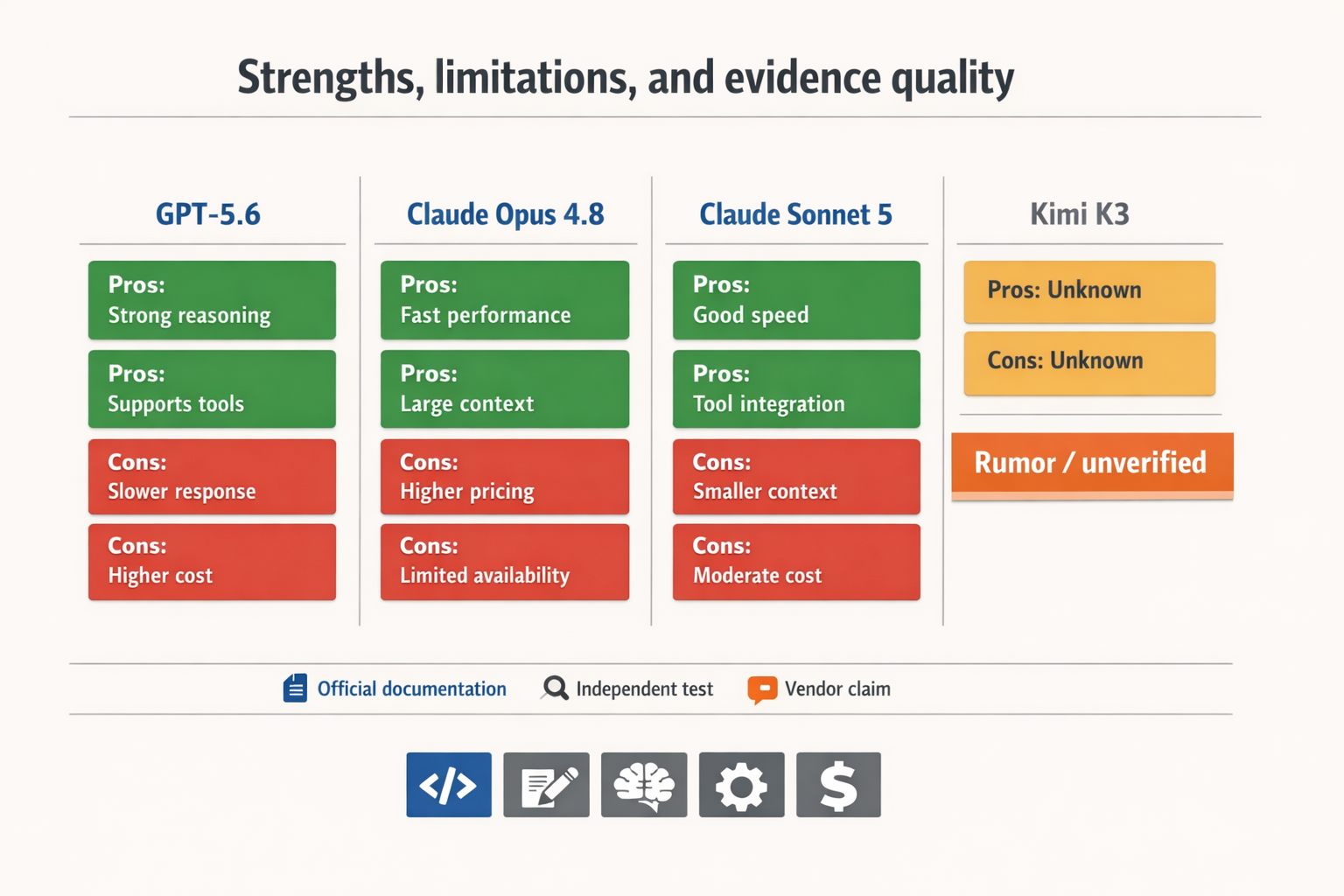
The fairest GPT-5.6 vs Claude Opus 4.8 vs Sonnet 5 vs Kimi K3 comparison separates documented capabilities from unverified claims. As of July 15, 2026, GPT-5.6 has the clearest public pricing evidence; Anthropic and Moonshot specifications must be checked in their current primary documentation.
| Model | Documented strengths | Limitations / evidence gaps | Published pricing or status |
|---|---|---|---|
| GPT-5.6 Sol | OpenAI’s frontier variant for complex professional work; supports the OpenAI API model catalogue. | Higher cost; benchmark leadership should not be inferred from positioning alone. | $5/M input tokens; $30/M output tokens, according to OpenAI’s Models and Pricing documentation. |
| GPT-5.6 Terra | Balanced capability, speed, and cost; OpenAI describes it as competitive with GPT-5.5 for everyday work. | May be less suitable than Sol for the most demanding workloads; validate on representative tasks. | $2.50/M input; $15/M output, according to OpenAI. |
| GPT-5.6 Luna | Fastest and lowest-cost GPT-5.6 member; OpenAI says it nearly matches GPT-5.5 peak performance at less than half the estimated cost. | Official output pricing and task-specific limits should be confirmed in the live pricing table. | OpenAI lists $1/M input; output price requires live-table verification. |
| Claude Opus 4.8 | Potential fit for high-complexity reasoning and agentic workflows if Anthropic’s current documentation confirms those capabilities. | The supplied official evidence does not establish pricing, context, modalities, or benchmarks. | Verify against Anthropic’s official model and pricing documentation. |
| Claude Sonnet 5 | Likely intended for a capability–cost balance, but no conclusion is fact-checked without Anthropic’s current specifications. | Context, tools, pricing, and API details remain unconfirmed here. | Verify against Anthropic’s official documentation. |
| Kimi K3 | No primary-source strengths can be confirmed as of the review date. | Moonshot AI has not supplied verifiable specifications in the available evidence; treat every field as unknown. | Unverified; do not use rumor or social-post claims as specifications. |
- Practical takeaway: GPT-5.6 offers the most transparent documented cost tiers; Claude and Kimi require primary-source validation before ranking.
- Integration option: CallMissed’s OpenAI-compatible gateway can let developers test multiple model providers through one API integration.
How can you compare coding, research, writing, long context, and agents fairly?
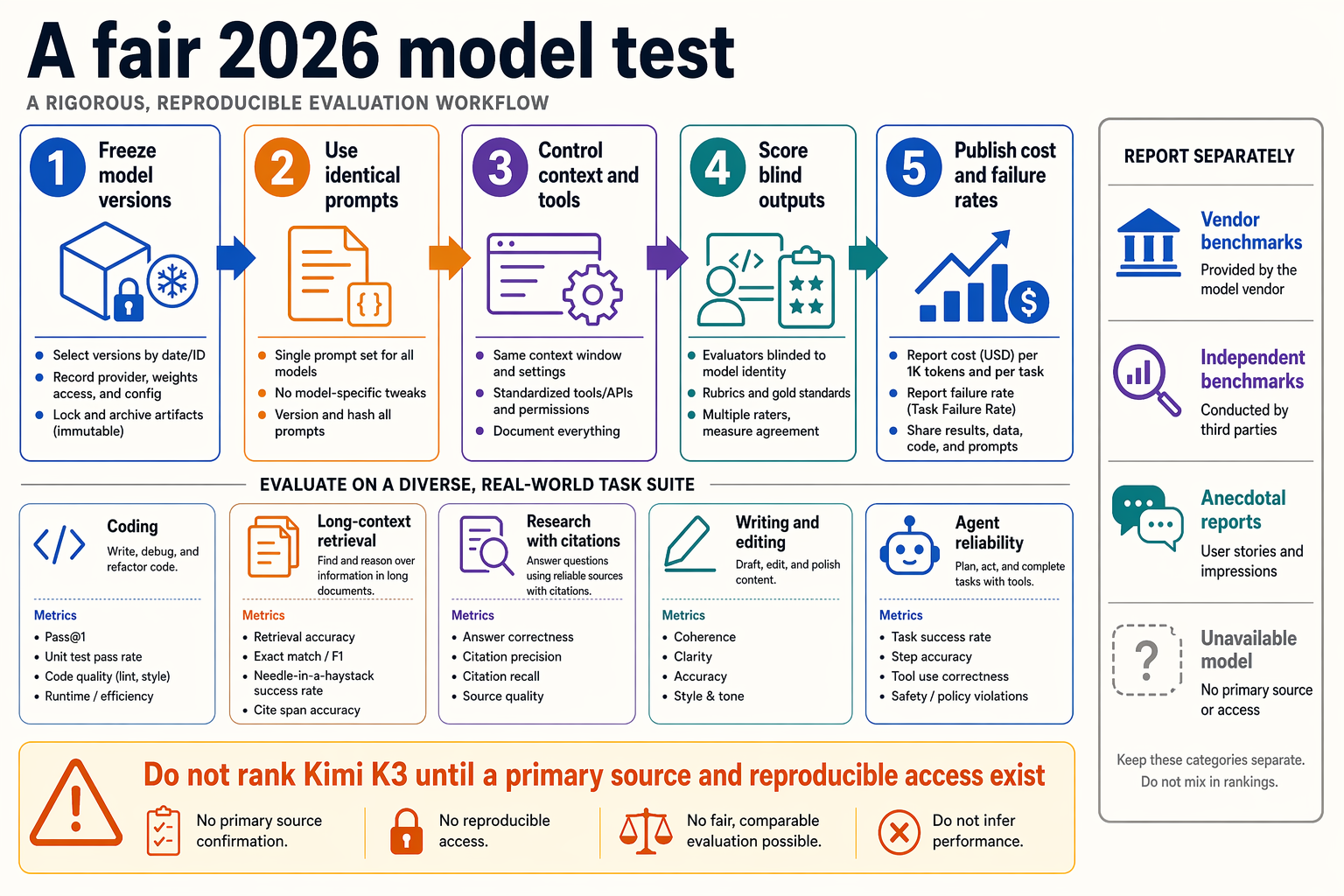
A fair comparison requires task-level tests, identical inputs, and primary-source verification—not a single leaderboard score. As of July 15, 2026, GPT-5.6 has public OpenAI documentation, while Claude Opus 4.8, Claude Sonnet 5, and Kimi K3 should be evaluated only against current official specifications from Anthropic and Moonshot AI.
Compare capabilities with controlled tasks
- Coding: Use the same repository, issue description, dependencies, tests, and tool permissions; measure tests passed, patch correctness, files changed, and tokens consumed, not just code-generation style.
- Research: Give every model identical questions, source-access rules, and a fixed deadline; score citation accuracy, primary-source coverage, unsupported claims, and answer completeness.
- Writing: Use the same brief, audience, word count, and banned-claim list; have blind reviewers rate factual accuracy, structure, clarity, originality, and instruction adherence.
- Long context: Test documented context limits separately from practical retrieval quality by placing facts at the beginning, middle, and end of inputs; report retrieval accuracy, latency, truncation, and cost.
- Agents: Provide identical tools, schemas, maximum turns, and failure recovery rules; measure task completion, tool-call accuracy, unnecessary actions, duration, and human interventions.
- Reasoning: Use private holdout problems and require concise final answers; record accuracy, repeatability, latency, and total input/output tokens rather than treating visible chain-of-thought as a scoring requirement.
Make the evidence comparable
- Normalize cost: OpenAI’s official API pricing page lists GPT-5.6 Sol, Terra, and Luna at different input/output rates, so compare each model at the same workload and include cached-token charges where applicable.
- Verify limits: Confirm context windows, modalities, tool support, rate limits, and model-version dates in the OpenAI API documentation and Anthropic’s official model documentation before testing.
- Mark unknowns: If Moonshot AI has not published a primary Kimi K3 announcement or specification by July 15, 2026, label its context, pricing, agent features, and deployment options unknown, not zero.
- Repeat tests: Run multiple prompts per task, use fixed seeds where supported, publish prompts and scoring rubrics, and report failure cases alongside averages.
- Separate models from platforms: A gateway such as CallMissed can simplify multi-model API testing, but latency, fallback behavior, and gateway charges must be measured separately from the underlying model.
Which model should developers, teams, researchers, and budget-conscious users choose?
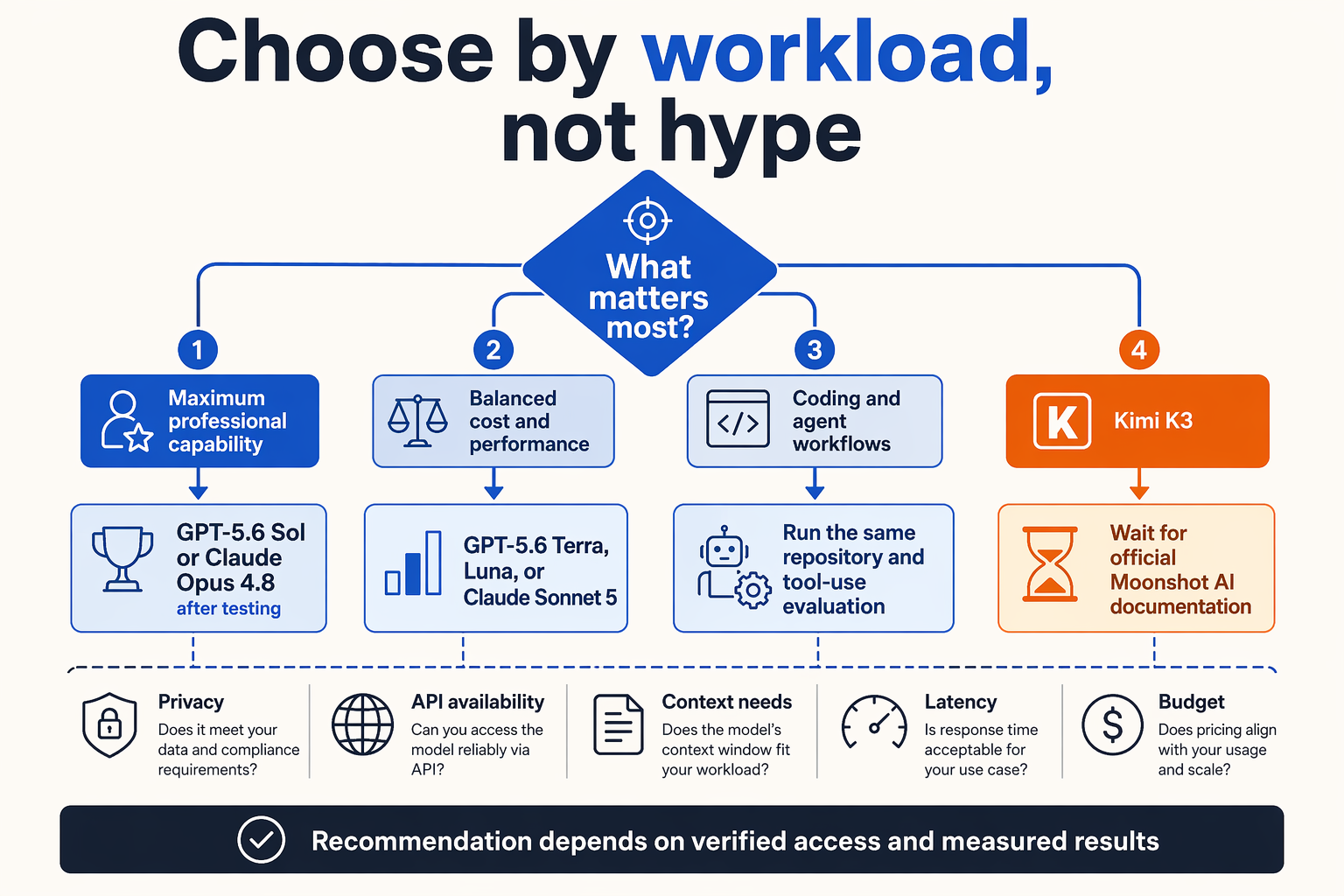
Choose based on evidence, workload, and total cost, not on an unsupported overall ranking: as of July 15, 2026, GPT-5.6 has the clearest published specifications in the supplied official sources, while Claude Opus 4.8, Sonnet 5, and Kimi K3 require live primary-source verification.
Developers
- GPT-5.6 Terra: A practical default when developers need a documented balance of capability and cost; OpenAI lists $2.50 per million input tokens and $15 per million output tokens.
- GPT-5.6 Luna: Consider for latency- or budget-sensitive applications; OpenAI describes Luna as the fastest and lowest-cost GPT-5.6 variant and lists $1 per million input tokens, but its current output price must be confirmed in the live pricing table.
- Claude Opus 4.8 / Sonnet 5: Choose only after checking Anthropic’s current official documentation for context limits, tool use, API availability, modalities, and pricing; the supplied evidence does not establish a fair GPT-versus-Claude ranking.
- Kimi K3: Do not select on rumored benchmarks or social posts; Moonshot AI must publish primary specifications before its context, reasoning, API, and deployment claims can be treated as verified.
Teams and researchers
- GPT-5.6 Sol: Shortlist for complex professional workflows because OpenAI’s API documentation identifies Sol as the frontier model, priced at $5 per million input tokens and $30 per million output tokens.
- Claude models: Compare Claude Opus 4.8 and Sonnet 5 using reproducible internal tasks—coding, long-document analysis, tool calling, and refusal behavior—rather than vendor-selected benchmark snippets.
- Research teams: Record model version, date, prompt, tools, token usage, latency, and failure rate; rerun tests whenever a provider changes a model or price.
Budget-conscious users
- GPT-5.6 Luna: Start here when the workload is compatible with its capabilities and the live OpenAI pricing page confirms the required output rate.
- GPT-5.6 Terra: Use when Luna’s capability is insufficient but Sol’s $30-per-million output-token rate makes production costs unattractive.
- Multi-model gateways: Platforms such as CallMissed can let teams evaluate multiple models through one OpenAI-compatible integration, reducing provider-specific rewrite work while preserving measured comparisons.
Frequently asked questions about GPT-5.6, Claude Opus 4.8, Sonnet 5, and Kimi K3
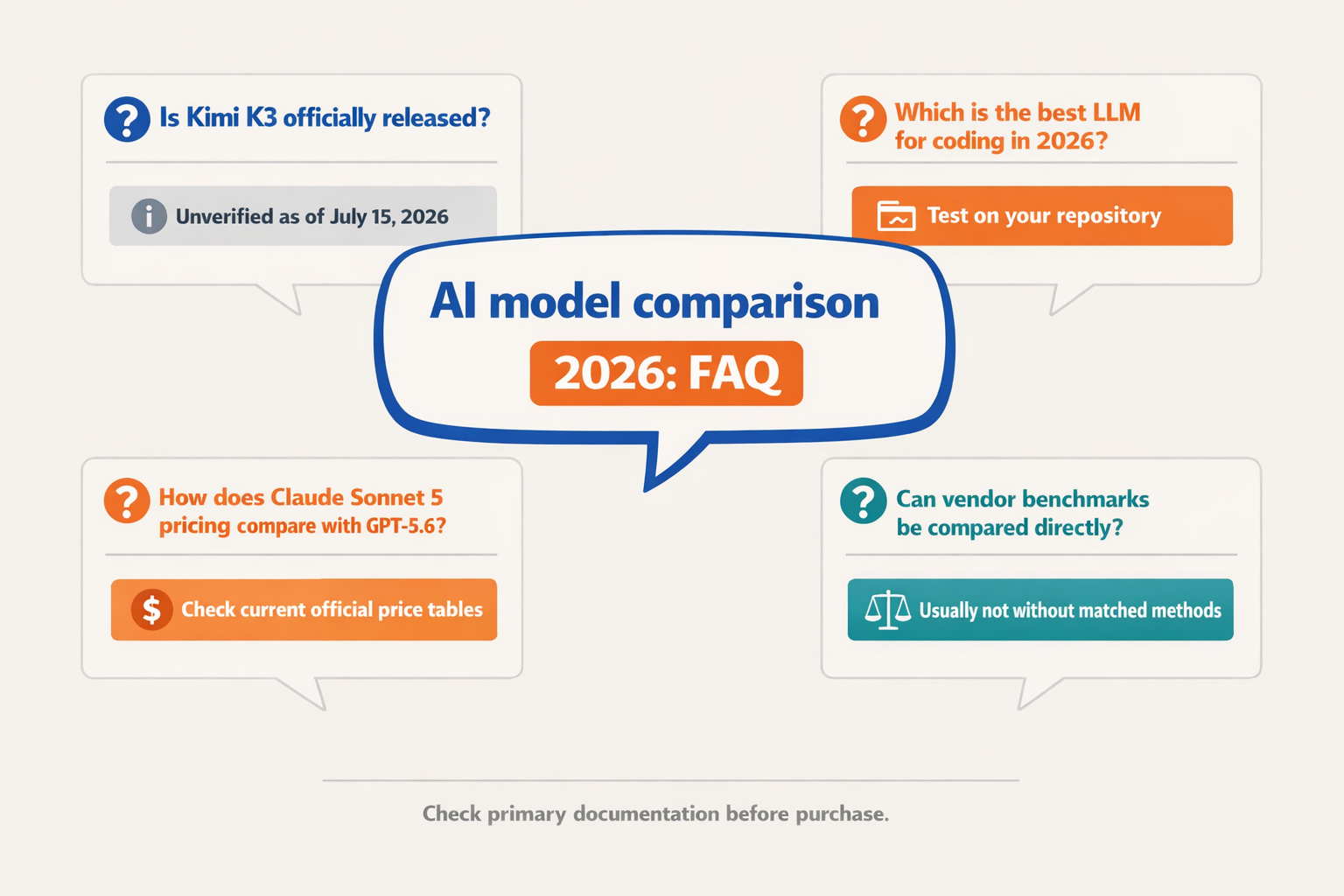
As of July 15, 2026, this comparison has uneven public evidence: OpenAI publishes GPT-5.6 pricing, while Claude and Kimi specifications must be verified against current primary documentation.
What is the difference between GPT-5.6, Claude Opus 4.8, Sonnet 5, and Kimi K3?
Which is the best model in the GPT-5.6 vs Claude Opus 4.8 vs Sonnet 5 vs Kimi K3 comparison?
How much does GPT-5.6 cost through the OpenAI API?
Is Claude Opus 4.8 better than Claude Sonnet 5 for coding?
Is Kimi K3 officially released, and how does Kimi K3 compare with Claude Opus 4.8?
Which model should businesses use in production in 2026?
Conclusion
- GPT-5.6 currently has the clearest public evidence, with Sol, Terra, and Luna pricing documented by OpenAI.
- Claude Opus 4.8 and Sonnet 5 require validation against Anthropic’s live specifications before fair ranking.
- Kimi K3 remains unverified unless Moonshot AI publishes primary technical documentation.
- No overall winner is supportable yet; use case-specific testing is essential.
Watch for updated model cards, pricing, context limits, and benchmarks. To explore this multi-model future, visit CallMissed. Which model will your own evaluation prove most effective?
Related Reading
Related Posts
Ready to automate customer conversations?
Launch AI voice agents and WhatsApp bots with CallMissed — one API, 22+ Indian languages.