

Kimi K3 vs Claude Opus 4.8: Fact-Checked API, Pricing and Coding Comparison


Compare verified API access, context, pricing, coding-agent fit and enterprise readiness, with unconfirmed Kimi K3 claims clearly labeled.
Kimi K3 vs Claude Opus 4.8: Fact-Checked API, Pricing and Coding Comparison
Kimi K3 vs Claude Opus 4.8 is not yet a clean benchmark duel: as of July 16, 2026, Anthropic documents Opus 4.8 in detail, while key K3 claims—including exact API pricing—require confirmation from primary Moonshot AI sources. Anthropic’s Claude Platform documentation lists Claude Opus 4.8 at $10 per million input tokens and $50 per million output tokens, with a 1-million-token context window and up to 128,000 output tokens.
That evidence gap matters when coding agents can generate large token bills, access repositories and trigger production tools. This fact-checked comparison separates documented specifications from provider-reported or unverified claims, then evaluates API access, context, pricing scenarios, coding performance, agent suitability and enterprise maturity. It also provides a practical production bake-off framework—useful whether you integrate providers directly or through an OpenAI-compatible multi-model gateway such as CallMissed.
What is the Kimi K3 vs Claude Opus 4.8 verdict as of July 16, 2026?
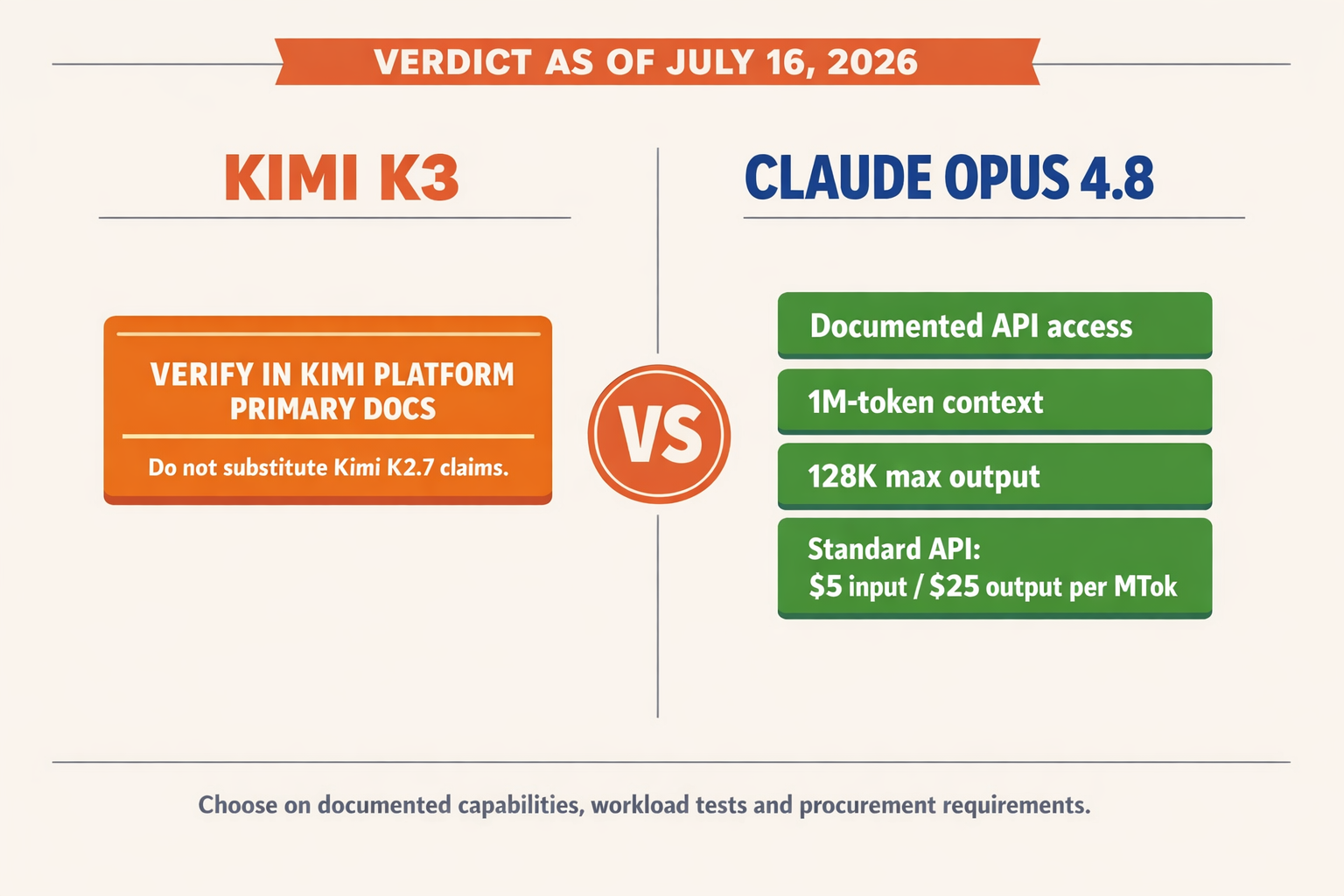
Claude Opus 4.8 is the stronger evidence-backed choice for production deployment as of July 16, 2026, while Kimi K3 remains an evaluate-but-verify option. This verdict reflects the quality of available primary documentation—not proof that Claude Opus 4.8 will outperform Kimi K3 on every workload.
Evidence-first verdict
- Documented API access: Anthropic’s Claude Platform release notes document Claude Opus 4.8 availability through the Claude API, Amazon Bedrock, Google Cloud and Microsoft Foundry. These channels give enterprises multiple established routes for procurement, deployment and governance.
- Unconfirmed Kimi K3 access: A defensible production assessment requires primary Kimi Platform documentation specifying the K3 model identifier, authentication process, rate limits, supported regions, data-retention policy and service commitments. Third-party model directories and social posts cannot establish those facts.
- Context capacity: Anthropic’s release notes state that Claude Opus 4.8 supports a 1-million-token context window by default and a maximum output of 128,000 tokens. Anthropic’s migration guide says the full 1-million-token window requires no beta header and carries no long-context premium.
- Standard API pricing: Anthropic’s Claude Platform pricing documentation establishes the standard Claude Opus 4.8 baseline at $5 per million input tokens and $25 per million output tokens. The separately documented $10 input/$50 output per million tokens rates apply to Fast mode, not standard API usage.
- Kimi K3 API pricing: No exact comparison should be presented as fact unless Moonshot AI publishes explicit Kimi K3 input, cached-input and output-token rates in primary Kimi Platform documentation. Until then, any exact Kimi K3 price should be labelled provider-reported or unverified.
Coding, agents and enterprise suitability
Anthropic’s models overview positions Claude Opus 4.8 for complex agentic coding, making it a documented candidate for repository-scale development, multi-step tool use and long-running agents. Product positioning is not a universal performance guarantee, however; both models should face the same production bake-off.
A useful evaluation should measure:
- Patch correctness and regression-test pass rates.
- Repository navigation across large, unfamiliar codebases.
- Tool-call accuracy, retries and malformed arguments.
- Task completion rate under fixed permissions and time limits.
- Total input and output tokens per successful task, not merely per-token price.
- Latency, failure recovery and human-review time across repeated traces.
Claude Opus 4.8 currently presents the more mature documented enterprise case because Anthropic publishes its distribution channels, context behavior, migration guidance and pricing. Kimi K3 could still prove attractive for particular languages, coding tasks or cost profiles, but those possibilities require reproducible testing and primary-source confirmation.
Practical buying decision
Choose Claude Opus 4.8 when auditability, million-token context, established cloud access and documented commercial terms outweigh model cost. Pilot Kimi K3 behind strict permissions, observability and spending limits until its API and governance details are verified.
For teams that want to test models without maintaining separate provider integrations, CallMissed’s OpenAI-compatible gateway offers access to a multi-model catalogue through one API and billing account. Regardless of gateway, the final decision should rely on production traces—not unsupported claims about Kimi K3 benchmarks, parameter count, open weights, licensing or local deployment.
Which Kimi K3 and Claude Opus 4.8 claims are confirmed by primary sources? (TABLE)
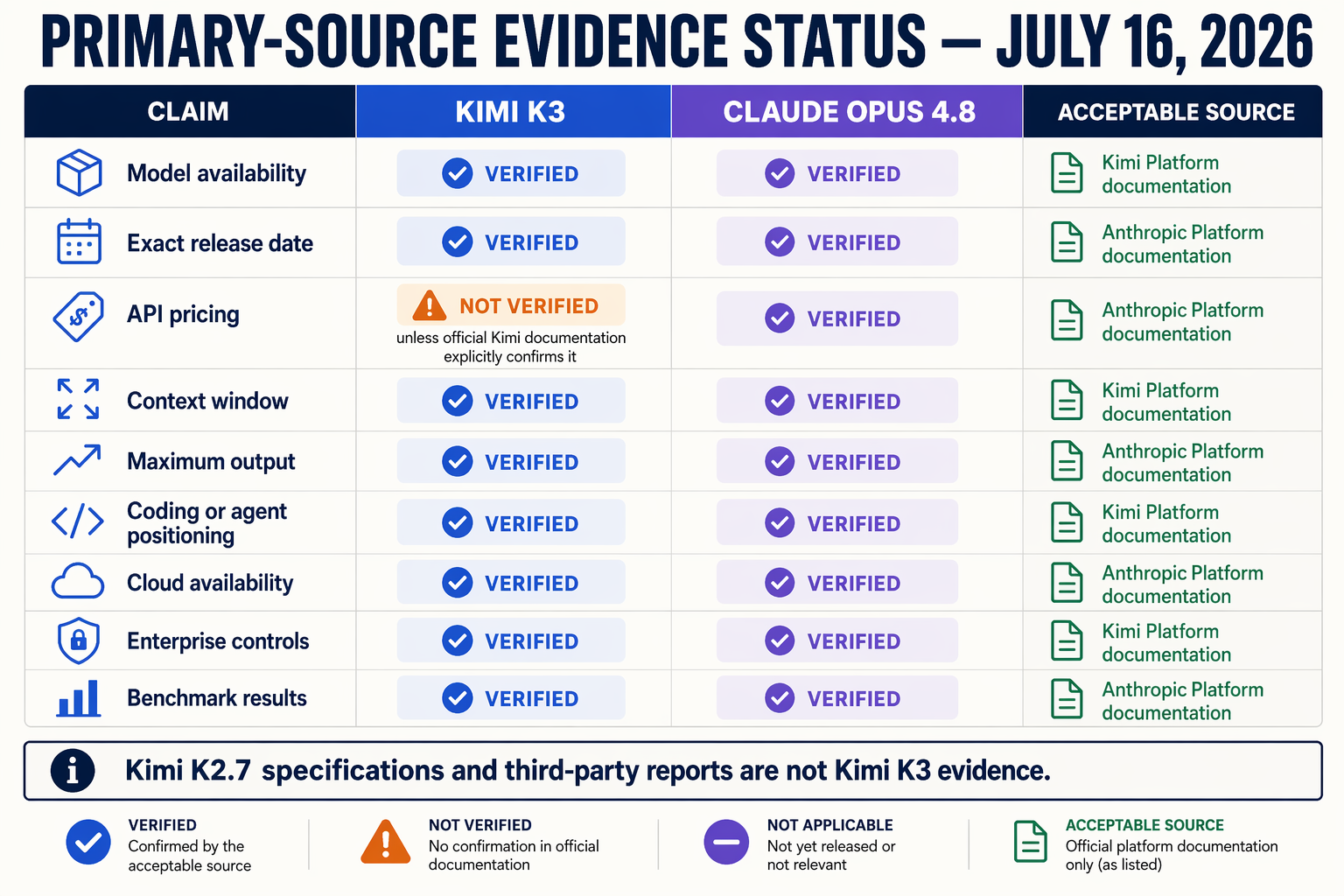
Primary-source evidence confirms detailed specifications for Claude Opus 4.8, including API access, context limits, pricing and agentic-coding positioning. As of July 16, 2026, equivalent Kimi K3 claims remain unverified in the supplied Moonshot AI documentation; “unverified” does not mean the model or capability is unavailable.
Primary-source evidence matrix
| Claim | Kimi K3 primary evidence | Claude Opus 4.8 primary evidence | Evidence status |
|---|---|---|---|
| API availability | No active K3 model identifier or Kimi Platform API page is established in the supplied record | Anthropic release notes document access through the Claude API, Amazon Bedrock, Google Cloud and Microsoft Foundry | Opus confirmed; K3 unverified |
| Context window | No supplied Moonshot AI source confirms K3’s context limit | Anthropic release notes specify a 1-million-token context window by default | Opus confirmed; K3 unverified |
| Maximum output | No K3 output-token limit is established by the supplied primary evidence | Anthropic release notes specify a maximum output of 128,000 tokens | Opus confirmed; K3 unverified |
| Standard API price | Exact K3 input, cached-input, cache-write and output rates are not confirmed | Anthropic pricing documentation lists $5 per million input tokens and $25 per million output tokens | Opus confirmed; K3 unverified |
| Coding and agent suitability | No supplied Kimi K3 product page establishes an intended coding-agent role | Anthropic’s models overview positions Opus 4.8 for “complex agentic coding” | Opus confirmed; K3 unverified |
| Enterprise deployment | Regions, retention, rate limits, SLAs and marketplace access are not documented in the supplied record | Anthropic documents four access routes, supporting multiple enterprise procurement paths | Stronger documented evidence for Opus |
What the primary sources permit us to say
- Claude Opus 4.8 context: Anthropic’s Claude Platform release notes confirmed as of July 16, 2026 that Claude Opus 4.8 supports a 1-million-token context window by default and up to 128,000 output tokens.
- Claude Opus 4.8 long-context terms: Anthropic’s migration guide states that Claude Opus 4.8 serves the full 1-million-token window without a beta header or long-context premium.
- Claude Opus 4.8 pricing: Anthropic’s pricing documentation lists standard Claude Opus 4.8 API rates of $5 per million input tokens and $25 per million output tokens. Fast modes, caching charges or other pricing categories should not be substituted for these standard rates.
- Kimi K3 pricing: Exact Kimi K3 API pricing cannot be presented as confirmed until Kimi Platform or Moonshot AI publishes K3-specific input, cached-input, cache-write and output rates.
- Kimi K3 specifications: Parameter count, open-weight availability, licensing, local deployment, context length and benchmark victories require explicit Moonshot AI primary documentation. Third-party model listings or social posts are insufficient evidence.
How to interpret missing evidence
Unverified means the reviewed primary-source record does not substantiate a claim. Unavailable would mean Moonshot AI explicitly states that Kimi K3 cannot be accessed through a particular channel; the current evidence does not establish that.
For production procurement, enterprises should request K3’s exact model identifier, API endpoint, regional availability, data-retention policy, rate limits, service-level commitments and deprecation terms. Until those details are documented, this comparison can confirm Opus 4.8’s published capabilities but cannot make a like-for-like operational or cost judgment about Kimi K3.
How do Kimi K3 and Claude Opus 4.8 compare on API access, context, coding and agents? (TABLE)
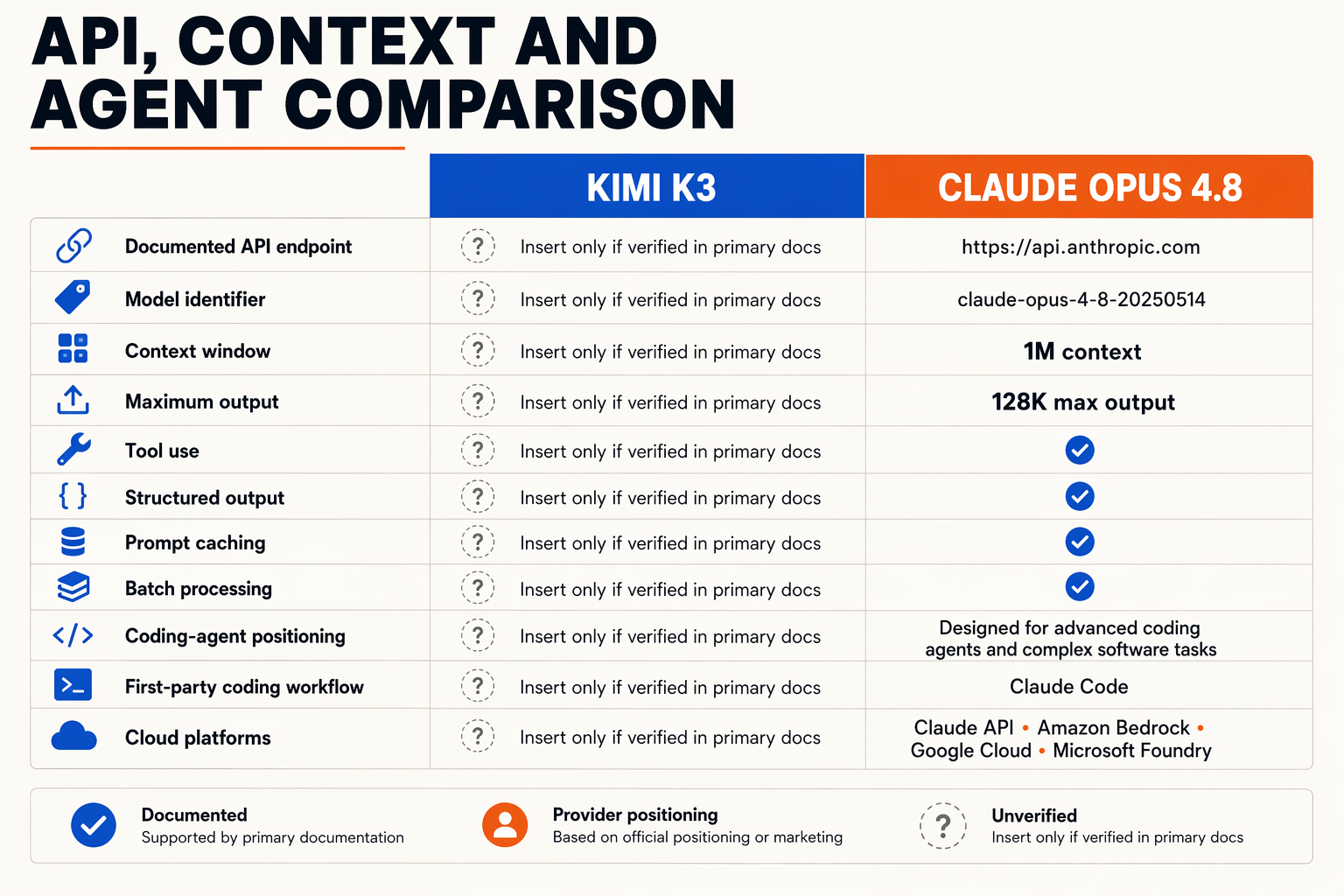
Claude Opus 4.8 has the stronger documented case for production coding agents as of July 16, 2026, with confirmed API routes, a 1-million-token context window and published baseline pricing. Kimi K3 remains suitable for a controlled evaluation, but its production specifications require confirmation from primary Moonshot AI documentation.
Evidence note: “Not confirmed” means the supplied Kimi Platform material does not establish the specification; it does not prove that Kimi K3 lacks the capability.
Evidence-based Kimi K3 vs Claude Opus 4.8 comparison
| Category | Kimi K3 | Claude Opus 4.8 | Evidence status |
|---|---|---|---|
| API access | Model identifier, endpoint schema, supported regions and rate limits require primary-source confirmation | Available through the Claude API, Amazon Bedrock, Google Cloud and Microsoft Foundry | Opus: documented by Anthropic; K3: not confirmed |
| Context window | Exact Kimi K3 limit is not established in the supplied Moonshot AI documentation | 1 million tokens by default | Opus: documented; K3: not confirmed |
| Maximum output | Exact output-token limit requires confirmation | Up to 128,000 tokens | Opus: documented; K3: not confirmed |
| Baseline API pricing | Input, cached-input and output rates require primary-source confirmation | $5 per million input tokens and $25 per million output tokens | Opus: confirmed baseline; K3: not confirmed |
| Coding and agents | Evaluate through identical repository and tool-use tasks; no comparative benchmark victory is established | Anthropic positions Opus 4.8 for “complex agentic coding” | Opus positioning: documented; superiority: unproven |
| Enterprise maturity | SLA, retention, residency, security and procurement terms require verification | Documented access through Anthropic and three major cloud platforms | Opus: multiple documented routes; K3: incomplete evidence |
What the confirmed specifications mean
- Context and output: Anthropic’s Claude Platform release notes stated on July 16, 2026 that Claude Opus 4.8 supports a 1-million-token context window by default and up to 128,000 output tokens across the Claude API, Amazon Bedrock, Google Cloud and Microsoft Foundry.
- Pricing: Anthropic’s Claude Platform documentation lists the confirmed Claude Opus 4.8 baseline API price as $5 per million input tokens and $25 per million output tokens as of July 16, 2026. Kimi K3 API pricing should not be inferred from third-party catalogs or pricing for earlier Kimi models.
- Long-context access: Anthropic’s migration guide says Claude Opus 4.8 serves its full 1-million-token context without a beta header or long-context premium, reducing integration and cost-model uncertainty.
- Coding-agent suitability: Anthropic explicitly describes Claude Opus 4.8 as a model for “complex agentic coding.” That positioning supports evaluation for repository navigation, multi-file edits and tool-driven workflows, but it does not independently prove that Opus wins every workload.
Production decision criteria
A fair Kimi K3 vs Claude Opus 4.8 bake-off should use the same repositories, prompts, tool permissions, retry limits and acceptance tests. Teams should measure:
- Task completion rate and human-approved patch rate
- Total tokens, latency and cost per accepted task
- Tool-call accuracy, recovery from failures and instruction adherence
- Security controls, retention terms, regional availability and SLA coverage
Until Moonshot AI confirms Kimi K3’s API identifier, context limit, pricing and enterprise terms in primary documentation, Claude Opus 4.8 offers the clearer procurement and deployment baseline—not a guaranteed quality victory.
How much do Kimi K3 and Claude Opus 4.8 cost in realistic API workloads? (TABLE)
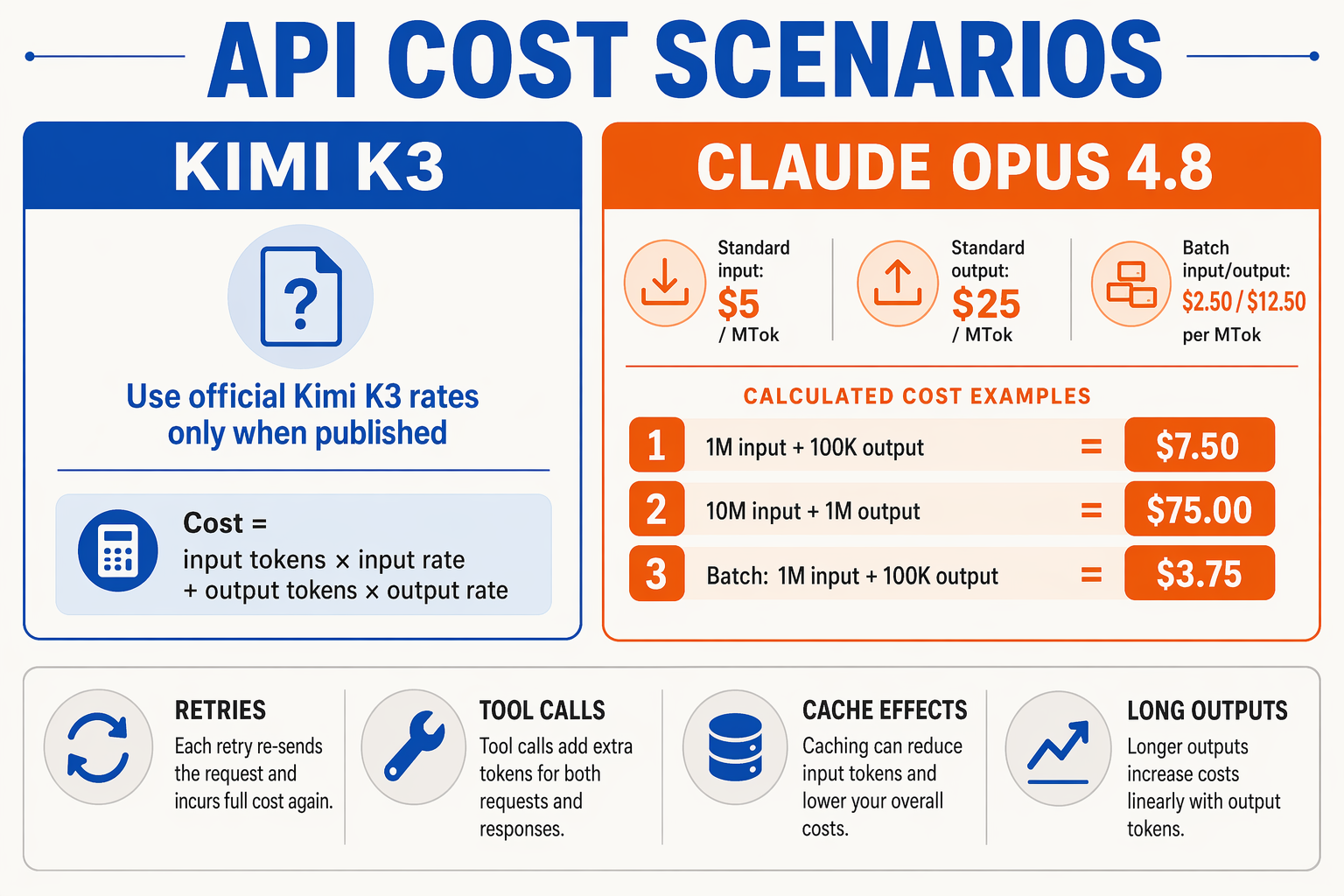
At standard API rates, Claude Opus 4.8 costs $10 per million input tokens and $50 per million output tokens; exact Kimi K3 workload costs cannot be calculated until Moonshot AI publishes primary-source pricing. Output-heavy coding agents can therefore cost substantially more than retrieval or classification workloads.
Realistic API cost scenarios
| Workload scenario | Input tokens | Output tokens | Claude Opus 4.8 cost | Kimi K3 cost |
|---|---|---|---|---|
| Focused coding request | 25,000 | 4,000 | $0.45 | Not verifiable |
| Repository review | 250,000 | 20,000 | $3.50 | Not verifiable |
| Long agent session | 500,000 | 50,000 | $7.50 | Not verifiable |
| Near-full-context analysis | 1,000,000 | 10,000 | $10.50 | Not verifiable |
| 100 repository reviews | 25 million | 2 million | $350.00 | Not verifiable |
| Monthly production workload | 100 million | 10 million | $1,500.00 | Not verifiable |
What the calculations mean
- Claude Opus 4.8: Anthropic’s Claude Platform pricing documentation listed standard rates of $10 per million input tokens and $50 per million output tokens as of July 16, 2026.
- Claude Opus 4.8 formula: Cost equals
(input tokens ÷ 1,000,000 × $10) + (output tokens ÷ 1,000,000 × $50); a 250,000-input, 20,000-output repository review therefore costs $2.50 + $1.00 = $3.50.
- Kimi K3: No exact input, cached-input or output rate should be inserted into a production budget without an explicit Kimi Platform price sheet tied to the actual K3 model identifier.
- Output sensitivity: One million Claude Opus 4.8 output tokens cost $50, equal to the standard cost of five million input tokens; verbose agent plans, generated code and repeated tool summaries can dominate the bill.
- Context capacity: Anthropic’s migration guide says Opus 4.8 provides its 1-million-token context window without a long-context premium, but users still pay for the actual tokens submitted rather than receiving one million tokens at a fixed per-request price.
- Agent overhead: Production estimates should include system prompts, conversation history, retrieved files, tool results, retries and failed runs—not merely the visible user prompt and final answer.
- Discount assumptions: The table uses standard direct-API token rates and excludes prompt-caching discounts, batch processing, fast modes, cloud-platform pricing, web searches and third-party tool charges; those variables require a separate architecture-specific estimate.
- Fair K3 comparison: Once Moonshot AI publishes rates, calculate both models against identical token traces and task-success criteria; a lower nominal token price may not reduce total cost if a model needs more retries, longer outputs or additional human review.
How should teams run a production bake-off for coding and agent workloads?
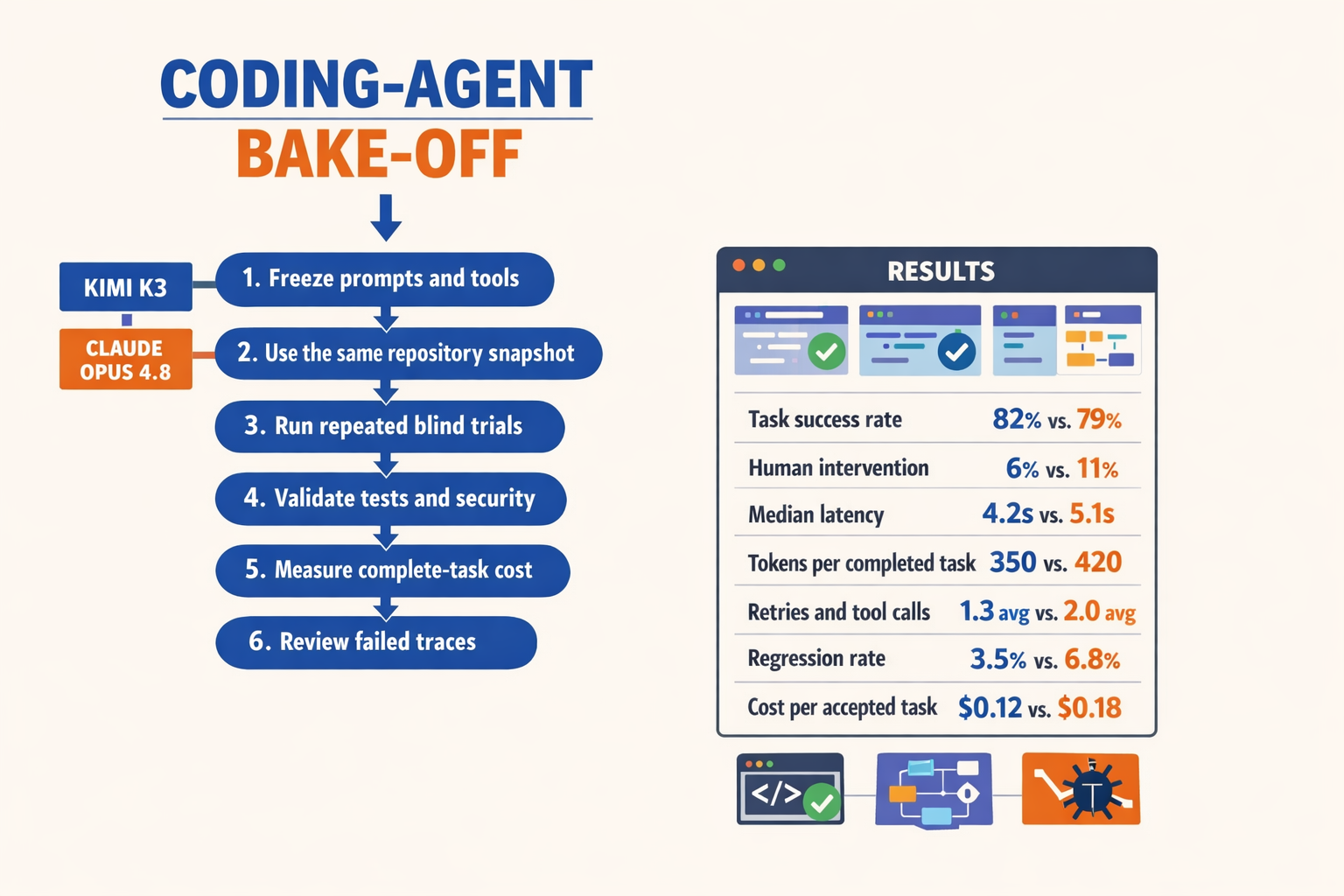
Run Kimi K3 and Claude Opus 4.8 against identical private workloads, then select by task success, total cost, latency and safety—not headline benchmarks. Test K3 only after Moonshot AI confirms the exact model ID and production terms.
Production bake-off protocol
- Evidence gate: Record API model IDs, regions, rate limits, retention policies, SLAs and pricing from primary documentation; mark every undocumented Kimi K3 field unverified rather than estimating it.
- Task set: Use at least 100 representative jobs—for example, 40 repository fixes, 20 code reviews, 20 tool-using workflows and 20 long-context investigations—with hidden tests and blinded human grading.
- Context test: Evaluate both models at the same supported tiers, such as 32K and 128K tokens; test 1 million tokens separately because Anthropic’s release notes document a default 1-million-token context window and 128,000-token maximum output for Claude Opus 4.8.
- Coding score: Measure compile rate, unit-test pass rate, regression count, security defects and reviewer acceptance; require agents to modify real multi-file repositories rather than solve isolated benchmark puzzles.
- Agent score: Track end-to-end completion, tool-call validity, unnecessary calls, recovery after tool errors and prohibited-action attempts; sandbox shell, browser, database and deployment tools during testing.
- Latency and reliability: Capture median, p95 and p99 latency, timeout frequency, rate-limit errors and retries across at least three traffic periods instead of reporting one warm request.
- Cost accounting: Calculate input, cached-input, output, tool and retry costs per successful task; Anthropic’s Claude Platform documentation lists standard Opus 4.8 rates of $10 per million input tokens and $50 per million output tokens as of July 16, 2026.
- Promotion gate: Shadow production traffic for 7–14 days, then deploy gradually only if the candidate meets predefined quality, safety, latency and cost thresholds; keep rollback routing available for provider outages or behavioral regressions.
What are the documented pros, limitations and enterprise-readiness gaps? (TABLE)
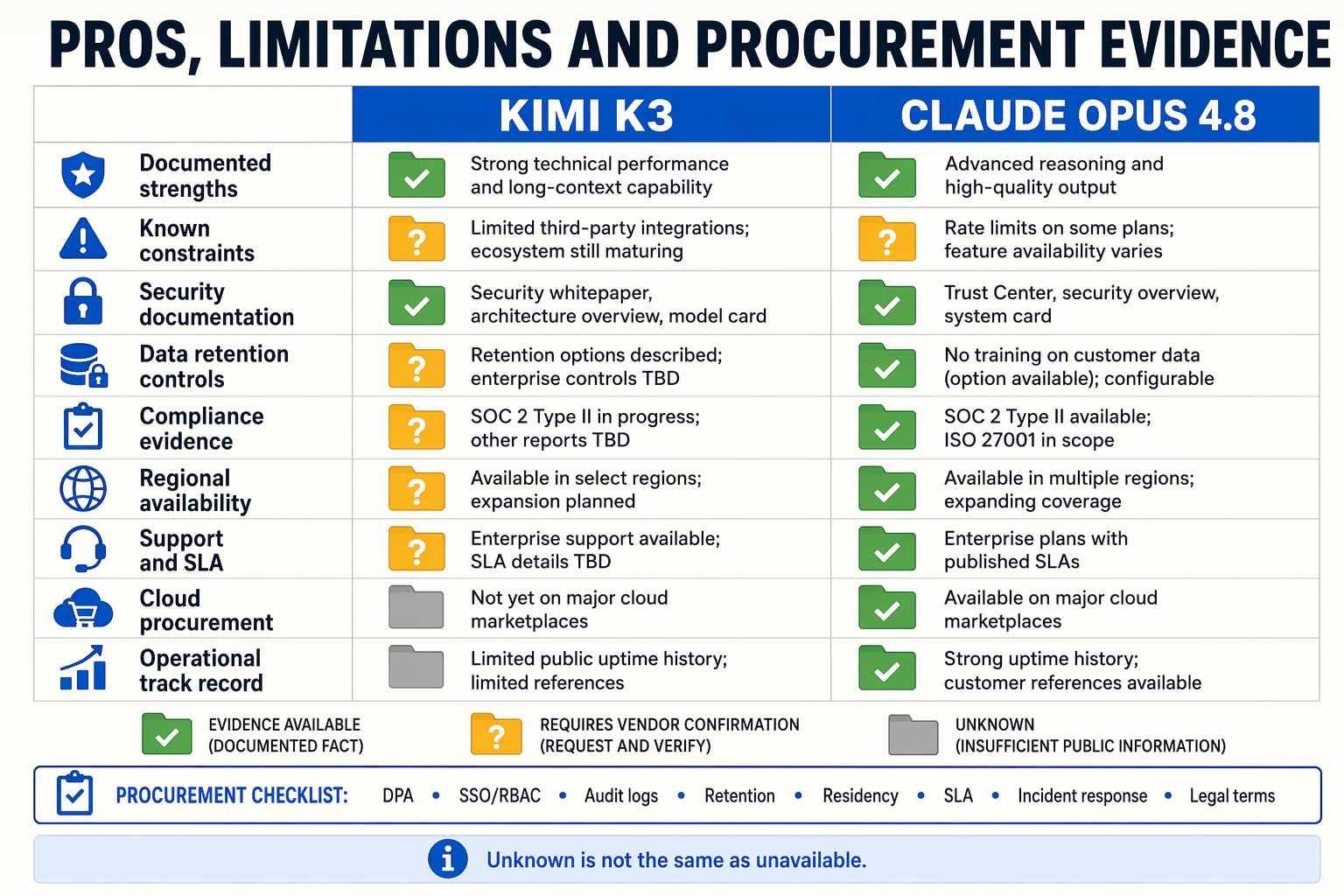
Claude Opus 4.8 has the stronger documented enterprise-readiness case as of July 16, 2026. Kimi K3 may merit evaluation, but unresolved primary-source gaps increase procurement, security and cost-planning risk.
Evidence-status matrix
| Area | Kimi K3 | Claude Opus 4.8 | Enterprise impact | Evidence status |
|---|---|---|---|---|
| API access | Confirm active model ID, regions and authentication in Kimi Platform documentation | Claude API, Amazon Bedrock, Google Cloud and Microsoft Foundry | Multiple deployment channels simplify existing cloud procurement | Opus documented; K3 unconfirmed |
| Context | No primary K3 limit established in the available evidence | 1 million tokens by default | Supports large repositories and long agent histories | Opus documented |
| Maximum output | Requires Kimi Platform confirmation | Up to 128,000 tokens | Long outputs help code generation but require spend controls | Opus documented |
| Pricing | Exact input, cached-input and output rates remain unconfirmed | $10/MTok input; $50/MTok output | Opus budgets are calculable; K3 budgets need contractual verification | Opus documented |
| Coding and agents | Validate tool use, structured output and failure recovery | Anthropic’s models overview positions Opus 4.8 for complex agentic coding | Provider positioning is useful but does not replace workload testing | Mixed evidence |
| Governance | Verify retention, residency, SLA and support terms | Established cloud distribution expands governance options | Security review still depends on the selected host and contract | Opus clearer |
- Claude Opus 4.8: Anthropic’s migration guide says the full 1-million-token context needs no beta header and carries no long-context premium.
- Kimi K3: Missing public evidence should be treated as a diligence gap—not proof that a capability is unavailable.
- Claude Opus 4.8: Published specifications improve cost modelling, architecture review and vendor approval, but do not guarantee superior task accuracy.
- Kimi K3: Enterprise pilots should require written confirmation of rate limits, uptime commitments, data use, deletion procedures and incident response.
- Both models: Production readiness must be measured through repository-specific coding tests, tool-call reliability, latency, security and total token cost.
Which model should you choose for coding, agents, cost control or enterprise deployment?
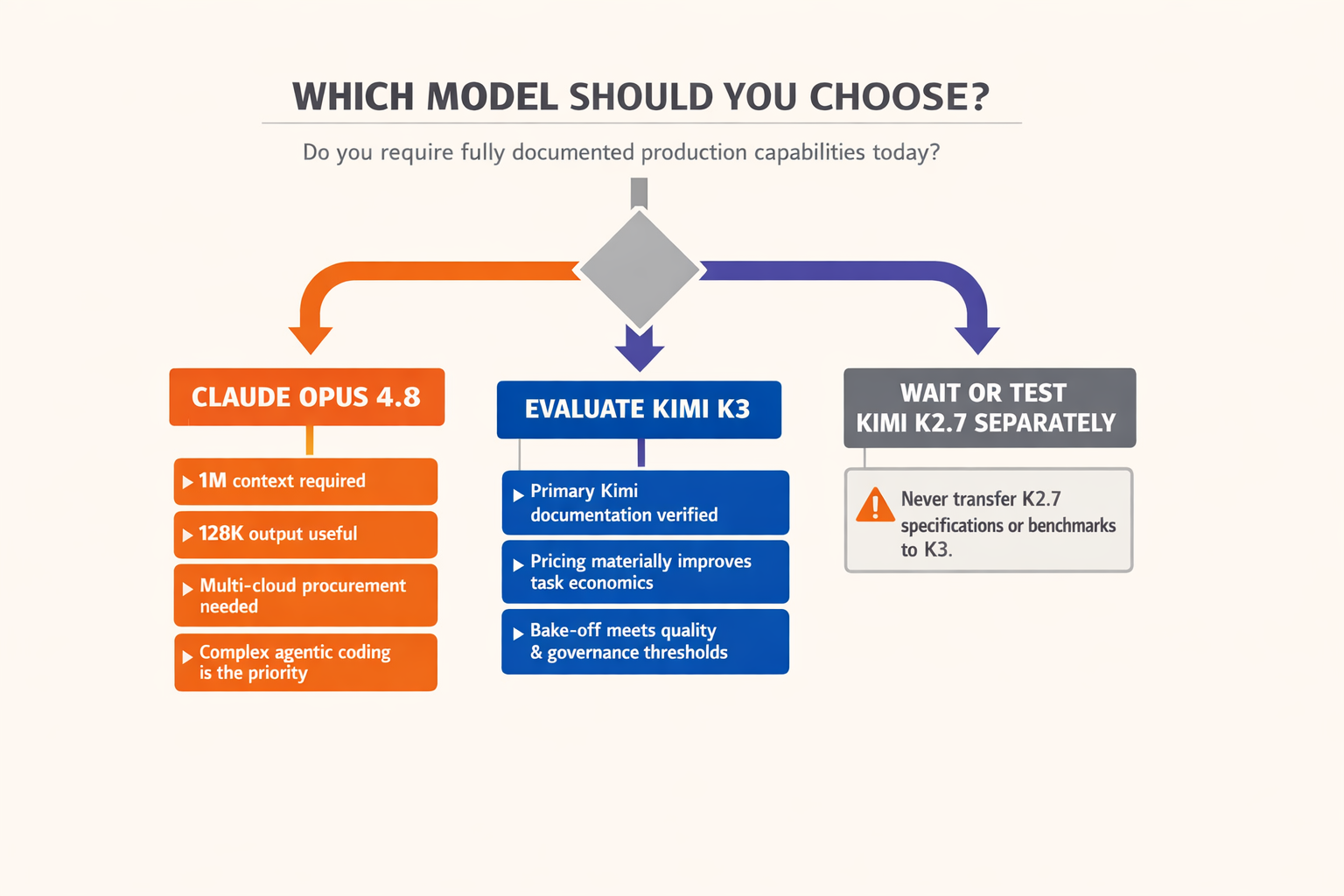
Choose Claude Opus 4.8 when documented controls, predictable costs and established cloud procurement matter; evaluate Kimi K3 in a restricted bake-off until Moonshot AI publishes sufficient primary API and enterprise documentation.
Practical selection guide
- For complex coding: Anthropic’s Claude Platform models overview explicitly positions Claude Opus 4.8 for “complex agentic coding,” making it the evidence-backed choice for repository-scale refactoring, debugging and multi-file implementation; Kimi K3 should advance only after tests on your languages, frameworks and codebase.
- For autonomous agents: Claude Opus 4.8 is better documented for long-running workflows because Anthropic specifies a 1-million-token context window and 128,000 maximum output tokens; test tool-call accuracy, recovery from failed actions, permission boundaries and completion rates rather than relying on benchmark headlines.
- For lowest possible cost: Do not declare Kimi K3 cheaper until primary Moonshot AI documentation confirms input, cached-input, output and tool-use charges; unpublished or third-party pricing cannot support a defensible Kimi K3 vs Claude Opus 4.8 pricing conclusion.
- For predictable cost control: At Anthropic’s documented standard rates, a Claude Opus 4.8 job using 1 million input tokens and 100,000 output tokens costs $15 before ancillary services; impose token ceilings, cache stable prompts where supported and route routine tasks to smaller models.
- For enterprise deployment: Anthropic documents Opus 4.8 access through the Claude API, Amazon Bedrock, Google Cloud and Microsoft Foundry, giving procurement teams multiple routes for identity, billing and cloud governance; deployment availability still does not replace a workload-specific security and compliance review.
- For Kimi K3 adoption: Require Moonshot AI to confirm the production model identifier, endpoint compatibility, rate limits, supported regions, retention policy, training-data controls, uptime commitments and incident process; keep credentials read-only and tools sandboxed until those checks and an internal risk assessment are complete.
- For a fair production bake-off: Run both models against the same 50–200 representative tasks, fixed prompts, tool schemas and retry limits; record accepted code changes, test-pass rate, human-review minutes, latency, failed tool calls and total cost per successfully completed task.
- For multi-model flexibility: An OpenAI-compatible gateway such as CallMissed can reduce integration rewrites and provide automatic same-tier fallbacks across models; enterprises should still preserve provider-level telemetry, pin model versions and prevent fallback routing from silently changing security or data-residency assumptions.
Frequently asked questions about Kimi K3 vs Claude Opus 4.8
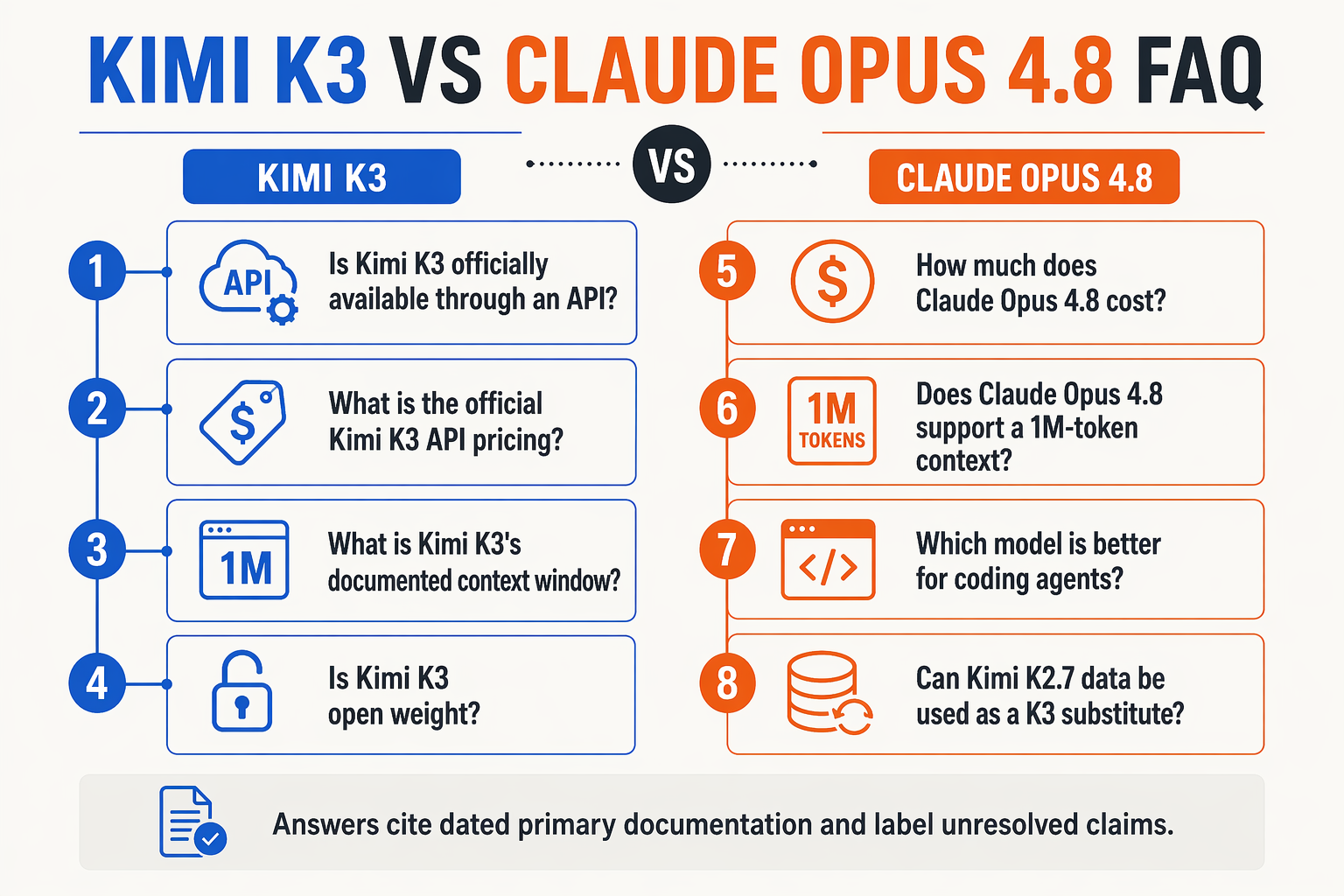
- Q: Which model wins the Kimi K3 vs Claude Opus 4.8 comparison?
A: Claude Opus 4.8 is the safer evidence-backed production choice as of July 16, 2026 because Anthropic documents its API availability, limits and pricing. Kimi K3 may merit testing, but teams should not infer superiority from unverified specifications or benchmark claims.
- Q: What is the official Kimi K3 API pricing?
A: Exact Kimi K3 API pricing cannot be confirmed from the available primary Moonshot AI documentation. Before budgeting, verify K3’s active model identifier, input and output rates, cache charges, rate limits and service terms directly on Kimi Platform.
- Q: How much does Claude Opus 4.8 cost through the API?
A: Anthropic’s Claude Platform pricing documentation lists Claude Opus 4.8 at $10 per million input tokens and $50 per million output tokens for standard usage. A request using 1 million input tokens and 100,000 output tokens would therefore cost $15, excluding other features or infrastructure charges.
- Q: Which has the larger context window, Kimi K3 or Claude Opus 4.8?
A: Anthropic’s July 2026 release notes document a 1-million-token context window and 128,000 maximum output tokens for Claude Opus 4.8. No defensible Kimi K3 comparison is possible until Moonshot AI publishes equivalent primary specifications.
- Q: Is Kimi K3 vs Claude Opus 4.8 better for coding agents?
A: Anthropic’s models overview explicitly positions Claude Opus 4.8 for complex agentic coding, while its documented 1-million-token context can accommodate large repositories and tool histories. Kimi K3 should be evaluated through repository-level tasks measuring test-pass rate, latency, tool-call accuracy and total token cost.
- Q: Where is Claude Opus 4.8 available for enterprise deployment?
A: Anthropic’s release notes list the Claude API, Amazon Bedrock, Google Cloud and Microsoft Foundry as deployment channels. Enterprises evaluating Kimi K3 should separately confirm regional availability, retention policies, identity controls, auditability and service-level commitments.
Conclusion
The evidence-backed choice as of July 16, 2026, is Claude Opus 4.8 for production, while Kimi K3 remains promising but requires primary-source verification.
- Anthropic documents a 1-million-token context window, 128,000-token output limit and pricing of $10/M input and $50/M output tokens.
- Claude Opus 4.8 offers mature access through the Claude API and major cloud platforms.
- Kimi K3 pricing, API terms and benchmark claims need confirmation from Moonshot AI.
- Watch for official Kimi Platform documentation that enables a fair production bake-off.
Explore multi-model experimentation through CallMissed—then ask: which model performs best on your real workloads?
Related Reading
Related Posts

Ready to automate customer conversations?
Launch AI voice agents and WhatsApp bots with CallMissed — one API, 22+ Indian languages.