

Kimi K3 Guide: Pricing, API, Context, Benchmarks & Verdict



Learn Kimi K3 pricing, API setup, 1M-token context, benchmark evidence, coding strengths, deployment caveats, and buying guidance.
Kimi K3 Guide: Pricing, API, Context, Benchmarks & Verdict
What if a single model could examine one million tokens at once—enough to process a large codebase, a substantial document archive, or thousands of customer-support conversations in one prompt? This Kimi K3 Ultimate Guide examines Moonshot AI’s newly available flagship model, including the Kimi K3 release date, pricing, API, benchmarks, context window, coding capabilities, and unresolved questions around open weights.
As of July 16, 2026, the official Kimi API Platform describes Kimi K3 as Moonshot AI’s “most capable model to date,” with native visual understanding and a 1-million-token context window. OpenRouter lists July 16, 2026 as the model’s release date, although that date should be treated as a third-party listing unless Moonshot AI publishes a separate dated launch announcement.
The economics are equally important for developers evaluating long-context workloads. The Kimi API Platform listed Kimi K3 pricing at $3 per million cache-miss input tokens, $0.30 per million cached input tokens, and $15 per million output tokens on July 16, 2026. That 10-to-1 difference between uncached and cached input makes prompt caching potentially decisive for repository-scale coding agents, recurring research workflows, and applications that repeatedly reference the same knowledge base.
This guide separates official Kimi Platform facts from third-party claims and information that remains unverified. You will learn:
- How to use the Kimi K3 API, including authentication and an OpenAI-style quickstart.
- What the 1M-token context window means in practice—and why context capacity does not automatically guarantee perfect retrieval.
- How Kimi K3 pricing changes the cost of coding agents, document analysis, visual tasks, and long-running knowledge work.
- What published Kimi K3 benchmarks can and cannot establish while independent post-launch testing remains early.
- Whether credible evidence confirms Kimi K3 parameter counts, open weights, licensing terms, or self-hosting requirements.
- How Kimi K3 compares with earlier Kimi models, while avoiding unsupported assumptions about names such as Kimi K2.7.
- Where the model appears compelling, where buyers should test carefully, and which workloads may not need a million-token context window.
Kimi K3 also reflects a broader shift from isolated chat models toward programmable, multimodal AI infrastructure. Platforms such as CallMissed, an OpenAI-compatible multi-model gateway, illustrate how developers can access LLM, speech, image, and search capabilities through a unified integration rather than maintaining separate provider interfaces.
The central question is therefore not whether Kimi K3 has an impressive specification sheet—it does. The real question is whether its API economics, coding performance, tool use, reliability, and deployment model justify adopting it for production workloads. This guide provides the evidence needed to reach that verdict.
What is Kimi K3, when was it released, and what should buyers know first? — Answer-first overview of official availability, the externally listed July 16, 2026 release date, 1M-token context, native visual understanding, flagship positioning, and current usage-based pricing
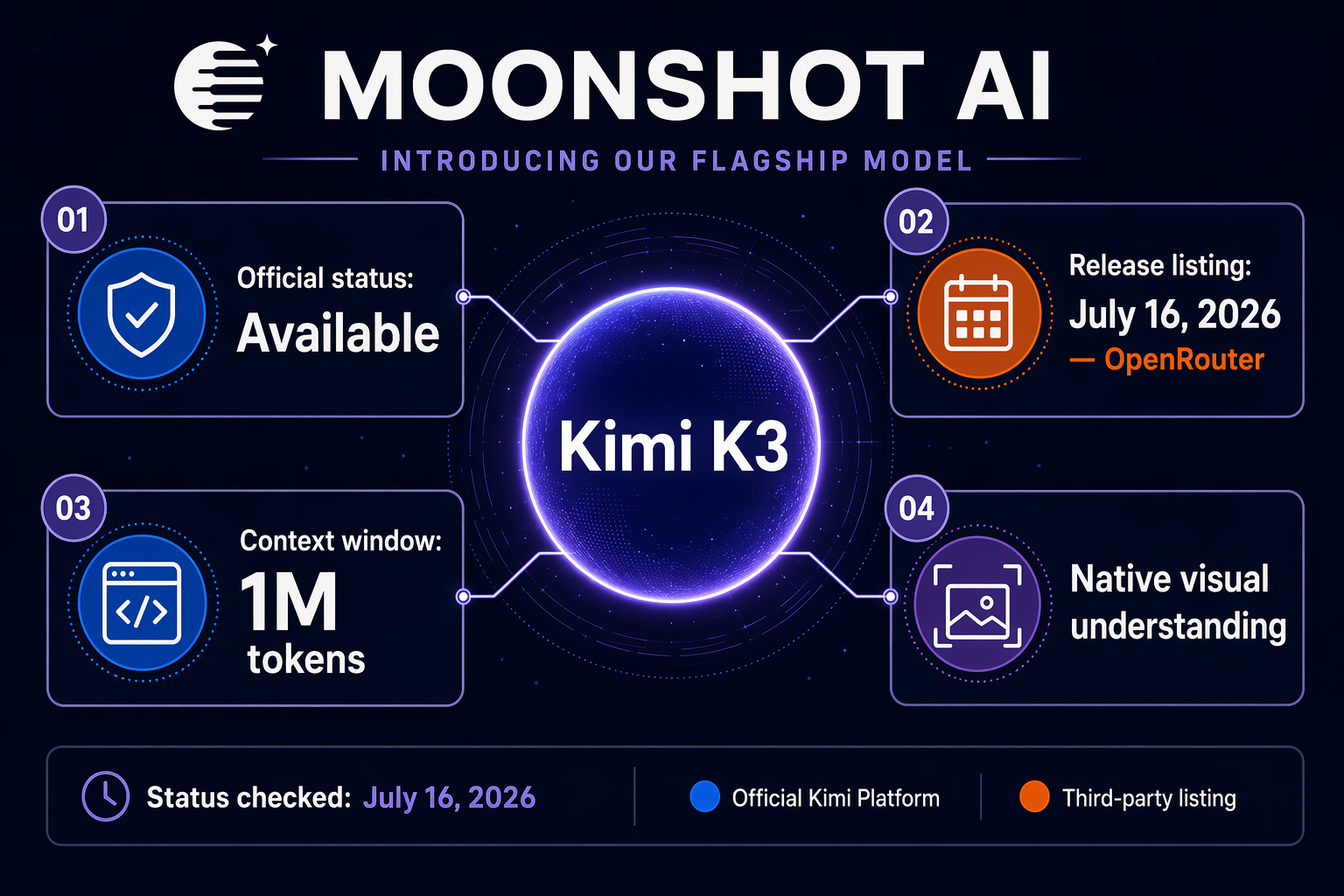
Kimi K3 is Moonshot AI’s flagship model for long-horizon coding, multimodal analysis, and end-to-end knowledge work. It is officially available through the Kimi API Platform as of July 16, 2026, with a 1-million-token context window, native visual understanding, and usage-based API pricing.
Official availability versus the release date
The official Kimi API Platform confirms that Kimi K3 is “now officially available” and describes it as Kimi’s “most capable model to date.” However, the official documentation surfaced so far does not provide a separate, dated launch announcement.
OpenRouter lists July 16, 2026 as the Kimi K3 release date. Buyers should therefore distinguish between two related facts:
- Official status: Moonshot AI’s Kimi API Platform confirms that Kimi K3 is available.
- Externally listed date: OpenRouter records the release date as July 16, 2026.
- Evidence caveat: Until Moonshot AI publishes a dated announcement, July 16 should be cited as an externally documented date rather than an independently confirmed official launch date.
Availability through the API also does not automatically establish identical access, limits, or features across Kimi’s consumer chat products, Kimi Code memberships, and third-party model gateways.
What the flagship specification means
The defining Kimi K3 specification is its 1M-token context window, four times the 256K-token context listed by OpenRouter for Kimi K2.5. That capacity could accommodate unusually large repositories, document collections, conversation histories, or combinations of text and visual material.
Moonshot AI’s pricing documentation positions Kimi K3 specifically for “long-horizon coding and end-to-end knowledge work.” Its native visual understanding also means developers can build workflows involving images rather than relying exclusively on extracted text.
Nevertheless, buyers should not treat context capacity as a quality score. A model can accept one million tokens without retrieving every buried fact consistently, reasoning equally well across the entire window, or using that capacity economically. Production evaluations should measure:
- Long-context retrieval accuracy at different prompt depths
- Repository-scale code navigation and edit reliability
- Image interpretation on domain-specific documents
- Tool-use success over extended workflows
- Latency, throughput, and output consistency
Current Kimi K3 pricing
The Kimi API Platform listed the following pay-as-you-go rates on July 16, 2026:
- Cache-miss input: $3.00 per million tokens
- Cached input: $0.30 per million tokens
- Output: $15.00 per million tokens
The official rates make cached input 90% cheaper than cache-miss input. For illustration, processing one million uncached input tokens and generating 100,000 output tokens would cost $4.50: $3.00 for input plus $1.50 for output. The same nominal input volume billed entirely at the cached rate would reduce that illustrative total to $1.80, subject to Moonshot AI’s actual caching rules and eligibility.
What buyers should verify before adoption
The strongest confirmed facts are availability, flagship positioning, visual input, context capacity, and token pricing. Buyers should avoid assuming that Kimi K3 has open weights or a particular architecture: verified parameter counts, licensing terms, self-hosting requirements, hardware needs, and independently reproduced benchmark results remain unavailable in the supplied launch evidence.
The practical first step is therefore a controlled API evaluation—not procurement based solely on the one-million-token headline.
How did Moonshot AI reach Kimi K3, and where does it fit in the Kimi model family? — Background, product evolution, Kimi Code context, and careful treatment of K2.5, K2.6, and unverified K2.7 claims
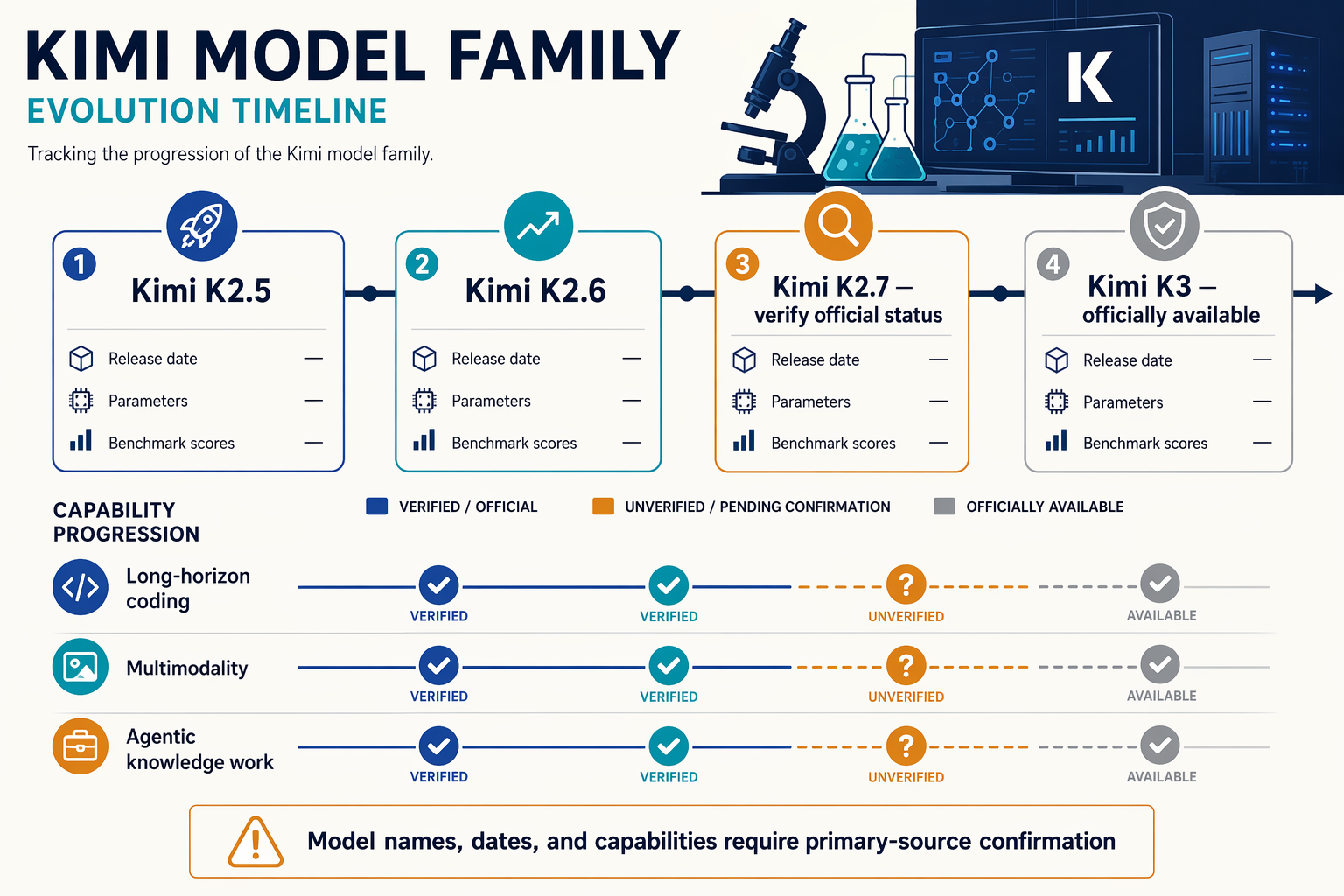
Moonshot AI reached Kimi K3 through a progression from long-context language models toward multimodal, agent-oriented systems for coding and knowledge work. Kimi K3 now occupies the flagship API position, while Kimi Code is a developer product built around coding workflows—not necessarily the name of a separate foundation model.
From long context to multimodal agents
The available evidence supports three broad stages in the Kimi family’s evolution:
- Kimi K2.5 expanded agentic coding and dialogue. OpenRouter’s third-party listing describes Kimi K2.5 as targeting “long-horizon coding, agentic task decomposition, and multi-turn dialogue.”
- Kimi K2.6 made multimodality explicit. Moonshot AI’s official website describes Kimi K2.6 as a “natively multimodal model” with coding and agent capabilities.
- Kimi K3 scales those ambitions to larger working sets. The official Kimi API Platform calls Kimi K3 its “most capable model to date” and positions it for long-horizon coding and end-to-end knowledge work.
The official Kimi API Platform documented a 1-million-token Kimi K3 context window on July 16, 2026. By comparison, OpenRouter lists a 256,000-token context window for Kimi K2.5, although OpenRouter is an independent model marketplace rather than Moonshot AI’s primary documentation.
That progression suggests Kimi K3 is intended to work across entire repositories, extensive research collections, visual inputs, and prolonged agent sessions. It does not prove that K3 will retrieve every detail accurately across one million tokens; effective long-context performance still requires targeted testing.
Where Kimi Code fits
Kimi Code is the coding interface and agent environment surrounding Moonshot AI’s models. Its documentation discusses subscriptions, request allowances, concurrency, and coding workflows, making it a product layer distinct from direct usage of the Kimi K3 API.
The official Kimi Code documentation reports:
- Approximately 300–1,200 requests per five-hour window, depending on the applicable allowance.
- Up to 30 concurrent requests.
- Membership billing through monthly or annual subscriptions.
These request limits should not be confused with API token pricing or model context capacity. A request allowance governs Kimi Code product usage; a token charge governs consumption through the Kimi API Platform. Developers should therefore choose between Kimi Code for an integrated coding experience and the Kimi K3 API for embedding the model inside custom agents, applications, or infrastructure.
What is verified about K2.5, K2.6, and K2.7?
The evidence has different confidence levels:
- Kimi K2.5: OpenRouter provides a model listing with a 256K context window and architecture details, but those fields should be attributed to OpenRouter unless corroborated by current Moonshot AI documentation.
- Kimi K2.6: Moonshot AI officially identifies K2.6 as natively multimodal and oriented toward coding and agent performance.
- Kimi K3: Moonshot AI officially presents K3 as its current flagship, with native visual understanding and a 1M-token context window.
- Kimi K2.7: No supplied official Moonshot AI source verifies a Kimi K2.7 or Kimi K2.7 Code model as of July 16, 2026.
Consequently, searches for “Kimi K3 vs Kimi K2.7” should not be treated as evidence that K2.7 was publicly released. Until Moonshot AI publishes a model card, API identifier, pricing page, or announcement, any claimed K2.7 specifications, benchmarks, release dates, or lineage remain unverified.
Which Kimi K3 launch facts are verified, externally reported, or still unknown? (TABLE) — Release status, date, context window, visual capability, positioning, prices, benchmarks, parameters, weights, license, and hardware requirements
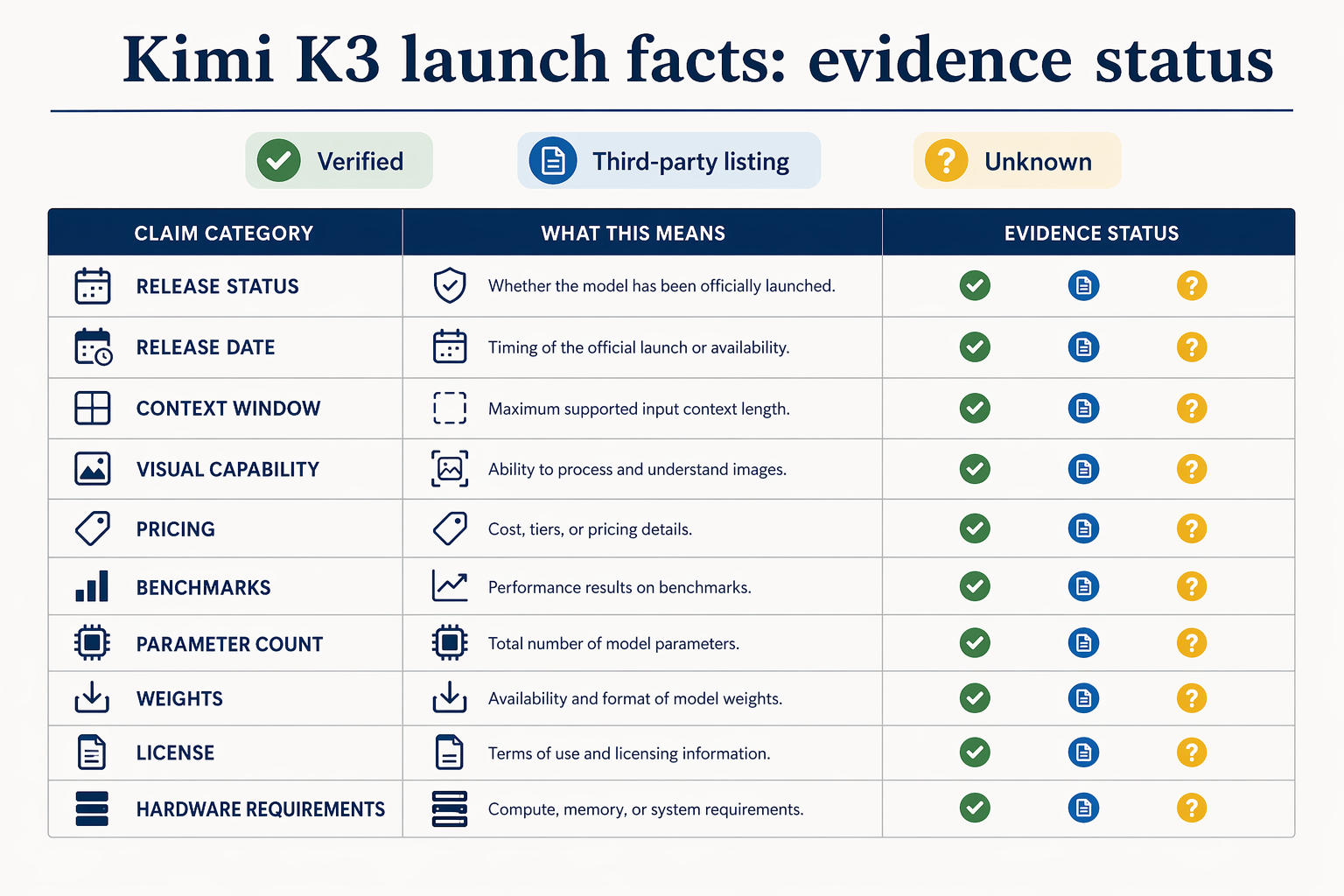
Kimi K3 is officially available through the Kimi API Platform, but not every commonly searched specification has been disclosed. As of July 16, 2026, the context window, visual capability, positioning, and API prices are official; the precise launch date is externally reported, while parameter count, weights, license, benchmark scores, and self-hosting hardware requirements remain unverified.
Verified-facts ledger
| Item | Current claim | Evidence status | What developers should conclude |
|---|---|---|---|
| Release status | Kimi K3 is available through the Kimi API Platform. | Officially verified by the Kimi API Platform quickstart. | Developers can evaluate the hosted API now rather than relying on a preview or waitlist. |
| Release date | OpenRouter lists July 16, 2026 as the release date. | Externally reported, not confirmed by a separate dated Moonshot AI announcement in the available evidence. | Use July 16 as the best-supported listing date, but label it as third-party sourced. |
| Context window | Kimi K3 supports 1 million tokens of context. | Officially verified by the Kimi API Platform on July 16, 2026. | The capacity suits large repositories and document collections, although usable context does not guarantee flawless retrieval across every token. |
| Visual capability | Kimi K3 has native visual understanding. | Officially verified by the Kimi API Platform quickstart. | The hosted model can support multimodal workflows, but supported formats, image limits, and billing behavior should be checked during implementation. |
| Positioning | Moonshot AI calls Kimi K3 its “most capable model to date” and positions it for long-horizon coding and end-to-end knowledge work. | Official positioning, not an independent performance finding. | Treat the description as intended use-case guidance rather than proof of superiority. |
| API pricing | Cache-miss input costs $3 per million tokens, cached input costs $0.30 per million tokens, and output costs $15 per million tokens. | Officially verified by the Kimi API Platform on July 16, 2026. | Reusing cached context reduces listed input cost by 90% compared with cache-miss input. |
| Benchmarks | No specific Kimi K3 benchmark scores are established by the supplied official launch evidence. | Still unknown or incomplete. | Buyers should wait for reproducible evaluations and run workload-specific tests before making performance claims. |
| Parameters | Total, active, and mixture-of-experts parameter counts have not been verified. | Still unknown. | Do not infer Kimi K3’s architecture from Kimi K2.5, which OpenRouter separately describes as activating 32 billion parameters. |
| Weights and license | No verified weights download or Kimi K3 model license appears in the available launch evidence. | Still unknown. | “API available” must not be interpreted as “open weights” or permission for redistribution and modification. |
| Hardware requirements | Moonshot AI has not published verified self-hosting GPU, memory, quantization, or cluster requirements in the supplied evidence. | Still unknown. | API users need no inference cluster; self-hosting plans should remain provisional unless weights and deployment documentation appear. |
How to interpret the evidence
The distinction between fact, positioning, and inference matters. “One-million-token context” is a documented specification; “industry-leading intelligence,” used in the Kimi Platform pricing explanation, is a provider characterization that requires independent validation.
Three purchasing rules follow:
- Price production behavior, not the headline window. Output is five times more expensive than cache-miss input under the listed rates.
- Test visual and long-context accuracy directly. Capacity alone does not establish OCR quality, cross-document recall, or repository-scale reasoning.
- Avoid architecture assumptions. Neither the Kimi K3 parameter count nor a hypothetical Kimi K2.7 lineage is confirmed by the cited launch materials.
This evidence ledger should therefore be treated as a July 16, 2026 snapshot and updated when Moonshot AI publishes benchmark methodology, model-card details, licensing terms, or deployment specifications.
How much does Kimi K3 cost, and what will real API workloads spend? (TABLE) — Official rate card, cache economics, cost formula, worked coding-agent scenarios, provider markups, and pricing-change checks
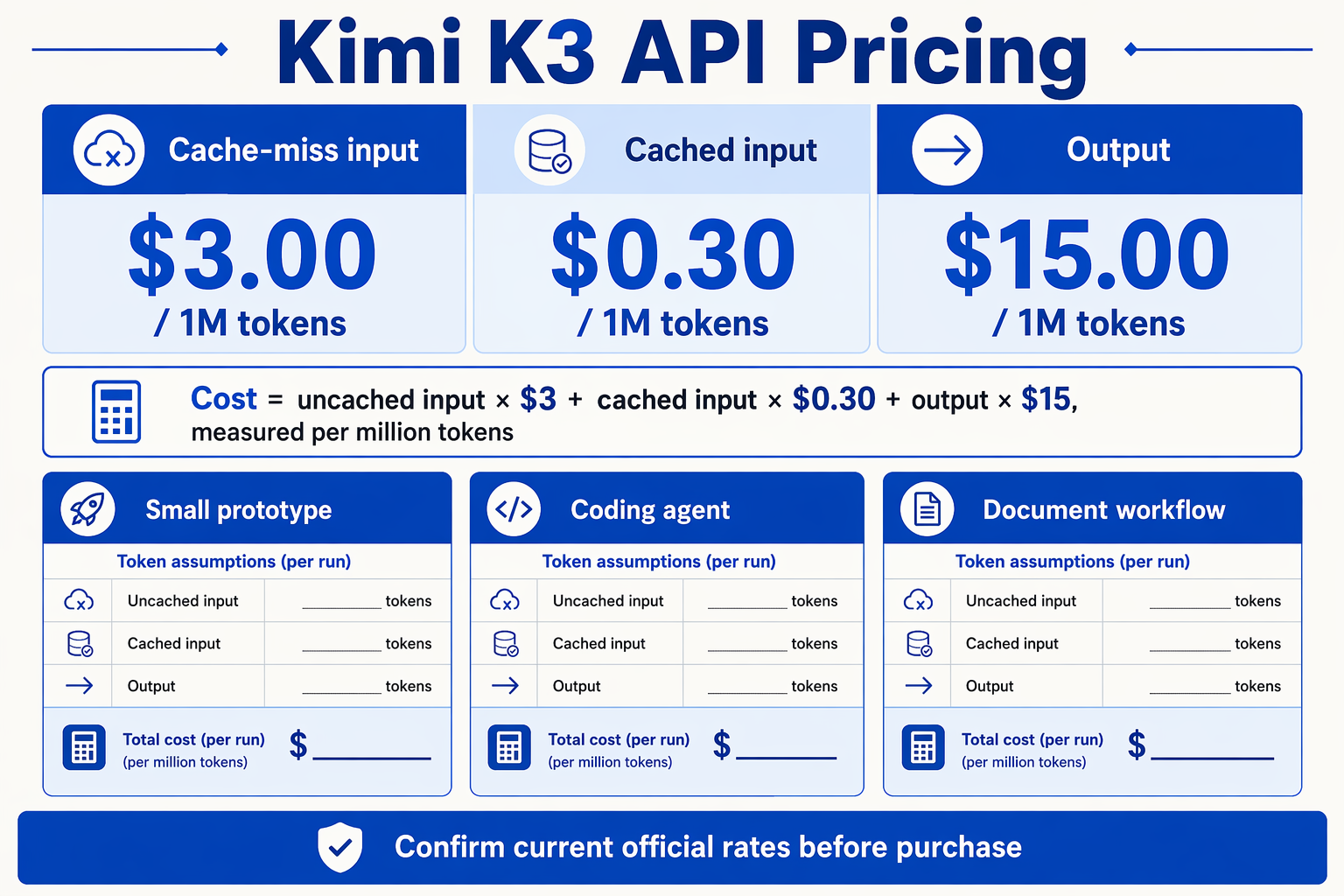
Kimi K3’s official pay-as-you-go API rate is $3 per million cache-miss input tokens, $0.30 per million cached input tokens, and $15 per million output tokens as of July 16, 2026. Real spending therefore depends less on the advertised 1-million-token context window than on output length, cache reuse, and how often an agent resends large prompts.
Official Kimi K3 rate card and cost formula
The official Kimi API Platform listed the following rates on July 16, 2026:
- Cache-miss input: $3.00 per million tokens
- Cache-hit input: $0.30 per million tokens
- Output: $15.00 per million tokens
- Billing model: Flat pay-as-you-go API pricing
Cached input is 90% cheaper than cache-miss input under this rate card. Output tokens cost five times as much as uncached input tokens and 50 times as much as cached input tokens, making verbose agent responses potentially more expensive than repository ingestion.
Use this formula, with token counts measured across all API calls:
Cost = (uncached input ÷ 1,000,000 × $3) + (cached input ÷ 1,000,000 × $0.30) + (output ÷ 1,000,000 × $15)
Worked API workload scenarios
These examples apply Moonshot AI’s official rates directly; they exclude taxes, currency conversion, gateway fees, retries, and failed or duplicated agent calls.
| Workload | Uncached / cached input | Output | Estimated cost | Without caching |
|---|---|---|---|---|
| Small coding task | 50K / 0 | 5K | $0.225 | $0.225 |
| One full-context analysis | 1M / 0 | 20K | $3.30 | $3.30 |
| Repeated repository pass | 100K / 900K | 20K | $0.87 | $3.30 |
| Ten-turn coding agent | 1.9M / 8.1M total | 200K | $11.13 | $33.00 |
| 100 document jobs | 20M / 0 total | 1M | $75.00 | $75.00 |
The ten-turn scenario assumes each call uses 900,000 reusable repository tokens, 100,000 new tokens, and 20,000 output tokens. Successful caching reduces the modeled bill from $33.00 to $11.13, a 66.3% saving. Actual cache eligibility and behavior should be verified through Kimi API usage records rather than assumed from identical-looking prompts.
Budgeting for production agents
Three operational details can materially change the invoice:
- Retries multiply token consumption. A $0.87 repository pass repeated three times costs approximately $2.61.
- Long reasoning or generated code raises output charges quickly. Every 100,000 output tokens costs $1.50.
- Cache misses can erase projected savings. Changing stable instructions, repository ordering, or large prompt prefixes may affect reuse, depending on Moonshot AI’s cache rules.
Kimi Code membership is a separate product from API token billing. Kimi Code documentation describes approximately 300–1,200 requests per five-hour window and up to 30 concurrent requests, so buyers should not treat subscription quotas as interchangeable with Kimi K3 API credits.
Provider markups and pricing-change checks
Third-party gateways may add platform fees, use different currencies, or route requests under provider-specific terms. Before deployment:
- Confirm the model identifier and rates on the official Kimi API Platform.
- Compare any aggregator’s displayed input, cached-input, and output prices.
- Check whether taxes, exchange-rate spreads, or prepaid-credit fees apply.
- Record the rate-card date in internal forecasts and set spend alerts.
- Recheck pricing before large batch jobs; the figures above are verified only for July 16, 2026.
How do you use the Kimi K3 API? — Account setup, authentication, model selection, first request, streaming, visual inputs, long-context prompting, caching, error handling, rate limits, security, and production monitoring
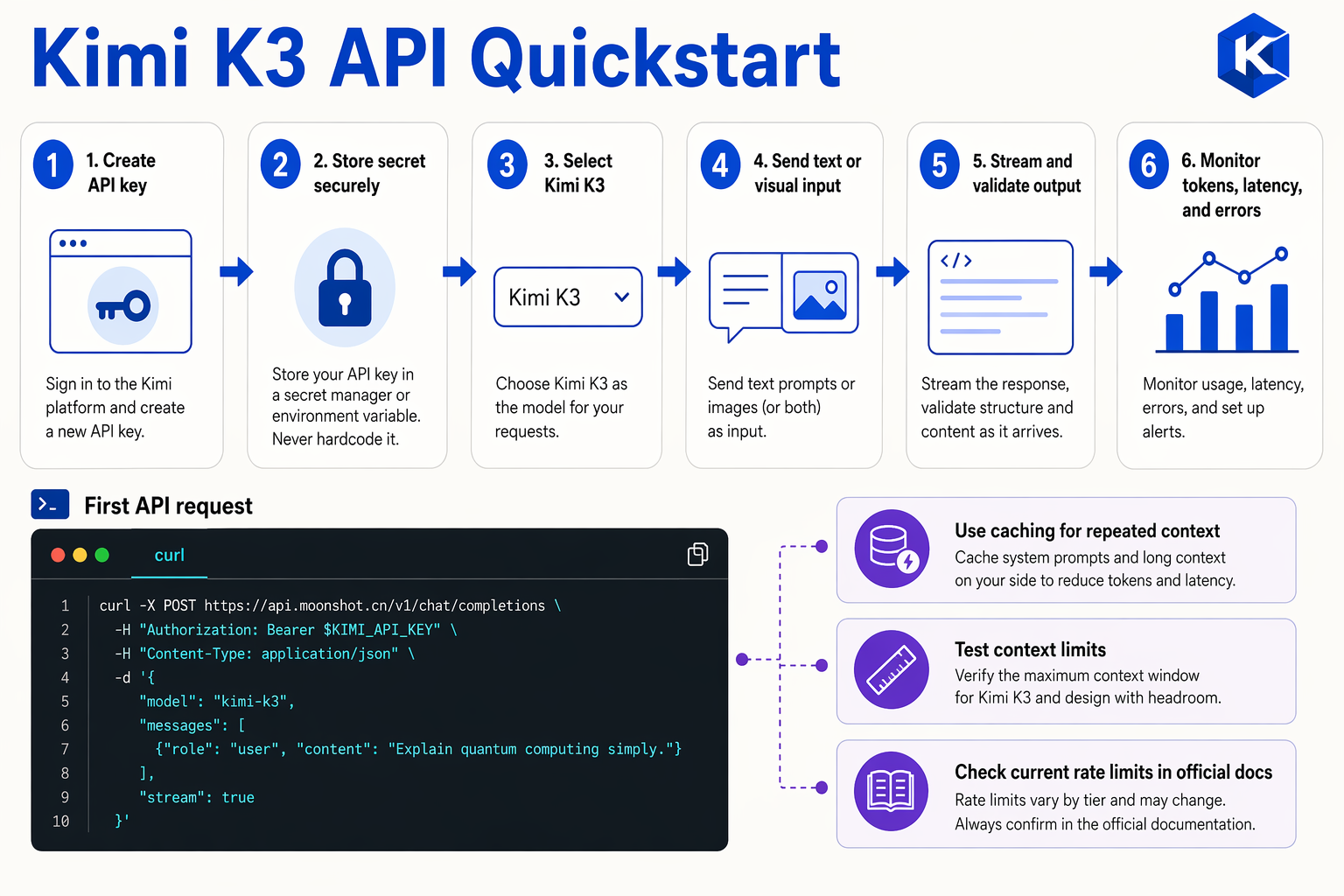
The Kimi K3 API is accessed by creating a Kimi API Platform account, generating a secret key, and sending OpenAI-style authenticated requests to the endpoint and model identifier shown in the official console. Use streaming for long outputs, reuse stable prompt prefixes to benefit from caching, and confirm account-specific rate limits before production deployment.
Account setup and first request
- Create an account on the Kimi API Platform and enable pay-as-you-go billing.
- Generate an API key and store it in a server-side secret manager.
- Copy the current base URL and exact Kimi K3 model ID from Moonshot AI’s quickstart; do not hard-code an identifier copied from an unofficial tutorial.
- Send a minimal request before adding tools, images, or large contexts.
An OpenAI-compatible Python pattern looks like this:
import os
from openai import OpenAI

client = OpenAI(
    api_key=os.environ["KIMI_API_KEY"],
    base_url=os.environ["KIMI_BASE_URL"]
)

response = client.chat.completions.create(
    model=os.environ["KIMI_MODEL"],
    messages=[
        {"role": "system", "content": "Answer with concise, sourced reasoning."},
        {"role": "user", "content": "Summarise this repository architecture."}
    ]
)

print(response.choices[0].message.content)
Keeping the endpoint and model name in environment variables makes migrations and same-tier fallback routing easier.
Streaming, images, and long context
Enable stream=True for coding agents, lengthy reports, and interactive applications so users see output as tokens arrive. Your client should assemble deltas, detect an interrupted stream, and preserve the request ID for troubleshooting.
The official Kimi API Platform described Kimi K3 on July 16, 2026 as having native visual understanding and a 1-million-token context window. For visual requests, follow the console’s current multimodal message schema, supply supported image URLs or uploaded assets, and validate file type, size, and access permissions before submission.
A million-token limit is capacity, not a recommendation to fill every request. For better long-context results:
- Put instructions and output constraints before the source material.
- Separate documents with explicit titles, dates, and identifiers.
- Ask the model to cite document IDs or line ranges.
- Retrieve only relevant material where possible.
- Test “needle-in-a-haystack” recall using your own documents.
Caching, errors, and rate limits
Prompt structure directly affects cost. The Kimi API Platform listed cache-hit input at $0.30 per million tokens, cache-miss input at $3 per million tokens, and output at $15 per million tokens on July 16, 2026. Keep reusable system instructions and large reference corpora stable at the beginning of requests, but verify through usage records whether a request actually received cached pricing.
Handle API failures by category:
- Retry 429 rate-limit and transient 5xx responses with exponential backoff and jitter.
- Do not blindly retry malformed-request, authentication, or context-limit errors.
- Use idempotency controls for workflows that trigger external actions.
- Set timeouts, retry ceilings, concurrency limits, and circuit breakers.
Moonshot AI’s Kimi Code documentation reports approximately 300–1,200 requests per five-hour window and up to 30 concurrent requests, but those figures apply to Kimi Code, not automatically to Kimi K3 API accounts. Read the API console’s account-specific limits rather than transferring subscription quotas to API capacity planning.
Security and production monitoring
Never expose a Kimi API key in browsers, mobile apps, logs, or source control. Route calls through your backend, rotate keys, redact personal data, restrict tool permissions, and defend retrieval pipelines against prompt injection.
Monitor latency, time to first token, input/output tokens, cache-hit rate, 429 frequency, error rate, cost per task, and answer quality. Log model versions and request IDs without retaining sensitive prompts unnecessarily, and run regression evaluations before changing prompts, tools, or model identifiers.
What do Kimi K3 benchmarks actually prove? — Official versus independent evidence, test settings, coding and agent evaluations, reproducibility requirements, contamination risk, and why early scores should not be invented or overread
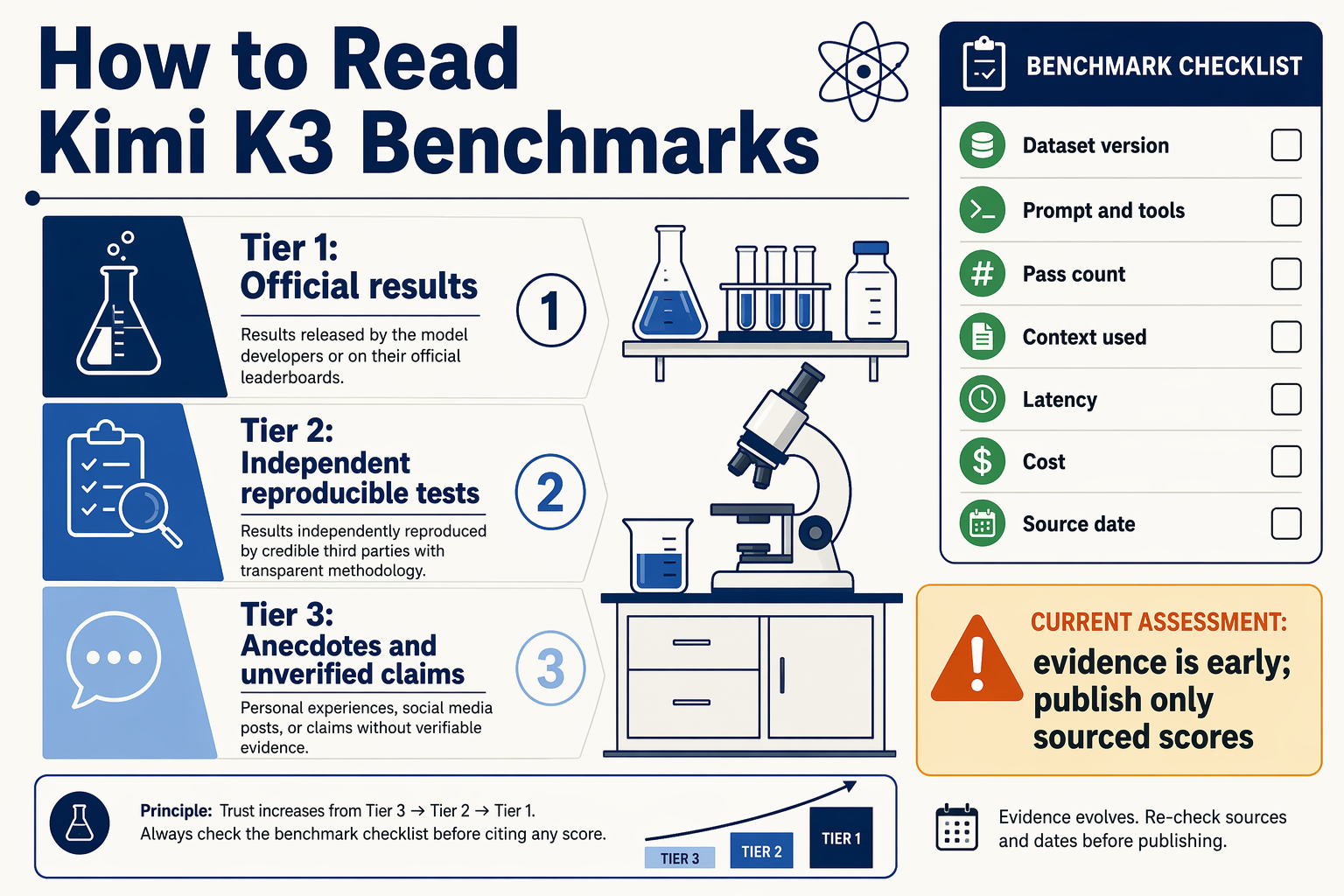
Kimi K3 benchmarks do not yet prove broad superiority or production reliability. As of July 16, 2026, the available evidence establishes Kimi K3’s official positioning and specifications, but it does not provide enough independently reproduced results to justify invented scores, universal rankings, or definitive “best model” claims.
Official claims are not independent validation
The Kimi API Platform calls Kimi K3 Moonshot AI’s “most capable model to date” and positions it for long-horizon coding and end-to-end knowledge work. The same official documentation confirms a 1-million-token context window and native visual understanding.
Those statements are useful, but they are not benchmark results. In the evidence reviewed for this guide, Moonshot AI does not provide all the information needed to audit a benchmark leaderboard, such as:
- Exact dataset versions and evaluation dates
- Prompts, system instructions, and tool definitions
- Sampling parameters, token budgets, and retry policies
- Whether reasoning traces or test-time scaling were used
- Pass@1 versus best-of-N reporting
- Error bars, run counts, and model snapshot identifiers
OpenRouter lists July 16, 2026 as Kimi K3’s release date. Because independent testing on launch day is necessarily limited, early charts and screenshots should be treated as provisional unless their methodology and raw outputs are available.
Coding scores require controlled settings
A credible Kimi K3 coding evaluation should separate code generation from repository-level software engineering. These tasks measure different capabilities:
- Function-level tests evaluate whether a model can solve short, self-contained programming problems.
- Repository-level tests, such as SWE-bench Verified, require issue interpretation, codebase navigation, patch creation, and test execution.
- Agent evaluations add shell access, search, tool selection, recovery from failed actions, and long-horizon planning.
- Human review examines maintainability, security, unnecessary changes, and whether a passing patch solves the intended problem.
Scores are not comparable when one model receives repository maps, repeated attempts, larger token budgets, or a stronger agent scaffold. For Kimi K3’s 1M-token context, evaluators should also report how much context was actually supplied; fitting an entire repository into a prompt does not prove that the model retrieved and used the correct evidence.
Agent benchmarks need cost and reliability data
An agent score without operational measurements can mislead buyers. Evaluations should report:
- Task success rate and failure categories
- Median and 95th-percentile completion time
- Input, cached-input, and output token consumption
- Tool calls, retries, and execution errors
- Total cost per successful task
This matters because the Kimi API Platform listed Kimi K3 at $3 per million cache-miss input tokens, $0.30 per million cached input tokens, and $15 per million output tokens on July 16, 2026. Two agents with equal success rates may have substantially different production economics.
Reproducibility and contamination are decisive
Benchmark publishers should disclose the model version, API date, harness commit, dataset revision, prompts, parameters, environment, and complete logs. At least three runs are preferable for nondeterministic agent tasks.
Contamination is another unresolved risk: public coding problems, solutions, and benchmark discussions may appear in training data. Stronger evidence comes from private or newly created test sets, time-split tasks released after training, deduplicated prompts, and verified execution. Until Kimi K3 receives such transparent, independent evaluation, its benchmark story should be described as promising but unconfirmed, not converted into unsupported numbers or overread as proof of universal capability.
What are Kimi K3’s architecture, context, tool-use, and deployment limits? — 1M-token workflows, native vision, long-horizon coding, parameter-count uncertainty, open-weight and license caveats, local deployment unknowns, and practical context-quality testing
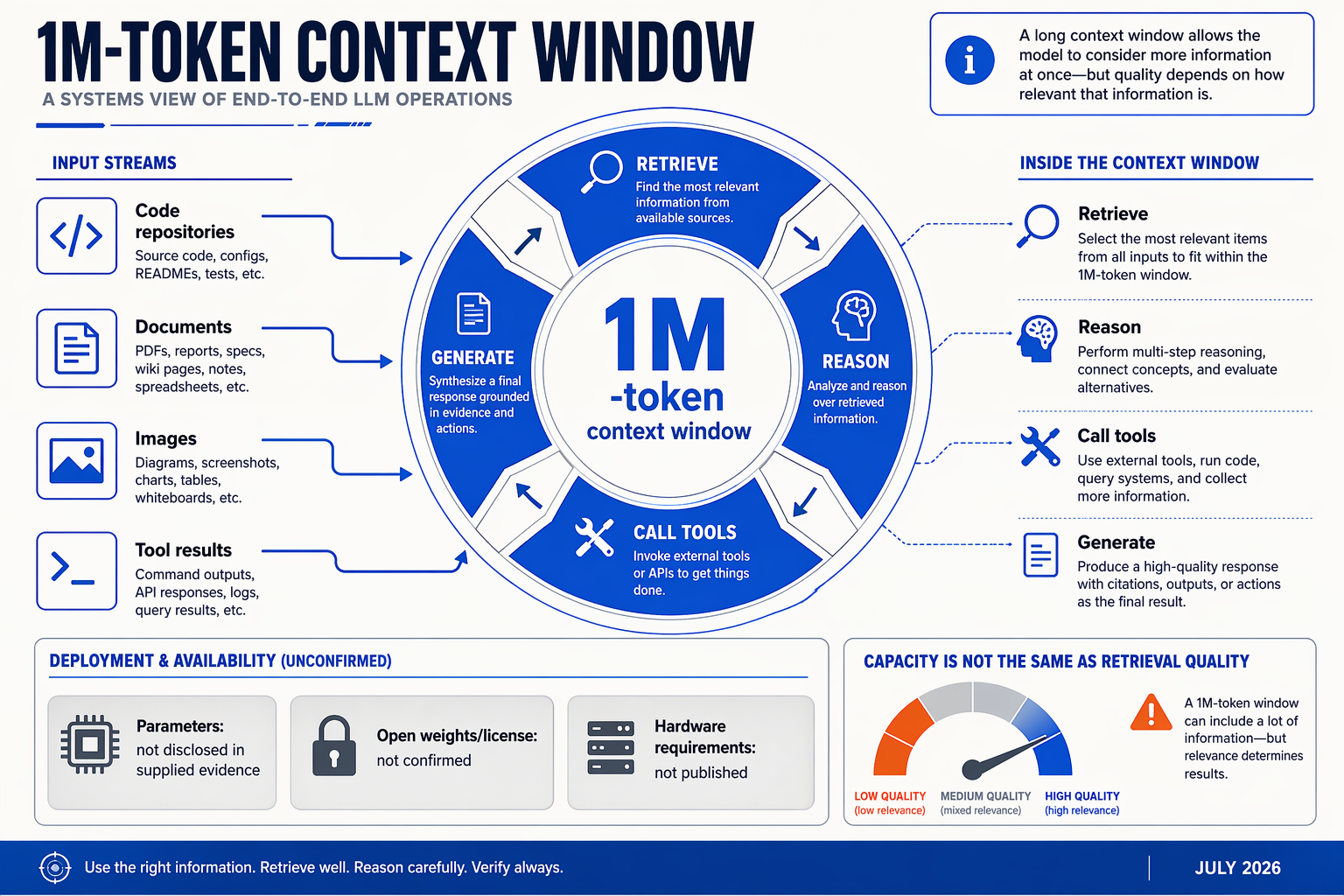
Kimi K3 officially offers a 1-million-token context window through the Kimi API Platform. Moonshot AI positions it for long-horizon coding and end-to-end knowledge work, but those claims do not establish uniform recall across the entire window or reliable autonomous tool execution.
As of July 16, 2026, the available primary documentation does not verify Kimi K3’s parameter count, architecture topology, downloadable weights, license, self-hosting process, or hardware requirements.
Confirmed context and vision capabilities
Kimi Platform documentation lists a 1M-token context window for Kimi K3 and describes native visual understanding. Potential applications include:
- Repository-scale code review and cross-file reasoning
- Analysis of long contracts, research collections, and support histories
- Processing text alongside screenshots, diagrams, or document images
- Agents that retain extensive plans, observations, and tool results
- Knowledge workflows using large collections of reference material
These are possible workloads, not guaranteed performance levels. A 1M-token capacity does not prove that Kimi K3 will retrieve every fact accurately, reconcile conflicting evidence, or follow instructions consistently throughout a maximum-length prompt.
“Native vision” also does not by itself define supported image formats, resolution and file-size limits, the number of images allowed per request, OCR accuracy, video support, or reliability on dense tables and charts. Confirm those details against the current API schema and test them with representative files.
Architecture and parameter count remain unverified
No cited primary Moonshot AI source establishes whether Kimi K3 uses a dense or mixture-of-experts architecture, its total or active parameter count, its training-data composition, or other architecture details.
Do not infer Kimi K3 specifications from Kimi K2, K2.6, K2.7, or another Moonshot model. Shared branding does not establish that the models use the same architecture, parameter count, context implementation, weights, or license. Precise claims about Kimi K3 parameters should remain labelled unverified unless they are supported by an official Moonshot model card, technical report, or repository.
Tool use requires production validation
Long-context capability is not the same as dependable tool use. Production agents also require clear function schemas, structured-output validation, retry limits, permission boundaries, persistent state, human approval gates, and detailed observability.
Before deploying Kimi K3 in an agentic workflow, test whether it can:
- Select the correct tool when several functions have similar descriptions
- Produce schema-valid arguments without silently inventing fields
- Handle unavailable tools, timeouts, and malformed results without looping
- Preserve instructions and task state through long, multi-step runs
- Request approval before destructive, financial, or irreversible actions
- Distinguish trusted instructions from prompt injection in retrieved text or images
- Resume safely after context truncation, retries, or application failures
Record success rates, invalid calls, retries, latency, and human interventions. Do not substitute general model positioning for task-specific tool-use evidence.
Open weights, licensing, and deployment limits
Current evidence confirms API availability, not downloadable Kimi K3 weights. Searches as of July 16, 2026, found no official Kimi K3 Hugging Face model card or MoonshotAI GitHub weights repository.
Accordingly, the following remain unverified unless a primary Moonshot source is cited:
- Downloadable checkpoints and checksums
- Open-weight or source-available status
- Commercial-use, modification, and redistribution rights
- Supported precision and quantization formats
- Compatible local inference and serving frameworks
- Self-hosting instructions
- GPU memory, node-count, storage, latency, and throughput requirements
- Hardware needed to serve the full 1M-token context window
Open-weight releases or licenses for earlier Kimi models do not automatically apply to Kimi K3. Teams should treat K3 as an API-access model for planning purposes unless Moonshot AI publishes model-specific weights, terms, and deployment guidance.
Test usable context, not just maximum context
A 1M-token limit is a capacity ceiling, not a guarantee of uniform recall or reasoning quality. Build a context-quality curve using the same evaluation at 32K, 128K, 256K, 512K, and approximately 1M tokens, subject to the API’s exact token-counting and request limits:
- Place unique facts near the beginning, middle, and end of the input.
- Require exact retrieval plus citations to the relevant source passages.
- Add plausible distractors, duplicated facts, and conflicting evidence.
- Test reasoning that depends on information spread across multiple documents.
- Repeat the evaluation with text, code, and supported visual inputs.
- Record latency, token usage, cost, refusals, tool errors, and answer degradation.
- Run each case multiple times to separate consistent performance from lucky retrieval.
Use documents and workflows that resemble production traffic. This reveals Kimi K3’s usable context for a specific application without inventing benchmark results or assuming that advertised capacity translates directly into dependable long-horizon performance.
Is Kimi K3 good for coding and knowledge work, and how does it compare with Kimi K2.7? — Use-case analysis, tool reliability, repository-scale tasks, multimodal workflows, limitations, and an evidence-first comparison that labels unsupported K2.7 claims
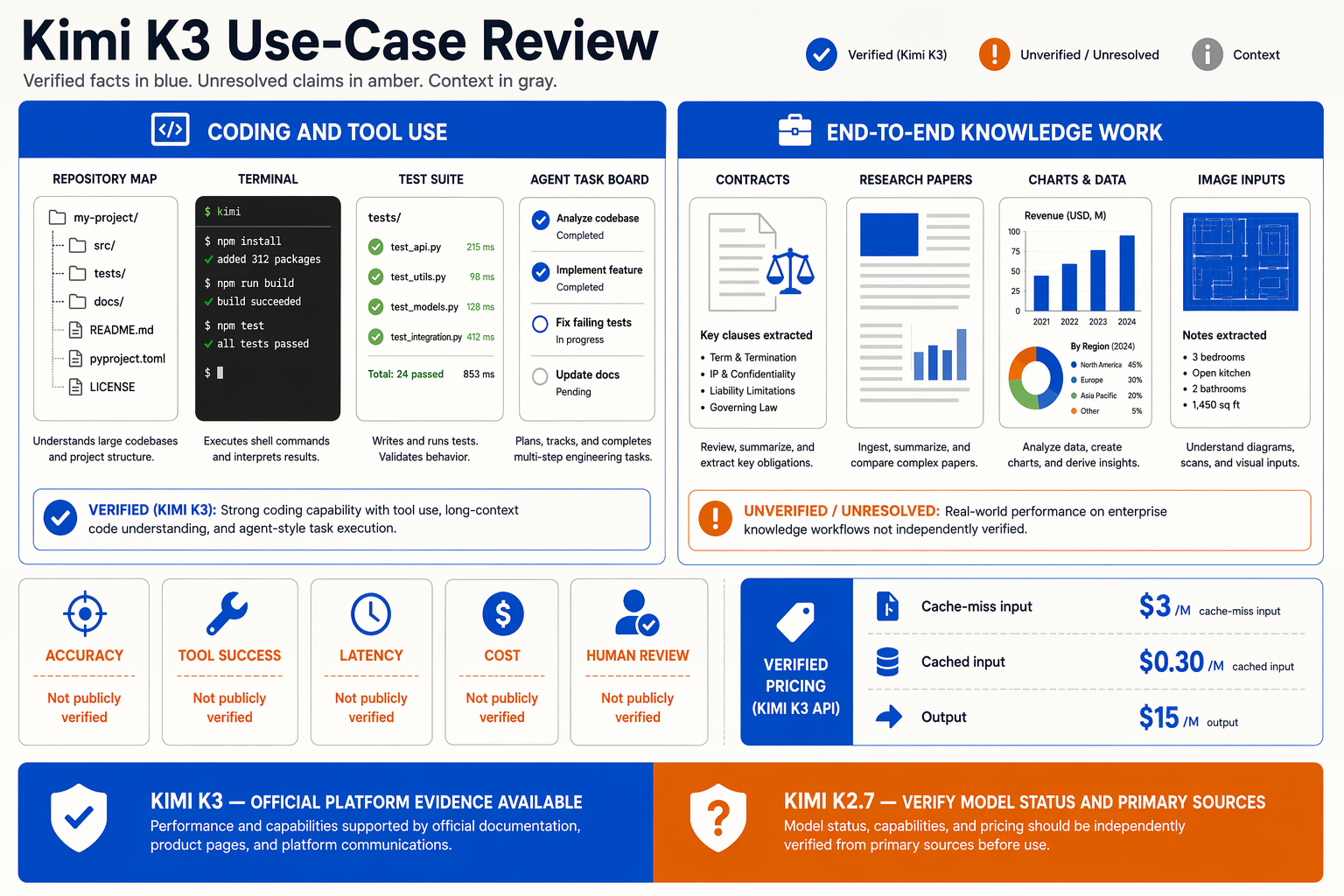
Kimi K3 appears well suited to coding and knowledge work, particularly when tasks combine large repositories, document collections, images, and tools. However, its production reliability is not yet established by enough independent post-launch evidence, and “Kimi K2.7” should not be treated as a verified Moonshot AI model without official documentation.
Coding and repository-scale tasks
Moonshot AI’s Kimi API Platform describes Kimi K3 as its flagship model for “long-horizon coding and end-to-end knowledge work.” The official Kimi API Quickstart confirmed on July 16, 2026 that Kimi K3 supports one million tokens of context, four times the 256K-token context window listed by OpenRouter for Kimi K2.5.
That capacity makes several workflows technically possible within one model context:
- Repository analysis: Inspect source files, tests, documentation, schemas, and issue histories together.
- Cross-file refactoring: Trace interfaces and dependencies before proposing coordinated changes.
- Migration planning: Compare old and new frameworks while preserving architectural constraints.
- Long-running agents: Retain more tool outputs and intermediate decisions before summarization becomes necessary.
A 1M-token window does not prove that Kimi K3 can accurately retrieve every detail from a million-token prompt. Developers should test needle retrieval, dependency tracing, patch correctness, test-pass rates, and performance at multiple context depths rather than equating capacity with usable recall.
Tool reliability and agentic coding
Kimi K3’s positioning suggests an emphasis on agent workflows, but tool reliability must be measured separately from general intelligence. A coding agent can produce a plausible plan while still selecting the wrong file, malformed tool arguments, repeating failed calls, or stopping before tests pass.
A production evaluation should record:
- Valid tool-call rate and schema compliance.
- Task completion rate under fixed time and token budgets.
- Compilation and test-pass rates for generated patches.
- Recovery rate after tool errors or contradictory results.
- Human review time compared with the existing development process.
The official Kimi Code documentation reports approximately 300–1,200 requests per five-hour window and up to 30 concurrent requests, but these are product usage limits—not evidence that Kimi K3 completes coding tasks reliably.
Multimodal knowledge work
The official Kimi API Quickstart states that Kimi K3 has native visual understanding, expanding its usefulness beyond text-only research. Potential workflows include analyzing diagrams alongside specifications, reading screenshots during debugging, extracting evidence from scanned reports, and connecting visual interface states to frontend code.
Buyers should nevertheless evaluate OCR accuracy, chart interpretation, image ordering, citation fidelity, and unsupported visual inferences. Native vision describes an input capability; it does not guarantee dependable conclusions for financial, medical, legal, or safety-critical documents.
Kimi K3 versus “Kimi K2.7”
An evidence-first comparison currently supports only a limited conclusion:
- Kimi K3: Officially documented by the Kimi API Platform with 1M-token context, native visual understanding, and long-horizon coding positioning.
- Kimi K2.6: Named on Moonshot AI’s official website as a natively multimodal model with coding and agent capabilities.
- Kimi K2.5: Listed by OpenRouter with 256K context and agentic coding positioning.
- Kimi K2.7: Unsupported in the supplied official evidence as of July 16, 2026. Claims about K2.7 Code pricing, benchmarks, parameters, or performance should be labeled unverified.
The practical verdict is promising but test-dependent: Kimi K3 has a strong specification for repository-scale and multimodal work, while independent benchmarks and production reliability data remain early.
What does Kimi K3 mean for developers, startups, and enterprise AI buyers? (TABLE) — Best-fit workloads, adoption signals, risks, evaluation plans, expert-source hierarchy, and the final buy, test, or wait verdict
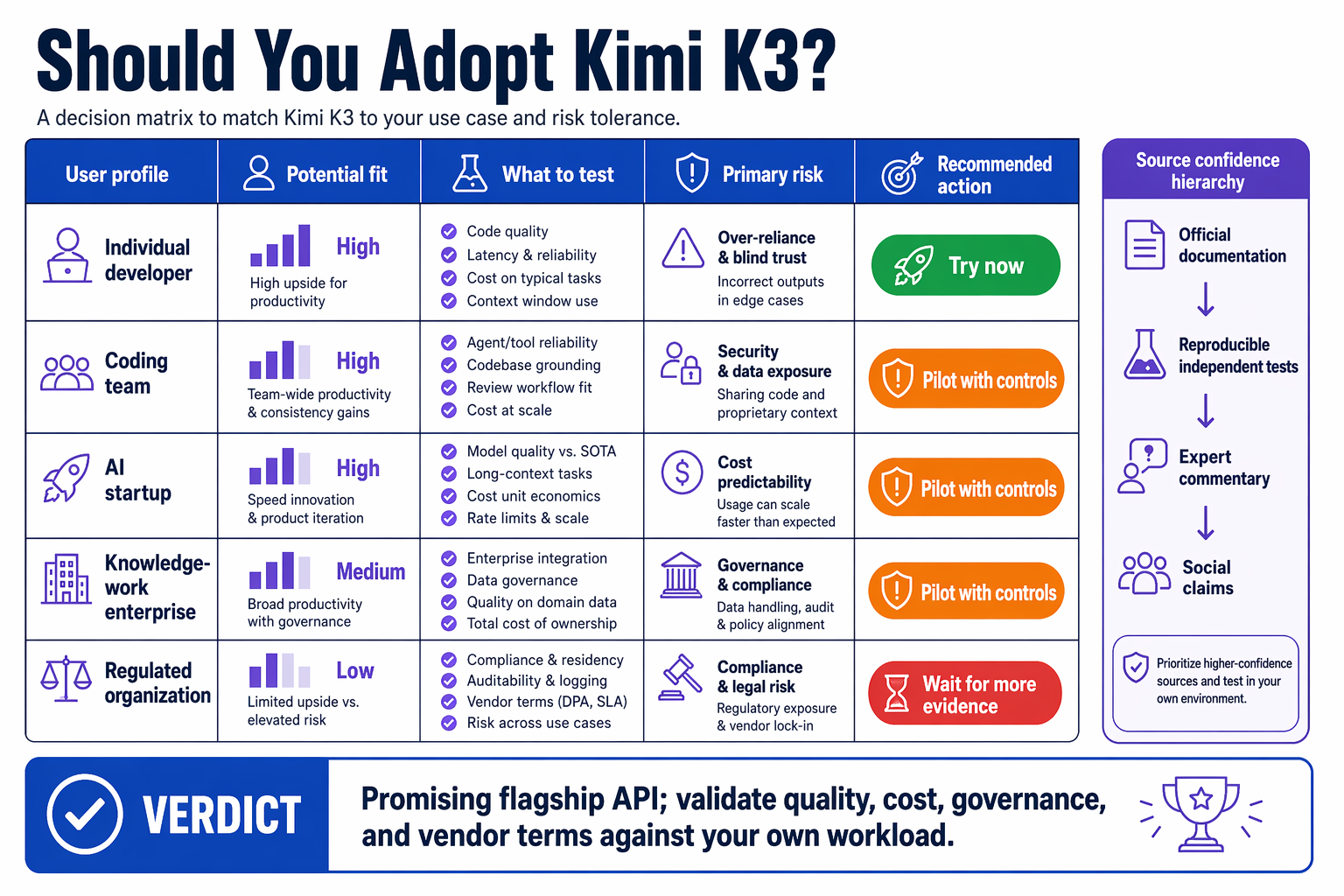
Kimi K3 is a “test now” model for long-context coding, multimodal analysis, and end-to-end knowledge work—not an automatic production migration. Developers and startups should pilot it against real workloads, while regulated enterprises should wait for verified licensing, deployment, security, and independent benchmark evidence before committing.
Best-fit workloads and adoption verdict
| Buyer or workload | Adoption signal | Primary risk | Verdict |
|---|---|---|---|
| Repository-scale coding agents | The official Kimi API Platform documents a 1M-token context window and positions Kimi K3 for long-horizon coding | Context capacity alone does not guarantee accurate cross-file reasoning, reliable patches, or successful tool calls | Test now |
| Research and knowledge workflows | Moonshot AI prices cached input at $0.30 per million tokens, 90% below the $3 cache-miss input rate, as of July 16, 2026 | Output costs $15 per million tokens, making verbose reports and repeated agent loops potentially expensive | Buy after a cost-controlled pilot |
| Multimodal document processing | The official Kimi API Platform confirms native visual understanding for combined image-and-text analysis | Public evidence remains limited for scans, charts, handwriting, and specialist imagery | Test now |
| Consumer and SMB applications | Pay-as-you-go API access lowers the cost of initial experimentation | A 1M-token window may provide little value for short chats, classification, or simple summaries | Compare with smaller models |
| Regulated enterprise deployments | Large context could support policy, contract, case-file, and internal-knowledge analysis | Kimi K3’s open-weight status, licence, parameter count, hardware requirements, and self-hosting options are not verified in the available official evidence | Wait or use a sandbox |
| Multi-model applications | API access supports model comparison and routing architectures | Rate limits, observability, provider-specific behaviour, and failover reliability require testing | Test behind a provider-neutral abstraction |
A production-shaped evaluation plan
A credible Kimi K3 buying decision should rely on representative tests rather than headline context limits or an early benchmark chart:
- Build a representative test set. Include real repositories, documents, images, prompts, tool calls, and known failure cases, with sensitive information removed.
- Measure outcomes, not impressions. Track coding test-pass rate, retrieval recall, citation faithfulness, tool-call completion, hallucination rate, latency, and human-review time.
- Test context scaling. Repeat tasks with short, medium, and near-maximum prompts. The official 1M-token capacity matters only if Kimi K3 can retrieve and apply the correct evidence across that window.
- Model total cost. Separate cache hits, cache misses, generated output, retries, agent loops, and concurrency. Moonshot AI’s official July 2026 rates make prompt caching a first-order architectural decision.
- Stage deployment. Move from offline evaluation to shadow traffic, restricted users, and a reversible production rollout.
- Preserve portability. Use a provider-neutral or OpenAI-compatible abstraction where practical, but test streaming, tool schemas, error handling, and fallback behaviour rather than assuming interchangeability.
Which Kimi K3 sources should buyers trust?
Use this evidence hierarchy whenever pricing, capabilities, benchmarks, or release details conflict:
- Tier 1 — Official documentation: Prioritise the Kimi API Platform for API behaviour, pricing, context limits, and supported modalities.
- Tier 2 — Reproducible independent tests: Prefer evaluations publishing prompts, datasets, model settings, dates, and raw outputs.
- Tier 3 — Established aggregators: OpenRouter lists July 16, 2026 as the Kimi K3 release date, but this remains secondary to a dated Moonshot AI announcement.
- Tier 4 — Unverified claims: Treat anonymous benchmark charts, screenshots, social posts, and undocumented parameter or licence claims as leads—not buying evidence.
Final verdict: test Kimi K3 now for long-context coding, recurring knowledge work, and multimodal analysis; buy only after workload-specific validation; wait for stronger official and independent evidence if open weights, self-hosting, compliance, or predictable deployment requirements are mandatory.
Frequently asked questions about Kimi K3 pricing, release date, API access, benchmarks, context window, coding, parameters, open weights, local deployment, and Kimi K3 vs K2.7

Availability and cost
What is the Kimi K3 release date, and how much does Kimi K3 cost?
How can developers access the Kimi K3 API?
Performance and context
How good is the model for coding, agents, and benchmark-heavy workloads?
Does the one-million-token context window mean it can understand an entire codebase perfectly?
Architecture and comparisons
Are the parameter count, open weights, licence, and local deployment requirements confirmed?
How does Kimi K3 vs Kimi K2.7 compare for coding, context, and price?
Conclusion
Kimi K3 is a compelling post-launch option for long-context coding, multimodal analysis, and end-to-end knowledge work—but production adoption should follow workload-specific testing, not specifications alone. As of July 16, 2026, the evidence supports four conclusions:
- Context is the headline capability: The official Kimi API Platform confirms a 1-million-token context window and native visual understanding, although capacity alone does not guarantee accurate retrieval across every token.
- Caching can transform the economics: The Kimi API Platform lists pricing of $3 per million cache-miss input tokens, $0.30 per million cached input tokens, and $15 per million output tokens—making reusable prompts and knowledge bases significantly cheaper.
- The API is developer-friendly: OpenAI-style integration reduces migration effort, while Kimi K3’s coding and tool-use capabilities make it relevant to repository-scale agents and sustained research workflows.
- Important evidence remains incomplete: Independent benchmarks are still emerging, while parameter counts, open-weight availability, licensing terms, and self-hosting requirements should not be assumed without official confirmation.
Next, watch for reproducible third-party benchmarks, dated Moonshot AI release documentation, reliability testing, and clearer deployment disclosures. To explore how this broader shift is reaching customer communication, check out CallMissed, an AI infrastructure platform for voice agents, multilingual chatbots, and unified model access.
Does Kimi K3’s million-token capacity solve a real production constraint for your team—or merely offer headroom you may never use?
Related Reading
Related Posts
Ready to automate customer conversations?
Launch AI voice agents and WhatsApp bots with CallMissed — one API, 22+ Indian languages.