

Inkling Open-Weights Model: Verified Multimodal Capabilities for Developers



Understand verified Inkling AI model capabilities, controllable reasoning effort, multimodal inputs, and a practical Tinker fine-tuning evaluation plan.
Inkling Open-Weights Model: Verified Multimodal Capabilities for Developers
A 975-billion-parameter open-weights multimodal model that can reason across text, images, and audio is now available for developers to examine—but the most important question is not its scale. The Inkling Open-Weights Model matters because Thinking Machines has paired a large Mixture-of-Experts (MoE) release with controllable reasoning effort and access to Tinker fine-tuning, shifting the developer conversation from “Which model is largest?” to “Which capabilities are actually verified and useful for a production workload?”
Thinking Machines’ official Inkling announcement confirms that Inkling is the company’s first open-weights model, a multimodal MoE model with controllable reasoning effort, and a model available for fine-tuning on Tinker. The official Hugging Face model page further establishes an important implementation boundary: Inkling accepts text, image, and audio inputs and produces text outputs. That means developers can evaluate Inkling for tasks such as document interpretation, visual question answering, audio understanding, and cross-modal analysis—but should not assume it generates images, audio, video, or other non-text outputs.
The timing is significant. As model teams increasingly need to manage inference cost, latency, privacy, and domain adaptation, a fixed “maximum reasoning” setting is rarely the right answer for every request. Thinking Machines describes controllable reasoning effort as a mechanism to balance cost and performance. In practice, that could let a team reserve higher-effort reasoning for difficult exception handling while using lower effort for routine classification, extraction, or customer-support triage. The specific performance trade-offs, however, must be tested against a developer’s own workload rather than inferred from the announcement.
This analysis takes a verification-first view of the Inkling AI model. It will separate what Thinking Machines has publicly confirmed—native text, image, and audio reasoning; controllable effort; and Tinker availability—from claims that require further primary documentation. Developers should not yet presume a particular hosted API, token pricing, deployment footprint, benchmark result, hardware requirement, commercial license interpretation, or self-hosting recipe unless Thinking Machines publishes those details directly.
That discipline matters especially for teams building customer-facing AI. Platforms such as CallMissed reflect the broader move toward model-flexible AI infrastructure, where developers may want to test multiple language, speech, and multimodal capabilities through a consistent integration layer. Inkling’s open-weights design and Tinker fine-tuning option add another potential route: adapting a capable multimodal foundation model to a specialized dataset and evaluating it under controlled quality, cost, and safety criteria.
The practical opportunity is real—but so is the need to verify every operational assumption before committing an architecture.
What is the Inkling AI model, and what has Thinking Machines officially confirmed?
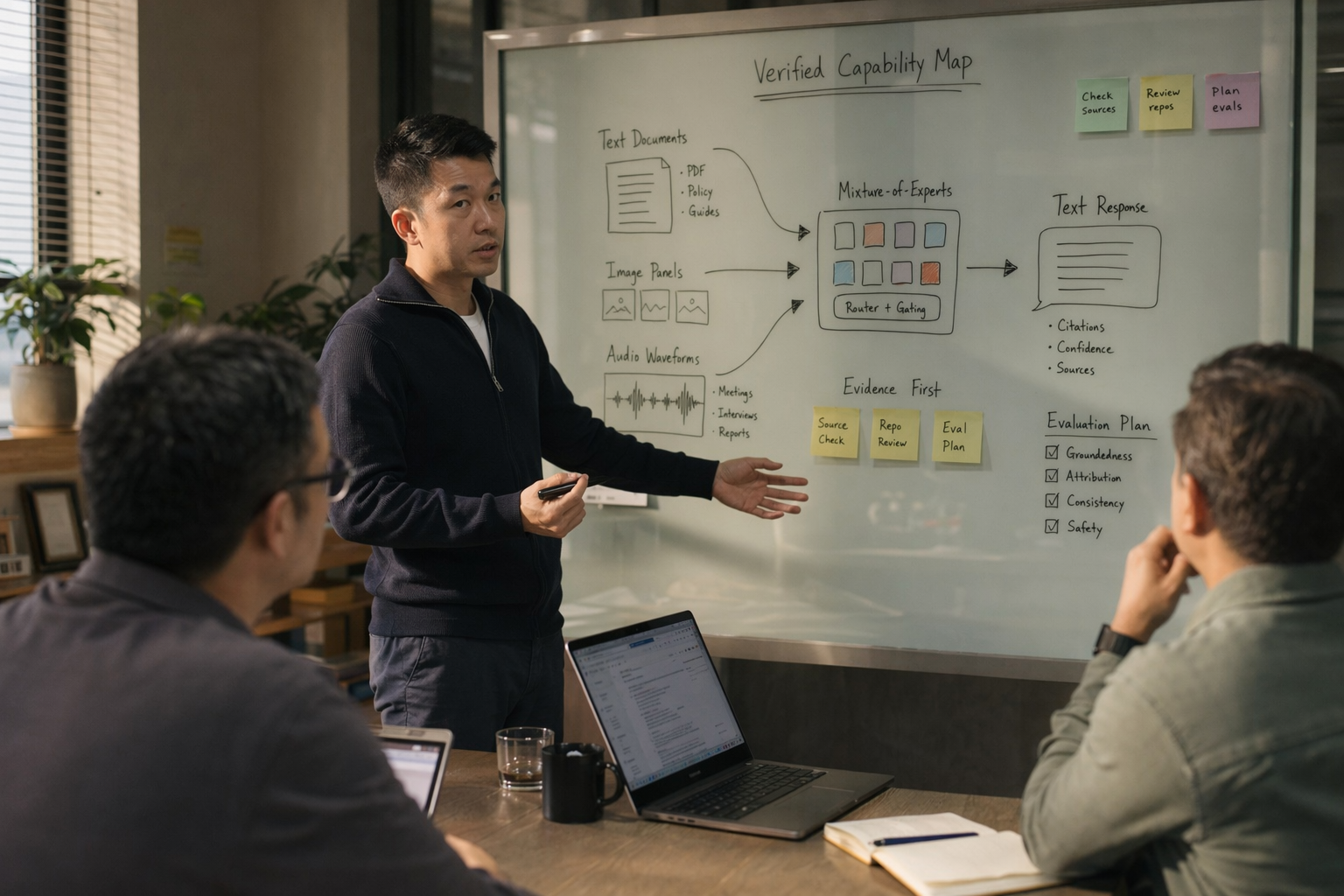
The Inkling AI model is Thinking Machines’ first open-weights multimodal model: a 975-billion-parameter Mixture-of-Experts system that reasons across text, images, and audio while allowing developers to adjust reasoning effort. Thinking Machines has officially confirmed the model’s multimodal inputs, text-only outputs, controllable reasoning effort, and availability for Tinker fine-tuning—but not a full set of deployment, pricing, benchmark, or hosting details.
What Thinking Machines has confirmed
Thinking Machines describes Inkling as an open-weights multimodal model with a Mixture-of-Experts (MoE) architecture. The company’s official Inkling announcement explicitly calls it its “first open-weights model” and states that it is multimodal, supports controllable reasoning effort, and is available to fine-tune on Tinker.
The confirmed capability set is specific:
- Native multimodal reasoning: Thinking Machines says Inkling reasons across text, images, and audio rather than treating multimodality as an external add-on.
- Text generation output: The official Hugging Face model page states that Inkling accepts text, image, and audio inputs and produces text outputs.
- Adjustable reasoning: Thinking Machines says controllable reasoning effort is intended to balance cost and performance.
- Fine-tuning availability: Thinking Machines confirms developers can access Inkling for fine-tuning through Tinker.
That input/output distinction is operationally important. A developer could provide an image of an invoice alongside a spoken customer explanation and ask Inkling to return a structured text summary or classification. The official materials do not establish that Inkling generates images, speech, music, or video; a text response is the confirmed output modality.
Why the 975B parameter figure needs context
Inkling has 975 billion parameters, according to Thinking Machines’ official announcement. That figure signals a very large foundation-model release, but parameter count alone does not tell a developer the information needed for production adoption—such as active parameters per request, throughput, context limits, memory requirements, latency, serving cost, or task-level accuracy.
The MoE designation matters because MoE systems commonly route a request through subsets of specialized model components rather than necessarily using every parameter for every token. However, developers should not infer Inkling’s active-parameter count, routing behavior, hardware profile, or efficiency characteristics until Thinking Machines publishes technical documentation that confirms them.
The practical meaning of official confirmation
For an evaluation team, the current evidence supports testing Inkling for workloads such as:
- Document and image understanding, including extracting text-grounded information from visual materials.
- Audio understanding, such as analyzing a recording and returning a text summary, label, or answer.
- Cross-modal reasoning, where text instructions, images, and audio provide complementary context.
- Domain adaptation, using Tinker fine-tuning to test whether specialized training data improves task performance.
It does not yet support assuming:
- A public hosted inference API or an OpenAI-compatible endpoint.
- Token prices, GPU requirements, self-hosting instructions, or regional availability.
- A particular commercial-license interpretation.
- Benchmark leadership or a guaranteed quality level on a business-specific task.
This verification boundary is useful rather than limiting. For example, CallMissed, the OpenAI-compatible AI gateway, reflects why teams increasingly separate model experimentation from infrastructure assumptions: a multimodal model may be promising, but its fit depends on measurable quality, latency, language coverage, safety behavior, and total cost for the actual workflow.
How does the open-weights multimodal model fit into Inkling’s background and context?
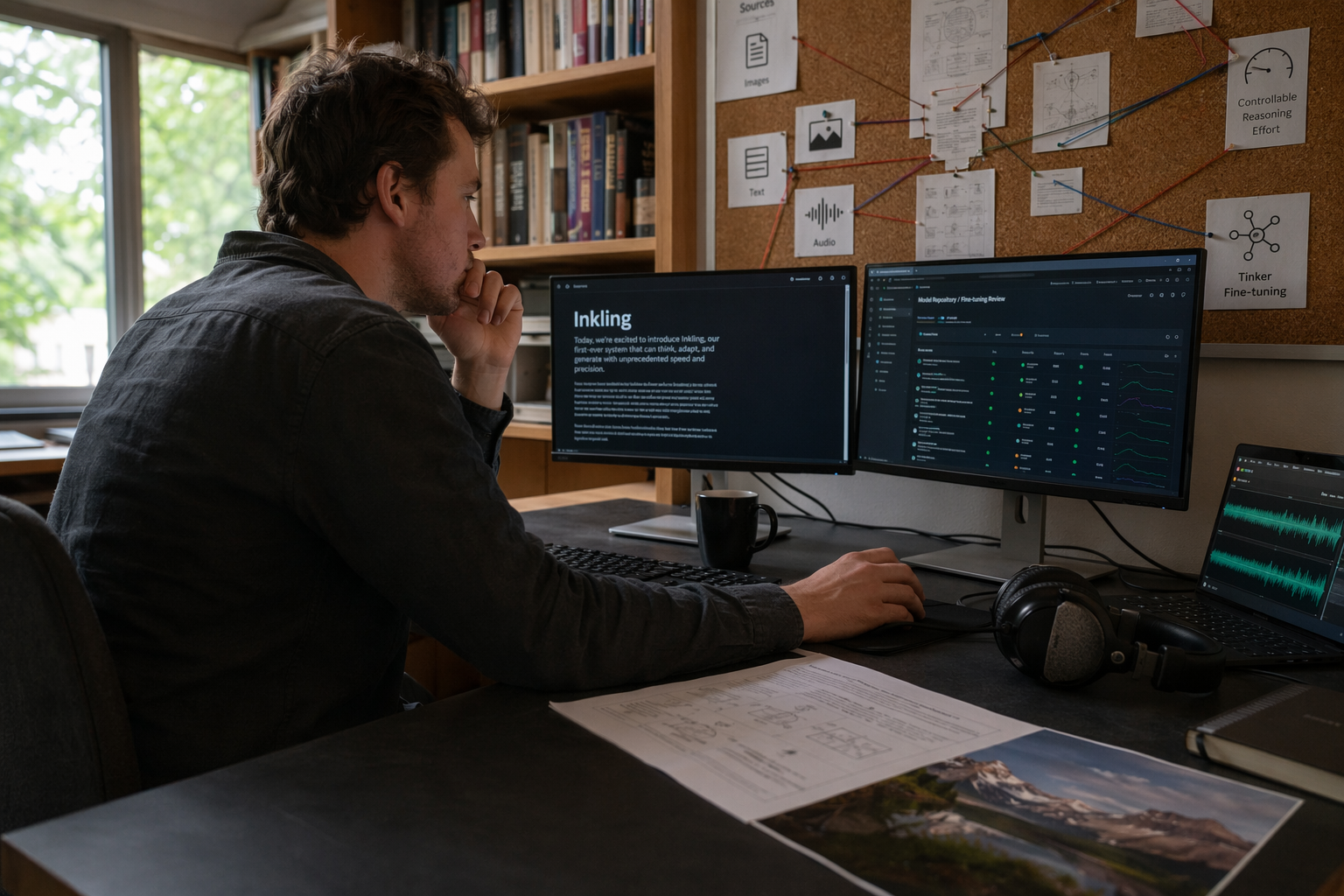
The Inkling AI model fits into Thinking Machines’ background as a first public foundation-model release designed around developer control rather than a narrowly packaged application. Thinking Machines has confirmed that Inkling is its first open-weights model, making the release a meaningful signal of how the company intends developers and researchers to inspect, adapt, and evaluate its work.
A first open-weights release, not a claim of full operational openness
Thinking Machines describes Inkling as an open-weights multimodal model and a Mixture-of-Experts (MoE) system. The distinction matters: open weights generally enable deeper experimentation than a model available only through a hosted interface, but they do not automatically establish every deployment right, training-data detail, license condition, hardware requirement, or commercial-use permission.
Developers should treat the confirmed announcement as evidence of these specific foundations:
- Model architecture category: Thinking Machines identifies Inkling as a Mixture-of-Experts model, a design that routes work through subsets of specialized model components rather than necessarily activating every parameter for every request.
- Native modality coverage: Thinking Machines says Inkling can reason across text, images, and audio.
- Input-output boundary: The official Hugging Face model page states that Inkling accepts text, image, and audio inputs and produces text outputs.
- Adaptation path: Thinking Machines says Inkling is available for Tinker fine-tuning.
That combination places Inkling in a different category from a text-only open model or a closed multimodal API. It is potentially relevant wherever an application must interpret several forms of customer or operational evidence together—such as a photographed document plus a spoken explanation and typed metadata—while ultimately returning a text decision, summary, extraction, or next action.
Why controllable reasoning effort is central to the context
Thinking Machines frames controllable reasoning effort as a way to balance cost and performance. That framing is especially relevant in the current model market, where “more reasoning” is not automatically the right production default.
A developer could conceptually divide a workload into tiers:
- Low effort: routine routing, tagging, extraction, or straightforward questions.
- Medium effort: ambiguous support cases, multi-step document review, or multimodal reconciliation.
- High effort: exceptions where the cost of an incorrect response justifies more latency or inference spend.
Thinking Machines has confirmed the control exists, but it has not, in the supplied primary materials, published workload-specific latency, token, price, or accuracy trade-offs. A responsible adoption plan therefore requires internal evaluation rather than assuming that a particular effort level will meet a service-level objective.
What Tinker fine-tuning signals—and what it does not
Tinker fine-tuning makes Inkling notable as more than a weights release: Thinking Machines is explicitly connecting the model to an adaptation workflow. The practical implication is that teams may be able to tailor Inkling to domain-specific examples, policies, terminology, and output formats rather than relying solely on prompting.
For example, a regional service business could evaluate whether tuned multimodal understanding improves interpretation of voice notes, photographed forms, and mixed-language customer messages. Indian AI infrastructure providers such as CallMissed illustrate why this direction matters: production systems increasingly combine voice, chat, knowledge retrieval, and regional-language interactions rather than treating AI as text-only automation.
However, availability on Tinker should not be read as proof of a particular fine-tuning method, dataset limit, training cost, evaluation suite, or production hosting arrangement. Until Thinking Machines publishes those details directly, the verified takeaway is narrower but still significant: Inkling is positioned as an inspectable, multimodal foundation model with adjustable reasoning and a stated path for customization.
Which Inkling AI model capabilities are confirmed, and which details remain unverified? (TABLE)
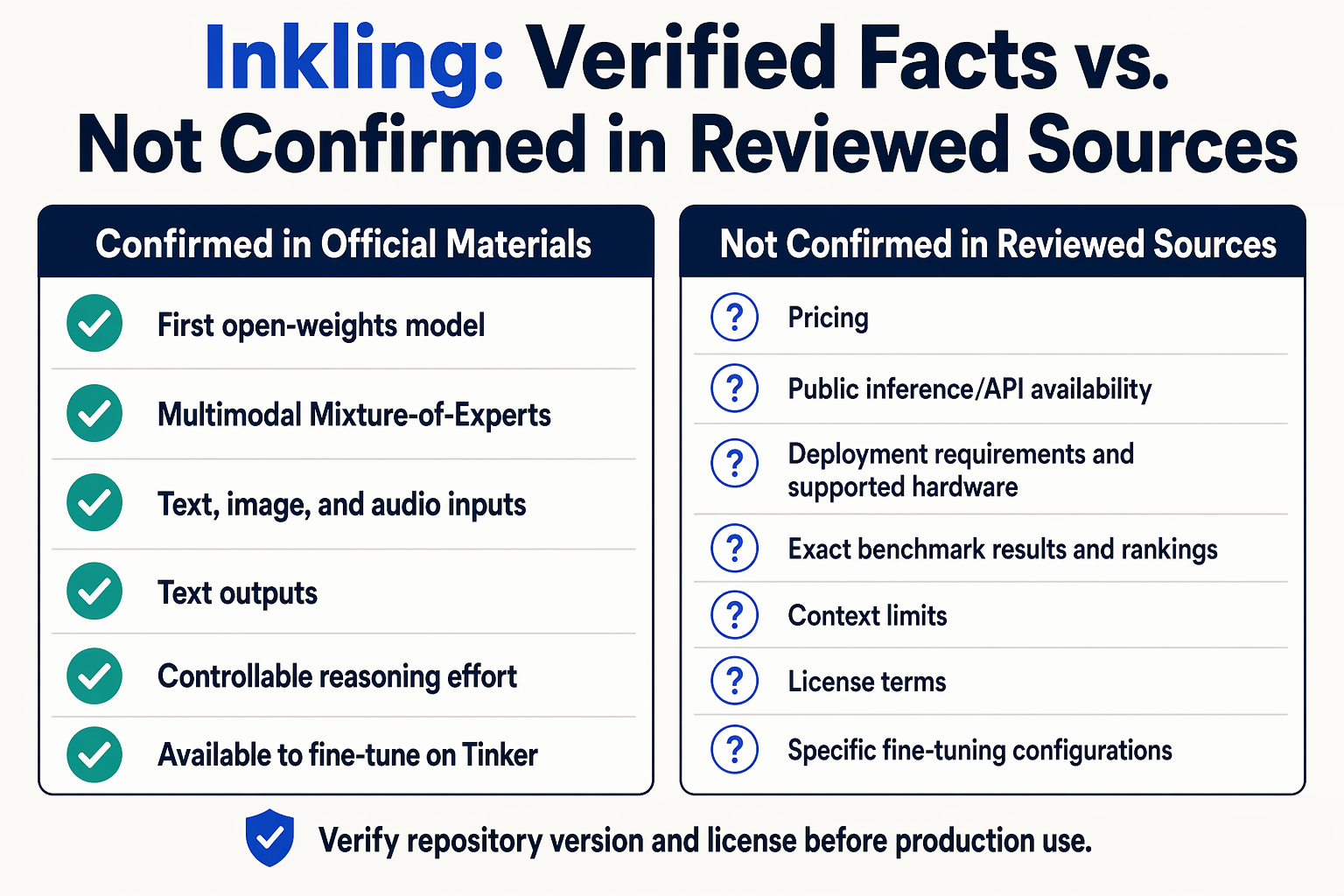
The Inkling AI model’s core modality, architecture, reasoning-control, and Tinker fine-tuning availability are confirmed by primary sources. Deployment mechanics, model economics, benchmark performance, licensing interpretation, and hosting options remain unverified unless Thinking Machines publishes technical documentation for them.
Confirmed versus unverified Inkling AI model details
| Area | What primary sources confirm | What developers should not assume | Verification source |
|---|---|---|---|
| Model scale and release type | Inkling is Thinking Machines’ first open-weights model and has 975 billion parameters. | “Open weights” does not automatically establish permissive commercial terms, redistribution rights, or a specific license. | Thinking Machines official Inkling announcement |
| Architecture | Inkling is a multimodal Mixture-of-Experts (MoE) model. | The official announcement does not, by itself, establish active parameters per token, expert count, context length, memory use, or GPU requirements. | Thinking Machines official Inkling announcement |
| Input and output modalities | The official Hugging Face model page states that Inkling accepts text, image, and audio inputs and produces text outputs. | Developers should not describe Inkling as an image generator, text-to-speech model, audio generator, video model, or multimodal-output model. | Official Hugging Face model page |
| Multimodal reasoning | Thinking Machines says Inkling reasons natively across text, images, and audio. | Native multimodal reasoning does not prove a particular score on document OCR, speech transcription, visual grounding, medical imaging, or multilingual audio tasks. | Thinking Machines official Inkling announcement |
| Controllable reasoning effort | Thinking Machines confirms controllable reasoning effort intended to balance cost and performance. | No published claim in the supplied primary material establishes the available effort levels, latency change, token usage, pricing multiplier, or quality gain at each setting. | Thinking Machines official Inkling announcement |
| Tinker fine-tuning | Thinking Machines states that Inkling is available for fine-tuning on Tinker. | This does not confirm self-hosted fine-tuning, supported training methods, dataset limits, regional availability, queue times, or Tinker pricing. | Thinking Machines official Inkling announcement |
Why these boundaries matter in production
The most actionable confirmed fact is that Inkling is an input-multimodal, text-output model. A developer could therefore evaluate the open-weights multimodal model for workflows such as:
- Extracting information from invoices or photographed forms and returning structured text.
- Answering questions about screenshots, product images, or charts.
- Interpreting an audio recording alongside a written customer history.
- Routing complex customer cases where text, image, and audio evidence must be considered together.
However, a production design should keep the output boundary explicit. If a workflow requires spoken replies, image creation, or generated media, Inkling would need to be paired with separately verified output services. For example, a customer-engagement stack may combine a multimodal reasoning model with dedicated speech synthesis and messaging infrastructure rather than assume one model handles every channel.
Controllable reasoning effort is also a capability to test, not a performance promise. Thinking Machines frames the control as a way to balance cost and performance, but teams should measure it on their own task mix. A practical evaluation can compare low-, medium-, and high-effort settings against the same test set, recording:
- Task accuracy and human-review rate.
- End-to-end latency.
- Input and output token consumption, where exposed.
- Failure patterns on image and audio inputs.
- Cost per successfully resolved task.
Tinker fine-tuning adds a meaningful adaptation route, particularly for organizations with specialized terminology or labeled multimodal examples. Yet “available to fine-tune on Tinker” should not be expanded into claims about supported algorithms or commercial terms without documentation. Platforms such as CallMissed, the OpenAI-compatible AI gateway, illustrate why this verification discipline matters: teams can test different language, speech, and multimodal components through a consistent integration approach while retaining evidence-based selection criteria.
How should developers evaluate controllable reasoning effort for quality, latency, and cost?
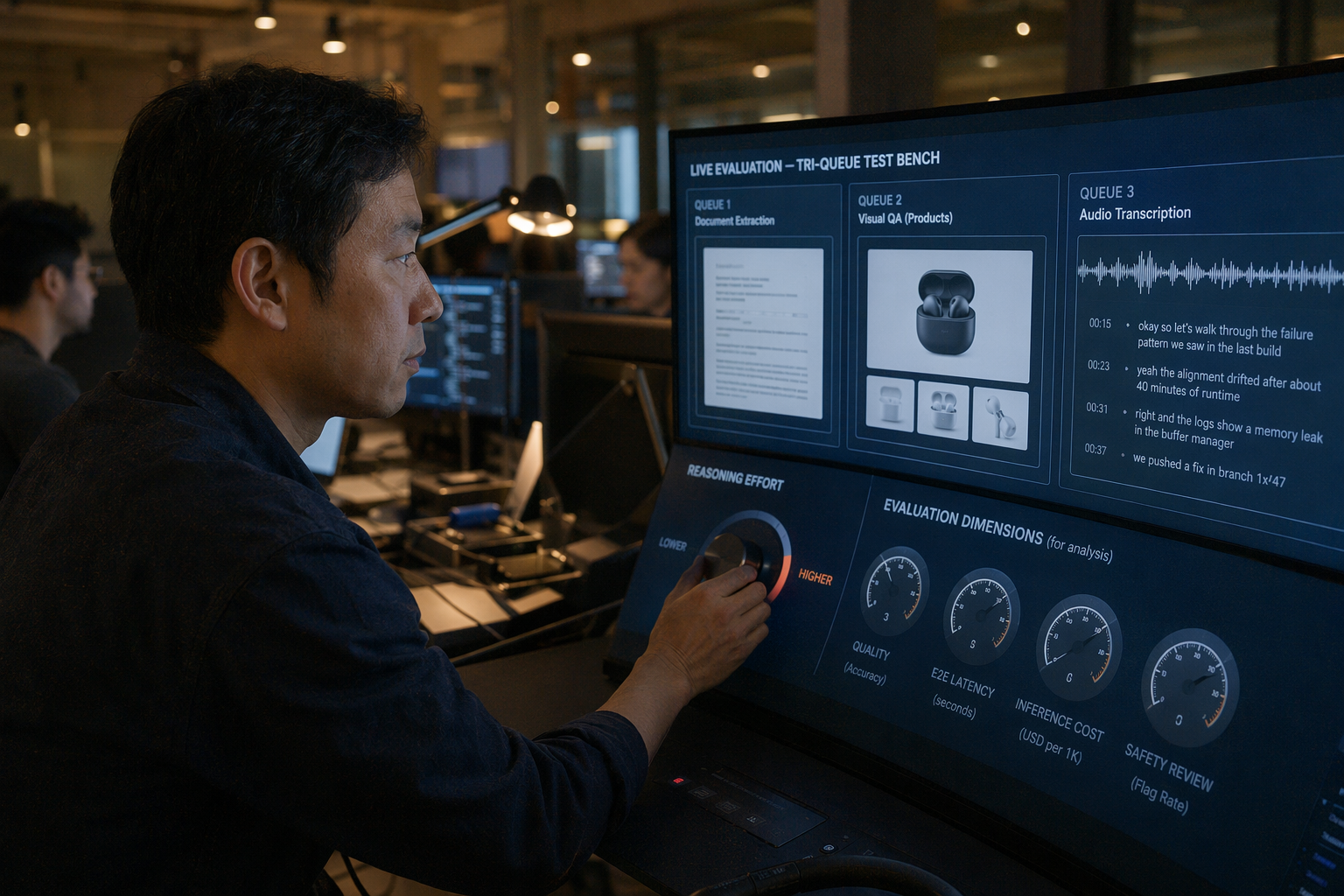
Developers should evaluate controllable reasoning effort as a workload-level routing decision, not as a universal “higher is better” setting. For the Inkling AI model, the right configuration is the lowest reasoning effort that meets a predefined quality threshold within an acceptable latency and cost budget.
Measure the quality–latency–cost frontier
Thinking Machines states that Inkling’s controllable thinking effort is designed to balance cost and performance, but the official materials do not establish a universal effort setting, token cost, latency figure, or benchmark curve for every application. Teams should therefore produce their own evidence using representative production tasks.
A practical evaluation starts with three or more effort tiers—such as low, default, and high, using the controls exposed in the applicable Inkling interface—and measures each against the same held-out dataset.
Track the following metrics for every tier:
- Task quality: Exact-match rate for extraction, F1 for classification, rubric scores for open-ended answers, or human preference rates for customer-facing responses.
- Latency: Median latency plus p95 and p99 latency, since long-tail delays often determine whether an interactive workflow feels reliable.
- Cost: Input tokens, output tokens, reasoning tokens if reported, and total request cost. If self-hosting becomes an option, include GPU, batching, and operations costs rather than comparing token counts alone.
- Reliability and safety: JSON-schema validity, citation accuracy, refusal correctness, hallucination rate, and escalation rate.
- Multimodal accuracy: Measure text, image, and audio cases separately before treating an aggregate score as meaningful.
A 975-billion-parameter open-weights Mixture-of-Experts model does not eliminate the need for workload-specific testing. The relevant question is whether extra reasoning effort improves outcomes enough to justify its incremental expense and delay for a particular request class.
Build a request-routing policy, not a single default
The most useful outcome is a routing policy that assigns effort according to request risk and complexity. For example:
- Low effort: Routine intent classification, language detection, simple structured extraction, and low-risk support triage.
- Medium effort: Multi-step document analysis, policy-grounded responses, or image-plus-text interpretation where confidence checks are required.
- High effort: Financial exceptions, ambiguous claims workflows, complex troubleshooting, or responses that will be reviewed by a human before action.
- Human escalation: Cases with low confidence, missing evidence, conflicting multimodal inputs, or irreversible business consequences.
This approach prevents a team from paying maximum reasoning cost for every query while avoiding the opposite failure: deploying low-effort responses for tasks where an incorrect answer is expensive.
Test multimodal tasks according to the confirmed I/O boundary
The official Hugging Face page confirms that Inkling accepts text, image, and audio inputs and produces text outputs. Evaluation sets should reflect that boundary: test invoice-image extraction, call-audio summarization, or photo-supported support questions as text-answer tasks.
Do not score Inkling as though it were an image, audio, or video generator unless Thinking Machines publishes a separate capability confirmation. Similarly, do not assume a particular API latency, hosted pricing model, or reasoning-token accounting method without primary documentation.
For developers operating model-flexible stacks, including OpenAI-compatible gateways such as CallMissed, this evidence-led approach enables a fair comparison: route a real request set across models, normalize for quality and service-level targets, and select the model-effort combination that meets the business requirement rather than relying on headline parameter counts.
What does Tinker fine-tuning confirm, and what must teams validate themselves?
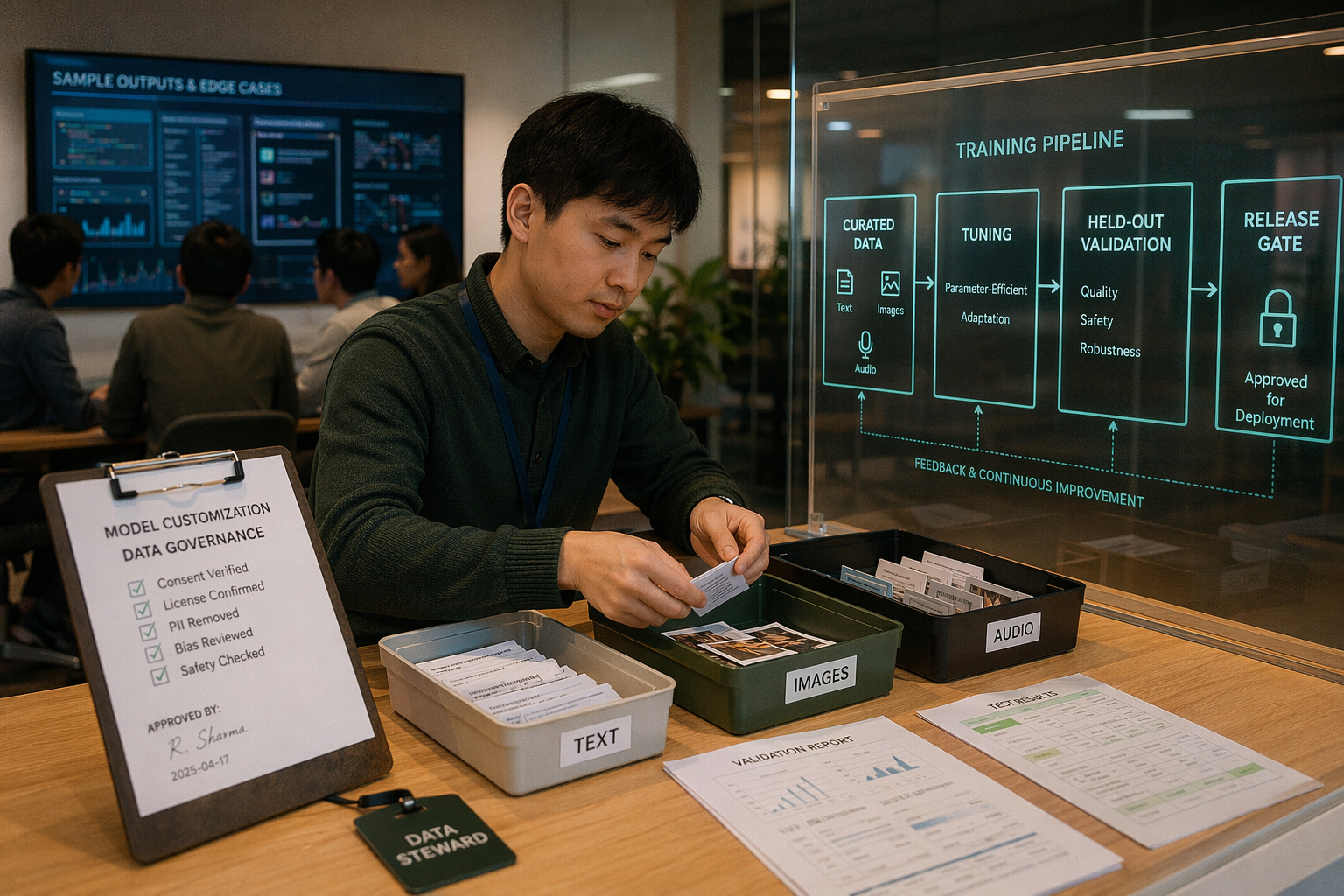
Tinker fine-tuning confirms that Inkling can be adapted beyond prompting, but it does not by itself confirm the training recipe, operational limits, economics, or production outcomes a team will experience. Thinking Machines’ official Inkling announcement states that the Inkling AI model is available for fine-tuning on Tinker, establishing a supported path for post-training customization rather than an open-weights release with no adaptation workflow.
What Tinker fine-tuning establishes
The confirmed signal is strategically meaningful. A developer can reasonably treat Tinker availability as evidence that Thinking Machines expects the 975-billion-parameter open-weights multimodal model to be adapted for specialized tasks, datasets, and behaviors.
For teams whose workflows combine documents, screenshots, photographs, recordings, and text, this matters because Inkling’s documented input modalities are not limited to text. The official Hugging Face model page states that Inkling accepts text, image, and audio inputs and produces text outputs. Fine-tuning could therefore be relevant to domain-specific multimodal interpretation—for example:
- Extracting structured facts from regional-language customer calls plus uploaded documents.
- Classifying support evidence that combines a screenshot, a voice note, and a written complaint.
- Teaching consistent output schemas, escalation labels, or policy-aware response formats.
- Improving performance on internal terminology, product catalogs, or narrowly defined reasoning tasks.
Thinking Machines’ announcement also confirms controllable reasoning effort, which frames adaptation as only one part of system optimization. A fine-tuned model may improve task fit, while inference-time effort controls may help teams choose a suitable cost-versus-quality point for each request type.
What availability does not prove
“Tinker fine-tuning available” should not be read as a guarantee that every customization approach, dataset size, modality, or deployment environment is supported. Until primary Tinker and Inkling documentation specifies otherwise, teams should avoid assuming:
- A particular fine-tuning method. The announcement does not, by itself, establish whether a workload uses full fine-tuning, parameter-efficient methods, reinforcement learning, supervised fine-tuning, or another post-training technique.
- Multimodal training coverage. Inkling can take text, images, and audio as inputs, but developers still need confirmation that Tinker fine-tuning accepts all three modalities in training data—not merely text examples.
- Price, quotas, or training duration. No verified per-token, per-GPU-hour, per-run, or storage pricing should be inferred from the release language.
- Model portability and serving options. Open weights do not automatically establish a managed inference API, self-hosting instructions, hardware footprint, checkpoint export policy, or enterprise deployment terms.
- Safety and quality gains. A tuned checkpoint can become more task-consistent, but it can also regress on general capability, robustness, calibration, or safety if data and evaluation are weak.
A validation plan before committing
Teams should run a controlled pilot rather than treating Tinker availability as a production-readiness verdict:
- Build a held-out evaluation set that reflects real inputs: noisy audio, low-quality images, mixed languages, edge cases, and adversarial instructions.
- Compare the base Inkling model and the tuned version at multiple controllable reasoning effort settings.
- Measure task accuracy, structured-output validity, latency, cost per successful task, refusal behavior, and error severity.
- Test whether tuning improves the intended domain without degrading performance on adjacent tasks.
- Confirm data retention, access controls, model ownership, licensing, and export terms directly with Thinking Machines.
This verification discipline is particularly relevant for communication platforms. Indian AI infrastructure such as CallMissed supports voice and chat workflows across 22 Indian languages, illustrating why a model’s stated multimodal capability is only the starting point: teams must validate performance on their own languages, audio conditions, customer intents, and operational constraints.
What are the developer and production implications of an open-weights multimodal model?

An open-weights multimodal model gives developers more room to inspect, adapt, and evaluate model behavior, but it does not automatically make production deployment simple or inexpensive. For the Inkling AI model, the practical implication is a more flexible evaluation path—especially for specialized multimodal workloads—alongside unresolved questions about serving, licensing, infrastructure, and commercial terms.
Open weights expand evaluation options, not operational guarantees
Thinking Machines describes Inkling as its first open-weights Mixture-of-Experts (MoE) model, while the official announcement confirms native reasoning across text, images, and audio. That enables teams to assess whether the model can handle a single workflow involving several evidence types—for example, reviewing a product photograph, a customer voice note, and an accompanying support request before returning a text response.
For production teams, the useful distinction is between model accessibility and production readiness:
- Open weights can support deeper inspection, controlled experimentation, and potentially more customized deployment architectures.
- Multimodal input can reduce the need to stitch together separate text, vision, and audio-understanding models for some workflows.
- Text-only output remains an important boundary: the official Hugging Face page says Inkling accepts text, image, and audio inputs and produces text outputs.
- Production availability still depends on documentation that has not been established in the public materials reviewed here, including model-serving requirements, supported inference stacks, rate limits, commercial terms, and security controls.
In other words, a developer can evaluate Inkling for insurance-claim triage, document review, call-quality analysis, or visual support diagnosis—but should not present it as an image, speech, or video generation engine.
Reasoning controls turn model choice into a routing problem
Thinking Machines says controllable reasoning effort is designed to balance cost and performance. In a production system, that suggests teams should avoid treating every request as equally difficult.
A practical rollout could define effort tiers such as:
- Low effort: tagging, straightforward extraction, intent classification, and standard FAQ routing.
- Medium effort: cross-checking a photo against a written claim or summarizing a multilingual customer interaction.
- High effort: ambiguous exceptions, multi-document reconciliation, safety-sensitive escalation, or cases requiring careful cross-modal evidence review.
The key decision is not whether higher reasoning effort is “better” in isolation. Teams should measure whether it improves task success enough to justify its added latency and inference cost. Thinking Machines has confirmed the control exists, but developers should not assume a particular effort scale, token budget, latency profile, or benchmark uplift until primary technical documentation specifies those details.
Tinker fine-tuning raises the value of proprietary data
Thinking Machines confirms that Inkling is available for Tinker fine-tuning. This is consequential for organizations whose task definitions, vocabulary, and quality standards differ from broad public-data assumptions.
A disciplined Tinker fine-tuning program should include:
- A versioned, consented training dataset with text, image, and audio examples where relevant.
- A held-out evaluation set that reflects real production failures—not only ideal examples.
- Comparisons between base-model prompting and fine-tuned behavior.
- Safety tests for hallucination, sensitive-data handling, language coverage, and adversarial multimodal inputs.
- Cost and latency measurement at each reasoning-effort level.
The production checklist remains larger than the model card
Before committing an open-weights multimodal model to customer-facing use, teams should verify license permissions, hosting options, hardware needs, observability, data residency, model updates, fallback behavior, and incident response. Inkling’s confirmed capabilities make it a meaningful candidate for evaluation; they do not yet answer every operational question needed for a production approval.
Which expert questions should teams ask before adopting Inkling or Tinker fine-tuning?
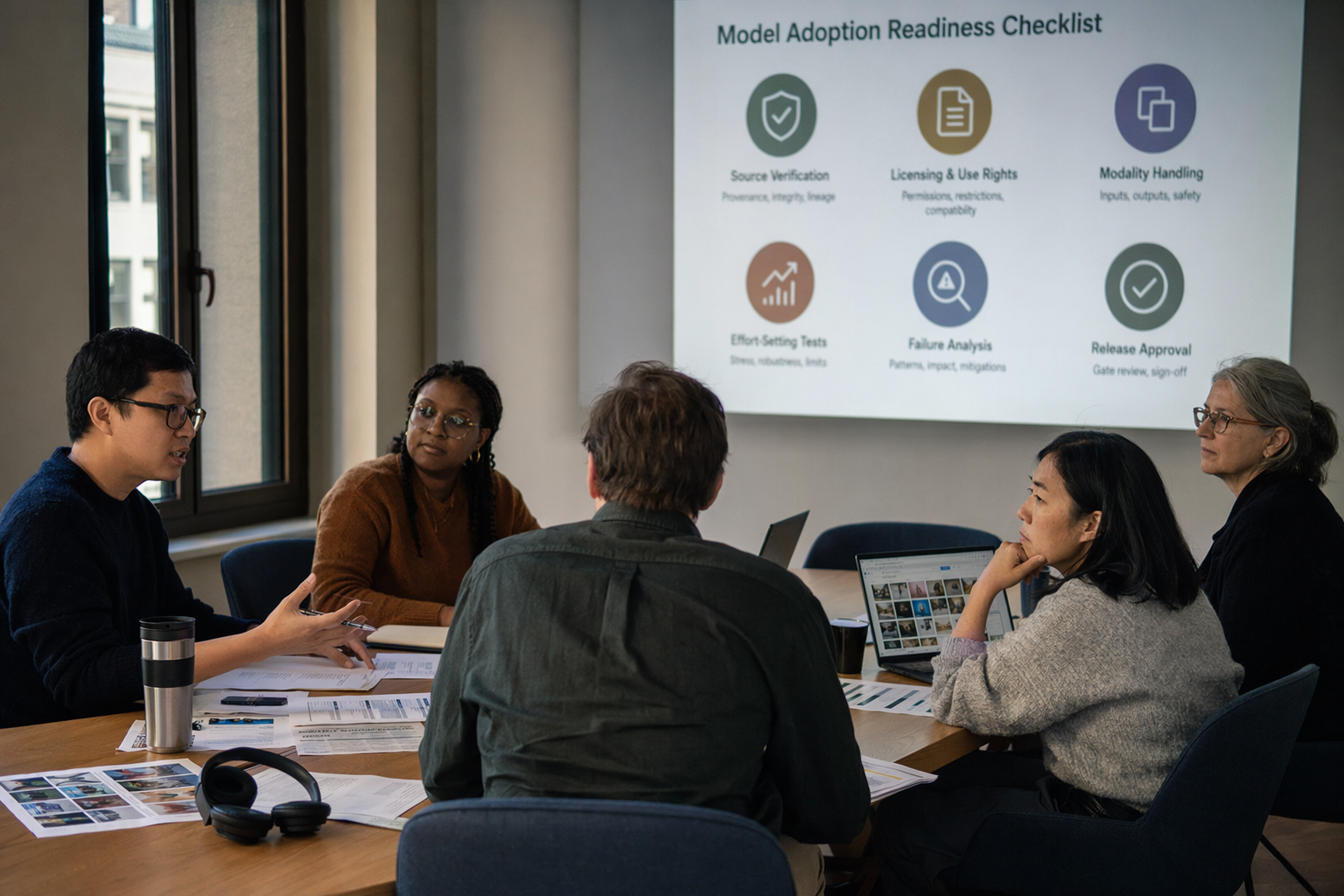
Teams should treat Inkling and Tinker as evaluation candidates, not completed production decisions, until the model’s behavior, operating constraints, and commercial terms are verified against their own workload. The most useful adoption questions turn Thinking Machines’ confirmed capabilities into testable acceptance criteria.
1. What input-output behavior is actually supported?
Start by mapping the proposed product workflow to the model’s documented modality boundary. The official Hugging Face model page says the Inkling AI model accepts text, image, and audio inputs and produces text outputs.
Ask:
- Does the application only need text output after analysing an image or audio file?
- Which input formats, file sizes, languages, and context limits are officially supported?
- Does the workflow require image, audio, or video generation elsewhere? If so, Inkling should be evaluated as an analysis/reasoning component, not assumed to be a generative media model.
- Can the model correctly connect evidence across modalities—for example, a photographed invoice, a spoken customer query, and a text policy document?
A production test set should include real noisy inputs: blurred mobile photos, mixed-language audio, incomplete forms, and ambiguous customer requests—not only clean benchmark-style examples.
2. How much does controllable reasoning effort change quality, latency, and cost?
Thinking Machines describes Inkling as an open-weights multimodal model with controllable reasoning effort, designed to balance cost and performance. That is a meaningful capability, but teams need to quantify the trade-off themselves.
Run a structured experiment:
- Define low-risk routine tasks, such as classification, extraction, and routing.
- Define high-consequence tasks, such as fraud-review assistance, policy interpretation, or exception handling.
- Test each task at every available reasoning-effort level.
- Measure task accuracy, hallucination rate, response time, token or compute use, and failure recovery.
The key question is not whether higher effort produces better answers in general; it is where the quality gain is large enough to justify added latency or compute. A support workflow may need fast low-effort triage with escalation, while an analyst workflow may reasonably reserve higher effort for difficult cases.
3. What does Tinker fine-tuning make controllable—and what remains undocumented?
Thinking Machines’ official Inkling announcement confirms that Inkling is available for Tinker fine-tuning. This signals a route for adapting the model to proprietary data, domain vocabulary, output formats, or specialised decision policies.
Before committing data, teams should ask:
- What tuning methods, hyperparameters, evaluation tools, and model-version controls does Tinker expose?
- Where is training data processed and retained, and who can access it?
- Can a team reproduce a fine-tuned checkpoint and roll back a harmful regression?
- How will the team measure whether fine-tuning improves target-task quality rather than overfitting?
- Are safety behaviors, multilingual performance, or multimodal grounding affected after tuning?
For Indian-language workloads, this verification is especially important. Platforms such as CallMissed support speech and chat across 22 Indian languages, illustrating why teams should test regional-language transcription, reasoning, and customer-facing responses directly rather than infer performance from English-only results.
4. Which operational claims need primary documentation?
The 975-billion-parameter figure is publicly associated with Inkling, but parameter count does not answer deployment questions. Teams should request or verify primary documentation for:
- License rights and redistribution obligations for the open weights
- Hardware, memory, quantization, and self-hosting requirements
- Hosted API availability, regions, rate limits, and pricing
- Published benchmarks, evaluation methodology, and known limitations
- Security controls, data handling, observability, and incident support
For developers comparing multiple providers, an OpenAI-compatible gateway such as CallMissed can simplify model experimentation through one integration. But Inkling should earn production placement through documented constraints and workload-specific evidence—not launch-day assumptions.
What should developers test before using the Inkling AI model? (TABLE)
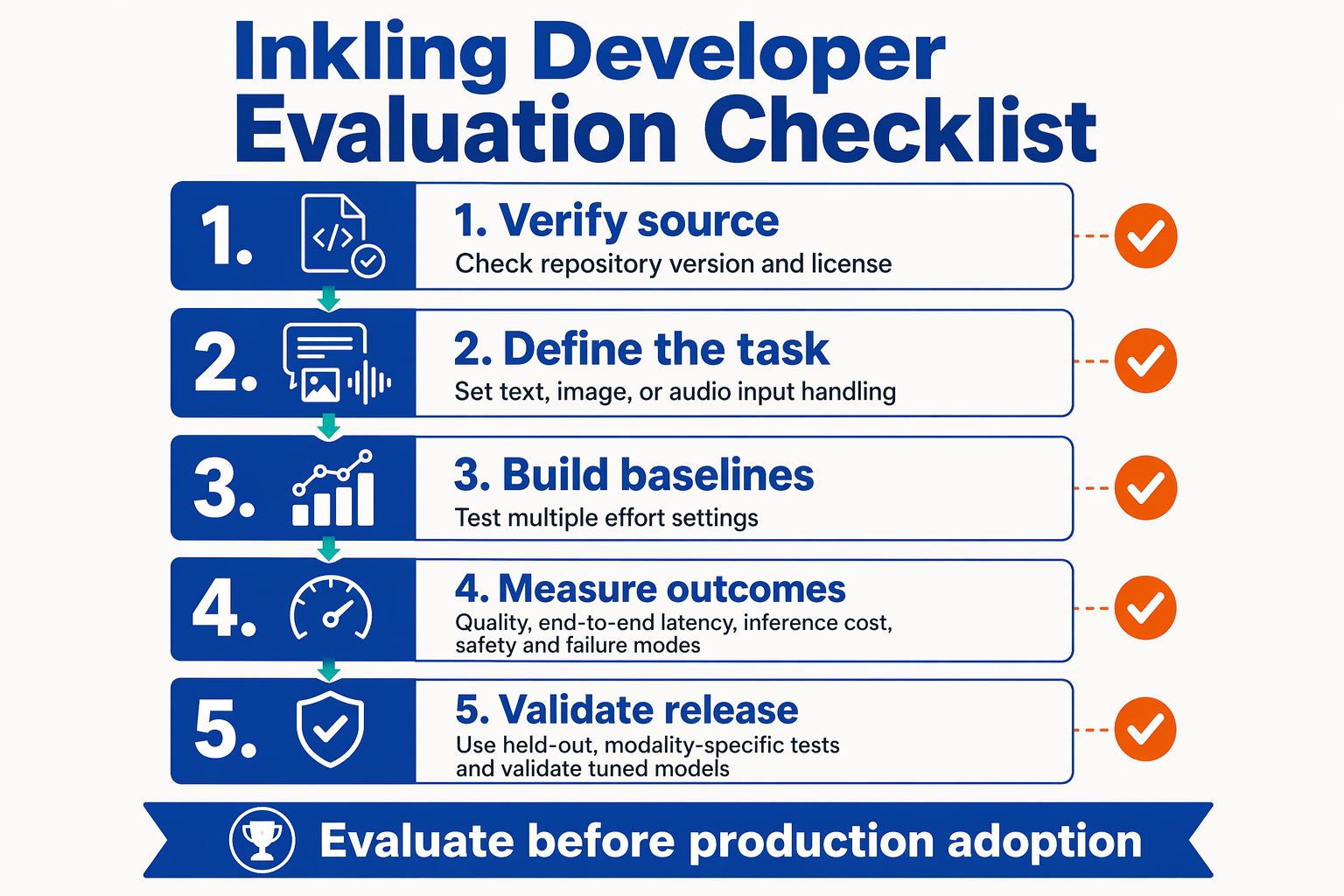
Developers should treat the Inkling AI model as a candidate to validate against their own workload, not as a drop-in production assumption. The right pre-adoption test plan measures multimodal accuracy, reasoning-effort trade-offs, Tinker fine-tuning outcomes, safety, and operational fit while keeping unverified deployment and pricing claims out of the decision.
Thinking Machines confirms that Inkling is a 975-billion-parameter open-weights multimodal model with a Mixture-of-Experts architecture, but parameter count alone does not establish latency, throughput, serving cost, or hardware requirements for a specific application.
A practical Inkling AI model test matrix
| Test area | What to test | Confirmed baseline | Decision signal |
|---|---|---|---|
| Input/output modality | Run representative text, image, and audio prompts, including mixed-input tasks such as “summarize this call and inspect the attached image.” | Thinking Machines says Inkling reasons across text, images, and audio; the official Hugging Face page says it returns text outputs. | Confirm that output quality meets requirements without assuming image, audio, or video generation. |
| Routine-task reasoning | Evaluate low-effort settings on classification, extraction, FAQ routing, tagging, and short summaries. | Thinking Machines describes controllable reasoning effort as a way to balance cost and performance. | Set an accuracy floor and measure whether lower effort clears it on high-volume, low-risk work. |
| Complex-task reasoning | Compare low, medium, and high effort on multi-step analysis, ambiguous documents, exception handling, and cross-modal questions. | The official announcement confirms that reasoning effort is controllable; it does not publish a universal quality-versus-cost curve. | Choose the lowest setting that reliably meets a defined quality threshold for each task class. |
| Multimodal grounding | Test whether answers cite the correct visual or audio evidence rather than relying on plausible but incorrect text patterns. | Inkling is officially described as natively multimodal across text, images, and audio. | Track grounded-answer accuracy, hallucination rate, and failure types separately by modality. |
| Tinker fine-tuning | Hold out a validation set before adapting Inkling with domain examples, then compare the base model and tuned version. | Thinking Machines confirms Inkling is available for Tinker fine-tuning. | Keep a tuned model only if it improves target-domain quality without degrading general safety or instruction following. |
| Production readiness | Validate access controls, license obligations, latency, uptime expectations, data handling, observability, and total cost. | Thinking Machines has not established a specific hosted API, token price, self-hosting recipe, hardware profile, or SLA in the cited materials. | Block rollout until primary documentation and internal tests establish each operational requirement. |
Measure the trade-off, not just the best answer
A useful evaluation should report more than an aggregate score. For every reasoning-effort setting, capture:
- Task success rate: Did Inkling complete the intended extraction, decision, or answer correctly?
- Grounding quality: Did the answer accurately reflect the supplied image or audio rather than inventing details?
- Latency and compute usage: Measure these in the actual environment; neither is implied by the 975-billion-parameter figure.
- Escalation rate: Identify requests that should move to higher reasoning effort or a human reviewer.
- Safety and privacy failures: Test prompt injection in documents, sensitive audio content, and adversarial image instructions.
Use Tinker fine-tuning as a controlled experiment
Tinker fine-tuning should begin with a narrow hypothesis, such as improving insurance-document extraction or regional-language call summarization. Preserve a frozen evaluation set, include difficult counterexamples, and compare tuned and untuned Inkling outputs under identical reasoning settings.
For teams building multilingual customer workflows, the broader lesson is to test the model layer alongside communication infrastructure. For example, CallMissed supports speech and chat across 22 Indian languages, so an evaluation may need to measure whether Inkling’s text responses remain accurate after speech transcription, regional-language translation, and customer-channel formatting.
Frequently Asked Questions about Inkling’s open-weights multimodal model
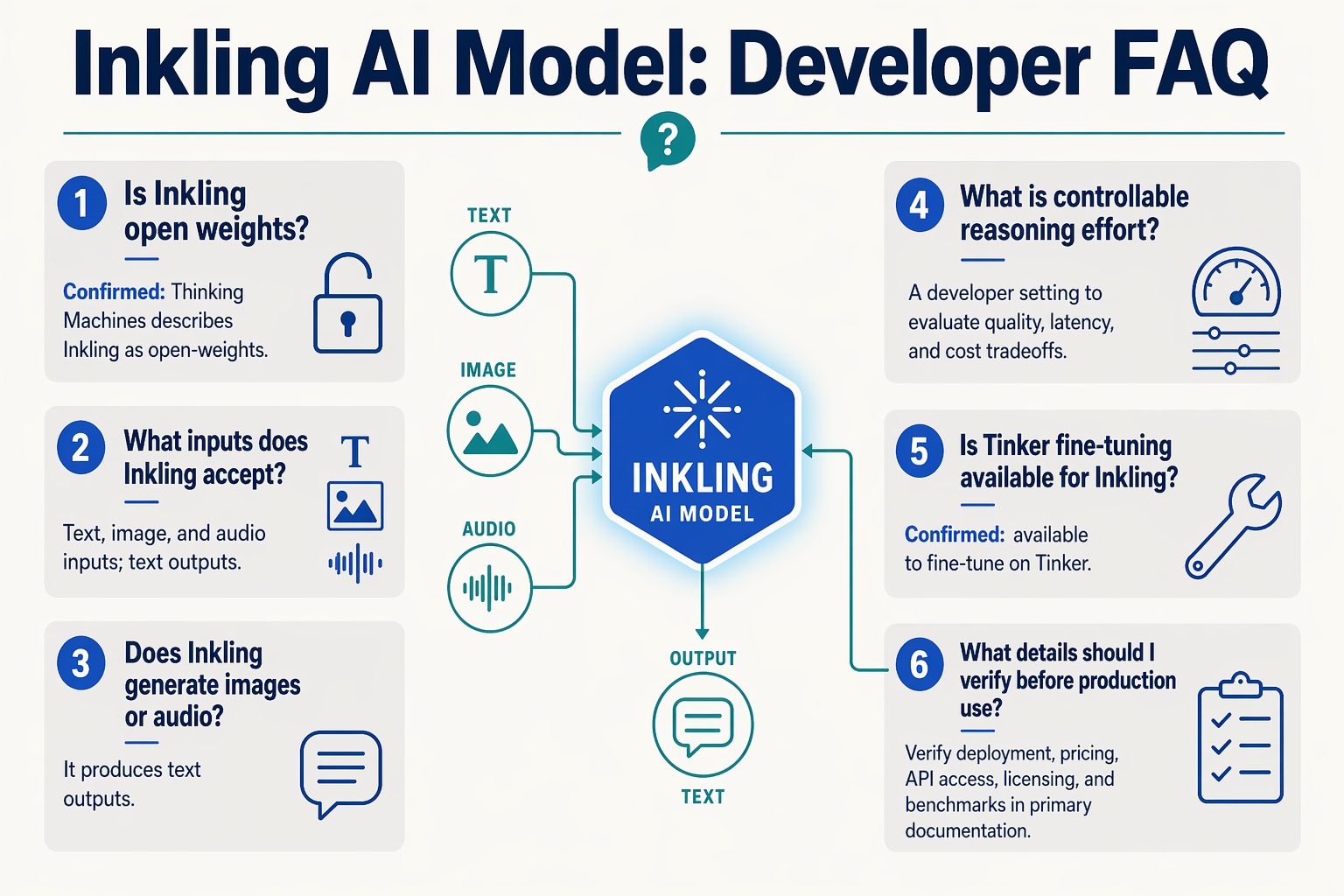
What is the Inkling AI model and what capabilities are officially confirmed?
Can the Inkling AI model generate images, audio, or video?
How does controllable reasoning effort work in Inkling?
Is Inkling an open-source model that developers can self-host?
What does Tinker fine-tuning mean for the Inkling AI model?
What should developers verify before using Inkling in production?
Conclusion
The Inkling AI model is worth watching not simply because it has 975 billion parameters, but because Thinking Machines has attached that scale to developer-relevant controls: open weights, native multimodal reasoning, configurable effort, and Tinker fine-tuning. The verification-first lesson is clear: evaluate the capabilities that are documented, and treat every unconfirmed operational detail as an open question.
- Thinking Machines confirms that Inkling is its first open-weights multimodal Mixture-of-Experts model, with native reasoning across text, images, and audio.
- The official Hugging Face model page confirms that Inkling accepts text, image, and audio inputs but produces text outputs. Developers should not infer image, audio, or video generation from its multimodal input support.
- Controllable reasoning effort is positioned by Thinking Machines as a way to balance cost and performance. Its practical value will depend on measured quality, latency, and cost across each team’s real production tasks.
- Tinker fine-tuning gives developers a documented customization path, but it does not by itself establish pricing, deployment requirements, benchmark outcomes, licensing interpretation, hosted API availability, or a self-hosting workflow.
The next signals to watch are primary documentation on inference access, model licensing, evaluation methodology, hardware expectations, and the precise controls available through Tinker fine-tuning. Those details will determine whether Inkling moves from an intriguing open-weights multimodal model to a practical foundation for specialized workflows.
For teams building customer-facing AI, model flexibility will increasingly matter alongside raw capability. To explore how AI communication is evolving, check out CallMissed, an AI infrastructure platform powering voice agents and multilingual chatbots for businesses. The key question is not whether Inkling is large—but whether its verified controls improve outcomes on your workload.
Related Reading
Related Posts

Ready to automate customer conversations?
Launch AI voice agents and WhatsApp bots with CallMissed — one API, 22+ Indian languages.