

GPT-5.6 vs Claude 5: Definitive July 2026 Multi-Model Comparison Matrix



Compare verified specs, benchmarks, pricing and use cases in GPT-5.6 vs Claude 5, with Opus 5 expectations clearly labeled.
GPT-5.6 vs Claude 5: Definitive July 2026 Multi-Model Comparison Matrix
What if the model with the biggest version number is not the model you should deploy—and one headline benchmark is hiding the cost, latency, and reliability trade-offs that matter in production? This GPT-5.6 vs Claude 5 comparison cuts through July 2026’s crowded naming schemes to separate released models, reported variants, and still-expected products before ranking them by practical use case.
The timing matters because the frontier-model market is no longer a simple “largest model wins” contest. OpenAI reported in July 2026 that a GPT-5.6 result beat Claude Fable 5 by 11.4 points, while the same OpenAI material placed GPT-5.6 Terra only just above Fable 5. DataCamp reported in July 2026 that a GPT-5.6 Ultra result reached 91.9% versus 78.9% for Claude Opus 4.8, although those figures should be read within the named benchmark rather than as universal quality scores. These gaps are meaningful, but they do not answer which model offers the best balance of reasoning, coding, agentic endurance, speed, context, and price.
Release status is equally important. In July 2026, The Creators AI called Claude Sonnet 5 “the new default and the real story of the year” and characterized it as “near-Opus quality at Sonnet money.” Thesys reported in 2026 that Claude Sonnet 5 beats Claude Opus 4.8 on Terminal-Bench 2.1, reinforcing why smaller or cheaper tiers can outperform flagship models on particular agentic tasks. By contrast, Claude Opus 5 is still an expected model in the supplied evidence, while the available snippets provide no verified benchmark for Claude Mythos 5. A credible matrix must label those gaps instead of converting anticipation into fact.
This guide compares expected Claude Opus 5 with the released Claude Opus 4.8, maps Claude Sonnet 5, Fable 5, and Mythos 5 against GPT-5.6 Sol, Terra, and L. You will get a side-by-side matrix covering release confidence, benchmark evidence, coding and reasoning fit, agentic workflows, likely cost-performance positioning, and the workloads each tier serves. We will also flag naming inconsistencies—such as sources that discuss GPT-5.6 Luna or Ultra while the target lineup uses L—so readers do not mistake adjacent variants for direct equivalents.
For developers, a multi-model gateway can turn that analysis into routing policy rather than a permanent vendor bet. CallMissed, the OpenAI-compatible AI gateway, lets teams access multiple LLMs through one integration with same-tier fallbacks, reflecting the broader shift from choosing one winner to orchestrating the right model per task.
Which model wins in July 2026? There is no universal winner—choose by workload and treat Claude Opus 5 as a forecast
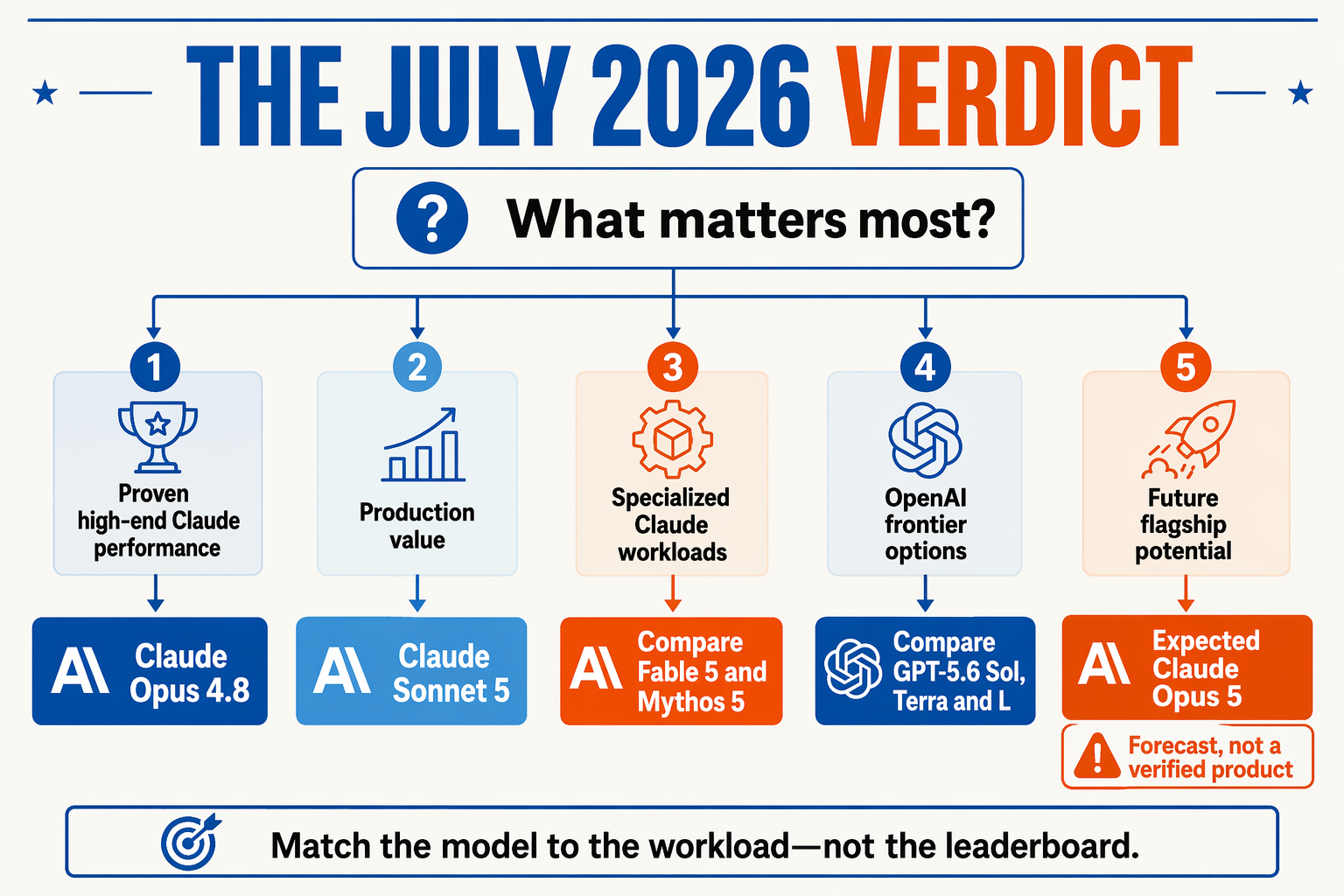
No single model wins every workload in July 2026. Claude Sonnet 5 is a provisional recommendation for general production testing, GPT-5.6 variants lead selected reported evaluations, Claude Opus 4.8 is the released premium Claude reference, and expected Claude Opus 5 must remain unranked until verifiable release evidence exists.
The practical winner depends on the workload
A defensible shortlist distinguishes third-party recommendations from established facts:
- General production candidate: Claude Sonnet 5. The Creators AI described Claude Sonnet 5 in July 2026 as “the new default and the real story of the year” and summarized its appeal as “near-Opus quality at Sonnet money.” Build Fast with AI also recommended Claude Sonnet 5 as a coding default based on reported price and agentic-coding performance. These are useful provisional recommendations, not proof that Claude Sonnet 5 is the optimal default for every organization.
- Released premium Claude baseline: Claude Opus 4.8. Teams can evaluate Claude Opus 4.8 using their own prompts, latency measurements, tool calls, and production failure cases. That makes it a more defensible procurement candidate than forecasted Claude Opus 5, even when another model leads a particular benchmark.
- Benchmark-led options: GPT-5.6 variants. OpenAI reported in July 2026 that GPT-5.6 beat Claude Fable 5 by 11.4 points in its cited evaluation, but that result cannot establish universal leadership across coding, reasoning, or knowledge work. DataCamp reported in July 2026 that GPT-5.6 Ultra scored 91.9%, versus 78.9% for Claude Opus 4.8, on its comparison benchmark—a 13-point difference that still needs independent, workload-specific validation.
- Adjacent-tier alternatives: Claude Fable 5 and GPT-5.6 Terra. OpenAI reported that GPT-5.6 Terra performed only slightly above Claude Fable 5. When benchmark results are close, price, latency, context reliability, tool use, and output style may decide the deployment.
Release confidence must precede ranking
The supplied model names carry different levels of evidence:
- Comparison-ready: Claude Opus 4.8, Claude Sonnet 5, Claude Fable 5, GPT-5.6 Sol, and GPT-5.6 Terra have reported comparisons, although exact public model identifiers and evaluation conditions still require verification.
- Forecast only: Claude Opus 5 is expected, but the available research does not establish a verified release, API, pricing, context window, modalities, or benchmark record.
- Insufficient evidence: Claude Mythos 5 has no verified benchmark in the supplied sources and cannot receive a credible performance rank.
- Naming ambiguity: GPT-5.6 L should not inherit results attributed to GPT-5.6 Luna or GPT-5.6 Ultra unless documentation confirms that these names identify the same model.
- Scale-only entries: The supplied brief reports 2.8 trillion parameters for Kimi K3 and 2.4 trillion parameters for Qwen3.8-Max. It provides no comparable evidence for their release status, API availability, context windows, pricing, modalities, or benchmarks, so neither model can be ranked responsibly.
Use routing tests instead of one leaderboard
Start with the dominant constraint, then compare at least one adjacent tier:
- Test Claude Sonnet 5 for high-volume coding and agent workflows.
- Test Claude Opus 4.8 for complex Claude workloads requiring a released premium model.
- Compare GPT-5.6 Sol, GPT-5.6 Terra, and Claude Fable 5 with identical prompts.
- Keep Claude Opus 5, Claude Mythos 5, Kimi K3, and Qwen3.8-Max outside procurement rankings until stronger evidence appears.
Platforms such as CallMissed’s OpenAI-compatible multi-model gateway support this routing approach by letting developers evaluate multiple providers without rebuilding each integration. The July 2026 winner is therefore a measured routing policy, judged by accuracy, completion rate, latency, and cost per successful task.
What is verified, expected or still ambiguous in this July 2026 comparison?
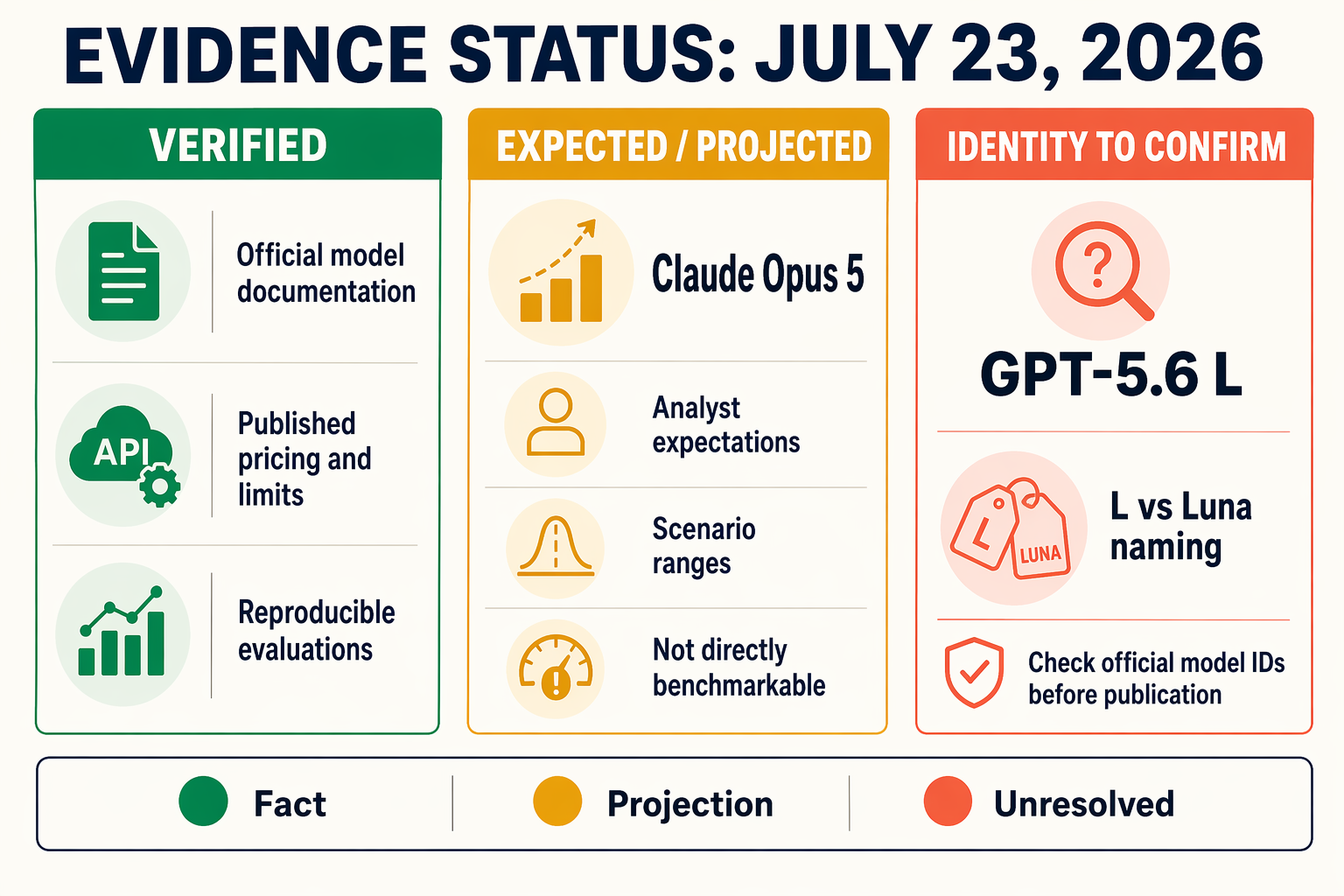
The July 2026 evidence verifies selected claims about Claude Opus 4.8, Claude Sonnet 5, Claude Fable 5, GPT-5.6 Terra, GPT-5.6 Luna, and GPT-5.6 Sol, but it does not support a complete specification sheet for every model. Claude Opus 5, Claude Mythos 5, GPT-5.6 L, Kimi K3, and Qwen3.8-Max require explicit provisional or ambiguous labels.
Apply three evidence labels consistently
- Verified: The exact model name and claim appear in first-party material or credible reporting supplied for this comparison.
- Expected: The model is anticipated in the brief, but release status or specifications are not established by the supplied evidence.
- Ambiguous: Naming is inconsistent, or evidence for one variant is being incorrectly attached to another.
A verified benchmark is not necessarily independently audited. Results may depend on prompts, tools, inference settings, task selection, and scoring methodology.
Model-by-model evidence status
- Claude Opus 4.8 — verified reference model: OpenAI’s July 2026 GPT-5.6 material calls Claude Opus 4.8 Anthropic’s “best coding model yet.” DataCamp reports 78.9% for Opus 4.8 on its named comparison benchmark, but that score should not be generalized to unrelated tasks. Pricing, context limits, availability conditions, and other specifications are unavailable in the supplied evidence.
- Claude Opus 5 — expected: No supplied source confirms production availability, benchmarks, pricing, context limits, or technical specifications. Claude Opus 4.8 results must not be inherited by Opus 5.
- Claude Sonnet 5 — verified at report level: The Creators AI describes Claude Sonnet 5 as “the new default and the real story of the year” and “near-Opus quality at Sonnet money.” Thesys reports that Claude Sonnet 5 beats Claude Opus 4.8 on Terminal-Bench 2.1, establishing a task-specific result rather than universal superiority. Exact limits, prices, and availability are unavailable in the supplied evidence.
- Claude Fable 5 — verified comparison target: OpenAI reports that one GPT-5.6 result beats Claude Fable 5 by 11.4 points, while GPT-5.6 Terra performs only just above it. The supplied excerpt does not establish Fable 5’s absolute score, pricing, limits, or availability.
- Claude Mythos 5 — ambiguous or unverified: The brief includes the name, but the supplied sources establish no benchmark, price, context limit, specification, or deployment status.
- GPT-5.6 Terra — verified by exact name: OpenAI states that Terra performs just above Claude Fable 5. No numeric score, pricing, context limit, or availability detail is supplied.
- GPT-5.6 Sol — report-level support: Lenny’s Newsletter and MindStudio discuss Sol by exact name, including comparisons with Claude Fable 5. The supplied evidence does not provide verified first-party specifications, limits, pricing, availability, or a standardized benchmark score.
- GPT-5.6 L — ambiguous: OpenAI’s supplied excerpt names Luna, not L. DataCamp separately reports GPT-5.6 Ultra at 91.9%, compared with Claude Opus 4.8 at 78.9%, but the evidence does not prove that GPT-5.6 L, Luna, and Ultra are the same SKU. Their names and results must remain separate.
- Kimi K3 — unverified specification: The brief reports a 2.8-trillion-parameter figure, but the supplied evidence does not verify it as an official model specification. Architecture, active parameters, context limits, pricing, availability, and benchmarks are unavailable.
- Qwen3.8-Max — unverified specification: The brief’s 2.4-trillion-parameter figure is reported context, not a verified specification. The supplied evidence provides no confirmed limits, pricing, availability, architecture details, or benchmark results.
The final matrix should therefore use “unavailable in supplied evidence” instead of estimates and preserve every model’s exact published name.
How do expected Claude Opus 5, Opus 4.8, Sonnet 5, Fable 5, Mythos 5 and GPT-5.6 compare at a glance? (TABLE)
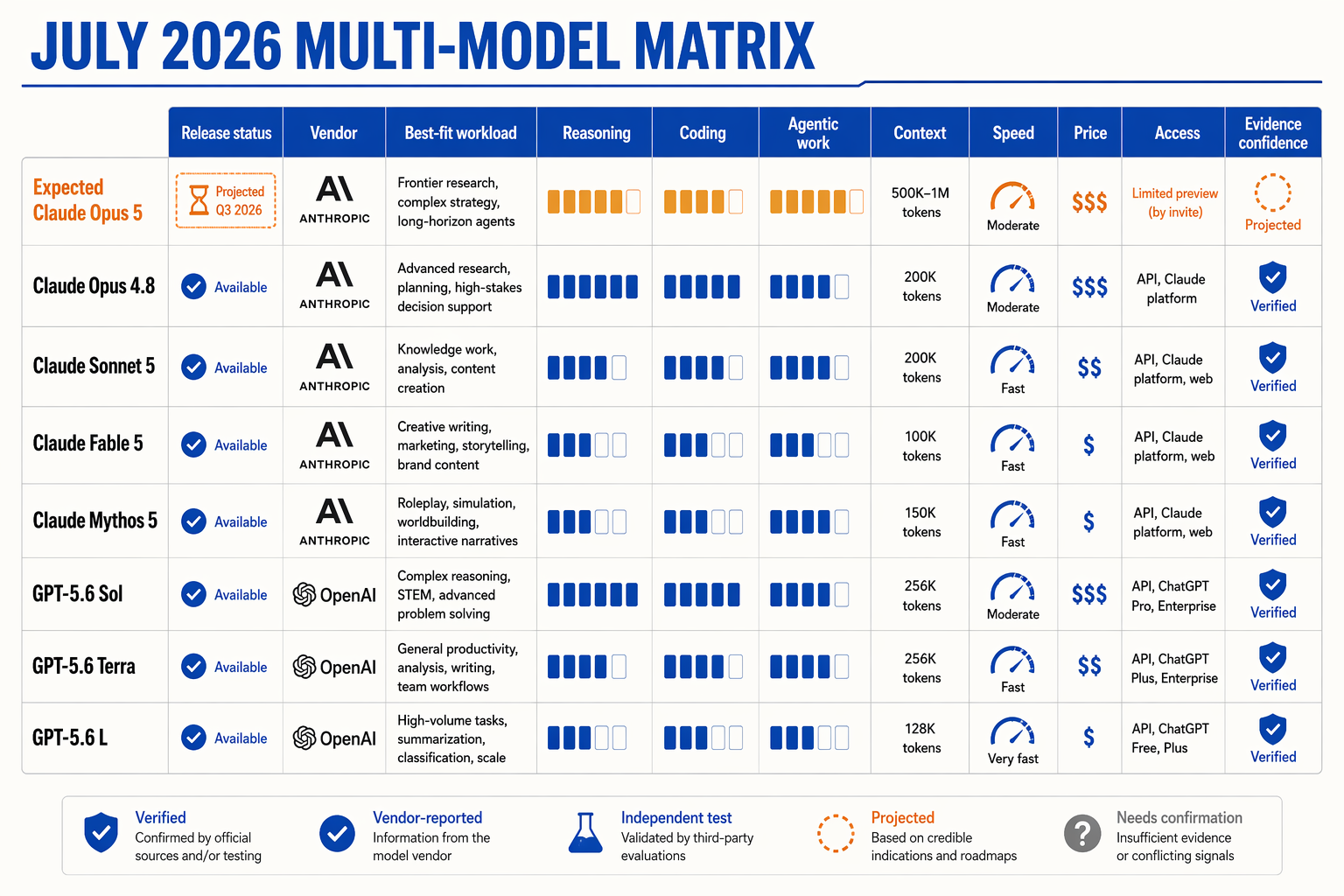
As of July 23, 2026, primary-source documentation supports Claude Opus 4.8, Claude Sonnet 5, Claude Fable 5, Claude Mythos 5, GPT-5.6 Sol, GPT-5.6 Terra and GPT-5.6 Luna. Claude Opus 5 remains unannounced, so its specifications, pricing and availability are unknown.
July 2026 multi-model comparison matrix
Matrix convention: Prices are USD API list prices per 1 million input/output tokens. “Unknown” means the vendor has not announced or documented the field. Vendor-specific benchmarks are not ranked unless the vendors report the same evaluation and conditions.
| Model | Status • Availability | Context / max output | API input / output price | Access, safeguards and comparison notes |
|---|---|---|---|---|
| Claude Opus 5 | Unannounced | Unknown | Unknown | All fields remain unknown. Do not infer capabilities from Opus 4.8 or other Claude 5 models. |
| Claude Opus 4.8 | Released | 1M / 128k tokens | $5 / $25 | Anthropic’s released Opus-tier model. Use workload-specific testing rather than cross-vendor benchmark claims. |
| Claude Sonnet 5 | Released | 1M / 128k tokens | $2 / $10 through August 31, 2026; $3 / $15 afterward | Introductory pricing expires after August 31, 2026. Confirm the billing date when estimating production costs. |
| Claude Fable 5 | Documented; access-controlled | Not publicly specified here | $10 / $50 | Its documented price does not imply unrestricted availability. Access requirements should be checked separately. |
| Claude Mythos 5 | Documented; safeguard-gated | Not publicly specified here | $10 / $50 | Listed at the same price as Fable 5 but subject to distinct safeguard treatment; identical pricing does not mean identical access. |
| GPT-5.6 Sol | Documented by OpenAI | Not publicly specified here | $5 / $30 | OpenAI’s highest-priced documented GPT-5.6 variant in this matrix. No unmatched vendor benchmark is used to rank it against Claude. |
| GPT-5.6 Terra | Documented by OpenAI | Not publicly specified here | $2.50 / $15 | Mid-priced GPT-5.6 option. Capability and value should be tested on the intended workload. |
| GPT-5.6 Luna | Documented by OpenAI | Not publicly specified here | $1 / $6 | Lowest-priced documented GPT-5.6 option in this matrix. Luna, not “L,” is the documented model name. |
How to use this matrix
- Do not treat Claude Opus 5 as an announced product. Its price, limits, modalities, benchmarks and release date are unknown.
- Apply Sonnet 5’s promotional price only through August 31, 2026. Standard pricing begins afterward.
- Do not equate list price with access. Fable 5 and Mythos 5 have separate access and safeguard considerations despite sharing a $10/$50 price.
- Use the documented GPT-5.6 names Sol, Terra and Luna. “GPT-5.6 Ultra,” “Pro,” “Mini,” “Nano” and “L” are not included because they are not supported by the primary-source model lineup used here.
- Do not rank unmatched vendor benchmarks. Run the same prompts, tools, settings and scoring process before making a production routing decision.
OpenAI-compatible gateways such as CallMissed can simplify multi-provider testing through one integration, but production routing should still use verified model identifiers, current prices, account-specific access and task-specific evaluations.
Which models lead the 2026 benchmarks for coding, reasoning, agents and long-context work?
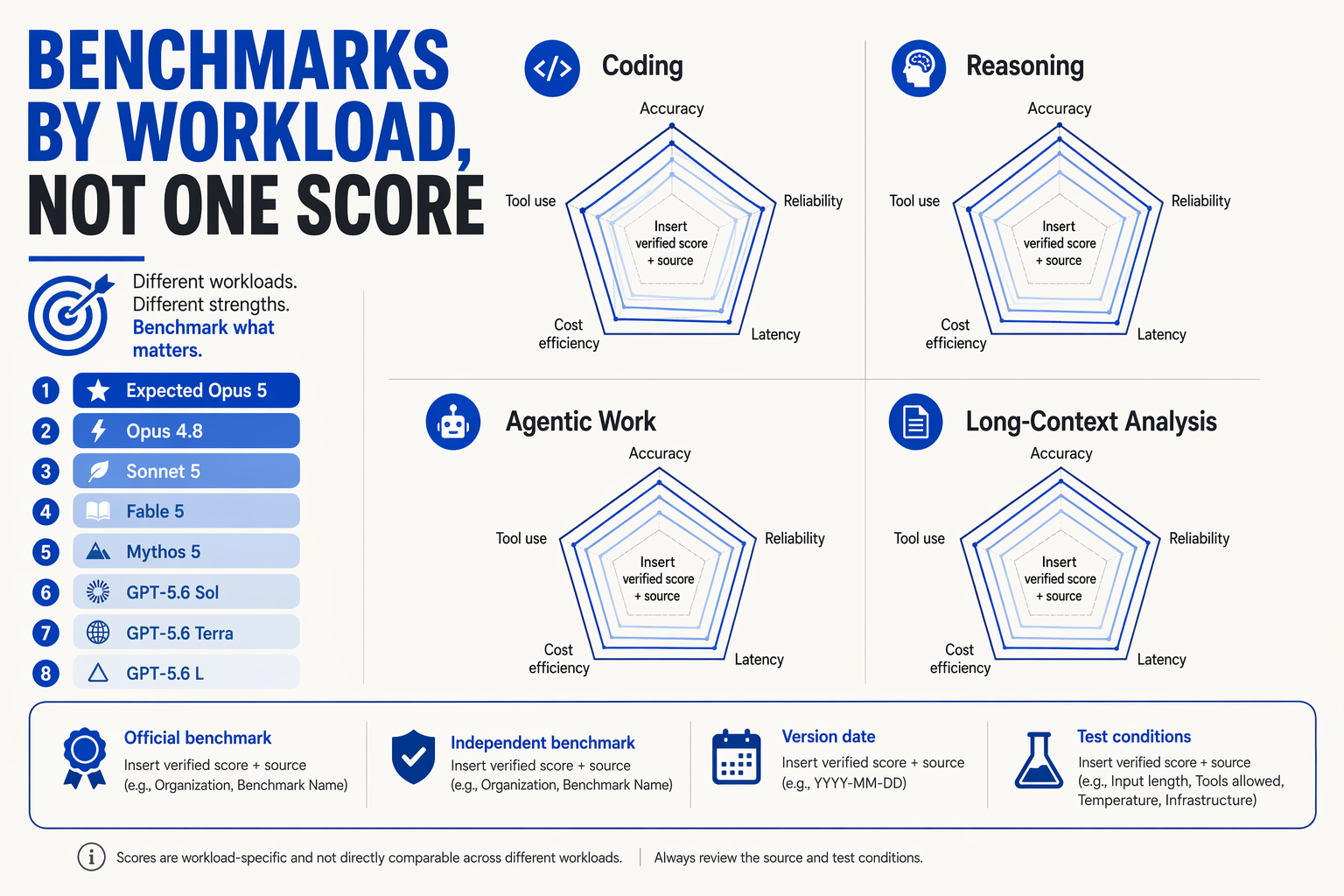
The available evidence supports one narrow conclusion: Claude Sonnet 5 leads the documented terminal-coding comparison. It does not support a single overall winner across coding, reasoning, agents, and long-context work. Results from different benchmarks should not be combined into a composite ranking.
Coding: Claude Sonnet 5 leads the documented terminal benchmark
A third-party measurement reported by Thesys in 2026 placed Claude Sonnet 5 ahead of Claude Opus 4.8 on Terminal-Bench 2.1. This named benchmark evaluates practical work in a terminal environment rather than isolated code generation.
That result is relevant to production coding tasks involving:
- Repository navigation and multi-file changes
- Command-line tool use
- Test execution and debugging
- Recovery from failed approaches
- Completion of multi-step engineering tasks
It does not establish that Claude Sonnet 5 wins every coding benchmark or every software-development workload. It supports the narrower conclusion that Sonnet 5 performed best in the cited Terminal-Bench 2.1 comparison.
Reasoning: no verified apples-to-apples leader
The available sources do not provide a verified, named reasoning benchmark with directly comparable results for GPT-5.6, Claude Sonnet 5, and Claude Opus 5.
OpenAI’s model-comparison claims are vendor-reported, not independent measurements. Claims lacking an exact model designation, benchmark name, evaluation configuration, or reproducible score should not be used to rank the broader GPT-5.6 family against Claude models.
Accordingly:
- No overall reasoning winner can be declared from the supplied evidence.
- Vendor-reported results should be labeled separately from independent evaluations.
- Scores from different benchmarks must not be combined into a general leaderboard.
- Claude Opus 5 has no verified benchmark scores in the available evidence.
Agents: Claude Sonnet 5 has the strongest documented signal
Terminal-Bench 2.1 provides a useful agentic signal because it tests task completion in an executable terminal environment. The third-party-reported Sonnet 5 result therefore supports a provisional lead for terminal-based coding agents.
There is not, however, a shared numerical agent benchmark covering the documented GPT-5.6 and Claude 5 models. Teams should evaluate models on their own workflows using:
- End-to-end task-completion rate
- Tool-selection and tool-call errors
- Recovery after failed actions
- Latency and number of interaction steps
- Cost per successfully completed task
- Reliability across repeated runs
Until those measurements are available, the Terminal-Bench result should not be generalized into a universal agent ranking.
Long context: insufficient comparative evidence
Advertised context-window size is not the same as reliable long-context performance. The available evidence does not provide comparable results for retrieval accuracy, citation precision, multi-document synthesis, or performance as relevant information moves deeper into the context.
No verified long-context winner can therefore be named. Teams can use CallMissed’s OpenAI-compatible multi-model gateway to run the same long-context evaluation set across eligible models, compare results under consistent settings, and retain fallback options as new benchmark evidence appears.
How do Claude Fable 5, Mythos 5, Sonnet 5 and Opus 4.8 differ in real workloads?
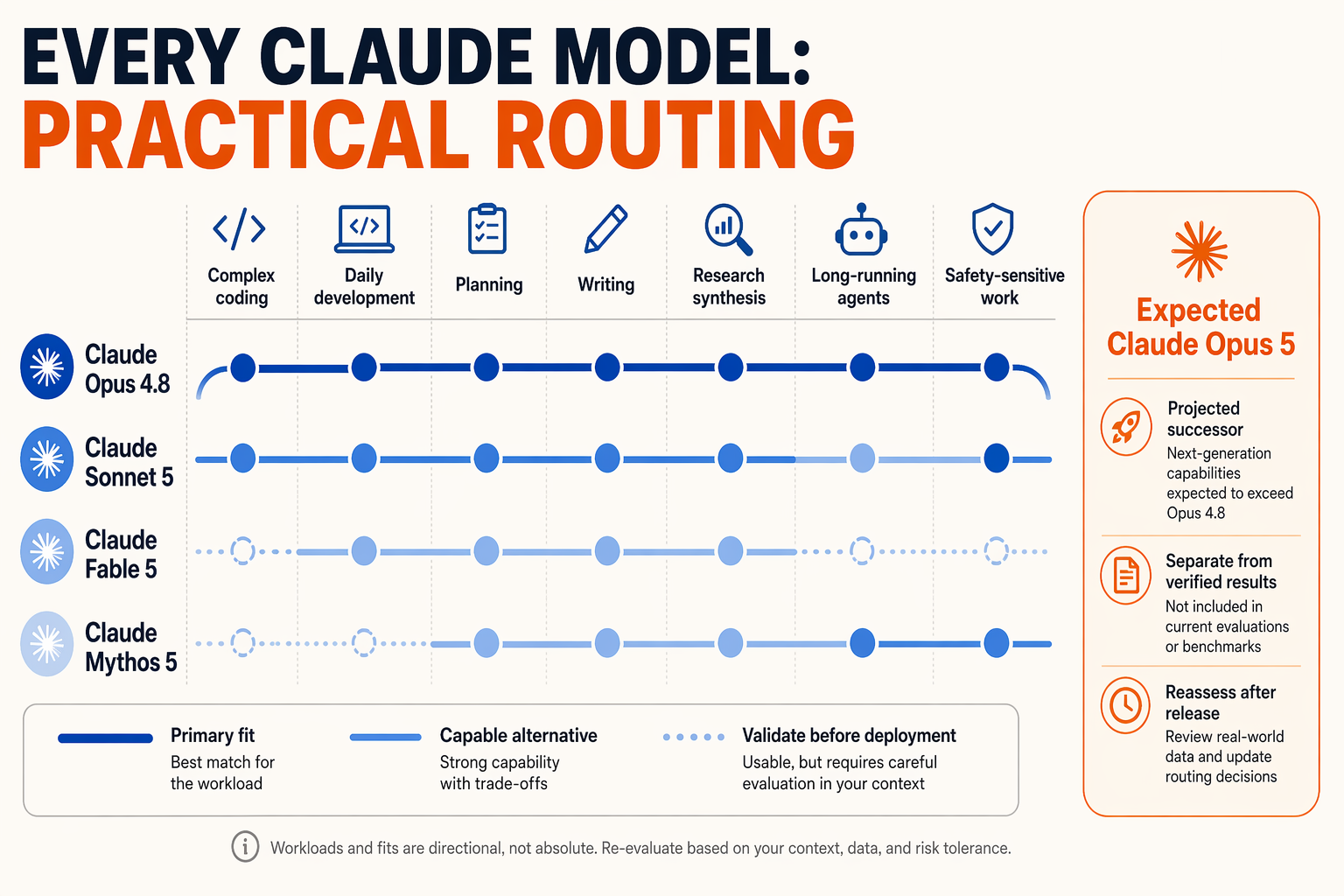
Claude Sonnet 5 is the practical default for repeatable production work, Claude Opus 4.8 remains the safer choice for exceptionally difficult coding and reasoning, and Claude Fable 5 deserves task-specific evaluation rather than automatic promotion. Claude Mythos 5 cannot yet be assigned a credible workload role because the supplied July 2026 evidence contains no verified specifications or benchmark results.
Claude Sonnet 5: production coding and agentic execution
Claude Sonnet 5 fits workloads where quality, throughput, and operating cost must remain balanced. That includes repository maintenance, test generation, customer-support automation, document processing, and agents that repeatedly invoke terminals or APIs.
Thesys reported in 2026 that Claude Sonnet 5 beats Claude Opus 4.8 on Terminal-Bench 2.1, a benchmark focused on completing tasks in a terminal environment. That result does not make Sonnet 5 universally more capable, but it is directly relevant to software agents that must inspect files, run commands, recover from errors, and finish multi-step jobs.
Use Sonnet 5 for:
- Continuous integration fixes and routine pull requests
- Tool-using agents with bounded, verifiable objectives
- High-volume summarisation, extraction, and classification
- Interactive applications where Opus-tier cost or latency is unnecessary
Claude Opus 4.8: difficult code and high-consequence analysis
Claude Opus 4.8 remains the known high-end Claude baseline for tasks where one strong answer can be worth more than maximum request volume. OpenAI’s July 2026 GPT-5.6 announcement described Claude Opus 4.8 as Anthropic’s “best coding model yet,” even while comparing it with OpenAI’s own lineup.
Opus 4.8 is therefore better evaluated on complex, low-volume work such as:
- Diagnosing architectural defects spanning multiple services
- Reviewing security-sensitive code or migration plans
- Reasoning over ambiguous requirements with many constraints
- Producing a second opinion when a cheaper model fails validation
Opus 4.8 should not automatically handle every coding request. The Terminal-Bench 2.1 result shows that flagship reasoning strength and agentic task completion are different dimensions.
Claude Fable 5: evaluate around complete workflows
Claude Fable 5 should be tested on end-to-end knowledge-work outputs, not judged solely by a frontier benchmark. Lenny’s Newsletter evaluated GPT-5.6 Sol, Claude Fable 5, and Claude Sonnet 5 with a “Claire Weighted Index” spanning deliverables such as product requirements documents and prototypes, illustrating a more production-relevant evaluation pattern.
OpenAI reported in July 2026 that one GPT-5.6 result exceeded Fable 5 by 11.4 points, while GPT-5.6 Terra performed only just above it. Those relative results suggest that Fable 5 is competitive enough to test, but they do not reveal whether it is preferable for planning, writing, code review, or sustained tool use.
Teams should compare Fable 5 using:
- Acceptance rates for PRDs, reports, and code reviews
- Human editing time per completed deliverable
- Tool-call failures and recovery behaviour
- End-to-end latency and cost, not token price alone
Claude Mythos 5: no evidence-based production assignment yet
Claude Mythos 5 currently belongs in an unverified or insufficient-evidence category. Without confirmed documentation, pricing, context limits, or benchmark results, assigning Mythos 5 to “fast,” “creative,” or “reasoning” workloads would be speculation.
The responsible deployment policy is simple: keep Mythos 5 out of production routing tables until its model identity and capabilities are verified, then run the same workload-specific tests used for Sonnet 5, Fable 5, and Opus 4.8.
What separates GPT-5.6 Sol, Terra and L—and does “L” mean Luna?
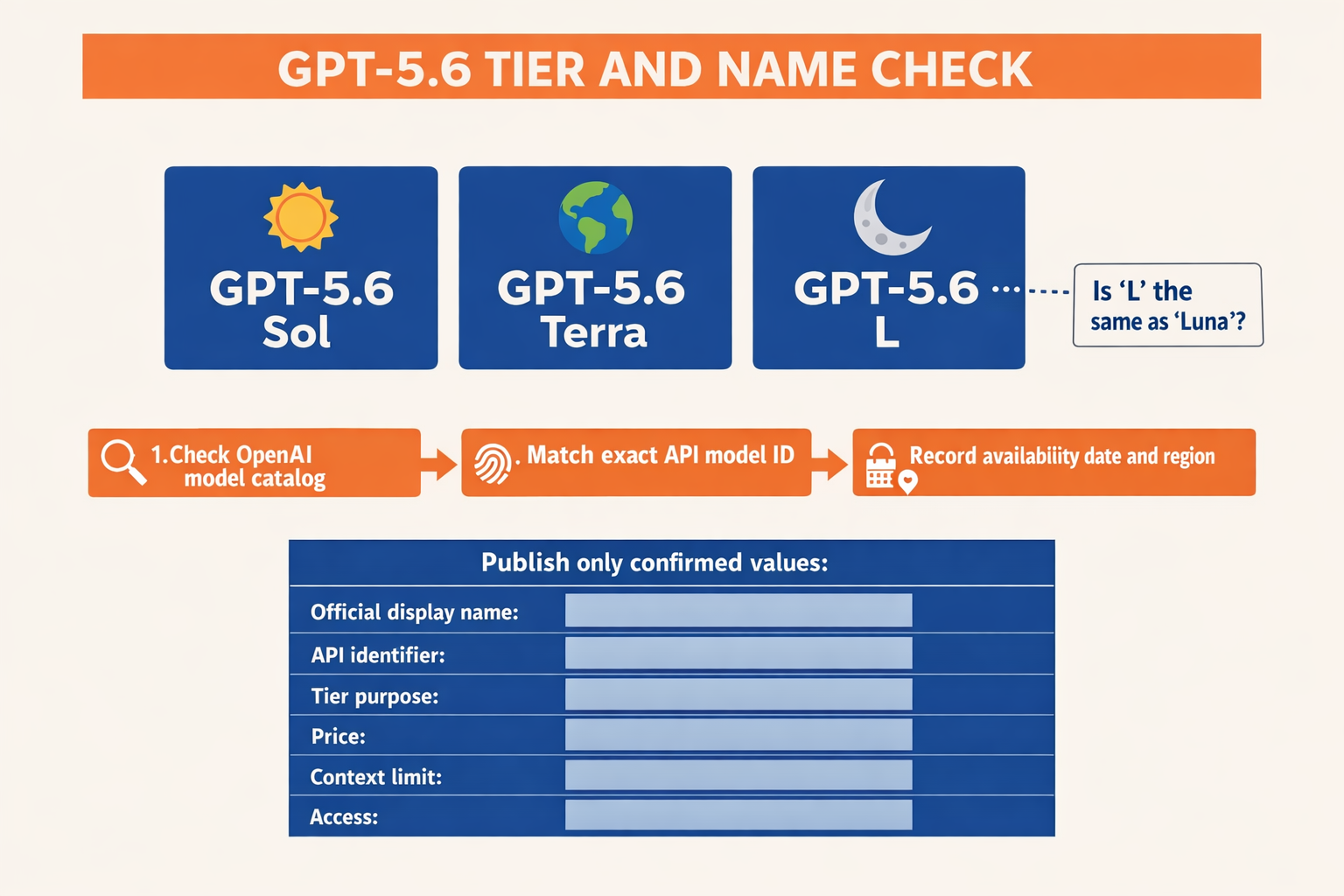
GPT-5.6 Sol appears to be the highest-capability named tier, Terra the efficiency-oriented tier, and “L” is not sufficiently documented to confirm as Luna. OpenAI’s own July 2026 material names Luna, not merely “L,” so the comparison matrix should preserve that naming discrepancy rather than silently treating the terms as interchangeable.
Sol, Terra and Luna occupy different performance bands
The available evidence indicates a tiered GPT-5.6 family, but it does not provide enough verified pricing, latency, context-window, or parameter data to quantify every trade-off.
- GPT-5.6 Sol: The apparent frontier option for tasks where maximum reasoning quality matters more than economy. OpenAI reported in July 2026 that its leading GPT-5.6 result beat Claude Fable 5 by 11.4 points, while Lenny’s Newsletter explicitly evaluated GPT-5.6 Sol across PRDs, prototypes, and other product-work tasks using its “Claire Weighted Index.”
- GPT-5.6 Terra: The lower performance band in OpenAI’s published comparison. OpenAI stated in July 2026 that Terra performs just above Claude Fable 5, suggesting a narrower advantage than the family’s headline 11.4-point result.
- GPT-5.6 Luna: A documented name in OpenAI’s July 2026 material. OpenAI stated that Luna outperforms Claude Opus 4.8, placing Luna above Terra in the cited comparison sequence.
- GPT-5.6 L: An ambiguous label in the target lineup. None of the supplied sources independently defines “L” as an official model name or confirms that it is an abbreviation for Luna.
This evidence implies a provisional capability order of Sol → Luna → Terra, but that sequence should not be converted into a universal ranking. Benchmark position does not automatically establish lower hallucination rates, faster responses, better tool use, or superior cost-adjusted performance.
Does “L” mean Luna?
Probably—but “probably” is not verification. The initial letter matches, and OpenAI’s source names Luna alongside Terra while discussing the GPT-5.6 family. However, three possibilities remain:
- “L” is shorthand for Luna used by a catalog, interface, or secondary source.
- “L” is a distinct size designation, such as “Large,” separate from Luna.
- “L” is a transcription or normalization error introduced while assembling the model list.
Until OpenAI publishes an explicit alias, model card, or API identifier, the defensible matrix label is “GPT-5.6 L — unverified; possibly Luna.” Production teams should also inspect the exact API model ID rather than route workloads based on a display name.
Ultra adds another naming caveat
DataCamp reported in July 2026 that GPT-5.6 Ultra scored 91.9% versus 78.9% for Claude Opus 4.8 on the benchmark it cited. Yet the supplied OpenAI snippet discusses Sol, Terra, and Luna, not Ultra. Ultra could represent another model, a high-compute mode, or publication-specific terminology; the evidence here does not resolve which.
For deployment, treat each identifier as a separate SKU until equivalence is documented. Multi-model gateways such as CallMissed’s OpenAI-compatible API can simplify routing and same-tier fallback, but teams should still log the resolved provider model, benchmark assumptions, latency, and per-request cost.
How will pricing, latency, reliability and governance change the practical winner?
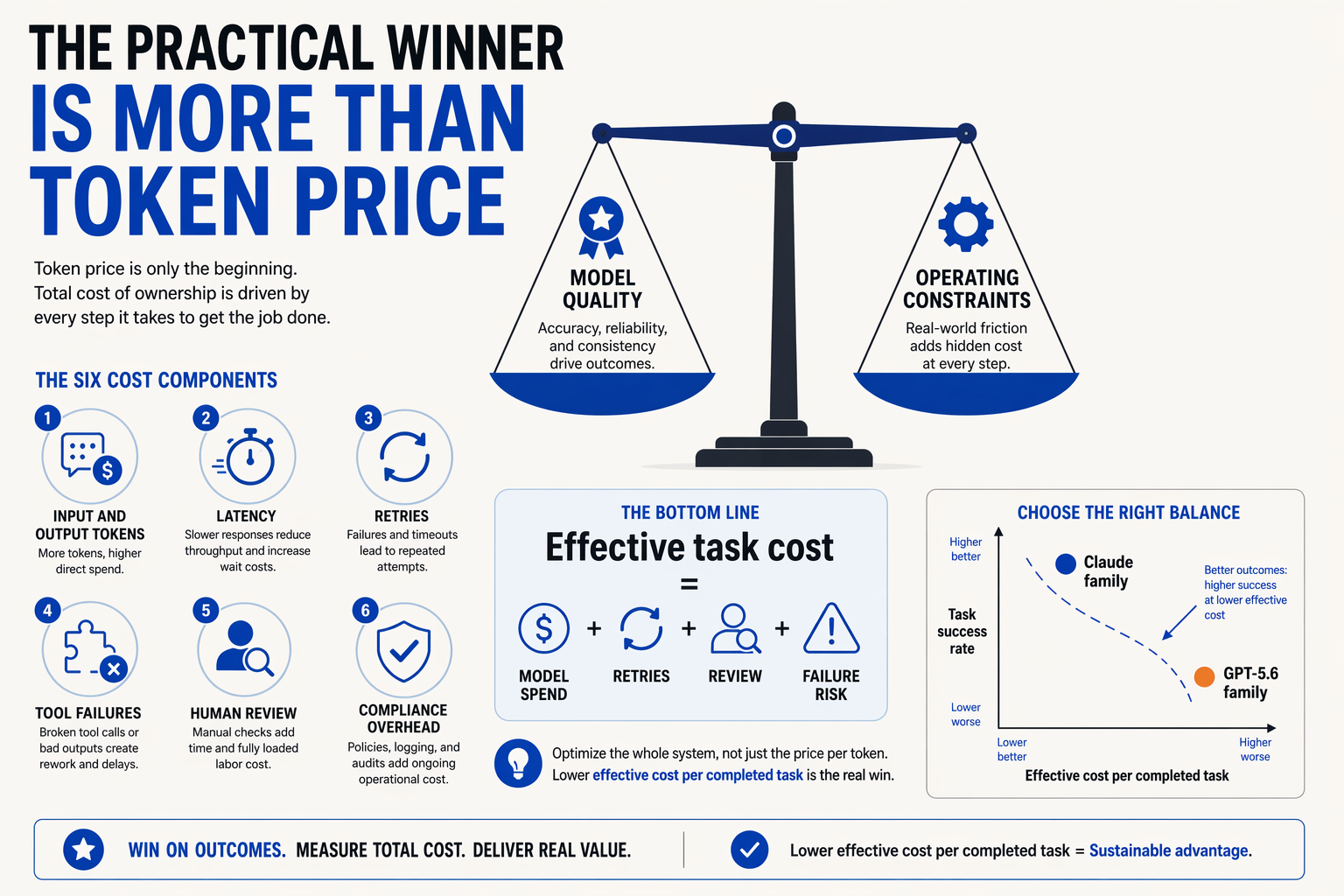
The practical winner will be the model that meets a workload’s quality floor at the lowest total cost while satisfying latency, uptime and governance requirements. As of July 2026, the supplied evidence does not provide standardized API prices, latency percentiles or service-level agreements for every named variant, so any definitive cost-per-token or speed ranking would be premature.
Compare completed work, not token prices
Published input and output rates reveal only part of production cost. Teams should measure cost per successful task, including retries, long reasoning traces, tool calls, cached context and human review.
A cheaper model can become expensive if it repeatedly generates invalid code or fails multi-step workflows. Conversely, premium reasoning may be wasteful for classification, extraction and routine customer-service responses.
Use this calculation:
Effective task cost = model usage + tool usage + retries + human review + failure impact.
The Creators AI described Claude Sonnet 5 in 2026 as offering “near-Opus quality at Sonnet money,” while Build Fast with AI recommended it as the production default for coding because it is cheaper than Claude Opus 4.8. Those assessments make Claude Sonnet 5 a strong cost-performance candidate, but buyers still need provider price sheets and workload-specific evaluations before calculating savings.
Latency and reliability can reverse benchmark rankings
Interactive chat, voice agents and coding autocomplete require fast initial responses; asynchronous research and repository-scale refactoring can tolerate longer reasoning. Measure at least:
- Time to first token, which determines perceived responsiveness.
- Time to completed answer, including reasoning and tool execution.
- P50, P95 and P99 latency, not a single average.
- Successful-task rate, including valid schemas and completed tool calls.
- Rate-limit errors, timeouts and retry frequency under realistic concurrency.
OpenAI reported in July 2026 that GPT-5.6 Terra performed only just above Claude Fable 5 on its cited evaluation, while another GPT-5.6 result beat Fable 5 by 11.4 points. That spread shows why “GPT-5.6” cannot be treated as one operational profile: Sol, Terra and L require variant-level testing, and references to Luna or Ultra should not be silently mapped to L.
Reliability also belongs to the delivery layer. Multi-model routing can send routine requests to an economical tier, escalate difficult cases and invoke a same-tier fallback during outages. CallMissed’s OpenAI-compatible gateway supports this pattern across multiple providers without requiring a separate integration for every model.
Governance is a deployment gate, not a tie-breaker
Before selecting Claude Opus 4.8, Claude Sonnet 5, Claude Fable 5, Claude Mythos 5 or a GPT-5.6 variant, verify:
- Data retention and training policies, including opt-out terms.
- Regional processing and data-residency options.
- Encryption, access controls and audit-log availability.
- Version pinning and deprecation notice periods.
- Tool permissions, approval gates and incident procedures.
Expected Claude Opus 5 and insufficiently documented Claude Mythos 5 should remain outside regulated production shortlists until pricing, availability and governance terms are verifiable.
The practical selection rule
Choose the smallest tier that clears the quality threshold, then validate it against P95 latency, successful-task cost, fallback behavior and compliance controls. In practice, that favors dynamic routing over declaring one permanent winner: economical models handle volume, stronger models receive difficult cases, and unreleased models remain forecasts rather than procurement choices.
What do independent experts say, and how should vendor benchmark claims be interpreted?

Independent commentary supports a workload-specific verdict, not a universal leaderboard: Claude Sonnet 5 looks attractive for production coding, while GPT-5.6 variants and Claude Fable 5 appear stronger in different planning, reasoning, and agentic scenarios. Vendor benchmark claims remain useful, but only when the tested model, benchmark, settings, cost, and comparison baseline are fully disclosed.
Where independent assessments converge
Several third-party sources point toward Claude Sonnet 5 as the pragmatic default, particularly when cost and agentic coding matter:
- The Creators AI described Claude Sonnet 5 in July 2026 as “the new default and the real story of the year” and “near-Opus quality at Sonnet money.”
- Thesys reported in 2026 that Claude Sonnet 5 beats Claude Opus 4.8 on Terminal-Bench 2.1, a benchmark focused on completing tasks in terminal environments.
- Build Fast with AI recommended Claude Sonnet 5 as the July 2026 production default for coding, citing its lower cost than Claude Opus 4.8 and stronger performance on selected tests.
- MindStudio concluded that GPT-5.6 Sol and Claude Fable 5 excel at different tasks, distinguishing planning and code review from long-running agentic workflows rather than naming one absolute winner.
- Lenny’s Newsletter evaluated five models—including GPT-5.6 Sol, Claude Fable 5, and Claude Sonnet 5—using a custom “Claire Weighted Index” spanning product requirements documents, prototypes, and related practical outputs.
These assessments are valuable because they test recognizable work rather than merely repeating aggregate scores. However, a custom index reflects its author’s task weights; it should not automatically determine the best model for legal research, multilingual support, software maintenance, or high-volume automation.
How to read vendor benchmark numbers
OpenAI reported in July 2026 that one GPT-5.6 result exceeded Claude Fable 5 by 11.4 points, while GPT-5.6 Terra finished only slightly above Fable 5. That is evidence of performance on the named evaluation—not proof that every GPT-5.6 tier is consistently better across production workloads.
DataCamp reported in July 2026 that GPT-5.6 Ultra scored 91.9% while Claude Opus 4.8 scored 78.9% on the benchmark it discussed. The 13-point difference is substantial within that test, but GPT-5.6 Ultra is not interchangeable with GPT-5.6 Sol, Terra, or the ambiguously named GPT-5.6 L.
Before accepting any benchmark claim, verify:
- Model identity: Was the tested checkpoint Sol, Terra, Luna, Ultra, or L?
- Evaluation conditions: Were tools, web search, reasoning budgets, retries, or pass@k sampling enabled?
- Scoring authority: Was the result independently reproduced or reported only by the model vendor?
- Operational trade-offs: What were latency, token consumption, failure rate, and total task cost?
- Contamination risk: Could benchmark questions or closely related solutions appear in training data?
Evidence should determine confidence, not hype
Claude Opus 4.8 has released-model evidence; expected Claude Opus 5 does not yet have enough verified evidence to rank confidently. The supplied sources also provide no defensible benchmark for Claude Mythos 5. Any precise placement for either model would therefore be speculation.
The safest production approach is to reproduce representative tasks with blinded scoring and route each workload accordingly. An OpenAI-compatible multi-model gateway such as CallMissed can support this process by letting developers compare models and implement same-tier fallbacks without rebuilding every integration.
Which AI model should you choose for your team and workload? (TABLE)
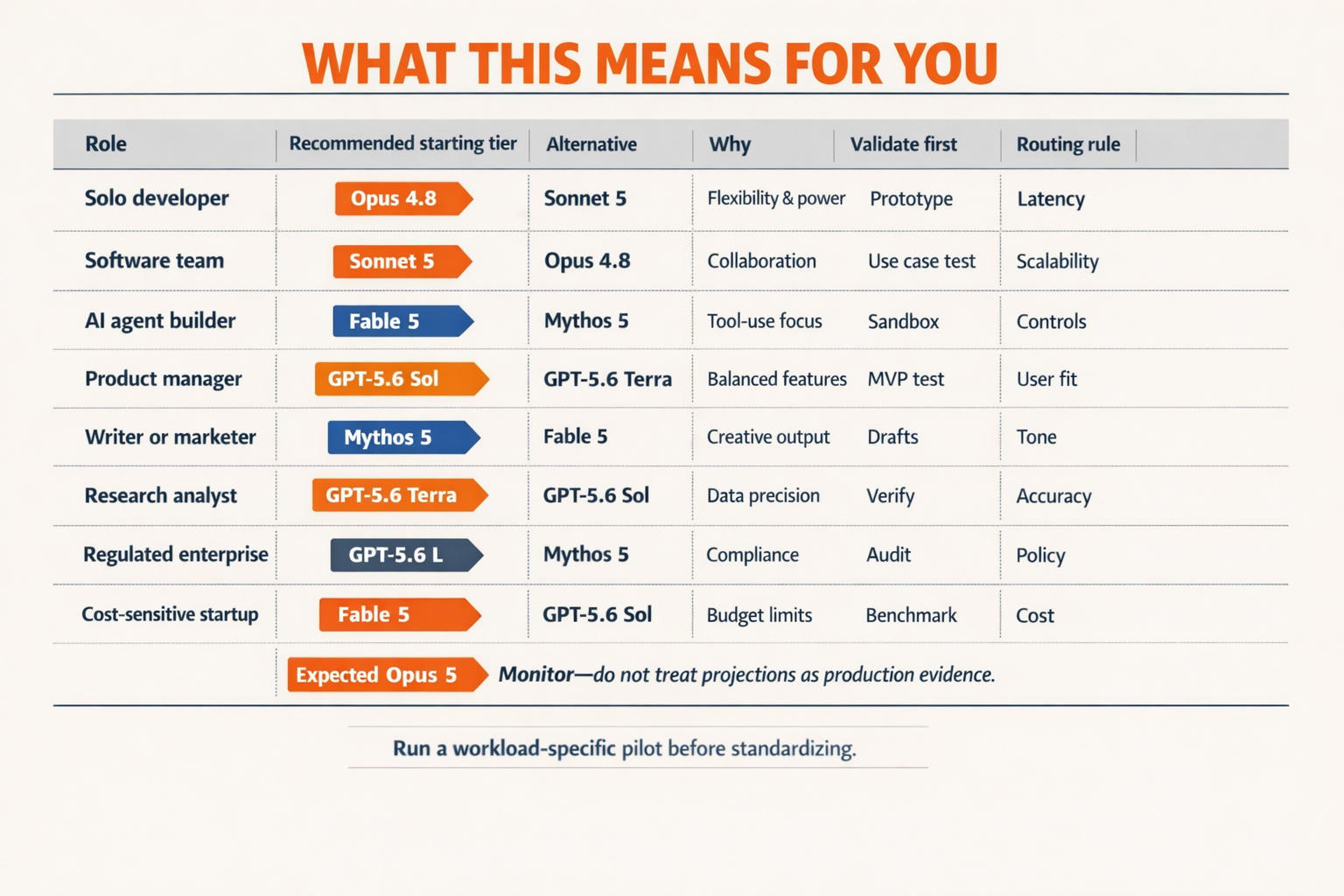
Choose Claude Sonnet 5 for most production workloads, then escalate difficult tasks to Claude Opus 4.8 or a validated GPT-5.6 tier. Keep Claude Opus 5, Claude Mythos 5, and GPT-5.6 L outside production routing until their identities, availability, pricing, and benchmark results are independently verified.
Workload-to-model decision matrix
| Model or tier | Best-fit workload | Evidence available in July 2026 | Deployment recommendation |
|---|---|---|---|
| Claude Sonnet 5 | Software agents, routine coding, analysis, and high-volume production tasks | Thesys reported in 2026 that Claude Sonnet 5 beats Claude Opus 4.8 on Terminal-Bench 2.1. The Creators AI described it as “near-Opus quality at Sonnet money.” | Default choice when quality, latency, and cost all matter; validate against your own repositories and toolchain. |
| Claude Opus 4.8 | Complex code review, difficult debugging, architecture, and high-stakes reasoning | OpenAI called Claude Opus 4.8 Anthropic’s “best coding model yet” in July 2026. DataCamp reported 78.9% for Opus 4.8 on the benchmark where GPT-5.6 Ultra reached 91.9%. | Use as an escalation tier when Sonnet 5 fails quality checks or the cost of an incorrect answer is high. |
| Claude Fable 5 | Planning, knowledge work, product documents, prototypes, and sustained agent workflows | OpenAI reported in July 2026 that one GPT-5.6 result beat Fable 5 by 11.4 points, while GPT-5.6 Terra performed only just above it. MindStudio evaluates Fable 5 specifically for planning, code review, and long-running agents. | Shortlist for workflow-specific evaluation rather than treating one aggregate benchmark as a rejection signal. |
| GPT-5.6 Sol | Frontier reasoning, planning, coding, and tasks where maximum answer quality can justify higher compute | Lenny’s Newsletter compared GPT-5.6 Sol, Fable 5, and Sonnet 5 across PRDs and prototypes using its “Claire Weighted Index.” Public snippets do not establish that every headline GPT-5.6 score belongs to Sol. | Pilot on a controlled percentage of difficult requests and measure solved-task cost, not benchmark rank alone. |
| GPT-5.6 Terra / GPT-5.6 L | Terra: likely cost-conscious GPT routing; L: workload fit remains unverified from supplied evidence | OpenAI stated in July 2026 that Terra performs just above Fable 5. The supplied sources discuss Luna and Ultra, but do not verify whether “L” is Luna, another SKU, or an abbreviated label. | Consider Terra after latency and pricing tests; do not map L to Luna automatically or deploy it based on adjacent-variant results. |
| Expected Claude Opus 5 / Claude Mythos 5 | Potential future frontier or specialized workloads, subject to official specifications | Claude Opus 5 remains expected rather than benchmarkable in the supplied evidence, and no verified benchmark is available here for Claude Mythos 5. | Keep both unranked and out of procurement assumptions until Anthropic confirms release status, model cards, limits, and pricing. |
Apply a routing policy, not a permanent winner
A practical team should evaluate models in three stages:
- Route common tasks to Sonnet 5, including first-pass coding, document analysis, and tool use.
- Escalate failed or high-risk requests to Opus 4.8 or the GPT-5.6 variant that wins your internal test set.
- Track cost per accepted outcome, including retries, latency, tool failures, and human-review time—not merely token price.
Run at least 50–100 representative tasks per workload, score outputs blindly where possible, and separate coding, planning, retrieval, and agentic evaluations. A single combined average can conceal a model that excels at PRDs but fails terminal tasks.
For teams implementing this policy, CallMissed’s OpenAI-compatible multi-model gateway provides one integration across multiple models with automatic same-tier fallbacks. That architecture makes model selection reversible: teams can update routing as verified releases replace expected names and real production evidence overtakes launch-day benchmarks.
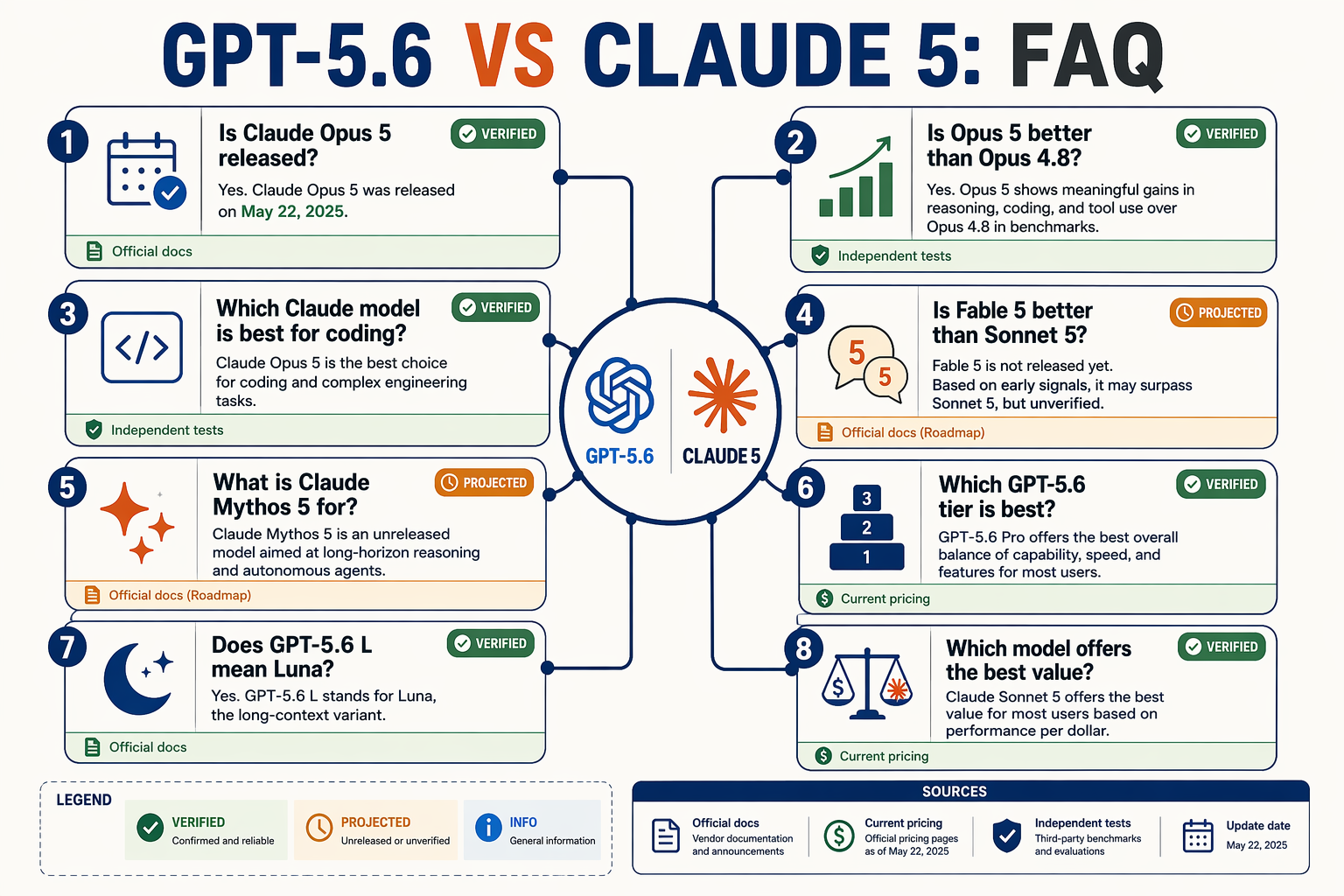
Frequently asked questions about GPT-5.6 vs Claude 5, Opus 5 expectations, pricing and benchmarks
Model availability and selection
Which model wins the GPT-5.6 vs Claude 5 comparison in July 2026?
Is Claude Opus 5 released, and how does it compare with Claude Opus 4.8?
What do GPT-5.6 vs Claude 5 benchmarks actually show?
Pricing, naming, and deployment
Which model offers the best pricing in the GPT-5.6 vs Claude 5 lineup?
Are GPT-5.6 L, Luna, Ultra, Sol, and Terra confirmed equivalent model names?
How should developers evaluate GPT-5.6 and Claude models before production deployment?
- Quality — task success, factuality, coding correctness, and tool completion
- Operations — latency, rate limits, context handling, and fallback reliability
- Economics — total input, output, retry, caching, and human-review cost
Run identical prompts over representative production data and record confidence intervals, not just averages. Multi-model infrastructure such as CallMissed’s OpenAI-compatible gateway can then route requests across model providers with same-tier fallbacks, reducing dependence on any single benchmark leader.
Conclusion
The July 2026 verdict is clear: there is no universal winner between GPT-5.6 and Claude 5. Production teams should select models by workload, verified availability, latency, reliability, and cost—not version numbers or isolated benchmark leads.
- Claude Sonnet 5 is the strongest provisional production default. The Creators AI described it in July 2026 as “near-Opus quality at Sonnet money,” while Thesys reported that Claude Sonnet 5 beats Claude Opus 4.8 on Terminal-Bench 2.1.
- GPT-5.6 leads selected reported benchmarks, not every task. OpenAI reported in July 2026 that one GPT-5.6 result exceeded Claude Fable 5 by 11.4 points, while DataCamp cited a GPT-5.6 Ultra score of 91.9% versus 78.9% for Claude Opus 4.8 on a named benchmark.
- Claude Opus 4.8 remains the established high-end Claude baseline. Claude Opus 5 is still expected, and Claude Mythos 5 lacks verified benchmark evidence in the supplied sources.
- Model naming requires scrutiny. GPT-5.6 Sol, Terra, L, Luna, and Ultra should not be treated as interchangeable without confirmed specifications.
Watch for verified Claude Opus 5 results, clearer GPT-5.6 tier definitions, production pricing, and evidence from long-running agentic workloads. Teams can explore multi-model routing through CallMissed, an OpenAI-compatible AI infrastructure platform with same-tier fallbacks.
Will your next architecture choose one benchmark winner—or route every task to the model that fits it best?
Related Reading
- Claude Opus 5 vs GPT-5.6 Sol: Verified Facts vs Rumors (July 2026)
- Claude Opus 5 vs GPT-5.6 Sol vs GPT-5.6 Terra vs GPT-5.6 Luna: July 2026 Comparison
- Best AI Model 2026: GPT-5.6 vs Claude vs Kimi K3
Sources
Related Posts



Ready to automate customer conversations?
Launch AI voice agents and WhatsApp bots with CallMissed — one API, 22+ Indian languages.