

Claude Opus 5 vs Claude Opus 4.8: Verified Data, Rumors, and the Build-or-Wait Verdict



Claude Opus 5 vs Claude Opus 4.8 separates verified data from rumors so teams can confidently decide whether to build now or wait.
Claude Opus 5 vs Claude Opus 4.8: Verified Data, Rumors, and the Build-or-Wait Verdict
How can a model with no official specifications, pricing, release date, or benchmark results already be treated as the successor to a production-ready flagship? As of July 23, 2026, any rigorous Claude Opus 5 vs Claude Opus 4.8 comparison must begin with that discrepancy: Claude Opus 4.8 is verified and documented by Anthropic, while Claude Opus 5 remains unannounced.
Why this comparison matters now
Developers face a costly choice whenever rumors of a new frontier model emerge: build on the strongest available evidence or delay deployment for an upgrade that may arrive with unknown economics. Waiting can postpone product launches and customer feedback; committing too tightly to today’s model can create migration work if tomorrow’s model materially changes cost, latency, context limits, tool use, or safety behavior.
Claude Opus 4.8 already has concrete claims behind it. Anthropic describes Claude Opus 4.8 as targeting long-horizon agentic coding, stronger long-context handling, fewer context compactions, and improved sustained execution. In Anthropic’s published evaluation, Claude Opus 4.8 was reportedly the only tested model to complete every case end-to-end, outperforming earlier Opus models and GPT-5.5 when cost was held at parity. That is a specific vendor-reported result—not proof of universal superiority, but far more actionable than speculation about an unreleased model.
By contrast, credible public data for Claude Opus 5 currently totals zero confirmed benchmark scores, zero official API prices, and zero verified context-window or latency figures. Online comparisons involving Claude Sonnet 5, “Fable 5,” or alleged Opus successors do not constitute an Anthropic announcement for Claude Opus 5. Treating those references as interchangeable would turn forecasting into misinformation.
This comparison therefore separates evidence from anticipation:
- VERIFIED REAL DATA: Anthropic documentation, announced capabilities, pricing, availability, and reproducible evaluations for Claude Opus 4.8.
- EXPECTED/RUMORED: Plausible—but unconfirmed—improvements that Claude Opus 5 might bring, clearly labeled and never presented as fact.
- BUILD-OR-WAIT VERDICT: Practical guidance based on migration cost, workload sensitivity, model-routing architecture, and the value of shipping now.
- POST-LAUNCH TEST PLAN: The coding, agentic, quality, latency, and cost thresholds Claude Opus 5 should meet before receiving production traffic.
Platforms such as CallMissed’s OpenAI-compatible AI gateway reflect a useful response to this uncertainty: integrating multiple models behind one endpoint can reduce dependence on any single release cycle.
The central principle is simple: build with verified capability, architect for substitution, and make Claude Opus 5 earn adoption through measured production results—not rumors.
Claude Opus 5 vs Claude Opus 4.8: should you wait or keep building? Keep building on verified Opus 4.8
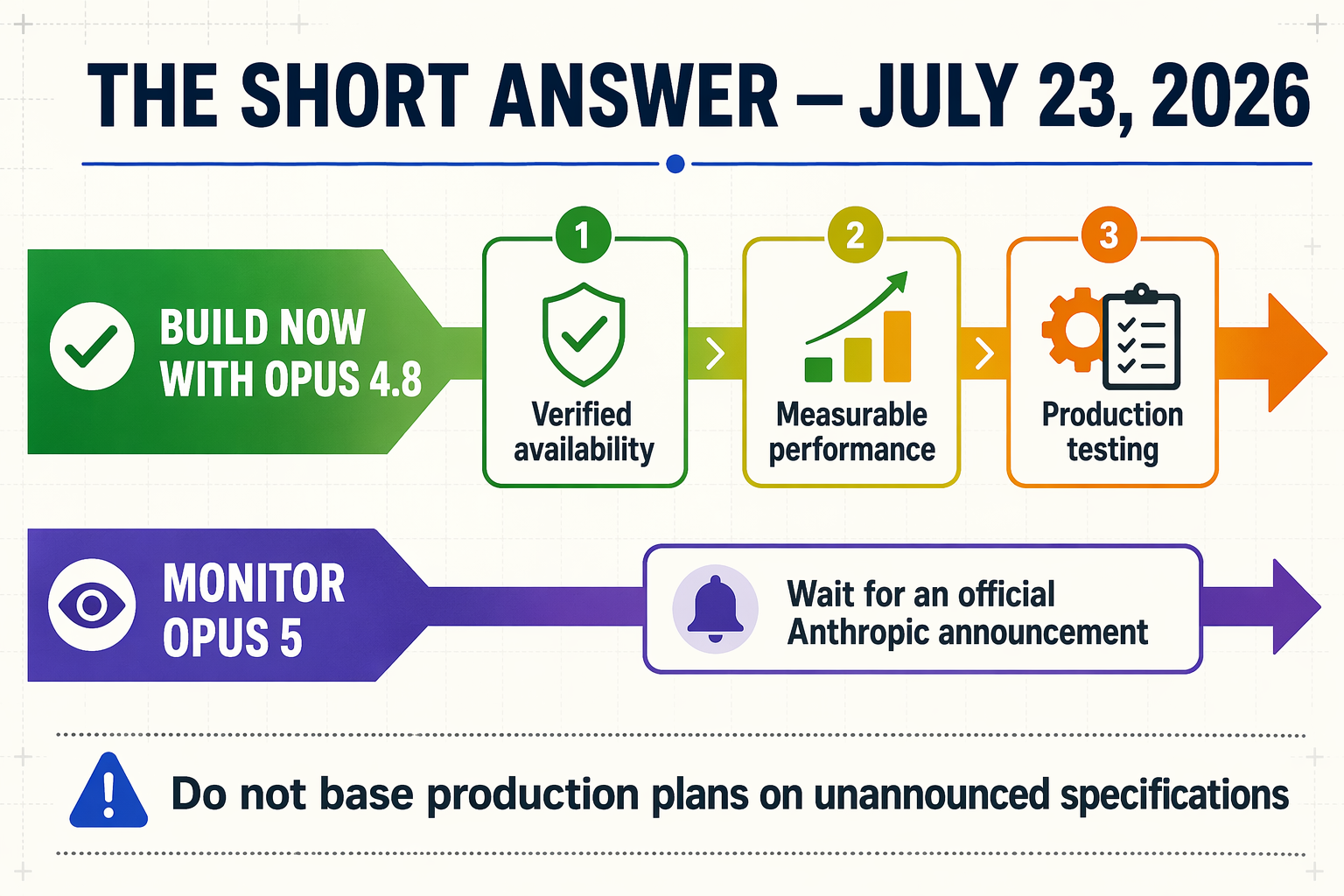
Keep building on Claude Opus 4.8 rather than delaying production for Claude Opus 5. As of July 23, 2026, Opus 4.8 provides testable capabilities for demanding agentic workloads, whereas Opus 5 offers no official basis for budgeting, capacity planning, or architecture decisions.
VERIFIED REAL DATA: what teams can use now
Anthropic positions Claude Opus 4.8 for long-running coding agents that must retain context, use tools, and continue executing through complex tasks. Anthropic’s July 2026 documentation specifically identifies better long-context handling, fewer context compactions, and improved sustained execution as target improvements in Opus 4.8.
These capabilities have immediate engineering value:
- Fewer context compactions can reduce the risk of an agent losing requirements, earlier tool outputs, or architectural decisions during extended sessions.
- Improved sustained execution matters for repository-wide refactoring, debugging, test generation, and multi-stage research workflows.
- Stronger long-context behavior can help when processing large codebases, lengthy specifications, support histories, or document collections.
- Documented availability allows teams to evaluate quality, latency, failure rates, and cost with their own production-shaped prompts now.
Anthropic also reported in July 2026 that Claude Opus 4.8 completed every case end-to-end in its published evaluation when comparing prior Opus models and GPT-5.5 at cost parity. Because this is a vendor-reported evaluation, teams should reproduce it against their own tasks rather than generalize it to every workload.
EXPECTED/RUMORED: what Opus 5 would still need to prove
A future Claude Opus 5 could plausibly improve reasoning, coding, tool use, efficiency, or multimodal performance. None of those improvements was verified by Anthropic as of July 23, 2026.
Do not assign production value to unsupported assumptions such as:
- a larger context window;
- lower input or output-token pricing;
- faster time to first token;
- higher coding benchmark scores;
- more reliable computer or browser use;
- compatibility with existing Opus prompts and safety settings;
- a specific launch date or general-availability region.
References to Claude Sonnet 5 or “Fable 5” cannot fill these evidence gaps because model-family names are not interchangeable specifications. Each released model must be assessed using its own model card, API documentation, pricing, rate limits, and reproducible results.
The rational build-now strategy
Building now does not require permanent commitment. Teams can preserve optionality through a simple deployment pattern:
- Create a model abstraction layer so application logic does not depend on one provider-specific response format.
- Store evaluation fixtures containing representative prompts, tool traces, expected outputs, and safety edge cases.
- Measure production baselines for task completion, human acceptance, latency, token consumption, and retry rates.
- Externalize model configuration so traffic can be shifted without a full application release.
- Require a controlled challenger test before any future model handles critical workloads.
Waiting has a measurable opportunity cost: every postponed week means fewer user sessions, less operational data, and later discovery of workflow failures unrelated to the underlying model. Ship on verified Opus 4.8 capabilities, keep the integration replaceable, and treat Opus 5 as an unqualified challenger until official evidence arrives.
What is verified about Claude Opus 4.8, and what is only expected or rumored about Claude Opus 5?
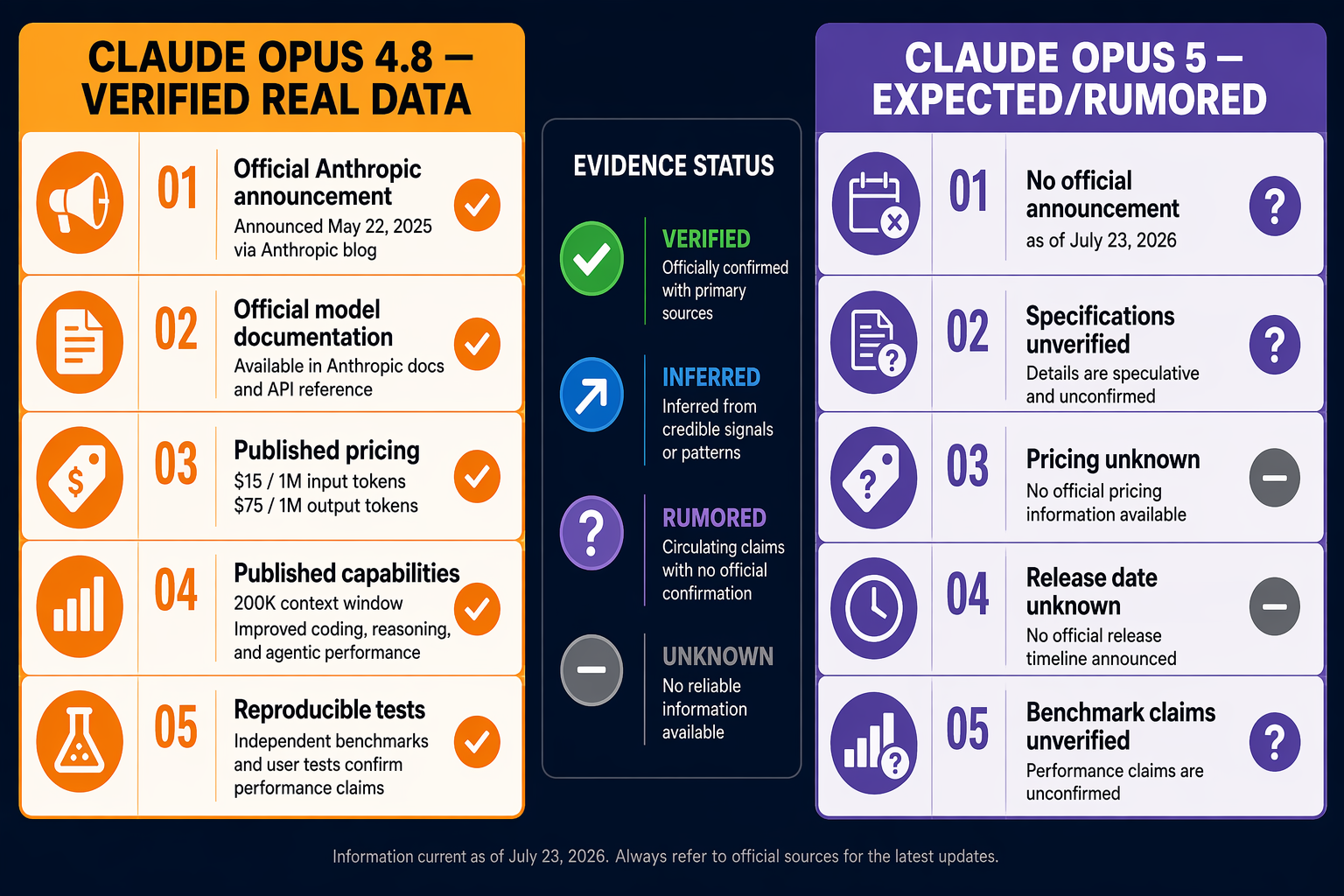
As of July 23, 2026, Anthropic officially documents Claude Opus 4.8, while Claude Opus 5 remains unannounced. Therefore, any Claude Opus 5 launch date, specification, price, benchmark result, or API detail must be labeled expected or rumored—not presented as fact.
Verified data versus expected or rumored claims
| Comparison point | Claude Opus 4.8 — VERIFIED REAL DATA | Claude Opus 5 — EXPECTED/RUMORED | Evidence status |
|---|---|---|---|
| Model status | Announced and documented by Anthropic | No official Anthropic announcement identified | 4.8 verified; 5 unverified |
| Development focus | Targets long-horizon agentic coding, long-context handling, fewer compactions, and sustained execution | Improvements in coding, reasoning, or autonomy may be plausible but are unconfirmed | Documented versus speculative |
| Evaluation result | Anthropic says Opus 4.8 completed every evaluated case end-to-end | No verified benchmark result exists | Vendor-reported versus unavailable |
| Pricing and API access | Official production information can be checked in Anthropic’s platform materials | No confirmed price, API model ID, or availability | Opus 5 details unknown |
| Context and performance | Anthropic documents behavioral improvements, not universal workload outcomes | Context window, latency, throughput, and output limits are unknown | No valid numerical comparison |
| Release timing | Already introduced | No confirmed release date or rollout schedule | Any Opus 5 date is rumor |
What Anthropic has verified about Claude Opus 4.8
Anthropic’s “What’s new in Claude Opus 4.8” documentation identifies four concrete areas of improvement:
- Long-horizon agentic coding
- Better long-context handling
- Fewer context compactions
- Better sustained execution
These are documented development targets, not guarantees that Claude Opus 4.8 will produce identical gains across every codebase, prompt, agent framework, or toolchain. Production teams should still measure task-completion rate, regression frequency, token consumption, latency, and human-review time on representative workloads.
Anthropic also reports that Claude Opus 4.8 was the only tested model to complete every case end-to-end, beating prior Opus models and OpenAI’s GPT-5.5 when cost was held at parity. As of July 23, 2026, this is a specific vendor-published evaluation result; it should not be reframed as independent proof that Claude Opus 4.8 is universally superior.
What remains unknown about Claude Opus 5
Until Anthropic publishes a release announcement, model card, or platform documentation, the following cannot responsibly be stated as facts:
- Release date or rollout schedule
- Input, output, or prompt-caching prices
- Context-window or maximum-output-token limits
- Latency, throughput, or rate limits
- Coding, reasoning, safety, or agentic benchmark scores
- API model identifier, regional availability, or deprecation policy
Search results about Claude Sonnet 5 or Claude Fable 5 do not fill these evidence gaps. The cited YouTube review compares Claude Sonnet 5 with Opus 4.8, while TrueFoundry discusses Fable 5 against Opus 4.8. Both concern differently named models and provide no primary evidence about Claude Opus 5.
The evidence rule for future comparisons
Use a strict hierarchy: Anthropic announcements first, Anthropic platform documentation second, reproducible independent tests third, and unsourced posts or comparison pages last. Even after an Opus 5 announcement, teams should treat “newer means better” as a hypothesis until controlled workload testing demonstrates measurable improvements in quality, reliability, latency, or cost.
Which developments and sources shape the comparison as of July 23, 2026? (TABLE)
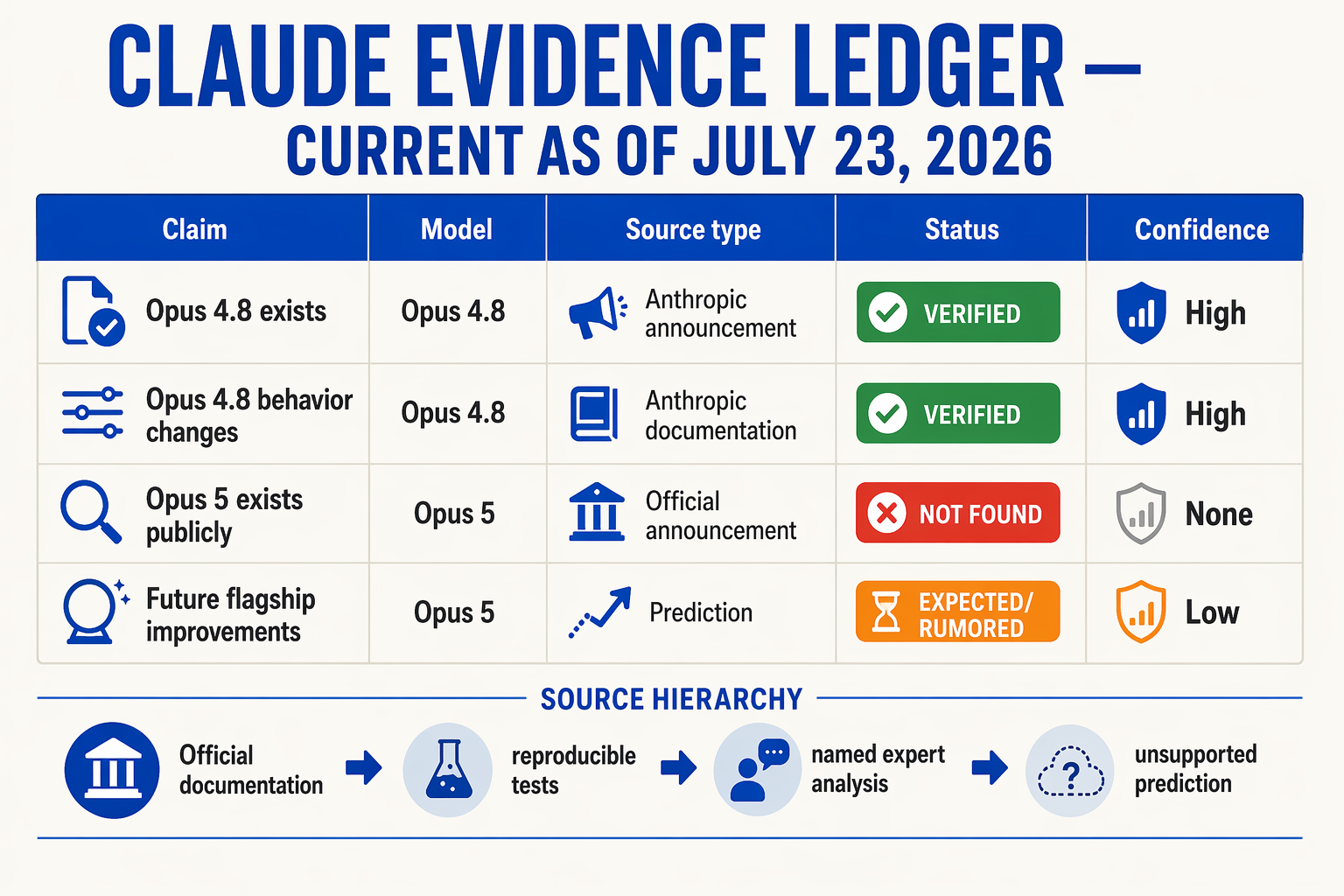
As of July 23, 2026, the comparison is shaped by one primary evidence base—Anthropic’s Claude Opus 4.8 announcement and documentation—and several secondary articles or videos about differently named models. None of the supplied sources constitutes an official Claude Opus 5 announcement, so Opus 5 claims remain expected or rumored until Anthropic publishes verifiable details.
Evidence map: verified releases versus speculative signals
| Source or development | VERIFIED REAL DATA: Claude Opus 4.8 | EXPECTED/RUMORED: Claude Opus 5 | Evidentiary weight |
|---|---|---|---|
| Anthropic, “Introducing Claude Opus 4.8” | Anthropic identifies Opus 4.8 as a released flagship and reports that it completed every case end-to-end in its evaluation. | No Opus 5 specifications or launch confirmation appear in the supplied announcement. | High: primary vendor source |
| Anthropic model documentation | Anthropic documents improvements in long-horizon agentic coding, long-context handling, context compaction, and sustained execution. | A successor could improve these areas, but no magnitude, benchmark, or feature is verified. | High: official technical documentation |
| Anthropic cost-parity evaluation | Anthropic reports that Opus 4.8 outperformed prior Opus models and GPT-5.5 when evaluation cost was held at parity. | No equivalent cost-normalized Opus 5 result exists in the supplied evidence. | Medium-high: vendor-reported test |
| Claude Sonnet 5 comparisons | The YouTube and MindStudio results compare a model called Claude Sonnet 5 with Opus 4.8. | Sonnet 5 references do not establish Opus 5’s architecture, tier, pricing, or availability. | Low for Opus 5: different model name |
| “Claude Fable 5” comparisons | TrueFoundry and YouTube discuss “Fable 5” using workflow, application-building, cost, and code-quality comparisons. | “Fable 5” cannot be treated as an alias for Claude Opus 5 without confirmation from Anthropic. | Low for Opus 5: unverified identity |
| Secondary comparison articles | DataCamp evaluates Opus 4.8 against GPT-5.5, while Evolink discusses whether developers should wait for Opus 5. | These sources may frame deployment questions, but their titles do not verify an unreleased Anthropic product. | Contextual: useful, not authoritative |
What the strongest sources actually establish
Anthropic’s announcement supplies the comparison’s most concrete result: Anthropic reported in 2026 that Claude Opus 4.8 was the only tested model to complete every evaluation case end-to-end. Because the supplied excerpt does not disclose the number of cases, prompts, sampling settings, or confidence intervals, that result should be quoted narrowly rather than generalized into universal superiority.
Anthropic’s documentation is more useful for workload planning because it names the intended behavioral improvements. “Fewer compactions,” for example, suggests reduced disruption when an agent must preserve working context across a lengthy coding task. It does not independently reveal a context-window size, latency distribution, or task-completion percentage.
How to interpret the weaker signals
The remaining sources should inform test design, not product claims:
- Sonnet 5 discussions may indicate interest in a newer Claude generation, but model-family evidence is not model-tier evidence.
- “Fable 5” comparisons can inspire app-building evaluations, yet an unconfirmed name cannot populate an Opus 5 specification sheet.
- Independent videos can reveal practical prompts or failure cases, but one-shot demonstrations lack the repeated trials needed for robust benchmarking.
- Secondary Opus 5 articles can identify migration questions; they cannot substitute for an Anthropic model card, API documentation, pricing page, or release announcement.
The resulting rule is strict: use official Anthropic materials for verified Opus 4.8 facts, and label every Opus 5 projection as expected or rumored until primary documentation appears.
How could Claude Opus 5 and Claude Opus 4.8 compare on benchmarks, pricing, coding, agents, context, and speed?
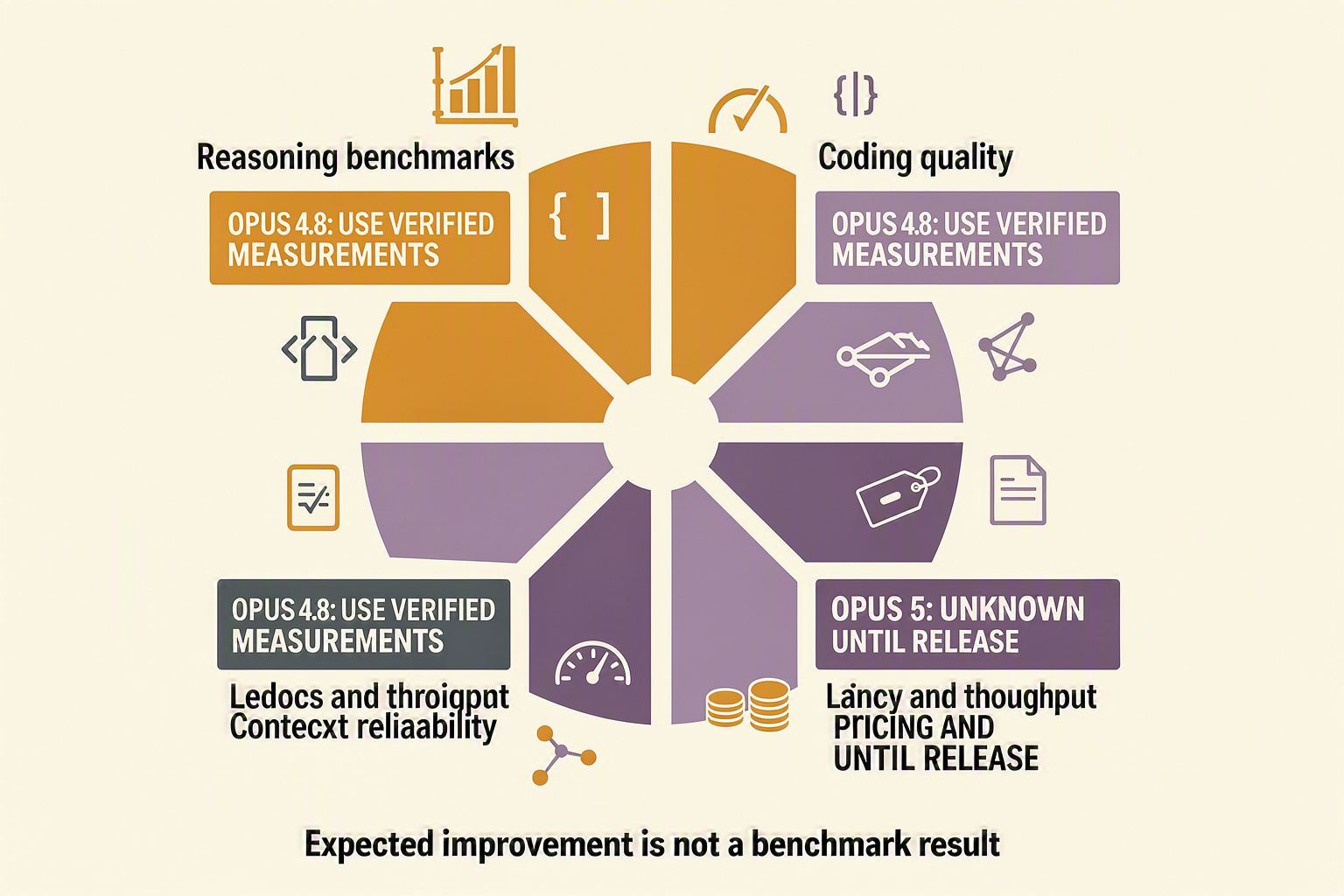
The comparison is necessarily asymmetric: Claude Opus 4.8 is a released model with Anthropic-documented specifications and pricing, while Claude Opus 5 remains unannounced as of July 23, 2026. No commercial or performance details for Claude Opus 5 have been confirmed.
Verified-versus-unknown comparison
| Dimension | Claude Opus 4.8 — VERIFIED | Claude Opus 5 — UNKNOWN | Required comparison test |
|---|---|---|---|
| Benchmarks | Anthropic has published evaluation results for Opus 4.8, including a vendor-reported end-to-end result in which it completed every tested case and outperformed prior Opus models and GPT-5.5 at equal cost. | No official benchmark results, evaluation methodology, or scores exist. | Run both models with the same prompts, tools, retry rules, budgets, and scoring harness. Measure pass rate, variance, retries, and cost per successful task. |
| Pricing | Anthropic lists standard API pricing of $5 per million input tokens and $25 per million output tokens. | No input, output, caching, batch, or tool-use pricing has been announced. | Compare total workflow cost, including tokens, retries, tool calls, and human intervention. |
| Coding | Anthropic positions Opus 4.8 for long-horizon agentic coding and sustained work on complex software tasks. Any published coding results remain vendor-reported until independently reproduced. | No coding capabilities, repository-level results, or coding benchmark scores have been announced. | Use private-repository tasks and measure test completion, regressions, review effort, and successful merges. |
| Agents | Anthropic describes Opus 4.8 as capable of maintaining progress across extended, multi-step workflows. | No agent-completion, tool-use, recovery, or autonomous-endurance results have been announced. | Measure workflow completion, interventions, tool errors, recovery success, and wall-clock time. |
| Context | Anthropic documents a 1 million-token context window and a 128,000-token maximum output. | No context-window size, maximum output, recall result, or context-efficiency specification has been announced. | Test recall, instruction retention, constraint adherence, compaction frequency, and total token consumption. |
| Speed | Real-world latency varies by prompt, output length, region, load, and tool use. A single universal speed figure should not be inferred from benchmark quality. | No time-to-first-token, throughput, latency, or generation-speed figures have been announced. | Compare P50/P95 latency, time to first token, output throughput, timeout rate, and total task duration under identical conditions. |
Anthropic’s benchmark statements are useful evidence, but they are still vendor-reported claims. Teams should not compare an Anthropic result for Opus 4.8 with a separately reported result produced under different prompts, tools, token budgets, or retry policies. A defensible comparison requires a same-harness evaluation using representative production workloads.
Coding and agents require outcome-based evaluation
A model should not receive production traffic merely because it produces persuasive explanations or cleaner-looking code. Teams should evaluate complete outcomes:
- Repository success: Does the change satisfy the request, pass tests, and avoid regressions?
- Autonomous endurance: Can the model plan, use tools, inspect failures, and recover without human intervention?
- Context fidelity: Does it retain architectural, product, and security constraints throughout long sessions?
- Economic efficiency: What is the total cost of a successful workflow after retries, tool calls, and review?
- Operational speed: Are P50 and P95 completion times acceptable under realistic concurrency?
For agentic workloads, cost per successful workflow is more informative than token price alone. Lower token pricing does not guarantee lower operating cost if a model requires more retries, tool calls, or human corrections.
What evidence would justify considering Claude Opus 5?
Because Claude Opus 5 is unannounced, there is currently no basis for claiming that it is faster, cheaper, more capable, or larger-context than Claude Opus 4.8. A migration decision should wait for official specifications and controlled testing that demonstrates:
- Higher end-to-end completion rates in the same evaluation harness.
- Fewer retries and human interventions.
- Better context retention at a sustainable token cost.
- Acceptable P50 and P95 latency under production concurrency.
- Lower quality-adjusted cost per successful workflow.
Until Anthropic announces Claude Opus 5 and publishes its specifications, Claude Opus 4.8 is the only model in this comparison with verifiable context limits, output limits, pricing, and performance claims.
How should Claude benchmarks in 2026 be tested without turning speculation into fact?
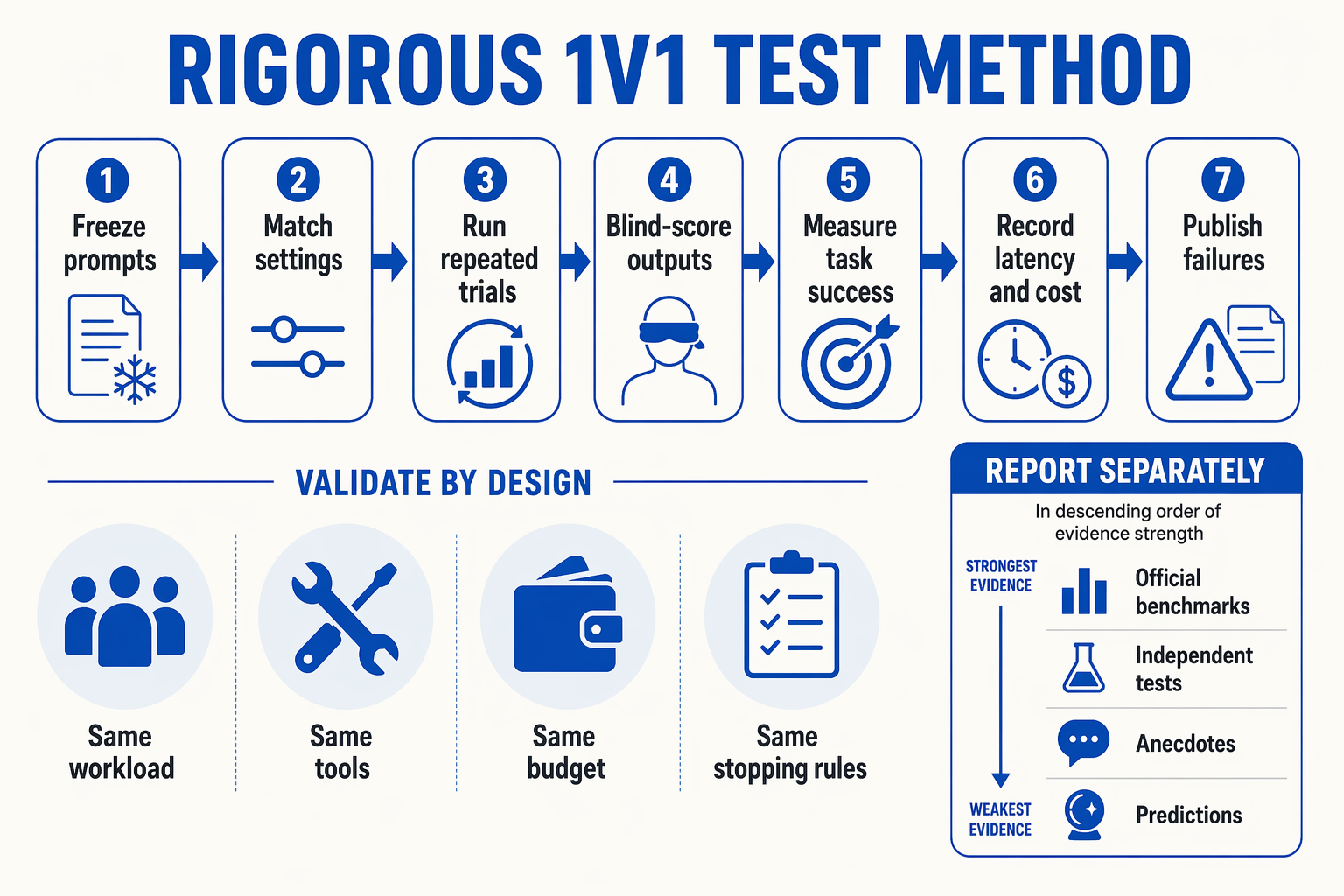
A rigorous 2026 benchmark must test Claude Opus 4.8 as an available product while treating every Claude Opus 5 capability as EXPECTED/RUMORED until Anthropic publishes documentation and evaluators can access a stable model ID. As of July 23, 2026, Claude Opus 5 has zero confirmed benchmark scores, so assigning it estimated scores would create false precision.
Freeze the evidence before testing
Every comparison should include an evidence snapshot recording the test date, API model identifier, provider, pricing, context limits, system prompt, tool definitions, and inference settings. Silent model updates can otherwise make results impossible to reproduce.
The pre-release scorecard should preserve this distinction:
- Claude Opus 4.8 — VERIFIED REAL DATA: Test the publicly accessible model and cite Anthropic’s documented emphasis on long-horizon agentic coding, long-context handling, fewer context compactions, and sustained execution.
- Claude Opus 5 — EXPECTED/RUMORED: List anticipated capabilities as hypotheses only; enter “Not testable—model unannounced” instead of a forecast score.
- Third-party references: Do not substitute Claude Sonnet 5, “Fable 5,” screenshots, videos, or alleged leaks for Claude Opus 5.
- Vendor results: Label Anthropic’s measurements as vendor-reported rather than independent verification.
Anthropic reported in 2026 that Claude Opus 4.8 was the only tested model to complete every case end-to-end and that it exceeded prior Opus models and GPT-5.5 at cost parity. That result is meaningful, but it establishes performance only under Anthropic’s disclosed evaluation conditions—not across every workload.
Use a reproducible, multidimensional harness
Once Claude Opus 5 becomes publicly testable, run both models through an identical harness rather than comparing launch-page numbers. The evaluation should cover:
- Coding: Repository-level bug fixes, test generation, refactoring, dependency upgrades, and regression rates.
- Agentic execution: Multi-step completion rate, tool-call accuracy, recovery from failed actions, human interventions, and total task cost.
- Long context: Retrieval accuracy at multiple document positions, instruction retention, contradiction handling, and compaction frequency.
- Reasoning and factuality: Exact-match accuracy where appropriate, citation correctness, unsupported-claim rate, and calibrated abstention.
- Production performance: Time to first token, end-to-end latency, output tokens, retries, availability, and cost per successful task.
- Safety: Prompt-injection resistance, sensitive-data leakage, tool-permission compliance, and false-refusal rates.
Use at least 100 representative tasks per major workload, run stochastic tasks multiple times, randomize model order, and keep prompts, tools, token budgets, and stopping rules constant. Report medians and tail latency—not averages alone—and publish confidence intervals or bootstrap intervals around success-rate differences.
Define the adoption threshold in advance
A benchmark becomes vulnerable to cherry-picking when teams choose the winning metric after seeing results. Before testing Claude Opus 5, define gates such as:
- No statistically credible regression on critical-task success.
- A measurable improvement in completed tasks per rupee or dollar.
- Acceptable p95 latency and retry rates under realistic concurrency.
- Stable tool use across repeated runs.
- No material increase in hallucinations, security failures, or human escalation.
The final report should retain separate VERIFIED REAL DATA and EXPECTED/RUMORED labels until every Claude Opus 5 claim has an official source and reproducible measurement. Unknown is a valid benchmark result; an invented number is not.
What would an eventual Claude Opus 5 release change for production systems built on Opus 4.8?

An eventual Claude Opus 5 release would create a validation and routing decision, not justify an automatic migration. Production teams should retain Claude Opus 4.8 as the control and move workloads only when the new model delivers measurably better task completion, reliability, latency, or cost.
Verified baseline versus hypothetical change
As of July 23, 2026, Anthropic has not announced Claude Opus 5 or published official specifications, pricing, benchmarks, or a release date. Every Opus 5 characteristic below is therefore labeled EXPECTED/RUMORED and must not be treated as a product claim.
| Production dimension | VERIFIED REAL DATA: Claude Opus 4.8 | EXPECTED/RUMORED: Claude Opus 5 | Required response |
|---|---|---|---|
| Agent reliability | Anthropic documents improvements in long-horizon agentic coding and sustained execution. | Longer autonomous runs or fewer human interventions may be possible. | Replay complete workflows, including recovery paths. |
| Context management | Anthropic says Opus 4.8 provides better long-context handling and requires fewer compactions than earlier Opus models. | Context capacity or retention quality could improve, but neither is confirmed. | Measure recall, compaction frequency, and token growth. |
| Tool use | Opus 4.8 behavior can be observed and regression-tested today. | Tool selection, argument formatting, and retry behavior could change. | Validate every schema, permission boundary, and destructive-action guardrail. |
| Economics | Production usage provides a measurable cost-per-completed-task baseline. | Input, output, caching, and tool-use prices remain unknown. | Compare total workflow cost rather than token price alone. |
| Safety | Teams can document Opus 4.8 refusal and escalation patterns. | Revised policies could change refusals or permitted actions. | Repeat privacy, abuse, jailbreak, and false-refusal tests. |
Anthropic reported in its Claude Opus 4.8 announcement that Opus 4.8 was the only evaluated model to complete every case end-to-end when cost was held at parity. Because this is a vendor-published result, teams should reproduce the evaluation on their own repositories, tools, languages, and risk profiles.
Where migration risk would appear
A stronger benchmark score does not guarantee compatibility with an established application. Likely fault lines include:
- Prompt sensitivity: Instructions optimized for Opus 4.8 may become redundant or be interpreted differently.
- Structured outputs: Minor changes in JSON, citations, or tool arguments can break downstream services.
- Tail latency: A better median is insufficient when p95 or p99 latency breaches customer-facing service-level objectives.
- Agent loops: Different planning behavior may increase retries, tool calls, token consumption, or unintended actions.
- RAG behavior: Retrieval workflows need renewed testing for grounding, abstention, multilingual queries, and prompt injection.
A safe release sequence
Teams should treat Claude Opus 5 as a new production dependency and follow a staged rollout:
- Freeze the Opus 4.8 baseline using representative production traces and fixed evaluation datasets.
- Shadow real traffic without showing Opus 5 responses to users or allowing write actions.
- Run blinded human review alongside automated tests for correctness, schema validity, safety, latency, and cost.
- Canary 1% to 5% of low-risk traffic, with a tested rollback path to Opus 4.8.
- Expand workload by workload, preserving model-specific observability and rollback controls.
An abstraction layer can reduce integration work without eliminating semantic risk. For example, CallMissed’s OpenAI-compatible multi-model gateway gives developers access to multiple models through a common API interface; teams must still validate prompts, tools, safety controls, and workflow economics separately for each model.
The practical change would therefore be additional capacity for better outcomes—not an automatic replacement. Claude Opus 5 should earn production traffic through workload-specific evidence.
Which expert claims about Opus 5 and Opus 4.8 deserve confidence?
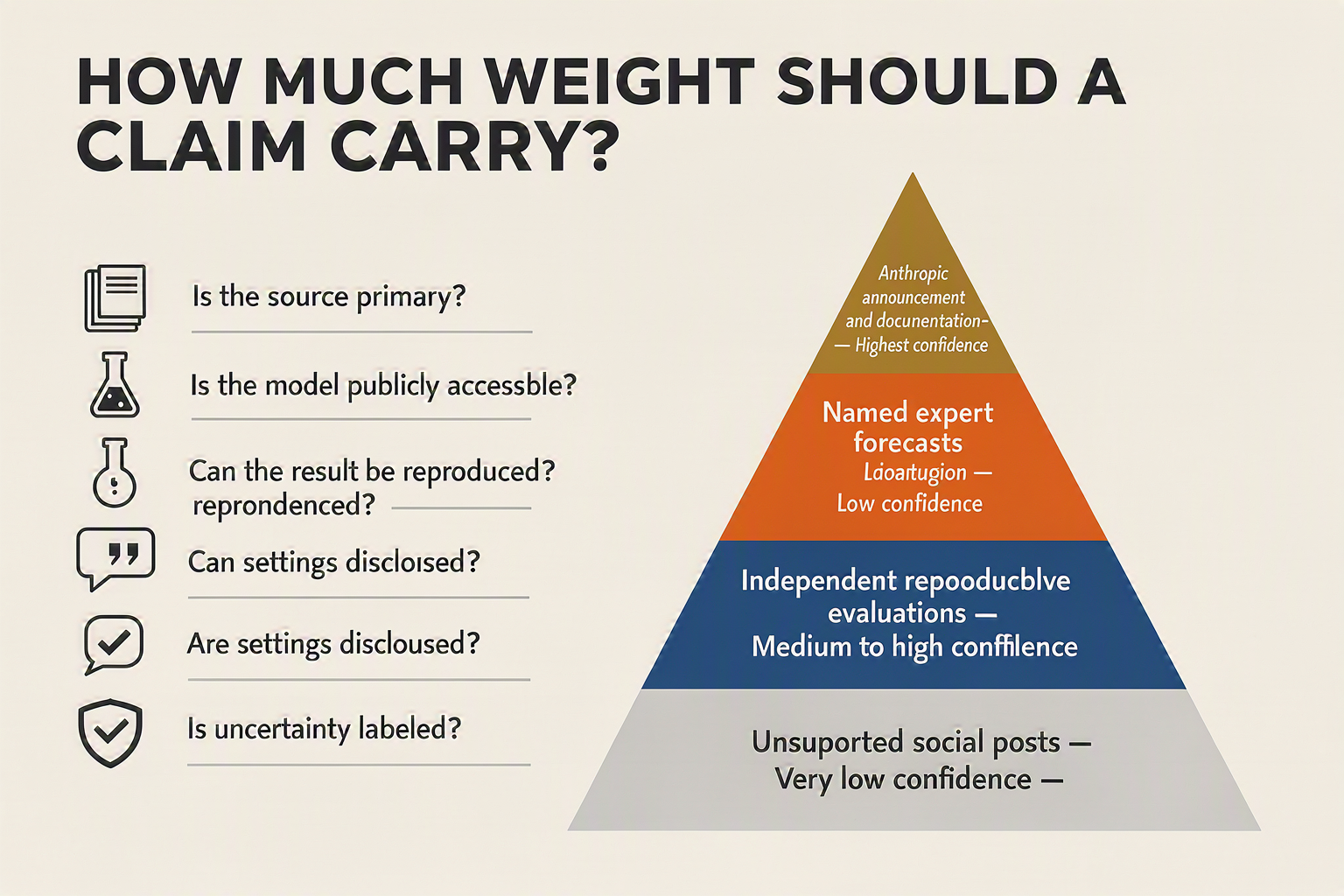
The expert claims deserving the most confidence are those tied to Anthropic’s published Claude Opus 4.8 documentation and reproducible workload tests. As of July 23, 2026, claims about Claude Opus 5’s capabilities, pricing, or release timing deserve low or zero confidence unless Anthropic confirms them.
High confidence: documented Opus 4.8 capabilities
Anthropic is the primary source for what Claude Opus 4.8 was designed to improve. Anthropic’s Claude Platform documentation specifically names long-horizon agentic coding, better long-context handling, fewer context compactions, and stronger sustained execution as target improvements.
Anthropic also reports that Claude Opus 4.8 was the only tested model to complete every case end-to-end, outperforming prior Opus models and GPT-5.5 at cost parity. That statement is specific and attributable, but it remains a vendor-reported evaluation, not proof that Opus 4.8 wins across every repository, programming language, agent framework, or budget.
The most defensible expert interpretation is therefore narrower: Opus 4.8 has credible evidence for complex, extended agentic work where maintaining state and finishing the entire task matter more than generating an impressive first response.
Medium confidence: independent workload observations
Hands-on evaluations can provide useful evidence when they disclose enough methodology to permit replication. Reviews from publications such as DataCamp, or controlled application-building tests, deserve attention if they specify:
- The exact model identifier and API configuration
- Identical prompts, tools, context, and stopping conditions
- Total input, output, cached, and reasoning-token costs
- Wall-clock latency and number of retries
- Whether generated code actually compiled and passed tests
- Multiple runs rather than one selectively presented result
A one-shot React Native challenge, such as the comparison format shown in public YouTube tests, can illustrate model behavior. It cannot establish a universal ranking because one prompt produces a tiny sample, and outcomes may change with tool access, scaffolding, temperature, or evaluator preference.
Low confidence: extrapolations disguised as Opus 5 evidence
Three common expert-sounding claims should be treated as EXPECTED/RUMORED, not verified:
- “Opus 5 will be significantly better at coding.” This is plausible generational forecasting, but Anthropic has published no confirmed Opus 5 coding score.
- “Opus 5 will cost more—or less—than Opus 4.8.” Either outcome is possible; there is no verified API price from Anthropic.
- “Sonnet 5 or Fable 5 results reveal Opus 5 performance.” They do not. Reviews covering “Claude Sonnet 5” and TrueFoundry comparisons involving “Fable 5” cannot authenticate a separate Claude Opus 5 product.
Product names, alleged leaks, screenshots, and unsourced benchmark charts are not substitutes for a model card, API documentation, pricing page, or reproducible endpoint.
A practical confidence ladder
Use this order when evaluating any new claim:
- Highest: Anthropic release notes, model documentation, API identifiers, pricing, and safety materials
- Strong: Independent, reproducible tests using the public production API
- Limited: Transparent but small-sample reviews and videos
- Weak: Anonymous leaks, predicted dates, benchmark screenshots, and name-based inference
The rigorous conclusion is not that Opus 5 will fail to improve. It is that no expert currently has public evidence sufficient to quantify that improvement. Opus 4.8 claims can be tested today; Opus 5 claims remain hypotheses awaiting an official model and repeatable measurements.
Which model strategy is right for you: build with Opus 4.8, test Sonnet 5, or wait for Opus 5? (TABLE)
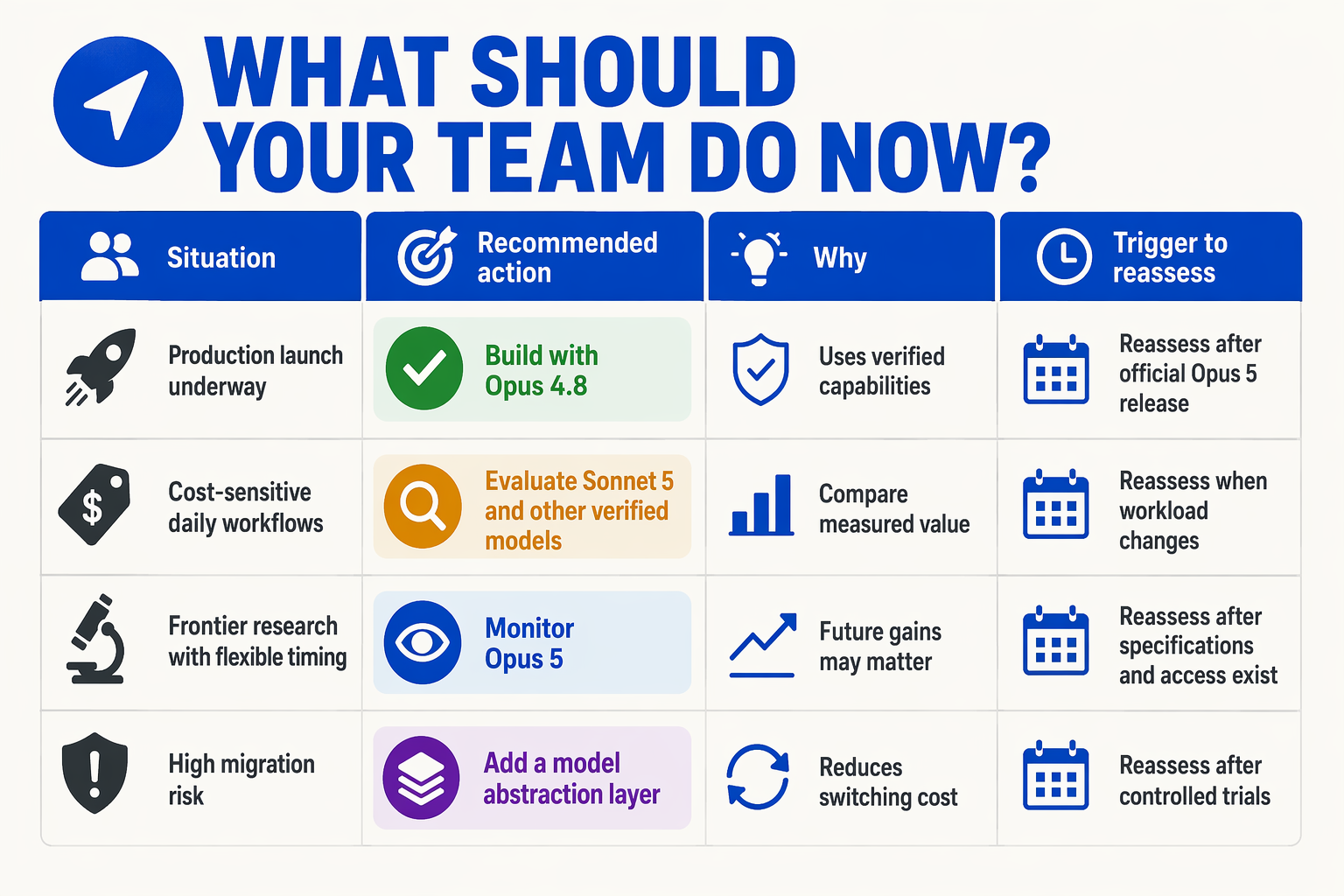
Build with Claude Opus 4.8 now when quality or long-running agent reliability affects revenue; test Claude Sonnet 5 only in an isolated evaluation lane; and wait for Claude Opus 5 only when deployment has little near-term value. As of July 23, 2026, Claude Opus 5 has no official specifications, so postponing a production roadmap for it is a speculative decision rather than a technical requirement.
Strategy matrix: verified capability versus expected releases
| Strategy | VERIFIED REAL DATA | EXPECTED/RUMORED | Best fit | Recommended decision |
|---|---|---|---|---|
| Build on Opus 4.8 | Anthropic documents improvements in long-horizon agentic coding, long-context handling, context compaction and sustained execution. | A future Opus release could improve quality, speed or cost, but no uplift is confirmed. | Complex coding agents, research workflows and high-value automation | Ship now, while keeping prompts, tools and evaluations portable. |
| Test Sonnet 5 | Public reviews compare a model called Claude Sonnet 5 with Opus 4.8, but third-party videos and articles do not replace Anthropic documentation. | Sonnet 5 may offer a better price-latency balance for routine workloads; that must be measured against an authenticated, versioned endpoint. | High-volume summarisation, extraction, support and routing | Shadow-test first; do not infer production readiness from model names or demonstrations. |
| Wait for Opus 5 | As of July 23, 2026, Anthropic has published zero confirmed Opus 5 benchmark scores, API prices, context limits or release dates. | Opus 5 might provide stronger reasoning, agentic execution or efficiency. None of those improvements is guaranteed. | Research projects without delivery pressure or teams facing prohibitive migration costs | Wait only when delay is inexpensive and current models cannot meet a documented threshold. |
| Use tiered routing | Opus 4.8 is available as a measurable quality tier; cheaper or faster models can handle simpler requests after evaluation. | Sonnet 5 or Opus 5 could later enter the routing policy if they pass the same tests. | Products with mixed task complexity and strict unit economics | Default to the lowest-cost passing model, escalating difficult cases to Opus 4.8. |
| Adopt a model gateway | OpenAI-compatible gateways can separate application code from individual model APIs and support controlled fallbacks. | Future Anthropic models may require new parameters, tool behavior or safety handling. | Multi-provider systems and teams planning frequent model evaluations | Abstract now, but retain model-specific adapters and pinned versions where behavior matters. |
Apply a deployment gate, not a release-name gate
Anthropic reports that Claude Opus 4.8 was the only model in its published evaluation to complete every case end-to-end, outperforming prior Opus models and GPT-5.5 at cost parity. That vendor-reported result does not establish universal superiority, but it gives teams a concrete baseline that unreleased models cannot yet match with evidence.
Before changing the production default, require every candidate to pass the same gates:
- Quality: Match or exceed Opus 4.8 on your task-completion, factuality and code-review suites.
- Reliability: Complete multi-step workflows without additional retries, compactions or human interventions.
- Economics: Lower the total cost per successful task—not merely the price per token.
- Latency: Meet p50 and p95 service-level objectives under realistic concurrency.
- Safety: Preserve permission boundaries, tool-call validation and refusal behavior.
A gateway architecture makes this discipline easier. For example, CallMissed’s OpenAI-compatible AI gateway provides one integration across multiple model categories with same-tier fallbacks, helping developers test alternatives without coupling an application to one release cycle.
The practical verdict is Opus 4.8 for verified high-complexity work, Sonnet 5 for controlled testing where access and provenance can be verified, and Opus 5 only after an official release plus workload-specific validation.
Is Claude Opus 5 released, is Opus 4.8 worth using, and should you wait? Frequently asked questions
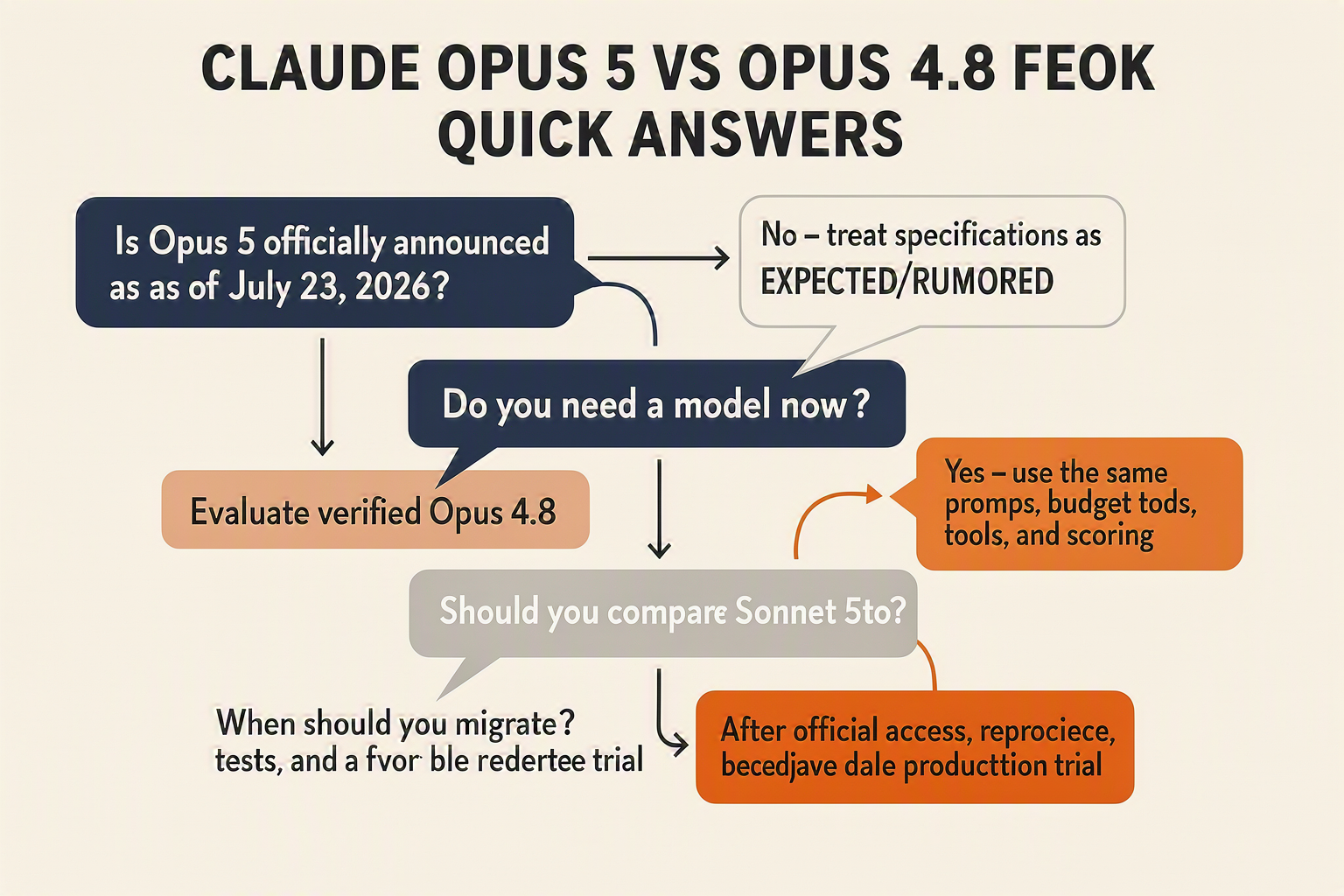
Is Claude Opus 5 officially released as of July 23, 2026?
What is the main difference in Claude Opus 5 vs Claude Opus 4.8?
Is Claude Opus 4.8 worth using for coding and AI agents?
Should developers wait for Claude Opus 5 or deploy Claude Opus 4.8 now?
How should teams evaluate Claude Opus 5 vs Claude Opus 4.8 after launch?
How can businesses prepare for Claude Opus 5 without delaying current AI projects?
Conclusion
The build-or-wait verdict is clear: keep building with Claude Opus 4.8, but design for model substitution. As of July 23, 2026, Claude Opus 5 has no official specifications, pricing, release date, context window, latency data, or benchmark results.
- Claude Opus 4.8 is the evidence-backed choice. Anthropic documents improvements in long-horizon agentic coding, long-context handling, context compaction, and sustained execution.
- Vendor-reported results are useful but not universal proof. Anthropic says Claude Opus 4.8 was the only tested model to complete every case end-to-end, outperforming prior Opus models and GPT-5.5 at cost parity.
- Claude Opus 5 remains EXPECTED/RUMORED. References to Claude Sonnet 5, “Fable 5,” or alleged successors cannot replace an official Anthropic announcement.
- Production adoption should follow measurement. Route limited traffic to any future Opus 5 release and compare task completion, output quality, latency, tool reliability, safety behavior, and total cost before migrating.
Watch for Anthropic’s official model card, API pricing, availability, reproducible evaluations, and migration guidance. Flexible infrastructure will matter: developers can explore CallMissed, an OpenAI-compatible AI gateway spanning multiple model providers, to reduce dependence on one release cycle.
Will Claude Opus 5 earn production traffic—or merely arrive with a higher version number?
Related Reading
- Claude Opus 5 vs GPT-5.6 Sol: Verified Facts vs Rumors (July 2026)
- Claude Opus 5 Release Date Rumors: When Will It Launch? Honeycomb Leak Explained
- GPT-5.6 vs Claude Opus 4.8: Benchmarks, Pricing & Verdict
Sources
Related Posts


Ready to automate customer conversations?
Launch AI voice agents and WhatsApp bots with CallMissed — one API, 22+ Indian languages.