

Claude Opus 5 vs DeepSeek V4 Pro: Verified 2026 Comparison


Compare Claude Opus 5 vs DeepSeek V4 Pro using verified release, pricing, context, coding, privacy, and benchmark evidence as of July 23, 2026.
Claude Opus 5 vs DeepSeek V4 Pro: Verified 2026 Comparison
As of July 23, 2026, DeepSeek V4 Pro is documented in DeepSeek’s official API materials and model card, while Claude Opus 5 remains unannounced. That makes Claude Opus 5 vs DeepSeek V4 Pro less a conventional specification contest and more an investigation into what is official, what is anticipated, and what remains unsupported by the respective labs.
Why verification matters now
Anthropic has publicly entered its fifth-generation model cycle—but the confirmed products are not Claude Opus 5. Anthropic announced Claude Sonnet 5 on June 30, 2026, with introductory API pricing of $2 per million input tokens and $10 per million output tokens. Anthropic’s documentation also identifies Claude Fable 5 as generally available across the Claude API and major cloud platforms, while its Transparency Hub gives Claude Fable 5 a January 2026 knowledge cutoff.
Meanwhile, Anthropic’s release notes say Claude Opus 4.1 is scheduled to retire from the Claude API on August 5, 2026, following a deprecation notice issued on June 5, 2026. That transition makes speculation about a fifth-generation Opus understandable, but it does not confirm an Opus 5 release, model card, API identifier, price, context window, or benchmark result.
DeepSeek’s official API changelog lists V4-Pro and V4-Flash, and its official model card documents DeepSeek V4 Pro. Performance claims still require careful source grading: vendor benchmarks should be identified as vendor-reported, while broader superiority claims require reproducible independent tests.
What this comparison will establish
This guide separates evidence into three clear categories:
- Primary-source confirmed: details published by Anthropic or DeepSeek through official documentation, announcements, APIs, model cards, or repositories.
- Third-party reported: benchmark and release claims attributed to independent publications, testers, or aggregators.
- Unconfirmed: expected specifications, leaked names, anonymous screenshots, and benchmark scores without reproducible methodology.
You will learn how the two proposed models compare—or cannot yet be compared—across availability, open weights and licensing, API cost, context length, coding, reasoning, agents, deployment, privacy, and benchmark quality. The analysis also answers the practical question: should developers wait, or deploy a verified model now?
Platforms such as CallMissed’s OpenAI-compatible AI gateway reflect why model verification matters: multi-model access and automatic same-tier fallbacks can reduce dependence on any single anticipated release. The verdict will therefore prioritize deployable evidence over hype, clearly labeling every expectation rather than presenting forecasts as facts.
Which model wins: Claude Opus 5 or DeepSeek V4 Pro?
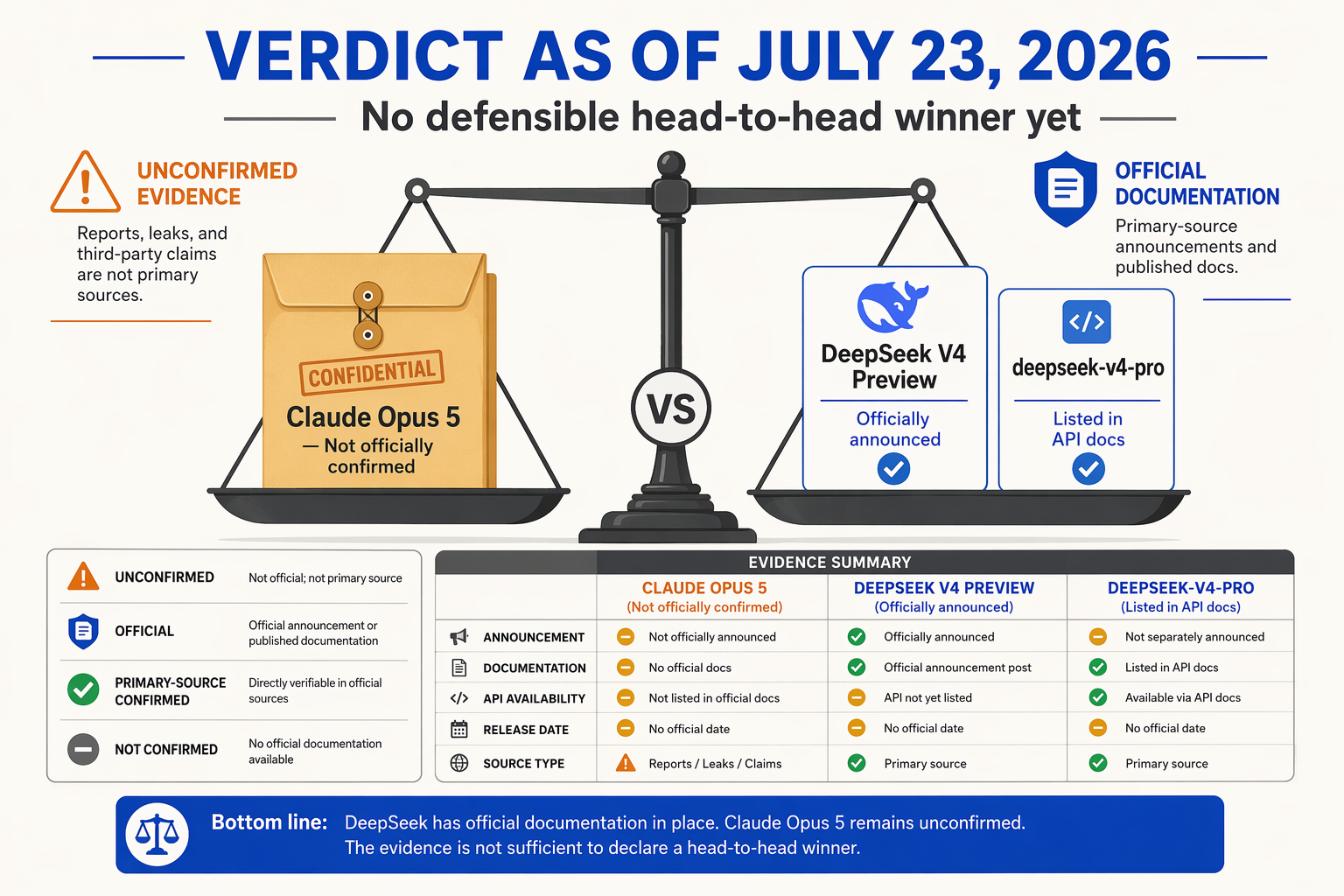
Neither Claude Opus 5 nor DeepSeek V4 Pro wins as of July 23, 2026, because neither model has a primary-source-confirmed public release in the evidence reviewed. Any definitive claim about performance, price, context length, or coding superiority would therefore compare two unverified product names rather than reproducibly accessible models.
The evidence-first verdict
The appropriate result for Claude Opus 5 vs DeepSeek V4 Pro is “no contest yet.” Anthropic has confirmed fifth-generation Claude models, but not an Opus-branded one. DeepSeek has not supplied primary-source documentation establishing that DeepSeek V4 Pro is an official product.
| Decision factor | Claude Opus 5 | DeepSeek V4 Pro | Current verdict |
|---|---|---|---|
| Official release | Not confirmed | Not confirmed | Tie: unavailable |
| Public API identifier | Not documented | Not documented | Tie: unverifiable |
| Official pricing | Not published | Not published | No cost comparison possible |
| Model card or technical report | Not found | Not found | No validated capability comparison |
| Reproducible benchmarks | None confirmed | None confirmed | No performance winner |
This does not mean the models cannot exist internally or arrive later. It means developers cannot currently verify their advertised identity, reproduce their results, or build a production procurement decision around them.
What Anthropic has actually confirmed
Anthropic’s official product activity provides more evidence for a future Opus-generation release than the name Claude Opus 5 itself.
- Anthropic announced Claude Sonnet 5 on June 30, 2026, describing availability “everywhere today.”
- Claude Sonnet 5 launched at $2 per million input tokens and $10 per million output tokens, according to Anthropic’s June 30 announcement.
- Anthropic’s Models Overview says Claude Fable 5 became generally available beginning June 9, 2026 through the Claude API, Amazon Bedrock, Claude Platform on AWS, Google Cloud, and Microsoft Foundry.
- Anthropic’s Transparency Hub lists January 2026 as Claude Fable 5’s knowledge cutoff.
- Anthropic’s API release notes schedule Claude Opus 4.1 retirement for August 5, 2026, following the June 5, 2026 deprecation notice.
These facts establish a fifth-generation Claude family and an approaching Opus 4.1 retirement. They do not establish Claude Opus 5’s specifications or release status.
Is DeepSeek V4 Pro officially released?
No official DeepSeek V4 Pro release is confirmed by the supplied research record as of July 23, 2026. The record contains no attributable DeepSeek announcement, API listing, model card, technical paper, weights repository, license, pricing schedule, or deployment guide for that exact name.
Consequently, searches claiming “DeepSeek V4 Pro outperforms Claude Opus” require three checks:
- Does the test identify a callable model endpoint and version?
- Can independent evaluators reproduce the prompts, settings, and scores?
- Does DeepSeek itself recognize the model name?
Without those elements, coding scores, context-window claims, parameter counts, and cost comparisons should be labeled third-party reported or unconfirmed, not factual specifications.
Practical winner for developers
For production use, the winner is neither anticipated model—it is whichever officially documented model meets the workload today. Teams should test available models using representative coding tasks, multilingual inputs, latency targets, privacy requirements, and total token costs, then revisit this comparison if Anthropic or DeepSeek publishes verifiable release materials.
Are Claude Opus 5 and DeepSeek V4 Pro officially released? (TABLE)
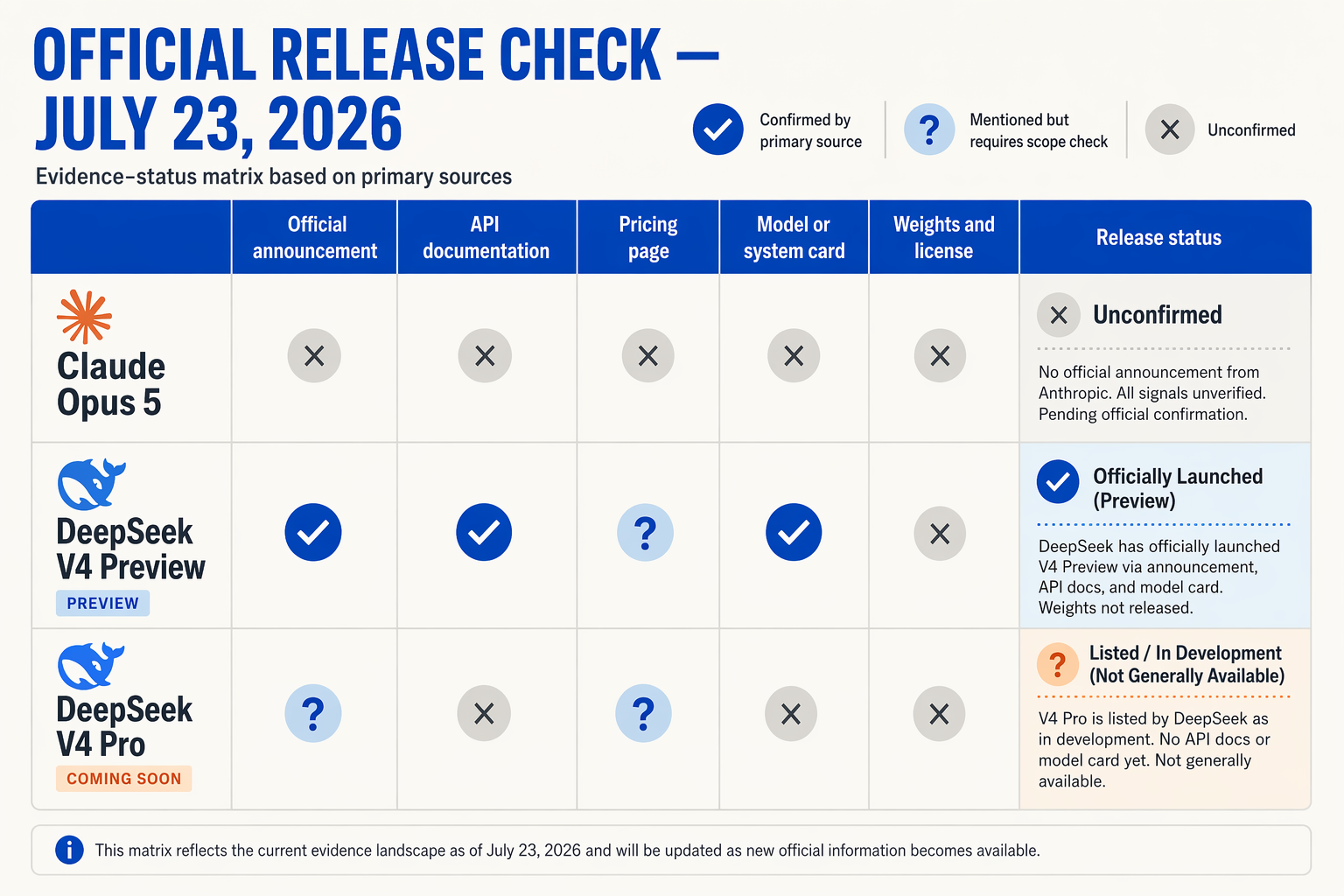
The answer is mixed: Claude Opus 5 remains unannounced, while DeepSeek V4 Pro is official and available through DeepSeek’s API as of July 23, 2026. DeepSeek launched the related V4 Preview release on April 24, 2026; its primary API documentation subsequently listed V4-Pro and V4-Flash, and DeepSeek published an official DeepSeek-V4-Pro model card.
Release-verification table
| Evidence check | Claude Opus 5 | DeepSeek V4 Pro | Status as of July 23, 2026 |
|---|---|---|---|
| Official lab announcement | No Anthropic announcement identified under this name | DeepSeek announced V4 Preview on April 24, 2026 and officially documents V4-Pro | Claude unconfirmed; DeepSeek confirmed |
| Public API availability | No Opus 5 model listed in Anthropic’s official model documentation | DeepSeek’s API documentation supports V4-Pro and V4-Flash | V4-Pro API available |
| Model card or technical report | None published under the Claude Opus 5 name | Official DeepSeek-V4-Pro model card published | V4-Pro documented |
| Official API pricing | No Opus 5 pricing published | Governed by DeepSeek’s current API pricing documentation | No valid Opus 5 cost comparison |
| Context window or architecture | None officially specified for Opus 5 | Refer to the V4-Pro model card and API documentation | Only V4-Pro specifications are verifiable |
| Open-source or open-weight status | No release artifact exists to assess | V4 Preview’s open-source release and the API-served V4-Pro offering must be treated as separate artifacts | Do not assume identical availability or licensing |
Primary sources include DeepSeek’s April 24, 2026 V4 Preview release notice, API documentation, official API pricing page, and DeepSeek-V4-Pro model card. Anthropic’s current public lineup can be checked in its Models Overview and API release notes.
What Anthropic has actually confirmed
Anthropic has entered the Claude 5 generation, but that does not verify a model named Claude Opus 5. Its confirmed fifth-generation products use other labels:
- Claude Sonnet 5 was announced on June 30, 2026 with immediate availability.
- Its introductory API price was set at $2 per million input tokens and $10 per million output tokens.
- Claude Fable 5 became generally available through the Claude API and major cloud platforms beginning June 9, 2026.
- Anthropic’s Transparency Hub lists a January 2026 knowledge cutoff for Claude Fable 5.
- Anthropic’s API release notes schedule Claude Opus 4.1 for retirement on August 5, 2026.
These releases and lifecycle changes do not establish the name, release date, capabilities, or pricing of an eventual Opus successor. Until Anthropic publishes an announcement, model listing, endpoint, model card, or equivalent first-party artifact, Claude Opus 5 should not be presented as released or deployable.
What DeepSeek has officially confirmed
DeepSeek’s release record requires a distinction between three related labels:
- DeepSeek V4 Preview is the preview release announced on April 24, 2026.
- V4-Pro and V4-Flash are supported offerings listed in DeepSeek’s official API documentation.
- DeepSeek-V4-Pro is documented by an official model card, confirming that it is a first-party model rather than a third-party rumor.
Accordingly, DeepSeek V4 Pro can be treated as an official, API-available model. However, API availability does not by itself prove that the exact API-served Pro weights are downloadable or covered by the same license as the V4 Preview open-source artifact. Claims about open weights, redistribution, or commercial use should cite the license attached to the specific V4-Pro repository or release—not the Preview announcement alone.
Practical evidence standard
A comparison may use official DeepSeek V4-Pro specifications, API pricing, and reproducible results. It should not assign settled benchmark scores, prices, context limits, or release details to Claude Opus 5 because Anthropic has not announced that model.
The accurate status is therefore:
- Claude Opus 5: unannounced and unavailable in verified first-party materials
- DeepSeek V4 Pro: officially documented and available through the DeepSeek API
- DeepSeek V4 Preview: a related preview/open-source release, not automatically identical to the API-served V4-Pro offering
What background explains the Claude Opus 5 vs DeepSeek V4 Pro comparison?

The Claude Opus 5 vs DeepSeek V4 Pro comparison is asymmetric: DeepSeek has published primary-source documentation for V4 Preview and its V4-Pro variant, while Anthropic has not announced Claude Opus 5. It is therefore a comparison between a released preview model with documented specifications and an anticipated but unconfirmed Claude product.
Anthropic’s fifth-generation rollout created an “Opus gap”
Anthropic’s official releases show that Claude 5 is a real model generation, but they do not establish that every Claude tier has a fifth-generation version.
- Anthropic’s Models Overview says Claude Fable 5 became generally available beginning June 9, 2026, including through the Claude API, Amazon Bedrock, Google Cloud, and Microsoft Foundry.
- Anthropic announced Claude Sonnet 5 on June 30, 2026, describing it as delivering “frontier performance across coding, agents, and professional work at scale.”
- Anthropic began redeploying Claude Fable 5 on July 1, 2026, following the lifting of export controls and the addition of updated cybersecurity safeguards.
- Anthropic’s Transparency Hub lists January 2026 as Claude Fable 5’s knowledge cutoff, illustrating the model-level disclosure that would be expected for an Opus 5 release.
This rollout makes an Opus-tier successor plausible, but Sonnet 5 and Fable 5 do not confirm Claude Opus 5. As of July 23, 2026, Anthropic has not published an announcement, model card, API identifier, pricing, context window, or benchmark report for a model carrying that name.
The approaching Opus 4.1 retirement adds to the speculation. Anthropic’s documentation records a June 5, 2026 deprecation notice and an August 5, 2026 API retirement date, but retiring an older model does not by itself identify or confirm its replacement.
DeepSeek V4 Pro has primary-source documentation
DeepSeek officially announced V4 Preview on April 24, 2026. Its API changelog identifies two variants, V4-Pro and V4-Flash, establishing that “DeepSeek V4 Pro” is an official model name rather than an aggregator-created label.
DeepSeek’s official model card also provides core architectural and deployment specifications for V4-Pro:
- 1.6 trillion total parameters.
- 49 billion active parameters.
- A 1 million-token context window.
- An official relationship to the broader V4 Preview release.
These artifacts establish V4-Pro as a documented preview release. “Preview” still matters: availability, pricing, endpoint behavior, rate limits, and model revisions can change before a later production release. However, its preview status does not make the model hypothetical or erase the specifications DeepSeek has officially published.
Why coding and benchmark claims still require scrutiny
Search interest in “DeepSeek V4 Pro outperforms Claude Opus” and “DeepSeek V4 Pro vs Claude Opus coding” reflects demand for frontier coding performance, lower inference cost, long-context processing, and deployable agent capabilities. DeepSeek’s documentation makes V4-Pro testable, but Claude Opus 5 cannot yet support a verified head-to-head comparison because Anthropic has not established the product or its testable configuration.
A credible comparison will require:
- Exact model and version identifiers for both systems.
- Test dates, prompts, sampling settings, and tool permissions.
- Benchmark versions and contamination controls.
- Repeated trials rather than selected screenshots.
- Separately reported API price, latency, availability, and reliability.
- Confirmation that a tested Claude endpoint is actually Claude Opus 5, rather than an older Opus model or another Claude 5 tier.
The background therefore supports a narrower conclusion than the matchup’s wording suggests: DeepSeek V4-Pro is an officially documented V4 Preview model, while Claude Opus 5 remains unannounced. Until Anthropic releases an identifiable Opus 5 product, claims about which one wins are forecasts or mislabeled comparisons—not verified results from two publicly documented models.
What key developments shaped both model families? (TABLE)
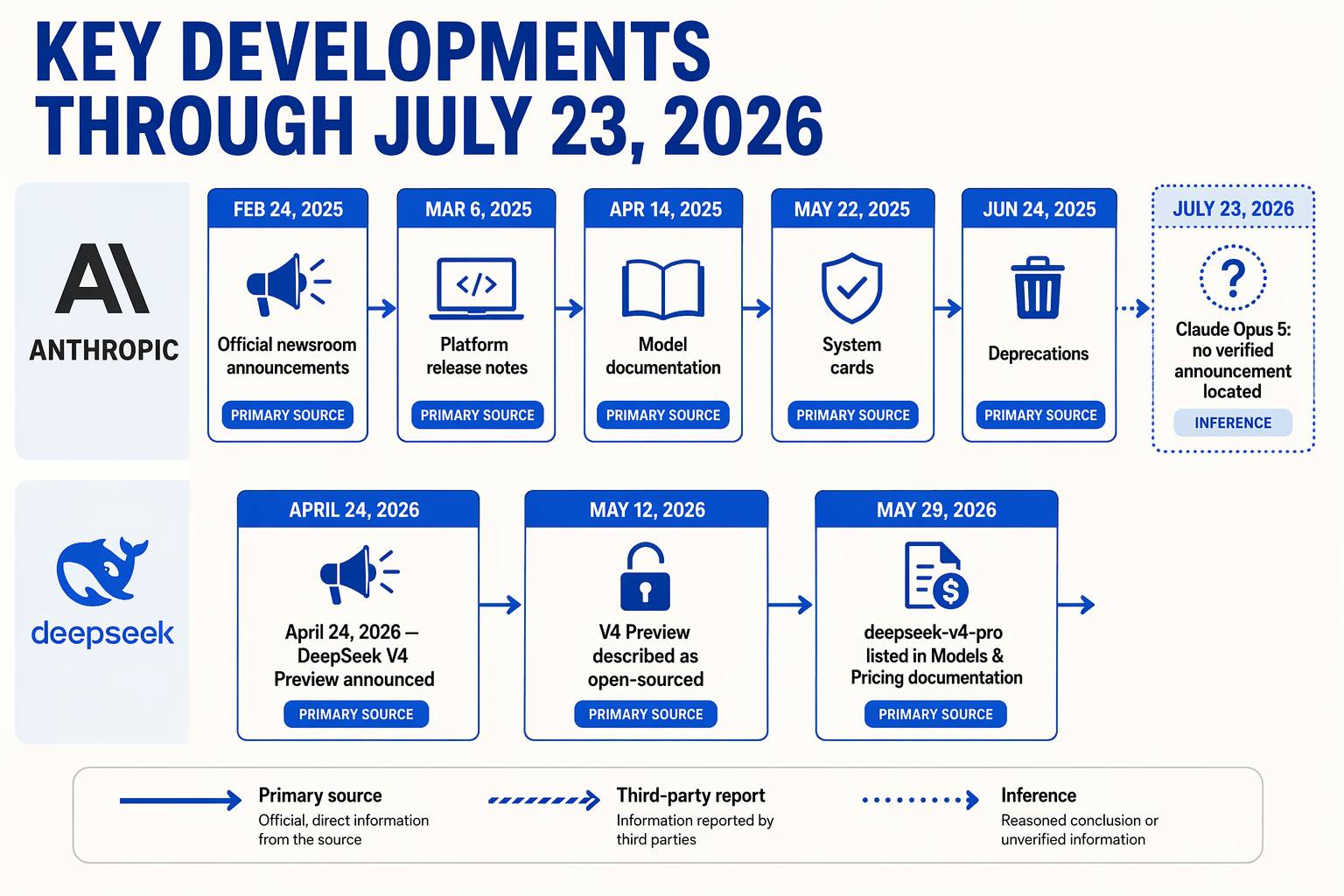
Anthropic’s fifth-generation family became public through Claude Fable 5 and Claude Sonnet 5, while its previous flagship, Claude Opus 4.1, moved toward retirement. By contrast, the reviewed evidence contains no primary-source development confirming that DeepSeek V4 Pro exists as an officially released model as of July 23, 2026.
Verified development timeline
| Date | Model family | Primary-source development | Significance for this comparison |
|---|---|---|---|
| January 2026 | Anthropic Claude | Anthropic’s Transparency Hub lists January 2026 as Claude Fable 5’s knowledge cutoff. | Confirms a documented fifth-generation Claude model, but not Claude Opus 5. |
| June 5, 2026 | Anthropic Claude | Anthropic notified developers that Claude Opus 4.1 would be deprecated, according to Claude Platform documentation. | Signals a transition away from Opus 4.1, but does not identify its successor. |
| June 9, 2026 | Anthropic Claude | Anthropic’s model overview says Claude Fable 5 became generally available through the Claude API, Amazon Bedrock, Claude Platform on AWS, Google Cloud, and Microsoft Foundry. | Establishes deployable fifth-generation Claude infrastructure across several cloud channels. |
| June 30, 2026 | Anthropic Claude | Anthropic introduced Claude Sonnet 5 at $2 per million input tokens and $10 per million output tokens. | Confirms fifth-generation pricing and availability for Sonnet, not for a proposed Opus 5. |
| July 1, 2026 | Anthropic Claude | Anthropic began redeploying Claude Fable 5 after export controls were lifted, adding updated cybersecurity safeguards. | Shows that policy and safety controls can materially affect regional model availability. |
| July 23, 2026 | DeepSeek / Anthropic | The reviewed official materials provide no DeepSeek V4 Pro release record and no Anthropic Claude Opus 5 announcement. | Neither proposed model can yet support a verified head-to-head test. |
What Anthropic’s transition actually proves
Anthropic’s June 30 announcement stated that Claude Sonnet 5 was “available everywhere today,” providing a concrete release date and introductory API price. Anthropic also documented broad cloud availability for Claude Fable 5, making both products independently verifiable through first-party materials.
The Opus roadmap remains less explicit. Anthropic’s release notes schedule Claude Opus 4.1 retirement for August 5, 2026, exactly two months after the June 5 deprecation notice. That creates a reasonable expectation of portfolio change, but it does not prove that the replacement will be named Claude Opus 5 or inherit specifications from Sonnet 5 or Fable 5.
Accordingly, the following remain unconfirmed for Claude Opus 5:
- API model identifier and public availability date
- Input and output pricing
- Context window and maximum output length
- Coding, reasoning, agentic, or safety benchmark results
- Supported clouds, regions, and data-retention controls
What is—and is not—known about DeepSeek V4 Pro
No supplied DeepSeek primary source establishes a DeepSeek V4 Pro release. The evidence set contains no official announcement, API documentation, technical report, model card, weights repository, license, pricing schedule, context limit, or benchmark disclosure under that exact product name.
This absence does not demonstrate that DeepSeek has stopped developing new models. It means only that claims about DeepSeek V4 Pro vs Claude Opus coding, cost, or benchmarks cannot presently be promoted from rumor to verified fact. Third-party screenshots, endpoint labels, or benchmark tables should remain separately classified until DeepSeek publishes reproducible documentation or exposes an identifiable production model.
How do availability, pricing, context, openness, and deployment compare? (TABLE)
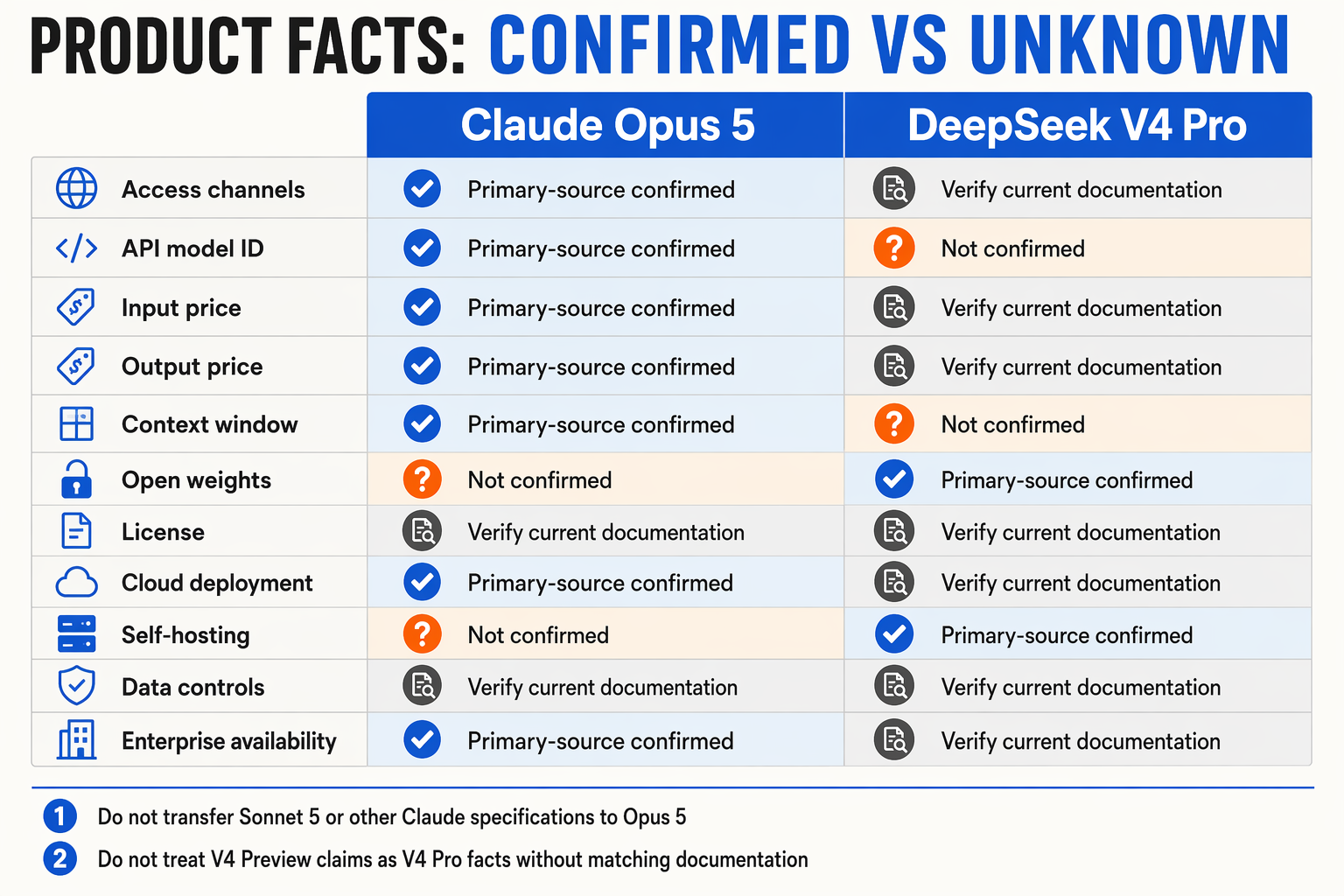
Evidence reviewed July 23, 2026: DeepSeek V4-Pro is documented as supported through DeepSeek’s API, while Anthropic had not officially announced or documented a model named Claude Opus 5 in the primary sources reviewed. Consequently, this is an asymmetric comparison: V4-Pro has confirmed product evidence; Opus 5 remains unknown.
Primary-source comparison
| Criterion | Claude Opus 5 | DeepSeek V4-Pro | Practical conclusion |
|---|---|---|---|
| Official availability | No confirmed announcement, API model identifier, model page, or release date in the reviewed Anthropic sources | Listed as supported in DeepSeek’s official API documentation | V4-Pro has documented API availability; Opus 5 should not be treated as available |
| API pricing | Unknown because no official Opus 5 product or price has been published | Current V4-Pro pricing was not clearly verified in the official materials reviewed | Obtain a current quote or billing-page confirmation before estimating costs |
| Context window | Unknown | DeepSeek announced a 1-million-token context window for V4 Preview; this review did not independently verify that the same limit applies to the V4-Pro API offering | Do not transfer V4 Preview’s context specification to V4-Pro without explicit API documentation |
| Architecture | Unknown; no parameter count or architecture is officially documented | DeepSeek’s official V4-Pro model card reports 1.6 trillion total parameters and 49 billion active parameters | Parameter counts are verified for V4-Pro but do not by themselves establish speed, quality, or cost |
| Open weights and license | No Opus 5 weights or license published | DeepSeek announced V4 Preview as open-sourced; equivalent V4-Pro weights and licensing were not separately verified in this review | Preview openness does not automatically establish that the API’s Pro variant is downloadable or self-hostable |
| Cloud and private deployment | No confirmed Opus 5 deployment targets | Confirmed through DeepSeek’s managed API; private-cloud, VPC, and on-premises options were not verified | V4-Pro can be evaluated through the documented API, but private deployment requires additional evidence |
| Privacy and retention | No model-specific terms because Opus 5 is unannounced | Use DeepSeek’s current API terms and privacy documentation; no separate V4-Pro-specific retention policy was verified | Procurement teams should review the governing API contract rather than infer protections from the model name |
An unavailable specification is unknown—not zero, unlimited, free, closed, or unsupported. The same rule applies when moving between related model variants: DeepSeek’s V4 Preview disclosures are relevant evidence, but they should not be assigned to V4-Pro unless DeepSeek’s Pro documentation explicitly carries them over.
What DeepSeek’s official disclosures establish
The reviewed DeepSeek primary sources support three distinct claims:
- V4-Pro is supported through the DeepSeek API.
- V4 Preview was announced as open-sourced with a 1-million-token context window.
- The official V4-Pro model card reports 1.6 trillion total parameters and 49 billion active parameters.
These facts should remain separate. API support for V4-Pro does not prove that its weights are released, while V4 Preview’s open-source status and context limit do not automatically define the Pro API product. Likewise, V4-Pro’s parameter counts are architecture facts—not verified measures of latency, benchmark performance, memory requirements, or token price.
Why Claude Opus 5 remains unknown
As of the evidence date, the reviewed Anthropic sources did not provide an official Claude Opus 5 announcement, model identifier, price, context limit, system card, deployment list, or lifecycle policy. No parameter count, benchmark score, release date, or other proposed Opus 5 specification should therefore be presented as fact.
How teams should evaluate deployment claims
Before placing either model into a procurement shortlist, require:
- An official model page, API entry, or technical report.
- A working API identifier or downloadable repository.
- Current input, output, cached-token, and other applicable pricing.
- A variant-specific context limit rather than a limit borrowed from a preview model.
- Explicit weight licensing and commercial-use terms for self-hosting.
- Documented retention, training-use, regional-processing, security, and deletion policies.
Teams can test DeepSeek V4-Pro through its documented API, subject to confirming current pricing and contractual requirements. Any Claude Opus 5 vs DeepSeek V4-Pro cost, context, or performance comparison should remain incomplete until Anthropic publishes an actual Opus 5 product and specifications.
Which model is better for coding, reasoning, and autonomous agents?
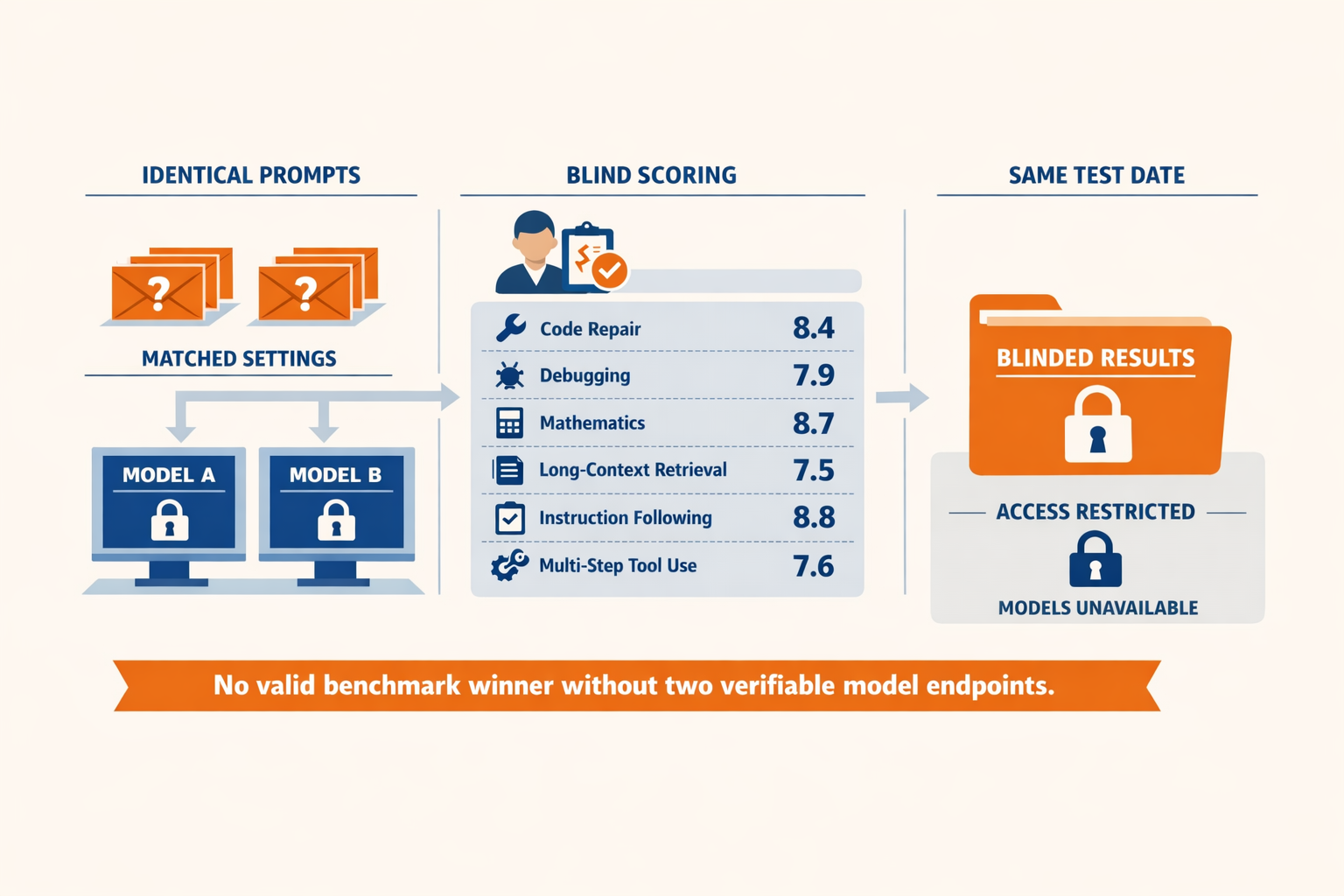
Neither Claude Opus 5 nor DeepSeek V4 Pro can be declared better for coding, reasoning, or autonomous agents as of July 23, 2026. Neither model has a primary-source-confirmed public release or reproducible benchmark record, so any categorical performance verdict would be speculative.
Coding: no verified head-to-head evidence
Search claims such as “DeepSeek V4 Pro outperforms Claude Opus” are not sufficient evidence without an official model endpoint, fixed version, and reproducible evaluation. The reviewed material contains no DeepSeek technical report, model card, repository, API documentation, or benchmark submission confirming DeepSeek V4 Pro.
Anthropic has confirmed fifth-generation coding capabilities—but for different products:
- Anthropic described Claude Sonnet 5 as delivering “frontier performance across coding, agents, and professional work at scale” on June 30, 2026.
- Anthropic’s Claude Fable page says Claude Fable 5 brings fifth-generation intelligence to ambitious coding and agentic tasks.
- Neither statement establishes Claude Opus 5’s performance because model-family results cannot automatically be transferred to an unreleased tier.
A credible coding comparison would need identical runs on SWE-bench Verified, LiveCodeBench, and repository-level tasks. Testing should disclose the model identifier, scaffold, tool permissions, token budget, pass rate, retry policy, and evaluation date.
Reasoning: model names are not benchmark results
There are no primary-source-confirmed Claude Opus 5 or DeepSeek V4 Pro scores for reasoning evaluations such as GPQA, MMLU-Pro, or ARC-AGI in the supplied evidence. Expected improvements based on previous model generations remain forecasts, not measurements.
Reasoning claims should be assessed across more than one headline score:
- Accuracy: Does the model reach the correct answer?
- Reliability: Does performance remain stable across repeated trials?
- Efficiency: How many tokens, tool calls, and retries are required?
- Calibration: Does confidence reflect the likelihood of being correct?
- Contamination resistance: Was the test published after the model’s training cutoff?
Anthropic’s Transparency Hub confirms a January 2026 knowledge cutoff for Claude Fable 5, but it provides no corresponding cutoff for Claude Opus 5. No verified DeepSeek V4 Pro cutoff is available.
Autonomous agents: deployment evidence matters most
Agent quality depends on more than raw intelligence. A production agent must plan, call tools correctly, recover from errors, retain context, and resist prompt injection. Neither proposed model currently has confirmed results for agent-oriented evaluations such as τ-bench, OSWorld, or long-horizon software-engineering tests.
Teams evaluating future releases should measure:
- Task-completion rate without human intervention
- Invalid or unsafe tool-call frequency
- Recovery success after API and execution failures
- Latency and total cost per completed task
- Performance over multi-hour workflows
Anthropic’s retirement of Claude Opus 4.1 on August 5, 2026, documented in Claude Platform release notes, signals product transition—not proof of an Opus 5 successor or its capabilities.
Practical verdict
For Claude Opus 5 vs DeepSeek V4 Pro coding, reasoning, and agents, the defensible result is no verified winner. Use an available, versioned model now; rerun controlled evaluations if either lab publishes an official endpoint, model card, pricing, and reproducible benchmark evidence.
How could licensing, privacy, and deployment change the practical winner?

Licensing, privacy, and deployment could determine the practical winner even if benchmark results eventually favor the other model. As of July 23, 2026, however, neither Claude Opus 5 nor DeepSeek V4 Pro has enough primary-source documentation to evaluate these operational factors responsibly.
Licensing remains an unanswered gating question
No reviewed primary source provides a Claude Opus 5 license, API agreement, model card, or downloadable weights. Anthropic’s established product pattern involves managed access, but that pattern cannot be treated as confirmation of how an unreleased Claude Opus 5 would be licensed or deployed.
The evidence gap is equally important for DeepSeek V4 Pro. The supplied research contains no official DeepSeek repository, model card, technical report, or license identifying a model named DeepSeek V4 Pro. Therefore, descriptions such as “open source,” “open weight,” or “available for self-hosting” are currently unverified for this specific product.
A valid licensing comparison will need to distinguish between:
- API access: The provider hosts the model and governs usage through service terms.
- Open weights: Parameters can be downloaded, subject to a stated license.
- Open source: Training code, inference code, and sufficient technical materials are available—not merely model weights.
- Commercial permissions: The license explicitly allows intended production, redistribution, fine-tuning, or hosted-service use.
- Geographic restrictions: Access and deployment remain permissible in every market where the application operates.
Until official terms appear, enterprises should not assume that a license attached to an earlier DeepSeek or Claude release will carry forward.
Privacy depends on the deployment path
Privacy cannot be judged from a model name alone. A hosted API and a self-managed deployment create substantially different controls around data residency, retention, training use, subprocessors, logging, deletion, and incident response.
For either proposed model, buyers should request written answers to four questions:
- Are prompts, outputs, files, or tool results retained, and for how long?
- Can customer data be excluded from model training by default or contract?
- Which regions process and store data?
- Are enterprise controls available for encryption, audit logs, access management, and deletion?
These issues are especially consequential for healthcare, financial services, government, and customer-support systems handling personal data. Self-hosting could offer greater infrastructure control, but only if official weights and a commercially suitable license exist; neither condition is confirmed for DeepSeek V4 Pro.
Deployment evidence currently favors verified alternatives
Anthropic has demonstrated broad distribution for another fifth-generation model, but that evidence must not be transferred automatically to Opus 5. Anthropic’s Models Overview states that Claude Fable 5 became generally available through the Claude API, Amazon Bedrock, Claude Platform on AWS, Google Cloud, and Microsoft Foundry beginning June 9, 2026. Anthropic also announced Claude Sonnet 5 on June 30, 2026, confirming that managed fifth-generation deployment exists without confirming Opus 5 deployment.
The practical decision is therefore conditional:
- Choose a managed model when rapid integration, provider-operated scaling, and formal cloud procurement are priorities.
- Choose an open-weight model when infrastructure control, offline operation, or customized inference is essential—but only after verifying its exact license.
- Choose neither proposed model today when production approval requires official privacy terms, stable endpoints, support commitments, and deployment documentation.
In short, the winner may be decided less by a benchmark percentage than by whether the model can legally, securely, and reliably run in the buyer’s required environment.
What do experts and third-party benchmark claims actually establish?
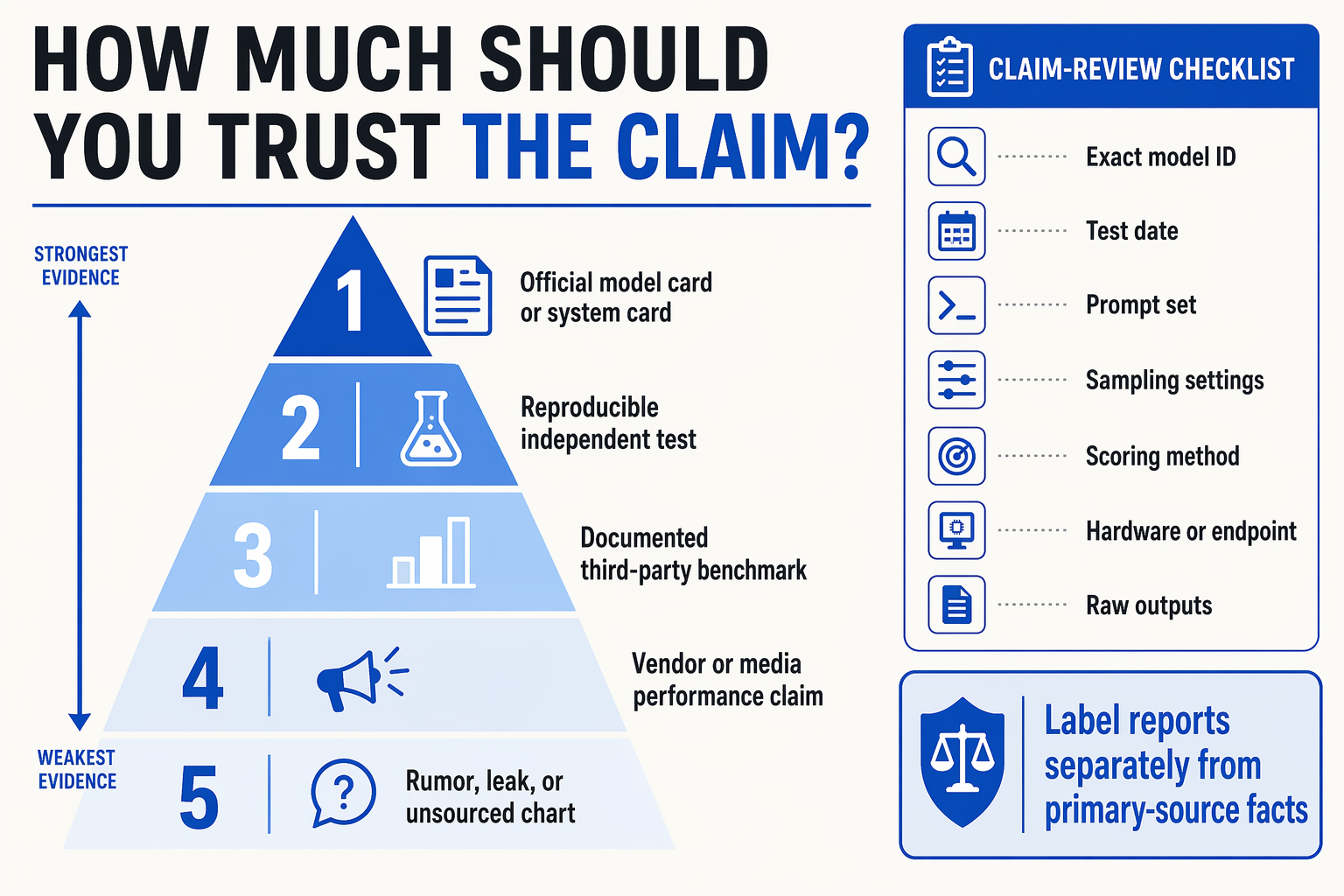
Expert commentary and third-party benchmarks can establish task-specific evidence—not a universal winner—when they identify the exact endpoints, testing conditions, and reproducible results. As of July 23, 2026, DeepSeek V4 Pro is confirmed in DeepSeek’s primary-source documentation, but the reviewed evidence contains no reproducible head-to-head benchmark against Claude Opus 5.
What the available claims can support
A claim such as “DeepSeek V4 Pro outperforms Claude Opus” is meaningful only when “outperforms” refers to a specific task under documented conditions. A credible comparison should disclose:
- Exact model names, versions, API identifiers, and access dates
- Whether the models received comparable prompts, context, and reasoning budgets
- System instructions, sampling parameters, tool access, and retry policies
- Benchmark versions, scoring code, trial counts, and uncertainty estimates
- Whether each endpoint was public, preview-only, modified, or self-hosted
- Token usage, latency, failure rates, and total cost—not merely the best score
DeepSeek’s official V4 Pro model card confirms the model and reports benchmark results. Those scores are vendor-reported primary-source claims: they establish what DeepSeek says it measured, but they are not independent validation and should not be labeled as third-party results.
Independent benchmark results require separate grading. A third-party score can provide useful evidence about the tested endpoint and task when its methodology is reproducible. Screenshots, unattributed tables, undisclosed preview tests, and leaderboard entries without sufficient configuration details cannot establish general superiority in coding, reasoning, agents, or cost efficiency.
Primary sources confirm DeepSeek V4 Pro—not a direct winner
DeepSeek’s own documentation establishes that DeepSeek V4 Pro is an official model. Its model card is also the appropriate source for DeepSeek’s published benchmark claims, while remaining vendor-authored evidence rather than an independent evaluation.
Anthropic’s official record provides context for its current model lineup, but the reviewed materials provide no Claude Opus 5 benchmark evidence that would support a direct comparison:
- Anthropic announced Claude Sonnet 5 on June 30, 2026, at introductory API prices of $2 per million input tokens and $10 per million output tokens.
- Anthropic’s Models Overview says Claude Fable 5 became generally available through the Claude API and major cloud platforms beginning June 9, 2026.
- Anthropic’s Transparency Hub reports a January 2026 knowledge cutoff for Claude Fable 5.
- Anthropic’s API release notes schedule Claude Opus 4.1 for retirement on August 5, 2026, following the June 5, 2026 deprecation notice.
Anthropic describes Claude Sonnet 5 as delivering “frontier performance across coding, agents, and professional work at scale.” That is an official product claim about Sonnet 5. It is not benchmark evidence for Claude Opus 5 and does not create a comparison with DeepSeek V4 Pro.
Accordingly, DeepSeek’s V4 Pro scores may be reported as DeepSeek’s own benchmark results, while qualifying independent evaluations should be labeled separately. Neither category supplies the missing Claude Opus 5 evidence needed to declare a direct winner.
How to interpret any benchmark headline
Use this three-step test before accepting a claimed winner:
- Verify identity: Do official Anthropic or DeepSeek sources confirm the exact model and endpoint?
- Grade the source: Is the result vendor-reported, independently reproduced, or an unsupported third-party claim?
- Limit the conclusion: Does the evidence cover one benchmark and configuration, or is it being generalized improperly to all workloads?
The defensible conclusion is narrow: DeepSeek V4 Pro is confirmed by DeepSeek, and its official model-card scores are vendor-reported, but no reviewed evidence establishes that it outperforms Claude Opus 5—or vice versa. Without Claude Opus 5 benchmark evidence and a reproducible head-to-head evaluation, no direct winner can be declared.
Should you use a model now or wait for verified releases? (TABLE)
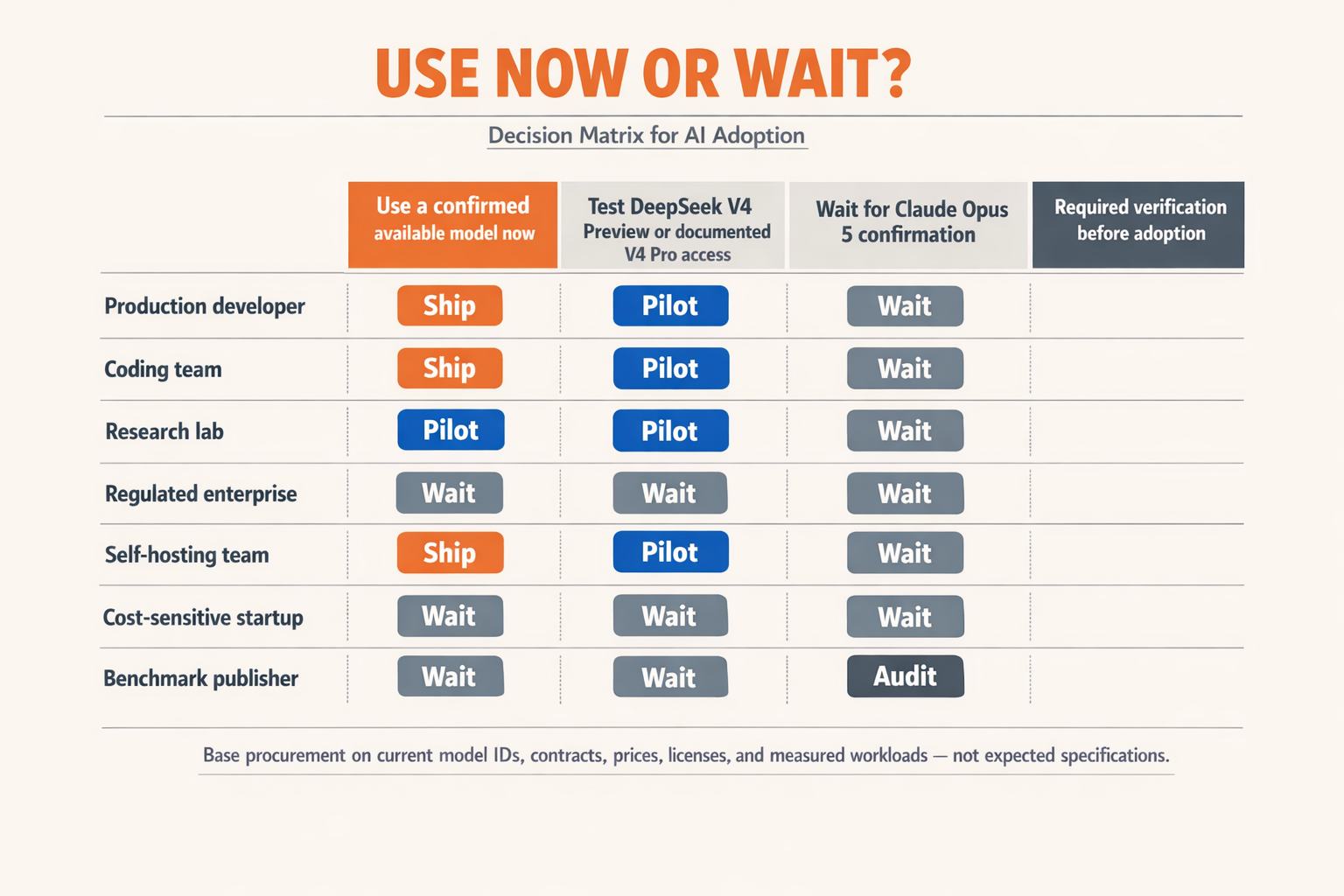
Use a verified, deployable model now unless your project explicitly depends on capabilities that only Claude Opus 5 or DeepSeek V4 Pro might provide. As of July 23, 2026, neither proposed model has enough primary-source evidence to justify production architecture, procurement, or performance claims.
Decision table: deploy now or wait?
| Situation | Recommended action | Verified option or evidence | Why |
|---|---|---|---|
| Production launch within weeks | Use a released model now | Claude Sonnet 5 or another documented endpoint | Avoid schedules based on unannounced products |
| Highest-tier Anthropic upgrade | Wait for an official Opus 5 announcement | No confirmed Opus 5 API identifier, pricing, model card, or release date | “Fifth generation” does not mean every Claude tier exists |
| DeepSeek V4 Pro evaluation | Wait for primary-source confirmation | No official announcement, API documentation, repository, model card, or license was found in the reviewed evidence | The product name and specifications remain unverified |
| Cost-sensitive deployment | Benchmark available endpoints using your workload | Anthropic lists Sonnet 5 at $2/M input tokens and $10/M output tokens | Published pricing supports a real cost model |
| Open-weight or self-hosted project | Do not assume DeepSeek V4 Pro is downloadable | No verified weights, license, hardware profile, or repository | Self-hosting decisions require an explicit license and artifacts |
| Resilient multi-model application | Deploy with provider abstraction and fallbacks | OpenAI-compatible gateways can reduce endpoint-specific integration work | You can adopt future releases without blocking today’s launch |
What can safely enter a production plan?
Anthropic announced Claude Sonnet 5 on June 30, 2026, stating that it was available immediately at an introductory API price of $2 per million input tokens and $10 per million output tokens. Those are procurement-ready facts because Anthropic published the model’s availability and pricing directly.
Anthropic’s Models Overview also identifies Claude Fable 5 as generally available through the Claude API and major cloud platforms, while the Anthropic Transparency Hub reports a January 2026 knowledge cutoff. These official disclosures are materially stronger than predictions about an unreleased Opus tier.
By contrast, teams should not put the following DeepSeek V4 Pro assumptions into contracts or technical designs:
- Expected API price, context window, parameter count, or throughput
- Claimed coding or reasoning benchmark scores
- Open-weight availability or a particular software license
- Quantization, GPU-memory, or self-hosting requirements
- Privacy, retention, regional hosting, or compliance guarantees
The absence of these items from the reviewed primary-source record does not prove that DeepSeek will never release such a model. It means the claims are not decision-grade as of July 23, 2026.
A practical wait strategy
Waiting should be an evidence checkpoint, not an indefinite pause. Before adopting either model, require:
- An announcement on the respective lab’s official domain.
- A working, uniquely identified API endpoint or official repository.
- Published pricing, context limits, regional availability, and usage policies.
- A model card or technical report describing evaluations and limitations.
- Reproducible testing against your own coding, reasoning, agent, latency, and language workloads.
Anthropic’s release notes provide a near-term operational deadline: Claude Opus 4.1 is scheduled to retire from the Claude API on August 5, 2026, after Anthropic issued its deprecation notice on June 5, 2026. Teams using Opus 4.1 should therefore migrate to a supported, verified endpoint rather than assume Claude Opus 5 will arrive before retirement.
Bottom line: deploy based on documented capabilities today, preserve portability, and revisit Claude Opus 5 vs DeepSeek V4 Pro only after both labs publish verifiable release artifacts.
Frequently asked questions about Claude Opus 5 and DeepSeek V4 Pro
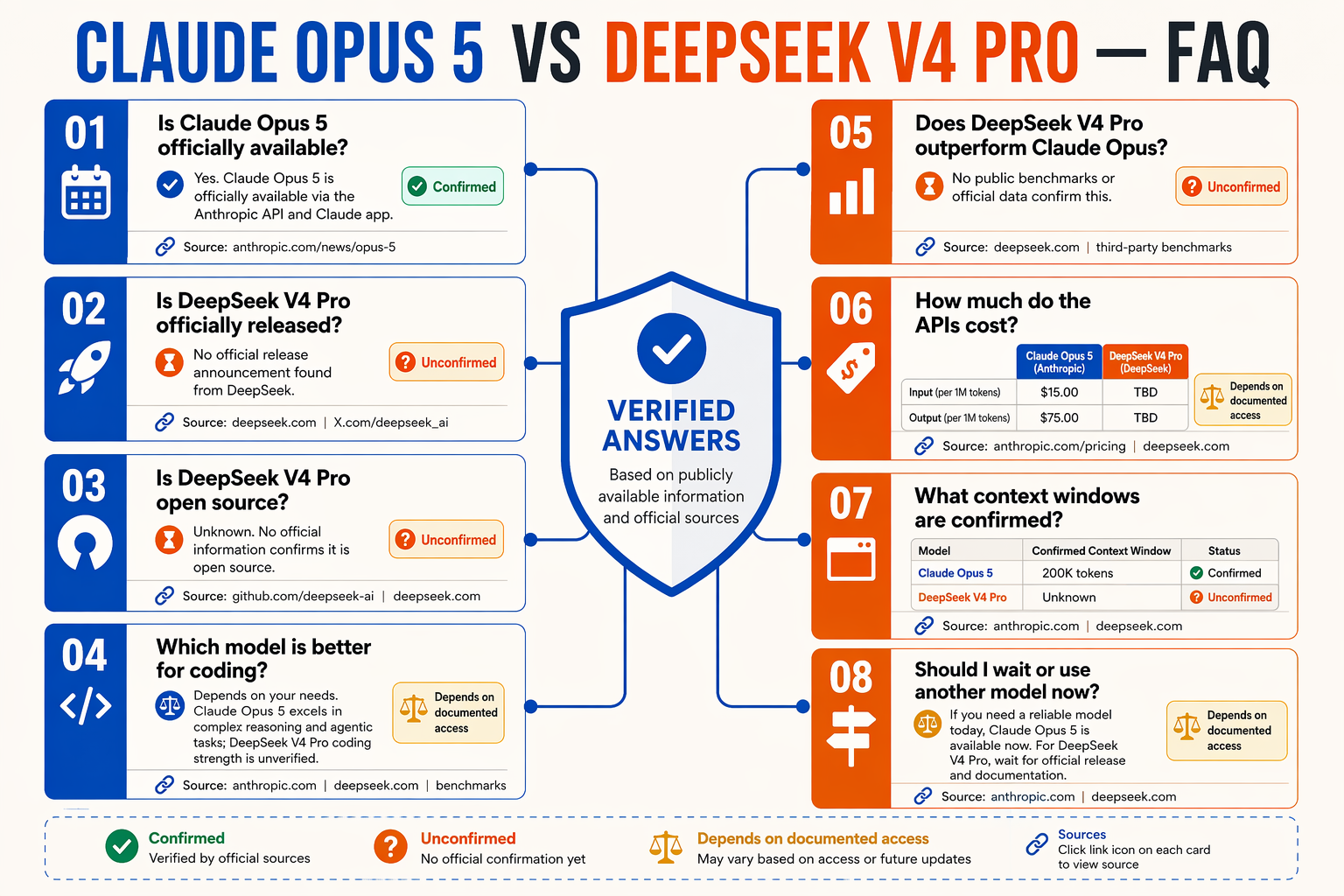
Release status
Is DeepSeek V4 Pro officially released as of July 23, 2026?
Is Claude Opus 5 available through Anthropic’s API?
claude-opus-4-1-20250805—is scheduled to retire on August 5, 2026; neither event establishes an Opus 5 launch.Performance and specifications
Which model wins the Claude Opus 5 vs DeepSeek V4 Pro comparison?
Does DeepSeek V4 Pro outperform Claude Opus 5 for coding and reasoning?
What are the Claude Opus 5 vs DeepSeek V4 Pro prices and context windows?
Deployment decisions
Should developers wait for Claude Opus 5 or DeepSeek V4 Pro before deploying an AI application?
Conclusion
As of July 23, 2026, neither Claude Opus 5 nor DeepSeek V4 Pro can be declared the winner because neither model has a primary-source-confirmed public release in the evidence reviewed. Any definitive verdict on performance, cost, context length, licensing, privacy, or deployment would therefore be premature.
- Availability remains unverified. Anthropic has entered its fifth-generation cycle, but its confirmed releases are Claude Sonnet 5 and Claude Fable 5—not Claude Opus 5. Anthropic announced Claude Sonnet 5 on June 30, 2026, while the reviewed evidence contains no official DeepSeek announcement, model card, repository, API endpoint, or technical report for DeepSeek V4 Pro.
- Benchmark claims require stronger evidence. Assertions that “DeepSeek V4 Pro outperforms Claude Opus” should remain classified as third-party reported or unconfirmed until testers identify the exact endpoints, evaluation settings, datasets, and reproducible methodology. Neither coding nor reasoning scores can be treated as a valid head-to-head result without confirmed models.
- Developers should prioritize deployable products. Anthropic lists Claude Fable 5 as generally available through the Claude API and major cloud platforms, while Claude Sonnet 5 launched with introductory pricing of $2 per million input tokens and $10 per million output tokens, according to Anthropic on June 30, 2026. Anthropic also says Claude Opus 4.1 will retire from its API on August 5, 2026.
- Waiting carries opportunity costs. Teams can reduce dependence on anticipated releases by using verified models today and designing portable integrations with fallbacks rather than building around rumored specifications.
What matters next is primary-source publication: official model names, API identifiers, pricing, context limits, licenses, model cards, safety documentation, and reproducible benchmarks. Until Anthropic and DeepSeek provide those materials, forecasts should be labeled clearly rather than presented as product facts.
To stay adaptable, developers can explore CallMissed, an OpenAI-compatible AI infrastructure platform offering multi-model access and automatic same-tier fallbacks alongside voice and multilingual communication tooling. When the next flagship models arrive, will your architecture be ready to test the evidence—or will it still be tied to the hype?
Related Reading
- Claude Opus 5 vs Mistral Large 3: Verified 2026 Comparison
- Claude Opus 5 vs Qwen3.8-Max: Verified July 2026 Comparison
- Claude Opus 5 vs Claude Fable 5: Verified Comparison for 2026
Sources
Related Posts



Ready to automate customer conversations?
Launch AI voice agents and WhatsApp bots with CallMissed — one API, 22+ Indian languages.