

GPT-5.6 Sol vs Qwen3.8-Max: Verified July 2026 Comparison



Compare GPT-5.6 Sol vs Qwen3.8-Max on access, pricing, coding, reasoning, context, privacy and verified July 2026 evidence.
GPT-5.6 Sol vs Qwen3.8-Max: Verified July 2026 Comparison
Can a reported 2.4-trillion-parameter model outperform a production-ready frontier system—or is the headline number obscuring what buyers actually need to know? This GPT-5.6 Sol vs Qwen3.8-Max comparison, current as of July 20, 2026, starts with an important caveat: OpenAI has published official availability and safety documentation for GPT-5.6 Sol, while key Qwen3.8-Max details—including the reported 2.4 trillion parameters—still require confirmation through an official Qwen or Alibaba release.
OpenAI’s documentation provides a comparatively firm baseline. OpenAI published the GPT-5.6 Preview System Card on June 26, 2026, describing GPT-5.6 as a three-model family comprising Sol, Terra, and Luna. OpenAI’s Model Release Notes state that GPT-5.6 Sol entered ChatGPT on July 9, 2026, positioning the flagship reasoning model for complex work spanning coding, research, science, cybersecurity, computer use, design, and broader knowledge tasks. OpenAI also claims that GPT-5.6 Sol delivers state-of-the-art performance across coding and knowledge work, but that remains a vendor claim until independently reproduced under transparent test conditions.
The Qwen side is less settled. Reports describing Qwen3.8-Max as an Alibaba preview with 2.4 trillion parameters are significant if accurate, but parameter count alone does not establish model quality, inference cost, active-parameter efficiency, latency, or reasoning reliability. Architecture matters too: a large mixture-of-experts system may activate only part of its total parameter capacity for each token. Until Alibaba or the Qwen team publishes a model card, technical report, API documentation, pricing, and reproducible evaluations, those details should be classified as unknown—not assumed.
This distinction matters because organizations are no longer selecting models from benchmark scores alone. They must evaluate:
- Availability: production access versus limited or announced preview access
- API and weights: hosted endpoints, open-weight licensing, and deployment options
- Reasoning and agents: tool use, coding, computer interaction, and long-horizon reliability
- Multimodality and context: supported inputs, context limits, and practical retrieval performance
- Economics and governance: token pricing, latency, data handling, regional hosting, and privacy controls
Platforms such as CallMissed’s OpenAI-compatible gateway reflect this multi-model shift by allowing developers to access different model providers through one integration rather than tying an application permanently to one vendor.
The comparison ahead separates confirmed facts, vendor assertions, third-party evidence, and unresolved preview claims. It will examine benchmark quality without equating scale with intelligence, compare likely deployment trade-offs, and identify the stronger fit for coding agents, enterprise workflows, private infrastructure, multilingual applications, and cost-sensitive production systems.
Which model wins today? GPT-5.6 Sol is the evidence-backed choice, while any Qwen3.8-Max verdict remains provisional

GPT-5.6 Sol wins this comparison as of July 20, 2026—not because it has been proved universally superior, but because organizations can evaluate it using official availability, capability, and safety documentation. A capability verdict on Qwen3.8-Max would be premature until Alibaba Cloud or the Qwen team confirms the model, its reported 2.4-trillion-parameter scale, access terms, and reproducible results.
The defensible winner is GPT-5.6 Sol
OpenAI has established an evidence trail that procurement, engineering, and risk teams can inspect:
- OpenAI published the GPT-5.6 Preview System Card on June 26, 2026, identifying Sol as the flagship member of a three-model family alongside Terra and Luna.
- OpenAI’s Model Release Notes document GPT-5.6 Sol’s ChatGPT release on July 9, 2026, giving the model a confirmed product surface rather than an unverified preview status.
- OpenAI describes GPT-5.6 Sol as a reasoning model for “complex work across coding, research, science, cybersecurity, computer use, and design.”
- OpenAI’s GPT-5.6 announcement claims state-of-the-art coding and knowledge-work results, although those figures should remain categorized as vendor-reported performance until independent evaluators reproduce them.
This evidence does not prove that GPT-5.6 Sol will win every prompt, language, workload, or cost comparison. It does make Sol the more defensible choice for a team that must select a model today and document why.
Why Qwen3.8-Max cannot yet receive a fair verdict
As of the July 20 cutoff, the supplied research contains no official Alibaba or Qwen model card, technical report, API page, or repository confirming Qwen3.8-Max and the reported 2.4-trillion-parameter figure. Consequently, critical buying criteria remain unresolved:
- Architecture: Whether 2.4 trillion refers to total or active parameters, and whether the model uses mixture-of-experts routing.
- Access: Whether Qwen3.8-Max will be generally available, invitation-only, API-hosted, or released with downloadable weights.
- Performance: Whether benchmark results use public test sets, private evaluations, tool scaffolding, or undisclosed reasoning budgets.
- Economics: Input and output token prices, cached-token discounts, throughput, latency, and rate limits.
- Governance: Data retention, regional processing, enterprise privacy controls, licensing, and deployment restrictions.
These are unknowns, not evidence of poor performance. Alibaba’s Qwen family has established relevance in the global model ecosystem, and a model at the reported scale could prove highly capable. However, total parameter count cannot independently predict reasoning accuracy, coding reliability, serving cost, or real-world agent performance.
What “wins” means here
The present decision should be interpreted narrowly:
- Winner for evidence-backed adoption today: GPT-5.6 Sol
- Winner on confirmed model size: Undetermined
- Winner on price, speed, or context capacity: Undetermined
- Winner for open-weight or private deployment: Undetermined pending Qwen licensing and weight details
- Winner on independent benchmarks: No defensible conclusion yet
The recommendation can change quickly. Once Alibaba publishes primary documentation and independent testing covers identical prompts, tools, context lengths, and inference settings, Qwen3.8-Max deserves a fresh head-to-head evaluation rather than assumptions based on its reported parameter count.
What are GPT-5.6 Sol and Qwen3.8-Max, and is the reported 2.4 trillion-parameter claim officially confirmed?
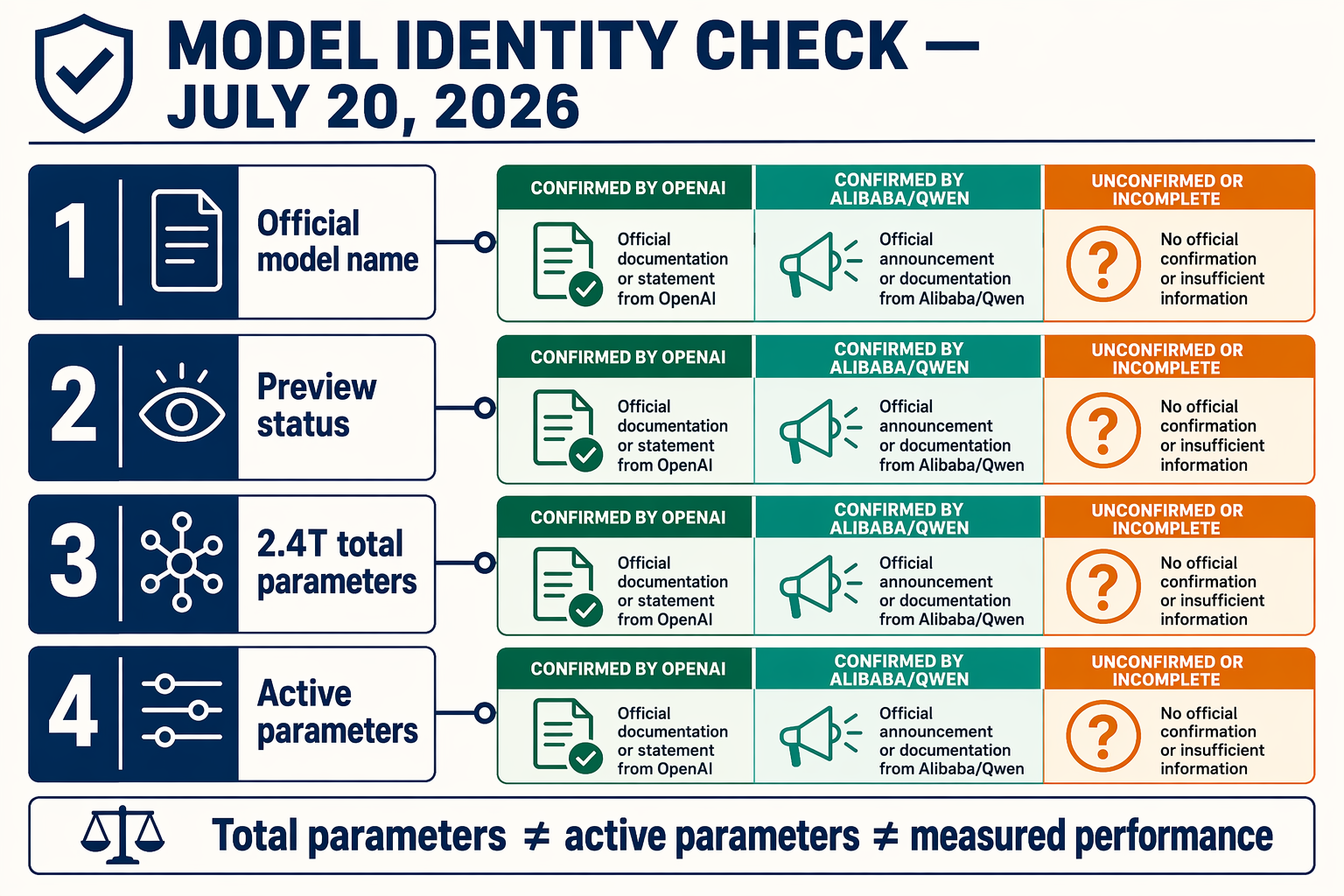
GPT-5.6 Sol is an officially documented OpenAI flagship reasoning model, whereas Qwen3.8-Max is currently a reported Alibaba preview whose name, architecture, and 2.4-trillion-parameter figure are not confirmed by an official Qwen or Alibaba source. As of July 20, 2026, the two models therefore cannot be treated as equally verified products.
GPT-5.6 Sol: an officially released reasoning model
OpenAI identifies GPT-5.6 Sol as the flagship member of a three-model family comprising Sol, Terra, and Luna. The official description positions Sol as a general-purpose frontier model for demanding professional and technical work rather than as a narrowly specialized coding model.
Two dated OpenAI sources establish its status:
- OpenAI published the GPT-5.6 Preview System Card on June 26, 2026, identifying Sol as the flagship model in the GPT-5.6 family.
- OpenAI’s Model Release Notes record the introduction of GPT-5.6 Sol in ChatGPT on July 9, 2026.
OpenAI says GPT-5.6 Sol is designed for complex tasks across coding, research, knowledge work, science, cybersecurity, computer use, and design. These are official product claims, but phrases such as “sets a new standard” and “state-of-the-art” should still be classified as vendor assertions until independent evaluators reproduce the results.
OpenAI’s cited materials do not disclose a parameter count for GPT-5.6 Sol. That omission prevents a meaningful parameter-for-parameter comparison with any reported Qwen model—and illustrates why model quality should be evaluated through task performance, reliability, latency, and cost rather than raw scale.
Qwen3.8-Max: a reported model awaiting primary-source confirmation
Qwen3.8-Max is being described in current reports as a newly previewed Alibaba model with 2.4 trillion parameters. However, the supplied official-source record contains no Qwen model card, Alibaba Cloud announcement, technical paper, repository, or API documentation confirming that designation or figure.
Until Qwen or Alibaba publishes primary documentation, the following remain unverified:
- Whether “Qwen3.8-Max” is the final official product name
- Whether 2.4 trillion means total, active, trainable, or another parameter measure
- Whether the architecture uses mixture-of-experts routing
- How many parameters are activated for each token
- Whether the model is a research preview, private beta, hosted API, or planned open-weight release
- Its context window, modalities, pricing, license, safety evaluations, and deployment regions
The distinction between total and active parameters is especially important. A mixture-of-experts model can contain trillions of total parameters while routing each token through a much smaller subset; the headline figure alone reveals neither inference cost nor real-world capability.
The defensible status as of July 20, 2026
The evidence supports three clear conclusions:
- Confirmed fact: GPT-5.6 Sol exists, belongs to OpenAI’s three-model GPT-5.6 family, and entered ChatGPT on July 9, 2026.
- Vendor claim: OpenAI presents Sol as highly capable across coding and knowledge-intensive work.
- Unconfirmed report: Qwen3.8-Max and its reported 2.4-trillion-parameter scale require an official Qwen or Alibaba primary source before being stated as fact.
For now, “GPT-5.6 Sol vs Qwen3.8-Max” is therefore a comparison between a documented release and an incompletely documented preview—not yet a like-for-like product contest.
What key developments shaped the GPT-5.6 Sol vs Qwen3.8-Max comparison? (TABLE)
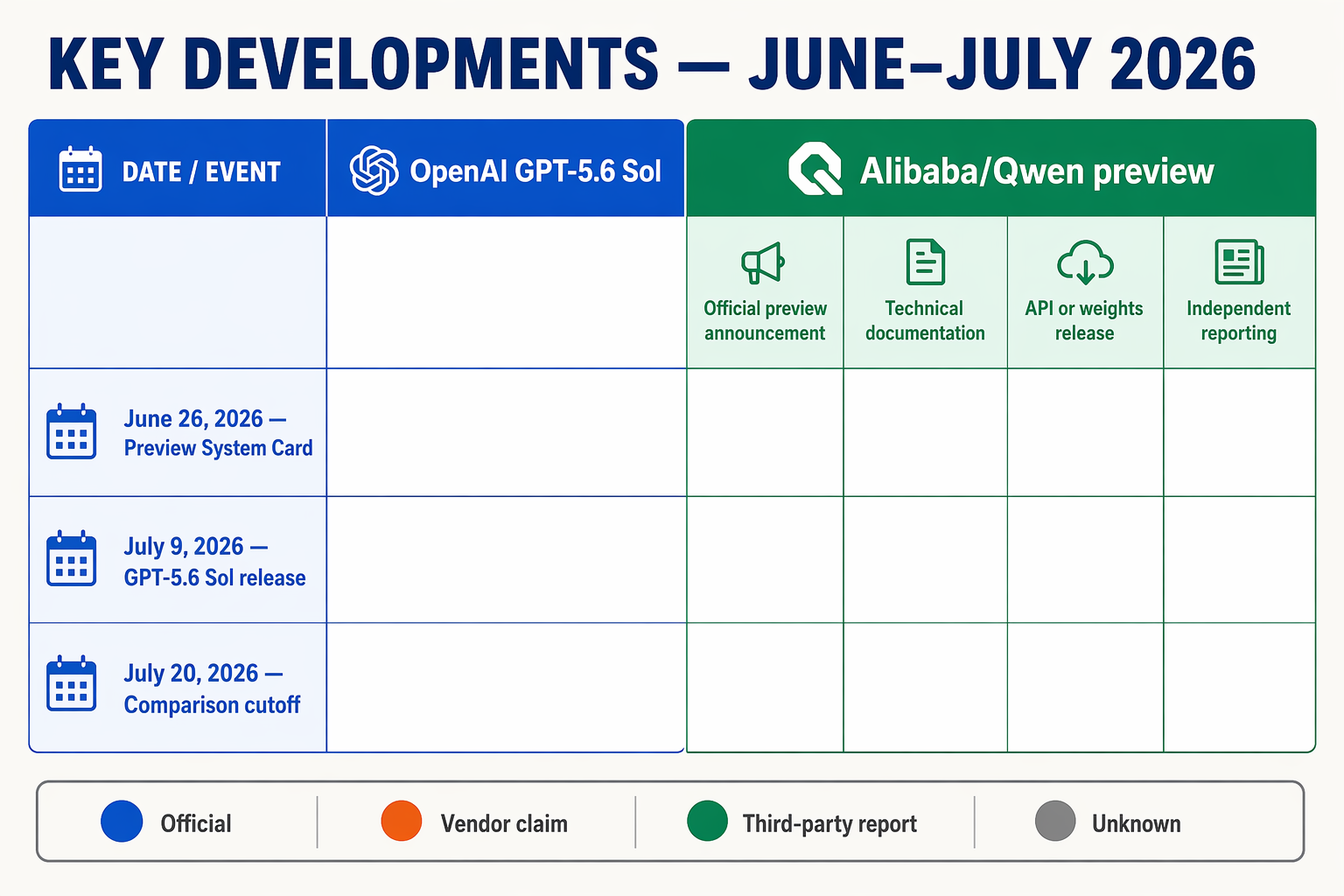
The comparison was shaped less by a simultaneous model launch than by a widening evidence gap. Between June 26 and July 20, 2026, OpenAI moved GPT-5.6 Sol from documented preview to ChatGPT availability, while the reported Qwen3.8-Max preview—including its 2.4-trillion-parameter figure—remained unverified by an official Alibaba or Qwen model card in the available sources.
Development timeline and its significance
| Date or stage | GPT-5.6 Sol development | Qwen3.8-Max development | Why it matters |
|---|---|---|---|
| June 26, 2026 | OpenAI published the GPT-5.6 Preview System Card, identifying Sol as the flagship in a three-model family with Terra and Luna. | No corresponding official Qwen3.8-Max system card was identified. | Sol gained a documented model identity and safety baseline; Qwen’s reported specifications remained provisional. |
| Pre-launch preview | OpenAI described GPT-5.6 Sol as stronger in coding, science, and cybersecurity, paired with its “most advanced safety” work. | Reports characterized Qwen3.8-Max as an Alibaba preview, but an official capability statement was not available for verification. | Both capability narratives require testing, but only OpenAI’s claims were attributable to a primary source. |
| July 9, 2026 | OpenAI’s Model Release Notes recorded the introduction of GPT-5.6 Sol in ChatGPT. | No verified public-release date was established from an official Qwen or Alibaba source. | Buyers could evaluate Sol through a named product surface rather than relying solely on preview reporting. |
| July 2026 positioning | OpenAI positioned Sol for “complex work” across coding, research, science, cybersecurity, computer use, design, and knowledge work. | The reported 2.4 trillion parameters became the defining headline for Qwen3.8-Max. | Sol’s narrative emphasized task coverage; Qwen’s centered on scale, which does not independently measure output quality. |
| July 20, 2026 cutoff | Official OpenAI pages, Help Center documentation, and a deployment-safety record were available. | Architecture, active parameters, context window, API access, weights, pricing, licensing, and benchmark methodology were still unconfirmed. | A feature-by-feature verdict would create false precision until Alibaba publishes primary documentation. |
Three shifts changed how the models should be evaluated
First, release status became a material differentiator. OpenAI’s Model Release Notes dated July 9, 2026 provide evidence of ChatGPT availability, although access tier, API pricing, rate limits, and regional availability still need to be checked against current product documentation before deployment.
Second, model scale stopped being a sufficient comparison shortcut. A reported 2.4-trillion-parameter model could use a dense architecture or a mixture-of-experts (MoE) design that activates only a subset of parameters per token. Without Alibaba disclosing total versus active parameters, memory requirements, inference configuration, and quantization, the figure cannot reliably predict latency, cost, or reasoning performance.
Third, agentic capability broadened the buying criteria. OpenAI explicitly names coding, computer use, cybersecurity, research, and design, suggesting evaluation should include tool execution and long-horizon task completion—not merely static question-answer benchmarks.
What the evidence supports today
As of July 20, 2026, the defensible conclusions are:
- Confirmed: GPT-5.6 is a three-model family, and Sol became available in ChatGPT on July 9.
- Vendor-claimed: OpenAI says GPT-5.6 Sol achieves state-of-the-art coding and knowledge-work results.
- Reported but unconfirmed: Qwen3.8-Max has approximately 2.4 trillion parameters.
- Unknown: Qwen3.8-Max pricing, weights, context length, active-parameter count, multimodality, licensing, and production availability.
This evidence hierarchy—not parameter count—is the foundation for a credible GPT-5.6 Sol vs Qwen3.8-Max comparison.
How do availability, API access, model weights, pricing, context and deployment privacy compare?
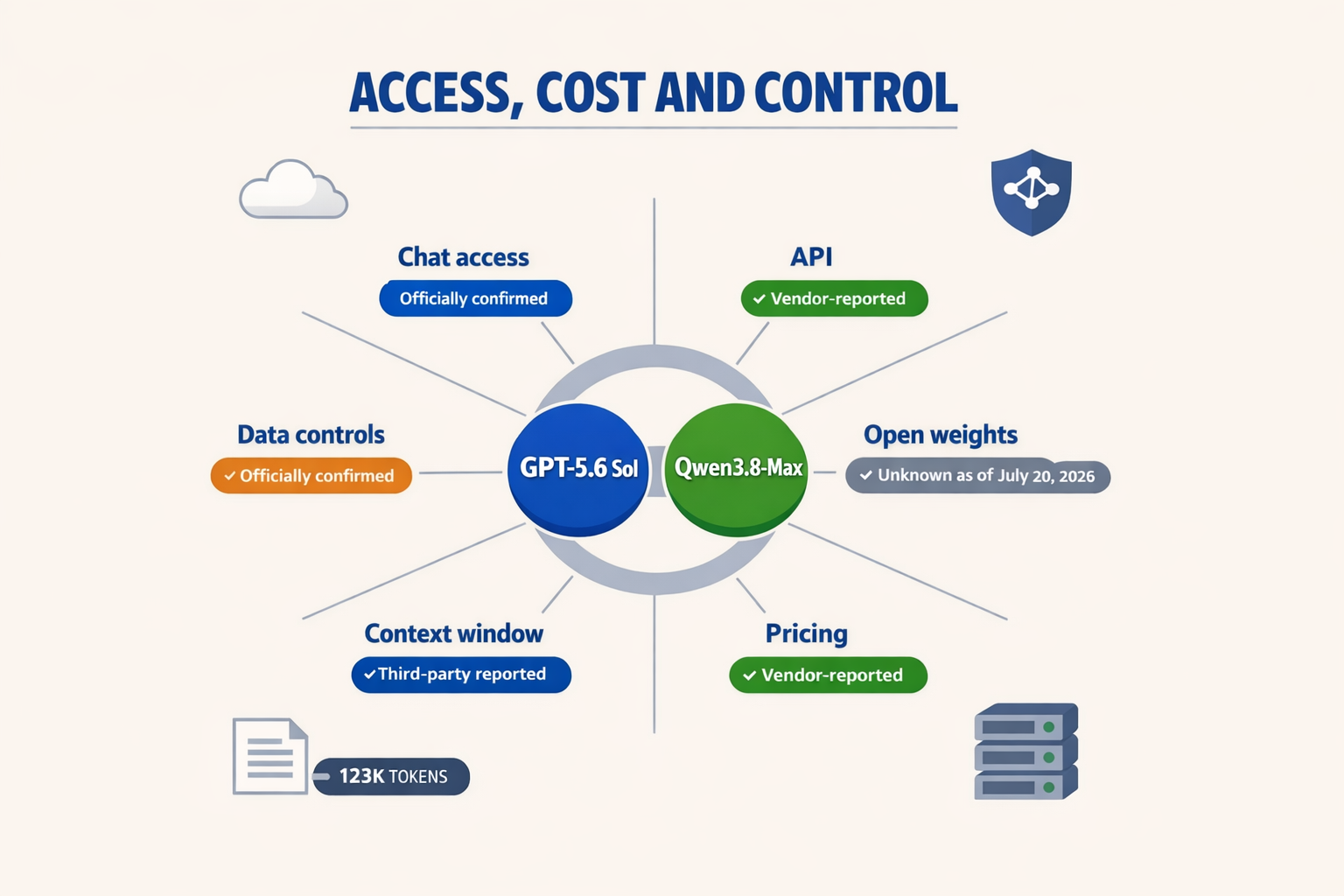
GPT-5.6 Sol has the clearer availability position as of July 20, 2026: it is documented in ChatGPT, while Qwen3.8-Max remains an insufficiently documented preview. API pricing, context limits, downloadable weights, and deployment terms should not be treated as confirmed for either model unless they appear in current first-party documentation.
Availability and API access
OpenAI’s Model Release Notes state that GPT-5.6 Sol became available in ChatGPT on July 9, 2026. OpenAI describes GPT-5.6 Sol as its flagship reasoning model for developers and enterprises, but ChatGPT availability does not automatically prove unrestricted API availability in every account, region, or service tier.
Before committing an application, developers should verify:
- Whether
gpt-5.6-solappears in their OpenAI API model list. - Whether access requires account verification, elevated usage tiers, or an allowlist.
- Which endpoints support tools, structured outputs, images, or computer interaction.
- Whether preview-version identifiers can change before general availability.
For Qwen3.8-Max, the supplied research does not include an official Alibaba Cloud or Qwen API page confirming endpoint names, access regions, quotas, or general availability. The reported preview and 2.4-trillion-parameter figure therefore remain provisional.
Weights and private deployment
Neither model should currently be described as open weight based on the available official evidence. OpenAI’s June 26, 2026 GPT-5.6 Preview System Card documents a three-model family—Sol, Terra, and Luna—but the cited material does not announce downloadable GPT-5.6 Sol weights.
Qwen has historically encompassed both downloadable and hosted models, but that history does not establish the license or weight availability of Qwen3.8-Max. Until Qwen or Alibaba publishes a repository, license, checksums, and hardware guidance, buyers should classify self-hosting as unconfirmed.
This distinction materially affects privacy:
- Hosted API: prompts and outputs cross a provider-controlled service boundary.
- Cloud-managed deployment: may offer regional controls without giving customers model weights.
- Self-hosting: can keep inference inside private infrastructure, subject to the model license.
- On-premises deployment: requires feasible compute, quantization support, security updates, and auditable serving software.
A reported 2.4 trillion parameters would also make full private deployment exceptionally demanding, although mixture-of-experts routing could reduce active computation. Alibaba has not provided enough official architecture information here to calculate memory or accelerator requirements.
Pricing and context remain unresolved
No verified token prices or context-window limits for GPT-5.6 Sol or Qwen3.8-Max appear in the provided first-party evidence. Consequently, comparisons quoting exact input costs, output costs, cached-token discounts, or context lengths should be treated cautiously.
A defensible procurement comparison should request:
- Input, cached-input, output, and tool-use charges
- Maximum input and generated-output limits
- Data-retention and training-use policies
- Regional processing and data-residency options
- Rate limits, uptime commitments, and preview-change terms
For multi-model applications, CallMissed’s OpenAI-compatible gateway illustrates a practical abstraction strategy: one integration can reach multiple model providers and use same-tier fallbacks. However, gateways do not eliminate the need to review each underlying provider’s pricing, residency, retention, and model-specific limits.
Current verdict: GPT-5.6 Sol wins on documented production visibility; Qwen3.8-Max cannot yet be judged on API economics, open-weight deployment, context capacity, or privacy flexibility without an official Alibaba or Qwen release.
Which model has stronger reasoning, long-context performance and benchmark evidence?
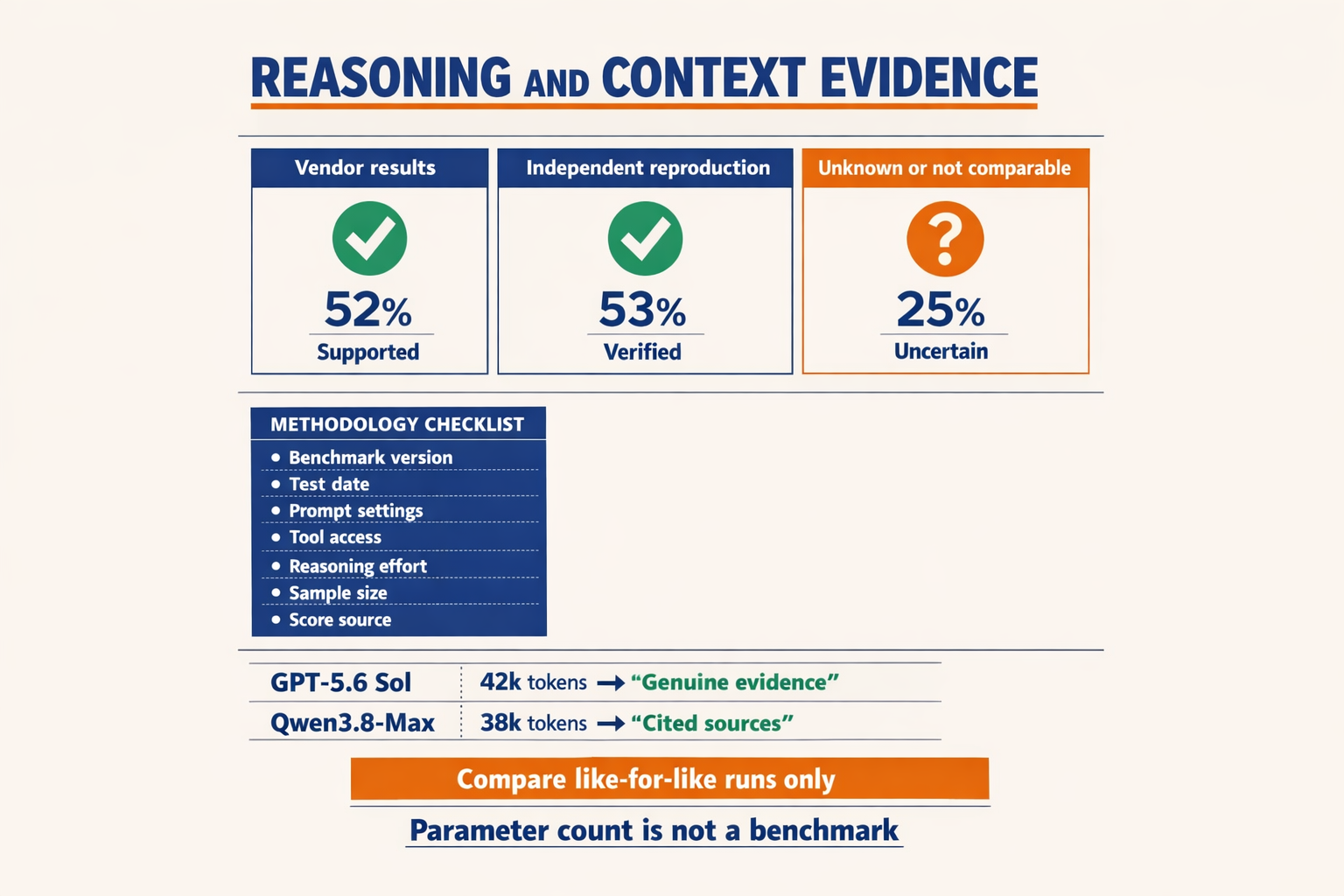
GPT-5.6 Sol currently has the stronger documented case for reasoning and complex work, but there is not yet enough verified evidence to declare it the definitive performance winner over Qwen3.8-Max. No official, reproducible head-to-head benchmark has been published, and Alibaba has not yet confirmed the reported Qwen3.8-Max specifications needed for a fair comparison.
Reasoning evidence favors GPT-5.6 Sol—for now
OpenAI’s Model Release Notes dated July 9, 2026 describe GPT-5.6 Sol as a reasoning model for complex work across coding, research, science, cybersecurity, computer use, and design. OpenAI also characterizes Sol as state of the art across coding and knowledge work on its GPT-5.6 product page.
Those statements establish intended capabilities, not independent proof of universal superiority. The evidence should be classified carefully:
- Confirmed: GPT-5.6 Sol is an officially released flagship reasoning model with published product and safety documentation.
- Vendor claim: OpenAI says GPT-5.6 Sol achieves state-of-the-art results in coding and knowledge work.
- Not established: Whether Sol leads Qwen3.8-Max under identical prompts, tool configurations, reasoning budgets, and scoring rules.
- Unknown: Qwen3.8-Max’s reasoning architecture, active parameter count, benchmark settings, and production behavior.
The reported 2.4-trillion-parameter figure for Qwen3.8-Max cannot substitute for evaluation data. If the model uses a mixture-of-experts architecture, its total parameter count could differ substantially from the number activated for each token. Without an official Alibaba or Qwen technical report, even that architectural assumption remains unverified.
Long-context performance remains unresolved
Neither a nominal context-window figure nor parameter scale proves that a model can reason reliably across long inputs. A meaningful long-context comparison needs to test:
- Information retrieval at multiple positions within the prompt.
- Multi-document synthesis without dropping conflicting evidence.
- Instruction retention across extended agent trajectories.
- Citation accuracy and resistance to unsupported conclusions.
- Latency and cost as input length and reasoning effort increase.
The supplied official OpenAI sources do not provide a context-window limit or comparable long-context scores for GPT-5.6 Sol. Likewise, no official Qwen or Alibaba source in the available evidence confirms Qwen3.8-Max’s context capacity. Consequently, any precise claim that one model has the larger or more effective context window would be premature.
Benchmark quality matters more than a leaderboard headline
OpenAI published the GPT-5.6 Preview System Card on June 26, 2026, confirming that GPT-5.6 comprises Sol, Terra, and Luna. That safety documentation gives GPT-5.6 Sol a clearer evidence trail, although a system card is not the same as an independently replicated benchmark study.
A credible GPT-5.6 Sol vs Qwen3.8-Max evaluation should disclose:
- Model version, API date, and whether each system is a preview.
- Reasoning setting, sampling parameters, and tool access.
- Pass rates across repeated runs—not one favorable output.
- Token usage, latency, refusals, and failure categories.
- Contamination controls for public benchmark questions.
The defensible July 2026 verdict is therefore “GPT-5.6 Sol wins on published evidence, not proven absolute capability.” Qwen3.8-Max could become highly competitive, but that conclusion must wait for official Alibaba specifications, benchmark results, and independent replication.
Which model is better for coding, agents, multimodality and computer-use workflows?
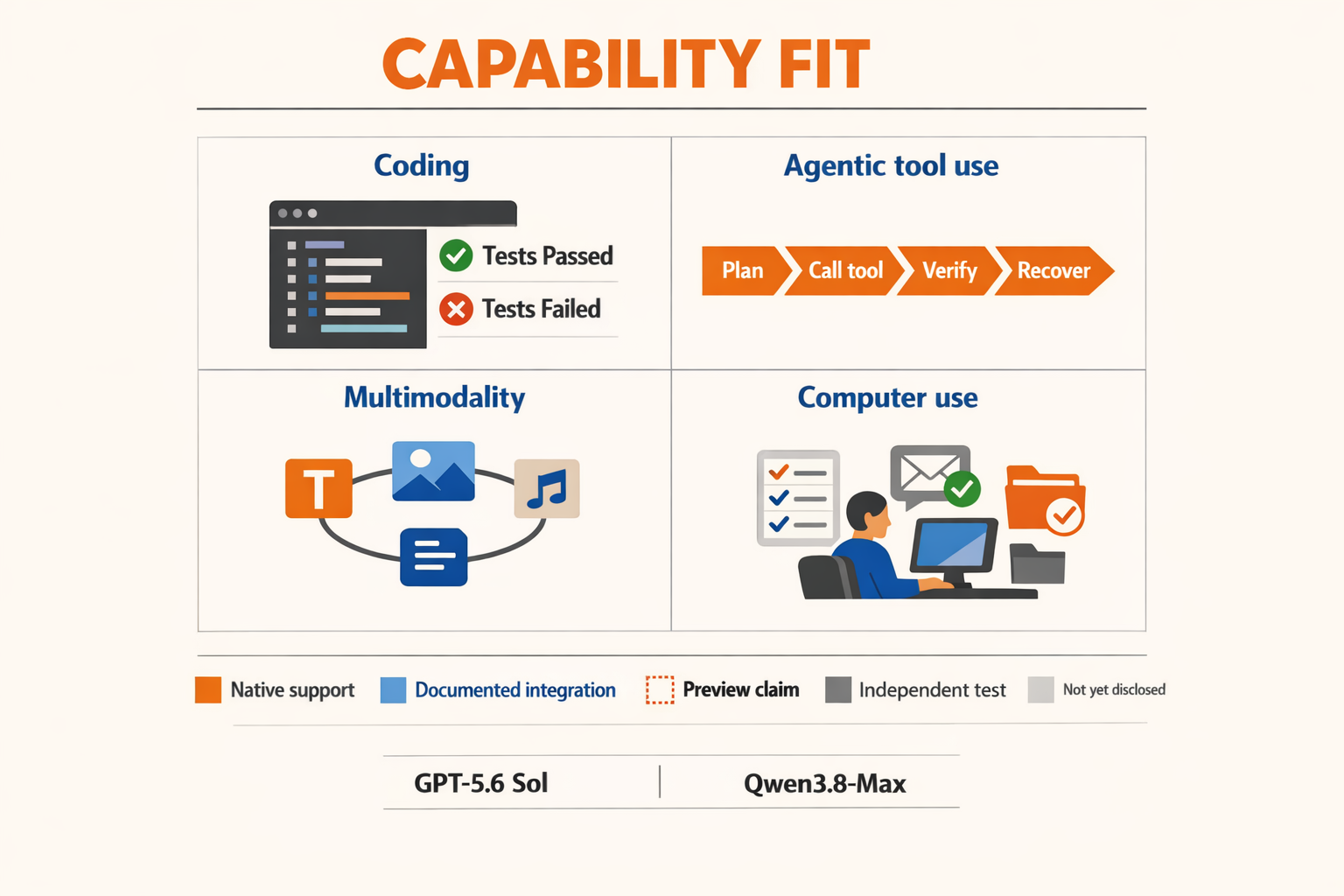
GPT-5.6 Sol is the stronger choice today for coding agents and computer-use workflows because OpenAI documents and ships those capabilities; no evidence-based winner can yet be declared for raw coding quality or multimodality until Alibaba publishes official Qwen3.8-Max specifications and reproducible results. This is a verdict about verified readiness, not proof that GPT-5.6 Sol is intrinsically more intelligent.
Coding: GPT-5.6 Sol wins on production evidence
OpenAI explicitly positions GPT-5.6 Sol for complex coding work. OpenAI’s Model Release Notes confirm that GPT-5.6 Sol became available in ChatGPT on July 9, 2026, while OpenAI’s launch materials claim state-of-the-art coding performance without providing independently reproduced results in the supplied evidence.
For engineering teams, the documented integration path makes GPT-5.6 Sol the safer current selection for:
- Repository exploration and multi-file changes
- Code generation, debugging and refactoring
- Test creation and implementation planning
- Workflows built through Codex, subject to using a compatible current app or CLI
- Coding tasks that require research or tool interaction
The reported 2.4-trillion-parameter size of Qwen3.8-Max does not establish coding superiority. As of July 20, 2026, an official Alibaba or Qwen model card confirming architecture, active parameters, coding evaluations and API behavior has not been identified in the provided sources.
Agents: choose the model with measurable task completion
For agents, one-shot benchmark accuracy is less important than whether the model can repeatedly select tools, preserve state and recover from errors. GPT-5.6 Sol has the clearer documented proposition: OpenAI describes the model as supporting complex work across coding, research, cybersecurity, science, design and computer use.
A serious agent evaluation should measure:
- End-to-end completion rate, including tool execution
- Invalid tool-call frequency and schema adherence
- Recovery rate after failed actions or incomplete data
- Tokens, latency and cost per completed task, not per isolated response
- Human-intervention rate across long-horizon runs
Until equivalent Qwen3.8-Max documentation and agent evaluations appear, GPT-5.6 Sol is the practical agent winner, while the comparative capability verdict remains open.
Multimodality: no defensible quality winner yet
Neither parameter count nor a general “multimodal” label reveals how well a model handles documents, screenshots, charts, images, audio or video. Buyers should verify the exact supported input and output modalities, file limits, context behavior and API schemas.
For Qwen3.8-Max, these details remain unconfirmed in official material supplied for this comparison. GPT-5.6 Sol has stronger documentation around design and computer-use scenarios, but that should not be converted into unsupported claims about every multimodal task.
Computer use: GPT-5.6 Sol is the current default
OpenAI specifically identifies computer use as a GPT-5.6 Sol workload in its July 2026 documentation. That makes Sol the better-supported option for browser navigation, interface interaction and multi-step desktop-style automation.
The operational verdict is therefore:
- Coding: GPT-5.6 Sol, provisionally
- Long-running agents: GPT-5.6 Sol on documented readiness
- Multimodal quality: insufficient comparative evidence
- Computer use: GPT-5.6 Sol
- Potential Qwen3.8-Max adoption: wait for official API access, model documentation, pricing and reproducible task-level testing
Qwen3.8-Max could alter these conclusions after Alibaba publishes verifiable evidence, but the reported scale alone cannot do so.
How could this competition affect enterprise AI, open deployment and the economics of frontier models?

The competition could give enterprises more negotiating power, accelerate multi-model architectures, and shift attention from headline scale to cost per successful task. However, GPT-5.6 Sol currently represents a documented hosted frontier product, while Qwen3.8-Max’s deployment model, licensing and reported 2.4-trillion-parameter scale remain unconfirmed by an official Alibaba or Qwen release as of July 20, 2026.
Enterprise AI becomes a portfolio decision
OpenAI’s Model Release Notes confirm that GPT-5.6 Sol became available in ChatGPT on July 9, 2026, giving enterprises a concrete path to test the model across coding, research, cybersecurity, computer use and design. OpenAI’s positioning favours managed access, integrated tools and centralized safety controls.
Qwen3.8-Max could create additional competitive pressure if Alibaba confirms comparable capabilities and production access. That pressure may benefit buyers through:
- More pricing leverage: credible alternatives reduce dependence on one provider’s token rates.
- Regional choice: multinational organizations can select providers based on hosting, latency, regulation and procurement requirements.
- Workload specialization: one model may handle difficult agentic tasks while less expensive models process classification, extraction or routine support.
- Faster product cycles: frontier vendors have stronger incentives to improve context handling, tool use, throughput and enterprise controls.
Enterprises should consequently measure task completion cost, not merely input and output token prices. A more expensive model can be economical if it needs fewer retries, tools or human corrections; a cheaper model can win at high-volume workloads when its accuracy clears the required threshold.
Open deployment remains an unresolved fault line
The word “Qwen” does not automatically mean “open weight.” Alibaba must publish Qwen3.8-Max’s weights, license, architecture, hardware requirements and redistribution terms before buyers can classify it as an open-deployment option.
If deployable weights eventually appear, organizations could gain greater control over:
- Data residency and private-cloud inference
- Fine-tuning and domain adaptation
- Inference optimization and hardware selection
- Auditability, retention and operational continuity
Yet a reported 2.4 trillion parameters could also make self-hosting technically and financially demanding. Total parameters do not disclose active parameters per token, memory requirements, routing overhead or achievable throughput—especially if the architecture uses mixture-of-experts routing. Open weights would therefore remove one dependency while potentially introducing substantial infrastructure costs.
Frontier economics will extend beyond token pricing
Neither raw model size nor a benchmark leaderboard captures the full enterprise bill. Buyers should calculate:
- API charges and committed-spend discounts
- Latency and concurrency under realistic traffic
- Failed-task, retry and human-review rates
- Tool calls, retrieval and long-context overhead
- GPU capacity, energy and operations for self-hosting
- Compliance, monitoring and model-migration costs
OpenAI’s GPT-5.6 Preview System Card, published June 26, 2026, provides enterprises with a documented safety baseline; equivalent Qwen3.8-Max documentation is not established in the supplied official evidence. That asymmetry can materially affect risk approval even before performance is considered.
Platforms such as CallMissed’s OpenAI-compatible gateway illustrate the likely enterprise response: abstract applications from individual providers, route workloads across multiple models and retain fallback options. The strategic winner may therefore be neither a universally dominant model nor the one with the largest parameter count, but an architecture that lets each organization switch models as quality, governance and economics change.
What do official sources, reputable reporting and independent experts actually establish?
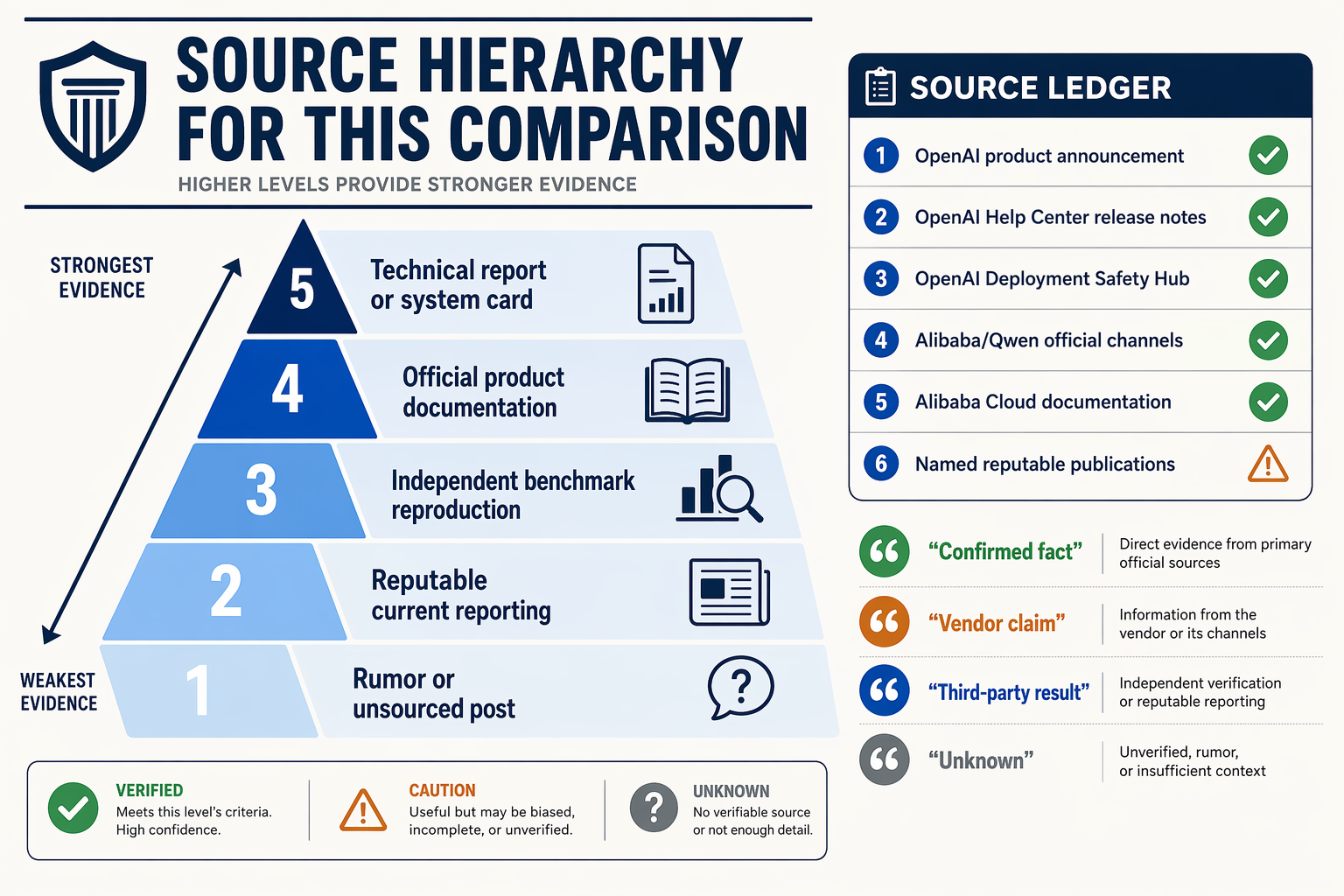
The verified record is currently asymmetric: official OpenAI materials establish that GPT-5.6 Sol is a documented, released model, while the supplied evidence does not include an official Alibaba or Qwen announcement confirming Qwen3.8-Max, its reported 2.4-trillion-parameter scale, or its production availability. No independently reproduced head-to-head result currently establishes which model performs better.
What official OpenAI sources confirm
OpenAI’s first-party documentation supports several concrete conclusions:
- GPT-5.6 is a three-model family comprising Sol, Terra, and Luna, according to OpenAI’s GPT-5.6 Preview System Card published on June 26, 2026.
- GPT-5.6 Sol became available in ChatGPT on July 9, 2026, according to OpenAI’s Model Release Notes.
- OpenAI describes Sol as its flagship reasoning model for coding, research, science, cybersecurity, computer use, design, and knowledge work.
- OpenAI has published a dedicated system card through its Deployment Safety Hub, giving evaluators a first-party basis for examining safety testing and deployment decisions.
OpenAI’s statement that GPT-5.6 Sol achieves “state-of-the-art results across coding [and] knowledge work” remains a vendor performance claim. Even when benchmark numbers appear in an official launch report, the strongest evidence comes from independent replication using disclosed prompts, model settings, tool permissions, scoring rules, and test dates.
What is—and is not—established for Qwen3.8-Max
The reported Qwen preview should be treated as an unverified emerging-model claim until Alibaba Cloud or the Qwen team publishes primary documentation. The evidence supplied for this comparison contains no official Qwen model card, technical paper, repository, API page, pricing schedule, or release notice for a model named Qwen3.8-Max.
Consequently, the following remain unconfirmed:
- The Qwen3.8-Max product name and version
- The reported 2.4-trillion total parameter count
- Dense versus mixture-of-experts architecture
- Active parameters per token
- Context window and multimodal inputs
- API access, downloadable weights, licensing, pricing, and regional deployment
- Benchmark scores and production latency
A 2.4-trillion-parameter figure, even if officially confirmed, would not reveal how many parameters are activated during inference or establish superiority in coding, reasoning, factuality, or cost efficiency.
What reporting and independent experts establish
The current source set provides no named reputable publication with independently verified technical details for Qwen3.8-Max and no independent laboratory result comparing it directly with GPT-5.6 Sol. Search-result wording, social posts, screenshots, community discussions, and benchmark-leaderboard submissions are useful leads, but they are not substitutes for primary documentation or reproducible evaluation.
Evidence should therefore be labeled explicitly:
- Confirmed fact: documented by OpenAI, Alibaba Cloud, or the Qwen team.
- Vendor claim: reported by the model developer but not independently reproduced.
- Third-party result: tested by a named evaluator with a disclosed methodology.
- Unknown: unsupported by accessible primary or credible independent evidence.
As of July 20, 2026, GPT-5.6 Sol has the stronger documentation trail—not automatically the stronger performance in every workload. A defensible purchasing decision still requires identical private evaluations covering output quality, tool reliability, latency, cost, data governance, and failure rates.
Which model should you choose for your use case? (TABLE)
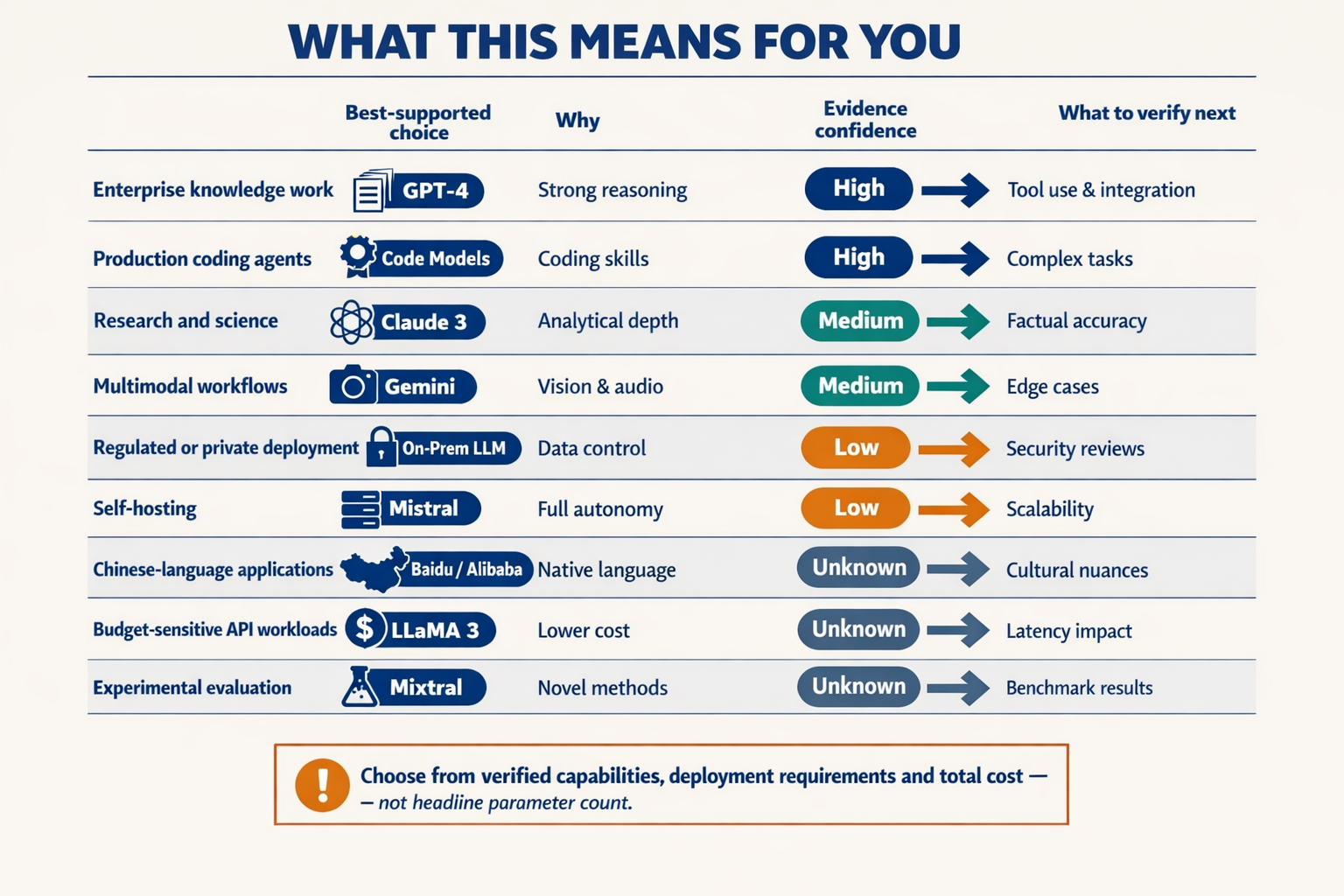
For GPT-5.6 Sol vs Qwen3.8-Max, choose GPT-5.6 Sol for immediate production workloads when OpenAI’s documented access, deployment model, and controls meet your requirements. Treat Qwen3.8-Max as a preview evaluation candidate—not a production default—until Alibaba publishes official model-card details, production API terms, pricing, context limits, architecture, licensing, safety documentation, and reproducible benchmarks. An unverified report of 2.4 trillion parameters does not establish capability, cost, speed, or deployability.
Winner by use case
| Use case | Recommended choice | Why | What to validate |
|---|---|---|---|
| Complex coding and software agents | GPT-5.6 Sol | OpenAI positions Sol for coding and complex reasoning, and documented access allows teams to test it now. That positioning is a vendor claim, not independent proof of superiority. | Repository-level accuracy, tool-call success, regression rate, latency, and total cost per completed task |
| Research and knowledge work | GPT-5.6 Sol | OpenAI identifies research, science, and knowledge work as target workloads. No authoritative Qwen3.8-Max documentation currently supports a like-for-like comparison. | Citation accuracy, hallucination rate, retrieval quality, private-document performance, and human-review time |
| Cybersecurity and computer-use agents | GPT-5.6 Sol—with controls | OpenAI documents cybersecurity and computer use among Sol’s intended capabilities and provides a preview system card for initial risk review. | Permission boundaries, sandboxing, prompt-injection resistance, human approval, incident response, and audit logs |
| Chinese-language or Alibaba-centered workflows | Evaluate Qwen3.8-Max | Qwen3.8-Max may eventually suit Chinese-language or Alibaba ecosystem deployments, but that case requires official evidence about access, language quality, integrations, and service terms. | Chinese task quality, regional availability, data residency, API compatibility, privacy controls, and support commitments |
| Private or self-hosted deployment | No verified winner yet | Hosted model access does not imply weight availability or self-hosting rights. Qwen3.8-Max weights, architecture, and licence remain unconfirmed. | Weight access, licence restrictions, hardware requirements, quantisation support, security updates, and model-update policy |
| Cost-sensitive, high-volume applications | Use GPT-5.6 Sol now or benchmark both after an official Qwen release | Reported parameter count cannot determine throughput, latency, active compute, or quality-adjusted cost. Qwen3.8-Max cannot be compared reliably without production pricing and API terms. | Input and output pricing, cached-token rates, retries, concurrency limits, latency, availability, and cost per successful task |
Why GPT-5.6 Sol is the evidence-backed deployable choice
In the current GPT-5.6 Sol vs Qwen3.8-Max comparison, GPT-5.6 Sol has the stronger deploy-now case because OpenAI has provided documented product access and safety material. According to OpenAI’s Model Release Notes, GPT-5.6 Sol became available in ChatGPT on July 9, 2026. OpenAI also published the GPT-5.6 Preview System Card on June 26, 2026, giving security and governance teams a documented starting point for evaluation.
These materials establish documentation and availability; they do not independently prove that GPT-5.6 Sol is more capable, safer, faster, or cheaper for every workload. OpenAI’s descriptions of state-of-the-art performance and intended capabilities are vendor claims unless independent evaluators reproduce them under comparable prompts, tools, inference settings, datasets, and scoring methods.
Teams should therefore treat GPT-5.6 Sol as the evidence-backed deployable candidate, not an automatic benchmark winner. Production selection should depend on representative internal tests and the organization’s security, compliance, latency, and cost requirements.
Why Qwen3.8-Max remains an evaluation candidate
Qwen3.8-Max may become competitive for multilingual, Alibaba-centered, cost-sensitive, or private-deployment workloads. For now, however, Alibaba has not supplied enough authoritative information to support a production recommendation in a GPT-5.6 Sol vs Qwen3.8-Max decision.
Before procurement or deployment, teams need official confirmation of:
- Model-card details and safety evaluations
- Whether the reported 2.4 trillion parameters refers to total, active, or another parameter measure
- Architecture, context limits, modalities, and tool-use support
- Production API availability, service regions, rate limits, and reliability terms
- Input, output, caching, and other applicable pricing
- Weight availability, licensing, self-hosting rights, and usage restrictions
- Privacy controls, data retention, data residency, and training-data policies
- Reproducible benchmark results with disclosed prompts, settings, and scoring methods
Until those details are published, Qwen3.8-Max should remain a preview evaluation candidate. Its reported scale alone cannot demonstrate production readiness or an advantage over GPT-5.6 Sol.
Practical selection rule
Use a two-stage evaluation:
- Qualify each model against mandatory requirements for access, governance, privacy, deployment, licensing, regional availability, and support.
- Benchmark qualified models on end-to-end task success, latency, reliability, human-review effort, and total cost per successful outcome.
For teams reducing provider lock-in, an OpenAI-compatible gateway such as CallMissed can support testing through a shared integration, while provider-specific capabilities remain isolated behind explicit adapters.
As of July 20, 2026, the answer to GPT-5.6 Sol vs Qwen3.8-Max is workload-dependent but clear: choose GPT-5.6 Sol where its documented access and controls fit your production needs; keep Qwen3.8-Max in preview evaluation until Alibaba releases verifiable technical, safety, licensing, benchmark, and commercial details.
Frequently asked questions: Is Qwen3.8-Max official, is it really 2.4 trillion parameters, and is it better than GPT-5.6 Sol?
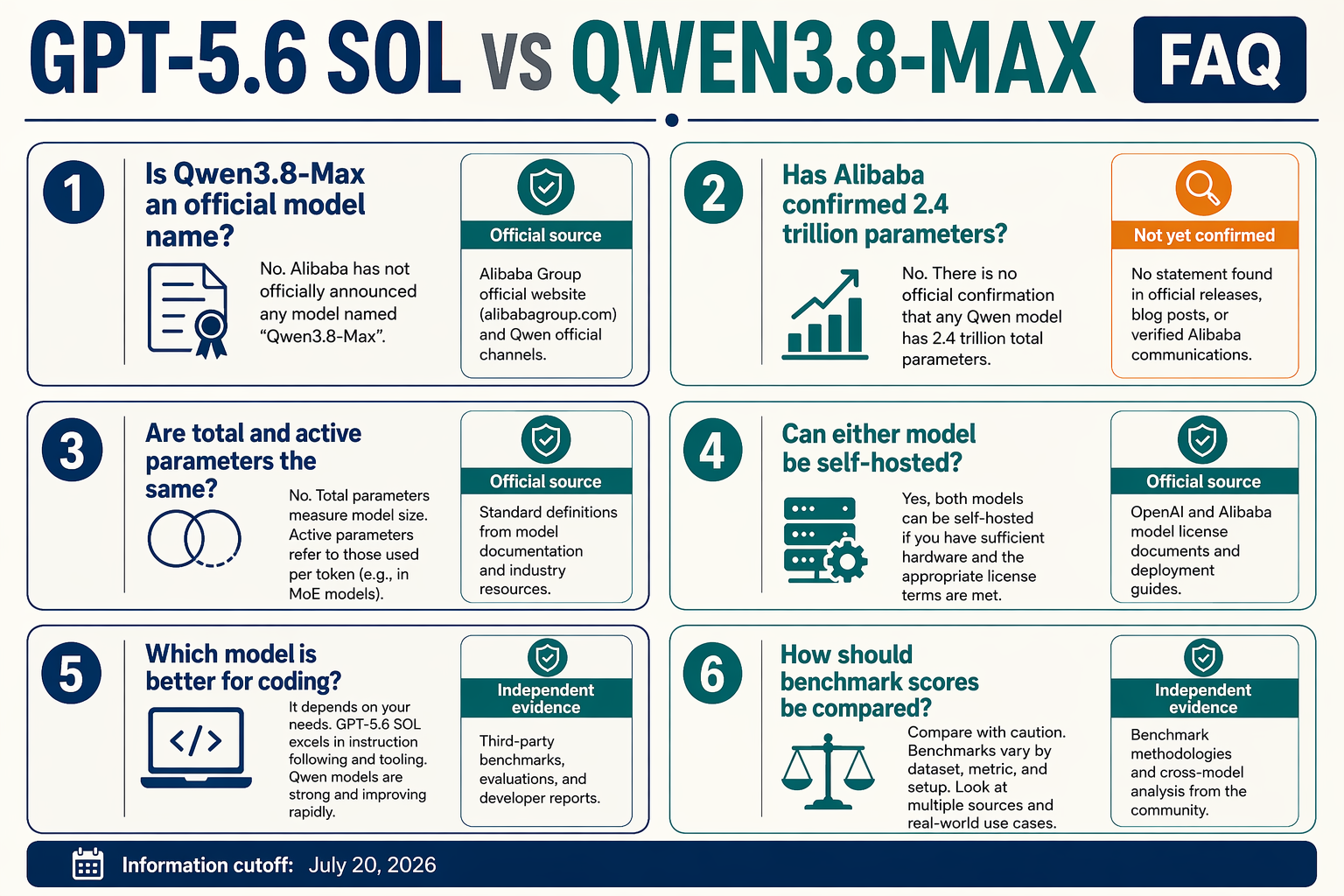
Is Qwen3.8-Max an official Alibaba or Qwen model?
Does Qwen3.8-Max really have 2.4 trillion parameters?
In GPT-5.6 Sol vs Qwen3.8-Max, which model is better?
Is GPT-5.6 Sol available now, and can developers access Qwen3.8-Max through an API?
What benchmarks should a GPT-5.6 Sol vs Qwen3.8-Max comparison use?
Should businesses wait for Qwen3.8-Max or deploy GPT-5.6 Sol today?
Conclusion
As of July 20, 2026, GPT-5.6 Sol has the stronger evidence-backed production case, while Qwen3.8-Max remains provisional pending primary Alibaba documentation and independent testing. In the GPT-5.6 Sol vs Qwen3.8-Max comparison, verified availability and documentation matter more than reported model size.
- GPT-5.6 Sol has the stronger confirmed baseline. OpenAI published the GPT-5.6 Preview System Card on June 26, 2026, identifying Sol as the flagship model alongside Terra and Luna. OpenAI’s Model Release Notes also confirm that Sol entered ChatGPT on July 9, 2026.
- Performance statements must be labeled correctly. OpenAI’s descriptions of state-of-the-art coding and knowledge-work performance are vendor claims, not independently established results. They require reproduction using transparent prompts, settings, tools, and evaluation datasets.
- Qwen3.8-Max remains insufficiently documented. Its reported 2.4-trillion-parameter scale should be treated as unconfirmed until Alibaba or the Qwen team publishes primary model documentation covering architecture, access, pricing, context limits, licensing, deployment, and evaluation methodology. Parameter count alone would not establish latency, cost, or reliability.
For teams deciding between GPT-5.6 Sol vs Qwen3.8-Max, GPT-5.6 Sol is currently the more defensible candidate for production evaluation—not a universally proven winner. A meaningful GPT-5.6 Sol vs Qwen3.8-Max decision will require official Alibaba documentation and independent head-to-head tests on real workloads.
Explore CallMissed, an AI infrastructure platform offering an OpenAI-compatible gateway alongside voice agents and multilingual chatbots, to build a stack that can adopt whichever verified model best fits each workload.
Related Reading
- Claude Fable 5 vs Qwen3.7 Max: July 2026 Facts on the Qwen3.8-Max Preview
- Claude Sonnet 5 vs Qwen3.8-Max: July 2026 Availability, Price and Benchmark Reality
- GPT-5.6 Sol Terra Luna Pricing Benchmarks: July 9, 2026 Buyer Guide
Sources
Related Posts



Ready to automate customer conversations?
Launch AI voice agents and WhatsApp bots with CallMissed — one API, 22+ Indian languages.