

Claude Fable 5 vs Qwen3.8-Max: July 2026 Comparison



Claude Fable 5 vs Qwen3.8-Max compared on availability, pricing, coding, agents, context, benchmarks, deployment, and verified July 2026 facts.
Claude Fable 5 vs Qwen3.8-Max: July 2026 Comparison
What does a reported 2.4-trillion-parameter model actually tell you when its architecture, price, context window and production availability remain unconfirmed? In July 2026, the Claude Fable 5 vs Qwen3.7 Max comparison is rapidly becoming a different—and more consequential—contest: Claude Fable 5 vs Qwen3.8-Max, an available commercial model versus a newly previewed Qwen model surrounded by significant unanswered questions.
The timing matters because these systems represent two distinct approaches to frontier AI. Anthropic describes Claude Fable 5 as a Mythos-class model adapted with cybersecurity and biology safeguards for general use. Anthropic’s Claude Platform documentation states that Claude Fable 5 became generally available on June 9, 2026, through the Claude API, Amazon Bedrock, Claude Platform on AWS, Google Cloud and Microsoft Foundry. Following a temporary interruption associated with export controls, Anthropic announced that Claude Fable 5 began redeploying globally on July 1, 2026, with updated cybersecurity protections.
By contrast, Qwen3.8-Max has been reported at 2.4 trillion parameters, but parameter count alone cannot establish reasoning quality, coding accuracy, inference cost or real-world agent reliability. At publication time, crucial details still require confirmation through official Qwen or Alibaba materials, including whether 2.4 trillion refers to total or active parameters, whether the architecture uses mixture-of-experts routing, and when developers will receive production API or downloadable-weight access.
Why this comparison needs careful qualification
This article separates verified specifications from preview claims. It examines:
- Actual availability and access, including hosted APIs, cloud marketplaces and possible local deployment
- Reasoning, coding and agent workflows, without treating vendor-selected benchmarks as universal rankings
- Multimodality and context length, where announced support may differ from production limits
- Pricing and enterprise readiness, including safeguards, governance and infrastructure choices
- Best-fit use cases for developers, regulated organizations and multilingual global businesses
The distinction is especially important for teams comparing Claude Fable 5 vs local Qwen, or revisiting earlier searches such as Claude Fable 5 vs Qwen3-Coder. A preview model may signal the direction of Alibaba’s Qwen portfolio, but an announced parameter figure is not equivalent to a deployable product with documented service levels.
Platforms such as CallMissed, an OpenAI-compatible multi-model gateway, reflect the broader shift toward testing multiple providers behind one integration rather than making architecture decisions from headline specifications alone.
The verdict, therefore, will not be based on which model has the larger number attached to it. It will focus on what organizations can verify, access and operate as of July 20, 2026—while clearly labeling every unresolved Qwen3.8-Max detail.
Which model wins in July 2026: Claude Fable 5 or the reported Qwen3.8-Max?
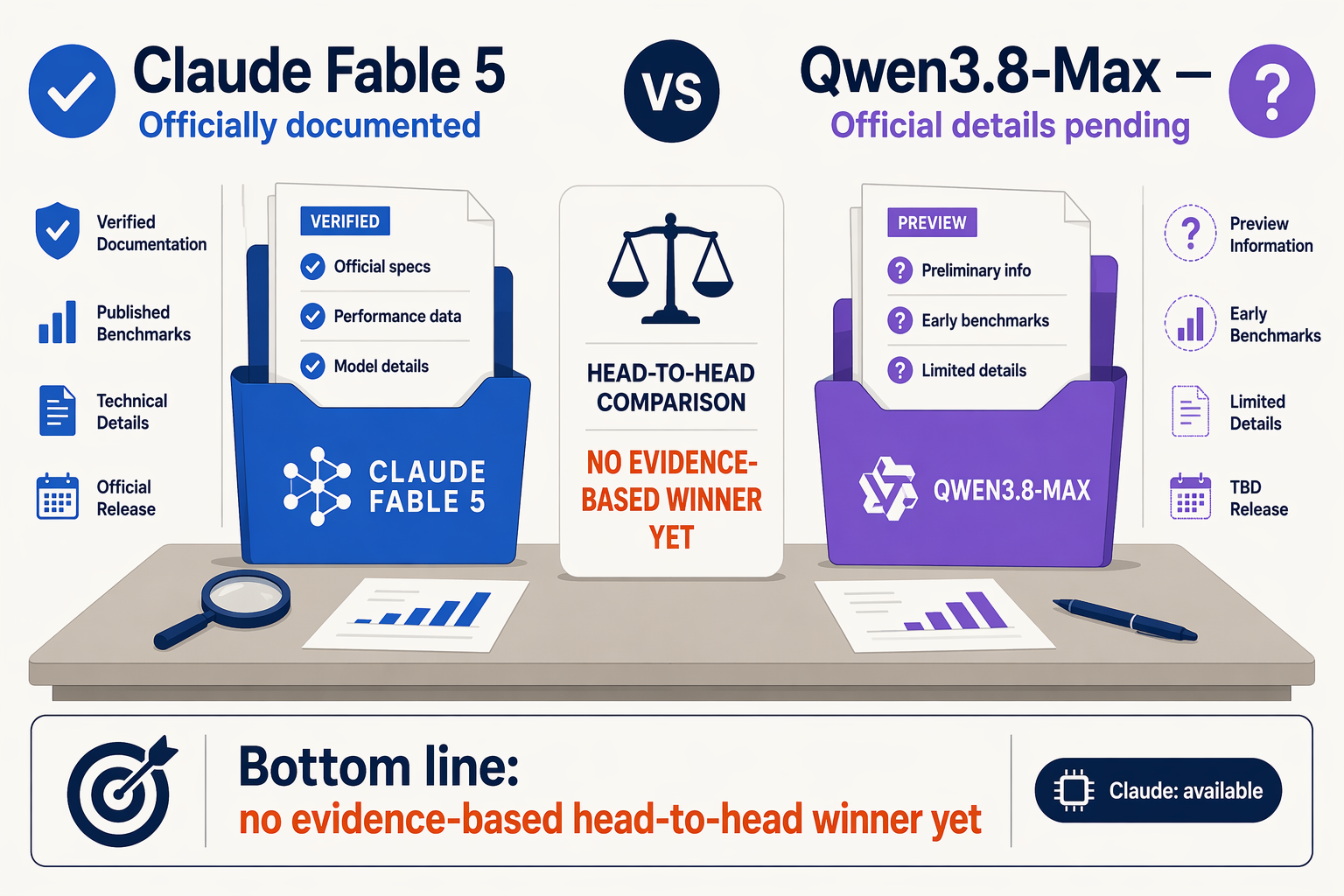
Claude Fable 5 wins the July 2026 production-readiness comparison, but no evidence-based winner can yet be declared for raw model capability. Anthropic offers documented access, deployment channels and safeguards; the reported Qwen3.8-Max remains a preview with too many unverified specifications to support a fair performance verdict.
The decision depends on what “wins” means
For organizations selecting a model now, the comparison produces three different verdicts:
- Production deployment: Claude Fable 5 wins.
Anthropic provides official documentation covering availability, cloud access and safety controls. Qwen3.8-Max does not yet have equivalently verified production details.
- Reasoning, coding and agent performance: Undecided.
No credible head-to-head evaluation has established which model performs better across representative workloads. A reported parameter count cannot substitute for controlled tests of accuracy, tool use, latency and reliability.
- Openness and local deployment: Undecided for Qwen3.8-Max specifically.
Earlier Qwen releases may offer downloadable weights, but that history does not prove that Alibaba will release Qwen3.8-Max under the same access model. Teams researching Claude Fable 5 vs Local Qwen should compare Fable 5 against an actually downloadable Qwen release rather than assume the previewed model will run locally.
Why Claude Fable 5 leads for immediate use
Anthropic calls Claude Fable 5 a “Mythos-class model that we’ve made safe for general use.” Anthropic also states that Claude Fable 5 and Claude Mythos 5 use the same underlying model, with Fable incorporating additional cybersecurity and biology safeguards.
The operational evidence is concrete:
- Anthropic’s Claude Platform documentation states that Claude Fable 5 became generally available on June 9, 2026, across the Claude API, Amazon Bedrock, Claude Platform on AWS, Google Cloud and Microsoft Foundry.
- Anthropic announced the global redeployment of Claude Fable 5 beginning July 1, 2026, following the lifting of export controls.
- Anthropic says its updated cyber controls aim to “block high-uplift vulnerability finding,” an explicit safeguard that enterprise security teams can assess during governance reviews.
Availability does not prove that Fable 5 is more intelligent. It does mean developers can evaluate it using real prompts, production integrations and procurement processes.
Why 2.4 trillion parameters do not settle the contest
The reported 2.4-trillion-parameter figure for Qwen3.8-Max is potentially significant, but its meaning depends on architecture. For a mixture-of-experts model, total parameters can be far higher than the parameters activated for each token, materially affecting inference cost and speed.
Until official Qwen or Alibaba documentation confirms the following, definitive comparisons would be premature:
- Total versus active parameter count
- Dense versus mixture-of-experts architecture
- Context window and multimodal inputs
- API, cloud or downloadable-weight availability
- Token pricing, rate limits and commercial terms
- Reproducible reasoning, coding and agent benchmarks
Consequently, Claude Fable 5 is the practical winner as of July 20, 2026, while the broader capability contest remains open. Searches for Claude Fable 5 vs Qwen3.7 Max or Claude Fable 5 vs Qwen3-Coder should not transfer conclusions automatically to Qwen3.8-Max: model names, architectures and access terms can change substantially between releases.
What is the official background of Claude Fable 5 and Qwen’s Max model family?
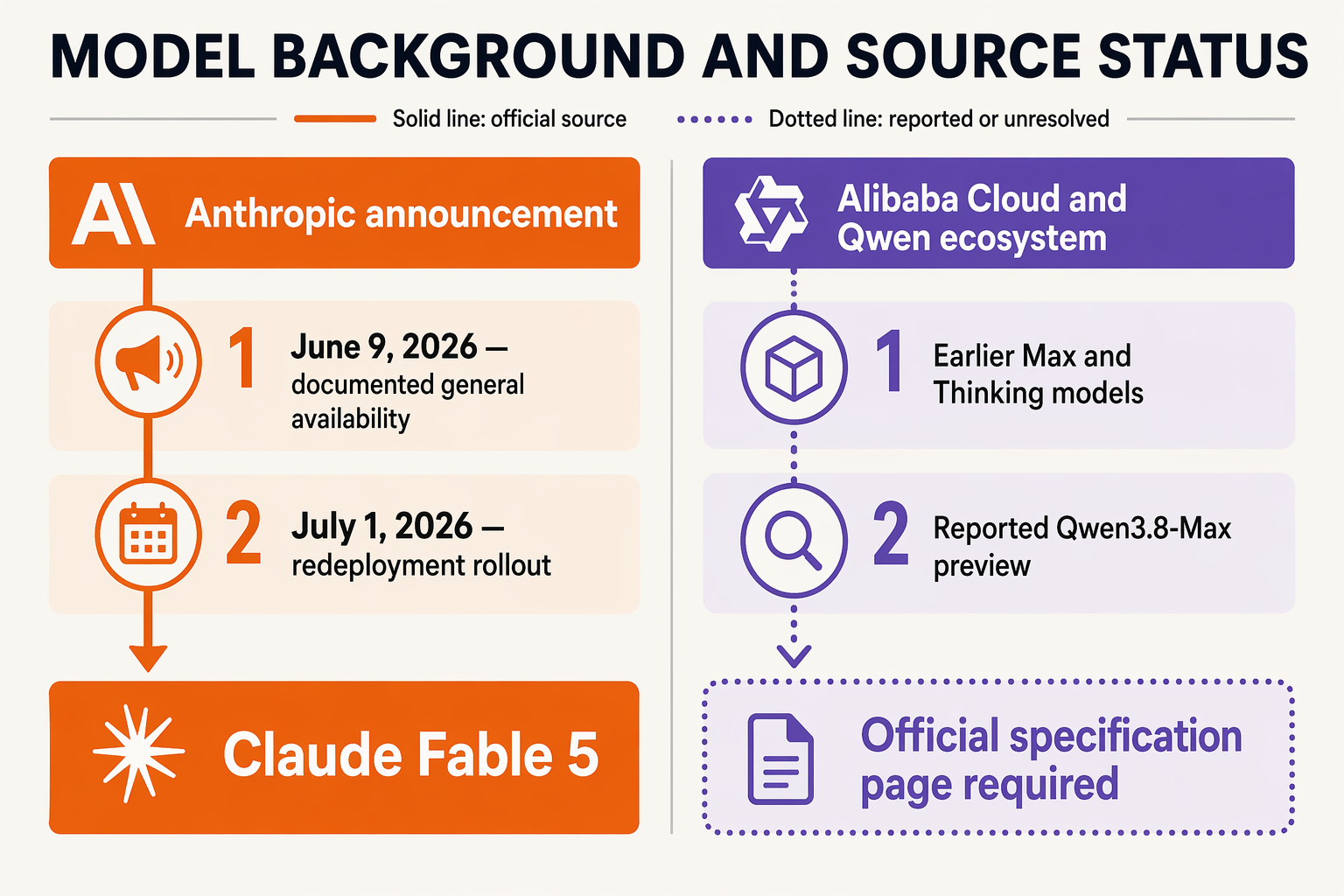
Claude Fable 5 has a documented Anthropic release history, deployment footprint and safety lineage; Qwen3.8-Max currently has a reported preview identity but not a comparably complete official specification. The key background distinction is therefore not Western versus Chinese AI—it is a generally available commercial model versus an incompletely documented member of Alibaba’s Qwen Max family.
Claude Fable 5: a safeguarded Mythos-class model
Anthropic introduced Claude Fable 5 as “a Mythos-class model that we’ve made safe for general use.” Anthropic’s system card explains that Claude Mythos 5 and Claude Fable 5 are two configurations of the same underlying large language model, rather than unrelated model architectures.
The product distinction centers on safeguards:
- Claude Mythos 5 represents the underlying frontier-capability configuration.
- Claude Fable 5 applies additional protections for cybersecurity and biology use cases.
- Anthropic says Fable 5’s cyber policy aims to block “high-uplift vulnerability finding,” while permitting many legitimate defensive and general-purpose requests.
According to Anthropic’s Claude Platform documentation, Claude Fable 5 became generally available on June 9, 2026, through the Claude API, Amazon Bedrock, Claude Platform on AWS, Google Cloud and Microsoft Foundry. That multi-cloud distribution gives enterprises several procurement, governance and infrastructure routes without implying that every cloud offers identical regional availability or commercial terms.
Anthropic subsequently reported a temporary access interruption connected to export controls. Anthropic began redeploying Claude Fable 5 globally on July 1, 2026, after those controls were lifted, adding updated cybersecurity safeguards. The official Claude Fable page summarized the restoration directly: “Claude Fable 5 is rolling out.”
Qwen Max: Alibaba’s hosted frontier-model branch
Qwen is Alibaba’s broader model family, while the Max designation has historically identified high-capability models delivered through Alibaba Cloud services. That distinction matters because “Qwen” does not automatically mean downloadable weights: the portfolio can include openly released models alongside proprietary hosted models.
For Qwen3.8-Max, the currently reported 2.4-trillion-parameter figure should be treated as a preview claim until Alibaba or the Qwen team publishes a model card, technical report or production API documentation. As of July 20, 2026, the available official material cited for this comparison does not establish:
- Whether 2.4 trillion means total parameters or parameters activated per token.
- Whether Qwen3.8-Max uses a mixture-of-experts architecture.
- Its training-token count, context window or multimodal input support.
- Its API model identifier, regional availability, pricing or service-level terms.
- Whether weights will be downloadable under a Qwen licence.
These omissions prevent a reliable inference-cost or capability comparison. A 2.4-trillion-parameter sparse model, for example, could activate only a fraction of its weights during inference; a dense model would have radically different compute and memory requirements.
What the official histories establish
The verified background supports three conclusions:
- Claude Fable 5 is an operational product with official access channels and published safety documentation.
- Qwen3.8-Max belongs to a strategically important Alibaba model lineage, but its preview status leaves core deployment facts unresolved.
- Earlier open-weight Qwen releases cannot be used as proof that Qwen3.8-Max will be open, locally deployable or similarly licensed.
Until Alibaba publishes primary documentation, comparisons should label Qwen3.8-Max specifications as reported, not confirmed.
Which July 2026 developments and specifications are actually verified? (TABLE)
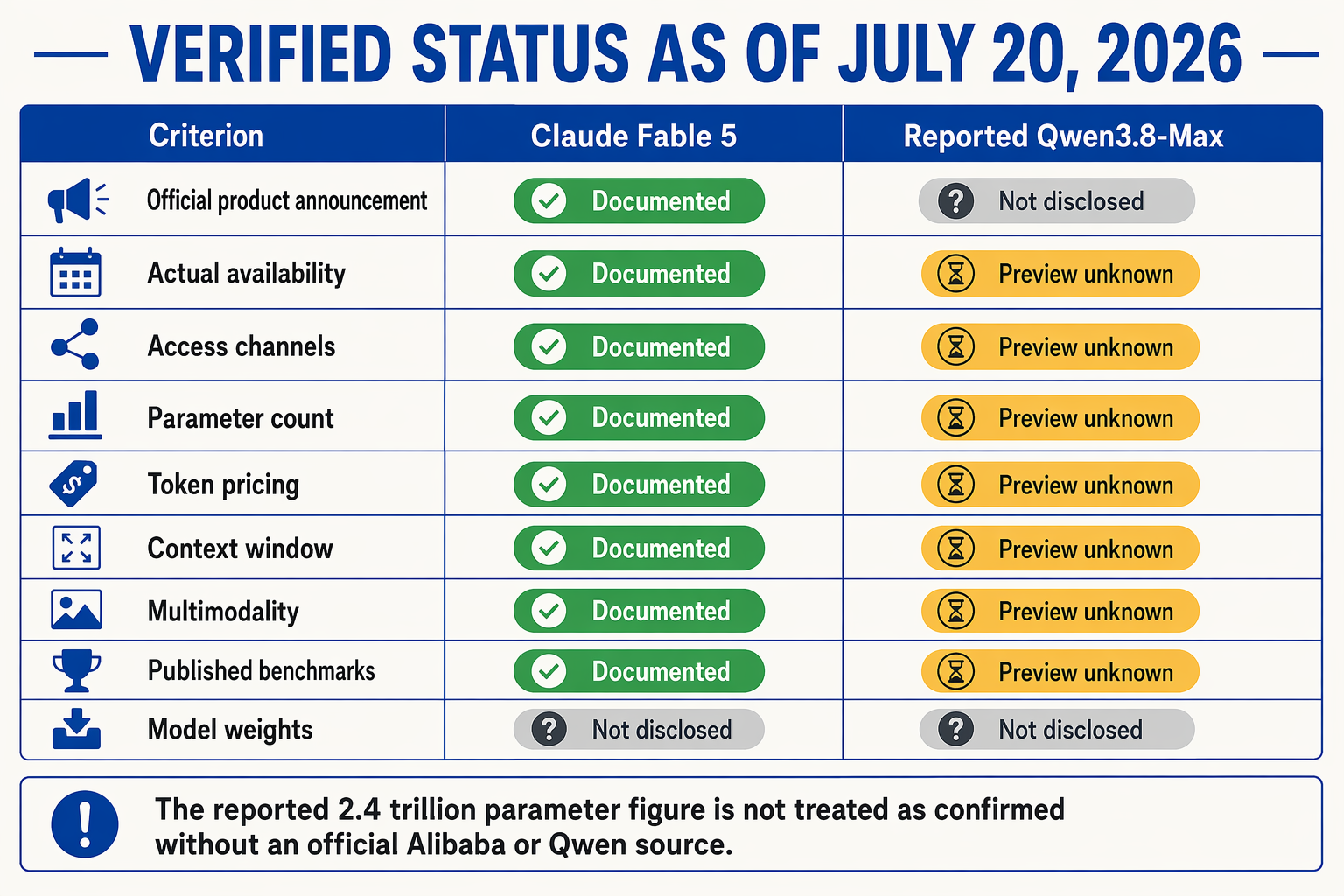
As of July 20, 2026, Claude Fable 5 has an official launch record, documented cloud distribution and published safety materials. Qwen3.8-Max remains a reported preview: the supplied research contains no official Qwen or Alibaba documentation confirming its 2.4-trillion-parameter figure, architecture, release date or production access.
Verified facts versus preview claims
| Category | Claude Fable 5 | Qwen3.8-Max | Verification status |
|---|---|---|---|
| Model status | Generally available; global redeployment began July 1, 2026 | Described as newly previewed, not documented as production-ready | Claude: verified; Qwen: unverified |
| Official availability date | June 9, 2026, according to Claude Platform documentation | No official availability date established | Claude: verified; Qwen: unknown |
| Access channels | Claude API, Amazon Bedrock, Claude Platform on AWS, Google Cloud and Microsoft Foundry | Hosted API, cloud marketplace and downloadable-weight access not confirmed | Claude: verified; Qwen: unknown |
| Model lineage | Anthropic describes Fable 5 as the same underlying model as Mythos 5, adapted with cybersecurity and biology safeguards | Model family relationship and architecture not officially documented in the supplied sources | Claude: verified; Qwen: unknown |
| Parameters and architecture | Anthropic has not disclosed a parameter count in the cited materials | Reported at 2.4 trillion parameters; total versus active parameters and mixture-of-experts routing remain unconfirmed | Both: undisclosed or unconfirmed |
| Context, pricing and benchmarks | Not specified in the supplied official excerpts | Context window, token pricing, benchmark results and inference requirements remain unconfirmed | Insufficient verified data |
What Anthropic has officially established
Anthropic announced Claude Fable 5 as “a Mythos-class model that we’ve made safe for general use.” Anthropic’s Claude Mythos page further states that Claude Fable 5 uses the same underlying model as Mythos 5 but adds robust safeguards for cybersecurity and biology requests.
The release chronology is also documented:
- Claude Platform documentation says Claude Fable 5 became generally available on June 9, 2026, across five named API and cloud channels.
- Anthropic announced that global redeployment started July 1, 2026, following the lifting of export controls.
- Anthropic said the redeployed version included updated cybersecurity safeguards.
- Anthropic’s safeguard documentation says the company aims to block “high-uplift vulnerability finding,” providing a concrete policy objective rather than a general safety label.
- Anthropic has published a dedicated Claude Fable 5 and Claude Mythos 5 System Card, establishing an official source for model-risk and evaluation disclosures.
These facts verify distribution and governance, but they do not independently prove superiority in reasoning, coding or agentic work.
What remains unknown about Qwen3.8-Max
The reported 2.4-trillion-parameter scale should be treated as a preview claim until Qwen or Alibaba publishes a model card, technical report, repository or API documentation. At minimum, developers still need official answers to four questions:
- Does 2.4 trillion mean total parameters or parameters activated per token?
- Is Qwen3.8-Max a dense model or a mixture-of-experts system?
- Will Alibaba provide an API, downloadable weights, or both?
- What are its context limit, multimodal inputs, pricing and reproducible benchmark settings?
Consequently, July 2026 comparisons should label Claude Fable 5 as commercially available and documented, while describing Qwen3.8-Max as promising but not yet specification-complete. Parameter count alone cannot resolve the comparison.
How do reasoning, coding and long-running agent workflows compare?
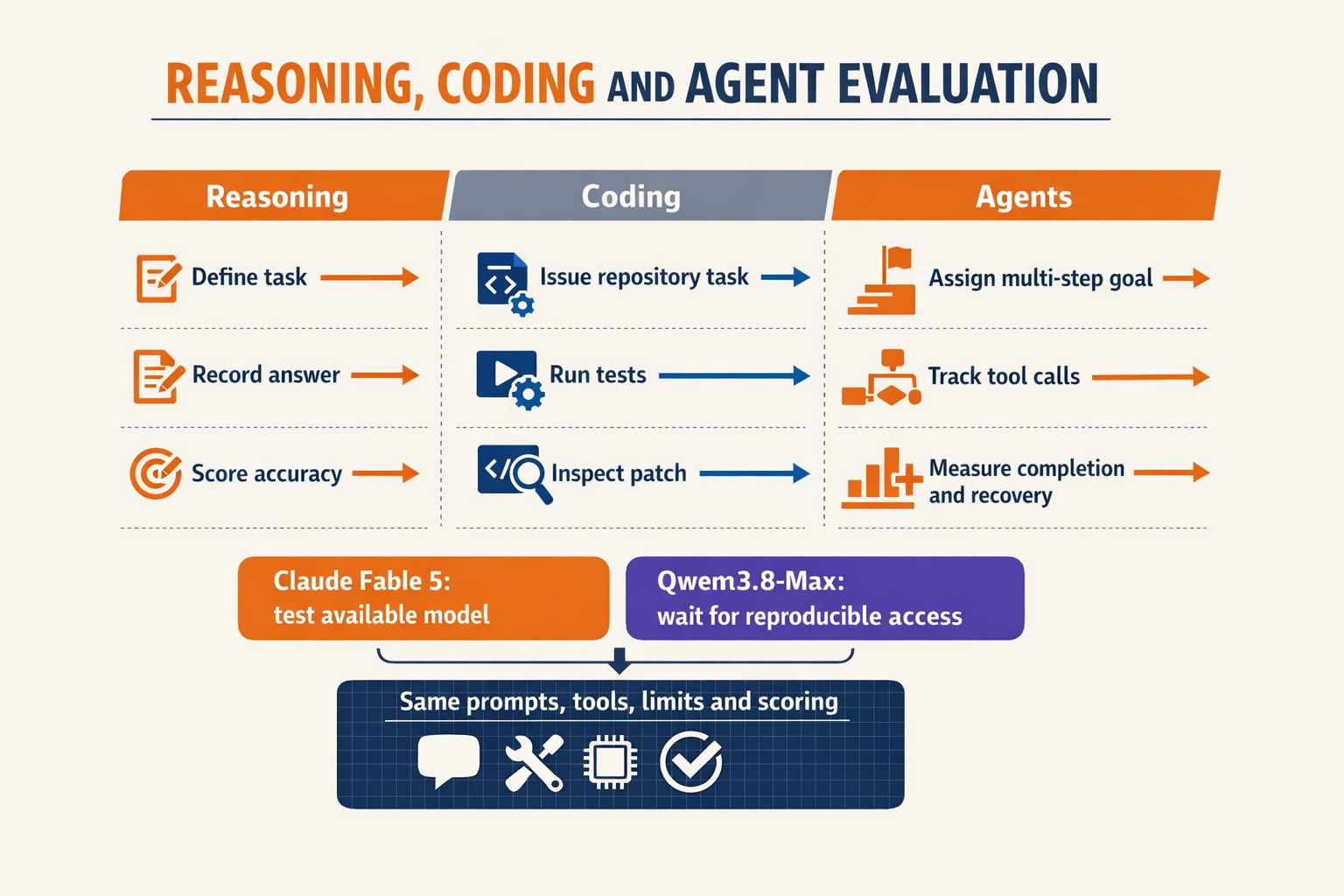
Claude Fable 5 is currently the more assessable choice for reasoning, coding and long-running agents because developers can test a production model with published documentation. Qwen3.8-Max may prove highly capable, but its reported 2.4-trillion-parameter scale does not yet provide enough evidence for a defensible workflow-level comparison.
Reasoning quality remains an evidence question
Anthropic describes Claude Fable 5 as a Mythos-class model made safe for general use, while Anthropic’s system card documents Claude Fable 5 and Claude Mythos 5 as two configurations of the same underlying large language model. That offers evaluators a defined model identity, safety profile and reproducible testing target.
No equivalent official evidence currently establishes how Qwen3.8-Max performs on multi-step planning, mathematical reasoning or instruction adherence. Until Qwen or Alibaba publishes a technical report, several variables remain unknown:
- Whether 2.4 trillion parameters means total or active parameters
- Whether Qwen3.8-Max uses mixture-of-experts routing
- How much inference-time computation its reasoning mode consumes
- Whether benchmark results use tools, majority voting or extended reasoning budgets
- How reliably it handles Chinese, English and multilingual reasoning outside curated tests
Parameter count is particularly weak as a standalone predictor. A sparsely activated 2.4-trillion-parameter model could use only a fraction of its weights per token, while post-training quality, data composition and tool orchestration may matter more than total scale.
Coding comparisons need repository-level tests
Anthropic introduced Claude Fable 5 for what it calls its “most ambitious coding” work, and the model began rolling out again on July 1, 2026, according to Anthropic. However, that vendor description should not be treated as proof that Claude Fable 5 wins every programming task.
A credible Claude Fable 5 vs Qwen3.8-Max coding comparison should test both models on:
- Repository navigation, including locating relevant files without excessive context loading
- Patch correctness, measured through hidden unit and integration tests
- Debugging persistence, especially recovery after an unsuccessful fix
- Tool use, including terminal commands, version control and structured outputs
- Cost per accepted change, not merely cost per million tokens
Earlier searches for Claude Fable 5 vs Qwen3-Coder or Claude Fable 5 vs local Qwen should not be extrapolated to Qwen3.8-Max. Different Qwen variants can have different post-training, licensing, deployment and coding characteristics.
Long-running agents reward reliability over headline scale
Agentic workflows amplify small errors because models repeatedly plan, call tools, inspect results and revise their approach. The relevant measures are therefore task-completion rate, tool-call accuracy, context retention, recovery behavior, latency and total cost.
Claude Fable 5 has an immediate evaluation advantage: Anthropic documents production access through the Claude API and major cloud channels beginning June 9, 2026, making multi-hour coding or research-agent trials operationally possible. Anthropic also publishes model-orchestration guidance and cybersecurity safeguards intended to block high-uplift vulnerability discovery, although those protections may affect some legitimate security workflows.
For Qwen3.8-Max, long-running-agent conclusions should wait for an official endpoint, context specification, tool-calling schema, pricing and rate limits. The current verdict is readiness-based, not a permanent capability ranking: Claude Fable 5 can be evaluated in production now, whereas Qwen3.8-Max remains a promising but insufficiently documented preview.
What can be verified about multimodality, context, pricing and benchmarks?
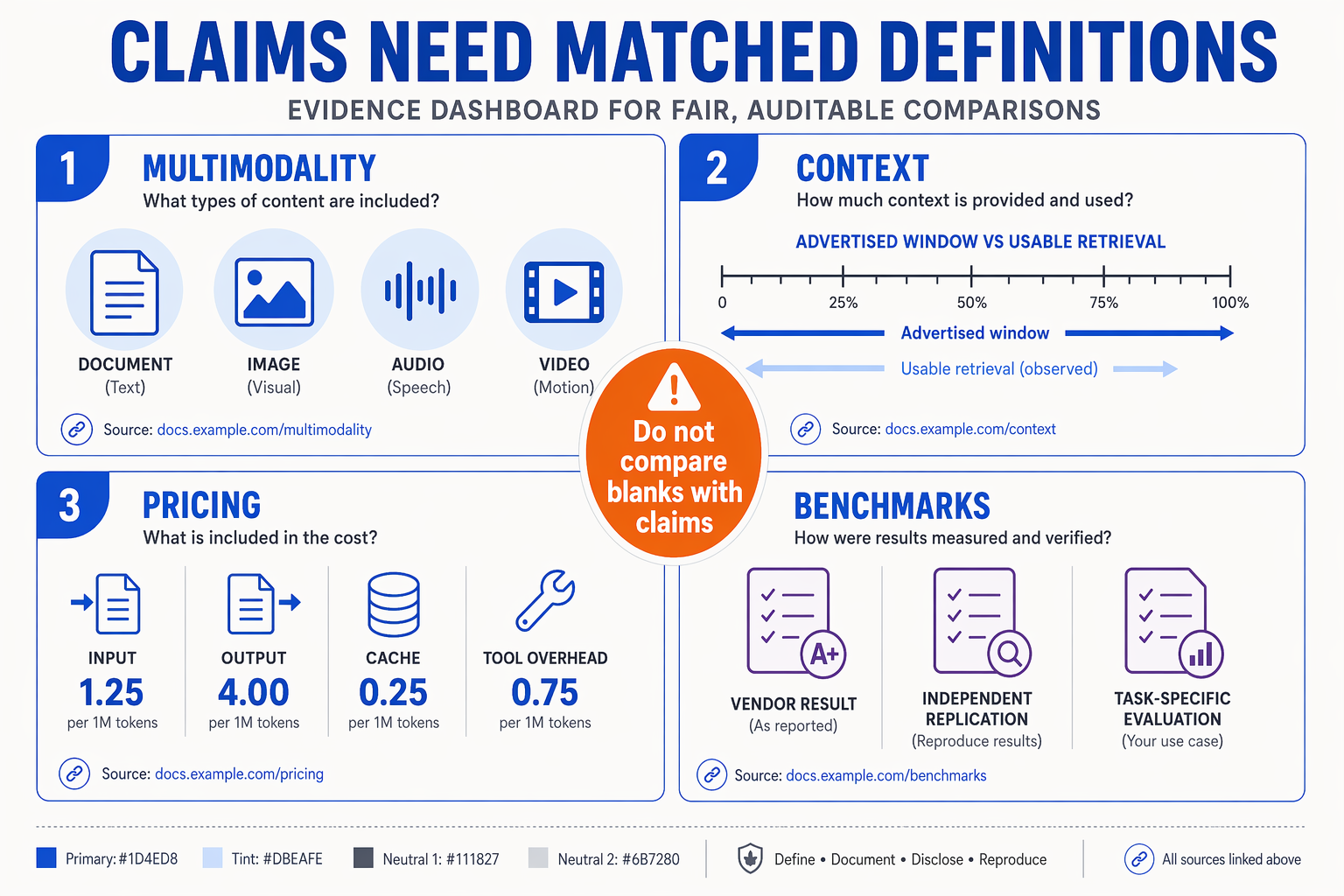
Only Claude Fable 5’s general capabilities and deployment status are supported by official documentation in the reviewed evidence. For Qwen3.8-Max, the reported 2.4-trillion-parameter scale does not yet establish its multimodal inputs, usable context window, API pricing or benchmark performance.
Multimodality remains insufficiently specified
Anthropic presents Claude Fable 5 as a general-use configuration of the same underlying model as Claude Mythos 5. Anthropic’s July 2026 Claude Mythos documentation states that “Claude Fable 5 is the same underlying model as Mythos 5”, but adds robust cybersecurity and biology safeguards.
However, the supplied official Anthropic materials do not provide a complete modality matrix covering image, audio and video inputs. Consequently, teams should verify the current Claude API model documentation before designing production workflows around any modality beyond text.
For Qwen3.8-Max, no reviewed official Qwen or Alibaba specification confirms:
- Supported text, image, audio or video inputs
- Native speech-to-text or text-to-speech functionality
- Image or video understanding limits
- Whether multimodality is built into one model or delivered through separate Qwen models
A model-family reputation for multimodality is not proof that a newly previewed model supports the same interfaces.
Context-window claims need production documentation
Neither an official Qwen3.8-Max context length nor its maximum output-token limit can be verified from the available official evidence. The reported 2.4-trillion-parameter count is unrelated to context capacity: parameter count describes model scale, while context length describes how many input and output tokens an inference endpoint can process.
For both models, buyers should distinguish among:
- Advertised context, the theoretical maximum accepted by the endpoint
- Effective context, the amount over which retrieval and reasoning remain reliable
- Maximum output, which may be far smaller than the total context window
- Cloud-specific limits, which can differ across first-party and marketplace deployments
Anthropic’s Claude Platform documentation confirms that Claude Fable 5 became generally available on June 9, 2026, but the context excerpt supplied for this comparison does not state a numerical context limit.
Pricing cannot yet be compared fairly
A defensible cost comparison requires official prices for input tokens, output tokens, prompt caching, batch processing and tool use. No verified Qwen3.8-Max API tariff is available in the reviewed material, so claims that it is cheaper—or more expensive—than Claude Fable 5 would be premature.
The 2.4-trillion figure also cannot predict inference cost without knowing:
- Whether Qwen3.8-Max uses a mixture-of-experts architecture
- How many parameters are active per token
- Its quantization and serving configuration
- Whether Alibaba will offer hosted access, downloadable weights or both
No apples-to-apples benchmark verdict is available
Anthropic has published the Claude Fable 5 and Claude Mythos 5 System Card, describing both configurations of its new large language model. Yet the supplied evidence contains no directly comparable Qwen3.8-Max results on identical tests, prompts, tool settings and evaluation dates.
Until Qwen or Alibaba publishes reproducible results, benchmark tables circulating without primary-source methodology should be treated as preview evidence, not a ranking. The most accurate July 2026 conclusion is therefore asymmetric: Claude Fable 5 is documented as a production model, while Qwen3.8-Max’s context, modalities, price and performance remain unverified preview variables.
How could availability, openness and safeguards affect enterprise adoption?
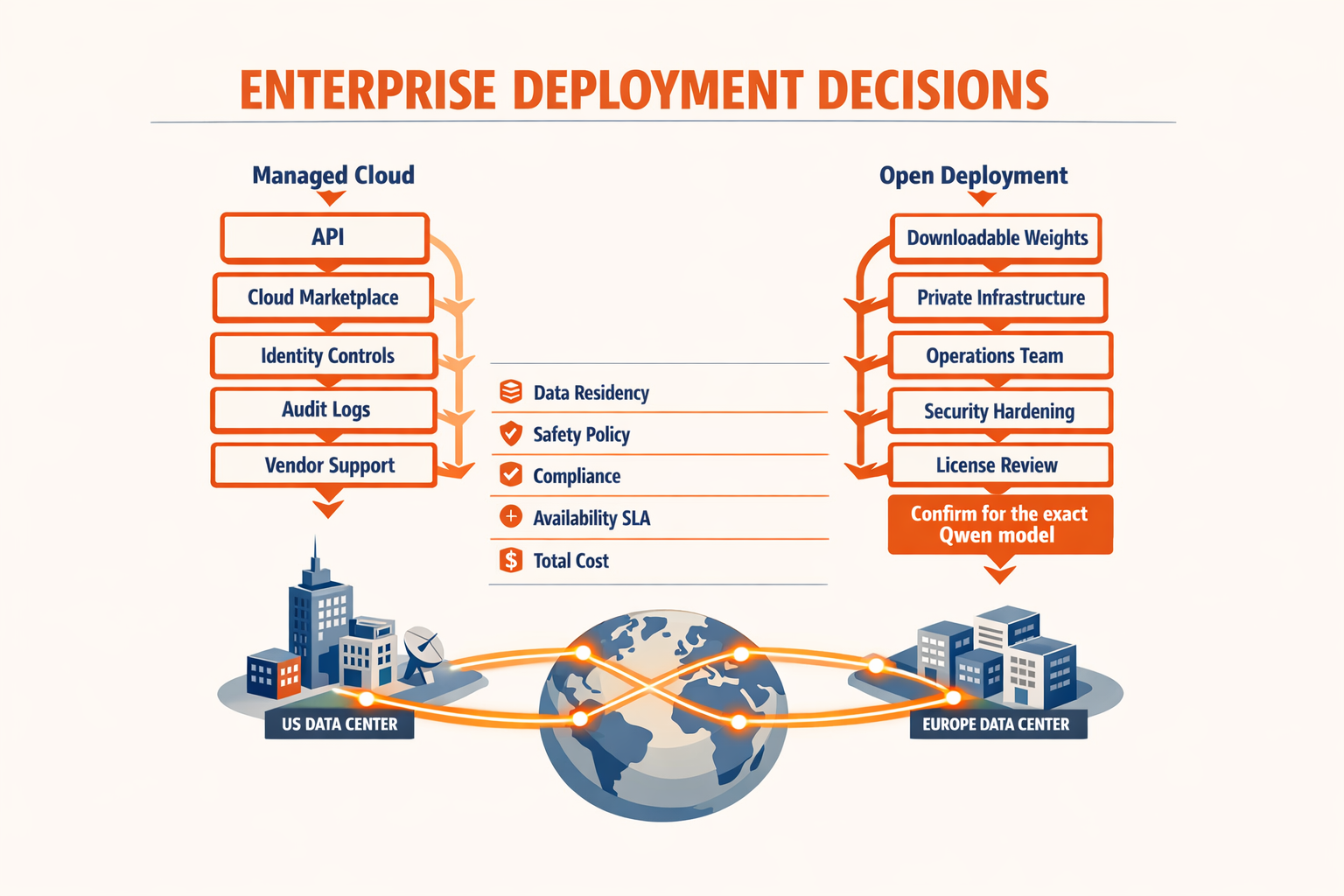
Enterprise adoption currently favors Claude Fable 5 when procurement requires documented access, cloud distribution and published safeguards; Qwen3.8-Max remains a preview whose enterprise case cannot be assessed from its reported 2.4-trillion-parameter size alone. Qwen3.8-Max could offer different deployment or openness advantages, but those depend on Alibaba confirming its weights, licence, API terms and security controls.
Availability changes the risk calculation
Anthropic’s Claude Platform documentation says Claude Fable 5 became generally available on June 9, 2026, through five named channels: the Claude API, Amazon Bedrock, Claude Platform on AWS, Google Cloud and Microsoft Foundry. Anthropic subsequently began its global redeployment on July 1, 2026, following an export-control-related interruption and the addition of updated cybersecurity safeguards.
That distribution gives enterprises several practical options:
- Use an existing cloud agreement rather than onboarding a separate infrastructure vendor.
- Apply established identity, logging and spending controls through a supported cloud environment.
- Design for provider resilience, particularly after Fable 5’s temporary availability interruption demonstrated that geopolitical and regulatory changes can affect even production services.
By comparison, Alibaba and the official Qwen project had not, at publication time, provided enough verified information to treat Qwen3.8-Max as production-ready. The reported 2.4 trillion parameters do not establish:
- A generally available API or service-level agreement
- Supported cloud regions and data-residency options
- Downloadable weights or hardware requirements
- Commercial licence terms
- Pricing, rate limits or reserved-capacity arrangements
- A stable model identifier suitable for production integration
A preview can support evaluation planning, but it should not be placed on a critical production path until these details are documented.
“Qwen” does not automatically mean open weights
The broader Qwen family includes models released with downloadable weights, making Claude Fable 5 vs local Qwen a legitimate architectural comparison. However, openness must be evaluated model by model. There is no basis yet to assume that Qwen3.8-Max’s weights will be downloadable merely because other Qwen models have supported local deployment.
If Alibaba releases weights under commercially usable terms, enterprises could potentially gain greater control over data locality, inference infrastructure, fine-tuning and offline operation. Those benefits would arrive with corresponding responsibilities for GPU capacity, patching, monitoring, abuse prevention and licence compliance.
Claude Fable 5 is a managed, closed-weight service. That limits infrastructure control but reduces the operational burden of hosting a frontier-scale model.
Safeguards create both assurance and friction
Anthropic describes Claude Fable 5 as the same underlying model as Claude Mythos 5, adapted for general use with robust cybersecurity and biology safeguards. Anthropic specifically says its cyber controls aim to block “high-uplift vulnerability finding.”
For regulated organizations, published safeguards and a system card can strengthen model-risk reviews. For authorized security teams, however, stricter controls may reject some legitimate dual-use requests. Enterprises should therefore test safeguards against representative workflows rather than assuming that stronger filtering is universally beneficial.
A responsible adoption process should compare:
- System-card disclosures and prohibited-use policies
- Prompt-injection and jailbreak resistance
- Audit logs, retention settings and regional processing
- False refusals in approved cybersecurity or scientific work
- Fallback behavior during outages or policy blocks
Platforms such as CallMissed’s OpenAI-compatible multi-model gateway illustrate one resilience pattern: keep the application interface consistent while testing supported models and same-tier fallbacks. Until Alibaba publishes equivalent Qwen3.8-Max deployment and safety documentation, Claude Fable 5 is the more procurement-ready option—not necessarily the final capability winner.
What do official Anthropic and Alibaba/Qwen sources say—and what remains opinion?
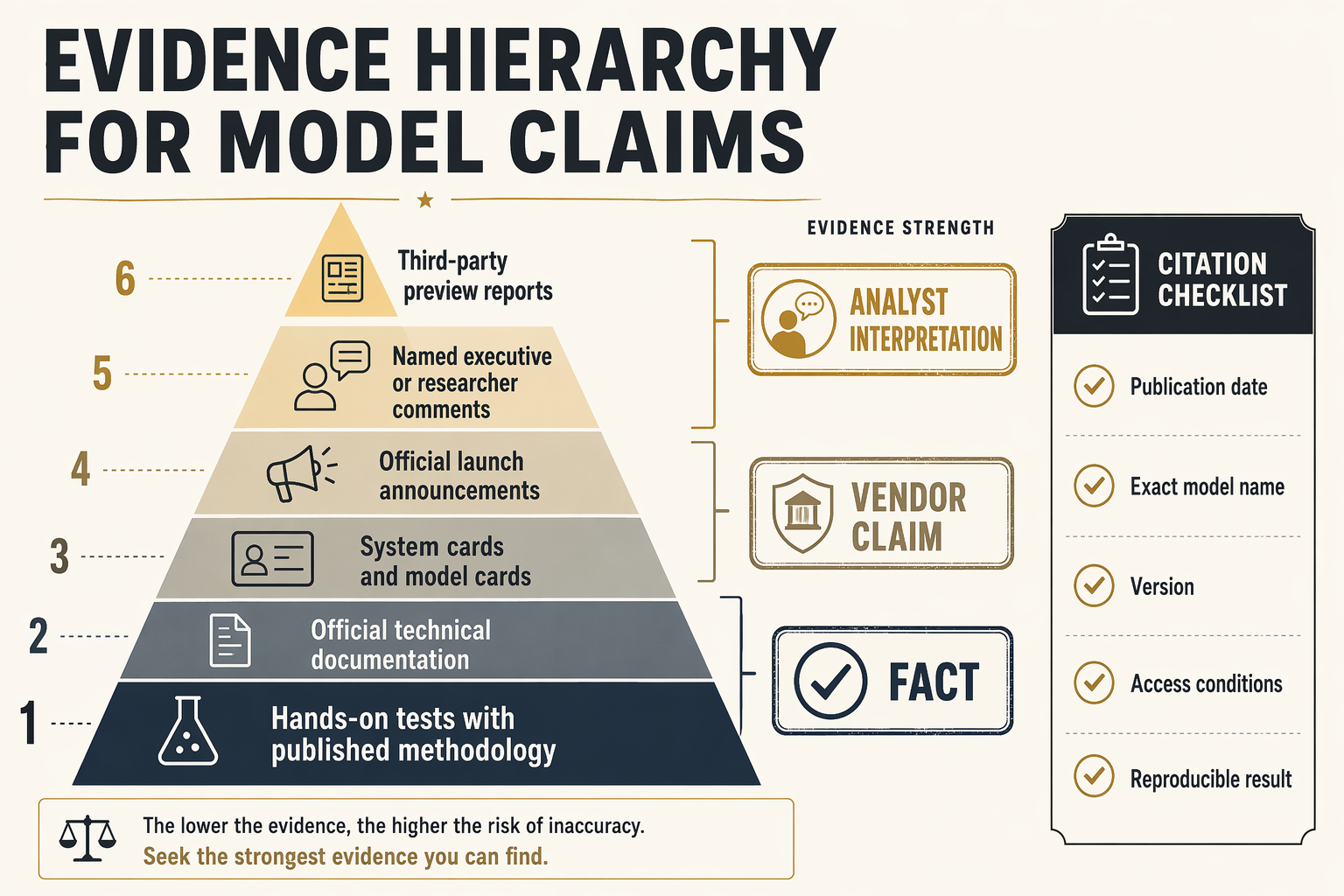
Official sources establish Claude Fable 5 as a documented, generally available Anthropic product, while the supplied official Alibaba/Qwen evidence does not yet substantiate Qwen3.8-Max’s reported 2.4-trillion-parameter size or production status. Any definitive performance ranking between the two therefore remains opinion until Alibaba publishes specifications, access details and reproducible evaluations.
What Anthropic officially confirms
Anthropic provides multiple first-party sources that broadly agree on Fable 5’s identity, availability and safeguards:
- Model lineage: Anthropic’s launch announcement describes Claude Fable 5 as “a Mythos-class model that we’ve made safe for general use.” Anthropic’s Claude Mythos page further states that Fable 5 uses the same underlying model as Mythos 5, with additional cybersecurity and biology safeguards.
- General availability: Anthropic’s Claude Platform documentation says Claude Fable 5 became generally available on June 9, 2026 through the Claude API, Amazon Bedrock, Claude Platform on AWS, Google Cloud and Microsoft Foundry.
- Restored deployment: Anthropic announced that Fable 5 began redeploying on July 1, 2026, following the lifting of export controls. Anthropic’s product page subsequently stated that access had been restored.
- Safety objective: Anthropic says its updated cyber safeguards “aim to block high-uplift vulnerability finding.” That wording identifies a design objective, not a guarantee that every harmful request will be detected.
- Technical disclosure: Anthropic has published a Claude Fable 5 and Claude Mythos 5 System Card, giving evaluators a first-party source for model behavior and risk analysis.
These are verifiable vendor statements. However, claims such as “5th-generation intelligence” and suitability for “your most ambitious coding” are Anthropic’s positioning language, not independent comparative findings.
What Alibaba and Qwen have not yet officially established
The headline figure of 2.4 trillion parameters should remain labelled as a reported preview claim unless an official Qwen or Alibaba model card, repository, API document or launch announcement confirms it. Based on the official material available for this comparison, several basic questions remain unanswered:
- Does 2.4 trillion mean total parameters, active parameters per token or another measurement?
- Is Qwen3.8-Max a mixture-of-experts model, and if so, how many experts are activated during inference?
- Is the model accessible through Alibaba Cloud Model Studio, an API, downloadable weights or a limited preview?
- What are its context window, multimodal inputs, tool-calling interfaces, rate limits and token prices?
- Which benchmark prompts, scoring methods, hardware configurations and model versions support any performance claims?
Until those details appear in official documentation, comparisons involving speed, cost, openness, coding reliability or agent performance are speculative.
Where fact ends and opinion begins
A disciplined Claude Fable 5 vs Qwen3.8-Max assessment should use three labels:
- Confirmed: documented by Anthropic, Alibaba or Qwen in first-party materials.
- Reported: attributed to a preview, media report or third party but not yet corroborated by official technical documentation.
- Inferred: an analyst’s interpretation, such as assuming a larger parameter count produces stronger reasoning.
The most defensible July 2026 conclusion is narrow: Claude Fable 5 can be evaluated as an available service with published documentation; Qwen3.8-Max cannot yet be evaluated on equivalent evidence. That is an evidence-availability verdict—not proof that either model is intrinsically more capable.
Which model is the better fit for your use case? (TABLE)
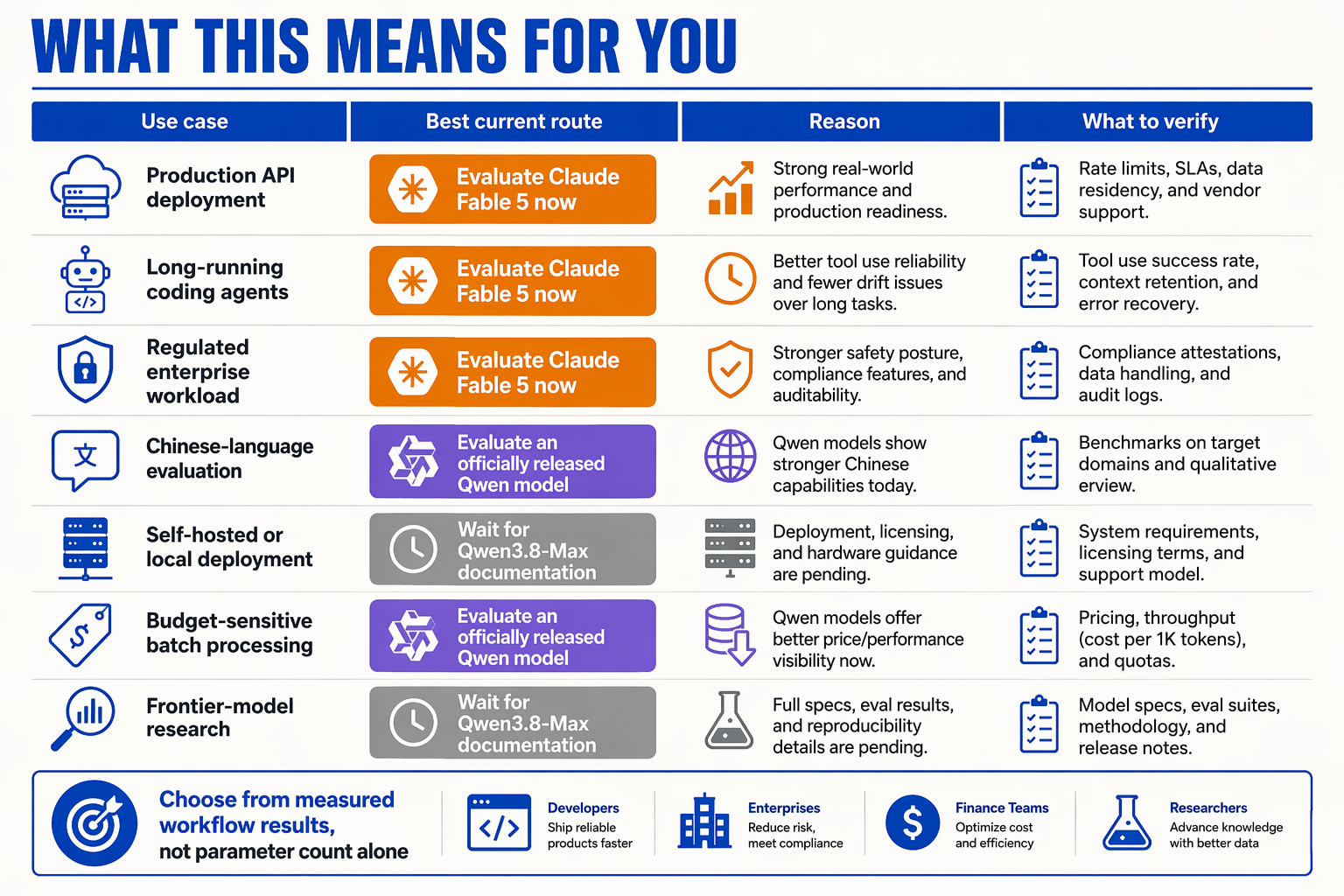
For most teams choosing between Claude Fable 5 vs Qwen3.8-Max on July 20, 2026, Claude Fable 5 is the better fit. Its production access routes and enterprise distribution are documented, while Qwen3.8-Max remains preview-stage, with availability, architecture, pricing, licensing and independently reproducible comparisons unresolved.
Use-case decision matrix
| Use case | Better fit on July 20, 2026 | Evidence-based reason | Important caveat |
|---|---|---|---|
| Production enterprise applications | Claude Fable 5 | Verified availability: Anthropic documents general access through its API and supported major cloud platforms. | Each organization must still assess data residency, retention, security and regional compliance requirements. |
| Coding and software agents | Claude Fable 5 for deployment; evaluate Qwen3.8-Max later | Claude Fable 5 has documented production access. Qwen3.8-Max does not yet have sufficiently confirmed production access or tool-use specifications. | No independently reproducible Claude Fable 5 vs Qwen3.8-Max coding comparison establishes an overall quality winner. |
| Cybersecurity assistance | Claude Fable 5 for defensive workflows | Vendor claim: Anthropic says the model includes updated cybersecurity safeguards intended to restrict high-uplift vulnerability discovery. | These safeguards may refuse some legitimate advanced-security requests. Test refusal behavior against authorized workflows. |
| Lowest-cost, high-volume inference | Undetermined | Qwen3.8-Max pricing, active-parameter count and infrastructure requirements have not been officially confirmed. | A reported 2.4 trillion total parameters does not establish inference cost or efficiency, particularly while routing architecture remains unconfirmed. |
| Local or sovereign deployment | Wait for Qwen3.8-Max licensing and weight-release details | Other Qwen-family models may be downloadable, but that does not establish that Qwen3.8-Max will be released as an open-weight model. | Do not treat “Qwen” and “open-weight Qwen3.8-Max” as interchangeable claims. |
| Multilingual customer engagement | Benchmark both on your actual languages when access permits | Parameter counts and general benchmark claims do not predict performance on regional languages, code-switching, accents or company-specific terminology. | For Indian voice workflows, CallMissed supports Speech-to-Text and Text-to-Speech across 22 Indian languages, independently of the selected LLM. |
| Research and early experimentation | Claude Fable 5 now; monitor Qwen3.8-Max | Claude Fable 5 can be evaluated through documented access routes. Qwen3.8-Max remains unsuitable for a reproducible comparison until access and specifications are confirmed. | Preview descriptions can change before general release and should not be treated as production commitments. |
What is verified, claimed and still unknown
Documented availability: Anthropic’s platform documentation states that Claude Fable 5 became generally available on June 9, 2026 through the Claude API and supported enterprise cloud channels, including Amazon Bedrock, Google Cloud and Microsoft Foundry. Anthropic also reported that global redeployment began on July 1, 2026, following the lifting of export controls and the addition of updated cybersecurity protections.
Vendor claims: Anthropic’s statements about cybersecurity protections, model behavior and safety improvements should be treated as vendor claims until validated against an organization’s own workloads. Documented access proves that teams can procure and test the model; it does not independently prove superior quality, safety or cost.
Unresolved Qwen3.8-Max details: As of July 20, 2026, the reported Qwen3.8-Max preview does not provide enough confirmed information for a responsible production recommendation. Key unknowns include:
- How many parameters are active per token
- Whether access will be API-only, open-weight or both
- The supported context window and multimodal input limits
- Tool-calling formats and structured-output guarantees
- Token pricing, rate limits and service-level commitments
- Weight licensing and commercial-use terms
- Hardware requirements for any potential self-hosted release
- Independently reproducible benchmark methodology and results
The reported 2.4-trillion-parameter figure is not, by itself, evidence of better quality, lower cost or higher throughput. Total parameter count cannot answer those questions without confirmed architecture, active-parameter and deployment details.
Practical selection rule
Choose Claude Fable 5 if the project must ship now, requires documented enterprise access or needs a model that can be tested through established cloud and API channels. Keep Qwen3.8-Max on the evaluation roadmap until Alibaba publishes official production-access documentation, architecture details, pricing, licensing terms and a model card sufficient for reproducible testing.
For teams assessing Claude Fable 5 vs Qwen3.8-Max, the final decision should come from workload-specific evaluations of output quality, latency, refusal rates, tool reliability, multilingual performance and total cost. Do not select either model solely from parameter counts or vendor-selected benchmark claims.
An orchestration layer such as CallMissed’s OpenAI-compatible multi-model gateway can reduce integration rewrites and support controlled provider testing. That flexibility will make it easier to run a credible Claude Fable 5 vs Qwen3.8-Max evaluation if Qwen3.8-Max progresses from preview to documented production availability.
Frequently asked questions about Claude Fable 5 vs Qwen3.8-Max
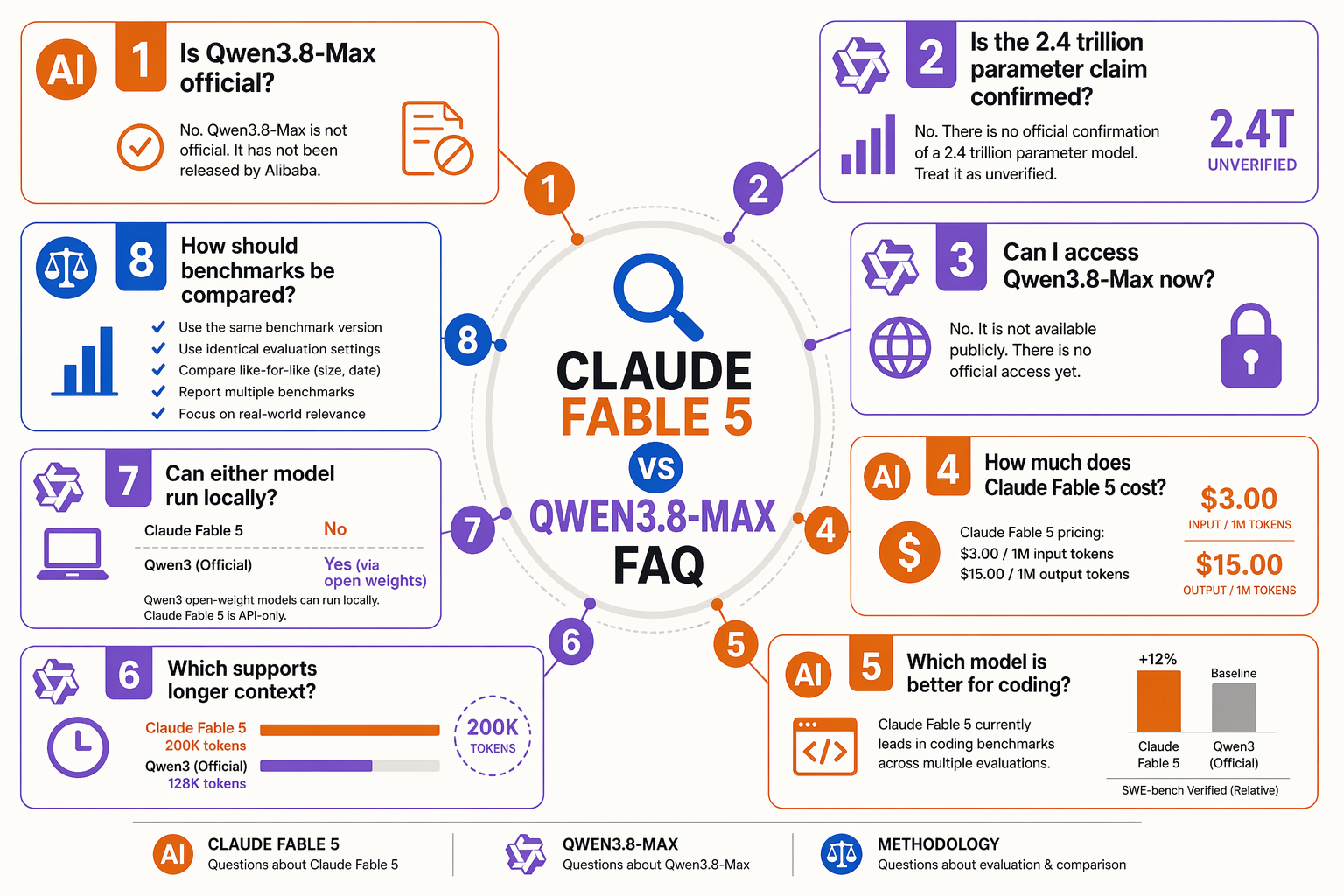
What is the main difference between Claude Fable 5 vs Qwen3.8-Max?
Is Claude Fable 5 or Qwen3.8-Max available through an API?
Does Qwen3.8-Max having 2.4 trillion parameters make it more powerful than Claude Fable 5?
Are there trustworthy Claude Fable 5 vs Qwen3.8-Max benchmarks?
Can Qwen3.8-Max run locally like other open Qwen models?
How should businesses choose between Claude Fable 5 vs Qwen3.8-Max?
Conclusion
The bottom line
Claude Fable 5 is the practical choice in July 2026 when production availability, documented safeguards and established cloud access matter; Qwen3.8-Max remains a promising but insufficiently documented preview. The reported 2.4-trillion-parameter scale makes Qwen3.8-Max worth watching, but it does not yet prove better reasoning, coding, agent reliability or deployment economics.
- Availability outweighs headline scale. Anthropic’s Claude Platform documentation states that Claude Fable 5 became generally available on June 9, 2026, through the Claude API, Amazon Bedrock, Claude Platform on AWS, Google Cloud and Microsoft Foundry. Anthropic then began its global redeployment on July 1, 2026, following the lifting of export controls.
- Qwen3.8-Max still carries material unknowns. The reported 2.4 trillion parameters cannot be interpreted confidently until Alibaba or the Qwen team confirms whether that figure represents total or active parameters, whether the model uses mixture-of-experts routing, and what context window, pricing and production access it will offer.
- Enterprise readiness involves more than benchmark scores. Anthropic describes Claude Fable 5 as a Mythos-class model adapted for general use with cybersecurity and biology safeguards. For Qwen3.8-Max, credible conclusions about governance, multimodality, coding performance and agent workflows should wait for official documentation and reproducible evaluations.
- The strongest strategy may be model flexibility. Organizations should test models against representative prompts, languages, latency targets and compliance requirements rather than locking infrastructure to one vendor or selecting from parameter count alone.
The next decisive signals will be Qwen3.8-Max’s official model card, architecture, context limit, benchmark methodology, API or downloadable-weight availability, commercial terms and measured inference costs. Those disclosures will determine whether the preview becomes a serious production alternative or remains primarily a scale milestone.
To explore how this multi-model shift is shaping customer communication, visit CallMissed, an AI infrastructure platform supporting voice agents, WhatsApp automation and multilingual engagement across 22 Indian languages. As frontier models evolve, will your architecture let you evaluate the next breakthrough without rebuilding your entire application?
Related Reading
- Claude Sonnet 5 vs Qwen3.8-Max: July 2026 Availability, Price and Benchmark Reality
- Best AI Model for Coding 2026: GPT-5.6 vs Claude Opus 4.8, Sonnet 5, Fable 5 and Kimi K3
- Claude Fable 5 vs Grok 4.5: 2026 Comparison
Sources
Related Posts



Ready to automate customer conversations?
Launch AI voice agents and WhatsApp bots with CallMissed — one API, 22+ Indian languages.