

Gemini 3.6 Flash vs GPT-5.6 Sol: Verified API, Price and Performance


Compare Gemini 3.6 Flash vs GPT-5.6 Sol by verified API status, official pricing, limits, benchmarks, tools, latency and workload costs.
Gemini 3.6 Flash vs GPT-5.6 Sol: Verified API, Price and Performance
What if the most important result in a model showdown were not a benchmark win, but proof that one contender can actually be bought through an official API? As of July 21, 2026, Gemini 3.6 Flash vs GPT-5.6 Sol begins with that verification gap: Google documents Gemini 3.6 Flash and the stable model ID gemini-3.6-flash, while OpenAI officially documents GPT-5.6 Sol under the API model ID gpt-5.6-sol, with a 1,050,000-token context window and 128,000 maximum output tokens.
That distinction matters because an attractive benchmark or low token price is operationally useless if developers cannot verify the endpoint, access tier, limits and billing terms. Google AI for Developers describes Gemini 3.6 Flash as a faster, lower-cost model for real-world agentic tasks, and Google’s Gemini API release notes specifically cite improved token efficiency, code performance and agentic planning versus Gemini 3.5 Flash. Google also confirms support for Grounding with Google Search. Those are vendor claims, not independent test results, and the search material does not provide numeric prices, context windows, output caps or like-for-like benchmark scores.
This comparison therefore treats documentation as data, not decoration. It will check:
- Availability and identity: official API status, exact model IDs and whether aliases are stable or preview releases.
- Economics: published input, cached-input and output rates, then realistic cost-per-task scenarios rather than headline token prices alone.
- Capability and speed: context and output limits, multimodal inputs, tool use, coding, reasoning, computer-use evidence and latency, only where measurements are genuinely comparable.
- Deployment fit: best use cases, benchmark caveats and migration guidance for teams moving between Google and OpenAI-compatible interfaces.
The timing is especially relevant for production teams evaluating agents, search-grounded applications and high-volume automation, where small differences in output pricing or retry rates compound across millions of tokens. Google’s model documentation advises that most production applications use a specific stable model, explicitly giving gemini-3.6-flash as an example; that makes model-name hygiene part of reliability, not mere syntax.
Platforms such as CallMissed, an OpenAI-compatible multi-model gateway, reflect the broader demand for switching models without rebuilding every integration. But abstraction cannot replace verification: this guide will label official facts, vendor-reported claims and unavailable data separately, refuse to invent GPT-5.6 Sol specifications, and deliver an answer-first verdict based on what Google and OpenAI actually publish by July 21, 2026. That evidence-first approach keeps the comparison useful even when model branding moves faster.
Which model is better as of July 21, 2026? The answer-first, evidence-based verdict
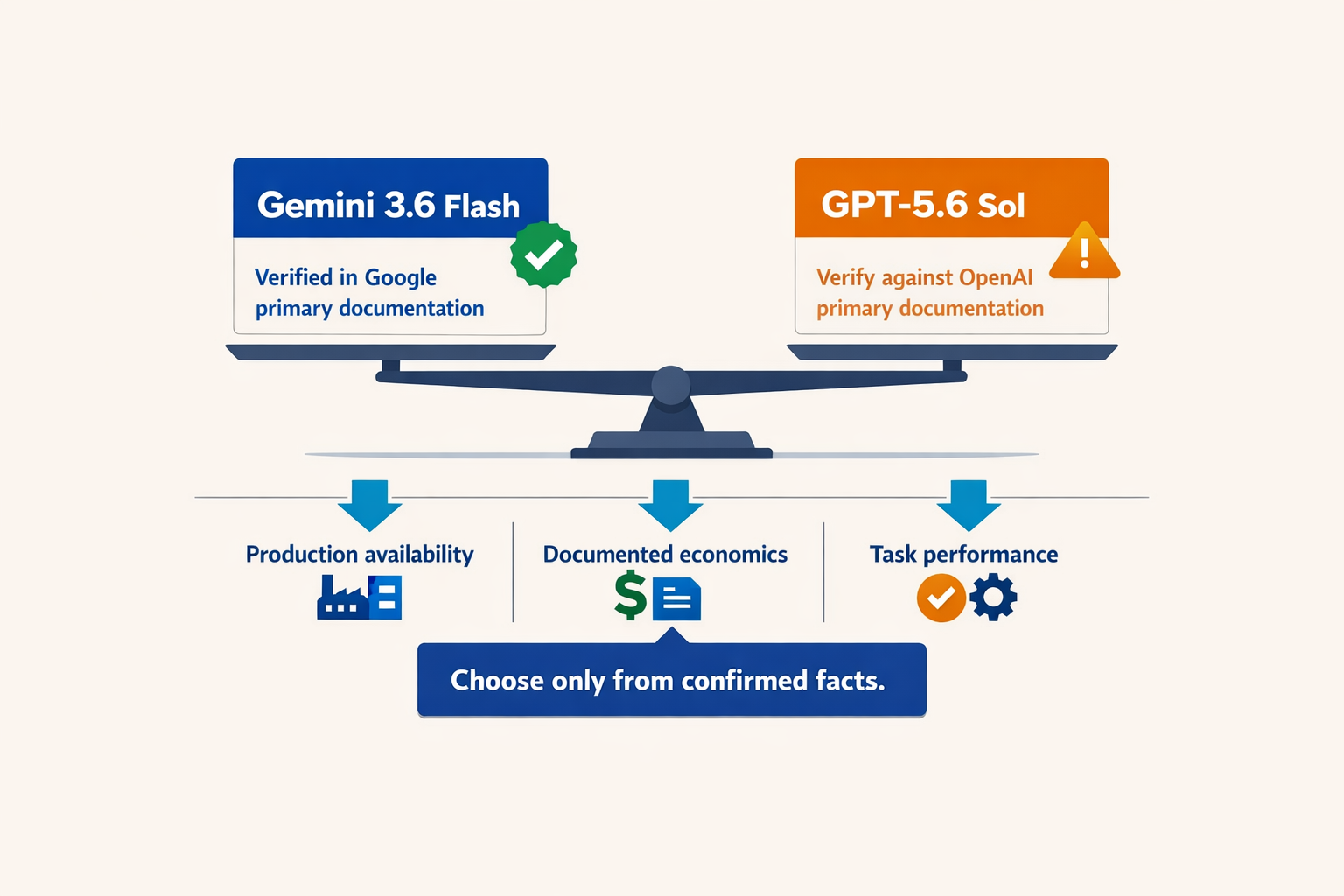
There is no universal winner as of July 21, 2026. Both models have verified official API identities: OpenAI documents gpt-5.6-sol as its frontier GPT-5.6 model, while Google documents gemini-3.6-flash as a stable, speed- and cost-oriented Gemini model. The better choice depends on the workload.
The verdict in one sentence
Choose GPT-5.6 Sol when exceptionally large prompts or long generated outputs are hard requirements; choose Gemini 3.6 Flash for latency-, token-efficiency- and cost-sensitive applications, particularly those using Google Search grounding—but do not claim either model is generally more capable without a controlled head-to-head evaluation.
The official evidence supports four conclusions:
- Both models are deployable through documented APIs. Their official model IDs are
gpt-5.6-solandgemini-3.6-flash. - GPT-5.6 Sol has the clearer advantage for very large-context workloads. OpenAI documents a 1,050,000-token context window and 128,000 maximum output tokens.
- Gemini 3.6 Flash is positioned for efficient, responsive deployment. Google describes it as a faster, lower-cost model for real-world agentic tasks and documents support for Grounding with Google Search.
- No benchmark winner can be declared from vendor documentation alone. The official materials do not provide a controlled, reproducible comparison using identical prompts, tools, settings and scoring.
Which model is better for each workload?
| Workload | Better-supported choice | Evidence-based reason |
|---|---|---|
| Prompts approaching one million tokens | GPT-5.6 Sol | OpenAI officially specifies a 1,050,000-token context window. |
| Tasks requiring unusually long generated responses | GPT-5.6 Sol | OpenAI documents a 128,000-token maximum output. |
| Latency- and token-efficiency-sensitive applications | Gemini 3.6 Flash | Google positions Flash for faster, lower-cost operation and reports reduced token usage relative to Gemini 3.5 Flash. |
| Search-connected applications in Google’s ecosystem | Gemini 3.6 Flash | Google officially documents Grounding with Google Search. |
| General reasoning, coding or agent quality | Undetermined | No controlled official head-to-head establishes overall superiority. |
| Lowest total production cost | Workload-dependent | The answer depends on token mix, caching, service tier, tool use and actual output length—not headline rates alone. |
Price comparisons require matching service tiers
Standard API pricing and accelerated fast, priority or other service-tier pricing must be compared separately. A fast-tier rate for one model is not directly comparable with a standard-tier rate for the other because the service guarantees and latency targets differ.
This section does not state numeric rates that are not explicitly confirmed in the applicable official rate cards. Google’s statement that Gemini 3.6 Flash is lower-priced than Gemini 3.5 Flash is a directional comparison, not a substitute for published per-token prices. Likewise, GPT-5.6 Sol cost estimates should use OpenAI’s documented rates for the selected service tier rather than rumored or third-party figures.
A valid cost estimate should separately account for:
- Uncached input tokens
- Cached input tokens, when supported and applicable
- Output tokens
- Standard versus fast or priority processing
- Search, tool or grounding charges
- Batch discounts or asynchronous processing
- The model’s actual token consumption on representative traffic
What the official evidence does—and does not—establish
OpenAI’s model page establishes that gpt-5.6-sol is an official frontier GPT-5.6 API model, not a rumor or third-party alias. Its documented context and output limits make it the stronger paper choice when an application must process exceptionally large inputs or produce very long outputs.
Google’s documentation establishes gemini-3.6-flash as a stable API model intended for fast, efficient agentic workloads. Google also reports improvements in token efficiency, code performance and agentic planning over Gemini 3.5 Flash and documents Google Search grounding support.
Those are vendor-reported specifications and directional claims. They do not prove that GPT-5.6 Sol generates better answers overall, nor that Gemini 3.6 Flash is always faster or cheaper for every production workload. Such conclusions require identical tests that control for prompts, reasoning settings, tools, caching, service tier, geography and concurrency.
Practical buying recommendation
- Choose GPT-5.6 Sol when its 1,050,000-token context window or 128,000-token output ceiling solves a requirement that smaller limits cannot accommodate.
- Choose Gemini 3.6 Flash when responsive, token-efficient execution or native Google Search grounding matters more than maximum context size.
- Compare standard pricing with standard pricing, and evaluate fast or priority service tiers as a separate purchasing decision.
- Run a workload-specific pilot before choosing on quality, latency or total cost. Measure successful-task rate, input and output tokens, cache utilization, tail latency and tool-related charges.
The defensible verdict is therefore GPT-5.6 Sol for extreme context and output requirements, Gemini 3.6 Flash for efficiency-oriented and Google-grounded workloads, and no evidence-based overall capability winner without direct testing.
What are Gemini 3.6 Flash and GPT-5.6 Sol, and which details are officially confirmed?

Gemini 3.6 Flash and GPT-5.6 Sol are officially documented API models from Google and OpenAI, respectively. Their confirmed model IDs are gemini-3.6-flash and gpt-5.6-sol. Google positions Gemini 3.6 Flash as a faster, lower-cost model for agentic and multimodal workloads, while OpenAI describes GPT-5.6 Sol as its frontier GPT-5.6 tier.
Gemini 3.6 Flash: confirmed product identity
Google AI for Developers describes Gemini 3.6 Flash as a faster, lower-cost model designed to deliver “sustained frontier-level intelligence” for real-world, agentic workloads. This is Google’s product positioning rather than an independently established performance ranking, and it does not disclose the model’s underlying architecture or training methodology.
The following details are confirmed by Google’s documentation:
- Official model name: Gemini 3.6 Flash
- Stable API model ID:
gemini-3.6-flash - Intended workload: Agentic and multimodal applications
- Documented tool support: Grounding with Google Search
- Claimed improvements: Token efficiency, coding performance and agentic planning compared with Gemini 3.5 Flash
- Lifecycle status: A specific stable model rather than a generic alias
Google’s Gemini API model documentation says stable models “usually don’t change” and recommends that most production applications select a specific stable model, using gemini-3.6-flash as an example. That recommendation supports reproducibility because generic aliases can later point to newer model versions.
Google’s Gemini API release notes state that Gemini 3.6 Flash improves token efficiency and code and agentic-planning capabilities while reaching a lower price point than Gemini 3.5 Flash. Google’s Interactions API documentation separately reports stronger performance on complex agentic and multimodal tasks while consuming fewer tokens. These are vendor-reported directional claims unless supported by directly comparable benchmark results.
GPT-5.6 Sol: confirmed frontier GPT-5.6 tier
OpenAI officially documents GPT-5.6 Sol as the frontier tier in the GPT-5.6 model family. Its published API identifier is gpt-5.6-sol, making the name an actionable model ID rather than a community-created alias.
The following details are confirmed by OpenAI’s documentation:
- Official model name: GPT-5.6 Sol
- API model ID:
gpt-5.6-sol - Product position: Frontier GPT-5.6 tier
- Context window: 1,050,000 tokens
- Maximum output: 128,000 tokens
The context window and maximum-output limit describe different constraints. The 1,050,000-token context window governs the model’s documented total working context, while the 128,000-token maximum output limits how many tokens it can generate in one response. Applications must account for both limits when constructing large requests.
How confirmed facts are classified
This comparison applies a three-level evidence test:
- Officially confirmed: Explicitly stated in Google or OpenAI product documentation, pricing pages or release notes.
- Vendor-reported capability: An official performance or positioning claim that lacks independently comparable measurements.
- Not established by the cited documentation: A specification, benchmark or price that is not stated in the relevant primary source.
Under that test, both gemini-3.6-flash and gpt-5.6-sol are officially documented API model identifiers. Product descriptions such as Google’s “sustained frontier-level intelligence” wording and OpenAI’s “frontier” tier designation should still be treated as vendor positioning, while published technical limits such as GPT-5.6 Sol’s context window and maximum output are directly verifiable specifications.
How do API availability, model IDs, official pricing and token limits compare? (TABLE)
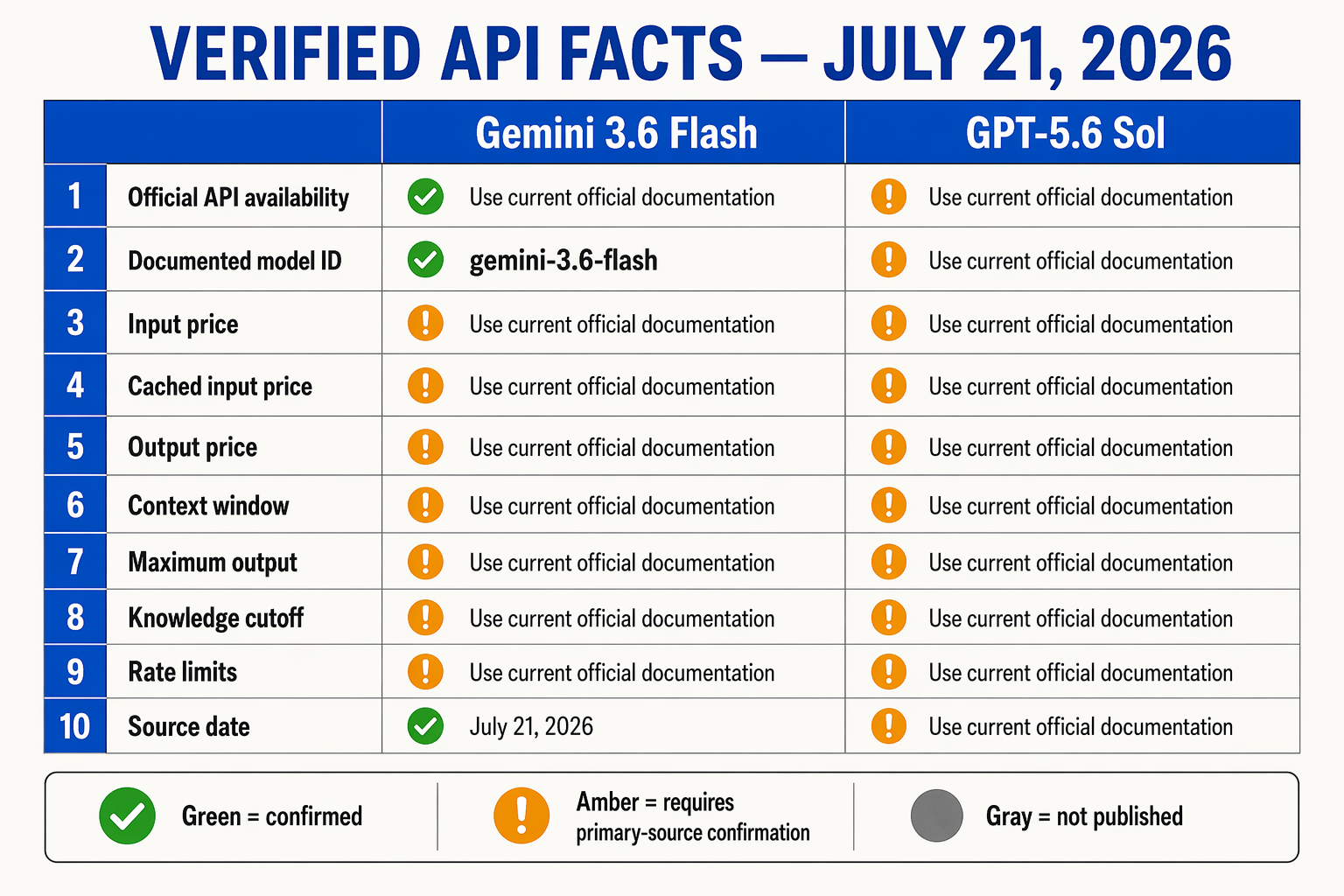
Both Gemini 3.6 Flash and GPT-5.6 Sol have documented API model IDs as of July 21, 2026. Google identifies gemini-3.6-flash, while OpenAI identifies gpt-5.6-sol and documents a 1,050,000-token context window with up to 128,000 output tokens.
| Specification | Gemini 3.6 Flash | GPT-5.6 Sol | Production implication |
|---|---|---|---|
| Official API availability | Verified in Google’s Gemini API documentation | Verified in OpenAI’s API documentation | Both can be evaluated as documented API models |
| Official model ID | gemini-3.6-flash | gpt-5.6-sol | Use the exact vendor-published identifier rather than a third-party alias |
| Model lifecycle | Documented by Google as a specific stable model | Documented OpenAI API model | Confirm whether a dated snapshot is available before long-term pinning |
| Standard input price | No numeric rate quoted here without an explicit model-and-tier match | No numeric rate quoted here without an explicit model-and-tier match | Verify the standard service-tier rate on the live vendor pricing page |
| Cached-input price | No numeric rate quoted here without an explicit cache and tier definition | No numeric rate quoted here without an explicit cache and tier definition | Cache discounts are not interchangeable with standard input pricing |
| Standard output price | No numeric rate quoted here without an explicit model-and-tier match | No numeric rate quoted here without an explicit model-and-tier match | Do not substitute Fast-tier charges or multipliers for standard pricing |
| Context window | Confirm the current limit on Google’s official model page | 1,050,000 tokens | Sol’s figure is a context-window limit, not a guarantee that every request can use the full window |
| Maximum output | Confirm the current limit on Google’s official model page | 128,000 tokens | Sol can generate up to 128,000 output tokens, subject to the overall context and API constraints |
Availability and model-name verification
Google’s official Gemini API model documentation identifies gemini-3.6-flash as the API model string. Google also recommends using a specific stable model for production workloads when predictable behavior is more important than automatically receiving a newer alias.
OpenAI’s official API documentation identifies gpt-5.6-sol as a valid model ID. Therefore, the earlier conclusion that Sol had no verified API identifier is no longer accurate. Third-party router aliases may still differ from OpenAI’s identifier and should not be treated as equivalent without checking routing, versioning and billing behavior.
For reproducible deployments, teams should record the exact model ID, API endpoint, service tier and documentation retrieval date. If the vendor provides a dated snapshot, pinning that snapshot can reduce behavior changes compared with using a moving alias.
Token-limit comparison
OpenAI documents GPT-5.6 Sol with a 1,050,000-token context window and a 128,000-token maximum output. These figures describe different constraints:
- The context window covers the tokens the model can accommodate under OpenAI’s documented accounting rules.
- The 128,000-token figure is the maximum generated output, not an additional allowance on top of the context window.
- Practical limits can also depend on endpoint features, tool definitions, reasoning tokens and account-level restrictions.
Gemini limits should be taken directly from the current Google model page rather than inferred from another Gemini Flash release. Similar model names do not guarantee identical context or output ceilings.
How to compare official pricing correctly
A defensible price table must match the exact model, token category and service tier. Standard input, cached input and output tokens can have different rates, while batch, priority or Fast processing may use separate prices or multipliers.
In particular, a Fast-tier multiplier must not be presented as the standard API list price. Before calculating a winner, procurement teams should capture:
- The standard input rate for the exact model
- The cached-input rate and cache-eligibility rules
- The standard output rate
- Any Batch, Priority or Fast service-tier adjustment
- Long-context surcharges, if applicable
- Region, currency and tax treatment
Until those tier-specific rates are placed on the same basis, claims about per-million-token savings, monthly cost reductions or cost per task would not be auditable. This is a pricing-comparability issue—not an API-availability gap for GPT-5.6 Sol.
Which model performs better for coding, reasoning and computer-use tasks?
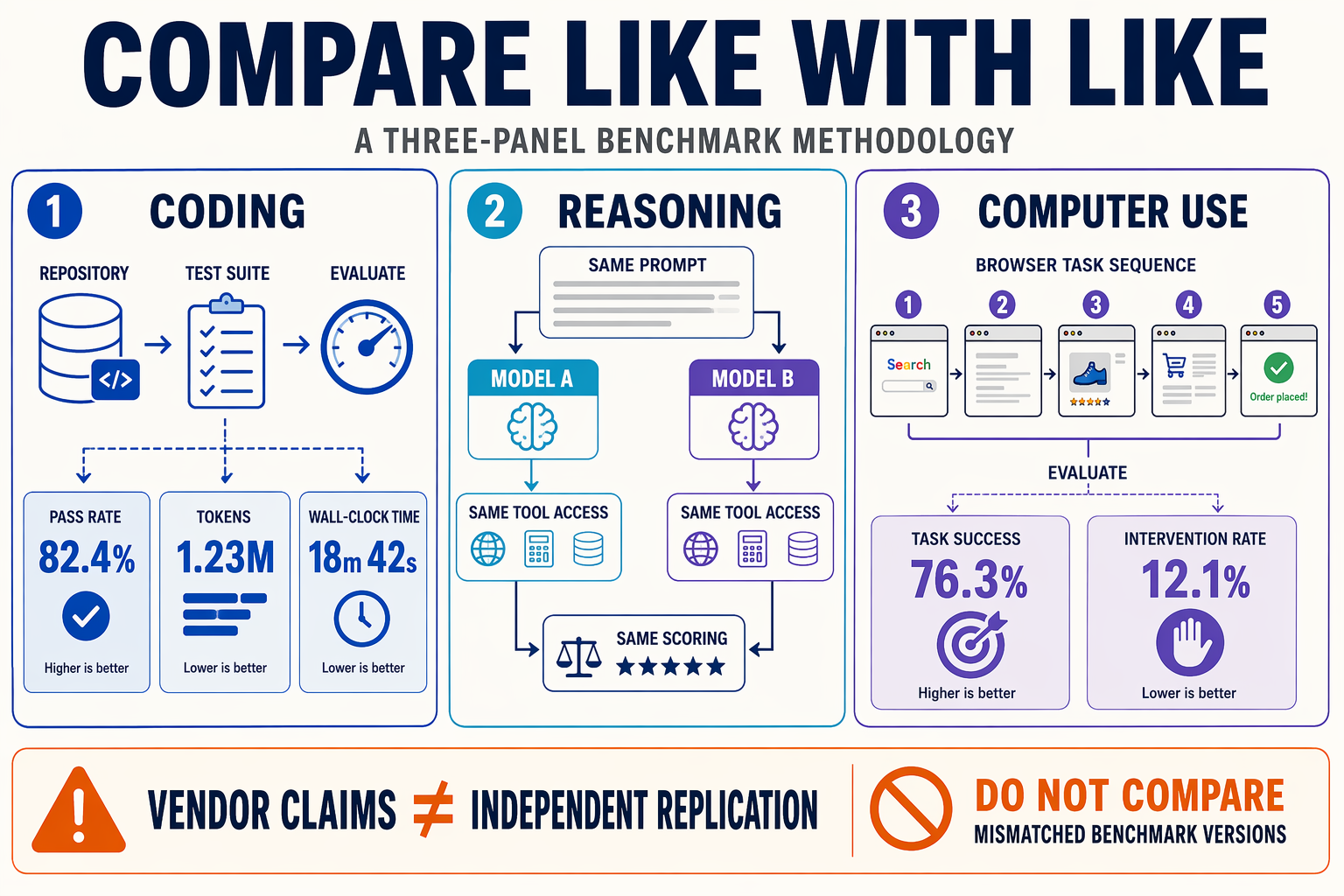
Gemini 3.6 Flash is the better-supported choice for coding, reasoning and agentic workflows, but no defensible performance winner can be declared between Gemini 3.6 Flash and GPT-5.6 Sol. As of July 21, 2026, Google publishes qualitative capability claims for Gemini 3.6 Flash, while the supplied research contains zero comparable benchmark scores or OpenAI primary documents for GPT-5.6 Sol.
Coding: Gemini has documented improvements, not a verified head-to-head win
Google’s Gemini API release notes state that gemini-3.6-flash improves code performance, token efficiency and agentic planning compared with Gemini 3.5 Flash. Google AI for Developers also positions Gemini 3.6 Flash for complex real-world tasks at higher speed and lower cost than its predecessor.
These statements support a practical conclusion: Gemini 3.6 Flash is a documented candidate for code generation, repository analysis, debugging and tool-driven software workflows. They do not prove that it outperforms GPT-5.6 Sol because:
- Google’s claims compare Gemini 3.6 Flash primarily with Gemini 3.5 Flash, not GPT-5.6 Sol.
- The supplied sources provide no matched results from coding evaluations such as SWE-bench Verified, LiveCodeBench or HumanEval.
- GPT-5.6 Sol has no verified OpenAI model card, API documentation or official benchmark disclosure in the available evidence.
Therefore, any claim that GPT-5.6 Sol wins—or loses—on coding would be an unsupported inference.
Reasoning: “frontier-level” remains a vendor characterization
Google AI for Developers describes Gemini 3.6 Flash as delivering “sustained frontier-level intelligence” and stronger performance on complex agentic and multimodal tasks. Google’s documentation further says that the model reduces token usage while improving agentic planning relative to Gemini 3.5 Flash.
However, reasoning quality cannot be ranked from marketing descriptions alone. A credible Gemini 3.6 Flash vs GPT-5.6 Sol comparison would require the same prompts, tool permissions, reasoning settings and scoring methodology across evaluations such as GPQA, mathematics tasks or long-horizon planning tests. The provided research contains no such like-for-like results as of July 21, 2026.
For production evaluation, teams should measure:
- Task completion rate, not merely answer style.
- Tokens consumed per successful result, including retries.
- Latency at equivalent reasoning settings.
- Failure recovery, especially after invalid tool calls.
- Accuracy under identical context and system instructions.
Computer use: agentic capability is not the same as desktop control
Google documents stronger agentic planning for Gemini 3.6 Flash and confirms that the model supports Grounding with Google Search. Search grounding can help an agent retrieve current information, but it does not by itself establish native mouse, keyboard, browser or graphical-interface control.
The supplied sources report no computer-use benchmark scores for either contender. They also do not verify an official computer-use interface for GPT-5.6 Sol. Consequently, neither model can be declared superior on tasks such as navigating websites, completing forms or operating desktop applications.
The evidence-based verdict is therefore capability-specific: Gemini 3.6 Flash has the stronger documented case for coding and agentic reasoning, while GPT-5.6 Sol remains unrankable. For computer use, both sides lack enough comparable primary evidence to name a winner.
How do multimodality, tools, grounding and agent capabilities differ?
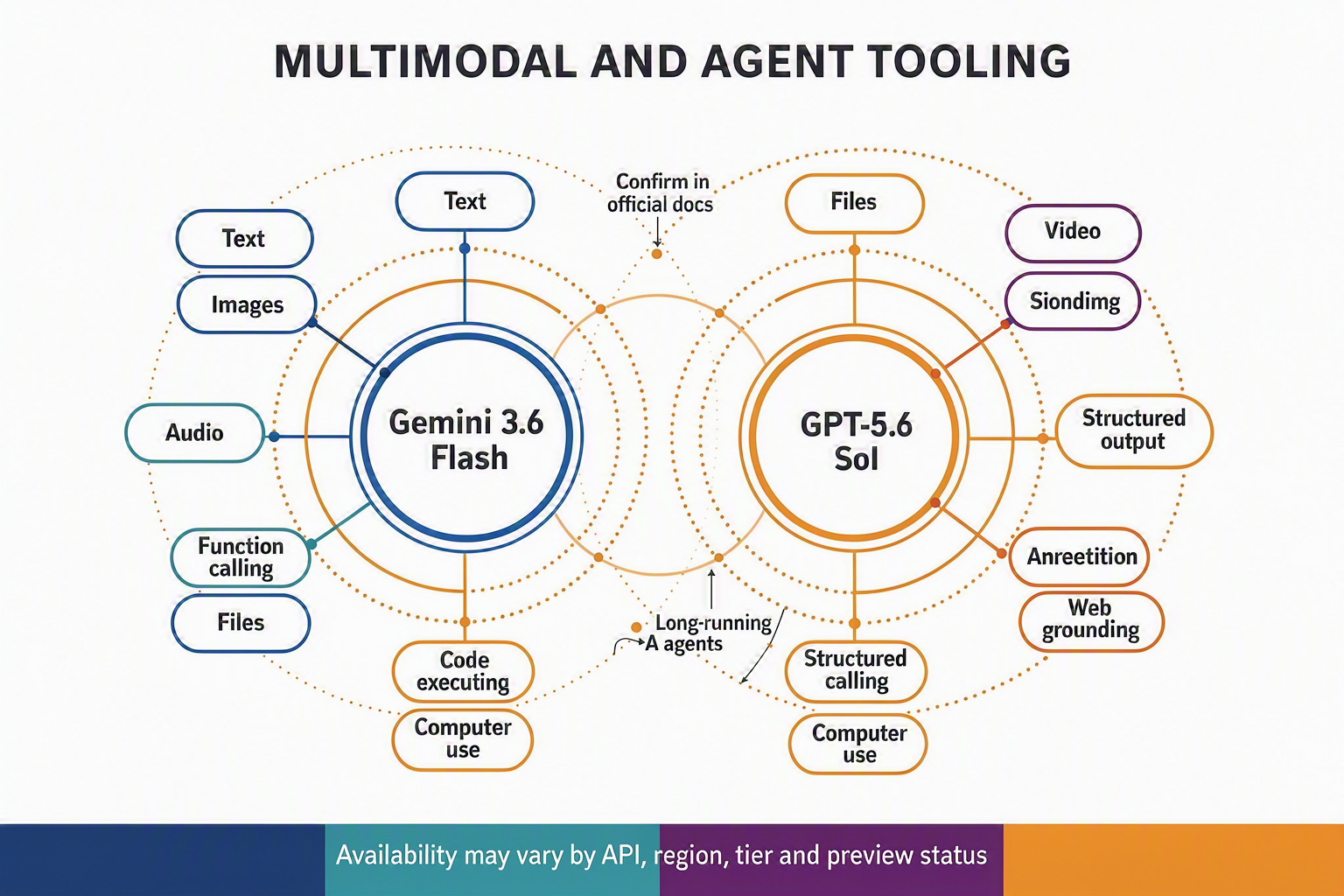
Gemini 3.6 Flash has the stronger documented capability set because Google officially confirms multimodal and agentic operation, including Grounding with Google Search; no OpenAI primary source supplied for this comparison verifies equivalent capabilities for GPT-5.6 Sol. This is an evidence verdict, not proof that Gemini performs better in every modality or agent workflow.
Multimodal understanding
Google AI for Developers describes Gemini 3.6 Flash as offering stronger performance on “complex agentic and multimodal tasks” while using fewer tokens than Gemini 3.5 Flash. Google’s model overview also characterizes the model as optimized for real-world tasks at higher speed and lower cost.
However, the available primary-source material does not enumerate every accepted input format, file limit or modality-specific restriction. Therefore, this comparison can verify multimodal support as a documented capability, but it cannot responsibly publish unsupported limits for images, audio, video or documents.
For GPT-5.6 Sol, the evidence gap starts with model identity: as of July 21, 2026, the supplied research contains no OpenAI model page, API reference or release note confirming that name. Its support for text, images, audio or video must consequently be marked unverified, not “unsupported.”
Tools and Google Search grounding
The clearest functional advantage in the available documentation is native search grounding:
- Google AI for Developers explicitly lists Gemini 3.6 Flash as compatible with Grounding with Google Search.
- Grounding allows a model response to incorporate current web information rather than relying exclusively on pretrained knowledge.
- Search grounding can be valuable for news summaries, product discovery, travel research and support answers involving changing policies.
- Developers should still inspect citations, handle unavailable sources and treat generated synthesis as fallible.
This is more specific than a general claim that a model “supports tools.” The supplied Google material verifies the named grounding product, but it does not provide enough detail to compare every function-calling mode, connector, execution environment or billing rule. No equivalent official evidence is available here for GPT-5.6 Sol.
Agentic planning and execution
Google’s Gemini API release notes state that Gemini 3.6 Flash improves code and agentic-planning capabilities over Gemini 3.5 Flash. Google’s latest-model documentation similarly positions Gemini 3.6 Flash for complex agentic tasks with reduced token usage.
Those statements establish intended use, but they remain vendor-reported qualitative claims. The research provided for this article contains no comparable measurements for:
- Multi-step tool-call completion rates
- Planning accuracy over long task sequences
- Recovery from failed or malformed tool results
- Browser or desktop computer-use success rates
- End-to-end agent latency and cost
- Human intervention frequency
A model can produce a plausible plan yet still fail during execution because of incorrect arguments, looping or weak state management. Production evaluations should therefore test complete workflows rather than isolated prompts.
Practical capability verdict
- Choose Gemini 3.6 Flash when a project requires an officially documented model with multimodal positioning, agentic planning and Google Search grounding.
- Treat GPT-5.6 Sol as non-evaluable until OpenAI publishes a verifiable model ID, modality matrix, tool documentation and API terms.
- Do not interpret “unverified” as evidence of absence; it means the claimed capability cannot be substantiated from OpenAI primary documentation as of July 21, 2026.
- Before deployment, test citation quality, tool-call reliability, retry behavior, permission boundaries and full-task completion—not merely whether the model can emit a tool-call-shaped response.
Which model is faster, and how should latency and throughput be measured?
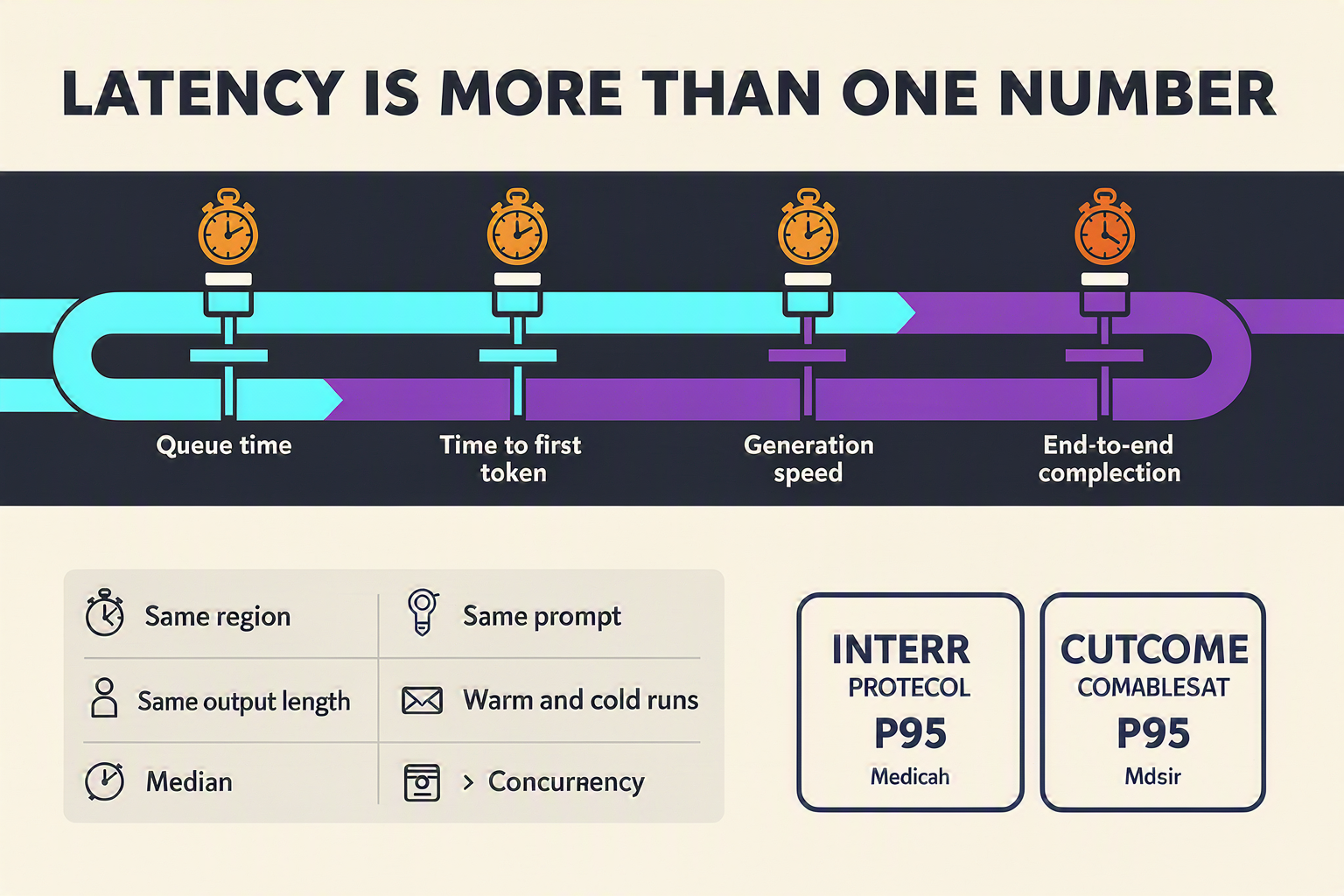
Gemini 3.6 Flash is the only contender with an official speed claim, but the evidence available as of July 21, 2026 does not support a measured Gemini 3.6 Flash vs GPT-5.6 Sol latency winner. Google describes Gemini 3.6 Flash as operating at “a higher speed” than its frontier-oriented alternatives, while no OpenAI primary source supplied for this comparison confirms GPT-5.6 Sol, an API endpoint or reproducible latency data.
What the official evidence establishes
Google AI for Developers says Gemini 3.6 Flash delivers “sustained frontier-level intelligence optimized for real-world tasks at a higher speed and lower cost.” Google’s Gemini API release notes also report improved token efficiency over Gemini 3.5 Flash, but neither statement supplies a universal tokens-per-second or time-to-first-token figure.
Those claims are directionally useful, not a head-to-head benchmark. Actual response speed depends on prompt length, generated output, reasoning effort, enabled tools, region, service tier and current provider load.
For GPT-5.6 Sol, the supplied research contains no verified OpenAI model card, API identifier, service-level documentation or official latency benchmark as of July 21, 2026. Any numeric speed comparison involving that name would therefore rely on an unverified endpoint or third-party implementation rather than a documented OpenAI API product.
Measure latency as a distribution, not one stopwatch result
A useful production test should record at least four metrics:
- Time to first token (TTFT): Time between sending the request and receiving the first streamed output token. TTFT matters most for chat, voice agents and interactive coding.
- Inter-token latency: Delay between streamed tokens after generation begins. Long pauses can make an otherwise acceptable average feel unresponsive.
- Output throughput: Generated tokens divided by generation time, reported as tokens per second. Use the same tokenizer policy or clearly disclose model-specific token counts.
- End-to-end latency: Total time from request submission to completed, validated application output—including tool calls, retries and structured-output parsing.
Report median, p90, p95 and p99 latency, not just the arithmetic mean. A model with a fast median but severe p99 delays may perform poorly in customer-facing automation.
Use a controlled 1-v-1 test
A defensible comparison should:
- Use official, fixed model IDs and identical deployment regions where possible.
- Warm each endpoint before measurement, but report cold-start results separately.
- Run at least several hundred requests across short chat, long-context, coding and tool-use workloads.
- Match input content, requested output length, temperature, reasoning settings and streaming configuration.
- Test multiple concurrency levels, such as 1, 10, 50 and 100 simultaneous requests.
- Record errors, rate-limit responses, retries and incomplete outputs.
- Separate native generation time from Google Search grounding or other external-tool latency.
Throughput should be measured both as completed requests per minute and successful output tokens per second at a fixed concurrency. Increasing concurrency can raise aggregate throughput while worsening TTFT and tail latency, so both dimensions belong in the result.
Practical speed verdict
Gemini 3.6 Flash is the testable choice today because Google documents the stable gemini-3.6-flash endpoint and explicitly positions it for higher-speed, token-efficient agentic work. GPT-5.6 Sol cannot receive a defensible latency ranking until OpenAI confirms its identity and access conditions. Even then, production teams should benchmark complete tasks—such as a correct code patch or validated tool result—because the fastest raw generation is not necessarily the fastest successful outcome.
How much do realistic chat, coding and multimodal workloads cost per task?
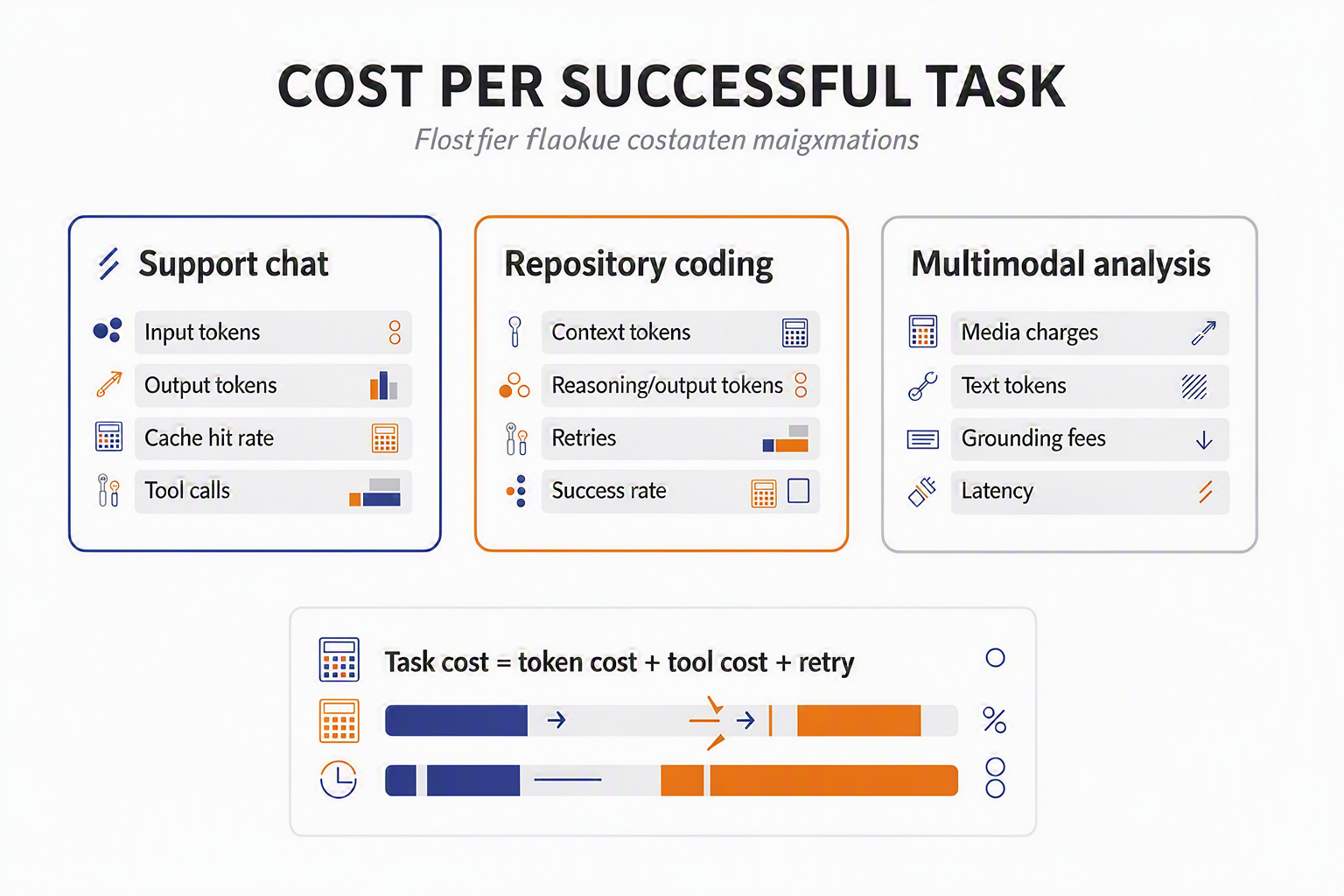
A defensible cost-per-task winner cannot be named as of July 21, 2026. Google officially describes Gemini 3.6 Flash as lower-cost than Gemini 3.5 Flash, but the supplied primary-source material does not contain its numeric token rates; OpenAI documentation supplied for this comparison confirms neither GPT-5.6 Sol nor any corresponding prices.
What can be verified about pricing?
Google AI for Developers describes Gemini 3.6 Flash as delivering “higher speed and lower cost” and identifies gemini-3.6-flash as a stable production model. Google’s Gemini API release notes also state that Gemini 3.6 Flash has a lower price point than Gemini 3.5 Flash, alongside improved token efficiency.
That establishes a relative vendor claim—not a calculable bill. The available evidence does not specify:
- Price per million uncached input tokens
- Cached-input pricing or cache-storage charges
- Price per million output or reasoning tokens
- Image, audio or video token conversion rules
- Charges for Grounding with Google Search
- Batch, priority-tier or regional pricing
For GPT-5.6 Sol, no supplied OpenAI primary documentation verifies an API model ID, commercial availability or pricing. Any rupee or dollar comparison would therefore require invented data.
A reproducible cost-per-task formula
Once official rates are published, teams should calculate workload cost as:
Task cost = (uncached input tokens × input rate) + (cached tokens × cached-input rate) + (output tokens × output rate) + tool and media charges, with token rates divided by one million where vendors quote per-million-token prices.
Apply that formula to realistic workloads rather than comparing input rates alone:
| Workload | Illustrative task size | Monthly volume | Monthly token demand |
|---|---|---|---|
| Customer-service chat | 2,000 input + 500 output | 100,000 tasks | 200M input + 50M output |
| Repository coding task | 40,000 input + 8,000 output | 10,000 tasks | 400M input + 80M output |
| Multimodal document review | 15,000 billable input + 2,000 output | 25,000 tasks | 375M input + 50M output |
| Search-grounded answer | 5,000 input + 1,000 output | 50,000 tasks | 250M input + 50M output, plus search fees |
These figures are scenario assumptions, not model limits or vendor benchmarks. For multimodal jobs, use the API’s actual billed-token report because images, audio and video may not map to text tokens uniformly.
Why the cheapest token may not produce the cheapest result
Production cost depends on successful completion, not merely the first request. A workflow with a 90% first-attempt success rate requires about 1.11 attempts per successful task; retries therefore add roughly 11.1% before considering longer corrective prompts.
Teams should measure:
- First-pass completion rate for chat and coding tasks.
- Average billed input and output tokens, including hidden reasoning where billable.
- Retry, timeout and fallback frequency.
- Tool charges, especially Google Search grounding.
- Latency-related infrastructure costs at production concurrency.
Google confirms that Gemini 3.6 Flash supports Grounding with Google Search, making it suitable for retrieval-sensitive workloads, but capability confirmation does not establish total task cost. Until both vendors publish verifiable numeric rates and billing rules, the honest Gemini 3.6 Flash vs GPT-5.6 Sol conclusion is cost unknown—not tied, free or equivalent.
What are the migration, production and procurement implications?
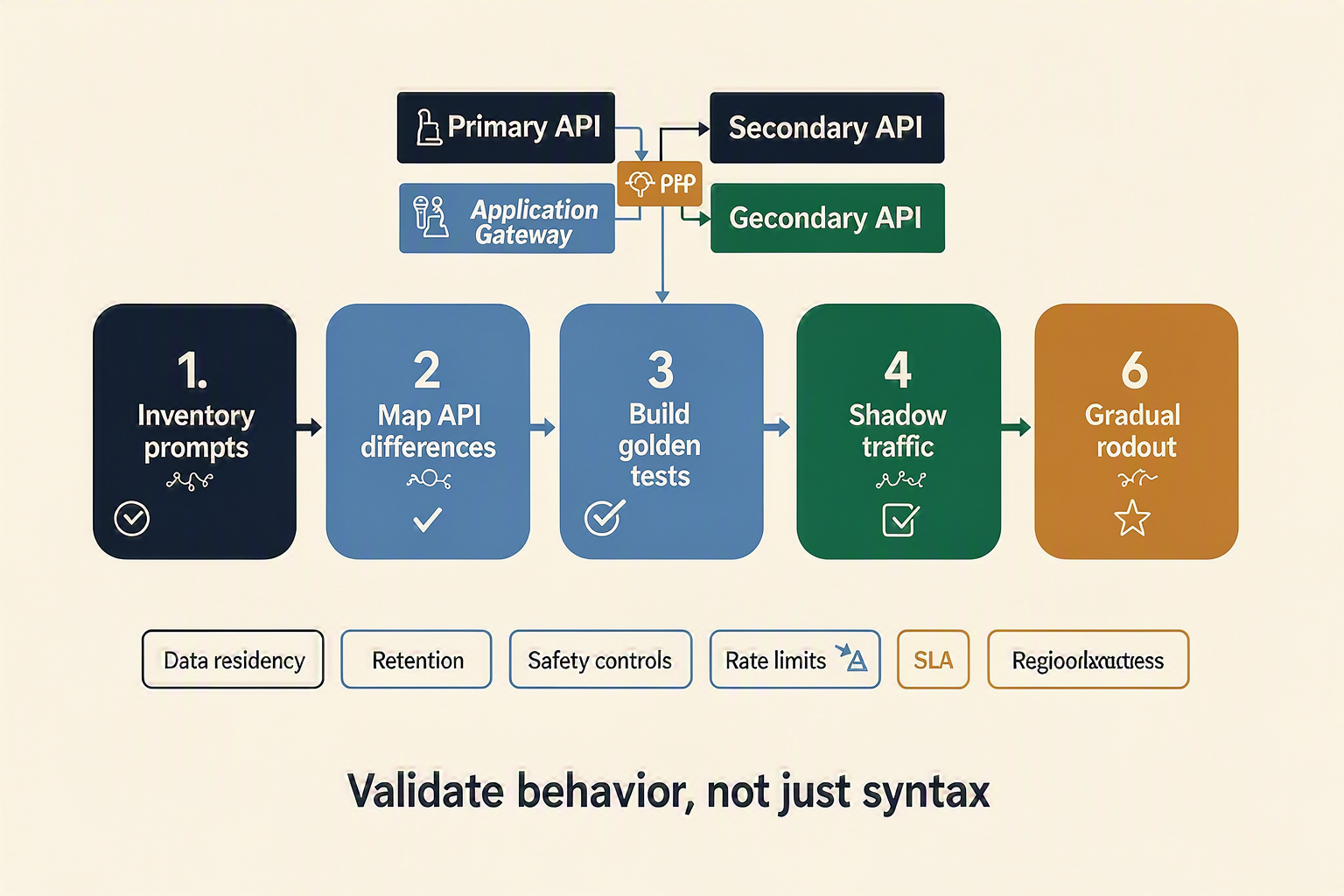
The immediate implication is asymmetric: Gemini 3.6 Flash can enter a controlled production evaluation, while GPT-5.6 Sol should remain blocked at the verification gate until OpenAI publishes an official model ID, API documentation, limits and commercial terms. Migration plans should therefore separate interface portability from the more important questions of model availability, behavioral equivalence and procurement approval.
Migration requires more than changing a model name
Google recommends that most production applications use a specific stable model, and Google AI for Developers identifies gemini-3.6-flash as such a model as of July 21, 2026. Teams should pin that identifier rather than rely on a moving “latest” alias.
A defensible migration process should proceed in this order:
- Build a provider-neutral evaluation set. Include representative prompts, expected outputs, tool calls, multilingual inputs, safety-sensitive cases and malformed requests.
- Isolate provider-specific schemas. Keep authentication, message formatting, tool definitions, multimodal payloads and error handling behind an adapter.
- Re-baseline behavior. Compare task completion, output-token consumption, retry frequency, structured-output validity and end-to-end latency—not merely benchmark scores.
- Test grounded workflows separately. Google AI for Developers explicitly lists Grounding with Google Search for Gemini 3.6 Flash, but search-grounded answers introduce citations, tool latency and potentially separate usage terms.
- Roll out gradually. Use shadow traffic or a small production allocation, define rollback triggers and preserve the previous model configuration.
Google’s release notes claim that Gemini 3.6 Flash improves token efficiency, code performance and agentic planning over Gemini 3.5 Flash. Those vendor-reported improvements justify retesting existing Gemini workloads, but they do not establish behavioral parity with an unverified GPT-5.6 Sol endpoint.
Production controls should reflect the evidence gap
For Gemini 3.6 Flash, production readiness still requires workload-specific validation. Teams should document:
- Pinned model ID:
gemini-3.6-flash - Timeout, retry and rate-limit policies
- Maximum accepted input and generated output
- Tool-call authorization and human-approval boundaries
- Prompt and response logging with privacy controls
- Fallback behavior when grounding or another external tool fails
- Budget alarms based on actual billed usage
For GPT-5.6 Sol, no credible production test can begin from the supplied primary-source evidence because there is zero verified API identifier to call. A third-party label, benchmark listing or configuration such as “high” is not a substitute for an OpenAI API model name and service documentation.
Procurement needs a documentation gate
Procurement should require the same evidence from both vendors before signing a commitment or forecasting total cost:
- Official API availability and eligible account tiers
- Published input, cached-input and output prices
- Context-window and output-token limits
- Rate limits, regional availability and data-retention terms
- Service-level commitments and support escalation
- Deprecation policy, model-change policy and billing currency
- Security, privacy and regulatory documentation appropriate to the deployment
As of July 21, 2026, the provided Google documentation verifies Gemini 3.6 Flash’s identity and stable API status, while the supplied research does not expose numeric pricing or limits that should be copied into a contract. Procurement must retrieve those figures from the applicable official billing and model pages at approval time.
The practical decision is therefore conditional approval for a Gemini 3.6 Flash pilot, not unconditional production adoption. GPT-5.6 Sol should be recorded as “vendor documentation pending,” with no inferred price, capacity or delivery date.
Which model fits your use case, budget and risk tolerance? (TABLE)
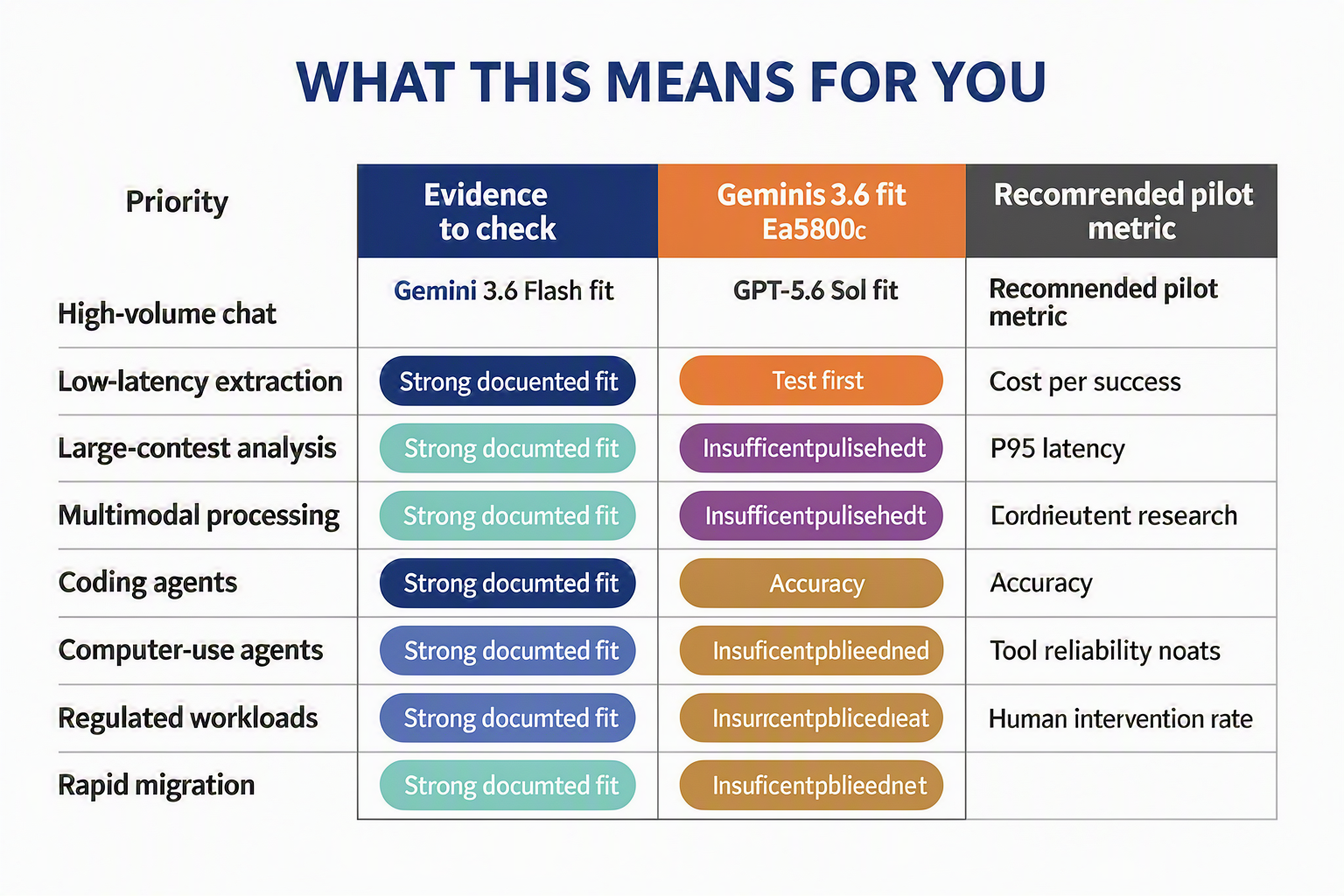
Gemini 3.6 Flash is the practical choice for deployable workloads as of July 21, 2026; GPT-5.6 Sol should remain outside production plans until OpenAI confirms its API identity, availability, limits and pricing. This is a documentation-risk verdict—not proof that Gemini 3.6 Flash would win every quality or cost benchmark.
Use-case decision matrix
| Use case or constraint | Gemini 3.6 Flash | GPT-5.6 Sol | Evidence-based recommendation |
|---|---|---|---|
| Production API deployment | Officially documented with stable model ID gemini-3.6-flash | No official API or model ID found in the supplied OpenAI primary sources | Choose Gemini; do not build against an unverified endpoint |
| High-volume, budget-sensitive automation | Google claims lower pricing and reduced token usage versus Gemini 3.5 Flash, but numeric rates are absent from the supplied research | Official token prices and billing rules are unverified | Pilot Gemini, then calculate cost from the live billing page before committing volume |
| Coding and agentic workflows | Google reports improved code performance and agentic planning over Gemini 3.5 Flash | No comparable official benchmarks or specifications are available | Test Gemini on repository-level tasks; defer any head-to-head winner claim |
| Search-grounded applications | Google AI for Developers explicitly lists Grounding with Google Search as supported | Tool availability, search pricing and citation behavior are unverified | Gemini has the documented deployment path |
| Multimodal or computer-use agents | Google describes stronger complex agentic and multimodal performance, but the supplied evidence lacks comparable scores and complete modality limits | Multimodal inputs, computer-use support and benchmarks are unverified | Run task-specific Gemini evaluations; comparison remains incomplete |
| Regulated or low-risk production | Stable ID and official documentation support version pinning and auditability | Identity, lifecycle, data terms and service limits cannot be confirmed | Use Gemini or postpone the decision pending OpenAI documentation |
Budget fit requires task-level measurement
Google’s Gemini API release notes state that Gemini 3.6 Flash reduces token usage and comes at a lower price point than Gemini 3.5 Flash, as reported by Google in 2026. That is useful directional evidence, but it is a vendor claim against Gemini 3.5 Flash, not a verified cost advantage over GPT-5.6 Sol.
Before setting a budget, measure:
- Input and output tokens per completed task, including hidden retries and tool calls.
- Grounding charges, cached-input rates and long-context tiers, where applicable.
- Successful-task cost, not merely price per million tokens.
- Latency percentiles and failure rates under realistic concurrency.
- Migration and fallback costs if a model or alias changes.
Without official GPT-5.6 Sol rates, a numerical cost-per-task comparison would be fabricated. Procurement teams should record its price, context window, maximum output and rate limits as “not verified,” not zero.
Match the model to risk tolerance
Google AI for Developers advises that most production applications should use a specific stable model and names gemini-3.6-flash as an example. That guidance makes Gemini 3.6 Flash the lower-documentation-risk option for teams that require reproducible deployments, support escalation and defensible vendor review.
The recommendation changes only when the missing evidence changes:
- Low risk tolerance: deploy the documented Gemini model after internal security and quality testing.
- Moderate risk tolerance: prototype with Gemini while retaining a provider-neutral interface and fallback strategy.
- High experimentation tolerance: evaluate GPT-5.6 Sol only if an official OpenAI source later confirms access; keep it out of customer-facing production until contractual and technical details are verified.
The central rule is simple: an undocumented model may be an evaluation lead, but it is not yet a procurement-ready alternative.
Frequently asked questions about Gemini 3.6 Flash vs GPT-5.6 Sol
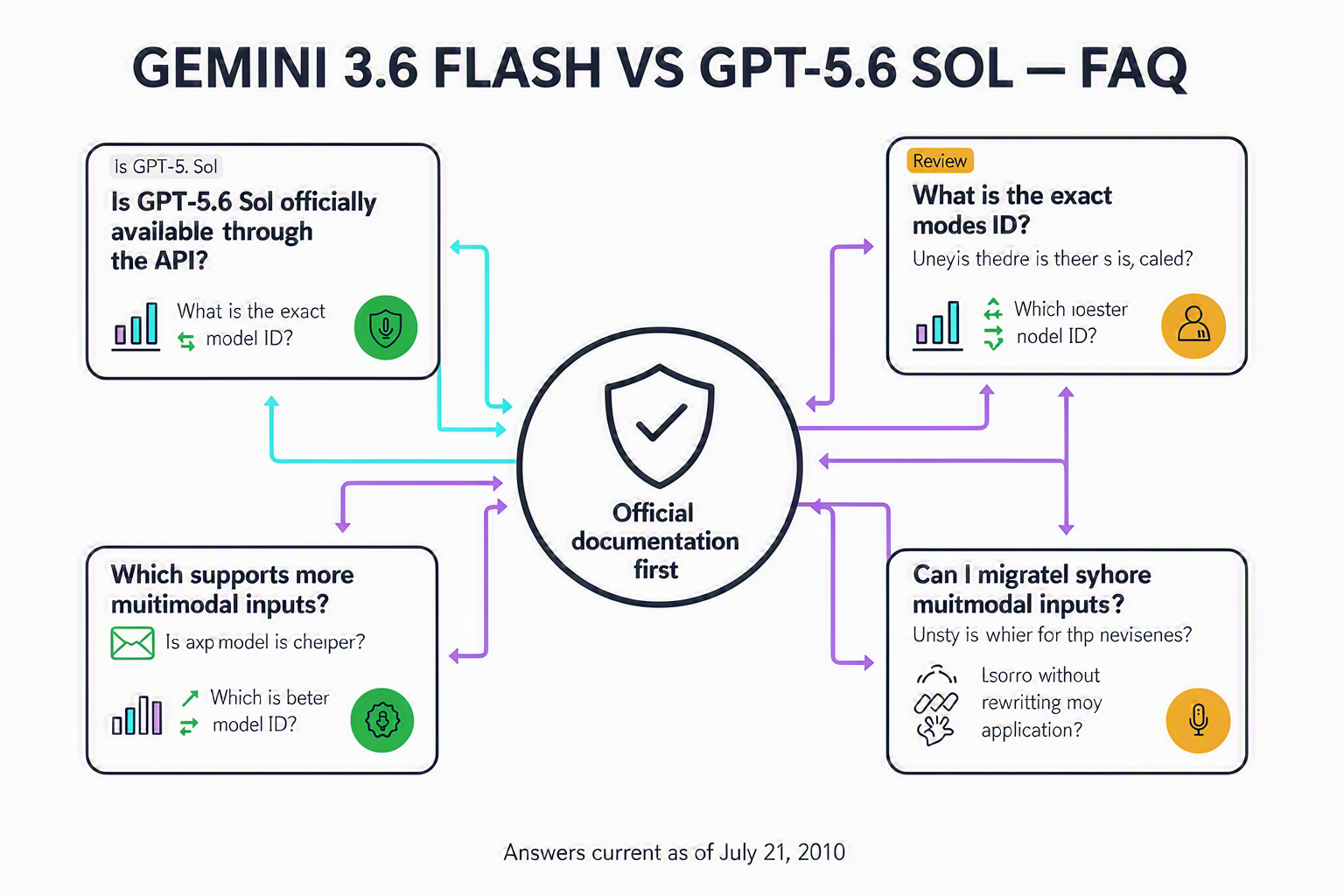
Is Gemini 3.6 Flash vs GPT-5.6 Sol a valid API comparison in July 2026?
What are the official API model IDs for Gemini 3.6 Flash and GPT-5.6 Sol?
gemini-3.6-flash, and Google’s model documentation recommends specific stable IDs for most production applications because stable models usually do not change. No verified OpenAI documentation in the supplied research identifies gpt-5.6-sol or any alternative GPT-5.6 Sol model ID, so developers should not treat that string as a working endpoint.How does Gemini 3.6 Flash vs GPT-5.6 Sol pricing compare?
Which model is better for coding, reasoning and agentic workflows?
Does Gemini 3.6 Flash vs GPT-5.6 Sol support multimodal input and web search?
Should developers deploy Gemini 3.6 Flash or wait for GPT-5.6 Sol?
gemini-3.6-flash now, while validating quotas, regional access, actual billing rates, latency and task-specific quality directly through Google’s current console and documentation. Teams interested in GPT-5.6 Sol should wait for an official OpenAI model page, API identifier, pricing table, limits and deprecation policy; until those exist, keep model routing configurable and avoid building procurement forecasts around third-party names or unofficial benchmark listings.Conclusion
As of July 22, 2026, the evidence-based verdict for Gemini 3.6 Flash vs GPT-5.6 Sol is workload-specific: both are official, deployable API models with documented identifiers. Gemini 3.6 Flash is the stronger fit for fast, cost-conscious agentic and multimodal applications that benefit from Google Search grounding, while GPT-5.6 Sol is better suited to frontier workloads requiring an exceptionally large context window and maximum output capacity.
- Both models have verified API identities. In the Gemini 3.6 Flash vs GPT-5.6 Sol comparison, Google documents
gemini-3.6-flash, while OpenAI officially documentsgpt-5.6-solas its frontier GPT-5.6 tier. Teams can evaluate and deploy either model without relying on speculative names or unofficial endpoints.
- GPT-5.6 Sol leads on documented context capacity. OpenAI specifies a 1,050,000-token context window and 128,000-token maximum output for
gpt-5.6-sol. That makes it the more compelling option in Gemini 3.6 Flash vs GPT-5.6 Sol for very large codebases, extensive document collections, long-running agent state and tasks that require unusually long generated responses.
- Gemini targets efficient, grounded applications. Google positions
gemini-3.6-flashas a fast, lower-cost model for agentic and multimodal workloads and documents support for Grounding with Google Search. In Gemini 3.6 Flash vs GPT-5.6 Sol, those capabilities favor Gemini for search-aware assistants, high-volume automation and applications where responsiveness and operating cost matter more than maximum context size.
- Price and performance depend on the complete workload. Published token rates are only part of the Gemini 3.6 Flash vs GPT-5.6 Sol calculation. Teams should also measure output length, cached input, retries, tool calls, grounding charges, latency and task success. Vendor-reported improvements are useful indicators, but they do not replace controlled, cross-model testing with identical prompts, tools and quality thresholds.
- Stable model IDs improve production reliability. Pinning
gemini-3.6-flashorgpt-5.6-solmakes evaluations, incident analysis and migrations more reproducible than relying on moving aliases. Production teams should still confirm regional availability, access tiers, rate limits, pricing and model-version behavior before rollout.
The conclusion for Gemini 3.6 Flash vs GPT-5.6 Sol is therefore not a universal win for either vendor. Choose Gemini 3.6 Flash for efficient, search-grounded, multimodal and high-throughput applications; choose GPT-5.6 Sol when frontier capability, million-token context and 128,000-token outputs justify its resource profile. For cost, latency and quality, the winner should be determined through workload-specific benchmarks rather than model labels alone.
To explore how model abstraction and AI communication are evolving, check out CallMissed, an OpenAI-compatible multi-model gateway and AI communication platform supporting voice agents and multilingual engagement. As the Gemini 3.6 Flash vs GPT-5.6 Sol comparison develops, will your architecture be guided by headline specifications—or by measured cost, reliability and task success in production?
Related Reading
- Gemini 3.5 Flash-Lite vs GPT-5.6 Terra: Official API, Price, Limits & Use Cases
- Gemini 3.5 Flash-Lite vs GPT-5.6 Sol: Verified 2026 Comparison
- Gemini 3.6 Flash vs GPT-5.6 Luna: Full API, Price and Speed Comparison
Sources
Related Posts

Ready to automate customer conversations?
Launch AI voice agents and WhatsApp bots with CallMissed — one API, 22+ Indian languages.