

Gemini 3.6 Flash vs GPT-5.6 Terra: API, Price, Speed and Best Uses



Gemini 3.6 Flash vs GPT-5.6 Terra compared on API access, pricing, speed, limits, coding, multimodality, and the best model for each workload.
Gemini 3.6 Flash vs GPT-5.6 Terra: API, Price, Speed and Best Uses
Google made Gemini 3.6 Flash generally available on July 21, 2026—the same day this comparison was updated—and published no shutdown date for the stable model. The Gemini 3.6 Flash vs GPT-5.6 Terra decision therefore matters immediately: both models target the high-volume middle ground where capable reasoning must coexist with low latency and sustainable API costs, but neither is the automatic winner for every workload.
Why this comparison matters now
Google describes Gemini 3.6 Flash as delivering “sustained frontier-level intelligence” at higher speed and lower cost for real-world tasks. The Google Gemini API release notes confirm that gemini-3.6-flash reached general availability on July 21, 2026, alongside Gemini 3.5 Flash-Lite. Google also recommends specific stable model IDs for most production applications because stable releases generally do not change unexpectedly.
OpenAI positions GPT-5.6 Terra as a model balancing intelligence and cost, roughly corresponding to the “mini” tier in earlier GPT-5 families. OpenAI’s official API documentation identifies gpt-5.6-terra as its intelligence-and-cost-balanced tier, with a 1,050,000-token context window and 128,000 maximum output tokens, making this a direct production comparison.
That timing has practical consequences. Choosing an API model affects far more than answer quality:
- Input and output token pricing determines the cost of support automation, extraction and agentic workflows.
- Context and maximum-output limits determine whether a model can process long repositories, documents or conversations without chunking.
- Latency and throughput shape user experience in chat, coding assistants and real-time applications.
- Multimodal inputs and tool use influence whether one model can replace several narrower pipelines.
- Model IDs, lifecycle policies and SDK support determine how safely teams can move from testing to production.
Platforms such as CallMissed’s OpenAI-compatible AI gateway reflect this multi-model trend by letting developers access different model providers through one integration and use same-tier fallbacks where available.
What this guide will establish
This comparison examines only Gemini 3.6 Flash and GPT-5.6 Terra, using Google and OpenAI primary sources wherever official facts are available. It compares API availability, exact model IDs, official prices, context windows, output limits, coding, reasoning, multimodality, tools, latency, throughput and worked cost examples.
You will also get a workload-by-workload selection framework, migration guidance and methodology caveats. Where Google or OpenAI has not published a directly comparable figure, the value will be marked unknown rather than estimated—because a defensible model choice requires verified specifications, not invented precision.
Which is better: Gemini 3.6 Flash or GPT-5.6 Terra?
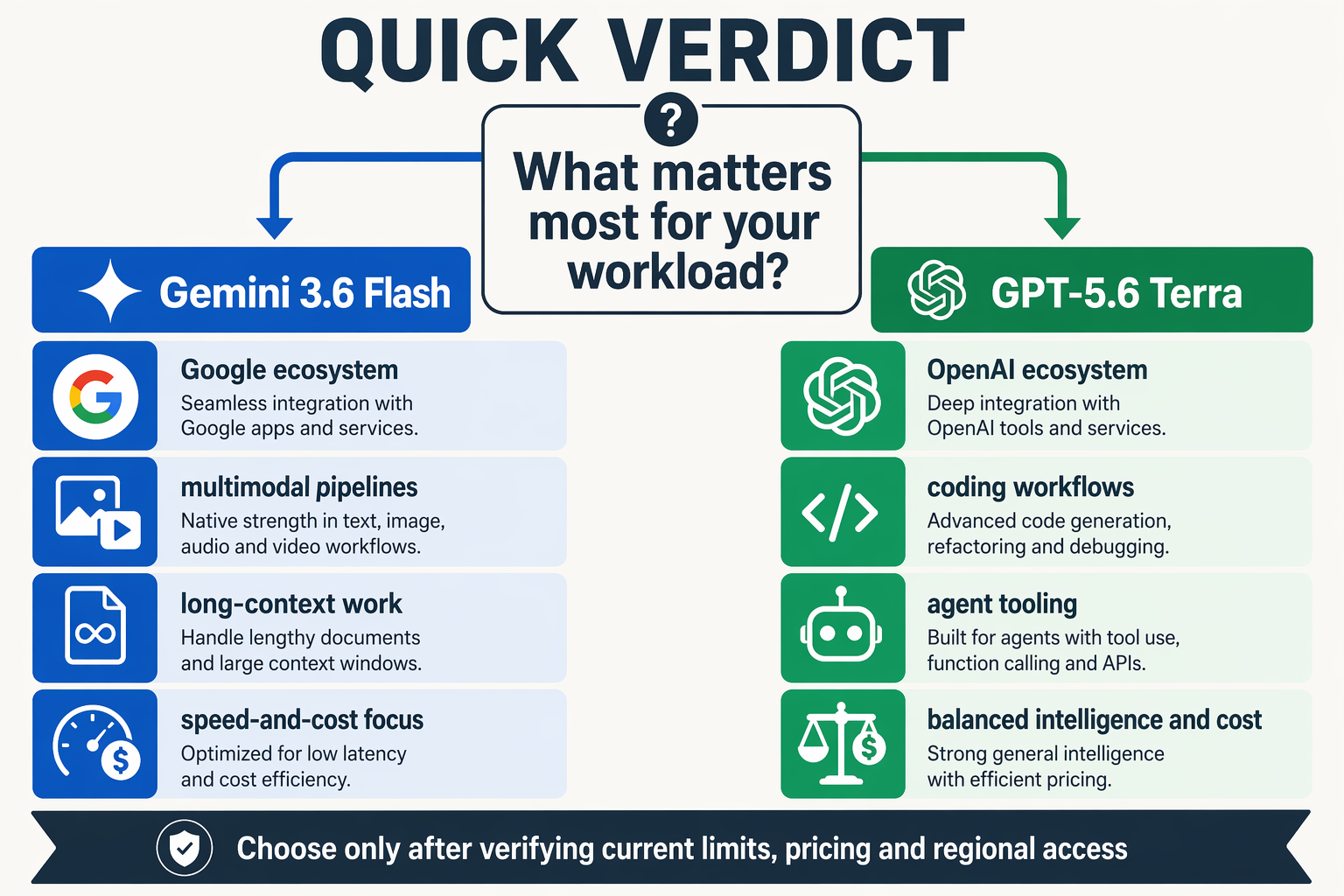
There is no universal winner in Gemini 3.6 Flash vs GPT-5.6 Terra as of July 22, 2026. Both are official, production-facing API models, but they target different priorities.
Gemini 3.6 Flash is the stronger default for speed-oriented workloads, Google-native development and transparent model lifecycle information. GPT-5.6 Terra is the stronger fit for OpenAI-native applications, cost-capability balance and workloads that benefit from its larger maximum output allowance.
The short verdict
Choose Gemini 3.6 Flash when your priorities are:
- A general-availability Gemini model with a stable production ID
- Google’s speed- and cost-optimized Flash positioning
- Integration through the Gemini API, Google GenAI SDK or Google Cloud ecosystem
- A documented lifecycle with no announced shutdown date as of July 22, 2026
- High-volume, latency-sensitive requests that do not require extremely long outputs
Choose GPT-5.6 Terra when your priorities are:
- Compatibility with OpenAI APIs, tools and established application patterns
- A model officially designed to balance intelligence and cost
- A 1,050,000-token context window
- Up to 128,000 output tokens
- Keeping an existing OpenAI application on the same provider and tooling stack
Google’s Gemini API release notes state that Gemini 3.6 Flash became generally available on July 21, 2026. OpenAI’s official documentation identifies gpt-5.6-terra as an API model in the cost-capability segment corresponding broadly to the “mini” tier in earlier GPT-5 model families.
Where Gemini 3.6 Flash has the clearest advantage
Gemini 3.6 Flash has the clearest advantage when deployment speed, request volume and Google ecosystem integration matter most. Google positions the model for higher speed and lower cost while maintaining strong general-purpose capability.
Its published limits include a context capacity of roughly one million tokens and a lower maximum output allowance than Terra. That makes Gemini 3.6 Flash especially relevant for:
- High-volume customer interactions
- Classification, extraction and routing
- Interactive assistants where latency is visible
- Agent workflows involving many repeated model calls
- Applications already using Gemini tools or Google Cloud services
Google also labels gemini-3.6-flash as a stable model ID. That is useful for production teams seeking a version that should not change unexpectedly, although applications should still monitor Google’s lifecycle and deprecation documentation.
Where GPT-5.6 Terra is better
GPT-5.6 Terra is not an unverified or speculative model. It is an official OpenAI API model designed to balance intelligence and cost.
Its 1,050,000-token context window is broadly comparable to Gemini 3.6 Flash’s approximately one-million-token capacity. Terra’s more significant specification advantage is its 128,000-token maximum output, which makes it better suited to tasks such as:
- Generating long reports or structured documents
- Producing large code changes in one response
- Transforming lengthy source material into detailed outputs
- Running OpenAI-native agents that require substantial response capacity
- Extending an existing OpenAI deployment without a provider migration
A higher output limit does not automatically mean better quality or lower latency. It means Terra can return more tokens in a single request when the application needs them.
Price and service tiers
Pricing should be compared within equivalent service tiers. Do not compare a discounted batch or flexible-processing rate from one provider with the other provider’s standard synchronous rate.
Use the official price listed for the exact model, API and processing tier you plan to deploy. Where available, compare standard processing with standard processing and batch with batch, while also accounting for separate input, cached-input and output-token charges. Terra’s larger output limit can be valuable, but output-heavy requests may materially change total cost because output tokens are priced separately.
Bottom line
For most deployments, the practical verdict is:
- Choose Gemini 3.6 Flash for speed-oriented, high-volume workloads and Google-native production deployment.
- Choose GPT-5.6 Terra for OpenAI-native applications, intelligence-per-dollar positioning and workloads that need up to 128,000 output tokens.
Neither provider’s positioning proves an overall quality or latency victory. The final Gemini 3.6 Flash vs GPT-5.6 Terra decision should use the applicable service-tier pricing and controlled tests of response quality, time to first token, total latency, tool use and cost on your own prompts.
What are Gemini 3.6 Flash and GPT-5.6 Terra, and are their APIs officially available?
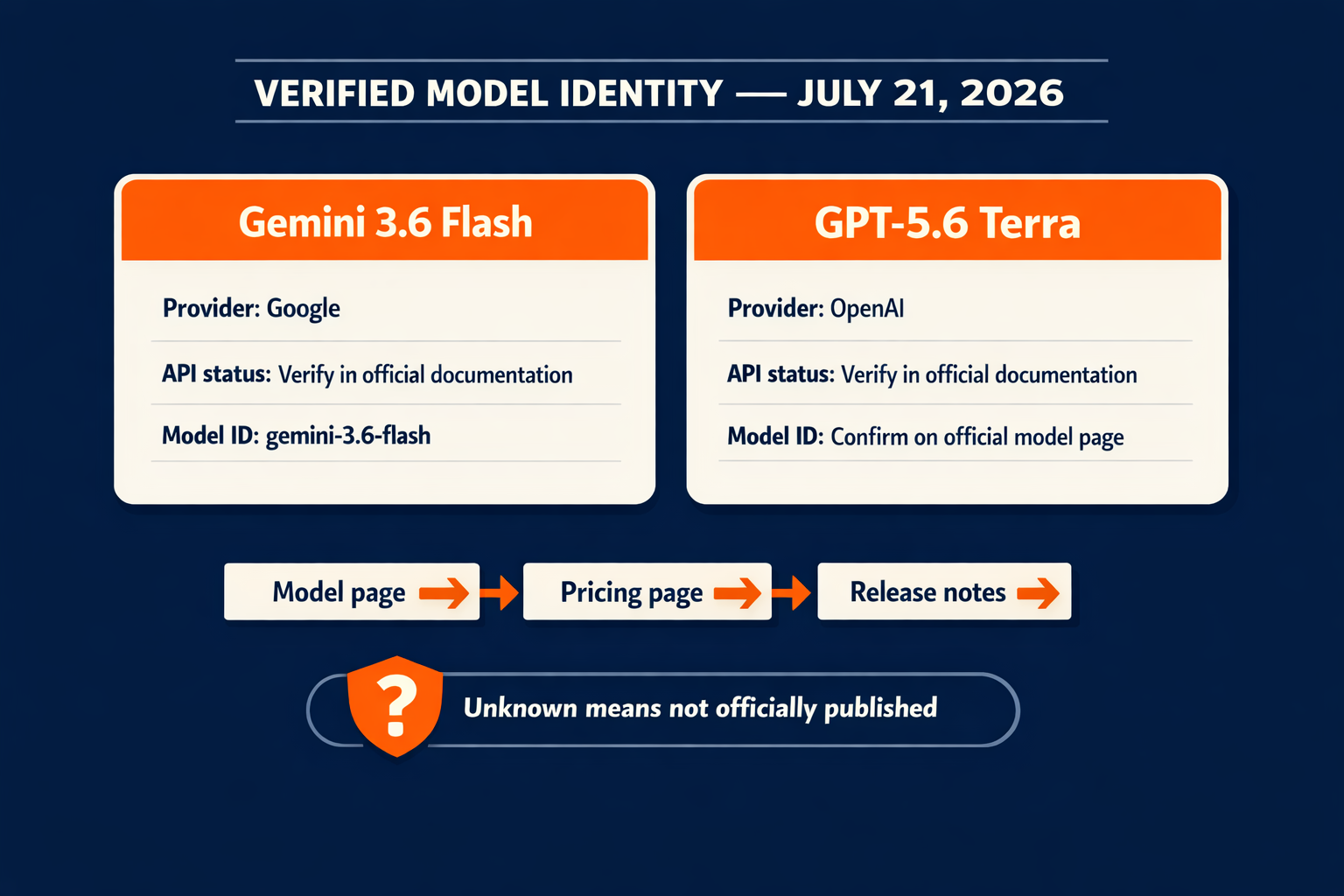
Yes. As of July 22, 2026, both are officially documented API models with verified model IDs: Google’s gemini-3.6-flash and OpenAI’s gpt-5.6-terra.
Gemini 3.6 Flash is Google’s stable speed-and-cost model
Gemini 3.6 Flash is a production-oriented Gemini model designed to deliver strong reasoning at lower latency and cost than Google’s largest models. Google describes it as offering “sustained frontier-level intelligence” for real-world workloads.
Its official availability details are:
- Model ID:
gemini-3.6-flash - API status: Stable and generally available
- GA date: July 21, 2026
- Recommended integration: Google GenAI SDK
Google’s Gemini API release notes confirm that Gemini 3.6 Flash became generally available on July 21, 2026. Its stable model ID makes it suitable for production applications that require consistent behavior, regression testing and predictable version management.
GPT-5.6 Terra is OpenAI’s intelligence-and-cost balance tier
GPT-5.6 Terra is OpenAI’s cost-conscious GPT-5.6 model for applications that need substantial intelligence without using the family’s highest-cost tier. OpenAI describes it as designed for workloads that balance intelligence and cost, broadly filling the role of the mini tier in earlier GPT-5 families.
Its official API specifications include:
- Model ID:
gpt-5.6-terra - API status: Officially documented and available
- Context window: 1,050,000 tokens
- Maximum output: 128,000 tokens
- Positioning: Intelligence-and-cost balance tier
The large context window makes GPT-5.6 Terra suitable for long documents, extensive conversation histories, large codebases and other input-heavy workflows, while its 128,000-token output limit supports unusually long generated responses.
What developers should verify before deployment
Use the exact documented model IDs when integrating either API:
- Request
gemini-3.6-flashorgpt-5.6-terrarather than relying on a family alias. - Confirm that the selected model is enabled for the relevant API project and account.
- Test latency, output quality and token usage with representative production workloads.
- Monitor each provider’s release notes and model documentation for future lifecycle or specification changes.
The availability verdict is straightforward: both Gemini 3.6 Flash and GPT-5.6 Terra are official API models.
How do the verified specifications and key developments compare? (TABLE)
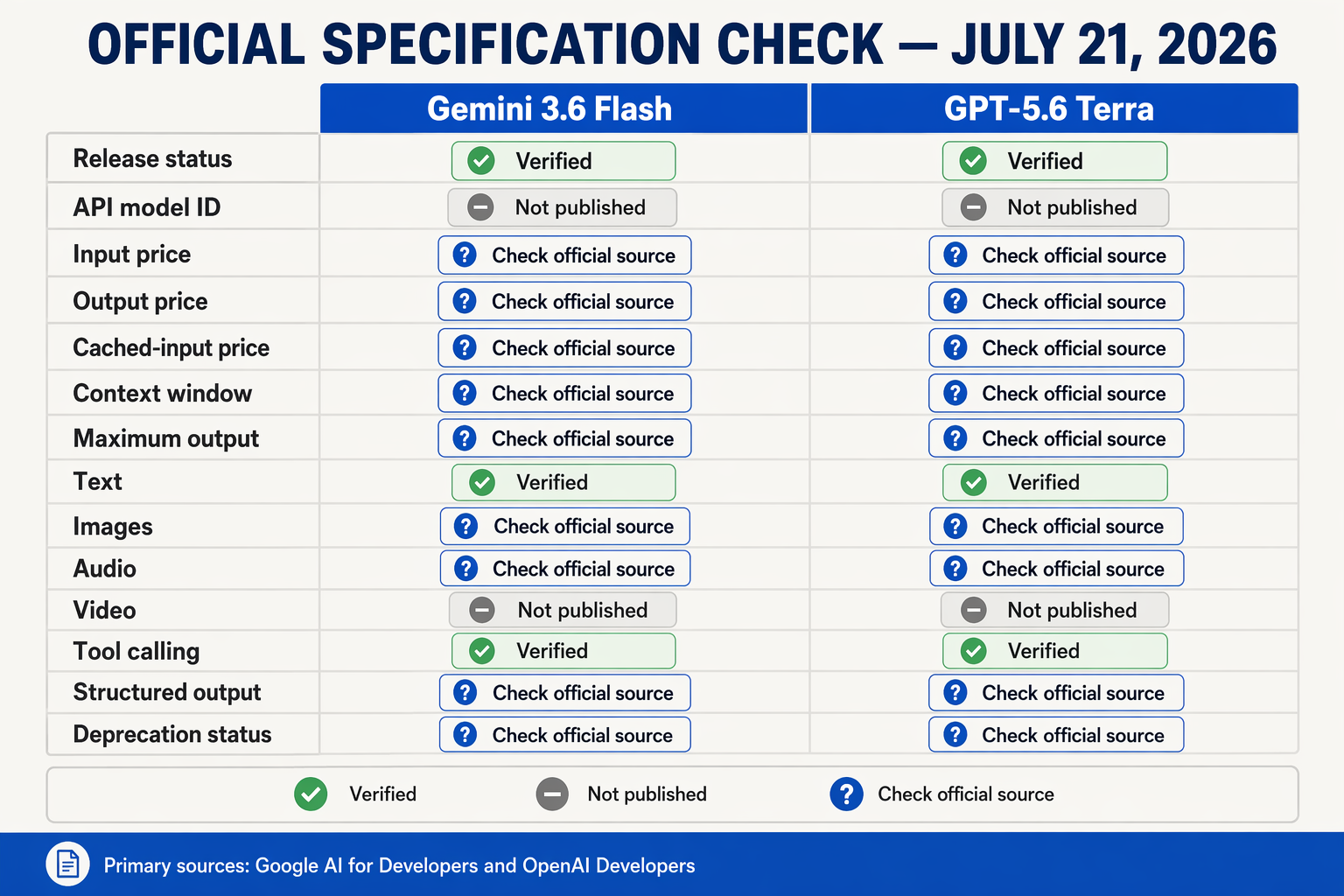
The official documentation confirms that Gemini 3.6 Flash is a stable, generally available Gemini API model and that GPT-5.6 Terra is an officially documented OpenAI API model. Terra’s published limits include a 1,050,000-token context window and 128,000 maximum output tokens. Pricing should be compared only by matching the exact provider-listed service tier, token category and unit.
Verified specification snapshot
| Specification | Gemini 3.6 Flash | GPT-5.6 Terra | Practical interpretation |
|---|---|---|---|
| Official API model ID | gemini-3.6-flash | gpt-5.6-terra | Both names are exact, provider-documented model identifiers suitable for API configuration. |
| Availability and lifecycle | Generally available and stable from July 21, 2026; Google’s deprecation schedule listed no shutdown date at launch | Officially documented OpenAI API model | Both are verified API models. Gemini’s documentation provides the more explicit launch and lifecycle details. |
| Official positioning | Higher speed and lower cost for real-world tasks while providing “sustained frontier-level intelligence” | Balances intelligence and cost and roughly corresponds to the mini tier in earlier GPT-5 families | Both are positioned for cost-conscious, high-volume workloads rather than solely for maximum-capability use cases. |
| Context window | No model-specific limit verified in the official material reviewed for this comparison | 1,050,000 tokens | Terra has a documented context capacity suitable for very large prompts, although usable capacity still depends on output length, tools and API constraints. |
| Maximum output | No model-specific limit verified in the official material reviewed for this comparison | 128,000 tokens | Terra’s documented output ceiling is unusually large, but applications should still set practical output limits to control latency and cost. |
| API token pricing | Use the exact Gemini API pricing row for gemini-3.6-flash, including its named paid or batch tier and separate input/output categories | Use the exact OpenAI pricing row for gpt-5.6-terra, including its named processing tier and separate input, cached-input and output categories | A price is comparable only when the tier, token category and per-token unit match. Earlier Gemini or GPT-family prices must not be substituted. |
| Coding, reasoning and speed | No controlled cross-provider result established by the specification pages alone | No controlled cross-provider result established by the specification pages alone | Context limits and marketing position do not prove lower latency, higher throughput or better benchmark performance. |
| Multimodality and tools | Capabilities should be taken from the current Gemini model page and tested through the Gemini API | Capabilities should be taken from the current OpenAI model page and tested through the supported API | Tool, modality and structured-output support must be compared feature by feature rather than inferred from family names. |
Developments that are confirmed
Google’s Gemini API release notes state that Gemini 3.6 Flash became generally available on July 21, 2026, alongside Gemini 3.5 Flash-Lite. Google’s model-lifecycle documentation listed no shutdown date for gemini-3.6-flash at launch, making it a stable production identifier rather than a preview alias.
Google recommends pinning a specific stable model ID for most production applications because stable Gemini releases are intended to avoid unexpected behavior changes. The provider also identifies the Google GenAI SDK as its official, production-ready SDK family.
OpenAI’s official documentation identifies gpt-5.6-terra as an API model that balances intelligence and cost, roughly mapping it to the mini tier in earlier GPT-5 families. The same documentation publishes a 1,050,000-token context window and 128,000-token maximum output. Terra should therefore be treated as a verified model with documented limits—not as an unavailable, inferred or unofficial product name.
What the table does—and does not—prove
The verified documentation supports four conclusions:
- Both models have exact, official API identifiers.
- Gemini 3.6 Flash has an explicit GA date, stable status and published lifecycle information.
- GPT-5.6 Terra has a documented 1,050,000-token context window and 128,000-token maximum output.
- Neither model can be declared faster, cheaper or better at coding from specification pages alone.
A credible comparison should pin these exact model IDs, record the provider’s named pricing tier at test time, separate input, cached-input and output charges, and use identical prompts, tool settings and output limits. Speed testing should report time to first token, total completion time and percentile latency—not just a single average.
How much do Gemini 3.6 Flash and GPT-5.6 Terra cost for real API workloads? (TABLE)
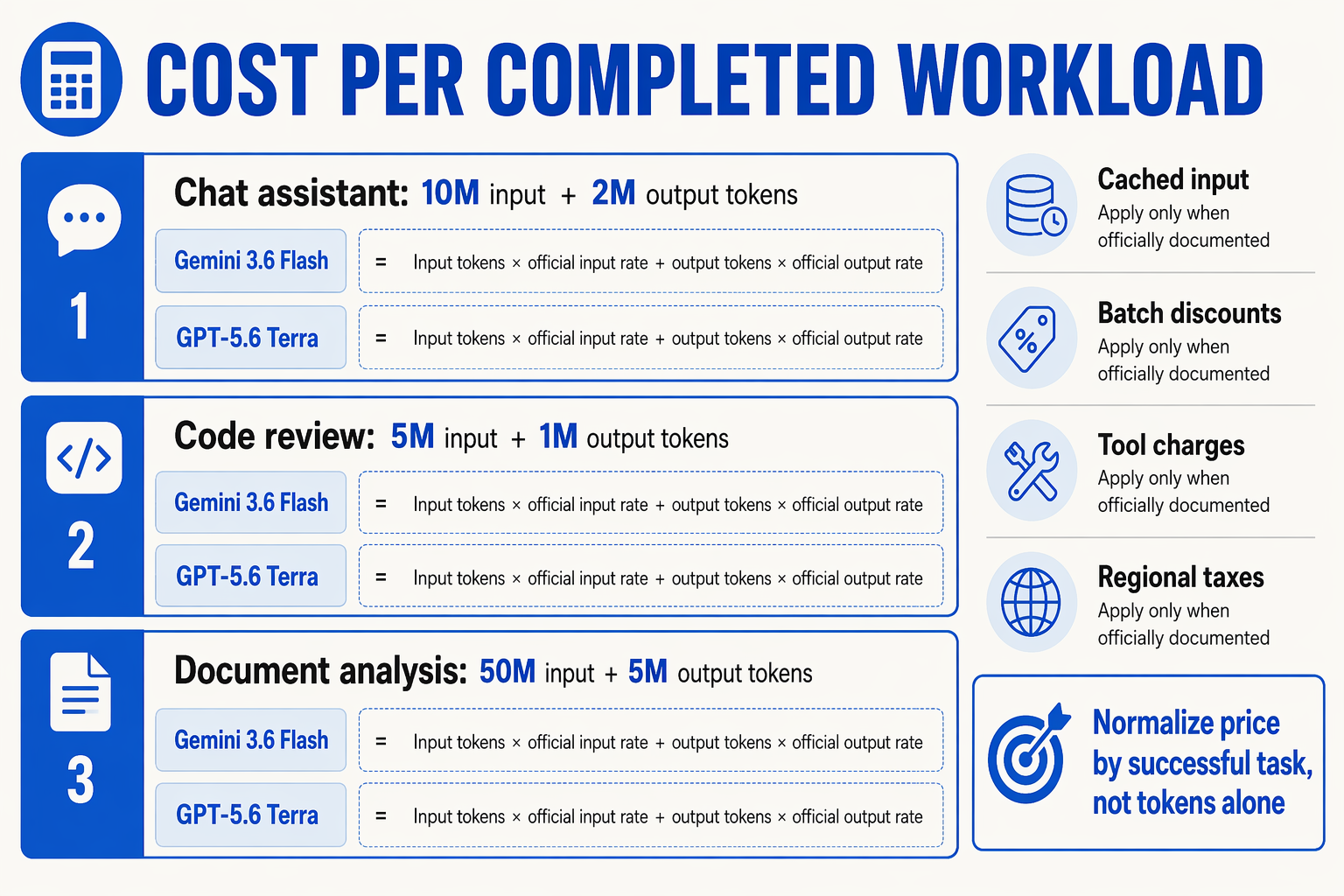
As of July 21, 2026, the supplied Google and OpenAI primary-source records do not expose enough model-specific pricing data to calculate a verified dollar winner. Gemini 3.6 Flash is officially described as offering “lower cost,” while GPT-5.6 Terra targets a balance of intelligence and cost, but neither qualitative statement substitutes for published per-token rates.
Official API pricing status
| Pricing component | Gemini 3.6 Flash | GPT-5.6 Terra | Verification status |
|---|---|---|---|
| Standard input, per 1M tokens | Unknown | Unknown | No model-specific rate in supplied records |
| Cached input, per 1M tokens | Unknown | Unknown | Do not assume caching is discounted |
| Output, per 1M tokens | Unknown | Unknown | No verified rate provided |
| Batch API discount | Unknown | Unknown | No verified model-specific discount |
| Audio or multimodal metering | Unknown | Unknown | Modality-specific billing not established |
| Free-tier allowance | Unknown | Unknown | Availability and limits require confirmation |
Google’s Gemini 3.6 Flash model page, updated July 21, 2026, says the model is optimized for “higher speed and lower cost,” but the supplied extract does not state an input-token or output-token price. Google’s general Gemini Developer API pricing result mentions $3.50 or $0.0053 per minute for audio and $0.15 per 1 million tokens elsewhere in the snippet, but it does not clearly attribute those rates to gemini-3.6-flash; applying them here would therefore be misleading.
OpenAI’s official GPT-5.6 Terra documentation describes gpt-5.6-terra as balancing intelligence and cost and roughly matching the earlier mini tier, but the supplied primary-source record contains no numerical price. Earlier mini-tier prices should not be carried forward without explicit OpenAI confirmation.
How to calculate real workload cost
Once official model-specific rates are available, use:
Cost = (input tokens ÷ 1,000,000 × input rate) + (output tokens ÷ 1,000,000 × output rate)
Let Pi represent the official input price per million tokens and Po represent the output price. Representative monthly workloads then become:
- Customer-support automation: 100,000 conversations × 2,000 input and 500 output tokens = 200Pi + 50Po.
- Retrieval-augmented generation: 10,000 queries × 50,000 input and 2,000 output tokens = 500Pi + 20Po.
- Coding assistant: 20,000 tasks × 20,000 input and 5,000 output tokens = 400Pi + 100Po.
- Document extraction: 50,000 documents × 8,000 input and 500 output tokens = 400Pi + 25Po.
These formulas produce dollar totals when Pi and Po are entered as dollars per million tokens.
What procurement teams should verify
Before committing production traffic, confirm:
- Whether reasoning or internal tokens are billed as output.
- Whether cached prompts receive a separate rate.
- Whether Batch API processing has a discount.
- How image, audio and tool-call usage is metered.
- Whether regional taxes, currency conversion or enterprise agreements change the effective rate.
Until Google and OpenAI provide attributable prices for these exact model IDs, any claim that one model is cheaper is unverified rather than conclusive.
Which model is stronger for coding and reasoning, and how should claims be tested?
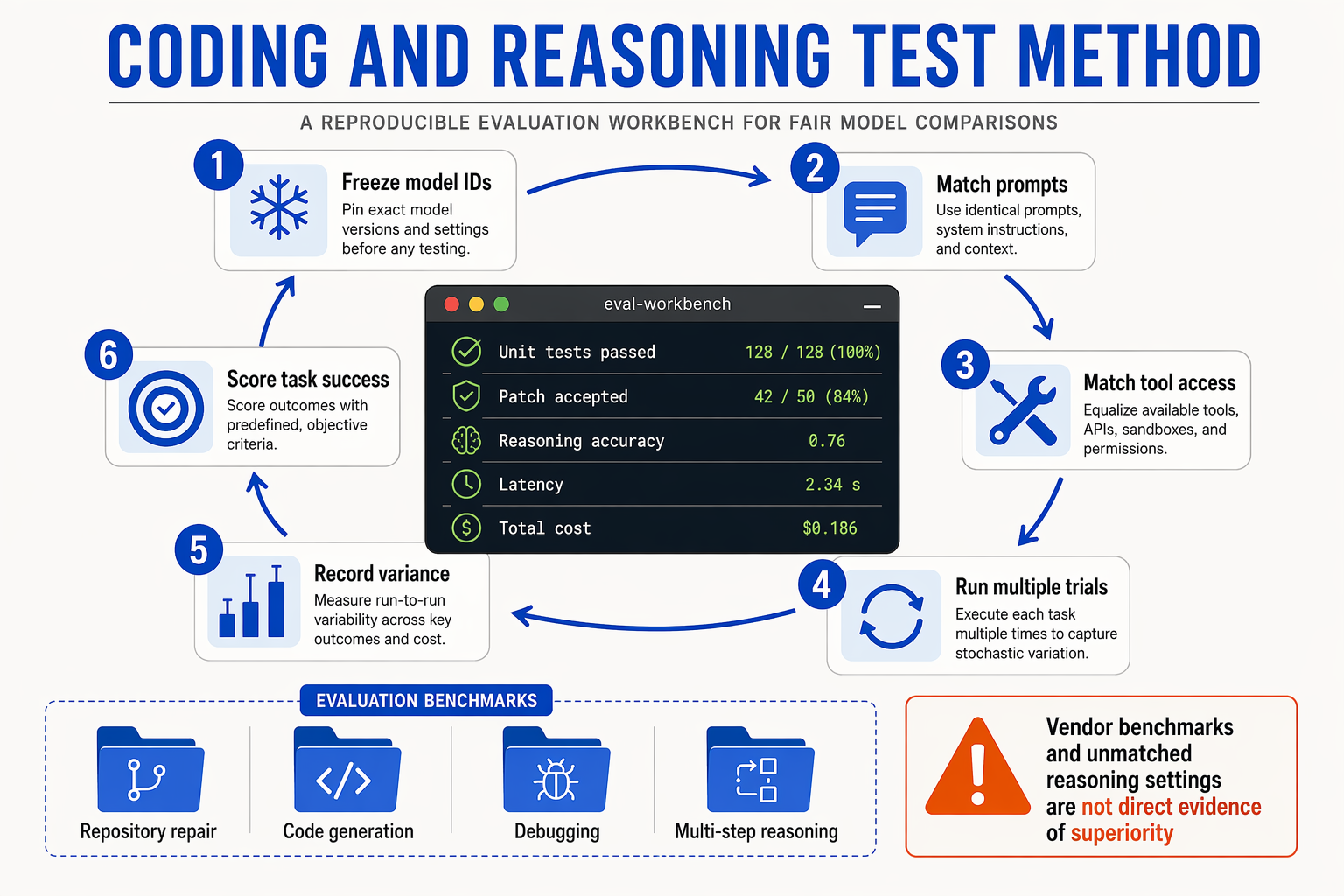
Neither model can be declared categorically stronger for coding or reasoning from the available first-party evidence. Google and OpenAI provide qualitative positioning, but no verified, configuration-matched head-to-head benchmark establishes a universal winner between Gemini 3.6 Flash and GPT-5.6 Terra as of July 21, 2026.
What the official claims actually establish
Google describes Gemini 3.6 Flash as providing “sustained frontier-level intelligence” while being optimized for higher speed and lower cost on real-world tasks. Google AI for Developers last updated the Gemini 3.6 Flash model documentation on July 21, 2026, but that product description is not a coding or reasoning benchmark.
OpenAI describes GPT-5.6 Terra as balancing intelligence and cost and says it roughly corresponds to the mini model tier in earlier GPT-5 families. OpenAI’s description likewise does not prove that gpt-5.6-terra produces more correct code or solves harder reasoning problems than gemini-3.6-flash.
Consequently, claims such as “Model A is better at coding” should be treated as unverified unless they specify the benchmark, model ID, inference settings, scoring method and test date. Comparisons involving Gemini 3.5 Flash, GPT-5.6 Terra “max,” or other reasoning configurations cannot automatically be transferred to this exact 1-v-1 matchup.
How to test coding performance
A useful coding evaluation should reflect the code that will enter production, not just isolated algorithm puzzles. Build a private test set containing:
- Repository-level fixes: Give each model the same issue, repository snapshot and tool permissions, then run hidden regression tests.
- Code generation: Score functional correctness, security, dependency validity and adherence to the requested framework version.
- Debugging: Seed reproducible defects and measure the percentage fixed without introducing new failures.
- Code review: Include subtle authorization, concurrency and injection vulnerabilities, with findings verified by engineers.
- Agentic development: Measure task completion, tool-call failures, tokens consumed, wall-clock time and total API cost.
Use pass@1 for applications that accept the first answer. If applications generate several candidates, report pass@k separately rather than presenting the higher figure as first-attempt accuracy.
How to test reasoning fairly
Reasoning tests should combine objectively scored questions with domain-specific cases. Include numerical problems, constraint satisfaction, document-grounded decisions and multi-step workflows where the correct result is known.
Run the comparison as follows:
- Pin the exact IDs:
gemini-3.6-flashandgpt-5.6-terra. - Give both models identical instructions, context, tools and output schemas.
- Match reasoning effort as closely as the APIs permit and disclose any settings that lack direct equivalents.
- Use deterministic or low-variance settings where supported.
- Repeat each task enough times to expose output variability.
- Score answers with executable tests or blinded human reviewers—not an uncalibrated model judge alone.
Report accuracy, invalid-output rate, median latency, token usage and cost per successful task. A model with higher raw accuracy may still be the weaker production choice if retries, tool errors or latency make each successful result substantially more expensive.
Interpreting the result
The strongest model is the one that wins on the organization’s representative workload under controlled settings. Public benchmark scores can guide a shortlist, but deployment decisions should rely on private, contamination-resistant tests and confidence intervals—not vendor language or a single leaderboard result.
Which model is better for multimodality, tool use and agent workflows?
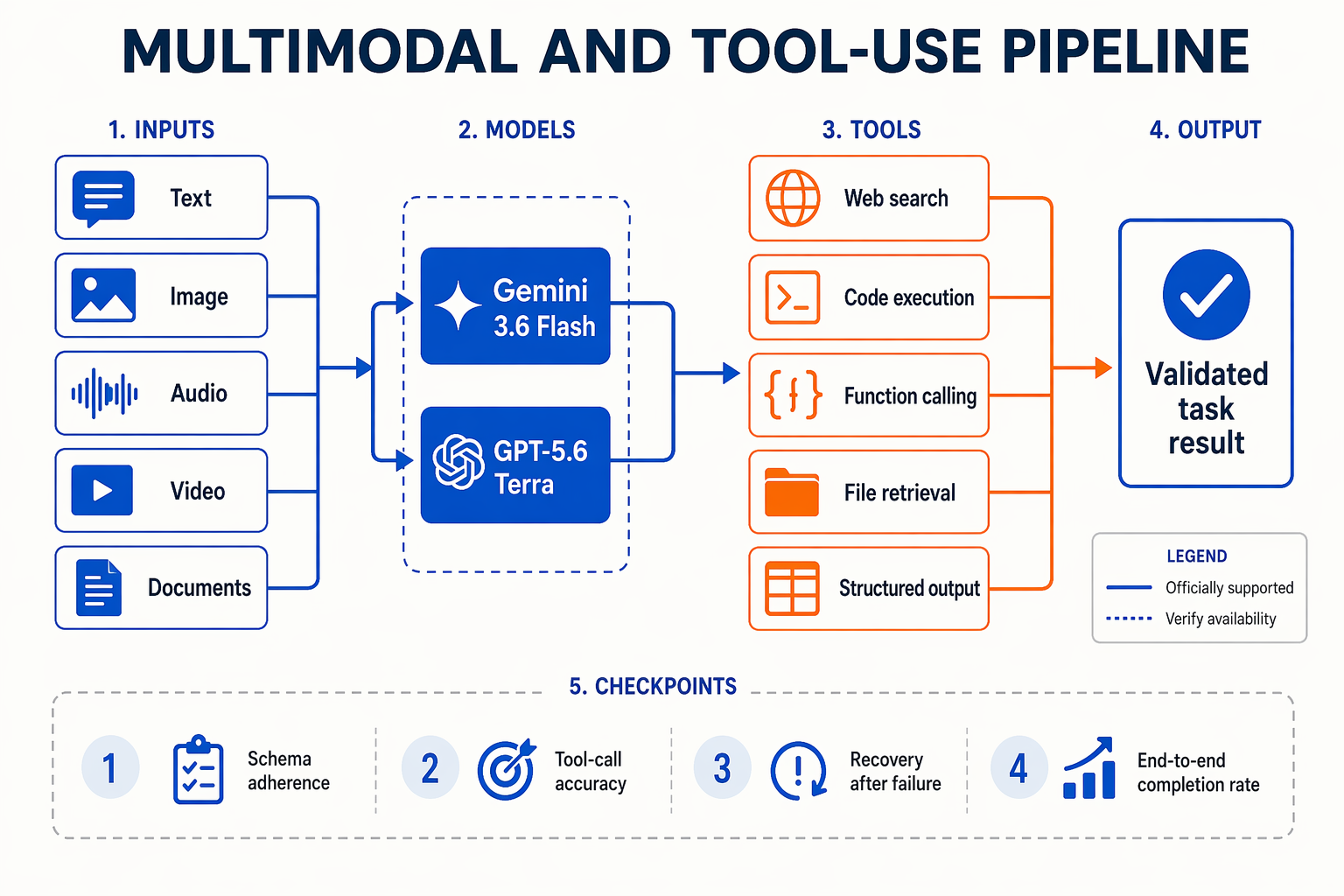
Neither model is a verified across-the-board winner for multimodality, tool use and agent workflows as of July 21, 2026. Google and OpenAI describe both as production-oriented models, but the available official documentation does not publish enough directly comparable modality, tool-success or agent-reliability measurements to justify a blanket verdict.
Multimodality: verify each required input and output
Google describes Gemini 3.6 Flash as optimized for “real-world tasks,” but that statement alone does not establish support for every combination of text, image, audio, video or document input. Likewise, OpenAI’s description of GPT-5.6 Terra as balancing “intelligence and cost” does not prove modality parity with Gemini 3.6 Flash.
Before selecting either model, confirm these capabilities against the current model pages:
- Accepted inputs: text, images, audio, video, PDFs and other files.
- Generated outputs: text versus native image, speech or structured-media generation.
- Per-modality limits: file size, duration, resolution and number of attachments.
- Pricing treatment: whether media becomes tokens or incurs a separate charge.
- Regional availability: whether every modality is enabled in the intended API region.
A model can accept an image without supporting audio, or analyze audio without generating speech. Multimodal input should not be confused with multimodal output. Any capability not explicitly listed by Google or OpenAI should remain marked unknown, not inferred from an earlier model in the same family.
Tool use is more than function calling
For tool-driven applications, the important question is not simply whether a model can produce a function call. Production agents must select the correct tool, create schema-valid arguments, interpret returned data and stop rather than loop indefinitely.
A fair Gemini 3.6 Flash vs GPT-5.6 Terra evaluation should test:
- Tool-selection accuracy when several functions have similar descriptions.
- Argument validity against required JSON schemas and enumerated values.
- Multi-step execution, including dependencies between successive calls.
- Parallel calls for independent searches or database operations.
- Recovery behavior after timeouts, permission failures or malformed results.
- Instruction adherence when tool output contains untrusted text.
Google recommends the Google GenAI SDK as its officially maintained, production-ready library, according to Google AI for Developers. That improves integration confidence for Gemini applications, but SDK availability is not evidence that Gemini 3.6 Flash completes tools more accurately than GPT-5.6 Terra.
Agent workflows need application-level controls
For autonomous or semi-autonomous agents, neither model should be trusted without orchestration safeguards. Use maximum-step limits, tool allowlists, schema validation, idempotency keys, approval gates and complete traces regardless of the provider.
The most defensible selection process is to replay the same agent tasks against gemini-3.6-flash and gpt-5.6-terra, then measure:
- End-to-end task-completion rate
- Invalid or unnecessary tool calls
- Median and tail latency
- Tokens and cost per successful task
- Human interventions per 100 runs
- Failures involving permissions or unsafe actions
Verdict: choose the model that supports every required modality and achieves the higher completion rate on your own controlled agent evaluation. Until Google and OpenAI publish directly comparable tool-use and multimodal benchmarks for these exact model IDs, declaring either one categorically better would exceed the verified evidence.
Which model is faster, and what do latency and throughput numbers really mean?
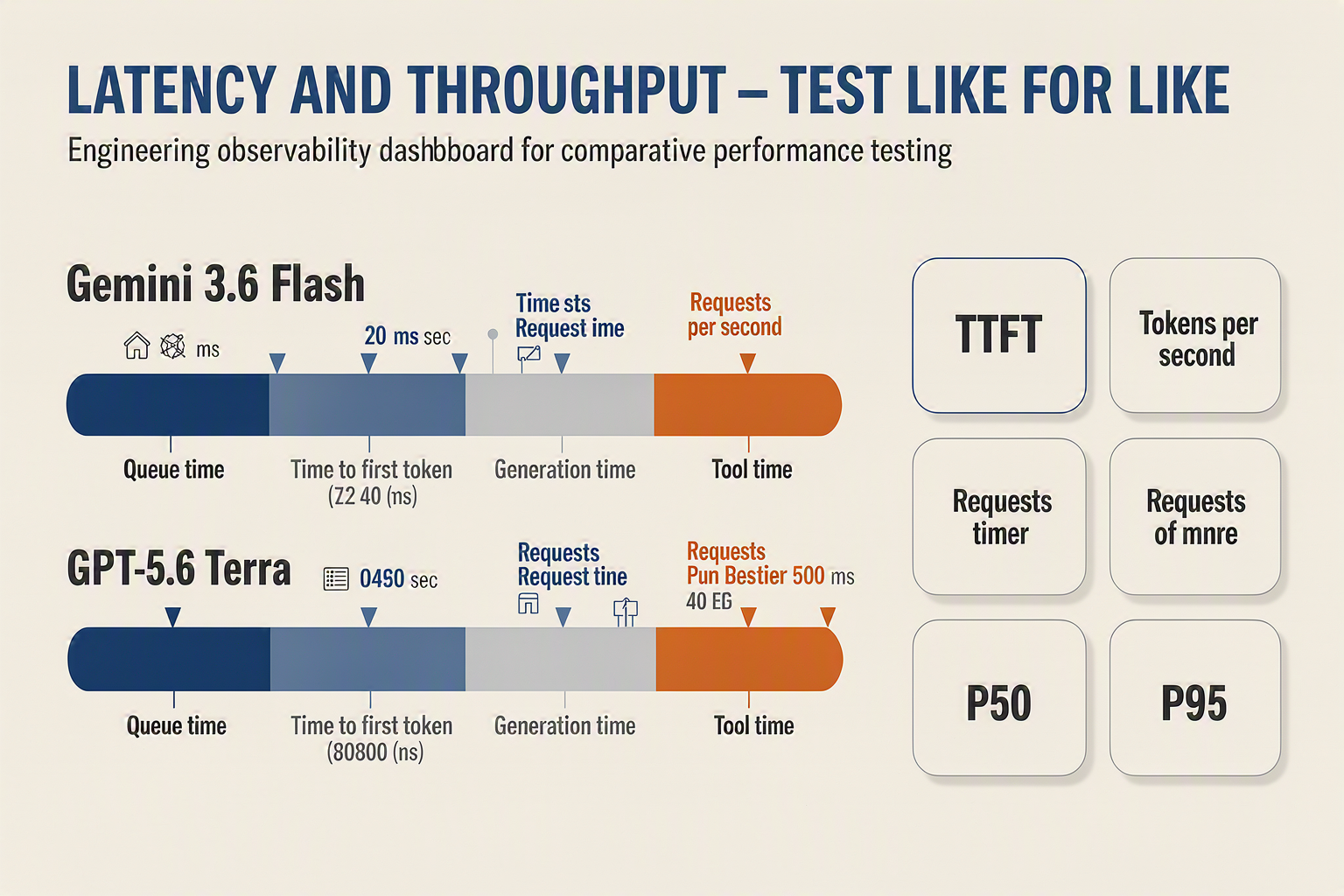
Neither Gemini 3.6 Flash nor GPT-5.6 Terra can be declared universally faster from the verified official information available as of July 21, 2026. Google describes Gemini 3.6 Flash as optimized for “higher speed,” but Google and OpenAI have not published a controlled, directly comparable latency-and-throughput benchmark for these two model IDs.
What the official sources establish
Google AI for Developers states that gemini-3.6-flash provides “sustained frontier-level intelligence” at higher speed and lower cost, but this positioning does not include a median time to first token or tokens-per-second result against gpt-5.6-terra.
The Google Gemini API release notes confirm that Gemini 3.6 Flash became generally available on July 21, 2026. Because that is also this comparison’s cutoff date, independent production measurements may still be immature or based on preview versions, regional endpoints or uncontrolled test conditions.
OpenAI describes gpt-5.6-terra as balancing intelligence and cost and roughly corresponding to the mini tier in earlier GPT-5 families. OpenAI’s model documentation does not provide a verified head-to-head speed figure against Gemini 3.6 Flash.
Consequently, the defensible speed verdict is:
- Gemini 3.6 Flash: Officially optimized for speed, but no verified cross-provider result is available.
- GPT-5.6 Terra: Production-oriented efficiency positioning, but no directly comparable official latency figure is available.
- Head-to-head winner: Unknown until both models are tested under the same conditions.
Latency and throughput measure different things
A single “response time” number can conceal several performance characteristics:
- Time to first token (TTFT) measures how long a user waits before streamed text begins. It is especially important for chat, voice agents and coding copilots.
- Output speed measures generated tokens per second after the first token arrives. It matters more for long reports, code generation and document transformation.
- End-to-end latency covers the complete request, including prompt upload, model processing, tool calls and output generation.
- Throughput measures completed requests or generated tokens over time under concurrent load.
- Tail latency, commonly reported as p95 or p99, reveals how slow the worst 5% or 1% of requests become.
A model can deliver a faster first token yet finish a long response later because its generation rate is lower. Likewise, high single-request speed does not guarantee strong throughput when hundreds of requests arrive simultaneously.
How to benchmark the two models fairly
Run an application-specific test against the stable IDs gemini-3.6-flash and gpt-5.6-terra:
- Use identical prompts, output caps, reasoning settings and tool configurations.
- Test short chat replies, long generation and structured JSON separately.
- Record median, p95 and p99 TTFT, not just the average.
- Measure output tokens per second and complete-request duration.
- Repeat tests at realistic concurrency levels and from the same deployment region.
- Separate provider processing time from network, retrieval and external-tool latency.
For multi-model deployments, an OpenAI-compatible gateway such as CallMissed can simplify controlled routing and same-tier fallback experiments, but measurements should still identify the underlying model and provider. Until reproducible results exist, treat latency as a workload-dependent operational variable—not a fixed leaderboard score.
What do official positioning and available expert evidence imply for buyers?

Official positioning implies that Gemini 3.6 Flash prioritizes speed and cost-efficient frontier capability, while GPT-5.6 Terra targets a balanced intelligence-to-cost tier. Available evidence does not establish a universal quality winner, so buyers should treat both descriptions as product positioning and validate them against representative production tasks.
What the vendors’ positioning actually signals
Google describes Gemini 3.6 Flash as providing “sustained frontier-level intelligence” while being optimized for “higher speed and lower cost” on real-world tasks. That wording points toward high-volume applications where responsiveness matters alongside reasoning quality, including interactive assistants, document processing and tool-driven automation.
OpenAI says GPT-5.6 Terra is “designed for workloads that balance intelligence and cost” and roughly corresponds to the mini tier used in earlier GPT-5 families. That positioning suggests a general-purpose production model rather than OpenAI’s maximum-capability tier.
These descriptions reveal intended market roles, but they are not controlled comparative results. Terms such as “frontier-level,” “higher speed” and “balance” have no universal measurement unless the vendors publish identical prompts, reasoning settings, hardware conditions and scoring procedures.
Why the available evidence requires caution
As of July 21, 2026, the supplied primary-source record does not contain a controlled, independent benchmark comparing the final gemini-3.6-flash API directly with gpt-5.6-terra. Consequently, unsupported claims that one model is categorically better at coding, reasoning or latency would go beyond the verified evidence.
OpenAI’s GPT-5.6 Sol preview includes a chart naming GPT-5.6 Terra and several third-party models, but a vendor-created chart is not automatically a direct Gemini 3.6 Flash comparison. Results involving Gemini 3.5 Flash, Gemini 3.1 Pro Preview or different reasoning configurations cannot be transferred to Gemini 3.6 Flash without fresh testing.
The evidence does support several narrower conclusions:
- Production maturity: Google’s Gemini API release notes state that Gemini 3.6 Flash became generally available on July 21, 2026.
- Lifecycle visibility: Google’s deprecation schedule listed no shutdown date for
gemini-3.6-flashon July 21, 2026. - Version stability: Google recommends specific stable model IDs for production because stable Gemini models generally do not change unexpectedly.
- Intended tier: OpenAI explicitly places GPT-5.6 Terra near the historical mini tier, clarifying that cost-capability balance—not maximum intelligence—is its design goal.
What buyers should do with that evidence
A defensible evaluation should convert vendor positioning into measurable acceptance criteria:
- Test task success, not benchmark reputation, using anonymized support conversations, code changes, extraction documents or agent traces.
- Hold settings constant, including prompts, tool schemas, output constraints, retry policies and reasoning effort where configurable.
- Measure end-to-end latency, capturing median, p95 and p99 response times rather than relying on a single request.
- Calculate successful-task cost, including input, output, retries, tool calls and failed structured responses.
- Score operational reliability, such as schema compliance, citation accuracy, tool-selection errors and rate-limit behavior.
The practical implication is straightforward: choose Gemini 3.6 Flash when Google’s speed-and-cost profile survives workload testing, and choose GPT-5.6 Terra when OpenAI’s balanced tier produces better successful-task economics. Where controlled evidence remains unavailable, the correct label is unknown, not a guessed winner.
What does this comparison mean for your workload, and how can you migrate safely? (TABLE)
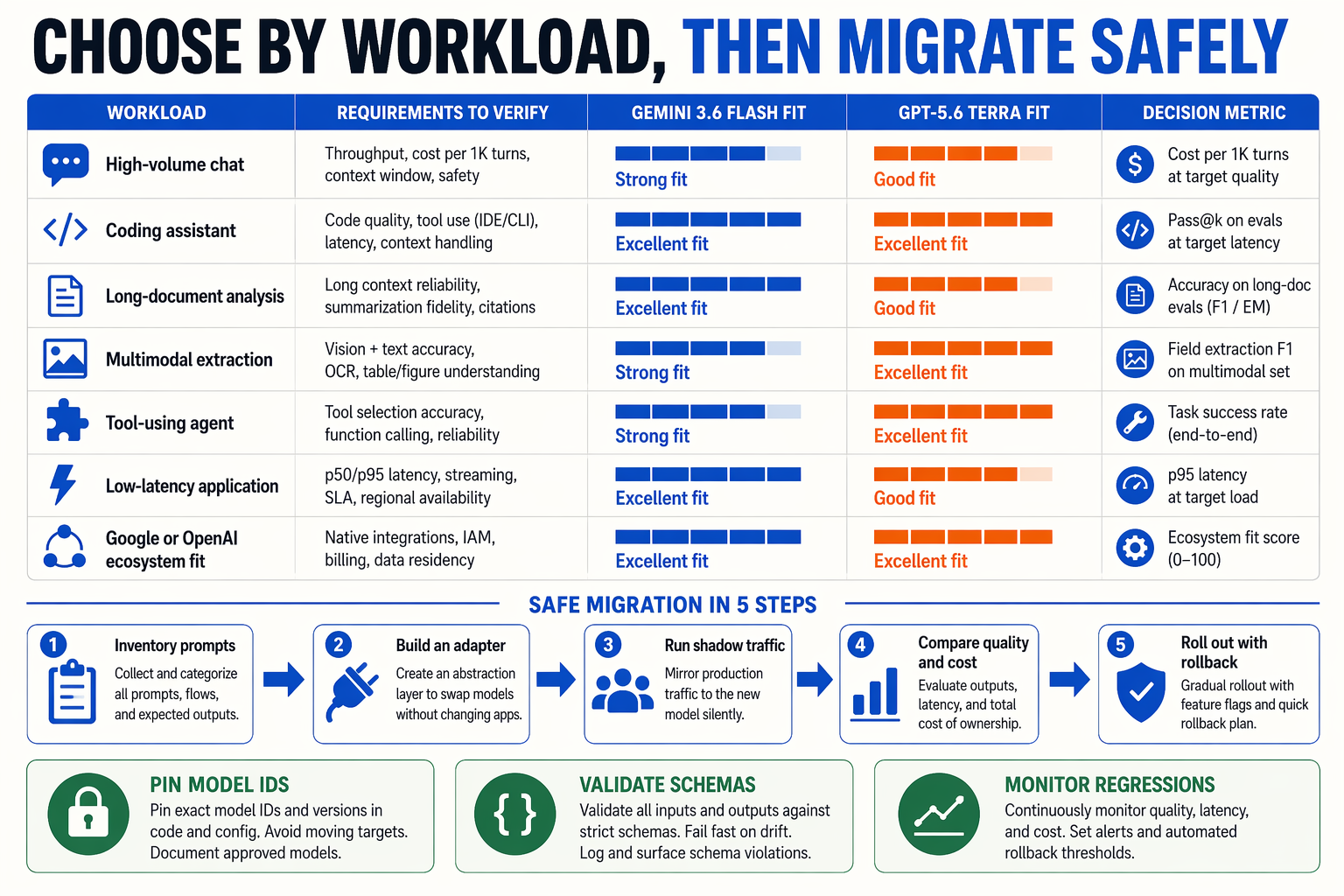
Neither Gemini 3.6 Flash nor GPT-5.6 Terra should be selected from positioning language alone. Choose the model that satisfies your documented API requirements and passes workload-specific tests for quality, latency, reliability, and total cost—with pinned model IDs and a tested rollback path.
Workload selection based on evidence
| Workload | Documented requirement to verify | Local test | Conditional decision rule |
|---|---|---|---|
| Customer conversations | Required languages, structured output, safety controls, and API availability | Measure resolution accuracy, escalation quality, p50/p95 latency, and cost per resolved case | Select a model only if it meets every mandatory requirement and the production acceptance threshold |
| Coding assistance | Tool support, output limits, and required API features | Test repository-level changes, compilation, regression tests, and valid tool arguments | Prefer the model with the higher pass rate on your repositories; do not infer coding quality from general positioning |
| Document extraction | Supported input formats, context capacity, and schema-output support | Measure field-level accuracy, schema validity, truncation, and failure handling | Deploy only if representative documents remain within verified limits and accuracy targets |
| Multimodal intake | Officially documented modalities, file constraints, and request limits | Exercise every required media type, size range, and malformed-input case | Use a model only for modalities explicitly supported by its current documentation and confirmed locally |
| Tool-using agents | Documented tool-calling interface and applicable limits | Measure tool selection, argument validity, loop rate, duplicate actions, and task completion | Select based on end-to-end task success, not conversational quality alone |
| Long-input analysis | Verified context and maximum-output limits | Test full-length inputs, retrieval accuracy, latency, token usage, and output truncation | Proceed only when both capacity and quality remain acceptable at realistic input lengths |
These rules make Gemini 3.6 Flash vs GPT-5.6 Terra a deployment decision rather than a universal ranking. Google describes Gemini 3.6 Flash as optimized for “real-world tasks at a higher speed and lower cost,” while OpenAI describes GPT-5.6 Terra as balancing “intelligence and cost”; neither statement proves suitability for a particular application without controlled testing.
A safe migration sequence
- Pin the verified model ID. Use
gemini-3.6-flashorgpt-5.6-terra, not an ambiguous family name or moving alias. Google’s model documentation states that stable models usually do not change unexpectedly and recommends specific stable models for most production applications.
- Confirm current API requirements. Before testing, record each model’s officially documented pricing, context and output limits, supported modalities, tool interface, regional availability, and rate limits. Mark any undocumented requirement as unknown rather than assuming parity.
- Freeze a representative evaluation set. Include routine, difficult, malformed, and adversarial inputs from the real workload. Score factual accuracy, instruction adherence, structured-output validity, latency, token consumption, and failure recovery separately.
- Normalize integration behavior. Explicitly map message roles, system instructions, tool schemas, streaming events, finish reasons, token accounting, retries, and errors. Similar concepts across APIs do not guarantee identical request or response semantics.
- Shadow, canary, and roll back. Run sanitized shadow traffic without executing side-effecting tools, then release to a small user segment. Expand only after predefined quality, p95 latency, error-rate, safety, and spending thresholds are met.
Lifecycle controls after migration
Google’s Gemini API release notes state that Gemini 3.6 Flash became generally available on July 21, 2026. Google’s deprecation schedule listed no shutdown date for gemini-3.6-flash as of July 21, 2026, but “no shutdown date” is not a permanent-lifetime guarantee.
Store the model ID, prompt version, evaluation results, and configuration with every release. Continue monitoring official lifecycle notices, pricing changes, rate limits, output truncation, and workload drift after deployment.
Frequently asked questions about Gemini 3.6 Flash vs GPT-5.6 Terra
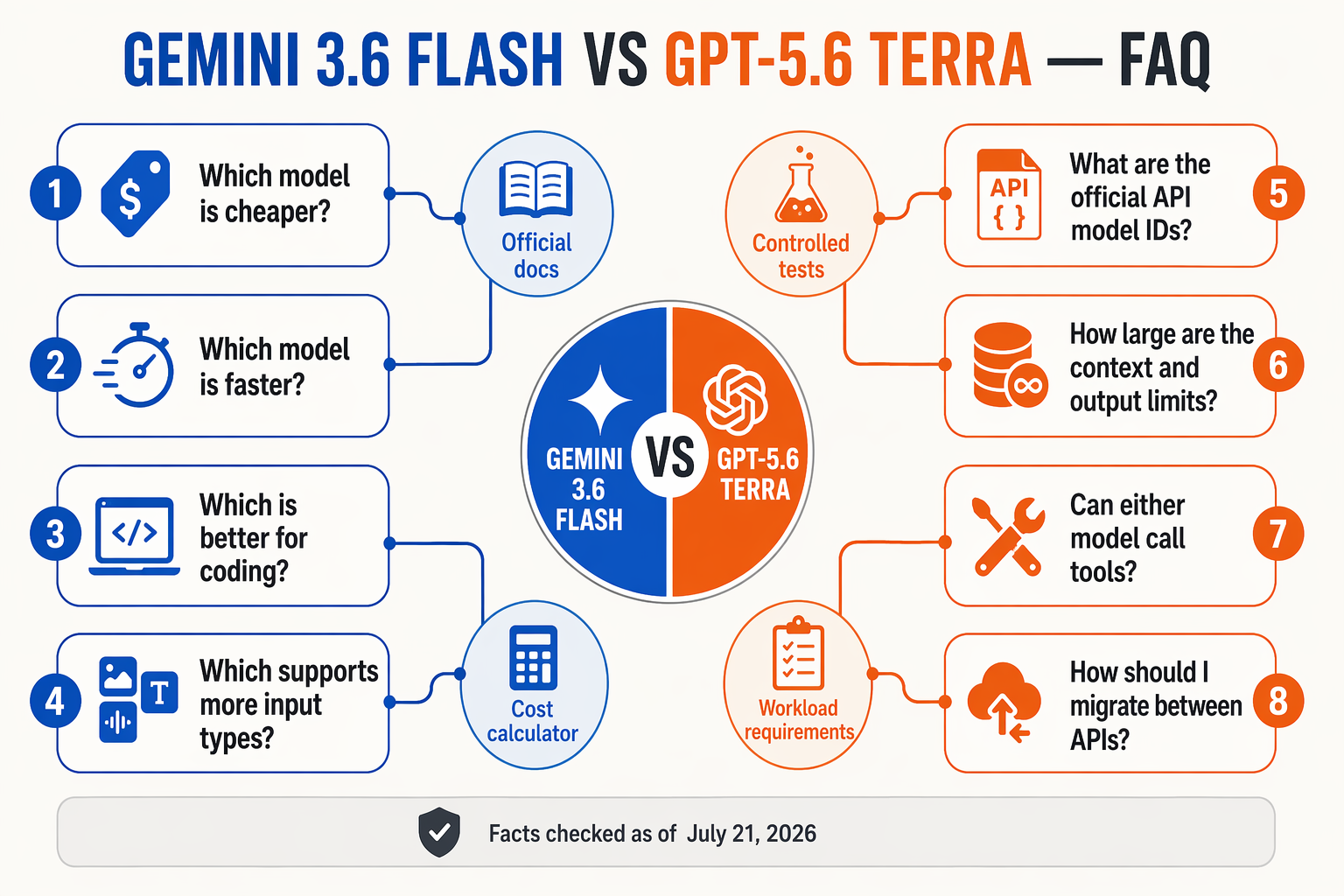
Which is better, Gemini 3.6 Flash or GPT-5.6 Terra?
What are the verified API model IDs for Gemini 3.6 Flash and GPT-5.6 Terra?
gemini-3.6-flash in Google’s documentation and gpt-5.6-terra in OpenAI’s model documentation. Google’s Gemini API release notes state that Gemini 3.6 Flash became generally available on July 21, 2026; the supplied evidence confirms OpenAI’s model listing but does not provide a corresponding GPT-5.6 Terra launch or GA date. Production applications should use the documented identifiers rather than infer aliases or version names.Is Gemini 3.6 Flash cheaper than GPT-5.6 Terra?
Which model has the larger context window and maximum output limit?
How do Gemini 3.6 Flash and GPT-5.6 Terra compare for coding and reasoning?
Do Gemini 3.6 Flash and GPT-5.6 Terra support multimodality and tools?
What is the lifecycle status of Gemini 3.6 Flash and GPT-5.6 Terra?
gemini-3.6-flash as a stable GA model released July 21, 2026, and Google’s deprecation documentation listed no shutdown date as of July 21, 2026. Google also states that stable models usually do not change and recommends specific stable versions for most production applications. The supplied evidence does not establish an equivalent lifecycle status or retirement schedule for gpt-5.6-terra, so consult OpenAI’s current official documentation.Conclusion
There is no universal winner in Gemini 3.6 Flash vs GPT-5.6 Terra. Both are official production models, but the right choice depends on verified pricing, context and output limits, latency, multimodal requirements, tool support, and performance on your own data—not a single benchmark score.
- API readiness is confirmed. Google’s Gemini API release notes state that
gemini-3.6-flashbecame generally available on July 21, 2026, with no shutdown date listed in Google’s deprecation schedule at that time. OpenAI’s API documentation identifiesgpt-5.6-terraas the production model ID for its intelligence-and-cost-balanced tier. This makes Gemini 3.6 Flash vs GPT-5.6 Terra a comparison between two official API models.
- Cost depends on the real token mix. Input volume, generated output, cached tokens, tool calls, and multimodal data can substantially change the effective bill. For a reliable Gemini 3.6 Flash vs GPT-5.6 Terra cost comparison, apply each provider’s official rates to representative production requests instead of relying on headline prices.
- Capacity does not guarantee application performance. Context windows and maximum-output limits determine whether repositories, long documents, or extended conversations require chunking. Coding quality, reasoning reliability, latency, and throughput still require workload-specific testing. Any unpublished or non-comparable specification should remain marked unknown, not replaced with an estimate.
- Best use depends on architecture. Google positions Gemini 3.6 Flash for “sustained frontier-level intelligence” with higher speed and lower cost. OpenAI describes GPT-5.6 Terra as balancing intelligence and cost in a tier roughly corresponding to earlier GPT-5 mini models. These positioning statements help frame Gemini 3.6 Flash vs GPT-5.6 Terra, but they do not replace controlled evaluations across coding, agents, extraction, chat, and multimodal pipelines.
The balanced verdict is simple: Gemini 3.6 Flash vs GPT-5.6 Terra should be decided through evidence from your workload. Monitor pricing revisions, model snapshots, lifecycle announcements, SDK changes, and reproducible latency or throughput results. Pin model versions where possible, maintain regression tests, track quality and cost, and preserve a tested fallback path.
To explore how multi-model AI communication is evolving, visit CallMissed, an AI infrastructure platform offering an OpenAI-compatible gateway alongside voice agents and multilingual chatbots. As these models evolve, will your architecture let you switch based on evidence rather than vendor lock-in?
Related Reading
- Gemini 3.5 Flash-Lite vs GPT-5.6 Terra: Official API, Price, Limits & Use Cases
- Gemini 3.6 Flash vs GPT-5.6 Luna: Full API, Price and Speed Comparison
- Gemini 3.6 Flash vs Claude Opus 4.8: Price, Speed, Limits and Best Uses
Sources
Related Posts
Ready to automate customer conversations?
Launch AI voice agents and WhatsApp bots with CallMissed — one API, 22+ Indian languages.