

Gemini 3.5 Flash-Lite vs GPT-5.6 Terra: Official API, Price, Limits & Use Cases


Gemini 3.5 Flash-Lite vs GPT-5.6 Terra comparison with verified API availability, pricing, limits, testing guidance and production-fit advice.
Gemini 3.5 Flash-Lite vs GPT-5.6 Terra: Official API, Price, Limits & Use Cases
What if the model in your production stack has no official API listing—or the “current” pricing page contradicts a release-note update published the same day? That is the practical question behind Gemini 3.5 Flash-Lite vs GPT-5.6 Terra, a comparison where model names, availability, limits, and costs must be verified against primary documentation before a team commits engineering time.
This topic matters on July 21, 2026 because Google’s Gemini API release notes state that Gemini 3.5 Flash-Lite reached general availability on July 21, 2026, alongside Gemini 3.6 Flash. Yet the Google Gemini Developer API pricing search result also contains language saying Flash-Lite was deprecated and shut down on June 1, 2026—a reminder that snippets, cached pages, and model-version labels can quickly become misleading. For production buyers, “Flash-Lite” is not enough: the exact official model ID, release channel, API surface, rate tier, and pricing unit determine whether an integration will work tomorrow.
The same discipline is essential for GPT-5.6 Terra. A popular comparison query or third-party model directory is not proof of an OpenAI API release. If OpenAI has not published an official model page, API reference, pricing entry, or deprecation notice for a specific GPT-5.6 Terra identifier, teams should treat claimed context windows, benchmark scores, token prices, and throughput figures as unverified, not as procurement-grade facts.
This comparison will separate documented specifications from assumptions. It will examine:
- Official availability and API IDs: whether Gemini 3.5 Flash-Lite and GPT-5.6 Terra can be selected through their respective first-party APIs.
- Price and operational cost: input, output, cached-token, tool-use, and multimodal charges, plus clear workload examples rather than vague “cheaper” claims.
- Context, output, and throughput limits: Google documentation says Gemini 3.5 Flash supports a 1 million-token context window, while Google’s Gemini 3.5 Flash-Lite model page lists a 65,536-token output limit.
- Quality and production fit: coding, structured extraction, long-document analysis, reasoning-heavy agents, multimodal workflows, and high-volume customer support.
- Tools and migration risk: Google’s Interactions API became generally available in June 2026 and is recommended by Google for new Gemini agent projects; tool support and API compatibility matter as much as raw model capability.
For teams that want optionality rather than a single-provider dependency, platforms such as CallMissed’s OpenAI-compatible AI gateway reflect a growing approach: one integration can provide access to multiple LLM, speech, image, and search capabilities, with model selection governed by verified requirements. The useful verdict is not which model has the louder name—it is which officially available model meets your latency, quality, language, compliance, and unit-economics targets.
Gemini 3.5 Flash-Lite vs GPT-5.6 Terra: Which model should you choose as of July 21, 2026?
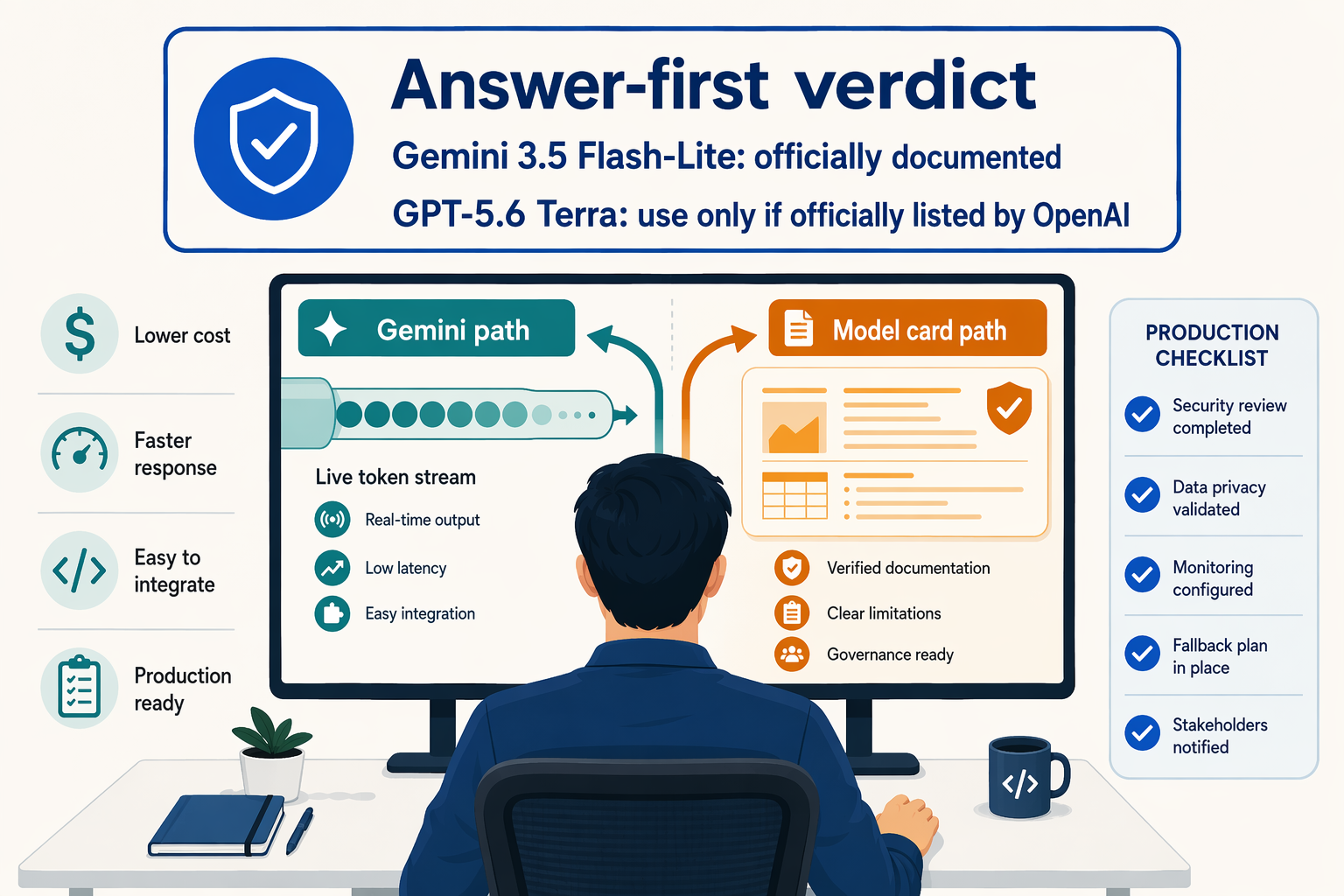
Neither model is the universal winner as of July 21, 2026. Choose Gemini 3.5 Flash-Lite for Gemini-native applications, Google Search grounding, and workloads that fit within its 1 million-token context and 65,536-token output limits. Choose GPT-5.6 Terra when its intelligence/cost-balanced positioning, 1,050,000-token context window, or substantially larger 128,000-token maximum output better matches the workload.
Both are officially documented API models. The decision should therefore be based on workload requirements, vendor ecosystem, measured quality and latency, and the official pricing applicable to the account—not on the previous claim that GPT-5.6 Terra is unverified.
At-a-glance verdict
| Decision factor | Gemini 3.5 Flash-Lite | GPT-5.6 Terra | Production implication |
|---|---|---|---|
| Official API model | Google documents gemini-3.5-flash-lite; general availability was announced on July 21, 2026 | OpenAI documents gpt-5.6-terra as its intelligence/cost-balanced tier | Both can be evaluated as official deployment options |
| Context window | 1,000,000 tokens | 1,050,000 tokens | Terra provides 50,000 additional context tokens, although either model can support very large prompts |
| Maximum output | 65,536 tokens | 128,000 tokens | Terra is the stronger fit when a single response may need to exceed Gemini’s output ceiling |
| Search grounding | Google documents support for Grounding with Google Search | Evaluate against the tools supported by the selected OpenAI API configuration | Gemini offers a documented path for Google Search-grounded workflows |
| Pricing decision | Use Google’s official Gemini API pricing for the applicable request type and tier | Use OpenAI’s official API pricing for Terra’s input, cached-input, output, and tool usage | Model the complete workload; context size alone does not determine cost |
| Best-fit signal | Gemini ecosystem, Google Search grounding, and workloads within a 65,536-token output ceiling | Intelligence/cost-balanced OpenAI workloads and unusually large generated outputs | Benchmark both with representative prompts before committing |
When to choose Gemini 3.5 Flash-Lite
Gemini 3.5 Flash-Lite is the more natural choice when the application already uses the Gemini API or depends on Google’s documented grounding capabilities. Google specifies a 1 million-token context window and a 65,536-token maximum output, providing substantial capacity for document analysis, customer transcripts, retrieval-augmented generation, and agent workflows.
Its strongest workload fits include:
- Google Search-grounded applications: Google officially documents Grounding with Google Search support for the model.
- Large-input, moderate-output tasks: The 1 million-token context window is suitable for extensive source collections when the final response remains within 65,536 tokens.
- Gemini-native agents: Teams using Google’s Gemini tooling and Interactions API can keep model access, grounding, and agent orchestration within the same platform.
- Existing Google deployments: Staying with Gemini may reduce integration and operational complexity when authentication, monitoring, safety controls, and data pipelines are already built around Google’s APIs.
Google’s rate-limit documentation must still be interpreted according to the stated metric, service tier, project, and account conditions. A listed limit should not be treated as guaranteed application throughput without load testing.
When to choose GPT-5.6 Terra
GPT-5.6 Terra is an official OpenAI model, not an unverified third-party label. OpenAI positions gpt-5.6-terra as an intelligence/cost-balanced tier and documents a 1,050,000-token context window with a 128,000-token maximum output.
Terra is the stronger candidate when:
- Responses may exceed 65,536 tokens: Its 128,000-token output ceiling is almost twice Gemini 3.5 Flash-Lite’s documented maximum.
- The workload needs the largest available context in this comparison: Terra provides 50,000 more context tokens, though the practical benefit depends on prompt construction and retrieval quality.
- The application is already built on OpenAI: Existing tool integrations, evaluations, observability, safety controls, and deployment infrastructure may outweigh small specification differences.
- Balanced intelligence and cost are the selection priority: Terra is explicitly positioned by OpenAI for this trade-off, but teams should confirm the fit with their own quality, latency, and billing tests.
A larger context or output limit does not automatically mean better quality, lower latency, or lower cost. Very large requests can increase processing time and token charges, while many applications never approach either model’s maximum limits.
Price and workload verdict
Do not declare a price winner from model names or headline token limits. Compare the current official Google and OpenAI API rates using the workload’s actual mix of input tokens, cached tokens, generated output, grounding or tool calls, batch processing, and service-tier requirements. Prices can also vary by feature or purchasing arrangement, so calculations should use the official rate applicable to the production account.
For a defensible decision, run the same representative evaluation set against both official model IDs and measure:
- Total billed cost per completed task.
- Accuracy and instruction-following quality.
- Time to first token and end-to-end latency.
- Reliability at the required concurrency.
- Tool-use, grounding, and structured-output success rates.
- Performance on the application’s longest real prompts and outputs.
The practical verdict is workload-dependent: Gemini 3.5 Flash-Lite is compelling for Google-integrated and Search-grounded applications that fit within its output limit, while GPT-5.6 Terra is preferable when OpenAI’s balanced tier or the 128,000-token output ceiling provides a concrete advantage. Teams without a decisive ecosystem requirement should benchmark both rather than choosing from specifications alone.
What are the official availability status and API IDs for Gemini 3.5 Flash-Lite and GPT-5.6 Terra?
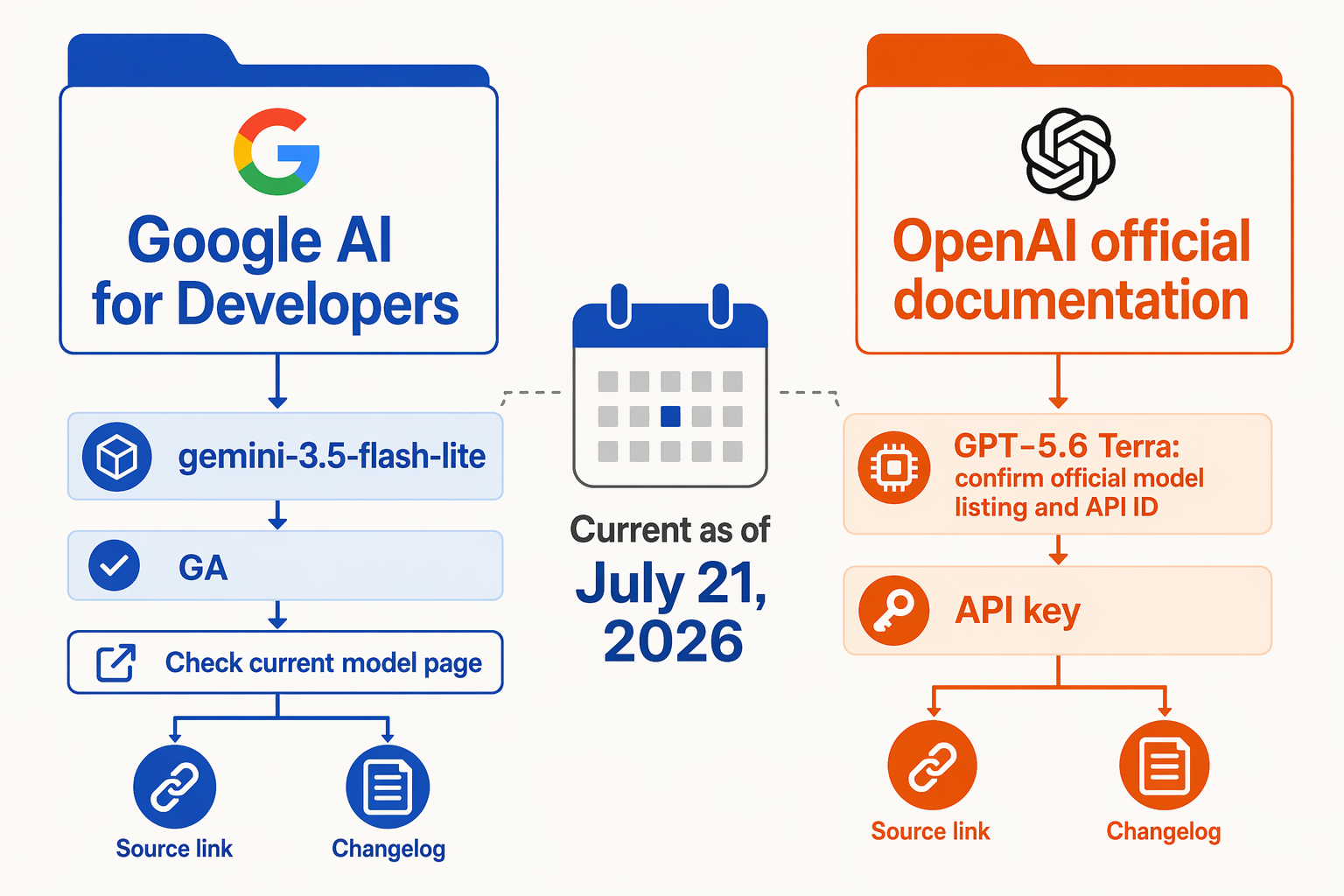
As of July 22, 2026, both Gemini 3.5 Flash-Lite and GPT-5.6 Terra are officially documented API models. Their respective API identifiers are gemini-3.5-flash-lite and gpt-5.6-terra.
Official status and identifiers
| Model | Official availability | API ID | Documented limits |
|---|---|---|---|
| Gemini 3.5 Flash-Lite | Generally available (GA) since July 21, 2026 | gemini-3.5-flash-lite | 1 million-token context window; 65,536-token maximum output |
| GPT-5.6 Terra | Officially available through the OpenAI API | gpt-5.6-terra | 1,050,000-token context window; 128,000-token maximum output |
Google’s Gemini API release notes state that Gemini 3.5 Flash-Lite became generally available on July 21, 2026. Google describes GA models as stable, making this release suitable for production planning rather than preview-only testing.
The official Gemini API model identifier is:
gemini-3.5-flash-liteGoogle documents a 1 million-token context window and a 65,536-token maximum output limit for Gemini 3.5 Flash-Lite. Developers should still confirm the limits, regional availability, rate limits, and quotas that apply to their chosen Gemini API surface and account tier.
OpenAI likewise officially documents GPT-5.6 Terra as an API model. Its model identifier is:
gpt-5.6-terraOpenAI documents GPT-5.6 Terra with a 1,050,000-token context window and a 128,000-token maximum output. These limits give Terra a slightly larger total context allowance and nearly twice Gemini 3.5 Flash-Lite’s documented maximum output capacity, although practical throughput and usable capacity can also depend on tools, reasoning tokens, account tier, and API rate limits.
Understand the older Gemini shutdown references
Older Google pricing or documentation references stating that “Flash-Lite” was deprecated and shut down on June 1, 2026 refer to earlier Flash-Lite model versions, not the new gemini-3.5-flash-lite release that reached GA on July 21, 2026.
Because Google has used the Flash-Lite name across multiple generations, teams should compare the complete API identifier rather than relying on the product-family name alone. In particular, verify that application code, pricing calculations, migration plans, and monitoring dashboards reference:
gemini-3.5-flash-liteThis version-specific distinction prevents an older model’s retirement notice from being incorrectly applied to Gemini 3.5 Flash-Lite.
For new agent implementations, Google states that the Interactions API became generally available in June 2026 and recommends it for new Gemini projects.
What changed in the Gemini and OpenAI model landscape? (TABLE)
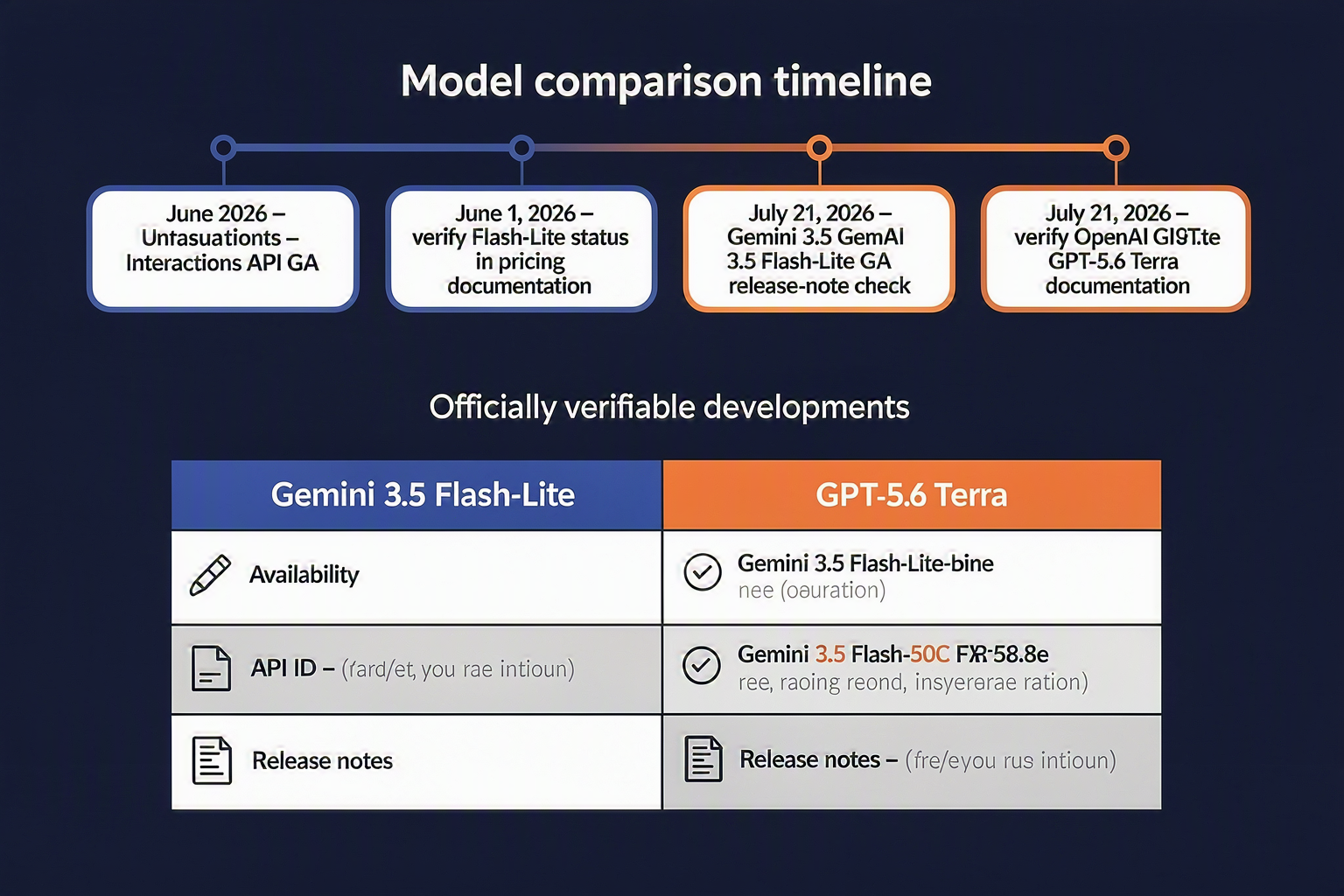
As of July 21, 2026, Gemini 3.5 Flash-Lite has a documented Google release, model ID, limits, and supported API features, while GPT-5.6 Terra has no supplied first-party OpenAI documentation for the exact model name. This is therefore a comparison of a verifiable Google API model against an unverified OpenAI label—not a basis for treating both models as equally purchasable production options.
What the official record shows
| Change area | Gemini 3.5 Flash-Lite | GPT-5.6 Terra | Production implication |
|---|---|---|---|
| Official availability | Google Gemini API release notes state that Gemini 3.5 Flash-Lite became generally available on July 21, 2026. | No supplied OpenAI model page, API reference, release note, or pricing entry verifies this exact model name. | Gemini 3.5 Flash-Lite can enter normal technical evaluation; GPT-5.6 Terra should remain unconfirmed until OpenAI publishes first-party records. |
| Official API ID | Google documents the model as gemini-3.5-flash-lite. | No official API identifier for GPT-5.6 Terra is available in the supplied documentation. | Do not convert a directory, search-result, or community label into a production model ID without validating it against the provider API. |
| Context and output limits | Google’s latest-model documentation lists a 1 million-token context window and 64K maximum output; the dedicated model page specifies 65,536 output tokens. | No verified context-window or maximum-output figure was supplied. | Long-context RAG, document analysis, and agent workflows can be sized around Gemini’s published limits; Terra capacity cannot be safely planned. |
| Rate-limit signal | Google’s rate-limits page lists 10,000,000 for Gemini 3.5 Flash-Lite, subject to the applicable limit category and account tier. | No official rate-limit, tokens-per-second, or throughput data was supplied. | Treat the Google figure as a rate-limit reference rather than a latency or speed guarantee; load-test using the limits assigned to the actual account. |
| Agent API direction | Google says the Interactions API became generally available in June 2026 and is recommended for new Gemini models and agents projects. | No API surface or agent guidance for this exact OpenAI model was supplied. | Teams building Gemini agents should validate Interactions API tool behavior early; no equivalent Terra implementation assumption is justified. |
| Search grounding | Google’s Interactions API documentation marks Grounding with Google Search as supported for Gemini 3.5 Flash-Lite. | No official tool-support matrix was supplied for GPT-5.6 Terra. | Search-grounded Gemini workflows have a documented path; Terra search, function-calling, and tool-use claims require primary-source confirmation. |
Why Gemini 3.5 Flash-Lite pricing requires a live-SKU check
The supplied Google search snippet for the Gemini Developer API pricing page includes the text, “Flash-Lite is deprecated and has been shut down June 1, 2026,” alongside price fragments such as “$0.075 Output price” and “$0.15 / 1M tokens.” That snippet does not establish that any quoted price or lifecycle statement applies to the exact GA model ID, gemini-3.5-flash-lite.
Before publishing a cost comparison or committing a budget, verify the live official pricing page on the deployment date:
- Confirm the page explicitly names
gemini-3.5-flash-lite, not an earlier Flash-Lite generation. - Capture distinct rates for input tokens, output tokens, cached input, Google Search grounding, and multimodal usage, where applicable.
- Record the account tier and relevant request/token limits alongside token prices.
- Do not calculate a GPT-5.6 Terra cost example until OpenAI publishes an exact-model SKU and official price card.
The meaningful landscape shift
Google’s July 21, 2026 release pairs a stable million-token-context Gemini model with an agent-oriented API and documented Google Search grounding. That makes Gemini 3.5 Flash-Lite a concrete option for teams that need published constraints before designing retrieval, tool-use, or high-volume workflows.
By contrast, GPT-5.6 Terra remains a name without supplied official OpenAI evidence for availability, API access, pricing, limits, or capabilities. Until that record exists, the technically responsible comparison is documentation versus absence of documentation—not assumed performance parity.
How do pricing, context window, output limits, and throughput compare?
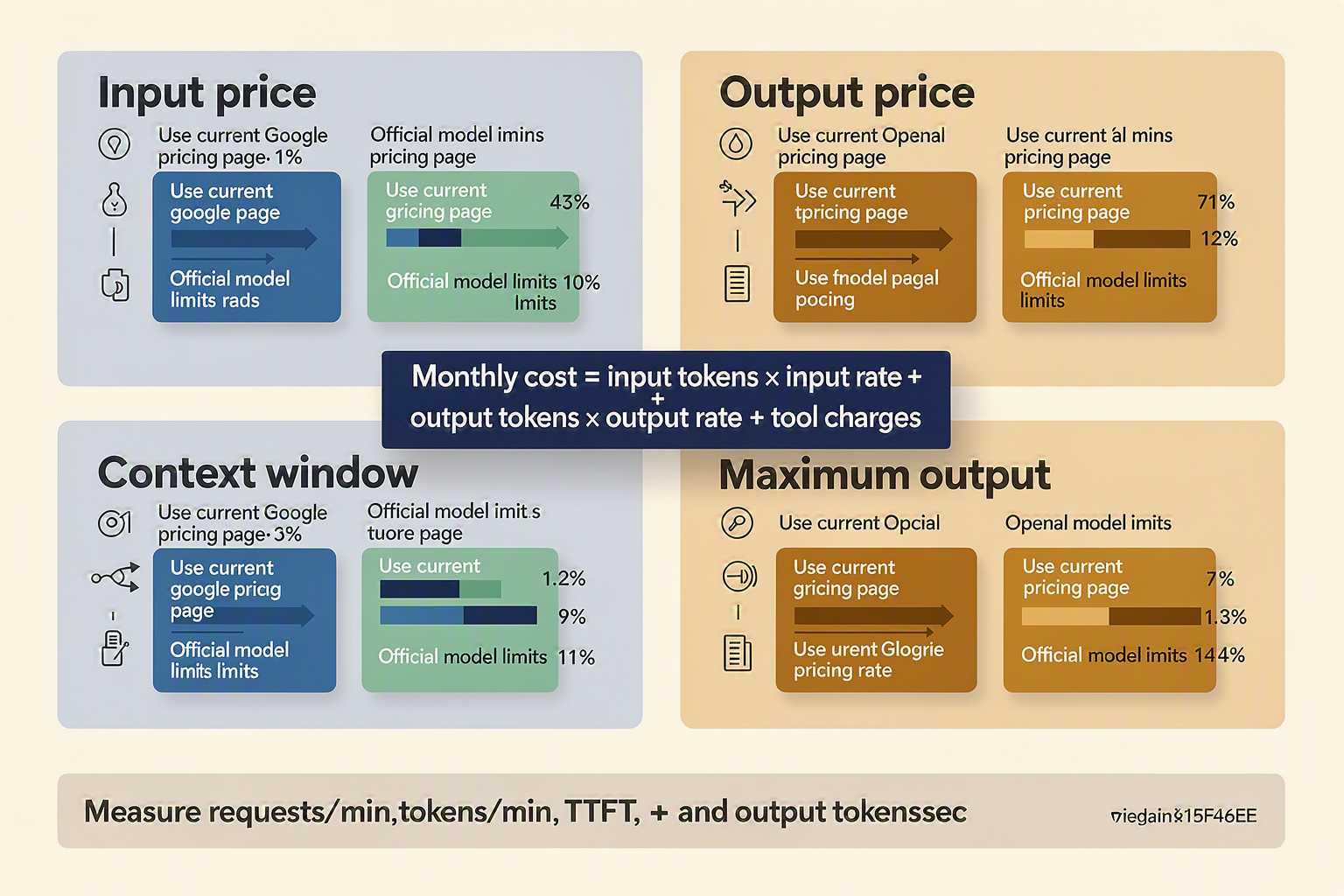
GPT-5.6 Terra has the larger documented capacity: its official model specification lists a 1,050,000-token context window and a 128,000-token maximum output, compared with Gemini 3.5 Flash-Lite’s 1,000,000-token context window and 65,536-token maximum output. These limits do not establish which model is faster or cheaper, however. Pricing must be matched to the exact API model ID, billing mode, and paid tier, while throughput depends on account-specific quotas.
Official capacity and quota comparison
| Dimension | Gemini 3.5 Flash-Lite | GPT-5.6 Terra | Practical implication |
|---|---|---|---|
| Context window | 1,000,000 tokens | 1,050,000 tokens | Terra provides 50,000 additional tokens of total context capacity; both can process very large documents and conversation histories. |
| Maximum output | 65,536 tokens | 128,000 tokens | Terra permits almost twice as many generated tokens in one response, although applications should normally set lower output caps for cost and latency control. |
| Real-time throughput | Varies by project, usage tier, region, and current quota | Varies by account, usage tier, and model-specific limits | Neither context size nor a Batch API allowance represents live requests-per-minute or tokens-per-minute throughput. |
| Batch capacity | Google documents a 10,000,000 enqueued-token allowance for Gemini 3.5 Flash-Lite where that Batch API quota applies | Check the model’s current Batch API and account-tier limits | Enqueued tokens measure how much work may be waiting in the batch queue, not interactive generation speed. |
| API price | Verify the exact Gemini 3.5 Flash-Lite model ID, paid tier, and standard-versus-batch rate on Google’s live pricing page | Verify the exact GPT-5.6 Terra API model ID and standard-versus-batch rate on OpenAI’s live pricing page | Do not mix cached-input, standard input, output, or discounted batch rates. |
Google’s first-party Gemini model documentation specifies a 1 million-token context window and a 65,536-token maximum output for Gemini 3.5 Flash-Lite. OpenAI’s official GPT-5.6 Terra specification lists a 1,050,000-token context window and a 128,000-token maximum output.
Those are model-capacity limits, not guarantees that a request of that size will be accepted under every account configuration. Tool definitions, conversation history, retrieved content, and requested output can all consume available context.
Pricing requires exact model and tier matching
A defensible cost comparison must use the live first-party price attached to each exact API identifier. Search-result snippets or prices for an earlier Flash-Lite, preview model, cached-input SKU, or Batch API tier should not be assigned to Gemini 3.5 Flash-Lite. The same rule applies to GPT-5.6 Terra.
Before approving a budget, record these rates separately:
- Standard input tokens.
- Cached input tokens, if supported.
- Standard output tokens.
- Batch input and output tokens, if batch processing will be used.
- Tool, grounding, storage, or other separately billed features.
Then calculate each model’s projected cost using the expected input/output mix rather than comparing only the headline input rate. Long outputs can dominate spending, particularly when Terra’s 128,000-token output capacity is used.
Throughput and production planning
The 10,000,000-token figure in Google’s rate-limit documentation is a Batch API enqueued-token allowance. It indicates how many tokens may be queued for asynchronous processing under the applicable quota; it is not a context window, real-time token rate, or promise of processing 10 million tokens per minute.
Interactive capacity should instead be planned from the provider console’s model- and tier-specific requests-per-minute, tokens-per-minute, concurrent-request, and daily limits. Benchmarking should also account for prompt length, generated-token count, tool calls, retries, regional availability, and time to first token.
For high-volume Indian customer engagement, CallMissed’s OpenAI-compatible AI gateway can keep the application layer portable while teams validate both models under representative traffic. Gemini 3.5 Flash-Lite offers a verified million-token context and 65,536-token output ceiling; GPT-5.6 Terra offers slightly more context and a substantially larger 128,000-token output ceiling. The final choice should follow a tier-matched price calculation and real workload benchmark, not the Batch API queue allowance.
Which model is better for reasoning, coding, and benchmark-sensitive work?
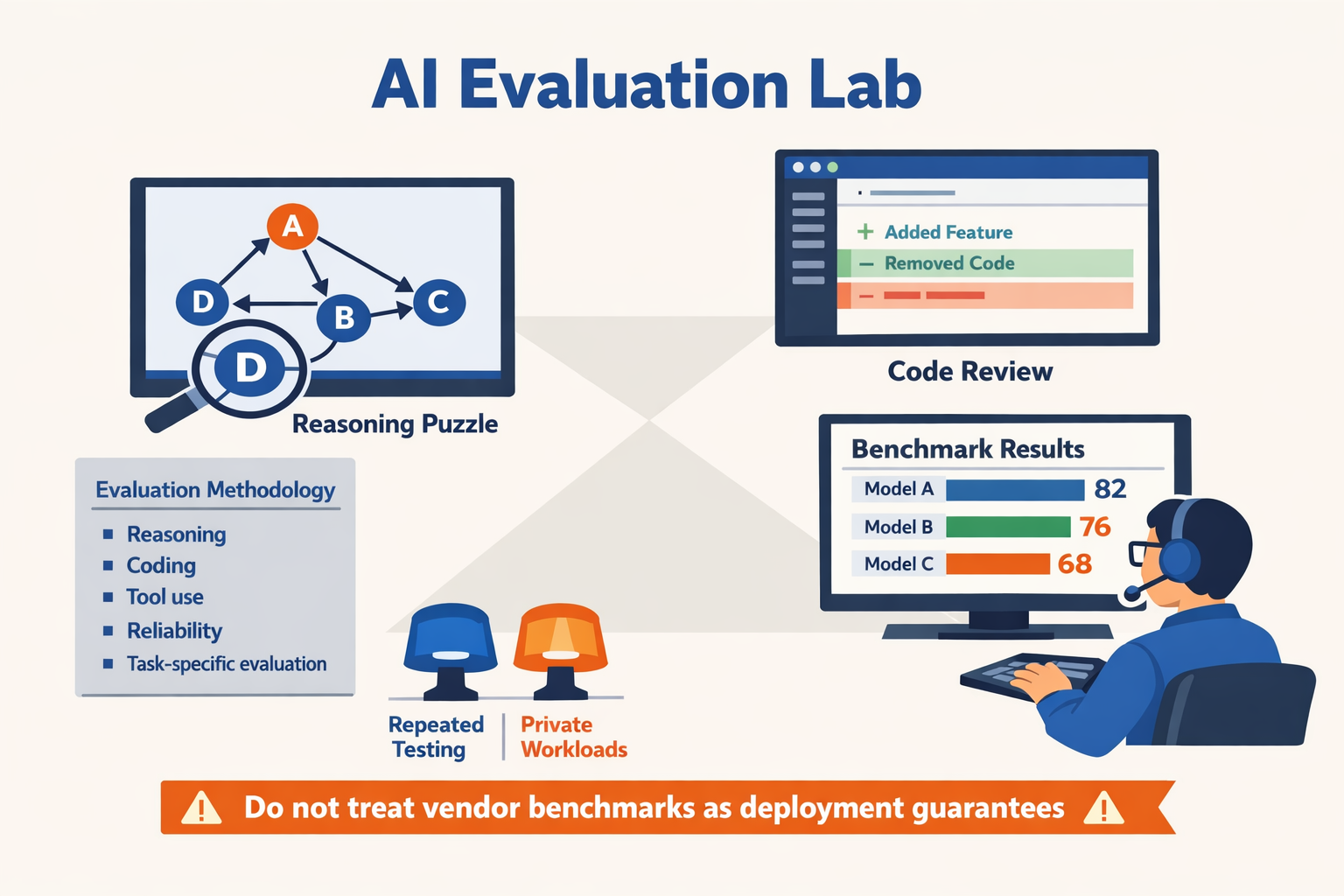
Gemini 3.5 Flash-Lite is the only model in this 1-v-1 comparison with documented, first-party evidence for production evaluation as of July 21, 2026. Google lists Gemini 3.5 Flash-Lite as generally available, while no official OpenAI model page, API reference, pricing entry, or benchmark report provided here verifies that a model called GPT-5.6 Terra is publicly available.
That does not prove GPT-5.6 Terra is weak; it means no responsible comparison can assign it reasoning, coding, or benchmark scores without primary OpenAI documentation.
Reasoning: evaluate the workflow, not an unverified score
For reasoning-sensitive work, Gemini 3.5 Flash-Lite has a credible production case because Google documents its availability and agent-oriented tool support. Google’s Gemini API release notes state that Gemini 3.5 Flash-Lite reached general availability on July 21, 2026.
Reasoning quality should be tested on the exact task a business needs, including:
- Multi-step decisions: Can the model apply policies in the correct order?
- Long-context synthesis: Can it identify conflicting clauses across a large contract or knowledge base?
- Grounded answers: Can it use approved sources rather than confidently inventing details?
- Structured outputs: Can it consistently return valid JSON, classifications, or workflow actions?
Google’s latest-model documentation says Gemini 3.5 Flash-Lite supports a 1 million-token context window and a 64K maximum output in the Interactions API. That capacity can matter more than a generic reasoning benchmark when an agent must inspect large product catalogs, support archives, policy manuals, or multiple documents in one request.
Coding: use reproducible repository-level tests
There is no verified basis in the supplied first-party context to declare a coding winner between Gemini 3.5 Flash-Lite and GPT-5.6 Terra. Teams should not substitute leaderboard claims, anonymous social posts, or third-party directories for a repeatable coding evaluation.
A useful coding scorecard includes:
- Pass rate on internal unit tests after the model modifies a real codebase.
- Diff quality, including whether changes are minimal, readable, and aligned with repository conventions.
- Tool-use reliability, such as choosing the right file search, test, or deployment action.
- Repair efficiency, measured by how many model turns are needed after a failed test.
- Security review findings for generated authentication, payment, and data-handling code.
Google states that the Interactions API became generally available in June 2026 and recommends it for new Gemini agent projects. Google also lists Grounding with Google Search as supported for Gemini 3.5 Flash-Lite. Those documented capabilities are relevant for coding agents that need current documentation or evidence-backed research, though web grounding is not a replacement for tests, code review, or dependency scanning.
Benchmark-sensitive procurement: treat missing evidence as a decision signal
Benchmarks are useful only when they name the exact deployed model version, configuration, prompt policy, tool access, and evaluation date. A “GPT-5.6 Terra” score without an official model identifier cannot establish equivalence with an API product your engineering team can call.
For a defensible selection decision:
- Choose Gemini 3.5 Flash-Lite when you need a currently documented Google API model, large-context agent workflows, and verifiable tool support.
- Keep GPT-5.6 Terra in a watchlist until OpenAI publishes its official API ID, availability, pricing, limits, and model-card or benchmark evidence.
- Run a blinded evaluation using your own prompts before treating any public benchmark as procurement evidence.
For multilingual customer-facing agents, this evaluation should also include language quality and escalation behavior. Indian platforms such as CallMissed add a practical layer here: CallMissed supports AI voice and chat across 22 Indian languages, enabling teams to test the LLM alongside real WhatsApp, voice, and knowledge-base workflows rather than evaluating reasoning in isolation.
How do multimodality, grounding, tools, and agent workflows differ?
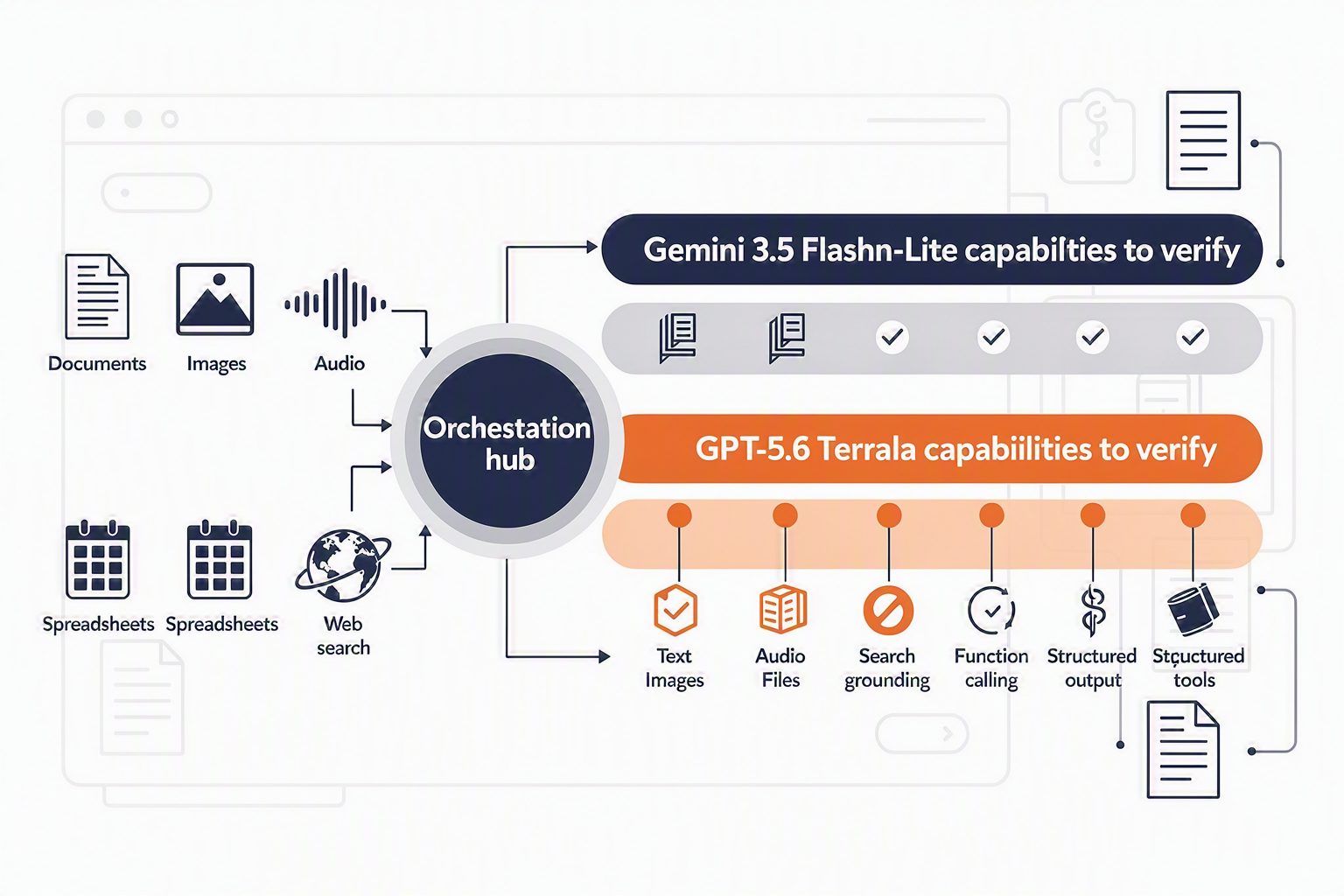
Gemini 3.5 Flash-Lite has documented Google-native grounding and agent tooling, while GPT-5.6 Terra has no verifiable official OpenAI API documentation as of July 21, 2026. That means a production team can evaluate Gemini 3.5 Flash-Lite’s supported workflow features, but should not assume that GPT-5.6 Terra supports vision, audio, web search, function calling, or agent orchestration until OpenAI publishes a first-party specification.
Multimodality: documented capability versus an unverified claim
Google’s official Gemini 3.5 Flash-Lite model page identifies audio among the model’s capabilities and specifies a 65,536-token output limit. The model is part of the Gemini multimodal ecosystem, but teams should validate the exact input modalities and media limits in the API surface they intend to use rather than equating a family-level capability with every endpoint or release channel.
For GPT-5.6 Terra, there is no official OpenAI model page, API reference entry, or pricing record in the available source material. Consequently, none of the following can be treated as confirmed:
- Image understanding or image generation
- Audio input, transcription, or speech output
- Video support
- Structured outputs or JSON-schema enforcement
- Contextual limits for multimodal files
This is not a judgement on GPT-5.6 Terra’s potential capabilities; it is a verification boundary. A third-party directory, benchmark card, or comparison page cannot establish production API support.
| Workflow capability | Gemini 3.5 Flash-Lite | GPT-5.6 Terra |
|---|---|---|
| Official model documentation | Yes, from Google AI for Developers | Not verified from OpenAI |
| Audio capability | Listed on Google’s model page | Not verified |
| Google Search grounding | Supported | Not verified |
| Agent-oriented API | Interactions API supported | Not verified |
| Tool and function schema | Validate against Gemini API docs | No official specification available |
Grounding and tool use
Gemini 3.5 Flash-Lite supports Grounding with Google Search in the Gemini Interactions API, according to Google AI for Developers’ grounding documentation dated July 21, 2026. Search grounding is useful when an answer must be tied to fresh web information—for example, checking current product availability, researching a policy change, or citing recently published information.
Google AI for Developers states that the Interactions API became generally available in June 2026 and is recommended for new Gemini agent projects. This matters because an agent is more than a text-generation call: it needs a durable interaction state, tool invocations, retrieval context, and observable execution paths.
A practical Gemini 3.5 Flash-Lite workflow can combine:
- A user request submitted through the Interactions API.
- Google Search grounding when the task requires current public-web facts.
- Application tools, such as a CRM lookup, order-status service, or inventory API.
- A constrained final response based on returned tool data rather than model inference alone.
For Indian customer-engagement deployments, the distinction is especially relevant. Platforms such as CallMissed combine AI voice agents, WhatsApp automation, knowledge-base RAG, and communication workflows; reliable tool boundaries help an agent retrieve an order record or appointment slot instead of inventing one.
Agent-workflow decision
Choose Gemini 3.5 Flash-Lite when Google Search grounding and the GA Interactions API fit the workflow and the team can test the documented model behavior in its own environment. Google’s release notes state that Gemini 3.5 Flash-Lite became generally available on July 21, 2026, providing a concrete release status for deployment planning.
Do not select GPT-5.6 Terra for a tool-using or multimodal production workflow on the basis of claimed third-party features. Until OpenAI publishes its API ID, supported tools, modalities, and operational constraints, the responsible comparison result is “not independently verifiable,” not “feature parity.”
How can you run a fair speed, quality, and cost test before production?
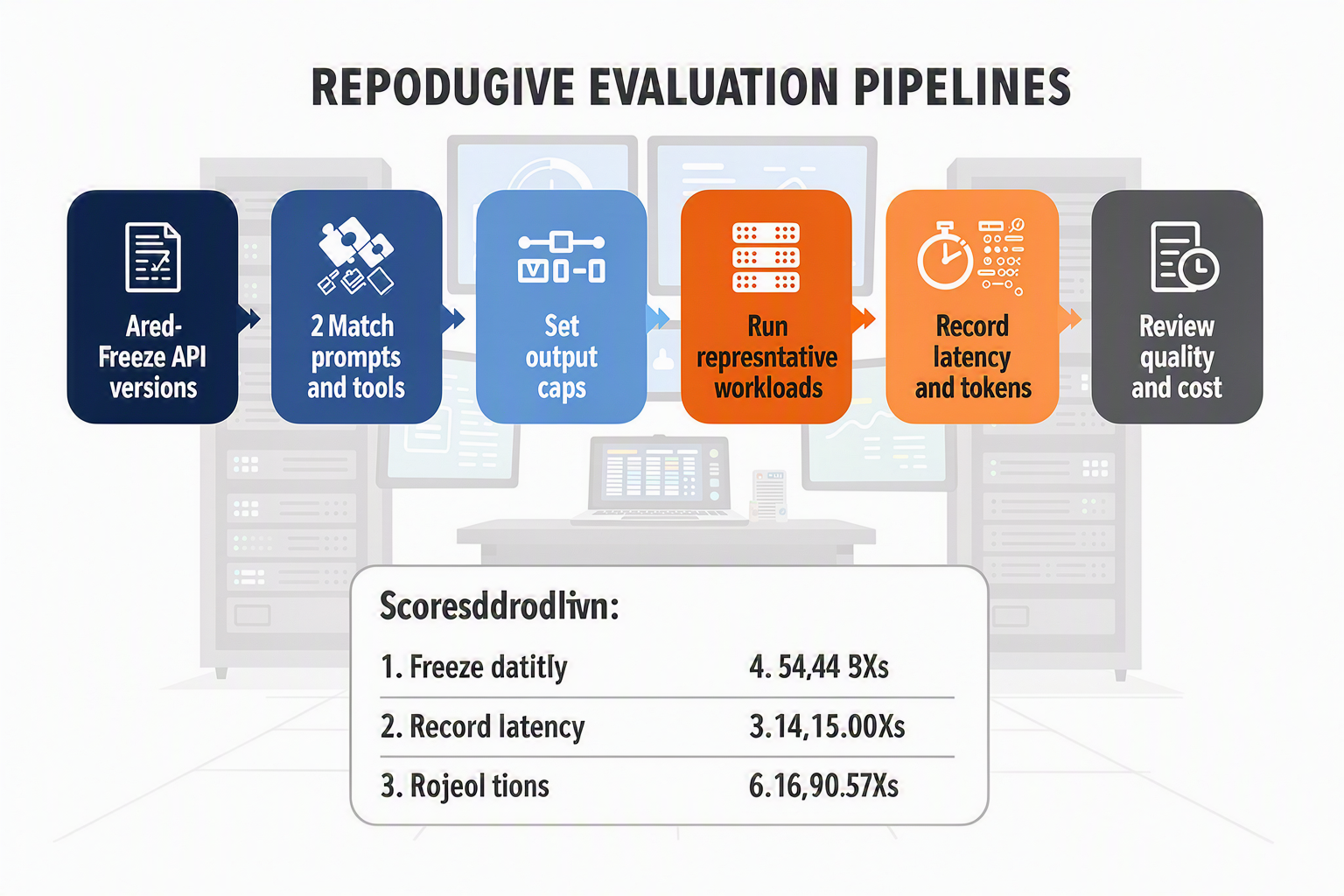
A fair pre-production test is possible only when both models have official, callable API identifiers and documented billing. As of July 21, 2026, teams can test Gemini 3.5 Flash-Lite through Google’s documented Gemini API surfaces, but should not assign a numerical score, price, or latency result to GPT-5.6 Terra unless OpenAI publishes an official API model ID and pricing documentation for that exact model.
Start with an eligibility gate
Do not let a third-party playground, benchmark chart, or reseller listing substitute for first-party availability. Before running the comparison, record:
- Exact model ID and API version used in every request.
- Region, account tier, and rate-limit tier, because these affect observed throughput.
- Prompt, system instruction, tool configuration, and decoding settings.
- Date and documentation snapshot, since model aliases and pricing can change.
Google AI for Developers listed Gemini 3.5 Flash-Lite as generally available on July 21, 2026, according to the Gemini API release notes. Google’s model documentation lists a 65,536-token output limit for Gemini 3.5 Flash-Lite, while Google’s latest-model guidance describes a 1 million-token context window and a 64k maximum output for the latest model workflow. Resolve such documentation differences by logging the exact endpoint and model page consulted, rather than silently treating near-identical figures as interchangeable.
For GPT-5.6 Terra, the correct result is “not testable from verified official documentation” until OpenAI confirms the identifier. That is not a loss for the evaluation; it prevents a misleading apples-to-oranges procurement decision.
Use a matched workload suite
A useful pilot contains 100–500 representative tasks, sampled from production rather than synthetic “hero prompts.” Split the suite by the work the model must actually perform:
- Structured extraction: invoices, leads, support tickets, and CRM updates; score exact JSON-schema validity and field-level F1.
- Customer-support drafting: use blinded human reviewers to score factuality, policy adherence, tone, and resolution completeness.
- Coding and reasoning: run unit tests, measure pass rate, and separately flag unsupported assumptions.
- Long-context tasks: place relevant evidence at different positions in a large document set, then measure retrieval accuracy and citation correctness.
- Tool-using workflows: test search, grounding, and function-call success independently from text quality.
Google’s Interactions API became generally available in June 2026 and is Google’s recommended API for new Gemini agent projects, according to Google AI for Developers. Google also documents Grounding with Google Search support for Gemini 3.5 Flash-Lite, so a fair test must compare tool-enabled and tool-disabled runs separately; grounding can improve freshness but adds latency and potentially changes cost.
Measure latency, throughput, quality, and cost separately
Report percentiles, not just averages:
- Time to first token (TTFT): p50, p95, and p99.
- End-to-end latency: from request submission through the final token or tool result.
- Sustained throughput: successful requests per minute and tokens per minute under realistic concurrency.
- Reliability: timeout, rate-limit, malformed-output, and retry rates.
- Unit economics: median and p95 cost per completed task, including input, output, cached tokens, and tool calls.
Google’s rate-limit documentation lists 10,000,000 for Gemini 3.5 Flash-Lite in its rate-limit table, but teams should verify the applicable unit and tier in their own account before treating that figure as deployable capacity. A 60-second burst test is insufficient; run at least a 30–60 minute sustained load test with warm-up requests excluded.
Make the production decision reversible
Select the model that clears predefined quality and service-level thresholds at the lowest completed-task cost, not the lowest token price. Keep prompts, evaluation datasets, and routing logic provider-neutral so a verified alternative can be introduced later.
For teams serving Indian audiences, platforms such as CallMissed’s OpenAI-compatible AI gateway provide a practical routing layer across multiple model providers, alongside Indic-first speech capabilities in 22 Indian languages. That architecture makes it easier to retain test evidence, set fallback rules, and avoid tying a production workflow to an unverified model name.
How should teams migrate or select a model for production?

Teams should select Gemini 3.5 Flash-Lite only after validating its live API identifier and quota in their own Google AI Studio or Gemini API project, while treating GPT-5.6 Terra as unavailable for production procurement unless OpenAI publishes first-party API documentation, pricing, and lifecycle terms. The safe migration strategy is therefore an evidence-led rollout—not a model-name swap.
Start with an availability gate
Before writing adapters or moving traffic, classify each candidate into one of two states:
- Officially production-verifiable: Google’s Gemini API release notes state that Gemini 3.5 Flash-Lite became generally available on July 21, 2026. Teams should confirm the current stable model ID in the Gemini API model catalog, rather than relying on search snippets or legacy aliases.
- Unverified: If GPT-5.6 Terra does not appear in official OpenAI API model documentation, pricing, and reference material, do not use third-party directory claims as a substitute for a production contract. There is no responsible way to estimate its token cost, latency, context window, or deprecation risk without those sources.
This distinction is operationally important: an undocumented identifier can break a deployment before quality testing even begins.
Use a staged selection framework
For Gemini 3.5 Flash-Lite, test the workload rather than assuming that “Lite” means every task is low stakes. Google’s Gemini API documentation lists a 65,536-token output limit for Gemini 3.5 Flash-Lite, while Google’s latest-model guidance describes 1 million-token context support for the latest Gemini model family. Confirm the exact limits enabled for the selected endpoint and project tier before setting product guarantees.
Score a candidate model against production requirements:
- Quality: Build a held-out evaluation set from real, permissioned tickets, documents, code tasks, and multilingual prompts.
- Latency: Measure p50, p95, and p99 end-to-end response time—including retrieval, tool calls, retries, and streaming—not just model generation time.
- Cost: Track input tokens, output tokens, cached context, search grounding, and failed/retried requests separately.
- Reliability: Test malformed JSON, tool-call failures, rate-limit responses, safety blocks, and provider outages.
- Language fit: For Indian customer workflows, evaluate Hindi and relevant regional languages with native speakers rather than English-translated test prompts.
Google’s rate-limit documentation lists 10,000,000 tokens per minute for Gemini 3.5 Flash-Lite, but teams should verify the quota actually assigned to their billing tier and project. A published ceiling is not the same as guaranteed application throughput.
Migrate with a reversible architecture
A safe rollout has four steps:
- Create a provider-neutral request schema for messages, tools, structured outputs, metadata, and error handling.
- Run shadow traffic through Gemini 3.5 Flash-Lite without exposing results to users; compare output quality, schema validity, cost, and latency against the incumbent.
- Canary release by intent, starting with lower-risk classification, extraction, summarisation, or FAQ tasks before autonomous actions or customer-facing escalation.
- Keep rollback controls: feature flags, request logging with sensitive-data redaction, rate-limit backoff, and a tested fallback model.
For new Gemini agent implementations, Google states that its Interactions API became generally available in June 2026 and is recommended for new projects. Gemini 3.5 Flash-Lite also supports Grounding with Google Search, according to Google’s Interactions API documentation, so teams should separately evaluate grounded-answer accuracy and the additional cost/latency of search-enabled requests.
Build for model optionality
A multi-provider abstraction is valuable only when it preserves model-specific controls and observability. Solutions such as CallMissed’s OpenAI-compatible AI gateway let developers use one integration across multiple model providers while retaining the option to route workloads based on verified availability, price, language support, and failure behavior. For this specific comparison, the immediate production choice is clear: validate Gemini 3.5 Flash-Lite in a controlled pilot, and defer any GPT-5.6 Terra migration until OpenAI publishes authoritative specifications.
What does Gemini 3.5 Flash-Lite vs GPT-5.6 Terra mean for your workload? (TABLE)
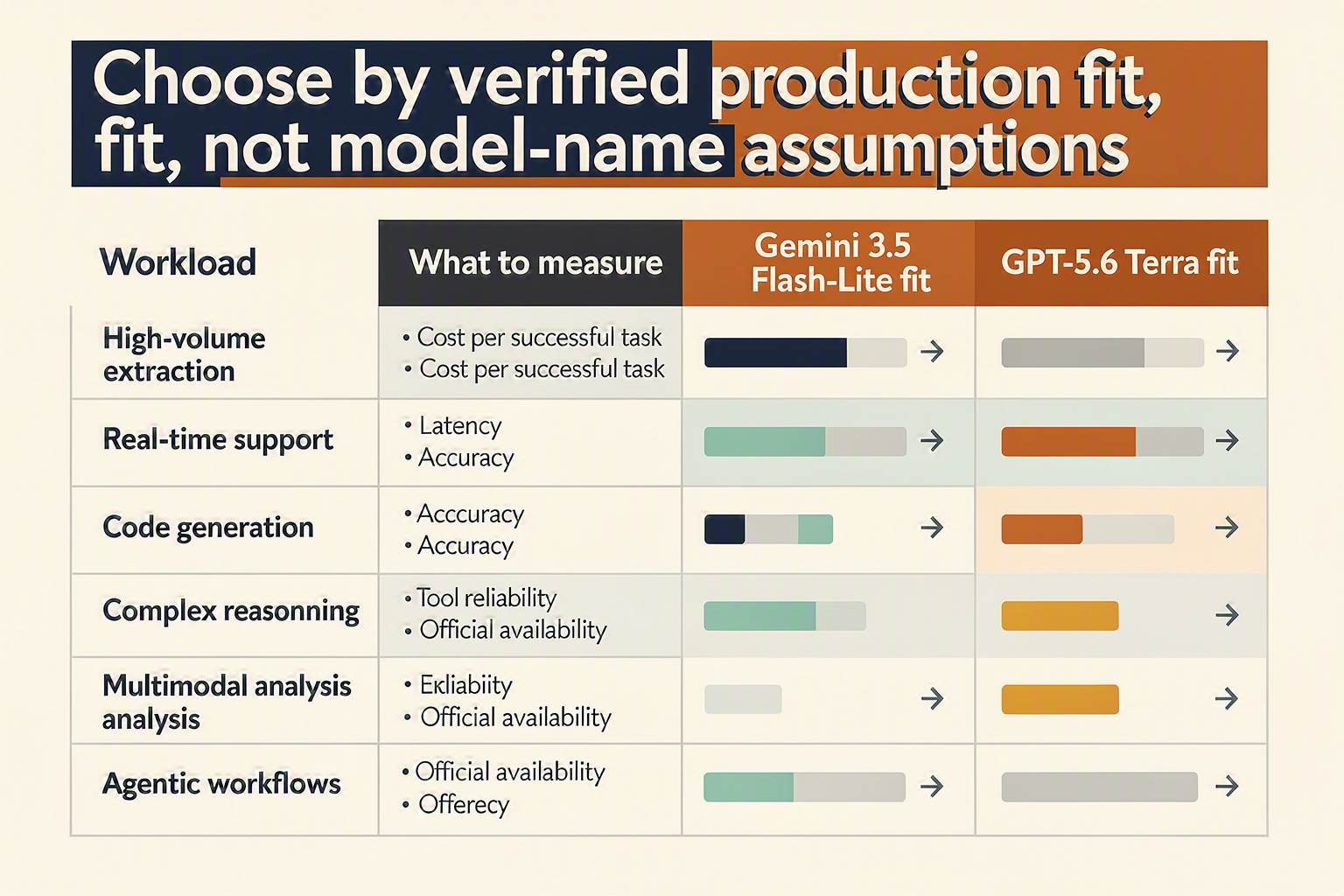
For production workloads, Gemini 3.5 Flash-Lite vs GPT-5.6 Terra is not yet a symmetrical model comparison. Gemini 3.5 Flash-Lite is actionable only after teams verify its live API identifier, availability, quotas, and billing status. GPT-5.6 Terra should remain outside production planning until OpenAI publishes first-party API documentation.
The practical question in Gemini 3.5 Flash-Lite vs GPT-5.6 Terra is not which model name sounds more capable. Engineering, procurement, security, and support teams need to validate the exact endpoint, documented limits, tool support, service status, and invoice line items before selecting a model.
| Workload | Gemini 3.5 Flash-Lite implication | GPT-5.6 Terra implication | Production decision |
|---|---|---|---|
| High-volume classification | The lightweight Gemini tier is suited to short, repeatable tasks such as intent routing, tagging, and extraction, subject to confirmed availability and active pricing. | No official OpenAI API ID, pricing, or limits are available in the primary-source context reviewed here. | Test Gemini with a small amount of paid traffic; do not plan Terra capacity. |
| Long-document analysis | Google’s latest-model guidance says Gemini 3.5 Flash-Lite supports a 1 million-token context window. | Any claimed Terra context window is not procurement-grade without supporting OpenAI documentation. | Gemini is the documented candidate for large document sets, but teams should still test retrieval quality, latency, and cost. |
| Large structured responses | Google’s Gemini 3.5 Flash-Lite model page lists a 65,536-token output limit; Google’s latest-model guide describes this as 64k max output. | Terra output limits remain unverified. | Set response caps well below the maximum and evaluate JSON and schema compliance on real data. |
| Search-grounded agents | Google’s Grounding with Google Search documentation marks Gemini 3.5 Flash-Lite as supporting Google Search grounding. | Terra tool and grounding support cannot be assumed from third-party listings. | Gemini provides a documented route for citation-aware search workflows, subject to feature pricing and regional availability. |
| Agentic customer operations | Google states that the Interactions API became GA in June 2026 and recommends it for new Gemini projects. | No official Terra endpoint or agent API surface is established in the available evidence. | Build new Gemini agents on the Interactions API while keeping orchestration and model routing portable. |
| Burst traffic and throughput | Google’s rate-limit page lists 10,000,000 for Gemini 3.5 Flash-Lite, but teams must verify the applicable metric, tier, unit, project quota, and account eligibility. | No verified Terra rate-limit data is available. | Load-test the quota assigned to the actual production project rather than relying on directories or headline figures. |
Where Gemini 3.5 Flash-Lite fits
In the Gemini 3.5 Flash-Lite vs GPT-5.6 Terra workload decision, Gemini is most relevant when an application combines high request volume, long context, controlled outputs, and Google-native tools. Google’s documented 1 million-token context window may reduce the need to split a large policy library, product catalogue, or multi-document case file across many prompts.
A large context window does not eliminate the need for retrieval design. Teams should measure whether the model consistently finds the correct passages, follows instructions placed deep in the prompt, and maintains acceptable latency as input size increases.
Practical workloads include:
- Support triage: Classify incoming WhatsApp, email, voice, and web requests before routing only difficult cases to a larger reasoning model or human agent.
- Regional knowledge retrieval: Supply a substantial retrieved knowledge base, then enforce a short answer budget to control latency and spending.
- Search-grounded assistance: Use Google Search grounding when current public information matters and citations or source verification are part of the workflow.
- Batch extraction: Convert invoices, forms, transcripts, and product records into validated fields while measuring schema compliance against representative samples.
- Conversation summarisation: Compress long customer histories into concise handoff notes, with checks for missing commitments, dates, and escalation details.
For Indian customer-engagement deployments, the model choice should also be evaluated alongside the channel and voice stack. Platforms such as CallMissed can combine AI workflows with WhatsApp, web, email, and voice automation. An OpenAI-compatible gateway can also help teams preserve a portable model-routing architecture instead of coupling every workflow directly to one provider-specific interface.
Key workload takeaways
The main takeaways from Gemini 3.5 Flash-Lite vs GPT-5.6 Terra are:
- Gemini has documented capabilities that justify controlled testing, including long context, large output capacity, Google Search grounding, and access through Google’s recommended API direction.
- Documented maximums are not guaranteed application performance. Context size, output limits, and headline quotas must be tested with the production account and workload.
- GPT-5.6 Terra should not receive a production budget, capacity plan, or launch dependency until OpenAI provides an official API model ID, pricing, limits, and endpoint documentation.
- Third-party model directories can support discovery, but they are not substitutes for provider documentation, paid test requests, billing records, or account-level quota screens.
- The safest Gemini 3.5 Flash-Lite vs GPT-5.6 Terra decision is therefore evidence-led rather than based on unverified benchmark or specification claims.
The critical commercial caveat
Google’s Gemini API release notes state that Gemini 3.5 Flash-Lite became generally available on July 21, 2026. However, a Gemini Developer API pricing search result contains conflicting language indicating that Flash-Lite was deprecated and shut down on June 1, 2026.
That inconsistency may reflect stale indexing, mismatched model generations, or an outdated cached snippet. It means teams should not build a token-cost forecast from search-result text alone.
Before launch:
- Confirm the exact Gemini 3.5 Flash-Lite API ID in Google’s live model catalog.
- Verify that the model is available in the intended account, project, region, and API surface.
- Send a small paid test request and retain the resulting usage and billing records.
- Confirm active input, output, cache, grounding, and multimodal charges on the live pricing page.
- Check whether published quotas refer to requests, tokens, batch usage, or another unit and whether they apply to the relevant service tier.
- Treat every GPT-5.6 Terra specification as unverified until OpenAI publishes it in official API reference, pricing, and model documentation.
Migration summary
For teams already using another model, the Gemini 3.5 Flash-Lite vs GPT-5.6 Terra migration path should begin with a narrow Gemini pilot rather than a full platform rewrite. Place prompts, schemas, tool definitions, retries, and fallback logic behind a provider-neutral routing layer. Replay representative traffic, compare quality and latency, verify billing, and increase volume only after the model passes operational thresholds.
Do not create a Terra-specific adapter or reserve Terra capacity based only on third-party claims. Until first-party OpenAI documentation exists, the migration verdict for Gemini 3.5 Flash-Lite vs GPT-5.6 Terra remains straightforward: Gemini has documented capabilities worth validating in a paid production-like test, while Terra lacks the official evidence required for a like-for-like deployment decision.
Frequently Asked Questions
Is Gemini 3.5 Flash-Lite officially available on July 21, 2026?
gemini-3.5-flash-lite; teams should still validate availability in their own Google AI Studio or Vertex AI project before deployment.Is GPT-5.6 Terra an official OpenAI API model?
What are the context window and output limits in Gemini 3.5 Flash-Lite vs GPT-5.6 Terra?
How much does Gemini 3.5 Flash-Lite cost, and why should buyers check the live pricing page?
Is Gemini 3.5 Flash-Lite suitable for high-throughput customer-support and agent workloads?
Which model should a production team choose in Gemini 3.5 Flash-Lite vs GPT-5.6 Terra?
Conclusion
The production verdict for Gemini 3.5 Flash-Lite vs GPT-5.6 Terra is clear: both are officially documented, deployable API models as of July 22, 2026. Google documents gemini-3.5-flash-lite, while OpenAI documents gpt-5.6-terra.
- Verify the exact model IDs. A production comparison of Gemini 3.5 Flash-Lite vs GPT-5.6 Terra should use
gemini-3.5-flash-liteandgpt-5.6-terra, not similar family names or unofficial aliases. - Compare documented capacity. In Gemini 3.5 Flash-Lite vs GPT-5.6 Terra, Google lists a 1,000,000-token context window and 65,536-token maximum output for Gemini 3.5 Flash-Lite. OpenAI lists a 1,050,000-token context window and 128,000-token maximum output for GPT-5.6 Terra.
- Choose by workload requirements. GPT-5.6 Terra is the stronger fit when an application genuinely needs more than 1 million context tokens or outputs beyond 65,536 tokens. Gemini 3.5 Flash-Lite remains a practical choice for large-context extraction, classification, summarization, and agent workflows that stay within its documented limits.
- Benchmark real production traffic. The best Gemini 3.5 Flash-Lite vs GPT-5.6 Terra choice also depends on current API pricing, latency, throughput, regional availability, rate limits, and output quality for your prompts. Test representative workloads and confirm live first-party documentation before setting budgets or capacity plans.
- Match the model to the communication workflow. For voice agents and chatbots, evaluate streaming behavior, tool use, response speed, multilingual quality, and typical output length rather than selecting solely on maximum token limits.
In short, Gemini 3.5 Flash-Lite vs GPT-5.6 Terra is a comparison between two official production options. Choose GPT-5.6 Terra for workloads requiring its larger 1,050,000-token context or 128,000-token maximum output; choose Gemini 3.5 Flash-Lite when its 1,000,000-token context and 65,536-token output limit meet the workload and it performs better on your price, latency, or quality benchmarks. To explore how these models can support AI communication, visit CallMissed, an AI infrastructure platform for voice agents and multilingual chatbots. Ultimately, the right answer to Gemini 3.5 Flash-Lite vs GPT-5.6 Terra should come from documented limits and workload-specific testing.
Related Reading
- Gemini 3.5 Flash vs GPT-5.6 Terra: Flash-Lite API Comparison
- Gemini 3.6 Flash vs GPT-5.6 Terra: Verified Cost, Speed & Limits
- GPT-5.6 Luna vs Gemini 3.5 Flash-Lite: Cost, Speed, API Availability Compared
Sources
Related Posts

Ready to automate customer conversations?
Launch AI voice agents and WhatsApp bots with CallMissed — one API, 22+ Indian languages.