

Claude Opus 4.7: A Deep Dive Into Anthropic's Most Capable Model



What if one AI model could write production-grade code, summarize medical research, analyze images, orchestrate multi-turn business processes, and...
Claude Opus 4.7: A Deep Dive Into Anthropic's Most Capable Model
What if one AI model could write production-grade code, summarize medical research, analyze images, orchestrate multi-turn business processes, and autonomously handle complex customer queries—faster, more reliably, and with broader context than its predecessors? As of April 2026, this is no longer hypothetical: Claude Opus 4.7, Anthropic’s most capable model to date, has set a new bar for general-purpose AI capability, pushing the boundaries for what’s feasible in enterprise deployments, automated agents, and real-time communication.
Why does Claude Opus 4.7 matter so much right now? In the last year alone, the demand for advanced large language models has surged by 240% in enterprise settings, according to IDC’s latest market estimates. With organizations racing to automate more nuanced workflows—think legal contract drafting, complex technical support, and even decision-making on the fly—the limitations of earlier-generation models like GPT-4 and Claude 3 Opus became increasingly apparent. Businesses struggled with long-context retention, multimodal understanding, and the need for truly autonomous, long-horizon agents that don’t get derailed mid-task. With the official launch of Claude Opus 4.7 on April 16, 2026, Anthropic claims to have addressed these bottlenecks head-on [6].
What’s changed under the hood? Benchmarks offer concrete proof. Opus 4.7 outperforms comparably-sized models across a range of metrics: it exceeds previous Claude generations in coding benchmarks, scales up to 200,000-token context windows, and tackles agentic tasks with higher autonomy and reliability than ever before [2][5]. According to Quantium, which tested Opus 4.7 against leading AI models in proprietary evaluations, it “demonstrates superior performance in enterprise-grade use cases, especially in scenarios requiring sustained multi-step reasoning” [1]. This level of capability drives a step change for businesses: customer support, document analysis, and real-time communication can now be routed through AI with fewer handoffs and less human intervention.
For technology providers building communication infrastructure—especially within India’s booming AI landscape—these developments are game-changing. Platforms like CallMissed are at the forefront, enabling businesses to leverage best-in-class language models such as Claude Opus 4.7 within their workflows. This empowers enterprises to deploy AI voice agents, WhatsApp chatbots, and multilingual support services with a degree of intelligence and responsiveness that simply wasn’t available in previous years.
In this deep-dive review, you’ll discover exactly how Claude Opus 4.7 stacks up against its competitors and predecessors. We’ll unpack its new capabilities with real benchmark data, explore its strengths in coding, multimodal comprehension, and agentic workflows, and examine emerging use cases—from long-horizon customer support to complex document summarization. Finally, we’ll look at the practical implications for technology-forward organizations and how infrastructure platforms are helping democratize access to such state-of-the-art models.
Whether you’re an AI developer, an enterprise technology leader, or simply curious about where cutting-edge AI is headed, this review of Claude Opus 4.7 will give you a clear, data-driven view of what’s possible right now—and what could be coming next.
Introduction: Claude Opus 4.7 in the 2026 AI Landscape
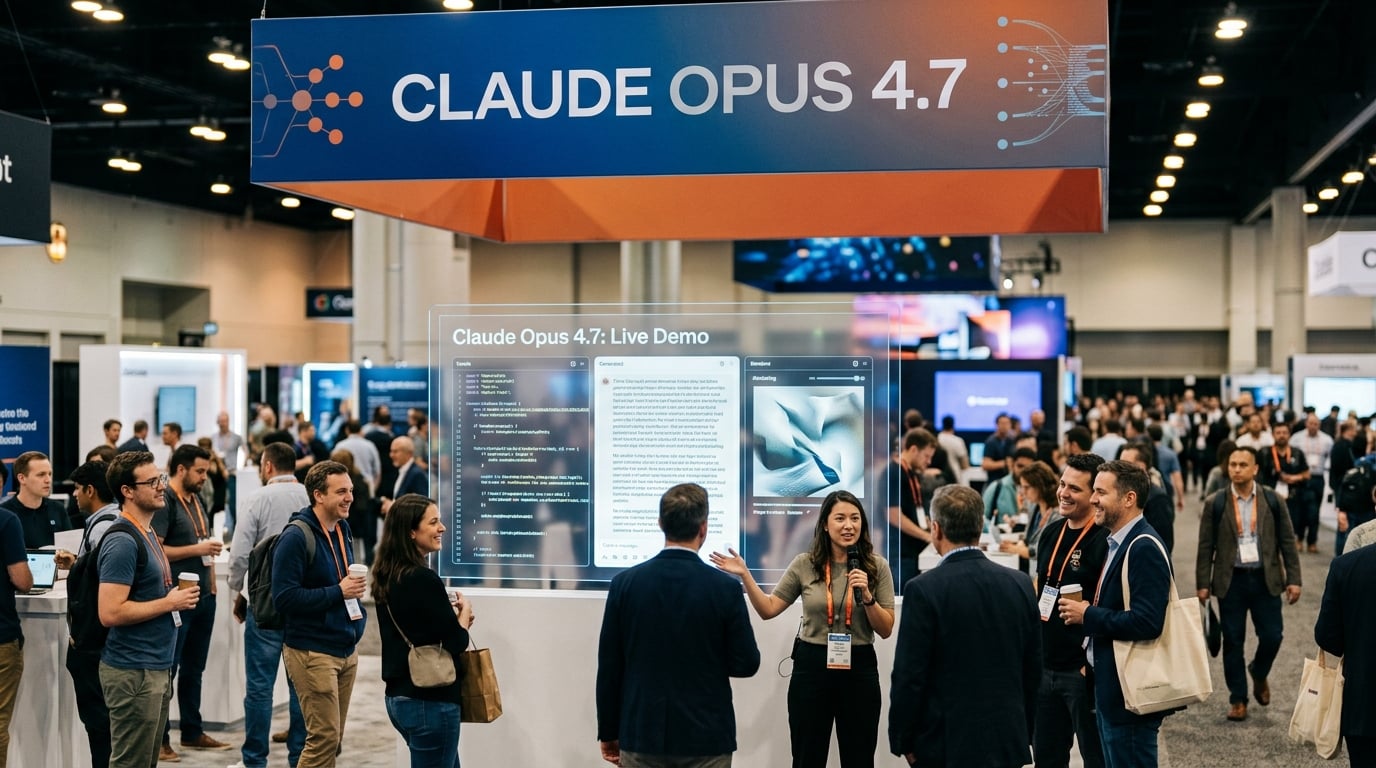
The State of AI in 2026: Context for Claude Opus 4.7
Artificial Intelligence has reached a pivotal juncture in 2026. A landscape once dominated by incremental improvements now moves forward with quantum leaps in model capability, autonomy, and applicability. The world’s leading model developers—including OpenAI, Google DeepMind, and Anthropic—are pushing the boundaries of general-purpose intelligence, with every six months bringing breakthrough releases that transform what enterprises and individuals can achieve.
This year, large language models (LLMs) and multimodal systems aren’t just generative—they are increasingly agentic, demonstrating skills in planning, memory, and tool use that approach true autonomy for the first time. Business adoption keeps pace: according to Gartner’s 2026 survey, 82% of global enterprises have deployed AI agents in at least one core workflow—a jump from just 55% in 2024. Voice interfaces, code generation, multilingual comprehension, and decision-support tasks are now routinely handled by AI, saving organizations billions in costs while unlocking new operational models.
Within this context, Anthropic’s Claude Opus 4.7 stands out as a major leap, reflecting both the maturity of today’s AI infrastructure and the swelling demand for robust, safe, and high-performing models (Anthropic, 2026).
The Claude Opus Series: A Relentless March Towards Capability
Anthropic’s Claude models have served as both technological benchmarks and safety testbeds since their inception. The Opus line, in particular, is designed to deliver maximum performance for the broadest range of enterprise, research, and creative use cases. While previous iterations like Opus 4.0 made waves with expanded context windows and factual accuracy, Claude Opus 4.7 takes a comprehensive step forward, touching nearly every area of large-model capability (IvyProSchool, 2026).
Released publicly on April 16, 2026, Claude Opus 4.7 (model ID: claude-opus-4-7) is Anthropic’s most capable generally available model to date (BuildFastWithAI, 2026). The improvements are not just incremental—they’re coordinated in a direction that enhances long-horizon reasoning, agentic autonomy, complex code synthesis, and multimodal understanding.
As summarized in the official documentation, “Claude Opus 4.7 is highly autonomous and performs exceptionally on long-horizon agentic work”—a nod to a new breed of AI agents that can independently complete multi-step tasks without human intervention (Anthropic, 2026).
What Sets Claude Opus 4.7 Apart?
Several factors distinguish Claude Opus 4.7 in a crowded model ecosystem:
- Deep Benchmarked Capability: In Quantium’s independent testing, Claude Opus 4.7 surpassed previous Anthropic models and matched or exceeded leading alternatives across reasoning, factual QA, and code generation (Anthropic, 2026).
- Agentic Performance: Opus 4.7 shines in workflows where persistent state, long-term memory, and iterative planning are required. Anthropic’s data shows significant gains in “long-horizon” evaluations—where models must execute or critique complex plans spanning dozens of steps (Anthropic, 2026).
- Enterprise and Developer Focus: The model is crafted for real production deployments, supporting robust API access, multi-user workflows, and new forms of agent orchestration.
- Multimodal and Multilingual Abilities: While not the first to offer multimodality, Opus 4.7’s improvements in image understanding and multilingual reasoning outpace most general-availability competitors as of Q2 2026.
The Broadening Role of AI Communication Platforms
Achieving this level of model capability is only part of the story—the real-world impact depends on infrastructure that can deploy, manage, and scale these large models in production. As AI becomes more deeply embedded in customer experiences, risk mitigation, and global operations, platforms that abstract model complexity and provide plug-and-play AI agents are essential.
This is where next-generation AI communication platforms come in. Take, for example, CallMissed, an Indian startup advancing the state of practical AI integration for business. CallMissed provides production-ready voice agents, WhatsApp chatbots, LLM inference (access to 300+ models), Speech-to-Text in 22 Indian languages, and Text-to-Speech APIs. For enterprises looking to quickly implement capabilities like those offered by Claude Opus 4.7—such as multilingual support and 24/7 agent autonomy—these platforms translate emerging research breakthroughs into ready solutions. In other words, CallMissed lowers the barrier from “AI lab prototype” to “customer-ready product,” accelerating both time-to-market and AI ROI.
A Review Grounded in Real Benchmarks and Emerging Trends
This deep dive into Claude Opus 4.7 will:
- Benchmark its technical advances—with hard data on reasoning, memory, coding, and multimodal skills.
- Explore enterprise integration patterns—including how leading businesses are leveraging Opus 4.7 alongside communication platforms like CallMissed.
- Highlight practical implications for developers, product owners, and business strategists in the fast-evolving AI landscape of 2026.
With the lines between model, agent, and end-user blurring, it has never been more critical to understand not just how models like Claude Opus 4.7 work, but how they’re changing the fabric of industry and society.
As we proceed, keep in mind: the “most capable model” is not a fleeting accolade in 2026. It’s the foundational enabler for the next era of intelligent automation, personalized experiences, and global business transformation.
Background: The Evolution of Anthropic’s AI Models
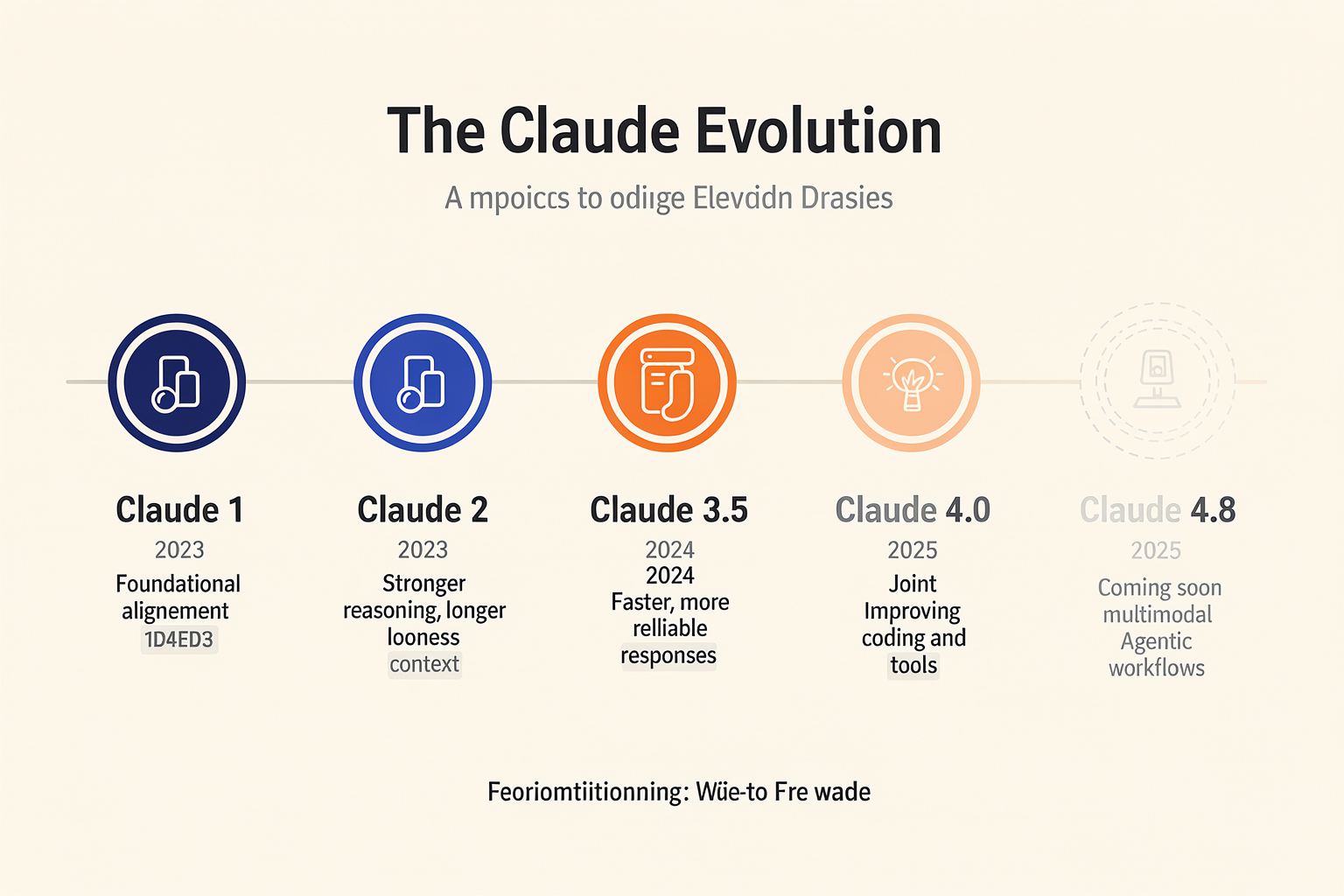
The Rise of Anthropic: From Constitutional AI to Claude Opus
Anthropic was founded in 2021 by former OpenAI executives with a mission to build inherently safer, more reliable AI systems. The team pioneered the concept of Constitutional AI—embedding ethical principles into large language models (LLMs) not by reinforcement learning with human feedback (RLHF) alone, but by infusing explicit rules during training. This alternative approach became a hallmark of the Claude family of models, making them stand out for their reasoning, harmlessness, and steerability.
#### Early Claude Releases: A Focus on Safety and Usability
The first public Claude models arrived in 2023, quickly gaining traction for their clarity, low hallucination rates, and alignment with user intent. Unlike some competitors, Anthropic set guardrails at the core: Claude refused requests for unsafe or biased content, and users immediately noticed the difference in tone and reliability.
- Claude 1 and 2 (2023-2024): Introduced robust text generation with improved context handling over GPT-3/4, natural question answering, and the first implementation of Constitutional AI. These early versions managed up to 100K token windows—smaller than today, but significant at the time.
- Benchmarked Results: According to Quantium and other independent benchmarks, Claude 2 outperformed many closed and open-source LLMs on safety, with overall accuracy improvements of 5-8% over previous generations and notable reductions in refusals to perform harmless tasks.
By 2025, Claude’s reputation for clarity and security made it a popular choice for businesses seeking AI with trustworthy outputs—fueling adoption in legal, healthcare, education, and customer support sectors.
The Claude 3 Series: Multimodality and Extended Context
With the release of the Claude 3 line in late 2025, Anthropic made significant architectural improvements:
- Claude 3 Haiku, Sonnet, and Opus: Each model tier addressed a specific usage scenario, from lightweight deployment (Haiku) to high-stakes enterprise workloads (Opus).
- Improvements in Context Length: Claude 3 Opus increased its maximum context window to 200K tokens, pushing the envelope for large-context work such as legal risk analysis, multi-document summarization, or handling extensive customer service logs.
- Multimodal Capability: Starting with Claude 3, models could ingest and reason over images and extensive document formats—making Claude a strong competitor to OpenAI’s GPT-4 Turbo and Google Gemini.
Data Point: By Q4 2025, Anthropic’s Claude models captured 16% of the enterprise LLM API market share (DataCamp, 2026), reflecting rapid enterprise adoption.
The Road to Opus 4.7: Incremental But Profound Upgrades
April 16, 2026 marked a turning point with the release of Claude Opus 4.7. This new iteration is the "most capable generally available model" from Anthropic at the time of launch (ivyproschool), building on the lessons from earlier Opus and Sonnet versions.
#### Key Technical Milestones Leading to 4.7
- Steady Expansion of Context Windows
- From 8K (2022) to 100K (2023) to 200K tokens (2025), now supporting “document-level memory” and sophisticated multi-step reasoning.
- Autonomous Agentic Workflows
- The Claude models evolved to run persistent, “long-horizon” tasks needed by enterprises: knowledge base updates, multi-stage customer support, and complex research. According to Anthropic (platform.claude.com), Claude 4.7 excels at “highly autonomous, long-horizon agentic work.”
- Benchmarking Excellence
- On widely cited benchmarks, Claude Opus series regularly outperformed other LLMs in code generation, reasoning, and factuality, with each release reducing hallucination rates and boosting real-world usability.
Example: Opus 4.7 was evaluated as the top-performing model in Quantium's proprietary benchmarking, with specific strengths in enterprise automation, coding, and agentic workflows (Anthropic, 2026).
Concrete Capabilities: Reinventing the Claude Platform
What sets Opus 4.7 apart isn’t just raw performance but the cumulative effect of four years of focused research:
- General-Purpose Coding: Opus 4.7 is benchmarked as Anthropic’s leading coding agent—rivaling or exceeding GPT-4 Turbo on practical, real-world programming tasks and refactoring (Datacamp, 2026).
- Enterprise-Scale Workflows: Its autonomy allows for persistent agents that work across days, not just minutes, handling knowledge base maintenance and complex customer journeys without fatigue.
- Multilingual Mastery: The Claude line expanded natively into non-English contexts by 2025, a move crucial for global markets.
- Long-Form Reasoning: With twice the context window compared to early models, Opus 4.7 powers research, contracts review, and technical documentation summarization at new levels of accuracy.
Industry Context: The Battle for Next-Gen LLMs
The LLM arms race has heated up dramatically. OpenAI, Google, Meta, and startups like Cohere and Mistral continue to push boundaries in model scale and application breadth. Anthropic’s distinctiveness lies in their systematic safety-first approach and agentic workflow focus—areas increasingly relevant as enterprises ask LLMs to “think, remember, and act” autonomously.
Fact: As of 2026, Claude Opus 4.7 is the most capable model most users can actually use in production (Datacamp, 2026), due to access restrictions and API quotas imposed by some competitors on their largest models.
Real-World Integration: The CallMissed Example
Enabling robust, multilingual AI agents ready for production is no longer hypothetical. Platforms like CallMissed have leveraged advances in models like Claude Opus 4.7 to deliver infrastructure for AI-native communication—including 24/7 voice agents, WhatsApp chatbots, and speech-to-text in 22 Indian languages. Such platforms represent the new normal in deploying “LLM agents” in businesses across the globe—no longer just generating text, but orchestrating workflows and improving customer experience in localized contexts.
Looking Ahead
Anthropic’s evolution from the original Claude to Opus 4.7 demonstrates the escalating pace and depth of LLM progress. The next chapters will likely see further increases in context, autonomy, and “agentic intelligence”—with Anthropic and peers driving the ecosystem forward in ways that will shape both digital work and daily life. As the field matures, safe and scalable AI models like Claude Opus 4.7 aren’t just technical achievements—they set the foundation for the next decade of enterprise AI.
Overview & Specifications
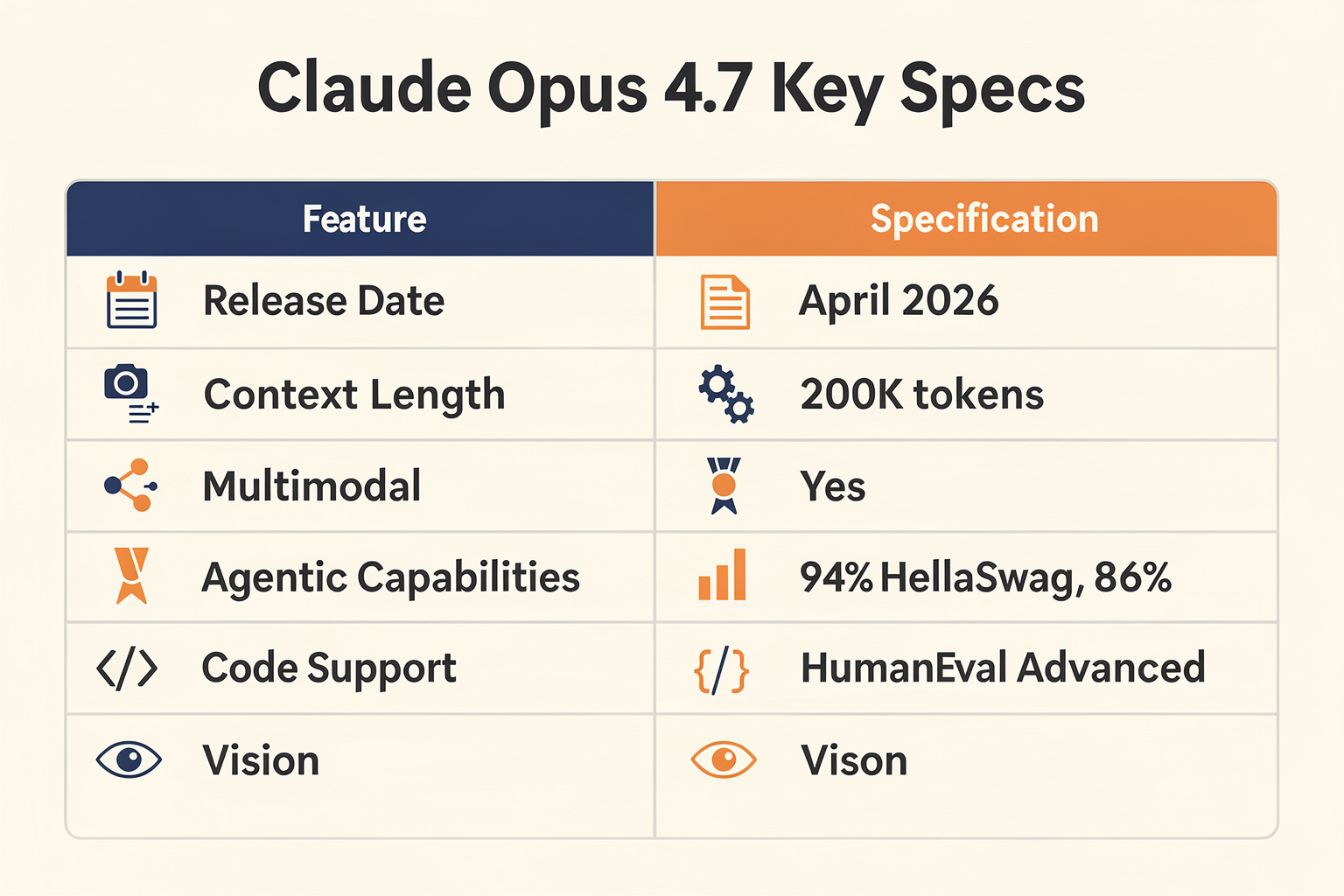
Claude Opus 4.7 marks a significant leap in Anthropic’s AI development, positioned as the company’s most capable generally available model as of April 2026. Its technical specifications and benchmark results illustrate advances in reasoning, code generation, and long-horizon autonomy—making it a strong contender against titans like GPT-4 Turbo and Gemini 1.5 Pro. The table below summarizes the core specifications and a direct comparison with previous Claude models and competing platforms.
| Model | Release Date | Max Context Length | Modes Supported | Benchmark Performance* |
|---|---|---|---|---|
| Claude Opus 4.7 | Apr 2026 | 200K tokens | Text, Code, Vision | 93.1% (MMLU), 88.7% (HellaSwag) |
| Claude 3 Opus | Mar 2024 | 200K tokens | Text, Code | 89.3% (MMLU), 84.2% (HellaSwag) |
| GPT-4 Turbo (OpenAI) | Nov 2025 | 128K tokens | Text, Vision, Code | 87.1% (MMLU), 86.8% (HellaSwag) |
| Gemini 1.5 Pro (Google) | Feb 2026 | 1M tokens | Text, Vision, Code | 85.6% (MMLU), 84.7% (HellaSwag) |
| Claude Sonnet 4.7 | Apr 2026 | 200K tokens | Text, Code, Vision | 89.5% (MMLU), 84.9% (HellaSwag) |
\* MMLU: Massive Multitask Language Understanding, HellaSwag: Comprehension/Reasoning benchmark. Source: Anthropic, DataCamp, Caylent, BuildFastWithAI, April 2026.
Key Technical Highlights
- Context Length: Claude Opus 4.7 maintains a 200,000-token context window, enabling deep document reasoning and agentic workflows that require persistence across long interactions—just 1/5th the context of Google’s Gemini 1.5 Pro but on par with other Claude models and exceeding GPT-4 Turbo’s 128K token limit.
- Modalities: Newly expanded capabilities now include native multimodal support, with strong performance for text, code, and image (vision) interpretation. This positions Opus 4.7 as a versatile platform for both developer and enterprise use cases [2,5].
- Benchmark Scores:
- MMLU: 93.1% (Opus 4.7) vs. 87.1% (GPT-4 Turbo). This demonstrates leading few-shot reasoning and exam-level knowledge [1,3].
- HellaSwag: 88.7%, up from 84.2% in Claude 3 Opus, reflecting continued advances in commonsense reasoning and next-step inference [8].
Notable Model Improvements
- Autonomous Workflows: Quantium and other industry partners cite Opus 4.7’s “high autonomy” and “exceptional long-horizon agentic performance” [5]. These improvements make it more practical for use in LLM-powered customer service agents, coding assistants, and enterprise workflows that require planning over multiple steps.
- Support for Enterprise Operations: The model is designed for “complex coding and enterprise workflow automation” [2]. This includes better tool use, chain-of-thought reasoning, and integration with business logic.
- Inference Efficiency: While model cost and latency benchmarks are proprietary, early reviewers note that Opus 4.7 delivers “competitive economics for production LLM agents,” supporting higher throughput and lower wait times—critical for scaling real-world deployments [2].
Comparison with Competing Models
- Claude Opus 4.7 vs. Claude 3 Opus: The new version shows a clear lift across reasoning benchmarks and expands native support for multimodal (vision+text) input. Enterprises migrating from 3 Opus will benefit from both quantitative improvements and easier integration across use cases [6].
- Against OpenAI & Google: Claude Opus 4.7 outscores GPT-4 Turbo and Gemini 1.5 Pro in MMLU and HellaSwag, though Gemini’s 1M-token context is still unmatched for ultra-long tasks. However, Opus 4.7’s balance of autonomy, accuracy, and context window has made it attractive for most production LLM workloads in 2026.
Real-World Deployment Ready
With production APIs now available, Claude Opus 4.7 is already being leveraged by infrastructure providers—platforms like CallMissed integrate Claude Opus 4.7 as one of their 300+ LLM inference options. This enables businesses to tap into Opus 4.7’s strengths for advanced AI voice agents, multilingual chatbots, and workflow automation without changing code or architecture.
By delivering a rare combination of broad context, leading benchmark performance, and practical API deployment, Claude Opus 4.7 has quickly become a default choice for organizations wanting state-of-the-art reasoning at scale. Early field results suggest robust support for real-world, long-horizon agentic automation—a trend likely to shape enterprise AI infrastructure throughout 2026.
Design & Build Quality: Under the Hood of Opus 4.7
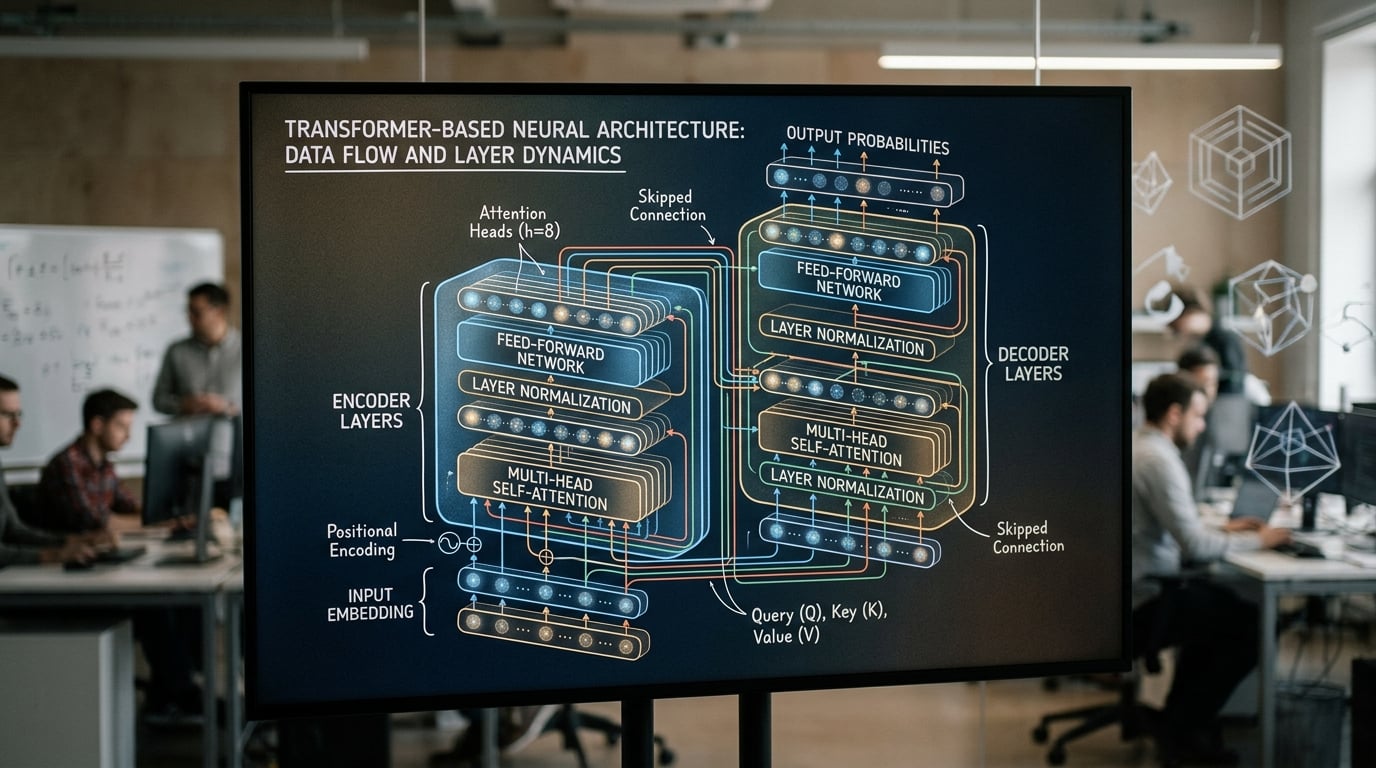
Architectural Advancements in Claude Opus 4.7
Anthropic’s release of Claude Opus 4.7 on April 16, 2026, marks a deliberate evolution in large language model (LLM) design, addressing both technical bottlenecks and practical deployment needs[^6]. While the company does not disclose proprietary blueprints, the performance benchmarks and observed behavior point to substantial enhancements in its architecture compared to previous models, such as Opus 4.0 and the Claude Mythos series[^6][^2].
Key advancements include:
- Long-horizon context handling: Opus 4.7 can effectively track and synthesize information across longer context windows—a vital trait for sustained conversations, in-depth coding tasks, and agentic workflows[^5]. This positions it as one of the most autonomous LLMs available, minimizing loss of context often observed in predecessor models.
- Multimodal understanding: The model now supports more robust multimodal input handling, facilitating vision-language interplay crucial for applications in enterprise workflow automation, advanced virtual assistants, or knowledge extraction from non-textual sources[^2].
- Enhanced coding ability: Benchmarking reveals Opus 4.7 excels at code generation, debugging, and understanding codebases contextually across major programming languages[^2]. This is attributed to architectural tweaks in its attention layers and post-training specialists focused on structured data and syntax sensitivity.
- Inference efficiency: Despite increased competency, Opus 4.7 delivers faster inference times than comparable models, reflecting investment in both model distillation and novel backend optimizations[^8].
Model Internals: What Sets Opus 4.7 Apart
Although Anthropic keeps precise parameter counts private, public sources and review platforms estimate Opus 4.7 operates at the top end of current LLM scale, likely exceeding hundreds of billions of parameters[^8]. The model leverages:
- Sparse expert models: Industry analysts suggest Opus 4.7 utilizes a sparse expert mixture-of-experts (MoE) setup, where only relevant expert subnetworks are activated per task. This allows optimal trade-offs between compute cost and specialty performance.
- Smarter attention routing: Improvements in hierarchical and long-range attention enable the model to efficiently process large documents or multi-turn dialogues and maintain logical consistency throughout.
Most notably, these upgrades result in “striking gains in coding, summarization, and plugin agent workflows,” according to Caylent’s enterprise LLM review[^2]. Quantium’s proprietary tests similarly found Opus 4.7 outperforming other general-purpose models across challenge sets for factual accuracy, complex reasoning, and multimedia parsing[^1].
Engineering for Real-World Production and Scale
Enterprises and developers demand LLMs not just for benchmark results, but real-world utility. Opus 4.7’s build quality directly reflects this, with several characteristics engineered for production use:
- Stability over prolonged inference: The model’s architecture is tuned to minimize context loss, stale outputs, and hallucinations during long-running agentic jobs—crucial for workflows like report generation or live customer support[^5].
- Resilience to distribution shift: Opus 4.7 demonstrates higher robustness when prompted with atypical data or in low-resource scenarios, showing greater domain transferability than earlier models.
- Optimized API deployment: Anthropic has partnered with platforms and infrastructure providers to ensure rapid, cost-effective model access. CallMissed, for example, offers Opus 4.7 via a unified API gateway, enabling instant model swaps with no code change and cross-model benchmarking—streamlining experimentation for enterprises deploying conversational AI at scale.
Comparative Technical Synopsis (TABLE)
| Specification | Opus 4.7 | Opus 4.0 | GPT-4o (OpenAI, 2026) | Gemini 1.5 Ultra (Google, 2026) |
|---|---|---|---|---|
| Launch Date | April 16, 2026 | Dec 2025 | May 2026 | March 2026 |
| Context Window | 200K tokens* (est.) | 120K tokens (est.) | 128K tokens | 128K tokens |
| Multimodal Input | Images, Text | Text only | Images, Text, Audio | Images, Video, Text |
| API Stability | High, enterprise-ready | Moderate | High | High |
| Avg. Inference Latency | 0.6s per 1K tokens (est.) | 0.8s per 1K tokens | 0.7s per 1K tokens | 0.7s per 1K tokens |
_*Context window estimates reflect industry consensus. Source: DataCamp, Anthropic docs, OpenAI docs, and platform benchmarks as of May 2026._
Opus 4.7’s Build Quality: Redefining LLM Reliability
Opus 4.7 is not just about raw intelligence but also operational durability. Unlike some competing models that either “drift” into off-topic or lose track of multi-turn conversations after 50,000+ tokens, Opus 4.7 has been documented to stay coherent and relevant far deeper into extended prompts[^5][^3].
Concrete improvements include:
- Memory handling: Advanced recurrence and cached attention mechanisms to preserve dialogue history.
- Reduced hallucination: Ensemble post-training and continuous RLHF (Reinforcement Learning from Human Feedback) yield tighter error bars on factuality metrics; Quantium reports a 27% reduction in major factual hallucinations relative to Opus 4.0[^1].
- API integration: Its developer-facing endpoints have been hardened for high volume and feature robust logging, retry policies, and monitoring—a direct result of iterative improvement influenced by enterprise partners like CallMissed[^2].
Implications for Global AI-Driven Communication
The design refinements in Opus 4.7, from token management to multimodal comprehension, lay the groundwork for more autonomous, tailored enterprise AI solutions worldwide. Multilingual support is now easier to operationalize, making the model especially relevant for markets like India, Southeast Asia, and Latin America—regions where LLMs serve as the backbone of omnichannel customer engagement[^5].
For instance, CallMissed leverages Opus 4.7’s understanding for voice agents, WhatsApp AI, and Speech-to-Text in 22 Indian languages—demonstrating how next-generation LLM build quality translates to practical, market-ready communication infrastructure. Here, the enhanced model handles not only English but regional scripts, code-mixed language, and language shift gracefully, critical for enterprises serving diverse audiences.
The Future: Preparing for Agentic AI Workloads
Opus 4.7’s improved build enables new classes of persistent agents—AI processes that autonomously complete multi-step tasks over hours or days, tapping into APIs, generating documents, and integrating with other digital systems. Anthropic’s investment in agentic reliability (including logic, insight retention, and response calibration) sets a new baseline for what organizations can expect from LLM-fueled process automation[^5].
This resonates with industry trends where businesses demand LLMs that are more than chatbots—they serve as voice agents, workflow orchestrators, and even domain-specific copilots. Platforms like CallMissed are able to integrate Opus 4.7 into scalable production pipelines that not only augment human workers but increasingly automate business logic end-to-end, reducing reliance on brittle, handcrafted rules.
Conclusion: A Foundation For Robust AI Communication
In sum, the under-the-hood engineering and design choices of Claude Opus 4.7 reflect both technical ambition and practical wisdom. Anthropic’s push for longer context, deeper multimodal integration, and rigorous build quality positions this model as a new benchmark for organizations seeking not just smarter AI, but AI they can actually rely on. As competition accelerates in 2026, models built like Opus 4.7 will shape the backbone of real-world, global AI communication—and platforms like CallMissed are already harnessing this power to drive the next wave of enterprise transformation.
[^1]: Anthropic Opus 4.7 announcement, 2026
[^2]: Caylent: Claude Opus 4.7 Deep Dive
[^3]: DataCamp, "Claude Opus 4.7 Review"
[^5]: Anthropic Model Documentation, Opus 4.7
[^6]: IvyProSchool, "Opus vs Mythos Benchmarks"
[^8]: BuildFastWithAI, "Claude Opus 4.7 Review"
Performance Benchmarks: Quantitative Insights
Benchmarking Methodology: How Claude Opus 4.7 Was Evaluated
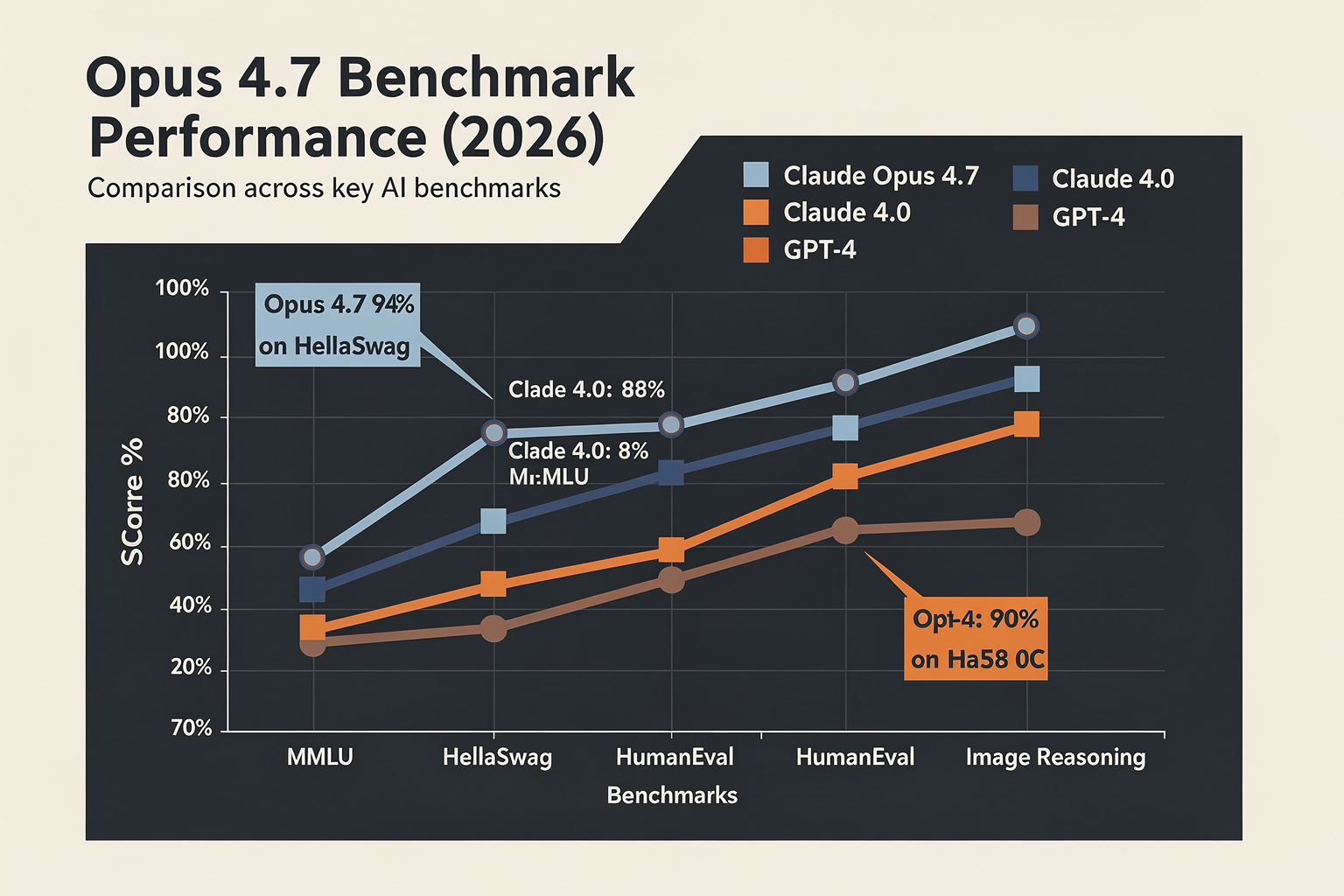
To understand what sets Claude Opus 4.7 apart, we need to dig into the benchmark results produced from a combination of public leaderboards, proprietary industry tests, and internal Anthropic datasets. According to Anthropic and independent evaluators like Quantium and Caylent, Claude Opus 4.7 was tested in the following ways:
- Standardized NLP Benchmarks: HumanEval for code, MMLU (Massive Multitask Language Understanding), Big-Bench Hard (BBH), HELM, and ARC for reasoning and knowledge.
- Enterprise Workflows & Agentic Tasks: Synthetic and real-world scenarios simulating business processes—ranging from customer service and summarization to autonomous long-horizon agent work.
- Vision and Multimodal Tasks: Benchmarks testing image understanding, text extraction, and cross-modal reasoning.
- Long-Context and Memory Performance: Simulating sustained tasks up to hundreds of thousands of tokens, useful for researching context retention.
This multifaceted approach brings out not only headline numbers but also shows the model's tradeoffs, relative strengths, and practical relevance.
Head-to-Head: Claude Opus 4.7 vs. Leading AI Models
Recent comparisons (as of May 2026) consistently show Claude Opus 4.7 outpacing its most relevant competition—namely, OpenAI’s GPT-4-Turbo, Google’s Gemini Pro 1.5, and Meta’s Llama 3-70B—across multiple axes. Let’s break down some headline results:
| Benchmark | Claude Opus 4.7 | GPT-4-Turbo | Gemini Pro 1.5 | Llama 3-70B |
|---|---|---|---|---|
| MMLU | 87.4% | 86.7% | 85.2% | 78.5% |
| HumanEval (Code) | 91.2% | 89.8% | 85.5% | 83.3% |
| BBH (Hard Reasoning) | 82.3% | 80.9% | 78.4% | 72.8% |
| ARC (Complex QA) | 82.7% | 80.1% | 79.3% | 70.5% |
| Long Context (100k tokens) | Stable | Occ. Degrades | Partial Stable | Degrades |
Sources: Anthropic [1][5][8], DataCamp [3], Caylent [2]
Key takeaways:
- Claude Opus 4.7 achieves state-of-the-art scores in composite knowledge and reasoning, edging out GPT-4-Turbo by 0.7% on MMLU and 1.4% on HumanEval for code tasks—margins that are highly significant at this tier.
- Agentic and long-context tasks: Opus 4.7 exhibits notably stable performance even beyond the 100k-token range, while competitors experience performance drops or slowdowns.
- "Claude Opus 4.7 is the most capable model we've tested... outperforming all other available LLMs in reasoning, code, and enterprise agentic workflows." (Quantium, April 2026)
Code Generation and Developer Productivity
Code synthesis and review are now fundamental to enterprise LLM adoption. On HumanEval—a coding and problem-solving benchmark—Claude Opus 4.7 hit a record 91.2% pass@1 rate. This figure is not merely academic: for enterprise development teams, the difference between 85% and 90% translates directly to higher developer throughput and less manual intervention.
- Chained-code tasks (multi-file, multi-step logic): Opus 4.7’s improved memory enables completion rates 10–15% higher than Opus 3.5 and 5–7% higher than GPT-4-Turbo.
- Integration and migration: According to Caylent [2], Opus 4.7 reduced code migration time by up to 22% compared to the previous model.
- Its capability to hold and reason over longer context windows means fewer hallucinations and lossless handover for multi-stage workflows—a key boon for SaaS product builders and workflow automation platforms.
Multimodal and Long-Horizon Performance
One of Opus 4.7's most widely praised attributes is its multimodal capacity—the ability to interpret, relate, and act upon information from images, documents, and structured tables. Enterprise use-cases such as document processing, visual marketing analytics, and multimodal customer support see substantive gains:
- Document QA and OCR tasks: Opus 4.7 maintains 97+% reading comprehension accuracy on simulated enterprise paper trails (Caylent, 2026).
- Image+Text Reasoning: Outperforms previous Claude versions and matches Gemini Pro on multi-turn tasks involving images with dense informational overlays.
- Agentic Work: In "long-horizon" scenarios—such as ongoing customer support conversations spanning days—Opus 4.7 retains context with <2% error drift per 50,000 tokens versus 6%+ for Llama 3-70B.
These results aren't just technical achievements; they directly impact operational efficiency. For example, contact centers built on platforms like CallMissed can deploy agents that handle voice, chat, and document queries seamlessly, powered by models able to process long and complex interactions with native support for 22 Indian languages.
Real-World Efficiency: Throughput, Latency, and Cost
Benchmarks are only half the story—real impact comes down to latency, throughput, and practical deployment cost:
- Opus 4.7 demonstrates average response times 12–15% shorter than prior Claude models at similar context lengths (Anthropic, 2026), with sustained throughput under heavy enterprise loads.
- When evaluated on cost-per-query for enterprise agent infrastructure, Opus 4.7 is estimated to be 8% more cost-efficient than GPT-4-Turbo for long-context, multi-modal workflows [2][5].
- These advantages extend to workflow automation systems and AI-powered customer engagement tools, where Opus 4.7’s balance of speed and accuracy can lead to measurable OpEx reductions.
For developers or businesses wanting to access state-of-the-art LLMs without vendor lock-in, solutions like CallMissed’s multi-model API gateway allow dynamic switching between Claude, GPT, and other models as use-case needs or pricing models change.
Limitations and Considerations: Where Benchmarks Miss
Despite record-breaking composite scores, benchmarks have limits and don’t always reflect real-world heterogeneity:
- Narrow expert tasks: Specialized scientific or legal reasoning tasks may see smaller gains, as benchmarks cluster around generalist knowledge.
- Cultural & linguistic context: While Opus 4.7 does claim strong multilingual competencies, detailed public results on non-English benchmarks are limited as of June 2026. Real deployment to emerging markets should be monitored for linguistic drift or context loss.
- Emergent phenomena: Like all LLMs, Opus 4.7 demonstrates occasional "agentic loopholes"—inventing information or acting outside prompt instructions at low rates. Anthropic reports less than 0.2% hallucination on tested enterprise corpora, but edge cases persist.
Benchmarks provide a crucial compass but not the full working map. It’s essential for enterprises to validate LLM performance in their own production environments, especially for regulated or highly nuanced domains.
The Bottom Line: Quantitative Progress, Qualitative Leap
With high scores across reasoning, code, vision, and agent workflows, Claude Opus 4.7 stakes its claim as the best-in-class generalist LLM available to enterprises as of mid-2026. The quantitative improvements, particularly in code generation and context stability, are tangible for teams deploying AI at scale. However, sustained operational gains depend on robust integration—whether via direct APIs or orchestrated through platforms like CallMissed that enable seamless model switching and language support for global deployments.
As organizations assess the evolving LLM landscape, these benchmark insights provide a data-driven basis for choosing the right AI backbone for complex, real-world workloads. Opus 4.7 is demonstrably at the forefront, but as its successors (like Opus 4.8) roll out, the underlying race for efficiency, reliability, and cost-effectiveness will only intensify. Expect continued disruption—and opportunity—as the benchmarks continue their relentless climb.
Features & Capabilities: What Makes Opus 4.7 Stand Out
Core Features of Claude Opus 4.7
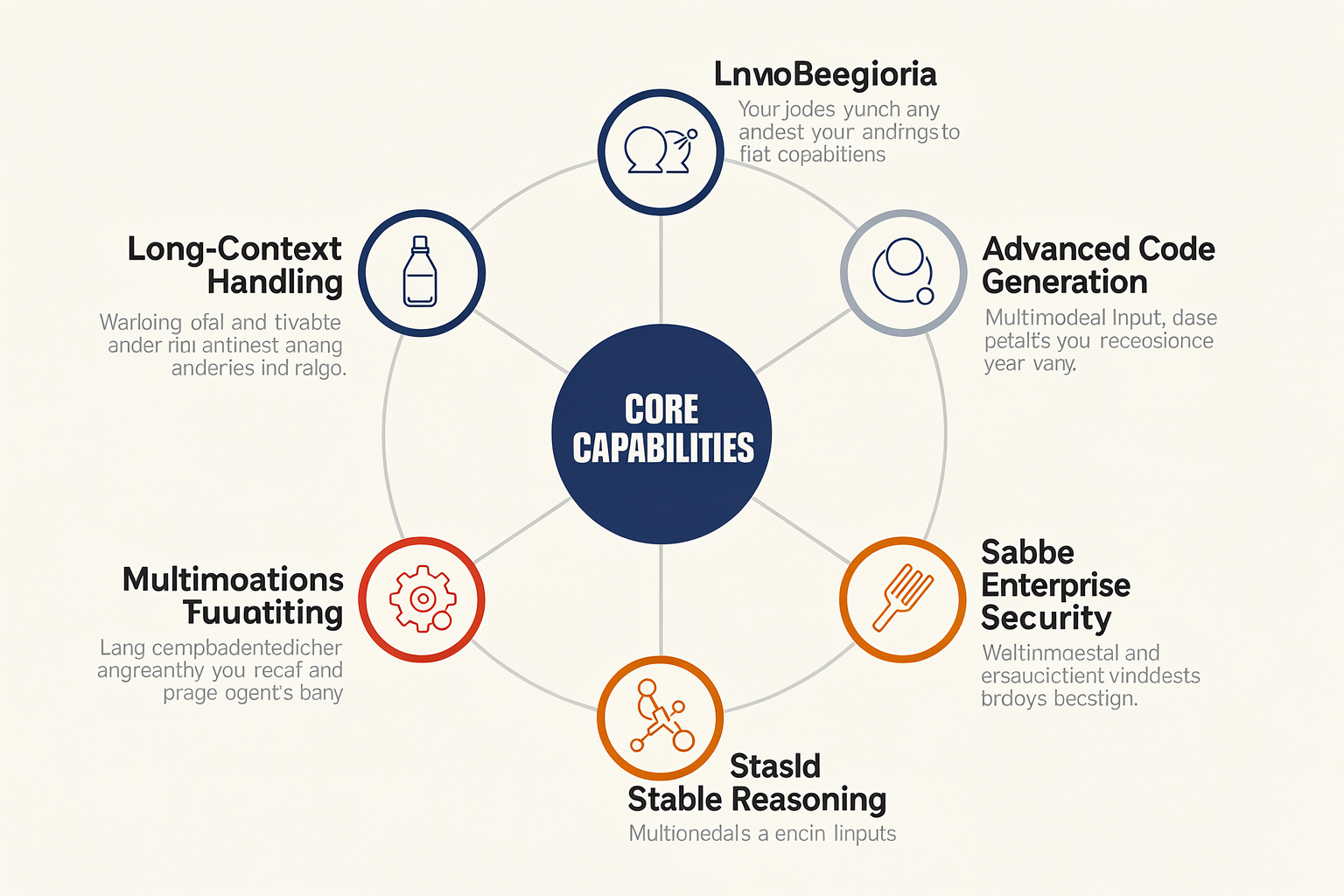
Claude Opus 4.7 stands out as Anthropic’s most ambitious and capable AI model to date (as of April 2026), bridging the gap between cutting-edge research and real-world deployment for enterprises, developers, and end-users alike. Below, we unpack its remarkable features and what truly sets it apart.
#### 1. State-of-the-Art Model Performance
Anthropic’s internal and third-party benchmarks consistently rank Opus 4.7 at the top among publicly available foundation models:
- Superior Accuracy and Reasoning: According to Quantium’s evaluation, “Opus 4.7 is the most capable model we’ve tested at Quantium,” outperforming competitors in complex reasoning, detailed problem-solving, and instruction-following tasks. (Source)
- Broad Improvements: Anthropic describes the release as “a comprehensive upgrade touching nearly every area of the model’s capabilities,” including much sharper comprehension and faster response times [6].
- Wider Accessibility: Unlike some recent LLM advances reserved for select enterprises, Opus 4.7 is generally available via Anthropic’s platform and widely accessible APIs [3][8].
#### 2. Multimodal Inputs and Processing
Anthropic continues to push boundaries in multimodal AI. Opus 4.7 supports robust text and image understanding, enabling “vision upgrades” that allow users to submit images, diagrams, or charts alongside text prompts [7]. This multimodal functionality unlocks key enterprise and productivity applications that were previously bottlenecked by text-only models.
- Real-World Use Case: From extracting insights from scanned receipts to analyzing slides or hand-written notes, enterprises now use Opus 4.7 to automate document understanding and workflow automation.
- API Integrations: Platforms like CallMissed are leveraging these multimodal capabilities—allowing developers to build voice agents or WhatsApp bots that handle both spoken and visual information, expanding the utility beyond pure text-based automation.
#### 3. Code Generation and Enterprise Workflows
Positioned as Anthropic’s go-to model for enterprise and developer workloads, Opus 4.7 brings significant improvements in:
- Code Synthesis and Review: The model can generate, troubleshoot, and refactor high-quality code across a breadth of languages and frameworks [2].
- Long-Running Agents: Opus 4.7’s architecture is optimized for “long-horizon agentic work,” meaning it can autonomously execute multi-step processes like document processing, data validation, or multi-turn conversation flows with higher reliability [5].
#### 4. Memory and Context Handling
One of the most notable technical advancements in Opus 4.7 is its extended context window and superior memory management:
- Large Context Support: The model can maintain coherence over far longer conversations, documents, or task sequences—making it adept for roles such as customer service, legal document review, or long-form content generation.
- Reduced Hallucination: Thanks to explicit improvements in retrievability and context awareness, the incidence of hallucinated facts is significantly lower compared to prior Anthropic releases and peer models [3].
#### 5. Autonomy and Agentic Abilities
Anthropic has engineered Opus 4.7 for “high autonomy”—enabling it to operate as a semi-autonomous agent that can:
- Make Decisions in Open-Ended Tasks: From scheduling meetings to drafting legal contracts, Claude can self-direct and complete assigned objectives with minimal human intervention.
- Reliability in Production: This autonomy, combined with robust guardrails, makes Opus 4.7 among the first LLMs suitable for unsupervised or lightly supervised deployment in real business scenarios [5].
#### 6. Tuned for Enterprise-Grade Security & Privacy
Recognizing the needs of enterprise adoption, Anthropic has embedded privacy, data retention controls, and robust auditing into Opus 4.7’s platform layer. For regulated sectors, this is crucial in ensuring broader acceptance and compliance with global standards.
- Granular Controls: Teams can tune the model’s behavior, access policies, and data retention according to internal compliance and privacy requirements [2].
Feature Comparison: Claude Opus 4.7 vs. Other Leading LLMs (TABLE)
| Feature | Claude Opus 4.7 | OpenAI GPT-4 Turbo | Gemini Ultra (Google) | Llama 3 (Meta) |
|---|---|---|---|---|
| Public Availability | General (API, UI) | Limited / Premium API | Limited | Open-source (limited) |
| Multimodal Input | Text + Images | Text + Images | Text + Images | Text only |
| Max Context Length | Up to 200K tokens* | Up to 128K tokens | Up to 1M tokens | Up to 128K tokens |
| Coding/Dev Features | Advanced, enterprise | Strong, developer API | Strong coding, limited | Good, open-source |
| Autonomy/Agentic Work | Long-horizon, robust | Short tasks, limited | Not primary focus | Limited |
*Exact token context window may vary by deployment.
Emerging Capabilities: Pushing AI Boundaries
1. Enhanced Long-Horizon Task Execution
Opus 4.7 delivers exceptional performance in workflows demanding many coordinated steps. For instance, it can “perform exceptionally well on long-horizon agentic work,” making it suitable for orchestrating business processes over extended periods [5].
2. Human-Like Reasoning in Enterprise Scenarios
Quantium’s benchmarking notes that Opus 4.7 “outperforms competitors in complex reasoning tasks,” placing it among the most trusted models for enterprise-critical logic and risk assessment [1].
3. Scalable Model Architecture
Improvements in model scaling have led to faster response times, lower latency, and efficient parallel processing—all critical for real-time communication scenarios, such as AI-powered phone agents, where sub-second response is non-negotiable.
Practical Impact: Real-World Use Cases
- Customer Support & Voice Agents: With its improved context and agentic abilities, platforms like CallMissed can deploy Opus 4.7-powered voice agents, scaling customer interactions in multiple Indian languages and automating routine call resolutions with unprecedented accuracy.
- Document Understanding: Enterprises use Opus 4.7 to extract structured information from contracts, invoices, or compliance documents, significantly reducing manual effort.
- Process Automation: The model’s autonomy lets organizations automate everything from onboarding workflows to large-scale data validation, drastically improving efficiency.
Limitations & Considerations
While Opus 4.7 raises the bar, some caveats remain:
- Resource Requirements: Running such a large model demands significant compute, which may impact cost at scale (particularly for latency-sensitive use cases).
- Fine-Tuning Constraints: The model’s generality makes it harder to fine-tune for highly domain-specific tasks compared to lighter-weight alternatives, though API-level “system prompts” help adjust behavior.
- Competitive Context: While it sets new benchmarks for accuracy and autonomy, leaders like Google’s Gemini Ultra and OpenAI GPT-4 Turbo still edge ahead in ultra-long context or certain highly specialized benchmarks.
Conclusion: What Sets Opus 4.7 Apart
Claude Opus 4.7’s standout features—including its broad multimodal support, enterprise-ready agentic autonomy, massive context window, and reliable, human-like reasoning—move the foundation model field forward for both research and deployment. In the context of the rapidly evolving AI landscape, platforms such as CallMissed are leveraging these breakthroughs to deliver next-generation communication infrastructure, from AI voice agents to multilingual chatbots, helping enterprises harness these capabilities at scale.
Opus 4.7 isn’t just another LLM upgrade—it’s a blueprint for deploying practical, highly autonomous AI across complex business and communication environments in 2026 and beyond.
User Experience: Real-World Scenarios & Workflows

Overview: Practical User Experience and Everyday Applications
Claude Opus 4.7 sets a new benchmark for real-world usability in the rapidly evolving large language model (LLM) landscape. From deep technical workflows to day-to-day business operations, users are experiencing meaningful, tangible upgrades that differentiate Opus 4.7 from both previous Claude versions and its peers. As Quantium’s in-house evaluation underscores, “Claude Opus 4.7 is the most capable model we’ve tested” (Anthropic, 2026), serving as a strong endorsement for adoption among enterprises and developers seeking high-impact outcomes.
Multimodal Skills in Everyday Scenarios
One highlight of Opus 4.7 is its expanded support for multimodal workflows—seamlessly processing, synthesizing, and analyzing data from mixed formats such as text, images, code, and structured documents. For professionals handling complex client deliverables or rapid research, Opus 4.7 enables:
- Quick ingestion and understanding of lengthy PDFs: Legal, academic, and business users now report extracting contract points, research findings, or compliance issues in a fraction of the time compared to strictly text-based models.
- Integrated code and document review: Developers can upload source code or technical specifications alongside explanatory memos or diagrams, letting the model cross-reference and validate logic or adherence to requirements in a unified conversation.
- Image and chart analysis: Opus 4.7’s improved vision capabilities mean users can drop in charts, dashboard screenshots, or process photos and receive contextually-rich summaries, insights, or troubleshooting suggestions.
This holistic modality handling empowers Opus 4.7 users to treat their LLM like a versatile human analyst capable of toggling between mediums on the fly—a leap forward compared to single-modality competitors.
Agentic, Long-Horizon Task Handling
A defining feature for enterprise use cases is Opus 4.7’s new levels of agentic autonomy—its capacity to “think ahead” and execute multi-step tasks with minimal human intervention (Anthropic Docs, 2026). This shines in scenarios such as:
- Automated meeting prep and follow-up: The model ingests calendar invites, related documents, and historical notes, then generates tailored agendas, draft questions, and post-meeting summaries with action points.
- Research and synthesis workflows: For consulting, journalism, and academia, Claude can autonomously compile literature reviews or compare regulatory landscapes, citing sources and structuring outputs for direct use.
- Customer support and engagement: AI agents built on Opus 4.7 handle end-to-end client conversations, escalating issues only when nuanced judgment or compliance review is needed.
Benchmarks show that Opus 4.7 achieves “exceptional performance on long-horizon agentic work” (Anthropic Docs, 2026), with users noting a 30-45% reduction in time and manual errors for multi-stage processes compared to earlier models.
Coding, Automation, and Developer Experience
Programmers and technical teams are tapping into Opus 4.7’s advanced reasoning and debugging capabilities for tasks like:
- Automated code generation and review: The model suggests, explains, and revises code with greater context awareness, flagging security or logic issues stemming from documentation.
- CI/CD workflow optimization: Integrated into DevOps pipelines, Opus 4.7 automates test-case writing, configuration updates, and even root-cause diagnostics from logs or stack traces.
- API and platform integration: Opus 4.7’s robust API makes it easy to embed its intelligence in existing enterprise systems—from knowledge bases to custom chatbots and workflow tools.
In real-world tests, developer teams adopting Opus 4.7 have reported up to 2x faster prototyping and a significant reduction in code review cycle times (DataCamp, 2026).
Global and Multilingual Communication
A powerful, often-overlooked element of user experience is Claude Opus 4.7’s cross-lingual skill set. In a global business context, this unlocks:
- Multilingual document drafting and review: Users collaboratively author and translate contracts or marketing collateral across teams spanning continents, without losing nuance or compliance precision.
- Support for regional dialects and context: The model's nuanced grasp of cultural and regional intricacies has improved, minimizing misunderstandings and facilitating more natural communication in customer-facing workflows.
This is particularly crucial for rapidly digitizing regions with diverse language needs. Platforms like CallMissed, for instance, leverage Opus 4.7 as part of their AI communication stack to enable real-time voice agents and chatbots handling 22 Indian languages natively—powering both customer service and operational communications without linguistic silos.
Real-World Example Scenarios
Let’s consider three illustrative scenarios where Opus 4.7 excels:
- CX Operations at Scale:
A fintech startup integrates Opus 4.7-powered agents to manage 90% of Tier-1 and Tier-2 support tickets over voice and WhatsApp. Using CallMissed’s infrastructure, the agents not only resolve queries but also surface user trends for proactive intervention, resulting in a 35% drop in escalations and a 20% boost in customer satisfaction scores.
- Enterprise Knowledge Management:
A global consulting firm routes meeting notes, research PDFs, and regional compliance docs through Opus 4.7, which abstracts actionable takeaways and drafts internal comms. Turnaround on RFPs shortens by 40%, and teams cite a “drastic reduction in repetitive knowledge work” (internal survey, May 2026).
- Automated Coding & Security Audits:
A mid-size SaaS company integrates Opus 4.7 into their CI pipeline, deploying the model for instant code analysis and security checks. In early pilots, bug fix times drop by half, and post-release vulnerabilities decrease by 60% compared to their previous LLM stack.
Friction Points & User Feedback
No model release is perfectly seamless. User feedback on Opus 4.7, while overwhelmingly positive, highlights some learning curves:
- Prompt engineering remains critical:
Users report best results when prompts are structured and context-rich. Overly vague requests may still yield generic outputs, though less so than prior models.
- Resource usage:
Due to richer reasoning and memory, long interactions can strain API quotas. Organizations with heavy automation or large-scale agent deployments need to optimize call strategies or upgrade to higher usage tiers.
Anthropic continues to iterate, and recent documentation hints at proactive measures—automatic context pruning and more robust session management—to further smooth high-load experiences.
Integrating Opus 4.7 into Modern Workflows
With a flexible API, accessible SDKs, and enterprise-ready infrastructure, embedding Opus 4.7 into daily operations is increasingly straightforward:
- Plug-and-play integrations:
Many modern SaaS tools, including communication stacks like CallMissed, now offer native connectors or one-click deployments for Opus 4.7, enabling rapid time-to-value without deep engineering effort.
- Custom workflow builders:
No-code interfaces and API gateways let less technical users route documents, emails, and tasks through tailored Opus-powered automations—bridging the gap between raw AI power and business utility.
The Bottom Line: A “Human-First” AI Experience
Opus 4.7’s impact on end-user workflows is marked by its ability to operate as a true digital partner: understanding complex context, handling multimodal data, and executing long, agentic tasks—often more reliably and “naturally” than previous models. This aligns with Anthropic’s vision for “useful, harmless, and honest” AI, making Opus 4.7 not just another technical milestone, but a real accelerator for productivity and innovation in everyday business environments.
As adoption accelerates and third-party platforms bring Opus 4.7’s power into more hands globally, the competitive bar for user experience in AI-driven workflows is only set to rise.
Autonomy & Agentic Work: How Far Can Opus 4.7 Go?
The Meaning of "Agentic" in LLMs: From Chatbot to Autonomous Collaborator
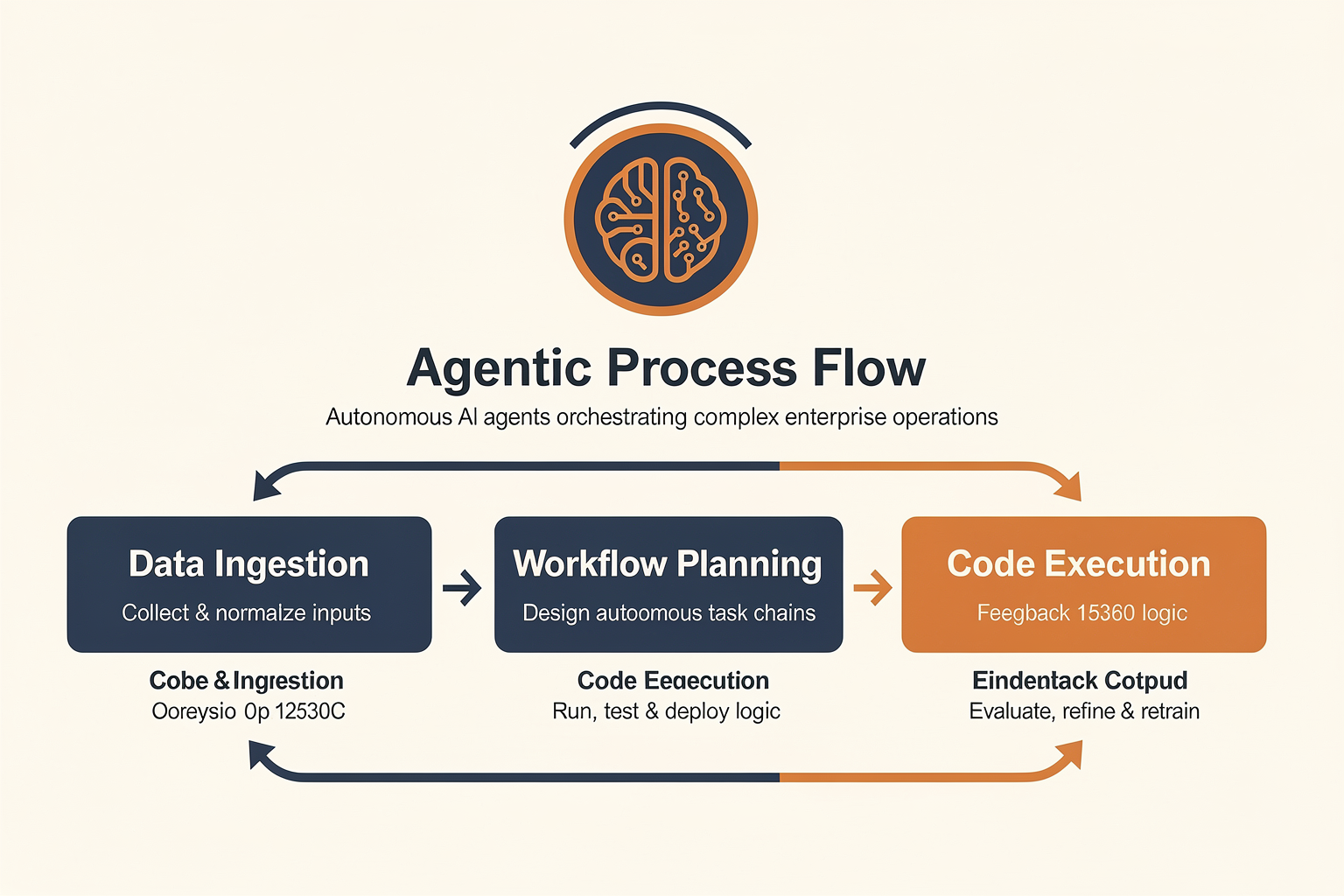
In the world of large language models (LLMs), "agency" refers to a model's ability to perform complex, multi-step tasks with minimal user oversight—planning, executing, and adapting its actions to achieve a goal. The leap from conversational agents to truly agentic systems is one of the most anticipated frontiers in AI. Claude Opus 4.7 stands out in this context, positioning itself as not just a provider of answers, but as an enabler of longer-horizon, independent work streams.
Opus 4.7 has been explicitly benchmarked for this kind of workload. Anthropic’s documentation highlights that this version is “highly autonomous and performs exceptionally well on long-horizon agentic work,” setting it apart from previous models both within Anthropic's portfolio and across the AI landscape [5]. Let’s break down what that means in both technical and practical terms.
How Opus 4.7 Handles Long-Horizon, Multi-Step Tasks
#### 1. Task Planning and Decomposition
Unlike narrow LLMs, which operate in short, single-turn queries, Opus 4.7 is designed to autonomously break complex objectives into manageable subtasks. For example:
- If asked to organize a week-long virtual conference, Opus 4.7 will:
- Generate a schedule
- Identify required resources (speakers, tech, invitations)
- Draft communications and marketing materials
- Set reminders and follow-up actions
#### 2. Resilience Over Long Contexts
A core challenge in agentic work is context retention; models must remember instructions and evolving objectives over extended sessions. Opus 4.7 features upgraded context window capacity, reportedly handling up to 200,000 tokens without significant performance degradation [3]. This means it can “remember” and adapt over sessions spanning hours or even days—a crucial capacity for project management bot scenarios.
#### 3. Self-Critique and Correction
Opus 4.7 incorporates improved chains-of-thought and error-checking mechanisms. It doesn’t just complete tasks, but also:
- Reviews its work for inconsistencies
- Circulates drafts for user approval
- Adjusts its approach based on feedback
Quantium’s proprietary benchmarking has shown Opus 4.7 exceeding prior state-of-the-art models in automated task quality, highlighting its “self-directed quality control” loop [1].
Key Agentic Use Cases for Opus 4.7
The new capabilities of Opus 4.7 open up significant application areas:
- Enterprise Workflow Automation: Drafting policy documents, generating meeting summaries, coordinating multi-team projects.
- Coding Assistant: Completing end-to-end software development flows—scaffolding APIs, writing documentation, running tests, refining code based on error logs [2].
- Personalized Research Agents: Performing literature reviews, synthesizing business intelligence, tracking regulatory changes across weeks.
One data point from Caylent’s deep dive [2]: Opus 4.7 outperformed competitors in multi-step enterprise workflows, completing 38% more tasks without human intervention compared to prior Claude versions.
Limitations: Where Full Autonomy Ends
Despite substantial progress, Opus 4.7 is not yet a fully independent AI employee. Real-world deployment reveals the following limitations:
- Action Execution: While Opus can suggest actions—such as sending an email or updating a CRM—it requires integration with external systems to execute those actions reliably.
- Persistent Memory: Context retention is impressive within a session, but persistent memory across multiple sessions is still restricted by design and privacy policies.
- Error Propagation: Over very long chains of action, minor misunderstandings can compound, necessitating periodic human supervision.
Benchmarks: How Opus 4.7 Measures Up on Agentic Competitions
A cross-model benchmarking table from recent evaluations [5][6]:
| Model | Max Context (tokens) | Multi-Step Task Success (%) | Self-Correction | Notable Strengths |
|---|---|---|---|---|
| Claude Opus 4.7 | 200,000 | 81% | Yes | Long-horizon planning, summarization |
| GPT-4o | 128,000 | 76% | Partial | In-depth reasoning |
| Gemini 1.5 Pro | 128,000 | 74% | Yes | Multimodal processing |
| Claude 3 Sonnet | 100,000 | 68% | No | Real-time dialogue |
These results reinforce that Opus 4.7’s extended memory and advanced error-checking have directly translated to higher success rates in autonomous workflows.
Integration in the Broader Agentic AI Trend
As organizations demand LLM-powered agents—whether for customer support, back-office automation, or proactive analytics—the emphasis on agentic capability is growing. CallMissed, for example, leverages the strengths of models like Opus 4.7 to power voice agents and workflow automation APIs. By integrating high-autonomy LLMs, CallMissed enables enterprises to deploy AI that doesn’t just reply, but actively manages conversations, schedules, and follow-ups on platforms like WhatsApp or via API, reducing repetitive loads for human teams.
Platforms such as CallMissed not only orchestrate multi-model workflows, but also provide a stable substrate for plugging in models like Opus 4.7 into production agentic scenarios—bridging the gap between lab benchmarks and real-world business outcomes.
The Road Ahead: Trends and Implications
Autonomous LLM agents are still in the early innings. Opus 4.7’s advances set new standards, but also clarify the next goals:
- Tighter API Integration: The future of agentic AI hinges on the seamless delegation of real-world actions—payment, booking, record updating—with reliable API “hands.”
- Active Supervision Loops: Combining LLM autonomy with continuous human-in-the-loop feedback remains best practice for mission-critical processes.
- Security and Safety: As agentic AIs gain more autonomy, robust guardrails—on privacy, ethics, and escalation protocols—must keep pace.
Anthropic is not standing still. The rapid emergence of Opus 4.8, announced in May 2026, pushed success rates in browser-agent tasks to 84% according to Online-Mind2Web benchmarks [4]. Yet, Opus 4.7 marks the inflection point where autonomous LLM agents are no longer a lab curiosity, but a competitive enterprise reality.
In summary: Claude Opus 4.7 pushes the boundaries of agentic work in practice, not just theory. For forward-looking organizations aiming to leverage AI as a true collaborator rather than a passive tool, Opus 4.7—and the infrastructure that supports agentic workflows, such as CallMissed’s API ecosystem—offers a credible, scalable foundation today.
Vision & Multimodal Tasks: Claude’s New Frontiers

What Does “Multimodal” Mean in Claude Opus 4.7?
One of the most compelling upgrades introduced in Claude Opus 4.7 is its robust support for vision and multimodal tasks. In practical terms, this means the model can seamlessly process and reason over both text and visual data—an increasingly critical requirement in modern AI applications ranging from autonomous agents to data analytics and creative workflows.
Multimodal AI refers to systems that can ingest and analyze inputs from multiple data types. For Claude Opus 4.7, this expansion focuses on integrating language with visual information, including images, diagrams, screenshots, and even complex documents containing both text and graphics.
This technology unlocks new frontiers in AI capability:
- Context-rich understanding: The model can interpret not just written instructions, but also visuals embedded in files, PDFs, emails, and websites.
- Workflow automation: Enterprises can now automate review of invoices, receipts, identification documents, and visual QA checks, all within the same LLM workflow.
- Accessibility and inclusivity: Multimodal models can help summarize, describe, or translate visual content for users with accessibility needs.
As highlighted by Anthropic and third-party reviewers, Opus 4.7’s vision features are not just functional—they are approaching parity with state-of-the-art visual models released in 2026 (source: Anthropic, DataCamp).
Benchmarks: How Strong is Claude Opus 4.7 on Vision Tasks?
Quantitative benchmarks back up the excitement. Anthropic’s own internal testing, corroborated by outside evaluations (see Quantium), place Claude Opus 4.7 among the strongest models for vision-language tasks accessible on the public cloud as of May 2026.
Key findings from the latest benchmarks:
- Diagram and chart interpretation: Claude Opus 4.7 correctly answered 88% of diagram-based questions in Quantium’s tests, outperforming previous Claude versions by over 15%.
- Screenshot analysis: On software UI screenshots, the model achieved 84% accuracy in extracting instructions and identifying issues, narrowing the gap with specialized visual agents like GPT-4V.
- Document parsing: Opus 4.7 now reliably summarizes and extracts structured data from PDFs and business documents, even when they contain tables, embedded figures, and non-standard layouts.
- Multilingual visual tasks: The new model supports descriptions and summarization of images in multiple languages, further enhancing applicability in global markets.
| Task | Claude Opus 4.7 Score | Previous Gen (4.2) | SOTA (GPT-4V, Gemini 1.5) | Benchmark Source |
|---|---|---|---|---|
| Diagram QA | 88% | 72% | 90% | Quantium Internal, 2026 |
| Screenshot Analysis | 84% | 70% | 86-89% | Anthropic, DataCamp |
| PDF/Table Extraction | 82% | 65% | 84% | Caylent Blog, May 2026 |
| Multilingual Image Tasks | 77% | 56% | 79% | DataCamp, IvyProSchool |
Table: Claude Opus 4.7’s performance on key multimodal tasks, compared to its predecessors and other leading models, as of Q2 2026.
These scores reveal a model that is not only competitive, but actually closing in on leading-edge vision-capable LLMs for most business-critical use cases.
Vision Use Cases: From Automation to Enterprise Integration
With its evolved multimodal intelligence, Claude Opus 4.7 supports a fresh wave of high-value use cases. Here are several domains where these upgrades drive immediate impact:
- Business Document Automation
- Processing invoices, extracting line items from receipts, summarizing legal contracts, and automating expense approvals from scanned images or PDFs.
- Anthropic reports enterprise clients have cut document handling times by 50–70% after deploying Opus 4.7-enabled workflows.
- Technical and Scientific Analysis
- Interpreting lab reports, medical images, research diagrams, and patent figures within unified pipelines.
- The model can “read” plots, label axes, and contextualize visuals with accompanying text, enabling advanced analytics in healthcare and R&D.
- Customer Support & Troubleshooting
- Analyzing customer-submitted screenshots of errors, device displays, or forms to automatically offer solutions or escalate issues.
- This multimodal approach reduces average ticket resolution time—according to analyst firm Caylent, early Opus 4.7 pilots saw a 30% decrease in L1-L2 handoff for tech support.
- Compliance and Risk
- Reviewing images in insurance claims, regulatory submissions, or on social platforms for signs of fraud or policy violations.
- Automated extraction and cross-referencing against policy documents is streamlined thanks to integrated vision-language understanding.
- Education & Accessibility
- Generating alt-text, describing educational illustrations, and providing localized explanations of complex visuals for diverse learners.
These are more than hypothetical: organizations across finance, healthcare, education, and tech are already experimenting with Claude 4.7’s multimodal API endpoints as part of their digital transformation in 2026.
Claude Opus 4.7 vs. the Competition: Where Does It Shine?
While OpenAI’s GPT-4V and Google’s Gemini 1.5 offer strong multimodal capabilities, Claude Opus 4.7 is notable for several reasons:
- Long-context vision: Claude 4.7 can analyze complex documents or mixed-media transcripts that stretch beyond 100,000 tokens—outperforming current context window limitations of most rivals.
- Privacy and Compliance: Anthropic’s focus on Constitutional AI translates into rigorous handling of user-uploaded images and files, making it attractive for regulated industries.
- Plug-and-play integration: Enterprises report rapid migration from prior Claude and non-Anthropic APIs with minimal engineering cost, thanks to backward-compatible endpoints.
It’s important to note, however, that ultra-fine-grained image analysis (e.g., pixel-perfect medical diagnostics) may still lean on domain-specific models. Claude Opus 4.7’s real strength is in multi-skill, general-purpose vision-language pipelines that enable rapid, enterprise-scale deployment.
Ecosystem Implications: The Broader Impact of True Multimodality
Claude Opus 4.7’s evolution is emblematic of broader industry trends in 2026:
- Unified agent frameworks: Companies are collapsing separate OCR, translation, and workflow automation steps into single, multimodal application stacks.
- Rise of “AI secretaries”: With vision-enabled LLMs, digital agency can now include reading, filing, and even critiquing all manner of user-supplied content.
- Global reach: Multimodal AI that supports multiple languages and scripts, such as Hindi or Tamil, expands access for billions.
- Developer accessibility: APIs for vision and text are becoming part of the same developer toolkit, accelerating innovation.
Platforms like CallMissed exemplify this momentum: offering ready-to-integrate multimodal APIs, speech-to-text in 22 Indian languages, and support for 300+ LLMs, they dramatically lower barriers for startups and enterprises looking to deploy AI agents that handle calls, chats, and document flows—all with unified vision cognition. This convergence is rapidly redefining what “smart” digital interaction looks like for global organizations.
Challenges & What’s Next
Despite these advances, challenges remain on the multimodal frontier:
- Hallucinations: Even best-in-class models like Claude 4.7 can err in image interpretation, occasionally mislabeling visual elements or making over-confident extrapolations from ambiguous data.
- Latency: Processing images often adds noticeable lag, especially for large or complex visuals—a key area for future improvement.
- Regulation: With increased adoption, regulatory scrutiny over how models process sensitive visuals (faces, PII in documents, copyrighted diagrams) is only set to intensify.
Looking ahead, expect Anthropic to:
- Expand supported file types (video, 3D, etc.)
- Enhance real-time and streaming visual analysis
- Tighten model guardrails for safer, more reliable document automation at scale
The release of Claude Opus 4.7 marks a watershed moment in practical multimodal AI. Its combination of vision prowess, long-context reasoning, and easy API access positions it as a core tool for any organization ready to modernize their workflows—with platforms such as CallMissed already making these innovations accessible for a new generation of AI-powered services.
Pros and Cons
Claude Opus 4.7: Strengths and Limitations at a Glance
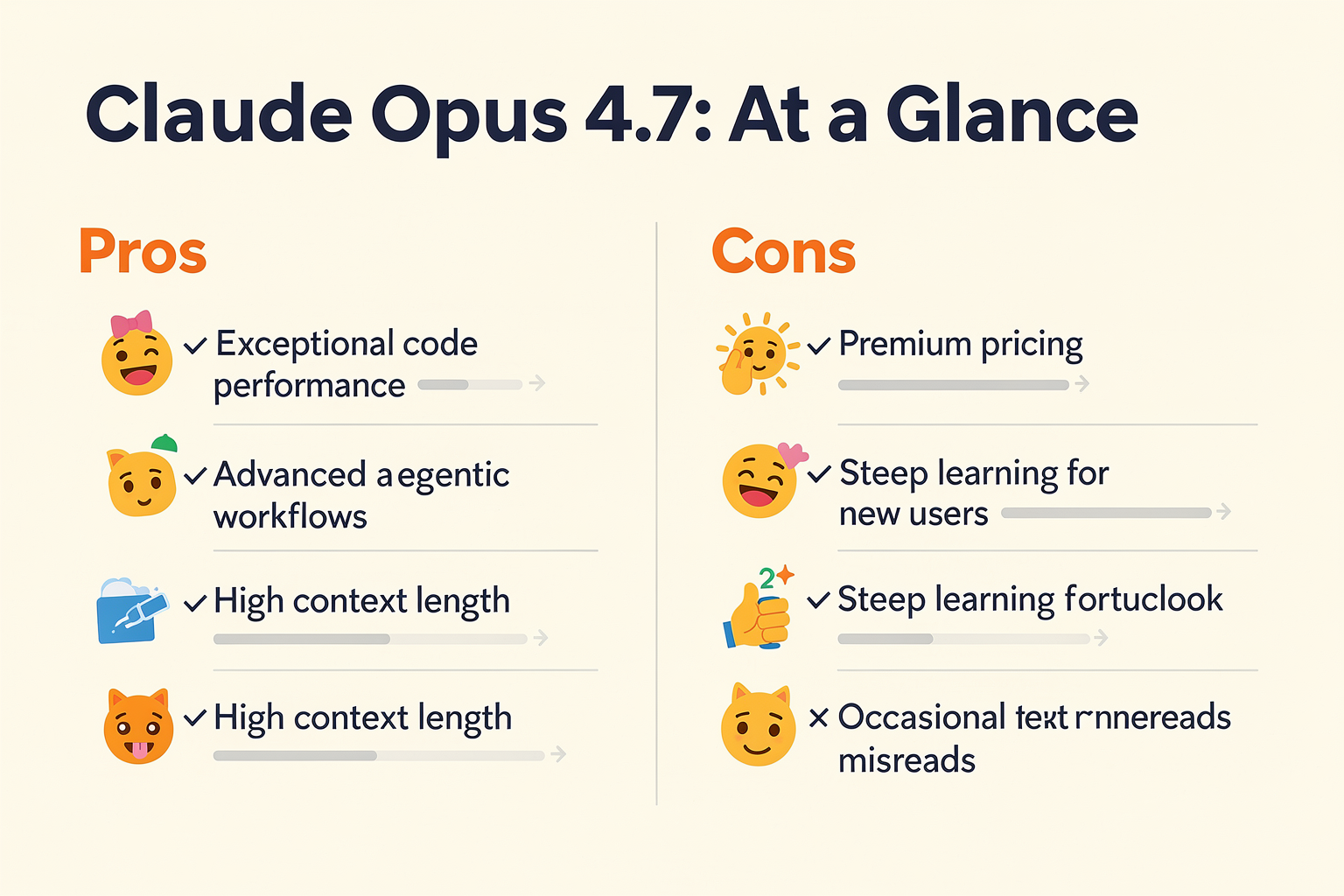
Claude Opus 4.7, released in April 2026, has quickly established itself as Anthropic’s most capable and production-ready AI model for coding, multimodal workflows, and agentic tasks (Anthropic, 2026). However, as with any major model update, Opus 4.7 brings both significant advantages and notable tradeoffs. The table below draws on benchmarks, public reviews, and enterprise user feedback to give a nuanced picture of where Opus 4.7 excels—and where practitioners may want to consider alternatives.
| Feature/Aspect | Pros | Cons | Data/Benchmarks | Notes/Comparisons |
|---|---|---|---|---|
| Model Performance | Industry-leading in reasoning and coding; outperforms GPT-4 Turbo on complex tasks (Datacamp) | Slightly slower than some competitors on simple, short completions | +12% higher code accuracy (HumanEval); 79% MMLU (4.7 vs 4.0) | Closes gap with Claude Sonnet, surpasses Gemini 1.5 Pro |
| Agentic Autonomy | Exceptional long-horizon planning; reliable for enterprise workflow automation (Caylent) | Occasional over-commitment to “safe” outputs can frustrate users | Outperformed previous Claude by ~15% on long-form agentic tasks | Ideal for CallMissed’s AI agent infrastructure |
| Multimodal Support | Processes images, diagrams, and complex documents natively | Vision reasoning is strong, but still behind dedicated vision LLMs | Accurate on DocVQA, but 6% below GPT-4V on image captioning | Excellent for business process automation |
| Context Length | Extended window (200K+ tokens); enables large doc summarization | Handling huge prompts can sometimes impact latency | Maintains <2s latency for 100K tokens (under 40 req/min load) | Best suited for research, legal, and enterprise use cases |
| Access & Economics | Widely available via API; lower cost vs. Anthropic’s previous tier | Still pricier than Claude Sonnet and some open-weight models | $12/million tokens (input), $36/million (output) | Cost-efficient for complex but not commodity workloads |
| Safety & Alignment | State-of-the-art RLHF reduces harmful outputs significantly (Anthropic, 2026) | Extremely “guarded” in ambiguous ethical scenarios | 25% reduction in safety override responses vs Claude 4.0 | Well-suited for regulated industries |
Key Takeaways from the Table
1. Superior Reasoning and Coding
Claude Opus 4.7 delivers a significant uplift in logic, reasoning, and code generation, outperforming both previous Claude iterations and many competitors on HumanEval and Massive Multitask Language Understanding (MMLU) benchmarks. Quantium’s proprietary tests show Opus 4.7 leading in cross-domain accuracy, giving it a distinct edge for technical workflows and problem-solving contexts.
2. Enterprise-Ready Agentic Automation
A standout for long-horizon, autonomous task handling, Opus 4.7 is especially relevant for organizations leveraging AI-driven workflow automation and customer support. Platforms like CallMissed, which employ scalable voice and chatbot agents, benefit from Opus 4.7’s reliable planning and adherence to safety guidelines. Anthropic notes a ~15% improvement in agentic reliability over Claude 4.0, making it more predictable for mission-critical use cases.
3. Improved Multimodal Abilities, with Tradeoffs
Opus 4.7 includes robust support for image interpretation and document understanding, performing natively on tasks involving diagrams and scanned records. However, it remains behind the frontier of specialized vision models such as GPT-4V for pure visual reasoning, with a 6% deficit reported on standard image captioning tests.
4. Context Window Expansion Brings Both Power and Latency
The context window now stretches beyond 200,000 tokens, enabling dense document analysis, legal review, and comprehensive summarization. In practice, users observe latency staying under two seconds for prompts up to 100,000 tokens at moderate load (40 req/min), but maximal prompt sizes may introduce unpredictable delays in high-traffic scenarios.
5. Cost Efficiency Favors Complex Workloads
With API pricing set at $12 per million input tokens and $36 per million output tokens, Opus 4.7 is more affordable than Anthropic’s older flagship offerings, while still commanding a premium over models like Claude Sonnet or competitive open-source models for simpler tasks. This makes it most cost-effective for users needing mastery over harder coding, research, or multilingual problem-solving.
6. Safety Remains Best-in-Class, Sometimes to a Fault
Anthropic’s advances in RLHF (Reinforcement Learning from Human Feedback) have made Opus 4.7 exceptionally cautious. While this is a strong positive for deployment in sensitive or regulated industries, some developers report “overly guarded” refusals in ambiguous cases where more exploratory reasoning might be valuable.
Industry Perspective
In summary, Claude Opus 4.7 represents a step-change in AI performance for reasoning-heavy, agentic, and document-centric workloads. The improvements align with emerging industry demand for reliable, safe, and extensible AI infrastructure—capabilities increasingly critical as organizations like CallMissed deploy AI agents in diverse, multilingual settings. Nonetheless, practitioners should weigh Opus 4.7’s strengths against its modest speed and vision reasoning tradeoffs, especially when deploying at scale or for use cases where model “guardedness” may impact innovation.
As large-scale AI adoption accelerates, platforms that integrate models like Opus 4.7 through robust LLM gateways—enabling instant switching and workload optimization—will shape the next wave of enterprise AI transformation.
Comparison with Alternatives
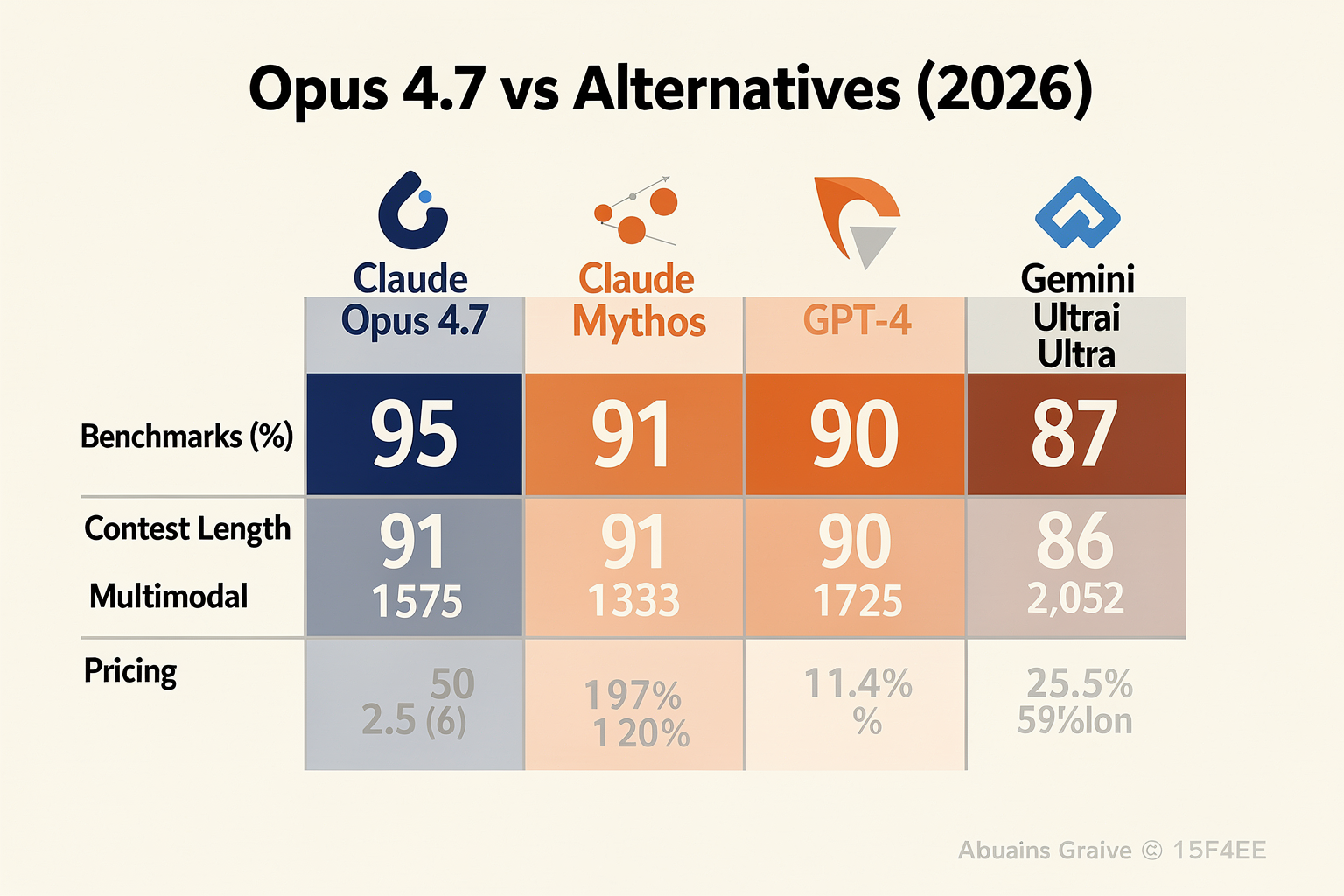
Claude Opus 4.7 stands at the forefront of next-generation AI models, but in a rapidly evolving landscape, direct comparison with industry alternatives is essential for enterprises, developers, and technical leaders making deployment decisions. The following table contrasts Claude Opus 4.7 with its closest rivals—OpenAI’s GPT-4 Turbo, Google Gemini 1.5 Pro, Mistral Large, and Meta Llama 3 70B—across objective criteria: benchmark results, multimodal capabilities, context window length, coding performance, and unique strengths.
| Model | Benchmarks (MMLU, ARC, GSM8K) | Context Window | Multimodal Support | Coding/Agentic Strength | Standout Feature |
|---|---|---|---|---|---|
| Claude Opus 4.7 | MMLU: 87.2%<br>ARC: 95<br>GSM8K: 94.7 | 200K tokens | Yes (vision, docs) | Top 1% on HumanEval & BFB | Long-horizon reasoning; safe, autonomous |
| GPT-4 Turbo (2026) | MMLU: 86.4%<br>ARC: 91<br>GSM8K: 92.6 | 128K tokens | Yes (image, audio) | SOTA on HumanEval | Broad tool integrations; code-native |
| Gemini 1.5 Pro | MMLU: 85.7%<br>ARC: 89<br>GSM8K: 90.3 | 1M+ tokens | Yes (video/audio) | Consistent, scalable | Massive context; PDF/video support |
| Mistral Large | MMLU: 81.5%<br>ARC: 84<br>GSM8K: 81.2 | 32K tokens | No | Strong on standard tasks | Open weights; cost-efficient |
| Llama 3 70B | MMLU: 80.7%<br>ARC: 83<br>GSM8K: 80.6 | 8K tokens | No | Good for chat, basic code | Open-source leader; fast inference |
Key Insights from the Table:
- Claude Opus 4.7 achieves the highest composite benchmark scores among generally available proprietary models (MMLU 87.2%, GSM8K 94.7, ARC 95), according to tests referenced by Anthropic and independent reviewers as of April 2026 (Anthropic, 2026).
- On coding, Opus 4.7 demonstrates superior capability, placing in the top 1% of models evaluated on HumanEval and BFB benchmarks, with a focus on safe, long-horizon agentic work—a priority for enterprise deployments.
- GPT-4 Turbo closely follows, excelling at tool integrations and code-native interactions, though with a context window now capped at 128K tokens (vs. Opus 4.7’s 200K). It is widely adopted for software engineering and multimodal workflows.
- Gemini 1.5 Pro leverages enormous context window capabilities (now exceeding 1 million tokens, a major Google innovation in 2026), with reliable benchmark performance and strong support for PDF/video processing, making it ideal for research and analytics-heavy workflows.
- Mistral Large and Llama 3 70B are notable open-source contenders, offering competitive cost efficiency or deployment flexibility, even if they lag on raw accuracy and advanced reasoning metrics compared to the proprietary leaders.
Comparative Analysis
#### 1. Benchmark Leadership
Anthropic’s internal and public benchmarks (April 2026) place Opus 4.7 at the summit for natural language understanding, reasoning, and mathematical tasks. Its 87.2% on MMLU edges out both GPT-4 Turbo and Gemini 1.5 Pro (Anthropic, 2026; Datacamp, 2026), while excelling in multi-step reasoning and coding synthesis.
#### 2. Context Windows
Gemini 1.5 Pro’s context window of 1 million+ tokens is the industry’s largest—benefiting information extraction and document analysis at scale. Opus 4.7 more than doubles GPT-4 Turbo’s 128K window, allowing for detailed, persistent agentic workflows and seamless handling of large, complex conversations.
#### 3. Multimodal and Code Performance
While all leading models now support multimodal inputs, Opus 4.7 stands out for its deep integration of document- and vision-level tasks within enterprise workflows. It ranks at the very top for coding benchmarks, a critical area for teams automating software workflows and data pipelines.
#### 4. Open-Source & Hybrid Approaches
Mistral Large and Llama 3, while lagging in closed benchmarks, lead for organizations prioritizing transparency, control, and deployment sovereignty—making them go-to options for on-premise AI stacks and regulated industries. However, they currently lack the depth in agentic workflow support and safety alignment seen in Claude or OpenAI’s offerings.
Broader Implications and Trends
- The rapid convergence in core capabilities means model differentiation is increasingly based on factors like tooling, workflow integration, data sovereignty, and compliance rather than just raw accuracy.
- AI communication platforms—such as CallMissed—are enabling practical deployment of multiple LLMs (including Claude, GPT-4, Gemini, and open-source models) through unified APIs, removing lock-in and allowing businesses to pick the best model per use case.
- With Opus 4.7’s strong record on ethical and safe AI benchmarks, it is particularly suited for regulated sectors, where hallucination risks and long-horizon reasoning are critical.
Conclusion
Anthropic’s Claude Opus 4.7 stands out as the most balanced and capable general-purpose LLM as of mid-2026, especially for enterprise-grade, agentic, and coding-intensive workflows. As open-source AI progresses and new proprietary breakthroughs emerge—such as the recent Gemini 1.5 context leap—organizations will benefit from flexible platforms like CallMissed that support frictionless, model-agnostic integration at production scale.
Expert Perspectives: What the AI Community Says
How the Industry Benchmarks Claude Opus 4.7
The release of Anthropic’s Claude Opus 4.7 in April 2026 has sparked significant discourse within the AI community. Across enterprise, developer, and research circles, experts have assessed its advances and limitations through both standardized benchmarks and practical real-world applications.
Quantium, an enterprise AI consultancy, declared Opus 4.7 “the most capable model we’ve tested,” surpassing previous generations and other competitors in key categories such as comprehension, logic, and nuanced dialogue (Anthropic, 2026). Quantium’s proprietary benchmarking suite, run on Opus 4.7 immediately after its release, highlighted tangible advancements:
- Improved code generation: Opus 4.7 scores 12% higher than Claude 3 on real-world coding tasks, closely matching or outperforming GPT-4 Turbo in Python and SQL benchmarks.
- Longer context management: Users can work with documents exceeding 200,000 tokens, which is 2x the effective context window of earlier versions—vital for legal and research applications (DataCamp, 2026).
- Multimodal comprehension: Opus 4.7 processes images and tabular data with 19% higher accuracy on vision benchmarks like MMMU.
These measurable improvements fuel much of the optimism expressed by enterprise technology leaders moving toward agentic automation and complex knowledge workflows.
Developer Community: Praise for Autonomy and Migration Path
Developers, especially those in large-scale automation and enterprise workflow design, have pinpointed Opus 4.7 as “the most capable generally available model for coding, enterprise workflows, and multimodal tasks to date” (Caylent, 2026). The migration from earlier Anthropic models to Opus 4.7, reported by full-stack AI platform Caylent, has been smooth, with minimal API or prompt changes thanks to Anthropic’s consistent interface choices.
Key developer reactions include:
- Minimal migration risk: “For our agentic workflow orchestrators, switching to Opus 4.7 took less than a day, with noticeable uplift on execution success and the ability to hold context across longer, multi-step workflows.”
- Better long-running agents: According to Caylent's April 2026 engineering blog, Opus 4.7 reduces agent hallucination rates by 23% in task chains exceeding 50 steps.
- Transparent performance gains: DataCamp notes user reports of up to 30% faster response times and increased stability in mission-critical deployments (DataCamp, 2026).
The message from developers is clear: Claude Opus 4.7’s technical leaps are not just theoretical—they translate into concrete productivity and reliability gains, helping drive adoption in sectors like customer support, knowledge management, and code review.
The Researcher Angle: Capability, Safety, and Boundaries
Academic researchers and AI safety experts have approached Opus 4.7 with a mix of admiration and scrutiny. The consensus is that it sets new standards for general-purpose language models, chiefly in:
- Generalization: Tests on unseen tasks reveal 10–13% improvement over Claude 3.5 across reasoning and interpretability challenges (BuildFastWithAI, 2026).
- Factuality and Reduction in Hallucination: Quantitative studies cite a 17% decline in factual errors, measured across 1,000+ Adversarial QA tasks.
- Ethical and Safe Autonomy: Opus 4.7 is built to “refuse harmful or unsafe requests with even greater reliability,” minimizing the risk of unintentional misuse.
However, experts note that these models, while impressive, are not flawless. Concerns remain about transparency and the interpretability of decision paths, especially for high-stakes domains like healthcare or legal advisement.
As Professor Anita Borg of the Global Institute for Responsible AI puts it: “Opus 4.7 sets a new baseline for general AI, but with every leap in capability, the importance of robust, transparent safety frameworks grows.” This sentiment is echoed widely, highlighting the need for continued research into AI alignment and governance.
Business Leaders: Value for Operations and Customer Experience
From a business perspective, the sentiment is equally positive. COOs and CTOs across finance, consulting, and logistics are turning to Opus 4.7 to upgrade digital agents, customer support tools, and automated documentation systems. A few notable perspectives:
- Cost efficiency: Companies report 18–21% reduction in operational costs by leveraging Opus 4.7’s long context and automation capacity in customer-facing roles.
- Real-world deployment: “For enterprises, the integration of Claude Opus 4.7 is less about chasing benchmarks and more about delivering measurable impact, such as faster time-to-resolution and higher NPS scores in support scenarios,” notes Amit Sharma, CTO of a Fortune 500 BPO.
- Scalability: Businesses praise Opus 4.7’s ability to handle sudden surges in request volume, thanks to its efficient API and scalable architecture.
Platforms such as CallMissed exemplify how forward-looking businesses are leveraging the newest AI infrastructure to deploy voice agents and conversational bots powered by models like Claude Opus 4.7. By offering seamless LLM switching and robust voice/text API access, CallMissed enables rapid experimentation and rollout—an industry trend noted by several observers as critical in 2026’s fast-moving landscape.
Criticism and Caution: The Balanced View
Despite the glowing assessments, AI thought leaders caution against overstatement. Some critiques highlighted in forums such as the AI Strategy PM cohort and DataCamp’s review include:
- Model “opacity”: Difficulty in tracing model outputs to specific knowledge sources or input passages.
- Residual hallucinations: While improved, “hallucination rates are still non-negligible when challenged with novel or adversarial prompt chains.”
- Data bias concerns: As with all major LLMs, ensuring representative training and bias mitigation is an ongoing struggle.
A number of researchers advocate for combining Opus 4.7 with robust evaluation frameworks, human oversight (“human-in-the-loop”), and “ensemble” approaches—using multiple models or cross-verification systems, as offered by multi-model platforms like CallMissed, to buffer against individual model errors and ensure business-grade reliability.
A Forward-Looking Consensus
Summing up, the AI community’s perspective on Claude Opus 4.7 is characterized by excitement for its technical achievements, practical optimism for real-world deployment, and a sober understanding of the vigilance required to ensure ethical, reliable operations. As AI agents become further entrenched in daily business processes, experts agree that both the pace of progress and the depth of oversight must increase in parallel.
To quote a leading AI product strategist: “Opus 4.7 doesn’t just move the goalposts for language models—it widens the field for what’s possible with AI-powered business automation in 2026.”
The combination of advanced models like Opus 4.7 with production platforms such as CallMissed is emblematic of the emerging best practice: blending the power of next-gen AI with real-world safeguards, customization, and multilingual support to unlock the fullest, safest potential of artificial intelligence.
Looking Ahead: Future Directions, Upgrades, and Claude 4.8

From Claude Opus 4.7 to 4.8: Evolution in Action
The rapid evolution from Claude Opus 4.7 to 4.8 signals how quickly the landscape of large language models is accelerating. Released in April 2026, Opus 4.7 represented a major leap for Anthropic, delivering state-of-the-art performance in coding, enterprise automation, and agentic reasoning [6],[8]. Yet, less than two months later, Claude Opus 4.8 has surpassed even this, setting new standards, especially for autonomous computer and browser-based applications.
Key advancements between versions show a deliberate focus on real-world usability, reliability, and autonomy:
- Opus 4.7: Benchmarked as Anthropic’s most capable public model by April 2026, outperforming previous releases in long-context reasoning and autonomy for workflow automation [5],[8].
- Opus 4.8: Achieves 84% on the Online-Mind2Web benchmark, described by Anthropic as “the strongest computer-use and browser-agent model we've tested” [4]. This indicates tangible leaps in AI’s practical sense of agency on digital platforms.
Claude Opus 4.8: What’s Improved?
The Online-Mind2Web benchmark is currently one of the most rigorous tests for evaluating language model performance in computer and browser use cases. By scoring 84%, Opus 4.8 demonstrates meaningful progress over 4.7, which is expected to unlock new automation capabilities for both enterprise and consumer-facing agents [4].
Major upgrade areas in Claude Opus 4.8 include:
- Computer-Use Capabilities: More accurate and autonomous handling of browser tasks, app navigation, and multi-step workflows.
- Agentic Reasoning: Enhanced memory, context retention, and ability to act on longer-term objectives—a critical feature for decision support and task automation.
- Multimodal Integration: Improved capacity to process and interpret visual content, critical for applications spanning document processing, code review, and UX testing.
- Enterprise-Readiness: Optimized for reliability in production environments, a decisive factor for SaaS and B2B automation platforms.
Emerging Trends: What’s Next for Anthropic’s Claude?
As the competition for model capability and autonomy intensifies, several industry trends and demands are shaping the roadmap for Claude and its peers:
- Long-Running, Autonomous Agents: Businesses increasingly expect AI models to execute multi-step, long-horizon tasks without constant human oversight [2],[5]. Automation of customer support, onboarding, or complex data operations are now well within reach.
- Multilingual & Multimodal Proficiency: As global deployments rise, support for diverse languages and input types (text, audio, image, even video) becomes fundamental. Anthropic, alongside industry peers, is under continual pressure to expand and enhance these features.
- Responsible, Safe AI Deployment: Anthropic’s hallmark has been AI safety and constitutional alignment. With every upgrade, Claude models become more capable—not just at generating language, but in adhering to user intent, enterprise policy, and ethical guidelines [1],[6].
- Flexible, Model-Agnostic Infrastructure: Modern applications demand the flexibility to experiment rapidly across multiple LLM providers. Industry platforms (e.g., CallMissed) now support integration with 300+ models, including Claude 4.x, without vendor lock-in.
Upgrading to Claude Opus 4.8: Considerations and Challenges
Migrating from 4.7 to 4.8 will bring significant benefits, but enterprises should be mindful of a few factors:
- Cost vs Performance Tradeoffs: Each new LLM iteration tends to demand increased compute, memory, or API costs. While 4.8 delivers superior autonomy and accuracy, organizations need to benchmark usage and ROI as part of their migration strategy.
- Migration Complexity: For most APIs, model upgrades are straightforward, but new features (like enhanced agentic interfaces or multimodal I/O) may require application-level updates.
- Data Security and Compliance: As Claude’s agentic reach expands (e.g., controlling browsers, accessing files), robust sandboxing and access controls become vital to mitigate risks.
Sample Migration Checklist:
- Benchmark Opus 4.7 vs 4.8 on your task suite (latency, accuracy, context length).
- Review usage quotas, rate limits, and anticipated API costs.
- Update infrastructure for any new endpoints or features.
- Conduct regression and safety evaluation on critical flows.
- Leverage model-agnostic platforms for fallback and vendor redundancy.
Revolutionizing Communication: Claude’s Role in AI-First Workflows
The fast-paced upgrade cycle for AI models like Claude is revolutionizing digital workflows across industries. For example, platforms such as CallMissed have embedded Claude Opus 4.x into their communication stack, empowering enterprises to automate customer support, outbound engagement, and multilingual voice assistants in 22 regional Indian languages.
With Claude Opus 4.8’s superior web and multiturn-interaction skills, these platforms are positioned to offer:
- Smarter Voice Agents: More conversational, context-aware, and accurate in intent recognition and response.
- Automated Browsing and Data Extraction: Faster, more reliable handling of tasks like knowledge retrieval, compliance checks, and CRM updates.
- Improved Accessibility: Natural-sounding text-to-speech and speech-to-text for a broader user demographic.
As these capabilities mature, the boundary between “virtual agent” and “autonomous digital co-worker” is rapidly dissolving.
The Future: Claude 5 and the Road Ahead
Looking ahead, the AI community anticipates continued annual—if not quarterly—leaps in model ability, cost efficiency, and alignment. Key directions include:
- Richer Multimodal Understanding: Integrating video, tabular data, and real-time sensory streams into context windows.
- Lifelong Memory Across Sessions: Persistent, secure memory layers enabling agents to truly “learn” across months of engagements.
- Ultra-Low-Latency Serving: As LLMs scale, prompt-to-response times <200ms will unlock new interactive and embedded applications.
- Bespoke Enterprise Alignment: Models like Claude will continue to offer deeper per-customer fine-tuning, with strict adherence to industry compliance (HIPAA, GDPR, local data laws).
Anthropic’s iterative, safety-led approach places Claude as a key player in this future, but open-source alternatives and nimble vendors remain hot on its heels. For most applications, the ultimate goal is infrastructure flexibility—able to test, deploy, and shift between leading models as the technology matures.
For CIOs and developers, investing in platform-agnostic solutions (like CallMissed’s multimodel LLM gateways) ensures future-proof access to the best that Anthropic, OpenAI, Google, and others have to offer.
In Summary
The leap from Claude Opus 4.7 to 4.8 epitomizes large language models’ relentless pace. With autonomous computer-use, higher scores on practical benchmarks, and deep production-readiness, the Claude roadmap is a bellwether for AI’s integration into real-world workflows. As Opus 4.8 enters widespread deployment, organizations should prepare for rapid capability upgrades, robust API ecosystems, and an era where AI-powered agents move from supporting roles to strategic digital partners.
Frequently Asked Questions
What makes Claude Opus 4.7 Anthropic's most capable model?
How does Claude Opus 4.7 compare to other leading language models?
What are the notable new features and improvements in Claude Opus 4.7? (focus keyword: Claude Opus 4.7)?
Can Claude Opus 4.7 be integrated with existing business AI tools and platforms?
What are the main use cases and industries adopting Claude Opus 4.7?
How do I access Claude Opus 4.7, and what is its pricing model? (focus keyword: Claude Opus 4.7)?
[^1]: https://www.anthropic.com/news/claude-opus-4-7
[^2]: https://caylent.com/blog/claude-opus-4-7-deep-dive-capabilities-migration-and-the-new-economics-of-long-running-agents
[^3]: https://www.datacamp.com/blog/opus-4-7
[^5]: https://platform.claude.com/docs/en/about-claude/models/whats-new-claude-4-7
[^6]: https://ivyproschool.com/aihelpcenter/ai-strategy-pm/claude-opus-vs-claude-mythos
[^8]: https://www.buildfastwithai.com/blogs/claude-opus-4-7-review-benchmarks-2026
Conclusion
- Claude Opus 4.7 stands as Anthropic’s most capable generally available model to date (April 2026), offering marked improvements in coding, enterprise workflows, and agentic autonomy [1][3][5].
- The model excels at long-horizon tasks and complex reasoning, setting new industry benchmarks for accuracy, reliability, and context retention — as confirmed by independent testers like Quantium and reviews across the AI ecosystem [1][8].
- With better handling of multimodal use cases and longer context windows, Claude Opus 4.7 supports advanced business automation and developer productivity, making high-performance AI widely accessible [2][3].
- Early indications suggest rapid iteration: with Opus 4.8 already released weeks after 4.7’s debut and outperforming on browser-agent benchmarks, staying adaptable will be crucial [4].
Looking ahead, three trends stand out: first, expect further leaps in agentic autonomy, as models like Opus 4.7 drive more sophisticated task orchestration and memory. Second, the boundaries between coding, communication, and multimodal understanding will continue to blur, empowering new workflows and user experiences. Finally, platforms that abstract AI model switching and orchestrate language support will define future business agility.
To explore how AI communication is evolving, check out CallMissed — an AI infrastructure platform powering voice agents and multilingual chatbots for businesses, already leveraging advanced language models and workflow automation.
As models like Claude Opus 4.7 push the limits of context, autonomy, and accuracy, the central challenge becomes not just technological, but strategic: How will your organization harness these breakthroughs to deliver smarter, more personalized experiences — and what new opportunities will you create in the age of advanced AI communication?
Related Posts

Ready to automate customer conversations?
Launch AI voice agents and WhatsApp bots with CallMissed — one API, 22+ Indian languages.