

Best AI Model for Coding 2026: GPT-5.6 vs Claude Opus 4.8, Sonnet 5, Fable 5 and Kimi K3



Compare GPT-5.6, Claude Fable 5, Opus 4.8, Sonnet 5 and rumored Kimi K3 by coding, agents, research, cost, privacy and business fit.
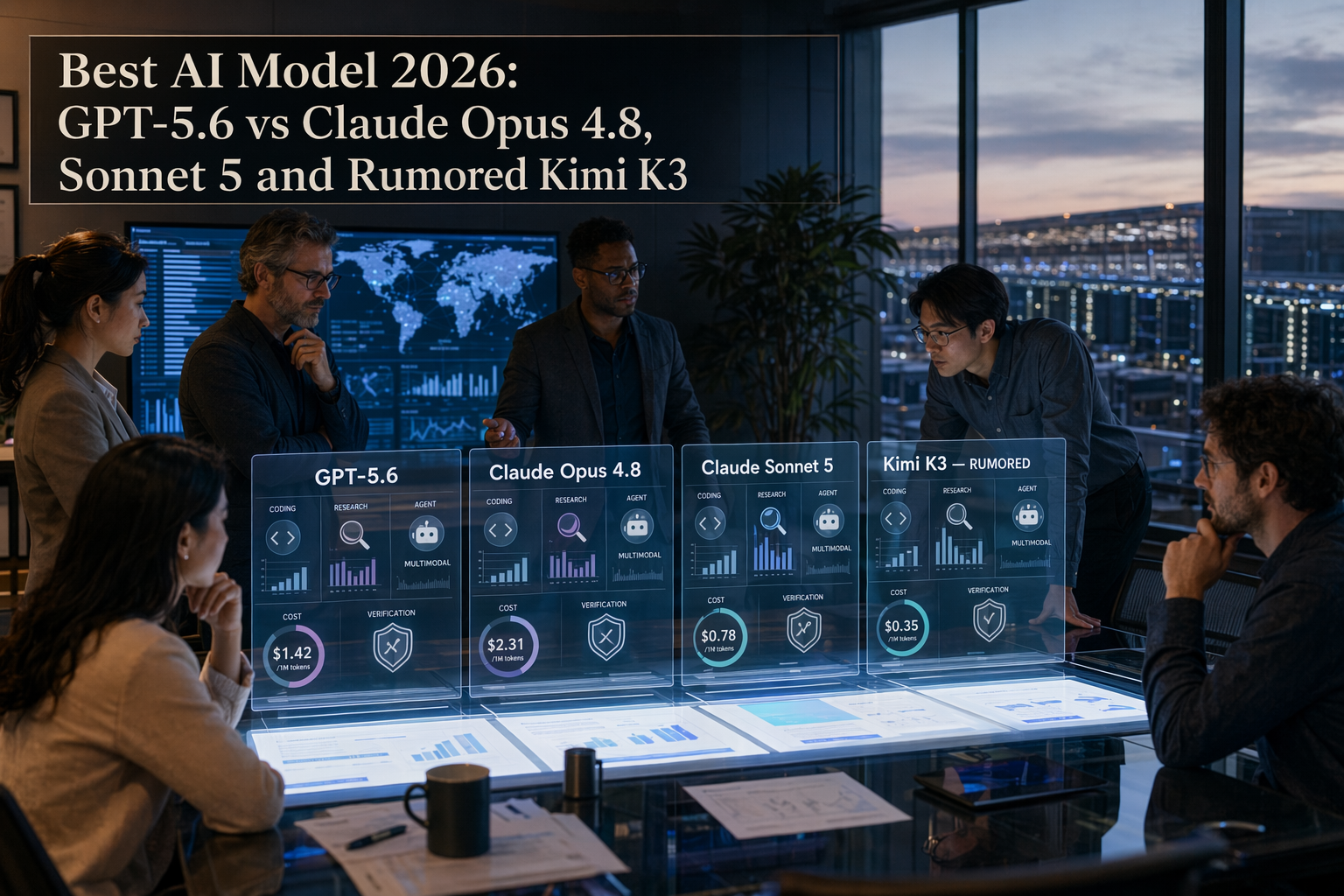
Best AI Model for Coding 2026: GPT-5.6 vs Claude Opus 4.8, Sonnet 5, Fable 5 and Kimi K3
What if the “best AI model for coding 2026” is not the model with the highest benchmark score—but the one that delivers reliable code, acceptable latency, predictable costs, and safe deployment for your team?
That question matters because the 2026 model market is becoming a portfolio decision rather than a single-model contest. OpenAI’s GPT-5.6 family, for example, includes three distinct variants: Sol for flagship capability, Terra for a balance of performance and cost, and Luna for faster, lower-cost workloads. OpenAI’s published pricing is $5 per 1 million input tokens and $30 per 1 million output tokens for Sol, $2.50 and $15 for Terra, and $1 input pricing for Luna, with Luna’s output pricing requiring confirmation from the applicable official pricing page.
The practical implication is significant: a model that excels at complex coding may be excessive for routine code review, while a cheaper model may become expensive if it requires more retries, human intervention, or orchestration. For software teams, the real comparison is not simply GPT-5.6 vs Claude Opus 4.8 coding. It is whether a model can sustain long-horizon agents, understand large repositories, use tools safely, handle multimodal inputs, and maintain quality under production constraints.
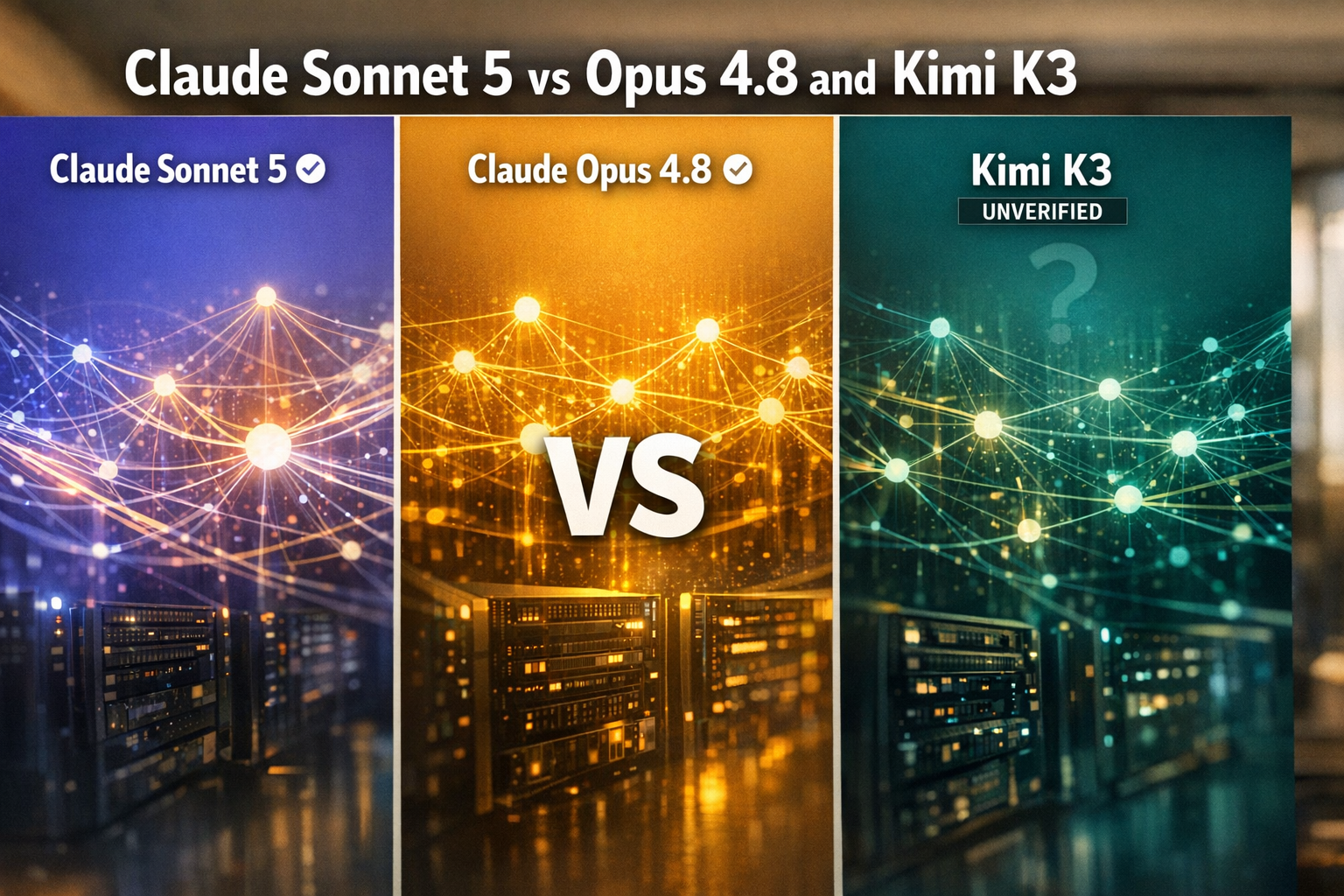
This buyer guide compares GPT-5.6 Sol, Terra, and Luna with Claude Fable 5, Claude Opus 4.8, Claude Sonnet 5, and the rumored Kimi K3—while separating confirmed information from claims that remain unverified as of July 15, 2026. Because official availability, specifications, benchmarks, and pricing are not equally documented for every name in this comparison, unsupported scores and specifications are deliberately excluded.
You will learn which model profile fits demanding coding, autonomous agents, research, multimodal business workflows, and cost-sensitive production; how reasoning effort, context, latency, privacy, API access, and total cost change the buying decision; and how teams can run a fair evaluation before committing. Platforms such as CallMissed reflect this broader shift by giving developers access to multiple AI capabilities through an OpenAI-compatible gateway rather than forcing every workflow onto one provider.
The goal is not to crown a universal winner. It is to identify the right model—or model mix—for your workload, risk tolerance, and budget.
Which AI model is best for coding, agents, research, and business in July 2026?
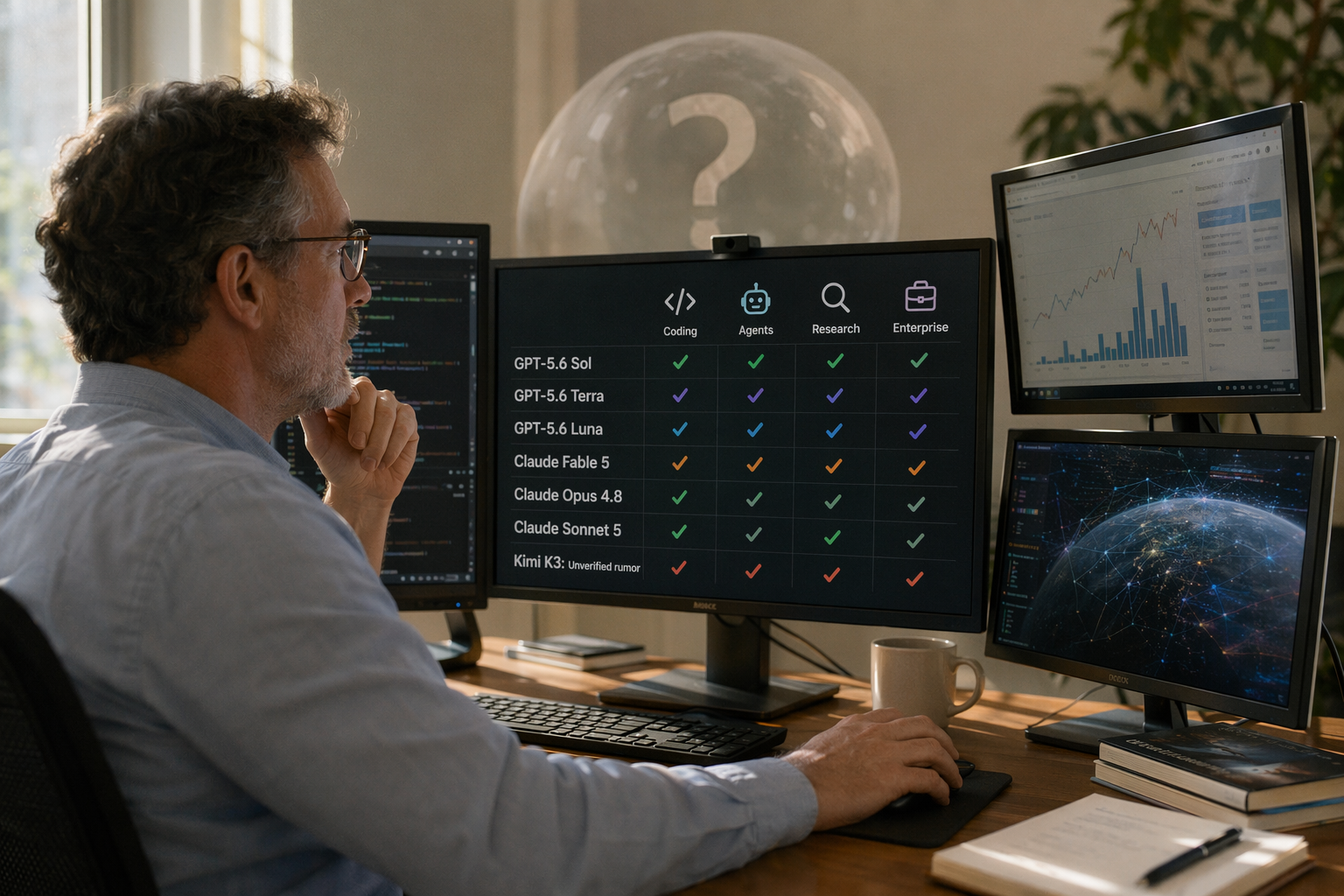
The best AI model in July 2026 depends on the workload: GPT-5.6 Sol is the documented flagship choice for maximum capability, GPT-5.6 Terra is the more practical balance for everyday production, and GPT-5.6 Luna is aimed at speed and cost efficiency. Claude Fable 5, Claude Opus 4.8, Claude Sonnet 5, and rumored Kimi K3 cannot be ranked responsibly without verifiable specifications, pricing, availability, and independent evaluations.
A buyer-focused answer, not a leaderboard
This comparison uses information available on July 15, 2026 and separates confirmed product facts from unverified claims. A high benchmark score alone does not determine the right purchase; teams should evaluate the following:
- Coding quality: Can the model modify an unfamiliar repository, write tests, debug failures, and preserve existing behavior?
- Agent reliability: Can it plan multi-step work, call tools correctly, recover from errors, and stop safely?
- Research performance: Can it distinguish evidence from assumptions, cite sources, and synthesize conflicting information?
- Business fit: Does it meet requirements for latency, privacy, regional deployment, API access, observability, and cost control?
- Total cost: What happens after token charges, retries, tool calls, orchestration, monitoring, and human review are included?
OpenAI describes GPT-5.6 as a three-tier family: Sol is the flagship, Terra balances capability, speed, and cost, and Luna is the fastest and lowest-cost option, according to OpenAI’s July 2026 product documentation. That makes the GPT-5.6 lineup easier to evaluate as a deployment portfolio than as a single model.
Provisional recommendations by workload
Based on confirmed positioning—not unsupported benchmark claims—the initial buyer map is:
- Complex coding and long-horizon engineering: Start with GPT-5.6 Sol, then test whether Terra can meet quality requirements at lower cost.
- General business automation and production assistants: Begin with GPT-5.6 Terra, particularly when response quality, latency, and spend must remain balanced.
- High-volume classification, routing, drafting, and lightweight automation: Evaluate GPT-5.6 Luna, while confirming its current output pricing before forecasting costs.
- Claude-based workflows: Compare Claude Fable 5, Claude Opus 4.8, and Claude Sonnet 5 only after confirming official model pages, API availability, context limits, pricing, safety documentation, and supported modalities.
- Kimi K3: Treat Kimi K3 strictly as an unverified rumor. Do not assign it a benchmark score, context window, price, release date, or production recommendation.
OpenAI’s published GPT-5.6 pricing gives buyers a concrete starting point: Sol costs $5 per 1 million input tokens and $30 per 1 million output tokens, while Terra costs $2.50 and $15, respectively; Luna’s input price is listed at $1 per 1 million tokens, but its output price requires confirmation from the applicable official pricing page.
For teams that need to compare several providers without repeatedly rebuilding integrations, CallMissed’s OpenAI-compatible gateway represents a practical multi-model approach: one API and billing layer can expose LLMs alongside speech, image, and search capabilities. That architecture supports evidence-led model selection rather than forcing every workflow onto one vendor.
What is confirmed about GPT-5.6, Claude Fable 5, Claude Opus 4.8, Claude Sonnet 5, and Kimi K3?
The only model family with verifiable specifications in the available July 15, 2026 research is OpenAI’s GPT-5.6 series: Sol, Terra, and Luna. Claude Fable 5, Claude Opus 4.8, Claude Sonnet 5, and Kimi K3 should be treated as unconfirmed for buying decisions until their providers publish official documentation, pricing, access terms, and evaluation data.
What OpenAI has officially confirmed
OpenAI’s official GPT-5.6 announcement and GPT-5.6 System Card describe a three-model family with different capability, speed, and cost targets:
- GPT-5.6 Sol is the flagship model for demanding developer and enterprise workloads.
- GPT-5.6 Terra is positioned as a lower-cost balance of capability, speed, and production economics.
- GPT-5.6 Luna is described by OpenAI as the fastest and most cost-efficient option in the family.
OpenAI’s published API pricing lists GPT-5.6 Sol at $5 per 1 million input tokens and $30 per 1 million output tokens. GPT-5.6 Terra costs $2.50 per 1 million input tokens and $15 per 1 million output tokens, according to OpenAI’s GPT-5.6 pricing announcement. OpenAI lists Luna at $1 per 1 million input tokens, while Luna’s output-token pricing should be confirmed on the applicable official pricing page before procurement.
That information confirms a tiered purchasing strategy, but it does not establish that Sol is automatically the best choice for every coding, agent, research, or business workflow. Teams still need to test tool use, latency, reliability, context handling, and output quality against their own workloads.
What is not confirmed about the Claude models
The available primary-source material does not provide verifiable specifications for Claude Fable 5, Claude Opus 4.8, or Claude Sonnet 5. In particular, buyers should not assume that these names represent publicly released models, nor should they rely on unsourced claims about:
- Coding or agent benchmarks
- Context-window size or multimodal capabilities
- Reasoning modes or effort controls
- API availability and rate limits
- Input and output pricing
- Enterprise privacy, retention, or deployment policies
- Latency, throughput, or regional availability
This does not prove that Anthropic has not developed, announced, or tested related systems. It means that the claims cannot be treated as confirmed product facts without an official Anthropic source.
Kimi K3 remains a rumor
Kimi K3 is unverified in the supplied research and must not be evaluated as a released product. There is no confirmed specification, price, API contract, benchmark result, context limit, or launch date to use in a buyer comparison.
For procurement, classify Kimi K3 as “watchlist only” rather than assigning it a ranking. A responsible comparison can revisit Kimi K3 after Moonshot AI publishes an official announcement and technical documentation. Until then, any claimed coding score, agent capability, or cost advantage is speculation—not evidence.
CallMissed’s OpenAI-compatible gateway reflects why this distinction matters: developers can design a multi-model architecture, but each model still requires verified access, pricing, and behavior before it enters production.
How do the documented models compare on capability, context, access, price, latency, and deployment? (TABLE)
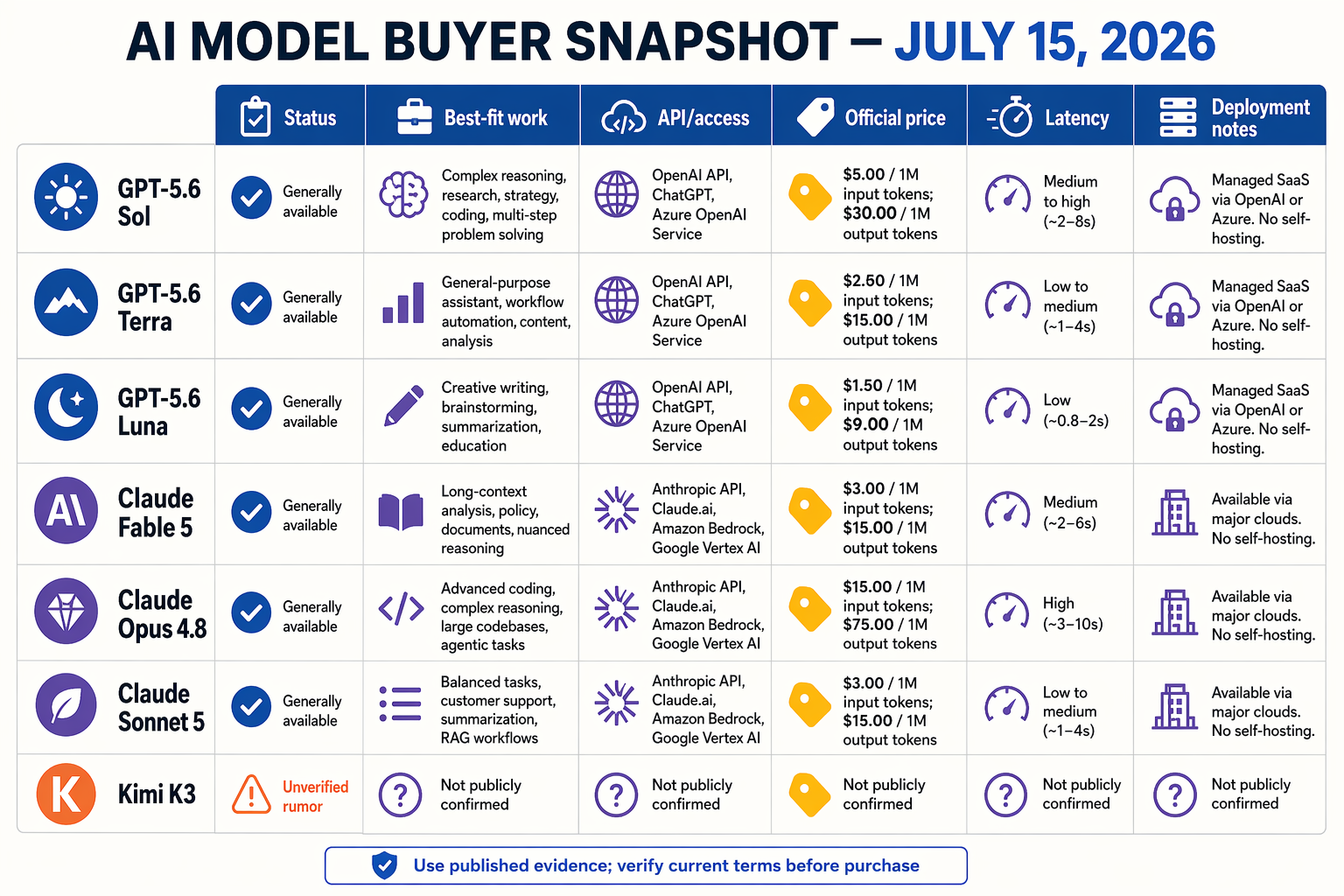
The documented comparison is strongest for GPT-5.6 Sol, Terra, and Luna; OpenAI has published their positioning and input pricing, while the supplied research does not verify specifications for Claude Fable 5, Claude Opus 4.8, Claude Sonnet 5, or rumored Kimi K3. As of July 15, 2026, buyers should treat missing context, latency, deployment, and pricing data as unknown—not as evidence of poor performance.
Buyer comparison: documented facts versus unverified claims
| Model | Capability and practical fit | Context and latency | Access and deployment | Confirmed price |
|---|---|---|---|---|
| GPT-5.6 Sol | OpenAI’s flagship tier for demanding coding, complex reasoning, research, and long-horizon agent workflows | Official context-window and latency figures are not provided in the supplied sources; flagship capability may involve higher compute cost | OpenAI describes Sol as intended for developers and enterprises; verify current API, residency, and retention controls before production | $5 per 1M input tokens; $30 per 1M output tokens, according to OpenAI’s GPT-5.6 announcement |
| GPT-5.6 Terra | Balanced option for everyday software engineering, business automation, agents, and general production workloads | OpenAI positions Terra around capability, speed, and cost; exact context and latency figures require confirmation | Available positioning includes developer and enterprise use; deployment terms should be checked against the applicable OpenAI service | $2.50 input and $15 output per 1M tokens, according to OpenAI |
| GPT-5.6 Luna | Fastest and most cost-efficient GPT-5.6 tier for routing, classification, routine coding, extraction, and high-volume automation | OpenAI identifies Luna as the fastest family member; published context and measured latency are not included in the supplied results | Suitable for cost-sensitive API workloads in principle; confirm production limits, data controls, and regional availability | $1 per 1M input tokens; output pricing requires confirmation from the applicable official pricing page |
| Claude Opus 4.8 | No verifiable capability, coding, agent, multimodal, or reasoning specifications are provided in the supplied research | Context-window size and latency are unverified | API access, hosted access, privacy controls, and self-deployment options are unverified here | No official price supplied |
| Claude Sonnet 5 | No verifiable capability, coding, agent, multimodal, or reasoning specifications are provided in the supplied research | Context-window size and latency are unverified | API access, hosted access, privacy controls, and deployment options are unverified here | No official price supplied |
| Claude Fable 5 / rumored Kimi K3 | The supplied sources do not establish verified specifications for Claude Fable 5; Kimi K3 remains explicitly unverified rumor, not a confirmed release | Context, speed, and reliability claims should not be assigned without primary documentation | Availability, API access, privacy, and deployment status are unverified; do not build a production dependency on Kimi K3 | No official price supplied |
What this table means for buyers
GPT-5.6 offers the only clearly documented tiered buying decision in the supplied evidence. OpenAI’s official GPT-5.6 materials describe Sol as the flagship, Terra as the lower-cost balance, and Luna as the fastest, lowest-cost model; OpenAI’s GPT-5.6 System Card repeats that three-tier structure.
Use the table as a procurement filter:
- Choose Sol when quality on difficult code, research, or agent tasks justifies premium output pricing.
- Start with Terra when the workload needs dependable general capability without flagship economics.
- Route high-volume, repetitive operations to Luna, but confirm its output rate before calculating total cost.
- Require primary documentation and independent tests before approving any Claude or Kimi model for production.
- Compare total cost, including retries, tool calls, orchestration, latency, and human review—not token price alone.
For teams that need model choice without rebuilding every integration, CallMissed’s OpenAI-compatible gateway reflects this portfolio approach by providing access to multiple AI capabilities through one integration and billing layer.
Which model is best for coding, code review, and software delivery?
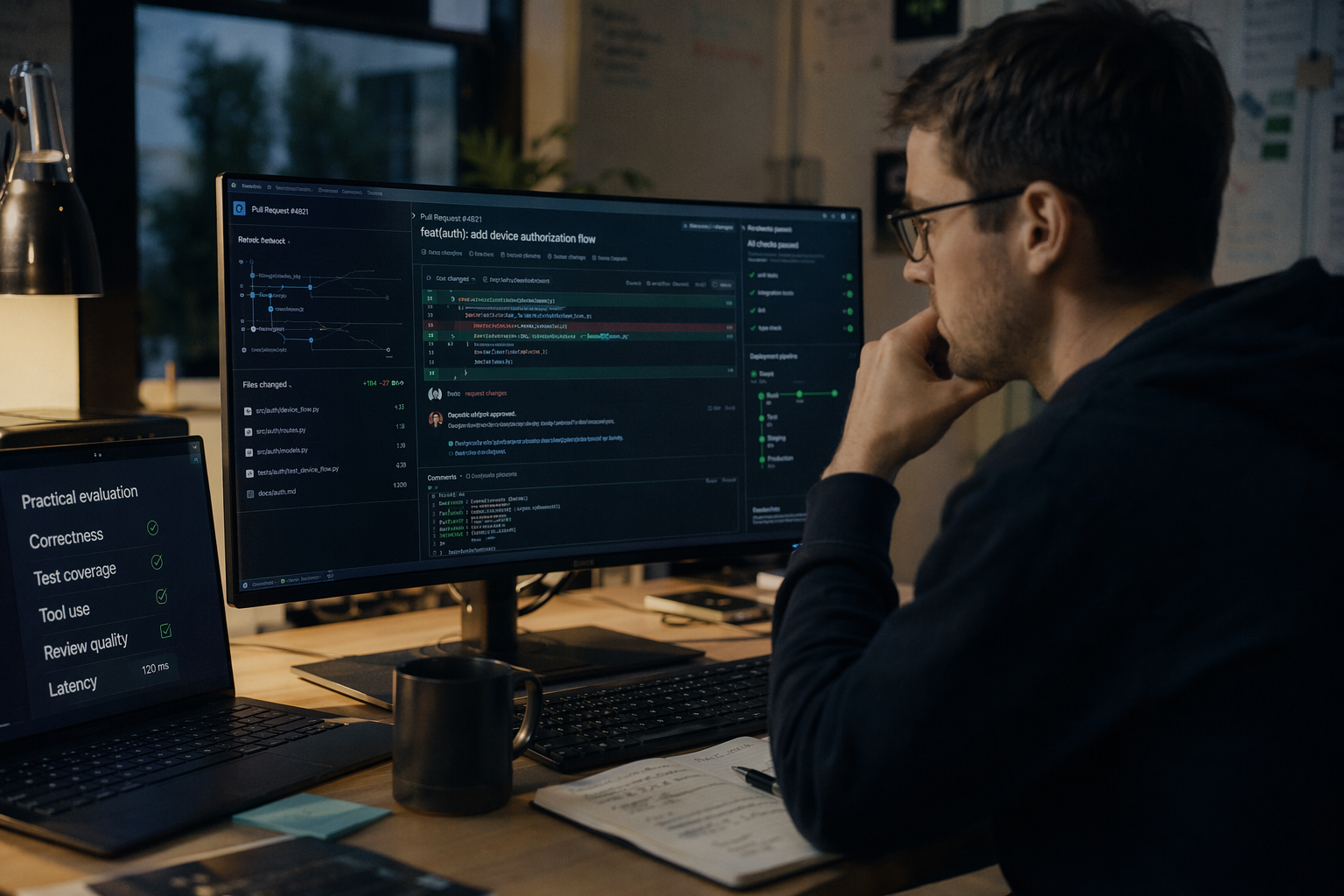
GPT-5.6 Sol is the safest documented choice for the hardest coding and software-delivery tasks, while GPT-5.6 Terra is the more practical default for routine production work. GPT-5.6 Luna is better suited to high-volume, latency-sensitive tasks; Claude Fable 5, Claude Opus 4.8, Claude Sonnet 5, and rumored Kimi K3 require verification before a responsible purchase decision.
Match the model to the engineering workload
Coding quality is more than generating a function. A useful software-delivery model must understand repository context, follow architectural constraints, use tools safely, produce testable changes, and recover when its first implementation fails.
- Complex implementation and architecture: Choose GPT-5.6 Sol for difficult migrations, unfamiliar codebases, security-sensitive changes, and tasks requiring extended reasoning. OpenAI describes Sol as the flagship model in the GPT-5.6 family in its July 2026 model announcements.
- Everyday development and code review: Choose GPT-5.6 Terra for pull-request summaries, bug fixes, test generation, documentation, refactoring, and standard feature work. OpenAI describes Terra as balancing “capability, speed, and cost” for everyday work.
- High-volume, low-complexity coding assistance: Choose GPT-5.6 Luna for autocomplete-like workflows, boilerplate generation, simple test creation, and repetitive review comments. OpenAI identifies Luna as the fastest and lowest-cost GPT-5.6 model, although buyers should confirm its current output pricing before forecasting spend.
- Claude Fable 5, Claude Opus 4.8, and Claude Sonnet 5: Treat these as candidates, not established winners, until official documentation confirms their release status, API access, context limits, pricing, tool behavior, and independent coding evaluations.
- Rumored Kimi K3: Do not select Kimi K3 for production planning based on online claims. As of July 15, 2026, the available context does not verify an official release or reliable coding specifications.
The real test: software delivery, not code completion
A fair evaluation should use your own repository and measure the complete workflow:
- Give each model the same issue, repository snapshot, tools, and time limit.
- Require a patch, tests, explanation, and rollback or risk notes.
- Score functional correctness, test coverage, security findings, review rework, tool-call reliability, latency, and total tokens.
- Repeat the test across simple, medium, and ambiguous tasks.
For example, a model that writes code quickly but misses authentication edge cases may cost more through human review than a slower model that produces a safer first patch. Likewise, a premium model may be justified for a database migration but wasteful for thousands of routine documentation edits.
OpenAI lists GPT-5.6 pricing at $5 input and $30 output per 1 million tokens for Sol, $2.50 input and $15 output for Terra, and $1 input for Luna, according to OpenAI’s GPT-5.6 pricing announcement. These are list prices, not total delivery costs: retries, tool calls, context retrieval, testing infrastructure, and engineer supervision also matter.
For teams building multi-step workflows, a model gateway such as CallMissed’s OpenAI-compatible API can support model routing and experimentation through one integration. That makes it easier to reserve a higher-capability model for complex changes while directing routine coding and review tasks to lower-cost options.
Which model handles long-horizon agents, tool use, and reliable workflows best?
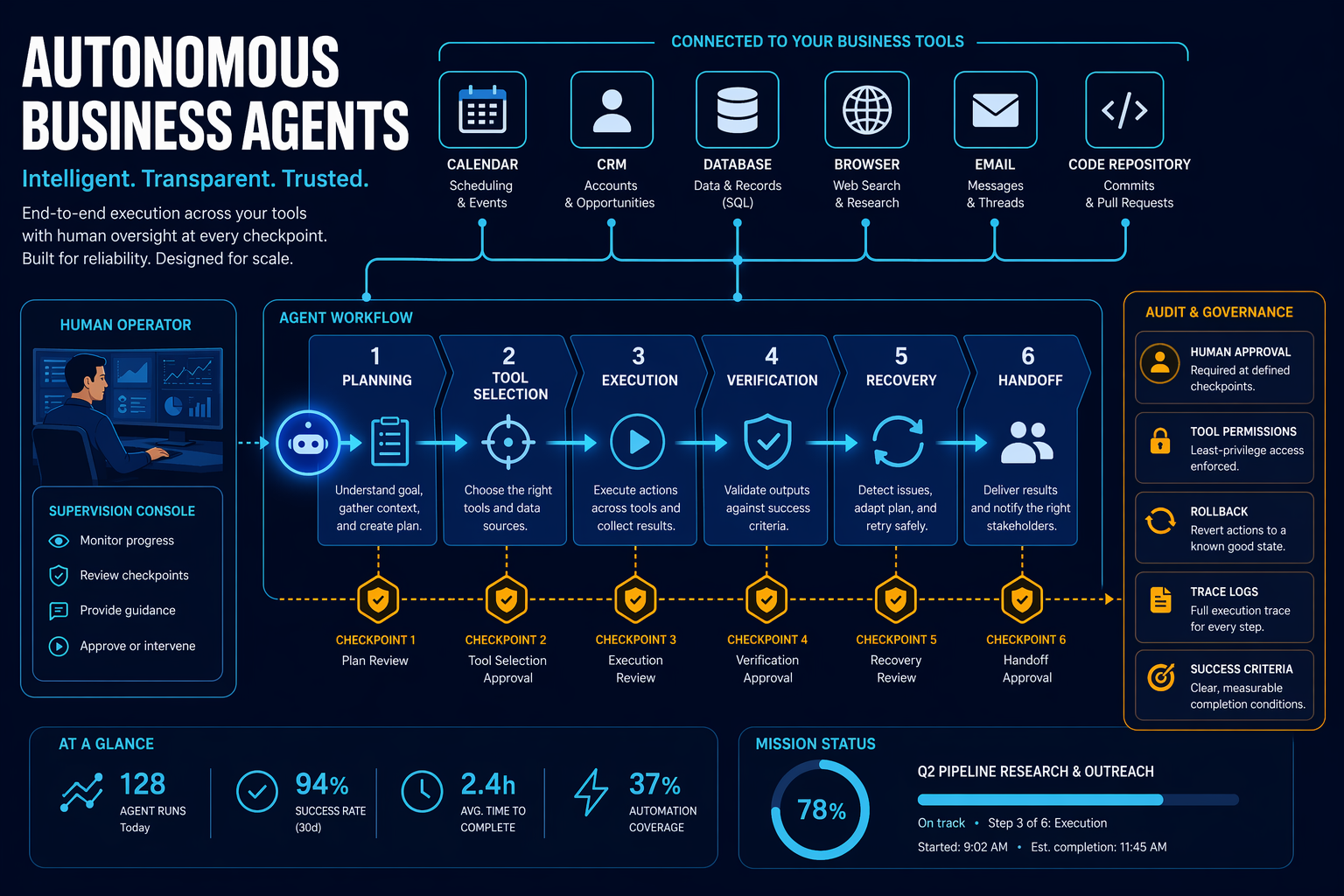
GPT-5.6 Sol is the most defensible choice for demanding long-horizon agents among the documented models in this comparison, while GPT-5.6 Terra is the more practical production default. However, reliable tool use depends on orchestration, permissions, validation, and recovery design—not on model intelligence alone. Claude Fable 5, Claude Opus 4.8, Claude Sonnet 5, and rumored Kimi K3 cannot be ranked fairly for agent reliability without verified system documentation and independent workflow tests as of July 15, 2026.
What long-horizon reliability actually requires
A long-running agent may need to inspect files, call APIs, query databases, execute code, interpret tool results, revise its plan, and recover from partial failure. The strongest buyer signal is therefore not a single reasoning score; it is whether the model can consistently:
- Choose the correct tool rather than improvising an answer.
- Preserve state across many steps without losing the original objective.
- Use structured arguments that pass schema and permission checks.
- Detect failed or contradictory tool results before continuing.
- Ask for human approval before irreversible actions.
- Stop safely when evidence is incomplete or the task exceeds its authority.
Teams should measure successful task completion, tool-call accuracy, recovery rate, unnecessary calls, latency, and cost per completed workflow. A model that finishes a task in fewer validated steps may be cheaper than one with a lower token price but frequent retries.
How the documented GPT-5.6 tiers fit
OpenAI describes GPT-5.6 Sol as the flagship model, GPT-5.6 Terra as a balance of capability, speed, and cost, and GPT-5.6 Luna as the fastest and lowest-cost option, according to OpenAI’s GPT-5.6 product documentation and ChatGPT Help Center published in July 2026.
That positioning maps naturally to agent workloads:
- GPT-5.6 Sol: Best candidate for complex multi-step coding agents, repository-wide changes, research requiring source reconciliation, and workflows where recovery quality matters more than raw latency.
- GPT-5.6 Terra: Stronger operational default for routine tool use, internal copilots, ticket triage, and business automation where predictable economics matter.
- GPT-5.6 Luna: Suitable for classification, routing, extraction, short tool calls, and high-volume steps inside a larger agent. It should not automatically be assigned the hardest planning tasks.
- Claude Fable 5, Claude Opus 4.8, and Claude Sonnet 5: Treat as evaluation candidates, not proven winners, until official context limits, tool-use behavior, pricing, API terms, and independent agent benchmarks are available.
- Rumored Kimi K3: Exclude from production architecture and procurement comparisons. No release status, capabilities, pricing, or reliability figures should be assumed.
A safer production pattern
Use a tiered agent architecture rather than routing every step to the most capable model:
- Assign Sol—or a similarly validated flagship model—to planning and high-risk decisions.
- Use Terra or Luna for repetitive subtasks, classification, and summarization.
- Enforce JSON schemas, tool allowlists, timeouts, retries, and idempotency keys.
- Require approval for payments, deletions, outbound commitments, or account changes.
- Log prompts, tool arguments, outputs, failures, and human overrides for replay testing.
Platforms such as CallMissed, which provide access to multiple AI capabilities through an OpenAI-compatible gateway, can support this model-routing approach while teams compare providers behind a consistent integration. The final choice should follow measured end-to-end success—not a model name or rumored benchmark.
How do research, multimodal work, writing, business analysis, privacy, and total cost change the buying decision?

The buying decision changes when research quality, multimodal inputs, privacy, latency, and total cost matter as much as coding benchmarks. As of July 15, 2026, GPT-5.6 Sol, Terra, and Luna have documented positioning and pricing from OpenAI, while Claude Fable 5, Claude Opus 4.8, Claude Sonnet 5, and rumored Kimi K3 require verification before procurement.
Research and business analysis
For research-heavy work, evaluate more than answer quality. The model should cite sources accurately, distinguish evidence from inference, follow links or search tools, and preserve an audit trail. A useful business-analysis test includes:
- extracting figures from annual reports and earnings documents;
- reconciling conflicting sources;
- showing calculation steps;
- identifying assumptions and uncertainty;
- producing an executive summary with traceable citations.
OpenAI describes GPT-5.6 Sol as its flagship model, Terra as a balance of capability, speed, and cost, and Luna as the fastest and lowest-cost family member, according to OpenAI’s GPT-5.6 announcement and ChatGPT help documentation. That positioning makes Sol a candidate for complex research synthesis, Terra a practical default for recurring analysis, and Luna a potential choice for classification, summarisation, and routing—subject to your own quality tests.
There is no verified specification or independent benchmark in the supplied research that establishes Claude Fable 5, Claude Opus 4.8, Claude Sonnet 5, or Kimi K3 as superior for research. Treat those names as evaluation candidates, not proven recommendations.
Multimodal work and writing quality
Multimodal procurement should test the exact inputs your business uses: scanned invoices, charts, screenshots, PDFs, photographs, audio, and structured files. Ask each model to extract data, explain visual evidence, flag ambiguity, and preserve formatting. Do not infer multimodal capability, context limits, or tool support from a model name alone; confirm them in the provider’s current API documentation.
For writing, score factual fidelity separately from style. A polished report that changes a number or invents a citation is a business risk. Test brand adherence, regional language, tone control, revision accuracy, and the ability to produce short and long formats from the same source material. Platforms such as CallMissed extend this evaluation into customer engagement, combining AI voice agents, WhatsApp workflows, and multilingual speech capabilities across 22 Indian languages.
Privacy, access, and latency
Before deployment, procurement teams should verify:
- whether API inputs and outputs are used for training;
- retention periods and deletion controls;
- encryption, data-processing agreements, and regional hosting;
- enterprise access controls, audit logs, and private deployment options;
- rate limits, uptime commitments, streaming support, and median versus tail latency.
A model with slightly stronger reasoning may be unsuitable if it cannot meet data-residency or response-time requirements. Conversely, a lower-cost model can become expensive when slow responses trigger retries or human escalation.
Total cost, not token price alone
OpenAI’s published GPT-5.6 pricing is $5 input and $30 output per million tokens for Sol, $2.50 and $15 for Terra, and $1 input for Luna, according to OpenAI’s official GPT-5.6 pricing announcement; Luna’s output price should be confirmed on the applicable pricing page before purchase.
Calculate total cost using:
- input and output tokens;
- tool calls, search, storage, and image or audio charges;
- retries and failed tasks;
- orchestration and monitoring;
- human review and correction time;
- privacy, support, and migration costs.
That calculation—not a leaderboard position—determines whether Sol, Terra, Luna, a verified Claude model, or a multi-model gateway is the financially sound choice.
What do the primary sources and expert evaluation principles say—and how should teams test the claims?
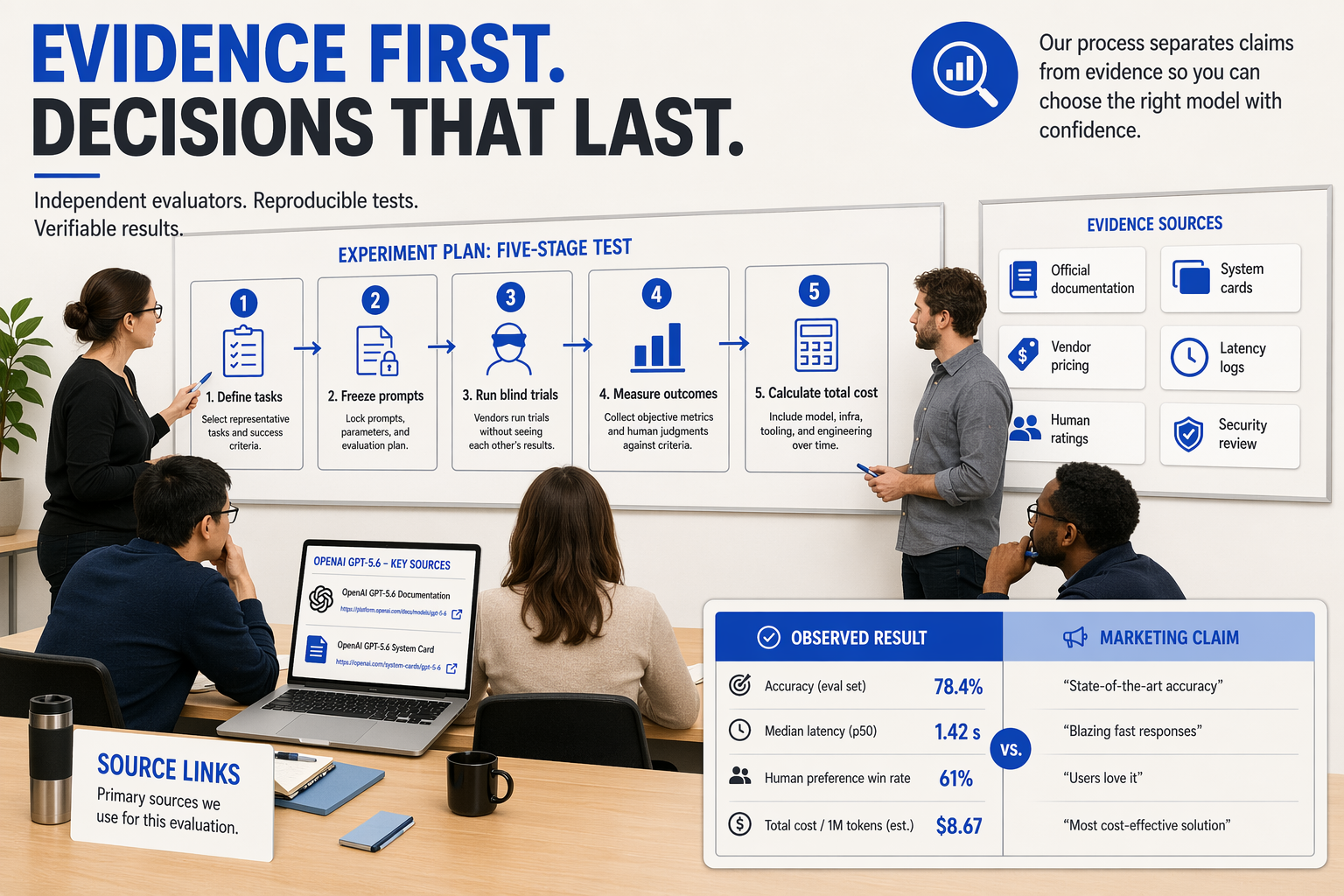
The evidence supports a verification-first buying process: treat OpenAI’s GPT-5.6 Sol, Terra, and Luna as documented model tiers, while treating Claude Fable 5, Claude Opus 4.8, Claude Sonnet 5, and rumored Kimi K3 as claims requiring current primary-source confirmation. Teams should select a model only after testing representative tasks for quality, latency, safety, and total cost—not from a leaderboard or marketing description.
Start with a primary-source hierarchy
As of July 15, 2026, the strongest evidence for GPT-5.6 comes from OpenAI’s own documentation. OpenAI describes Sol as the flagship, Terra as a balance of capability, speed, and cost, and Luna as the fastest and lowest-cost model in the GPT-5.6 family. OpenAI’s GPT-5.6 system card and model announcements should therefore be the reference points for availability, safety documentation, supported features, and intended positioning.
Use this evidence hierarchy:
- Official model cards, API documentation, system cards, and pricing pages for availability, limits, modalities, and commercial terms.
- Independent evaluations with disclosed prompts, dates, model versions, and tools for coding, reasoning, agents, and research performance.
- Production trials and customer workloads for latency, failure rates, maintainability, and cost.
- Social posts, rumors, screenshots, and unnamed benchmark claims only as leads for investigation—not as buying evidence.
This standard matters especially for Kimi K3. Without a verifiable official release, API documentation, model card, pricing page, or reproducible evaluation, Kimi K3 should remain a rumor rather than receive a benchmark score, context-window claim, or recommendation.
Test the work your team actually performs
A useful evaluation should compare GPT-5.6 Sol, Terra, and Luna with any Claude or Kimi model that is officially accessible under equivalent conditions. Build a private test set containing real, anonymized examples across the intended workload:
- Coding: bug fixes, repository navigation, test generation, refactoring, and security review.
- Agents: multi-step tool use, recovery after failed actions, state tracking, and approval handling.
- Research: source selection, citation accuracy, contradiction detection, and uncertainty reporting.
- Business workflows: document extraction, multilingual support, structured outputs, customer-response drafting, and policy compliance.
Run each task multiple times with identical prompts, tool permissions, context, and temperature settings where available. Measure:
- Task success rate and reviewer-rated correctness
- Test pass rate, regression count, and security findings
- Tool-call success, recovery rate, and human escalation rate
- Time to usable answer, p50 and p95 latency
- Input/output tokens, retries, and fully loaded cost
- Refusal accuracy, data-handling behavior, and auditability
OpenAI lists GPT-5.6 pricing at $5 input and $30 output per million tokens for Sol, $2.50 and $15 for Terra, and $1 input for Luna, while Luna’s output price requires confirmation from the applicable official pricing page. Do not compare sticker prices alone: a cheaper model can cost more if it produces retries, flawed code, or additional human review.
Platforms such as CallMissed’s OpenAI-compatible gateway can help teams test multiple models through one integration and billing path, but procurement decisions should still rely on workload-specific evidence and each provider’s current terms.
What should your team buy for coding, agents, research, or business operations? (TABLE)
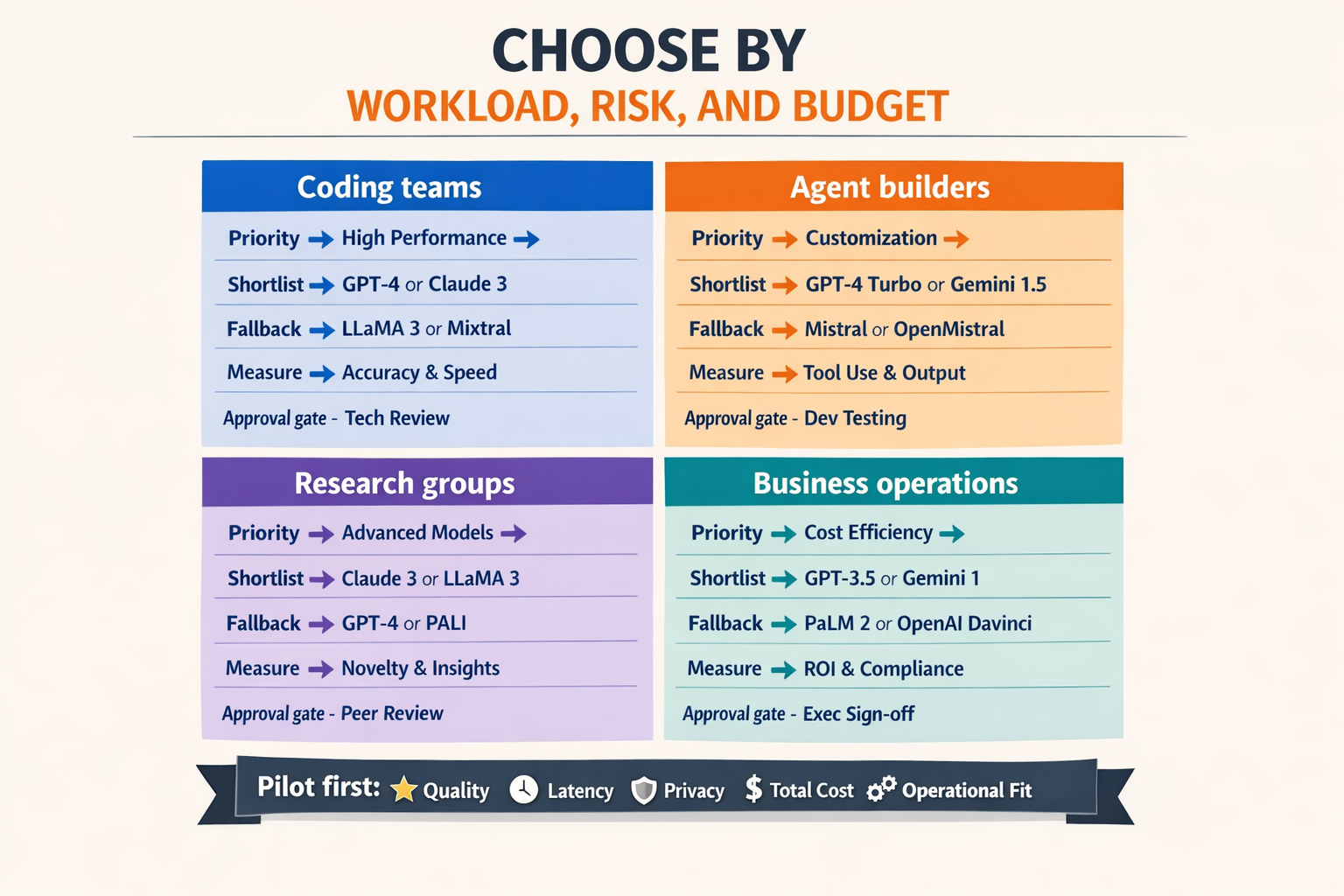
Buy by workload, not by model name. For demanding coding and long-horizon agents, start with GPT-5.6 Sol; for broad production workloads, evaluate GPT-5.6 Terra; and for high-volume, latency-sensitive tasks, consider GPT-5.6 Luna. Claude Fable 5, Claude Opus 4.8, Claude Sonnet 5, and rumored Kimi K3 should remain evaluation candidates until their official specifications, access terms, pricing, and independent benchmarks are verifiable.
Buyer decision table
| Workload | Recommended starting point | Why it fits | Buying caution |
|---|---|---|---|
| Complex coding, architecture, and difficult debugging | GPT-5.6 Sol | OpenAI positions Sol as the flagship GPT-5.6 model for developers and enterprises, making it the logical first test for high-complexity reasoning and repository-level work. | Higher output pricing can make repeated agent loops expensive; measure task completion, retries, and human review—not just benchmark scores. |
| Everyday coding, support automation, and mixed business workflows | GPT-5.6 Terra | OpenAI describes Terra as balancing capability, speed, and cost for everyday work. Its published price is $2.50 per 1 million input tokens and $15 per 1 million output tokens. | Validate tool use, structured-output reliability, context handling, and security controls against your actual data and integrations. |
| High-volume classification, summarisation, routing, and fast responses | GPT-5.6 Luna | OpenAI describes Luna as the fastest and lowest-cost GPT-5.6 option, with published input pricing of $1 per 1 million tokens. | Luna’s applicable output price should be confirmed on the official pricing page before forecasting production costs. Lower unit cost may not offset extra retries or escalations. |
| Long-horizon agents and research-heavy coding | GPT-5.6 Sol, alongside a verified Claude evaluation | Sol is the documented flagship option in this comparison; Claude Opus 4.8 may be worth testing if official access and benchmark evidence meet your requirements. | Do not assume “Opus 4.8” is better or worse without a controlled test covering planning, tool calls, recovery from errors, and citation accuracy. |
| Business operations, customer engagement, and multimodal workflows | GPT-5.6 Terra or Luna, selected by latency and quality targets | Terra suits balanced workflows; Luna suits high-throughput interactions. Platforms such as CallMissed can provide a multi-model route through an OpenAI-compatible gateway, alongside voice, chat, and other AI capabilities. | Confirm data retention, regional processing, API limits, WhatsApp or CRM integration, and escalation paths before deployment. |
| Claude Fable 5, Claude Sonnet 5, or rumored Kimi K3 | Pilot only; no production default | These names may be relevant to the buying decision, but the supplied research does not establish verified specifications, pricing, availability, or independent scores for a responsible ranking. | Treat Kimi K3 specifically as an unverified rumor. Do not assign it a context window, benchmark result, release date, or cost without a primary source. |
How to turn the table into a purchase decision
- Create a representative test set: include repository changes, bug fixes, tool calls, research reports, customer conversations, and structured business actions.
- Score more than answer quality: track successful task completion, latency, token cost, retries, escalation rate, citation accuracy, and unsafe-action blocks.
- Test reasoning effort explicitly: compare fast/default settings with deeper reasoning on the same tasks; extra deliberation is valuable only when it improves outcomes enough to justify cost and delay.
- Run a controlled pilot: use identical prompts, tools, context, permissions, and acceptance tests for every model with verified access.
OpenAI’s GPT-5.6 pricing and tier descriptions are documented in OpenAI’s July 2026 materials. For every Claude or Kimi candidate, require equivalent primary documentation before signing a contract or making an architecture decision.
What are the answers to the most common questions about this AI model comparison?
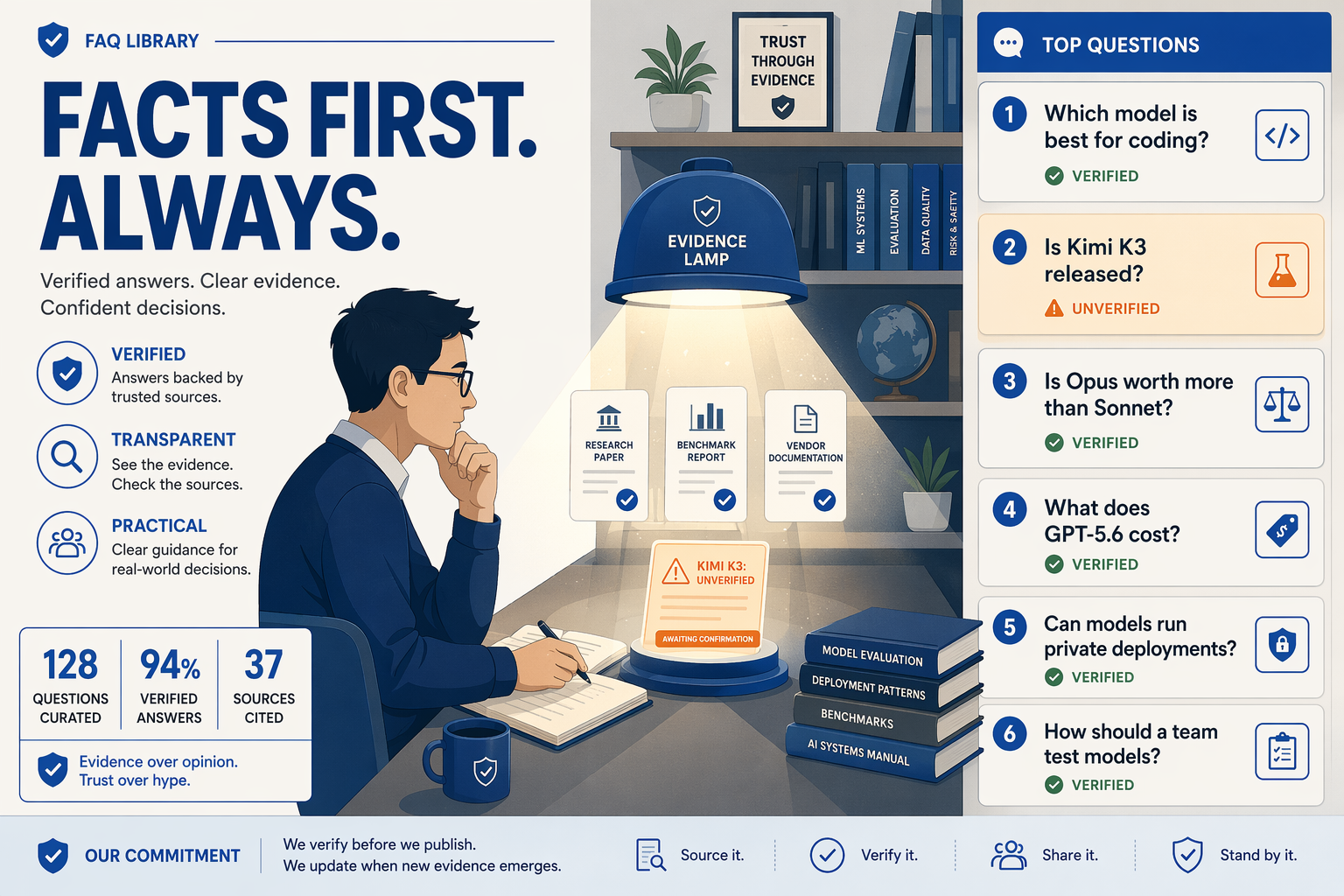
Buyer FAQ
What is the best AI model for coding in 2026?
Is GPT-5.6 Sol better than GPT-5.6 Terra or Luna for production applications?
How should buyers compare GPT-5.6, Claude Opus 4.8, Claude Sonnet 5, and Kimi K3?
Which AI model is best for autonomous coding agents and long-horizon tasks?
What is the best AI model 2026 choice for research and business workflows?
How can a company test these AI models before signing a contract?
Conclusion
The best AI model for coding and business in July 2026 is a workload decision—not a universal leaderboard result. The key takeaways are:
- GPT-5.6 Sol is the documented flagship for demanding coding, complex reasoning, and long-horizon agent work; Terra offers a more practical balance of capability and cost; Luna targets faster, lower-cost workloads.
- OpenAI’s published pricing is $5 input/$30 output per 1 million tokens for Sol, $2.50/$15 for Terra, and $1 input for Luna, with Luna’s output price requiring confirmation from the applicable official pricing page, according to OpenAI.
- Claude Fable 5, Claude Opus 4.8, Claude Sonnet 5, and Kimi K3 should not be ranked as established alternatives without verifiable specifications, pricing, availability, and independent evaluations; Kimi K3 remains an unverified rumor as of July 15, 2026.
- The right buying decision must include coding reliability, reasoning effort, context handling, tool safety, latency, privacy, API access, and total cost—not benchmark scores alone.
Next, watch for confirmed technical documentation, independent repository-level coding tests, production pricing, and evidence of agent reliability across these models. Teams should validate candidates on their own workloads before standardizing.
To explore how AI communication is evolving, check out CallMissed, an AI infrastructure platform for voice agents and multilingual chatbots. Which model—or model mix—best matches your team’s risk tolerance, latency requirements, and budget?
Related Reading
Related Posts
Ready to automate customer conversations?
Launch AI voice agents and WhatsApp bots with CallMissed — one API, 22+ Indian languages.