

Zen and the Art of Machine Learning Research: Navigating Deep Learning Complexity



Did you know that in modern AI development, a single out-of-order data transformation can silently degrade your model’s accuracy by 15% without throwing a...
Zen and the Art of Machine Learning Research: Navigating Deep Learning Complexity
Did you know that in modern AI development, a single out-of-order data transformation can silently degrade your model’s accuracy by 15% without throwing a single runtime error? As deep learning models scale to hundreds of billions of parameters, the complexity of the software stacks supporting them has grown exponentially. In his viral essay on Zen and the Art of Machine Learning Research, researcher Jack Morris highlighted a sobering reality: our modern deep learning infrastructure is so intricate that critical bugs can easily lie hidden across training loops, evaluation harnesses, inference pipelines, and raw datasets.
In 2026, AI research is no longer just about designing novel neural architectures; it is an exercise in managing extreme software complexity. With distributed training on massive GPU clusters and real-time, multi-modal pipelines becoming the industry standard, researchers and engineers spend more time debugging CUDA memory leaks and data pipeline mismatches than writing core ML code. This operational fragility is why platforms like CallMissed now offer robust infrastructure to manage this complexity, allowing developers to deploy resilient voice agents and query over 300 LLMs via a unified API without dealing with the underlying execution hazards.
But how do we, as researchers and developers, survive and thrive in this chaotic environment? Navigating this landscape requires more than just technical skill—it demands a philosophical shift.
In this post, we will unpack the core principles of Zen and the Art of Machine Learning Research. You will learn how to systematically isolate silent bugs within your training and inference pipelines, build bulletproof evaluation harnesses, and cultivate a disciplined, zen-like methodology to conquer deep learning complexity. Let’s dive into how you can bring order to the chaos of modern AI development.
Introduction
In 2026, the landscape of artificial intelligence and machine learning (ML) is moving at a breakneck, almost dizzying pace. Every week brings a flurry of new open-source weights, novel optimization techniques, and evolving deployment paradigms. Yet, beneath the polished surface of state-of-the-art benchmarks lies a messy, chaotic reality. As highlighted in jxmorris12's widely discussed piece, "Zen and the Art of Machine Learning Research," the modern deep learning software stack has become incredibly complicated.
For researchers and developers alike, navigating this complexity requires more than just raw computational power—it demands a specific, disciplined mindset. Unlike traditional software engineering where a bug typically results in a clear error message or a hard crash, an ML bug is often silent. It might simply cause a model to converge slightly slower, yield a fractionally lower accuracy, or output gibberish in a tiny percentage of production edge cases.
According to recent discussions in the ML community, these elusive bugs tend to hide in four critical areas of the workflow:
- Bugs in Training: Subtle issues like poorly initialized weights, gradient clipping anomalies, or silent learning rate decay mismatches that degrade model quality without raising errors.
- Bugs in Inference: Mismatched tokenizers, precision mismatches (such as FP16 vs. BF16), or stateful caching issues during auto-regressive generation.
- Bugs in Harnesses: Flawed evaluation metrics, data leakage between training and testing sets, or biased prompts in LLM evaluation frameworks.
- Bugs in Data: Corrupted input tensors, mismatched indexing, or unexpected distribution shifts that go completely unnoticed until the system is live.
To survive and thrive in this environment, researchers must adopt a "Zen" approach—a philosophy of deliberate engineering, ruthless simplification, and structured debugging.
This operational friction is precisely why both enterprises and researchers are shifting toward unified infrastructure. For instance, platforms like CallMissed help abstract away the fragile, lower-level layers of this stack. By providing access to 300+ LLM models through a resilient API gateway and managing complex audio processing pipelines (such as Speech-to-Text supporting 22 Indian languages), CallMissed allows developers to bypass the typical "harness and inference" bottlenecks. Instead of wrestling with CUDA driver mismatches or tokenizer bugs, teams can focus entirely on core logic and user experience.
In this article, we will explore the core tenets of cultivating "Zen" in machine learning research. We will dissect the anatomy of silent ML bugs, look at best practices for robust context engineering, and outline strategies to maintain rigorous experimental habits in a hyper-active research ecosystem.
Background & Context
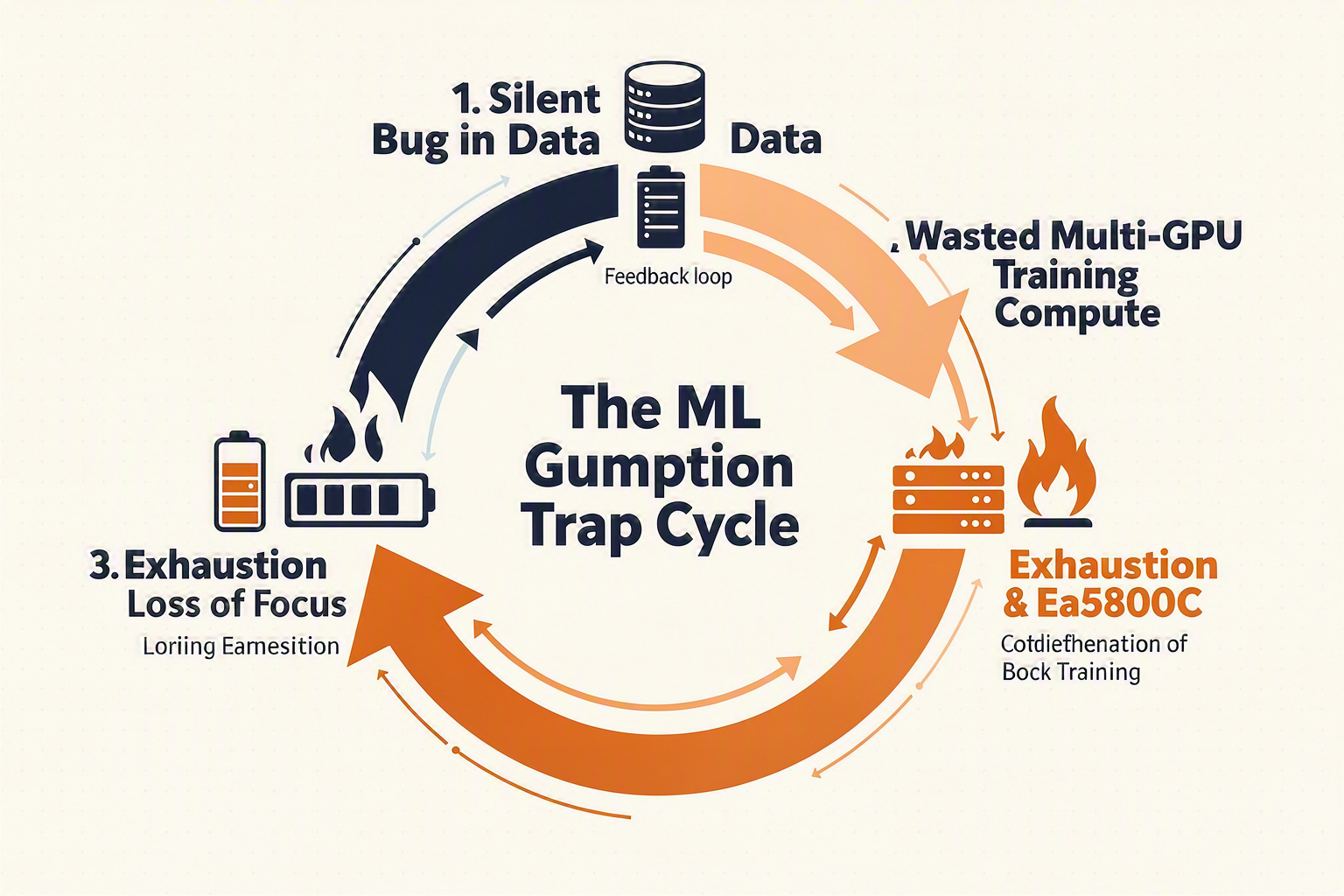
The Illusion of Simplicity in Modern AI
Historically, machine learning was viewed through a purely mathematical lens—a discipline of clean algorithms, loss functions, and statistical proofs. However, as the industry has scaled, ML research and development have undergone a dramatic transformation. Today, building state-of-the-art AI systems is less about pure mathematics and more about wrestling with massive, highly fragile software engineering pipelines.
In this landscape, the romanticized image of the lone researcher inventing a breakthrough algorithm in a vacuum has been replaced by the reality of the "system wrangler." Modern deep learning relies on an intricate, multi-layered stack of hardware accelerators, distributed training frameworks, specialized data loaders, and complex optimization libraries. When things go wrong, finding the point of failure is rarely straightforward.
The Multi-Layered Bug Maze
In his widely discussed piece, Zen and the Art of AI Research, technologist jxmorris12 captures the core frustration of modern practitioners: "A modern deep learning software stack is extremely complicated, and bugs can lie anywhere: in training, in inference, in harnesses, in data."
Unlike traditional software engineering—where a bug typically triggers a crash, a stack trace, or an explicit error message—machine learning bugs are notoriously silent. A model with a critical flaw will often still compile, run, and output predictions; it will simply perform worse than it should, leaving the developer to guess why. These silent failures hide in several distinct layers:
- The Data Pipeline: Silent corruption, subtle preprocessing mismatches between training and inference, or label leakage.
- The Training Loop: Numerical instability, vanishing gradients, or hidden synchronization lag in distributed multi-GPU training.
- The Evaluation Harness: Flawed metrics, biased test distributions, or minor bugs in evaluation scripts that artificially inflate or deflate performance scores.
- The Inference Engine: Subtle quantization errors, memory leaks under high concurrency, or compiler optimizations that alter tensor outputs.
Cultivating Zen Through Infrastructure
To survive this environment without burning out, AI researchers and developers must adopt a "Zen" mindset—a philosophy of meticulousness, patience, and systemic simplification. It requires treating the entire stack as a holistic, interconnected system rather than isolated blocks of code.
To combat this overwhelming complexity, the industry is shifting toward robust, pre-verified infrastructure that abstracts away low-level failure points. Instead of manually stitching together disparate speech, translation, and language models—which exponentially increases the surface area for silent bugs—developers are turning to consolidated platforms.
For instance, unified communication infrastructures like CallMissed help developers bypass stack-level headaches by offering a production-ready API gateway. By managing the complexities of Speech-to-Text across 22 regional languages, LLM inference, and Text-to-Speech within a single, highly reliable architecture, such platforms eliminate the brittle "glue code" where bugs so often hide.
Ultimately, achieving "Zen" in machine learning requires recognizing that the model is only as reliable as the invisible infrastructure supporting it. To build systems that actually work in production, developers must transition from chaotic firefighting to structured, systematic engineering.
Key Developments (TABLE)
To understand the shift toward a more mindful, disciplined approach to artificial intelligence, we must examine where the current machine learning lifecycle breaks down. As researcher jxmorris12 pointed out in a widely discussed Hacker News thread, "a modern deep learning software stack is extremely complicated, and bugs can lie anywhere: in training, in inference, in harnesses, in data." Unlike traditional software, ML pipelines rarely throw explicit runtime errors when things go wrong; instead, they fail silently, degrading model performance or hallucinating outputs without warning.
Achieving "Zen" in ML research requires reducing this systemic friction. Below is a breakdown of the key developments helping engineers move away from chaotic, over-engineered architectures toward elegant, minimalist workflows.
| Focus Area | The Complexity Challenge | "Zen" / Minimalist Solution | Key Technological Shift (2026) |
|---|---|---|---|
| System & Inference | Silent bugs lurking in deep stack harnesses, training loops, and inference engines | Abstracting low-level infrastructure to focus purely on high-level model routing | Multi-model API gateways and serverless, unified execution layers |
| Context Engineering | "Prompt bloat," excessive token spend, and noise within extended RAG windows | "Less is more": meticulous pruning of input tokens to maximize information density | Advanced semantic chunking, contextual pruning, and intent routing |
| Adversarial Security | Vulnerability to prompt injections, model poisoning, and unexpected distribution shifts | Proactive, robust model alignment coupled with deterministic safety filters | Low-utility-cost mitigations and collaborative, federated defense systems |
| Data & Training | Hard-to-trace data leakage and non-reproducible training runs | Radical determinism in pipelines and strict unit-testing for training data | Verifiable data-lineage tracking and automated validation harnesses |
Embracing Minimalist Infrastructure
The first step toward Zen-like clarity in machine learning is eliminating the operational overhead of the software stack. When developers are forced to manually configure drivers, optimize inference frameworks, and manage multiple open-source dependencies, they have less time to focus on core algorithmic design.
This infrastructure fatigue is driving the adoption of highly abstracted, production-ready platforms. For instance, rather than maintaining dozens of bespoke APIs for regional speech models or LLMs, engineering teams are increasingly relying on platforms like CallMissed. By offering unified APIs for Speech-to-Text (including 22 regional Indian languages) and access to over 300 LLMs through a single multi-model gateway, CallMissed abstracts away the fragile, low-level mechanics of model deployment. This allows researchers to swap, test, and run models without rewriting their underlying application harnesses.
The Art of Context Engineering
Another area undergoing a meditative simplification is how we feed data to models. As Nicola Procopio notes in his exploration of Zen and Context Engineering, throwing massive, unfiltered documents into a retrieval-augmented generation (RAG) system creates massive cognitive noise for the model.
Instead of chasing infinite context windows—which often lead to higher latency and "needle in a haystack" retrieval failures—the focus has shifted to extreme precision. By applying semantic pruning and routing, developers can deliver exactly the right context to the LLM. This minimalist approach not only drastically reduces token costs but also guarantees more accurate, hallucination-free outputs.
Mitigating Silent Failures
Because machine learning systems fail gracefully rather than crashing outright, debugging requires an almost meditative level of discipline. A bug in a data pre-processing script might only drop model accuracy by 2%, making it nearly impossible to spot without rigorous, deterministic validation harnesses.
By implementing continuous, automated unit testing across data, training, and inference pipelines, researchers can catch these silent regressions early. The goal is to build collaborative systems where safety, robustness, and performance are monitored continuously, freeing developers from the constant anxiety of silent model drift.
In-Depth Analysis
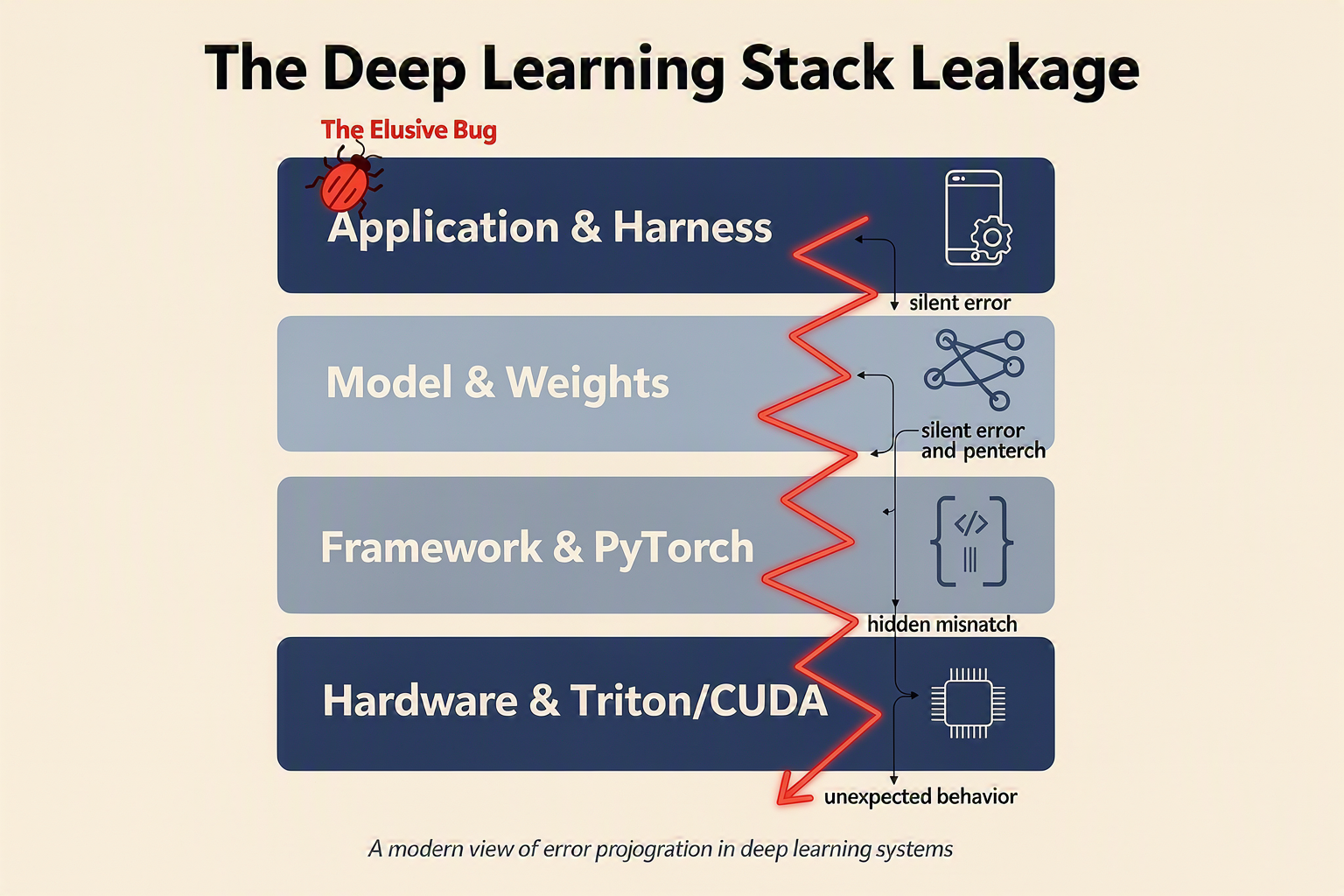
The Silent Saboteurs of the Modern ML Stack
To understand the core thesis of jxmorris12’s "Zen and the Art of Machine Learning Research," one must first confront the sheer complexity of modern deep learning software. Historically, software engineering relied on deterministic logic: input A yielded output B. In modern machine learning, however, we deal with stochastic systems where failure is rarely loud. Instead of throwing an explicit error, a buggy ML stack will often complete its run successfully, outputting a model that simply performs slightly worse than expected.
As noted in the primary research, a modern deep learning stack is a sprawling, fragile pipeline where "bugs can lie anywhere: in training, in inference, in harnesses, in data." To systematically debug this complexity, researchers must adopt a "Zen" mindset—a state of methodical patience that isolates and tests each layer of the stack:
- The Data Layer: Silent corruptions, tokenization mismatches, or preprocessing drift can ruin a model before training even begins.
- The Training Pipeline: Vanishing gradients, incorrect weight initializations, or subtle bugs in custom CUDA kernels can silently stall convergence.
- The Evaluation Harness: If the evaluation dataset or metric calculation is flawed, researchers may optimize for the wrong target entirely.
- The Inference Environment: Divergences between training-time tokenization and production-time serving can lead to erratic model behavior.
Context Engineering and the Mindful Researcher
Achieving "Zen" in ML research requires transitioning from haphazard brute-force experimentation to structured, mindful engineering. This philosophy is highly evident in emerging disciplines like Context Engineering and Retrieval-Augmented Generation (RAG). As researchers explore advanced RAG frameworks, they find that taming the unpredictability of Large Language Models requires treating the prompt context as a highly structured, sterile environment.
When context is messy, models hallucinate. When training data is unvetted, models underperform. By applying the Zen principles of minimalism and clarity to context window construction, researchers can drastically reduce the search space for bugs, turning chaotic, unpredictable outputs into reproducible science.
Eliminating Infrastructure Friction
For many researchers and developers, maintaining this massive stack is a distraction from their core objective: designing better workflows and solving real-world problems. Every hour spent debugging a PyTorch-to-TensorRT quantization bug or configuring multi-GPU inference harnesses is an hour lost to actual innovation.
This is where outsourcing stack complexity to production-ready platforms becomes essential. For instance, platforms like CallMissed allow developers to completely bypass the headaches of inference stack maintenance. By providing a unified gateway to over 300+ LLMs alongside robust Speech-to-Text APIs supporting 22 regional Indian languages, CallMissed handles the low-level infrastructure, containerization, and model serving. This allows AI teams to maintain their focus—and their Zen—on high-level application logic rather than low-level infrastructure debugging.
Impact & Implications
The philosophical shift proposed in "Zen and the Art of Machine Learning Research" carries profound implications for how AI research and product development are conducted. As highlighted by researcher jxmorris12, whose insights recently sparked significant debate on Hacker News, the primary bottleneck in modern AI is no longer just theoretical math, but the staggering complexity of the software stacks we build upon.
Taming the Multi-Layered Complexity
The most immediate impact of this Zen-like perspective is the realization that engineering hygiene is paramount. In deep learning, silent failures are the norm rather than the exception. As the author notes, a modern deep learning software stack is extremely complicated, meaning bugs can lie hidden anywhere across several vectors:
- Training Bugs: Subtle gradient clipping errors or learning rate schedule mismatches that do not throw errors but quietly degrade final accuracy.
- Inference Bugs: Tokenization mismatches or quantization discrepancies between training and deployment environments that ruin model outputs post-launch.
- Harness Bugs: Flawed evaluation pipelines and benchmark harnesses that falsely inflate or deflate performance metrics.
- Data Bugs: Corrupted training samples, silently dropped columns, or leaking evaluation data that distort training progress.
By embracing a "Zen" mindset, developers and researchers are forced to slow down, write comprehensive unit tests for data shapes, and visually inspect model outputs. The implication is clear: the fastest way to progress in AI is to build slower, more robust pipelines.
Streamlining the Infrastructure Stack
The sheer complexity of managing multi-layered ML pipelines is driving an industry-wide transition toward robust, decoupled infrastructure. Trying to self-host, fine-tune, and maintain custom training and inference stacks for every project is becoming increasingly unsustainable for modern enterprises.
To mitigate these infrastructure bugs, the industry is shifting toward consolidated, API-driven architectures. For example, unified platforms like CallMissed address these exact pain points. By providing a production-ready gateway to over 300+ LLMs alongside specialized Speech-to-Text engines (supporting 22 Indian languages natively) and voice APIs, CallMissed abstracts the intricate, bug-prone inference and harness layers. Instead of spending weeks debugging CUDA drivers, latency spikes, or hardware-level bottlenecks, developers can consume reliable APIs, allowing them to maintain their focus on core application logic.
Redefining the Role of the AI Engineer
Ultimately, this paradigm shift redefines what it means to be an AI practitioner. The industry is moving away from the "model-centric" era—where the primary goal was training slightly larger models from scratch—and entering an "infrastructure and system-centric" era.
- System-Level Thinking: Modern AI engineers must act as system architects, understanding how data flows across disparate APIs and microservices.
- Rigor Over Speed: Success is measured by the reliability of the evaluation harness rather than the speed of initial deployment.
- Mindful Debugging: Rather than blindly changing hyperparameters, developers must adopt a disciplined, scientific method of isolating variables.
By treating the machine learning pipeline not as a black box of magic, but as a complex software engineering artifact requiring rigorous Zen-like focus, organizations can build AI systems that are both resilient and highly scalable.
Expert Opinions

The consensus among leading AI researchers and software engineers is clear: modern machine learning has evolved from a purely mathematical pursuit into an intricate, often volatile engineering discipline. To succeed in this landscape, practitioners must adopt a methodical, almost meditative approach to their workflows—a mindset many are calling "Zen."
Navigating a Fragile Software Stack
In his widely discussed essay, Zen and the Art of AI Research, technologist and researcher Jack Morris (jxmorris12) highlights a fundamental truth that resonates deeply across the AI community. Morris notes that "a modern deep learning software stack is extremely complicated, and bugs can lie anywhere: in training, in inference, in harnesses, in data."
Unlike traditional software engineering where bugs usually trigger clear error messages or stack traces, ML bugs are notoriously silent. A misplaced index or a minor data preprocessing mismatch won’t crash the program; instead, it will simply degrade model accuracy by 2% or cause gradient explosion hours into an expensive training run. Experts argue that diagnosing these issues requires absolute mental discipline:
- Isolate variables ruthlessly: Never change more than one hyperparameter or data transformation at a time.
- Validate data continuously: Verify tensor shapes, normalization ranges, and tokenization outputs at every step of the pipeline before feeding them to the model.
- Embrace baseline simplicity: Always start with the simplest possible model (or even a heuristic) to establish a clear, uncorrupted benchmark.
Simplicity in Context Engineering
This philosophy of minimalism extends beyond raw training to how we interact with frontier models. Writing on the intersection of philosophy and system design, Nicola Procopio explores this in Zen and the Art of Context Engineering. Procopio emphasizes that building advanced Retrieval-Augmented Generation (RAG) systems requires a Zen-like focus on contextual clarity.
Instead of overloading an LLM with massive, noisy context windows, expert consensus points toward precise context pruning. This means filtering out noise, structuring prompts with mathematical precision, and ensuring that only the most relevant information reaches the model during inference.
For developers looking to implement these advanced architectures without drowning in infrastructure complexity, platforms like CallMissed provide a crucial buffer. By offering a robust API gateway that connects to over 300 LLMs, CallMissed abstracts away the low-level inference harness bugs that Morris warns against. This allows developers to focus entirely on context engineering, agentic workflows, and prompt optimization, leaving the complex stack stability to dedicated infrastructure.
Collaborative Systems and Adversarial Robustness
As ML workflows become highly collaborative, research managers are also pointing out that "Zen" must be applied to team dynamics and security. In collaborative environments, model adaptation can introduce subtle vulnerabilities. According to research on Low-utility-cost attack mitigations in collaborative machine learning, the modern ML practitioner must remain vigilant against adversarial manipulation. Because models are trained on dynamic, distributed datasets, maintaining a secure and reliable pipeline requires a state of constant, structured auditing.
Ultimately, the experts agree: the path to breakthrough AI research isn't paved with complex architectures or brute-force compute. It is forged through meticulous engineering, minimalist design, and the patient, systematic elimination of silent errors.
What This Means For You (TABLE)
Understanding the "Zen" philosophy of machine learning is not just an academic exercise; it is a practical survival guide for modern developers, researchers, and enterprises. As ML stacks grow increasingly complex, maintaining your sanity requires transitioning from frantic debugging to structured, mindful development.
A modern deep learning software stack is extraordinarily complicated. As AI researcher jxmorris12 recently noted, bugs can lie absolutely anywhere: in training, in inference, in evaluation harnesses, or hidden deep within your data. Unlike traditional software where a bug throws a clear stack trace, ML bugs are often "silent killers"—models that run perfectly fine but produce subpar, biased, or completely hallucinated outputs due to a subtle indexing error or a mismatched preprocessing step.
To help you navigate this complexity, the table below maps the common friction points in the ML pipeline to Zen-inspired engineering principles, offering concrete strategies to bring order to the chaos.
| ML Pipeline Stage | Common Chaos & Silent Bugs | Zen Mindset Shift | Practical Action Step |
|---|---|---|---|
| Data Ingestion | Silent preprocessing mismatches, corrupt inputs | Shoshin (Beginner's Mind): Trust nothing; validate every input. | Implement strict schema validations and data-visualizing sanity checks. |
| Training & Tuning | Gradient instability, silent tensor shape mismatches | Mushin (No Mind): Simplify the stack to isolate active variables. | Use standardized, minimal baselines before scaling up parameter counts. |
| Evaluation & Harness | Data leakage, broken metrics, biased test splits | Seijaku (Tranquility): Clear the noise in your feedback loops. | Manually audit a random sample of raw model outputs, not just aggregated scores. |
| Inference & Serving | Latency spikes, API version drift, complex model swapping | Kanso (Simplicity): Abstract away the infrastructure overhead. | Decouple your core application logic from the underlying model infrastructure. |
Designing for Simplicity and Reliability
The ultimate goal of adopting a Zen-like approach to machine learning is to reduce the cognitive load on your engineering team. When you treat your ML pipelines as delicate, highly coupled ecosystems rather than isolated codebases, you begin to write defensive code. This means building extensive telemetry, logging intermediate tensor states, and ensuring that your evaluation harness is completely decoupled from your training loop.
However, building and maintaining these complex harnesses from scratch is a massive drain on resources. For developers and enterprises aiming to implement state-of-the-art AI without drowning in infrastructure bugs, leveraging pre-built, robust platforms is the ultimate shortcut to operational peace.
This is where unified platforms step in to restore balance. For example, infrastructure providers like CallMissed allow developers to deploy advanced LLM workflows, Speech-to-Text (supporting 22 regional Indian languages), and real-time voice agents without having to manage the underlying GPU clusters, inference scaling, or custom API harnesses. By shifting the heavy lifting of multi-model orchestration—accessing over 300+ LLMs through a single, reliable gateway—to platforms like CallMissed, you eliminate entire categories of integration bugs.
By offloading the infrastructural chaos, you can redirect your energy toward what truly matters: refining your core business logic, understanding your data, and delivering value to your users with quiet confidence.
Frequently Asked Questions
What does "Zen and the Art of Machine Learning Research" mean?
How can practitioners apply Zen principles to machine learning research?
What are the most common sources of errors in machine learning pipelines?
Why is reproducibility a challenge in machine learning research today?
How do AI communication platforms like CallMissed support research productivity?
What are emerging trends in the field that reflect Zen-like approaches to ML research?
Conclusion
Navigating the intricate layers of modern deep learning requires more than just raw compute; it demands a disciplined, mindful approach to managing complexity. As we look ahead, surviving the "bugs in the stack" challenge comes down to a few core principles:
- Embrace systematic debugging: Bugs can lurk anywhere from raw training data to inference pipelines; finding them requires patient, step-by-step isolation.
- Prioritize robust abstractions: Reduce cognitive load by relying on proven, production-ready frameworks rather than rebuilding the wheel.
- Design for simplicity: The most resilient AI systems prioritize clean, maintainable architectures over hyper-complex experimental setups.
Looking forward, the next frontier of machine learning will not just be about scaling parameters, but about our ability to seamlessly deploy and run models without getting bogged down by infrastructure debt. To explore how AI communication is evolving, check out CallMissed—an AI infrastructure platform powering voice agents and multilingual chatbots for businesses, helping teams bypass stack complexity and deliver reliable AI.
As deep learning stacks grow even more complex, how will you simplify your development pipeline to focus on what truly matters?
Related Posts

Ready to automate customer conversations?
Launch AI voice agents and WhatsApp bots with CallMissed — one API, 22+ Indian languages.