

How Can I Connect an LLM API Gateway to Voice and WhatsApp Agents? A Developer Guide


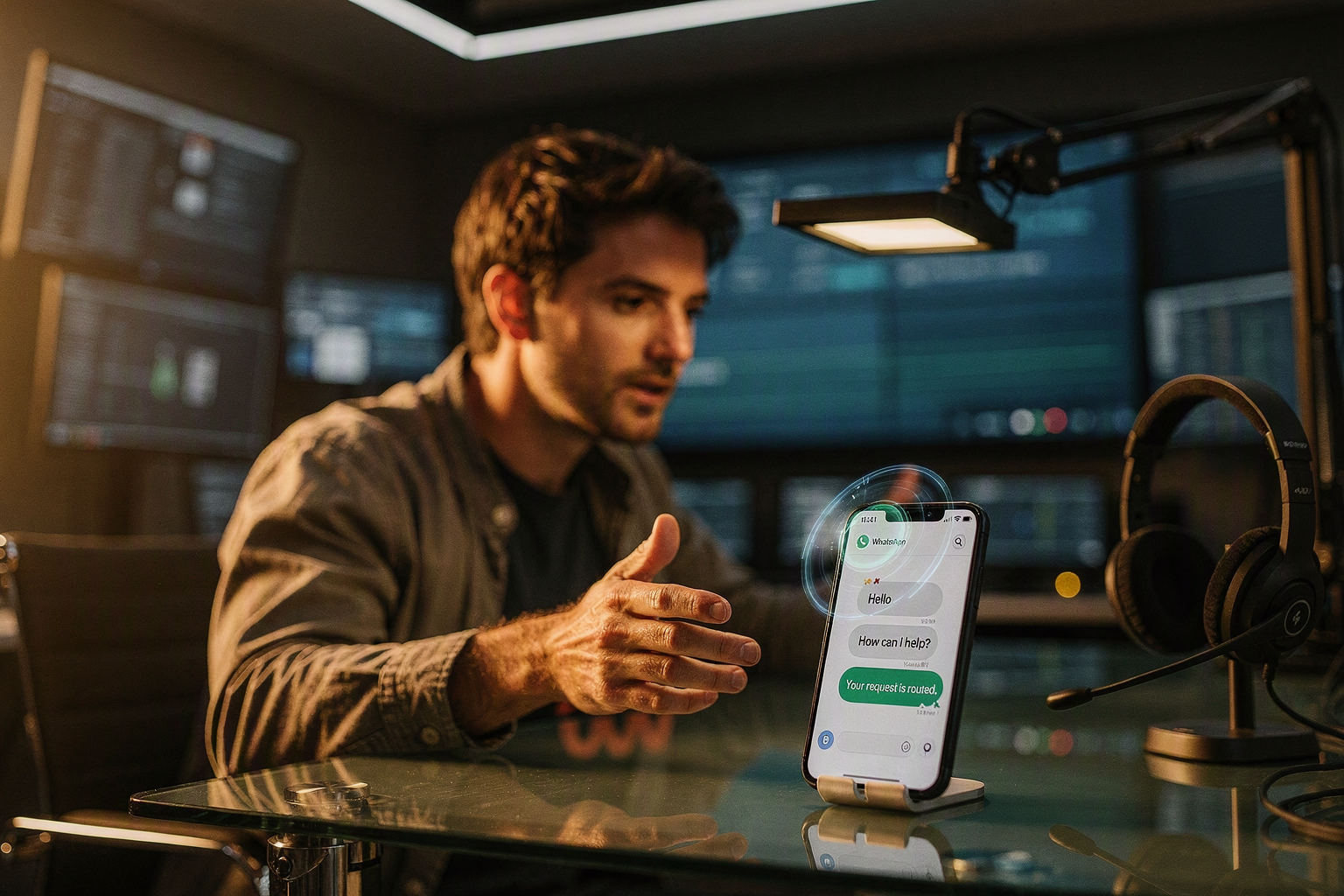
Learn how to connect voice and WhatsApp agents through one LLM API gateway with shared schemas, routing, streaming, security, and troubleshooting.
How Can I Connect an LLM API Gateway to Voice and WhatsApp Agents? A Developer Guide
How can I connect an LLM API gateway to voice and WhatsApp agents? Put an HTTPS gateway between your channel providers and the model layer: verify each inbound event, normalize voice and WhatsApp payloads into one internal message contract, apply routing and security policies, invoke the selected LLM, then adapt the result back into a WhatsApp message or a live voice response. This channel-neutral design keeps provider-specific webhooks and model integrations behind clear adapter boundaries.
The need is substantial: Meta says WhatsApp is used by more than 2 billion people worldwide, making WhatsApp a critical customer-engagement channel, while voice agents introduce a different engineering challenge—responses must be produced incrementally, sessions must remain correlated, and callers may interrupt an agent mid-sentence. A text reply can tolerate ordinary request-response processing; a live call usually cannot wait for a complete multi-paragraph LLM response before audio begins.
This guide shows how to build the connection as a production-minded developer workflow. You will learn how to:
- Design an architecture with WhatsApp webhooks, voice media or session endpoints, an internal event schema, and an LLM API gateway.
- Normalize text, media, call, interruption, and delivery events into a shared TypeScript contract.
- Route requests across model providers with policy checks, budgets, retries, timeouts, and circuit breakers.
- Distinguish synchronous WhatsApp responses from streaming voice output and barge-in handling.
- Execute tools safely, validate arguments, preserve conversation state, and prevent duplicate webhook processing.
- Format channel-specific responses and troubleshoot common authentication, latency, media, and delivery failures.
The examples will remain provider-neutral: WhatsApp signature verification, voice media streaming, codec conversion, and realtime LLM sessions vary by vendor, so each integration point will be clearly marked as an adapter rather than presented as universally portable. Platforms such as CallMissed reflect this broader convergence by combining an OpenAI-compatible gateway with voice, WhatsApp, and multilingual AI capabilities, including support for 22 Indian languages.
The central implementation principle is simple: one internal conversation contract, multiple channel adapters, and a policy-controlled LLM gateway in the middle. Once that separation is in place, adding another model, voice provider, WhatsApp workflow, or tool becomes an integration task—not a rewrite of every agent.
How can I connect an LLM API gateway to voice and WhatsApp agents? Use one channel-neutral HTTPS gateway
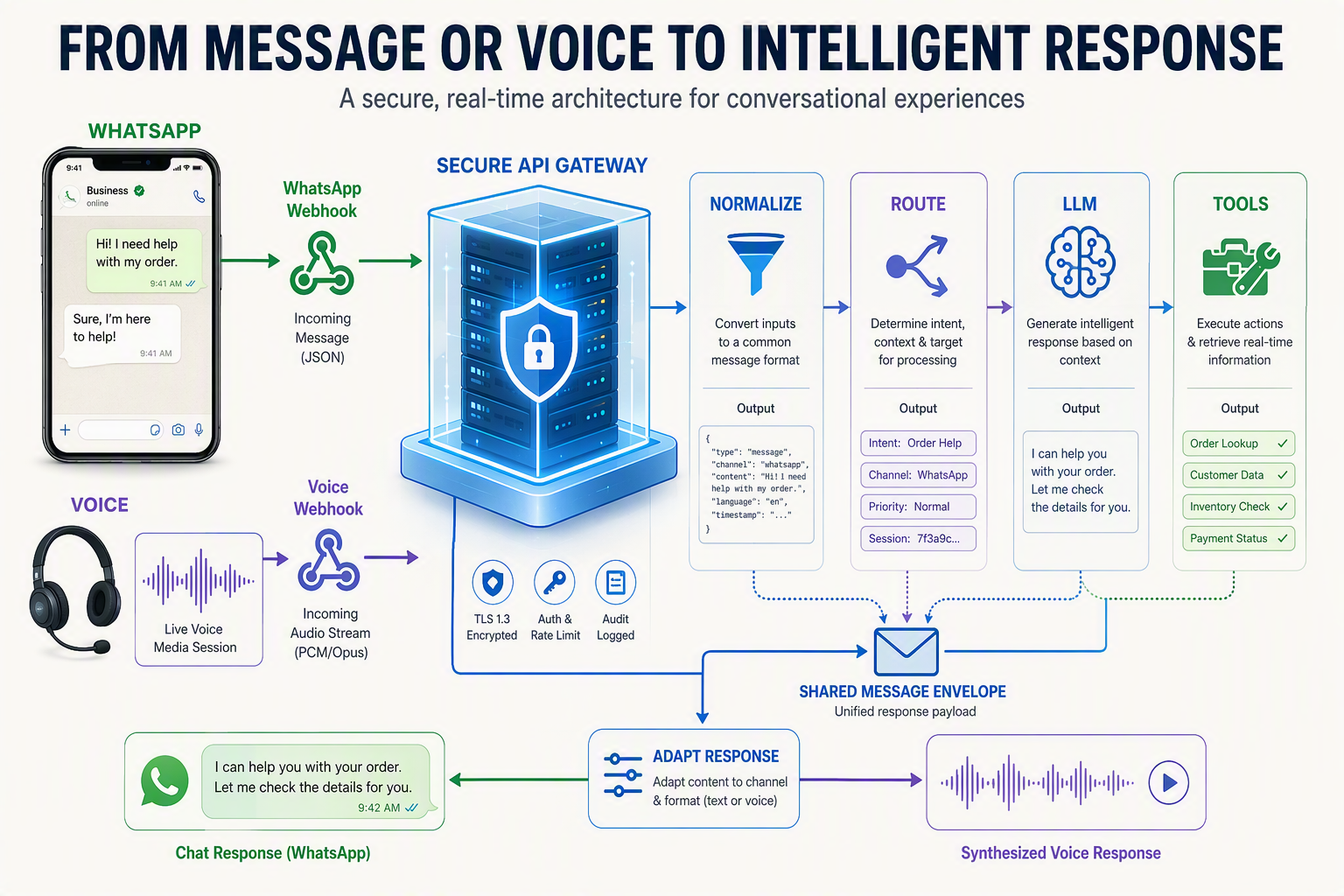
How can I connect an LLM API gateway to voice and WhatsApp agents? Place a channel-neutral HTTPS gateway between each provider and the model layer: verify inbound requests, normalize WhatsApp and voice events into one internal contract, route them through policy controls, and adapt the LLM response back to the correct channel. WhatsApp remains message-oriented, while voice requires incremental output, session correlation, and interruption handling.
What architecture should I use?
Use adapters at the edges and keep business logic inside the gateway:
- Inbound adapters: receive a WhatsApp agent webhook or voice-provider media/session event.
- Security layer: verify signatures, authenticate tenants, reject replayed or unauthorized requests.
- Normalizer: convert channel payloads into a shared
ConversationEvent. - Gateway router: select an LLM, apply budgets and timeouts, and execute approved tools.
- Response adapters: send a WhatsApp message or stream generated audio into the active call.
- Observability layer: record correlation IDs, latency, status, and redacted errors.
Meta says WhatsApp is used by more than 2 billion people worldwide, so the architecture should support high-volume message webhooks without coupling WhatsApp-specific fields to model code. For voice, treat the provider’s media stream and the LLM’s realtime interface as separate adapters; their codecs, framing, and event names are not universally portable.
How do I normalize voice and WhatsApp events?
Define one internal contract before writing model logic:
type ConversationEvent = {
  id: string; channel: "whatsapp" | "voice";
  tenantId: string; sessionId: string; userId?: string;
  kind: "text" | "audio" | "image" | "interrupt" | "status";
  text?: string; mediaUrl?: string;
  receivedAt: string; raw?: unknown;
};
A provider-neutral parser can make channel differences explicit:
function normalize(input: any, channel: ConversationEvent["channel"]): ConversationEvent {
  if (channel === "whatsapp") return {
    id: input.messageId, channel, tenantId: input.tenantId,
    sessionId: `wa:${input.userId}`, userId: input.userId,
    kind: input.type === "text" ? "text" : "audio",
    text: input.text, mediaUrl: input.mediaUrl,
    receivedAt: new Date().toISOString()
  };

  return {
    id: input.eventId, channel, tenantId: input.tenantId,
    sessionId: input.callId, kind: input.type === "speech" ? "text" : "interrupt",
    text: input.transcript, receivedAt: new Date().toISOString()
  };
}
The WhatsApp parser should map text, media, delivery receipts, and message IDs. The voice parser should map transcripts, audio frames, call IDs, and barge-in events. Add an idempotency store keyed by event.id before processing.
How does the HTTPS gateway route requests?
Keep credentials server-side and expose one application endpoint:
app.post("/events/:channel", async (req, res) => {
  await verifySignature(req);              // provider-specific adapter
  const event = normalize(req.body, req.params.channel as any);
  if (await seen(event.id)) return res.sendStatus(200);

  const reply = await gateway.chat({
    model: routeFor(event.channel),
    messages: await loadContext(event.sessionId),
    timeoutMs: event.channel === "voice" ? 1200 : 8000
  });

  await adaptAndDeliver(event, reply);     // WhatsApp send or voice stream
  res.sendStatus(200);
});
Use retries only for transient failures, with exponential backoff and a circuit breaker. RFC 9110 defines 429 for rate limiting, 502 for an invalid upstream response, 503 for temporary unavailability, and 504 for an upstream timeout—use these statuses consistently in logs and monitoring.
| Status | Meaning | Gateway action |
|---|---|---|
| 200 | Successful request | Acknowledge webhook |
| 202 | Accepted for processing | Queue asynchronous work |
| 400 | Invalid request | Reject and log safely |
| 401/403 | Authentication or authorization failure | Do not retry |
| 429 | Rate limited | Back off |
| 502/503/504 | Upstream failure | Retry selectively |
Solutions such as CallMissed’s OpenAI-compatible gateway demonstrate this channel-neutral direction: one model-facing integration can sit behind voice and WhatsApp experiences while routing across multiple AI capabilities.
What do I need before building the gateway? (TABLE)
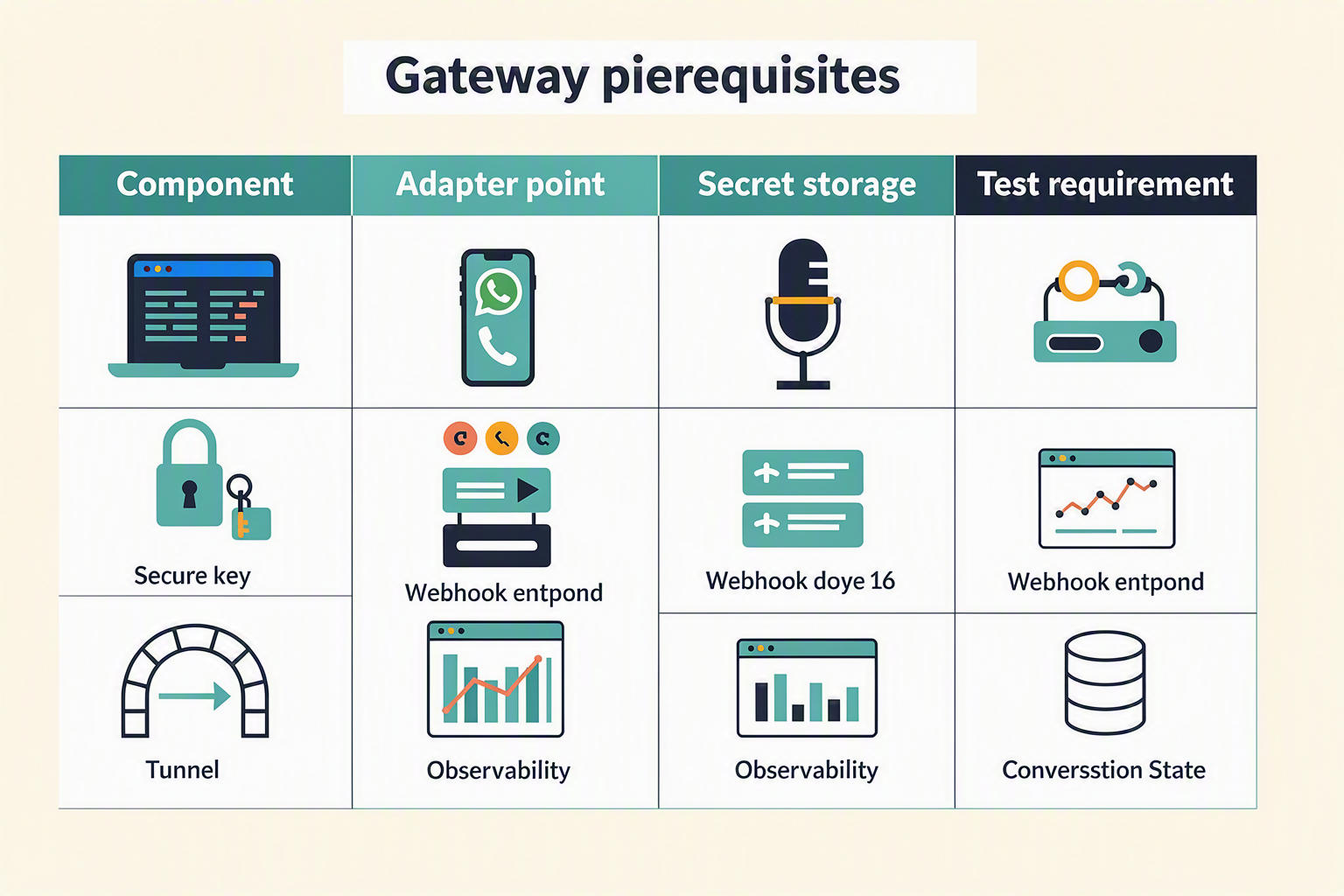
Before building, prepare five layers: secure HTTPS endpoints, provider credentials, a shared event schema, a voice-media strategy, and operational controls for routing, retries, and observability. Meta reports that WhatsApp is used by more than 2 billion people worldwide, so the gateway should treat WhatsApp delivery, consent, and duplicate-event handling as production requirements—not optional add-ons.
What should I prepare before writing gateway code?
Use the following preflight checklist. Keep channel-specific details inside adapters, while the gateway owns authentication, normalization, routing, policy, and model invocation.
| Prerequisite | What to prepare | Minimum implementation | Verification |
|---|---|---|---|
| HTTPS service | A publicly reachable Node.js, Python, or similar service | TLS-protected endpoints for webhook verification, inbound events, and health checks; RFC 9110 defines 200 as a successful response and 401 as missing or invalid authentication | Confirm the provider can reach /webhooks/whatsapp and /webhooks/voice |
| Channel credentials | WhatsApp Business API credentials and voice-provider session or media credentials | Store tokens, signing secrets, and phone or account identifiers in a server-side secret manager; never expose them in browser or mobile code | Rotate a test secret and confirm requests still authenticate |
| LLM gateway credentials | One or more model-provider keys, model names, and routing policies | Define an OpenAI-compatible client interface, request timeout, fallback model, token budget, and allowed tools | Make a test completion without exposing the provider key to the channel adapter |
| Shared event contract | A normalized TypeScript or JSON structure for text, media, calls, and delivery events | Include tenantId, conversationId, channel, sender, messageId, text, media, timestamp, and replyTarget | Replay one WhatsApp text event and one voice transcript through the same gateway handler |
| Voice media pipeline | Codec, sample-rate, streaming, and interruption decisions | Separate the voice provider’s media stream from the LLM’s realtime or audio interface; define buffering, transcription, incremental output, and barge-in behavior | Verify that a caller can interrupt while the agent is speaking |
| Production controls | Logging, rate limits, idempotency, authorization, and failure handling | Store processed event IDs, redact PII, validate tool arguments, enforce per-tenant budgets, and return provider-appropriate errors; RFC 9110 defines 409 for conflicts and 429 for excessive requests | Send a duplicate webhook and confirm it is not processed twice |
Which channel differences must I decide early?
WhatsApp is message-oriented, so the adapter generally receives a webhook, invokes the gateway, and sends a separate outbound message through the WhatsApp Business API. Plan for text and media normalization, delivery-status callbacks, user consent, and template rules where applicable. A messageId-based idempotency store prevents retries from creating duplicate replies.
Voice is session- and latency-sensitive. Decide whether the voice provider sends audio over WebSocket, HTTP callbacks, or a vendor-specific media stream. The gateway may need speech-to-text before the LLM and text-to-speech afterward, or it may bridge to a realtime model interface. These are different protocols: a voice provider’s audio stream is not automatically compatible with an LLM’s realtime endpoint.
What test data should I collect?
Create fixtures before implementation:
- A WhatsApp text message, image, audio note, and delivery-status event.
- A voice
session.started, transcript, interruption, andsession.endedevent. - Invalid signatures, expired timestamps, duplicate IDs, timeouts, and provider
5xxresponses. - Tool calls with valid, missing, and malicious arguments.
For Indian deployments, multilingual test coverage matters. CallMissed documents support for 22 Indian languages, illustrating why language detection, transcription, and synthesized speech should be explicit fields in the internal contract rather than assumptions hidden inside a channel adapter.
What architecture should I use for one voice and WhatsApp gateway?
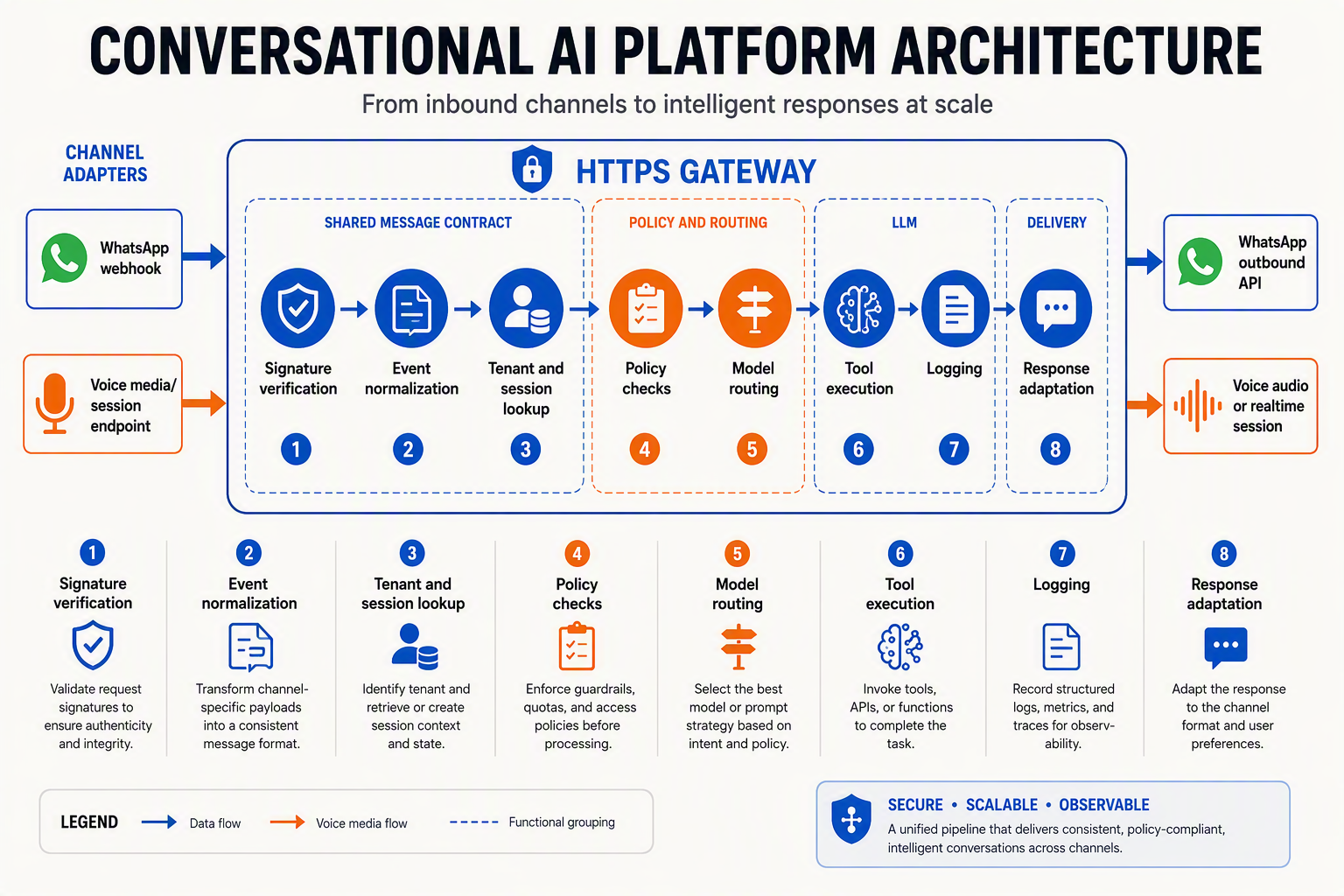
How can I connect an LLM API gateway to voice and WhatsApp agents? Use an HTTPS gateway as the channel-neutral control plane: verify provider requests, normalize WhatsApp and voice events into one internal contract, apply routing and security policies, call the selected LLM, and adapt the result back to the originating channel. Keep WhatsApp message handling request-based, while treating voice as a session-oriented, streaming workload.
What architecture should I use for one voice and WhatsApp gateway?
Use separate channel adapters at the edge and one shared orchestration pipeline behind them:
WhatsApp webhook ─┐
                  ├─> Verify ─> Normalize ─> Session lookup
Voice media/API ──┘                            │
                                               v
                                  Policy + model routing
                                               │
                                               v
                                      LLM API gateway
                                               │
                                  Tools / conversation state
                                               │
                         ┌─────────────────────┴──────────────────┐
                         v                                        v
                 WhatsApp response                         Voice audio stream
This design matters because Meta says WhatsApp has more than 2 billion users worldwide, while voice agents must manage live sessions, incremental output, media formats, and caller interruptions. A WhatsApp reply can usually complete as an outbound message; a voice agent should begin producing audio without waiting for an entire long-form answer.
Recommended components are:
- Inbound adapters: Receive WhatsApp webhooks and voice session or media events.
- Verification middleware: Validate signatures, timestamps, provider tokens, and tenant authorization.
- Normalizer: Convert provider-specific payloads into a shared event schema.
- Orchestrator: Load conversation state, enforce budgets, select a model, and execute approved tools.
- LLM gateway: Provide one authenticated interface for chat, speech, tools, and—where supported—streaming or realtime models.
- Outbound adapters: Format WhatsApp messages or stream synthesized audio to the voice provider.
- Observability layer: Record correlation IDs, timings, delivery states, and redacted errors.
What should the shared event contract contain?
Keep provider details outside the model layer. A minimal TypeScript contract can represent both channels:
type Channel = "whatsapp" | "voice";

interface AgentEvent {
  id: string;                 // provider event ID; used for idempotency
  tenantId: string;
  channel: Channel;
  sessionId: string;          // call ID or WhatsApp conversation key
  userId: string;
  type: "text" | "audio" | "media" | "status" | "interrupt";
  text?: string;
  audio?: { codec: string; sampleRateHz: number; base64: string };
  metadata: Record<string, string>;
  receivedAt: string;
}
The WhatsApp adapter maps text, media, delivery receipts, and status changes to this contract. The voice adapter maps call-start, audio frames, transcription, interruption, and call-end events. Codec conversion remains an adapter responsibility: a voice provider’s media stream is not automatically compatible with an LLM’s realtime interface.
Which HTTP responses should the gateway return?
Use standards-based responses and make duplicate delivery explicit:
| Status | Meaning | Gateway use |
|---|---|---|
| 200 | Successful request | Webhook accepted and processed |
| 202 | Accepted for processing | Queue long-running voice or tool work |
| 400 | Bad request | Invalid or incomplete provider payload |
| 401/403 | Authentication or authorization failure | Reject invalid signatures or tenants |
| 409 | Conflict | Duplicate event or idempotency collision |
| 429 | Too many requests | Rate limit or budget protection |
| 502/503/504 | Upstream failure, unavailable service, or timeout | Model/provider failure handling |
These meanings are defined by RFC 9110, HTTP Semantics. In production, store the event ID before processing, return a safe acknowledgment, and use a queue where provider timeout windows are shorter than model or tool execution time. Platforms such as CallMissed follow this broader convergence by combining an OpenAI-compatible gateway with voice and WhatsApp capabilities, including support for 22 Indian languages.
How do I normalize voice and WhatsApp events into one message contract?
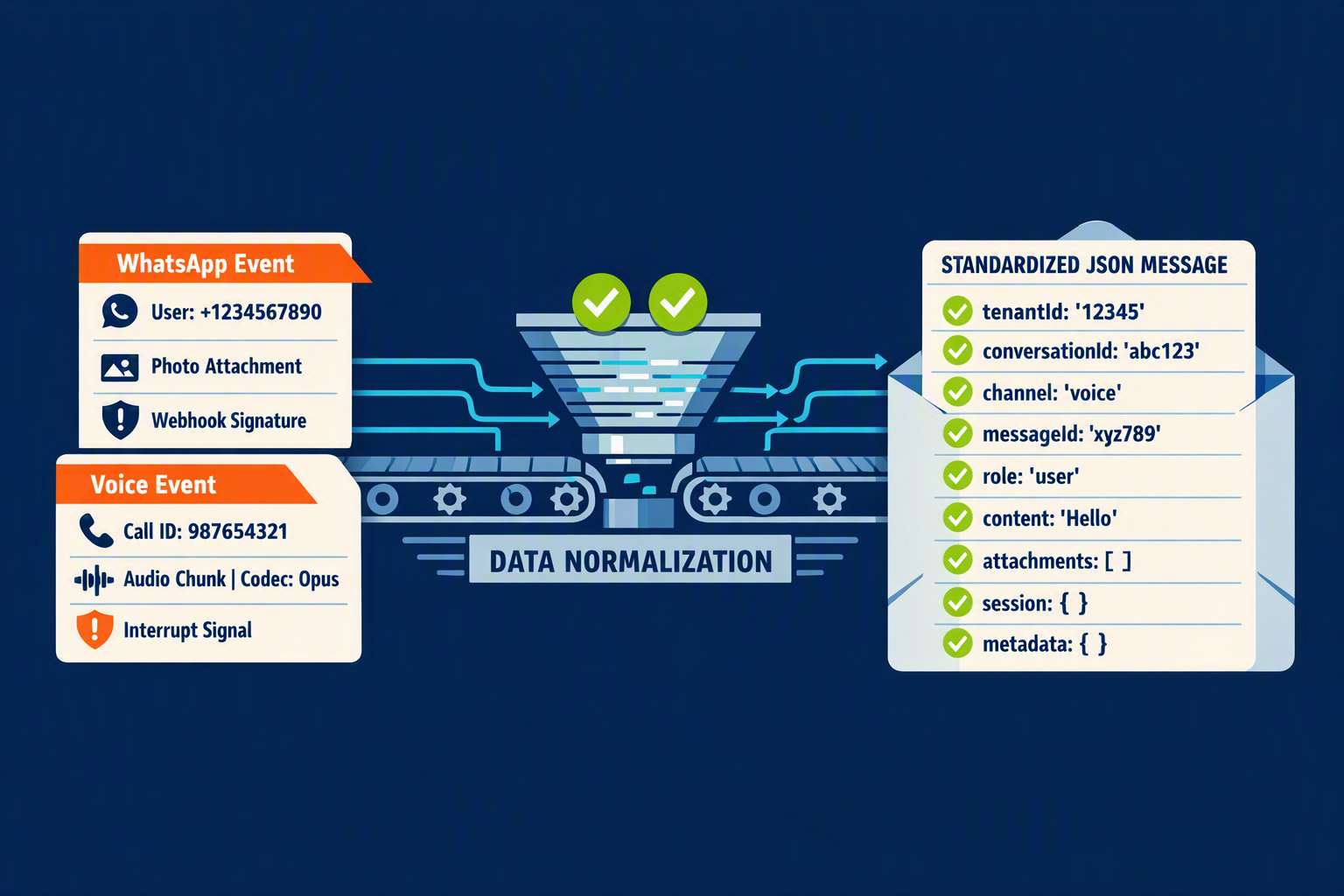
Normalize both channels into one internal message contract before calling the model. Map WhatsApp webhooks and voice-session events into the same fields—tenant, conversation, sender, content, timing, and reply mode—then let downstream routing ignore provider-specific payloads. Keep the original event in an adapter-only field for debugging and delivery acknowledgements.
What should the shared message contract contain?
A practical contract must represent text, media, live audio, interruptions, and lifecycle events without pretending that WhatsApp and voice behave identically:
type Channel = "whatsapp" | "voice";
type EventKind = "message" | "audio" | "interrupt" | "status";

interface NormalizedEvent {
  id: string;                 // provider event ID; used for deduplication
  channel: Channel;
  kind: EventKind;
  tenantId: string;
  conversationId: string;
  senderId: string;
  occurredAt: string;         // ISO-8601 timestamp
  text?: string;
  media?: {
    url?: string;
    mimeType: string;
    bytes?: Uint8Array;
    durationMs?: number;
  };
  replyMode: "message" | "stream";
  replyAddress: string;       // WhatsApp number or voice session ID
  metadata: Record<string, unknown>;
}
Use replyMode: "message" for WhatsApp and replyMode: "stream" for a live voice session. A voice provider’s media stream is not automatically compatible with an LLM’s realtime interface: your adapter may need to decode provider audio, resample it, transcribe it, and convert generated audio back to the provider’s required codec.
How do I parse WhatsApp and voice webhooks?
Verify the provider signature before parsing either payload. The verification algorithm, timestamp tolerance, and header names are provider-specific, so keep them inside adapters rather than treating the example below as universal:
function parseWhatsApp(p: any, tenantId: string): NormalizedEvent {
  const m = p.entry?.[0]?.changes?.[0]?.value?.messages?.[0];
  if (!m) throw new Error("unsupported WhatsApp event");

  return {
    id: m.id,
    channel: "whatsapp",
    kind: "message",
    tenantId,
    conversationId: `wa:${m.from}`,
    senderId: m.from,
    occurredAt: new Date(Number(m.timestamp) * 1000).toISOString(),
    text: m.text?.body,
    media: m.image || m.audio
      ? { url: m.image?.id || m.audio?.id,
          mimeType: m.image?.mime_type || "audio/ogg" }
      : undefined,
    replyMode: "message",
    replyAddress: m.from,
    metadata: { providerType: m.type }
  };
}

function parseVoice(p: any, tenantId: string): NormalizedEvent {
  return {
    id: p.eventId,
    channel: "voice",
    kind: p.type === "speech.started" ? "interrupt" : "audio",
    tenantId,
    conversationId: `voice:${p.callId}`,
    senderId: p.callerId,
    occurredAt: new Date().toISOString(),
    text: p.transcript,
    media: p.audio
      ? { bytes: p.audio, mimeType: p.codec || "audio/pcm" }
      : undefined,
    replyMode: "stream",
    replyAddress: p.callId,
    metadata: { sequence: p.sequence }
  };
}
How do I prevent duplicate or misrouted events?
Persist event.id with a unique constraint before invoking the model. Return success for an already-seen event after confirming its prior processing state; otherwise webhook retries can create duplicate replies or repeated tool calls.
Also enforce:
- Tenant and sender authorization during conversation lookup.
- PII minimization and redaction in logs.
- Sequence checks for voice audio and explicit cancellation on barge-in.
- Separate delivery-status events from user messages.
- Media retrieval through short-lived, authenticated URLs.
This contract lets an LLM API gateway such as CallMissed’s OpenAI-compatible gateway receive channel-neutral requests, while the final adapter decides whether the answer becomes a WhatsApp message or incremental audio for a voice agent.
How do I route requests through the LLM gateway and handle failures?
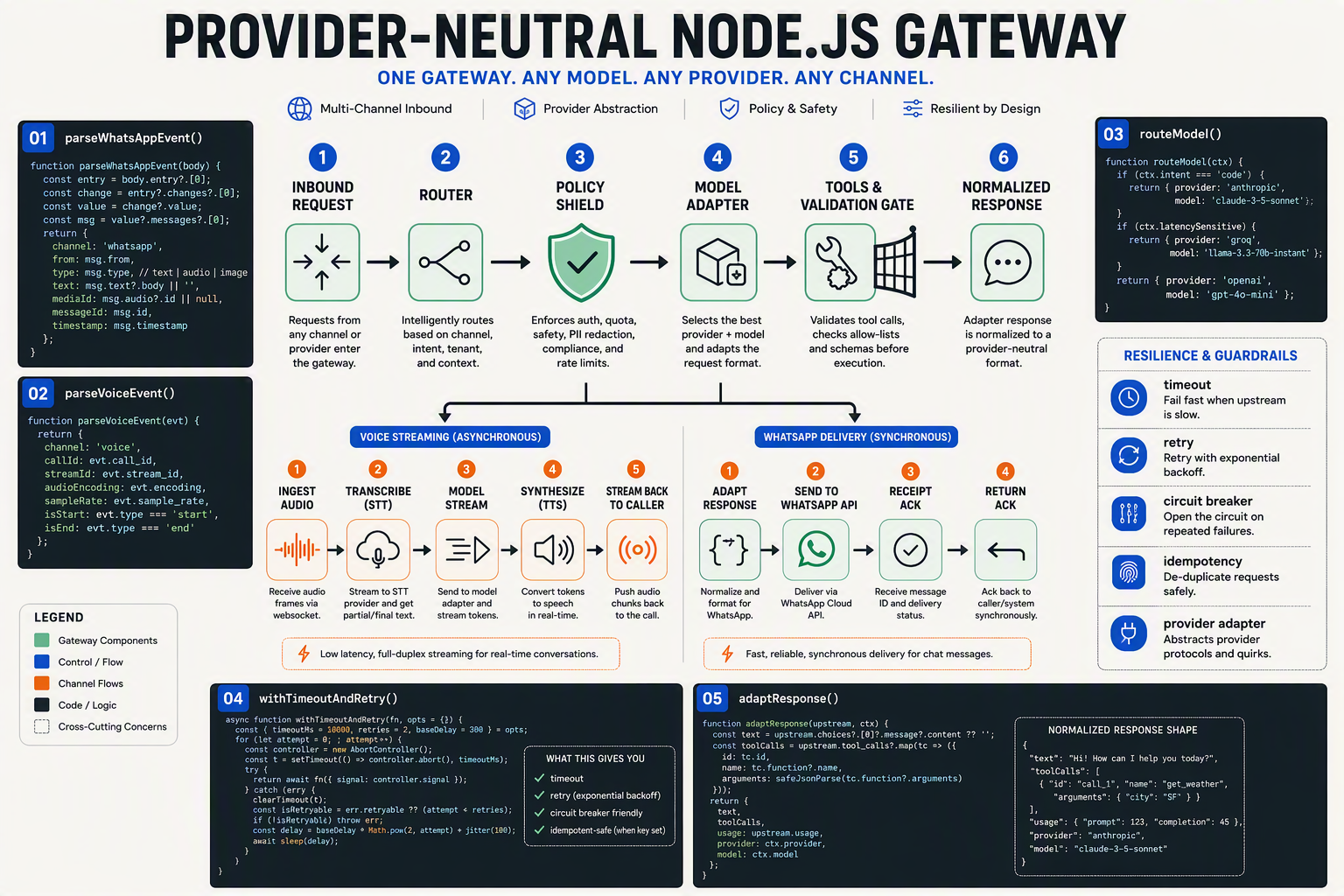
Route every normalized WhatsApp or voice request through a policy-aware gateway that selects a model, applies a deadline and budget, and returns a channel-neutral result. Handle failures with bounded retries, provider fallbacks, circuit breakers, idempotency, and graceful channel-specific responses—a delayed voice response and a delayed WhatsApp message require different recovery strategies.
How do I route requests through the LLM gateway?
The gateway should make routing decisions from tenant policy, task type, language, cost limits, and channel latency requirements—not directly from an untrusted webhook payload.
type RouteInput = {
  messages: { role: "system" | "user" | "assistant"; content: string }[];
  channel: "whatsapp" | "voice";
  language?: string;
  maxOutputTokens?: number;
};

const routes = {
  fast: { model: "provider-a/fast-chat", timeoutMs: 2_500 },
  quality: { model: "provider-b/quality-chat", timeoutMs: 8_000 }
};

async function callGateway(input: RouteInput) {
  const profile =
    input.channel === "voice" || input.language
      ? routes.fast
      : routes.quality;

  return withRetry(
    () => fetchModel(profile.model, input.messages, profile.timeoutMs),
    { attempts: 2, timeoutMs: profile.timeoutMs }
  );
}
Keep fetchModel behind an adapter that translates your internal request into the selected provider’s API. An OpenAI-compatible gateway such as CallMissed can provide one endpoint for multiple LLMs, while your application retains control over routing policy, budgets, and channel behavior.
How should timeout and retry handling work?
Retry only failures that are likely transient, such as connection resets, HTTP 429, 502, 503, and 504. Do not blindly retry malformed requests, authentication failures, invalid tool arguments, or a request that may already have triggered an external side effect.
async function withRetry<T>(
  operation: () => Promise<T>,
  cfg: { attempts: number; timeoutMs: number }
): Promise<T> {
  let lastError: unknown;

  for (let attempt = 0; attempt < cfg.attempts; attempt++) {
    try {
      return await Promise.race([
        operation(),
        new Promise<never>((_, reject) =>
          setTimeout(() => reject(new Error("upstream_timeout")), cfg.timeoutMs)
        )
      ]);
    } catch (error) {
      lastError = error;
      if (attempt + 1 < cfg.attempts) {
        await new Promise(r => setTimeout(r, 150 * 2 ** attempt));
      }
    }
  }
  throw lastError;
}
Use an idempotency key derived from the tenant, conversation, and inbound event ID. This prevents a retried WhatsApp webhook or voice event from generating duplicate replies or repeating a tool action.
Which HTTP failures should the gateway expose?
Map upstream failures to stable responses so channel adapters can behave predictably. RFC 9110 defines the following standard HTTP meanings:
| Status | Gateway meaning | Typical action |
|---|---|---|
| 400 | Invalid normalized request | Fix payload; do not retry |
| 401 | Missing or invalid authentication | Reject and alert |
| 409 | Duplicate or conflicting request | Return stored result |
| 429 | Rate limit exceeded | Back off or queue |
| 502 | Invalid upstream response | Try fallback model |
| 503 | Service temporarily unavailable | Circuit-break and retry later |
| 504 | Upstream deadline exceeded | Use channel fallback |
A circuit breaker should open after repeated upstream failures, route new requests to a same-tier fallback, and close only after health probes succeed. Log the provider, model, request ID, latency, status, and retry count—but redact message content and personal information unless operationally necessary.
How do I stream a voice response and send a message back to WhatsApp?
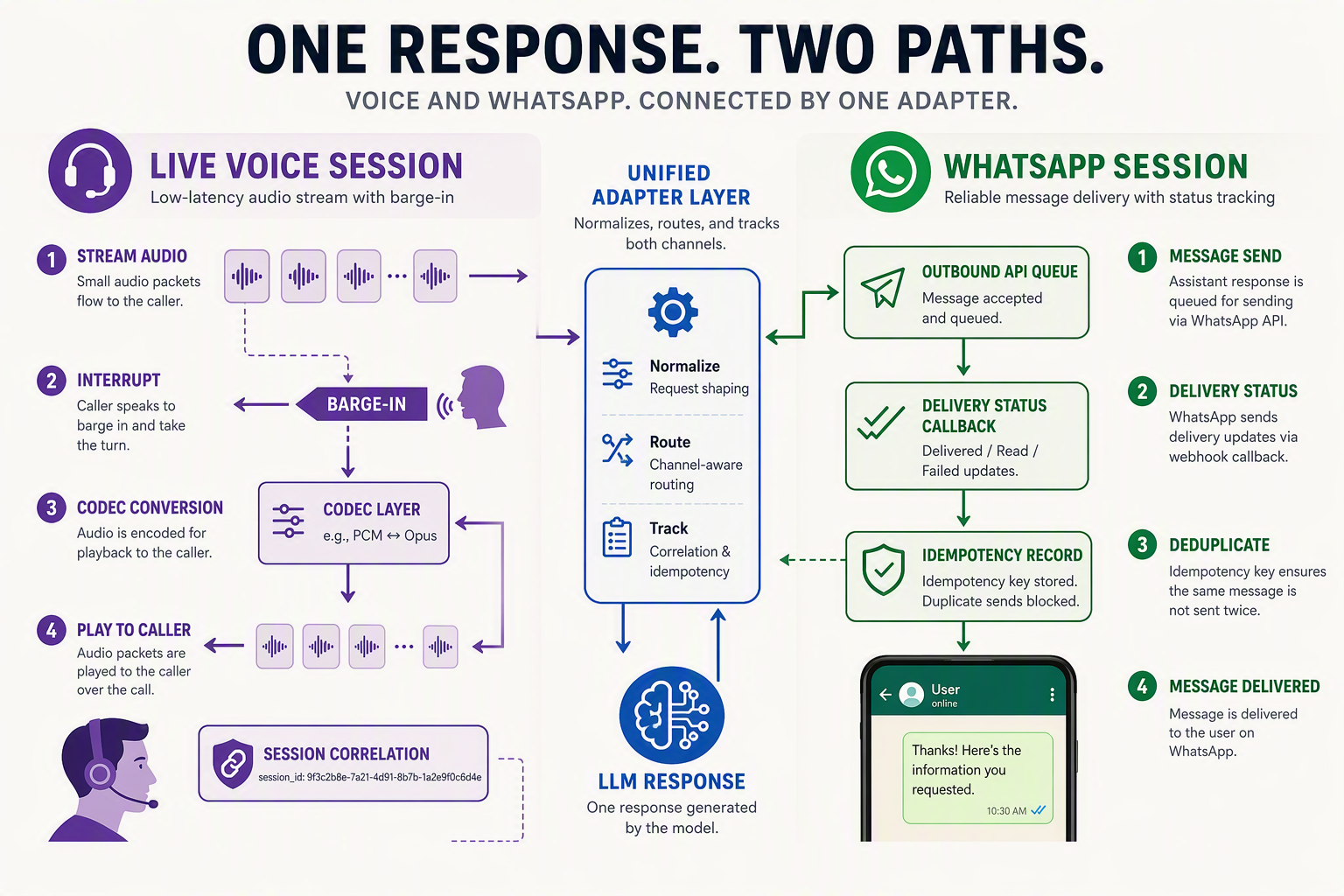
How can I connect an LLM API gateway to voice and WhatsApp agents? Stream the LLM’s output through a voice-provider adapter that converts text into the provider’s required audio format, while sending WhatsApp responses through the provider’s outbound Messages API. Keep both paths behind the same gateway, but treat voice as an incremental, interruptible session and WhatsApp as an idempotent message-delivery workflow.
How do I stream a voice response?
A voice provider’s media stream is not automatically the same as an LLM provider’s realtime interface. Your adapter may need to convert codecs, frame audio, manage session identifiers, and translate partial model output into playable audio.
A practical streaming loop is:
- Receive a normalized
voice.inputevent. - Send the utterance or audio frames to the LLM gateway.
- Read streamed text or audio chunks.
- Forward each audio chunk to the voice provider.
- Stop generation immediately when a
voice.interruptionevent arrives.
async function streamVoiceReply(sessionId: string, text: string) {
  const response = await fetch("https://api.callmissed.com/v1/chat/completions", {
    method: "POST",
    headers: {
      "Authorization": `Bearer ${process.env.LLM_GATEWAY_KEY}`,
      "Content-Type": "application/json"
    },
    body: JSON.stringify({
      model: "your-selected-model",
      stream: true,
      messages: [{ role: "user", content: text }]
    })
  });

  if (!response.body) throw new Error("Missing model stream");

  for await (const chunk of response.body as any) {
    const token = parseGatewayChunk(chunk);
    if (token) {
      // Adapter-specific: synthesize token/chunk and send media frames.
      await voiceProvider.sendAudio(sessionId, await ttsAdapter.synthesize(token));
    }
    if (await voiceProvider.wasInterrupted(sessionId)) break;
  }
}
For natural turn-taking, buffer short text fragments before text-to-speech rather than synthesizing every token. The voice adapter should also maintain call/session correlation, sequence numbers, cancellation, and codec conversion. Platforms such as CallMissed can be relevant where an AI agent must bridge WhatsApp Business voice calls or multilingual voice interactions into this same orchestration layer.
How do I send the response back to WhatsApp?
WhatsApp is generally a message-based channel, not an open bidirectional audio stream. After the gateway produces a final response, the WhatsApp adapter should send a text or media message, record the provider message ID, and process delivery-status webhooks separately.
async function sendWhatsAppText(to: string, body: string, idempotencyKey: string) {
  return fetch(`${process.env.WA_API_BASE}/messages`, {
    method: "POST",
    headers: {
      "Authorization": `Bearer ${process.env.WA_TOKEN}`,
      "Content-Type": "application/json",
      "X-Idempotency-Key": idempotencyKey
    },
    body: JSON.stringify({
      messaging_product: "whatsapp",
      to,
      type: "text",
      text: { body }
    })
  });
}
Apply provider-specific consent, template, session-window, media, and authentication rules at this adapter boundary. Never assume a successful HTTP response means the user has received the message; reconcile later delivery events.
Which HTTP outcomes should the gateway handle?
RFC 9110 defines these common outcomes:
| Status | Meaning | Gateway action |
|---|---|---|
| 200 | Successful request | Return or acknowledge |
| 202 | Accepted for processing | Track asynchronous job |
| 409 | Conflict | Detect duplicate or state collision |
| 429 | Too many requests | Back off and retry safely |
| 502/503/504 | Upstream or gateway failure | Fail over or return controlled error |
Use webhook signature verification, replay protection, tenant authorization, rate limits, per-request budgets, and circuit breakers on both paths. Log correlation IDs and provider message IDs, but redact unnecessary phone numbers, transcripts, and other personal data.
What advanced tips and HTTP status codes should I use in production? (TABLE)
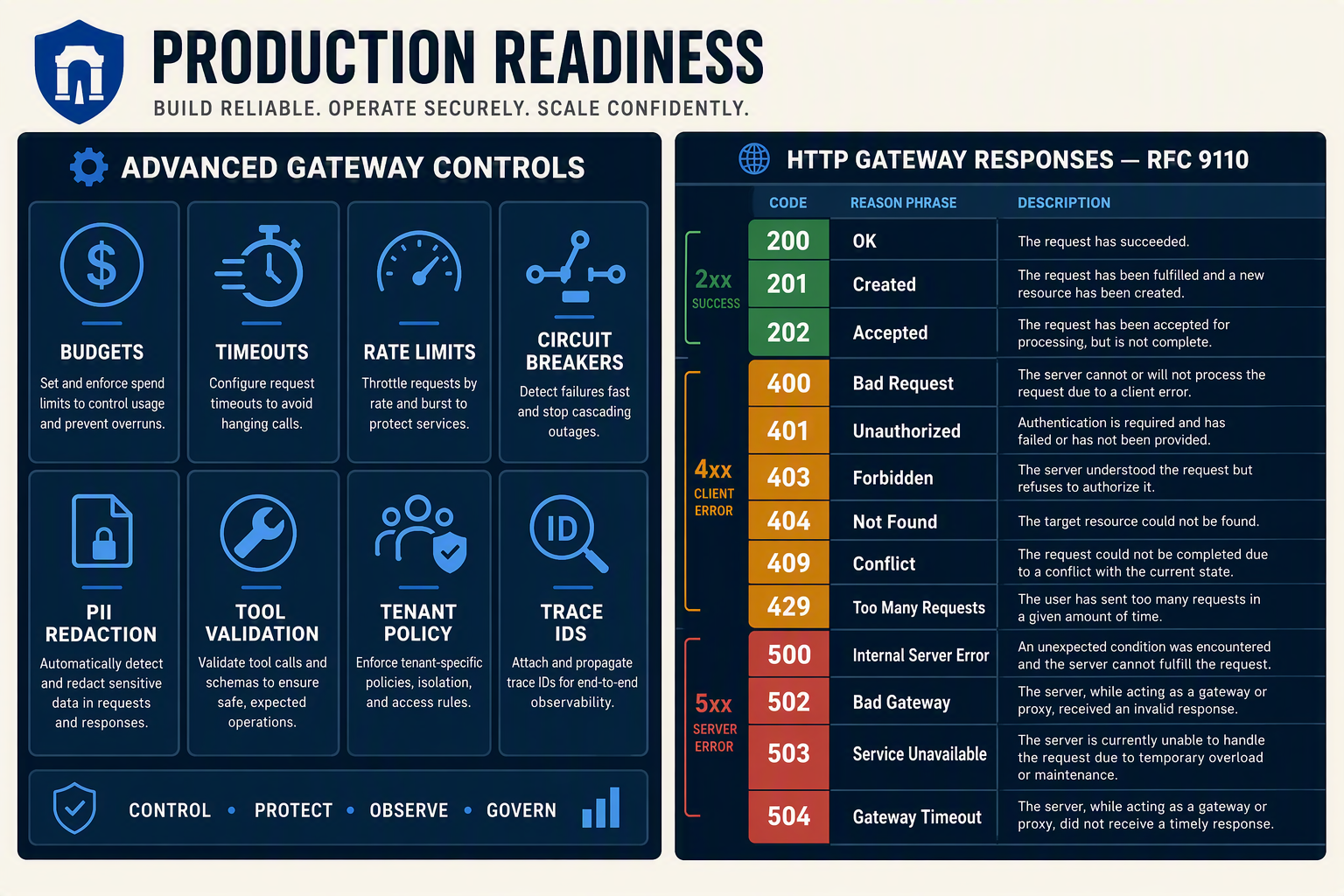
Production reliability comes from treating the gateway as a policy boundary, not merely a proxy: classify failures, retry only safe operations, and preserve correlation and idempotency across voice and WhatsApp events. Use RFC 9110 HTTP status semantics consistently so channel adapters, model providers, queues, and observability tools interpret failures the same way.
Which HTTP status codes should my gateway return?
RFC 9110, published by the IETF in June 2022, defines the standard meanings for the HTTP status codes below. For webhook receivers, acknowledge accepted work quickly and process slow LLM or media operations asynchronously where the channel permits it.
| Status | Meaning | Production use | Retry guidance |
|---|---|---|---|
| 200 OK | Request succeeded | Synchronous WhatsApp response, health check, or completed gateway call | Do not retry |
| 201 Created | Resource created | New conversation, job, or tool-execution record | Do not retry unless the client did not receive the response and the operation is not idempotent |
| 202 Accepted | Request accepted for processing | Queue a voice transcription, media task, or asynchronous agent job | Poll or consume a callback; avoid immediate duplicate submission |
| 400 Bad Request | Invalid request syntax or payload | Malformed webhook, unsupported media event, invalid model parameters | Do not retry until the payload is fixed |
| 401 / 403 | Missing/invalid authentication or insufficient permission | Bad gateway key, failed tenant authorization, or rejected webhook signature | Do not retry automatically; alert on repeated occurrences |
| 404 / 409 | Resource missing or request conflicts with current state | Expired call session, duplicate event, or already-created idempotency key | Treat 409 as a duplicate when confirmed; investigate unexpected 404 responses |
| 429 | Too many requests | Tenant, provider, or model rate limit exceeded | Honor Retry-After, apply exponential backoff, and protect the queue |
| 500 / 502 / 503 / 504 | Server, upstream, unavailable-service, or gateway-timeout failure | Internal exception, model-provider failure, overload, or upstream timeout | Retry only idempotent requests and use a circuit breaker |
The table’s status definitions come from RFC 9110; provider-specific webhook requirements may add their own acknowledgment rules.
How should I make retries safe for voice and WhatsApp?
Use an idempotency key derived from the provider event ID, tenant ID, and operation type. Store it before invoking an LLM, tool, outbound WhatsApp API, or voice action. A repeated webhook should return the previously recorded result or 409 Conflict, not send a second message or execute a duplicate refund.
Apply these production controls:
- Set separate connect, model, tool, and total-request timeouts; do not let a slow tool block a live voice turn indefinitely.
- Retry transient 429, 502, 503, and 504 responses with bounded exponential backoff and jitter.
- Never blindly retry non-idempotent outbound messages or tools; require an idempotency key at the tool boundary.
- Open a circuit breaker after repeated upstream failures, then route to a same-tier fallback model or a safe channel response.
- Return a short voice fallback promptly, while WhatsApp can receive a queued status message when processing continues asynchronously.
- Propagate
trace_id,tenant_id,conversation_id,call_id, andprovider_event_idthrough every adapter and log record.
What advanced security and observability practices matter?
Keep channel credentials and LLM keys server-side, verify webhook signatures before parsing payloads, redact phone numbers and message content from default logs, and validate every tool argument against a schema. Record latency by stage—normalization, routing, model, tool, synthesis, and delivery—rather than only measuring total request time.
A gateway such as CallMissed, with an OpenAI-compatible multi-model endpoint, illustrates this policy-and-routing pattern: one integration can centralize model selection and fallback logic while voice and WhatsApp adapters remain channel-specific.
What common mistakes should I avoid when connecting voice and WhatsApp agents? (TABLE)
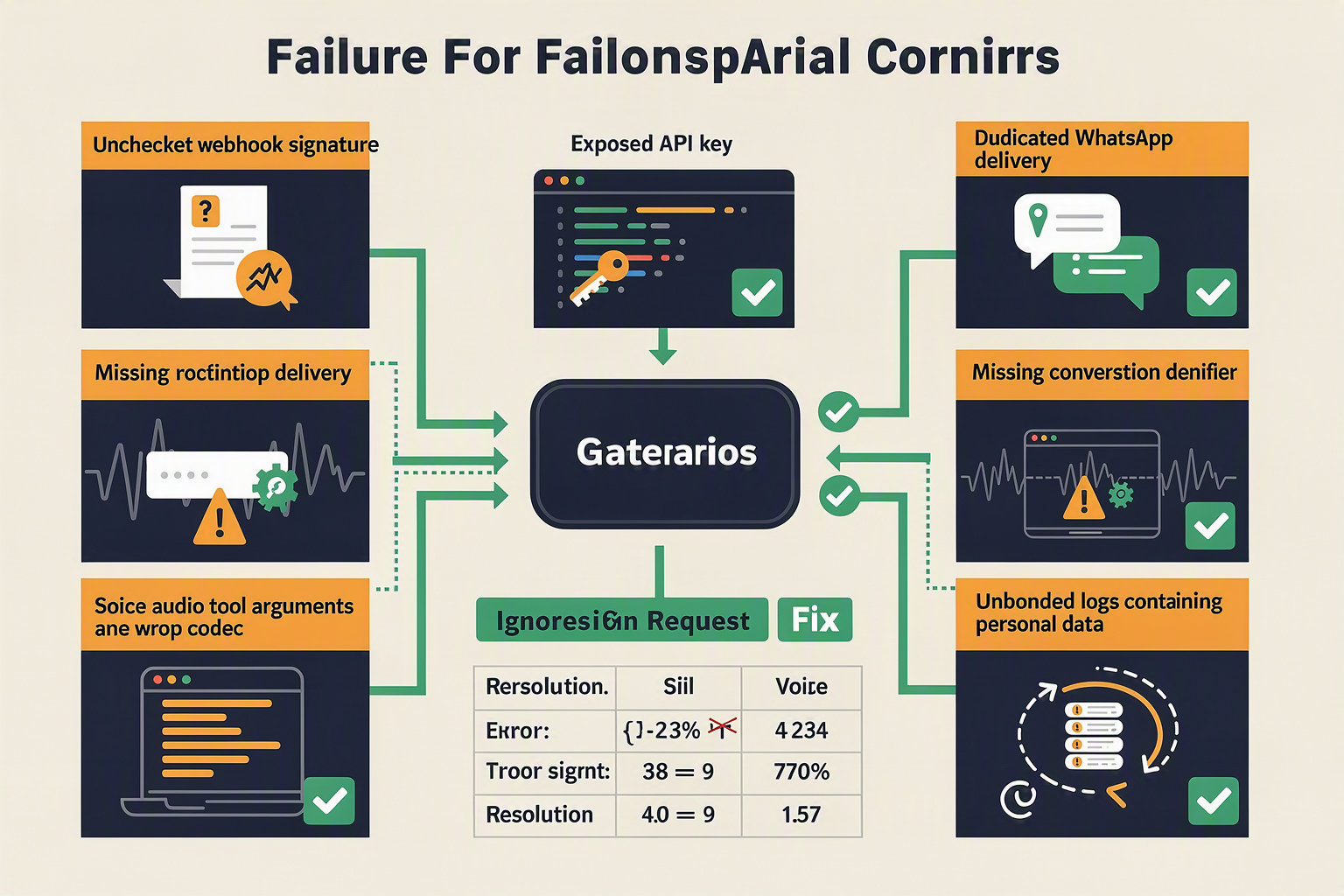
The most common integration failures come from treating voice and WhatsApp as identical channels, trusting unverified webhooks, and sending every request directly to one model. Avoid these mistakes by enforcing a shared message contract, idempotent event handling, channel-specific response adapters, and gateway-level timeouts, retries, authentication, and routing policies.
Which mistakes should I avoid when designing the architecture?
| Common mistake | Typical symptom | Safer implementation | Useful signal |
|---|---|---|---|
| Mixing provider payloads throughout the application | Business logic breaks when a WhatsApp or voice provider changes its schema | Normalize every event into one internal contract, such as {tenantId, channel, sessionId, text, media, eventId} | Log the original eventId and normalized event type |
| Treating voice like WhatsApp text | Callers hear long pauses or incomplete responses | Stream partial model output to speech, support barge-in, and cancel the current generation when the caller interrupts | Track voice session and turn IDs |
| Skipping webhook signature verification | Attackers can inject messages, calls, or tool requests | Verify the provider signature before parsing or queuing the event; keep channel secrets server-side | Reject invalid requests with HTTP 401, a status defined by RFC 9110 |
| Processing duplicate webhooks as new messages | Duplicate replies, repeated tool calls, or double charges | Store a short-lived idempotency record keyed by provider, tenant, and event ID before executing work | Return HTTP 409 for a known conflicting or already-processed request where appropriate, following RFC 9110 semantics |
| Retrying every failure identically | Retry storms, higher costs, and repeated customer messages | Retry only transient failures with bounded exponential backoff; do not blindly retry validation, authentication, or tool errors | Treat HTTP 429 as rate limiting and HTTP 503/504 as potentially transient conditions under RFC 9110 |
| Assuming model output is safe to send or execute | Invalid WhatsApp formatting, unsafe content, or unauthorized actions | Validate structured output and tool arguments against a schema, then apply tenant permissions and budget limits | Record tool name, validation result, and approval decision without logging unnecessary PII |
How do I avoid channel-specific failures?
WhatsApp agent webhooks are message-oriented; voice agents are session- and latency-sensitive. A WhatsApp reply can normally be queued for an outbound API call, while a live voice turn must preserve call correlation, handle interruption, convert media formats when necessary, and begin audio incrementally.
Use separate adapters after the shared gateway response:
- WhatsApp adapter: convert text, media, buttons, or templates into the provider’s outbound format; track delivery and failure statuses; apply consent and template rules where applicable.
- Voice adapter: convert generated text into streaming speech, maintain the provider’s media session, and stop queued audio when a barge-in event arrives.
- Gateway adapter: select the LLM or speech model according to tenant policy, language, cost budget, and fallback rules rather than hard-coding one provider.
A practical safeguard is to test the full event lifecycle: inbound event, normalization, model request, tool validation, channel response, delivery status, timeout, retry, and duplicate delivery. Test both a WhatsApp text event and a voice interruption using the same internal conversation contract.
What should I monitor in production?
Monitor authentication failures, duplicate-event rates, model timeouts, tool-validation failures, queue depth, delivery status, and channel-to-session correlation. Redact phone numbers, transcripts, access tokens, and other PII from ordinary logs; retain only the minimum data needed for debugging and compliance.
The scale of the channel makes these controls material: Meta says WhatsApp is used by more than 2 billion people worldwide, so a small webhook or retry defect can affect substantial message volume. Platforms such as CallMissed address this convergence by combining WhatsApp engagement, voice agents, and an OpenAI-compatible multi-model gateway; its support for 22 Indian languages also illustrates why language and channel policy should remain explicit rather than buried inside provider-specific code.
What should I troubleshoot first?
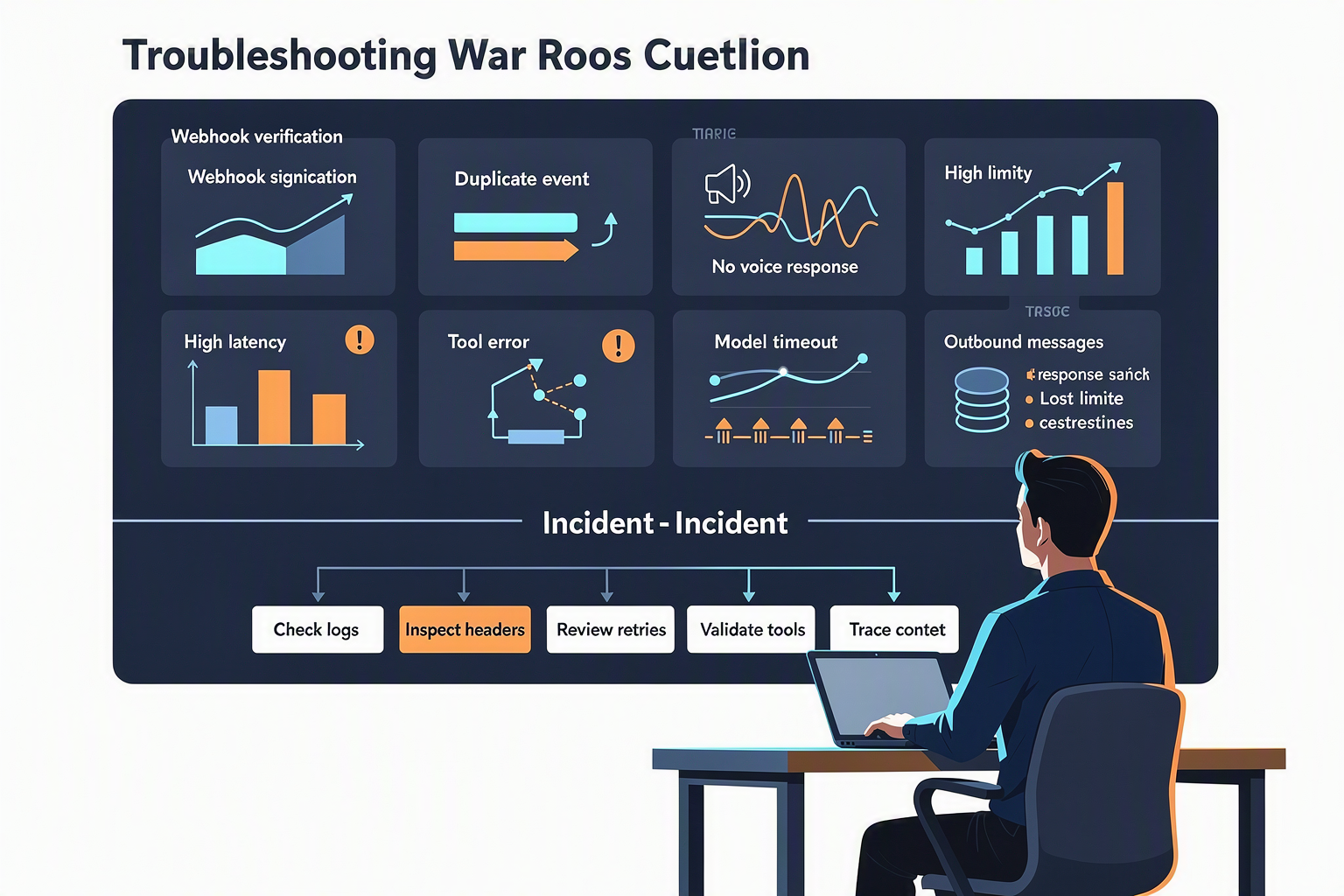
How can I connect an LLM API gateway to voice and WhatsApp agents when webhooks use different payloads?
tenantId, conversationId, channel, text, media, timestamp, and eventId. Verify the provider signature before parsing, look up the conversation, route the normalized request to the LLM, and adapt the result into either a WhatsApp message or streamed voice output.How can I connect an LLM API gateway to voice and WhatsApp agents without exposing API keys?
Why does my voice agent respond slowly even though the LLM request succeeds?
Why is my WhatsApp agent sending duplicate replies?
How do I troubleshoot a 401, 403, 429, or 5xx error from an LLM API gateway?
Why can my voice provider not play the LLM’s audio response?
What resources and next steps will help me take this gateway to production?
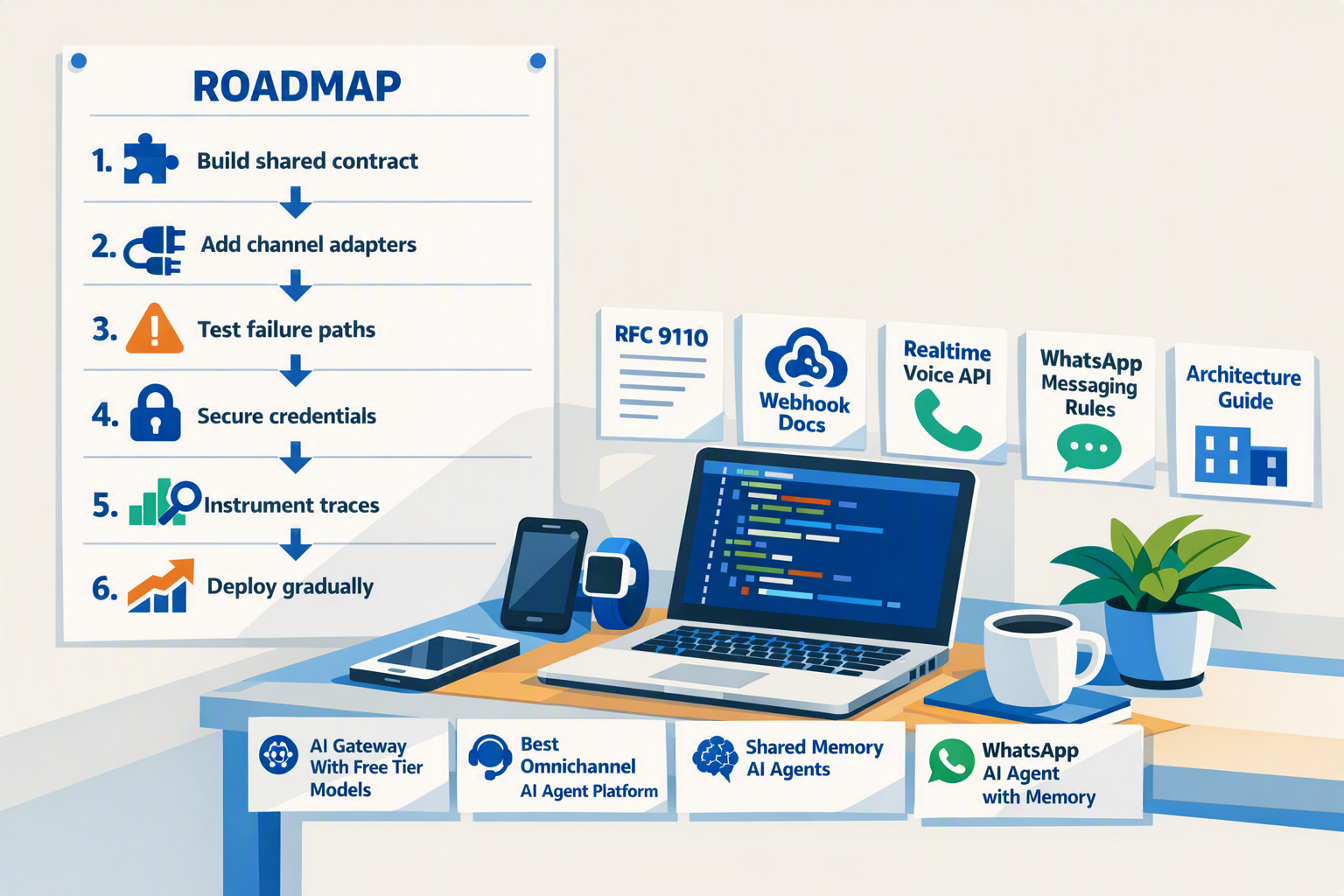
The resources and next steps that will help take your gateway to production are provider API references, channel and voice webhook documentation, security guidance such as the OWASP API Security Top 10, contract tests, failure simulations, and a staged rollout plan.
How should I structure the gateway architecture?
Treat the gateway as a policy-controlled platform rather than a simple model proxy. Separate channel adapters, normalized conversation events, model routing, tool execution, safety policies, and delivery adapters. Version shared schemas so voice and WhatsApp integrations can evolve without breaking downstream services.
How do I secure inbound webhooks?
Verify each provider’s webhook signature before processing the payload. Enforce timestamp or nonce checks where supported, reject replayed event IDs, validate payload schemas, and keep credentials server-side. Apply tenant authorization and redact sensitive data from logs, traces, and model requests.
How should voice and WhatsApp agents share context?
Store a canonical conversation state keyed by stable tenant, customer, and session identifiers. Normalize channel events into a shared format, but retain channel-specific metadata such as call state, message IDs, media references, consent, and delivery status. Use explicit retention limits and access controls for transcripts and customer data.
What is required for reliable streaming voice?
Support incremental audio input and output, cancellation, interruption detection, and session correlation. Measure time to first audio, transcript accuracy, packet loss, codec conversion, and recovery after disconnects. Apply tight deadlines to real-time operations and move non-urgent tasks to asynchronous queues.
How should I handle WhatsApp delivery?
Track the outbound message ID and process subsequent delivery-status events as state transitions. Expect duplicate, delayed, or out-of-order webhooks, and make handlers idempotent. Also test template and consent requirements, media retrieval, opt-outs, and failures that occur after the initial send request is accepted.
Which failures should the gateway retry?
Retry only transient failures when the operation is safe. Use bounded exponential backoff with jitter for rate limits, timeouts, and temporary upstream unavailability. Do not automatically retry validation, authentication, or authorization failures. Attach idempotency keys to message sends and tool calls that could create duplicate side effects.
What observability should I add?
Propagate a trace or correlation ID across the channel webhook, gateway, model request, tool call, and outbound delivery. Record latency, error category, retry count, fallback use, token or media consumption, and delivery outcome. Use structured logs, metrics, and distributed traces while avoiding raw credentials and unnecessary personal data.
When should the agent hand off to a person?
Define handoff triggers for explicit customer requests, repeated misunderstandings, sensitive actions, policy restrictions, low-confidence outcomes, and provider failures. Pass the human operator a concise conversation summary and relevant context, and clearly tell the customer that the handoff is occurring. Maintain a model-independent emergency response if automated services become unavailable.
Production checklist
- [ ] Version and test normalized voice, message, media, status, and session events.
- [ ] Verify webhook signatures, authorization, replay protection, and secret storage.
- [ ] Test shared context across channel changes, reconnects, and concurrent sessions.
- [ ] Load-test streaming audio, interruption handling, timeouts, and network degradation.
- [ ] Validate WhatsApp consent, templates, media, delivery statuses, duplicates, and opt-outs.
- [ ] Configure deadlines, bounded retries, idempotency, rate limits, fallbacks, and circuit breakers.
- [ ] Create dashboards and alerts for latency, errors, delivery, cost, and fallback usage.
- [ ] Document human handoff, incident response, rollback, and provider-outage procedures.
- [ ] Roll out through development, staging, a limited canary, and monitored general availability.
Conclusion
Connecting an LLM API gateway to voice and WhatsApp agents means placing a channel-neutral HTTPS layer between provider webhooks, media sessions, and model APIs. The gateway verifies requests, converts events into one internal conversation contract, applies routing and security policies, invokes the selected model, and formats the response for WhatsApp or live voice.
The production pattern is:
- Normalize first: Convert WhatsApp text, media, delivery events, voice audio, interruptions, and session updates into a shared schema.
- Route centrally: Apply tenant authorization, budgets, timeouts, retries, circuit breakers, tool-validation rules, and model-provider fallbacks in the gateway.
- Adapt by channel: Return message-based responses for WhatsApp, but stream incremental audio for voice while preserving call correlation and handling barge-in.
- Operate defensively: Verify signatures, protect credentials, enforce idempotency, minimize sensitive logs, and distinguish provider-specific adapters from portable application logic.
This architecture matters at global scale: Meta says WhatsApp is used by more than 2 billion people worldwide, while voice agents demand tighter coordination between streaming media, realtime models, and interruption handling. Looking ahead, watch how realtime model interfaces, multilingual speech systems, and channel providers converge around more interoperable agent protocols.
To explore how this communication layer is evolving, visit CallMissed, which combines an OpenAI-compatible gateway with voice agents, WhatsApp capabilities, and support for 22 Indian languages. What new agent channel could your application add once the gateway—not the channel—owns the policy and routing logic?
Related Reading
Related Posts
Ready to automate customer conversations?
Launch AI voice agents and WhatsApp bots with CallMissed — one API, 22+ Indian languages.