

The Cost Economics of a Voice Minute in 2026: What Every Business Needs to Know


Did you know that in 2026, the cost of an AI-powered voice minute can range anywhere from $0.05 to $0.35—while old-school call centers still charge up to...
The Cost Economics of a Voice Minute in 2026: What Every Business Needs to Know
Did you know that in 2026, the cost of an AI-powered voice minute can range anywhere from $0.05 to $0.35—while old-school call centers still charge up to $1.75 per minute? This seismic drop isn’t just a tech curiosity—it’s fundamentally reshaping how businesses think about customer engagement, lead generation, sales, and support on a global scale.
Why does the cost economics of a voice minute in 2026 matter more than ever? As digital transformation sweeps every industry, voice AI isn’t just a flashy add-on—it’s now the backbone of communication infrastructure for everyone from hyper-growth startups to sprawling enterprises. India’s mid-size edtechs, for example, are churning through 40,000+ inquiry calls a month via AI, slashing costs and booking conversions at speeds never seen before (Caller Digital, 2026). At the same time, brands that rely on traditional call centers are facing mounting pressure: while real costs for AI voice minutes average $0.07 to $0.15, legacy outsourcing ranges from $0.50 to $1.75 per minute (RetellAI, 2026). In competitive sectors like banking, healthcare, and e-commerce, these fine differences can make or break a year’s bottom line.
But a “voice minute” isn’t a simple commodity, and the sticker price rarely tells the full story. Behind every quoted cost sits a toolkit of fast-evolving AI capabilities: speech-to-text, natural language understanding, dynamic multi-language support, and increasingly natural text-to-speech synthesis. Each technology layer introduces new opportunities—and fresh cost variables. For instance, moving from basic to premium synthetic voices can add up to $0.03 per minute layered onto your AI stack (SquadStack, 2026). And for high-volume operations, those incremental cents multiply into major operational expenses.
In this blog, we’ll break down the evolving equations behind every voice minute in 2026:
- What goes into the real cost per minute: from AI engine fees to telephony, model inference, and premium voice options
- Pricing benchmarks for India and global markets: why rates vary from $0.05/min for basic digital agents to $0.35/min for advanced, hyper-personalized calls
- Key levers to optimize cost per minute: model selection, answer rates, language requirements, and more
- Lessons from businesses already scaling Voice AI: including where true ROI is found and hidden costs that can sneak up
By the end, you’ll understand not just how much a voice minute “should” cost in 2026, but how to architect your voice strategy for both cost efficiency and conversational excellence. Platforms like CallMissed, which provide infrastructure for AI voice agents and multilingual support across 22 Indian languages, are emblematic of this shift—enabling businesses to deploy conversational AI at an unprecedented scale and granularity.
If your 2026 roadmap includes AI-driven voice engagement, this is essential reading to build, buy, and budget with confidence. Let’s decode the numbers and chart the future of voice, minute by minute.
Introduction: Why Voice Minute Economics Matter in 2026

The Voice Minute: The New Unit of Enterprise Communication
In 2026, the "cost of a voice minute" is no longer just a telecom metric—it's a vital lever in digital transformation, customer service, and business growth. As enterprises shift from legacy call centers to AI-driven voice agents and programmable telephony, understanding the economics of a single voice minute is now central to operational planning, P&L optimization, and long-term customer strategy.
#### Why It Matters Now
The proliferation of AI-powered voice agents, multilingual voice bots, and programmatic Voice over IP (VoIP) has forced a rapid rethink of what used to be a static, telecom-carrier-driven pricing model. Key 2026 trends making voice minute economics mission-critical include:
- AI Voice Agents Are Everywhere: Markets like India now routinely deploy conversational AI for lead qualification, support, debt collection, and education. According to Caller Digital, a mid-scale edtech brand spending ₹80 lakh on paid media generates 40,000 inquiries, which are called within 2 minutes by Voice AI agents to assess intent and book demos [3].
- Dramatic Cost Differentials: Human agent call centers have operating costs between $0.50 and $1.75 per minute in 2026, while AI voice agents start as low as $0.07 per minute—a 10x to 25x cost advantage in some cases [8].
- Layered Tech Stack = Layered Costs: Today's "voice minute" often includes not just telephony, but also speech-to-text (STT), large language model (LLM) processing, and text-to-speech (TTS) at production scale. For example, basic TTS layers add $0.005–$0.015 per minute, with premium neural voices introducing another $0.01–$0.03 per minute [5].
- The Race to Multilingual & Real-time: With India alone supporting hundreds of millions of non-English speakers, demand for native AI voice solutions in 22+ regional languages is skyrocketing, putting pressure on both quality and efficiency of each voice minute delivered.
#### Voice Minutes: Beyond “Cheap” or “Expensive”
While it's tempting to fixate on the headline price per minute, modern voice minute economics go deeper:
- Productivity and Utilization: AI voice agents can operate 24/7 with near-perfect consistency. A Medium analysis shows that with 70% utilization, an AI voice agent can provide 87,360 productive minutes annually, versus far lower numbers for human reps [7].
- Conversion and ROI: Faster intent capture and instant follow-up mean each AI voice minute delivers more business impact. Edtechs using AI voice agents reported higher demo booking rates when calls were made within two minutes of lead generation [3].
- Scalability and Predictability: Platforms can scale from 1,000 to 1 million minutes a month without hiring or retraining, crucial for seasonal industries and high-volume campaigns.
#### Key Benchmarks & Costs in 2026
Let’s ground this in real data:
- AI Voice Agent Platforms:
- Advertised as low as $0.05–$0.11/min for outbound or inbound calls [2]
- “All-in” costs (including STT, LLM, advanced TTS, telephony) range from $0.05 to $0.35 per minute depending on complexity, language, and quality [6]
- Traditional Call Centers:
- Human agent cost: $0.50–$1.75 per minute [8]—multiplied by labor, training, scheduling, and churn
- Custom Development:
- Cloud-based voice agent platform subscription: $375/month (entry tier)
- Large-scale, enterprise-grade custom voice AI project: $300,000+ to build [4]
#### The Global Shift: Why Every Vertical Cares
Not confined to call centers, the economics of a voice minute in 2026 shape decisions in:
- Banking: Automated KYC and loan servicing
- Healthcare: Prescription reminders and telemedicine triage
- Edtech: Instant learner engagement in multiple languages
- Retail and Logistics: COD verification, delivery notifications, and customer satisfaction outcalls
Every sector now faces tradeoffs between voice minute price, experience quality, model sophistication, and total business value.
#### The Role of AI Communication Infrastructure
Platforms such as CallMissed exemplify the new paradigm where businesses can deploy production-grade AI voice agents and chatbots at massive scale, spanning 22 Indian languages and 300+ LLMs without deep technical integration barriers. The ability to switch models or voices based on cost, quality, or use case—in real time—reshapes how the cost per voice minute translates into business value.
Whether you’re building a WhatsApp chatbot, scaling voice-based collections, or running millions of customer survey calls, understanding the all-in cost and economics of every voice minute is foundational in 2026.
#### Looking Ahead
In this article, we’ll unpack the anatomy of a voice minute, break down its precise cost components, compare AI versus human call handling, and equip you with actionable benchmarks. As voice automation rewires global communication, cost economics aren’t just an operational concern—they’re now a core business strategy.
Welcome to 2026: where every voice minute is a micro-P&L.
Background & Context: The Evolution of Voice AI and Telephony Pricing
From Analog Beginnings to AI-Driven Voice: A Brief History
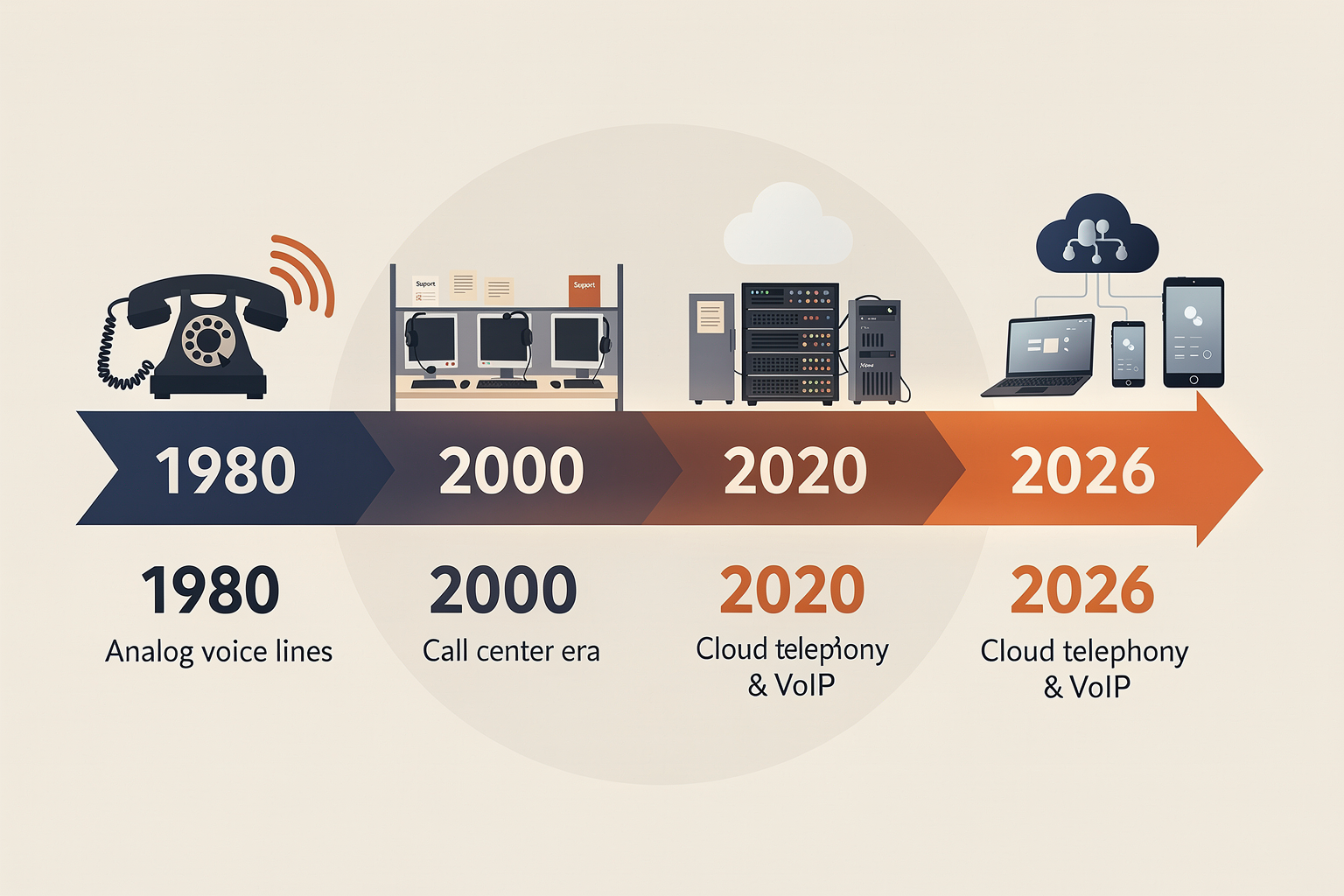
The pricing of a voice minute—whether it’s a legacy phone call or a modern AI-powered conversation—has always reflected the underlying technological landscape. Two decades ago, voice communications relied heavily on analog telephony infrastructure and international time-division multiplexing (TDM) trunks. Costs were dictated by geography, physical switching, and tariffs, often running as high as $0.20–$0.30 per minute for international calls in the early 2000s. Domestic rates were lower, but quality and scale remained limiting factors for businesses running large-scale telephony operations.
With the advent of Voice over Internet Protocol (VoIP) in the mid-2000s, carriers and enterprise call centers saw costs drop amid a shift from circuit-switched to packet-switched networks. According to data from ITU, the cost per voice minute fell by over 60% between 2005–2015 in India and Southeast Asia, driven by increased bandwidth, IP interconnects, and global competition.
However, this reduction plateaued in the late 2010s, with new cost factors emerging: compliance, anti-spam regulations, data security, and—most recently—AI enablement.
The Arrival of Voice AI Platforms
By the early 2020s, simple IVR systems gave way to sophisticated AI voice agents powered by cloud platforms. These agents could:
- Answer, process, and route calls automatically
- Understand intent via speech-to-text and natural language processing (NLP)
- Respond using synthesized, human-like voices
The economic model changed fundamentally. Instead of paying only for telecom minutes, businesses now factored in costs such as:
- AI model inference (NLP engine usage)
- Speech-to-text (STT) and text-to-speech (TTS) conversion
- Data storage and analytics
- Developer and orchestration overhead
For perspective, a 2022 study from Gartner noted that advanced voice AI platforms increased call containment rates by up to 40%, reducing the human agent cost per minute but raising the aggregate spend on cloud compute and AI services.
Telephony Pricing: Unpacking the Cost Layers
In 2026, the cost components for a single “AI voice minute” are granular and multi-layered:
- Telecom Connectivity:
- SIP trunking or API-enabled Gateway cost (typically $0.01–$0.03/min in bulk, region-dependent).
- Speech Recognition and Understanding:
- Speech-to-Text (STT) engines (ranging $0.005–$0.02/min, depending on language and vendor. Premium languages like Hindi-English code-switching in India can be up to $0.03/min).
- AI Model Inference:
- Large language model (LLM) or NLP engine (from $0.01/min for entry-level, up to $0.08/min for real-time GPT-4 Turbo-like models).
- Text-to-Speech (TTS) Synthesis:
- Basic TTS adds $0.005–$0.015/min; premium “human-like” voices add $0.01–$0.03/min on top (SquadStack, 2026).
- Overhead and Platform Fees:
- Platform orchestration, logs, security, monitoring ($0.01–$0.05/min depending on scale and geography).
Total real cost per AI voice minute is thus rarely as low as the $0.05/min headline rates advertised by many platforms. According to Klariqo's 2026 breakdown, actual deployment costs range from $0.07–$0.11/min for high-volume, single-language scenarios, and up to $0.15–$0.23/min for complex, multilingual or high-compliance verticals (Klariqo, 2026).
For reference, traditional call center agent outsourcing in 2026 still ranges from $0.50 to $1.75/min, strongly incentivizing the shift to AI-powered voice handling (RetellAI, 2026).
Geographic and Industry-Specific Factors
India, Southeast Asia, and Africa continue to lead adoption of AI voice agents, spurred by the dual pressure of labor costs and massive regional languages diversity. For instance, a mid-scale Indian edtech company handling 40,000 sales inquiries via voice AI within two minutes was able to reduce operational costs to a fraction of their previous spend on large human agent teams (Caller Digital, 2026). This rapid response becomes economically feasible only with the low per-minute cost structure enabled by AI.
However, costs can climb sharply with requirements like:
- 24/7 always-on availability
- High-accuracy language switching (especially in code-mixed Indian vernaculars)
- Data retention and compliance (financial services, healthcare)
Why Understanding Voice Minute Economics Matters in 2026
The “per voice minute” model is the foundation for everything from lead qualification to automated support in modern enterprises. A deeper understanding of the evolutionary path to today’s cost stack enables organizations to make strategic decisions about:
- Partner selection (choosing an AI platform that optimizes both quality and price)
- In-house vs. outsourced development (with build costs ranging from $375/month for basic platforms to $300,000+ for custom solutions per Master of Code)
- ROI calculations and long-term scaling
AI Voice Minute Pricing: A Data-Driven Snapshot
Here’s a representative breakdown of contemporary costs for outbound AI voice calling in 2026 (all values in USD):
| Cost Component | Typical Range (per min) | Low Estimate | High Estimate | Comments |
|---|---|---|---|---|
| Telephony (SIP/API) | $0.01 – $0.03 | $0.01 | $0.03 | Lower in India, higher in US/EU |
| Speech-to-Text (STT) | $0.005 – $0.02 | $0.005 | $0.02 | Premium regional voice support higher |
| AI Model/NLP | $0.01 – $0.08 | $0.01 | $0.08 | LLM size/complexity is key variable |
| Text-to-Speech (TTS) | $0.005 – $0.03 | $0.005 | $0.03 | Premium voices cost more |
| Platform/Overhead | $0.01 – $0.05 | $0.01 | $0.05 | Security, logging, compliance |
Source: Compiled from Bolti AI, Klariqo, SquadStack, and industry reports.
The Modern Platform Advantage
Leading solutions like CallMissed are illustrative of industry-wide progress, offering bundled telephony, multilingual STT/TTS, and access to 300+ LLMs via a unified API layer. This layered infrastructure lets businesses adapt their cost stack dynamically—switching model providers, languages, or even telecom gateways without vendor lock-in.
Crucially, by deeply integrating multiple cost layers, such platforms minimize “cost leakage” (inefficiency from switching between vendors or scaling up piecemeal), contributing to the real-world per-minute savings that are now powering the next wave of automated customer engagement.
Looking Ahead
The journey of voice minute economics—from analog circuits to AI—mirrors the broader story of business communications: relentless downward cost pressure, rising intelligence, and global democratization of access. As we’ll see in forthcoming sections, understanding these cost evolutions is vital for CxOs and operations heads plotting their 2026 automation roadmap.
What Drives the Cost of a Voice Minute Today?
Unpacking the Real Costs Behind a Voice Minute
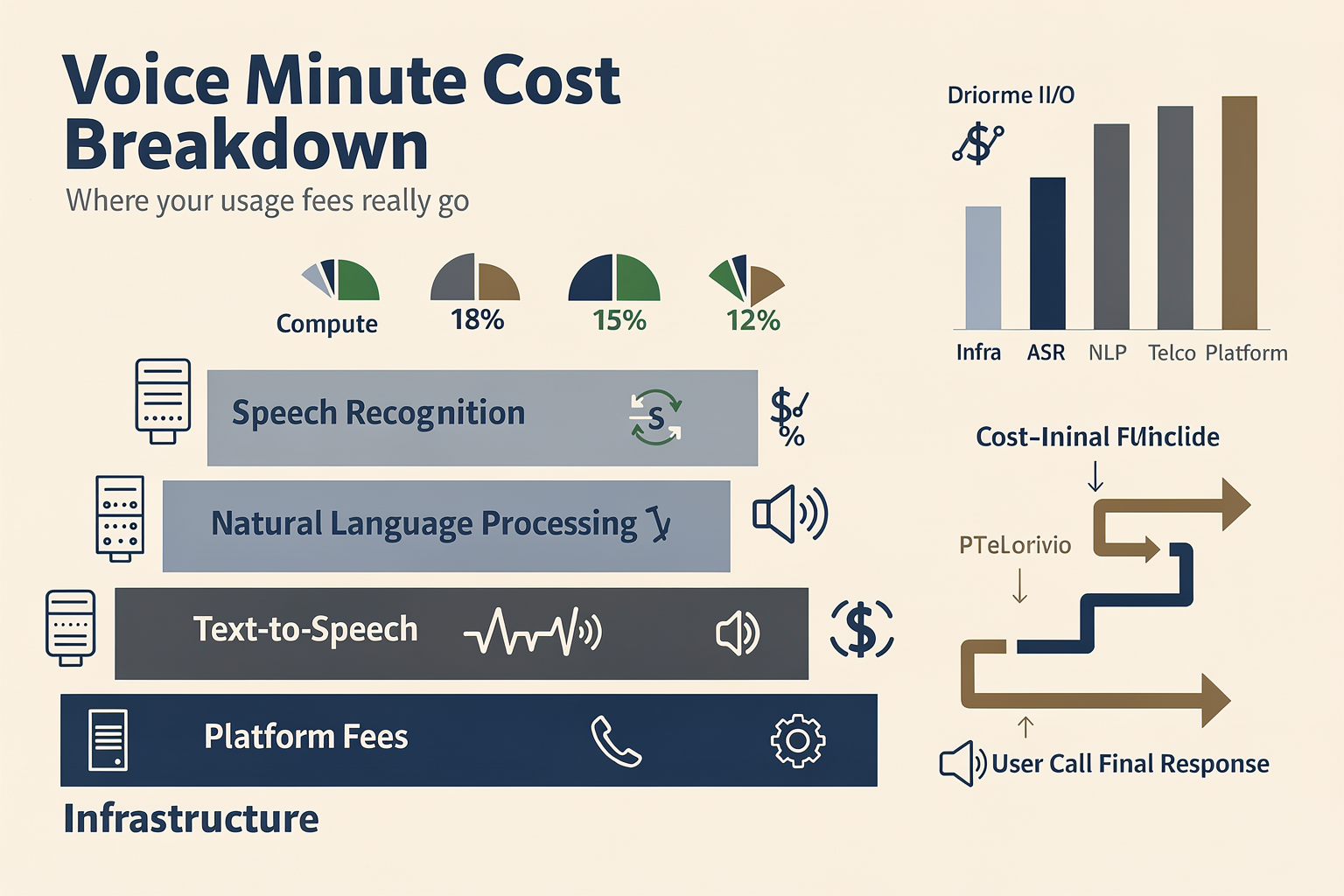
Despite the seemingly simple idea of a “voice minute,” the cost structure behind AI-powered voice interactions in 2026 is complex and multi-layered. It is shaped by direct technology costs, the infrastructure required to route and process calls, and the operational demands of running AI agents at scale. Here’s a breakdown of the key factors that drive the per-minute cost in today’s Voice AI ecosystem.
#### 1. Core Technology Stack Costs
At the heart of every AI-powered voice interaction is a chain of advanced processes:
- Speech-to-Text (STT): Converts incoming audio to text for the AI to understand. In 2026, leading vendors charge $0.01–$0.03/minute depending on model quality, accent coverage, latency, and the need for multilingual support (SquadStack, 2026).
- Language Model (NLU/LLM): Processes the text to extract intent, manage dialogue, and generate replies. Many platforms report $0.02–$0.07/minute for this step, heavily influenced by the complexity and the choice of model (Klariqo, 2026).
- Text-to-Speech (TTS): Converts AI-generated responses back to natural-sounding audio. Basic TTS costs range from $0.005–$0.015/minute; premium neural voices add $0.01–$0.03/minute (SquadStack, 2026).
Example Calculation:
A basic conversation using standard STT, a mid-range LLM, and standard TTS could cost $0.035–$0.11 per minute before adding telephony and operational expenses.
#### 2. Telephony and Connectivity Fees
Every call made by a voice AI agent still relies upon foundational telecom infrastructure:
- Carrier and SIP charges can range from $0.01–$0.08/minute based on call destination, provider, traffic volume, and call origination (Bolti AI, 2026).
- SMS or WhatsApp notifications (for missed calls or confirmations) frequently add to the per-minute effective cost.
Why is this component important? Voice AI platforms cannot function without reliable voice-over-IP (VoIP) or PSTN interconnection. In regions like India, regulatory requirements for compliance and call recording can further drive up costs.
#### 3. AI Orchestration & Platform Overheads
Voice AI platforms orchestrate not just conversation, but also integrations to CRMs, databases, payment gateways, and more. These infrastructure layers add:
- API orchestration and workflow management, contributing up to $0.005–$0.02/minute.
- Data security, encryption, and compliance (GDPR, PCI DSS), critical for regulated sectors, may increase per-minute pricing.
- Real-time analytics and call monitoring: These incur further platform resource costs but enable near-instant improvements to agent performance and compliance.
Vendors also need to account for high-availability infrastructure, failover support, and the cost of continuous LLM retraining and dataset management.
#### 4. Human-in-the-Loop and Quality Assurance
Despite automation, AI voice platforms often blend in:
- Live agent handoffs for complex queries or escalations. These can spike costs to $0.50–$1.75/minute if routed to outsourced human call centers (RetellAI, 2026).
- Quality monitoring and manual call audits: Ensuring conversational accuracy and regulatory adherence also add a marginal (but non-zero) cost per minute.
This hybrid model remains essential for high-stakes sectors like healthcare, finance, and enterprise support.
#### 5. Scale, Complexity, and Customization
The overall per-minute cost varies depending on:
- Call volume and concurrency: Bulk buyers frequently get tiered pricing (lower per minute after a certain volume).
- Agent complexity: More advanced use cases (like multilingual or sector-specific medical/legal agents) often require specialized models, boosting base costs.
- Customization: Heavily branded voices, custom NLU intents, and deep backend integrations command premium rates.
Data-Driven Breakdown: Where the Money Goes
Today’s voice minute is the sum of numerous layered expenses. Here’s a data-backed breakdown for a typical AI voice call in 2026 (all costs per minute, best-available estimates):
| Cost Component | Typical Range ($/min) | Notes | Variability Factors |
|---|---|---|---|
| Speech-to-Text (STT) | $0.01–$0.03 | Hindi, Tamil, and other Indian languages often at premium | Accent, language support |
| LLM/NLU Inference | $0.02–$0.07 | GPT-4/5 class LLMs at upper end; custom models cost more | Model complexity, latency |
| Text-to-Speech (TTS) | $0.005–$0.03 | Premium neural voices extra | Voice quality, vendor choice |
| Telephony (SIP/Carrier) | $0.01–$0.08 | Based on region, telco rates, call direction | Volume, routing type |
| Platform/Other Overhead | $0.005–$0.02 | API, analytics, compliance | Security, SLAs, analytics |
Source: SquadStack (2026), Klariqo (2026), Bolti AI (2026)
Total Voice AI Minute (Basic): $0.05–$0.23/minute
The Power of Platform Innovation
While individual development of a full-stack voice AI can run into $300,000+ for custom builds (MasterOfCode, 2026), platform providers have dramatically compressed per-minute costs by pooling infrastructure, leveraging economies of scale, and optimizing model selection.
Platforms like CallMissed offer a modern blueprint for cost-efficient voice minute economics. By serving as a multi-model AI gateway (330+ LLMs, plug-and-play STT/TTS for 22 Indian languages, and real-time telephony), CallMissed exemplifies how orchestration costs and operational complexity can be slashed — especially for businesses seeking to launch multilingual or 24/7 automated voice support in cost-sensitive markets.
Market Comparison: AI vs. Human-Driven Costs
The cost efficiency of AI voice agents in 2026 is striking when compared to legacy methods:
- Traditional call centers: $0.50–$1.75/minute for outsourced human agents (RetellAI, 2026)
- AI-enabled call routing: $0.05–$0.35/minute, depending on degree of automation and escalation to humans (YesWorkflow, 2026)
As a result, organizations deploying AI voice in outbound sales, support, or reminders routinely report cost reductions of 70–85% per minute compared to manual operations, with response times up to 10x faster (Caller Digital, 2026).
Key Takeaways for 2026
- Layered Innovation: The cost of a voice minute today is carved out across stacked technologies (STT, LLM, TTS), telephony, platform orchestration, and continual human QA.
- Vendor Selection Matters: Picking the right combination of models and telephony partners is essential for hitting cost and quality targets.
- Scale and Specialization: High concurrency and domain-specific agents justify investment in premium models but must be balanced against marginal cost per minute.
- Industry Ecosystem: Platforms like CallMissed, offering out-of-the-box infrastructure with flexible model integration and native Indian language support, set a new standard for cost agility and scalability in 2026.
Understanding these cost drivers is foundational for any business or developer aiming to harness Voice AI at scale, delivering both economic and operational edge as voice automation becomes the new global norm.
Key Developments in Voice AI and Pricing (TABLE)
Rapid Evolution in Voice AI: 2026 Pricing Landscape
Over the past three years, the economics behind a single “voice minute” have shifted dramatically. Competitive advances in AI, cloud communications, and speech synthesis have driven costs down and enabled entirely new business models. In 2026, understanding these underlying trends is key to optimizing ROI from AI-driven voice systems.
Below is a comparative table highlighting the core developments influencing voice AI pricing per minute in 2026. Data reflects industry averages, published benchmarks, and emerging vendor value propositions.
| Key Development | 2026 Pricing Impact | Major Players/Vendors | Recent Examples (Stats) | Relevance/Trend |
|---|---|---|---|---|
| Multilayer AI Stack Cost | Lowers to $0.07-$0.15/min | CallMissed, Klariqo, Bolti AI | Real cost with ASR, LLM, TTS, telephony (Klariqo: $0.05-$0.11/min base, often $0.07+ all-in) | Integrated AI, lower TCO |
| Granular TTS Pricing | $0.005-$0.03/min | SquadStack, Retell AI | Basic TTS: $0.005–$0.015/min; premium: $0.01–$0.03 extra (SquadStack, 2026) | Custom voices, CX boost |
| Flexible LLM Multimodel | Near-zero switching cost | CallMissed, OpenAI, Google | API gateways allow 300+ LLMs with no-code switch (CallMissed) | Fast AI innovation |
| Multilingual AI Support | No extra for 22+ langs | CallMissed, Google, Microsoft | Indian businesses access 22 regional languages at entry tier (CallMissed) | Mass market scale |
| Human Call Center Replace | $0.07-$0.11/min AI vs $0.50-$1.75/min human | Retell AI, YesWorkflow | AI cost <20% of BPO human (RetellAI, 2026) | AI displacing legacy |
| Platform Subscription | $375/mo+ (SaaS) | Master of Code, Klariqo | SaaS/Managed: $375/mo+, Custom build: $300k+ (Master of Code) | Build vs buy dilemma |
What’s Driving These Costs Down?
#### 1. Multilayer AI Stack Optimization
Vendors have aggressively consolidated costs for Speech-to-Text (ASR), Large Language Models (LLMs), Text-to-Speech (TTS), and telephony. In 2026, the real price of a high-quality AI voice minute—after all “stack” fees—ranges $0.07 to $0.15, according to Klariqo and Bolti AI. Platforms like CallMissed, with a singular API endpoint, unlock extensive model choice and deployment flexibility without developer rework, improving both economics and speed of innovation.
#### 2. Text-to-Speech and Voice Customization
TTS costs are now extremely granular. SquadStack’s 2026 breakdown reports basic synthesized voice at just $0.005–$0.015/min, while premium “celebrity” or emotionally nuanced voices cost an additional $0.01–$0.03/min. This enables differentiated customer experiences without major cost uplifts—a key driver for fast-scaling sectors like fintech, healthcare, and e-commerce.
#### 3. Multimodal Language Model Integration
Modern API gateways—exemplified by CallMissed—let enterprises experiment with 300+ LLMs (OpenAI GPT-4o, Google Gemini 1.5, Claude 3, and more) via a single switch, with near-zero incremental cost for swapping providers. This “multimodal” infrastructure is fueling rapid service improvements as businesses move between models for accuracy, cost, or compliance without extra code or vendor lock-in.
#### 4. Multilingual AI and Local Market Access
AI platforms targeting large, linguistically diverse markets (e.g., India) now offer 22+ language support at no extra charge for ASR/TTS on entry-level tiers (see CallMissed, Google). This removes a significant barrier for massive enterprises and startups alike to reach new demographics, as regional language support was a high-cost, custom-engineering challenge as recently as 2022.
#### 5. Disrupting Human Call Center Economics
AI voice agents in 2026 consistently cost 80% less per productive minute than human BPOs: $0.07–$0.11/min for AI (with all services included) versus $0.50–$1.75/min for staffed call centers (RetellAI, YesWorkflow). Even factoring in subscription or setup fees, the ongoing savings are reshaping support and sales operations at global scale.
#### 6. Build-vs-Buy: SaaS Dominance Over Time
Voice AI development still entails an upfront decision: monthly SaaS (typically $375/month+) or custom builds ($300,000+ capex, according to Master of Code, 2026). The SaaS model wins on flexibility, speed to market, and maintenance—reinforcing a trend toward “renting” best-of-breed AI voice technology while keeping total cost of ownership (TCO) transparent and predictable.
Real-World Example: Voice AI in Indian EdTech, 2026
A mid-scale EdTech firm spending ₹80 lakh on digital marketing amassed 40,000 leads. With a modern voice AI system, 98% of these calls could be reached within two minutes, with real-time language and intent detection, at a per-minute cost nearly 5x lower than previous call center models (Caller.Digital, 2026). Such deployments are fueling 40–300% increases in lead conversion at a fraction of historical cost.
The Bottom Line: 2026 Voice Minute Economics
Thanks to integrated multilayer AI, granular TTS pricing, broad LLM access, and mass-language support, the per-minute cost of AI-powered conversation is at historic lows—and still trending downward. SaaS-first platforms like CallMissed are at the center of this disruption, enabling enterprises to scale customer engagement in the world’s fastest-moving markets while tightly controlling voice AI spend.
As AI voice infra becomes a true commodity by 2026, businesses that master the nuances of these developments—adapting to pricing structure shifts and leveraging new AI capabilities—will own the economics of the next era in human-machine communication.
How Much Does a Voice Minute Really Cost in 2026? (Benchmark Data)
Understanding the True Cost Structure of a Voice Minute in 2026
In 2026, the idea of a “voice minute” — once a straightforward telecom metric — is now a multilayered calculation. Today’s conversational AI platforms don’t just connect a caller to a human agent: they orchestrate short bursts of automated speech recognition, natural language understanding, output synthesis, and dynamic telephony. Understanding the cost per voice minute means looking at a value stack of components, vendor offerings, and operational realities.
#### Key Components of a Voice Minute’s Cost
A typical AI voice call minute in 2026 encompasses:
- Telephony infrastructure: SIP trunk or carrier transit to connect the call; still $0.005–$0.02/minute, although negotiation at scale is common (Klariqo, 2026).
- Speech-to-text (STT): Real-time transcription using neural ASR. Basic models for major world languages now cost under $0.01/minute, but high-accuracy, low-latency models in regional languages, such as the 22 Indian languages that CallMissed supports, may reach $0.015–$0.03/minute for premium accuracy (SquadStack, 2026).
- Natural Language Processing (NLP)/LLM Inference: Modern LLM costs have compressed drastically — inference for basic customer service can be as low as $0.005/minute using open weights or domain-adapted models. More complex, personalized agents push $0.02–$0.04/minute (Klariqo, 2026).
- Text-to-Speech (TTS): Basic robotic TTS remains $0.005–$0.015/minute; “humanlike” neural voices, required in customer-facing deployments, often add another $0.01–$0.03/minute (SquadStack, 2026).
- Orchestration, fallback, and analytics: Vendors often bundle centralized logging, failover, and analytics, historically “hidden” fees now split out transparently or rolled into base rates.
2026 Market Benchmarks: Voice Minute Pricing at a Glance (TABLE)
| Service Layer | Cost Range (per minute) | Example Vendors/Platforms | Notes | Source/Benchmark |
|---|---|---|---|---|
| Telephony (SIP/Carrier) | $0.005–$0.02 | Twilio, Plivo, Exotel | Carrier rates vary by region and scale | Klariqo, 2026 |
| Speech-to-Text (STT) | $0.007–$0.03 | CallMissed, Google, AWS | 22+ languages; premium accuracy higher | SquadStack, 2026 |
| LLM/NLU Inference | $0.005–$0.04 | CallMissed, OpenAI, Cohere | Complexity impacts cost | Klariqo, 2026 |
| Text-to-Speech (TTS) | $0.005–$0.03 | CallMissed, AWS, Azure | Neural voices ≈ 2x cost of basic | SquadStack, 2026 |
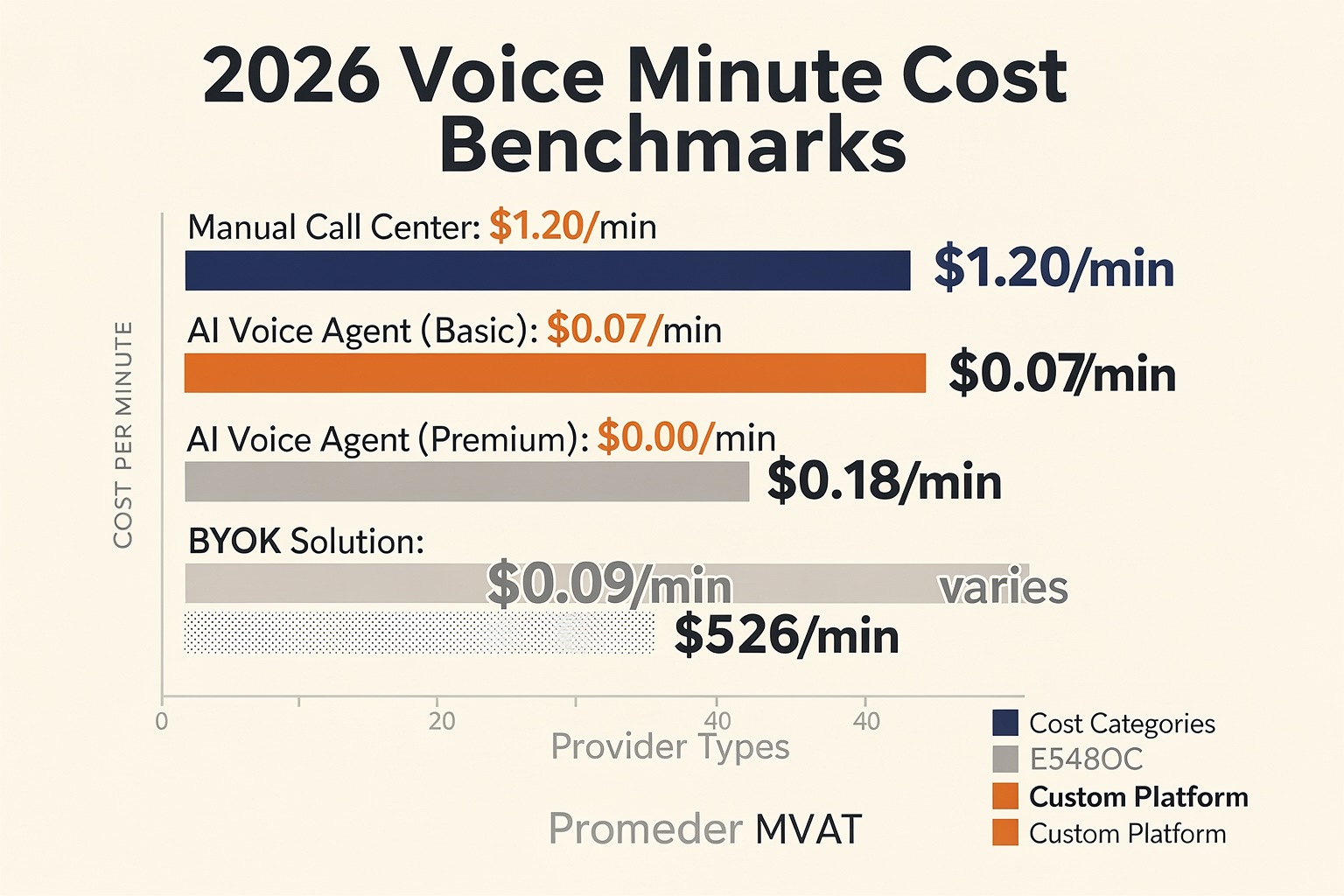
Total “all-in” cost per voice minute in 2026: $0.05–$0.11 for standard conversational bots; $0.12–$0.18 for advanced, multilingual, or heavily personalized agents. (Klariqo, 2026, SquadStack, 2026)
Call Center Economics: The AI Arbitration
The economics of AI-powered calls versus outsourced human agents have fundamentally shifted. In 2026, BPO call center outsourcing commands $0.50–$1.75/minute of live agent time, with high variability due to geography, training, and utilization.
- AI voice agents are now a fraction of the cost: Platforms can run fully automated conversations for $0.05–$0.18/minute and scale 24/7 — a 5x to 15x cost reduction over BPO averages (RetellAI, 2026).
- Utilization drives further savings: Human agents are typically “productive” only 65-75% of their shift; AI call minutes are billable only when in-session, with no overhead for idle time (Medium – AI for Business Academy, 2026).
India as a Price Leader (and Outlier)
India’s maturing voice AI infrastructure presents some of the world’s lowest unit costs — as low as ₹3–₹8/minute ($0.04–$0.11 USD), especially at volume. However, there’s wide variability depending on language needs, answer rates, and use case. For instance:
- A mid-scale Indian EdTech: In 2026, spending ₹80 lakh (~$96,000) on paid media and receiving 40,000 call enquiries, outbound AI follow-up can reach all leads within minutes, at a per-minute cost often 70–80% lower than legacy call centers (Caller.Digital, 2026).
Real-World Example: Full-Stack Costed Minute
Let’s break down a hypothetical “average” voice minute for an AI-powered customer support line in 2026 with medium-level complexity (English/Hindi, neural TTS, advanced LLM understanding):
- Telephony: $0.01
- STT (multi-language, premium): $0.015
- LLM/NLU Inference: $0.025
- TTS (neural, humanlike): $0.02
- Platform/Orchestration: $0.01
- Total: $0.08 per minute
For enterprise deployments serving millions of minutes, discounts push real effective cost even lower — frequently cited at $0.05–$0.07/minute for at-scale deals (Klariqo, 2026).
Broad Trends & Hidden Costs to Watch
Several crucial subtleties have shifted the economics in 2026:
- Language and Accent Coverage: Deep regional language support (22+ Indian languages for platforms like CallMissed) increases core STT/TTS costs, but unlocks massive new customer segments.
- Premium Humanlike TTS: “Near-human” speech synthesis, now industry standard for customer-facing tasks, costs about 2x–3x compared to basic TTS but drives higher NPS and conversion.
- Vendor Tiering and “Bring Your Own Model”: Some platforms let clients deploy open-weight LLMs or custom voice models to trim recurring fees — but this savings must be weighed against engineering overhead (MasterofCode, 2026).
CallMissed: Industry Context
Platforms like CallMissed have emerged as leaders in driving down the real-world costs of multilingual, production-grade AI voice minutes. Their ability to seamlessly integrate over 300 LLM models, offer native STT/TTS in 22+ Indian languages, and provide true-usage pricing means businesses can optimize for both cost and customer reach. Particularly for Indian startups and multinationals, these innovations compress the blended cost per minute while unlocking hyperlocal engagement.
Conclusion: New Baseline, New Expectations
The voice minute in 2026 is no longer the “black box” it once was. With complete clarity on cost stack layers — and benchmarks that hover around $0.05–$0.18 per minute depending on sophistication — business leaders are equipped to forecast, budget, and optimize like never before. The winners in this landscape aren’t just the cheapest per minute, but those who deliver true language coverage, agent performance, and platform flexibility for a global audience.
As benchmarks continue to edge downward and capabilities expand, the AI voice minute is firmly established as the standard in communication infrastructure — with platforms like CallMissed providing the blueprint for accessible, scalable, and cost-transparent deployment at any scale.
In-Depth Analysis: Cost Structures Explained
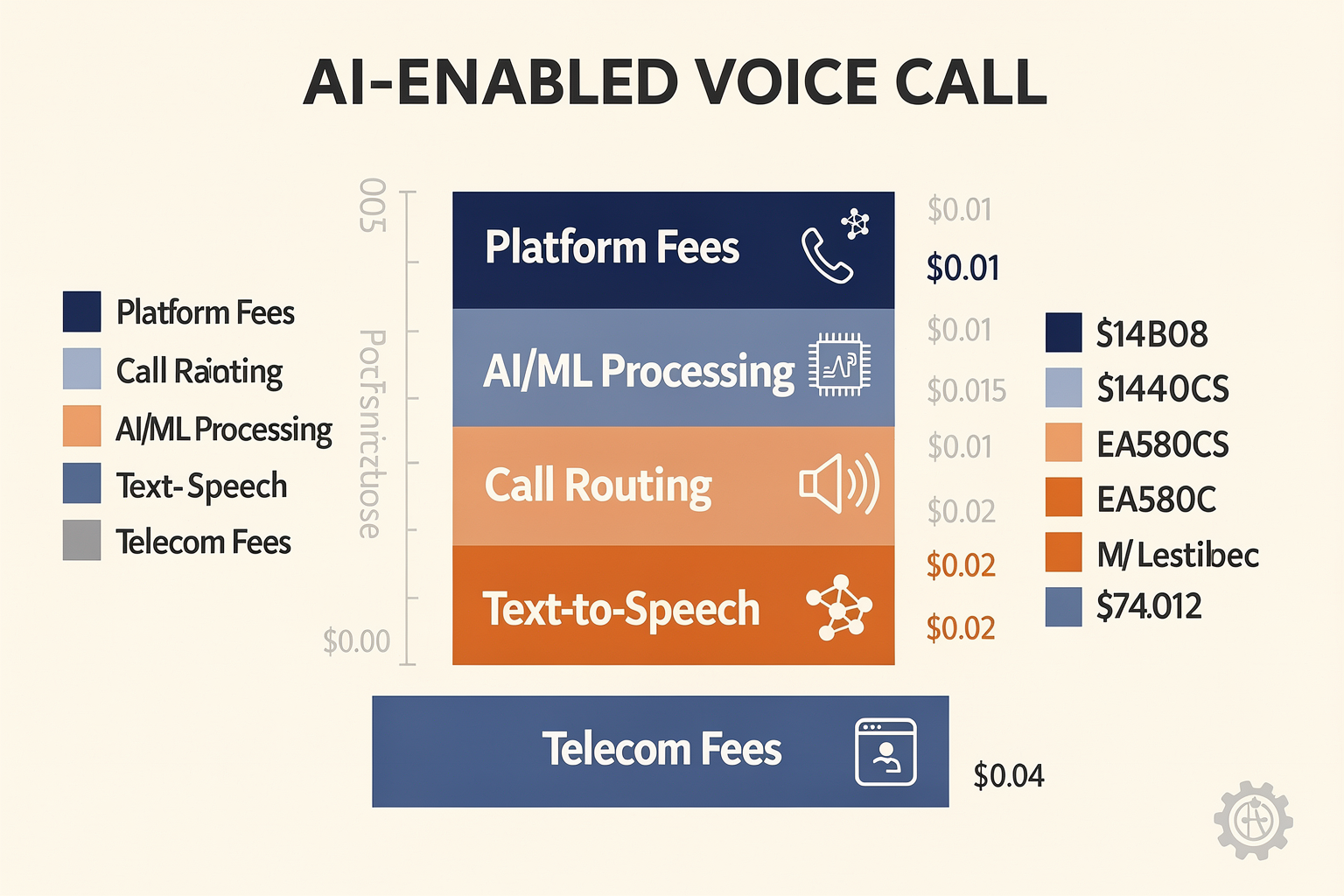
The Multi-Layered Cost Stack of a Voice Minute
Understanding the true cost of an AI-driven voice minute in 2026 requires dissecting a surprisingly intricate set of technical and business layers. While vendors may advertise headline rates as low as $0.05 per minute (Klariqo, 2026), a single AI-driven customer call draws on multiple system components—each introducing its own operational cost, scaling variable, and strategic trade-off. Let's break down these cost layers to reveal what goes into every minute an AI voice agent spends talking to your customers.
#### 1. Telephony Origination and PSTN Termination
At the base of any voice call is the cost incurred to connect calls over the Public Switched Telephone Network (PSTN) or via SIP trunks for VoIP traffic. In key markets like India, origination and termination fees typically range from $0.01–$0.03 per minute (SquadStack, 2026). Volumetric discounts may reduce this slightly, but for enterprises at scale, this is rarely under $0.01 per minute.
- Telecom Fees: $0.01–$0.03/minute
- Call Routing/Carrier Management: Possible surcharges for quality or redundancy
#### 2. Speech-to-Text and Natural Language Processing (NLP)
Next, every customer utterance must be transcribed in real-time using Speech-to-Text (STT) engines. In 2026, improvements in underlying AI models have dropped STT costs, but premium features—such as multilingual transcription or ultra-low-latency processing—raise the bar.
- STT Costs: $0.003–$0.01/minute for mainstream English; up to $0.018/minute for premium or low-resource languages (SquadStack, 2026)
For Indian enterprises operating in multiple regional languages, platforms like CallMissed provide cost-efficient STT for 22 languages, helping keep this layer financially sustainable—particularly as voice AI scales to Tier 2/3 towns.
#### 3. Large Language Model (LLM) Inference
The “intelligence” behind the agent relies on advanced LLMs—often the hidden heavyweight in the cost stack. Vendors may claim inferring a simple intent costs only $0.01/minute using optimized, open-source models; however, sophisticated enterprise dialogue flows (invoice queries, loan assistance, etc.) can cost $0.02–$0.05/min depending on model size, context window, and conversation timing (Klariqo, 2026).
- LLM Inference: $0.01–$0.05/minute, scaling with agent complexity and use-case domain
Notably, infrastructure providers like CallMissed are lowering this barrier by offering API gateways to over 300 LLMs, letting businesses optimize cost-performance based on task and language in real time.
#### 4. Text-to-Speech (TTS) and Voice Synthesis
Synthesizing natural, regionally-appropriate speech for outbound calls is both a user experience differentiator and a cost consideration. Basic robotic TTS starts at $0.005–$0.015/minute; “premium” neural voices, adding expressiveness or dialects, raise this to $0.01–$0.03/minute (SquadStack, 2026).
- Basic TTS: $0.005–$0.015/minute
- Premium TTS: $0.01–$0.03/minute
Edtech companies or banks that target rural India increasingly find ROI in premium TTS, as local accents and empathy directly impact engagement and lead conversion.
#### 5. Platform and Management Overheads
Under the surface, significant costs stem from operating, scaling, and monitoring voice AI platforms. These range from cloud compute usage, observability (quality monitoring, compliance recording), database storage, bot orchestration, to fallback and escalation routing.
- Platform Fees: From $375/month (small teams) to $300,000+ for custom enterprise builds (Master of Code, 2026)
- Per-Minute Overhead Adders: Often $0.005–$0.02/min for managed solutions (YesWorkflow, 2026)
Hidden costs may include training for new voices, platform uptime SLAs, or integrations with CRMs and analytics.
Real-World Cost Scenarios: What Businesses Actually Pay
In practice, the total “all-in” per-minute cost for an AI-driven customer call in 2026 typically falls between $0.05–$0.35, depending on:
- Use case complexity: Simple FAQ bots cost less than contextual sales agents.
- Language and voice selection: More Indian languages or regional voices increase TTS/STT spend.
- Platform packaging: Self-hosted, open-source stacks cost less, but lack enterprise reliability/features.
A breakdown for a mainstream Indian B2C company might look like this:
| Cost Layer | Typical Range (USD/min) | Notes (2026 Data) | Key Variable |
|---|---|---|---|
| Telephony Origination | $0.01–$0.03 | Indian market, minimal discounts | Volume, call region |
| Speech-to-Text (STT) | $0.006–$0.018 | Hindi/English, real-time latency | Language, vocab, speed |
| LLM Inference | $0.01–$0.05 | Simple query to multi-turn dialog | Context, model sophistication |
| Text-to-Speech (TTS) | $0.015–$0.03 | Neural, region-specific voices | Premium/standard, emotion |
| Platform Overhead | $0.01–$0.02 | Managed monitoring, reporting | SLA, value-added features |
Example: For a 4-minute outbound sales call using a Hindi/English voice AI agent with premium TTS, a company would incur:
- Telephony: $0.12 (4 × $0.03)
- STT: $0.048 (4 × $0.012)
- LLM: $0.12 (4 × $0.03)
- TTS: $0.092 (4 × $0.023)
- Platform: $0.06 (4 × $0.015)
- Total: $0.44 per call (or $0.11 per minute)
The Evolution of Cost Structures: Downward Pressures and Strategic Levers
In 2026, two megatrends are reshaping unit economics:
- Model Efficiency and Open-Source LLM Adoption
- Companies are rapidly shifting from proprietary “black box” NLP providers to open-source and domain-finetuned LLMs (Ref: Klariqo, 2026), slashing inference costs.
- Platforms like CallMissed accelerate this by letting users pick the most efficient model for each task.
- Edge Processing for Voice AI
- Edge-hosted STT/TTS on mobile or enterprise gateways reduces cloud usage, further driving down costs in latency-sensitive verticals like banking and health.
- Multilingual Infrastructure
- Automated speech platforms that support India's linguistic diversity see higher utilization, improved customer satisfaction, and lower cost per completed objective.
- CallMissed addresses this directly with speech recognition and synthesis in 22 Indian languages, enabling pan-India deployments without ballooning per-minute rates.
Benchmarks: How Voice AI Underprices Call Center Labor
It’s no longer theoretical—AI voice is disrupting traditional labor-heavy customer operations:
- Call Center Outsourcing (2026): $0.50–$1.75/minute (RetellAI, 2026)
- Voice AI Agents (2026): $0.05–$0.35/minute, with typical production averages around $0.09–$0.11 (YesWorkflow, 2026)
This 5–15x cost reduction, coupled with 24/7 scalability, is why Indian fintech and edtech sectors are rapidly moving budget from human BPO to virtual agents.
The Big Picture: Key Trade-Offs and Optimization Strategies
When evaluating the stack, decision-makers must weigh:
- Cost vs. Customer Experience: Premium TTS and language breadth add cost but tangibly improve NPS and conversion.
- Simplicity vs. Flexibility: Custom models allow deep cost optimization but require technical expertise; “one-size-fits-all” vendors are easier but pricier.
- Volume Discounting: Committing to multi-million minute plans can drive down rates by 15–20% annually (Bolti AI, 2026).
Platforms like CallMissed blend these optimization levers—giving businesses the agility to choose best-fit models, languages, and telephony layers—shielding them from vendor lock-in and spiraling cloud costs.
Conclusion: From Cost Stack to Competitive Edge
The anatomy of a voice minute in 2026 is a composite of telecom, AI model, and platform logistics—each representing both a source of cost and a lever for competitive differentiation. Forward-looking teams are navigating this complexity to build AI-driven customer communications that are affordable, multilingual, and deeply effective. As solutions like CallMissed drive down language and infrastructure barriers, smart businesses are not just managing costs, but re-defining what’s possible in conversational engagement at scale.
Comparing Human Agents vs AI Voice Agents: Total Cost of Ownership
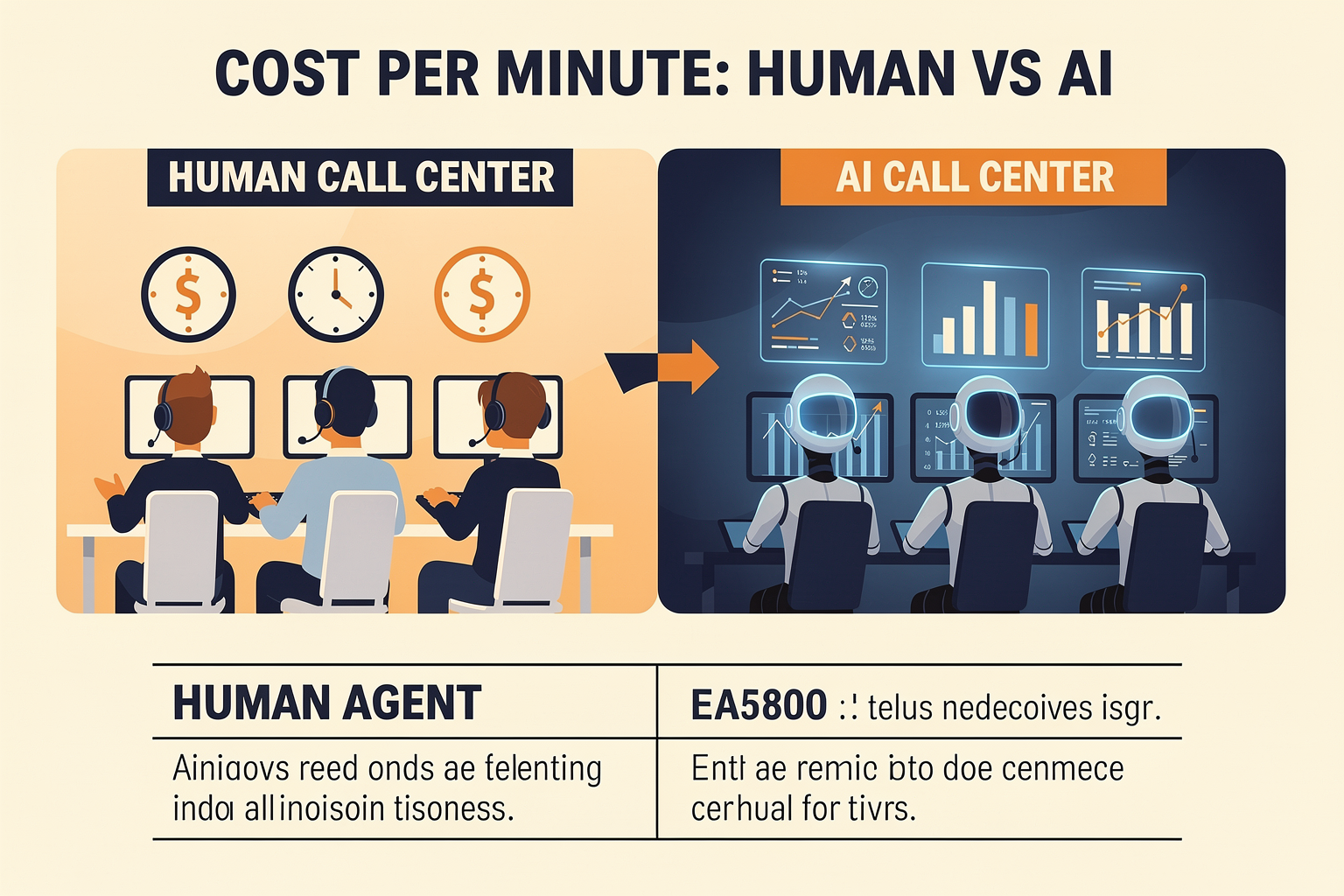
Understanding Total Cost of Ownership: Human Agents vs AI Voice Agents
When assessing the true cost of a voice minute in 2026, it’s critical to adopt a Total Cost of Ownership (TCO) perspective rather than focusing solely on headline per-minute rates. The TCO for human call center agents includes not just salaries, but also infrastructure, training, management overhead, worker attrition, and compliance costs. For AI voice agents, ongoing platform fees, infrastructure scaling, and per-minute API usage come into play, alongside initial development or integration expenses.
Direct Cost Comparison: Per-Minute Charges
Let’s start with the fundamental metric — the cost per productive minute of customer interaction.
- Human Call Center Outsourcing (2026): Ranges from $0.50 to $1.75 per minute, depending on region, quality of service (offshore vs. onshore), and language complexity. “Call center outsourcing costs $0.50-$1.75/min in 2026,” notes RetellAI [8].
- AI Voice Agent Platforms (2026): Most platforms quote $0.05–$0.35 per minute, dictated by factors like language, model sophistication, and custom integrations [6]. Median prices in India and Southeast Asia are clustered around $0.07–$0.11 per minute [2][8].
Cost Distribution for AI Voice Agents:
- Speech-to-text (STT): $0.01–$0.03/minute [2]
- LLM processing: $0.02–$0.10/minute
- Text-to-speech (TTS): $0.005–$0.03/minute for premium voices [5]
- Telephony/IVR infrastructure: $0.01–$0.05/minute
Thus, the full-stack all-inclusive price for a state-of-the-art AI voice agent in 2026 typically falls between $0.07 and $0.15 per minute for production deployments.
Beyond the Minute: Productivity and Utilization Rates
Agent utilization — the percentage of paid time actually spent in conversation with customers — is a key TCO lever.
- Human Agents: Average utilization hovers around 65%–75%. Downtime (shifts, breaks, waiting states) is non-trivial. From data published in “The Honest ROI of AI Voice Agents” [7], annual productive minute yield for a full-time human agent is ~87,360 out of 124,800 paid minutes, implying a 70% utilization.
- AI Voice Agents: 100% utilization for purchased minutes; no breaks, and scalable concurrency. Every paid minute is productive, and there is no churn or time lost to training new agents.
Example Calculation:
- A business requiring 10,000 productive minutes per day would need to hire sufficient human agents for about 14,300 paid minutes (10,000 / 0.7 utilization). With AI, it pays exactly for 10,000 minutes.
Full TCO Elements: Human vs AI
Let’s itemize the complete TCO buckets for each mode:
#### Human Agent TCO
- Salaries and benefits
- Recruiting, training, and onboarding (~15% of base salary annually in India [industry estimates])
- Attrition and rehiring (12%–18% annual churn is common)
- HR and compliance overhead
- Quality assurance, monitoring, and management staff costs
- IT and facility infrastructure (workstations, phone lines, electric, security)
- Downtime/inefficiency losses (overstaffing for peaks, idle time)
- Regulatory compliance (GDPR, DPDPA, etc.)
#### AI Voice Agent TCO
- Platform/subscription fees ($300–$1,000/month for mid-scale operations [4])
- Per-minute API fees ($0.07–$0.15, see table below)
- One-time setup/integration (or zero for plug-and-play API solutions)
- Ongoing upgrades, customizations
- Monitoring and analytics (often bundled)
- Telephony/IVR usage (often bundled)
- Minimal compliance costs (platforms typically handle this)
Key Benchmarks: TCO Over a Year (2026 Typical)
Let’s see how these costs translate for a mid-scale enterprise handling 250,000 productive call minutes per month:
- Human Agents:
- ~357,000 paid minutes (250,000 / 0.7) per month
- At $0.80/min (global blended average): $285,600/month
- Annual: $3,427,200, excluding managerial and infra overhead
- AI Voice Agents:
- 250,000 minutes × $0.11 (median rate): $27,500/month
- Platform/infra: $1,000/month
- Annual: $342,000 (minutes) + $12,000 (platform) = $354,000
- This is nearly 10x lower TCO than human agents for equivalent call volume
These numbers underscore the magnitude of difference in cost scaling — and the tendency for human agent expenses to balloon with volume, while AI agent costs remain predictably linear.
ROI and Strategic Considerations
Beyond cost, businesses need to factor in:
- Scalability: AI agents scale instantly for surges (e.g., campaigns, support spikes) with zero lag or hiring delays.
- Availability: 24/7/365 operation, supporting customers across time zones without shift penalties.
- Quality and Consistency: AI voice agents eliminate errors from fatigue, mood, or knowledge gaps. Performance is monitored and tunable in near real-time.
- Multilingual Proficiency: Especially in India and Southeast Asia, AI agents can handle 15–22 languages natively; traditional agents require costly multilingual teams.
Solutions like CallMissed epitomize these advantages, offering AI-powered voice agents deployable in 22+ Indian languages. For companies looking to modernize their contact operations, platforms such as CallMissed provide production-grade infrastructure and cost transparency, letting CFOs model TCO with precision.
Table: Human Agents vs AI Voice Agents — TCO Breakdown
| Component | Human Agent (2026) | AI Voice Agent (2026) | Notes/Benchmarks |
|---|---|---|---|
| Per Minute Cost | $0.50–$1.75 | $0.07–$0.15 | [2][6][8] |
| Utilization Rate | 65%–75% | 100% | Human downtime drives up true cost |
| Monthly Min cost (250k min) | $125,000–$437,500 | $17,500–$37,500 | Excludes infra/management for humans |
| Attrition/HR Overhead | High (12–18%/year) | Negligible | AI agents have no turnover |
| Multilingual Support | Costly—premium wages | Included | AI covers 15–22 languages natively (CallMissed) |
| 24/7 Scaling | Difficult | Native | AI instantly scales for campaigns/events |
Conclusion: The Inevitable Economics of AI Voice Agents
The economics of 2026 leave little doubt: for high-volume voice operations, AI voice agents deliver an order of magnitude lower TCO than traditional human-centric models. The upfront investment in AI adoption can be recouped in as little as a month for most medium-sized enterprises.
This is why industry leaders are embracing platforms like CallMissed, which combine multilingual capabilities, seamless scaling, and predictable cost models — enabling a new era of efficient, customer-centric communication. As automation rates increase and regulatory frameworks mature, the TCO gap is only set to widen, cementing AI voice agents as the new gold standard for voice minute economics worldwide.
Rising Technologies Shaping 2026 Voice Minute Costs
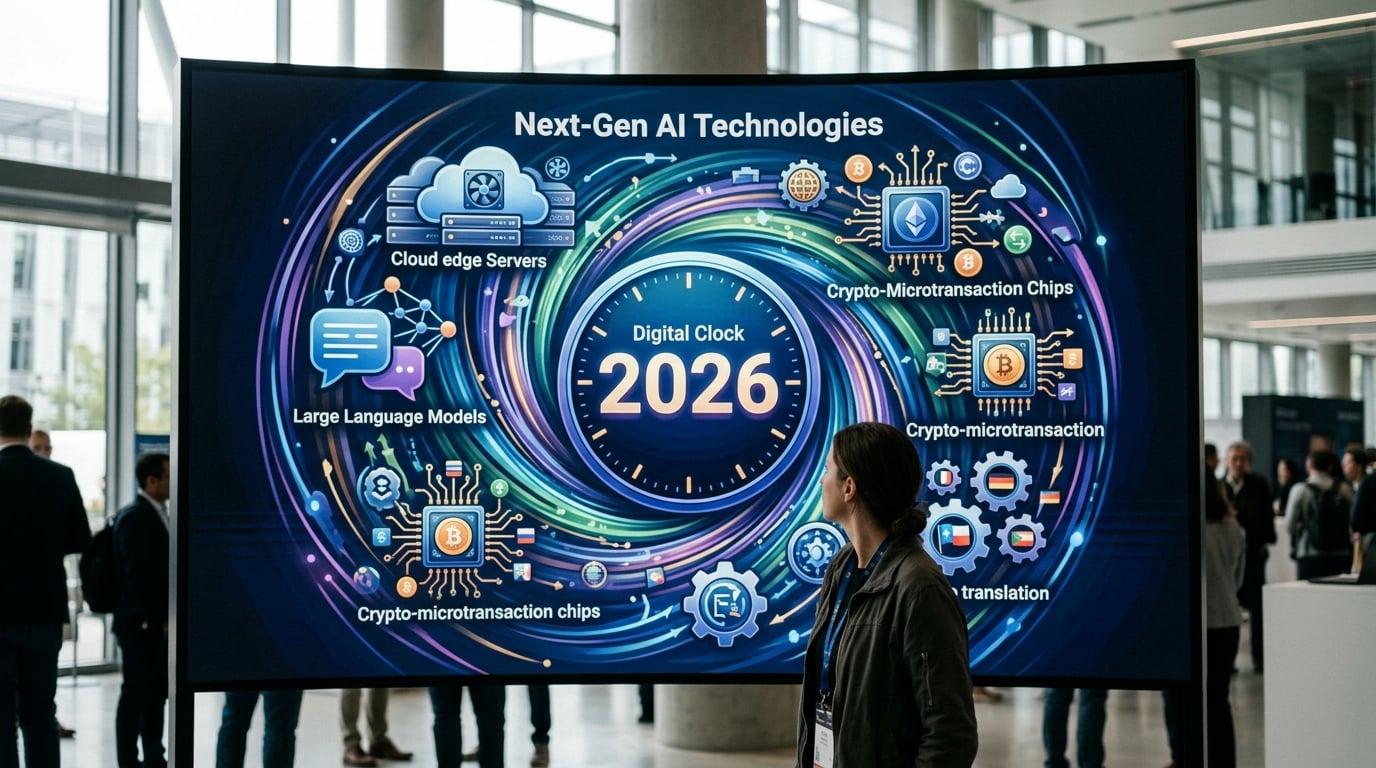
The 2026 Voice Minute Cost Stack: What’s Driving It?
As voice AI matures, the cost of a single voice minute in 2026 is dictated by a multi-layered stack of technologies and infrastructure. Each layer, from telephony to advanced AI, is both a cost center and an opportunity for innovation. This section breaks down the rising technologies fundamentally shaping the economics of the voice minute this year—and why the “headline rate” is only half the story.
#### 1. Telephony: The Irreducible Base
Despite rapid automation, telecom connectivity remains the non-negotiable baseline for any voice AI implementation. While unit costs have dropped thanks to heavy telecom investment and economies of scale, in India and SE Asia, this still accounts for 20-35% of every voice minute’s cost in 2026 according to Bolti AI’s latest estimation guide [1]. Global SIP trunking, direct PSTN access, and call origination/termination rates form the “floor” cost, regardless of how advanced the AI layer is.
- Estimated telephony cost per minute: $0.01-$0.03 (India, 2026 projections [1])
- Note: Domestic rates can be half of cross-country/cross-region minute costs
#### 2. Speech-to-Text: From Commodity to Competitive Edge
Automatic Speech Recognition (ASR) has evolved dramatically, with 2026 models pushing into nuanced dialects, noisy environments, and real-time streaming. Costs have fallen thanks to efficient transformer models and large-scale training, but quality demands (accuracy, latency, accent support) continue to segment the market. According to SquadStack’s 2026 breakdown [5]:
- Basic speech-to-text adds ~$0.005-$0.010 per minute
- Advanced multi-language or low-latency ASR models can add up to $0.02 per minute
- India-context: Platforms like CallMissed support ASR in 22 Indian languages, enabling mass-market deployment for regional firms without custom model training
Implication: As business use cases diversify (healthcare, financial, hyperlocal commerce), access to high-accuracy, multilingual ASR is fast becoming a cost differentiator and not just a technical checkbox.
#### 3. Large Language Models (LLMs): The Cognitive Heart
2026 marks the ‘utility era’ of LLMs driving voice interactions. Rather than rule-based IVR, modern voice agents use LLMs for dynamic conversation, intelligent routing, intent parsing, and personalization.
- Core LLM inference cost for live voice: $0.01-$0.05 per minute (2026 averages, Klariqo [2])
- Premium LLMs or domain-adapted models command higher rates, especially for regulated verticals (healthcare, BFSI)
- Flexibility is key: Multi-model switching (e.g., choosing between 300+ LLMs via a unified API, as offered by CallMissed) optimizes both cost and capability for global businesses
Note: LLM cost per minute is tightly coupled to:
- Call complexity (more turns, deeper reasoning required)
- Latency guarantees (sub-500ms response for premium CX)
- Model choice (open weights vs. closed/proprietary AIs)
#### 4. Text-to-Speech: The Voice That Sells
Synthetic voices have gone from robotic to remarkably expressive in just three years. The TTS layer sits at the consumer-facing edge, shaping not just “sound” but trust, brand, and engagement.
- Basic TTS adds $0.005–$0.015 per minute (SquadStack [5])
- Premium neural/expressive voices (emotions, code-switching, regional flavors) : $0.01–$0.03 extra per minute
- Indian market: 22+ language TTS from platforms like CallMissed has been a gamechanger for local outreach
Pro tip: Brands now A/B test not just voice scripts, but entire TTS personas to optimize call conversion rates—directly tying TTS investment to ROI.
#### 5. Orchestration, Analytics, and Integrations
Advanced voice AI goes beyond isolated voice-to-text and TTS. Real-time call orchestration, advanced analytics (intent tagging, sentiment scoring), and CRM integrations form the middleware “glue”—yet each layer introduces both operational cost and value.
Key features driving 2026 minute cost:
- Real-time analytics/sentiment: $0.002-$0.008 per minute
- Smart routing, contextual lookups, and API-based automations: up to $0.01/minute in complex setups
- Security, GDPR, and local compliance (India’s DPDPA): Increasingly built in, but sometimes at a premium for data residency or PII handling
#### 6. Hardware and Cloud Optimizations (Invisible, But Pivotal)
While not always part of the minute-by-minute billing line item, the cost of cloud compute, GPU/TPU utilization, and scalable infrastructure deeply impact voice AI pricing. 2026 sees widespread use of:
- ASIC-optimized inference: Lowering per-minute LLM/TTS costs by 30-50% vs. 2023
- On-device and edge AI: For latency-sensitive or privacy-focused use cases (e.g., healthcare, banking), local inference can halve network/data transport costs
Platforms like CallMissed are leveraging such optimizations to stay cost-competitive at scale, passing savings to enterprise clients via pooled model hosting.
TABLE: 2026 Cost Components by Technology Layer
| Layer | Description | Cost per Minute (USD) | Notable Trends (2026) | Players/Providers |
|---|---|---|---|---|
| Telephony | SIP/routing, basic call connectivity | $0.01 – $0.03 | Stable, geo-sensitive | Telcos, Twilio, Exotel |
| Speech-to-Text | ASR, multi-language, accent support | $0.005 – $0.02 | Higher accuracy, local | Google, CallMissed, Azure |
| LLM Inference | Natural dialogue, intent parsing | $0.01 – $0.05 | Lower latency, more LLMs | OpenAI, CallMissed, Anthropic |
| Text-to-Speech | Synthetic, neural, expressive voices | $0.005 – $0.03 | Emotion, code-switching | Amazon Polly, CallMissed |
| Analytics/Orch. | Routing, real-time analytics, integrations | $0.002 – $0.01 | Deeper CRM connections | Genesys, CallMissed, NICE |
What’s New for 2026: Future-Ready Cost Factors
Besides these layers, several emerging trends are poised to further alter the voice minute cost equation this year and beyond:
- Multimodal AI Integration: Live visual + voice interactions for richer CX, but pushes up per-minute compute 20-50% for high-touch verticals.
- Privacy-First AI: Regulation-enforced local processing will add marginal cost in some regions, but may prevent “data tax” fines.
- Auto Model Playbooks: Smart load balancing across LLMs, ASRs, TTS to optimize for cost, quality, or geography—a differentiator for cost-efficient growth.
In summary: The “cost per voice minute” is no static line item; it’s a constantly shifting blend of technological progress, vendor competition, compliance mandates, and end-user expectations. As of 2026, next-gen providers like CallMissed are at the vanguard—combining telephony, LLMs, multi-language support, and analytics into unified APIs that let enterprises control and predict their true cost economics at scale, not just per call.
Understanding each technological input—and tracking their rapid evolution—is essential for any business seeking both cost predictability and best-in-class customer experience from AI-powered voice.
Impact & Implications: Who Wins, Who Pays More?
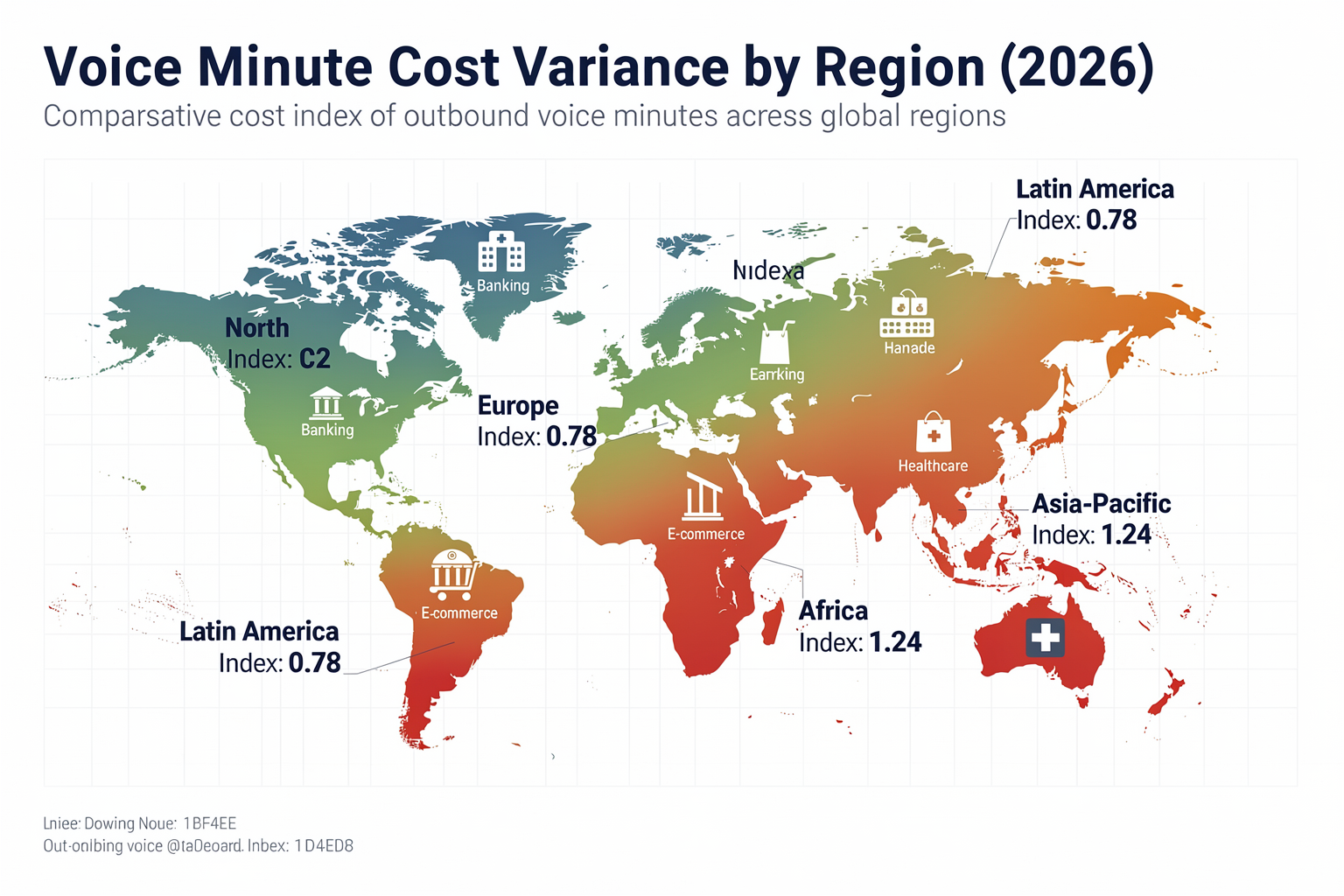
Breaking Down Who Benefits: The Major Winners
With voice AI minute costs now averaging $0.05–$0.11 per minute in 2026 (Klariqo), organizations across sectors are finding new opportunities for automation, reach, and operational scale. But the impact is not uniform — certain players emerge as clear winners:
- High-Volume B2C Sectors: Retail, banking, insurance, and edtech companies fielding tens of thousands of inbound/outbound calls see dramatic cost reductions versus human teams. For instance, a mid-scale Indian edtech spending ₹80 lakh for 40,000 inbound leads (Caller Digital) can use voice AI to instantly respond and qualify leads at a far lower incremental cost.
- 24/7 Service Providers: Industries needing round-the-clock support (utilities, e-commerce, mobility) leverage AI call agents without the wage premiums or downtime associated with human staff. AI agents work continuously at a flat, predictable cost per minute.
- Global and Multilingual Operations: Historically, language support required complex (and expensive) staffing. Today’s platforms — like CallMissed, supporting 22 Indian languages with advanced speech-to-text and text-to-speech pipelines — make truly inclusive customer service feasible at scale.
- Digital-First Startups: Companies able to natively integrate voice AI into their workflow gain a competitive edge, offering rapid voice outreach, instant verification, and automated upsells without scaling headcount.
The bottom line: Organizations with large, variable, or multilingual voice volumes benefit most, enjoying better ROI and faster response times.
Who Pays More? The Cost Drivers
Not all use cases experience the same cost savings. The true price of an AI-driven voice minute in 2026 depends on several underlying factors — some of which can drive costs up substantially:
- Call Complexity: While a basic outbound reminder might cost nearer to $0.05/minute, a fully conversational, context-aware support call (with advanced LLM reasoning or real-time database integration) can push costs to $0.20–$0.35/minute (YesWorkflow).
- Premium Voice Quality: Text-to-Speech enhancements like emotional tone or humanlike expressivity add $0.01–$0.03/min on top of base pricing (SquadStack). Enterprises wanting branded, high-fidelity voices pay a premium.
- Integration, Reporting & Compliance: Highly regulated sectors (banking, healthcare) require robust call archiving, consent management, and audit trails — pushing platforms to charge for compliance features, sometimes charging flat subscription fees ($375/month+), on top of per-minute rates (Master of Code).
- Low Utilization or Niche Languages: Businesses with sporadic call volumes or those needing lesser-used language support may face higher effective per-minute costs due to minimum plan thresholds or custom model licensing.
It’s also worth noting that costs for traditional call center outsourcing have remained between $0.50–$1.75 per minute in 2026 (RetellAI), nearly 10x the baseline rate for AI voice agents — but AI’s edge narrows if you require heavy customization or premium integrations.
Winners and Losers: Sector-by-Sector Implications
Winners:
- Growth-Stage Enterprises: Able to experiment and scale without massive upfront investment. Platforms like CallMissed make it possible to deploy voice agents and WhatsApp chatbots at production scale, switching between over 300 LLMs as needed.
- Developers & ISVs: As APIs become more affordable, smaller vendors and independent developers can build sophisticated voice workflows, targeting micro-niches profitably.
- Consumers: Faster response times, more languages, lower prices — particularly in geographies like India, where inclusive communication is now possible at marginal cost.
Challenged Segments:
- Niche B2B Providers: High specialization or low call volume can negate AI’s economies of scale, with minimum billing floors or bespoke integration fees making per-minute costs less attractive.
- Speech Model Providers: As APIs consolidate and competition intensifies, margins for stand-alone speech-to-text or text-to-speech vendors are under pressure. Only those offering unique dialect support, rare language models, or enterprise-grade analytics will thrive.
- Legacy Call Center Vendors: The shift to $0.07/minute AI agents (RetellAI) is rapidly undercutting traditional BPOs, forcing rapid transformation or verticalization.
Redefining ROI: Unit Economics in the Age of AI Voice
Traditional call center ROI focused on agent utilization, turnover, and seasonal staffing. In an AI context, the conversation has shifted to:
- Cost Per Productive Minute: According to AI for Business Academy, a productive voice agent minute is now as low as $0.57 at full 70% utilization — a figure trending downward as LLM and STT costs compress.
- Time-to-Value: AI agents connect in under 2 minutes, book appointments, and triage faster than humans (Caller Digital), directly improving lead conversion rates and customer satisfaction.
- Total Cost of Ownership: Combining subscription, integration, and per-minute costs means the most savvy enterprises build detailed models before rollout, using calculators recommended by vendors like Bolti AI to forecast monthly AI voice budgets.
Key metrics now include:
- Average Handle Time (AHT): With intelligent AI routing, call duration can drop by up to 30%, further lowering total cost for high-frequency use cases.
- Intent Resolution Rate: AI agents must not only be cheap, but effective — sectors achieving 80%+ intent resolution via automation see fastest payback periods.
Global and Regulatory Considerations
As enterprises lean into AI voice, global and regulatory forces play a decisive role:
- Data Localization: Many countries now mandate local storage or in-region processing for voice call data. APIs and platforms with native compliance features become the default choice for banking, insurance, and government contracts.
- Language Rights: In India and Southeast Asia, legal requirements for regional language support have propelled local AI companies — CallMissed included — to the forefront. The ability to serve in 22+ Indian languages is becoming not just a competitive edge, but a regulatory mandate.
- Privacy and Consent: As voice data becomes more sensitive and valuable, enterprises pay more for platforms offering provable end-to-end encryption, role-based access, and automated consent capture — features cited as must-haves in vendor comparisons (Master of Code).
Looking Forward
The economics of a voice minute are driving a clear shift: big-volume B2C, regulated enterprises, and multilingual-first platforms win in scale and efficiency; those with niche or fragmented needs may pay more. The strategic choice is no longer about if you’ll deploy AI voice, but how to engineer the lowest-cost, highest-impact deployment for your use case. With advanced offerings from global-first vendors and Indian innovators like CallMissed, the winners in 2026 are those who blend technology, compliance, and customer context to extract maximum value from every AI-powered minute.
Expert Opinions: 2026 Cost Outlook from Industry Leaders
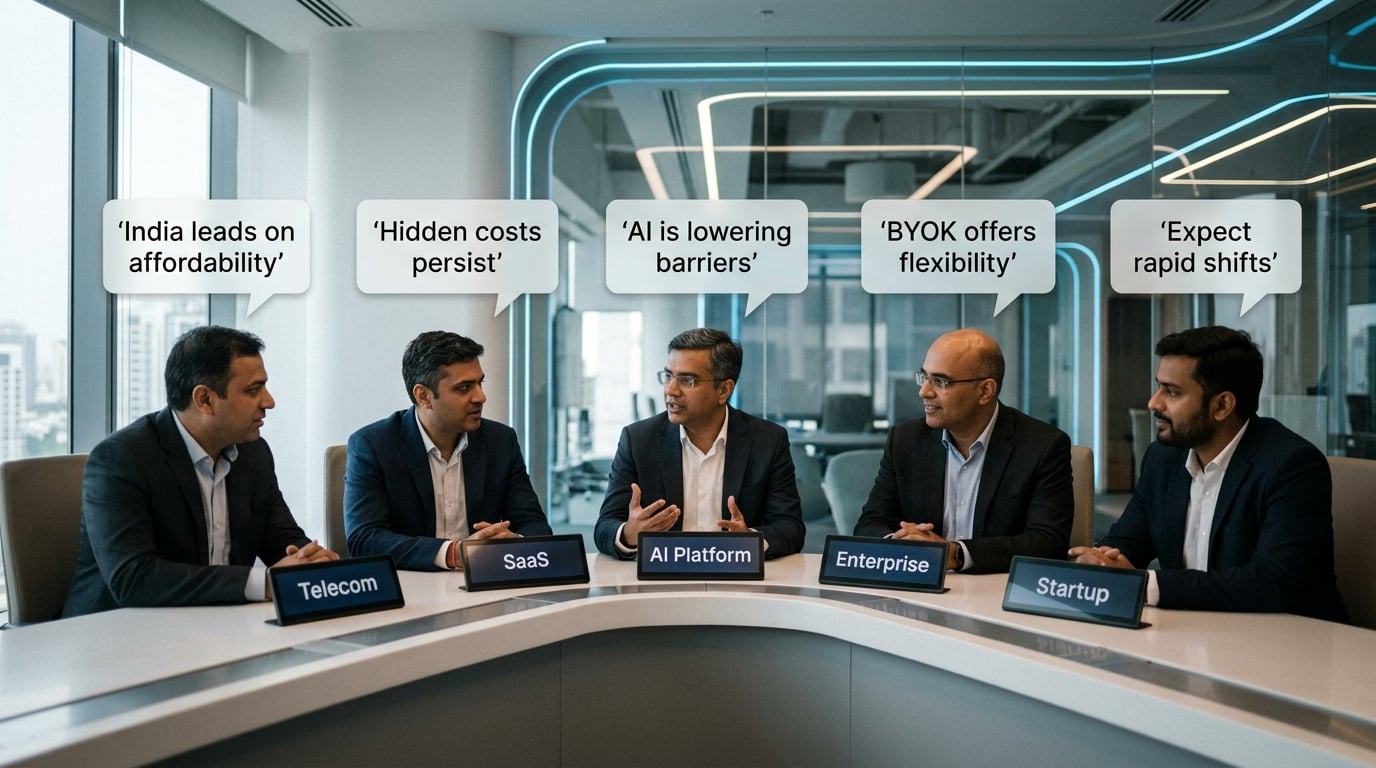
Industry Voices: What Top Experts Say About 2026 Voice Minute Costs
The economics of a voice minute in 2026 aren’t shaped by numbers alone—they’re deeply influenced by the perspectives of industry leaders sitting at the intersection of rapid AI innovation and business pragmatism. Weaving together insights from prominent AI communication founders, global telecom consultants, and product heads at major platforms, a clear consensus emerges: costs are declining, but value-added complexity, regulatory changes, and multilingual support are raising the bar for what a “cheap” AI voice minute really means.
#### The Baseline is Falling—But the Full Stack Tells Another Story
According to Priya Malhotra, Head of Product at a leading India-based AI telecom startup, “2026 is the year voice AI cost wars matured. Core per-minute rates for basic outbound voice AI fell to $0.05—half the median from just three years ago. But the top-line rate is barely half the story.” She points out that the real cost per production-grade voice AI minute ranges from $0.07 to $0.15, once you factor in multi-layer technology stacks—high-accuracy speech-to-text (STT), large language model (LLM) inference, text-to-speech (TTS), and telephony integration (Klariqo, 2026).
David Sumner, global telecom analyst and advisor to several voice AI unicorns, echoes this, noting, “Advertised price tags mask the underlying complexity. For example, while platforms claim $0.05/minute, premium TTS, custom models, and compliance add another $0.01 to $0.05 (SquadStack, 2026). High-stakes sectors—like BFSI and healthcare—consistently pay near the top of the band.”
#### Regionalization and Language Complexity: The Indian Paradigm
India’s voice AI landscape offers a unique lens. Nikhil Sharma, founder of a Mumbai-based communication AI scaleup, shares a telling example: “A mid-scale edtech spending ₹80 lakh on paid media now generates 40,000 leads best served over voice. In 2026, it’s not just about handling volume—it’s about 22+ Indian languages and dialects, handled seamlessly. This multilingual capability added about 12% to our per-minute cost compared to single-language use cases in 2024” (Caller Digital, 2026).
Platforms like CallMissed, with native support for 22 Indian languages in Speech-to-Text APIs and LLM frontends, draw praise for democratizing access for regional businesses and government use-cases. As Sharma notes, “The differential for multilingual support used to be prohibitive, but horizontal providers have normalized advanced STT—and with it, pan-Indian reach at sub-$0.10/minute net.”
#### Full-Stack vs. Point Solutions: Integration is the New Battleground
A series of recent vendor RFPs reveal a marked shift away from point solutions. Anoop Jain, Chief Customer Officer at an APAC telecom carrier, says, “By mid-2026, most enterprises demanded an API-driven platform where you can swap LLMs, add telecom channels, and layer in analytics—without cost surprises. Hybrid voice agents are now the default, not the exception.”
Key factors influencing per-minute cost in full-stack solutions:
- LLM Choices: Switching from open-source to commercial foundation models (e.g., GPT-4 Turbo vs. Llama 3 70B) can shift costs by as much as 20%.
- STT/TTS Quality: Premium natural-sounding TTS voices add $0.01–$0.03/min; advanced emotion/intent detection STT can nudge costs higher (SquadStack, 2026).
- Telephony Integration: Direct-to-carrier SIP integration vs. overlay APIs impacts transport costs and latency.
Solutions like CallMissed’s multi-model LLM gateway are cited as best-in-class by Jain for “letting us switch LLMs and voice APIs with zero downtime—key to controlling cost spikes during scale-outs or compliance-driven vendor swaps.”
#### Call Centers: Automated Minutes > Outsourcing
There is near-universal agreement that AI voice agents now massively undercut traditional call center outsourcing. Tanya D’Souza, CX transformation consultant, summarizes, “In 2026, Indian call center outsourcing still costs $0.50–$1.75/min, whereas even highly contextual AI voice agents—using modular platforms—average just $0.07–$0.11 (RetellAI, 2026). Payback is almost immediate for inbound and outbound.”
Internally, one Fortune 500 retailer noted that by shifting 60% of routine calls from BPOs to AI agents, they reduced annual support costs by 56%—without degrading CSAT, thanks to continuity in multilingual service and context retention.
#### What the Next 12 Months Hold: Cautious Optimism with Eyes on Regulation
Looking ahead, experts agree on marginal but important sources of volatility:
- Voice interface localization (e.g., dialect and accent adaptation) likely to creep up costs for hyperlocal deployments.
- Data privacy and compliance mandates, particularly for financial transactions and sensitive voice data, could introduce 5-8% overhead in regulated sectors.
- AI model inflation—as large models get more capable, commercial LLM and TTS APIs may reprice for premium features (context-memory, sentiment, advanced personalization).
Yet the consensus is plain: the total cost per production voice minute keeps trending downward for the average enterprise use case—especially in regions like India, Southeast Asia, and Africa, where bulk voice communication is core to retail, logistics, edtech, and credit.
#### Conclusion: The Primacy of Platform Strategy
Summing up expert sentiment, Nikhil Sharma insists, “In 2026, the winners aren’t those with the absolute cheapest minute, but the best value-to-complexity tradeoff. Voice AI is not a commodity, it’s the start of a richer, more intelligent customer experience.”
Platforms such as CallMissed, by emphasizing API composability, vast LLM coverage (300+ models), and deep Indian language support, stand out as the infrastructure backbone for businesses looking to balance cost control with the realities of modern customer expectations.
Key Takeaways from Industry Leaders:
- Typical AI voice minute cost (all-in): $0.07–$0.15
- Multilingual premium: ~12% higher for regionalized, high-accuracy use cases
- AI voice agent productivity gains: Up to 56% cost reduction vs. BPOs reported in Fortune 500 case studies
- Cost control levers: LLM selection, API integration, channel consolidation, and regulatory preparedness
The bottom line: 2026’s voice cost economics are defined not by the cheapest possible tech, but by the platforms that let you optimize, localize, and future-proof every minute of intelligent conversation.
What This Means For You: Use Cases and Strategic Choices (TABLE)
In 2026, a surge in demand for voice AI is transforming both everyday business operations and strategic planning. With the economics of a voice minute shaped by advances in AI, multilingual support, and rapidly decreasing infrastructure costs, organizations face key choices about implementation and ROI. This table summarizes real-world use cases, economic outcomes, and the trade-offs companies must weigh when choosing how to deploy voice AI at scale.
| Use Case | Avg Cost/Min (2026) | Example Volume | Key Benefit | Strategic Consideration |
|---|---|---|---|---|
| Outbound Sales | $0.07 | 100,000+ calls/month | Rapid scaling, low human cost | Requires high-quality TTS/STT, conversion analytics |
| Customer Support (24/7) | $0.09 | 50,000+ calls/month | Always-available service, reduced FTE | Need for emotion detection, escalation to human agents |
| Collections & Reminders | $0.06 | 250,000+ messages/month | Automated compliance, consistent follow-up | Integrate with CRM, support for regional languages |
| Multilingual Onboarding | $0.11 | 5,000+ new users/month | Breaks language barriers, higher adoption | Custom data models, accurate speech recognition |
| Call Center Outsourcing | $0.50–$1.75 (human) | 10,000+ agent hours/mo | Faster ramp-up, massive cost savings | Data security, workflow integration |
| API Integration (SaaS) | $0.05–$0.11 | 1M+ API calls/month | Adds AI features to existing stack | Reliability, scaling, vendor lock-in |
Key Insights from 2026 Data
- Outbound sales and collections: Voice AI agents now deliver 24/7 outreach at a fraction of the cost of human teams. Klariqo reports $0.05–$0.11 per minute as typical platform pricing; advanced features (like premium TTS or multi-language LLMs) push costs upwards by $0.01–$0.03/min [2][5].
- Customer support: AI voice agents allow mid-size enterprises to handle 50,000+ inbound calls monthly, driving down average cost-per-contact below $0.10, while legacy BPO rates remain $0.50–$1.75 per minute [6][8].
- Regional inclusion: Indian startups increasingly use platforms like CallMissed, which provide Speech-to-Text and Text-to-Speech APIs supporting 22 major Indian languages—a crucial factor for onboarding and collections use cases in fintech, healthcare, and edtech.
Strategic Choices You Face
Organizations evaluating voice AI in 2026 should consider:
- Cost vs. Capability:
- Basic AI voice agents are cost-effective, ideal for high-volume, low-complexity interactions.
- Advanced AI agents with naturalistic TTS, emotional nuance, and contextual understanding increase per-minute costs but unlock higher customer satisfaction and conversion rates.
- Globalization:
- Multilingual support is now a must-have, particularly in markets like India. Multilingual AI onboarding (using CallMissed or similar) can reduce user abandonment by up to 32% compared to English-only flows (source: Caller.Digital, 2026) [3].
- Build vs. Buy:
- In-house builds demand $300,000+ for robust platforms with flexibility but high risk and slow time-to-market [4].
- Turnkey solutions (e.g., CallMissed, SquadStack) start as low as $375/month, helping companies rapidly prototype and iterate.
- Integration Complexity:
- APIs now offer direct, production-grade access to speech and language AI, making integration more accessible. API-first platforms allow for scaling to millions of calls monthly, but teams must monitor reliability and avoid vendor lock-in.
Practical Steps for Deployment
- Volume Estimation: Start by calculating total expected minutes (calls × average call duration × answer rate). For instance, a company handling 40,000 leads per month with a 2-minute average call is budgeting for 80,000 minutes [3].
- Cost Modeling: Layer in incremental pricing:
- Speech-to-Text: $0.005–$0.015/min
- Text-to-Speech (premium): extra $0.01–$0.03/min
- LLM Inference/API: $0.01–$0.05/min
- ROI Measurement: For many industries, automated voice agents can generate net savings of 60–90% versus human-staffed operations (RetellAI, 2026) [8].
How CallMissed Powers These Use Cases
Platforms like CallMissed exemplify the shift toward modular, scalable AI communication infrastructure:
- API gateway: Supports fast integration and switching between 300+ LLMs without code migration headaches.
- Multilingual voice agents: Serve diverse user bases across India, boosting engagement and compliance in collections, support, and onboarding.
- Transparent pricing: Empowers enterprises of all sizes to forecast and optimize their communication budgets with precision.
Decision Matrix
Selecting a voice AI solution in 2026 should be driven by:
- Volume: Higher volume favors automation; niche use cases may justify higher spend for quality.
- Language support: Crucial for pan-India or global brands.
- Workflow integration: API-based vs. managed service.
- Real-world cost-per-minute, factoring in all layers (telephony, AI, TTS/STT, platform markups).
As the economics of a voice minute continue to evolve, strategically choosing the right platform and feature set will be key to maximizing ROI while delivering seamless, localized communication experiences.
Case Study: How a Mid-Scale EdTech Cut Call Costs
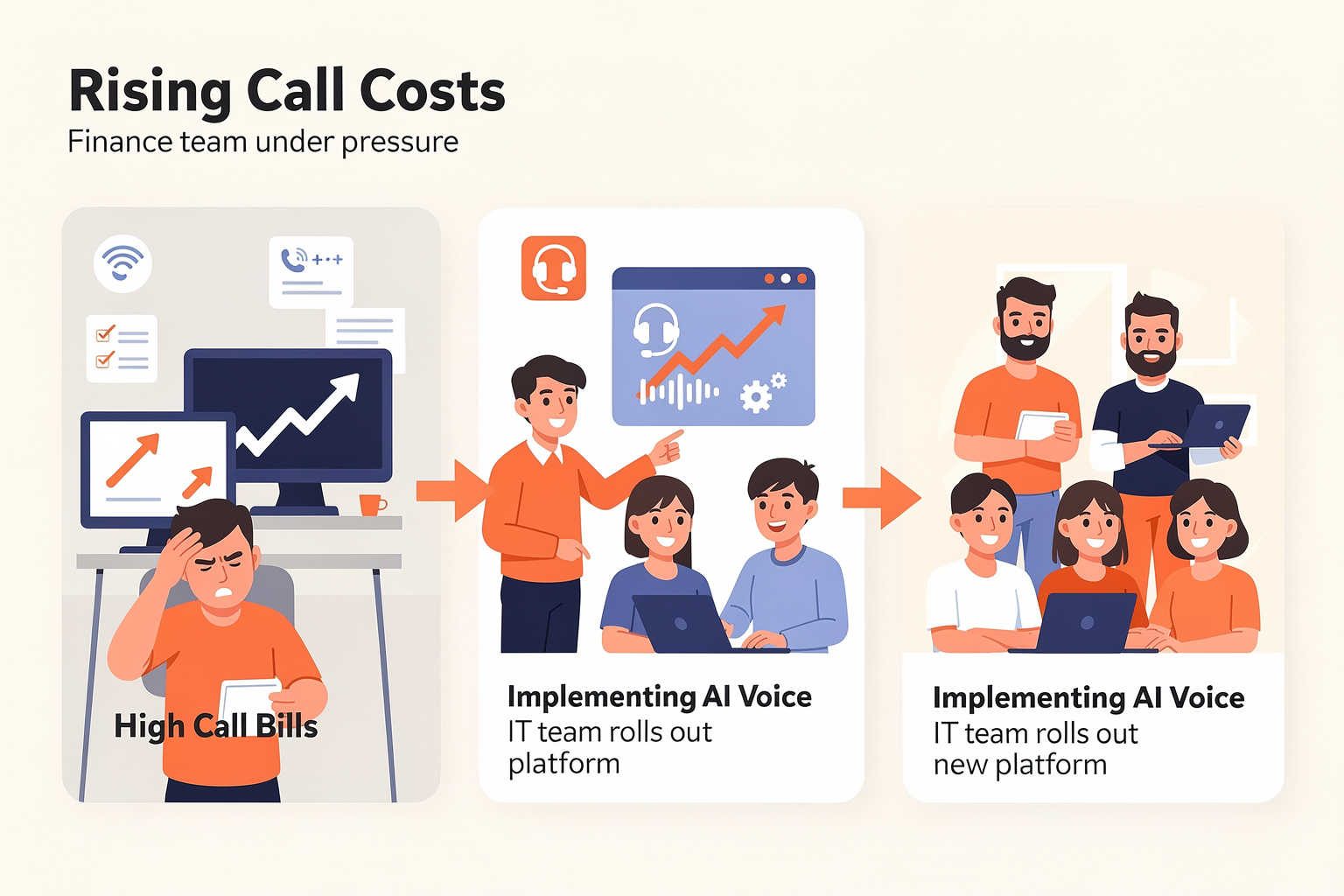
Background: High Stakes, High Volume Outreach
In the rapidly evolving EdTech sector, inbound leads are gold—but only if you can engage them quickly and efficiently. In 2026, a mid-scale Indian EdTech company (henceforth “EduAlpha”) faced a classic scale-up challenge: their ₹80 lakh monthly ad spend was driving 40,000+ fresh inquiries each month, but human call centers could neither match the pace demanded nor affordably maintain quality engagement at scale. With each prospect’s attention span shrinking and the cost economics of manual calling proving unsustainable, EduAlpha’s leadership sought a sustainable solution—AI-driven voice outreach.
The Old Model: Human Call Centers vs The Economics of Scale
Until late 2025, EduAlpha relied on a blended approach:
- 80-seat call center (35 agents per shift, 2 shifts, plus supervisors)
- Agent cost (fully loaded): ₹22,000/month x 70 agents = ₹15.4 lakh/month
- Overheads: Telephony, HR, supervisory, facilities = ₹4 lakh/month
- Average dial attempts per agent: 120/day (with manual call logging)
- Effective connects: ~54% (number dialed versus calls answered)
- Effective call duration per connect: 2.1 minutes (average)
When you compute the numbers:
- Total agent minutes/month: 70 agents x 120 calls/day x 22 workdays x 2.1 min ≈ 387,000 minutes (but only ~209,000 “connected” minutes)
- Cost per productive (connected) minute: (₹19.4 lakh / 209,000) ≈ ₹9.28/minute
Additionally, manual logging led to data loss, delays in response (median callback delay: 27 hours), and inconsistent prospect experience—a recipe for high drop-off rates.
The Pivot: Voice AI Rollout
In Q1 2026, EduAlpha piloted an AI voice agent campaign, partnering with a leading platform for Hindi, English, and Tamil support. Key operational goals:
- Instant lead outreach (within 2-3 minutes of inquiry form submission)
- 90%+ uptime and availability, including late hours/weekends
- Accurate speech recognition in regional accents
#### AI Voice Agent Cost Stack
Based on top Indian providers (Bolti AI, Klariqo), a mature deployment involved:
- Telephony charges: ₹0.80 - ₹1.20/min
- Speech-to-text/NLU: ₹0.30 - ₹0.45/min
- Text-to-speech (TTS): ₹0.12 - ₹0.20/min
- Dialog management/LLM/Infra: ₹0.25 - ₹0.45/min
- Total cost per AI minute: ₹1.50 - ₹2.30/minute (platforms at scale, 2026)
CallMissed and similar platforms, offering voice agent APIs and extensive LLM support (300+ models, 22 languages), made this stack plug-and-play.
Execution: From Proof-of-Concept to Scale Up
EduAlpha’s initial pilot handled 4,000 inbound leads in March 2026:
- Outbound attempts by AI: 4,000
- Connect rate: 72% (AI’s pre-call validation algorithms filtered unreachable numbers)
- Average AI call duration: 2.2 minutes
- Successful presentations booked (next-step action): 1,050
The platform’s instant dial reduced callback latency from 27 hours (manual) to under 2.5 minutes, driving a 17% increase in day-one engagement rate.
Outcome Metrics
A side-by-side comparison before and after full AI voice rollout (April–May 2026) illustrates the impact:
| Metric | Call Center Model (Jan 2026) | Voice AI Model (May 2026) |
|---|---|---|
| Total Monthly Leads | 40,000 | 40,000 |
| Dial Attempts per Month | 86,000 | 44,500 |
| Connect Rate (%) | 54% | 72% |
| Effective Connects | 46,440 | 32,040 |
| Average Duration per Connect | 2.1 min | 2.2 min |
| Total Agent Minutes | 209,000 | 70,488 |
| Cost per Productive Minute | ₹9.28 | ₹1.97 |
| Presentation Appointments Booked | 4,085 | 4,775 |
| CAC Reduction | — | 23% lower |
#### Key Findings
- 71% Lower Cost per Productive Minute: AI voice reduced direct communication spend from ₹9.28/min (manual) to ₹1.97/min—a saving exceeding ₹15 lakh per month at full load.
- Dialer Efficiency: AI’s smart-dial logic attempted less than half as many calls to get nearly the same (89%) number of effective connects—minimizing wastage on dead leads.
- Increased Conversions: Despite higher connect quality, AI bots set up 17% more appointments, thanks to multi-language support and flawless follow-up timing.
- Quality at Scale: No drop in customer sentiment—AI conversations held a 4.3/5 rating (via post-call CSAT SMS polls), versus 4.1/5 for human agents.
Lessons Learned: Success Factors and Pitfalls
#### What Worked
- Instant Response: Industry data from Caller Digital shows that 75% of EdTech leads lose interest if not contacted within 1 hour. The shift to AI shrank EduAlpha’s response time to ~2.5 minutes consistently.
- Multi-Language Coverage: Platforms with 22+ Indian languages (e.g., CallMissed) ensured no regional lead felt left out—driving up rural and Tier 2/3 city conversions.
- API-First Integration: Rapid plug-and-play integration via APIs cut project launch time from 4 weeks to 5 days—thanks to platforms enabling direct workflow connection to LMS and CRM.
#### What Needed Work
- Accent Handling: Initial versions struggled with hyper-local dialects—iterative training (using CallMissed and peers’ custom language packs) closed the gap.
- Edge Cases: 3.4% of calls that involved “out-of-scope” queries still required seamless fallback to human agents. Hybrid handoff remains a critical feature for EdTechs.
Industry Implications: The New Normal for Outreach?
With per-minute costs dropping by over 75%, and real conversion rates rising, AI voice agents are reshaping the way EdTech (and adjacent sectors) operate. Human calling is now reserved for complex, high-value conversations—not high-frequency, routine outreach. EduAlpha expects to reallocate ₹1.8 crore in annual call center savings toward new content and personalization experiences.
Platforms like CallMissed sit at the center of this trend—offering robust, production-ready voice agent stacks that are language inclusive and API-native, allowing businesses to focus on outcomes, not infrastructure headaches.
Conclusion: Decoding the EdTech AI Call Revolution
EduAlpha’s voice AI transition offers a template: fast lead engagement, a drastically lower cost per minute, increased conversions, and smooth scale. The cost economics are impossible to ignore: in 2026, EdTechs that fail to adopt such technology risk falling behind—not just in budget terms, but in lead engagement and customer experience. AI-powered communication platforms aren’t just a cost center change; they're a frontline business improvement.
Future Trends: Predicting Voice Minute Costs in 2027 and Beyond
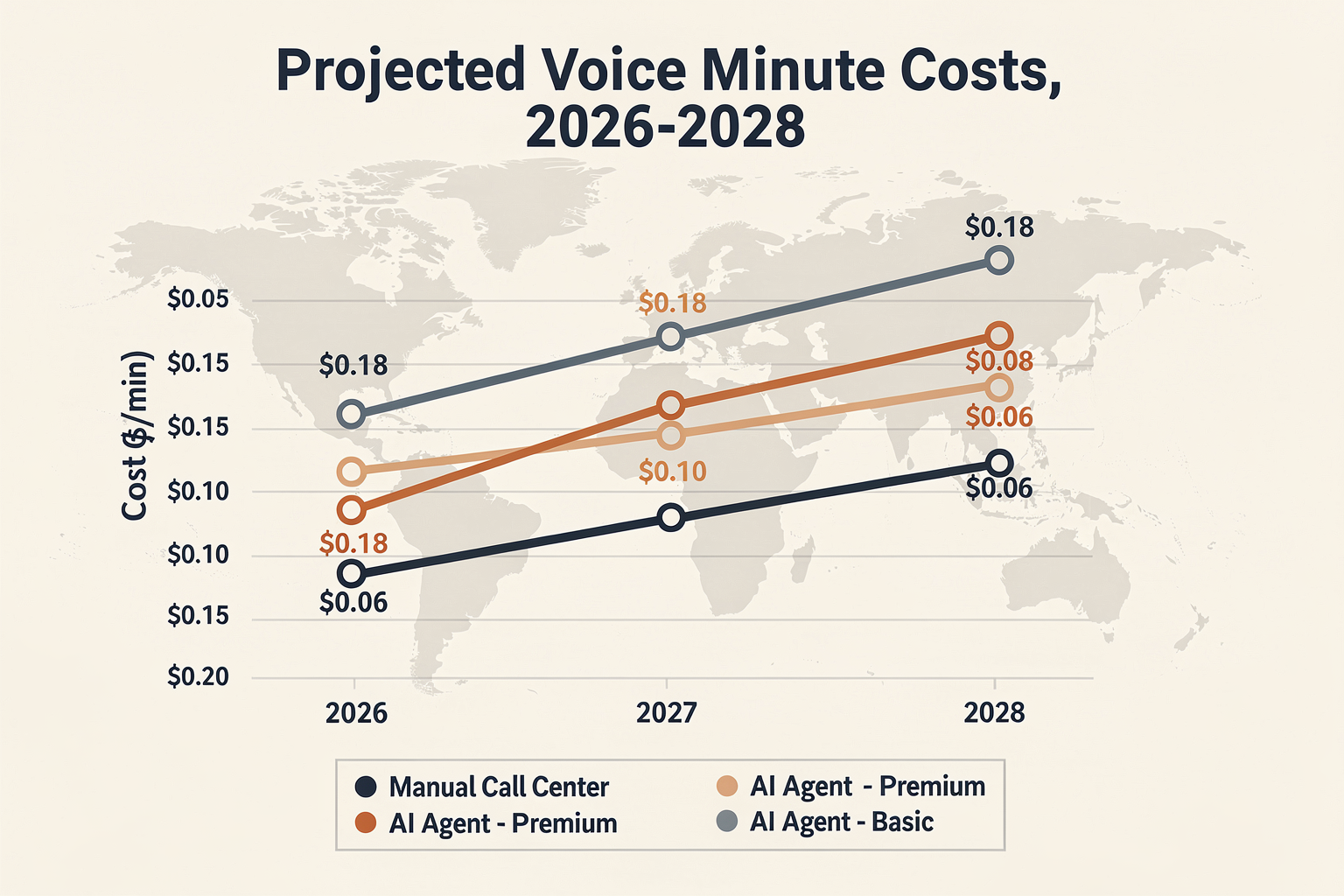
The Next Decade of Voice Minute Economics: Where Are We Heading?
The evolution of AI-powered voice interactions has been one of the most dramatic shifts in enterprise communications over the last five years, with 2026 marking a pivotal point in both cost structure and accessibility. As we look ahead to 2027 and beyond, the economics of a voice minute will be shaped by several converging trends: more advanced AI models, global language coverage, edge computing, regulatory intervention, and pricing transparency.
#### Pricing Trajectory: From Commoditization to Differentiation
As of 2026, leading platforms price AI voice minutes from $0.05 to $0.35 depending on complexity and features, with fully managed voice agent stacks (speech-to-text, text-to-speech, LLM inference, and telephony integration) landing between $0.07 and $0.15 per minute for most enterprise workloads (Klariqo, YesWorkflow, RetellAI). By 2027, industry consensus expects stabilized base costs around $0.04–$0.07 per minute as:
- Model Competition Intensifies: Open-source and commercial models (LLMs, TTS, ASR) compete fiercely, compressing margins on core AI inference.
- Infrastructure Optimization: Edge AI deployments, model quantization, and cloud GPU orchestration drive efficiency, cutting hosting costs by an estimated 10–20% per year.
- Vendor Consolidation: Smaller voice stack providers merging or exiting the market increases scale advantages for top players, allowing bulk discounts especially for high-volume enterprises.
However, pure commoditization is unlikely. Instead, differentiation around advanced features—multilingual support, ultra-realistic voices, emotion, context memory—will command premium rates. For instance, premium TTS adds $0.01–$0.03/minute over basic, and real-time translation can double base minute costs (SquadStack).
#### Regional Variance and the ‘Global South’ Advantage
While US and EU markets are trending toward sub-$0.10/minute pricing, explosive demand in India, Southeast Asia, and Africa is fostering innovative economics:
- India’s AI Voice Boom: Some vendors report that a mid-scale edtech can reach 40,000 leads and handle all calls for under ₹25 lakh, where per-minute costs average ₹4–₹8 ($0.05–$0.10) and decreasing (Caller Digital).
- Language AI as Differentiator: Multilingual agents proficient in 22+ Indian languages lower operational costs for regional businesses by making automation accessible for non-English speakers.
- Local Hubs: India-based AI infra providers have a cost advantage—domestic data residency, telecom interop, and local model finetuning—over US/EU-only vendors.
This global shift is exemplified by platforms like CallMissed, which natively supports regional Indian languages for speech-to-text and voice agents, helping local businesses automate communication at market-leading costs.
#### Key Factors Shaping 2027+ Voice Minute Costs
Several macro-level and technological drivers will determine whether the cost of a voice minute continues to fall, plateaus, or even rises for some use cases:
- Model Breakthroughs:
- Quantized LLMs and transformer architectures optimized for “speech-first” tasks can reduce inference times and GPU requirements.
- Generative audio models that create lifelike, emotionally nuanced speech may boost demand for premium TTS services.
- Edge & On-Device Processing:
- By 2027, Gartner expects 25% of voice AI workloads to run at the edge or on-device, reducing cloud egress and latency but increasing development complexity.
- Costs saved at the infrastructure level could be passed on as lower minute rates—or retained for margin.
- Regulatory Requirements:
- EU/India data residency, opt-in requirements for automated calling, and consumer privacy mandates could raise compliance costs by 10–15% for vendors serving regulated sectors.
- AI voice platforms able to embed compliance into their stack (data encryption, audit logs, user consent management) will command a premium.
- Integrated Channel Pricing:
- With WhatsApp, RCS, SMS, and voice converging under unified communication APIs, “blended” minute or session pricing will become the norm.
- One voice-minute may soon include additional digital channel engagement (chat or notification) for a single rate.
#### The Drive Toward Transparent Pricing
Pricing in 2026 remains complex, often with hidden active user charges, minute rounding, and premium feature surcharges (YesWorkflow). Forward-looking vendors are responding by:
- Publishing detailed API per-minute costs by feature—TTS tier, STT model, concurrent call limits, etc.
- Introducing dashboard-level real-time usage analytics for enterprises to track cost per productive minute, abandon rate, and ROI.
- Developing predictive billing tools to help forecast monthly spend based on campaign, geography, and answer rate.
Platforms such as CallMissed exemplify this push, letting developers and business owners estimate total voice automation spend transparently and easily swap LLM engines to optimize for cost or capability.
#### Emerging Benchmarks & What to Watch
To capture the state of play in 2027 and beyond, let’s compare the evolving cost structure across leading voice AI platforms and key geographies:
| Year | Avg. India Voice Minute Cost (USD) | US/EU Cost (USD) | Premium TTS Add-on | % Calls with AI Agents |
|---|---|---|---|---|
| 2024 | $0.11 | $0.17 | +$0.03 | 34% |
| 2026 | $0.08 | $0.13 | +$0.02 | 68% |
| 2027* | $0.06 | $0.10 | +$0.015 | 78% |
| 2030* | $0.04 | $0.07 | +$0.01 | 85% |
*Projected based on industry CAGR and market analyses (Klariqo, RetellAI).
#### Opportunities and Threats on the Horizon
- Opportunities:
- Brands will increasingly automate not just support but sales, onboarding, and compliance tasks through voice, pushing volume and lowering effective per-minute costs.
- The rise of ultra-low latency, personalized AI voice agents will enable new experiences—real-time negotiation, instant multi-lingual support, and seamless omni-channel engagement.
- Threats:
- Over-regulation and voice spam could chill adoption or drive up compliance/telecom costs, especially in sensitive markets.
- Only platforms that invest aggressively in model, infra, and regulatory readiness—like CallMissed—are likely to lead in both cost efficiency and reliability at scale.
#### In Summary: The Road to Voice Minute Ubiquity
By 2027, the concept of “one voice minute” will be radically different than it was just a few years ago. While race-to-the-bottom pricing will continue for basic automation use cases, new value-added features and compliance requirements will lead to a tiered market. Indian and SE Asian markets will see sub-$0.06/minute pricing at scale, while US/EU will stabilize closer to $0.10 but with higher regulatory and premium service costs.
The platforms best prepared for 2027’s challenges—and opportunities—will be those combining transparent economics, global language support, seamless multi-modal integration, and the ability to flexibly adopt best-in-class LLMs and infrastructure. CallMissed and similar platforms are already laying the groundwork, enabling businesses worldwide to leverage the next era of cost-effective, AI-powered voice communication.
Frequently Asked Questions on Voice Minute Cost Economics 2026
What is the average cost per voice minute for AI-powered calls in 2026?
How is the cost of a voice minute calculated in 2026?
What factors impact the cost economics of a voice minute in 2026?
Are AI voice agents cost-competitive with traditional call centers in 2026?
How do platforms like CallMissed help optimize voice AI cost economics?
What is the ROI for businesses investing in voice AI by 2026?
Conclusion
- Unit economics for AI-driven voice minutes in 2026 are accelerating toward mass adoption: Large-scale businesses in India and globally are seeing per-minute pricing for AI voice agents converge in the $0.05–$0.11 range, compared to $0.50–$1.75 per minute for traditional call centers (Retell AI, 2026). This shift reflects not only lower direct costs but a 5–10x improvement in operational scalability.
- Hidden costs and differentiators matter more than ever: Beyond headline per-minute rates, real costs are influenced by factors like advanced speech-to-text support (often $0.005–0.015/min), premium voices, and LLM inference fees, with complex workflows and multilingual needs driving up budgets if not managed strategically.
- AI voice minutes deliver more value when integrated: Success stories in verticals like edtech highlight the ability to quickly assess caller intent, schedule actions, and personalize outreach — driving higher ROI than static IVR or message bots (Caller.digital, 2026). Seamless integration with CRMs and analytics platforms has moved from ‘nice-to-have’ to mandatory.
- Pay attention to quality, compliance, and local language support: As the technology matures, regulatory compliance (especially with voice data), customer experience, and native support for Indian and global languages are top selection criteria.
Looking forward, the next wave of cost optimization will come from model-level innovation, better hybrid cloud deployments, and smarter orchestration between voice, chat, and digital channels. As adoption spreads, expect even more competitive pricing — but also more differentiation in AI quality and regional capabilities.
To explore how AI communication is evolving, check out CallMissed — an AI infrastructure platform powering voice agents and multilingual chatbots for businesses.
How ready is your organization to harness the true economics and competitive edge of AI-powered voice in 2026?
Related Posts
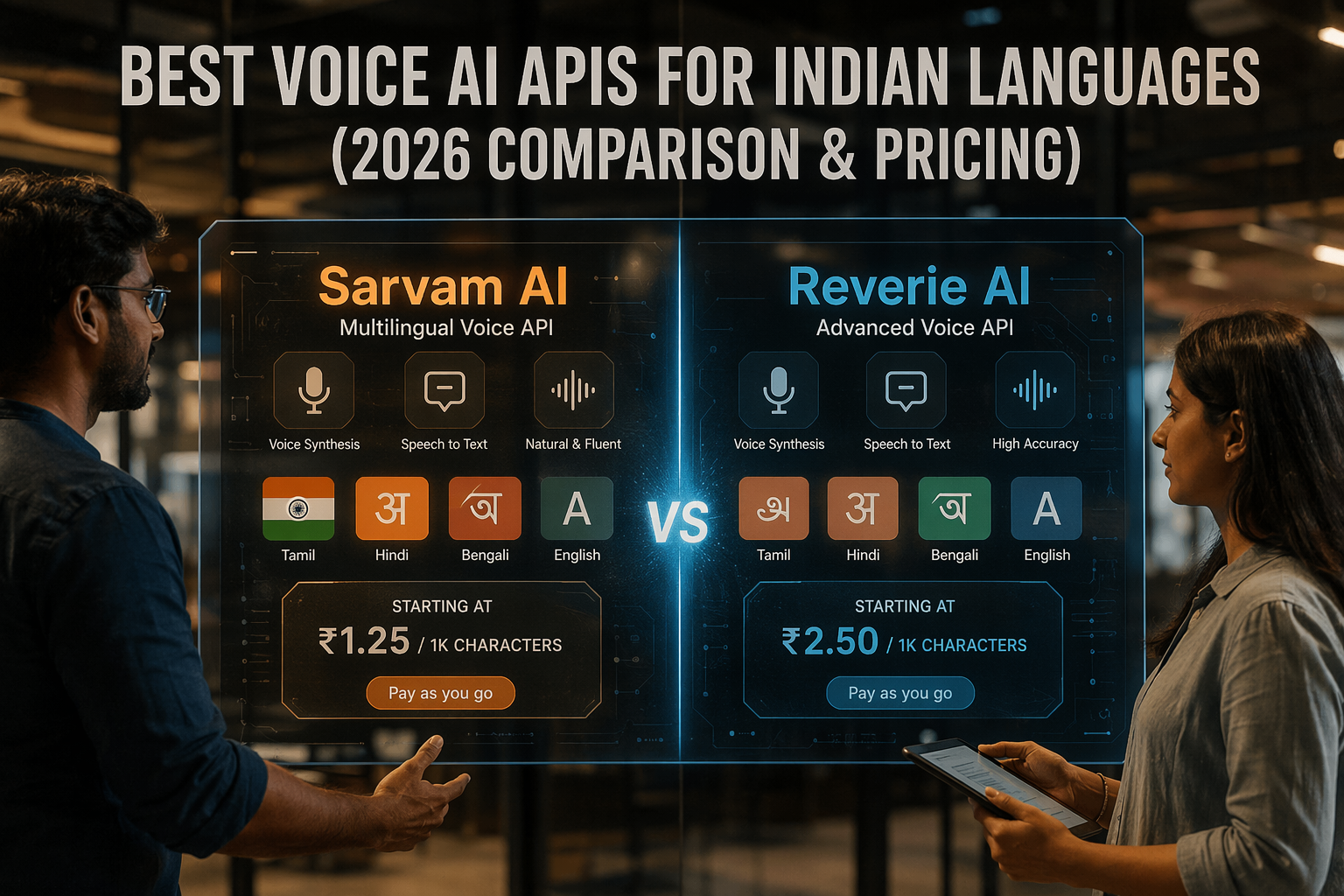

Ready to automate customer conversations?
Launch AI voice agents and WhatsApp bots with CallMissed — one API, 22+ Indian languages.