

Sovereign Voice AI at Scale: Inside Gnani.ai’s Inya VoiceOS and Prisma v2.5 Models



What if the next major AI breakthrough in India doesn’t start with text prompts—but with millions of real-time phone conversations in Hindi, Kannada,...
Sovereign Voice AI at Scale: Inside Gnani.ai’s Inya VoiceOS and Prisma v2.5 Models
What if the next major AI breakthrough in India doesn’t start with text prompts—but with millions of real-time phone conversations in Hindi, Kannada, Tamil, Bengali, and other Indic languages?
That is the promise behind Sovereign Voice AI at Scale, and it is why Gnani.ai’s latest model stack is drawing attention across enterprise AI, BFSI, and public-sector digital infrastructure. In early 2026, Bengaluru-based deep-tech startup Gnani.ai raised $10 million in Series B funding led by Aavishkaar Capital, with participation from Info Edge Ventures, to accelerate global expansion, deep-tech R&D, and the development of sovereign AI voice agents. The timing matters: Indian enterprises are no longer experimenting with voice bots for basic IVR deflection—they are looking for secure, compliant, multilingual AI systems capable of handling high-volume, high-stakes customer interactions.
Gnani.ai’s answer is Inya VoiceOS, described as India’s first 5-billion-parameter voice-to-voice foundational model, developed under the IndiaAI Mission. Alongside it, the company has introduced Prisma v2.5, reinforcing its focus on proprietary, low-latency speech and language models designed for enterprise-scale deployments. According to Gnani.ai’s own enterprise voice agent positioning, its systems support 12+ Indic languages, can reduce operational expenditure by up to 60%, and are built for millions of concurrent calls with sub-second latency. The new model stack pushes that further with reported processing capacity of 10 million to 30 million calls per day and sub-200ms latency targets.
For BFSI, telecom, healthcare, and government services, this is not just a performance upgrade—it is a sovereignty issue. Voice AI systems must understand regional speech patterns, protect sensitive customer data, comply with local regulations, and operate reliably at national scale. CallMissed’s coverage of India’s vernacular voice AI market highlights the same shift: platforms building multilingual AI agents and voice infrastructure are becoming critical to secure, always-on customer engagement.
In this article, we’ll unpack how Inya VoiceOS and Prisma v2.5 work, why Gnani.ai’s model-agnostic architecture matters, how sovereign deployments differ from generic cloud AI, and what these breakthroughs mean for the future of Indian BFSI and enterprise voice automation.
Introduction

Why voice—not text—is India’s real AI frontier
India’s next leap in artificial intelligence may not be defined by a chatbot typing polished English responses. It may be defined by whether an AI agent can understand a farmer speaking Kannada, a bank customer switching between Hindi and English, or a policyholder explaining a claim in Tamil—all in real time, over a phone call.
That is the context behind Gnani.ai’s Inya VoiceOS and Prisma v2.5, two model announcements that signal a larger shift in India’s AI ecosystem: from generic cloud-hosted language models to sovereign, multilingual, voice-first AI infrastructure. For a country where customer service, financial inclusion, healthcare access, and government support still depend heavily on voice conversations, the ability to process speech accurately, securely, and at scale is not a convenience feature—it is critical infrastructure.
In early 2026, Bengaluru-based deep-tech company Gnani.ai raised $10 million in Series B funding, led by Aavishkaar Capital with participation from Info Edge Ventures. The funding is aimed at global expansion, deep-tech R&D, and the development of sovereign AI voice agents. The timing is important: Indian enterprises are moving beyond basic IVR bots and scripted call automation toward AI systems that can reason, respond, authenticate, and resolve customer queries across regional languages.
The breakthrough: Inya VoiceOS and Prisma v2.5
At the center of this shift is Inya VoiceOS, described as India’s first 5-billion-parameter voice-to-voice foundational model, developed under the IndiaAI Mission. Unlike text-first models adapted for speech, a voice-to-voice model is designed to handle the full conversational pipeline—speech understanding, intent detection, response generation, and spoken output—with lower latency and better contextual awareness.
Alongside Inya, Gnani.ai has introduced Prisma v2.5, part of its proprietary speech and language model stack. According to Gnani.ai’s enterprise positioning, its AI voice agents are fluent in 12+ Indic languages, can reduce operational expenditure by up to 60%, and support millions of concurrent calls with sub-second latency. The latest model stack pushes that ambition further, targeting 10 million to 30 million calls per day with sub-200ms latency—performance levels that matter in high-volume sectors such as banking, telecom, insurance, healthcare, and public services.
Why sovereign voice AI matters
For Indian enterprises, especially in BFSI, voice AI is not just about automation. It raises deeper questions:
- Where is sensitive customer data processed?
- Can the model understand regional accents and code-switching?
- Does the system comply with local security and regulatory expectations?
- Can it operate reliably during peak call volumes?
- Can it reduce costs without degrading customer experience?
These are the problems sovereign AI is designed to solve. Instead of relying entirely on foreign-hosted, general-purpose models, sovereign deployments prioritize local language performance, data residency, compliance, and enterprise control.
Gnani.ai’s own case studies show why this matters in practice. In one reported deployment, Bank of Baroda used Gnani.ai’s Armour365 to reduce authentication time by 50 seconds per call, achieving 15% cost savings and a 24% improvement in CSAT. Those are not abstract AI benchmarks—they are operational outcomes tied directly to call center efficiency and customer trust.
A broader market shift
CallMissed’s coverage of India’s vernacular voice AI opportunity points to the same trend: the future of customer engagement in India will be multilingual, voice-led, and always available. Platforms such as CallMissed, which provide AI voice agents, WhatsApp chatbots, speech-to-text for 22 Indian languages, text-to-speech APIs, and access to 300+ LLMs, reflect how the market is moving toward production-ready communication infrastructure rather than isolated AI demos.
In this article, we will unpack how Inya VoiceOS and Prisma v2.5 work, why Gnani.ai’s model-agnostic architecture matters, and how sovereign voice AI could reshape enterprise automation across India’s most language-diverse and compliance-sensitive industries.
Background & Context
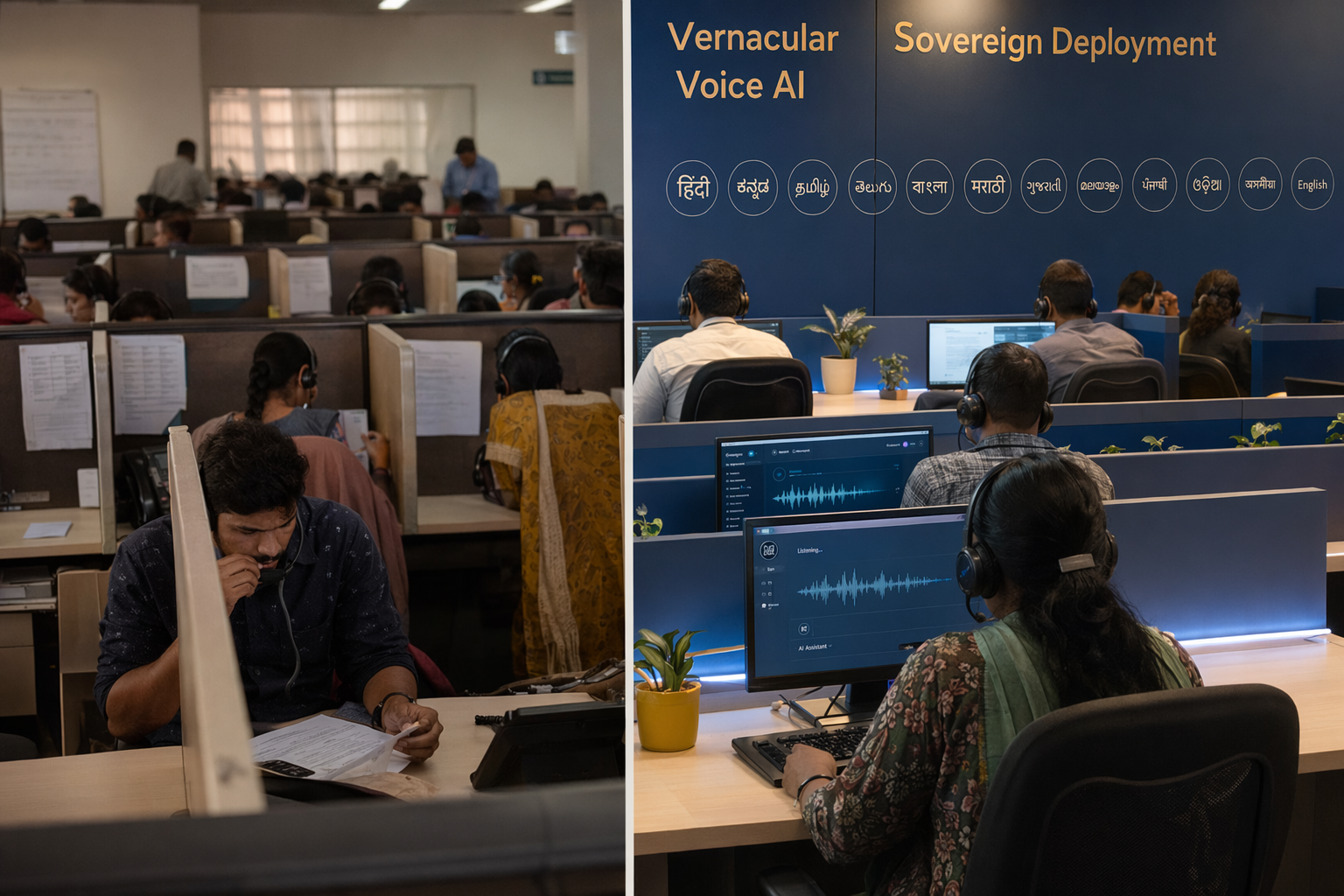
From call centers to sovereign AI infrastructure
For years, enterprise voice automation in India was treated as a contact-center efficiency project: replace repetitive IVR flows, reduce queue times, and automate basic FAQs. That framing is now too narrow. In sectors such as banking, insurance, telecom, healthcare, and government services, voice AI is becoming part of national-scale digital infrastructure—where latency, data residency, language coverage, authentication, and regulatory control matter as much as model accuracy.
This is the background against which Gnani.ai has positioned itself as a frontier Voice AI company building proprietary speech and language models for enterprise deployments. Its public enterprise voice-agent materials emphasize three metrics that explain why the market is paying attention:
- 12+ Indic languages supported for multilingual customer conversations
- Up to 60% OpEx reduction through process automation
- Millions of concurrent calls with sub-second latency
Those are not cosmetic improvements. In India, where customer journeys often begin on a phone call rather than an app, the ability to understand regional accents, code-switching, and domain-specific terminology can determine whether AI is usable at all.
Why BFSI became the proving ground
Indian BFSI has emerged as one of the most demanding environments for voice AI because the stakes are unusually high. A bank or insurer does not simply need a bot that can “talk.” It needs systems that can authenticate users, handle sensitive financial information, maintain auditability, and operate under strict compliance expectations.
Gnani.ai’s own case-study data illustrates this shift from experimentation to measurable enterprise impact. In a Bank of Baroda deployment using Armour365, Gnani.ai reported that voice authentication helped:
- Reduce authentication time by 50 seconds per call
- Save 15% in cost
- Improve customer satisfaction by 24%
These numbers explain why BFSI is central to the sovereign voice AI conversation. A 50-second reduction per call becomes a major operating advantage when multiplied across millions of customer interactions. But the more strategic point is trust: voice AI in banking must be secure enough to support identity verification, grievance handling, collections, onboarding, and service requests without exposing sensitive data to uncontrolled systems.
CallMissed’s own coverage of the vernacular voice opportunity in Indian BFSI highlights the same pattern: companies like Gnani.ai are showing that a voice agent can speak in Kannada, Hindi, Tamil, or other regional languages while still meeting enterprise-grade requirements for security and scale.
The sovereignty layer: more than “made in India”
The phrase sovereign AI is sometimes reduced to geography, but in voice systems it has a broader meaning. It involves control across the full communication stack:
- Language sovereignty — models trained and optimized for Indian languages, dialects, and speech patterns
- Data sovereignty — sensitive customer voice and transcript data governed under local compliance expectations
- Operational sovereignty — the ability to run high-volume infrastructure reliably without depending entirely on external black-box models
- Cost sovereignty — routing tasks to the right model size instead of using expensive frontier LLMs for every interaction
This is where Gnani.ai’s 2026 developments become important. The company’s $10 million Series B funding, led by Aavishkaar Capital with participation from Info Edge Ventures, was aimed at global expansion, deep-tech R&D, and sovereign AI voice-agent development. That funding context matters because building production voice AI is capital-intensive: it requires speech datasets, real-time inference infrastructure, telephony integration, safety layers, monitoring, and continuous language tuning.
The road to Inya VoiceOS and Prisma v2.5
Before Inya VoiceOS, Gnani.ai had already been building around proprietary voice models, including the Gnani Prisma v2 model stack referenced in its public materials. The 2026 launch of Inya VoiceOS, described as India’s first 5-billion-parameter voice-to-voice foundational model under the IndiaAI Mission, represents a move from point solutions toward a deeper platform layer.
At the same time, Prisma v2.5 signals a practical enterprise priority: not every call needs the largest model. The emerging architecture is model-agnostic, allowing enterprises to balance cost, latency, and intelligence by routing simpler tasks to lightweight in-house models and more complex tasks to larger models when needed.
That context is essential before examining the technology itself: India’s voice AI race is no longer just about who builds the smartest bot—it is about who can run sovereign, multilingual, real-time AI conversations at national scale.
Key Developments (TABLE)
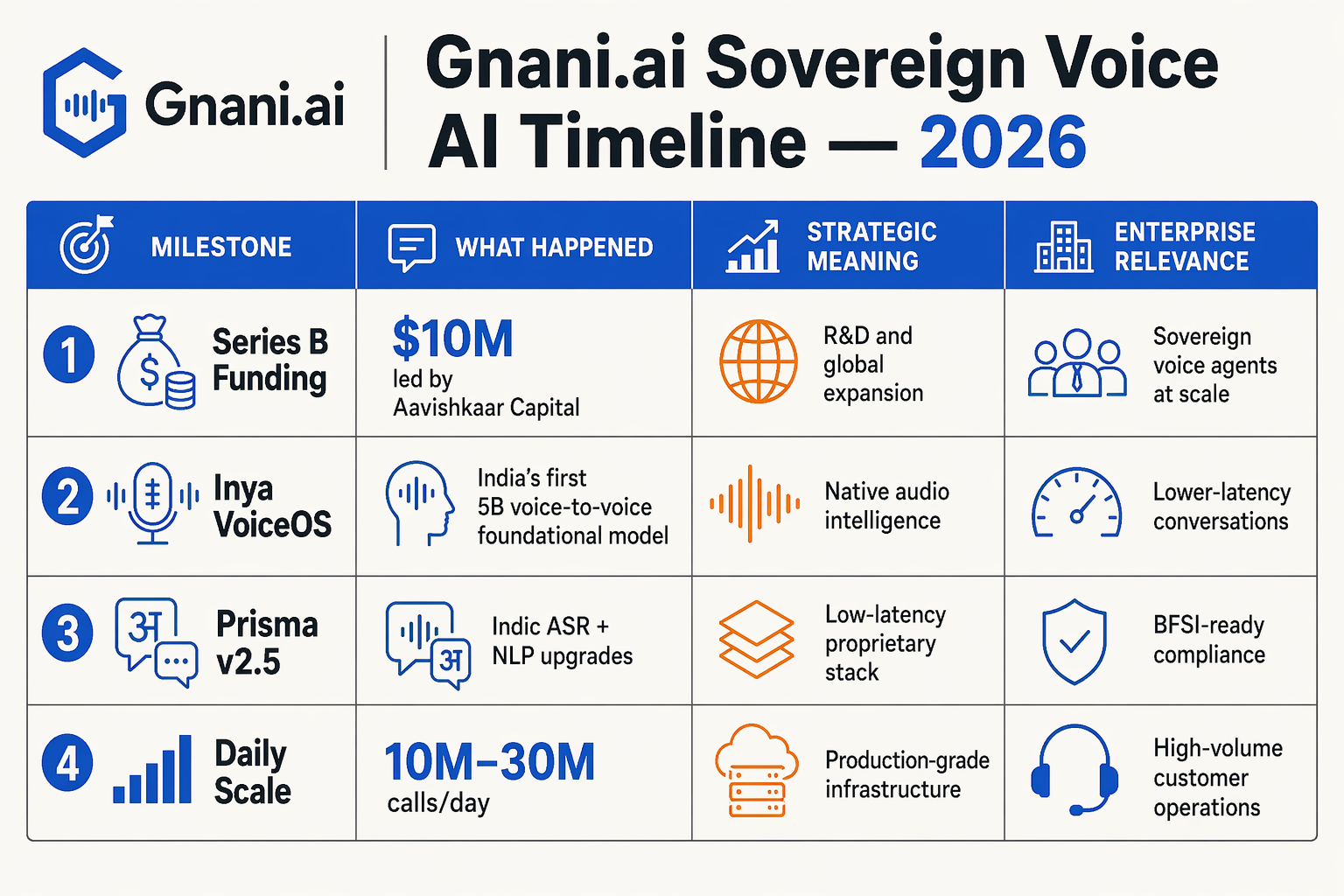
From funding to production-scale sovereign Voice AI
The key story is not just that Gnani.ai announced new models—it is that the company is aligning capital, architecture, latency, language coverage, and enterprise deployment into one sovereign voice AI stack. In early 2026, Gnani.ai raised $10 million in Series B funding led by Aavishkaar Capital, with participation from Info Edge Ventures, specifically to accelerate global expansion, deep-tech R&D, and sovereign AI voice agents. That funding sits behind two major technical releases: Inya VoiceOS and Prisma v2.5.
| Development | What changed | Reported scale / spec | Enterprise relevance |
|---|---|---|---|
| Series B funding | Gnani.ai secured fresh capital led by Aavishkaar Capital, with Info Edge Ventures participating | $10 million, announced in early 2026 | Funds sovereign voice AI R&D, global expansion, and production deployments |
| Inya VoiceOS | Introduced as India’s first 5B voice-to-voice foundational model | 5-billion-parameter model, developed under the IndiaAI Mission | Enables native speech-to-speech automation instead of stitching together separate ASR, LLM, and TTS layers |
| Prisma v2.5 | Expanded Gnani.ai’s proprietary low-latency speech and language model stack | Designed for 10M–30M calls/day with sub-200ms latency targets | Supports high-volume sectors such as BFSI, telecom, healthcare, and public services |
| Indic language reach | Enterprise voice agents built for vernacular conversations | 12+ Indic languages, according to Gnani.ai’s AI voice agent positioning | Critical for customers who do not prefer English-first digital interfaces |
| Operational efficiency | Automation of customer support, verification, collections, and service workflows | Gnani.ai cites up to 60% OpEx reduction | Makes voice AI viable beyond pilots by tying deployment to measurable cost savings |
| Voice authentication use case | Armour365 deployment at Bank of Baroda showed measurable impact | 50 seconds less authentication time per call, 15% cost savings, 24% CSAT improvement | Demonstrates that sovereign voice AI is moving from demos into regulated BFSI workflows |
Why these developments matter together
Individually, each milestone is notable. Together, they point to a more mature phase of India’s voice AI market. A 5B voice-to-voice model is not simply a larger chatbot; it suggests an architecture optimized for spoken interaction, where latency, turn-taking, accents, interruptions, and emotional tone matter as much as semantic accuracy.
That distinction is especially important in India, where enterprise voice automation must handle:
- Code-switching between Hindi, English, and regional languages
- Noisy call environments and varied mobile network quality
- Domain-specific terminology in banking, insurance, telecom, and healthcare
- Compliance-sensitive workflows, including authentication and customer verification
- Massive concurrency, where even small latency increases affect millions of calls
The reported sub-200ms latency target is therefore not a vanity benchmark. In a live phone call, delays above a few hundred milliseconds can make an AI agent feel unnatural, interruptive, or unreliable. For BFSI and telecom contact centers handling millions of monthly interactions, this directly affects containment rates, escalation volumes, and customer satisfaction.
The model-agnostic advantage
One of the more strategic developments is Inya’s model-agnostic direction. Instead of forcing every task through one large model, enterprises can route workloads between Gnani.ai’s lightweight proprietary models and larger external models depending on cost, speed, accuracy, and task complexity. That is a practical design choice for real deployments: a balance-check call, a KYC prompt, and an insurance grievance should not all require the same compute profile.
This mirrors a broader infrastructure trend also visible in platforms like CallMissed, where businesses increasingly need flexible AI communication layers—voice agents, multilingual speech APIs, WhatsApp automation, and access to multiple LLMs—without rebuilding workflows for every model upgrade.
The takeaway: Gnani.ai’s 2026 announcements are not isolated product launches. They represent a shift toward sovereign, multilingual, low-latency voice infrastructure built for India-scale enterprise communication.
In-Depth Analysis: How Inya VoiceOS Changes Voice AI Architecture
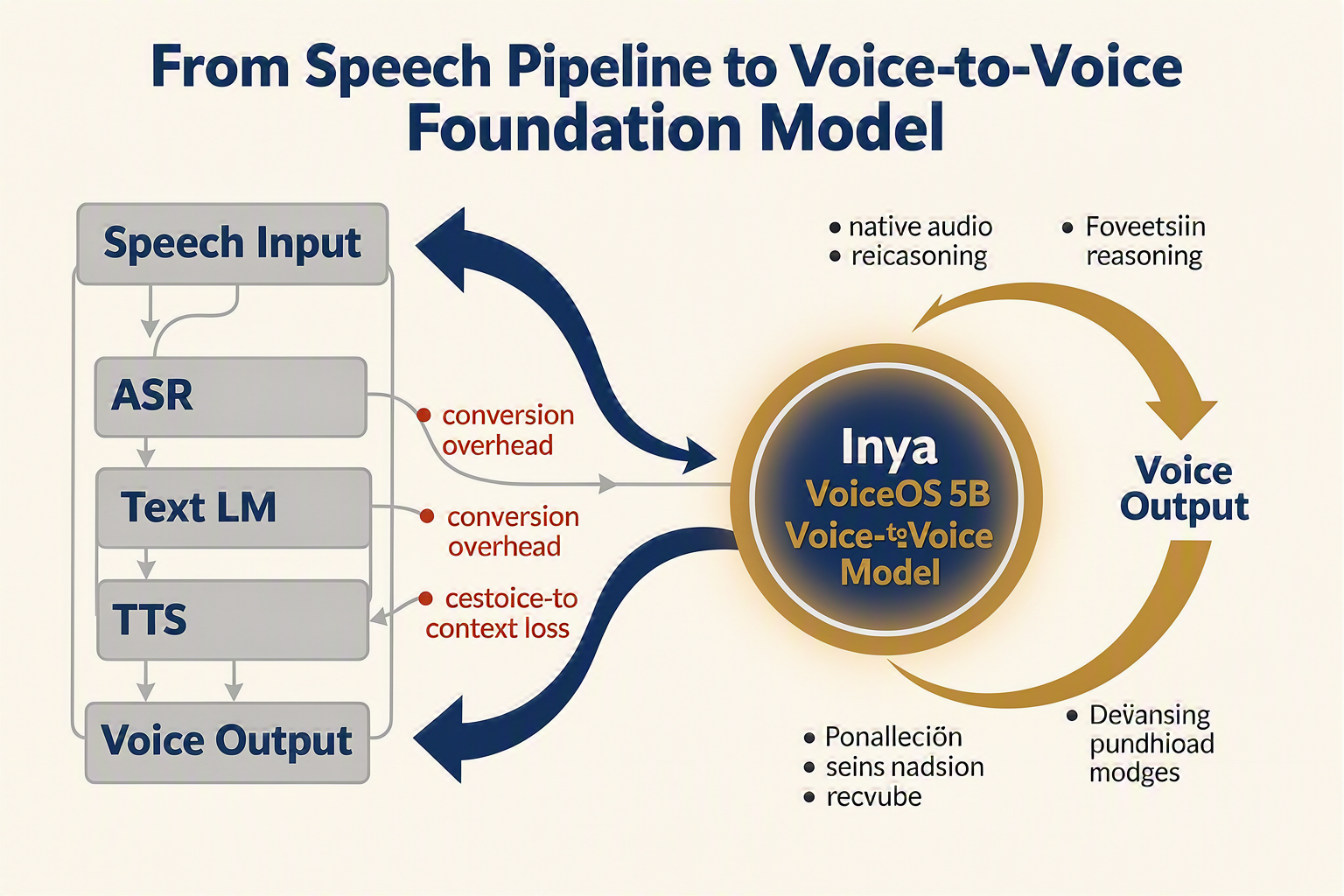
From stitched pipelines to a voice-native operating layer
Traditional enterprise voice bots are usually built as a chain of separate systems: speech-to-text, intent detection, dialogue management, LLM response generation, text-to-speech, and telephony routing. Each handoff adds latency, cost, failure points, and language loss—especially when a caller mixes Hindi with English or uses regional banking vocabulary.
Inya VoiceOS changes that architecture by treating voice as the primary interface, not an afterthought. As India’s first reported 5-billion-parameter voice-to-voice foundational model, developed under the IndiaAI Mission, Inya is designed to reason directly across spoken inputs and spoken outputs. That matters because real phone conversations are messy: people interrupt, change intent mid-sentence, use non-standard grammar, and speak with local accents.
Instead of simply “transcribing first and thinking later,” a voice-native stack can optimize for:
- Turn-taking: knowing when the caller has finished speaking
- Low-latency response: keeping conversations natural under tight timing constraints
- Prosody and emotion: detecting hesitation, urgency, frustration, or confidence
- Code-switching: handling mixed-language speech common in Indian customer service
- Task completion: driving outcomes such as authentication, collections, claims, or service requests
This is why Gnani.ai’s positioning around millions of concurrent calls with sub-second latency is architecturally important. Voice AI at BFSI scale cannot behave like a demo chatbot—it must sustain call-center-grade throughput.
The model-agnostic layer is the real enterprise unlock
One of the most important design ideas behind Inya VoiceOS is its model-agnostic architecture. Rather than forcing every call through one large model, the platform can route work between Gnani’s lightweight proprietary models and larger external models depending on complexity, cost, privacy, and latency requirements.
A practical routing pattern may look like this:
- Lightweight in-house model handles common intents: balance inquiry, EMI reminder, policy renewal, appointment confirmation.
- Specialized speech model manages accent, language, and noisy audio conditions.
- Larger reasoning model is invoked only when the conversation requires complex explanation, escalation, or document-aware reasoning.
- Policy and compliance layer enforces what the agent can say, store, or trigger.
- Voice synthesis layer replies in the caller’s preferred language with natural cadence.
This approach matters because enterprise voice economics are brutal. If every call depends on a large frontier model, costs rise quickly and latency becomes harder to control. Gnani.ai’s reported 10 million to 30 million calls per day capacity and sub-200ms latency targets suggest an architecture optimized for selective model use—not brute-force inference.
Platforms such as CallMissed are moving in the same direction from an infrastructure perspective, offering voice agents, WhatsApp bots, LLM inference across 300+ models, and speech APIs for Indian languages. The broader trend is clear: enterprises want orchestration layers that let them choose the right model for the right interaction without rebuilding the entire stack.
Why this architecture fits sovereign AI
For regulated sectors, architecture is not just a technical decision—it is a compliance boundary. Indian BFSI, telecom, healthcare, and public-sector deployments need control over data residency, auditability, authentication, consent, and language localization.
Gnani.ai’s enterprise voice agent page highlights agents fluent in 12+ Indic languages, potential OpEx reduction of up to 60%, and large-scale concurrency. Its case-study data shows the operational value: Bank of Baroda implemented Armour365, reducing authentication time by 50 seconds per call, saving 15% cost, and improving CSAT by 24%.
That is the architectural promise of Inya VoiceOS: not just better speech recognition, but a sovereign voice layer where latency, compliance, localization, and automation are designed together. In a market where CallMissed notes that vernacular agents can “speak in Kannada” and support real customer workflows, Inya’s deeper shift is making Indian-language voice AI foundational rather than peripheral.
Prisma v2.5 and the Sovereign Model Stack
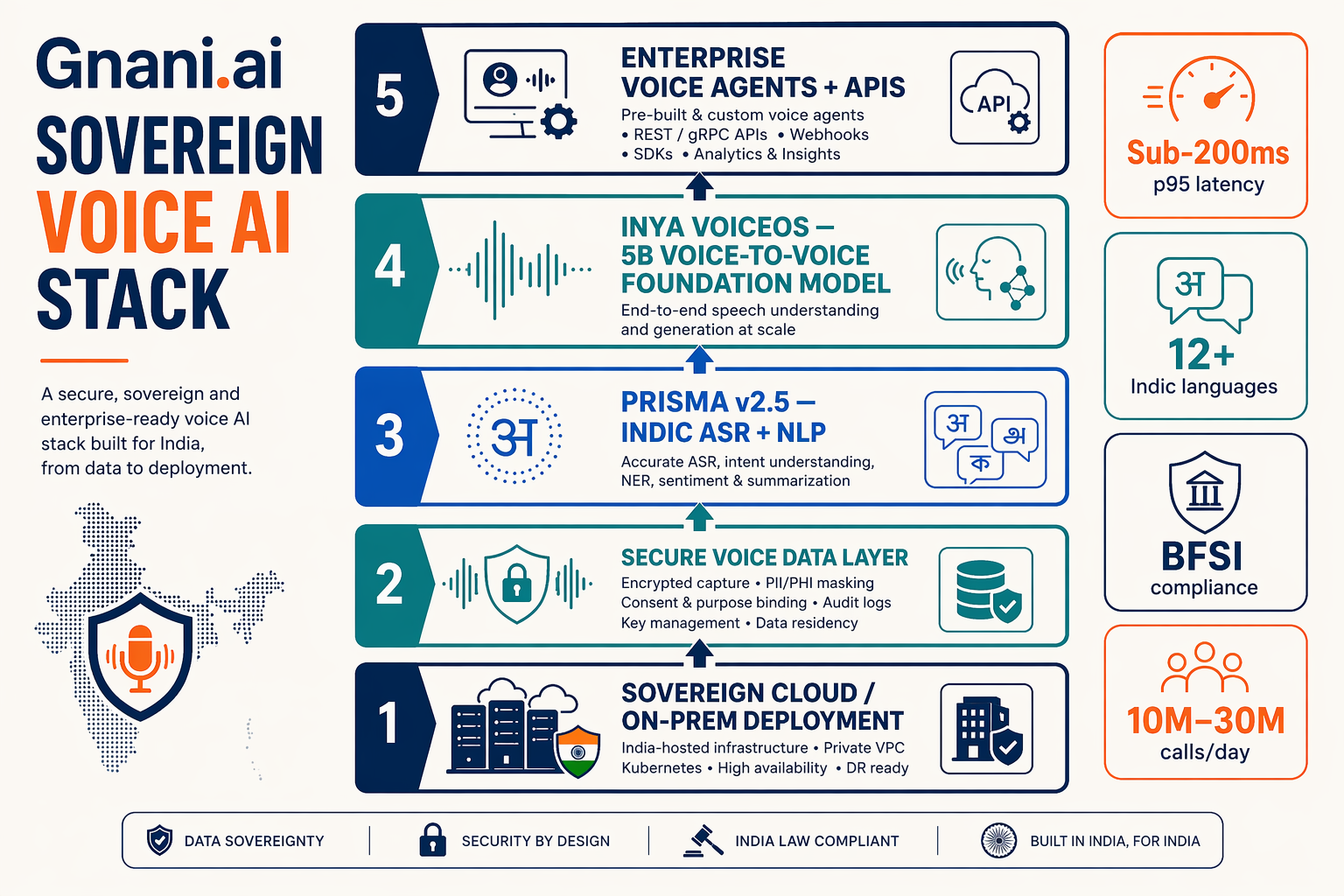
From “voice bot” to sovereign model stack
Prisma v2.5 is important because it reframes enterprise voice AI as a full-stack model problem, not just a conversational interface problem. In traditional deployments, a call center voice bot often depends on separate vendors for speech recognition, natural language understanding, dialogue management, text-to-speech, analytics, and compliance logging. That architecture works for pilots—but it becomes fragile when a bank, insurer, or telecom operator needs to process millions of real customer calls in multiple Indian languages.
Gnani.ai’s positioning is different: its public materials describe the company as a “frontier Voice AI company” building proprietary speech and language models for enterprise deployments, with a model stack that includes Gnani Prisma v2. Prisma v2.5 extends that direction by focusing on the requirements that matter most in production voice AI:
- Low-latency inference for live, interruptible conversations
- Indic-language speech intelligence across diverse accents and code-switching patterns
- Enterprise-grade deployment controls for regulated sectors
- Cost-efficient routing between lightweight and larger models
- Scalability for very high call volumes
This is where the “sovereign” layer becomes more than a branding term. For Indian BFSI and public-sector use cases, the model stack must be able to run with strong controls over data residency, auditability, customer identity, and language localization.
Why Prisma v2.5 matters for real-time calls
Voice AI has a stricter performance envelope than text AI. A chatbot can take two or three seconds to respond and still feel usable. A phone conversation cannot. Delays create awkward overlaps, customer frustration, and failed automation. Gnani.ai’s broader voice agent claims already emphasize millions of concurrent calls with sub-second latency, while the new stack is associated with reported throughput of 10 million to 30 million calls per day and sub-200ms latency targets.
That matters because every live call involves multiple model decisions happening almost simultaneously:
- Speech-to-text converts the caller’s audio into text.
- Intent detection identifies what the customer wants.
- Policy and workflow logic checks what the agent is allowed to do.
- Language generation creates a response.
- Text-to-speech speaks back naturally, in the right language and tone.
If any part of that chain is slow, the whole experience breaks. Prisma v2.5’s role is to make this chain faster and more controlled by keeping core speech and language capabilities inside Gnani.ai’s proprietary stack rather than relying entirely on generic external models.
The model-agnostic advantage
One of the most strategically important ideas around Inya and Prisma v2.5 is model-agnostic routing. Instead of forcing every task through one massive model, enterprises can route workloads based on cost, risk, and complexity.
For example:
- A simple balance inquiry or appointment reminder may be handled by a lightweight in-house model.
- A complex complaint or multilingual escalation may be routed to a larger external model.
- A regulated banking workflow may stay inside a sovereign deployment boundary for compliance reasons.
This design is becoming common across modern AI infrastructure. Platforms like CallMissed follow a similar industry pattern through multi-model access, offering LLM inference across 300+ models alongside voice agents, WhatsApp chatbots, Speech-to-Text for 22 Indian languages, and Text-to-Speech APIs. The broader trend is clear: enterprises do not want one monolithic model—they want orchestration, control, and the ability to match the right model to the right task.
Built for BFSI-grade constraints
The strongest test for Prisma v2.5 will be BFSI, where voice AI must combine speed with trust. Gnani.ai’s case study materials cite Bank of Baroda’s use of Armour365, where authentication time was reduced by 50 seconds per call, with 15% cost savings and a 24% CSAT improvement. Those numbers show why model performance is not an abstract benchmark—it directly affects queue times, fraud checks, agent productivity, and customer satisfaction.
Prisma v2.5 therefore sits at the center of Gnani.ai’s sovereign AI thesis: build speech and language models close enough to Indian enterprise reality that they can handle scale, compliance, and vernacular nuance together. In a market where Gnani.ai says voice agents can support 12+ Indic languages and reduce OpEx by up to 60%, the next frontier is not merely automating calls—it is making voice AI reliable enough to become core communication infrastructure.
Impact & Implications for BFSI, Compliance, and Vernacular India
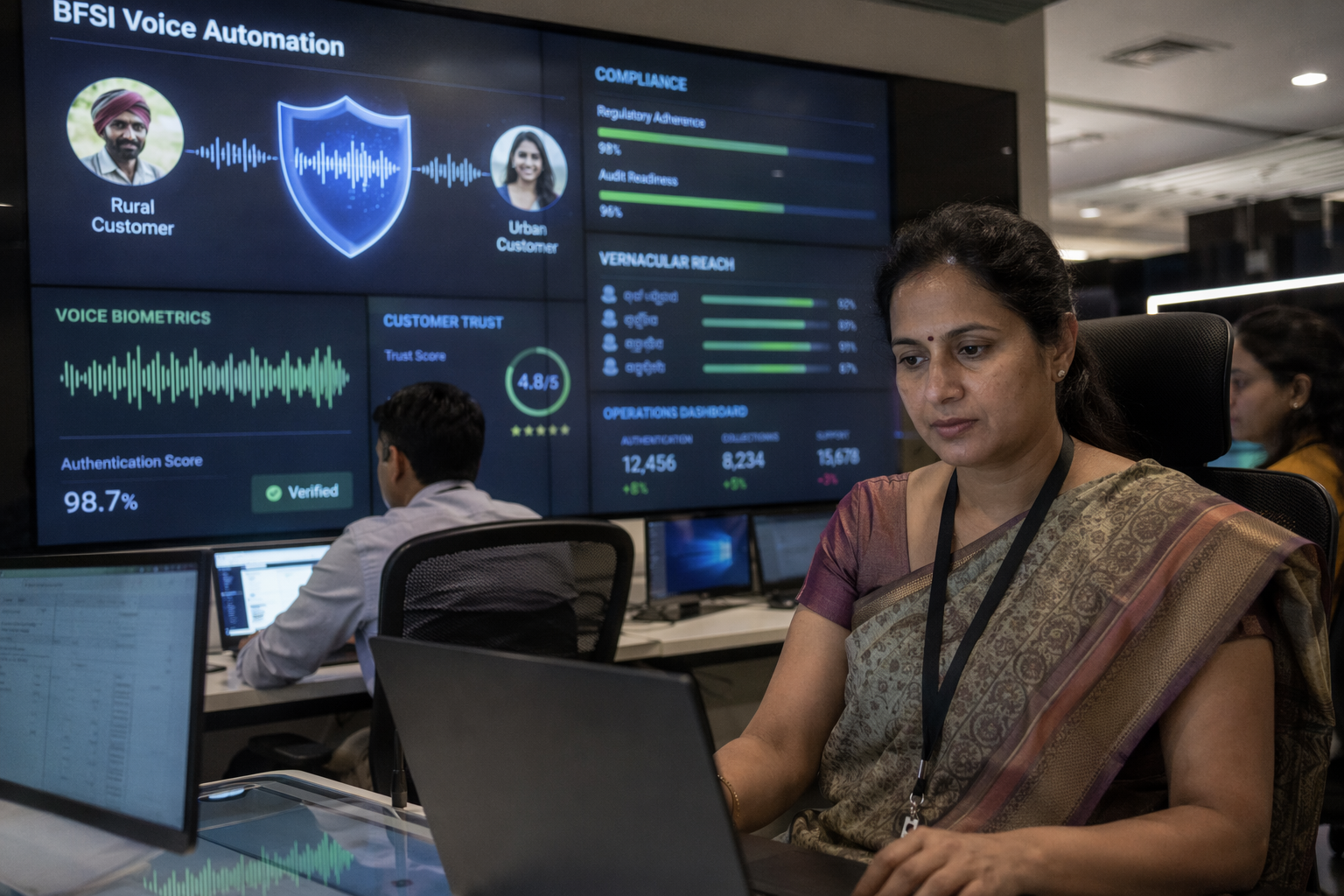
BFSI becomes the proving ground for sovereign voice AI
For Indian BFSI, the biggest opportunity is not simply automating call centers—it is automating regulated, multilingual, trust-sensitive conversations at national scale. Banks, insurers, NBFCs, and payment firms handle millions of calls involving identity verification, loan servicing, fraud alerts, collections, claims, KYC follow-ups, and customer complaints. These are not low-risk chatbot exchanges; they involve personally identifiable information, financial records, consent, and auditability.
That is where Gnani.ai’s stack becomes strategically important. Its enterprise voice agent platform claims support for 12+ Indic languages, millions of concurrent calls, and sub-second latency, while the newer Inya VoiceOS and Prisma v2.5 roadmap pushes toward 10 million to 30 million calls per day with sub-200ms latency targets. For BFSI, those numbers matter because latency directly affects call containment, customer experience, and agent handoff efficiency.
A concrete example already exists in Gnani.ai’s published case studies: Bank of Baroda implemented Gnani.ai’s Armour365 voice biometrics solution, reducing authentication time by 50 seconds per call, saving 15% in cost, and improving CSAT by 24%. That illustrates the practical BFSI impact: voice AI is not just answering questions; it is shortening secure workflows.
Compliance shifts from “where is the model?” to “where is the intelligence?”
In regulated industries, sovereignty is no longer only about data residency. It is also about model governance, inference control, logging, explainability, and vendor dependency. A bank may be comfortable experimenting with a generic cloud LLM for internal productivity, but customer-facing voice automation is a different compliance category.
Sovereign Voice AI changes the architecture in three ways:
- Sensitive speech data can remain within controlled environments rather than being routed indiscriminately to external APIs.
- Domain-specific models can be tuned for Indian compliance workflows, such as consent capture, KYC reminders, dispute resolution, and repayment conversations.
- Model-agnostic routing allows risk-based orchestration, where routine tasks run on lightweight in-house models while complex reasoning can be selectively escalated.
This is why the Inya platform’s model-agnostic direction matters. Enterprises can balance cost, latency, accuracy, and compliance instead of treating every call as a job for the largest available model. In production, that means a bank could use a fast proprietary speech model for authentication, a domain-tuned dialogue model for account servicing, and a larger external model only for edge-case summarization—while preserving policy controls.
Platforms such as CallMissed are moving in the same infrastructure direction for enterprises that need multilingual voice agents, WhatsApp automation, speech-to-text across 22 Indian languages, and access to 300+ LLMs through API-based orchestration. The broader implication is clear: compliance-ready AI will be built as a stack, not a single model.
Vernacular India moves from accessibility layer to core market
The most important implication may be linguistic. India’s digital economy cannot scale on English-first interfaces alone. Customers often describe problems in mixed-language speech: Hindi-English in Delhi, Kannada-English in Bengaluru, Tamil-English in Chennai, Bengali-Hindi in eastern markets. Traditional IVR systems fail here because they force users into rigid menus and standardized phrases.
Voice AI built for vernacular India can unlock:
- Higher financial inclusion, especially for users uncomfortable with app-based banking.
- Better collections and servicing outcomes, because customers respond more naturally in their preferred language.
- Lower call abandonment, since conversational agents remove menu friction.
- More inclusive public-service delivery, from insurance schemes to subsidy support.
CallMissed’s coverage of Indian BFSI voice automation captures this shift with the example that “a voice agent can speak in Kannada” and handle customer journeys that previously required scarce human language support. Gnani.ai’s investment in Indic speech models reinforces the same market reality: India’s AI adoption curve will be shaped by voice, not keyboards.
The strategic takeaway
For BFSI leaders, the question is no longer whether voice AI can reduce support costs. Gnani.ai already claims up to 60% OpEx reduction through process automation, and real deployments show measurable savings. The harder question is whether the system can be secure, sovereign, multilingual, low-latency, and auditable at once.
Inya VoiceOS and Prisma v2.5 suggest that Indian voice AI is moving toward that standard—where vernacular intelligence, compliance architecture, and enterprise-scale inference converge. For India’s financial sector, that could make voice the default interface for the next hundred million digital customers.
Expert Opinions
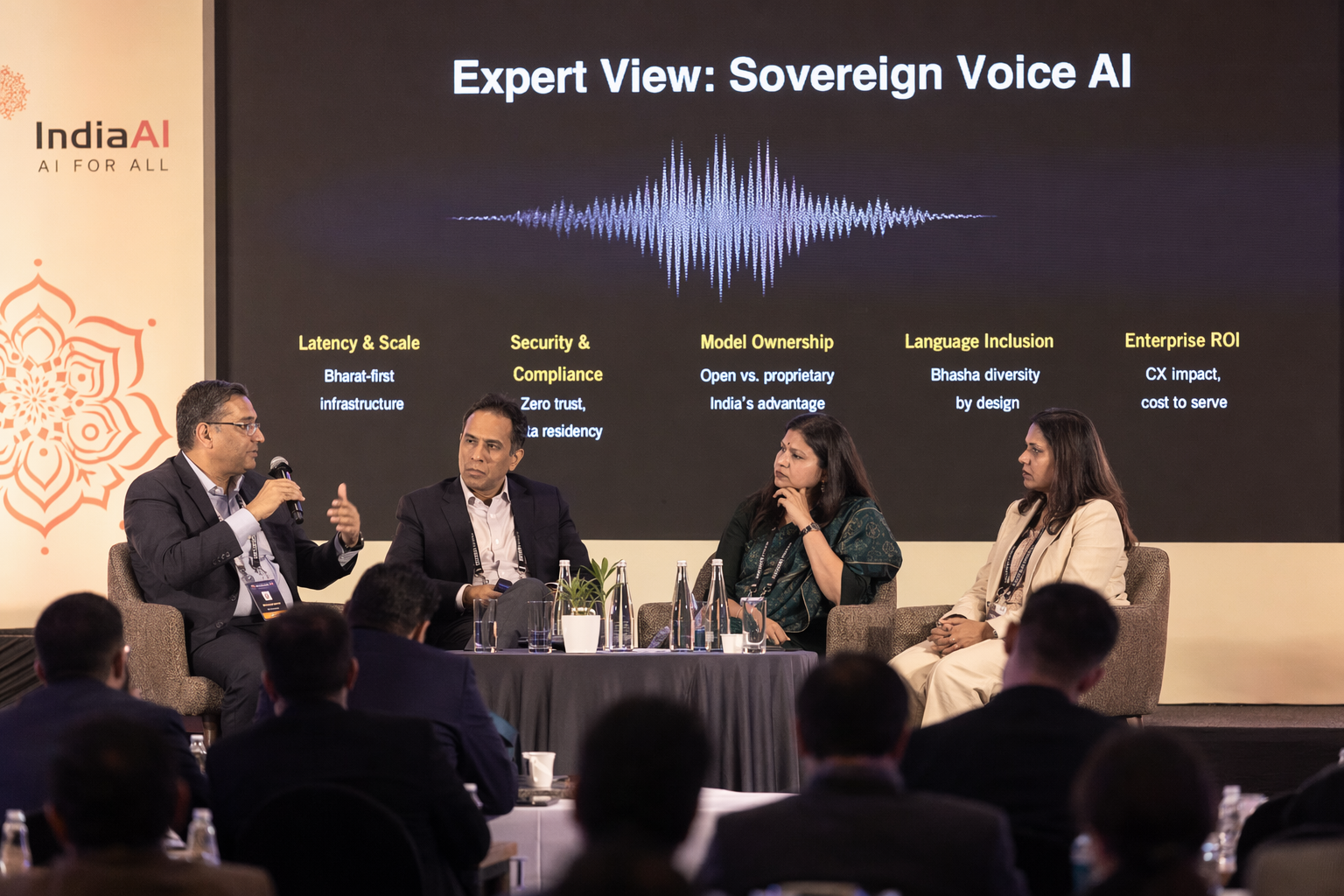
What enterprise AI leaders are watching
The expert consensus around Gnani.ai’s 2026 announcements is not simply that India has another large model. The more important signal is that voice AI is becoming infrastructure—especially for sectors where phone calls remain the dominant customer interface.
Gnani.ai’s own positioning describes the company as a “frontier Voice AI company” building proprietary speech and language models for enterprise deployments, with its model stack including Gnani Prisma v2. That matters because enterprise buyers are increasingly looking beyond generic chatbot layers. They want systems that can listen, reason, respond, authenticate, and escalate across real-world telephony environments.
From an industry standpoint, three points stand out:
- Sovereignty is now a buying criterion
BFSI, telecom, and government buyers are asking where data is processed, how models are governed, and whether sensitive voice interactions can remain within compliant infrastructure.
- Latency is a business metric, not just a technical benchmark
Gnani.ai’s reported target of sub-200ms latency and ability to process 10 million to 30 million calls per day places performance directly in the realm of contact-center economics.
- Language depth beats language coverage alone
Gnani.ai says its enterprise voice agents are fluent in 12+ Indic languages, while CallMissed’s own coverage of Indian BFSI highlights the vernacular gap: a customer may start in Hindi, switch to Kannada, and use English banking terms in the same conversation.
Why BFSI experts are paying attention
For banks and insurers, voice AI has to do more than answer FAQs. It must reduce call-center load, preserve trust, and handle sensitive workflows like authentication, collections, claims, fraud alerts, and onboarding.
The strongest evidence comes from production deployments. Gnani.ai’s published case-study data says Bank of Baroda implemented Armour365, reducing authentication time by 50 seconds per call, saving 15% in cost, and improving CSAT by 24%. Those are not vanity metrics; they map directly to the operational KPIs BFSI leaders care about:
- Average handle time
- Authentication success rate
- Customer satisfaction
- Fraud-risk reduction
- Agent productivity
- Cost per resolved interaction
This is where expert opinion is shifting. The question is no longer, “Can voice bots deflect calls?” It is, “Can AI agents safely complete regulated customer journeys at scale?” Gnani.ai’s combination of Inya VoiceOS, Prisma v2.5, and voice biometrics suggests a move toward full-stack voice intelligence rather than isolated speech-to-text or IVR automation.
The model-agnostic view
Another area experts are likely to value is Gnani.ai’s model-agnostic architecture. In enterprise environments, not every task needs the largest model. A balance-enquiry call, authentication prompt, or payment reminder may be better handled by a lightweight proprietary model, while complex dispute resolution may require a larger reasoning model.
That creates a practical architecture pattern:
- Use small, low-latency models for repetitive, high-volume calls.
- Route complex conversations to larger models when reasoning depth is required.
- Keep sensitive workloads within sovereign deployments where compliance demands it.
- Monitor cost, latency, and accuracy continuously across the call lifecycle.
This mirrors a broader trend in AI communication infrastructure. Platforms like CallMissed, which provide voice agents, WhatsApp chatbots, LLM inference across 300+ models, speech-to-text for 22 Indian languages, and text-to-speech APIs, reflect the same enterprise need: flexible orchestration rather than one-model-fits-all automation.
The practical takeaway
Experts are likely to judge Inya VoiceOS and Prisma v2.5 not only by benchmark claims, but by deployment outcomes: call completion rates, latency under load, accuracy in noisy environments, compliance posture, and measurable cost savings. Gnani.ai’s reported ability to support millions of concurrent calls with sub-second latency and reduce operational expenditure by up to 60% gives enterprises a concrete basis for evaluation.
The larger conclusion is clear: India’s voice AI race will be won by companies that combine vernacular fluency, sovereign infrastructure, real-time performance, and enterprise-grade governance. On those dimensions, Gnani.ai’s 2026 model stack has become one of the most closely watched developments in the market.
What This Means For You (TABLE)
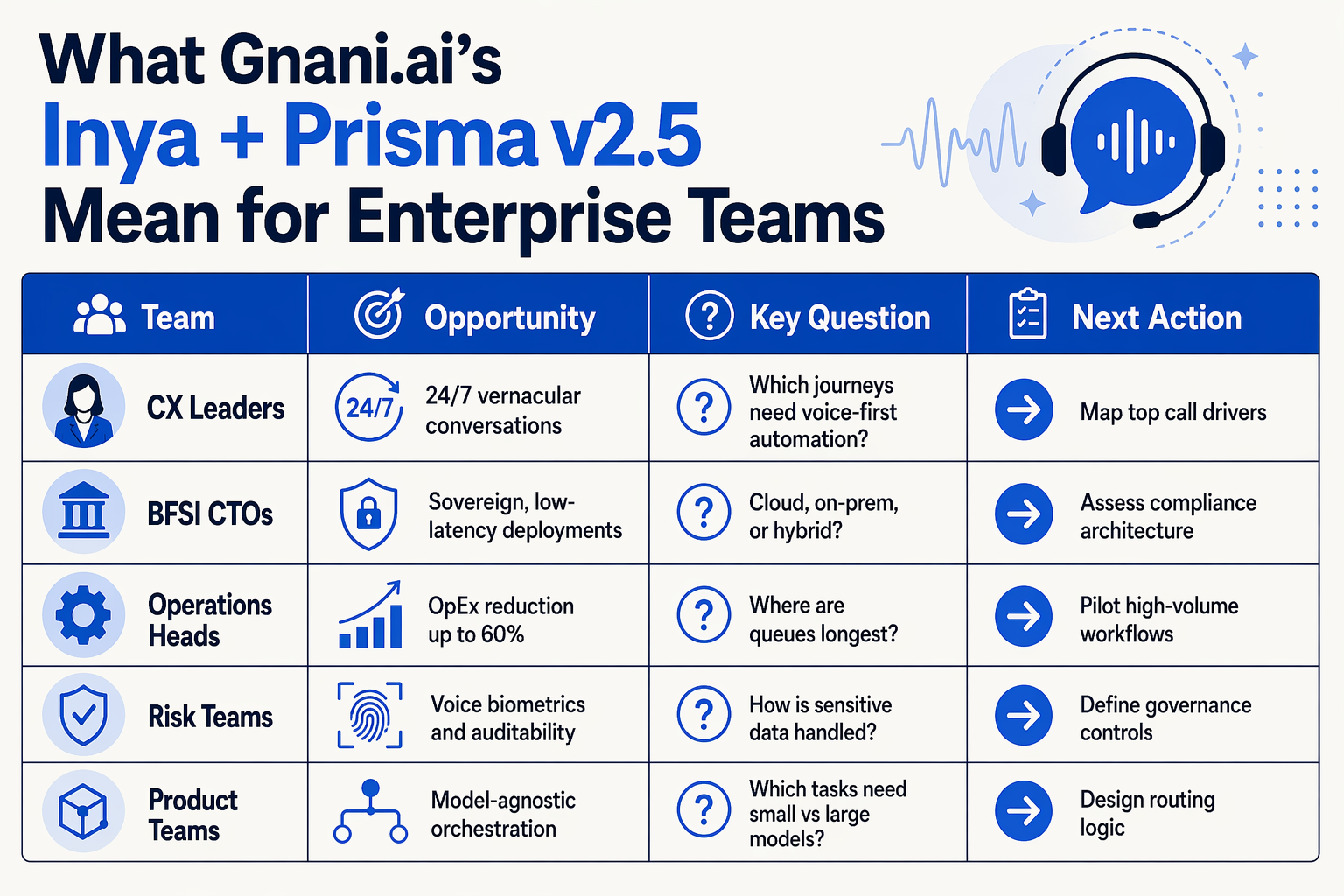
Practical implications for enterprises, builders, and policy teams
The biggest takeaway is that voice AI is moving from “call-center automation” to regulated digital infrastructure. Gnani.ai’s Inya VoiceOS and Prisma v2.5 show what the next benchmark looks like: sovereign deployment, Indic-language fluency, real-time response, and enterprise-grade scale. For organizations evaluating voice AI in 2026, the question is no longer “Can a bot answer calls?” It is: Can the system handle sensitive conversations, in local languages, at national scale, with predictable latency and compliance controls?
| If you are a… | What changes now | Data point to watch | Best next step |
|---|---|---|---|
| BFSI leader | Voice AI can move beyond FAQs into onboarding, collections, authentication, and service recovery | Gnani.ai case study: Bank of Baroda reduced authentication time by 50 seconds per call, saved 15% cost, and improved CSAT by 24% | Prioritize high-volume, low-risk journeys first, then expand into regulated workflows |
| CX / contact-center head | AI agents can absorb peak call traffic without adding proportional headcount | Gnani.ai claims millions of concurrent calls and up to 60% OpEx reduction | Benchmark containment rate, escalation quality, and language-wise CSAT |
| CTO / AI architect | Model-agnostic routing becomes a core design principle, not a nice-to-have | Inya + Prisma v2.5 target 10M–30M calls/day and sub-200ms latency | Build routing rules by task complexity, latency need, and data sensitivity |
| Compliance / risk team | Sovereign AI reduces exposure from sending customer voice data to generic offshore systems | Inya VoiceOS is positioned as a 5B voice-to-voice foundational model developed under the IndiaAI Mission | Define data residency, audit logging, consent, and retention policies upfront |
| Product builder | Vernacular voice can become a primary interface for users who may never adopt app-first workflows | Gnani.ai supports 12+ Indic languages; CallMissed supports Speech-to-Text across 22 Indian languages | Design for code-switching, interruptions, noisy calls, and regional accents |
| Public-sector planner | Citizen services can scale through always-on multilingual phone access | Daily capacity claims now reach 10 million to 30 million calls | Start with benefits status, grievance intake, appointment booking, and helpline triage |
The new buyer checklist
Before selecting a sovereign voice AI platform, enterprises should evaluate five capabilities:
- Latency under real call conditions
A lab demo is not enough. If Prisma v2.5 is targeting sub-200ms latency, buyers should ask for performance data across noisy networks, regional accents, and peak-hour call loads.
- Language depth, not just language count
Supporting 12+ Indic languages is valuable only if the model handles dialects, mixed-language speech, and domain-specific vocabulary such as loan terms, KYC phrases, insurance claim details, or healthcare instructions.
- Deployment control
For BFSI and government use cases, sovereignty means more than hosting in India. It includes data residency, audit trails, encryption, consent management, and human escalation controls.
- Model routing economics
Inya’s model-agnostic approach matters because not every query needs a large model. Simple balance checks, payment reminders, or appointment confirmations can run on lighter models, while complex disputes may require stronger reasoning.
- Integration readiness
The best voice AI stack must connect to CRMs, core banking systems, ticketing tools, analytics dashboards, and telephony infrastructure without months of custom engineering.
Bottom line
For enterprises, Gnani.ai’s latest stack sets a higher benchmark for what Indian voice AI should deliver: sovereign control, vernacular fluency, high throughput, and measurable business outcomes. Platforms such as CallMissed reflect the same market direction, giving businesses production-ready infrastructure for voice agents, WhatsApp automation, multilingual STT/TTS, and access to 300+ LLMs through a unified AI communication layer.
The winners will not be the companies that deploy the flashiest voice bot. They will be the ones that combine local language intelligence, regulatory discipline, cost-aware model routing, and real operational scale.
Frequently Asked Questions
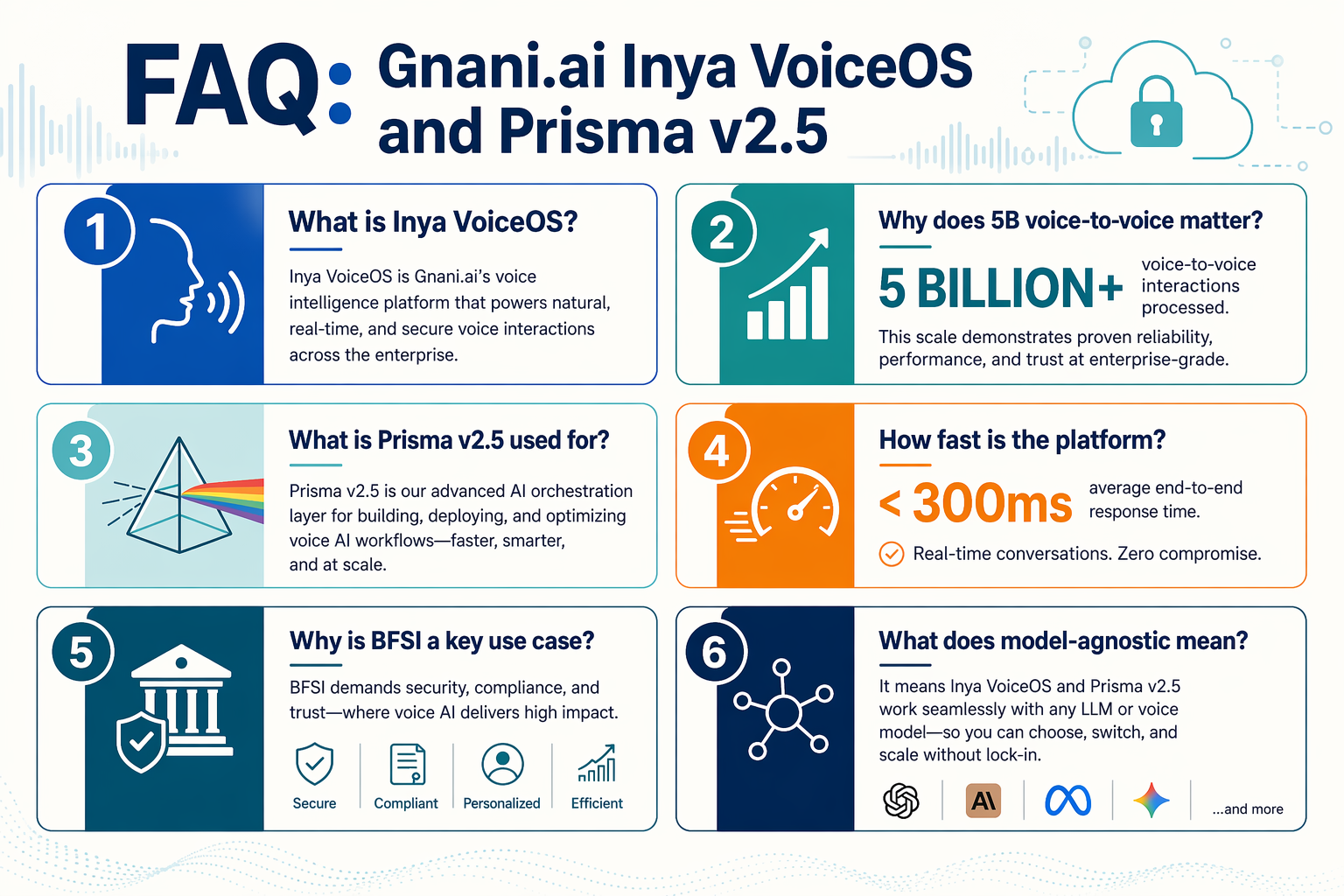
What is Sovereign Voice AI at Scale and why does it matter for India?
What is Gnani.ai’s Inya VoiceOS?
How is Prisma v2.5 different from earlier voice AI models?
Why is Sovereign Voice AI at Scale important for BFSI companies?
What does model-agnostic architecture mean in Gnani.ai’s voice AI platform?
Is Sovereign Voice AI at Scale only relevant for large enterprises?
Conclusion
Gnani.ai’s Inya VoiceOS and Prisma v2.5 point to a clear shift: India’s enterprise AI future will be spoken, multilingual, low-latency, and sovereign by design. The company’s $10 million Series B funding in early 2026, led by Aavishkaar Capital, gives it fresh momentum to scale this vision across BFSI, telecom, healthcare, and public-sector deployments.
Key takeaways:
- Inya VoiceOS marks a foundational leap as India’s first reported 5-billion-parameter voice-to-voice model, built under the IndiaAI Mission for Indic-language voice intelligence.
- Prisma v2.5 reinforces the scale thesis, targeting 10 million to 30 million calls per day with sub-200ms latency for enterprise-grade real-time conversations.
- Sovereign AI matters in high-stakes sectors, where data residency, compliance, authentication, and local language accuracy are not optional.
- Model-agnostic routing could become the enterprise default, balancing Gnani.ai’s lightweight proprietary models with larger external models based on cost, speed, and task complexity.
What to watch next is whether sovereign voice AI moves from large BFSI deployments into everyday customer journeys across India’s regional markets. To explore how AI communication is evolving, check out CallMissed — an AI infrastructure platform powering voice agents and multilingual chatbots for businesses.
If India’s next billion users prefer speaking to typing, is your enterprise ready to listen?
Related Posts
WhatsApp Integration in CallMissed Is Easy: Automate Support, Leads, Orders, and Bookings

Stop Bleeding Leads: The 2026 Guide to AI Voice Agents, Call Analytics, and Missed-Call Recovery for Small Business

AI Voice Agent for Missed Calls — Turn Missed Calls into Leads
Ready to automate customer conversations?
Launch AI voice agents and WhatsApp bots with CallMissed — one API, 22+ Indian languages.