

Mistral AI Acquires Emmi AI: What It Means for Europe’s Industrial AI Future


What if the factory of the future were designed not by human engineers sketching for months, but by an Austrian physics model reasoning in milliseconds?...
Mistral AI Acquires Emmi AI: What It Means for Europe’s Industrial AI Future
What if the factory of the future were designed not by human engineers sketching for months, but by an Austrian physics model reasoning in milliseconds? That future just got dramatically closer to European shores. In one of the continent’s most strategically significant AI deals to date, Mistral AI acquires Emmi AI, the Austrian startup pioneering physics-native artificial intelligence for industrial engineering. The announcement didn’t just make headlines—it dominated technical conversation, rocketing to the top of HackerNews with 222 upvotes and 58 comments in just 11.2 hours, a clear signal that the developer community views this as a genuine inflection point rather than another routine acquihire.
For years, European tech watchers have asked whether the continent could cultivate an AI champion capable of rivaling Silicon Valley’s scale and speed. Mistral’s response is unequivocal: stop competing solely on consumer-facing LLMs, and instead own the industrial stack that actually builds physical things. Emmi AI brings deep expertise in Physics AI—models trained to simulate mechanical forces, fluid dynamics, material stress, and thermodynamic behavior—to Mistral’s expanding arsenal. Together, the companies aim to create what they describe as the "leading AI stack" for industry, compressing engineering and simulation timelines from weeks to hours while ensuring that critical intellectual property and infrastructure remain firmly within European jurisdiction.
This matters right now because global supply chains are being rewritten in real time, and advanced economies are racing to re-shore manufacturing capability. By fusing Mistral’s large-model prowess with Emmi’s physics-first approach, the deal accelerates AI-native re-industrialization—a trend where generative models don’t just write code but design turbines, optimize factory layouts, and predict structural failures before a single prototype is cast.
In the sections ahead, we’ll dissect exactly what Physics AI means for aerospace, automotive, and energy sectors; examine how this acquisition alters the competitive balance between European, American, and Chinese AI ecosystems; and outline the technical and cultural challenges of integrating two radically different engineering teams. As these specialized industrial models move from research to factory floor, the need for production-ready AI communication infrastructure becomes impossible to ignore—something platforms like CallMissed are already tackling by enabling enterprises to deploy multilingual voice and messaging agents that interface seamlessly with complex backend systems.
Introduction
Background & Context
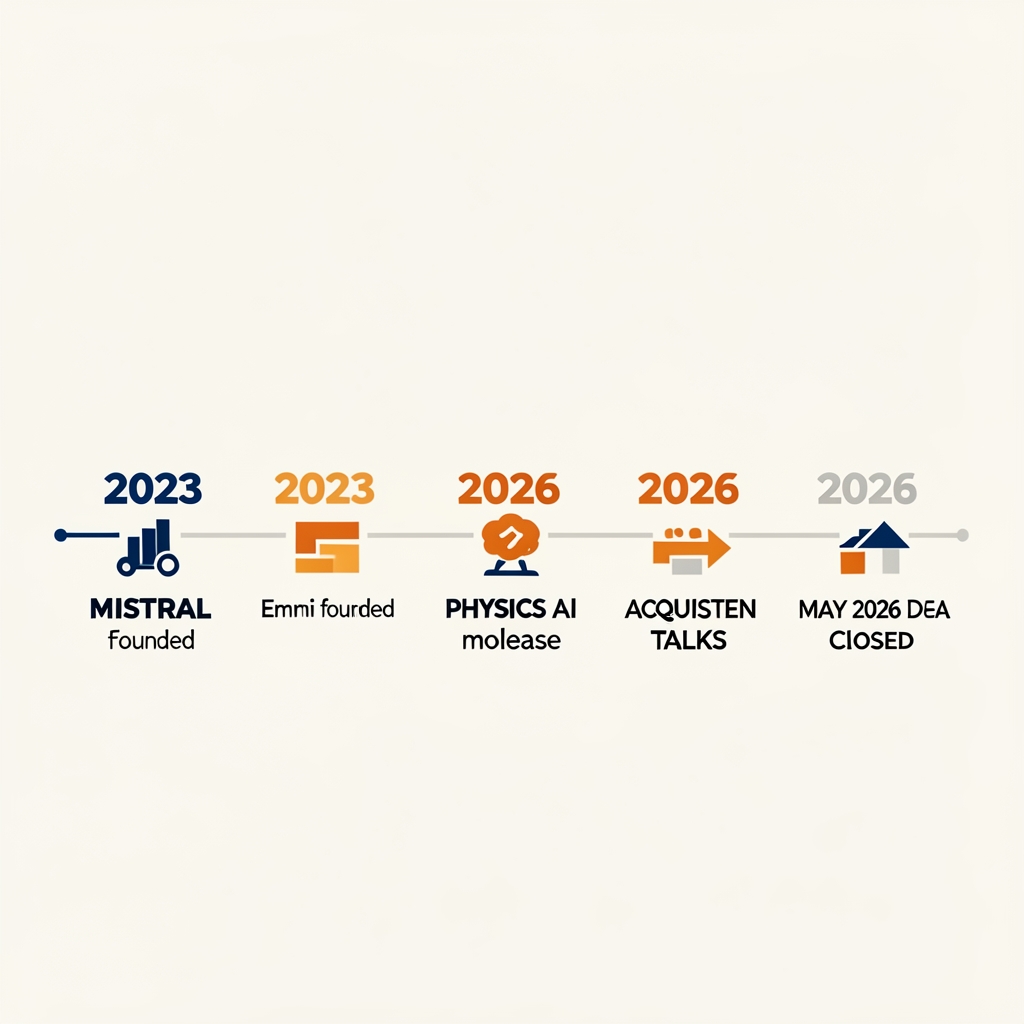
Since its emergence from Paris, Mistral AI has established itself as Europe's leading AI company, routinely positioned as the continent's most credible answer to OpenAI, Google DeepMind, and Meta AI. The company distinguished itself early through a dual-track strategy: releasing high-performance open-weight models (including Mistral 7B and the Mixtral mixture-of-experts series) while aggressively pursuing enterprise and government contracts. This hybrid approach gave Mistral both developer mindshare and revenue traction. Yet the acquisition of Emmi AI reveals a strategic inflection point. Mistral is moving beyond general-purpose large language models (LLMs) to build what it describes as the leading AI stack—one that spans from natural-language reasoning to physics-grounded industrial simulation. In a LinkedIn post highlighted by Board Europe, Mistral was explicitly identified as Europe’s leading AI company, underscoring the continent’s desire to cultivate a homegrown champion capable of rivaling Silicon Valley’s incumbents across both software and heavy industry.
Emmi AI and the Physics AI Frontier
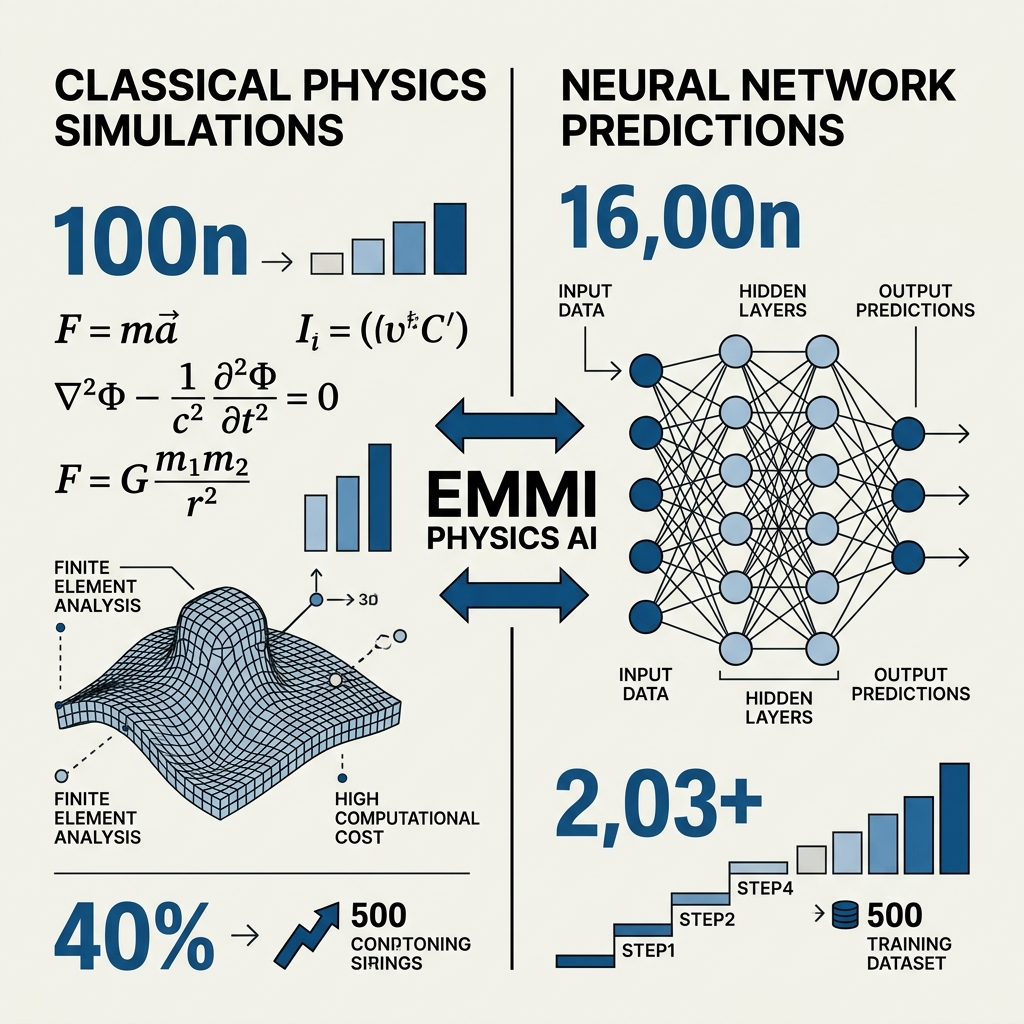
Emmi AI operated from Austria as a Physics AI pioneer, developing machine-learning architectures that encode physical laws to model industrial engineering problems. Where conventional computer-aided engineering (CAE) relies on finite-element methods that can consume hours of compute per simulation, Emmi’s neural approaches aim to compress those timelines by orders of magnitude, predicting thermal, fluid, and structural behaviors in seconds. In press materials, the deal was described as a move to accelerate industrial engineering workflows by embedding learned neural surrogates directly into the design pipeline, bypassing brute-force numerical methods. Under the definitive agreement, Emmi AI’s entire research team will join Mistral, instantly adding deep expertise in physics-informed machine learning and industrial optimization. Before the deal, Emmi had quietly become one of Europe's most strategically significant deep-tech startups because its technology sits at the intersection of mechanical engineering, thermodynamics, and generative AI—domains where errors are measured in material failure, not token hallucination.
Why This Acquisition Matters Now
The timing is no accident. European industry and policymakers are pushing aggressively for digital sovereignty and re-industrialization, seeking to reshore advanced manufacturing capabilities and reduce dependence on non-European software stacks. Mistral’s purchase of Emmi directly serves that agenda, expanding its European industrial presence into physics simulation and engineering intelligence. Observers recognized the weight of the move immediately: the announcement hit the top of HackerNews, generating 222 upvotes and 58 comments in just 11.2 hours, signaling intense developer and researcher interest.
More broadly, the deal exemplifies a tectonic shift in AI investment. Capital is rotating out of horizontal chatbot applications and into vertical, domain-specific infrastructure where models must respect physical constraints, regulatory standards, and industrial safety requirements. As one announcement framed it, this ranks among "Europe's most important and strategic AI acquisitions to date." The strategic rationale rests on several pillars:
- Deep-tech moats: Physics AI models require specialized training data from wind tunnels, material labs, and manufacturing floors—datasets that cannot be scraped from the public web.
- Regulatory alignment: European industrial standards demand traceability and deterministic outputs, areas where physics-informed architectures outperform generalist LLMs.
- Economic multiplier: Accelerating simulation cycles from hours to seconds directly reduces R&D costs in aerospace, automotive, and energy sectors.
By folding Physics AI into its portfolio, Mistral is betting that the next frontier of foundation models will not merely process text, but predict how turbines heat, how alloys stress, and how supply chains bend under real-world physics.
Key Developments (TABLE)
The Mistral–Emmi transaction marks a decisive inflection point for European artificial intelligence, shifting the narrative from general-purpose language models toward physics-backed industrial applications. By acquiring an Austrian pioneer in Physics AI, Mistral is signaling that its long-term competitive advantage will rest on vertical integration—the ability to fuse foundational LLMs with domain-specific simulation intelligence. This development arrives at a critical moment when policymakers and enterprise buyers alike are questioning whether Europe can cultivate AI champions capable of rivaling American and Chinese dominance in high-value sectors such as automotive, energy, and advanced manufacturing.
Strategic Deal Parameters
To grasp the full scope of this consolidation, consider the following breakdown of the acquisition’s core components and their strategic consequences:
| Category | Key Detail | Impact on Mistral | Broader Industry Implication |
|---|---|---|---|
| Acquisition Target | Emmi AI, an Austrian startup specializing in Physics AI | Adds industrial-grade physics simulation models to Mistral’s portfolio | Validates vertical AI as the next major battleground after general LLMs |
| Deal Structure | Definitive agreement; Emmi’s full research team joins Mistral AI | Absorbs scarce specialized talent and proprietary IP directly into R&D | Consolidates European deep-tech expertise under a native AI champion |
| Core Technology | Physics AI models engineered for industrial simulation | Enables predictive, AI-native manufacturing and engineering workflows | Offers European enterprises a sovereign alternative to US industrial software |
| Strategic Objective | Create the leading AI stack and accelerate the AI-native industry | Transforms Mistral from a model provider into end-to-end industrial infrastructure | Supports EU re-industrialization and digital sovereignty agendas |
| Market Signal | Trended on HackerNews with 222 points and 58 comments in 11.2 hours | Validates strong technical community interest in industrial use cases | Indicates developer appetite for deterministic, physics-grounded AI |
| Geographic Expansion | Expands Mistral’s operational footprint into Austria’s industrial ecosystem | Strengthens EU-wide R&D presence and local enterprise partnerships | Reduces reliance on non-European AI stacks for critical infrastructure |
Why Physics AI Changes the Equation
Unlike general LLMs trained primarily on text corpora, Emmi AI’s architectures embed physical laws and engineering constraints directly into their predictive models. This distinction is vital because industrial applications—from jet turbine design to semiconductor fabrication—demand deterministic accuracy rather than probabilistic fluency. By folding Emmi’s physics models into its stack, Mistral can deliver simulations that materially reduce prototyping cycles, cut material waste, and optimize energy efficiency. The result is a platform that speaks the language of engineers, not just end consumers.
This specialization mirrors broader infrastructure trends across the AI economy. Platforms like CallMissed already demonstrate how purpose-built systems—production-ready voice agents, multilingual Speech-to-Text, and LLM inference—outperform generic alternatives in real-world deployments. Mistral’s acquisition similarly reflects a market maturation: one-size-fits-all models are fragmenting into domain-specific stacks purpose-built for distinct operational environments.
Immediate Implications for the Ecosystem
The ripple effects of this deal are already visible across multiple dimensions:
- Talent concentration: Integrating Emmi AI’s researchers directly into Mistral’s R&D captures scarce physics-informed machine learning expertise that would take years to develop organically.
- Enterprise lock-in: Manufacturing clients increasingly prefer unified, integrated stacks over patchworks of generalist APIs, giving Mistral a stickier, higher-margin proposition.
- Sovereignty narrative: The acquisition strengthens Europe’s case for technological independence by domesticating a critical layer of industrial AI that historically relied on non-EU vendors.
- Community validation: The HackerNews reception—222 upvotes and 58 comments in just 11.2 hours—reveals that technical audiences prioritize tangible, physics-grounded breakthroughs over incremental consumer chatbot updates.
With Emmi AI’s team already transitioning into Mistral’s organization, the integration roadmap appears aggressive and talent-centric. Enterprise customers can expect near-term deliverables that unify language reasoning with physics simulation, enabling manufacturers to query, design, and validate components within a single AI-native workflow.
In-Depth Analysis
Strategic Rationale: From General Intelligence to Physics AI
The generative AI race has been dominated by headline benchmarks on reasoning and coding. Mistral's acquisition of Emmi AI suggests the next battleground is vertical specialization. By acquiring an Austrian startup that builds Physics AI models for industrial engineering, Mistral is moving decisively beyond conversational LLMs into physics simulation, digital twins, and manufacturing optimization.
The deal is described by both parties as "one of Europe's most important and strategic AI acquisitions to date." It transfers Emmi AI's entire research team to Mistral, embedding years of computational physics expertise directly into the French company's engineering pipeline. Rather than training physics models from scratch—a process that demands both scarce talent and highly specialized datasets—Mistral bought the capability outright.
What Emmi AI Contributes
Emmi AI's value to Mistral rests on three concrete pillars:
- Physics-informed AI models capable of accelerating industrial engineering workflows beyond traditional finite-element methods
- A specialized Austrian research team with deep expertise in computational physics and simulation software
- Geographic expansion that strengthens Mistral's European industrial presence, particularly in Central European manufacturing corridors
These assets give Mistral immediate credibility in sectors—automotive, aerospace, energy—where predictive physics simulations directly impact product safety and R&D costs.
Implications for European AI Sovereignty
The acquisition arrives at a critical moment for EU technological policy. With regulators and industry leaders pushing for reduced dependence on U.S. and Chinese AI infrastructure, Mistral's move aligns neatly with the bloc's re-industrialization agenda. Keeping physics AI capabilities under European ownership means sensitive engineering data and critical simulation workflows can remain governed by EU standards.
As industry observers have noted, this isn't merely a talent grab; it is a sovereignty play. By integrating Emmi's physics engines with its general-purpose models, Mistral can offer continental manufacturers an end-to-end stack that no American hyperscaler currently matches: natural language interfaces layered directly on top of physics simulations.
The Fragmenting AI Stack
Mistral's vision of the "leading AI stack" implies a future where general LLMs and domain-specific models coexist tightly. An engineer might describe a design problem in natural language; a Mistral LLM parses the intent, triggers an Emmi physics simulation, and synthesizes the results into actionable feedback.
This hybrid architecture, however, creates integration complexity. As enterprises stitch together general language models, physics simulators, and industry-specific tools, the need for flexible routing layers becomes acute. Solutions like CallMissed's multi-model API gateway exemplify the kind of infrastructure required—enabling developers to switch between 300+ LLMs and specialized models without code rewrites, a practical necessity as AI stacks span from chat interfaces to physics engines.
Competitive Positioning Against U.S. Rivals
While OpenAI and Anthropic remain fixated on consumer and enterprise-software applications, Mistral is carving out a differentiated moat in industrial engineering AI. Physics simulation represents a high-barrier, high-value market where traditional software incumbents have long dominated. By combining Emmi's capabilities with its open-weight and commercial model families, Mistral can attack both the software layer and the model layer simultaneously.
The HackerNews traction—222 points and 58 comments within 11.2 hours—signals that technical audiences recognize the strategic weight of this move. It suggests the industry is ready for AI that manipulates physical reality, not just text.
Impact & Implications
A Strategic Bet on European Industrial Sovereignty
The acquisition is not merely a talent consolidation; it is already being described as one of Europe's most important and strategic AI acquisitions to date. By integrating Emmi AI—an Austrian startup developing Physics AI models for industrial engineering—Mistral is making a decisive pivot from general-purpose language models to domain-specific industrial stacks. With Emmi AI's research team joining Mistral and expanding the latter's European industrial presence, the deal directly supports Europe's re-industrialization agenda. For manufacturers and engineering firms operating under strict data sovereignty requirements, the merger offers a credible alternative to U.S.-centric cloud AI, ensuring sensitive physics and process data remain within European jurisdictional boundaries.
Accelerating the Physics-AI Convergence
Emmi AI's technology centers on embedding physical laws directly into AI architectures—an approach that moves beyond black-box prediction to physics-informed reasoning. This matters because traditional neural networks often violate conservation laws or material constraints, rendering them unusable for high-stakes simulation. By merging Emmi's physics engines with Mistral's compute scale, the combined platform can accelerate the promise of an AI-native industry. Expected near-term impacts include:
- Generative engineering design, where AI proposes structures that already satisfy load-bearing and thermodynamic constraints
- Real-time digital twins that mirror physical assets with physics-backed fidelity rather than statistical approximation
- Predictive maintenance models that account for fluid dynamics, friction wear, and thermal fatigue instead of relying solely on historical sensor patterns
In sectors like automotive, aerospace, and energy infrastructure, these capabilities could compress prototyping cycles by orders of magnitude.
Redrawing the Competitive Map
The story's immediate traction—topping HackerNews with 222 points and 58 comments in under half a day—signals that technical audiences recognize the structural weight of this move. Rather than competing solely on benchmark leaderboards, Mistral is building a full-stack moat: generalist reasoning from its open and commercial models, now augmented by Emmi AI's specialized physics intelligence. This challenges the prevailing narrative that European AI must remain a downstream consumer of American foundation models. If Mistral successfully productizes Emmi's research, it could become the default sovereign-AI partner for European industrials and regulated utilities that require auditable, physics-grounded systems—markets where generic LLMs struggle to gain trust.
Infrastructure Implications for Enterprise Adoption
Owning the model layer is only half the battle. Translating physics-grounded AI into factory-floor decisions and field-engineer workflows requires deployment infrastructure that can route specialized, multimodal agents at scale. As Mistral integrates Emmi's models, enterprises will face a familiar problem: how to switch between general LLMs, physics simulators, and communication tools without fragmenting their stack. Platforms like CallMissed address this orchestration gap by offering businesses access to 300+ models through a unified API gateway, paired with production-ready channels such as voice agents and WhatsApp chatbots. In an era where industrial AI must reach human teams across multiple interfaces, the winners will not just be the labs building physics models, but the infrastructure layers that make those models actionable.
Expert Opinions

The Mistral-Emmi deal has rapidly become one of the most discussed strategic moves in the global AI sector, surging to the top of HackerNews with 222 points and 58 comments within just 11.2 hours. That level of organic traction signals something rare in today's crowded AI news cycle: genuine conviction among technical practitioners that this acquisition could materially reshape the competitive landscape, rather than simply being another consolidation headline.
Strategic Validation for European AI Sovereignty
Industry watchers are nearly unanimous in framing this as "one of Europe's most important and strategic AI acquisitions to date." The consensus view holds that Mistral is not merely absorbing engineering talent; it is consolidating a deeply specialized vertical capability—Physics AI—that few general-purpose labs possess. By acquiring Emmi AI, an Austrian startup developing Physics AI models for industrial engineering, Mistral gains an immediate moat in sectors where European manufacturing, automotive, and energy firms still maintain significant global influence.
Analysts emphasizing European re-industrialization see the deal as a geopolitical statement as much as a commercial transaction. While U.S. labs race toward artificial general intelligence narratives and consumer chatbots, Mistral is doubling down on AI-native industry: applied models that optimize turbine efficiency, simulate material fatigue, or accelerate hardware prototyping. As a LinkedIn analysis from Board Europe highlighted, the acquisition directly strengthens Europe's industrial artificial intelligence capabilities at a critical moment when regional supply chains are being rearchitected for strategic resilience and energy independence.
Differentiation Beyond the LLM Hype Cycle
Experts across Reddit's ArtificialIntelligence community and HackerNews comment threads have pointed out that Emmi's Physics AI focus offers something most foundation models lack: ground-truth alignment with physical realities. Unlike general LLMs, which can hallucinate linguistic patterns, physics-informed models must rigidly conform to thermodynamics, fluid dynamics, and structural engineering constraints.
This distinction gives Mistral several concrete advantages in industrial markets:
- Deterministic reliability — Physics-informed outputs must obey measurable physical laws rather than probabilistic text patterns, reducing catastrophic failure risks in engineering workflows.
- Regulatory defensibility — Physics-based model recommendations are inherently more auditable than black-box LLM outputs, a critical factor for aerospace, energy, and automotive certifications.
- Hardware optimization — Emmi's models are purpose-built for industrial engineering tasks such as simulating material stress, fluid behavior, and thermal dynamics.
The distinction is fueling speculation that Mistral intends to build a dual-stack offering: general-purpose language and reasoning capabilities on one side, and hard-science industrial inference on the other. If executed correctly, this combination would make Mistral the only European AI player with credible, best-in-class assets across both software and physical domains.
The Deployment Reality
Despite the strategic enthusiasm, several seasoned observers have cautioned that model superiority alone does not guarantee enterprise adoption. Industrial AI must ultimately be embedded into noisy, human-centric operational workflows—often requiring voice interfaces, multilingual chat support, and real-time data streams on factory floors and remote field sites. In this context, communication infrastructure providers are becoming as critical as base model developers. Platforms like CallMissed, which deliver production-ready voice agents, multilingual Speech-to-Text support across 22 Indian languages, and LLM inference gateways connecting to 300+ models, illustrate the communication layer necessary to translate Mistral's physics models into actionable shop-floor tools. Indian startups such as CallMissed are already demonstrating how regional language APIs and multi-model orchestration can bridge the gap between frontier research and last-mile industrial deployment.
As Mistral integrates Emmi AI's research team and expands its European industrial presence, the prevailing expert opinion is clear: the acquisition is strategically sound and well-timed. The larger question now is execution—specifically, how quickly Mistral can package its newly acquired Physics AI into scalable, multimodal products that global industries can actually deploy.
What This Means For You (TABLE)
Frequently Asked Questions
Conclusion
The Mistral AI–Emmi AI acquisition marks a defining inflection point for European artificial intelligence. By uniting frontier language models with Physics AI, Mistral is wagering that the next wave of AI value will be built on factory floors, supply chains, and physical infrastructure—not just chat interfaces.
- Europe’s first integrated industrial AI stack: The deal merges Mistral’s leading LLMs with Emmi’s physics-native models, creating a unified platform for engineering simulation and manufacturing workflows.
- Strategic sovereignty: As geopolitical competition over AI intensifies, combining Parisian and Austrian R&D strengthens Europe’s capacity to build sovereign infrastructure independent of U.S. hyperscalers.
- From generative to physical: The move signals a broader industry pivot—applying AI beyond text and images to systems that understand thermodynamics, materials science, and structural engineering.
In the coming year, watch whether Mistral can convert this merged technology into live deployments across European automotive, aerospace, and energy sectors before American industrial AI platforms reach similar scale. To explore how AI communication infrastructure is evolving alongside these industrial advances, check out CallMissed — an AI infrastructure platform powering voice agents and multilingual chatbots for businesses navigating this transformation. Will Mistral’s physics-aware stack become the default engine for Europe’s re-industrialization, or will Silicon Valley’s compute advantages prove too deep to overcome?
Related Posts



Ready to automate customer conversations?
Launch AI voice agents and WhatsApp bots with CallMissed — one API, 22+ Indian languages.