

JSC to Spotlight Exascale, Quantum, and AI Advances Across ISC 2026 Program



Did you know that a single exascale supercomputer can perform more calculations in one second than the entire global population could complete in over...
JSC to Spotlight Exascale, Quantum, and AI Advances Across ISC 2026 Program
Did you know that a single exascale supercomputer can perform more calculations in one second than the entire global population could complete in over 4,000 years? As we kick off the highly anticipated ISC High Performance 2026 conference this June, this mind-boggling scale of computing power is no longer a distant dream—it is our current reality. At the forefront of this computational revolution is the Jülich Supercomputing Centre (JSC), which is gearing up for an extensive showcase across the ISC 2026 program. Operating from high-profile exhibition spaces including Booth #Z01, JSC to Spotlight Exascale, Quantum, and AI Advances Across ISC 2026 Program, demonstrating how next-generation hardware is actively transforming scientific discovery and commercial industries alike.
This convergence of technologies matters now more than ever. With artificial intelligence models growing exponentially in size and complexity, traditional computing infrastructure is struggling to keep pace. The integration of Europe's pioneering JUPITER exascale supercomputer alongside hybrid quantum-classical computing frameworks represents a monumental leap forward in solving previously intractable problems, from molecular modeling to climate forecasting. As these massive supercomputing centers push the boundaries of foundational AI research, downstream communication platforms like CallMissed are already leveraging these breakthroughs to power ultra-low latency AI voice agents and multilingual speech-to-text APIs that handle complex enterprise workflows.
In this article, we will dive deep into JSC’s major contributions to the ISC 2026 program. You will learn about the immense technical potential of the JUPITER exascale system, the latest breakthroughs in integrating quantum machines with classical High-Performance Computing (HPC) environments, and the practical AI tutorials—such as Andreas Herten's highly anticipated session on "Efficient Distributed GPU Training"—designed to help developers scale their deep learning workloads. Let's explore how Europe is securing its position as a global leader in the next era of advanced computing.
Introduction
The landscape of high-performance computing (HPC) is undergoing a historic shift, driven by the powerful convergence of exascale computing, quantum systems, and artificial intelligence. As the global scientific community gathers for the ISC High Performance 2026 conference, the focus is squarely on how these tri-fold technologies will redefine computational boundaries. Leading this charge is the Jülich Supercomputing Centre (JSC), which is set to play a central role in this year's program by showcasing its latest breakthroughs in supercomputing infrastructure, hybrid quantum-classical systems, and advanced AI methodologies.
At ISC 2026, JSC will engage attendees across multiple touchpoints, including its primary exhibition presence at Booth #Z01. The center's contributions span the entire conference agenda, reflecting its status as a cornerstone of Europe's high-performance computing ecosystem. From deep-dive technical tutorials to high-level panels, JSC researchers are demonstrating how the integration of massive compute power and cognitive technologies will address some of the world's most complex challenges.
Key Themes of JSC's ISC 2026 Showcase
The Jülich Supercomputing Centre's presentations and exhibits will focus on three main pillars of modern computational science:
- The JUPITER Exascale Supercomputer: As Europe’s premier exascale system, JUPITER represents an unprecedented leap in processing power, capable of executing over a billion billion calculations per second. JSC will highlight JUPITER's immense potential for running massive, climate-scale simulations and training complex, multi-billion-parameter AI foundation models.
- Quantum-Classical Integration: Rather than viewing quantum computing as a standalone technology, JSC is pioneering the integration of quantum machines with traditional supercomputing architectures. This hybrid approach aims to accelerate optimization problems and quantum chemistry simulations.
- Distributed GPU Acceleration for AI: Training modern AI models requires highly optimized, distributed workloads. Highlighting JSC's hands-on technical leadership, researcher Andreas Herten is organizing the specialized ISC 2026 tutorial, “Efficient Distributed GPU...”, designed to help developers and data scientists maximize hardware efficiency across massive GPU clusters.
While institutions like JSC push the absolute limits of raw computational physics and hardware architecture, the downstream benefits of these breakthroughs are rapidly transforming the commercial landscape. The massive artificial intelligence models trained on exascale infrastructures are paving the way for highly sophisticated, real-world applications.
For instance, next-generation communication platforms like CallMissed rely on these very advancements in AI scalability to power real-time voice agents and multi-lingual Speech-to-Text APIs across 22 regional languages natively. By bridging the gap between raw supercomputing research and daily enterprise workflows, the innovations spotlighted at ISC 2026 are already beginning to shape the future of global business communication.
As we dive deeper into the ISC 2026 program, JSC’s contributions offer a compelling blueprint for how exascale power, quantum logic, and AI will fuse to drive the next decade of digital transformation.
Background & Context
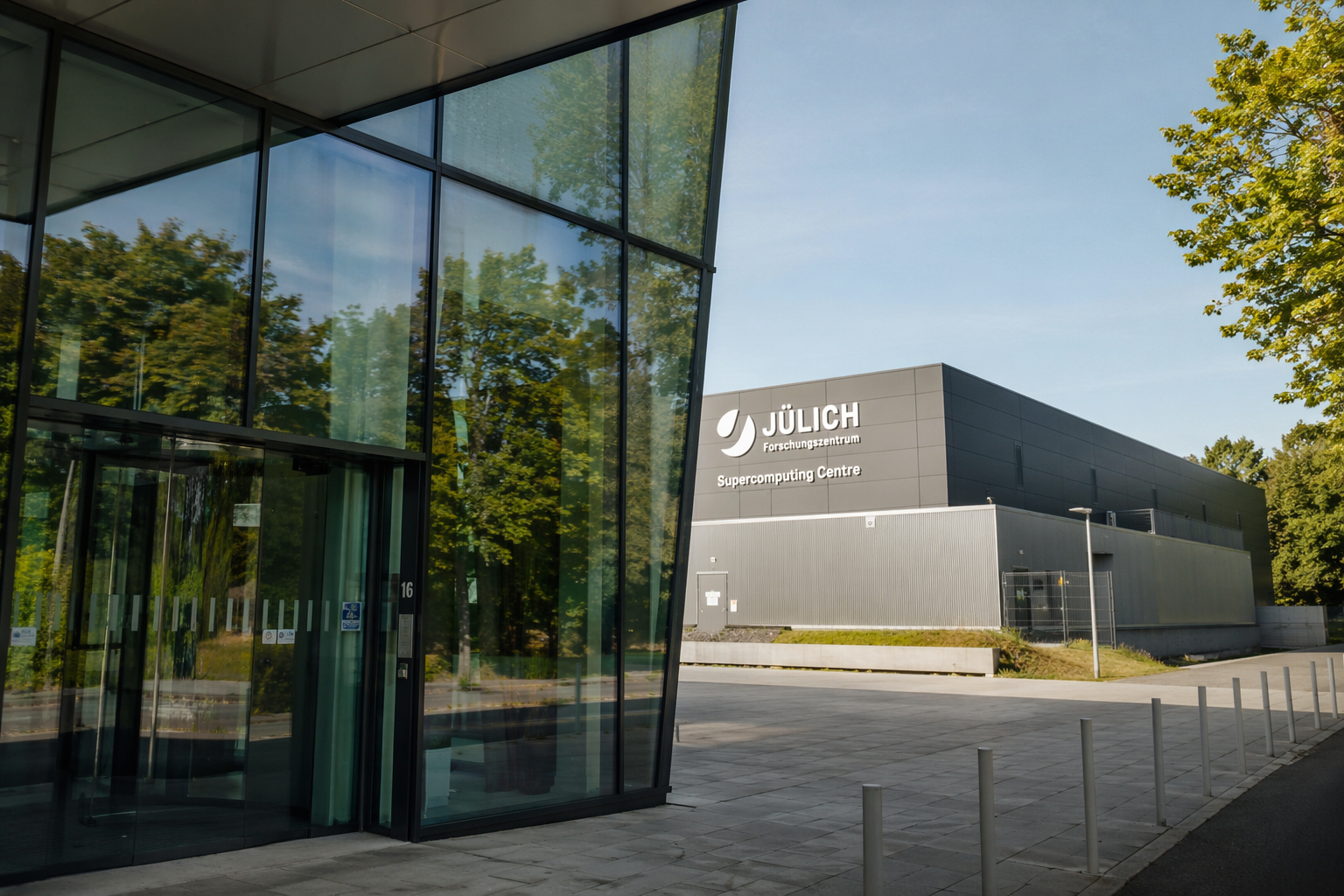
The landscape of High-Performance Computing (HPC) is undergoing a massive transformation, driven by the convergence of exascale capabilities, quantum technology, and artificial intelligence. As the premier global forum for these technologies, ISC High Performance 2026 serves as the critical meeting ground where researchers, system architects, and industry leaders map out the future of advanced computing. At the center of this dialogue is the Jülich Supercomputing Centre (JSC), a cornerstone of Europe's supercomputing infrastructure and a key member of the Gauss Centre for Supercomputing (GCS).
At ISC 2026, JSC is showcasing its leadership across two distinct exhibition areas, headlined by Booth #Z01. The central theme of their showcase centers on three pillars:
- The JUPITER Exascale Supercomputer: As Europe’s pioneer in exascale class computing, JUPITER represents an unprecedented leap in raw computational power, capable of executing over a billion billion calculations per second.
- Quantum Integration: Rather than viewing quantum as a standalone silo, JSC is leading the charge in integrating quantum machines with classical HPC environments, enabling hybrid classical-quantum workflows that solve previously intractable optimization problems.
- Democratizing AI Scale: Beyond hardware, JSC researchers are heavily contributing to the ISC 2026 academic program. A prime example is JSC's Andreas Herten, who is organizing the highly anticipated tutorial “Efficient Distributed GPU...” to help developers optimize massive AI training runs across distributed systems.
The Shift from Scientific Compute to Practical AI Infrastructure
The advancements pioneered by JSC are not occurring in a vacuum. In 2026, the boundaries between elite scientific supercomputing and commercial AI deployment are blurring. High-performance clusters are no longer reserved solely for climate modeling or molecular physics; they are the engines training the foundational LLMs that power daily business operations.
However, raw supercomputing power is only half of the equation. While institutions like JSC build the high-performance backend, enterprise application demands a different kind of infrastructure to make this intelligence actionable. For instance, while exascale systems train massive models, commercial communication platforms like CallMissed act as the bridge to the end-user. By leveraging high-performance API gateways, CallMissed allows businesses to deploy these highly advanced models into production instantly—supporting voice agents, real-time Speech-to-Text in 22 regional Indian languages, and unified LLM routing across 300+ models.
Ultimately, JSC's presence at ISC 2026 highlights a crucial reality: the future of technology relies on a continuous spectrum of computation. It starts with exascale and quantum research at the foundational layer and extends all the way to low-latency, API-driven communications at the edge.
Key Developments (TABLE)
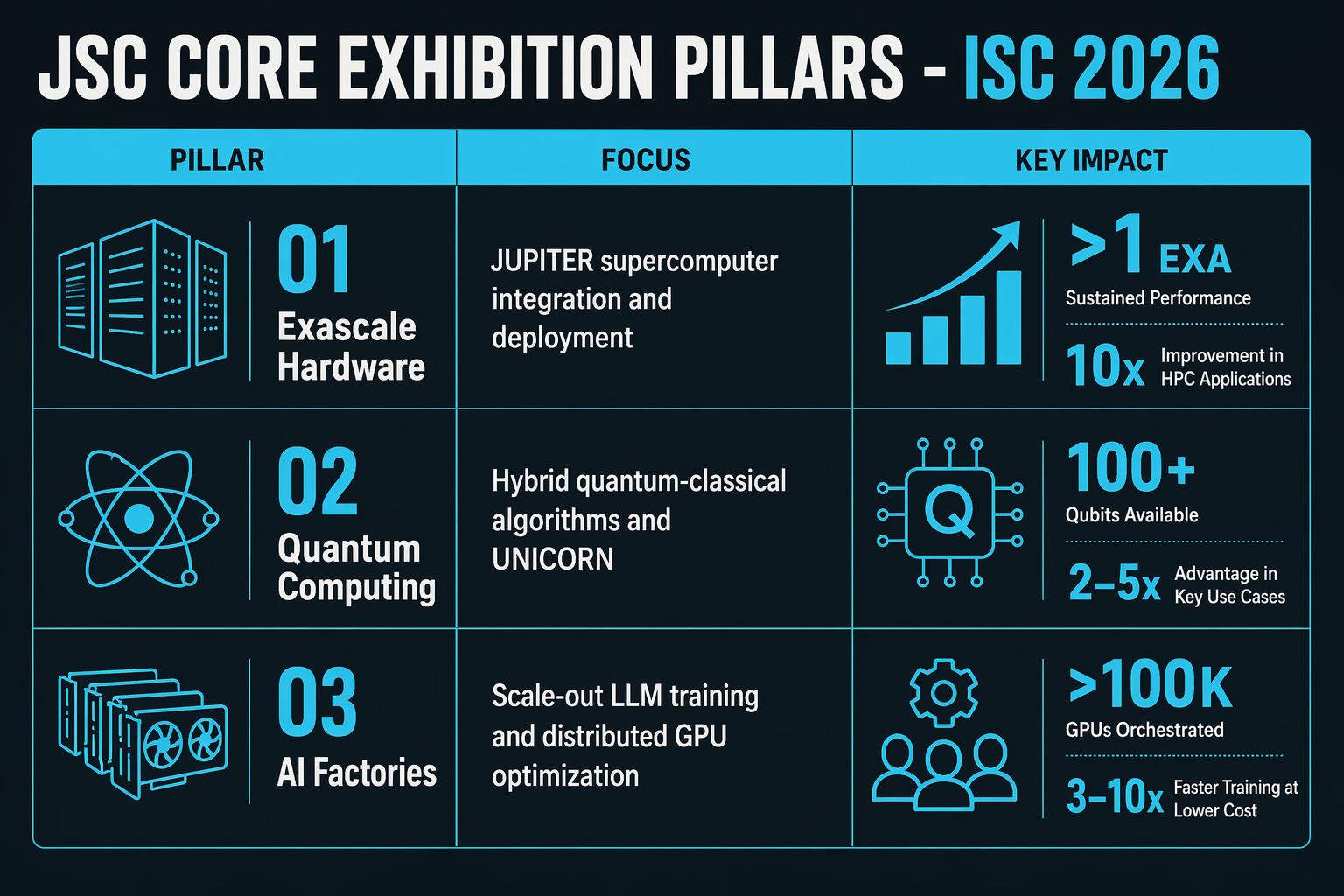
The convergence of exascale computing, quantum technology, and artificial intelligence represents the frontier of modern scientific discovery. At ISC 2026, the Jülich Supercomputing Centre (JSC) is anchoring this shift by demonstrating how these three pillars are no longer isolated domains, but rather deeply integrated components of a single, unified computing ecosystem.
JSC’s double exhibition presence—headlined by Booth #Z01—serves as a primary venue for revealing real-world benchmarks, architectural integrations, and training methodologies. To understand the sheer scale of the developments being presented, the table below outlines the core technological focus areas showcased by JSC at the event:
| Technology Pillar | Key System / Initiative | Primary Technical Focus | ISC 2026 Presentation Focus |
|---|---|---|---|
| Exascale Computing | JUPITER Supercomputer | Trillion-parameter AI & massive physics simulation | First-hand insights into exascale operations |
| Quantum Computing | JUNIQ Infrastructure | Hybrid quantum-classical algorithms | Coupling quantum hardware directly with HPC |
| AI Optimization | Distributed GPU Training | High-efficiency deep learning scaling | Tutorial on maximizing multi-GPU throughput |
| Modular Architectures | MSA (Modular Supercomputing) | Dynamic workload allocation across clusters | Demonstration of unified software stacks |
Bridging Exascale and Enterprise AI
The JUPITER supercomputer, Europe’s pioneer in exascale-class computing, stands at the absolute center of JSC's program. JUPITER is designed specifically to handle highly complex simulations alongside massive artificial intelligence workloads.
However, scaling AI to this level introduces significant software and training hurdles. To address this, JSC researchers are delivering targeted technical sessions, including an intensive tutorial organized by Andreas Herten titled "Efficient Distributed GPU Training". This tutorial unpacks the optimization techniques necessary to scale deep learning networks across thousands of GPUs without running into communication bottlenecks.
While JUPITER represents the peak of scientific research computing, translating these breakthroughs into practical, everyday commercial use cases requires accessible API middleware. For organizations looking to implement high-throughput AI without managing exascale infrastructure, platforms like CallMissed provide the necessary software gateway, allowing developers to orchestrate and deploy over 300+ LLMs for production-ready voice and text communication agents.
The Rise of Hybrid Quantum-Classical Systems
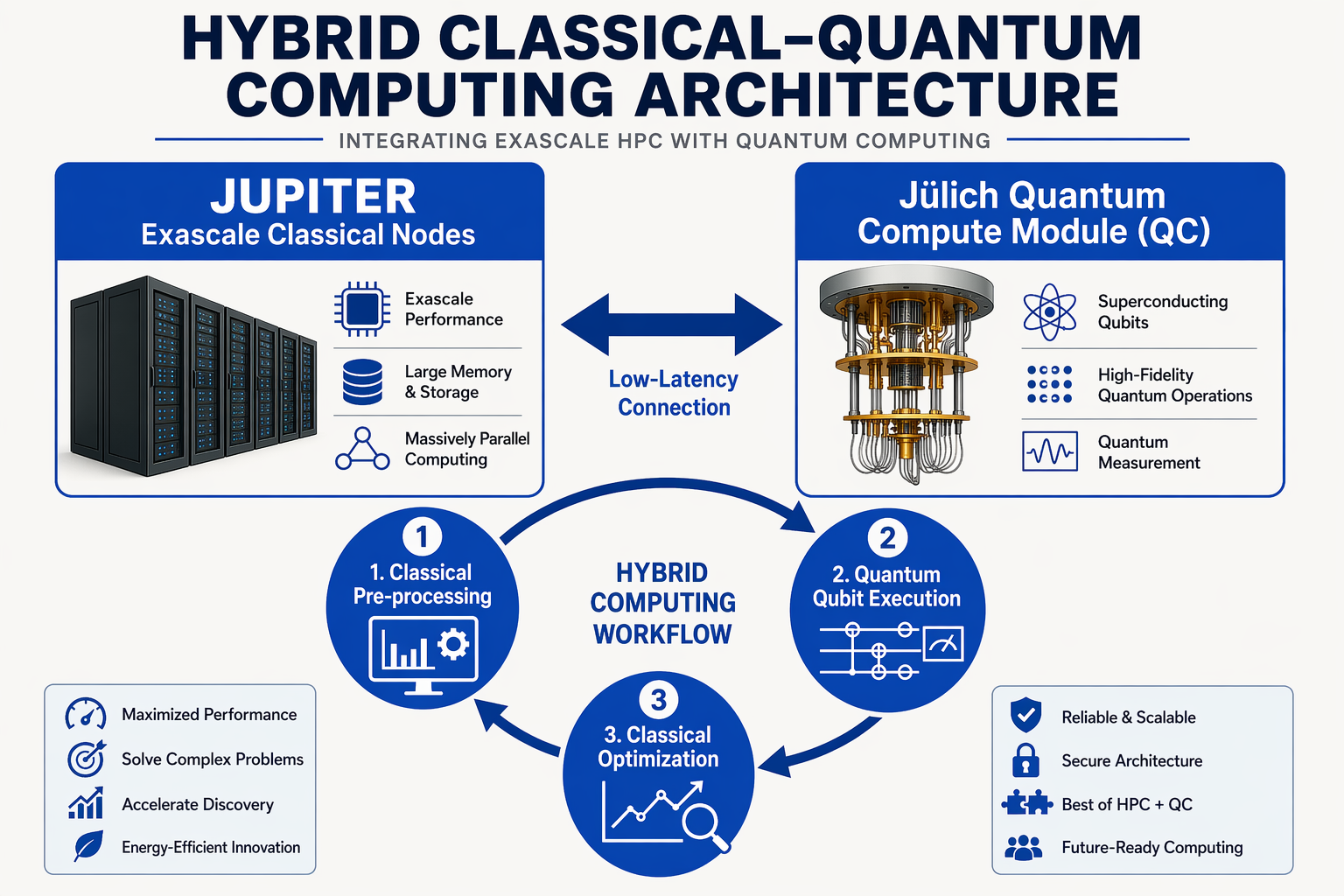
Another critical development highlighted by JSC at ISC 2026 is the physical and logical integration of quantum processing units (QPUs) with classical supercomputers. Through the Jülich Unified Infrastructure for Quantum Computing (JUNIQ), researchers are demonstrating how hybrid quantum-classical algorithms can solve optimization problems that are currently intractable for classical systems alone.
Rather than treating quantum computing as a standalone novelty, JSC’s presentations illustrate how low-latency connections between GPU-accelerated clusters and QPUs are being realized. This architectural framework ensures that classical supercomputers can offload specific math-heavy subroutines to quantum coprocessors, establishing a benchmark for the next decade of heterogeneous high-performance computing.
In-Depth Analysis
The Jülich Supercomputing Centre (JSC) is anchoring its ISC 2026 presence around the convergence of three foundational pillars: exascale computing, quantum integration, and deep learning. By analyzing JSC’s contributions—headlined by their interactive presentations at Booth #Z01—we can see how high-performance computing (HPC) is evolving from a purely scientific tool into the ultimate engine for next-generation artificial intelligence.
The JUPITER Paradigm: Exascale AI in Action
At the heart of JSC's showcase is JUPITER, Europe’s premier exascale supercomputer. JUPITER represents a massive leap forward, capable of executing over one billion billion calculations per second (one exaflop). Unlike historical supercomputers built strictly for physics simulations, JUPITER is architected from the ground up to support massive AI workloads:
- Foundation Model Training: The system's unparalleled compute density allows researchers to train foundational AI models with trillions of parameters, reducing training times from months to mere days.
- Modular Supercomputing Architecture (MSA): JUPITER utilizes MSA to dynamically allocate resources, pairing general-purpose CPUs with highly specialized GPU accelerators depending on the specific phase of the AI training pipeline.
Bridging the Gap: Hybrid Quantum-Classical Systems
Another major focus for JSC at ISC 2026 is the practical integration of quantum computing into classical HPC environments. Rather than viewing quantum as a standalone replacement, JSC advocates for a hybrid model where classical supercomputers and quantum simulators work in tandem.
- Co-processing Power: Under this framework, quantum processing units (QPUs) handle highly specific optimization tasks, while classical GPUs manage raw data processing and neural network training.
- Optimizing Distributed Nodes: Managing these complex, hybrid architectures requires highly optimized communication protocols. To address this bottleneck, JSC researcher Andreas Herten is leading a specialized tutorial at ISC 2026 titled "Efficient Distributed GPU...", targeting the critical software techniques needed to scale deep learning workloads across thousands of GPUs without latency degradation.
Democratizing Supercomputing Insights for Enterprise AI
While exascale systems like JUPITER run in highly specialized research facilities, the architectural breakthroughs developed at JSC directly influence the broader commercial AI ecosystem. The software optimizations, distributed training techniques, and multi-node GPU efficiencies showcased at ISC 2026 are what make real-world, low-latency AI applications viable.
For instance, commercial communication platforms like CallMissed rely heavily on these underlying infrastructure advancements. CallMissed’s ability to offer ultra-low-latency Speech-to-Text APIs across 22 Indian languages and real-time LLM inference spanning over 300+ models depends on highly optimized, distributed GPU environments. As supercomputing centers solve the challenges of distributed orchestration and model optimization at the exascale level, enterprise platforms can more reliably deploy production-ready AI voice agents and multilingual chatbots that respond in milliseconds.
Ultimately, the innovations spotlighted by JSC at ISC 2026 prove that the future of AI is not just about building larger models, but about mastering the highly integrated, hybrid, and efficient infrastructure that powers them.
Impact & Implications
The breakthroughs highlighted by the Jülich Supercomputing Centre (JSC) at ISC 2026—particularly regarding the JUPITER exascale supercomputer and quantum-classical integration—carry profound implications for the global technology ecosystem. As high-performance computing (HPC), quantum systems, and artificial intelligence converge, the boundaries of what is computationally possible are shifting. This creates a powerful ripple effect, translating fundamental scientific research into enterprise-level applications.
Democratizing Exascale AI and Distributed Computing
The sheer scale of the JUPITER system demonstrates that the next frontier of artificial intelligence relies on massive, distributed computational power. However, physical hardware is only half the battle; the real impact lies in software optimization. Sessions at ISC 2026, such as Andreas Herten’s tutorial on "Efficient Distributed GPU" programming, address a critical industry bottleneck: maximizing hardware efficiency across thousands of interconnected nodes.
By mastering distributed GPU architectures, developers can train larger foundational models faster and with significantly reduced energy footprints. This computational efficiency directly trickles down to commercial AI infrastructure. For instance, advanced communication platforms like CallMissed rely on highly optimized LLM inference gateways to serve over 300+ models to global enterprises. The optimization techniques pioneered at research centers like JSC eventually find their way into mainstream production environments, allowing APIs to deliver ultra-low-latency, multilingual speech-to-text and conversational AI.
The Quantum-Classical Convergence
Another major takeaway from the ISC 2026 program is the physical integration of quantum computing with classical HPC infrastructure. Rather than viewing quantum as a standalone replacement, the industry is embracing a hybrid model. This integration yields several immediate benefits:
- Solving Complex Optimization Problems: Hybrid systems can tackle combinatorial optimization, cryptography, and molecular simulations far more efficiently than classical computers alone.
- Accelerating AI Training Loops: Quantum coprocessors can speed up specific neural network calculations, laying the groundwork for practical Quantum Machine Learning (QML).
- Bridging the Lab-to-Market Gap: Connecting research-grade quantum systems to real-world deployment pipelines ensures that quantum breakthroughs move quickly from theoretical concepts to commercial applications.
Translating Raw Power to Real-World Value
Ultimately, the advancements spotlighted by JSC at booth #Z01 and throughout the ISC 2026 program bridge the gap between high-level academic research and practical deployment. As exascale supercomputers and hybrid quantum-classical architectures become more accessible, the cost of running complex AI workflows will continue to fall. This democratizes access to state-of-the-art tools, enabling businesses to deploy sophisticated multilingual voice agents and real-time transcription systems—such as those supporting 22 regional Indian languages on the CallMissed platform—without requiring multi-million dollar in-house infrastructure budgets.
Expert Opinions
The convergence of exascale computing, quantum hardware, and advanced artificial intelligence at ISC 2026 has ignited intense debate among global technology leaders. As the Jülich Supercomputing Centre (JSC) showcases its latest breakthroughs at Booth #Z01, researchers and industry experts are sharing crucial insights on how these computing paradigms will shape the remainder of the decade.
Maximizing Compute Efficiency via Distributed GPUs
A major talking point among systems architects at ISC 2026 is the urgent need to optimize distributed infrastructure. As AI models scale exponentially, standard computing architectures are hitting physical limits.
- Efficient GPU Scaling: JSC researcher Andreas Herten, a key contributor to this year's program, emphasizes that the bottleneck is no longer just raw hardware, but how efficiently we distribute workloads. In his ISC 2026 tutorial on "Efficient Distributed GPU" systems, Herten highlights that mastering distributed memory and interconnect pipelines is crucial to unlocking the true potential of multi-node GPU clusters.
- The Exascale Standard: With the emergence of Europe’s premier exascale supercomputer, JUPITER, experts agree that we are entering an era where computational modeling and deep learning are indistinguishable. JUPITER’s architecture is designed to handle massive AI workloads natively, serving as a blueprint for future industrial AI installations.
The Era of Hybrid Quantum-Classical Systems
Another consensus emerging from the panel discussions at ISC 2026 is that quantum computing will not replace classical systems, but rather supercharge them.
According to researchers at the Gauss Centre for Supercomputing (GCS), the immediate future belongs to hybrid quantum-classical computing. By integrating quantum co-processors directly into classical exascale environments like JUPITER, scientists can offload highly complex optimization and simulation tasks. This hybrid approach represents a dramatic leap forward, bridging the gap between theoretical quantum mechanics and practical, real-world applications.
Translating High-Performance Infrastructure for the Enterprise
While organizations like JSC push the boundaries of extreme-scale research, industry analysts note a growing demand to translate these computational breakthroughs into accessible commercial infrastructure. The high-performance techniques developed for distributed GPUs and multi-node clusters are rapidly trickling down to production environments.
For instance, platforms like CallMissed are leveraging these optimized infrastructure patterns to provide enterprise-grade AI communication tools. By utilizing highly optimized multi-model API gateways, CallMissed allows developers to deploy AI voice agents and access over 300+ LLMs without managing complex, distributed hardware backends. Just as JSC researchers optimize distributed GPUs for scientific simulation, communication platforms use parallelized, low-latency Speech-to-Text pipelines supporting 22 regional languages to handle thousands of concurrent calls seamlessly.
As the discussions at ISC 2026 make clear, the true metric of success for next-generation computing lies in how effectively we can democratize this immense power—moving it from isolated supercomputing centers directly into the hands of global developers and businesses.
What This Means For You (TABLE)
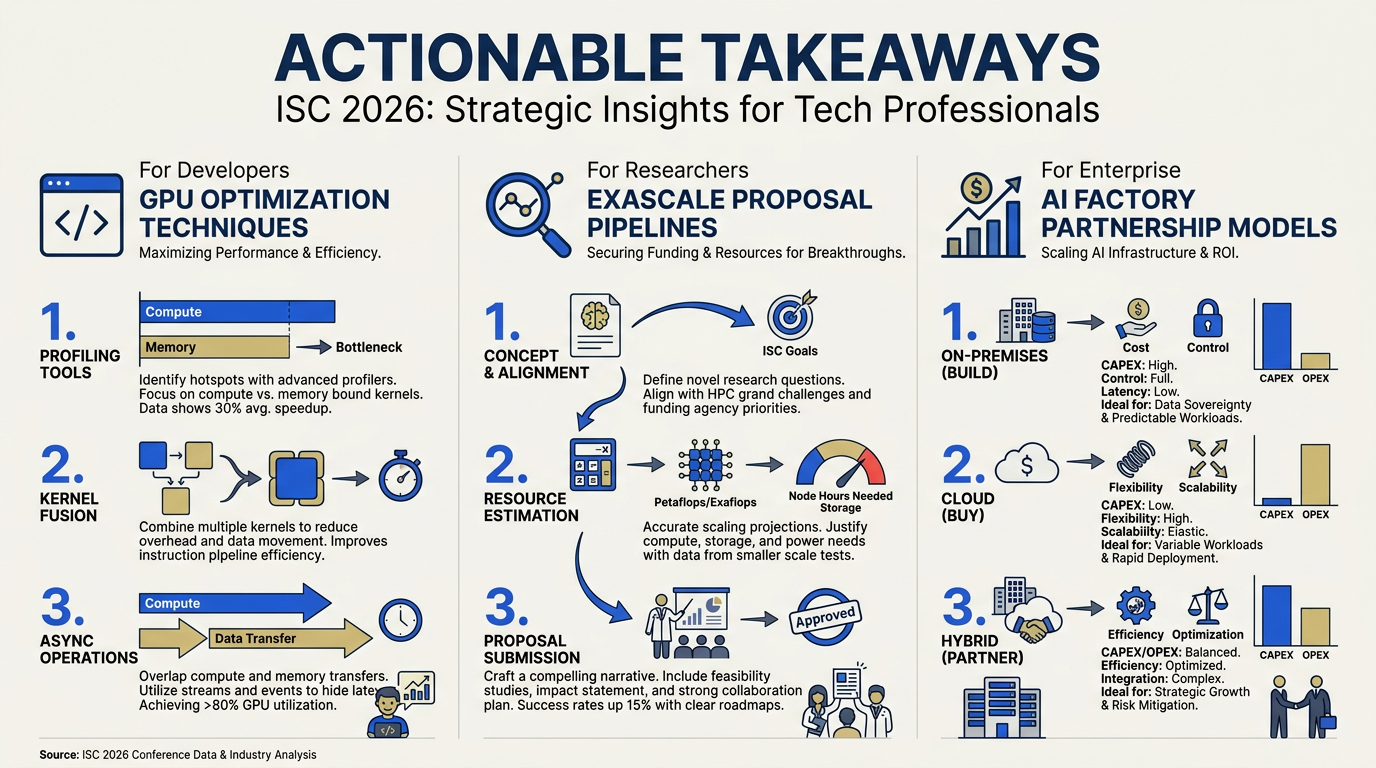
The breakthroughs showcased by the Jülich Supercomputing Centre (JSC) at ISC 2026 represent more than just academic milestones; they signal a massive shift in how commercial enterprises, researchers, and developers build and scale technology. From the raw power of the JUPITER exascale supercomputer to highly optimized distributed GPU architectures, the computational paradigms established here will directly dictate the next generation of consumer and enterprise software.
For decision-makers looking to navigate this transition, understanding where these high-performance computing (HPC) innovations intersect with real-world applications is crucial. The table below outlines what these advancements mean for your specific workflow.
| Stakeholder Group | Key ISC 2026 Focus Area | Practical Real-World Impact | Actionable Next Step |
|---|---|---|---|
| Enterprise Leaders | Hybrid Quantum-Classical Systems | Optimizes complex logistics, high-frequency financial modeling, and supply chain bottlenecks. | Assess current computational pipelines for quantum-hybrid compatibility. |
| AI Developers | Distributed GPU Training | Dramatically accelerates training times and lowers costs for custom foundational models. | Implement scaling frameworks highlighted in JSC’s "Efficient Distributed GPU" workshops. |
| Research Institutions | Exascale Computational Power | Enables ultra-high-resolution climate modeling and molecular-level drug discovery. | Apply for research allocations on Europe's JUPITER supercomputer. |
| Product Managers | Scalable AI Inference & Voice Tech | Powers low-latency, context-aware customer interactions across global regions. | Deploy production-ready AI agents using robust middleware. |
From Exascale Science to Everyday Software
The research coming out of JSC’s ISC 2026 sessions—such as Andreas Herten’s tutorial on "Efficient Distributed GPU" training—focuses heavily on solving the efficiency bottlenecks of modern machine learning. In the past, only tech giants could afford to train and run massive, multi-billion parameter models. Now, optimized distributed training techniques are democratizing access to high-tier AI.
As these massive models become highly optimized at the supercomputer level, they trickle down into commercial application programming interfaces (APIs). This is where the gap between raw research and industry implementation is bridged. While organizations like JSC push the boundaries of raw computational physics, platforms like CallMissed make these breakthroughs accessible to businesses. By providing a unified infrastructure that offers ultra-low latency LLM inference across over 300+ models and advanced Speech-to-Text capabilities in 22 regional Indian languages, CallMissed translates the computational efficiency pioneered at events like ISC 2026 into practical, scalable tools for everyday customer communication.
Preparing for the Quantum-Classical Hybrid Era
A major talking point at ISC 2026 is the integration of quantum coprocessors with classical exascale systems. Rather than waiting for "pure" quantum computers—which are still years away from broad commercial viability—industries are finding immediate success in hybrid architectures.
By leveraging classical HPC systems to handle the bulk of a workflow and offloading specific, highly complex mathematical formulas to quantum simulators, businesses can solve optimization problems that were previously computational dead-ends. Preparing for this shift means building modular, API-first software architectures today so that as hybrid backends become commercially available, your business can swap computing resources without rewriting your entire codebase.
Frequently Asked Questions
What will the Jülich Supercomputing Centre (JSC) highlight during the ISC 2026 event?
How is JSC presenting its exascale, quantum and AI advances at ISC 2026?
What is the JUPITER supercomputer, and why is it a focal point for JSC's ISC 2026 showcase?
How do the exascale, quantum, and AI advances shown at ISC 2026 impact commercial applications like CallMissed?
Who are some of the key JSC researchers presenting at the ISC 2026 program?
Where can attendees interact with JSC and explore their research at ISC High Performance 2026?
Conclusion
As ISC 2026 showcases, the convergence of exascale computing, quantum technology, and AI is no longer a distant vision—it is actively redefining the global scientific and business landscape. Key takeaways from JSC’s spotlight sessions include:
- JUPITER's Exascale Milestone: Leveraging Europe's premier exascale supercomputer to unlock next-generation computational capabilities.
- Quantum-Classical Hybridization: Integrating quantum machines with traditional HPC systems to tackle complex optimization challenges.
- Scalable AI Demystified: Deploying advanced distributed GPU architectures to train larger, more efficient AI models.
Looking forward, the critical development to watch is how these massive supercomputing breakthroughs will transition from research laboratories into practical, everyday commercial deployments. To explore how AI communication is evolving alongside these massive computational leaps, check out CallMissed — an AI infrastructure platform powering voice agents and multilingual chatbots for businesses.
As these powerful technologies continue to mature and merge, how will your organization leverage the next wave of exascale-driven AI intelligence?
Related Posts

Ready to automate customer conversations?
Launch AI voice agents and WhatsApp bots with CallMissed — one API, 22+ Indian languages.