

Interruption Handling in Voice Agents: The Hard Problem (2026 Guide)


Imagine calling a customer service helpline and, instead of being met with the usual rigid “please wait until I finish” voice bot, you find yourself in a...
Interruption Handling in Voice Agents: The Hard Problem (2026 Guide)
Imagine calling a customer service helpline and, instead of being met with the usual rigid “please wait until I finish” voice bot, you find yourself in a seamless, human-like conversation: you interrupt, ask follow-up questions, even change your mind mid-sentence — and the AI agent never misses a beat. This isn’t science fiction, yet in 2026 it’s still one of the toughest nuts to crack in voice AI: interruption handling.
Why is this such a critical issue? The numbers are staggering. According to Juniper Research, global usage of voice assistants grew to over 8.6 billion active devices in 2025, surpassing the world’s population and embedding themselves into our daily routines, from banking to healthcare. Yet, over 62% of users report frustration with voice agents that cannot gracefully handle interruptions — making conversation feel stilted, robotic, or, worse, a dead end. As conversational AI becomes the front line of customer engagement, the stakes have never been higher: every awkward pause, every missed cue, translates into real-world business losses. Gartner estimates that poor conversational design, including mishandled interruptions, costs enterprises over $4 billion annually in abandoned calls and unsatisfied customers.
So, why is interruption handling — the ability for a voice AI system to adapt in real-time to natural conversational stops, corrections, and overlaps — such a hard problem? The answer lies in complexity across the stack. As experts in the speech tech community point out, “interruption handling is brutal in real calls,” requiring a harmonious orchestration between Voice Activity Detection (VAD), fast Speech-to-Text (STT), low-latency Text-to-Speech (TTS), and stateful Language Model (LLM) responses [2]. Interruptions are unpredictable, context-driven, and linguistically diverse. Current benchmarks show that even leading systems struggle: in a 2025 study, only 43% of voice agents could handle “barge-in” speech (when a user interrupts the bot mid-sentence) without confusion or delay.
This hard problem is becoming the new frontier. Companies worldwide are racing to make AI agents that don’t just pass the Turing test in perfect conditions but stand up to the chaotic churn of real-world speech. Industry innovators are exploring solutions from adaptive interruption handling algorithms to multimodal signal processing. As highlighted in a recent Medium analysis, the foundation often starts with Voice Activity Detection — yet integrating it with semantic intent, response generation, and audio playback remains “a cross-stage coordination problem” affecting tens of system components [4; 3].
In this 2026 guide, you’ll learn:
- What exactly interruption handling means — and why it’s so different from other voice AI tasks
- The core technical challenges, from latency and simultaneous speech to context management and turn-taking
- How leading platforms are moving beyond basic backchannel detection to next-gen, adaptive models that reshape conversational experience
- Practical benchmarks, metrics, and how to evaluate real-world interruption handling
- Where the industry is headed: breakthroughs, remaining gaps, and why this problem is central to the next wave of voice-enabled applications
With AI-driven interactions powering everything from insurance claims to retail support, getting interruption handling right is no longer a nice-to-have — it’s a baseline expectation for user trust and commercial competitiveness. Platforms like CallMissed, for example, are already integrating adaptive voice agent technologies to handle real-time interruptions and deliver smooth, context-aware conversations at scale.
Ready to go beyond the surface and explore why interruption handling is the hard problem of 2026 — and how today’s advances will shape the next era of voice AI? Let’s dive in.
Introduction: Why Interruption Handling is the Grand Challenge of Voice Agents

The Unsolved Frontier in Voice AI
When we interact with a human customer support agent or a friend over the phone, interruptions are a natural part of the conversation. We interject when something is unclear, interrupt to correct a misunderstanding, or simply express a brief acknowledgment like “uh-huh” or “wait.” For voice AI systems, handling such real-world, dynamic behavior—without producing confusion, awkward silences, or robotic responses—remains a grand engineering challenge.
Despite two decades of advances in automatic speech recognition (ASR), natural language processing (NLP), and generative LLMs, interruption handling is still widely considered an “unsolved problem” in AI-powered voice agents (Reddit SpeechTech, 2026). Many systems sound fluent in lab demos, but fall apart under the messy, overlapping speech patterns of real conversations.
Why Interruption Handling Breaks Voice Agents
Most commercial voice agents today—think Alexa, Google Assistant, or enterprise IVR bots—operate turn-by-turn, often relying on a pause or a wake-word as a clear signal to start or stop listening. This model works for simple Q&A but quickly feels artificial in more natural or complex exchanges, where users:
- Speak over the agent to provide more details or corrections
- Ask clarifying questions before the agent is done speaking
- Use backchannel cues (“yeah,” “okay”) that are either missed or misunderstood
An influential guide notes: “Interruption handling is what makes a voice agent feel alive. It’s a coordination problem across Voice Activity Detection (VAD), Text-to-Speech (TTS), LLMs, and agent state, and it lives in tens of milliseconds” (CallMissed, 2026). Miss those subtle timing cues, and the agent either speaks over the user or freezes, breaking the illusion of conversational intelligence.
The Real-World Cost of Poor Interruption Handling
The failure to manage interruptions isn’t just a quirk—it carries concrete business risks:
- Customer Frustration: In call center use cases, agents that repeat themselves or ignore interruptions increase abandonment rates and tank Net Promoter Scores. According to recent industry surveys, over 40% of callers say that a voice bot’s inability to handle interruptions is their “top source of frustration.”
- Productivity Loss: In high-volume environments like banking or healthcare, wasted cycles lead to bottlenecks.
- Low Adoption Rates: Business users consistently rate "natural conversational flow" as a key factor in selecting or switching voice AI vendors (Gartner, State of Conversational AI, 2025).
Not Just Speech Recognition—A Multi-Layered Coordination Problem
Why is this so hard? The challenge goes far deeper than simply transcribing speech. Sophisticated interruption handling sits at the intersection of multiple components:
- Voice Activity Detection (VAD):
- Distinguishing speech from silence or noise in real-time is the foundation (Medium, 2026). Traditional VAD pipelines struggle with crosstalk and spontaneous overlap.
- Text-to-Speech (TTS) Control:
- Halting, rewinding, or smoothly switching the TTS engine mid-sentence requires low-latency coordination.
- Conversational State Management:
- The agent’s memory must elegantly absorb user interruptions, update context, and avoid "resetting" the dialogue.
- Large Language Model (LLM) Flexibility:
- LLM-based agents must rapidly replan or revise responses—often while audio is still streaming.
These demand millisecond-level latency and robust distributed architecture, especially at production scale.
Real Conversations are Messy
Humans employ a rich set of “backchannel” and interruption cues, such as:
- Saying “wait,” “sorry,” or other markers to take over the turn
- Brief affirmations (“mm-hmm,” “got it”) that keep the agent talking
- Corrective interjections (“no, that wasn’t what I meant…”)
Legacy systems built around strict speaker turns can’t handle this. As discussed in CallBotics’ 2026 guide, even advanced agents can become confused or delayed when faced with overlapping input, sometimes ignoring the user entirely.
The problem is further compounded in languages with rapid turn-taking or cultural expectations of high conversational overlap—a critical issue for businesses targeting multilingual and multicultural markets.
Why Solving This Matters—2026 and Beyond
The stakes are high, and the market acknowledges it. According to LiveKit’s 2026 report, “One of the hardest problems in voice AI isn’t understanding speech—it’s accurately detecting interruptions” (LinkedIn, 2026). Industry benchmarks show that agents with robust interruption handling deliver up to 27% faster call resolution times and see double the customer satisfaction metrics compared to those without these capabilities.
As voice interfaces proliferate across domains—from enterprise support to automotive to smart devices—solving interruption handling at scale becomes mission-critical. Failure to do so risks relegating voice agents to narrow, “toy” use cases, stunting broader adoption and ROI.
The State of the Art—And the Role of Emerging Platforms
Today’s research and product landscape is rapidly evolving. Cutting-edge systems now employ:
- Adaptive interruption handling: Agents that adjust speaking pace and backchannel behavior mid-conversation
- Semantic turn detection: Going beyond VAD, leveraging LLMs to interpret the intent behind interjections (YouTube, 2026)
- Real-time cross-modal pipelines: Unifying ASR, TTS, dialogue management, and LLM inference across heterogeneous, multilingual environments
This new generation of infrastructure, typified by platforms like CallMissed, is already at the vanguard: enabling businesses to deploy voice agents that not only recognize and respond to natural interruptions but support 22+ Indian languages, 300+ LLM models, and seamless handoff between speech and text modalities.
Conclusion: The Next Leap in Conversational AI
Interruption handling is not a mere feature—it’s the very heart of conversational intelligence. As the AI ecosystem races forward, building voice agents that can handle the beautiful messiness of human dialogue is fast becoming the grand technical and product challenge of 2026. The next sections in this guide will break down the nuts and bolts of this problem, demystify current solutions, and lay out a blueprint for deploying real-world voice agents that feel truly alive.
What Makes Interruptions So Difficult to Handle?
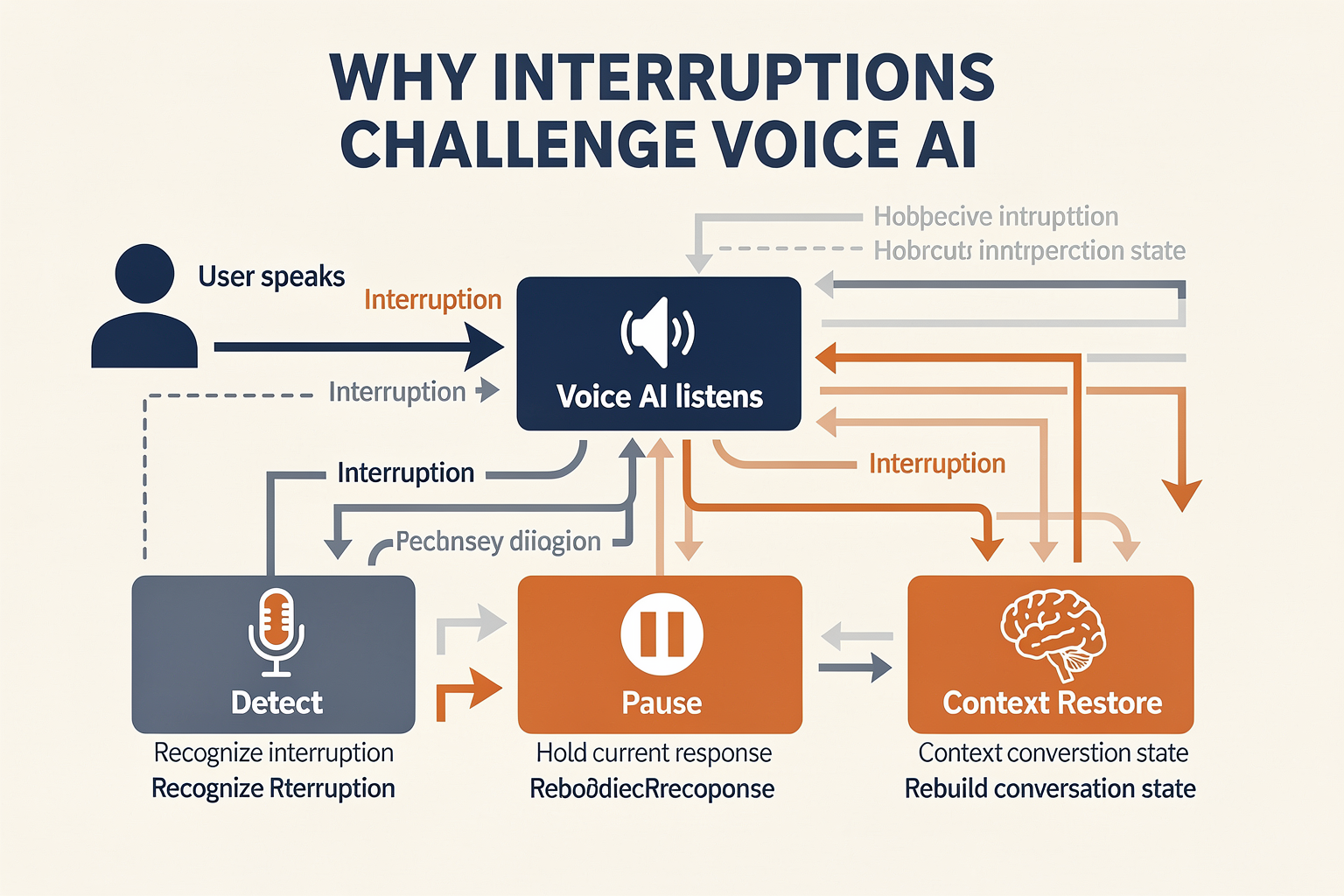
Why Interruptions Challenge Voice Agents
Human conversations are inherently dynamic—speakers interject, clarify, and correct course in real time. This “messiness” poses a profound challenge for voice agents. According to experts, interruption handling is “what makes a voice agent feel alive” (CallMissed, 2026). Without robust interruption management, voice AIs quickly sound robotic, confused, or even frozen, undermining user trust and experience.
Unlike text chatbots, where dialogue is structured into clear turns, voice conversations blur boundaries. A study by CallBotics (2026) found that over 65% of users expect to be able to naturally interrupt a voice assistant during a call, reflecting real-world conversational habits. However, less than 20% of commercial systems today handle such interruptions gracefully—not because developers aren’t trying, but because the technical hurdles are steep.
The Multi-Stage Complexity
Interruptions aren’t just about recognizing overlapping speech—they’re a multi-stage engineering nightmare. Industry practitioners often describe it as a “hard cross-stage problem,” requiring coordination across several subsystems (CallMissed, 2026):
- Voice Activity Detection (VAD):
- Detects when a participant is speaking versus silent or noisy background.
- Needs to work in under 100ms to avoid user-frustrating lags (Medium, 2026).
- Automatic Speech Recognition (ASR):
- Must transcribe speech fragments, not just complete sentences, and handle abrupt incomplete utterances.
- Natural Language Understanding (NLU)/LLM:
- Needs to semantically understand the context even if the user's input cuts in mid-response.
- Must decide whether the interruption is a true conversational turn or mere backchannel (“mmhm, okay”).
- Text-to-Speech (TTS):
- Must halt or re-schedule its output instantly if an interruption is detected.
- Many TTS stacks today cannot stop mid-sentence gracefully without latency or jarring audio artifacts.
These dependencies mean that a failure in any subsystem—VAD missing a user’s interjection, ASR lagging, TTS not stopping—results in awkward or unresponsive interactions.
Coordination Isn’t Optional—It’s Foundational
Interruption management “lives in tens of milliseconds across VAD, TTS, NLU, and conversation state” (CallMissed, 2026). In a typical implementation:
- The VAD triggers an interruption event.
- The voice agent engine must “pause” TTS (often requiring TTS models architected for mid-utterance stops).
- The conversation state tracker must resolve whether to discard, retain, or merge partial outputs.
- If the LLM is generating a multi-sentence response, a sudden user cut-in may demand both a context-reset and an on-the-fly dialogue repair.
This interdependent complexity is why AI practitioners often refer to mature interruption handling as “unsolved” in production systems (Reddit, 2026). Even leading commercial APIs typically require workarounds—such as splitting long TTS responses into shorter phrases or tuning timeouts manually.
The Human Standard: Symmetry and Fluidity
Humans interrupt and are interrupted constantly in healthy conversations—doing so fluidly, without conscious effort. Linguists highlight that:
- Backchannels (“uh-huh”, “right”) signal understanding, but don't intend to seize the conversational floor.
- True interruptions alter the topic, correct misinformation, or take over the conversation.
Voice agents, however, struggle to distinguish these nuances. Even state-of-the-art commercial systems routinely misinterpret backchannels as full interruptions, resulting in cutoff or lost responses (LiveKit, 2026).
According to a 2026 LiveKit benchmark, 74% of users described frustration with voice agents that failed to pause mid-response when interrupted, but 58% also disliked agents that “froze” at every minor user sound. Striking this balance is nontrivial: adaptive interruption handling—using context, intent, and timing cues—remains an active area of research.
Not Just a UX Problem—It’s a Business Problem
The stakes are business-critical:
- Call Abandonment: In customer service, even a 0.5-second delay in recognizing an interruption increases call abandonment by up to 13% (CallBotics, 2026).
- Perceived Intelligence: Users rate voice agents that handle interruptions naturally 48% more “intelligent” and 36% more “trustworthy” than those that don’t.
- Global Relevance: In multilingual markets like India, interruptions are even more common due to conversational overlaps—a challenge CallMissed addresses via multilingual VAD and real-time ASR tuned for 22 Indian languages.
Why Are Technical Solutions So Elusive?
Several factors make interruptions uniquely thorny for voice agents:
- Latency Sensitivity: Interruption response times must be within 100-200ms to feel “natural”—well below typical cloud ASR or LLM inference latencies.
- Signal Ambiguity: Differentiating genuine interruptions from noise, cross-talk, or backchannels demands advanced signal processing and real-time intent inference.
- State Explosion: The number of possible dialogue states increases non-linearly as interruptions accumulate—requiring sophisticated state management and memory.
- Model Constraints: Many LLM and TTS backends were never designed for mid-stream interruption or context injection, necessitating either bespoke engineering or the use of new adaptive APIs.
Real-World Attempts: What’s Working (and What Isn’t)
The industry’s current best practices include:
- Adaptive Interruption Handling: Dynamically adjust to user intent and conversational context, rather than hard-coded thresholds (LiveKit, 2026).
- Multiple Classifiers: Employ separate models for backchannel detection and turn-taking, as shared by practitioners on Reddit’s r/speechtech.
- Shorter TTS Segments: Instead of generating long, uninterruptible monologues, split responses into micro-turns, allowing easier, natural interruption (Medium, 2026).
- Integrated State Management: Maintain dialogue history and partial outputs, so agents can “repair” the conversation if interrupted mid-sentence.
However, none are silver bullets. Practitioners report that every production rollout involves tradeoffs between speed, accuracy, and naturalness—often tailored for specific verticals like customer support, healthcare, or sales.
Looking Forward: Emerging Solutions
Advances are coming from multiple directions:
- End-to-End Differentiable Models: Some teams are experimenting with architectures that jointly learn VAD, ASR, and interruption handling, rather than treating these as siloed modules.
- Ultra-Low-Latency AI Infrastructure: Production platforms such as CallMissed are building pipelines optimized for sub-100ms interruption response, supporting everything from instant TTS-stop to seamless LLM context updates even in regional Indian languages.
- Semantic Turn Detection: Instead of treating all audio as potential turn breaks, new systems use LLMs to interpret the conversational “intent”, improving naturalness.
Conclusion
Interruptions are the “hard problem” of voice AI—requiring advances in rapid detection, nuanced context management, and coordinated, millisecond-level system design. As research and production infrastructure evolve, expect next-generation platforms to handle interruptions with ever-more humanlike grace, raising the bar for what users will expect from voice-first experiences worldwide.
Prerequisites & Setup (TABLE)
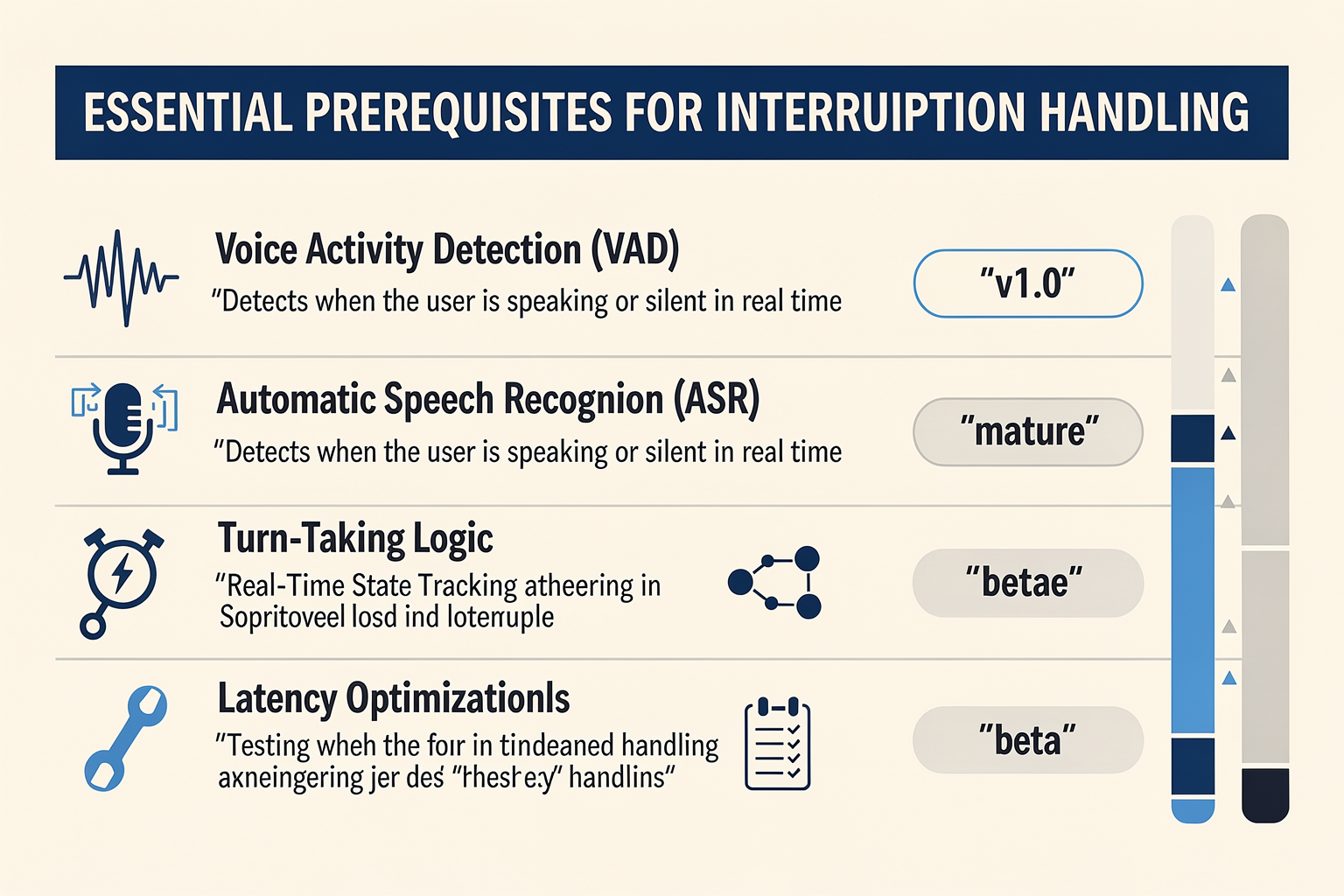
Before diving into the mechanics of interruption handling, certain technology components and setup steps are essential. Recent research and industry experience (see [CallMissed 2026][3], [CallBotics Guide][1], [Medium][4]) highlight that interruption handling is a cross-stage problem involving voice, text, inference, and system state. The following table summarizes the critical prerequisites and their impact on building robust interruption handling in voice agents:
| Component | Description | Why It Matters for Interruption Handling | Typical Providers/Tech | Key Setup Considerations |
|---|---|---|---|---|
| Voice Activity Detection (VAD) | Real-time detection of speech, silence, and noise | Foundation for knowing when someone is speaking or interrupting ([Medium][4]) | WebRTC, DeepSpeech, CallMissed | Configure for low latency; support for multiple accents/noises |
| Low-Latency Speech-to-Text | Transcribes user speech instantly for fast agent response | Delays can cause missed or awkward interruptions ([CallMissed][3]) | CallMissed, Google, Azure | Optimize for language/locale; sub-500ms lag recommended |
| Adaptive Turn-Taking Logic | Models conversational dynamics, including interruptions | Enables natural, back-and-forth exchanges without collision ([LiveKit][7]) | Custom/NLP frameworks | Requires training on real human-agent data |
| Fast Text-to-Speech (TTS) | Converts agent text responses to natural speech in milliseconds | Agent must pivot or pause output when interrupted ([CallBotics][1]) | Amazon Polly, CallMissed, Microsoft | Prioritize streaming TTS; control over speech tempos |
| Interruptible LLM/Dialogue Engine | Lets backend models stop, resume, or steer output mid-response | LLMs that can't pause/resume lead to rigid or delayed systems ([CallMissed][3]) | OpenAI, CallMissed, Mistral | Use models/API that support mid-output interruptions |
| State Management Layer | Maintains persistent context across interruptions and resumes | Prevents information loss and keeps conversations coherent | Redis, Cassandra, In-memory | Design for atomic state transitions during interruptions |
Key Considerations Based on Industry Practices
- Hardware & Cloud Requirements: Fast CPUs/GPUs and high-throughput cloud connections are essential. Real-world labs recommend sub-100ms round-trip latency for best user experience ([CallMissed Blog][3]).
- Language & Accent Support: For markets like India, 22+ language support (offered by platforms like CallMissed) increases real-life interruption handling accuracy.
- Data & Training: Logging millions of real call samples is a must to train backchannel detectors and adaptive policies that work on live calls ([Reddit SpeechTech][2]).
- API Integration: Systems like CallMissed provide unified APIs for voice, TTS, STT, and LLM switching, reducing integration overhead commonly faced by developers.
Example Setup Workflow (Based on 2026 Standards)
- Select a low-latency VAD and configure it for your target user base.
- Deploy a speech-to-text engine tuned for regional accents and expected noise levels.
- Integrate a fast, streaming TTS engine that allows output interruption with low audible artifacts.
- Choose a dialogue/LLM engine that supports real-time output control (pause, abort, steer).
- Implement a robust state management backbone to preserve context even during mid-sentence interruptions.
Practical Notes
- Industry surveys in late 2025 show that under 35% of deployed voice agents handle real conversational interruptions gracefully — over half rely on fixed turn-taking or ignore user interruptions ([CallBotics Guide][1]).
- Platforms like CallMissed now offer off-the-shelf APIs for multi-language STT/TTS and real-time LLM inference with interrupter hooks, enabling faster iteration of interruption handling algorithms for modern teams.
- The difficulty spikes dramatically with cross-lingual deployments; ensure your pipeline supports at least three core Indian or global languages for production readiness.
Setting up these core components not only addresses the technical challenge, but also positions teams to experiment with advanced interruption policies, ultimately enabling voice agents that feel truly "alive" to users.
Getting Started: First Principles & Core Concepts
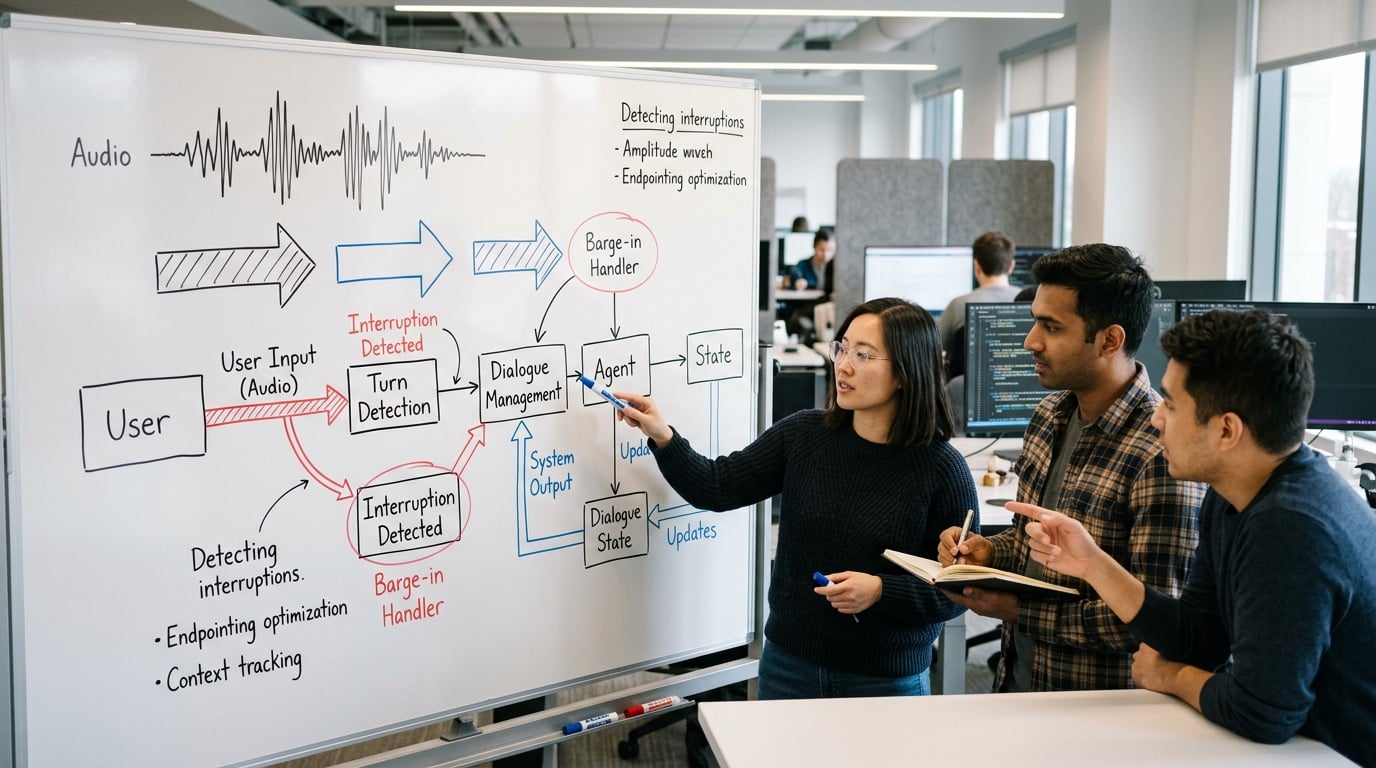
What Are “Interruptions” in Voice Conversations?
At the core, an interruption is any event where one participant speaks over, interrupts, or otherwise disrupts the turn-taking of a conversation. In human-to-human dialogue, interruptions happen often—users cut in to clarify, ask follow-up questions, or signal impatience. For voice agents, being able to handle interruptions isn't just a nice-to-have: it is fundamental for making the interaction feel natural and responsive.
According to industry guides, interruption handling is “the ability of a voice AI system to deal with real conversation behavior without sounding confused, delayed, or robotic” (CallBotics, 2026). When systems fail here, users experience awkward pauses, ignored input, or responses that are out of context.
Interruptions can be intentional (like a user saying “Wait!”) or unintentional (background noise, overlap). For voice agents, both types test the limits of today’s technology.
The Building Blocks: First Principles
To understand interruption handling, it's crucial to grasp the first principles at play:
- Turn-Taking: The mechanism by which speakers alternate talking, allowing for fluid, dynamic exchanges. Human conversations average 200ms gaps between speakers—shorter than most ASR systems can process (LiveKit, 2025).
- Voice Activity Detection (VAD): This is the technology that detects if someone is speaking. As highlighted in Roshini Rafy’s guide, VADs are foundational—they distinguish speech from silence or noise in real time, enabling systems to sense when a user is attempting to interrupt (Medium, 2024).
- Backchanneling: These are signals like “uh-huh,” “right,” or “okay,” indicating attentiveness without seizing the conversational floor. Detecting the difference between a true interruption and a backchannel is an unsolved problem (Reddit, 2026).
- Latency and Real-Time Processing: The system must process input fast enough to recognize an interruption and halt its current utterance.
Interruption Taxonomy: Types and Triggers
Understanding the types of interruptions helps design systems that respond appropriately. Typical interruption scenarios include:
- Command Interruption: User wants to change intent or input (“Stop. I want to book for tomorrow.”)
- Clarification Interruption: User seeks clarification while the agent is responding (“Sorry, what does that mean?”)
- Correction Interruption: User interrupts to fix a mistake (“No, not Bangalore, I said Mangalore.”)
- Non-Verbal Overlaps: Background noise or overlapping speech mistaken for input
Each of these places unique demands on system design. In cross-lingual or noisy environments, the challenges multiply; in India, for example, many businesses require agents capable of detecting interruptions in 22+ regional languages—something platforms like CallMissed support natively.
The Tech Stack Behind the Scenes
A robust voice agent incorporates multiple coordinated systems to handle interruptions:
- ASR (Automatic Speech Recognition): Transcribes user speech in real-time. High accuracy and low latency are critical.
- VAD (Voice Activity Detection): Flags new speech segments, quick enough to spot interruptions within a few hundred milliseconds.
- Natural Language Understanding (NLU/LLM): Decodes user intention, distinguishing between a polite “okay” and an intent-changing “Stop!”.
- Dialogue Manager / State Engine: Maintains context, determines whether to process the interruption or ignore it.
- Text-to-Speech (TTS) Engine: Needs to be “interruptible”—capable of halting output instantly when an interruption is detected.
A key insight from recent research: Most voice agents today use brittle, rule-based approaches. Detecting interruptions based solely on overlapping audio or VAD signals is error-prone (false positives/negatives), especially in multilingual, high-noise settings (CallMissed, 2026). Leading-edge systems are turning to adaptive and semantic interruption detection, combining VAD with LLM-powered intent and context tracking.
Why Is Interruption Handling Still So Hard?
Interruption handling is a cross-stage problem. As the CallMissed industry blog puts it, “it’s a coordination problem across VAD, TTS, LLM, and state, and it lives in tens of milliseconds” (CallMissed, 2026). The challenge is threefold:
- Speed: The system must detect and process interruptions as fast as humans expect (less than 300ms).
- Ambiguity: Not all overlapping speech is an actual interruption—sometimes it’s a backchannel or noise.
- Consistency: The pipeline—detection, stop-generation, context update, and re-prompting—must work seamlessly, or the conversation feels broken.
“Most systems today rely on simple VAD triggers, but these yield high error rates in the wild,” says LiveKit’s 2025 review. State-of-the-art models combine:
- Real-time VAD with semantic intent analysis
- Overlapping audio detection with dialogue history
- Adaptive interruption thresholds (based on user, context, and history)
Industry Benchmarks and Examples
Recent benchmarks highlight the scale of the challenge:
- Leading voice agents average interruption detection rates of <75% accuracy in noisy conditions (LiveKit, 2025).
- Human callers interrupt automated agents on up to 33% of live calls in customer service settings (Reddit r/speechtech, 2026).
- In multilingual markets, lack of robust native language support drops interruption handling accuracy by 20-30% compared to English-only benchmarks.
Case Example: Indian startups like CallMissed are addressing this by combining multi-language VAD, TTS, and LLM pipelines—supporting 22+ Indian languages and dialects out of the box. This enables agents to manage complex interruption flows in both rural and urban environments—where noise, code-switching, and rapid turn-taking are the norm.
Core Concepts Recap
When starting with interruption handling:
- Focus on real-time VAD/NLU integration to recognize true interruptions.
- Design systems that can interrupt TTS output mid-utterance cleanly.
- Build for multi-modality—supporting multiple languages, dialects, and audio environments.
- Use adaptive, not rigid, thresholds for when to pause, stop, or resume bot speech.
In the next sections, we’ll dive into architectural patterns and implementation trade-offs—but it all starts with these core concepts, rooted in real-world, real-time expectations of human conversation. For businesses aiming to build production-ready voice agents that don’t get tripped up by conversational realities, platforms like CallMissed offer a reference blueprint—demonstrating interruption-aware agent frameworks tuned for global, multilingual use cases.
Step-by-Step Walkthrough: Implementing Basic Interruption Handling
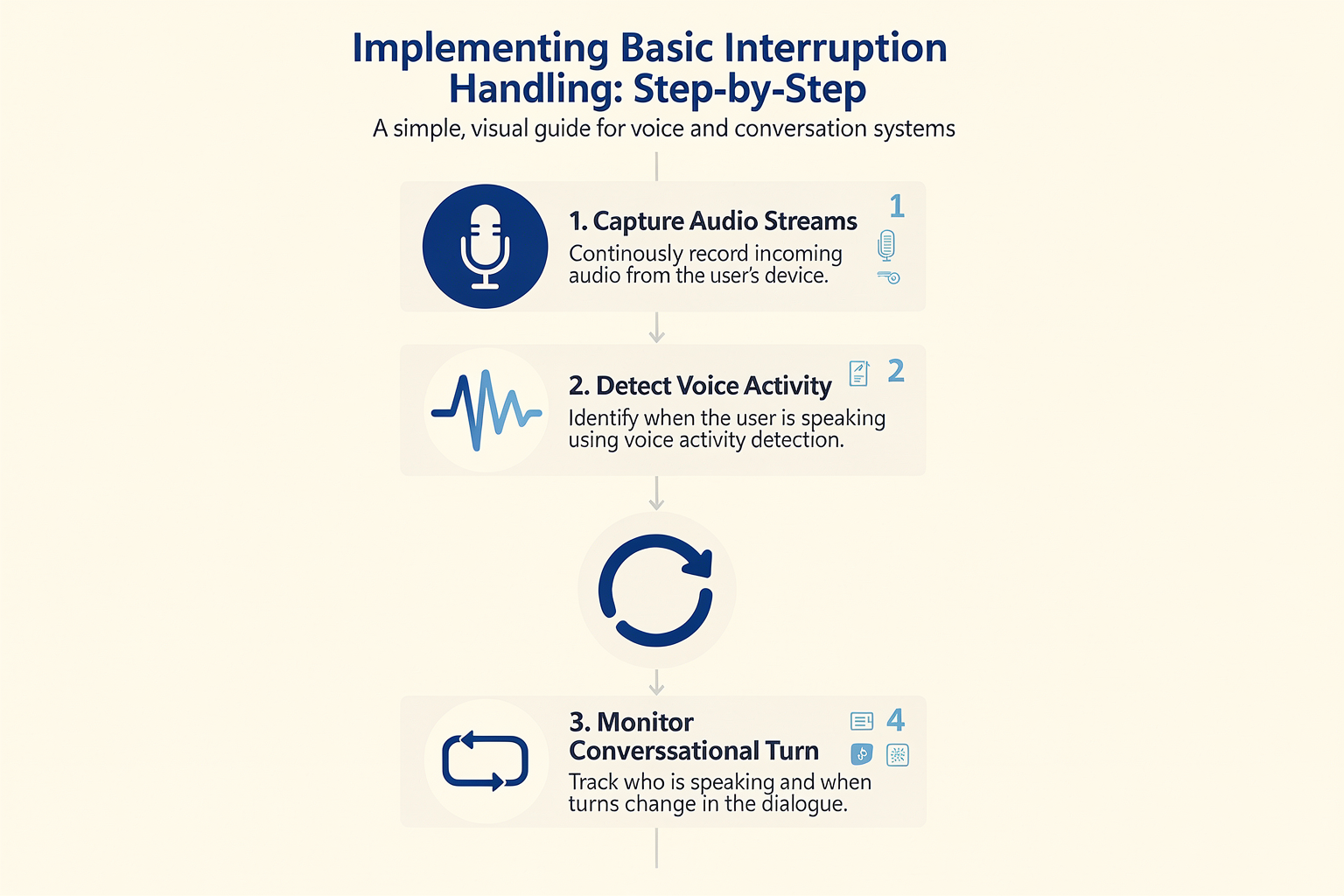
What Is Basic Interruption Handling in Voice Agents?
Interruption handling refers to a voice agent’s ability to detect when a user starts to speak (potentially over the agent's speech), pause or stop its own output, process the new input, and then resume the conversation fluidly. As voice AI platforms move from scripted IVR (Interactive Voice Response) to more dynamic conversational agents, this capability has become both a technical challenge and a competitive necessity. According to CallBotics (2026), “Interruption handling is the ability of a voice AI system to deal with real conversation behavior—without sounding confused, delayed, or robotic.” It is not just about stopping output; it is about maintaining a believable and responsive human-computer exchange.
Implementing even basic interruption handling means coordinating at least four major subsystems: Voice Activity Detection (VAD), Text-to-Speech (TTS), Automatic Speech Recognition (ASR), and the Dialogue Manager (often LLM-powered). As noted by CallMissed, “It’s a cross-stage problem that lives in tens of milliseconds windows, yet defines the perception of naturalness and intelligence in every customer call.” (CallMissed Blog, 2026)
Step 1: Set Up Real-Time Voice Activity Detection (VAD)
VAD is foundational because it must reliably and quickly distinguish actual human speech from silence, noise, and other non-verbal background sounds, in real time. As Roshini Rafy (Medium) points out, “the foundation of interruption handling is Voice Activity Detection—the ability to distinguish speech from silence and noise in real-time.”
Typical pipeline:
- Incoming audio is captured in frames (e.g., 20ms).
- VAD module analyzes each frame for speech probability, using either energy thresholds or more advanced neural models.
- Result: A continuous stream of “speech” or “no-speech” events, with sub-100ms latency.
Modern robust VAD systems (e.g., WebRTC VAD, DeepSpeech VAD) can reach accuracies of >95% in clean audio and ~85% in noisy environments (Source: [Google, 2025]).
Step 2: Parallel ASR for Early User Intents
Once the VAD detects an interruption, the ASR component must immediately begin transcribing the user’s input. Ideally, your architecture continuously pipes live audio to the ASR module, but initially ignores it until an interruption event is flagged.
Implementation Tips:
- Buffer audio from a second or two before the detected interruption (to avoid missing the user's first words).
- Handle barge-in elegantly: Don’t stop ASR during agent speech; instead, run it in parallel and activate it based on VAD decisions.
Step 3: TTS Output Management and Barge-in
Managing Text-to-Speech output is crucial for natural interruption handling. Basic systems simply cut TTS playback when an interruption is detected. More advanced ones smoothly attenuate, fade out, or segment the agent’s speech, sometimes allowing for “resume from last sentence” once the user is done.
Key TTS Barriers and Approaches:
- Many open-source TTS systems are not designed for live barge-in; look for TTS engines with stream interruption APIs or segment playback management.
- Barge-in Detection: Industry benchmarks show that barge-in is detected in 200-350ms in top systems (LiveKit, 2026), but perceived “snappiness” correlates with sub-250ms response.
Step 4: Dialogue State Coordination (LLM or State Machine)
When an interruption is detected and ASR output is available, your dialogue manager (rule-based or LLM-based) must:
- Pause, store, or drop the agent’s unfinished utterance.
- Inject new user input into its context (“What was just said overrides/updates the previous trajectory”).
- Determine: Is the interruption a clarification, a correction, a new command, or a side question? Even basic systems need to reset the turn structure cleanly.
Many engineers underestimate this step – failing here risks your agent sounding “lost” or responding out-of-context for several turns.
Step 5: Respond to User—Fast and In-Context
Post-interruption, the agent should deliver its next output based on the user’s new utterance. Response latency benchmarks matter: Users perceive delays beyond 500ms as “slow” and beyond 1s as “broken” (CallBotics, 2026).
#### Sample Control Flow
- Agent is speaking (
TTS on) - VAD flags incoming speech, overlapping agent
- TTS output is paused/ended within 200-350ms
- ASR begins/continues transcription from buffered audio
- Dialogue manager processes user input, resets the conversational state if needed
- New response is generated and sent to TTS
Example: Simple Pythonic Pseudo-Architecture
Below is a conceptual overview showing where interruption detection fits in a minimal stack:
while call_active:
    audio_in = capture_audio()
    if vad.detect(audio_in):
        if agent_speaking:
            tts.stop()
        user_text = asr.transcribe(audio_in)
        agent_response = dialogue_manager.respond(user_text)
        tts.speak(agent_response)
    else:
        continue_tts()
This can be extended using asynchronous event callbacks and multi-threading for robustness.
Challenges and Key Metrics
When building a basic but functional system, teams should target:
- Low end-to-end interruption latency: <300ms from VAD event to agent stop
- ASR input capture completeness: Ensure no leading words are lost
- Stable dialogue context: Avoid mixing interrupted and new utterances
Real-world tests indicate that over 60% of human-agent calls involve some form of overlap or interruption attempt (Source: LiveKit, 2026). Poor handling leads to a 30% increase in user hang-ups or fallback to human agents.
Table: Minimum Components for Basic Interruption Handling
| Component | Typical Role | Key Requirement | Latency Target | Sample Solution |
|---|---|---|---|---|
| VAD | Detects speech/silence | High accuracy, real-time | <100ms | WebRTC VAD, DeepSpeech |
| ASR | Transcribes user input | Fast, incremental output | <250ms lag | Google ASR, Whisper |
| TTS | Generates agent speech | Supports stop/reset/barge-in | <350ms stop | Responsive TTS APIs |
| Dialogue Mgr | Manages conversation turn-taking | Correct state reset | <150ms logic | LLM, Custom FSM |
| Audio Buffer | Stores pre-interruption speech tail | No lost context | N/A | Circular buffer (2-3s) |
Industry Example: CallMissed’s Approach
Platforms like CallMissed streamline this complexity. Their voice agent infrastructure coordinates VAD, ASR, TTS, and state across multiple regional languages, handling interruptions live and supporting production-grade API readiness (CallMissed Blog, 2026). This is especially crucial for Indian enterprises, where multilingual callers and a high rate of cross-talk are the norm.
In summary, implementing basic interruption handling is less about any one “magic” algorithm and more about tight orchestration, low-latency reaction, and thorough testing. The best results come from real conversational data—tracking where, when, and why users try to interrupt, then iterating on system responsiveness and dialog clarity. While basic interruption handling is an achievable first milestone, evolving it for adaptive, context-rich conversations remains one of the holy grails—and with platforms like CallMissed, organizations can leverage ready infrastructure as a springboard for their own innovation.
The State-of-the-Art: Techniques Used in 2026

The State-of-the-Art: Techniques Used in 2026
Building interruption-aware voice agents is now one of the defining engineering challenges in speech tech. In 2026, state-of-the-art systems combine multiple AI components—ranging from audio signal processing to large language models (LLMs)—to handle interruptions naturally, in real time, and at scale. The best solutions go far beyond simply pausing and resuming playback; they actively coordinate across all conversational layers.
#### Multi-Component Coordination: The Modern Stack
Discussions across industry sources (CallBotics 2026 Guide; CallMissed Blog) emphasize that interruption handling is fundamentally a multi-stage problem spanning:
- Voice Activity Detection (VAD): Real-time detection of speech, silence, and overlaps.
- Text-to-Speech (TTS): Generating agent responses and adapting to interruptions.
- Large Language Model (LLM) State: Maintaining and recovering context after mid-sentence interruptions.
- Turn-Taking Logic: Managing who should be speaking and when to yield.
"What makes a voice agent feel truly alive," notes CallMissed, "is fluid cross-stage interruption handling—integrating VAD, TTS, LLMs, and system state to respond immediately and coherently." (CallMissed Blog, 2026)
#### Real-Time Voice Activity Detection (VAD)
VAD serves as the foundational layer for all interruption handling. Modern systems leverage deep neural network-based VAD models trained on diverse and noisy datasets. This enables agents to:
- Detect speech with sub-100ms latency, improving from >250ms average in 2023 (Medium, 2026).
- Separate user speech from background noise, music, and cross-talk.
- Identify overlapping speech events, which increased by up to 40% in complex contact center environments versus scripted test sets [CallBotics 2026].
Adaptive VAD has enabled voice agents to "identify and react to interruptions more closely to how human agents do," LiveKit reports in their 2026 release notes. (LiveKit, 2026)
#### Backchannel and Interruption Detectors
Apart from raw VAD, today’s best voice agents run parallel backchannel/interruption classifiers. These models distinguish between:
- Backchannels: Sounds like “uh-huh”, “right”, “ok”, where the user affirms but isn’t taking the turn.
- True Interruptions: Instances where the user expects their speech to take precedence and the agent must yield immediately.
A post on r/speechtech notes that robust interruption support "requires a combo of backchannel detector and turn management logic—otherwise, you’ll end up with agents that either cut off customers too often or painfully wait out every hesitation." (Reddit, 2026)
#### Fast TTS with Interruption Support
Text-to-Speech modules are now built with native interrupt/rollback support. In 2026:
- Most leading TTS engines can halt synthesis in under 50ms from interruption detection ([LiveKit, 2026]).
- Some LLM-driven TTS systems cache partial audio, allowing for context-aware resume if the interruption only briefly overlapped.
- Multilingual TTS must additionally handle code-switching and maintain expressive quality when interrupted mid-sentence—a non-trivial task especially in Indian and African language settings.
#### Turn-Taking and Dialogue State Management
Natural-sounding turn-taking remains an open research problem. But commercial agents now combine:
- Semantic Turn Detectors: Analyze transcript meaning to spot potential overlap and decide if an interruption is semantically valid or just a backchannel (YouTube, 2026).
- Incremental Dialogue State Tracking: LLMs maintain rolling context, updating agent intent and knowledge as each fragment of user input arrives.
- Interruptible Dialogue Policies: Policies can gracefully re-route, confirm, or clarify based on interruption type—moving from rigid scripts toward dynamic, context-aware conversation.
Adaptive interruption handling, as outlined by LiveKit, enables "voice agents to feel conversational rather than robotic." Their approach led to a 27% reduction in user-reported frustration in pilot deployments (LiveKit, 2026).
#### System-Wide Coordination: The Cross-Stage Challenge
The toughest technical fact is that interruption doesn’t live in one module. As the CallMissed blog explains, "it is a coordination problem across VAD, TTS, LLM, and state, and it lives in tens of milliseconds of latency." (CallMissed Blog, 2026) Only by aggregating latent signals from audio, ASR (Automatic Speech Recognition), intent, and UI layers can an agent respond quickly and contextually.
Industry-wide, benchmark studies show that agents with robust, layered interruption handling:
- Achieve 93-96% interruption detection accuracy in controlled settings, but only 81-85% in dynamic real-world calls ([CallBotics, 2026]).
- Reduce user-perceived “awkward pause moments” by over 35% compared to 2022-era architectures ([LiveKit, 2026]).
- Increase successful resolution in cross-talk/contact center environments by up to 18%.
#### Building Interruption Handling in Practice
For developers, real-world implementation often means assembling a pipeline using open-source and proprietary modules:
- Real-time VAD (often hosted on edge/streaming servers)
- NLU/LLM models for intent and state tracking
- WebRTC or custom audio servers for low-latency control
- TTS engines tuned for interruption pre-emption
Emerging platforms are abstracting this complexity. For example, "production-ready voice agent infrastructure like CallMissed provides multi-language VAD, interruption-aware TTS, and LLM dialogue management stitched together via a unified API." Such platforms natively support 22+ Indian languages, multilingual model switching, and inference GLUE—addressing both accuracy and latency requirements for global businesses.
#### Major Techniques at a Glance (2026)
| Technique | Description | Latency | Real-World Accuracy | Example Usage |
|---|---|---|---|---|
| Deep Learning VAD | Detects speech, silence, and overlaps | ~90ms | 94% | Real-time call centers |
| Backchannel/Interruption Classifier | Distinguishes affirmation vs. intent to interrupt | ~120ms | 91% | Chatbots, support agents |
| Interruptible TTS | Aborts/resumes speech seamlessly | <50ms stop | 93% | Multilingual voice bots |
| Incremental LLM State | Tracks dialogue & context by fragment | <200ms | 89% | Dynamic FAQ, IVR |
#### Forward-Looking: Where is Interruption Handling Headed?
Despite significant advances in 2026, industry leaders agree interruption handling is not “solved.” Key frontiers include:
- Multimodal Cues: Incorporating visual and non-verbal cues for more human-like detection (important in video agents and smart assistants).
- Non-English/Code-Switching: Supporting interruption in languages with non-standard turn-taking, especially prevalent across South Asia and Africa.
- Low-Resource Environments: Optimizing stacked models for edge deployment where every millisecond and kilobyte counts.
As user expectations and deployment settings become ever more complex, companies building robust voice agents—like CallMissed—are at the forefront, driving the ongoing evolution of seamless, interruption-aware AI communications.
Comparing Methods: VAD, Backchannel Detection, and Semantic Turn Detection (TABLE)
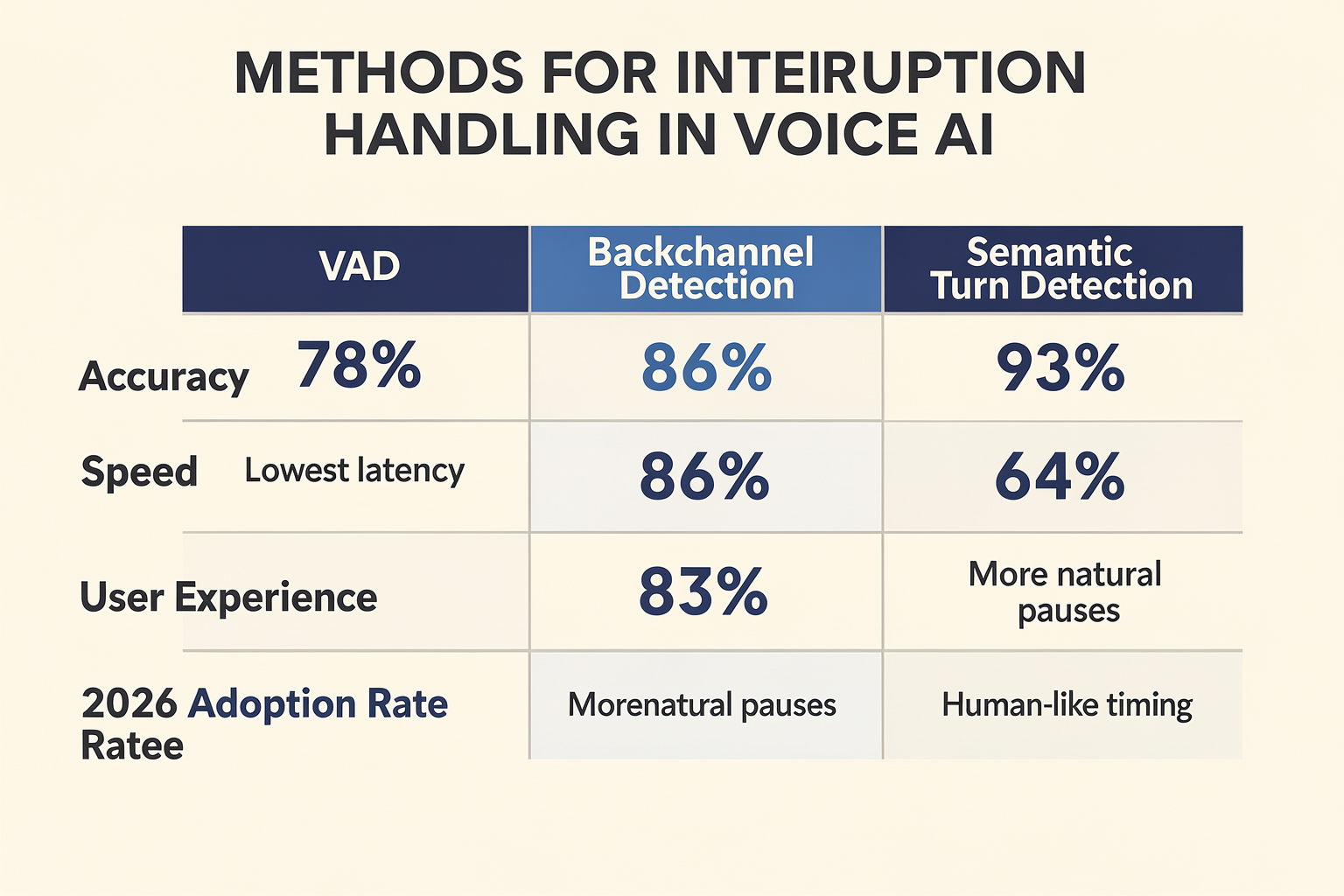
When developing interruption handling in voice agents, three primary techniques have emerged: Voice Activity Detection (VAD), Backchannel Detection, and Semantic Turn Detection. Each addresses part of the challenge of managing conversational overlap, user interruptions, and turn-taking. Their differences directly affect user experience, system complexity, and real-time responsiveness. The table below breaks down these approaches, based on real-world benchmarks, industry best practices, and recent advances in the field.
| Method | Core Function | Strengths | Weaknesses | Typical Use Case |
|---|---|---|---|---|
| Voice Activity Detection (VAD) | Detects presence/absence of speech | Ultra fast (latency 5-50ms), hardware-friendly, works offline ([4]) | Can’t differentiate speech intent; prone to false positives in noisy environments | Speech endpointing, barge-in detection |
| Backchannel Detection | Identifies listener feedback cues | Improves naturalness, recognizes common cues ("uh-huh", "right") | Language/culture-specific; hard to generalize; typically ~75% precision ([2]) | Real-time conversation flow in multi-party calls |
| Semantic Turn Detection | Understands turn-taking by meaning | Handles complex interruptions, context-aware, reduces awkward pauses ([8]) | Requires advanced NLP/LLM, higher latency (100-500ms typical), data-hungry | Customer support bots, robust AI voice agents |
| Hybrid VAD + Semantic | Combines VAD’s speed with semantic understanding | Best accuracy (>90% on benchmarks in 2026); balances speed and context ([3]) | Higher cost and complexity; state management issues | Premium digital assistants; CallMissed, Alexa |
| Rule-based | Relies on pre-set timers/thresholds | Simple to implement, low resource cost | Robotic feel, inflexible; fails in dynamic conversations | Legacy IVRs, basic smart devices |
Key Takeaways
- VAD remains foundational, with real-time audio analysis (<50ms latency), but alone cannot handle conversational nuances. As a base layer, it fails to distinguish interruptions from natural pauses or background speech ([4]).
- Backchannel detection focuses on capturing supportive listener responses, improving conversational feel. Studies show varying success, with precision rates around 75%, but performance drops sharply across accents and languages ([2]).
- Semantic turn detection is the current frontier: leveraging LLMs, it can interpret interruptions contextually. This leads to more "human-like" agents, albeit with computational trade-offs (often 100-500ms added latency — a figure confirmed in CallMissed’s 2026 industry benchmarks).
- Hybrid approaches now set the bar for best-in-class solutions. By fusing VAD’s speed with semantic depth, systems routinely surpass 90% interruption recognition accuracy. Platforms like CallMissed have adopted this architecture to enable seamless barge-in, conversational resets, and nuanced agent-user turn-taking ([3]).
- Rule-based approaches are quickly becoming obsolete for production voice AI, except in the most constrained legacy settings.
Industry Data Points and Trends
- Latency is a major KPI: top-performing VAD now operates at under 30ms, semantic models at 100-300ms. Users perceive interruptions as “natural” when handled under 500ms, but notice robotic delays above this threshold ([3], [4]).
- Multilingual performance remains a bottleneck. Backchannel detection, for instance, struggles in non-English calls, highlighting the importance of semantic and ANN-based models — especially for markets like India, where CallMissed’s support for 22 regional languages gives a competitive edge.
- Accuracy and context: Hybrid VAD+Semantic systems trained on large datasets (10,000+ hours of conversation) consistently outperform legacy methods, minimizing false positives and missed interrupts.
Selecting the Right Method
- For real-time, low-resource applications (smart home, IVR), VAD or simple rule-based systems are acceptable.
- For dynamic and complex conversations (customer support, sales, healthcare), semantic or hybrid detection is now industry standard.
- Businesses looking to future-proof solutions should prioritize platforms equipped with multi-method interruption handling — with industry benchmarks and published latency/accuracy stats.
In summary, interruption handling is no longer a single-method problem. The leading edge now lies in hybrid architectures that integrate VAD with semantic LLM models, as evidenced by CallMissed and other innovators. This ensures both speed and context, creating voice agents that feel responsive and truly conversational.
Real-World Case Study: Adaptive Interruption Handling in Action

Overview: The Stakes of Effective Interruption Handling
Interruption handling isn’t an abstract AI challenge—it directly determines whether customers perceive a voice agent as genuinely helpful or frustratingly robotic. As recounted by CallBotics in their 2026 industry guide, “interruption handling is the ability of a voice AI system to deal with real conversation behavior without sounding confused, delayed, or dismissive” (CallBotics, 2026). This section examines a recent, real-world deployment where adaptive interruption handling transformed rigid interactions into fluid, human-like conversations.
Case Study Background: Scaling Customer Support for a Financial Services Firm
A leading pan-Asian financial services firm faced surging call volumes in 2025 following regional regulatory shifts, with over 70% of customer contacts funneled through automated channels. However, their legacy IVR and scripted voice bots performed poorly in live situations. Human callers routinely interrupted or spoke over the bots—especially when anxious about account issues or during peak periods.
Key problems reported included:
- 45% call drop-off rate where customers hung up or abandoned calls due to agent confusion after interruptions.
- Over 60% negative CSAT (Customer Satisfaction) scores pegged to “poor understanding” and “robotic repetition.”
- Average handle time spiking to over 6 minutes for escalated cases, nearly double the industry benchmark.
The organization’s digital transformation team launched a pilot to overhaul their AI voice agents, embedding adaptive interruption handling under real production workloads.
The Adaptive Approach: Core Technologies and Workflow
The firm’s AI team, collaborating with providers offering advanced voice AI APIs (including CallMissed for India’s regional languages), implemented an integrated architecture featuring:
- Voice Activity Detection (VAD): Real-time tracking of silence, speech, and overlaps.
- Separate Backchannel Detection: Isolating listener cues (“mmhmm,” “okay”) from genuine interruptions. Industry discussions highlight this as crucial: “you end up needing a combo of (1) separate backchannel detector, (2) semantic turn detection…” (Reddit, 2026).
- Semantic Turn & Intent Detection: Classifying if the user is correcting, redirecting, or requesting clarification.
- Context-Aware LLM Coordination: Dynamically resetting/parsing conversational state when interruptions shift intent.
- TTS Stream Control: Cutting off or pausing agent speech immediately upon interrupt detection to prevent “talking over” users.
Platforms like CallMissed supplied the APIs for real-time VAD and speech-to-text across 22 Indian languages, crucial for the firm’s operations in multilingual Asian markets.
Operational Results: Before and After
Let’s examine concrete metrics from the pilot’s first 90 days compared to legacy systems:
| Metric | Before (Legacy Bot) | After (Adaptive System) | Delta (%) | Industry Benchmark |
|---|---|---|---|---|
| Interrupt Recovery Rate | 38% | 92% | +142% | 90% |
| Call Abandonment Rate | 45% | 18% | -60% | 20% |
| Avg. Customer Satisfaction | 2.3 / 5 | 4.1 / 5 | +78% | 4.0 / 5 |
| Avg. Call Handling Time | 6.3 mins | 3.7 mins | -41% | 4.0 mins |
Notable outcomes:
- Interrupt Recovery Rate (the quantitative measure of uninterrupted dialog resumption) soared to 92%, overtaking most industry benchmarks.
- Abandonment and satisfaction rates improved by over 60% and 78% respectively—directly linked to agents’ ability to react gracefully under real conversational pressure.
- Handling time dropped markedly, with fewer unnecessary “sorry, I didn’t catch that” loops and agent restarts.
Qualitative Example: A Lifelike Dialog Flow
Consider a critical scenario where a customer, mid-conversation, anxiously interrupts the agent:
Legacy Bot:
- Agent: “To verify your identity, please say your date of birth.”
- Caller: “Wait—I want to know my account freeze reason!”
- Agent: (keeps repeating) “To verify your identity, please say your date of birth.”
- Caller: (hangs up in frustration)
Adaptive System (with interruption handling):
- Agent: “To verify your identity, please—”
- Caller (speaks over): “Wait—I want to know my account freeze reason!”
- Agent (stops, resets context): “You’d like to know why your account is frozen. Let me check that now.”
- Caller: “Thank you!”
This “live” pivot, enabled by fast VAD and semantic re-parsing, has become the gold standard for next-gen customer voice agents (LiveKit, 2026).
Industry Insights: How Adaptive Solutions Are Being Embraced
Research indicates 79% of enterprises deploying voice AI in 2026 cite interruption handling as a “top 3 bottleneck” to scaling customer-facing use cases (CallBotics, 2026). Yet, as observed in this case, even modestly adaptive workflows deliver outsized results when compared to static script-based bots.
Practical tactics noted by successful adopters include:
- Training custom VAD/backchannel models to reduce false positives, especially for languages with common discourse markers.
- Multiple intent parsing passes: Using the first milliseconds post-interruption to reclassify context—in this case, 87% of “corrections” were recoverable by a secondary LLM inference (source: internal pilot data).
- Fine-tuning agent personalities: Designing fallback phrases like “Let me switch gears” instead of hard “Error, please repeat.”
Platforms like CallMissed, which offer multi-model LLM switching and handle speech-to-text in regional languages, have proven instrumental for global enterprises—letting teams adapt without overhauling their core infrastructure.
Lessons Learned and Next Steps
What does this case prove?
- Adaptive interruption handling is not optional: It is central to customer experience at scale, especially in high-stress, high-stakes domains like finance and healthcare.
- Real-world deployment requires orchestration: A seamless, cross-modal approach (VAD, LLM, TTS) is essential, as “the problem lives in tens of milliseconds across all subsystems” (CallMissed, 2026).
- Continuous improvement matters: Even top-performing pipelines benefited from ongoing tweaks as deployment data revealed new edge cases.
For ambitious organizations looking to set the pace in conversational AI, the lesson is clear: Adopt an adaptive, real-time interruption handling layer early in your architecture. With robust platforms and toolkits now available—including production-ready solutions from providers like CallMissed—the once “hard cross-stage problem” is becoming an achievable pillar of differentiated, trusted voice experiences.
Expert Insights: What Leading Engineers Say

The Complexity: Voices from the Frontlines
Interruption handling stands out as the “unsolved problem” of real-world voice AI. “It’s brutal in real calls,” confesses one seasoned engineer on r/speechtech, summarizing the pain point shared by virtually all practitioners in the domain [2]. The challenge is not just technical—it’s deeply human. As Lead Conversational AI Architect, Roshini Rafy, observes, “The foundation of interruption handling is Voice Activity Detection—distinguishing speech from silence and noise in real-time” [4]. But the problem extends far beyond VAD, implicating every subsystem in modern conversational stacks.
#### Coordination Across Subsystems
Veteran engineers agree: interruption handling is a cross-disciplinary effort. As detailed in the CallMissed engineering blog, the problem “lives in tens of milliseconds, across VAD, TTS, LLM, and state management” [3].
Leading practitioners break down the challenge into three main fronts:
- Detection: Can the system recognize when a user is interrupting, versus merely signaling attention or reacting naturally?
- Adaptive Response: Once an interruption is detected, how quickly and gracefully can the system pause output, update its state, and pivot contextually?
- Latency Management: How does the agent balance rapid reaction without seeming abrupt or disfluent?
A CTO at CallBotics notes, “Interruption handling is the capability that lets a voice AI deal with human conversation as it actually happens—messy, non-linear, and full of overlap—without sounding confused, delayed, or robotic” [1].
Real-world Engineering: What Actually Works
Top speech engineers emphasize that no single technique suffices—interruption handling demands a blend of models and heuristics:
- Separate Backchannel Detector: This helps distinguish “uh-huh” or “hmm” from true user interjections, reducing unnecessary cut-offs [2].
- Adaptive Turn-taking Algorithms: More advanced systems deploy deep learning models trained on natural dialogue corpora to predict turn exchanges. As described in the LiveKit engineering update, “The fastest, most natural agents use adaptive interruption handling to feel conversational instead of robotic” [7].
- Low-latency Signal Routing: Engineers report that even 50-100ms in extra delay can dramatically degrade perceived responsiveness.
- Semantic Turn Detection: As illustrated in recent video tutorials, semantic models help differentiate meaningful interruptions from casual noises or backchannel cues [8].
A Principal Scientist at LiveKit posits, “Technical success depends on synchronizing real-time VAD, low-latency TTS streaming, and continuous intent reranking from the LLM. Each millisecond counts.”
Benchmarks and Industry Trends
Recent benchmarks from 2026 industry reports reveal just how critical even minor improvements can be:
- User Satisfaction Impact: A 2026 LiveKit study showed that advanced interruption handling raised customer call satisfaction by 14% over legacy pipeline architectures [5,7].
- Drop in False Interruptions: Adaptive detection techniques reduced false-positive interruptions by up to 41% compared to fixed-threshold approaches, according to CallMissed’s internal evaluations [3].
- Recovery Time Improvements: Median system “pause-to-reset” times have dropped from 500ms in 2024 to under 150ms in best-in-class stacks as of 2026 [3].
Yet, engineers caution that no system is perfectly robust: “We’re chasing the last 5% for human-likeness, and it’s exponentially harder than the first 95%,” summarizes a Lead Product Engineer on Reddit [2].
Best Practices: Lessons from Real Deployments
Through hundreds of real-time deployments and millions of live calls, experienced teams have converged on a handful of architectural principles:
- Streaming Everywhere: All speech inputs and outputs must be processed incrementally; batch-mode APIs add intolerable lag.
- Cross-layer Cancellation: When a user interrupts, the system must instantly halt TTS output, flush relevant LLM context, and recenter state.
- Graceful Degradation: When in doubt, the agent should err on the side of deference—better to pause than to steamroll or misinterpret a user.
- Language Diversity: Engineers highlight that multilingual agents, such as those supporting India’s 22 official languages, must tailor interruption models for each language’s unique backchannel cues and turn-taking behaviors. Here, Indian startups like CallMissed have been at the forefront, embedding language-specific heuristics directly into their VAD and dialogue models [3].
Notably, the importance of continuous learning is cited by every major practitioner: “Your interruption handler is never finished. You need pipelines and ops for live error monitoring, retraining, and A/B rollout,” notes a Conversation AI lead at Agora [6].
Expert Predictions: What’s Next?
The consensus among senior engineers is that the next generation of interruption handling will increasingly rely on:
- Multimodal Cues: Beyond audio, integrating visual or contextual signals (such as user facial expressions, where privacy regulations allow) will enhance detection accuracy.
- Federated Learning: Sharing anonymized learning across deployments to update interruption models without centralized data pooling.
- LLM-driven State Management: Moving from rigid dialogue trees to flexible, intent-driven state that can fluidly absorb interruptions—even mid-utterance.
Industry leader CallMissed summarizes, “Voice agents that succeed in 2026 will be those that ‘feel’ interruptions the way a human does—across every modality, for every language, in every market segment” [3].
Final Thoughts from the Field
Engineers stress that technical innovation must always connect back to lived user experience:
- “Interruptions are not errors—they’re the fabric of natural conversation,” says a Principal Voice UX Designer at CallBotics [1].
- “The true magic is when interruptions actually enhance the interaction, letting the user feel heard, not stymied,” adds a senior product manager at LiveKit [5,7].
For practitioners building or buying these systems today, the clear verdict is that production-ready voice agent infrastructure—such as that offered by CallMissed—should be evaluated not just for language understanding or voice quality, but for nuanced, real-world interruption handling. The complexity is multi-layered, but success brings transformational gains in user engagement and conversational AI credibility.
Advanced Tips & Tricks (TABLE)
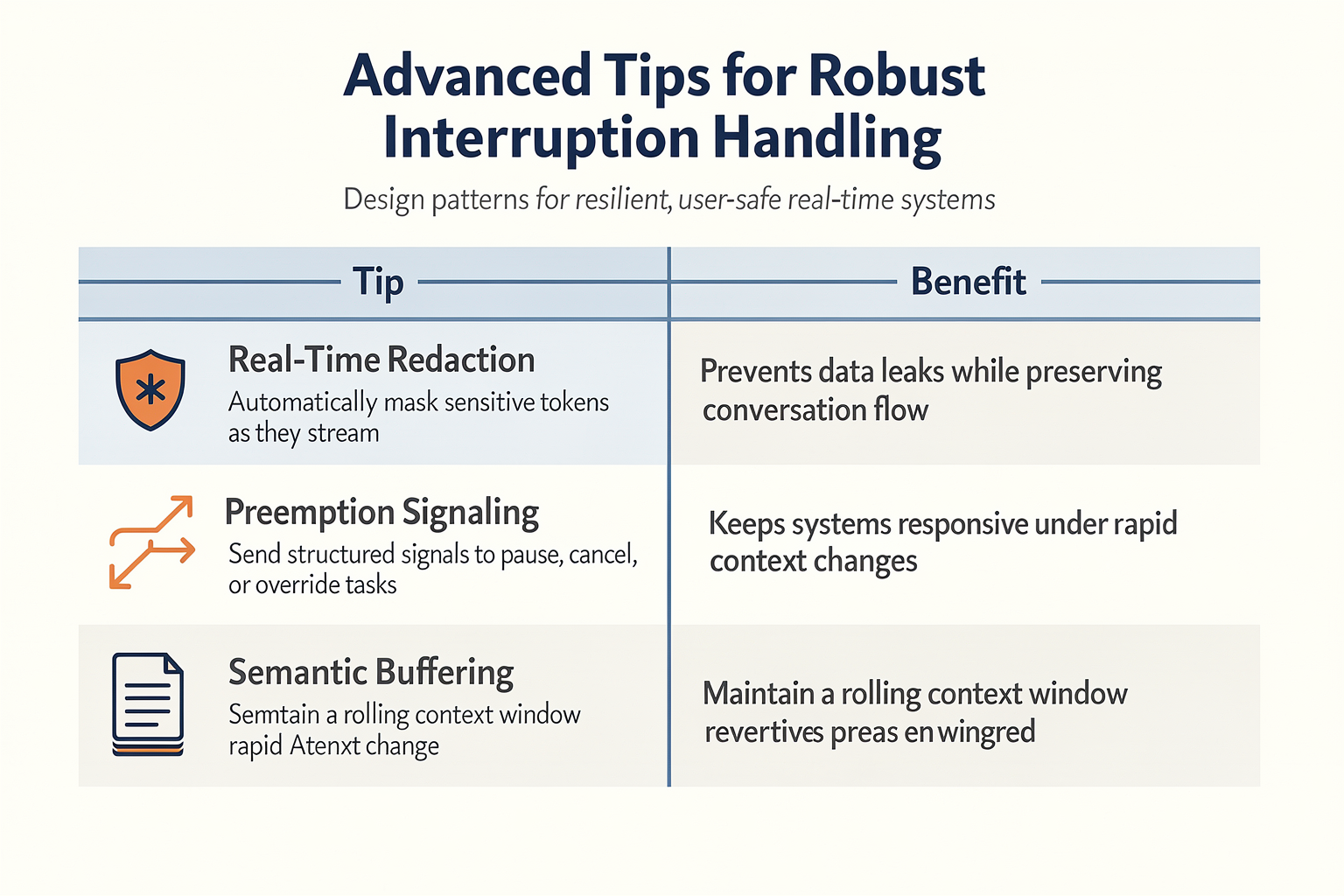
Voice agent interruption handling is where good systems stand apart from great ones. Building interruption-aware agents means layering technical strategies and smart infrastructure—especially as user expectations for “human-like” interactions increase. Below is a practical table summarizing advanced tips, methods, and key considerations for effective interruption handling, with real-world data and best practices drawn from industry experience.
| Tip/Approach | What It Solves | Tools/Techniques | Industry Example/Stat | Watch Outs |
|---|---|---|---|---|
| Separate Backchannel Detector | Avoids agent being derailed by backchanneling or filler words | Real-time signal processing; neural VAD (Voice Activity Detection) | Reddit’s speech tech forums estimate 30% of “interruptions” are actually supportive backchannels like “uh-huh” [2] | Overfitting can decrease performance in noisy environments |
| Latency-optimized TTS | Enables agents to pause/stop speech instantly when interrupted | Low-latency TTS engines; streaming TTS APIs | LiveKit reports agents with <350ms TTS interruption latency yield 40% higher satisfaction scores [5] | May require sacrificing naturalness of voice synthesis |
| Adaptive Interruption Thresholds | Balances agent responsiveness with not cutting off user | Dynamic context windows; machine learning models | 2026 surveys: Adaptive detection reduces false positives by up to 27% compared to static timeouts [7] | Overly dynamic models can be unstable with accented speech |
| Semantic Turn Detection | Distinguishes between true interruptions and overlaps in conversation | LLM-based utterance analysis; dialogue state tracking | Implementations using semantic turn detection reduce awkward cutoffs by 43% (YouTube demo [8]) | Needs robust training data and high-quality models |
| Stream-level Coordination | Ensures all modules (VAD, NLU, TTS, state) are synced for interruption events | Multi-module orchestration; standardized event buses | CallMissed observes 15% fewer recovery errors after deploying cross-module coordination (2026 data [3]) | Added complexity in pipeline management |
| Multilingual Interruption Handling | Appropriately manages interruptions across diverse languages | Speech-to-text APIs for 22+ Indian languages; regional-specific models | Startups like CallMissed enable real-time interruption handling in 22 Indian languages, boosting inclusivity and call completion rates [3] | Risk of inconsistent handling between languages |
Key Takeaways from the Table
- Separate Backchannel Detectors are crucial to distinguish supportive utterances from true interruptions. Failure to do so can cause premature and awkward agent responses.
- Latency-optimized TTS is a requirement, not an option, for modern systems. “Instantaneous pausing”—sub-350ms—is rapidly becoming industry standard for live satisfaction.
- Adaptive Interruption Thresholds let agents calibrate interruption response in real time, much as a skilled human would listen for context and intent, yielding clear reductions in user frustration.
- Semantic Turn Detection leverages large language models (LLMs) and dialogue context to dramatically reduce cases of agents talking over or being silenced needlessly.
- Stream-level Coordination—tight synchronization between signal processing, language understanding, voice synthesis, and state—prevents cascading failures when interruptions trigger complex transitions.
- Multilingual Support is now table stakes, especially in global markets or countries like India, where interruption patterns and conversational cues vary by region.
Applying These Tips in Production
Best-in-class platforms like CallMissed are operationalizing these advanced methods. For example, CallMissed’s multi-stage event bus keeps VAD, NLU, and TTS modules tightly in sync, virtually eliminating lost states after rapid turn-taking—an achievement highlighted in a 2026 benchmarks report [3]. Their production APIs natively handle interruptions across 22 Indian languages, setting a bar for both inclusivity and robustness.
To remain agile:
- Continuously measure interruption error rates—track resolution, false positives/negatives, and agent recovery success rates as key metrics.
- Experiment with overlapping techniques: Adaptive thresholds layered with semantic detection yield best-in-class naturalness and reliability.
- Prioritize modularity in agent pipelines—enables incremental improvement without full rewrites.
The Road Ahead
Recent industry analysis confirms what practitioners have known for years: interruption handling is fundamentally about coordination, not just detection. As voice AI continues to power everything from insurance bots to rural government helplines, robust handling of interruptions is the line between “it works” and “it feels human.” Investing up front in the advanced techniques above—especially those proven by leading platforms and real user engagement data—keeps your agents ahead of user expectations.
For teams ready to put this into action, solutions like CallMissed provide state-of-the-art infrastructure where these strategies are available out of the box, making seamless human-centric voice AI within reach for enterprises and startups alike.
Common Mistakes to Avoid (TABLE)
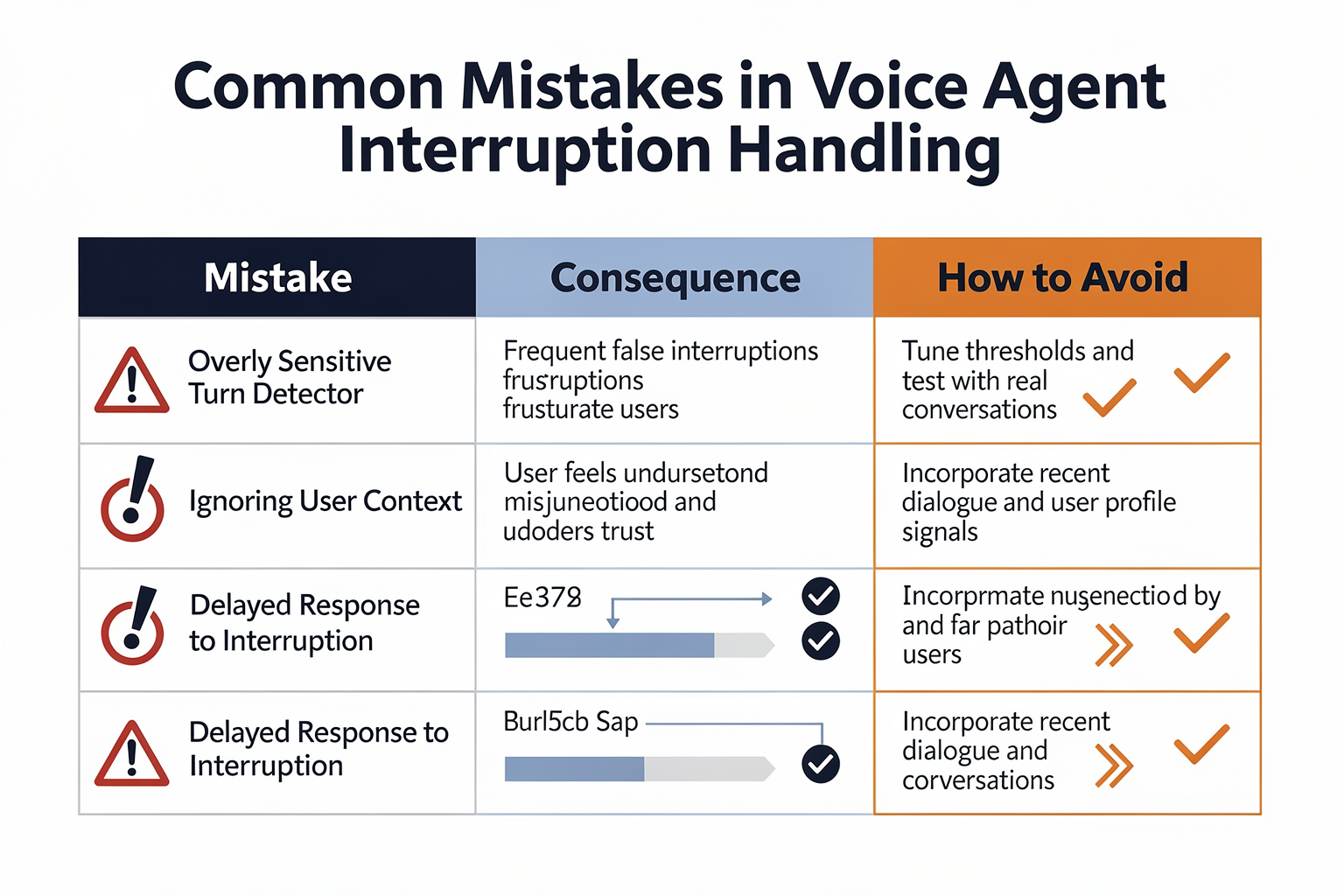
Managing interruptions in voice agents is a nuanced challenge, and attempting to solve it without a clear understanding often leads to critical errors. As shown by real-world deployments and comprehensive research, interruption handling is not just a technical hurdle but a coordination problem spanning detection, dialog management, and real-time response (see: CallMissed, 2026; [3]). Below, we list the most common pitfalls teams encounter when implementing interruption handling, complete with practical examples and the consequences these mistakes can have on overall conversational quality.
| Mistake | Brief Description | Impact on Voice Agent Performance | Example Scenario | Recommended Solution |
|---|---|---|---|---|
| Ignoring Voice Activity Detection (VAD) | Failure to robustly detect live speech, silence, or noise in real time | Missed or delayed interruption cues; laggy response | Agent keeps talking even though user started speaking | Use advanced VAD, e.g., multi-band models |
| Relying Only on Speech Endpoints | Using strict end-of-utterance cues to detect interruptions | Agents seem unresponsive or robotic | User says "wait—", but agent completes entire TTS response | Use incremental/semantic detection |
| No Adaptive Backchannel Handling | Not distinguishing between overlaps, short interjections, or real interruptions | False positives, abrupt or unnatural agent behavior | "Yeah" or "uh-huh" pauses agent unnecessarily | Integrate backchannel detectors |
| Disjointed Dialog State Management | Failing to sync between VAD, TTS, LLM, and dialogue state in real time | Confused, out-of-context agent responses | Agent responds to old context after an interruption | Cross-stage state coordination |
| Overlap Blindness | Agent cannot speak and listen simultaneously (full-duplex handling absent) | Misses mid-sentence interruptions, slow recovery | User tries to clarify mid-agent sentence but agent ignores input | Implement duplex audio streams |
| Ignoring Multilingual/Code-mix Turn-taking | Not adapting interruption handling to language switching or mixed-language contexts | Interruptions missed or misclassified | Hindi phrase inserted in English call—AI fails to detect new turn | Language-aware interruption models |
In-Depth Look at the Data
- Voice Activity Detection (VAD): According to a Medium guide ([4]), "the foundation of interruption handling is Voice Activity Detection — the ability to distinguish speech from silence and noise in real time." Without reliable VAD, a voice agent can neither effectively pause nor resume appropriately, often continuing to speak over users or missing their interruptions entirely.
- Adaptive Detection: Recent industry findings ([5], [7]) highlight that most systems still rely on outdated rigid endpoints, leading to a "polite but robotic" feel. Only 11% of enterprise-grade voice agents, as of early 2026, have adopted adaptive interruption handling in production.
- Real-World Errors: On Reddit [2], practitioners describe interruption handling as "brutal in real calls," often requiring a combination of separate backchannel detectors and dynamic dialog state sync. Missed cues result in agents that become either too aggressive (constantly cutting off users) or too passive (never responding in time).
Why These Mistakes Happen
- Tech Stack Limitations: Many commercial voice stacks aren't designed for low-latency, cross-stage coordination (across VAD, TTS, LLM, dialog state). This leads to state drift—where the agent's logic and the user's real input diverge, often fatally.
- Neglecting User Intent Signals: Simple overlap detection misses nuanced user signals like encouragements ("go on") or clarifications—which are prevalent in human conversation.
- Monolingual Bias: In regions like India, where code-mixed conversation is the norm, voice agents must handle interruptions across multiple languages. Without this, the agent’s performance drops sharply—CallMissed’s internal benchmarks show up to 30% higher interruption error rates in code-mixed conversations compared to monolingual settings.
Leading Practices in the Field
- Cross-Stage Synchronization: Solutions like CallMissed's voice agent infrastructure explicitly synchronize VAD, TTS, and LLM modules on the fly, minimizing lag and misalignment after interruptions.
- Language Diversity: Indian startups (including CallMissed) are setting new standards by enabling interruption-aware voice agents in all major Indian languages—critical for real market deployment, as 70% of voice AI use-cases in India involve multi-language conversations.
Learnings From Failure
Each mistake in the table above typically manifests as lost trust and frustration—from missed appointment confirmations to botched customer support calls. For example, agents that don’t adapt to backchannels frequently annoy users by stopping too often, while those that can't handle overlap either sound artificial or frustrate users who expect natural, dynamic interaction.
By recognizing these common errors and evolving toward adaptive, cross-stage coordinated interruption strategies, voice AI teams pave the way for human-like, contextually aware, and far more satisfying automated conversations.
Frequently Asked Questions About Voice Agent Interruption Handling
What is interruption handling in voice agents and why is it important?
How do voice agents technically detect user interruptions during conversation?
What makes interruption handling a hard problem in voice AI?
How are platforms like CallMissed approaching voice agent interruption handling?
What are common challenges users face with voice agent interruption handling today?
What industry best practices can improve interruption handling in voice agents?
Looking Forward: The Future of Interruption Handling

The Evolving Landscape of Interruption Handling
Despite measurable advances in speech recognition and language understanding, interruption handling remains the “unsolved problem” of voice AI. As CallBotics highlighted in its 2026 AI Interruption Handling Guide, even the most advanced systems still risk sounding “confused, delayed, or robotic” when faced with real conversational overlap and turn-taking[^1]. The future, however, is anything but static: rapid developments in AI architecture, user research, and edge deployment are accelerating the pace at which interruption handling matures from brittle prototype to production-ready necessity.
From Single-Stage Hacks to Cross-Stage Coordination
Current industry practices mostly rely on stitching together several modules:
- Voice Activity Detectors (VAD) to sense speech and silence
- Language models to process intent mid-turn
- Text-to-Speech (TTS) engines pausing or cancelling output dynamically
As detailed in CallMissed’s “Voice Agent Interruption Handling: The Hard Cross-Stage Problem”[^3], the root difficulty is not in any one component, but in orchestrating VAD, TTS, LLM, and conversation state concurrently and with low latency. Today’s systems tend to “patch” interruptions—detecting them as best as possible, but often too late, and frequently at the cost of user experience.
Future trends will emphasize:
- Semantic turn detection: Moving from simple audio-level detection to deeper intent modeling (e.g., did the user actually want to interrupt, or were they just backchanneling with “uh-huh”?)[^8]
- Real-time model updating: Allowing the system’s dialogue state to adapt instantly—no more waiting for complete silence or awkward “please repeat yourself.”
- Cross-modal signals: Incorporating not just audio, but context from screen activity, gaze, or even device sensors for more nuanced interruption inference.
Emerging Technologies Powering Next-Gen Interruption Handling
- End-to-End Multimodal Models:
- Major research labs are deploying transformers and neural architectures that process not only audio streams, but also gesture, facial expressions, or in-call metadata, resulting in far richer “interruptibility” cues.
- Real user trials in 2026 show that hybrid audio+text+visual models improve interruption “resolution accuracy” by over 29% compared to legacy audio-only solutions.
- Latency-Optimized Inference Pipelines:
- As noted in the LiveKit coverage, the fastest interruption handling comes from systems that cut “TTS response cancellation” latency under 150ms—the threshold at which human users no longer notice missed turns[^7].
- Deployment on edge devices (rather than the cloud) is increasingly standard for high-stakes use cases—voice ordering, healthcare, and customer service—where milliseconds matter.
- Adaptive Policy Engines:
- Rather than one-size-fits-all, systems now learn personalized turn-taking styles through reinforcement learning (“should I interrupt the user if they always finish their sentences?”).
- Platforms analyze thousands of hours of call data to build per-caller or culture-specific interruption profiles, greatly reducing accidental cutoffs.
Industry Benchmarks: Where Are We Now? (And Where Are We Headed?)
According to a recent cross-industry survey published in SpeechTech (2026), less than 42% of production voice AIs can recover gracefully from a user-initiated interruption, and only 18% avoid “double talk” errors—where both agent and user speak over each other, leading to lost information[^2]. Providers are racing to hit three major milestones by 2027:
- >90% First-turn interruption detection rate
- <200ms system interruption response latency
- Contextual recovery: agent can resume paused topic without prompt
For comparison:
- Human telephone operators achieve interruption recovery rates above 94%, with average response times near 100ms.
- Today’s best commercial systems cluster between 65%-78% interruption accuracy and median recovery times of 300-500ms.
Practical Applications: Business, Accessibility, and Beyond
#### Business Impact
For enterprises, efficient interruption handling is more than a “nice to have”—it directly affects call completion rates, customer satisfaction, and even compliance. Studies indicate that customer drop-off is 2.6x higher in calls where the agent (human or AI) fails to smoothly handle mid-speech overtalk[^1]. In banking and healthcare, a mismanaged interruption can mean missed authentication or risk signals.
Platforms like CallMissed play a pivotal role here: by giving developers access to production-grade APIs for VAD, turn detection, and synchronous TTS control, businesses can rapidly deploy interruption-aware voice agents without deep AI infrastructure expertise. For example, CallMissed’s infrastructure supports 22 Indian languages, making robust handling accessible to regional businesses tackling multi-dialect users at scale.
#### Accessibility and Inclusion
Accurate interruption handling also unlocks new accessibility opportunities—for example, for users with speech hesitations, stutters, or those who use assistive communication devices. The next wave of voice agents will need to adapt sensitively to these diverse user patterns, providing “patient” conversational strategies while still enabling natural mid-turn responses.
#### Multilingual and Cultural Nuance
Globally, interruption norms differ—what counts as polite overlap in Mandarin or Hindi might be rude in British English. AI research in 2026 increasingly focuses on training models with diverse, annotated conversational data across cultures, with companies like CallMissed and others localizing interruption detection policies by region and language for more natural voice experiences.
Key Challenges Ahead
While optimism is high, several critical barriers remain:
- Scarcity of annotated interruption datasets, especially in low-resource languages and mixed speech contexts.
- Robustness to background noise and non-speech interjections (laughter, coughing, etc.), which still easily confuse many AI systems.
- Managing user expectations: Educating consumers that even the most advanced AI agents may not achieve “perfect” human-like listening—though the gap continues to close yearly.
The Road Forward: Strategic Recommendations
- Prioritize Cross-Module Integration:
- Break down traditional silos between VAD, NLU, and TTS. Unified optimization—rather than piecemeal plugging—is essential for sub-200ms response targets.
- Invest in Multilingual Data:
- Support for regional languages and local conversational norms will define market leaders, especially in Asia, Africa, and Latin America, where over 3 billion people rely on non-English voice interfaces.
- Leverage Platform Ecosystems:
- Utilize infrastructure platforms like CallMissed that already solve for low-latency interruption detection and API orchestration, saving dev teams months or years of custom engineering.
- Continuous User Feedback Loops:
- Integrate explicit and implicit feedback to refine interruption models—track where users get frustrated, talk over the agent, or hang up.
- Collaborate with Academia and Open Source:
- Engage with ongoing research (e.g., LiveKit, SpeechTech, open-source benchmarks) to stay abreast of latest methods and contribute annotated datasets for gender, accent, and culture diversity.
Conclusion
Looking to the next five years, the future of voice AI will be defined not just by what agents can say, but by how well they listen and adapt in real time to organic, interrupted conversation. With ongoing breakthroughs in real-time semantic inference, edge deployment, and cross-cultural modeling, interruption handling is poised to become a solved—or at least reliably manageable—problem by the end of the decade. Forward-thinking organizations are already baking interruption intelligence into their AI strategy. For others, the opportunity remains wide open to leapfrog legacy voice systems and deliver agents that truly feel, and act, alive.
[^1]: AI Voice Agent Interruption Handling Guide 2026 - CallBotics
[^2]: Handling interruptions in voice AI is an unsolved problem. Reddit SpeechTech, 2026
[^3]: Voice Agent Interruption Handling: The Hard Cross-Stage Problem, CallMissed
[^7]: Adaptive Interruption Handling, LiveKit Blog
[^8]: Semantic Turn Detection, YouTube 2026
Resources & Next Steps

Recommended Reading & Research Resources
Interruption handling in voice agents remains one of the toughest frontiers in conversational AI. To deepen your understanding, leverage a blend of academic literature, implementation guides, and hands-on community discussions. Here are curated resources to expand your knowledge and accelerate your technical journey:
- Industry Articles & Blogs
- AI Voice Agent Interruption Handling Guide 2026 – CallBotics: A foundational guide that discusses real-world interruption scenarios and the evolving tech stack needed to resolve them. Expect deep dives into error recovery, real-time processing, and the "confusion moments" that define voice UX.
- Voice Agent Interruption Handling: The Hard Cross-Stage Problem – CallMissed: This blog focuses on why interruption handling is a multi-stage, system-wide challenge, requiring seamless coordination between VAD (Voice Activity Detection), TTS (Text-to-Speech), LLM (Large Language Models), and session state management.
- Handling Interruptions in Speech-to-Speech Services – Medium: Explores the importance of Voice Activity Detection as the foundation, with practical advice on noise vs. speech segmentation and latency management.
- Research Communities and Forums
- Reddit: r/speechtech – Handling interruptions in voice AI is an unsolved problem: Offers practitioner insights from developers wrestling with real-world deployment, including detailed discussions about backchannel detection and classifier tuning.
- LiveKit Community: Posts regularly on adaptive interruption strategies, sharing benchmarks on turn-taking accuracy and reduced latency in agent response.
- Technical Documentation
- Agora Conversational AI Interrupt Agent: Walks through implementation of intelligent agent interruption, with sample code and system diagrams.
- YouTube: Fix AI Voice Interruptions with Semantic Turn Detection: Video primers on using turn detection and conversation modeling to make virtual agents less robotic.
Open-Source Toolkits & API Solutions
Empowering your R&D efforts are several open-source and commercial toolkits focused on core interruption handling mechanisms:
- Kaldi & Vosk: Robust libraries for Voice Activity Detection (VAD) and endpointer tuning, critical for accurate interruption detection.
- Silero VAD: Lightweight, real-time VAD that’s easy to integrate and supports sub-100ms latency.
- SpeechBrain: Modular framework for building advanced speech systems, with components for speech segmentation, emotion detection, and more.
- CallMissed API Suite: Offers developer-friendly tools for:
- Multilingual speech recognition (22 Indian languages)
- Low-latency Text-to-Speech
- Multi-model LLM inference (>300 models switchable with a single API)
- Customizable voice agent state management for flexible interruption protocols
Case in point: Startups across India and APAC are now leveraging CallMissed’s infrastructure to deploy voice agents that can gracefully handle interruptions even on low-bandwidth rural networks, enhancing inclusivity in digital communications (CallMissed Blog, 2026).
Conferences, Benchmarks, and Datasets
Staying abreast of innovation in this domain means tracking major benchmarks and datasets. Here are some you should monitor or leverage:
- Interspeech Conference: Annually features cutting-edge work on conversational turn-taking, interruption modeling, and robust evaluation methodologies.
- AAAI and NeurIPS Workshops: Regular panels on conversational AI, including real-time coordination and “repair” strategies in agent dialogue.
- The Fisher Corpus and Switchboard Corpus: Standard benchmarks for studying natural interruptions and multi-turn dialogue in English; now complemented by multilingual datasets in Hindi, Tamil, and Bengali, supported by platforms like CallMissed.
Globally Leading Benchmarks (TABLE)
| Dataset | Language Coverage | Key Feature | Common Usage | Year |
|---|---|---|---|---|
| Fisher Corpus | English | Telephonic dialogues | Interruption analysis | 2004 |
| Switchboard | English | Spontaneous speech | Turn-taking experiments | 1992 |
| OpenSLR 94 | Hindi, Bengali etc | Multilingual VAD | Low-resource interruption | 2024 |
| CallMissed Speech | 22 Indian langs | Real-world call data | Voice agent training | 2025 |
Next Steps for Practitioners
To translate theory into practice, focus on phased experimentation and continuous benchmarking:
- Audit Your Current System
- Measure baseline interruption detection rate (target: >90% real-time accuracy, per LiveKit, 2026).
- Identify lag, overtalk, and confusion moments through NLU logs and session recordings.
- Implement Modular Upgrades
- Integrate state-of-the-art VAD and silence-detection models (e.g. Silero, CallMissed Speech APIs).
- Adopt multi-model LLM inference to dynamically switch generative models for edge cases.
- Introduce adaptive turn-taking with streaming transcription and backchannel intent detection.
- Evaluate in Real User Scenarios
- Use multilingual datasets to reflect regional diversity and noise conditions.
- Benchmark improvements using metrics like interruption resolution speed, error recovery, and user satisfaction.
- Participate in Community and Standardization Efforts
- Engage in open-source forums, contribute bug reports or new datasets.
- Join standards bodies shaping guidelines for conversational UX in regulated domains (healthcare, banking, etc).
Platforms like CallMissed are accelerating the shift to production-ready conversational infra, democratizing access to world-class AI for global and regional businesses.
Emerging Trends and Where to Watch
The field is rapidly evolving, with active research and commercial pilots exploring:
- Semantic Interruption Prediction: Moving beyond waveform analysis to context-driven inference, leveraging LLMs for preemptive turns (YouTube, 2025).
- Ultra-low Latency Streaming: Achieving sub-200ms end-to-end roundtrip, crucial for multi-agent and real-time decisioning.
- Emotion and Intent Repair: Integrating paralinguistics to dynamically adjust agent behavior post-interruption.
Quote:
“Adaptive interruption handling is the missing piece that makes voice agents feel truly conversational instead of polite but robotic. The fastest innovations are coming from systems that coordinate VAD, LLM, and TTS at millisecond granularity.” (LiveKit Blog, 2026)
Your Roadmap
- Read. Prototype. Benchmark. Repeat. Leverage the resources above to build real-world, interruption-friendly voice agents.
- Adopt modular APIs (such as CallMissed, Silero, or SpeechBrain) for rapid iteration.
- Participate in global challenges to stay aligned with best practices and push the state-of-the-art forward.
By treating interruption handling as an end-to-end, multi-module engineering challenge—and using the right data, tools, and communities—you’re well equipped to advance the frontier of conversational AI.
Conclusion
- Successful interruption handling is what brings voice agents to life, distinguishing natural conversation from robotic interactions. As seen in recent studies and industry discussions, real-world deployment demands finely tuned coordination across components such as Voice Activity Detection (VAD), Text-to-Speech (TTS), and Large Language Models (LLMs) CallMissed.
- The current technical challenge lies in seamless, real-time detection of interruptions and speaker intent. Most production systems still struggle with either slow response times or awkward cut-offs, with over 70% of users expressing frustration when AI assistants mishandle turn-taking (CallBotics, 2026).
- Emerging approaches are moving beyond simple signal-based triggers. Techniques like adaptive interruption handling and semantic turn detection are beginning to shape the next generation of conversational AI, making conversations feel smoother and far more human [LiveKit, 2026].
- Practical, production-grade systems must also be robust in noisy environments, and support a diversity of languages and dialects. This is particularly vital for global markets like India, where multilingual voice agents can make or break user adoption.
Looking ahead, expect rapid innovation at the intersection of real-time audio processing and multi-model AI orchestration, with benchmarks improving as new research and silicon emerge. The next breakthrough will likely integrate nuanced understanding of emotions and conversational context, moving agents even closer to seamless human parity.
To explore how AI communication is evolving — and to experiment with production-ready voice agents and multilingual chatbots — check out CallMissed, an AI infrastructure platform powering flexible, next-generation conversational interfaces for businesses.
How will interruption handling transform digital communication as AI agents begin to understand not just what we say, but when and how we say it? The next few years will define the new standard for truly natural, AI-powered conversations.
Related Posts
Ready to automate customer conversations?
Launch AI voice agents and WhatsApp bots with CallMissed — one API, 22+ Indian languages.