

Identity Emerges as the Core Governance Layer for Agentic AI


When an autonomous AI agent can independently access your databases, draft legal contracts, and execute financial transactions without a human in the...
Identity Emerges as the Core Governance Layer for Agentic AI
When an autonomous AI agent can independently access your databases, draft legal contracts, and execute financial transactions without a human in the loop, who—or what—is ultimately responsible for its actions? As we move deeper into 2026, the rapid transition of AI from passive copilots to fully autonomous actors has triggered a massive paradigm shift in enterprise security. Traditional security measures like input validation and firewalls are no longer sufficient to contain autonomous behavior; instead, identity emerges as the core governance layer for agentic AI.
This shift matters now more than ever because the enterprise security perimeter has moved from network boundaries to individual agent permissions. Security researchers note that the agentic architecture is rapidly splitting into distinct layers where governance, runtime safeguards, and execution must align. Because every agent action begins with an authentication or authorization step, treating agents as non-human identities (NHIs) is the only way to prevent privilege escalation and unauthorized API actions. Without a disciplined identity control plane, businesses face "agent drift"—where an agent daisy-chains tools to access data it was never intended to see. This is why standards bodies like NIST and OWASP are already establishing identity as the primary control plane for zero-trust agentic security.
As organizations scale these autonomous workflows, infrastructure platforms like CallMissed are already integrating with emerging identity frameworks to ensure that deployed AI voice agents and multilingual chatbots operate strictly within authorized, audited boundaries.
In this article, we will unpack the rapid evolution of the agentic identity ecosystem. You will learn why legacy Identity and Access Management (IAM) systems fail autonomous agents, how to bridge the non-human identity governance gap, and the practical steps your organization can take to establish a secure, zero-trust framework to safely govern agentic AI at scale.
Introduction: Why Identity is the New Control Plane for Agentic AI
As we move deeper into 2026, the artificial intelligence landscape is undergoing a fundamental paradigm shift. We have rapidly transitioned from the era of passive, prompt-based AI "copilots" to the age of fully autonomous, action-oriented agentic AI. Today’s AI agents do not just suggest text or analyze data; they execute complex workflows, access databases, authorize transactions, and communicate directly with customers.
However, as these agents gain autonomy, they also introduce unprecedented security and operational risks. Legacy cybersecurity frameworks—which primarily focused on input validation, firewalls, and output filtering—are proving wholly inadequate. If an autonomous agent can independently execute API calls or access sensitive databases, a security strategy cannot rely solely on checking its prompts. Instead, enterprise security must answer a more fundamental question: Who—or what—is this agent, and what is it authorized to do?
The Shift to Identity-Centric AI Governance
In this new paradigm, identity has emerged as the definitive control plane for agentic AI governance. Industry analysts and security researchers agree that the process of governing agents at scale hinges almost entirely on identity. Because every single action an agent takes begins with an authentication or authorization event, the identity layer represents the most effective point of governance enforcement.
This shift is reflected in the evolving standards landscape. Organizations like the National Institute of Standards and Technology (NIST), OWASP, and zero-trust security architects are actively pointing to Non-Human Identity (NHI) management as the cornerstone of agentic security. As the ecosystem splits into specialized layers—governance vendors, Model Context Protocol (MCP) developers, and identity providers—securing the relationship between the human user, the parent enterprise, and the autonomous agent is paramount.
Why Legacy Control Planes Fail
Traditional security and governance models fail to address the dynamic nature of autonomous agents for three key reasons:
- Dynamic Execution Paths: Unlike rigid software integrations, LLM-driven agents determine their execution paths dynamically at runtime based on real-time data inputs and LLM reasoning.
- Privilege Escalation Risks: An agent designed to draft customer emails might be tricked via prompt injection into accessing backend customer databases if access permissions are not bound to a strict identity profile.
- Lack of Attribution: Without structured identity tracking, it is nearly impossible to audit which specific agent initiated a transaction, modified a file, or made an external API call.
For enterprises deploying these advanced systems, managing this identity gap is critical. For instance, when orchestrating complex, customer-facing workflows—such as deploying autonomous voice agents or multilingual conversational chatbots via communications infrastructure like CallMissed—securing the underlying agentic identity ensures that these tools interact with internal APIs and databases safely, predictably, and strictly within their authorized bounds.
Ultimately, treating AI agents as first-class digital citizens with their own machine identities, cryptographic credentials, and granular access privileges is no longer optional. It is the foundational requirement for building a secure, compliant, and scalable autonomous enterprise.
Background & Context: The Shift from Copilots to Autonomous AI Agents

The paradigm shift in artificial intelligence is no longer a future prediction—it is our current reality. Over the past few years, we have transitioned rapidly from the era of AI copilots to the age of autonomous AI agents. While copilots acted as passive, human-in-the-loop assistants that required constant prompting to generate text, retrieve information, or write code, modern autonomous agents are active, goal-oriented systems. They possess the agency to plan, execute multi-step workflows, utilize external APIs, and make decisions independently to complete complex tasks.
However, as these agents transition from passive advisors to autonomous actors, they pose unprecedented security and compliance risks. When an AI agent can autonomously access databases, draft emails, modify system configurations, or execute financial transactions, standard application security measures fail. A defense strategy focused solely on input validation or output filtering is no longer sufficient; the industry has realized that governing agents at scale hinges fundamentally on identity.
The Split in Agentic Architecture
According to recent industry analyses of the evolving agentic ecosystem, the enterprise AI architecture is splitting into three distinct layers:
- Governance and Identity: The control plane that authenticates, authorizes, and audits agent actions.
- Execution and Frameworks: The cognitive engines and orchestration platforms that power the agent's logic.
- Communication and Connectivity: The channels and APIs through which agents interact with users and external systems.
In this decentralized environment, the identity layer has emerged as the most effective governance enforcement point. Because every agent action begins with an authentication or authorization event, identity serves as the ultimate boundary. This shift is reflected across the global standards landscape, with organizations like OWASP, NIST, and zero-trust framework designers actively defining non-human identity and access management (NHIAM) guidance specifically for agentic workflows.
Real-World Implications for Enterprise Scale
For businesses deploying these systems, the operational challenges are vast. For example, in customer engagement, enterprises are shifting from basic decision-tree chatbots to fully autonomous agentic networks. Infrastructure platforms like CallMissed are already enabling organizations to deploy sophisticated voice and WhatsApp agents that handle end-to-end customer workflows natively in 22 regional languages. But if an autonomous voice agent is authorized to modify a customer's subscription or access billing details, how does the system verify its permission boundaries?
This is where agentic identity governance becomes non-negotiable. Without a robust identity layer to define what an agent can and cannot do—and which human operator or organizational unit it represents—autonomous systems risk executing unauthorized actions, escalating privileges, or falling victim to indirect prompt injection attacks that compromise backend databases.
To secure this new frontier, enterprises must treat AI agents not merely as software scripts, but as digital employees requiring strict identity provisioning, continuous authentication, and granular access controls.
Key Developments in Agentic Identity Frameworks (TABLE)
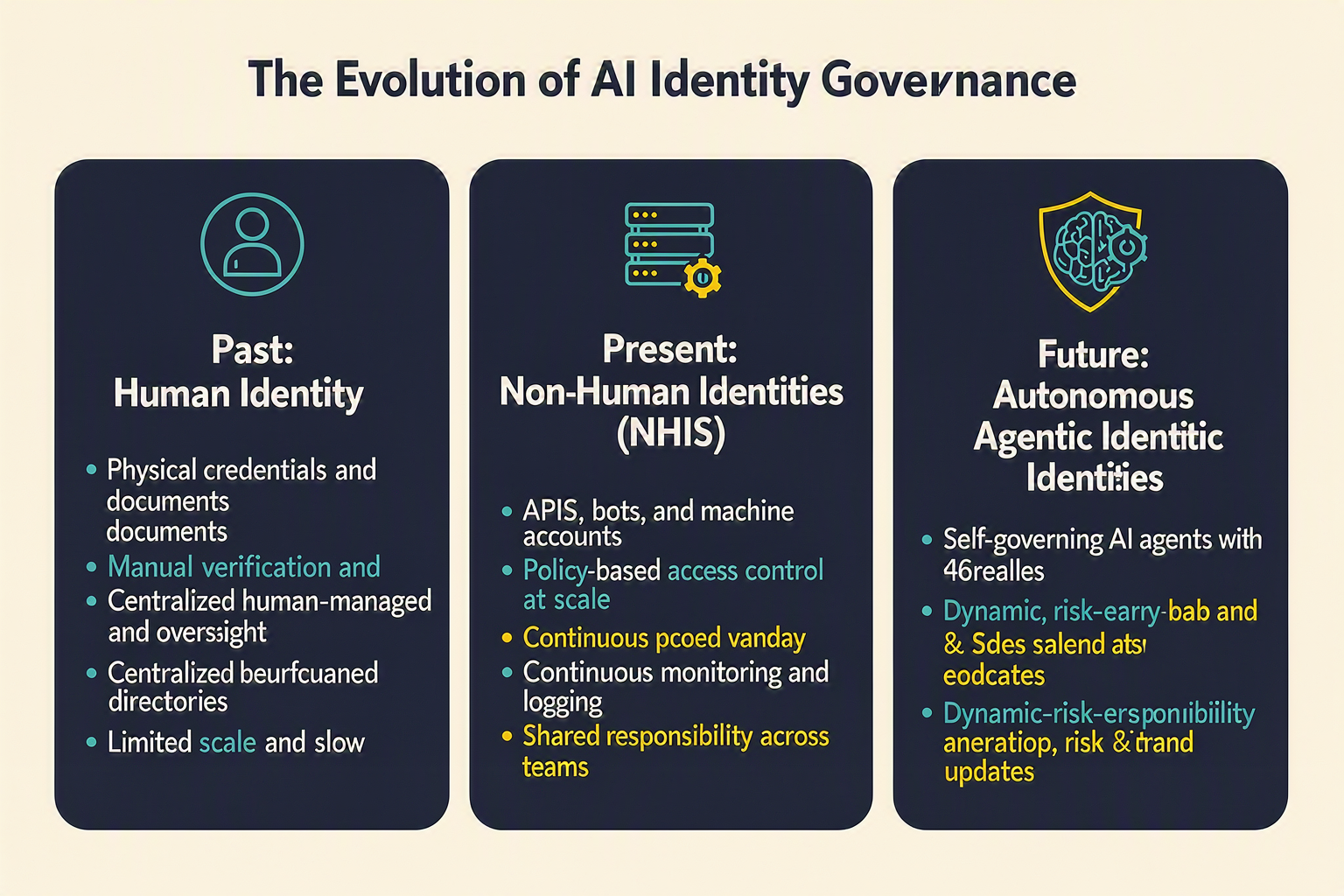
As AI agents shift from passive, prompt-driven co-pilots to highly autonomous actors capable of making financial transactions, editing databases, and communicating with customers, traditional security perimeters are collapsing. Industry experts agree that because every single autonomous action must initiate with verification, the identity layer has become the most effective governance enforcement point.
To manage this shift, a new architecture is dividing the agentic ecosystem into distinct governance, protocol, and identity layers. Standards bodies and security frameworks are rapidly evolving to treat these autonomous systems as distinct, auditable non-human identities (NHIs).
Standards and Protocol Comparison
The following table highlights the critical frameworks, standards, and industry developments shaping agentic identity and governance:
| Framework / Standard | Governance Focus | Core Enforcement Mechanism | Key Backers & Standards Bodies |
|---|---|---|---|
| NIST Zero-Trust Guidance (NHI) | Non-Human Identity Lifecycle | Cryptographic signing, ephemeral tokens, and continuous machine-to-machine authentication. | NIST & Federal Cybersecurity Agencies |
| OWASP Top 10 for LLMs & Agents | Vulnerability Mitigation | Defense-in-depth against unauthorized tool execution, privilege escalation, and data exfiltration. | OWASP Foundation |
| Model Context Protocol (MCP) | Secure Context & Data Access | Open standard establishing secure, authenticated client-to-agent and host-to-agent data sharing. | Anthropic & Open-Source Community |
| Agentic IAM Frameworks | Role-Based Access Control (RBAC) | Bounded, time-sensitive execution scopes and continuous API session verification. | Enterprise IAM Leaders (e.g., Okta, Strata) |
| Dynamic Execution Firewalls | Real-Time Transaction Security | Human-in-the-loop triggers for high-risk actions alongside automated rate-limiting. | Platform & Infrastructure Providers |
Why Traditional IAM Falls Short for AI Agents
Historically, Identity and Access Management (IAM) was designed around static, human-centric workflows. A human user logged in, completed multi-factor authentication (MFA), and maintained a session. AI agents, however, operate continuously, asynchronously, and at machine scale. Applying a static API key to an autonomous agent creates an immense security loophole: if the agent is compromised via prompt injection or direct manipulation, the attacker inherits the agent's full, unrestricted backend access.
For true governance, organizations must transition to dynamic identity delegation. Under this model, agents do not possess permanent administrative privileges. Instead, they are issued ephemeral, context-specific tokens that expire immediately after a task is completed. Furthermore, any attempt by an agent to escalate privileges or access data outside of its immediate operational scope triggers immediate revocation.
Implementing this high level of operational security requires deep integration at the communications and infrastructure level. For example, enterprise platforms like CallMissed integrate these exact governance principles into their communication infrastructure. When businesses deploy CallMissed AI voice agents or WhatsApp chatbots, the underlying platform manages conversational workflows across 22 regional Indian languages while enforcing strict non-human identity constraints. This ensures that even as autonomous communication agents dynamically retrieve data or execute API calls to resolve a customer's query, they do so within tightly bounded security guardrails—protecting sensitive user data without sacrificing agentic utility.
In-Depth Analysis: How the Identity Layer Secures Non-Human Agents
To secure a world run by autonomous systems, security teams are realizing that traditional perimeter defenses are no longer sufficient. When an AI agent transitions from a passive "copilot" to an active, autonomous decision-maker, traditional defense-in-depth strategies—which historically focused on input validation and output filtering—fall short. Cybersecurity research highlights a massive "non-human identity governance gap" when enterprises secure agentic systems solely at the application layer. Because autonomous agents can independently write code, execute API calls, and interact with databases, identity is the only logical control plane capable of governing them at scale.
The Shift to Non-Human Identity (NHI) Governance
Every autonomous action must begin with verification. As highlighted by Strata Identity, the identity layer is the most effective governance enforcement point because every agentic action is preceded by an authentication or authorization check.
Securing these autonomous workflows requires treating AI agents as Non-Human Identities (NHIs), governed by similar rigorous standards applied to human employees. Security standards organizations, including OWASP, NIST, and zero-trust steering committees, now position identity-driven security as the primary control plane for agentic architectures. To protect enterprise systems, an identity-driven governance framework relies on three core pillars:
- Cryptographic Attestation: Verifying the exact identity of the agent, its underlying LLM version, and its hosting environment before granting access to network resources.
- Dynamic, Least-Privilege Authorization: Ensuring that an agent is only granted the minimal permissions necessary to execute its immediate task, with access rights expiring immediately upon task completion.
- Continuous Runtime Auditing: Monitoring agent behaviors in real time to detect anomalous activity, such as privilege escalation or sudden deviations from typical operational patterns.
Securing Autonomous Agents in Practice
In production environments, securing these workflows requires tightly coupling AI communications with identity frameworks. For instance, when deploying conversational AI agents to handle external communications, security cannot be an afterthought.
Using AI infrastructure platforms like CallMissed, enterprises can deploy production-ready AI voice agents and WhatsApp chatbots powered by over 300+ LLMs to handle complex customer interactions natively in 22 regional Indian languages. However, if a CallMissed agent needs to access an enterprise CRM to update an account or process a billing inquiry, it must operate under strict identity constraints. By integrating the communications layer with a dedicated identity-governance engine, the agent is granted temporary, scoped credentials tied strictly to the authenticated customer’s session. If a prompt injection attempt occurs, the identity layer blocks any unauthorized lateral movement into the broader corporate network.
Building a Resilient Governance Architecture
According to industry frameworks from Palo Alto Networks and Saviynt, modern enterprise identity architecture is splitting into specialized governance, runtime guardrail, and directory layers. By utilizing identity-centric governance, organizations can safely leverage the massive productivity gains of autonomous agents without exposing sensitive data silos. The identity layer ensures that whether an agent is generating code or speaking to a customer, it does so within verifiable, auditable boundary lines.
The Emerging Architecture: MCP, OIDC, and Zero-Trust Standards
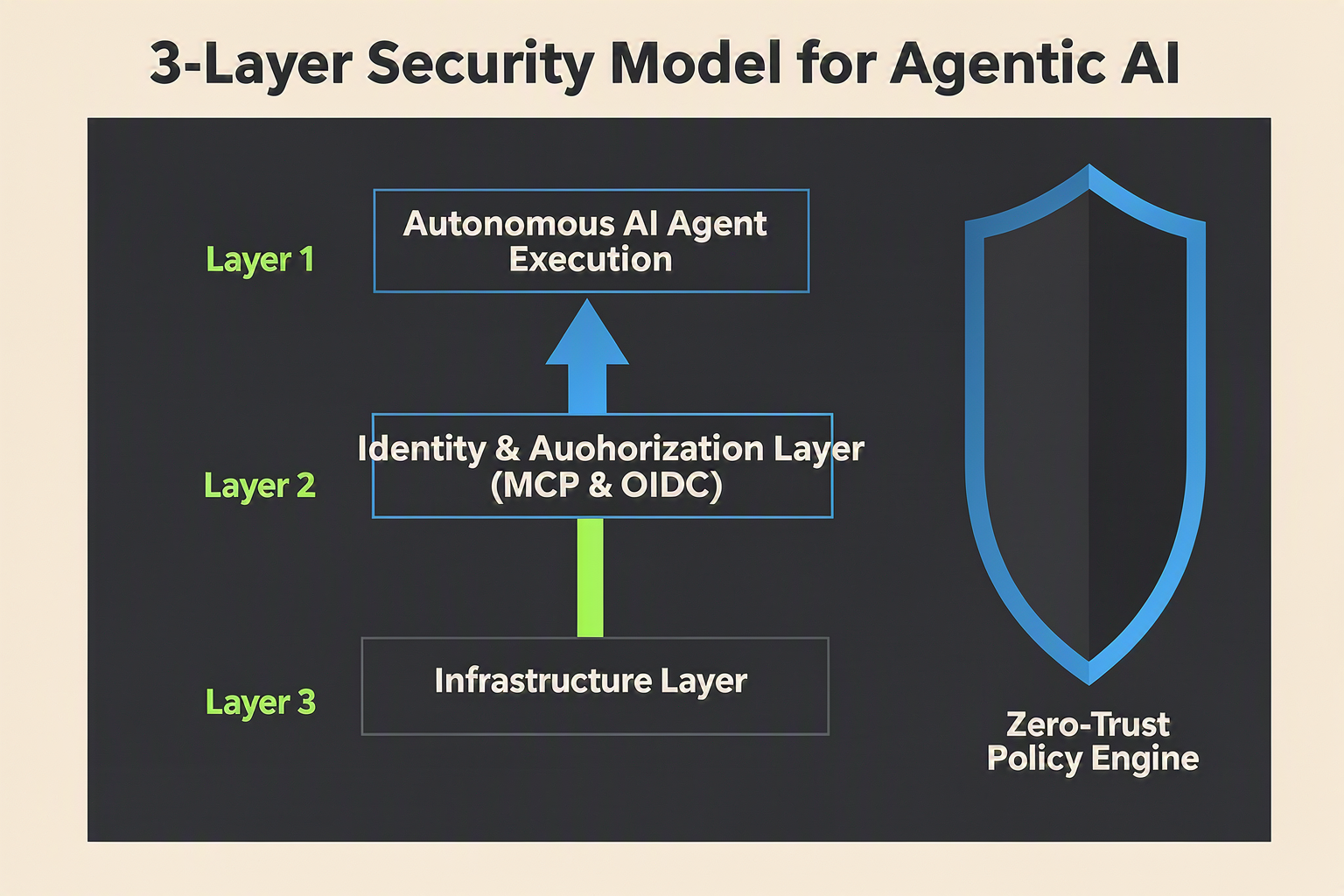
As AI agents transition from passive copilots to fully autonomous actors, traditional perimeter-based security is no longer sufficient. The industry is rapidly shifting toward an identity-centric architecture to manage these non-human systems. Security architects observe that this agentic identity ecosystem is splitting into distinct operational layers—governance, connectivity, and execution—with identity serving as the foundational control plane. To govern these autonomous systems at scale, enterprises are aligning around three critical architectural pillars: Model Context Protocol (MCP), OpenID Connect (OIDC), and Zero-Trust standards.
Model Context Protocol (MCP): Securing the Connectivity Layer
The Model Context Protocol (MCP) has emerged as a crucial open standard for defining how AI agents securely connect to external data sources, enterprise tools, and APIs. Instead of allowing agents to have direct, unmonitored access to sensitive internal databases, MCP acts as a secure mediation layer. It structures how context is shared, ensuring that an agent can only retrieve or manipulate data within strictly defined parameters.
For organizations deploying advanced conversational systems, integrating these secure protocols is essential. Platforms like CallMissed leverage secure, standardized API gateways to orchestrate their voice agents and WhatsApp chatbots across 300+ LLMs. This architecture ensures that even as the underlying models process language dynamically in real time, the connectivity layer remains tightly bounded, authenticated, and fully auditable.
OIDC and Non-Human Identity (NHI) Federation
Traditional identity systems were built for humans, relying on credentials, session cookies, and multi-factor authentication (MFA). AI agents, however, operate as Non-Human Identities (NHIs) that execute complex tasks in milliseconds without direct human intervention.
To bridge this gap, modern agentic security architectures are adapting OpenID Connect (OIDC) to support machine-to-machine and agent-to-application interactions. By utilizing OIDC federated identity extensions, organizations can:
- Issue Ephemeral Tokens: Mint short-lived, cryptographically secure cryptographic keys specifically for individual agent sessions.
- Enforce Micro-Granular Access Control: Restrict an agent’s active permissions to the absolute minimum required to complete its current task.
- Establish Parent-Agent Provenance: Track exactly which human user or parent system authorized the agent to act, maintaining an unbroken chain of custody for audit trails.
Zero-Trust and Identity as the Security Control Plane
According to recent guidance from cybersecurity bodies like OWASP and NIST, identity has officially emerged as the primary control plane for agentic security. A robust defense strategy cannot rely solely on input validation or output filtering at the user interface; security must be enforced at every point of execution.
This is where Zero-Trust standards become vital. In a zero-trust model, the fundamental rule is "never trust, always verify." Because every single action taken by an autonomous agent begins with an authentication or authorization event, the identity layer serves as the most effective enforcement point for governance. Security teams can implement automated, runtime safeguards that continuously evaluate the risk profile of an agent's requests. If an agent suddenly attempts to access unauthorized systems or execute anomalous API calls, the zero-trust identity plane can instantly revoke its active tokens, neutralizing the threat before data exfiltration can occur.
Impact & Implications: Navigating the Risks of Autonomous Action
As AI agents transition from passive copilots to fully autonomous actors, the risk landscape undergoes a fundamental shift. When an agent is empowered to execute API calls, process transactions, and access sensitive databases without direct human intervention, traditional perimeter security controls fall short. A defense strategy focused solely on input validation or output filtering is no longer sufficient to secure these dynamic environments. Instead, identity is emerging as the ultimate control plane for agentic security, aligning with modern Zero Trust frameworks.
The Limitations of Legacy Security Models
In traditional enterprise security, access is granted to human users. With autonomous agents, however, we are witnessing an explosion of Non-Human Identities (NHIs). These machine-to-machine interactions introduce several critical risks:
- Privilege Escalation: An agent designed to summarize customer feedback could maliciously or accidentally be manipulated to access internal database records if its identity permissions are too broad.
- Execution Auditing Gaps: Without an immutable identity bound to every agentic action, organizations cannot verify which agent initiated a specific database write or API call, leading to severe compliance and traceability issues.
- Cascading Failures: When autonomous agents interact with other agents, a security compromise in one agent can rapidly propagate through an entire ecosystem if strict identity and authorization boundaries are not enforced.
Identity as the Core Enforcement Point
Because every autonomous agent action begins with an authentication or authorization step, the identity layer has become the most effective governance enforcement point. Organizations must transition from passive monitoring to active identity-driven governance. Standards bodies like NIST and security organizations like OWASP are already highlighting identity as the essential control plane for agentic AI.
Implementing this requires a multi-layered identity framework:
- Strict Authentication & Access Control: Every agent must have a uniquely verifiable identity and be governed by the principle of least privilege.
- Runtime Safeguards: Identity checks must occur dynamically during execution, ensuring the agent has the specific authority to perform a given action at that exact moment.
- Sustained Oversight: Every action taken by an agent must be cryptographically signed and logged against its non-human identity to maintain an unalterable audit trail.
For enterprises deploying AI solutions, these security requirements must be built into the core infrastructure. For instance, platforms like CallMissed enable businesses to securely deploy AI voice agents and WhatsApp chatbots by leveraging robust infrastructure that integrates seamlessly with existing enterprise identity frameworks. This ensures that as these voice and text agents access customer databases, execute APIs, or initiate workflows across 22 regional languages, every interaction remains authenticated, authorized, and completely auditable.
Ultimately, navigating the risks of autonomous action is not about restricting what AI agents can do, but about establishing the disciplined identity controls required to let them operate safely. By anchoring agentic governance in identity, organizations can confidently scale their AI automation while maintaining absolute control over their digital assets.
Expert Opinions: Industry Leaders on the Future of AI Governance
As AI agents rapidly transition from passive copilots to fully autonomous actors, the cybersecurity and enterprise tech landscape is undergoing a massive paradigm shift. Industry leaders and security researchers increasingly agree: the traditional perimeter is gone, and identity is the ultimate control plane for the agentic era.
Security experts from across the industry have voiced critical perspectives on how organizations must adapt to this new paradigm of Non-Human Identity (NHI) governance.
1. Identity as the Ultimate Enforcement Point
According to identity orchestration specialists at Strata Identity, the identity layer is the single most effective enforcement point for agentic AI governance. Because every single action an agent takes—whether calling an external API, database, or third-party service—begins with an authentication or authorization step, security must be baked directly into these handshakes.
Enterprise security leaders point out that treating AI agents as standard service accounts is a recipe for disaster. Unlike legacy software, autonomous agents exhibit dynamic, unpredictable behaviors. Securing them requires dynamic, context-aware authorization policies that can evaluate the legitimacy of an agent's request in real-time.
2. The Evolution of Standards and Frameworks
The consensus among standards bodies like NIST and OWASP is that agentic security must move beyond static input-output validation. Industry analysts highlight that zero-trust architectures must now natively accommodate autonomous agents.
According to cybersecurity leaders at Palo Alto Networks, robust agentic AI governance must seamlessly unite:
- Defined authority boundaries: Hard limits on what systems an agent can access.
- Disciplined identity controls: Verification protocols specifically designed for non-human entities.
- Runtime safeguards: Active monitoring to detect and block anomalous agent behaviors before they cause damage.
This structural shift has led to the emergence of specialized Non-Human Identity and Access Management (NHAM) frameworks, which treat AI agents as distinct digital citizens requiring continuous verification.
3. Splitting the Agentic Architecture
Market researchers, including enterprise tech analysts, observe that the agentic ecosystem is splitting into three distinct architectural layers: the governance and identity layer, the interoperability layer (such as Model Context Protocol), and the agent execution runtime.
For businesses deploying these autonomous workflows, bridging the gap between execution and governance is a primary challenge. This is where advanced infrastructure providers are stepping in. For instance, platforms like CallMissed are designing communication infrastructures with these governance realities in mind. By offering a unified gateway to over 300 LLMs and enabling voice agents that natively support 22 Indian languages, CallMissed allows enterprises to manage and audit multi-model, multilingual interactions under a centralized governance umbrella. This ensures that agent communications remain secure, authenticated, and fully aligned with internal enterprise identity policies.
Ultimately, industry leaders agree that the future of AI adoption hinges entirely on trust. As autonomous systems scale, organizations that fail to establish robust identity-driven governance will find themselves exposed to unprecedented compliance and security risks. Conversely, those that prioritize a rigorous, identity-first approach will unlock the full, secure potential of the agentic revolution.
What This Means For You: Enterprise Implementation Checklist (TABLE)
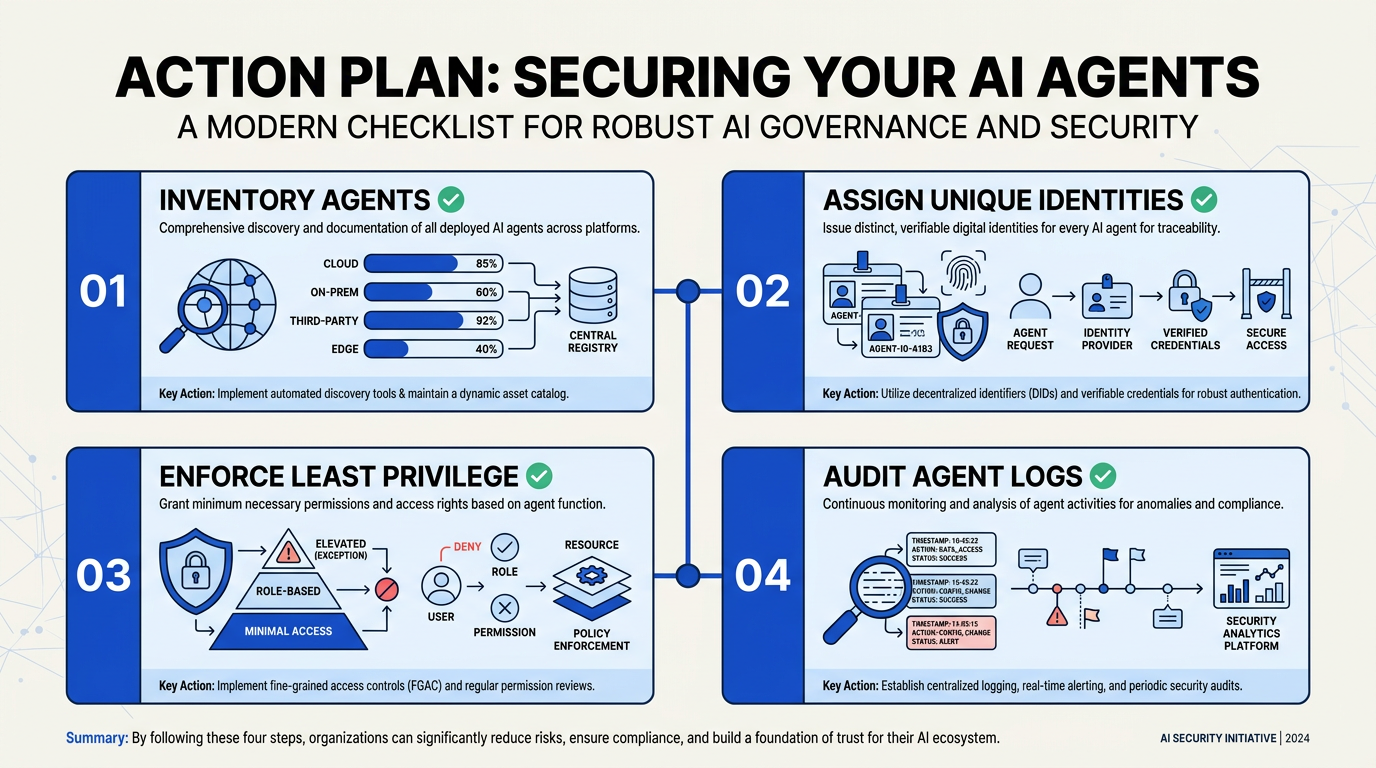
Transitioning agentic AI from an experimental copilot to an autonomous enterprise workforce requires moving beyond superficial security. As cybersecurity experts point out, relying solely on input validation or output filtering leaves massive governance gaps. Instead, enterprises must treat autonomous systems as first-class corporate citizens, provisioning them with robust, non-human identities (NHIs). This paradigm shift aligns with emerging guidelines from OWASP, NIST, and Zero-Trust frameworks, establishing identity as the primary control plane for agentic security.
For enterprises deploying complex communication agents—such as AI voice systems and WhatsApp chatbots powered by platforms like CallMissed—securing these workflows starts at the identity layer. By assigning cryptographic identities to agents, organizations can ensure that every automated outbound call, database query, or API call is authenticated, restricted to least-privilege access, and fully audited.
The following enterprise checklist outlines the critical phases for establishing a secure, identity-driven governance framework for autonomous AI agents:
| Phase | Key Objective | Core Implementation Detail | Standards & Reference |
|---|---|---|---|
| 1. Identity Provisioning | Assign unique, machine-readable non-human identities (NHIs). | Register each agent with a distinct cryptographic identifier (e.g., SPIFFE/SPIRE). | NIST SP 800-207 (Zero Trust Architecture) |
| 2. Authentication | Enforce strong, token-based machine authentication. | Use short-lived OAuth 2.0 tokens and secure API gateways to prevent credential theft. | Okta Agentic AI Framework |
| 3. Authorization (Least Privilege) | Restrict agent capabilities to minimum required operations. | Apply Role-Based (RBAC) and Attribute-Based Access Control (ABAC) policies. | Saviynt Identity-Driven Governance |
| 4. Real-time Auditability | Log every autonomous decision and system interaction. | Capture inputs, outputs, and system actions with tamper-resistant audit trails. | Model Context Protocol (MCP) |
| 5. Revocation & Kill-Switches | Terminate compromised or malfunctioning agents immediately. | Implement dynamic token revocation and centralized session invalidation. | Strata Identity Governance |
Step 1: Establish Non-Human Identities (NHIs)
Before an agent can execute a single transaction, it must have a verifiable identity. Traditional service accounts are no longer sufficient for complex, multi-agent workflows. Enterprises must register each agent with unique metadata, including owner attribution, LLM lineage (especially when leveraging multi-model platforms like CallMissed's gateway to switch between 300+ LLMs), and authorized operational boundaries.
Step 2: Enforce Fine-Grained, Dynamic Authorization
Unlike static software, autonomous agents dynamically determine their execution paths. Consequently, authorization must be continuous and contextual. By leveraging Attribute-Based Access Control (ABAC), security teams can restrict an agent's actions based on real-time factors, such as transaction limits, data sensitivity tiers, and time-bound session tokens.
Step 3: Implement Zero-Trust Runtime Monitoring
Identity governance does not end at authentication. Utilizing standards like the Model Context Protocol (MCP) allows enterprises to map out exactly how agents interact with internal data sources and external APIs. Continuous session monitoring ensures that any anomalous behavior—such as an agent attempting to escalate its own privileges—triggers an automated kill-switch, instantly revoking its access tokens.
Frequently Asked Questions
What is identity governance for agentic AI and why is it necessary?
How does agentic AI governance differ from traditional non-human identity management?
What are the primary security risks of failing to implement identity governance for agentic AI?
What standards are emerging to establish identity as a core governance layer?
How can businesses deploy autonomous agents safely without compromising compliance?
What role does continuous authentication play in securing autonomous agent lifecycles?
Conclusion
As autonomous systems transition from simple copilots to independent actors, managing non-human digital identities has emerged as the ultimate frontier of enterprise security. Governing agentic AI at scale requires moving beyond passive input-output monitoring toward robust, identity-first architectures.
Key takeaways for securing this transition include:
- Identity as the primary control plane: Effective governance hinges on assigning unique digital identities to AI agents, enabling precise tracking, auditing, and lifecycle management.
- Action-level authorization: Security must be enforced at the runtime level, ensuring autonomous agents only execute authenticated and authorized API actions.
- Standardized security frameworks: Aligning with emerging NIST and OWASP zero-trust guidance is critical for mitigating non-human identity and access management risks.
Looking ahead, the next phase of enterprise AI will watch organizations shift from siloed bots to interconnected, multi-agent ecosystems governed by strict zero-trust policies. To explore how secure, reliable AI communication is evolving, check out CallMissed—an AI infrastructure platform powering production-ready voice agents and multilingual chatbots for businesses.
Is your organization's infrastructure ready to govern the autonomous digital workforce of tomorrow?
Related Posts


Ready to automate customer conversations?
Launch AI voice agents and WhatsApp bots with CallMissed — one API, 22+ Indian languages.