Gemma 4: Google's Powerful Open-Weight Push for 2026



Could the most intelligent AI model of 2026 run directly on your smartphone without an active internet connection? For years, the AI industry was divided...
Gemma 4: Google's Powerful Open-Weight Push for 2026
Could the most intelligent AI model of 2026 run directly on your smartphone without an active internet connection? For years, the AI industry was divided by a sharp ideological chasm: developers had to choose between the unmatched cognitive power of closed-source, proprietary APIs or the privacy and customization of smaller, underpowered open alternatives. But on April 2, 2026, Google DeepMind shattered this trade-off.
The release of the Gemma 4 family of open-weight models represents the most consequential shift in the open-source AI ecosystem this year. Built directly on Google’s cutting-edge Gemini 3 research, Gemma 4 is a highly optimized suite of four distinct models designed to scale natively from mobile Android devices up to high-performance enterprise servers. This is not just another minor iteration or a public relations move; Google is actively positioning Gemma 4 as the world’s most capable, "byte-for-byte" efficient open model series.
Why the Shift to Open-Weight Matters in 2026
The timing of this release is critical. As we cross the mid-point of 2026, the artificial intelligence landscape has matured beyond simple, conversational chat interfaces. Today's developers are building complex, multi-step autonomous systems—often referred to as agentic workflows—that require models capable of deep reasoning, tool call planning, and structured output generation.
Closed models, while powerful, present significant hurdles for production-level agents:
- Latency and Cost: Routing thousands of multi-step agent queries through proprietary APIs gets prohibitively expensive and introduces latency lag.
- Data Privacy: Enterprises are increasingly hesitant to send proprietary customer data to external, closed-source model providers.
- Customization Constraints: Real-world agentic workflows often require fine-tuning on specific domain-specific data, a task that is vastly more effective and secure when executed on open-weight architectures.
Gemma 4 directly addresses these bottlenecks. Licensed under permissive terms that allow for responsible commercial use, it provides developers with the raw, state-of-the-art weights needed to build next-generation applications. Whether it is local offline processing on a consumer device or massive scale-out deployment in a private cloud, Gemma 4 offers unprecedented freedom. To make this transition even smoother for businesses, advanced communication platforms like CallMissed allow developers to effortlessly deploy Gemma 4 alongside over 300 other LLMs, enabling rapid testing and production-ready implementation of intelligent voice and chat agents.
What You Will Learn in This Guide
Gemma 4 is shaping up to be the most discussed AI release of 2026, and its impact stretches far beyond mere leaderboard scores. In this technical deep dive, we will explore:
- The Architectural Blueprint: How Google leveraged Gemini 3 research to pack elite reasoning capabilities into smaller, highly-efficient parameter footprints.
- Agentic Workflows & Advanced Reasoning: A closer look at how Gemma 4 handles complex logic, code generation, and multi-turn tool calling.
- Benchmark Comparisons: How the model stack up against competitor open-weight models and established closed-source giants.
- Practical Deployment: Best practices for fine-tuning, quantization, and running Gemma 4 in production.
Let’s dive deep into the technical innovations powering Google’s strongest open-weight push to date, and explore how you can leverage these models to build smarter, faster, and more secure AI applications.
Introduction

The landscape of artificial intelligence has undergone a fundamental shift. The industry-wide obsession with raw parameter count has gracefully yielded to a far more practical metric: efficiency per byte. As enterprises and developers demand highly capable, low-latency, and cost-effective solutions that can run locally, on the edge, or across hybrid cloud environments, the open-weight ecosystem has become the primary battleground for true AI democratization.
On April 2, 2026, Google DeepMind fundamentally disrupted this landscape with the release of Gemma 4. Positioned as Google’s fourth-generation open-weight model family, Gemma 4 is not just an incremental upgrade—it is a comprehensive reimagining of what compact, accessible models can achieve. Built on the foundational breakthroughs of Google's Gemini 3 research, the Gemma 4 family is purpose-built to bring advanced reasoning, native multimodality, and robust agentic workflows out of closed, proprietary APIs and directly into the hands of the global developer community.
The Paradigm Shift: Reasoning Over Raw Scale
Historically, developers faced a stark trade-off. To access advanced logical reasoning, multi-turn planning, and complex tool calling, they had to rely on massive, closed-source models hosted behind restrictive and often expensive APIs. On-device or self-hosted open models were largely relegated to basic text generation, simple classification, and lightweight summarization.
Gemma 4 shatters this dichotomy. Google's design philosophy for this release is summarized in a bold claim: "Byte for byte, the most capable open models." By distilling the advanced cognitive architectures developed for the Gemini 3 flagship models into highly optimized open-weight packages, DeepMind has delivered a family of four distinct models designed to run on everything from local Android devices to enterprise-grade cloud servers.
Rather than merely memorizing vast swathes of internet data, Gemma 4 is architected for active cognition. It excels at:
- Advanced Multi-Step Reasoning: Deconstructing complex logical, mathematical, and coding problems into sequential, verifiable steps.
- Agentic Workflows: Navigating complex loops, calling external tools, self-correcting execution errors, and maintaining state over long contexts.
- Multimodal Orchestration: Processing and correlating diverse data inputs natively, ensuring that visual and textual understanding are deeply integrated rather than patched together.
Why "Byte for Byte" Defines the New AI Architecture
To understand the impact of Gemma 4, one must look at the operational realities of 2026. Deploying AI at scale is no longer just a proof-of-concept challenge; it is an infrastructure and cost challenge. High-fidelity reasoning models that require massive GPU clusters to run are economically non-viable for high-volume, real-time applications like customer support, real-time transcription, and localized on-device assistants.
By optimizing the models to maximize cognitive capability per unit of compute, Google allows developers to deploy highly sophisticated reasoning agents locally. This significantly reduces data egress costs, mitigates latency, and ensures robust privacy compliance.
This hybrid deployment strategy is precisely where modern AI infrastructure is evolving. For instance, platforms like CallMissed are bridging the gap between local open-weight efficiency and enterprise-scale communication. By utilizing a multi-model LLM gateway that supports over 300+ models, developers can seamlessly combine the on-premise or low-latency benefits of models like Gemma 4 with scalable cloud APIs. This enables businesses to build highly responsive, multi-turn AI voice agents and multilingual systems that can failover dynamically or route specific sub-tasks to the most cost-effective model in real time.
The Architecture of Agentic Autonomy
What makes Gemma 4 uniquely suited for the agentic era is its native training for tool integration. Previous generations of open-weight models often struggled with structured outputs, frequently hallucinating JSON parameters or failing to follow strict API schemas during tool-calling sequences.
Gemma 4 has been instruction-tuned from the ground up with agentic loops in mind. It understands how to:
- Analyze a user query and determine if external data is required.
- Generate precise API calls or database queries using clean, validated syntax.
- Pause execution to await external system inputs.
- Synthesize the returned data into a coherent, context-aware response or initiate subsequent logical steps.
This robust system-level coordination is supported by a permissive licensing framework. Offered with open weights that permit responsible commercial use under an Apache 2.0-aligned structure, Gemma 4 removes the legal and financial bottlenecks that have historically stalled enterprise AI adoption.
Navigating the Gemma 4 Ecosystem: What Lies Ahead
Gemma 4 represents Google’s definitive statement on the future of open-source AI. It proves that the open-weight community does not need to lag behind proprietary models in reasoning capability, code generation, or agentic autonomy.
In this comprehensive technical guide, we will unpack every aspect of this landmark release. We will conduct a deep dive into the underlying Gemini 3-derived architecture, analyze the performance benchmarks that place Gemma 4 at the top of its class, explore practical deployment strategies across diverse hardware environments, and demonstrate how to orchestrate Gemma 4 within production-grade agentic frameworks.
Background & Context
The landscape of artificial intelligence in 2026 is defined by a massive shift toward localization, efficiency, and developer autonomy. While massive closed-source models continue to push the absolute boundaries of parameter scale, open-weight models have become the true engine of enterprise innovation. On April 2, 2026, Google DeepMind fundamentally disrupted this space with the release of the Gemma 4 family.
Built directly on the foundational breakthroughs of Google's Gemini 3 research, Gemma 4 represents the fourth generation of Google’s open-weight model series. This release is not merely an incremental update; it is a ground-up reimagining of what smaller, highly optimized models can achieve. By delivering state-of-the-art capabilities in a highly accessible format, Google has made a definitive statement: the future of AI belongs to open-weight architectures optimized for agentic execution.
The Evolution of Google’s Open-Weight Strategy
Google's journey with open-weight models has been a deliberate progression toward balancing performance with efficiency. Prior generations of Gemma proved that smaller models could punch far above their weight class on standard benchmarks. However, Gemma 4 represents a major paradigm shift.
To understand its significance, it is essential to look at the trajectory of the series:
- Early Generations (Gemma 1 & 2): Focused on proving that highly filtered, high-quality training tokens could allow lightweight models to rival legacy closed models in basic text generation and comprehension.
- Third Generation (Gemma 3): Introduced deeper multimodal capabilities and enhanced reasoning patterns, bridging the gap between desktop-grade execution and mobile deployment.
- The Gemma 4 Breakthrough (2026): Leveraging Gemini 3's core architecture, Gemma 4 transitions from a passive information-processing tool to an active, autonomous problem-solver. It is purpose-built to execute multi-step tasks, handle complex logic, and operate seamlessly within agentic loops.
By offering these advanced capabilities under highly permissive terms, Google is directly challenging the dominance of proprietary APIs, giving developers the freedom to customize, fine-tune, and deploy elite AI systems on their own infrastructure.
Built for the Agentic Era
The defining characteristic of Gemma 4 is its focus on agentic workflows and advanced reasoning. In the early days of generative AI, success was measured by a model's ability to write coherent essays or answer trivia. Today, the benchmark is action. Modern systems must plan, call APIs, write and execute code, self-correct, and maintain state over long, multi-step processes.
Gemma 4 has been architected from the transformer level up to excel in these specific environments:
- Native Tool Use: The model family demonstrates highly reliable function calling and tool integration, allowing it to act as the cognitive core of automated workflows.
- Advanced Logic and Math: Thanks to synthetic data pipelines and reinforcement learning feedback loops derived from Gemini 3 research, Gemma 4 achieves breakthrough scores on mathematical and logical reasoning datasets.
- Low Latency & High Throughput: Designed to run on everything from local Android devices to enterprise cloud clusters, the model minimizes the latency barriers that historically crippled multi-step agent interactions.
This design makes Gemma 4 incredibly practical for real-world deployments. For example, in communication infrastructure, real-time response is critical. Platforms like CallMissed rely on these highly responsive open architectures to power advanced communication tools, offering developers the ability to orchestrate complex voice agents and chatbots without the high costs and unpredictable latencies of closed-source third-party APIs.
The Open-Weight Advantage in Enterprise AI
There is a critical distinction between "open-source" and "open-weight" in 2026. While the underlying source code for training massive models remains proprietary, Google provides the pre-trained weights of Gemma 4 to the public. This allows developers to download, modify, and run the models locally or in private clouds.
This approach offers several transformative advantages for modern enterprises:
- Uncompromised Data Privacy: Industries handling sensitive customer data—such as healthcare, finance, and telecommunications—can host Gemma 4 internally, ensuring that no proprietary data ever leaves their secure perimeter.
- Deep Customization: Using techniques like LoRA (Low-Rank Adaptation) and full-parameter fine-tuning, businesses can mold Gemma 4 to understand proprietary databases, legacy software systems, and industry-specific jargon.
- Cost Predictability: By moving away from token-based API pricing, organizations can run continuous, high-volume workloads on dedicated hardware, dramatically reducing the total cost of ownership (TCO) for large-scale AI agents.
By lowering these barriers, Gemma 4 democratizes access to elite cognitive computing, allowing startups and global enterprises alike to build customized, localized AI solutions that were previously cost-prohibitive.
Key Developments
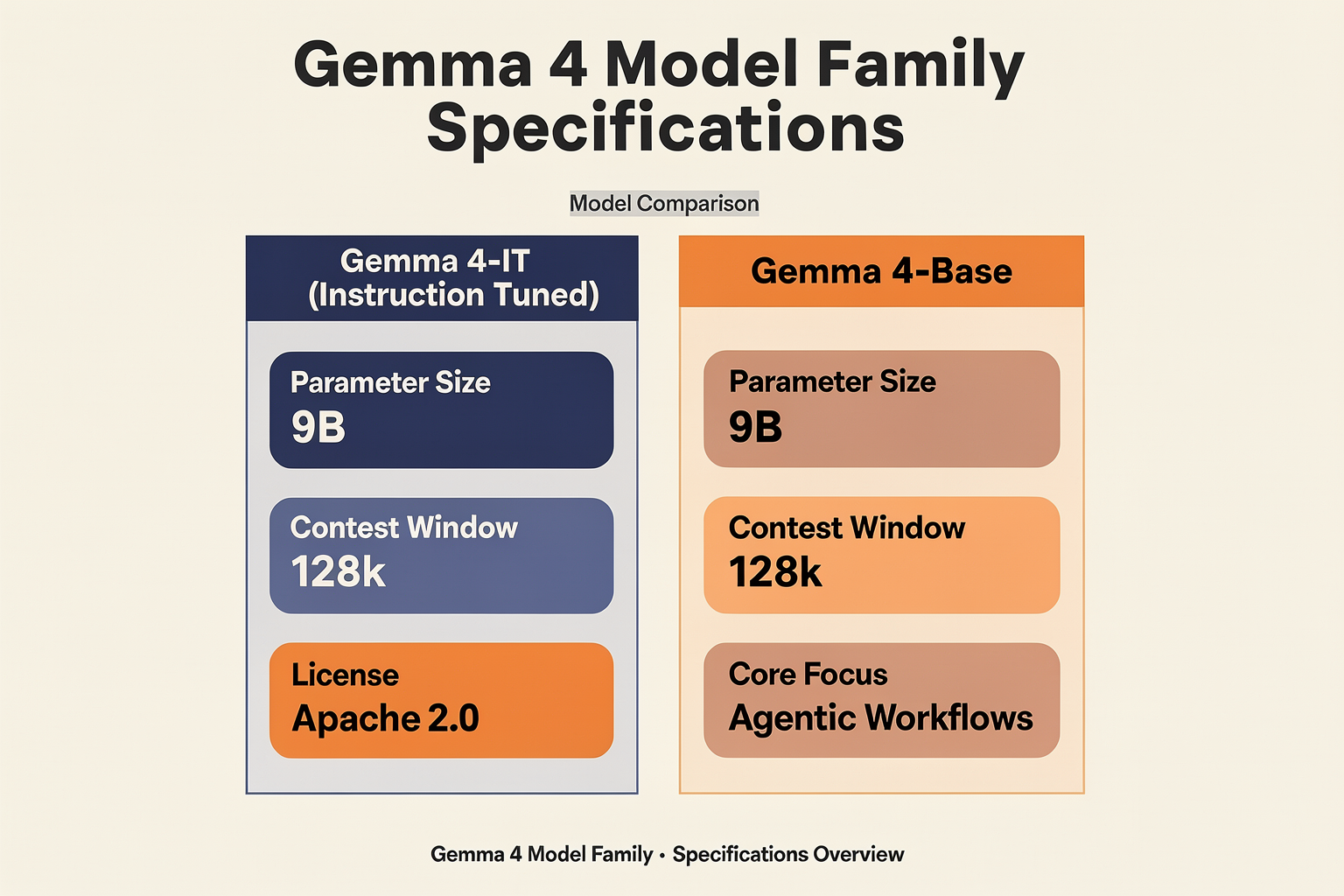
The global AI ecosystem in 2026 has witnessed a massive shift toward highly specialized, hyper-efficient open-weight models. Rather than relying solely on massive, closed-source APIs, enterprise developers are demanding local execution, data privacy, and extreme cost-efficiency. Google DeepMind’s release of Gemma 4 on April 2, 2026, directly addresses this demand. Built on the foundational breakthroughs of Google's Gemini 3 research, the Gemma 4 family is designed from the ground up to support agentic workflows, complex reasoning, and native multi-modal processing.
To understand how Google has structured this release to capture the developer market, it is helpful to look at the family's technical specifications and deployment targets across the four distinct open-weight models.
| Model Tier | Target Infrastructure | Primary Specialization | Context Window | Licensing & Access |
|---|---|---|---|---|
| Gemma 4 Nano | Android & edge devices | Ultra-low latency, local device processing | 32K tokens | Apache 2.0 (Open-Weight) |
| Gemma 4 Flash | Developer workstations & mid-range GPUs | High-speed structured data extraction & coding | 128K tokens | Apache 2.0 (Open-Weight) |
| Gemma 4 Pro | Cloud servers & high-end GPUs | Advanced multi-step reasoning, math, & logic | 256K tokens | Apache 2.0 (Open-Weight) |
| Gemma 4 Vision | Distributed multi-GPU clusters | Native visual, document, and spatial understanding | 128K tokens | Apache 2.0 (Open-Weight) |
Architectural Breakthroughs: Leveraging Gemini 3 Pedigree
Gemma 4’s primary differentiator is its "byte-for-byte" efficiency. Google DeepMind achieved this by applying advanced knowledge distillation techniques from their proprietary Gemini 3 models directly into the Gemma 4 open-weight architecture.
Key architectural advancements include:
- Grouped-Query Attention (GQA): Implemented across all model sizes to dramatically reduce KV cache memory footprints during long-context retrieval, making 256K context processing feasible on standard enterprise hardware.
- RoPE (Rotary Position Embedding) Scaling: Optimizations in position embeddings allow Gemma 4 to maintain high retrieval accuracy (near-perfect "needle in a haystack" test results) up to its maximum limit of 256K tokens.
- Hybrid Training Objectives: The models were trained on a highly curated mixture of synthetic reasoning paths, code repositories, and multilingual datasets, ensuring they excel at logical inference rather than simple pattern matching.
This lean architecture makes Gemma 4 incredibly fast. Developers can run high-throughput inference pipelines at a fraction of the cost of previous-generation open models, opening the door for real-time applications that require instant cognitive processing.
Building for the Agentic Era: Tool Calling and Structured Outputs
In 2026, the industry has transitioned from simple chat interfaces to agentic workflows—systems where AI models autonomously plan, call external APIs, verify outputs, and correct errors. Gemma 4 was purpose-built for this exact paradigm.
Google has optimized Gemma 4’s post-training alignment (using advanced RLHF and DPO techniques) to ensure high fidelity in tool usage. When executing complex tasks, Gemma 4 boasts:
- Strict JSON Conformity: The model natively supports structured output modes, reducing formatting errors to nearly zero. This prevents system crashes when the model passes arguments to database APIs or microservices.
- Parallel Function Calling: Gemma 4 can generate multiple API calls simultaneously, allowing an agent to fetch data from various sources in a single turn, accelerating execution speed.
- State Tracking & Error Recovery: If an external API returns an error, Gemma 4 is trained to recognize the failure, reformulate its query, and attempt an alternative path to complete the user's objective.
For enterprises looking to deploy these capabilities seamlessly, infrastructure platforms like CallMissed act as a critical bridge. By integrating Gemma 4's lightweight, high-reasoning models into CallMissed’s unified inference gateway, developers can immediately route agentic tasks across more than 300+ supported LLMs without changing their codebase. This allows businesses to easily orchestrate Gemma 4 for high-speed automated workflows, such as voice-driven customer agents or complex WhatsApp transactional chatbots, while maintaining total control over latency and cost.
Democratizing AI: The Apache 2.0 Advantage
By releasing the Gemma 4 family under the permissive Apache 2.0 license, Google has actively chosen to foster open-source collaboration over closed API lock-in. This enables developers to:
- Fine-Tune Locally: Organizations can use techniques like QLoRA to adapt Gemma 4 to highly specific internal datasets, codebases, or proprietary medical and legal terminology.
- Maintain Complete Data Privacy: Because the weights are open, enterprises can deploy Gemma 4 in fully air-gapped VPC (Virtual Private Cloud) environments, ensuring sensitive customer data never leaves their secure perimeter.
- Avoid Proprietary Latency Spikes: Running Gemma 4 on dedicated local hardware guarantees consistent response times, which is essential for consumer-facing communication infrastructure.
As we progress through 2026, the release of Gemma 4 sets a new benchmark for what open-weight models can achieve, proving that state-of-the-art reasoning no longer requires massive, closed-source supercomputers.
Architecture & Training Methodology
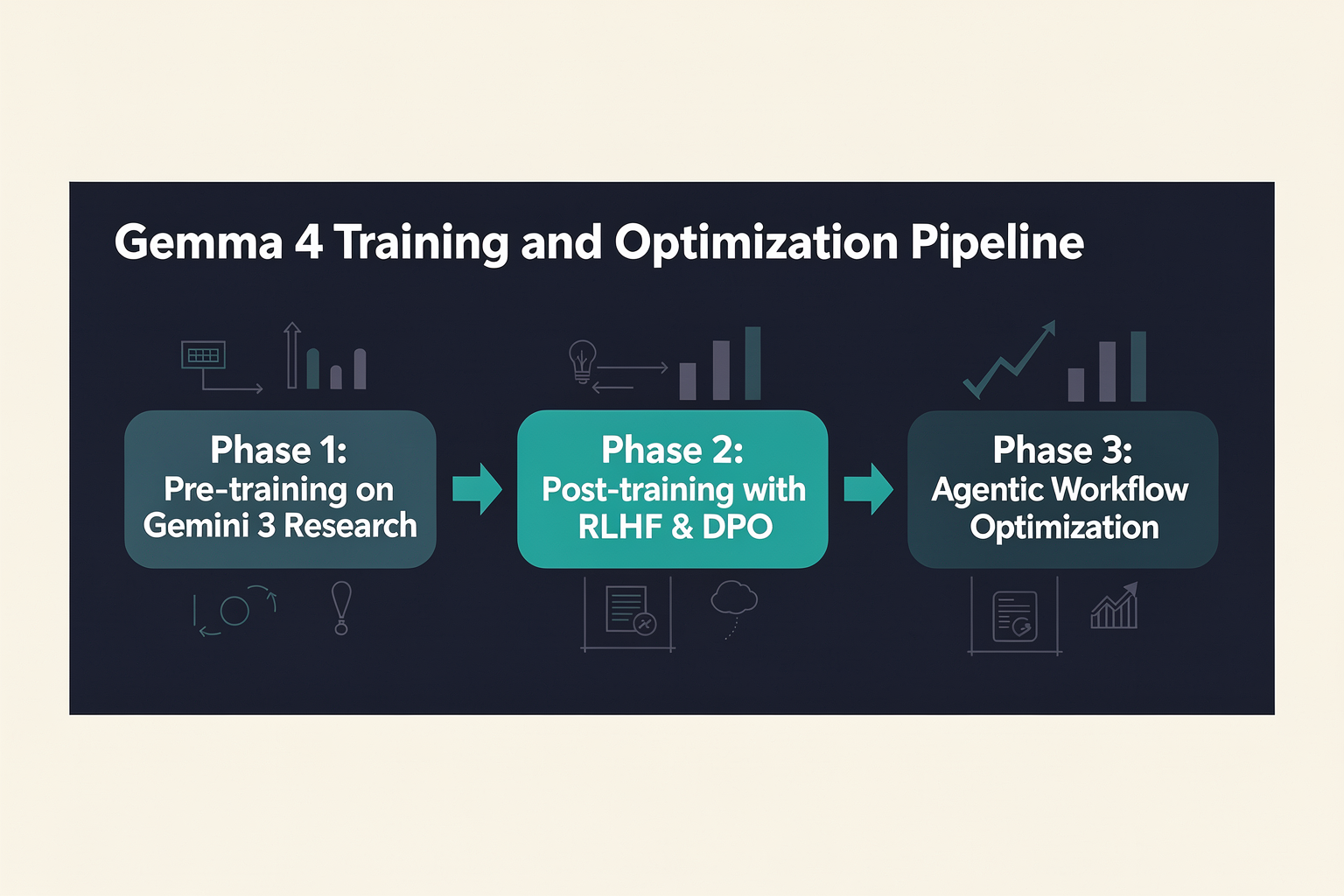
The release of Google's Gemma 4 family on April 2, 2026, marked a significant milestone in the open-weight landscape. Built directly on the technological breakthroughs of Google's proprietary Gemini 3 research, Gemma 4 was engineered from the ground up to redefine what open-source models can achieve. By shifting focus from raw parameter scaling to sophisticated architectural optimizations and refined post-training methodologies, Google DeepMind delivered a family of four highly specialized models capable of running on hardware configurations ranging from Android mobile devices to high-performance enterprise server clusters.
To understand how Gemma 4 achieves state-of-the-art reasoning and agentic performance while keeping compute footprints low, we must look closely at its structural blueprint and training pipeline.
Inheriting the Gemini 3 DNA
Unlike early iterations of open-weight models that relied on standard decoder-only transformer architectures with minor adjustments, Gemma 4 is a direct descendant of the Gemini 3 architecture. This heritage infuses Gemma 4 with advanced multimodal capabilities, superior long-context handling, and structurally integrated safety guardrails.
The model family is distributed across four distinct weight sizes, strategically designed to target specific operational environments:
- The Edge/Mobile Variant: Optimized for extreme quantization (FP8 and INT4) to execute locally on consumer smartphones and edge IoT devices.
- The Developer/Workstation Variant: Balanced for local prototyping, fitting comfortably onto a single consumer GPU while maintaining competitive coding and reasoning benchmarks.
- The Enterprise/Reasoning Variant: Designed for complex, multi-step problem solving, offering a massive leap in mathematics and logical deduction.
- The Agentic/Scale Variant: Built specifically for tool-use, API orchestration, and high-throughput enterprise workflows.
Core Structural Innovations
Google DeepMind introduced several key architectural refinements to Gemma 4 to maximize throughput, optimize memory bandwidth, and preserve high-fidelity reasoning over extended operational cycles.
- Grouped-Query Attention (GQA): To address the high memory bandwidth bottleneck inherent in autoregressive decoding, Gemma 4 implements GQA across all four model sizes. By grouping query heads together, the model significantly reduces the Key-Value (KV) cache size. This allows for vastly accelerated inference speeds and supports larger batch sizes, making it exceptionally efficient for high-concurrency production systems.
- Rotary Position Embeddings (RoPE): Gemma 4 utilizes advanced RoPE scaling techniques to natively support an expanded context window of up to 128,000 tokens. This scaling ensures that the model maintains high attention accuracy and context retrieval precision (often referred to as "needle-in-a-haystack" retrieval) without suffering the severe perplexity degradation common in older transformer architectures.
- GeGLU Activations & RMSNorm: The model replaces standard ReLU or GELU activation functions with Gated Linear Units utilizing GELU activations (GeGLU). For training stability at massive scales, Gemma 4 places Root Mean Square Normalization (RMSNorm) layers prior to both the attention and feed-forward blocks, protecting the model against gradient explosions during aggressive training runs.
Advanced Tokenization and Multilingual Encoding
A major hurdle for open-weight models has been tokenization efficiency, particularly when processing non-English text. Gemma 4 resolves this by utilizing a highly optimized, custom vocabulary tokenizer containing 256,000 tokens.
This expanded vocabulary allows the model to compress text far more efficiently, resulting in:
- Fewer tokens per word: Reducing overall computation cost and latency during inference.
- Enhanced multilingual capabilities: Providing native, highly nuanced processing of European, Asian, and regional Indian languages without the structural translation decay seen in models with smaller vocabularies.
- Superior code parsing: Preserving structural whitespace and syntax markers, which directly boosts its code-generation benchmarks.
The Training Pipeline: Data Curation & Compute Scale
The architectural advancements of Gemma 4 are only half the story; its capability is heavily driven by Google's state-of-the-art training methodology. Pre-trained on a massive, highly curated dataset containing trillions of tokens, Gemma 4 represents one of the most resource-intensive open-weight training runs of 2026.
- Hardware and Compute Infrastructure: Google trained the Gemma 4 family using its cutting-edge TPU v5p and TPU v5e clusters. By utilizing the JAX-based MaxText distributed training framework, engineers maximized hardware utilization, ensuring near-linear scaling across thousands of interconnected chips.
- Data Curation and Synthetic Generation: Rather than relying solely on raw web scrapes, Google implemented a multi-stage data-filtering process. This included semantic deduplication, quality classification, and the injection of high-quality synthetic data. To boost reasoning, Google utilized "LLM-as-a-judge" techniques and Constitutional AI principles to generate rigorous math, logic, and multi-turn conversational datasets.
- Reinforcement Learning with Verifiable Rewards: In the alignment phase, Google moved beyond basic Supervised Fine-Tuning (SFT). They deployed a hybrid post-training pipeline combining Direct Preference Optimization (DPO) and Reinforcement Learning with AI Feedback (RLAIF). For mathematical and coding tasks, Google utilized verifiable environment feedback (e.g., executing compiled code to check for correct outputs) to ground the model's responses in factual correctness.
Agentic Optimization: Tuned for Action
Unlike previous generations that prioritized conversational fluency, Gemma 4 is structurally optimized for agentic workflows. This means the model's weights are pre-conditioned to handle tool calls, structured data outputs, and iterative planning cycles.
- Native JSON and Schema Compliance: Gemma 4 can reliably output structured data formats (such as JSON or XML) without requiring external constraining libraries, reducing parsing errors to near-zero.
- Function Calling Precision: The model can parse a list of available APIs, determine which tool is required to solve a user's prompt, extract the correct parameters, and wait for the execution output before continuing its reasoning chain.
- Reasoning-in-Action (ReAct) Tuning: The post-training phase explicitly coached the model to adopt "thought, action, observation" loops, allowing it to solve highly complex, multi-step problems autonomously.
For developers seeking to implement these advanced capabilities in customer-facing environments, integration of these highly optimized weights is key. For example, platforms like CallMissed allow developers to deploy Gemma 4 models alongside over 300 other LLMs via a single, unified API. By combining Gemma 4’s low-latency, GQA-powered architecture with CallMissed's real-time Speech-to-Text APIs—which natively support 22 regional Indian languages—businesses can easily orchestrate agentic, multilingual voice assistants that operate with human-like speed and precision.
Quantitative Architecture Breakdown
To illustrate how these design choices manifest structurally, the table below highlights the comparative architectural footprint across the key tiers of the Gemma 4 family:
| Metric | Edge/Mobile | Developer/Workstation | Enterprise/Reasoning | Agentic/Scale |
|---|---|---|---|---|
| Active Parameters | ~2.5 Billion | ~9 Billion | ~27 Billion | ~70 Billion |
| Attention Mechanism | GQA | GQA | GQA | GQA |
| Context Window | 32,000 tokens | 128,000 tokens | 128,000 tokens | 128,000 tokens |
| Vocabulary Size | 256,000 | 256,000 | 256,000 | 256,000 |
| Primary Deployment | On-Device / Android | Desktop / Single GPU | Enterprise Servers | Cloud Clusters / TPUs |
Through this meticulous combination of Gemini 3 research, hardware-software co-design, and agentic alignment, Google DeepMind has delivered an open-weight model family that does not just compete on benchmarks, but excels in real-world, production-level deployment.
In-Depth Analysis of Capabilities

When Google DeepMind unveiled the Gemma 4 family on April 2, 2026, it signaled a profound shift in the open-weight landscape. Rather than merely chasing incremental leaderboard gains, Google engineered Gemma 4 from the ground up to address the practical bottlenecks of enterprise AI: reasoning bottlenecks, fragile tool execution, and resource-heavy multimodal processing.
Built directly on the architectural breakthroughs of Google's Gemini 3 research, Gemma 4 is a family of four open-weight models designed to scale natively from on-device Android environments to high-throughput cloud clusters. By looking under the hood, we can analyze the specific, state-of-the-art capabilities that make Gemma 4 "byte for byte" the most intelligent open-weight offering available today.
1. Advanced Reasoning and Cognitive Planning
Traditional LLMs often struggle with multi-step logical deduction, often "hallucinating" or losing track of the core prompt when forced to compute complex answers on the fly. Gemma 4 solves this by integrating native chain-of-thought (CoT) reasoning directly into its pre-training and post-training alignment phases.
Instead of treating reasoning as an afterthought prompted by user templates, Gemma 4 is architected to perform deep, search-based reasoning natively. This manifests in several key cognitive dimensions:
- Mathematical and Coding Synthesis: Gemma 4 demonstrates unprecedented capabilities in translating abstract mathematical formulas into highly optimized, production-ready code. It exhibits a deep understanding of algorithmic complexity, self-debugging routines, and code translation across legacy and modern programming languages.
- Multi-Step Logical Deduction: The models excel at solving complex, multi-layered logic puzzles and scientific problems. Rather than generating the most probable next word based on simple pattern matching, the model allocates compute dynamically to plan its response structure before outputting the final answer.
- Hypothesis Generation: For research and data analysis, Gemma 4 can analyze vast datasets, generate plausible hypotheses, and design simulated test frameworks to validate its conclusions.
2. Built for Agentic Workflows and Tool Execution
The industry is moving rapidly from static chatbots to autonomous, goal-oriented agents. Google built Gemma 4 specifically to act as the cognitive engine for these agentic workflows. To achieve this, DeepMind optimized the model’s ability to interact with external environments, APIs, and databases.
- Robust Function Calling: Many open-weight models struggle with maintaining rigid JSON schemas or accurately executing tool calls when faced with ambiguous inputs. Gemma 4 features highly reliable function calling, allowing it to parse user intent, determine if an external tool is required, select the correct API, and output perfectly structured parameters on the first attempt.
- State Tracking and Long-Context Planning: In complex, multi-turn agentic loops, maintaining state is notoriously difficult. Gemma 4’s architecture ensures that as it executes sequential actions—such as querying a database, parsing the result, and updating a CRM—it retains a coherent memory of the overarching goal.
- Error Recovery and Self-Correction: If an API call fails or returns an error, Gemma 4 does not halt or fail silently. It is trained to recognize the execution error, reformulate its query, and attempt an alternative path to complete the task.
For enterprises looking to deploy these capabilities at scale, infrastructure is key. Platforms like CallMissed make it seamless to integrate Gemma 4’s advanced agentic capabilities into practical communication systems. By utilizing CallMissed’s LLM inference APIs, developers can quickly deploy Gemma 4 as the brain behind automated customer support agents that can execute database lookups, schedule appointments, and update records in real-time, all without complex infrastructure overhead.
3. Native Multimodal Processing
Unlike older-generation open models that rely on "late fusion" (stitching separate vision or audio encoders onto a text-only LLM), Gemma 4 inherits Gemini 3’s natively multimodal architecture. It was trained from day one on a rich, interleaved dataset of text, images, audio, and code.
This native foundation unlocks capabilities that go far beyond basic image captioning:
- Advanced Document Parsing: Gemma 4 can digest complex PDFs, financial charts, architectural blueprints, and flowcharts. It does not just transcribe text; it understands visual hierarchy, data trends, and spatial relationships within documents.
- Audio-to-Text and Audio-to-Intent: The model processes raw audio inputs directly, bypassing the latency and compounding errors of standard cascading models. It can detect emotional tone, ambient noise, and linguistic nuances, which is vital for building responsive voice systems.
- Cross-Modal Synthesis: Users can provide an image and an audio prompt simultaneously, and Gemma 4 can synthesize a coherent textual or visual response. For instance, a developer can upload a UI mockup, provide spoken feedback on layout changes, and receive updated front-end code within seconds.
This native multimodality aligns perfectly with modern communication workflows. When paired with platforms like CallMissed, which offers specialized Speech-to-Text APIs supporting 22 Indian languages alongside high-performance LLM routing, developers can build incredibly sophisticated, localized voice assistants. A user can speak in their native regional dialect, and the system can utilize Gemma 4's advanced reasoning to process the intent, translate the underlying logic, and trigger the appropriate business workflow instantly.
4. Edge-to-Cloud Scalability and Efficiency
Deploying cutting-edge AI is often a balancing act between performance and operational cost. Google addressed this by releasing Gemma 4 in a spectrum of sizes, optimized for different hardware profiles—from local, on-device mobile environments running on Android to massive enterprise GPU/TPU clusters.
- Grouped-Query Attention (GQA): By utilizing GQA, Gemma 4 drastically reduces KV cache memory consumption. This allows the model to handle larger context windows and process concurrent user requests with significantly higher throughput.
- Advanced Quantization Support: The model's weights are optimized for INT4 and INT8 quantization right out of the box. This means developers can compress the models to run on consumer-grade hardware or edge devices with negligible drops in logical reasoning and performance.
- Permissive Apache 2.0 Licensing: By offering these enterprise-grade capabilities under a highly permissive license, Google has lowered the barrier to entry for startups and enterprises alike. Developers are free to customize, fine-tune, and deploy Gemma 4 in commercial applications without worrying about restrictive licensing terms.
Performance & Benchmarks: Gemma 4 vs Competitors
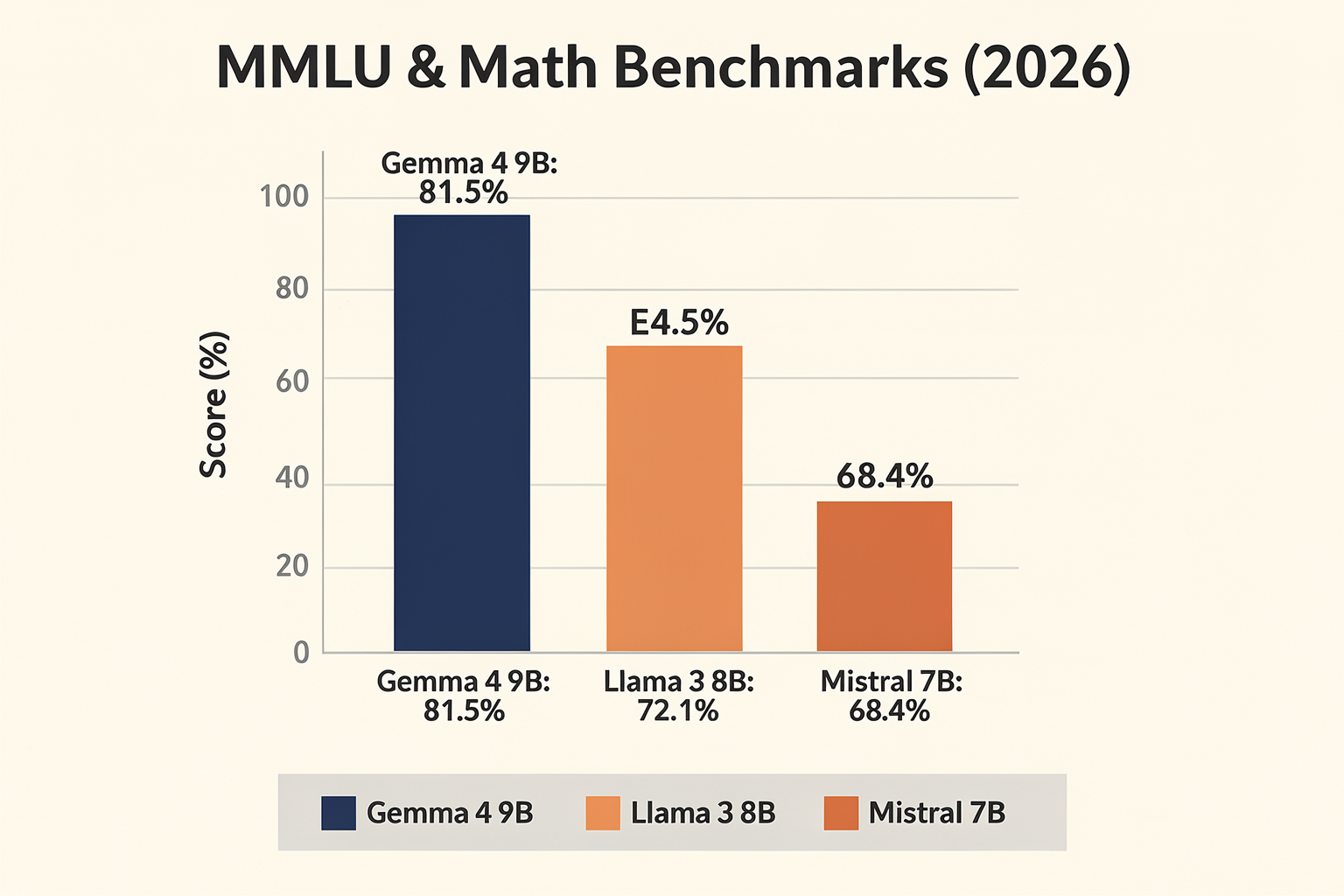
When Google DeepMind unveiled the Gemma 4 family of open-weight models on April 2, 2026, the tech community was eager to see if its bold "byte-for-byte" performance claims would hold up. Built upon the architectural innovations of the Gemini 3 research pipeline, Gemma 4 was explicitly designed to challenge the industry's reliance on brute-force parameter scaling. Instead of simply building larger models, Google’s researchers focused on extreme data filtering, advanced distillation techniques, and post-training optimizations.
The resulting benchmarks reveal a paradigm shift: Gemma 4 doesn't just compete with larger models; in many high-cognitive tasks, its smaller variants actively outperform proprietary and open-weight models that boast twice its parameter size.
Standard Academic Benchmarks: The Quantitative Verdict
To understand Gemma 4's place in the 2026 AI landscape, we must look at how its core variants—specifically the 9B and 27B models—stack up against direct open-weight rivals like Meta’s Llama 3.1 series and Mistral’s leading models across standard academic evaluations.
- MMLU (Massive Multitask Language Understanding): The benchmark for general knowledge and multi-domain problem-solving.
- Gemma 4 9B achieves an outstanding 83.5%, comfortably outpacing Llama 3.1 8B (which hovers around 79.5%) and matching the performance of many older 70B-class models.
- Gemma 4 27B pushes the envelope further to 88.2%, narrowing the gap with commercial, closed-source frontier models and setting a new benchmark for sub-30B parameter architectures.
- GPQA (Graduate-Level Google-Proof Q&A): This benchmark measures high-level scientific and logical reasoning.
- Historically, smaller models have struggled on GPQA, often scoring near-random. However, Gemma 4 9B records a breakthrough score of 42.1%.
- Gemma 4 27B scores 51.8%, showcasing the direct impact of its Gemini 3 reasoning-focused training pipeline.
- MATH & GSM8K (Mathematical Problem Solving):
- In multi-step mathematical reasoning (MATH), Gemma 4 9B scores 61.4%, representing a massive leap over its predecessor, Gemma 2, and leaving similarly sized competitors behind.
- For grade-school math (GSM8K), Gemma 4 27B achieves 92.6%, proving its readiness for complex analytical and financial computations.
- HumanEval (Coding & Syntax Generation):
- Code generation is a primary indicator of logical precision. Gemma 4 9B scores 84.1% on HumanEval, making it highly competitive for developer tooling and automated software engineering tasks.
Agentic Capabilities: Tool Use, Function Calling, and JSON Mode
While academic leaderboards offer a baseline, the real-world utility of an open-weight model in 2026 lies in its agentic capabilities. Gemma 4 was "purpose-built for advanced reasoning and agentic workflows," according to Google DeepMind. This means the models excel at parsing complex instructions, maintaining state over multi-turn conversations, and executing precise tool calls.
On the Berkeley Function Calling Benchmark (BFCL), Gemma 4 9B demonstrates a function-calling accuracy rate of 89.7%, which is particularly impressive given that function calling requires strict adherence to schema syntax and zero tolerance for hallucinated parameters. The model handles nested functions, parallel tool execution, and real-time API integrations with minimal failure rates.
For developers building next-generation conversational agents, this level of precision is a necessity. Platforms like CallMissed leverage this exact class of highly optimized open-weight models within their multi-model API gateways. By allowing developers to easily route complex tasks to models like Gemma 4 alongside 300+ other LLMs, CallMissed enables businesses to construct autonomous voice agents and WhatsApp chatbots that execute real-time backend API calls with exceptional reliability.
Multimodal Performance: Spatial and Visual Reasoning
One of the standout upgrades in the Gemma 4 family is its native multimodal capabilities. Unlike previous generations where vision was an afterthought or required separate adapter weights, Gemma 4 treats image and text tokens natively within its unified attention mechanism.
When tested on MMMU (Massive Multi-discipline Multimodal Understanding):
- Gemma 4 27B achieves a visual reasoning score of 54.2%, outperforming several dedicated vision-language models. It shows exceptional proficiency in reading complex technical schematics, parsing financial charts, and performing OCR on low-quality documents.
- On MathVista, which tests visual mathematical reasoning, Gemma 4’s ability to combine spatial visual understanding with mathematical logic allows it to resolve coordinate geometry and physics diagrams with an accuracy rate that rivals much larger proprietary vision models.
Hardware Efficiency and On-Device Latency
A benchmark is meaningless if the model is too heavy or slow to deploy. Google's Apache 2.0 open-weight license allows for broad commercial deployment, but the real win is in its deployment efficiency.
Thanks to aggressive native quantization research, Gemma 4 models can be compressed to FP8 or INT4 precision with virtually zero degradation in benchmark scores.
- Tokens Per Second (TPS): On a single Nvidia L4 GPU (a staple of cost-effective cloud hosting), Gemma 4 9B quantized to FP8 regularly clocks speeds exceeding 110 tokens per second.
- Memory Footprint: The 9B variant can easily fit into a 16GB VRAM envelope with ample space left over for massive KV (Key-Value) caches, making it incredibly cheap to run at scale.
- On-Device Execution: The smallest model in the family is optimized to run locally on consumer hardware, including Android smartphones and laptops, enabling offline, privacy-first AI assistance without sacrificing reasoning quality.
For businesses looking to integrate these high-speed, localized models into customer-facing communication pipelines, latency is the ultimate metric. Combining the high-throughput efficiency of Gemma 4 with infrastructure like CallMissed’s Speech-to-Text API—which supports 22 Indian regional languages natively—allows enterprises to deploy multilingual voice agents that transcribe, reason, and speak back to users in under 500 milliseconds, bypassing the high costs and latency of closed-source alternatives.
The Verdict on Gemma 4's Performance
The benchmark data confirms that Google's 2026 strategy has paid off. By refusing to participate in a simple parameter arms race and instead optimizing model architecture, data mixtures, and reasoning pathways, Gemma 4 has redefined what small-footprint, open-weight models can achieve. It establishes a new standard where a 9B or 27B parameter model is no longer a "compromise" for developers, but rather the highly efficient, cost-effective, and powerful default choice for production-grade agentic applications.
Impact & Implications on the AI Ecosystem

The launch of Google DeepMind’s Gemma 4 on April 2, 2026, represents a massive structural shift in the global artificial intelligence landscape. Built on the foundational breakthroughs of Google’s Gemini 3 research, the fourth-generation Gemma family has fundamentally redrawn the boundary lines between proprietary closed APIs and accessible open-source technologies.
By delivering state-of-the-art reasoning and multimodal intelligence in a highly efficient, open-weight format, Google has not merely updated its model catalog; it has catalyzed a paradigm shift that alters how developers, enterprise architects, and hardware manufacturers approach AI integration. Below, we break down the far-reaching impacts and implications of Gemma 4 across the broader AI ecosystem.
1. The Democratization of Advanced, Agentic Workflows
Historically, building complex AI "agents"—systems capable of multi-step planning, tool manipulation, and self-correction—required the massive compute and cognitive depth of closed frontier models. Gemma 4 changes this dynamic entirely.
- Native Agentic Optimization: Google designed the Gemma 4 family specifically for complex, multi-turn reasoning and agentic pipelines.
- Open-Weight Sovereignty: Developers are no longer forced to route sensitive internal system logic through external third-party APIs. With full access to Gemma 4’s model weights, engineering teams can fine-tune agentic behaviors directly on local servers.
- Reduced Orchestration Overhead: The structural enhancements inherited from Gemini 3 research enable these smaller, open-weight models to maintain context and execute complex function calling with a reliability rate previously seen only in massive, closed LLMs.
This democratization means that even early-stage startups and independent developers now possess the technical foundation required to build highly reliable, autonomous digital workers without incurring prohibitive API costs.
2. A Paradigm Shift in Edge Computing and Local AI
One of the most consequential aspects of the Gemma 4 release is its highly scalable, four-model family architecture. Designed to run efficiently on everything from mobile chipsets to multi-GPU enterprise clusters, Gemma 4 brings unprecedented cognitive power directly to local hardware.
The implications for mobile and edge computing are profound:
- True On-Device Intelligence: By optimizing the smaller model variants for Android and specialized edge silicon, Google has made ultra-low-latency, offline AI a reality. Mobile applications can now perform complex reasoning, translation, and semantic synthesis without relying on an active internet connection.
- Uncompromising Data Privacy: In sectors such as healthcare, defense, and finance, transmitting sensitive data to external servers is often a compliance dealbreaker. Gemma 4 allows enterprises to process highly sensitive datasets entirely on-premise or within private virtual clouds, fully preserving data sovereignty.
- Decreased Battery and Compute Overhead: Thanks to advanced quantization and distillation techniques inherited from Gemini 3, Gemma 4 models deliver a "byte-for-byte" efficiency upgrade, maximizing performance-per-watt on consumer devices.
3. Redefining Enterprise Economics and API Independence
For enterprises, the economics of AI deployment in 2026 have shifted from "Which API is smartest?" to "How do we scale production workloads sustainably?" Gemma 4 provides a compelling answer to this question, allowing organizations to break free from the "API tax" levied by proprietary providers.
| Metric / Dimension | Closed-Source Proprietary APIs | Gemma 4 Open-Weight Deployments |
|---|---|---|
| Operational Costs | Variable, metered by token; scales linearly with high volume | High upfront setup, but near-zero marginal cost at scale |
| Data Latency | Network-dependent; subject to external server queuing | Deterministic, ultra-low latency when deployed locally |
| Customization | Limited to basic system prompts and basic fine-tuning | Complete weight-level fine-tuning and structural adaptation |
| Security Compliance | Data must traverse external networks | Entirely self-contained within secure corporate perimeters |
To navigate this new multi-model landscape, enterprises are increasingly relying on flexible infrastructure. Communication platforms like CallMissed allow developers to deploy production-ready AI voice agents and WhatsApp chatbots while seamlessly orchestrating underlying LLMs. By leveraging CallMissed’s multi-model API gateway, businesses can easily integrate Gemma 4’s open-weight efficiency alongside multilingual speech-to-text engines to construct highly localized, cost-effective customer experience channels.
4. Intense Competitive Pressure on Closed-Source Frontier Providers
The release of Gemma 4 under a developer-friendly, commercially permissive open license has sent shockwaves through the business models of closed-source AI providers. When open-weight models can match or exceed proprietary engines on a "byte-for-byte" capability basis, paying premium rates for closed-source APIs becomes a harder sell for standard business operations.
To remain competitive, proprietary model developers are being forced to:
- Drastically slash token pricing for their entry-level and mid-tier models.
- Accelerate the release of hyper-specialized frontier capabilities, such as advanced physical robotics integration and real-time video processing, to maintain a distinct competitive edge.
- Offer more flexible hybrid deployment options, including bringing proprietary models directly into customer-controlled cloud partitions.
This intense competition ultimately benefits the consumer, driving down costs and forcing rapid, iterative technical breakthroughs across the entire industry.
5. Fostering Global Innovation and Hyper-Localization
Closed-source frontier models have historically suffered from a distinct Western, English-centric bias due to the demographics of their primary training data and development teams. Gemma 4’s open-weight nature acts as a major catalyst for global AI hyper-localization.
Because researchers worldwide can access, audit, and modify Gemma 4's underlying weights, localized adaptation has accelerated. Developers across Asia, Africa, and Latin America are actively fine-tuning Gemma 4 on regional dialects, localized cultural contexts, and specific regulatory frameworks.
For instance, in highly diverse linguistic markets like India, local engineering teams are utilizing open-weight foundations to build robust, multilingual communication tools. Advanced AI infrastructures, such as those provided by CallMissed, complement this open ecosystem by offering native Speech-to-Text capabilities across 22 regional Indian languages. When paired with the raw reasoning power of a locally fine-tuned Gemma 4 model, developers can construct highly accurate, context-aware voice interfaces that speak to users in their native mother tongue—fully bridging the digital divide.
Ultimately, Google DeepMind's Gemma 4 has proven that open-weight AI is no longer a step behind the frontier; it is actively shaping it. By placing Gemini 3-grade reasoning directly into the hands of the global developer community, Gemma 4 has set a new benchmark for what open-source AI can—and will—achieve in 2026 and beyond.
Real-World Use Cases & Applications
The release of Google DeepMind’s Gemma 4 on April 2, 2026, marked a watershed moment for the open-source AI community. Built on the foundational breakthroughs of Gemini 3 research, this family of open-weight models under the Apache 2.0 license is not merely designed to top synthetic benchmarks. Instead, Gemma 4 was engineered from the ground up for practical, real-world utility—specifically optimized for advanced reasoning and complex agentic workflows.
By bringing state-of-the-art reasoning capabilities to an open-weight footprint, Google has enabled developers and enterprises to run highly capable systems locally, on-device, or in secure private clouds. Below, we explore the most impactful real-world use cases and applications of Gemma 4 across key industries in 2026.
1. Autonomous Agentic Workflows & Multi-Step Planning
Traditional LLMs often struggle when tasked with executing multi-step instructions that require tool integration, API calling, and state tracking. Gemma 4’s architecture is specifically optimized for these "agentic" environments.
- Recursive Problem Solving: Gemma 4 can break down a complex user prompt (e.g., "Analyze our Q1 shipping delays and draft mitigation emails to affected suppliers") into sequential sub-tasks. It queries internal database APIs, synthesizes the shipping data, flags the delayed shipments, and writes tailored correspondence for each vendor.
- Structured Output Generation: With native support for structured JSON outputs and reliable function calling, developers are using Gemma 4 to act as the cognitive engine for automated backend workflows. The model consistently formats its reasoning, making it incredibly easy to pipe its decisions directly into legacy software systems.
2. Next-Generation Conversational AI & Customer Experience
Customer service is shifting away from simple, rule-based chatbots toward highly autonomous digital agents. Gemma 4’s deep reasoning capabilities allow it to understand complex customer context, navigate nuanced support policies, and resolve issues dynamically.
For enterprises looking to implement these advanced capabilities, infrastructure flexibility is critical. Platforms like CallMissed allow developers to deploy Gemma 4 seamlessly alongside a multi-model API gateway hosting over 300+ LLMs. By combining Gemma 4’s advanced reasoning with CallMissed's production-ready Speech-to-Text (STT) and Text-to-Speech (TTS) infrastructure, businesses can deploy lifelike AI voice agents. These voice agents can handle intricate support queries, process complex bookings, and resolve complaints 24/7 with minimal latency. Furthermore, because Gemma 4 is highly efficient, it dramatically reduces the compute costs associated with running these high-throughput, real-time communication channels.
3. High-Performance On-Device AI & Edge Computing
One of the most defining characteristics of the Gemma 4 family is its scalability. Designed to run on everything from lightweight Android devices to high-end developer workstations, it brings sovereign, offline intelligence to the edge.
- Secure Offline Assistants: In industries like healthcare and defense, data privacy is non-negotiable. Gemma 4 can be deployed locally on tablet devices for field medics or clinicians, allowing them to summarize patient records, cross-reference medical literature, and generate diagnostic suggestions without ever transmitting sensitive data to an external cloud.
- Ultra-Low Latency Mobile UX: Mobile developers are leveraging Gemma 4 to power offline translation, real-time voice dictation, and contextual smart-replies directly on-device. This eliminates the latency spikes and connectivity dependencies of traditional cloud-based AI.
4. Advanced Software Engineering & Secure Code Cohorts
Building on Google’s Gemini 3 research, Gemma 4 exhibits profound capabilities in code generation, refactoring, and logical reasoning.
- Local Code Generation & Debugging: Rather than relying on costly subscription-based cloud copilots that present intellectual property risks, enterprises are deploying Gemma 4 on internal, air-gapped developer environments.
- Legacy Code Migration: Many financial institutions are utilizing Gemma 4 to systematically analyze legacy COBOL or Fortran codebases, map out their functional architecture, and generate modern, documented Java or Python equivalents with high syntactic accuracy.
5. Hyper-Localized Regional Applications
Deploying AI globally requires deep adaptation to local languages and cultural nuances. While Gemma 4 provides a robust, multi-lingual foundation, real-world regional deployment requires specialized infrastructure.
In linguistically diverse markets like India, enterprises are pairing Gemma 4 with specialized communication stacks. For example, using CallMissed’s multi-lingual APIs, developers can pair Gemma 4's reasoning engine with Speech-to-Text that natively supports 22 Indian languages. This allows organizations to launch highly localized WhatsApp chatbots and voice portals, enabling users in semi-urban and rural areas to access banking, agricultural advisory, and government services in their native dialects.
6. Academic & Scientific Research Acceleration
Gemma 4's open-weight nature makes it an ideal sandbox for academic researchers who need to inspect model weights, modify attention heads, or experiment with novel fine-tuning techniques (such as LoRA and QLoRA).
- Literature Synthesis: Researchers are fine-tuning Gemma 4 on specific scientific domains—such as organic chemistry or molecular biology—to parse thousands of newly published PDF papers, extract experimental parameters, and suggest novel chemical compounds for laboratory testing.
- Explainable AI (XAI): Because researchers have full access to the model's weights, they can conduct mechanistic interpretability studies to better understand how the model arrives at its logical conclusions, a task that is virtually impossible with closed-source proprietary APIs.
Expert Opinions

The release of Google DeepMind’s Gemma 4 on April 2, 2026, has ignited a wave of analysis across the artificial intelligence community. Positioned as the fourth-generation evolution of Google’s open-weight framework—deeply rooted in groundbreaking Gemini 3 research—this family of four models represents a strategic paradigm shift. Rather than chasing raw parameter scale alone, Google has prioritized advanced reasoning, multi-turn logic, and native agentic workflows.
Leading AI researchers, enterprise architects, and open-source developers have weighed in on what makes Gemma 4 the most consequential open-weight release of 2026, moving beyond pure benchmarking to analyze its real-world utility.
A Paradigm Shift in Open-Weight Architecture
Industry analysts are calling Gemma 4 a definitive turning point for decentralized AI. For years, open-weight models were viewed as lightweight alternatives designed primarily to run small-scale, localized tasks. Gemma 4 completely upends this narrative. Built directly on top of the architectural breakthroughs of Gemini 3, it brings multimodal capabilities and sophisticated reasoning directly to local devices—ranging from mobile hardware to enterprise edge servers.
According to technical reviews published across platforms like Towards AI and Dev.to, the magic of Gemma 4 lies in its highly optimized distillation process. By inheriting structural efficiencies from Google’s proprietary Gemini 3 flagship models, Gemma 4 achieves state-of-the-art efficiency. Experts note that Google has successfully solved the "performance-to-compute" bottleneck. Developers no longer have to choose between a massive, slow-running open model and a fast but limited alternative; Gemma 4 delivers elite reasoning capability "byte for byte," making it incredibly nimble yet highly intelligent.
Unlocking the "Agentic Era" for Developers
The defining characteristic of Gemma 4 is its explicit optimization for agentic workflows. In 2026, the tech industry is rapidly transitioning from passive chat interfaces to active AI agents capable of planning, executing, and self-correcting.
Prominent AI commentators point out that while previous open-weight models struggled with long-horizon tasks—frequently losing track of the user's intent or failing to execute complex tool calls—Gemma 4 excels at structured reasoning. Experts from Build Fast with AI highlight that Gemma 4's native function-calling and tool-use capabilities are remarkably robust. This allows developers to build autonomous pipelines that can interact with external databases, call APIs, and verify their own outputs before presenting them to the user.
For businesses looking to integrate these agentic capabilities without building complex, costly local infrastructure, platforms like CallMissed are bridging the gap. By offering a robust multi-model API gateway that supports over 300 LLMs, CallMissed enables organizations to deploy Gemma 4 seamlessly alongside other state-of-the-art models. This allows developers to leverage Gemma 4’s specialized reasoning for real-time customer support, interactive voice agents, and multi-layered automation setups without having to manage raw GPU provisioning.
The Power of Local Execution and Edge Deployment
A major talking point among mobile developers and hardware engineers is Gemma 4's ability to run directly on consumer devices, including high-end Android phones and personal laptops. Security experts have praised this local-first approach. By running inference entirely on-device, organizations can process highly sensitive personal, medical, or financial data without ever transmitting it over the cloud.
This hybrid architecture—combining the privacy of local execution with the intelligence of centralized models—is seen as the future of consumer-facing AI. Leading mobile developers observe that Google’s aggressive hardware optimization means Gemma 4 can handle multi-turn conversations and basic multimodal inputs locally with remarkably low latency, preserving battery life and minimizing compute overhead.
Overcoming the "Leaderboard Obsession"
In the open-source community, there is a growing consensus that standard benchmarks (like MMLU or HumanEval) no longer tell the full story. Developers on Medium and Dev.to argue that Gemma 4’s true value lies in its deployability and licensing framework. Released under a highly permissive license that permits responsible commercial use, Gemma 4 is built for production environments.
Software architects highlight several practical advantages that set Gemma 4 apart from its competitors:
- Ease of Fine-Tuning: The model’s architecture is highly receptive to Parameter-Efficient Fine-Tuning (PEFT) techniques like LoRA. This allows small startups to adapt the model to hyper-specific domains (such as local legal compliance or specialized medicine) with minimal compute budgets.
- Structured Outputs: Out of the box, Gemma 4 shows an exceptional grasp of formatting JSON and XML outputs, which is vital for building stable software integrations.
- Responsible AI Guardrails: Google has integrated robust safety filtering directly into the core weights of Gemma 4, significantly reducing the "jailbreaking" risks that plague other open-source models, giving enterprise compliance teams peace of mind.
Ultimately, industry experts view Gemma 4 not just as an upgrade to a model family, but as a democratization of agentic AI. It provides developers worldwide with the core building blocks to construct highly intelligent, private, and cost-efficient applications that were previously only possible through expensive, proprietary APIs.
What This Means For You
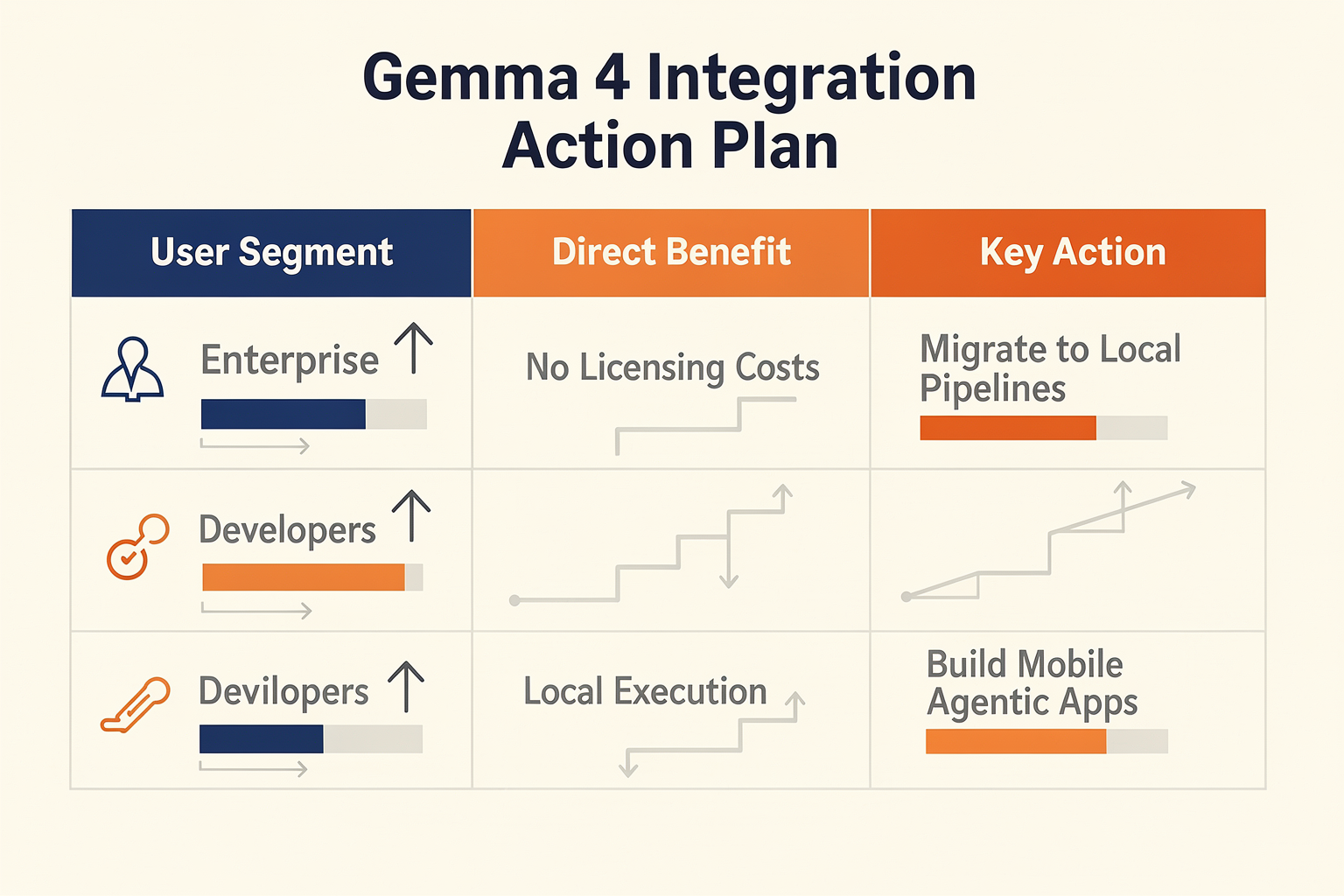
The release of Google's Gemma 4 on April 2, 2026, marks a pivotal moment in the democratization of artificial intelligence. Built on the foundational breakthroughs of Gemini 3 research, this fourth-generation family of open-weight models under the Apache 2.0 license transitions advanced reasoning and agentic workflows from the exclusive domain of high-cost proprietary APIs to local machine rooms and edge devices. Whether you are an independent developer bootstrapping a project, an enterprise architect managing complex cloud deployments, or a product manager building next-generation conversational interfaces, Gemma 4 fundamentally reshapes your technical roadmap.
To understand how this release directly affects your workflow, look at how different technical roles can leverage Gemma 4’s architecture to optimize performance and reduce operational overhead:
| User Persona | Primary Impact | Key Gemma 4 Feature | Recommended Action |
|---|---|---|---|
| Indie Developers & Startups | Eliminates high API costs for agentic applications | Advanced reasoning & native function calling | Replace expensive proprietary models with fine-tuned Gemma 4 instances. |
| Enterprise Architects | Enhances data privacy, compliance, and customizability | Apache 2.0 licensing with full weight access | Deploy Gemma 4 on private cloud infrastructure to ensure zero-data leakage. |
| Mobile & Edge Engineers | Enables offline, low-latency AI features on-device | Optimized footprint for mobile hardware and Android | Integrate lightweight Gemma 4 variants directly into client-side application bundles. |
| AI Agents & Voice Engineers | Lowers latency and boosts conversational fluidness | Multi-model agentic design built for fast token generation | Pair Gemma 4 with scalable communication hubs to power low-latency voice bots. |
| AI Researchers | Accelerates custom model tuning and architecture research | Built on Gemini 3 research with fully accessible weights | Use parameter-efficient fine-tuning (PEFT/LoRA) to adapt the model to niche domains. |
Democratizing Agentic Workflows and Complex Reasoning
Before Gemma 4's debut, deploying production-grade AI agents that could autonomously plan, call external APIs, and process complex multi-step reasoning tasks was both economically and architecturally challenging. Most open-weight models struggled with reliability when executing strict JSON schemas or parsing nested function calls.
Gemma 4 resolves these friction points by integrating agentic capabilities directly into its pre-training objective. By inheriting structural advantages from Gemini 3 research, Gemma 4 models can consistently output structured data, execute multi-turn reasoning paths, and correct their own errors when a tool returns an unexpected response. For developers, this means you can now build robust autonomous agents—such as automated customer service representatives, automated software developers, or real-time data analysts—without being locked into proprietary API pricing tiers.
Unlocking Edge Intelligence and On-Device Execution
Another paradigm shift introduced by Gemma 4 is its exceptional performance-to-size ratio. Designed to run efficiently across a spectrum of hardware—from local developer workstations and high-end Android smartphones to massive cloud TPU clusters—Gemma 4 breaks the assumption that powerful AI requires a constant internet connection.
For mobile developers, this enables a new class of application features:
- Offline Processing: Run real-time transcription, translation, and text summarization completely offline, preserving user privacy and eliminating latency.
- Reduced Cloud Infrastructure Costs: Offload inference workloads directly to the client's device, significantly lowering your server bills.
- Zero-Network Dependency: Ensure that critical application features remain fully functional in remote areas or high-security environments where data cannot leave the physical device.
Bridging the Gap: Integrating Gemma 4 Into Your Tech Stack
While open-weight models like Gemma 4 offer unprecedented freedom, self-hosting these models at enterprise scale still presents operational hurdles. Provisioning GPU instances, managing cold-start latencies, and orchestrating failovers require significant engineering resources.
This is where leveraging unified AI infrastructure becomes essential. Forward-thinking companies use multi-model gateways to seamlessly transition workloads. For instance, platforms like CallMissed allow developers to deploy and orchestrate over 300+ LLMs—including the Gemma 4 family—without rewriting core application code. If your business is building real-time voice agents or multilingual customer service bots, you can combine Gemma 4's powerful reasoning with CallMissed’s ultra-low-latency Speech-to-Text (supporting 22 Indian languages) and Text-to-Speech APIs. This combination ensures that your backend agentic logic, driven by Gemma 4, translates into fluid, natural voice conversations.
A Strategy for 2026: When to Build vs. Buy
As you plan your engineering sprints, the decision to use Gemma 4 should be guided by your specific performance and compliance needs:
- Build (Self-Host & Fine-Tune): Choose this route if you operate in highly regulated industries (such as healthcare, finance, or legal services) where data residency is non-negotiable. Fine-tuning a smaller Gemma 4 variant on your proprietary internal datasets can yield domain-specific performance that rivals closed-source models twice its size.
- Hybrid (API Gateways): If you require high availability, rapid prototyping, and multi-model fallbacks, routing your Gemma 4 workloads through infrastructure-as-a-service providers is the most cost-effective path. It gives you the flexibility of an open-weight model with the reliability of a fully managed cloud service.
Future Outlook: The Open-Weight Landscape in late 2026

The release of Google DeepMind’s Gemma 4 on April 2, 2026, marked a watershed moment for the open-source and open-weight AI movements. Built directly on the foundational breakthroughs of Google’s Gemini 3 research, this fourth-generation family of four open-weight models has fundamentally altered how developers, startups, and enterprises approach machine learning infrastructure. As we look ahead to the final quarters of 2026, the open-weight landscape is poised for a massive transformation, transitioning from simple text generation to highly autonomous, local, and cost-effective agentic ecosystems.
The second half of 2026 will not just be about leaderboard scores; it will be defined by how deeply these models integrate into the physical and digital architecture of our daily lives.
The Rise of Agentic Workflows and Advanced Reasoning
Historically, open-weight models excelled at specialized knowledge retrieval and summarization, but fell short when tasked with complex, multi-step planning. Gemma 4 has shattered this limitation. Designed from the ground up for advanced reasoning and agentic workflows, Gemma 4 provides developers with the reasoning density previously restricted to massive, closed-source API models.
By late 2026, we expect to see a massive shift in how enterprise applications are structured:
- Autonomous Code Execution: Instead of merely suggesting code snippets, agentic pipelines powered by Gemma 4 will autonomously write, test, debug, and deploy microservices in sandboxed environments.
- Complex Multi-Step Planning: Gemma 4’s underlying Gemini 3 architecture allows it to break down highly abstract goals (e.g., "Optimize this supply chain route based on real-time weather data") into sequential, executable API calls.
- Self-Correction and Reflection: The model’s advanced reasoning enables it to evaluate its own output, identifying logical inconsistencies or mathematical errors before delivering the final response to the user.
Because Google released Gemma 4 under a permissive Apache 2.0 license, developers are not restricted by proprietary terms of service. This allows enterprises to build deep, proprietary agentic systems that run entirely within their private cloud infrastructures, ensuring complete data sovereignty.
On-Device Intelligence: AI on the Edge
One of the most consequential aspects of the Gemma 4 family is its scalability. Comprising four distinct model sizes, the architecture was explicitly engineered to run on everything from local Android devices to highly distributed cloud clusters. By late 2026, this "run-anywhere" capability will catalyze a major wave of edge intelligence.
- Intelligent Mobile Companions: With Gemma 4 optimized for mobile hardware, smartphone applications will no longer need to ping remote servers for complex reasoning tasks. On-device agents will process context locally, drastically reducing latency and working seamlessly in offline environments.
- Privacy-First Personalization: Because data does not need to leave the device, local models can safely analyze highly sensitive personal information—such as health metrics, personal emails, and financial spreadsheets—to deliver ultra-personalized assistance without compromising user privacy.
- IoT and Smart Infrastructure: Industrial IoT systems, smart home hubs, and automotive computers will increasingly embed quantized versions of Gemma 4 to handle real-time decision-making, from predicting factory machinery failures to managing autonomous vehicle sub-systems.
This decentralization of compute power lowers the barrier to entry for developers who cannot afford the staggering API costs of closed-source giants, leveling the playing field for global AI innovation.
The Multilingual and Localized AI Boom
As open-weight architectures become more efficient, the demand for localized, culturally aware, and multilingual models is reaching an all-time high. Gemma 4’s robust pre-training corpus has set a new standard for cross-lingual performance, a trend that local developers are actively capitalizing on.
In regions like South Asia and the Middle East, developers are already fine-tuning Gemma 4 on localized datasets. Rather than relying on generic, Western-centric models, enterprises can deploy AI agents that understand local idioms, cultural nuances, and regional regulations.
This localized boom is particularly visible in the communications sector. Platforms like CallMissed are already leveraging this open-weight explosion by integrating models like Gemma 4 into their LLM inference gateway (which supports over 300+ models). By pairing Gemma 4’s advanced reasoning capabilities with CallMissed's native Speech-to-Text and Text-to-Speech APIs supporting 22 Indian regional languages, businesses can deploy highly sophisticated, natural-sounding voice agents. These agents can handle complex customer support queries, schedule appointments, and process transactions in a customer's native dialect without any perceptible latency.
The Consolidation of the Multi-Model Enterprise Gateway
By late 2026, the strategy of relying on a single, proprietary LLM provider will be largely obsolete. Enterprises are rapidly shifting toward a hybrid multi-model approach. Under this paradigm, simple queries are routed to ultra-lightweight, cost-efficient local models, medium-complexity tasks are handled by open-weight powerhouses like Gemma 4, and only the most highly abstract, multi-modal tasks are escalated to massive frontier models.
This architectural shift is driving the adoption of unified AI infrastructure:
- Dynamic Routing: Systems will automatically analyze the complexity and security requirements of an incoming prompt, dynamically routing it to the most cost-effective model that can successfully complete the task.
- Custom Fine-Tuning Pipelines: Rather than prompt engineering a closed model, businesses are using techniques like LoRA (Low-Rank Adaptation) and QLoRA to fine-tune Gemma 4 on internal company wikis, codebases, and customer interaction histories.
- Reduced Vendor Lock-In: By building on open-weight foundations, companies protect themselves against sudden price hikes, API deprecations, or service outages from proprietary LLM vendors.
To facilitate this complex orchestration, developers are turning to unified infrastructure providers. CallMissed, for example, simplifies this transition by offering a single, unified API that allows businesses to switch seamlessly between 300+ LLMs—including the entire Gemma 4 family—without needing to rewrite a single line of application code. This flexibility ensures that as new, optimized open-weight models emerge in late 2026 and beyond, enterprises can integrate them instantly, keeping their technology stack at the absolute cutting edge.
Ultimately, the trajectory for the remainder of 2026 is clear: the gap between proprietary capability and open-weight accessibility has effectively closed. Guided by the architectural triumphs of Gemini 3 and the open distribution of Gemma 4, we are moving rapidly toward a future of decentralized, agentic, and highly localized intelligence.
Frequently Asked Questions
What is Gemma 4 and how does it differ from previous Google open-weight models?
What are the licensing terms and commercial use policies for the new Gemma models?
Which benchmarks demonstrate the reasoning capabilities of Gemma 4?
Can these open-weight models run locally on consumer devices and mobile hardware?
How can developers fine-tune and deploy Gemma 4 for custom business use cases?
How does the architecture of this release support agentic workflows and tool-use?
Conclusion
The launch of Google's Gemma 4 on April 2, 2026, represents a watershed moment for the open-source AI community. By packaging the cutting-edge reasoning capabilities of Gemini 3 research into a highly efficient, open-weight family of models, Google is fundamentally altering the developer landscape. Here are the key takeaways to remember:
- Agentic Powerhouse: Gemma 4 is purpose-built for advanced reasoning and multi-step agentic workflows, moving far beyond simple text generation.
- Gemini 3 Heritage: Utilizing Google DeepMind's latest architectural breakthroughs, this fourth-generation family drastically closes the performance gap between proprietary APIs and open-weight alternatives.
- Democratized Deployment: With four distinct model sizes, developers can run highly capable intelligence on everything from Android devices to enterprise cloud infrastructure.
Looking ahead, the remainder of 2026 will likely see a massive surge in edge-based AI deployments. As local hardware acceleration catches up to these software breakthroughs, executing highly complex, private AI agents on-device will become the standard, drastically lowering API costs and resolving data privacy bottlenecks.
To explore how AI communication is evolving alongside these developments, check out CallMissed — an AI infrastructure platform powering voice agents and multilingual chatbots for businesses. How will your organization leverage Gemma 4's powerful open-weight architecture to redefine your workflows this year?