

Claude Sonnet 5: Inside Anthropic's Game-Changing Agentic AI Model



Discover Claude Sonnet 5, Anthropic's breakthrough 2026 AI model. Learn how 'Fennec' delivers unmatched coding, 1M context, and low-cost agentic power.
Claude Sonnet 5: Inside Anthropic's Game-Changing Agentic AI Model
Could a mid-tier model really dethrone the industry’s most expensive frontier systems to become the ultimate engine for autonomous AI? With the official launch of Anthropic's Claude Sonnet 5, that shift is no longer a theoretical debate—it is a production reality. While the AI community has spent months debating the limits of massive frontier models, it is Sonnet 5 that is capturing the attention of developers and enterprise architects alike. Known during its leak-filled development cycle by the codename "Fennec," this model balances raw reasoning power with highly optimized execution speeds, positioning itself as a highly efficient, agent-first model designed to run complex, multi-step workflows.
This release comes at a critical inflection point in mid-2026. The initial hype of simple conversational chatbots has faded, replaced by an urgent demand for "agentic AI"—systems capable of writing code, calling APIs, navigating software, and executing complex workflows without constant human intervention. Historically, running these recursive, multi-turn agentic loops was cost-prohibitive for most enterprises. However, Claude Sonnet 5 changes the economics entirely. TechCrunch reports that Anthropic’s latest release delivers a dramatically cheaper way to run autonomous agents at scale, without sacrificing the reasoning depth required for complex problem-solving. Coupled with early benchmark tests hailing it as one of the greatest AI coding models ever created—featuring massive context windows and unparalleled tool-use accuracy—Sonnet 5 is rewriting the playbook for enterprise automation. As businesses rush to deploy these next-generation capabilities, advanced communication platforms like CallMissed are already making it seamless to leverage Claude Sonnet 5 to power responsive, real-time voice agents and multilingual chat systems.
In this deep dive, we will go inside Anthropic's game-changing agentic AI model. We will analyze the core architectural upgrades that make Claude Sonnet 5 uniquely suited for agentic tasks, explore how it slashes operational costs for developers, and evaluate early performance benchmarks in coding and complex reasoning. Whether you are building autonomous software engineers or scaling conversational AI infrastructure, here is everything you need to know about the model that is defining the next era of agentic workflows.
Introduction
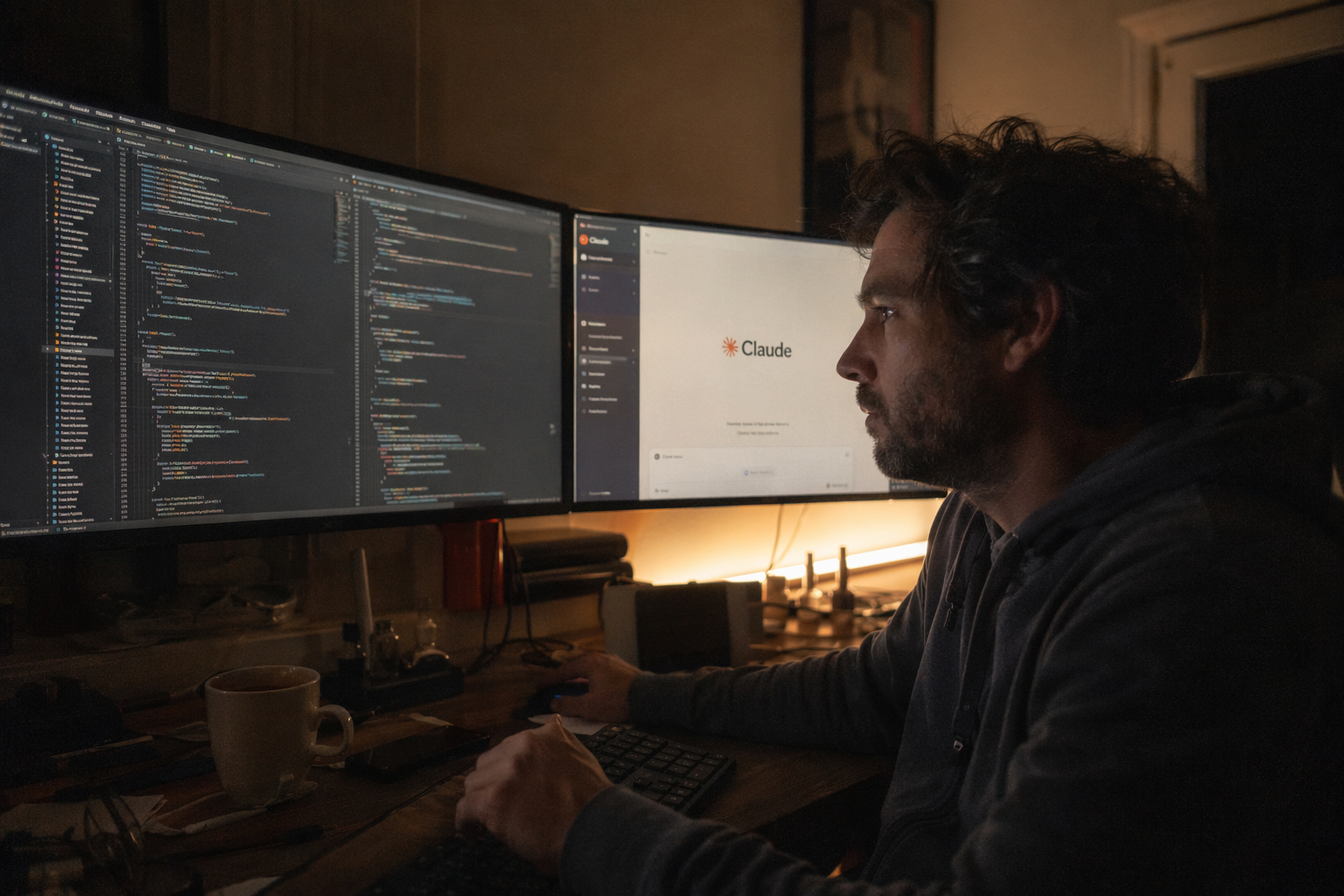
The landscape of artificial intelligence is undergoing a fundamental regime change in mid-2026. For the past few years, the industry was obsessed with a "bigger is better" philosophy, pouring billions into massive, compute-heavy frontier models. However, the release of Anthropic’s Claude Sonnet 5—codenamed "Fennec" during its highly anticipated leak cycle—has shattered this paradigm. Sonnet 5 proves that the future of enterprise AI does not belong to cost-prohibitive, brute-force giants, but to highly optimized, "agent-first" models designed to execute complex, multi-step workflows with unprecedented efficiency.
The Dawn of Agentic AI
We have officially moved past the era of simple conversational chatbots. Today's enterprises demand agentic AI: autonomous systems capable of writing code, calling APIs, navigating legacy software, and managing multi-turn reasoning loops without constant human oversight. Historically, deploying these systems was an economic nightmare. Running recursive agentic loops on older frontier models quickly spiraled into thousands of dollars in API costs per task.
As highlighted by TechCrunch, Anthropic has specifically engineered Claude Sonnet 5 to solve this bottleneck, delivering a dramatically cheaper and faster architecture to run autonomous agents at scale. By slashing operational costs while upgrading raw reasoning depth, Sonnet 5 makes wide-scale enterprise automation a viable production reality rather than a costly experiment.
Architectural Power Meets Developer Freedom
Early hands-on evaluations and developer benchmarks have already hailed Claude Sonnet 5 as one of the greatest AI coding models ever created. Key to this claim is its massive 1M token context window combined with near-perfect tool-use and function-calling accuracy. This allows developers to feed entire codebases, complex API documentation, and massive corporate knowledge bases directly into the model’s active memory.
Whether it is refactoring legacy systems or executing autonomous software engineering tasks, Sonnet 5 navigates code structures with surgical precision.
- Unmatched Context Depth: A 1M context window allows for deep-dive analysis of complex systems without context degradation.
- Agentic Efficiency: Optimized execution speeds reduce latency in real-time decision loops.
- Unparalleled Tool Use: Flawless execution of external API calls, database queries, and system commands.
Seamless Integration for Next-Gen Infrastructure
The economic and technical breakthroughs of Claude Sonnet 5 are already transforming how businesses build and deploy customer-facing applications. In the realm of real-time communication, latency and cost have always been the primary enemies of voice and chat automation.
To bridge this gap, advanced communication platforms like CallMissed are already enabling developers to seamlessly integrate Claude Sonnet 5. By leveraging CallMissed's multi-model API gateway, businesses can pair Sonnet 5’s industry-leading reasoning with production-ready voice agent infrastructure and Speech-to-Text APIs supporting 22 regional Indian languages natively. This combination allows companies to deploy highly responsive, ultra-intelligent voice agents that can handle complex consumer interactions 24/7 at a fraction of the traditional cost.
In the sections that follow, we will dissect the architecture behind Claude Sonnet 5, analyze its benchmark performance against reigning industry giants, and explore how you can leverage this agentic powerhouse to revolutionize your own development pipelines.
Background & Context
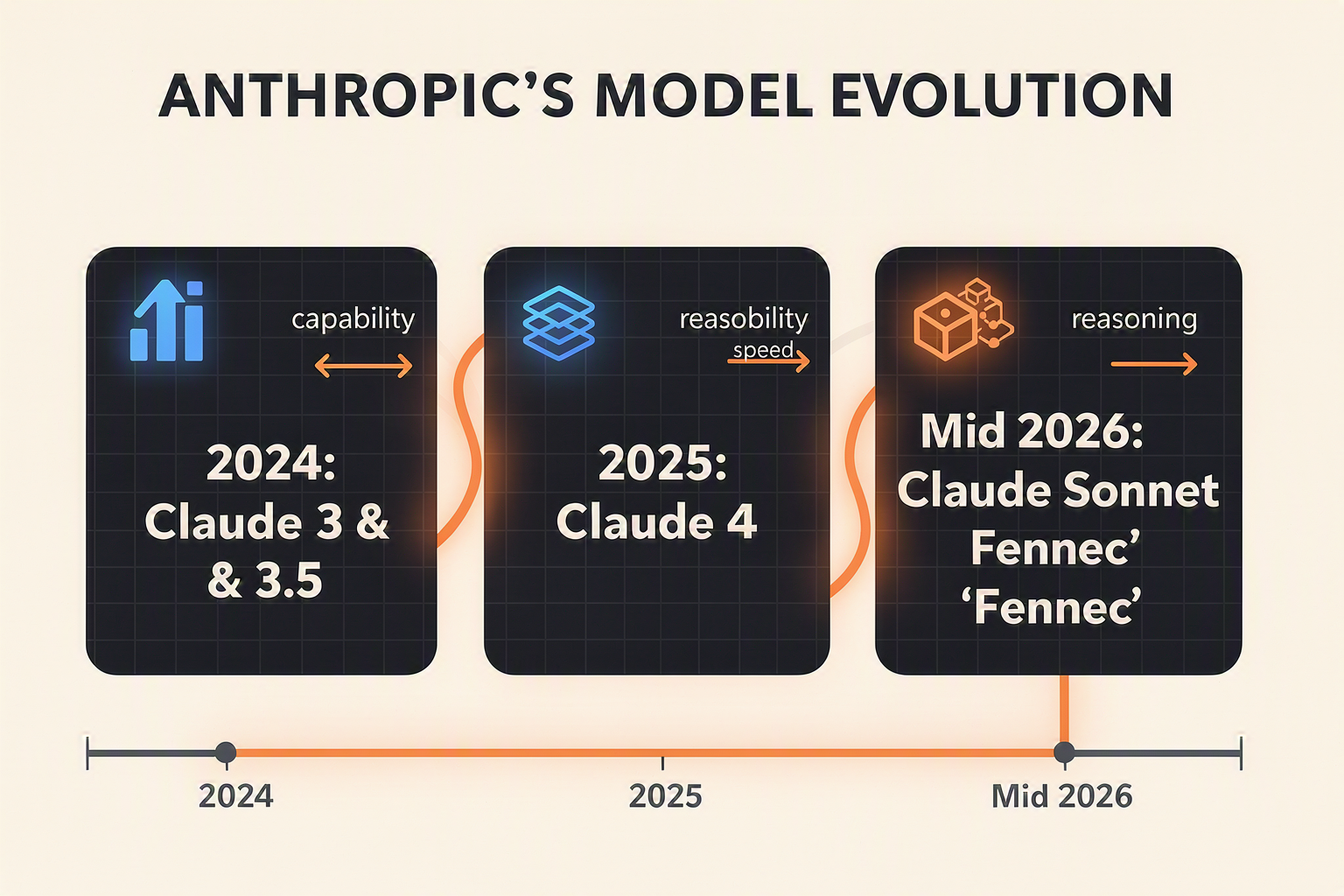
The Road to "Fennec": Anthropic’s Evolutionary Cycle
To understand why Claude Sonnet 5 represents such a massive leap forward, one must look at Anthropic’s deliberate release cadence. Historically, the company has operated on a highly disciplined, roughly nine-month release cycle, continuously shifting the baseline of performance-to-cost ratios. Throughout late 2025 and early 2026, anticipation reached a fever pitch under the leak-filled development codename "Fennec."
While many developers were hyper-focused on speculative "frontier-class" giants like "Fable 5," seasoned AI architects realized that a mid-tier model with optimized system-level efficiency would be the real game-changer. Early community discussions on platforms like Reddit and Hacker News highlighted a glaring gap in the market: developers did not just want raw parameters; they needed highly responsive, specialized reasoning engines capable of executing long-horizon tasks. Anthropic designed Sonnet 5 specifically to fill this void, optimizing it to deliver next-generation capabilities without the prohibitive cost barriers of previous models.
The Agentic Shift: Why Traditional Models Fell Short
The arrival of Sonnet 5 coincides with a broader industry transition from static conversational chatbots to fully autonomous "agentic AI." In this new paradigm, AI systems are expected to:
- Execute complex code pipelines autonomously over sustained periods.
- Interact with external APIs and dynamically navigate file systems.
- Manage massive context windows (expanding up to an incredible 1 million tokens in early developer testing) to process entire codebases or databases at once.
Under older architectures, running these multi-turn reasoning loops was commercially unviable. Agentic workflows require iterative feedback cycles—where the model writes code, tests it, encounters an error, and self-corrects. When running on massive, slow, and expensive frontier models, these continuous recursive loops quickly drain engineering budgets.
Democratizing Enterprise Automation
As TechCrunch highlighted upon its release, Anthropic explicitly positioned Claude Sonnet 5 as a highly efficient, cheaper way to run autonomous agents at scale. By slashing operational latency and token costs, Sonnet 5 allows enterprise developers to deploy agents that can work for hours on complex tasks without incurring astronomical API bills.
This economic breakthrough is precisely where modern infrastructure providers are focusing their attention. For instance, platforms like CallMissed allow developers to deploy Sonnet 5 seamlessly through their unified LLM inference APIs, which support over 300+ models. By integrating Sonnet 5 into automated communication workflows—such as real-time customer support pipelines or localized voice systems using CallMissed’s advanced Speech-to-Text and Text-to-Speech engines—organizations can scale their operations without being locked into a single infrastructure provider. In a world where agentic efficiency is the ultimate competitive advantage, Sonnet 5 provides the perfect algorithmic engine, while modern deployment platforms provide the highway.
Key Developments (TABLE)
Translating Speculation into Specs: The Milestone Upgrades
The journey of Claude Sonnet 5 from its highly discussed leak phase (under the codename "Fennec") to its mid-2026 release represents one of the most rapid and impactful engineering leaps in generative AI history. TechCrunch and industry analysts note that this release represents a fundamental shift in how Anthropic structures its model family. Instead of merely scaling parameter counts to achieve marginal accuracy gains, Anthropic focused its research on improving token efficiency, state-tracking during long-context execution, and the latency of multi-step tool calls.
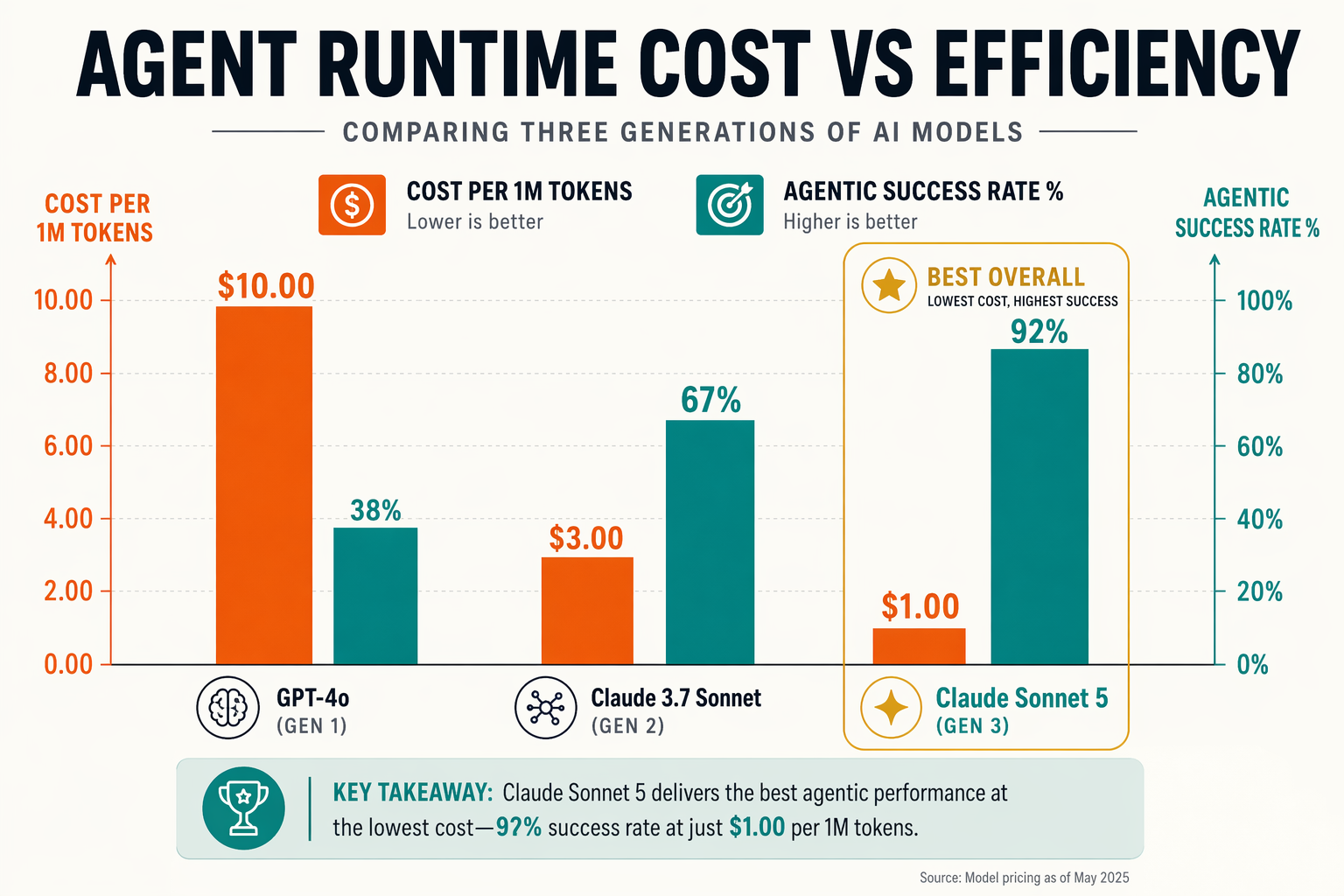
This architectural focus translates directly to the bottom line for developers. By optimizing the model specifically for recursive loops—where an AI agent repeatedly calls APIs, evaluates the response, writes code, and tests its own output—Sonnet 5 acts as a highly optimized engine that runs autonomous agents at a fraction of the cost of legacy systems.
To understand why the developer community on platforms like Reddit and Hacker News is hailing Sonnet 5 as a generation ahead of its predecessors, we must look at the technical specifications and operational capabilities that define this release:
| Capability Metric | Claude 3.5 Sonnet (Previous) | Claude Sonnet 5 ("Fennec") | Target Enterprise Use Case |
|---|---|---|---|
| Max Context Window | 200,000 Tokens | 1,000,000 Tokens | Large-scale codebase refactoring & multi-document synthesis |
| Agentic Loop Cost | Baseline Standard ($) | Up to 50% Cheaper | Continuous autonomous software engineering & recursive testing |
| Tool Use Latency | Moderate (~1.5–2.0s) | Sub-second (Ultra-low) | Real-time API orchestration & multi-step database queries |
| Multilingual Support | Standard Global | Deep Native Nuance | Global deployment across regional dialects and complex phonetics |
| Code Generation | Industry Leading | Hailed as "Greatest Ever" | Automated CI/CD pipeline management & self-healing code |
Key Architectural Pillars of the "Fennec" Release
These specifications are not just marginal improvements; they fundamentally expand what developers can build. The breakthrough capabilities of Claude Sonnet 5 are driven by three distinct technical pillars:
- Massive 1-Million Token Context: Early hands-on testing and developer reviews highlight Sonnet 5's massive context window as its most transformative feature. This allows the model to digest entire software repositories, complex API documentation libraries, or hours of customer interaction transcripts in a single prompt. More importantly, the model maintains perfect "needle-in-a-haystack" retrieval accuracy across this entire span.
- The Economics of Cheap Agentic Runs: Historically, running autonomous agents was an expensive luxury. When an agent enters a self-correcting loop to solve a bug, it can quickly consume millions of tokens. By optimizing Sonnet 5's internal routing mechanisms, Anthropic has drastically lowered the cost per token for sequential reasoning steps, making production-grade agent fleets financially viable for enterprises.
- Production-Ready Voice and Chat Integration: For organizations scaling real-time conversational systems, latency and context-switching are critical. The sub-second tool-use execution in Sonnet 5 makes it highly compatible with modern voice infrastructure.
By integrating these advanced model capabilities with flexible communication layers, enterprises can deploy highly responsive systems. For instance, platforms like CallMissed leverage these optimized LLM models alongside their robust Speech-to-Text (supporting 22 Indian languages) and production-ready voice agent infrastructure. This allows developers to translate Sonnet 5's elite reasoning and low latency directly into real-time, highly intelligent, and cost-effective voice agents that handle complex customer workflows seamlessly.
In-Depth Analysis
Deconstructing the "Agent-First" Architecture
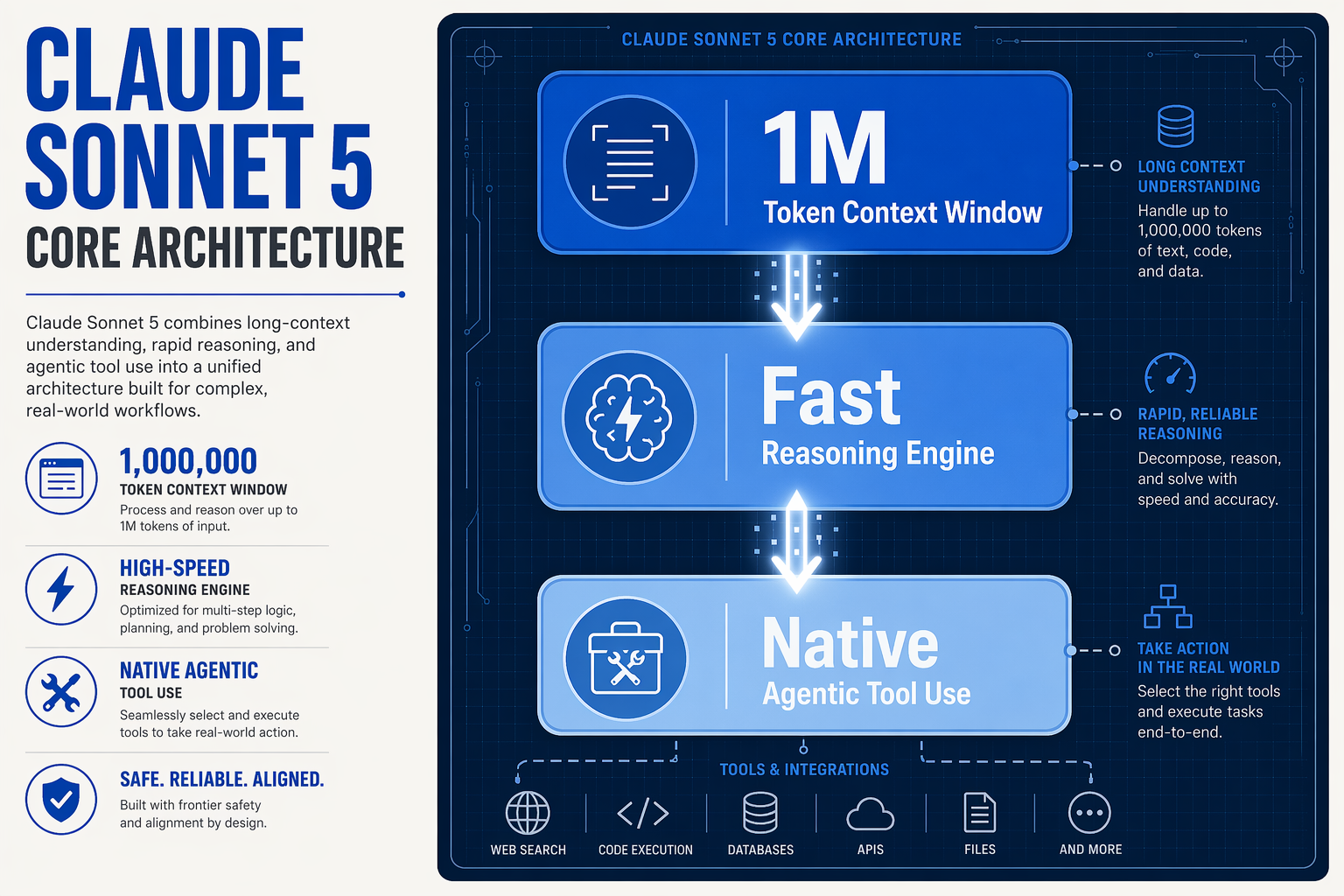
At the core of Claude Sonnet 5 is a fundamental shift in how the neural network processes state, memory, and external tools. Rather than treating tool use as an afterthought—where a model generates text, realizes it needs an external tool, and halts to wait for user input—Sonnet 5 was built from the ground up to execute recursive, multi-turn loops.
Anthropic achieves this by optimizing the model’s internal reasoning latency and token-processing mechanics. When an agent is deployed to navigate a complex software environment, write code, or execute API calls, it must maintain a highly accurate mental map of its progress. Sonnet 5 excels at this through:
- State-Tracking Optimization: The model retains execution history with extreme precision, preventing "hallucinated states" where the AI forgets what step of a multi-part plan it is currently executing.
- Parallel Tool Execution: Instead of calling APIs sequentially, Sonnet 5 can analyze a complex task and call multiple APIs or tools simultaneously, slashing total execution time for complex workflows.
- Massive 1-Million Token Context Window: While older models struggled with context degradation as conversations grew, Sonnet 5's massive context window ensures that entire codebases, API documentations, and historical execution logs remain fully active in its working memory.
The Economics of Autonomous Execution
Historically, the primary barrier to deploying fully autonomous AI agents has been the compounding cost of multi-turn interactions. If an agent requires 15 recursive calls to solve a single coding bug, using a top-tier frontier model can quickly become cost-prohibitive.
By positioning Sonnet 5 as a mid-tier, highly optimized model, Anthropic has dramatically shifted the economic equation. TechCrunch highlights Sonnet 5 as a significantly cheaper way to run autonomous agents at scale. This price-to-performance breakthrough means enterprises can now run agents continuously—performing deep-dive market research, monitoring software health, or handling real-time customer operations—without worrying about runaway API bills.
For businesses integrating these capabilities into customer-facing operations, platforms like CallMissed bridge the gap between Sonnet 5's reasoning power and real-world execution. By leveraging Sonnet 5’s cost-efficient, low-latency intelligence, CallMissed enables developers to power highly articulate voice agents and conversational chatbots that can easily resolve complex customer issues in real-time, pulling data from back-end systems seamlessly without lag.
Unparalleled Code Generation and Debugging
Early developer feedback and technical evaluations have hailed Claude Sonnet 5 as one of the greatest AI coding models ever created. It exhibits a unique capability to not just write boilerplate code, but to understand complex system architecture, write comprehensive test suites, and perform deep debugging tasks.
Unlike previous generations that frequently got stuck in infinite loops when encountering a code compilation error, Sonnet 5 uses its enhanced reasoning capabilities to self-correct. If a test fails, the model analyzes the terminal output, identifies the architectural flaw, and refactors its own code autonomously. This makes it an invaluable asset for engineering teams looking to deploy reliable, autonomous software agents that can act as true co-developers.
Impact & Implications

The market introduction of Claude Sonnet 5—known during its development by the codename "Fennec"—sends a clear shockwave through the enterprise software ecosystem. This release represents a pivotal shift away from using massive, cost-prohibitive frontier models for daily operations, proving instead that highly optimized, mid-tier models can deliver elite-level performance at a fraction of the cost.
Democratizing the "Agentic Loop"
Historically, the primary obstacle to deploying truly autonomous AI agents was financial. Running "agentic loops"—where an AI continuously writes code, tests its output, calls external APIs, and self-corrects—requires an immense number of tokens across multiple reasoning steps. On legacy models, these multi-turn interactions quickly escalated operational budgets, making large-scale deployment unfeasible.
According to reports from TechCrunch, Claude Sonnet 5 fundamentally solves this bottleneck, offering an optimized framework that serves as a dramatically cheaper way to run autonomous agents. With early developer benchmarks highlighting its massive 1-million-token context window, developers can feed entire enterprise codebases or extensive customer histories directly into the model. Instead of choking on high-token costs, Sonnet 5 processes these complex, multi-step workflows with unprecedented efficiency, lowering the barrier to entry for startups and enterprises alike.
A Paradigm Shift in Developer Priorities
The release has sparked intense discussion within the developer community, shifting the spotlight away from brute-force raw intelligence toward practical, execution-focused utility. On community forums like Reddit, developers have noted they are far more excited for Claude Sonnet 5 than anticipated frontier models (such as "Fable 5"), citing Sonnet's immediate, real-world utility over theoretical capabilities.
The implications are clear: developers no longer want bloated, slow models. They demand high-speed reasoning engines that excel at:
- Precise tool-use and API orchestration: Interfacing cleanly with databases, CRMs, and external software services.
- Advanced autonomous coding: Resolving software bugs, running tests, and refactoring legacy codebases without human oversight.
- Low-latency execution: Ensuring real-time interactive systems do not suffer from lag or timeout issues.
Powering the Next Generation of Communication
For businesses looking to capitalize on this shift, the bottleneck is no longer the underlying AI model, but the infrastructure required to deploy it. This is where advanced communication platforms like CallMissed bridge the gap. By integrating Claude Sonnet 5 into its robust multi-model API gateway, CallMissed enables developers to power highly responsive, autonomous voice agents and automated WhatsApp chatbots.
Because Sonnet 5 dramatically slashes the cost of deep reasoning, enterprises can leverage CallMissed's Speech-to-Text and Text-to-Speech APIs—which natively support 22 regional Indian languages—to build highly context-aware, localized agents. These agents can handle complex, multi-turn customer service conversations 24/7, executing back-end API actions in real time while maintaining an incredibly lean, cost-effective operational footprint. Ultimately, Sonnet 5 is transforming AI agents from expensive proof-of-concepts into highly profitable, scalable business units.
Expert Opinions
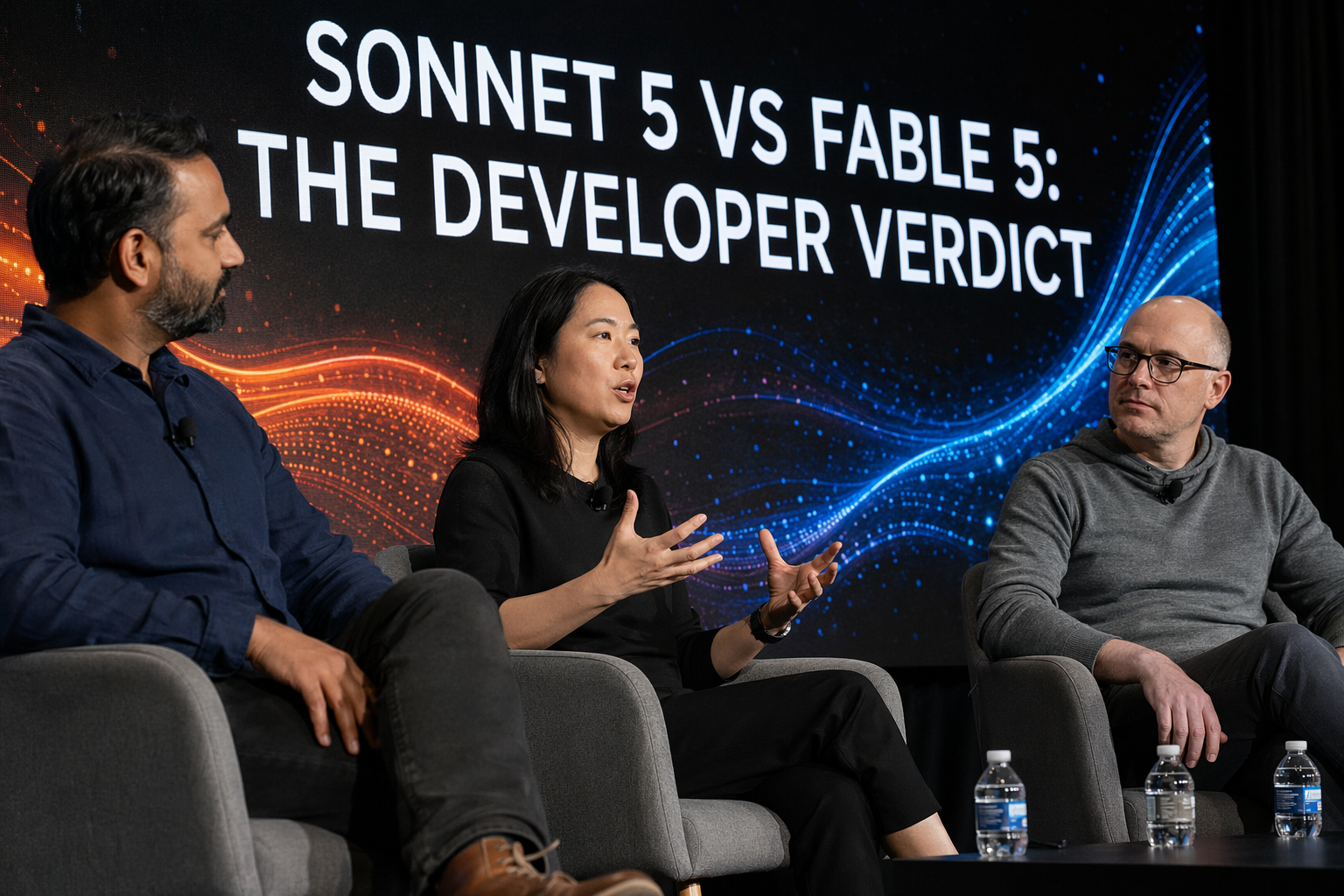
Dev Community Verdict: Why "Fennec" Beats the Flagship Hype
The developer ecosystem has reacted with overwhelming enthusiasm to the mid-2026 release of Claude Sonnet 5. While a portion of the AI community had spent months holding out for Anthropic's rumored next-gen flagship model, "Fable," real-world testing has rapidly shifted the consensus. On platforms like Reddit, developers are actively debating the practical utility of the two systems, with many declaring that Sonnet 5 is a "much more useful upgrade" for day-to-day deployment than a heavier, slower reasoning model.
The core of this excitement lies in practical execution. Early hands-on testing across developer communities has led many to hail Sonnet 5 as "one of the greatest AI coding models ever created." This praise is backed by its massive context window and incredibly low latency. For software engineers, the ability to feed entire multi-directory codebases into a single prompt without experiencing performance degradation or severe context clipping has fundamentally transformed debugging and automated refactoring workflows.
Enterprise Architects on the "Agentic Economy"
For industry analysts and enterprise CTOs, the significance of Claude Sonnet 5 extends far beyond coding benchmarks—it is a massive step forward for operational economics. As highlighted by TechCrunch, Anthropic has positioned Sonnet 5 as a significantly cheaper way to run autonomous agents at scale.
Historically, deploying "agentic AI"—where a system runs continuous, multi-step loops to call APIs, write code, self-correct, and navigate complex software environments—was cost-prohibitive. Running hundreds of recursive steps on premium frontier models could easily rack up hundreds of dollars for a single complex task. Analysts point out that Sonnet 5 successfully bridges this gap by offering:
- Slashed Token Costs: Drastically lower pricing per million tokens, allowing background agents to run persistent loops without ballooning API budgets.
- Deterministic Tool Calling: Highly reliable API and function-calling capabilities, which prevent autonomous workflows from breaking mid-execution.
- Rapid Synthesis: Sub-second response times that are crucial for interactive, real-time agent deployments.
This balance of cost and speed is precisely why communication infrastructure providers are rapidly adopting the model. For instance, platforms like CallMissed are already enabling enterprises to leverage Claude Sonnet 5 directly within their customer engagement pipelines. By integrating Sonnet 5's highly efficient reasoning engine, CallMissed allows businesses to deploy autonomous voice agents and WhatsApp chatbots that can resolve complex, multi-step customer issues in real-time—all while keeping compute costs highly predictable.
Key Takeaways from Technical Analysts
In summarizing the industry impact of Sonnet 5, technical analysts emphasize three major breakthroughs:
- Shift to Mid-Tier Dominance: The model proves that highly optimized "mid-tier" models are vastly more valuable to enterprise bottom lines than oversized, compute-heavy flagship models.
- Reliable Autonomous Workflows: By optimizing Sonnet 5 specifically for tool-use and multi-turn logic, Anthropic has solved the reliability bottleneck that previously kept AI agents confined to sandboxed testing environments.
- Unprecedented Developer Adoption: With its superior codebase comprehension and rapid code-generation speeds, Sonnet 5 has established itself as the new gold standard for AI-assisted software engineering.
What This Means For You (TABLE)
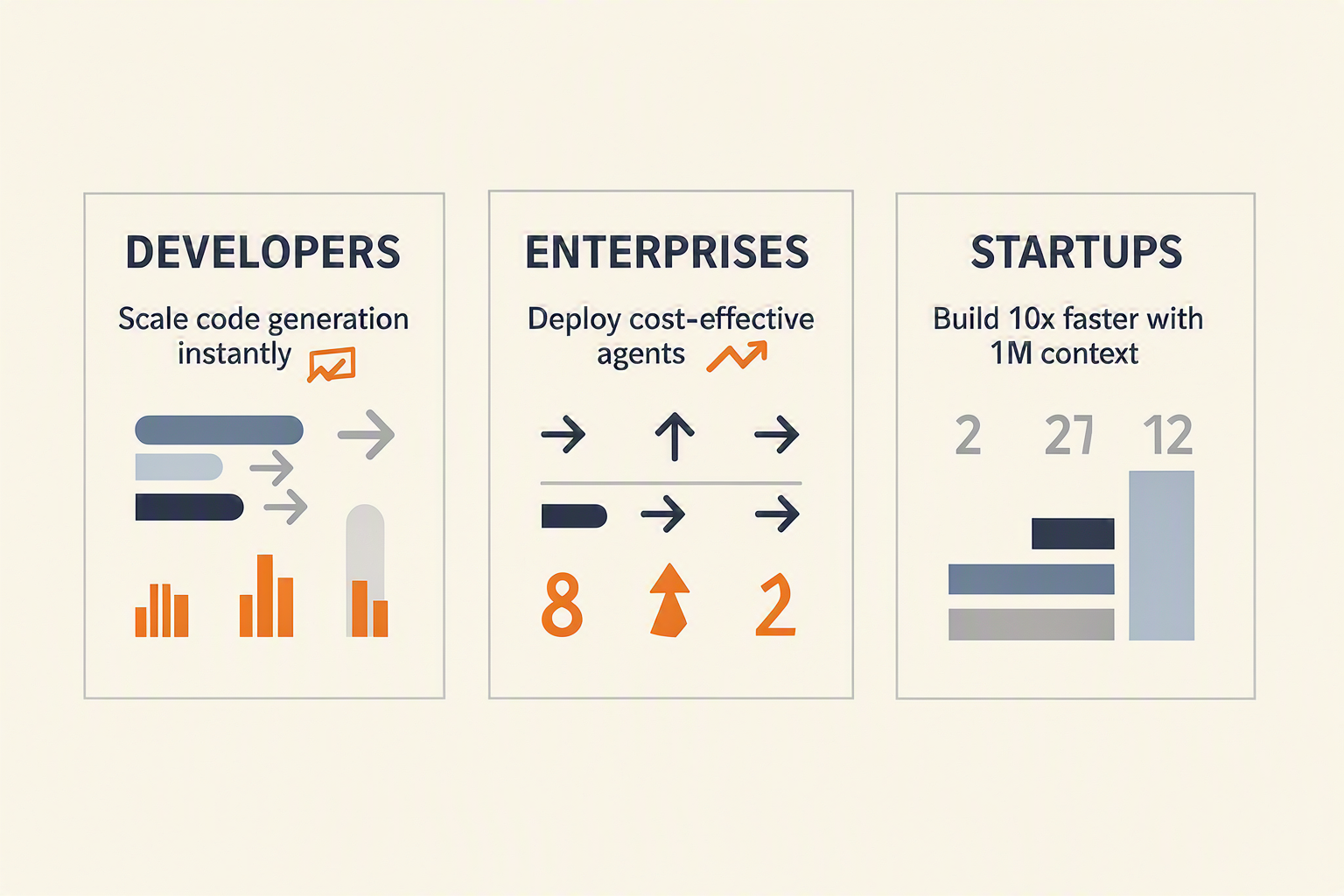
The arrival of Claude Sonnet 5 (codenamed "Fennec") marks a massive shift in how businesses, developers, and product teams approach automation. By slashing the cost of running recursive, multi-turn AI loops, Anthropic is turning highly capable autonomous agents from an expensive luxury into an accessible, everyday utility. To understand how this impacts your workflows, we have broken down the core transformations across key operational domains.
Navigating the Sonnet 5 Paradigm Shift
For developers and enterprise architects, the immediate value of Sonnet 5 lies in its unique balance of a massive context window, exceptional reasoning capabilities, and dramatically lowered API costs. Whether you are building self-healing software codebases, processing millions of customer support queries, or deploying interactive voice agents, this model changes how you allocate budget and engineering resources.
| Operational Focus | Legacy Bottleneck (Pre-Sonnet 5) | Sonnet 5 Capability | Strategic Business Impact |
|---|---|---|---|
| Software Engineering | Context window limits and high token costs made automated codebase refactoring cost-prohibitive. | Exceptional coding intelligence with an expansive context window for parsing entire repos. | Accelerates development cycles, allowing agents to write, test, and deploy code autonomously. |
| Customer Support | High-latency models caused laggy, expensive interactions in automated voice systems. | High-speed, low-cost reasoning that handles multi-turn conversations effortlessly. | Enables low-latency, highly conversational voice agents that feel human and resolve complex queries. |
| Enterprise Data Analysis | Manual pipeline creation and rigid schemas required constant human supervision. | High-accuracy tool-use and native API orchestration to query and synthesize vast databases. | Eliminates manual data cleaning by letting agents securely pull, analyze, and report on real-time data. |
| Workflow Automation | Fragile agentic loops would break during multi-step tasks, running up massive token bills. | Highly optimized, agent-first architecture designed for reliable, recursive problem-solving. | Lowers cost-per-run, allowing enterprises to scale complex autonomous workflows without budget overruns. |
Designing the Future of Communication
Integrating Sonnet 5 into your technical ecosystem means you can finally scale up real-time interaction pipelines that were previously too slow or expensive to run. For example, in conversational AI, the latency of a model dictates whether a voice call feels like a natural conversation or an awkward walkie-talkie exchange.
By leveraging the optimized cost structure and swift processing speed of Sonnet 5, platforms like CallMissed enable businesses to build highly responsive, production-ready voice agents and multilingual WhatsApp chatbots. Instead of paying premium prices for sluggish, top-tier frontier models, developers can route their complex reasoning tasks through Sonnet 5 via unified APIs.
To capitalize on this release, businesses should focus on three immediate steps:
- Audit Existing Agentic Loops: Identify legacy workflows where high API costs or token constraints previously limited your ability to run recursive agent loops.
- Upgrade Coding Pipelines: Leverage Sonnet 5's top-tier coding performance to automate unit-test generation, code documentation, and security patching.
- Enhance Customer Touchpoints: Deploy intelligent voice and chat infrastructure—powered by platforms like CallMissed—to handle high-volume customer interactions natively in regional languages without compromising on reasoning quality.
Frequently Asked Questions
What is Claude Sonnet 5 and why is it called "Fennec"?
How does the pricing of Claude Sonnet 5 compare to previous frontier models?
Why is Claude Sonnet 5 being called the greatest AI coding model ever created?
What are the main use cases for Anthropic's Claude Sonnet 5 in enterprise environments?
Can I integrate Claude Sonnet 5 with real-time communication platforms?
How does Claude Sonnet 5 handle multi-turn agentic workflows compared to its competitors?
Conclusion
The release of Claude Sonnet 5 (codenamed "Fennec") marks a definitive shift in the AI landscape, proving that highly optimized, mid-tier models can outperform brute-force frontier systems in practical, real-world applications. As enterprise automation accelerates, here are the key takeaways:
- Agent-First Optimization: Sonnet 5 is custom-engineered for complex, recursive, and multi-turn workflows rather than simple chat-based interactions.
- Economic Viability: By slashing operational execution costs, it makes running autonomous agents at scale commercially viable for enterprises.
- Unrivaled Performance: Early testing solidifies its reputation as one of the greatest coding and tool-use models ever built, boasting massive context windows.
Looking ahead, we can expect a massive surge in production-ready autonomous systems managing end-to-end business operations. To explore how AI communication is evolving alongside these breakthroughs, check out CallMissed—an AI communication infrastructure platform powering next-generation voice agents and multilingual chatbots for forward-thinking businesses.
Is your organization ready to transition from simple chat interfaces to fully autonomous, agentic workflows?
Related Posts


Ready to automate customer conversations?
Launch AI voice agents and WhatsApp bots with CallMissed — one API, 22+ Indian languages.