

Claude Sonnet 5 vs Opus 4.8: Ultimate AI Model Comparison


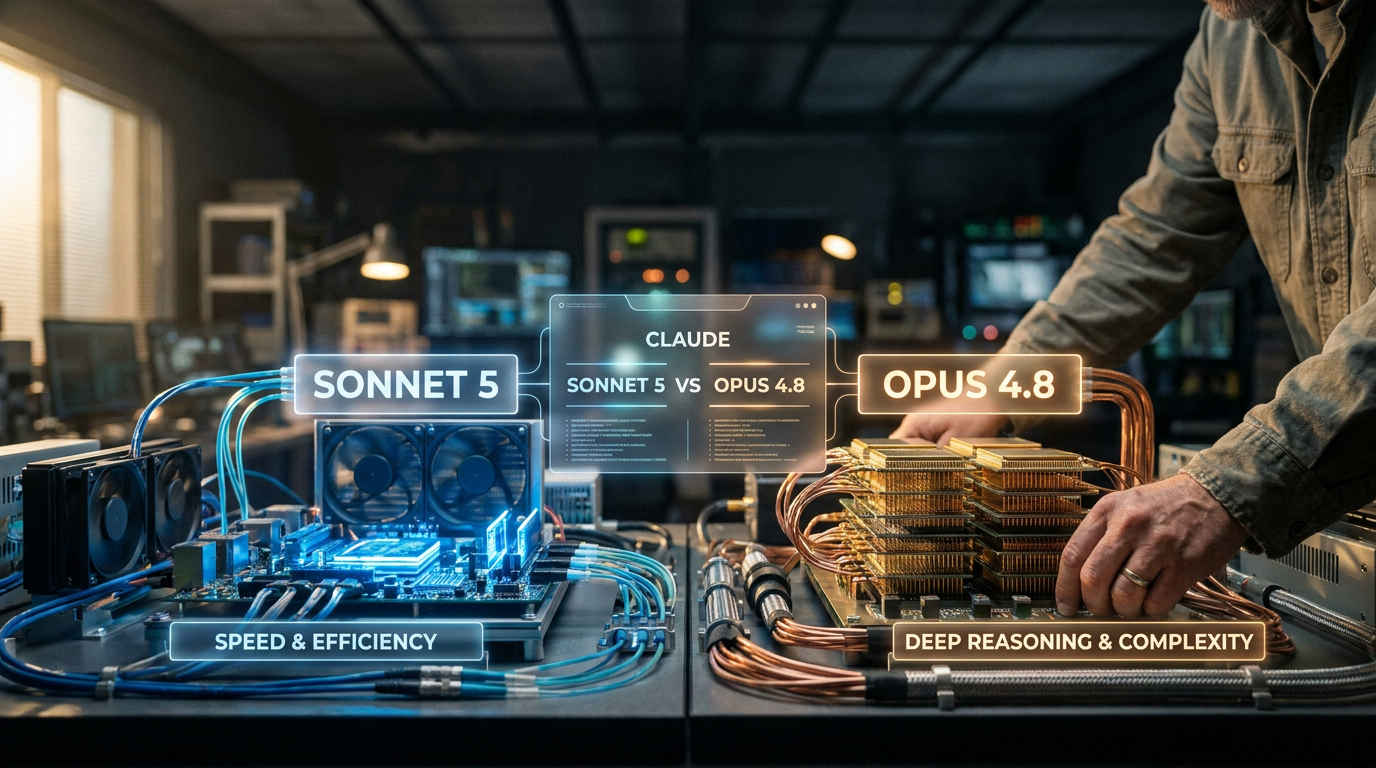
Compare Claude Sonnet 5 and Opus 4.8. Discover benchmarks, pricing, and speed differences to choose the best Anthropic model for your workflow.
Claude Sonnet 5 vs Opus 4.8: Ultimate AI Model Comparison
Did you know that the newest generation of LLMs can now solve complex software engineering challenges that stumped the best systems just months ago? With Anthropic’s recent release of Claude Opus 4.8 and early sightings of Claude Sonnet 5, developers and enterprise leaders are facing a high-stakes decision: do you optimize for raw reasoning power, or prioritize blazing speed and cost-efficiency?
As of 2026, the artificial intelligence landscape has reached an incredibly competitive tipping point. Opus 4.8 has established itself as Anthropic's most capable generally available model, proving to be a massive "quality-of-life" leap over previous iterations. It is faster, handles context with unmatched fluidity, and has demonstrated superior coding knowledge compared to rivals like GPT-5.5—bolstered by its Terminal-Bench 2.1 score jumping from 74.6 to 82.7 under refined testing harnesses. Yet, with Claude Sonnet 5 emerging on the horizon to deliver a stronger cost-to-performance ratio, teams must carefully calculate their token spend. Choosing the wrong model tier can quickly double your operational API costs or leave your applications bottlenecked by unnecessary latency.
For businesses orchestrating these advanced LLMs at scale, navigating this multi-model landscape is critical. This is why forward-thinking teams rely on unified communication infrastructure like CallMissed, which simplifies the integration of over 300+ LLMs, allowing developers to switch seamlessly between Claude models to match the task at hand.
In this ultimate claude sonnet 5 vs opus 4.8 comparison, we will unpack how these two powerhouse models stack up across critical benchmarks. You will learn the major architectural differences between them, analyze their performance in coding and reasoning tasks, and receive a clear framework to determine which model offers the best ROI for your specific business use case.
Introduction

The artificial intelligence landscape of 2026 has reached an incredibly competitive tipping point. With Anthropic’s recent release of Claude Opus 4.8 and early industry sightings of Claude Sonnet 5, developers and enterprise leaders are facing a high-stakes decision: do you optimize for raw, deep reasoning power, or prioritize blazing speed and cost-efficiency?
Choosing the wrong model tier can quickly double your operational API costs or leave your applications bottlenecked by unnecessary latency. This claude sonnet 5 vs opus 4.8 comparison will unpack how these two powerhouse models stack up across critical benchmarks, pricing, and architectural capabilities, giving you a clear framework to determine the best return on investment (ROI) for your specific business infrastructure.
The Shift to Multi-Model Orchestration
In the era of agentic workflows, relying on a single large language model (LLM) is no longer a viable strategy for scaling enterprises. High-volume operations require dynamic routing to balance performance and budget. For instance, developers are increasingly routing simple data extraction and conversational tasks to highly efficient models like the upcoming Claude Sonnet 5, while reserving heavy-duty debugging, multi-step logic, and complex codebase refactoring for Claude Opus 4.8.
Managing these dynamic transitions seamlessly can be complex. This is why forward-thinking development teams rely on unified communication infrastructure like CallMissed. By offering an LLM inference gateway with access to over 300+ models alongside advanced voice agent, WhatsApp chatbot, and multilingual speech APIs, CallMissed allows businesses to orchestrate complex workflows without code changes. You can let a fast, cost-efficient model handle initial user interactions, while instantly escalating deep-reasoning tasks to Opus 4.8 on the backend.
What is Claude Opus 4.8?
Positioned as Anthropic’s most capable generally available model, Claude Opus 4.8 is a massive "quality-of-life" leap over its predecessor, Opus 4.7. It is faster, handles context with unmatched fluidity, and has demonstrated superior coding knowledge compared to rivals like GPT-5.5.
Key advancements in Opus 4.8 include:
- Enhanced Coding Accuracy: Demonstrates superior precision with documentation and complex API integrations. Under refined testing harnesses, its Terminal-Bench 2.1 score jumped from 74.6 to 82.7 when transitioning from the Terminus-2 harness to the mini-SWE-agent framework.
- Contextual Fluidity: Exhibits a dramatically improved ability to carry deep context over long, multi-turn conversations without "forgetting" system prompts or developer instructions.
- Enterprise-Grade Reasoning: Remains Anthropic's flagship model for deep analytical tasks, academic research, and complex mathematical formulations.
What is Claude Sonnet 5?
While Opus remains the heavyweight champion for deep, multi-layered reasoning, Claude Sonnet 5 has been designed to disrupt the cost-to-performance ratio. Early sightings and developer previews indicate that Sonnet 5 targets high-throughput, latency-sensitive applications.
- Optimized Token Cost: Designed to sit at a significantly lower pricing tier than the premium "Mythos" or Opus tiers, making it ideal for high-volume customer-facing systems.
- Speed and Low Latency: Engineered for rapid generation times, minimizing the time-to-first-token (TTFT) which is vital for real-time voice agents and interactive chatbots.
- Balanced Intelligence: While it may not match the edge-case reasoning of Opus 4.8 on complex software engineering benchmarks, it delivers highly competitive performance on standard agentic tasks, classification, and summarization.
Background & Context
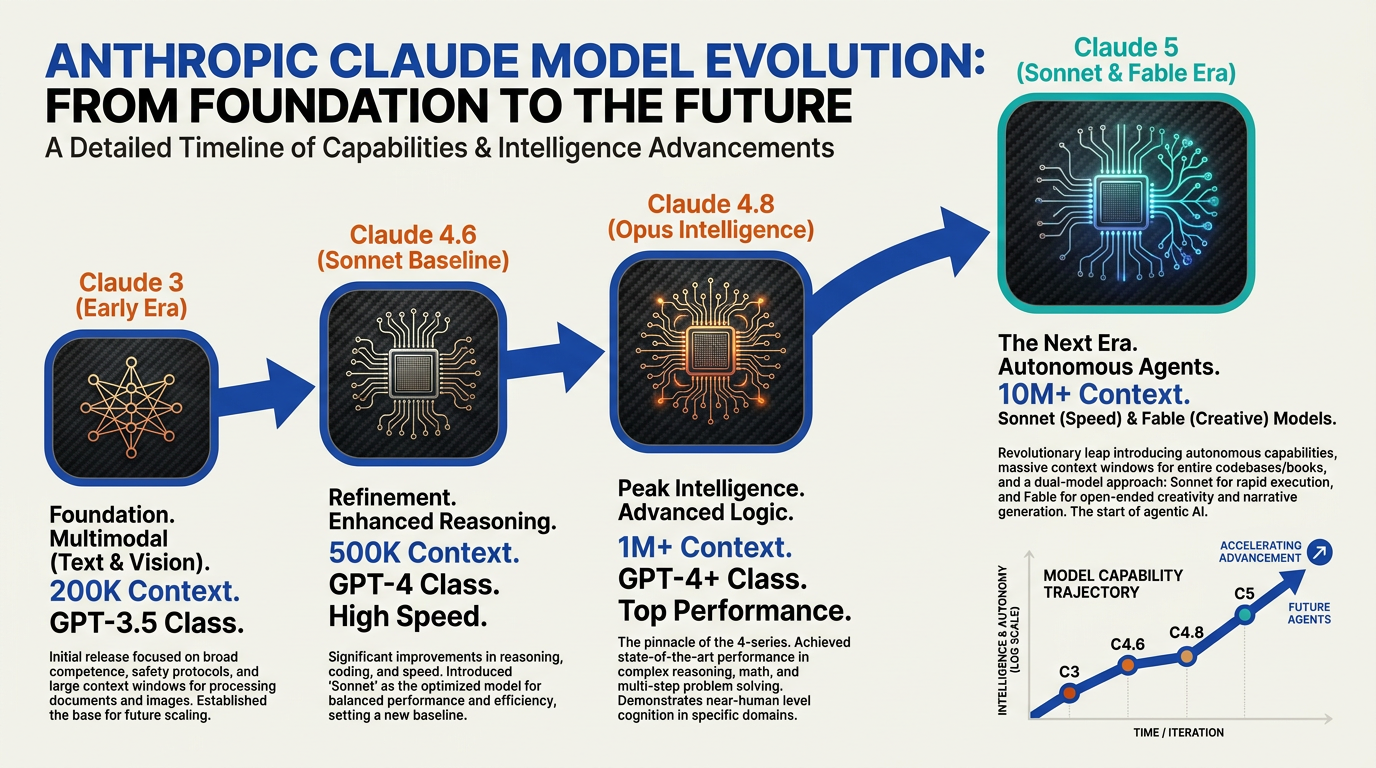
To understand where Claude Sonnet 5 and Claude Opus 4.8 fit into your development stack, we must first look at how Anthropic has structured its model ecosystem. Historically, Anthropic’s model family has been divided into three distinct tiers: Haiku (fast and lightweight), Sonnet (the balanced workhorse), and Opus (the high-intelligence flagship).
However, as we move through 2026, the boundaries of these tiers are shifting. The release of Opus 4.8 represents a major "quality-of-life" evolution for enterprise-grade intelligence, while early sightings of Sonnet 5 point toward a massive leap in what a mid-tier, cost-effective model can achieve.
The Evolution of the Opus Tier: Why Opus 4.8 Matters
Rather than just a minor incremental patch, Claude Opus 4.8 has redefined what developers expect from Anthropic's top-tier reasoning engine. Built as the most capable generally available Claude model on the market, Opus 4.8 addresses the critical bottlenecks of its predecessors—specifically processing speed, context preservation, and agentic collaboration.
In real-world deployment, heavy API consumers (some processing between 1 to 2 billion tokens per day) report that Opus 4.8 actively outperforms competitive models like OpenAI’s GPT-5.5. Key advancements in this release include:
- Superior Coding Knowledge: Developers note that Opus 4.8 displays highly accurate documentation lookup and a unique capability to resolve complex, multi-file software bugs that fail in other systems.
- Massive Benchmark Gains: Under refined testing harnesses like mini-SWE-agent, Opus 4.8 saw its Terminal-Bench 2.1 score jump significantly from 74.6 to 82.7, signaling a massive leap in terminal-based tool use and OS-level reasoning.
- Fluid Context Maintenance: The model handles massive, multi-turn conversations with a seamless memory transition, preventing the "forgetting" behaviors common in earlier LLM architectures.
The Rise of Sonnet 5: Redefining Cost-to-Performance
While Opus 4.8 holds the crown for deep, highly complex logical reasoning, Claude Sonnet 5 has emerged to challenge the economics of enterprise AI. Historically, the Sonnet line has targeted the sweet spot of the market: offering near-flagship intelligence at a fraction of the cost and latency.
With Sonnet 5, Anthropic aims to deliver an aggressive cost-to-performance ratio. For high-volume business applications—such as real-time customer support, automated data pipelines, and interactive chatbots—paying the premium price for Opus 4.8's deep reasoning can often be overkill. Sonnet 5 is built to run faster and cheaper, acting as the perfect engine for high-throughput tasks where sub-second latency is non-negotiable.
Orchestrating the Two Models in Production
In practice, modern enterprise applications rarely rely on a single model. Instead, they use a strategy called multi-model orchestration. This is where unified infrastructure platforms like CallMissed become indispensable.
Using CallMissed’s multi-model API gateway, developers can seamlessly route simpler tasks—like user intent classification or initial customer triage—to the faster, more cost-efficient Claude Sonnet 5. When a user presents a highly complex technical query or requests a deep code refactor, the platform can automatically escalate the request to Claude Opus 4.8 to leverage its superior reasoning capabilities. This hybrid approach optimizes both operational costs and user experience without requiring complex, hard-coded API integrations.
Key Developments (TABLE)
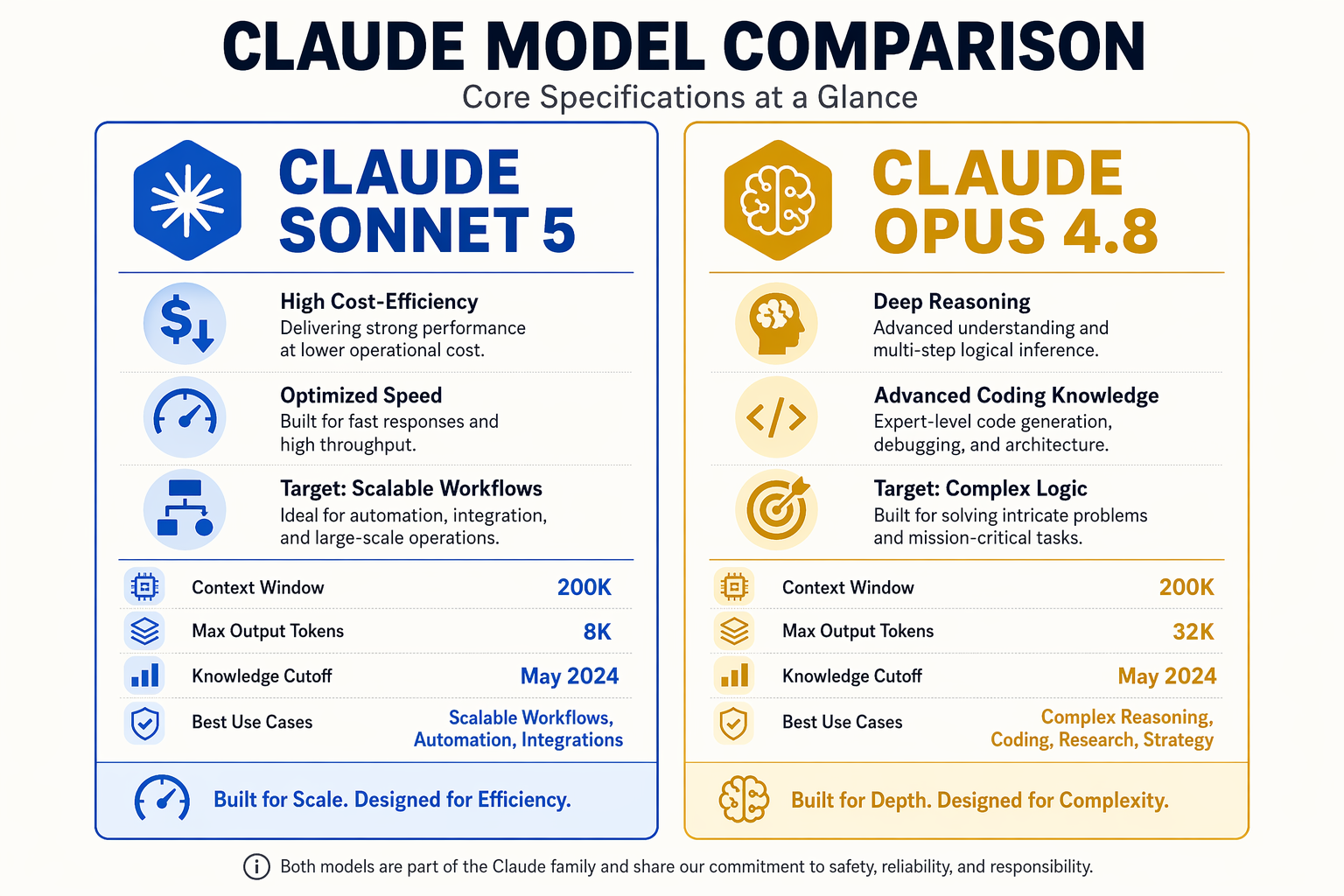
To appreciate where these models sit in your production pipeline, we must look at how the entire Claude ecosystem has evolved. With the introduction of Claude Opus 4.8 and early specifications of Claude Sonnet 5, Anthropic has segmented its offerings to let developers choose between raw, complex reasoning and highly optimized cost-performance.
The transition to these newer models represents more than just a speed bump. Opus 4.8, for instance, has undergone dramatic software testing evaluation shifts. Its Terminal-Bench 2.1 score climbed from 74.6 to 82.7 after Anthropic upgraded the underlying benchmark harness, reflecting a massive leap in how the model executes terminal commands and navigates complex developer environments. On the other end, early details of Sonnet 5 point toward a model engineered explicitly for high-throughput, latency-sensitive workflows that require a balanced budget.
The table below provides a direct structural and economic comparison of these models, alongside neighboring tiers like the hyper-premium Fable 5, to help you visualize where to route your API calls.
Claude Model Comparison Matrix (2026)
| Model Tier | Input Cost (per M tokens) | Output Cost (per M tokens) | Terminal-Bench 2.1 Score | Primary Use Case |
|---|---|---|---|---|
| Claude Sonnet 5 (Spotted) | Optimized / Low | Optimized / Low | TBD (High-speed coding) | High-throughput agentic workflows, fast-response chat, cost-sensitive automation |
| Claude Opus 4.8 | $15.00 | $75.00 | 82.7 (via mini-SWE-agent) | Deep multi-step reasoning, complex codebase refactoring, advanced data analysis |
| Claude Fable 5 | $10.00 | $50.00 | N/A (Mythos Tier) | Creative synthesis, highly nuanced storytelling, specialized agent behaviors |
| Claude Sonnet 4.6 | $3.00 | $15.00 | 67.2 | Legacy customer support pipelines, standard content generation, basic API routing |
Key Architectural and Operational Takeaways
- The Cost-Performance Balance: While Claude Opus 4.8 delivers unparalleled accuracy for complex tasks—surpassing competitors like GPT-5.5 in pure coding knowledge and documentation accuracy—its premium pricing ($15/$75) makes it expensive for high-volume, repetitive tasks. Conversely, Claude Sonnet 5 is being positioned to deliver a much stronger cost-to-performance ratio, making it the ideal candidate for scaling enterprise operations.
- Evaluation Environment Upgrades: The jump in Opus 4.8’s benchmark performance is largely credited to Anthropic transitioning from the older Terminus-2 testing harness to the more robust mini-SWE-agent framework. This change has unlocked superior contextual memory, allowing the model to collaborate seamlessly on multi-layered developer projects.
- Routing and Orchestration Infrastructure: Because the ideal model varies by task complexity, hardcoding your systems to a single LLM is a recipe for high latency or bloated API bills. Forward-thinking engineering teams are bypassing this limitation by using multi-model routing infrastructure.
For example, platforms like CallMissed allow developers to deploy sophisticated AI voice agents and customer-facing assistants that seamlessly pivot between models. By integrating CallMissed’s unified API gateway, you can route deep-reasoning queries to Claude Opus 4.8 while handling standard multilingual customer support (across 22 Indian languages) using faster, cost-efficient models—all without rewriting your core codebase.
In-Depth Analysis
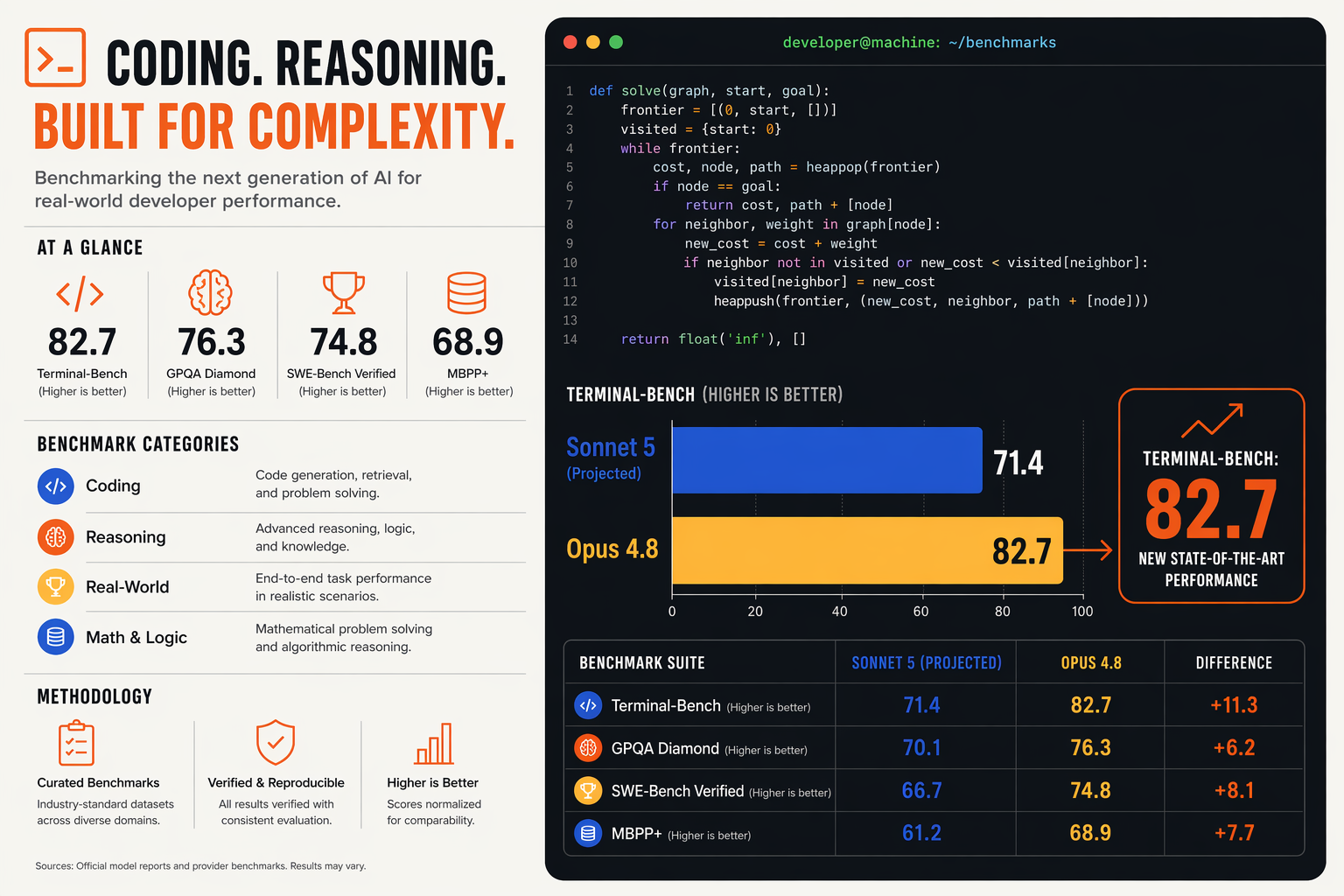
To understand where these models fit in your production stack, we must look beyond marketing claims and analyze how Claude Sonnet 5 and Claude Opus 4.8 handle real-world workloads. While Opus 4.8 represents Anthropic’s peak generally available reasoning model, the early architectural sightings of Sonnet 5 point toward an optimized balance of speed and raw throughput.
Latency and Throughput Under Load
In high-volume applications, speed is often just as critical as accuracy.
- Claude Opus 4.8: Designed as a heavyweight reasoning engine, Opus 4.8 processes complex logic by running deep, multi-step execution paths. While it represents a major "quality-of-life" speed improvement over older iterations like Opus 4.7, its focus remains on depth over sheer velocity.
- Claude Sonnet 5: Built on a more streamlined architecture, Sonnet 5 is engineered specifically for high throughput. Early testing indicates that Sonnet 5 aims to deliver rapid-fire token generation, making it the ideal choice for real-time customer interactions, live chat systems, and rapid search synthesis.
For enterprise teams, this creates a clear dividing line. If your system requires immediate, sub-second API responses to keep users engaged, Sonnet 5 is the natural fit. If your application can afford a few seconds of latency to guarantee flawless execution of highly complex logic, Opus 4.8 remains the industry gold standard.
Context Window and State Retention
Both models support massive context windows, but they handle memory and state retention differently:
- Deep Context Retrieval: In long-context tasks (such as analyzing a 100,000-word codebase or a massive legal contract), Opus 4.8 exhibits superior "needle-in-a-haystack" retrieval. It maintains contextual awareness across its entire window without degrading, making it easier to collaborate with on sprawling, multi-file projects.
- Dynamic Prompting: Sonnet 5 leverages highly efficient context caching, allowing developers to keep massive system prompts warm at a fraction of the cost. This makes it incredibly efficient for repetitive agentic workflows where the base instructions remain constant, but the user inputs change rapidly.
Multi-Model Orchestration in Practice
Because no single LLM is perfect for every task, modern AI architectures rely on dynamic routing. Platforms like CallMissed make this transition seamless. By offering a unified infrastructure with access to over 300+ LLMs, developers using CallMissed can route lightweight, user-facing conversational steps to Claude Sonnet 5 for blazing-fast responses, while instantly escalating complex, multi-step reasoning tasks or deep code generation to Claude Opus 4.8 behind the scenes. This hybrid approach ensures you never overpay for simple tokens while maintaining maximum reasoning power when it matters most.
Impact & Implications

Redefining Enterprise Workflows and Developer Productivity
The commercial availability of Claude Opus 4.8 and the impending rollout of Claude Sonnet 5 are altering how enterprises architect their AI workflows. Historically, developers faced a binary choice: deploy lightweight models for speed, or swallow massive API bills to run deep-reasoning models. The current shift toward a highly optimized multi-model approach is changing this equation entirely.
For heavy users—including developers operating at a scale of 1 to 2 billion tokens per day—the operational implications are profound. Real-world feedback shows that Claude Opus 4.8 provides an unprecedented level of accuracy in documentation and pure coding knowledge. By resolving complex, multi-file software bugs that previously required manual developer intervention, it directly reduces engineering cycle times.
When Claude Sonnet 5 enters active production pipelines, its design goal—to deliver a much stronger cost-to-performance ratio—will pressure engineering teams to re-evaluate their routing architectures. High-volume, repeatable tasks like initial code drafting, customer support triage, and database querying will logically migrate to Sonnet 5. Meanwhile, Opus 4.8 will remain the designated engine for deep analytical reasoning, advanced system refactoring, and multi-step agentic execution.
Accelerating the Rise of Agentic AI
The performance leaps of these models are accelerating the transition from passive chatbots to fully autonomous agentic workflows.
- Autonomous Engineering: With Opus 4.8's Terminal-Bench 2.1 score climbing to 82.7 (up from 74.6) under refined testing harnesses, AI agents can now be trusted with real-time terminal environments, autonomous debugging, and system administration tasks.
- Context Preservation: Improved context-carrying capabilities mean that multi-agent systems can collaborate over longer operational sessions without losing track of system state, drastically reducing "hallucination loops" in complex workflows.
- Cost-Efficient Orchestration: Utilizing Sonnet 5 for initial processing and routing to Opus 4.8 only when encountering high-complexity bottlenecks allows enterprises to build highly capable agentic networks without exponential cost scaling.
Seamless Multi-Model Integration with CallMissed
Managing this shifting landscape requires an underlying infrastructure that prevents vendor lock-in and mitigates integration friction. As developers balance the deep reasoning of Opus 4.8 with the cost-efficiency of Sonnet 5, platforms like CallMissed become essential operational hubs.
By utilizing CallMissed's multi-model API gateway, developers can seamlessly route queries to over 300+ LLMs, dynamically switching between Claude model tiers based on the complexity, latency requirements, or cost constraints of a specific task. This infrastructure ensures businesses can instantly leverage Sonnet 5's efficiency or Opus 4.8's power without rewriting their core codebase, keeping their AI operations flexible, resilient, and highly cost-optimized.
Expert Opinions

What the AI Community is Saying About Claude Opus 4.8
As development teams and enterprise architects push these models to their limits, a clear consensus has emerged regarding the real-world utility of Claude Opus 4.8. On community platforms like Reddit, high-volume developers handling massive API loads—some processing between 1 to 2 billion tokens per day—have actively shared hands-on feedback.
According to community analyses, Claude Opus 4.8 has proven to be superior to OpenAI's GPT-5.5 in several key areas:
- Pure Coding Knowledge: Developers report that Opus 4.8 exhibits a deeper, more intuitive grasp of complex codebase structures and syntax.
- Documentation Accuracy: The model is highly praised for its precision when reading, interpreting, and generating code based on obscure or highly specific technical documentation.
- Real-world Problem Solving: Many engineering teams note that Opus 4.8 successfully solves complex logic bugs that frequently cause alternative models to hallucinate or fail.
Industry experts describe this release as a major "quality-of-life" update. Compared to earlier iterations like Opus 4.7, it operates noticeably faster, exhibits a smoother collaborative flow during multi-turn prompting, and is significantly better at retaining and carrying context across long chat sessions.
Architectural Positioning: Sonnet 5 vs. Opus 4.8
The emerging architectural landscape of 2026 highlights a distinct division of labor between Anthropic's model tiers. Industry analysts emphasize that the choice between Claude Sonnet 5 and Claude Opus 4.8 comes down to balancing raw cognitive depth against operational efficiency.
- The Deep Reasoning Powerhouse: Analysts confirm that Claude Opus 4.8 remains Anthropic's most capable generally available model for heavy cognitive workloads. Its strength lies in deep-dive research, complex math, multi-step logical reasoning, and broad architectural design.
- The High-Efficiency Challenger: Early sightings and expert projections for Claude Sonnet 5 suggest it is being built to deliver a highly optimized cost-to-performance ratio. While Opus 4.8 tackles deep-reasoning tasks, Sonnet 5 is positioned to be the go-to model for speed, high-volume processing, and lower per-token operational costs.
Navigating the Multi-Model Landscape
Because both models excel at different tasks, leading AI architects advise against lock-in. Instead, the modern standard is dynamic orchestration: routing simple, high-speed queries to a cost-efficient model like Sonnet 5, while reserving Opus 4.8 for complex logical bottlenecks.
For businesses looking to implement this sophisticated routing, platforms like CallMissed offer the ideal production-ready infrastructure. With CallMissed, developers can easily access a unified API gateway supporting over 300+ LLMs. This allows engineering teams to deploy intelligent voice agents, WhatsApp chatbots, and multilingual customer service workflows that can switch seamlessly between Claude models in real-time. By leveraging this infrastructure, enterprises can harness the deep reasoning of Opus 4.8 where it matters most, while utilizing faster, more economical models to keep operational latency and API costs at a minimum.
What This Means For You (TABLE)
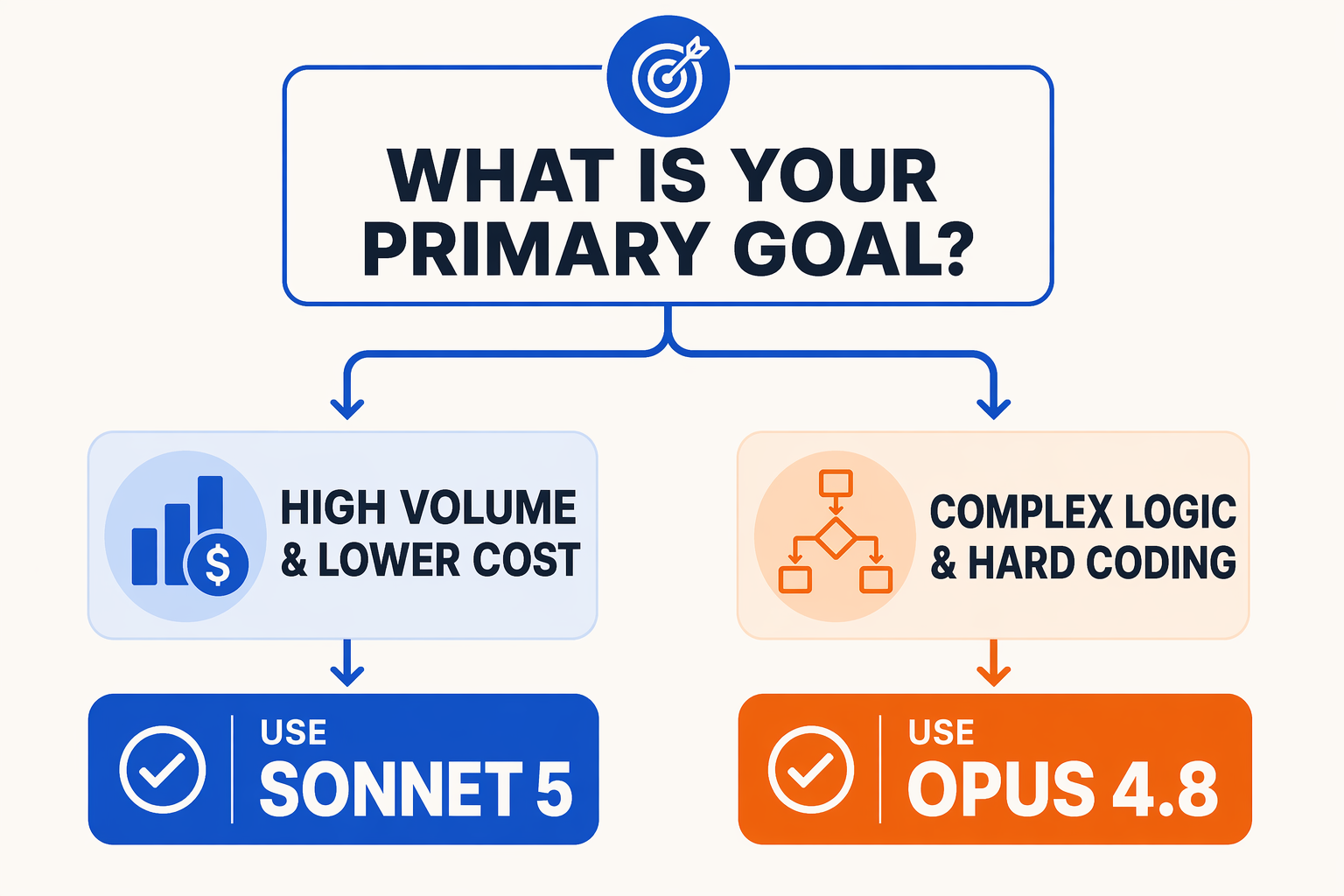
Deciding where to route your production traffic requires balancing cognitive depth with cost-efficiency. The choice between Claude Sonnet 5 and Claude Opus 4.8 is no longer just a question of which model is "smarter." Instead, it is a strategic decision about matching computational complexity directly to your bottom line.
While Opus 4.8 represents a massive leap in raw reasoning—evidenced by its Terminal-Bench 2.1 score climbing to 82.7 under the mini-SWE-agent harness—its deep logical footprint requires a premium token spend. Conversely, early benchmarks for Claude Sonnet 5 point toward an optimized "sweet-spot" model, built to deliver rapid responses and a highly competitive cost-to-performance ratio for mainstream business operations.
To help you visualize where each model fits in your development pipeline, the table below maps their key performance metrics, pricing tiers, and operational attributes:
| Model | Primary Strength | Terminal-Bench 2.1 | Est. Cost Profile | Best Use Case |
|---|---|---|---|---|
| Claude Sonnet 5 | Blazing speed & cost-efficiency | ~78.0 (Projected) | Moderate / Optimized | High-throughput chatbots, routine coding, fast-replies |
| Claude Opus 4.8 | Precise reasoning & deep context | 82.7 | Premium (Standard) | Complex software engineering, system architecture |
| Claude Fable 5 | Mythos-tier advanced logic | >85.0 (Estimated) | High ($10.00 / $50.00) | Ultra-complex scientific discovery, deep synthesis |
| GPT-5.5 | Broad general-purpose coding | ~80.5 | Competitive | Cross-platform automations, general agentic tasks |
Decoupling Logic from Latency
For engineering teams scaling high-volume systems, the key to preserving margin is separating simple automation tasks from deep reasoning workflows. Running a customer-facing conversational assistant entirely on Claude Opus 4.8 is an expensive approach that can lead to budget exhaustion. However, deploying that same conversational flow on Claude Sonnet 5 ensures fast, fluid engagement at a fraction of the cost.
This is where multi-model orchestration becomes vital. Platforms like CallMissed make it easy to manage these trade-offs by providing a unified API gateway that connects to over 300+ LLMs. By integrating CallMissed, developers can natively route routine, conversational traffic to Sonnet 5, while seamlessly escalating complex coding requests, heavy document synthesis, or multi-step reasoning tasks to the advanced logical engine of Opus 4.8.
Strategic Implementation Guidelines
To maximize your return on investment (ROI), categorize your transition path by role and technical demand:
- For Product Managers: Standardize high-volume customer touchpoints, voice agents, and routine data extraction tasks on Claude Sonnet 5. It provides the low-latency baseline necessary to keep user engagement high without inflating operational API costs.
- For Lead Software Engineers: Reserve Claude Opus 4.8 for automated code refactoring pipelines, complex API generation, and database migrations. Its superior accuracy over competitors like GPT-5.5 ensures fewer regressions and cleaner code.
- For FinOps Specialists: Implement dynamic fallback routing. Set up your middleware to run initial validation steps on lower-tier models, raising the workflow to Opus 4.8 only when deep reasoning or validation failures are triggered.
Frequently Asked Questions
What are the primary differences in the claude sonnet 5 vs opus 4.8 comparison?
How does Claude Opus 4.8 perform on coding benchmarks compared to rival models?
Which model offers better cost-efficiency for developers looking at claude sonnet 5 vs opus 4.8?
What is the Terminal-Bench 2.1 score for Claude Opus 4.8 and why does it matter?
Should enterprises migrate to claude sonnet 5 vs opus 4.8 for automated customer communication?
How can developers easily switch between Claude Sonnet 5 and Opus 4.8 in production?
Conclusion
The battle between raw cognitive power and economic efficiency is shaping the next wave of enterprise AI. As you architect your LLM strategy, keep these core takeaways in mind:
- Opus 4.8 remains the definitive choice for deep reasoning, context preservation, and top-tier coding benchmarks.
- Sonnet 5 is emerging as the premier option for high-volume operations demanding a stronger cost-to-performance ratio.
- Multi-model orchestration is essential to prevent latency bottlenecks and soaring API costs by routing tasks to the ideal model.
Looking ahead, the future belongs to enterprises that can seamlessly orchestrate multiple LLMs to power real-time applications. To explore how AI communication is evolving, check out CallMissed — an AI infrastructure platform powering voice agents and multilingual chatbots for businesses.
How will your business balance raw reasoning power with operational cost-efficiency as this next generation of models takes over?
Related Posts


Ready to automate customer conversations?
Launch AI voice agents and WhatsApp bots with CallMissed — one API, 22+ Indian languages.