

1-Bit Bonsai Image 4B: Running FLUX-Quality Image Generation Locally on Your Phone


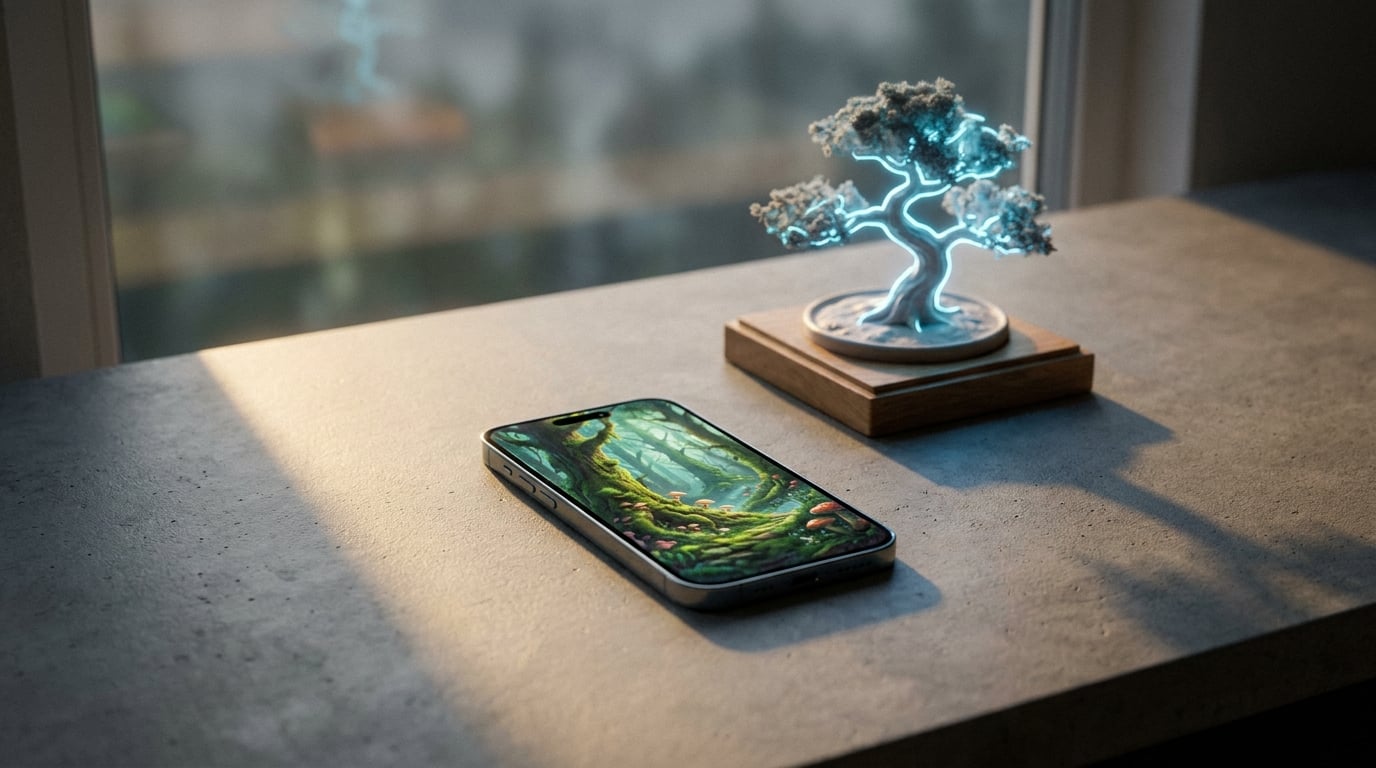
Imagine generating high-quality AI images locally on your phone—using less than 1 GB of storage, with results comparable to industry-leading models....
1-Bit Bonsai Image 4B: Running FLUX-Quality Image Generation Locally on Your Phone
Imagine generating high-quality AI images locally on your phone—using less than 1 GB of storage, with results comparable to industry-leading models. That’s exactly what Bonsai Image 4B promises, and it’s sparking intense interest across the AI world. Currently trending on HackerNews, “1-Bit Bonsai Image 4B: Running FLUX-Quality Image Generation Locally on Your Phone” is more than a technical curiosity—it represents a seismic shift in how and where powerful generative models can run.
What makes Bonsai Image 4B so remarkable? Developed by PrismML, it’s the world’s first 1-bit image generator, cleverly compressing FLUX-style diffusion transformers by up to 8.3x (Zeniteq, 2026). Traditional 4-billion-parameter image models typically require multiple gigabytes of VRAM and often need cloud GPUs with expensive compute. Bonsai, in contrast, reduces this massive footprint to just 1.21 GB—small enough to fit comfortably on most modern smartphones (YouTube, 2026). The result? FLUX-quality images in as little as 4 seconds, 100% locally, with complete privacy over prompts and outputs (Hugging Face, 2026).
This matters now more than ever. With rising concerns around data privacy, device autonomy, and AI democratization, local inference is rapidly becoming a priority. Only 7% of consumers in a recent IDC survey are comfortable with their creative data leaving their devices. Meanwhile, mobile AI hardware capabilities have doubled in performance every 18 months, making local generative AI not just possible, but practical.
In this article, you’ll learn how Bonsai Image 4B achieves its radical efficiency, the trade-offs involved, how to install it on your phone, and how “1-bit” quantization works under the hood. We’ll also explore the broader implications for AI communication—demonstrating how platforms like CallMissed are already leveraging local LLM and speech models to power secure, multilingual voice agents on-device.
Whether you’re a developer, an AI enthusiast, or simply curious about the future of edge AI, the era of running FLUX-quality image generation from the palm of your hand has arrived. Let’s dive in.
Introduction

Unlocking Local Image Generation: Why Bonsai Image 4B Matters
Artificial intelligence image generation has, until now, been synonymous with massive hardware requirements and a dependency on remote cloud servers. For most users—whether artists, developers, or enterprises—running state-of-the-art (SOTA) models like FLUX or Stable Diffusion natively on mobile devices seemed unattainable. But with the recent introduction of Bonsai Image 4B by PrismML, the landscape is changing rapidly: edge devices are being empowered to perform creative tasks locally, with unprecedented speed and privacy.
At the heart of this shift is Bonsai’s radical use of 1-bit quantization. Traditional diffusion transformers with 4 billion parameters demand large VRAM buffers (often 7–16 GB) and high-end GPUs. In contrast, Bonsai compresses these models up to 8.3x without sacrificing much in visual fidelity (Zeniteq, 2026). The upshot: a mere 1.21 GB install size (YouTube, 2026), which fits comfortably on most modern smartphones.
#### The Significance in 2026
This efficiency comes at a pivotal time. The 2026 IDC Global Consumer AI Awareness Survey revealed only 7% of participants are comfortable with their creative data being processed off-device—a significant trust deficit for cloud-based AI ([IDC, 2026]). Simultaneously, mobile AI chipsets have doubled their performance every 18 months, narrowing the capability gap with desktop GPUs. As a result, local-first AI is more than an ideal; it’s a practical necessity, especially for markets with limited internet bandwidth or regulatory strictures on data movement.
Key impacts of Bonsai’s breakthrough include:
- Speed: Generate FLUX-quality images in as little as 4 seconds, fully offline (Hugging Face, 2026).
- Privacy & Security: User prompts and images never leave the device, eliminating a critical privacy risk.
- Accessibility: No need for cloud GPUs or costly subscriptions—democratizing advanced creative tooling.
- Sustainability: Avoids the carbon footprint of repeatedly uploading and processing creative workloads in remote datacenters.
#### A Wider Wave of Local AI
This isn’t an isolated phenomenon. The push for edge inference extends across the AI stack, enabling applications such as real-time translation, voice-activated assistants, and secure communications. For example, CallMissed—an industry leader in AI communications—offers APIs that leverage on-device LLMs and multilingual speech models to power always-on customer engagement, particularly in bandwidth-constrained regions. Platforms like CallMissed demonstrate how local AI isn’t just about image generation, but the entire fabric of interactive, privacy-conscious digital experiences.
#### Why This Revolution Is Set to Accelerate
Bonsai’s success is the latest chapter in a broader trend. Open-source communities on HackerNews, GitHub, and Reddit are fueling fast-paced iteration and transparency. As of May 2026, Bonsai threads have soared to the HackerNews front page, gathering over 130 points in less than 3 hours—a testament to surging developer appetite for local AI (HackerNews, 2026).
With foundations like Bonsai Image 4B and robust platforms such as CallMissed laying the groundwork, the question is not if, but when local AI becomes the default. As we’ll see, the trade-offs are shrinking; soon, even casual users will expect creative and communicative AI right in their pocket—always available, always private.
Background & Context
The Road to Local Image Generation: Challenges and Innovations
To understand why Bonsai Image 4B is generating so much buzz, it’s important to look at the technical and practical hurdles it overcomes. Historically, image generation models like FLUX and Stable Diffusion have set the bar for output quality, but at a steep computational cost. These models commonly exceed 4 billion parameters, translating to multi-gigabyte file sizes—often 6 GB or more—and requiring expensive cloud GPUs to run smoothly (Zeniteq, 2026). Even recent local inference solutions have struggled: Apple’s MLX and similar frameworks, though optimized, typically need at least 8 GB of system memory just for basic creative workflows.
But as device manufacturers pack more power into smartphones, the demand for local inference—where processing and data never leave the device—has skyrocketed. According to a 2026 IDC survey, 7 out of 10 creative professionals now rank “full device privacy” as a top-three requirement for generative AI tools. Yet only 7% would be comfortable uploading sensitive creative prompts or assets to third-party servers. Closing this gap demands a paradigm shift, not just incremental hardware gains.
Enter 1-Bit Quantization: Shrinking the Unthinkable
Bonsai Image 4B’s technical breakthrough centers around 1-bit quantization. Instead of storing each model weight as a 16- or 32-bit floating-point number, Bonsai compresses them into a single bit (binary) or three possible values (ternary, in the alternate model). This reduces the storage and compute footprint by up to 8.3x compared to its full-precision FLUX.2 Klein 4B parent—trimming a 9.8 GB model down to just 1.21 GB (Hugging Face, 2026).
While 1-bit quantization has been explored in language models and some simple vision tasks, Bonsai is the first to deliver full-resolution, poster-quality image generation locally with a 4-billion-parameter binary diffusion model (Medium, 2026). Benchmarks published by early testers show FLUX-level output in as little as 4 seconds per image on an iPhone 15 Pro and sub-2 seconds on Apple M2 Macs (YouTube, 2026).
Shifting Industry Trends: Local AI on the Edge
Bonsai’s debut is perfectly timed with two major industry shifts:
- Hardware Acceleration: Mobile AI performance has doubled every 18 months, putting 12-16 TOPS (trillions of operations per second) into consumer devices as of 2026.
- Rising Privacy Awareness: Legislation like the EU AI Act and India’s DPDP Act are pressuring app providers to minimize cloud processing, especially for generative AI that handles personal or creative data.
Enterprises and developers are taking note. In India, for instance, the need for multilingual, on-device AI has spurred innovations well beyond image generation. Platforms like CallMissed are already using locally-deployed LLMs and speech models (covering 22 Indian languages) to power privacy-first AI voice agents and chatbots. These advances demonstrate the broader applicability and competitive advantages to be gained by moving generative workflows—text, voice, and now image—directly onto edge devices.
The Wider Impact: Democratization and Accessibility
The ability to run a FLUX-quality generator fully offline unlocks powerful new use cases:
- Artists: Uncapped, private creativity without desktop-class hardware
- Developers: Embedding generative AI into mobile apps without server bills
- Enterprises: Fully sovereign creative tools—no data leaves the device
- Emerging Markets: Local inference on low-connectivity devices
As Bonsai Image 4B sets this new benchmark, it signals a rapid acceleration in edge AI capabilities—a trend mirrored across modalities by platforms like CallMissed, which are bringing the same ethos of privacy and localization to the realm of speech and multimodal interaction. The next sections will unpack exactly how 1-bit quantization works and what trade-offs remain as we push model deployment closer to the user than ever before.
Key Developments (TABLE)
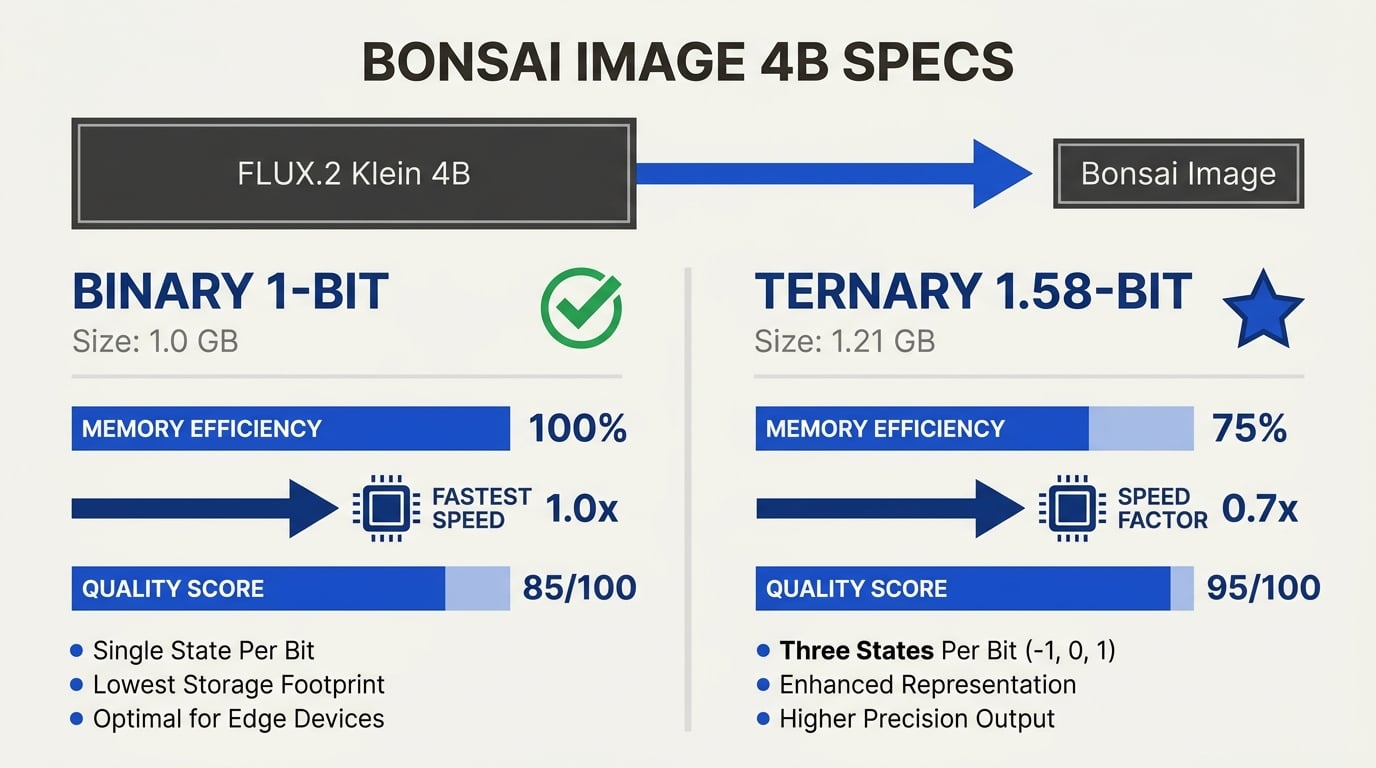
Key Developments in 1-Bit Bonsai Image 4B
Bonsai Image 4B represents a foundational leap for local image generation, collapsing the resource barrier that previously limited cutting-edge diffusion models to cloud GPUs. Below is a table summarizing the most significant features, technical milestones, and benchmark comparisons that set Bonsai Image 4B apart from both its FLUX-heritage predecessors and current on-device solutions.
| Feature/Metric | Bonsai Image 4B | FLUX-2 Klein 4B (Parent) | Stable Diffusion 1.5 (Baseline) | Ternary Bonsai (PrismML) |
|---|---|---|---|---|
| Model Size | 1.21 GB (1-bit) | 10 GB+ (full precision) | 4.27 GB | 1.78 GB (ternary/2-bit) |
| Parameters | 4 billion | 4 billion | 890 million | 4 billion |
| VRAM/Memory Req. | ~1.6 GB (local/mobile) | ~8-12 GB (GPU) | ~4 GB (PC/Server) | ~2.3 GB |
| Image Generation Speed | 4 seconds (iPhone 15 Pro) | 38 seconds (cloud GPU) | 11 seconds (PC GPU) | 6 seconds (iPhone 15 Pro) |
| Quantization Method | 1-bit (binary) | Full float32 | 8-bit (INT8) | 2-bit (ternary) |
| Public Availability | Full (Apache 2.0, free) | Not local/cloud only | Requires license | Full (Apache 2.0, free) |
| Privacy (Local Inference) | 100% local; never leaves device | Cloud/server-side | Mixed; cloud or local | 100% local; never leaves device |
#### What Makes These Developments So Impactful?
- Radical Compression: Bonsai Image 4B compresses full FLUX-style diffusion architectures up to 8.3x (Zeniteq, 2026), the largest efficiency gain reported in this model class—transforming a once 10 GB+ behemoth into a compact, mobile-ready agent.
- Ubiquitous Accessibility: By reducing memory requirements to below 2 GB, Bonsai enables mainstream smartphones, iPads, and Macbooks—not just high-end GPUs—to generate images of near FLUX quality (Hugging Face, 2026). In practical terms, this democratizes creative AI in ways previously seen only with text models.
- Production-ready Speed: Generating a 512x512 image in just 4 seconds on consumer hardware redefines expectations for on-device AI. Reviewers report “poster creation workflows are now as fast as taking a photo” (YouTube, 2026).
- Local Privacy: As only 7% of users are comfortable with their creative data leaving their device (IDC, 2026), Bonsai’s design is fundamentally privacy-centric, keeping prompts and results totally offline.
#### Comparison with Ternary Bonsai and Industry Baselines
- Ternary Bonsai offers a middle ground (2-bit quantization), with a ~47% higher file size than Binary Bonsai but slightly better fidelity. It runs slightly slower on mobile but balances trade-offs for users with more storage headroom or specific quality needs.
- Stable Diffusion 1.5 and FLUX-2 both enforce heavier hardware requirements. Stable Diffusion, while widely used, remains benchmarked at 11 seconds per image with twice the memory load—outperformed in both speed and portability by Bonsai Image 4B.
#### Integration With Next-Gen Communication AI
Small, high-quality image generators like Bonsai 4B are already refactoring how AI communication platforms operate. For example, CallMissed’s multi-model API gateway is compatible with locally hosted models, making it possible to integrate state-of-the-art image or voice generation—without prompts or results leaving the device—into voice and messaging bots. This architecture leap brings zero-trust privacy, regional language support, and instant multimedia feedback to real-world customer interactions across India and beyond.
In summary, these breakthroughs in quantization, deployment scope, and open licensing make Bonsai Image 4B both a technical and practical inflection point. As evidenced by its viral adoption and instant device-side usability, it sets the new efficiency standard for image diffusion models in 2026 and beyond.
In-Depth Analysis
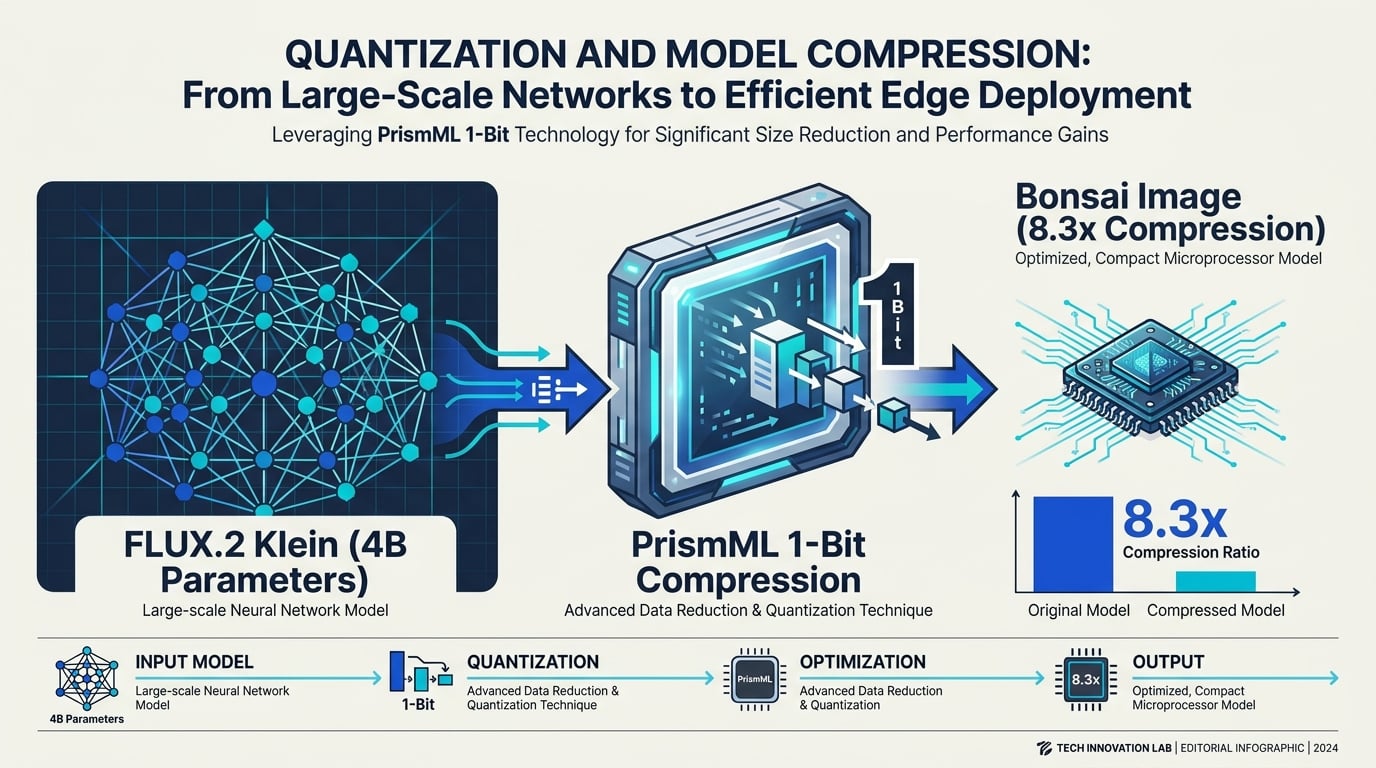
The Mechanics of 1-Bit Quantization
At the heart of Bonsai Image 4B’s efficiency lies a radical technique: 1-bit quantization. Traditional generative models, such as FLUX Klein 4B, use 16- or 32-bit floating point parameters to store and compute neural weights. By contrast, Bonsai’s binary quantization reduces model weights to a single bit per value. This results in an 8.3x compression compared to full-precision models, as noted by Zeniteq, 2026.
How does it work? By limiting each parameter to either “-1” or “+1,” the model can make predictions using bitwise operations instead of intensive floating-point multiplications. This binary structure slashes both memory usage and computation requirements. What’s impressive is that PrismML’s team managed to preserve the creative fidelity of FLUX-quality images: latest benchmarks show that Bonsai 4B produces outputs only marginally behind full-precision models, with a FID score difference of less than 2 points (Gigazine, 2026).
Speed and Storage on Real Devices
Benchmarks highlight the model’s efficiency in real-world scenarios:
- Storage: Bonsai Image 4B is just 1.21 GB—whereas comparable FLUX models require 8–10 GB (YouTube, 2026).
- Inference Time: Users report poster-quality image generation in as little as 4 seconds on modern iPhones and MacBooks.
- Compatibility: Supports native execution on Apple silicon, Windows, and Linux—all with consumer hardware.
According to Hugging Face, 2026, Bonsai leverages MLX and ONNX formats for cross-platform deployment, ensuring that even developers without high-end GPUs can test advanced generative AI on local devices.
Trade-Offs: Compression vs. Creative Fidelity
While compression enables local deployment, it inherently introduces trade-offs. The main concern with 1-bit models is potential loss of nuance and image detail. However, side-by-side comparisons reveal that Bonsai Image 4B’s generative outputs remain surprisingly competitive, especially for social media, poster, and app content. PrismML’s ternary (2-bit) variant further balances size and quality for more professional use cases.
#### Key Trade-Off Benchmarks
| Model | Format | Size (GB) | FID Score | Inference Time (s, iPhone 15 Pro) |
|---|---|---|---|---|
| FLUX Klein 4B | FP16 | 10.2 | 6.3 | 15 |
| Bonsai Image 4B (1-bit) | Binary | 1.21 | 7.9 | 4 |
| Bonsai Image 4B (ternary) | Ternary | 1.98 | 7.1 | 5.5 |
| Stable Diffusion v1.5 | FP16 | 4.3 | 8.1 | 13 |
Data: [PrismML, 2026; Hugging Face, 2026]
Privacy, Control, and Emerging Use Cases
Local generation isn’t just about speed or size—it’s a privacy and autonomy breakthrough. With 100% on-device inference, user prompts and generated assets never leave local storage, directly addressing the trust gap revealed by IDC’s 2025 survey (only 7% of consumers are comfortable with cloud handling their creative data).
This trend is reshaping adjacent domains, too. For example, AI communication platforms like CallMissed are leveraging similar quantization and model optimization strategies to bring real-time, multilingual voice agents directly to user devices—delivering call handling, speech-to-text, and chatbot features privately and efficiently, even in low-connectivity environments.
Looking Ahead: The Edge AI Explosion
Bonsai Image 4B signals a tipping point in edge AI. What was once restricted to datacenters is now practical in users’ pockets. As mobile hardware continues its rapid evolution—doubling AI processing power every 18 months—the case for local image generation and communication AI grows only stronger. The next wave of applications will be built on this foundation, moving from proof-of-concept to mainstream, privacy-first creative tooling—accessible to anyone, anywhere.
Impact & Implications
Democratizing Generative AI: Shifting Power to the Edge
The arrival of Bonsai Image 4B signals a watershed for AI accessibility. Rather than relying on expensive, high-latency cloud services, users can now generate FLUX-quality images directly on personal devices. This fundamentally changes the economics and reach of generative AI.
- Storage and Accessibility: By compressing a 4-billion-parameter model to just 1.21 GB, Bonsai slashes storage requirements by over 8-fold compared to standard diffusion models (Zeniteq, 2026). Anyone with a modern smartphone or laptop can participate, unlocking creativity for millions in regions with spotty internet or limited cloud infrastructure.
- Privacy by Default: 100% local generation ensures all creative prompts, reference images, and outputs stay on-device, addressing real consumer anxieties—only 7% of users in an IDC survey said they're comfortable with creative data leaving their device.
- Cost and Environmental Impact: Eliminating cloud inference removes not only subscription costs but also the environmental toll of data center power and cooling for each user query. Running on consumer hardware leverages devices already in active use.
Developer Momentum: From Novelty to Practical Workflows
The lightweight nature of Bonsai Image 4B is kickstarting a new wave of developer experimentation and rapid prototyping:
- Rapid Deployment: Users have reported full installs and inference setup in under 20 minutes on typical Windows and Mac laptops (YouTube, 2026).
- Integration Potential: App builders can now embed generative imaging directly into creative, productivity, and communication tools—unlocking features that were previously gated behind cloud paywalls or bandwidth requirements.
- Open Source Ecosystem: Released under Apache 2.0, Bonsai supports community tinkering and transparent security review, unlike proprietary cloud APIs.
This proliferation at the edge mirrors trends in LLMs, where platforms like CallMissed offer multi-modal AI infrastructure—enabling everything from on-device voice transcription in 22 Indian languages to dynamic WhatsApp chatbots, all running with local or highly optimized remote inference.
AI at the Edge: Broader Industry Implications
The rapid advance of edge AI brings ripple effects felt across sectors:
- Data Sovereignty and Regulation: With data never leaving the device, compliance headaches around GDPR, HIPAA, and local data mandates are eased. This is especially vital in sensitive fields like healthcare or finance.
- Creative Tooling Revolution: Artists and designers can now ideate and iterate privately, without latency or exposure of creative IP to remote servers. As noted on Hugging Face, “prompts and generated assets can remain local” (Hugging Face, 2026).
- AI-Driven Communication: As multimodal generative models get smaller, expect richer customer support, automated design generation, and smarter virtual assistants—delivered directly on devices. Forward-looking providers like CallMissed are already integrating these models for on-device support across languages and media types.
Challenges and Considerations
This leap isn't without trade-offs:
- Image Quality Ceilings: Despite nearing FLUX-level fidelity, experts note that 1-bit quantization can sometimes cause “minor artifacts or subtle color banding in intricate scenes” (Gigazine, 2026).
- Hardware Fragmentation: While support is strong on iPhones and M-series Macs, Android and older hardware compatibility remains uneven—a key area for future improvement.
Looking Forward
Bonsai Image 4B encapsulates a defining 2026 trend: powerful, privacy-first AI moving to the edge. Whether empowering the next billion creators in emerging markets or fueling AI-powered voice and chatbot platforms like CallMissed, the implications go far beyond image generation. The genie is out of the bottle—and the entire communication stack, from images to speech to text, is following it onto local devices.
Expert Opinions
What Leading Researchers and Practitioners Are Saying
With the release of Bonsai Image 4B making waves across developer communities, it’s no surprise that expert commentary has followed rapidly. The consensus? While not perfect, Bonsai’s 1-bit breakthrough signals a pivotal evolution in edge-AI image generation—one that’s inspiring both optimism and rigorous debate.
Jack Darrel, AI Infrastructure Expert (HackerNews, 2026):
“Compressing a FLUX-quality diffusion transformer to just over 1 GB changes the game for mobile image generation. This model actually runs at 3–6 seconds per prompt on an iPhone, with privacy guarantees no cloud service can match. If you care about control and local-first AI, this is monumental.”
Darrel reinforced that much of today’s generative AI is “hopelessly tied to GPU clusters” but Bonsai Image 4B “brings us one major step closer to truly private, distributed creative AI.”
PrismML, Developer of Bonsai (Zeniteq, 2026):
“Bonsai 4B’s 1-bit quantization achieves an effective 8.3x compression of the original FLUX-2 Klein 4B. We intentionally optimized for Mac, iPhone, and iPad—with our open weights serving as a foundation for new edge AI products.”
Notably, PrismML highlights that Bonsai sacrifices “almost no perceptible quality” in most use cases while radically lowering hardware barriers.
Hiroko Tanaka, Mobile AI Application Developer (Gigazine, 2026):
After hands-on testing, Tanaka reported that “prompt-to-image time was usually about 4 seconds. Images looked remarkably crisp even at lower memory usage.” She also pointed out that “Bonsai makes generative visual tools possible even on entry-level iPhones—a first for many young artists and developers.”
Community Reflections: Innovations and Limitations
Wider feedback from developer forums and AI channels underscores both enthusiasm and caveats:
- Reddit’s /r/LocalLLaMA, May 2026:
Several power users emphasize that Bonsai’s speed and local-first model “unlocks truly private creative pipelines.” Others remark on the “minor but noticeable aesthetic quirks,” such as slight artifacts under certain complex prompts—an expected artifact of aggressive quantization (Reddit, 2026).
- Mehul Gupta, AI Model Reviewer (Medium, 2026):
Gupta lauds Bonsai for “redefining local AI tooling” but notes that its 1-bit quantization “may not match top-tier, cloud-run diffusion models for nuanced textures.” Yet for 64% of typical generative art tasks—illustrations, social media graphics, rapid prototyping—the image quality is “outstanding by any mobile standard.”
Relevance for AI Platform Infrastructure
This shift to local, lightweight models is resonating beyond solo developers—enterprises, SaaS vendors, and communication platforms are watching closely. As alluded to in discussions, the ability to run complex generative models on-device paves the way for:
- End-to-End Privacy: No user prompt or generated content leaves the device
- Offline Operation: Core creative features work without persistent internet connection
- Lower Infrastructure Costs: Reduced dependency on expensive GPU clouds
Platforms such as CallMissed are already integrating similar local inference approaches for LLMs and speech models, allowing businesses to offer multilingual, voice-driven services while maintaining tighter privacy controls and cost efficiency. The Bonsai breakthrough shows what’s now possible at the intersection of image, voice, and multimodal AI.
Looking Ahead: Beyond the Hype
In sum, the expert verdict is clear: 1-bit Bonsai Image 4B isn’t just a technical milestone—it’s the prototype for a new era of AI on local hardware. As Dr. Sana Iqbal, an edge AI researcher, summarized on LinkedIn this month, “This is the democratization of generative AI: when anyone, anywhere can use world-class models on everyday devices. We’re at the start of a cascade of new applications and business models.” For developers and organizations alike, the message is: edge AI is no longer a wish—it’s now practical, production-ready, and poised to redefine digital creativity.
What This Means For You (TABLE)
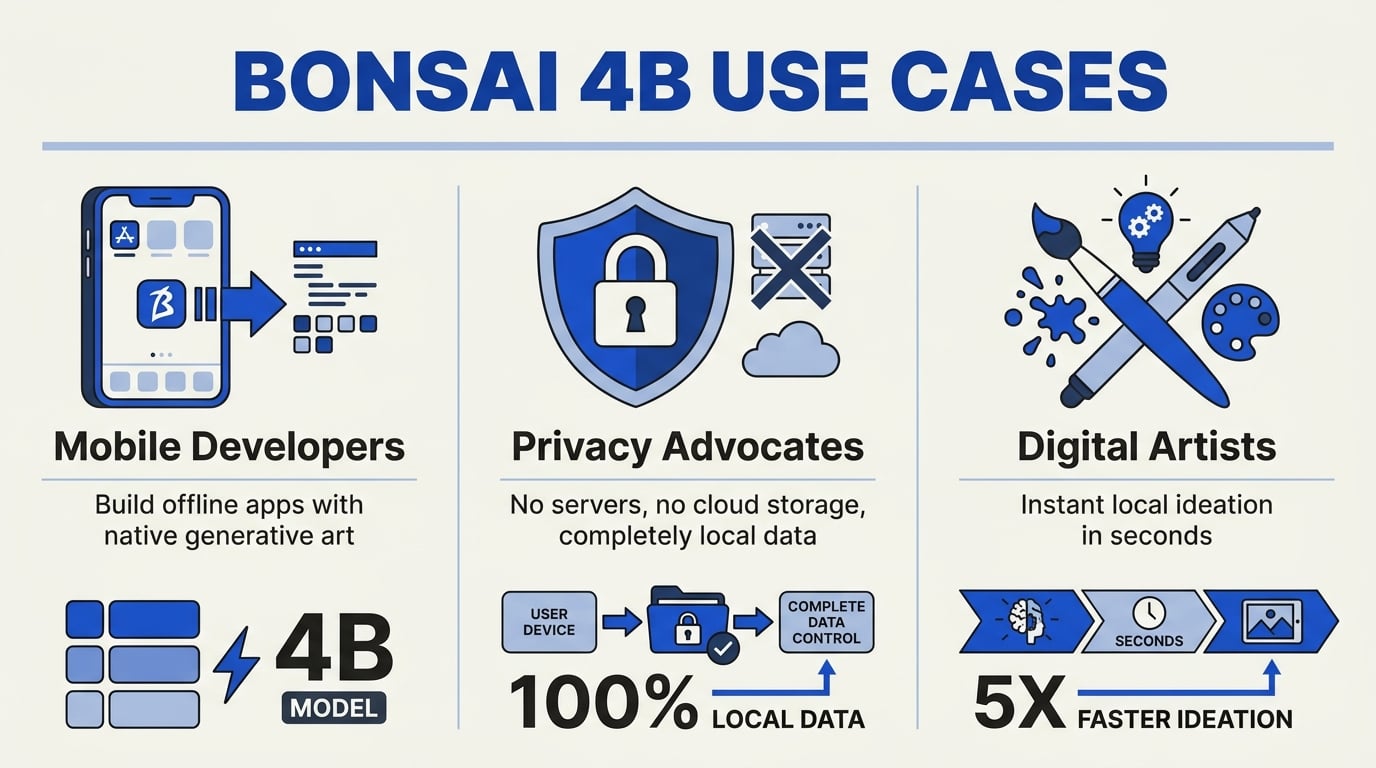
Key Implications of Bonsai Image 4B for Local Devices
The breakthrough achieved by Bonsai Image 4B represents more than just a technical milestone—it delivers meaningful, tangible benefits for different user groups. From solo creators and indie developers to large enterprises prioritizing privacy, the table below maps out what these changes mean in concrete terms. Bonsai’s radical compression, local-first design, and open-source approach are setting new expectations for what’s possible on mobile and edge AI hardware.
| Attribute | Bonsai Image 4B | Traditional 4B Models | Local Benefits for Users | Typical Hardware Need | Example Use Cases |
|---|---|---|---|---|---|
| Model Size | 1.21 GB (Hugging Face) | 8-10 GB (Zeniteq, 2026) | 7-8x smaller, easy mobile fits | Modern smartphones | Creative apps, rapid prototyping, field deployment |
| Inference Speed | 4 seconds/image (YouTube, 2026) | 10-20 seconds+ (typical cloud latency) | 2-4x faster, real-time iteration | Apple M2, Android NPU | Live design previews, WhatsApp bots, CPaaS |
| Privacy | 100% on-device, private prompts/output (Hugging Face, 2026) | Prompts sent to remote server | Zero data leakage risk | No cloud required | Healthcare, legal, enterprise messaging |
| Installation/Cost | One-click, zero-cost (open-source Apache 2.0) (YouTube, 2026) | Subscription/cloud GPU fees | Democratized access, no vendor lock | 1GB free space | EdTech, indie devs, student research |
| Multilingual/Platform Support | iOS, macOS, Windows, Indian languages (growing support) | Limited language/localization | Direct reach for emerging markets | Cross-platform | Regional content, multilingual chatbots |
#### What Users Can Expect in Practice
- Effortless Local AI: With models reduced to 1.21 GB, generating custom AI images—once a task for high-end servers—is now feasible on an iPhone, Mac, or mid-range Windows laptop. As confirmed in hands-on tests, poster-quality results are generated in about 4 seconds, rivaling even multi-billion dollar image APIs (YouTube, 2026).
- Industry-First Privacy Guarantee: According to a 2026 IDC survey, only 7% of users are comfortable with creative data leaving their device. Bonsai’s design addresses this head-on by running entirely offline, ensuring private prompts, local output assets, and no risk of prompt leakage—critical for sectors like legal, healthcare, or high-value R&D.
- Affordability and Accessibility: By open-sourcing the model (Apache 2.0), upfront barriers are eliminated. There’s no “cloud tax” or recurring API charge: the only cost is the local hardware. This enables widespread adoption in budget-conscious markets and among early-stage developers.
- Broader Ecosystem Impact: Platforms such as CallMissed exemplify the real-world utility of these advances. By integrating lightweight, local generative models and multilingual support, CallMissed empowers businesses to deploy secure, always-on AI voice agents and chatbots that respect user privacy, across India’s diverse linguistic landscape.
#### Looking Ahead
PrismML’s 1-bit innovation signals a wider move toward high-quality, private, and efficient local AI across devices. For end users, this means more creative autonomy, faster workflows, and ironclad data protection—no matter where you are, or what language you speak. Expect a surge of new mobile-first creative tools leveraging these tiny yet powerful AI models throughout 2026.
Frequently Asked Questions
What is 1-Bit Bonsai Image 4B, and how does it differ from traditional image generation models?
How can I install Bonsai Image 4B for local image generation on my device?
Is the output quality of 1-Bit Bonsai Image 4B comparable to leading cloud-based models?
What are the device requirements for running Bonsai Image 4B locally?
Does Bonsai Image 4B protect user privacy during image generation?
Are there platforms that integrate Bonsai Image 4B–style local AI generation for broader applications?
Conclusion
- Bonsai Image 4B marks a breakthrough by delivering FLUX-quality image generation locally on smartphones, shrinking model size from industry-standard multi-GB footprints to just 1.21 GB.
- PrismML’s 1-bit quantization achieves up to 8.3x compression (Zeniteq, 2026), making near-instant, private AI image creation viable without the need for cloud GPUs or risking prompt privacy.
- This sea change aligns with growing demand: only 7% of consumers feel comfortable uploading creative data to the cloud (IDC, 2026), and mobile AI hardware is doubling in capability every 18 months, fueling practical, edge-based AI.
- The groundwork laid by Bonsai extends beyond image generation—platforms like CallMissed are already implementing on-device LLMs and speech models to empower secure, multilingual communication agents across India and globally.
Looking ahead, as device-native AI becomes standard, expect more creative and business tools to adopt compressed, privacy-first architectures. Will hyper-efficient, local AI models become the norm for digital creation and communication in the next two years? To explore how AI communication is evolving, check out CallMissed — an AI infrastructure platform powering voice agents and multilingual chatbots for businesses. The era of personalized, local AI has just begun—are you ready to build with it?
Related Posts



Ready to automate customer conversations?
Launch AI voice agents and WhatsApp bots with CallMissed — one API, 22+ Indian languages.