

Bland AI vs Synthflow vs Retell AI vs Vapi: Best AI Voice Agent Solutions for Businesses in 2026


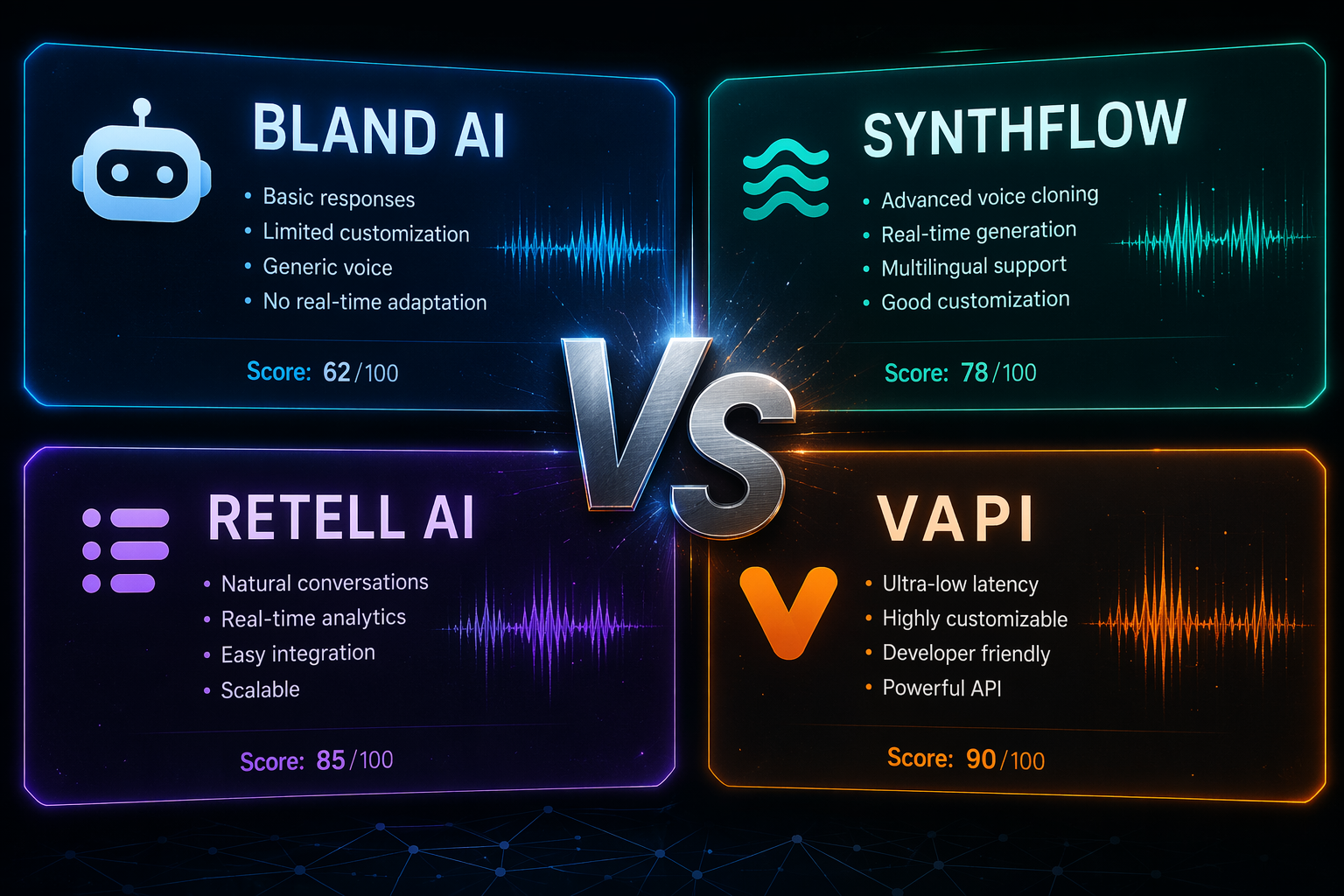
Compare Vapi, Retell, Bland and Synthflow for voice AI pricing, latency, no-code setup, outbound calls, integrations, languages and production fit.
Bland AI vs Synthflow vs Retell AI vs Vapi: Best AI Voice Agent Solutions for Businesses in 2026
Did you know that in 2026, the average consumer can no longer reliably distinguish between a human receptionist and a state-of-the-art AI phone agent? Thanks to breakthroughs in sub-1-second latency and emotive text-to-speech, businesses are rapidly replacing rigid IVR systems with fluid, conversational voice bots. However, choosing the right infrastructure can be a financial and technical minefield.
In this comprehensive guide, we compare the best AI voice agent solutions for business phone systems, analyzing the industry's "Big Four": Bland AI, Synthflow, Retell AI, and Vapi. Whether you need a simple no-code voice agent builder for local lead routing or a highly customizable developer API to handle millions of concurrent calls, we break down their real-world latency, pricing structures, and integration capabilities.
As next-generation tools like CallMissed continue to democratize conversational AI by providing multi-model LLM access and multilingual support, finding the perfect voice stack is essential to scaling your operations without skyrocketing costs. Let's dive into how these four giants stack up.
Introduction: The Rise of Sub-Second AI Phone Agents
The short answer: there is no single best AI voice agent platform for every business. Vapi is a strong fit for developer control and composable voice infrastructure; Retell AI for teams seeking a more managed production stack; Synthflow for visual, no-code workflows; and Bland AI for outbound automation at scale. Businesses prioritizing Indian-language support and WhatsApp-connected customer journeys should also evaluate CallMissed.
Here is the practical Vapi vs Retell vs Bland vs Synthflow verdict:
- Best for developer control — Vapi: Suited to engineering teams that want APIs, configurable model providers, custom tools, and control over the voice-agent stack.
- Best for managed production deployment — Retell AI: Worth shortlisting when call handling, testing, monitoring, and operational tooling matter more than assembling every component independently. Confirm current SLAs and support terms for your plan.
- Best for no-code workflows — Synthflow: Designed for teams that want to build and connect voice automations through a visual interface with less custom development.
- Best for outbound scale — Bland AI: Focused on programmable calling and high-volume outbound use cases. Buyers should validate concurrency limits, carrier performance, consent controls, and regional calling rules.
- Best alternative for Indian languages and omnichannel workflows — CallMissed: Relevant for businesses that need AI calling alongside WhatsApp-connected lead capture, routing, and follow-up across multilingual Indian markets.
Latency figures should not be compared as fixed platform-wide numbers. Response time changes with the telephony route, region, speech-to-text provider, model, text-to-speech engine, prompt size, tool calls, endpointing settings, and network conditions. Pricing is similarly configuration-dependent because advertised platform rates may exclude telephony, phone numbers, premium voices, model usage, transfers, recordings, or concurrency charges.
Before selecting a platform, run identical test calls and compare:
- Median and 95th-percentile time to first audio
- Interruption handling, endpointing, and recovery from overlapping speech
- Accuracy with realistic accents, background noise, names, and domain terminology
- Task-completion, transfer, and tool-call success rates
- Call connection rates, drop rates, concurrency, and regional availability
- Total cost per completed call, including every model, voice, carrier, and platform fee
- Monitoring, transcripts, data retention, security controls, and human handoff
- Integration effort for CRM, calendars, WhatsApp, and existing support systems
The best choice is therefore the platform that performs most reliably on your actual calls, languages, integrations, and compliance requirements—not the one with the lowest advertised latency or per-minute price.
At a Glance: Verdict
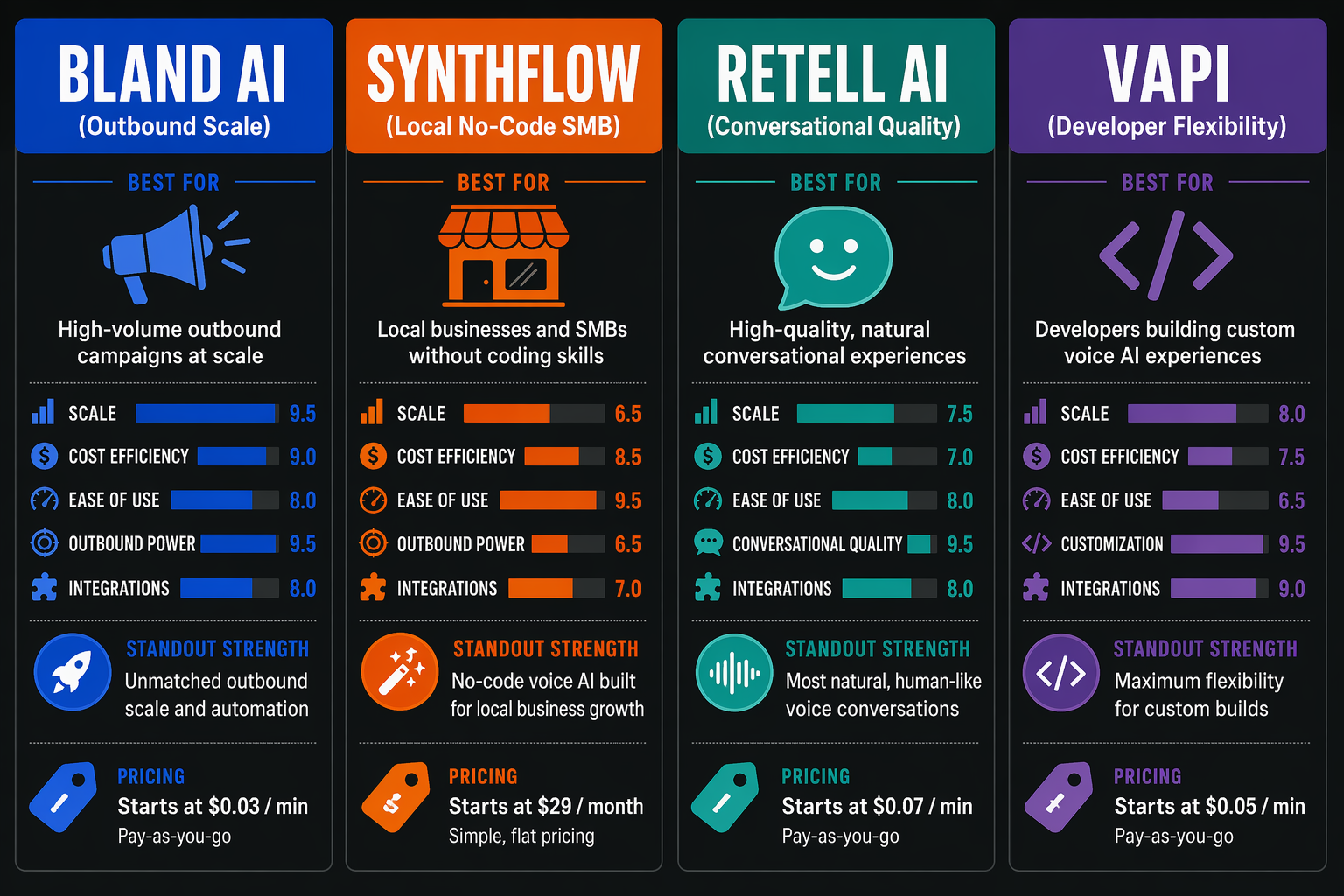
To help you cut through the marketing noise and choose the best AI voice agent solutions for business phone systems, we have boiled down the decision matrix into definitive, practical recommendations.
Choose your platform based on your primary business objectives:
- Bland AI: Best for enterprise-grade outbound cold calling and massive lead generation campaigns that require executing thousands of concurrent automated calls.
- Synthflow: Best for agency owners and small businesses looking for a complete no-code voice agent builder with pre-built CRM integrations and straightforward SaaS pricing starting at $29/month.
- Retell AI: Best for organizations demanding the absolute fastest, most natural conversational fluidity, leading the industry with ultra-low latency of 400–700ms.
- Vapi: Best for developer-first teams requiring granular control over their voice stack, offering a flexible pay-as-you-go API that easily integrates with external LLMs and custom telephony networks.
- Hybrid Operations: For enterprises seeking a unified communication layer, platforms like CallMissed bridge these ecosystems by offering access to over 300+ LLMs alongside built-in speech-to-text (STT) for 22 regional Indian languages.
Ultimately, your choice depends on whether your priority is raw speed (Retell AI), effortless setup (Synthflow), high-volume outbound campaigns (Bland AI), or total customizability (Vapi).
Feature Comparison (TABLE)
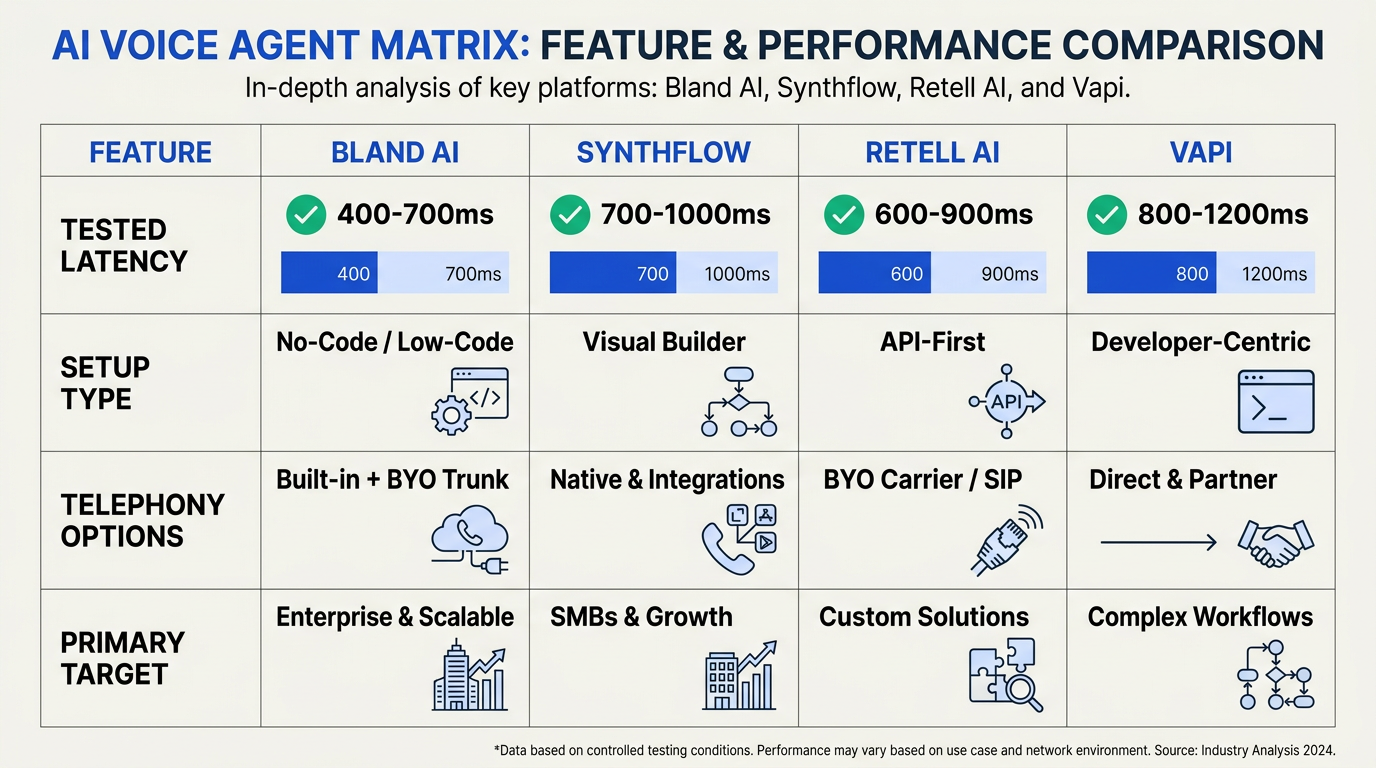
To help you identify the best AI phone agent for your business phone systems, we have compiled a direct technical and operational breakdown of the leading platforms.
| Platform | Latency Benchmark | Primary Pricing Model | Target User | Key Strength |
|---|---|---|---|---|
| Retell AI | 400–700ms | Pay-as-you-go API ($0.15/min) | Developers | Ultra-low latency & conversational control |
| Bland AI | 600–900ms | SaaS + Usage ($0.09/min base) | Enterprises | High-volume outbound campaigns |
| Synthflow | 700–1000ms | Subscription plans (from $29/mo) | Non-technical / SMBs | Visual no-code drag-and-drop builder |
| Vapi | 800–1200ms | Pay-as-you-go API ($0.15/min) | Developers | Multi-provider LLM & TTS flexibility |
Key Feature Takeaways
- Retell AI: Best-in-class for real-time responsiveness. It uses a proprietary WebRTC stack to achieve a 400–700ms latency, making it the most natural AI receptionist software for high-touch customer support.
- Bland AI: The ultimate engine for outbound calling campaigns. It is built to execute millions of concurrent automated phone calls, featuring robust API pathways for deep CRM syncing.
- Synthflow: The ideal zero-code AI calling agent platform. Its intuitive interface allows non-technical business owners to deploy a fully functional AI phone answering system in minutes without writing a single line of code.
- Vapi: A highly customizable, developer-first orchestrator. It allows you to mix and match LLM providers (OpenAI, Anthropic) and TTS engines (ElevenLabs, Deepgram) to construct highly tailored voice workflows.
- CallMissed: For businesses needing native multilingual support, CallMissed bridges the gap by offering a multi-model API gateway supporting 22 Indian regional languages alongside its production-ready voice agent infrastructure.
Pricing & Value (TABLE)
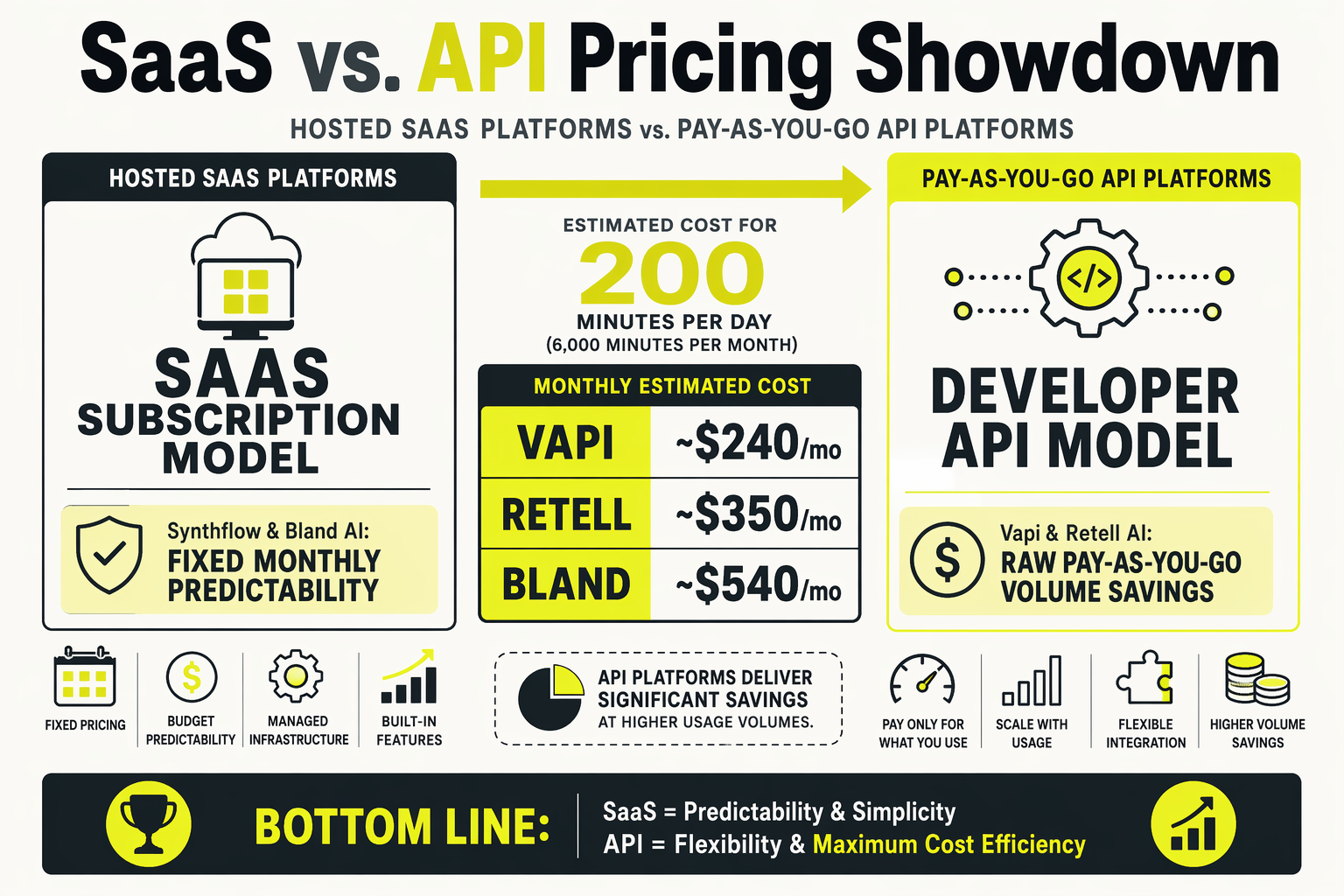
Evaluating the financial viability of an AI calling agent platform requires looking past the surface per-minute rates to analyze platform fees, hidden telecom surcharges, and commitments.
| Platform | Starting Price / Plan | Base Cost Per Minute | Key Pricing Feature | Target Audience |
|---|---|---|---|---|
| Vapi | Pay-as-you-go ($0/mo) | $0.15 / min | Bring Your Own Keys (BYOK) for TTS/LLM | Developers & Startups |
| Retell AI | Pay-as-you-go ($0/mo) | $0.15 / min | Dedicated low-latency infrastructure | Mid-Market & Enterprise |
| Bland AI | $19.99/mo (Subscription) | $0.09 - $0.15 / min | Low rates for massive outbound volume | Enterprise Outbound |
| Synthflow | $29/mo (Subscription) | $0.13 - $0.20 / min | Bundled minutes with no-code builder | SMBs & Agencies |
Key Pricing & Value Takeaways
- Vapi: Offers a developer-first, pure utility model with a flat $0.15 per minute platform fee, allowing you to plug in your own cheap LLM and TTS keys to keep overall costs exceptionally low.
- Retell AI: Matches Vapi's $0.15 per minute base rate but offers premium volume discounts for enterprises requiring guaranteed low-latency trunking and dedicated computing instances.
- Bland AI: Requires a monthly subscription starting at $19.99, but slashes per-minute rates down to $0.09 for high-volume enterprise outbound campaigns, making it the most cost-effective for mass cold-calling.
- Synthflow: Focuses on SaaS-style tiers starting at $29/month with bundled minutes; while per-minute costs are higher (up to $0.20), it provides the best out-of-the-box value for non-technical users who need an all-in-one AI receptionist software.
- The CallMissed Advantage: For businesses seeking to optimize their bottom line, infrastructure platforms like CallMissed offer a powerful alternative, letting teams deploy highly customizable voice agents across 22 regional Indian languages with transparent, multi-model pricing that avoids expensive SaaS lock-ins.
Pros and Cons (TABLE)
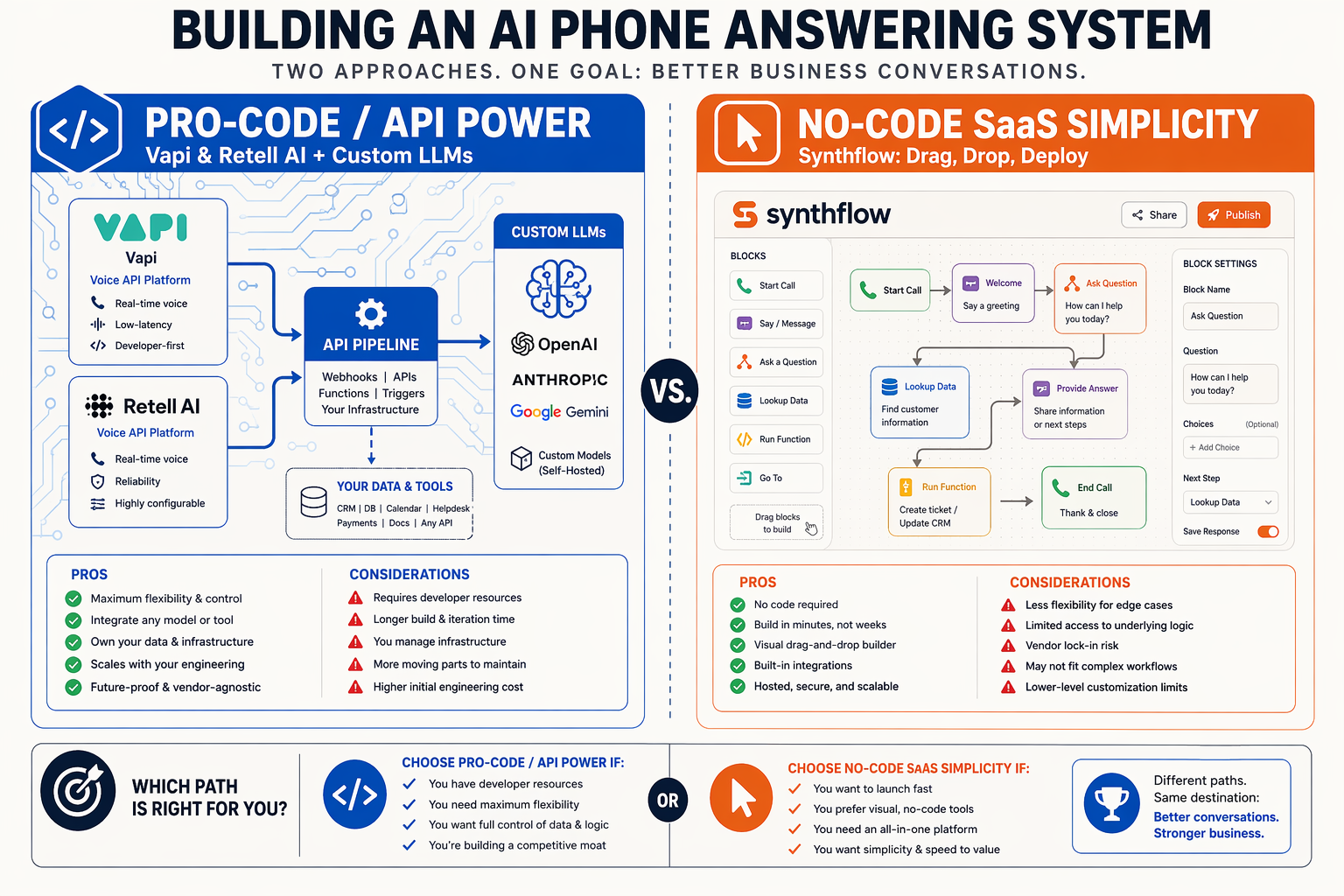
To make an informed choice, businesses must weigh the trade-offs of each platform. The best AI voice agent solutions for business phone systems vary significantly based on whether you prioritize developer control, outbound call volume, or no-code setup.
| Platform | Primary Strengths | Major Limitations | Pricing Model | Best For |
|---|---|---|---|---|
| Bland AI | Unmatched scale, custom pathway builder, robust enterprise outbound capability | Steeper developer learning curve, higher upfront setup complexity | Paid subscription tiers + usage fees | Enterprises running massive outbound call campaigns |
| Synthflow | Visual drag-and-drop workflow builder, fast setup, zero coding required | Higher cost-per-minute on lower tiers, restricted custom API integrations | Monthly subscription with bundled minutes | Non-technical agencies, SMBs, and local service providers |
| Retell AI | Ultra-low latency (400-700ms), advanced state tracking, incredibly natural voices | Requires software engineering resources to maximize its API potential | Pay-as-you-go developer API ($0.15/min base + LLM/TTS) | Inbound customer support and high-performance AI receptionists |
| Vapi | High developer flexibility, multi-provider interoperability, open system architecture | Requires external SIP/telephony configurations, slightly higher average latency | Pay-as-you-go developer API ($0.15/min base + third-party costs) | Tech-forward developers wanting complete control over their tech stack |
Strategic Trade-Offs at a Glance
- Bland AI: Pros: Best-in-class for handling millions of concurrent calls, enterprise-grade compliance, and programmatic routing. Cons: Complex implementation process compared to drag-and-drop competitors.
- Synthflow: Pros: Easiest no-code voice agent builder for quick deployments, seamless local CRM sync, and rapid template setups. Cons: Rigid pricing models make it highly expensive for large-scale enterprise rollouts.
- Retell AI: Pros: The market leader in raw conversational speed with sub-700ms response times, minimizing awkward call overlaps. Cons: Lacks a native, end-to-end visual flow builder for non-technical users.
- Vapi: Pros: Complete freedom to swap LLMs, speech-to-text, and TTS engines instantly to customize costs and features. Cons: Latency can fluctuate depending on your chosen third-party integrations (ranging up to 1200ms).
For businesses seeking a balanced approach—especially those operating globally or in multilingual markets—infrastructure alternatives like CallMissed offer unified multi-model gateways. Platforms such as CallMissed complement these engines by offering native support for 22 regional Indian languages and a library of 300+ LLMs, helping businesses deploy high-performance AI phone answering systems without getting locked into a single voice provider's ecosystem.
Which Should You Choose?
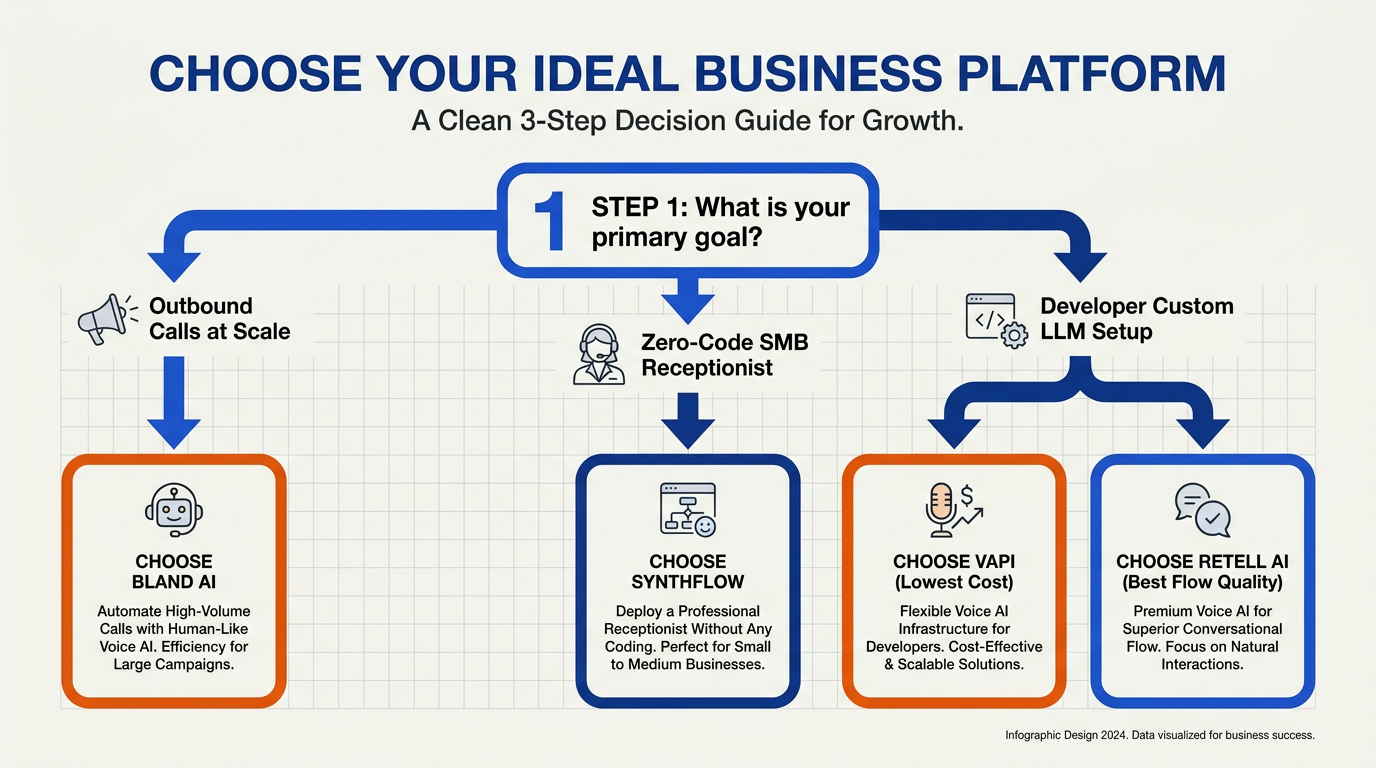
Choosing the right AI calling agent platform depends entirely on your team's technical expertise, call volume, and business goals.
Best For Outbound Scale: Bland AI
- Bland AI: The ideal choice if your primary goal is launching hyper-scale, high-volume outbound campaigns with up to millions of concurrent automated phone calls.
- Bland AI: Best suited for businesses comfortable with a SaaS-style subscription model with bundled minutes rather than pay-as-you-go pricing.
- Bland AI: Delivers strong enterprise compliance and custom tooling, though it sits at a slightly higher latency tier (600–900ms) compared to developer-first alternatives.
Best For Advanced Developers: Retell AI & Vapi
- Retell AI: The gold standard for real-time responsiveness, boasting a industry-leading latency of 400–700ms for natural, interruption-tolerant conversations.
- Retell AI: Offers deep voice customizability and seamless integration with leading LLMs and advanced TTS systems via its developer-first API.
- Vapi: Provides a highly flexible, pay-as-you-go developer API with 800–1200ms latency, making it the most cost-effective sandbox for building custom VoIP architectures from scratch.
- Vapi: Extremely customizable for engineering teams who want complete control over their LLM backends and telephony routing without paying subscription premiums.
Best For No-Code Deployment: Synthflow
- Synthflow: The best no-code voice agent builder on the market, allowing non-technical teams to deploy a functional AI receptionist software in minutes.
- Synthflow: Employs an intuitive drag-and-drop workflow that simplifies CRM integrations and local lead routing with respectable 700–1000ms latency.
- Synthflow: Perfect for small businesses and solopreneurs looking for predictable, tiered monthly subscription pricing rather than complex API billing.
For businesses seeking a unified approach, infrastructure platforms like CallMissed offer the best of both worlds by providing production-ready voice agent infrastructure alongside a multi-model API gateway, allowing you to deploy multilingual agents supporting 22 regional Indian languages natively.
Frequently Asked Questions
Here are some of the most frequently asked questions about deploying the best AI voice agent solutions for business phone systems in 2026:
Which AI calling agent platform has the lowest latency in 2026?
Can I build an AI phone agent for business tasks without writing any code?
How do pricing structures differ between an API platform and a SaaS-based AI calling agent platform?
Which AI receptionist software is best for high-volume outbound calling campaigns?
Do these AI voice platforms support multiple languages for global businesses?
Do I need to buy a separate phone number to use an AI receptionist?
Conclusion
Selecting the best AI voice agent solution for your business phone system ultimately depends on your technical resources and scaling goals:
- For developer-first customization and ultra-low latency: Retell AI and Vapi offer the most flexible, pay-as-you-go APIs.
- For rapid, no-code deployment: Synthflow provides an intuitive, visual drag-and-drop builder.
- For high-volume outbound campaigns: Bland AI delivers the infrastructure needed to scale millions of concurrent automated calls.
As sub-second AI receptionists become the standard, the future lies in unified, multi-model communication. To explore how AI communication is evolving, check out CallMissed — an AI infrastructure platform powering voice agents and multilingual chatbots for businesses. Ready to transition your business phone systems to the next generation of voice AI?
Related Reading
Related Posts



Ready to automate customer conversations?
Launch AI voice agents and WhatsApp bots with CallMissed — one API, 22+ Indian languages.