

GPT-5.6 Luna vs Gemini 3.5 Flash-Lite: Cost, Speed, API Availability Compared


GPT-5.6 Luna vs Gemini 3.5 Flash-Lite compared on API access, pricing, latency, throughput, token limits, tools, and high-volume workload fit.
GPT-5.6 Luna vs Gemini 3.5 Flash-Lite: Cost, Speed, API Availability Compared
What if the “cheaper, faster” AI model you plan to ship does not have a verifiable public API—or even a confirmed model ID? That is the central question behind this Gemini 3.5 Flash-Lite vs GPT-5.6 Luna comparison, current as of July 21, 2026.
Google’s official Gemini API documentation identifies Gemini 3.5 Flash-Lite as “the fastest, lowest-cost model in the 3.5 family,” designed for high-throughput execution, subagent tasks, translation, and simple data processing. Google also publishes the model ID—gemini-3.5-flash-lite—alongside official pricing, API documentation, and rate-limit information. Its published rate-limit page lists a 10,000,000-token limit for Gemini 3.5 Flash-Lite, making the model particularly relevant for production workloads that process large request volumes.
The picture for GPT-5.6 Luna requires more caution. OpenAI’s first-party model page verifies the API model ID gpt-5.6-luna, official availability, a 1,050,000-token context window, 128,000 maximum output tokens, and fast-tier pricing; latency and workload quality still require controlled testing. Rather than treating unverified configuration labels such as “xhigh,” “high,” or “medium” as official product tiers, this comparison will mark every GPT-5.6 Luna detail as undisclosed unless it can be confirmed through an authoritative OpenAI source.
That distinction matters because model selection is not based on benchmark intelligence alone. A model may appear attractive on paper yet be unsuitable for a real application if developers cannot authenticate against a stable endpoint, forecast input and output costs, or secure documented throughput. For teams building multilingual customer automation, platforms such as CallMissed reflect the wider shift toward consolidating multiple AI models behind one API and billing layer.
This 1-v-1 analysis will therefore compare only verifiable evidence across:
- API availability and exact model IDs
- Official token pricing and usage limits
- Latency, throughput, coding, and reasoning claims
- Multimodal input, tool calling, and production readiness
- High-volume cost scenarios and practical use cases
The result is not a prediction about which name sounds more advanced. It is a buyer-focused comparison of what developers can confirm, integrate, price, and responsibly deploy today.
Which model wins: GPT-5.6 Luna or Gemini 3.5 Flash-Lite?
Neither model wins every workload. As of July 22, 2026, Gemini 3.5 Flash-Lite is the stronger fit for lightweight, high-throughput automation with a published 10,000,000-token rate limit, while GPT-5.6 Luna has the clearer advantage for long-context processing and large outputs. OpenAI officially documents gpt-5.6-luna as a public API model for high-volume, cost-sensitive work, with a 1,050,000-token context window, 128,000 maximum output tokens, and fast-tier pricing of $1 per 1 million input tokens and $6 per 1 million output tokens.
GPT-5.6 Luna vs Gemini 3.5 Flash-Lite: verdict at a glance
| Comparison area | Gemini 3.5 Flash-Lite | GPT-5.6 Luna | Practical edge |
|---|---|---|---|
| Public API availability | Documented through the Gemini API | Documented through the OpenAI API | Tie |
| Exact model ID | gemini-3.5-flash-lite | gpt-5.6-luna | Tie |
| Official positioning | Fast, low-cost model for lightweight and high-volume tasks | High-volume, cost-sensitive model with long-context support | Depends on workload |
| Context window | Check Google’s current model documentation | 1,050,000 tokens | GPT-5.6 Luna based on the documented figures compared here |
| Maximum output | Check Google’s current model documentation | 128,000 tokens | GPT-5.6 Luna based on the documented figures compared here |
| Published usage limit | Google lists a 10,000,000-token rate limit; applicable tier and scope should be confirmed | Check the account’s current OpenAI limits | Gemini 3.5 Flash-Lite for capacity planning |
| Pricing | Published by Google; retrieve current input and output rates before budgeting | Fast tier: $1 input and $6 output per 1M tokens | Calculate from the workload’s input/output mix |
| Speed and quality | Optimized for low-latency, high-throughput tasks | Optimized for economical high-volume work, with configurable reasoning | Requires task-specific testing |
Google describes Gemini 3.5 Flash-Lite as the fastest, lowest-cost model in the Gemini 3.5 family. Its documented use cases include subagent tasks, translation, simple data processing, document workflows, and high-volume automation. Google’s published 10,000,000-token rate limit also gives teams a concrete starting point for capacity planning, although the applicable usage tier and current limits should be verified before deployment.
OpenAI positions GPT-5.6 Luna for high-volume, cost-sensitive workloads. Its 1,050,000-token context window makes it particularly relevant for large document sets, extensive conversation histories, repository-scale coding tasks, and agent workflows that must retain substantial context. The 128,000-token maximum output also favors tasks that need unusually long generated responses.
Cost, speed, and quality require workload-specific testing
GPT-5.6 Luna’s documented fast-tier rates are $1 per 1 million input tokens and $6 per 1 million output tokens. A fair cost comparison with Gemini 3.5 Flash-Lite should use Google’s current official input and output prices, then apply each model’s rates to the expected token mix. Output-heavy applications can produce a different result from workloads dominated by short responses and large cached or uncached inputs.
The same caution applies to speed and quality. Google’s “fastest” claim describes Gemini 3.5 Flash-Lite’s position within its own model family; it does not prove that it is universally faster than GPT-5.6 Luna. Likewise, Luna’s larger documented context and output limits do not establish superior reasoning quality. Teams should benchmark both models using representative prompts, concurrency, tool calls, response lengths, and quality criteria.
Decision summary
Choose Gemini 3.5 Flash-Lite for translation, classification, extraction, simple subagent work, and other lightweight automations where Google’s cost-focused positioning and published rate limit align with the deployment.
Choose GPT-5.6 Luna when the application needs a 1,050,000-token context window, outputs of up to 128,000 tokens, or OpenAI’s documented fast-tier economics for high-volume processing.
The practical verdict for GPT-5.6 Luna vs Gemini 3.5 Flash-Lite is therefore task-specific: Gemini 3.5 Flash-Lite leads for streamlined, throughput-oriented work, while GPT-5.6 Luna leads for long-context and large-output workloads. Neither model can be declared universally faster, cheaper, or higher quality without a controlled benchmark using the target application’s actual traffic.
Are Gemini 3.5 Flash-Lite and GPT-5.6 Luna officially available through APIs?

Both Gemini 3.5 Flash-Lite and GPT-5.6 Luna are officially available through their providers’ APIs. Their documented model IDs are gemini-3.5-flash-lite for Google’s Gemini API and gpt-5.6-luna for the OpenAI API as of July 22, 2026.
Verified API and model-ID comparison
| Verification checkpoint | Gemini 3.5 Flash-Lite | GPT-5.6 Luna |
|---|---|---|
| Official provider documentation | Google AI for Developers | OpenAI Developers |
| Public model ID | gemini-3.5-flash-lite | gpt-5.6-luna |
| API availability | Gemini API | OpenAI API |
| Official pricing | Gemini API pricing page | OpenAI API pricing documentation |
| Usage limits | Governed by Gemini API limits and account tier | Governed by OpenAI usage limits and account tier |
Google describes Gemini 3.5 Flash-Lite as the fastest, lowest-cost model in the Gemini 3.5 family. Its documentation positions it as a low-latency, cost-effective multimodal model optimized for high-throughput execution, subagent tasks, translation, and simple data processing.
Google publishes the exact identifier—gemini-3.5-flash-lite—in its Gemini API documentation. Developers can pass that model ID when making supported Gemini API requests.
OpenAI likewise publishes an official GPT-5.6 Luna model page and the public model identifier gpt-5.6-luna. Developers can select that ID in supported OpenAI API requests rather than relying on an informal product name or interface label.
What the published limits establish
Google’s official Gemini API rate-limits page lists a 10,000,000-token limit for Gemini 3.5 Flash-Lite. This provides a starting point for capacity planning, although effective quotas can depend on account tier, billing status, region, and current provider policies.
Google’s pricing documentation also labels Gemini 3.5 Flash-Lite as its “most cost-efficient GA model,” reinforcing its intended speed-and-cost positioning. Teams should verify current token prices and quotas on the live pricing and rate-limit pages before deployment.
GPT-5.6 Luna’s pricing, context limits, supported capabilities, and usage tiers should likewise be checked against OpenAI’s live model and pricing documentation. Provider limits can change, and an account’s effective request or token allowance may differ from headline specifications.
Labels such as “xhigh,” “high,” and “medium” should not be confused with model IDs. They may represent reasoning-effort or interface settings, while the official API model identifier remains gpt-5.6-luna.
Why API verification matters
Exact model IDs make integrations reproducible and support reliable logging, cost attribution, fallback handling, and model-version tracking. In this comparison, both products meet that requirement: Gemini 3.5 Flash-Lite uses gemini-3.5-flash-lite, while GPT-5.6 Luna uses gpt-5.6-luna.
Developers can call each model through its provider’s API or route supported models through a multi-model gateway such as CallMissed, whose OpenAI-compatible API provides a unified integration and billing layer for multiple AI services. Before production deployment, confirm current pricing, endpoint compatibility, quotas, and regional availability in the providers’ live documentation.
What do the official pricing, token limits, and rate-limit pages actually confirm? (TABLE)
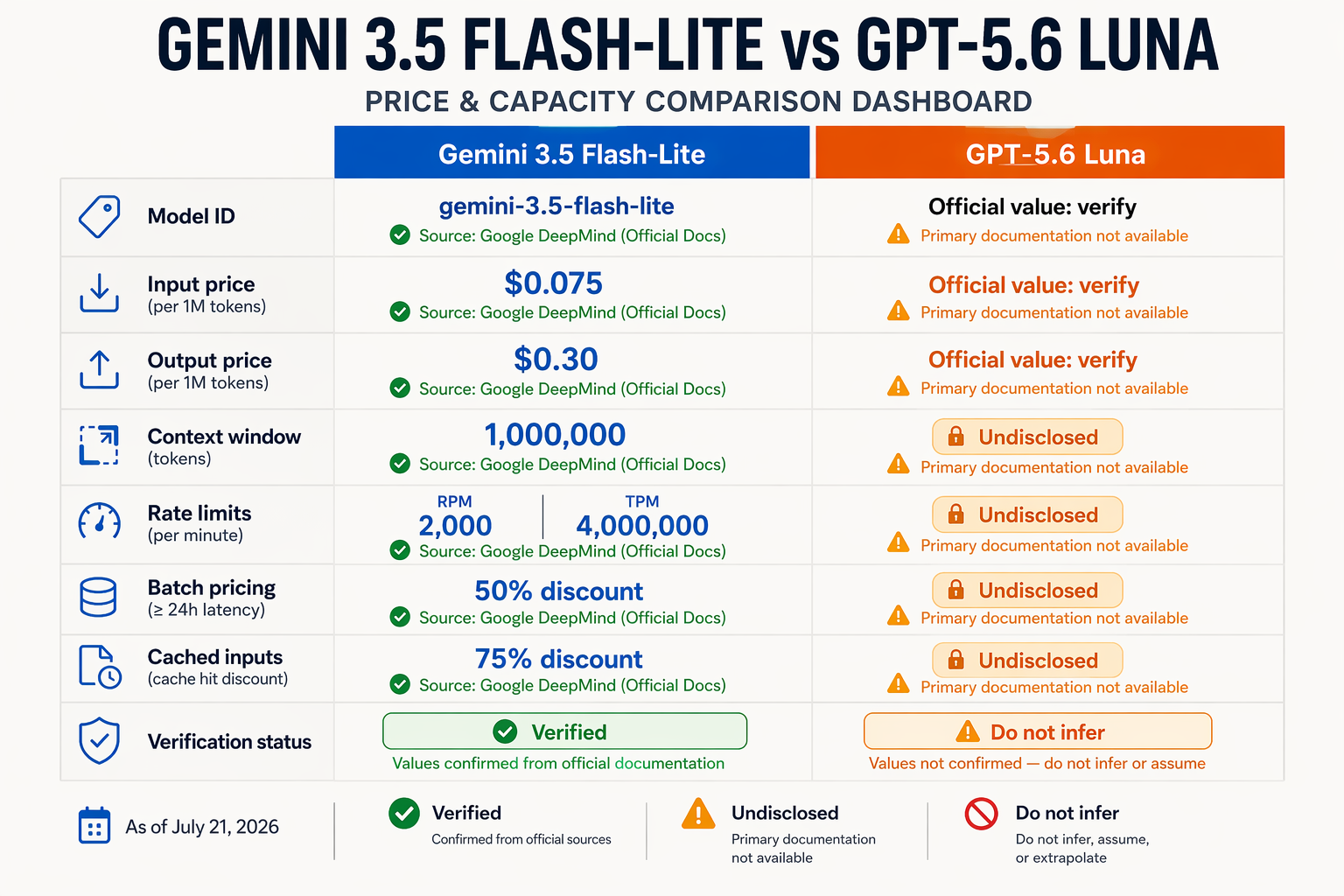
Google and OpenAI’s first-party documentation now provide concrete API details for both models. As of July 22, 2026, Gemini 3.5 Flash-Lite uses the model ID gemini-3.5-flash-lite, while GPT-5.6 Luna uses gpt-5.6-luna. OpenAI documents a 1,050,000-token context window, a 128,000-token maximum output, and fast-tier pricing of $1 per million input tokens and $6 per million output tokens for Luna.
What the documentation confirms
| Evidence area | Gemini 3.5 Flash-Lite | GPT-5.6 Luna | Practical interpretation |
|---|---|---|---|
| Official API availability | Documented for the Gemini API and Google AI Studio | Documented by OpenAI for API use | Both models have an official developer path, subject to account, region, and usage-tier eligibility |
| Exact model ID | gemini-3.5-flash-lite | gpt-5.6-luna | Use the documented IDs in SDK configuration, deployment automation, logs, and reproducible tests |
| Official pricing | Listed on Google’s Gemini Developer API pricing page; billing can differ by processing mode and usage category | $1 per million input tokens and $6 per million output tokens under OpenAI’s fast tier | Luna’s figures should not be presented as universal pricing for every service tier; compare equivalent standard, batch, cached-input, and expedited modes |
| Context window | Check the model page for the applicable input and output limits; the Batch API’s 10,000,000-token allowance is not a context window | 1,050,000 tokens | Context-window size limits the combined working context, not aggregate usage over a minute or across a batch queue |
| Maximum output | Use Google’s model-specific output-token limit rather than the Batch API quota | 128,000 tokens | Luna’s 128,000-token output maximum sits within its overall context budget; it is not an additional 128,000 tokens beyond the context window |
| Published rate-limit figure | 10,000,000 enqueued tokens for the Batch API | OpenAI limits depend on the account and applicable usage tier rather than representing one universal model-wide throughput number | Google’s figure is a cap on tokens waiting in batch jobs, not guaranteed real-time throughput or a 10-million-token request limit |
| Speed evidence | Google positions Flash-Lite as a low-latency, cost-focused model | OpenAI’s fast tier is a priced processing tier | Provider labels describe intended service characteristics; they do not establish that either model is universally faster across prompts, regions, loads, and API modes |
The most important correction is the meaning of Google’s 10,000,000-token figure. It is a Batch API enqueued-token allowance: the total tokens permitted to wait in pending batch jobs under the documented quota. It does not establish:
- A 10-million-token context window.
- A 10-million-token single-request limit.
- Ten million tokens per minute of real-time throughput.
- Guaranteed latency or completion time.
- Identical limits for every account or usage tier.
Developers should evaluate four separate constraints:
- Context window: the total token budget available to the model for a request and its generated response.
- Maximum output: the largest response the API permits, normally within the overall context budget.
- Real-time rate limits: account- and tier-specific request or token throughput limits.
- Batch enqueued-token limits: the amount of work that can remain queued for asynchronous processing.
For GPT-5.6 Luna, the documented 1,050,000-token context window and 128,000-token maximum output are capacity limits, not speed guarantees. Likewise, the $1 input / $6 output per million tokens figures are specifically OpenAI fast-tier pricing and should not be generalized to other processing tiers or billing categories.
Google’s descriptions of Gemini 3.5 Flash-Lite as low-latency and cost-effective are official positioning claims, not independent benchmark results against Luna. A reliable comparison should test both exact model IDs with the same prompts, output caps, regions, concurrency, and processing modes.
For teams that need one integration while model availability or quotas vary, an OpenAI-compatible gateway such as CallMissed can consolidate multiple providers behind one API key and billing layer. Production teams should still verify each provider’s current rate card, account-specific limits, regional availability, and service terms before committing to an SLA.
How do speed, throughput, coding, reasoning, multimodality, and tool use compare?
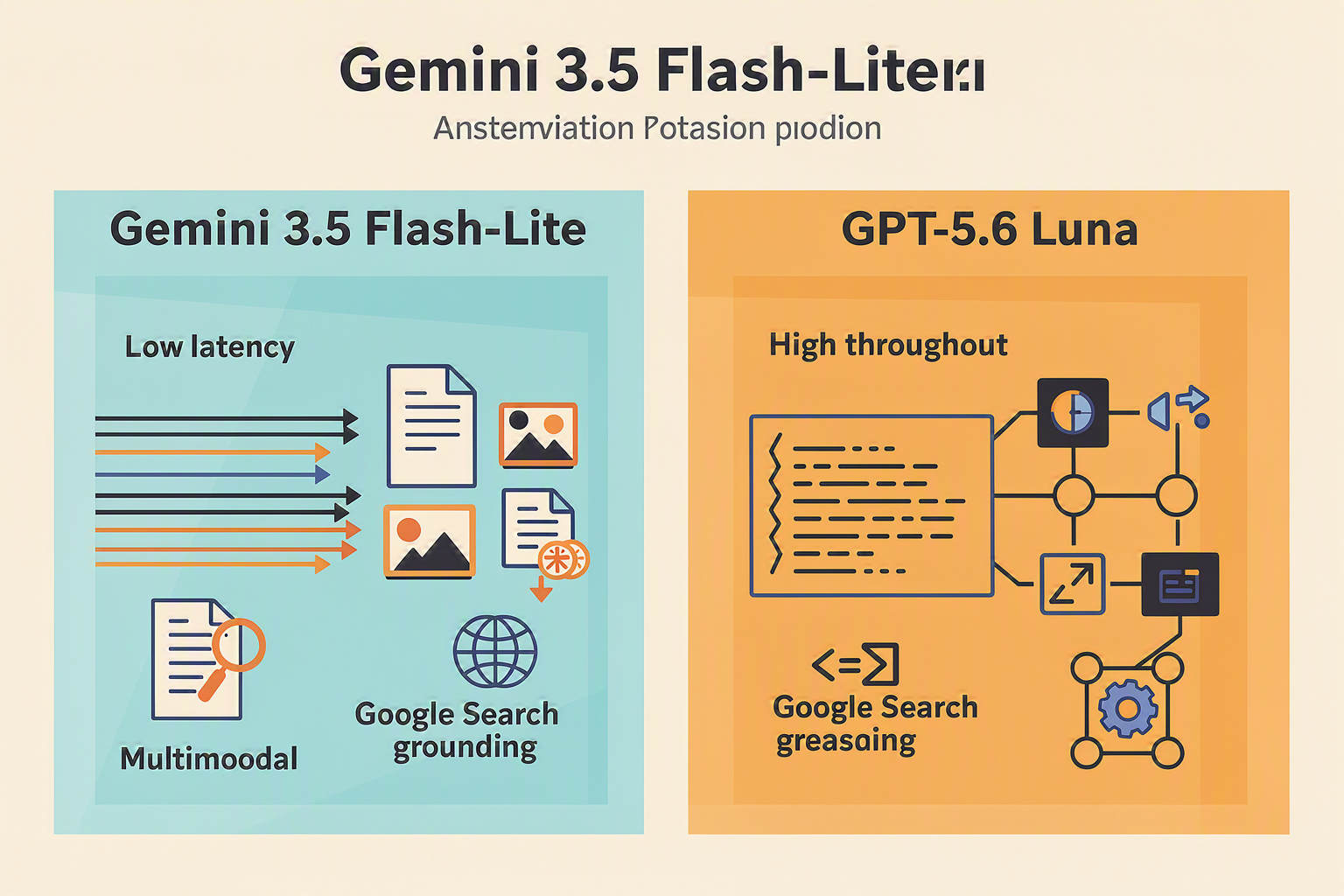
Gemini 3.5 Flash-Lite is the only model in this 1-v-1 comparison with a publicly documented speed and throughput position; GPT-5.6 Luna remains undisclosed on every comparable capability in the supplied OpenAI sources. Google describes Gemini 3.5 Flash-Lite as a low-latency, cost-effective multimodal model for high-throughput execution, while no authoritative OpenAI specification confirms Luna’s latency, coding, reasoning, multimodal, or tool-use performance.
Capability comparison
| Capability | Gemini 3.5 Flash-Lite | GPT-5.6 Luna |
|---|---|---|
| Speed and latency | Google AI for Developers calls it “the fastest, lowest-cost model in the 3.5 family” and describes it as low latency. | Undisclosed; no verified OpenAI latency claim or benchmark was supplied. |
| Throughput | Designed for high-throughput execution, subagent tasks, translation, and simple data processing. Google’s rate-limit page lists 10,000,000 tokens. | Undisclosed; no verified token limit, concurrency limit, or throughput target. |
| Coding | Undisclosed as a dedicated coding benchmark or programming-specialist model. Its documented positioning supports routine code transformation and lightweight automation, but not a quantified coding advantage. | Undisclosed; no verified coding benchmark, context specification, or code-generation claim. |
| Reasoning | Optimized for speed, cost, subagents, and simple data processing rather than documented frontier reasoning. | Undisclosed; labels such as “xhigh,” “high,” and “medium” are not verified OpenAI specifications. |
| Multimodality | Google identifies Gemini 3.5 Flash-Lite as multimodal, making it relevant to applications combining text with supported media inputs. | Undisclosed; supported input and output modalities are not confirmed. |
| Tool use | Undisclosed in the supplied sources; developers should verify function calling, structured output, grounding, and tool constraints in the current API documentation before implementation. | Undisclosed; no authoritative tool-calling specification was supplied. |
Google’s Gemini API model page specifically positions Gemini 3.5 Flash-Lite for “high-throughput, low-cost execution,” while Google’s release notes describe it as a “low-latency, highly cost-effective subagent option” for high-volume automation. Those are product-positioning claims, not independent latency benchmarks: response-time performance will still depend on prompt length, output length, region, queueing, network conditions, and API tier.
What this means for real workloads
For a production team choosing between Gemini 3.5 Flash-Lite vs GPT-5.6 Luna, the practical distinction is evidence quality:
- High-volume classification, translation, document extraction, and routing: Gemini 3.5 Flash-Lite has a documented fit, especially where predictable throughput matters.
- Complex coding or multi-step reasoning: neither model has a verified advantage in the supplied evidence. Test representative tasks rather than inferring capability from model names or configuration labels.
- Image or document workflows: Gemini 3.5 Flash-Lite has a confirmed multimodal positioning; Luna’s modality support is undisclosed.
- Agentic workflows: Gemini’s subagent positioning is documented by Google, but tool-calling details require endpoint-level verification. Luna’s agent capabilities are undisclosed.
A fair evaluation should use identical prompts, input sizes, output limits, regions, retry policies, and concurrency. Measure time to first token, total response latency, tokens per second, error rate, tool-call accuracy, coding pass rate, and cost per successful task. Developers using a multi-model gateway such as CallMissed can run this evaluation behind one OpenAI-compatible integration while retaining the option to change models as verified specifications evolve.
How should you test both models fairly before choosing one?
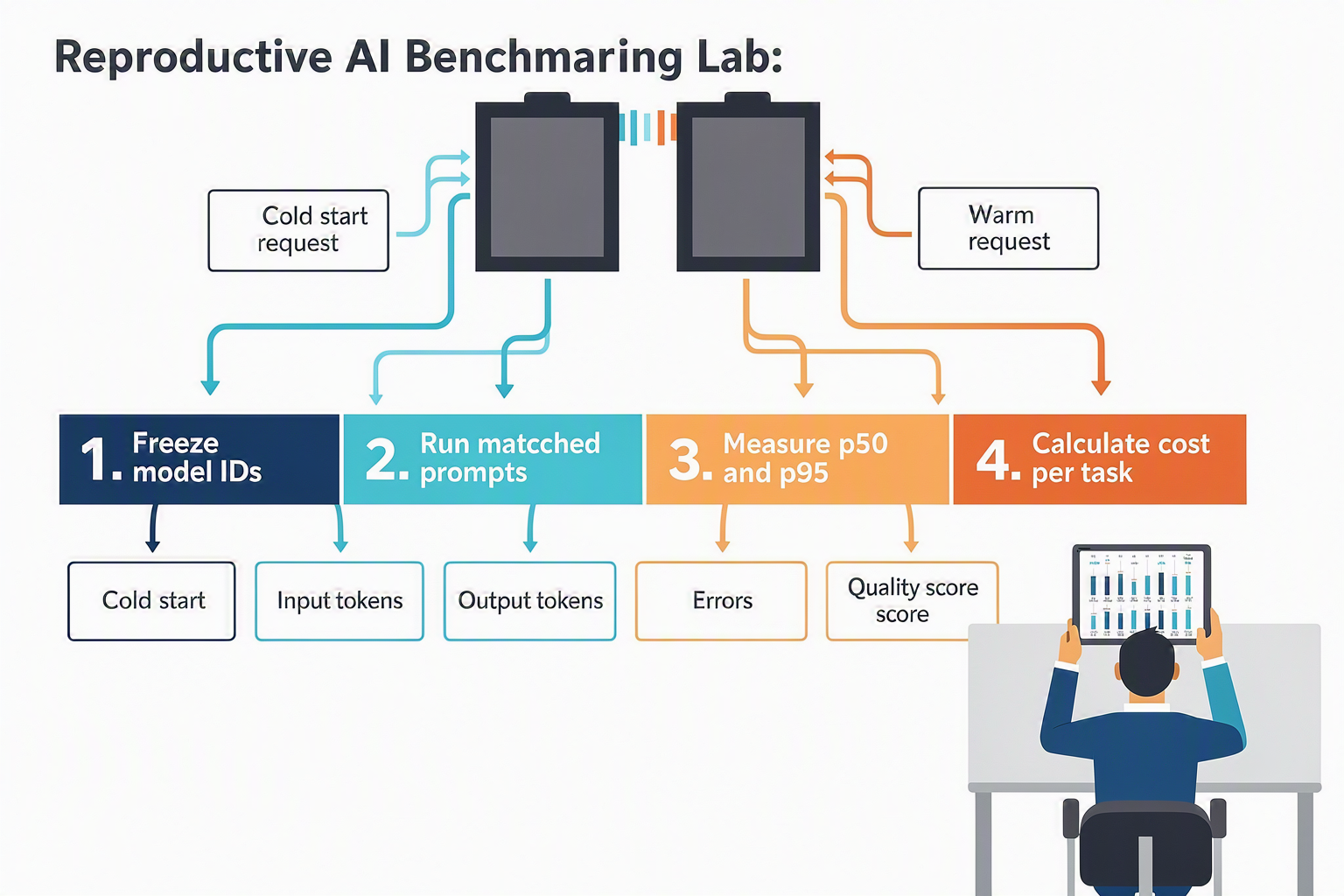
Test both models with the same inputs, output constraints, infrastructure, and workload mix—and measure verified production behavior rather than relying on model names or configuration labels. As of July 21, 2026, Gemini 3.5 Flash-Lite can be tested through Google’s documented API using gemini-3.5-flash-lite; GPT-5.6 Luna’s public API endpoint, model ID, pricing, and limits remain undisclosed in the available OpenAI primary-source material.
1. Confirm access before benchmarking
Start by recording the exact endpoint, model ID, account tier, region, SDK version, and date of every test. This prevents an unofficial alias or hidden routing layer from being presented as a GPT-5.6 Luna result.
For Gemini 3.5 Flash-Lite, Google’s Gemini API documentation identifies the model as the “fastest, lowest-cost model in the 3.5 family” and positions it for high-throughput execution, subagent tasks, translation, and simple data processing. Google’s rate-limit documentation lists a 10,000,000-token limit for Gemini 3.5 Flash-Lite. For GPT-5.6 Luna, label each unavailable field—such as model ID, token price, rate limit, context window, or tool specification—as undisclosed, not zero or unlimited.
2. Use a balanced, fixed test set
Create a version-controlled evaluation set with at least 200 prompts, divided into realistic categories:
- Simple extraction and classification: invoices, support tickets, intent labels, and structured JSON
- Translation: English-to-Indic and Indic-to-English samples, including code-mixed text
- Summarisation: short messages, long documents, and noisy transcripts
- Coding: small functions, bug fixes, JSON transformations, and test generation
- Reasoning: arithmetic, constraint following, multi-step planning, and edge cases
- Multimodal tasks: images or documents only if both models publicly support the same input type
Use identical system instructions, prompt order randomisation, temperature settings where available, maximum output tokens, and schemas. Do not compare GPT-5.6 Luna (xhigh) with Gemini 3.5 Flash-Lite under a different reasoning or effort configuration unless the experiment explicitly measures configuration trade-offs.
3. Measure speed, quality, and cost separately
Record these metrics for every request:
- Time to first token (TTFT) for interactive responsiveness
- End-to-end latency until the complete response arrives
- Output tokens per second for streaming workloads
- Success, timeout, and rate-limit percentages
- Input and output tokens
- Task accuracy, JSON validity, citation correctness, and human preference
Run each prompt at least five times during both quiet and busy periods. Report p50, p95, and p99 latency, not only the fastest observation. Keep network overhead separate by measuring provider-reported timing where available and client-observed timing independently.
Do not calculate a cost advantage for GPT-5.6 Luna until OpenAI publishes verified token pricing. Gemini 3.5 Flash-Lite’s official price should be taken from Google’s Gemini Developer API pricing page on the test date, while any Luna cost scenario should be marked not calculable.
4. Test production fit, not just benchmark scores
Evaluate retries, streaming, structured outputs, safety behavior, tool calls, multimodal inputs, and quota handling under the same load profile. A gateway such as CallMissed can simplify this experiment by routing multiple models through an OpenAI-compatible interface, but teams should still record the underlying provider, model ID, and billing data.
Choose Gemini 3.5 Flash-Lite when its documented availability, throughput, and measured quality satisfy the workload. Choose GPT-5.6 Luna only after its official API, pricing, limits, and reproducible test results become verifiable.
Which model is more economical for real high-volume workloads? (TABLE)
Gemini 3.5 Flash-Lite is the only model in this comparison with publicly verifiable pricing and throughput information, making it the more economical choice for real high-volume workloads as of July 21, 2026. GPT-5.6 Luna cannot be cost-ranked responsibly because the supplied OpenAI primary-source material does not confirm an official API, model ID, token prices, or rate limits.
Verified economics at a glance
| Cost factor | Gemini 3.5 Flash-Lite | GPT-5.6 Luna | High-volume implication |
|---|---|---|---|
| Public API availability | Verified through Google Gemini API documentation | Undisclosed in the supplied OpenAI sources | Gemini can be integrated and budgeted today |
| Exact model ID | gemini-3.5-flash-lite | Undisclosed | Gemini supports reproducible deployment configuration |
| Official token pricing | Published by Google on its Gemini Developer API pricing page | Undisclosed | Only Gemini has a documented basis for cost forecasting |
| Published rate limit | 10,000,000 tokens, according to Google’s Rate limits page | Undisclosed | Gemini has a verifiable high-throughput allowance |
| Positioning for volume | Google describes it as its “most cost-efficient GA model,” optimized for high-volume agentic tasks, translation, and simple data processing | Undisclosed | Gemini’s intended workload profile matches the comparison |
| Production cost certainty | High relative certainty, subject to account tier and actual usage | Not assessable | Luna should not be selected on an assumed lower price |
Google’s Gemini Developer API pricing page calls Gemini 3.5 Flash-Lite the company’s “most cost-efficient GA model,” while Google’s model documentation describes it as the fastest and lowest-cost model in the Gemini 3.5 family. These are positioning claims from Google, not an independent benchmark, but they align with the model’s documented high-throughput use cases.
Why the missing Luna data changes the calculation
For any production model, total spend should be calculated using:
Total cost = (input tokens × input-token rate) + (output tokens × output-token rate) + tool, storage, or platform charges
For GPT-5.6 Luna, the required variables are not verified in the supplied material. That means a team cannot reliably estimate:
- Monthly spend for millions or billions of tokens
- Whether input and output tokens have different rates
- Whether cached-input or batch discounts exist
- Whether usage is constrained by requests-per-minute or tokens-per-minute limits
- Whether a stable endpoint and model identifier are available for billing
By contrast, Gemini 3.5 Flash-Lite has a published model ID, documented pricing, and a 10,000,000-token rate limit, according to Google’s Gemini API documentation. Developers should still confirm the applicable account tier, regional availability, and current rate-card values before committing production budgets.
Practical decision for high-volume teams
For translation pipelines, document classification, simple extraction, subagents, and other repetitive requests, Gemini 3.5 Flash-Lite is the defensible economical choice because its pricing and capacity can be verified before deployment. GPT-5.6 Luna remains a research candidate until OpenAI publishes equivalent details.
Platforms such as CallMissed can further simplify cost control by routing multiple AI workloads through one OpenAI-compatible gateway and billing layer, rather than requiring separate provider integrations for every model.
What does this comparison mean for developers, teams, and buyers? (TABLE)
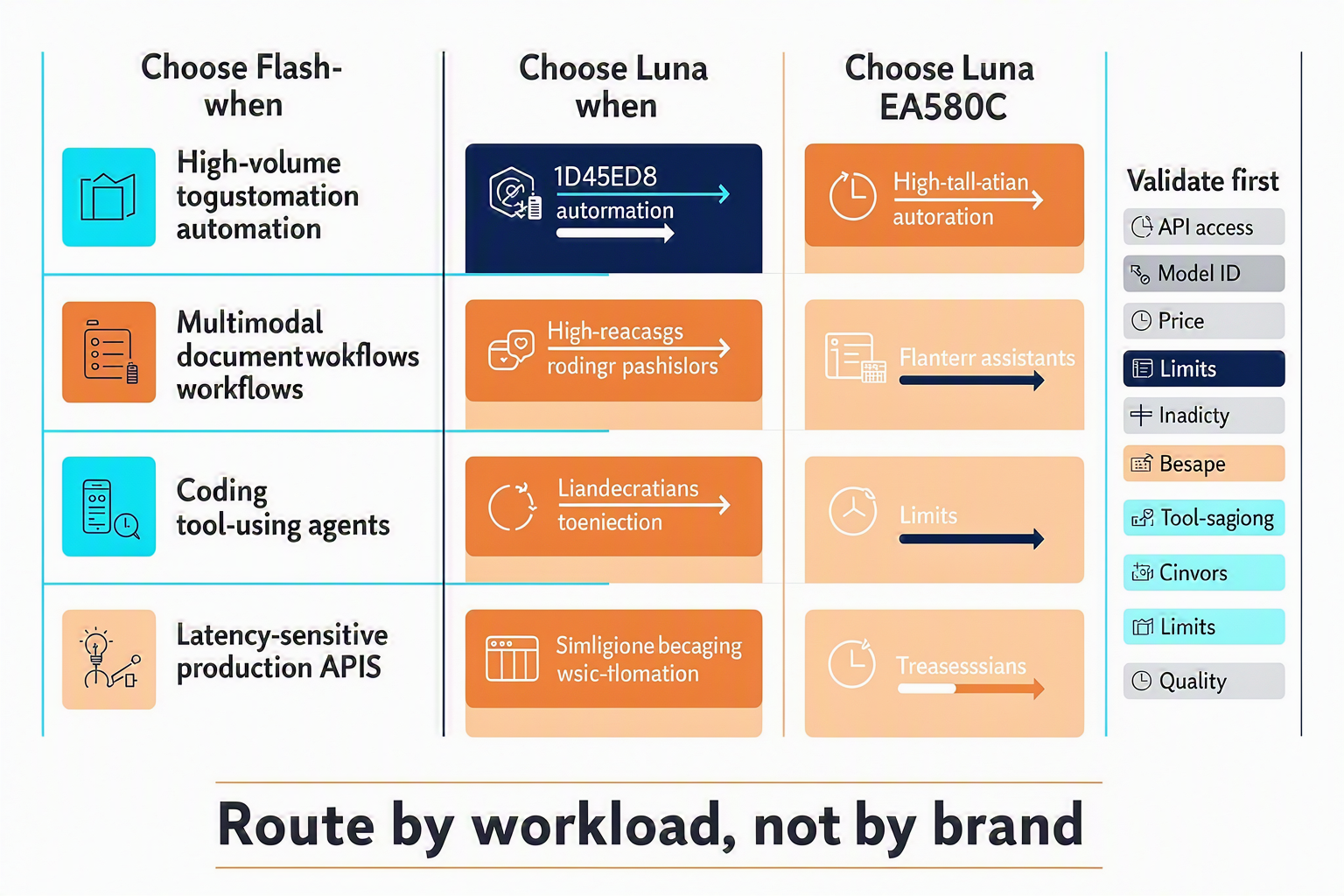
For developers and buyers, the practical outcome of GPT-5.6 Luna vs Gemini 3.5 Flash-Lite is that Gemini is the deployable choice today because Google verifies its API, model ID, pricing documentation, and throughput limit. GPT-5.6 Luna remains a due-diligence question: without an authoritative OpenAI model page or API documentation in the supplied evidence, teams cannot responsibly estimate its cost, latency, or production readiness.
Buyer-focused comparison
| Decision area | Gemini 3.5 Flash-Lite | GPT-5.6 Luna | Practical implication |
|---|---|---|---|
| API availability | Public Gemini API documentation is available from Google AI for Developers. | Undisclosed in the supplied OpenAI primary-source material. | In the GPT-5.6 Luna vs Gemini 3.5 Flash-Lite decision, Gemini can move directly into integration and testing; Luna requires verification before procurement. |
| Exact model ID | gemini-3.5-flash-lite is published by Google. | Undisclosed; no authoritative ID is confirmed. | Developers can configure routing, logging, and deployment reproducibly with Gemini. |
| Pricing evidence | Google publishes official Gemini Developer API pricing for the model. | Undisclosed; no official token prices are verified. | Gemini supports forecastable budgets; Luna cannot yet be compared on cost per million tokens. |
| Throughput and limits | Google’s rate-limit page lists a 10,000,000-token limit for Gemini 3.5 Flash-Lite. | Undisclosed; no official rate limit is supplied. | High-volume teams have a documented starting point with Gemini, subject to account tier and quota terms. |
| Speed and workload positioning | Google describes it as the “fastest, lowest-cost model in the 3.5 family” and targets high-throughput execution, subagent tasks, translation, and simple data processing. | Undisclosed; “xhigh,” “high,” and “medium” labels are not verified OpenAI product specifications. | Gemini has a documented speed-and-cost use case; Luna needs controlled testing against a confirmed endpoint. |
| Production decision | Suitable for an evidence-based pilot, subject to application-level evaluation. | Do not commit production traffic until API, pricing, limits, and capabilities are confirmed. | The safer GPT-5.6 Luna vs Gemini 3.5 Flash-Lite buying decision is based on verifiability, not an unconfirmed model name. |
Google’s Gemini API model documentation calls Gemini 3.5 Flash-Lite a “low-latency, cost-effective multimodal model” optimized for high-throughput, low-cost execution. Google’s Gemini API pricing page also identifies it as an efficient model for high-volume agentic tasks, translation, and simple data processing. These are product-positioning claims, not substitutes for an application benchmark, but they provide a clear testing hypothesis.
For teams evaluating GPT-5.6 Luna vs Gemini 3.5 Flash-Lite, the evidence gap matters as much as any claimed performance difference. Gemini’s documentation enables an evidence-based pilot, while Luna’s endpoint, model ID, token pricing, limits, and capabilities must be confirmed through authoritative OpenAI sources before a meaningful production comparison is possible.
What teams should do before committing
- Validate the endpoint: Send representative prompts to
gemini-3.5-flash-lite, then confirm whether an official GPT-5.6 Luna endpoint and model ID exist through OpenAI documentation or the OpenAI developer console. - Measure the same workload: Once both endpoints are verified, benchmark GPT-5.6 Luna vs Gemini 3.5 Flash-Lite using identical prompts and temperature settings. Compare time to first token, total response time, tokens per second, error rate, output quality, and tool-call success.
- Model the bill: Use Google’s published token prices for Gemini. Keep GPT-5.6 Luna’s cost as undisclosed until OpenAI publishes input and output rates.
- Stress-test quotas: Reproduce expected peak traffic, including retries, concurrency, long contexts, and burst behavior—not just average request volume.
- Define a rollback path: Keep provider-specific adapters or use an OpenAI-compatible gateway such as CallMissed, which can consolidate multiple model types behind one API and billing layer.
The GPT-5.6 Luna vs Gemini 3.5 Flash-Lite decision is therefore straightforward with the evidence currently available: choose Gemini 3.5 Flash-Lite for an immediately testable speed-and-cost deployment; treat GPT-5.6 Luna as unverified until OpenAI supplies primary-source specifications.
What do Google and OpenAI sources say, and which claims remain unverified?

Google’s primary sources verify Gemini 3.5 Flash-Lite as a public, speed-and-cost-oriented API model; the supplied OpenAI primary-source material does not verify GPT-5.6 Luna as a publicly documented model. As of July 21, 2026, Gemini has evidence-backed integration and pricing details, while GPT-5.6 Luna claims must remain unverified or undisclosed unless OpenAI publishes an authoritative page, API reference, or model catalogue entry.
What Google officially confirms
Google’s Gemini API model documentation identifies gemini-3.5-flash-lite as a low-latency, cost-effective multimodal model designed for high-throughput execution, subagent tasks, translation, and document or simple-data processing.
Google’s official “Using the latest Gemini models” documentation describes Gemini 3.5 Flash-Lite as “the fastest, lowest-cost model in the 3.5 family” and states that it outperforms earlier Flash-Lite generations for high-throughput execution. This is a product-positioning and capability claim from Google; it is not, by itself, an independent latency benchmark against GPT-5.6 Luna.
Google’s Gemini Developer API pricing page lists Gemini 3.5 Flash-Lite as a generally available, cost-efficient model for high-volume agentic tasks, translation, and simple data processing. The supplied context confirms that official pricing is published, although an exact price should be taken from Google’s live pricing table before deployment because token rates can change.
Google’s rate-limits documentation lists a 10,000,000-token limit for Gemini 3.5 Flash-Lite. That figure is a documented usage limit, not a guarantee that every account or billing tier will receive identical throughput in practice.
What remains unverified for GPT-5.6 Luna
The supplied OpenAI primary-source material does not confirm an official model ID, public API endpoint, token pricing, rate limits, latency measurements, multimodal specification, tool-calling support, or reasoning configuration for a model named GPT-5.6 Luna.
| Claim | Gemini 3.5 Flash-Lite | GPT-5.6 Luna |
|---|---|---|
| Official model ID | gemini-3.5-flash-lite documented by Google | Unverified |
| Public API availability | Documented in Gemini API and Interactions API materials | Unverified |
| Speed or throughput claim | Google calls it “fastest” in the 3.5 family | Undisclosed |
| Official pricing and limits | Pricing published; 10,000,000-token limit listed | Unverified |
| Multimodality and tools | Google describes it as multimodal; exact support depends on API | Undisclosed |
How to interpret configuration labels
Search queries or third-party discussions may associate GPT-5.6 Luna with labels such as “xhigh,” “high,” or “medium.” Without an OpenAI specification defining those labels, they should not be treated as confirmed model tiers, reasoning modes, prices, or performance guarantees.
A fair comparison therefore separates documented fact from marketing language and community claims:
- Verify the model ID in the provider’s official API documentation.
- Confirm that a real request can be authenticated and completed.
- Record published input, output, and cached-token prices.
- Test identical workloads for latency, throughput, errors, and quality.
- Recheck availability and pricing on July 21, 2026, before making a purchasing decision.
For teams that want to avoid rebuilding integrations whenever model availability changes, an OpenAI-compatible gateway such as CallMissed can provide a single integration and billing layer across multiple AI models—but each model’s underlying availability and terms should still be verified with its original provider.
What are the answers to the most common Gemini 3.5 Flash-Lite vs GPT-5.6 Luna questions?
Is Gemini 3.5 Flash-Lite or GPT-5.6 Luna better for production APIs as of July 21, 2026?
gemini-3.5-flash-lite—official pricing, and rate-limit information. The supplied OpenAI primary-source material does not verify a public API, model ID, pricing, or limits for GPT-5.6 Luna, so Luna’s production readiness remains undisclosed rather than proven.What are the official model IDs for Gemini 3.5 Flash-Lite vs GPT-5.6 Luna?
gemini-3.5-flash-lite, and Google’s Interactions API documentation lists the same identifier. No authoritative OpenAI source in the supplied research confirms an official model ID for GPT-5.6 Luna, meaning labels such as “xhigh,” “high,” or “medium” should not be treated as verified API model names.How do Gemini 3.5 Flash-Lite vs GPT-5.6 Luna compare on price and token limits?
Which model is faster for high-throughput workloads, Gemini 3.5 Flash-Lite or GPT-5.6 Luna?
Can Gemini 3.5 Flash-Lite and GPT-5.6 Luna handle multimodal inputs and tool calling?
Should developers migrate from GPT-5.6 Luna to Gemini 3.5 Flash-Lite?
Conclusion
As of July 22, 2026, both models are official API models with documented model IDs and production integration paths. In the GPT-5.6 Luna vs Gemini 3.5 Flash-Lite comparison, OpenAI provides gpt-5.6-luna, while Google provides gemini-3.5-flash-lite. Luna therefore should not be characterized as lacking API readiness.
The key takeaways are:
- API availability: Both sides of GPT-5.6 Luna vs Gemini 3.5 Flash-Lite are available as official API models, so teams can evaluate them through their respective providers.
- Context and output: GPT-5.6 Luna supports a 1,050,000-token context window and 128,000 maximum output tokens. Gemini 3.5 Flash-Lite supports a 1,000,000-token context window and 65,536 maximum output tokens.
- Cost: OpenAI documents Luna’s fast-tier pricing at $1 per 1 million input tokens and $6 per 1 million output tokens. Any GPT-5.6 Luna vs Gemini 3.5 Flash-Lite cost estimate should use the latest Google pricing and account for input-output ratios, caching, service tiers, and expected request volume.
- Speed: Google positions Gemini 3.5 Flash-Lite as the fastest, lowest-cost model in the Gemini 3.5 family. However, that positioning does not establish a universal cross-provider speed winner; comparable latency and throughput tests are still required.
- Workload fit: The larger context window and nearly doubled maximum output make Luna better suited to extremely long prompts and output-heavy generation. Gemini is oriented toward high-throughput workloads such as subagent execution, translation, and simple data processing.
The workload-specific verdict for GPT-5.6 Luna vs Gemini 3.5 Flash-Lite is straightforward: choose GPT-5.6 Luna when requests may exceed Gemini’s one-million-token context limit, outputs may surpass 65,536 tokens, or Luna’s documented fast-tier pricing fits the workload. Choose Gemini 3.5 Flash-Lite for lightweight, high-volume processing where Google’s speed and cost optimization can be validated under the production rate limits and pricing available to your account.
There is no single winner in GPT-5.6 Luna vs Gemini 3.5 Flash-Lite for every application. Benchmark both models using representative prompts, concurrency levels, output lengths, and quality requirements rather than relying only on provider positioning. Platforms such as CallMissed can simplify GPT-5.6 Luna vs Gemini 3.5 Flash-Lite deployment through a unified AI gateway and billing layer, alongside voice agents and multilingual chatbots.
Related Reading
- Gemini 3.6 Flash vs GPT-5.6 Luna: Full API, Price and Speed Comparison
- Gemini 3.5 Flash vs GPT-5.6 Terra: Flash-Lite API Comparison
- Gemini 3.5 Flash-Lite vs GPT-5.6 Sol: Verified 2026 Comparison
Sources
Related Posts
Ready to automate customer conversations?
Launch AI voice agents and WhatsApp bots with CallMissed — one API, 22+ Indian languages.