

Gemini 3.6 Flash vs Kimi K3: API, Price and Limits (2026)


Gemini 3.6 Flash vs Kimi K3: compare verified API access, model IDs, token pricing, limits, benchmarks, speed, tools, and deployment fit.
Gemini 3.6 Flash vs Kimi K3: API, Price and Limits (2026)
A model launched today could immediately change the price-performance equation for production AI. In the Gemini 3.6 Flash vs Kimi K3 comparison, Google Gemini 3.6 Flash has the clearer verified deployment story as of July 21, 2026: Google lists it as generally available under the official API model ID gemini-3.6-flash, while Moonshot AI officially documents Kimi K3 under the API model ID kimi-k3, with a 1,048,576-token context window and published token pricing.
The timing matters because model names alone reveal little about real-world operating costs. Google describes Gemini 3.6 Flash as delivering “sustained frontier-level intelligence optimized for real-world tasks at a higher speed and lower cost,” according to the Gemini API model documentation updated on July 21, 2026. Google’s Gemini API release notes also state that Gemini 3.6 Flash reached general availability on July 21, 2026, making this comparison relevant to teams choosing a model for deployment now—not evaluating a speculative preview.
Availability and lifecycle guarantees can be as important as benchmark scores. Google’s deprecation documentation lists July 21, 2026 as the release date for gemini-3.6-flash and gives it no announced shutdown date. That distinction is practical: Google shut down Gemini 2.0 Flash on June 1, 2026, demonstrating why developers should verify stable model IDs and retirement schedules before committing production workloads.
This guide will compare the two models strictly one to one across:
- Official API availability and model identifiers
- Input and output token pricing, with concrete workload examples
- Context-window and maximum-output limits
- Supported modalities, reasoning, coding, and tool use
- Vendor-reported benchmarks, clearly separated from independent evidence
- Latency, throughput, deployment constraints, and migration considerations
- Best-fit use cases for each model
Figures are taken from current first-party Google and Moonshot documentation; genuinely unpublished fields are marked undisclosed, not estimated. For developers who want to test multiple model providers without rebuilding integrations, an OpenAI-compatible gateway such as CallMissed can place different models behind one API key and support automatic same-tier fallbacks. The final verdict will therefore focus on verifiable API economics and production limits—not leaderboard hype.
Which model wins? An answer-first Gemini 3.6 Flash vs Kimi K3 verdict by workload, with every unverified claim marked “undisclosed”
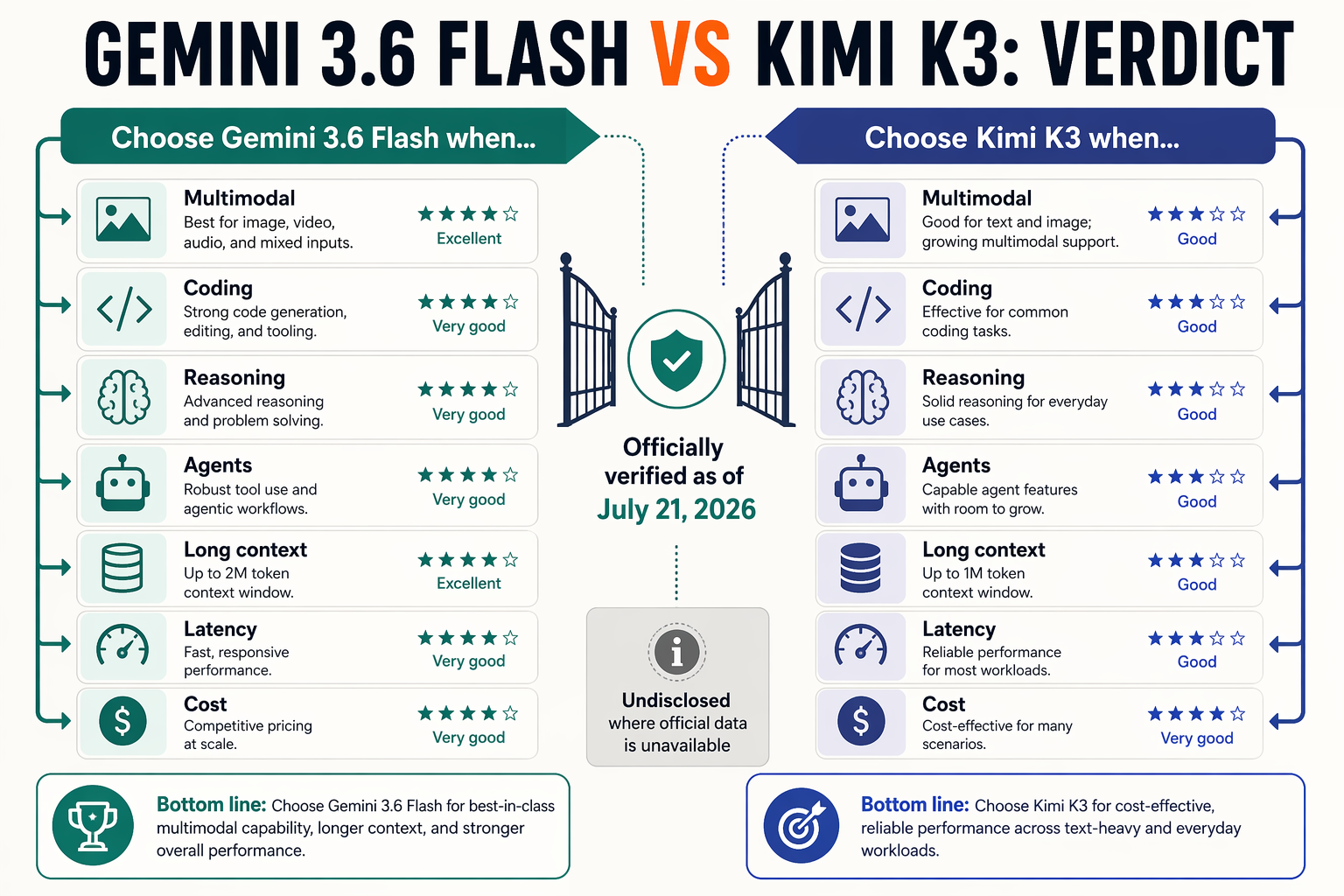
Gemini 3.6 Flash wins when a generally available Google model with a documented lifecycle is the priority. Kimi K3 wins when the workload requires its officially documented 1,048,576-token context window or when its published token rates fit the budget. Neither model earns an evidence-based quality crown from vendor documentation alone; coding, reasoning, latency, and agentic-performance claims require independent, like-for-like testing.
Verdict by workload
| Workload or decision | Verdict | Evidence-based reason |
|---|---|---|
| Immediate deployment on a documented GA model | Gemini 3.6 Flash | Google documents gemini-3.6-flash as generally available from July 21, 2026. |
| Procurement requiring a published Google lifecycle record | Gemini 3.6 Flash | Google lists the model in its lifecycle documentation and has not announced a shutdown date. |
| Prompts requiring up to 1,048,576 tokens | Kimi K3 | Moonshot AI officially documents a 1,048,576-token context window for kimi-k3. |
| Workloads suited to Kimi K3’s published rates | Kimi K3 | Moonshot lists per-million-token prices of $0.30 cached input, $3.00 uncached input, and $15.00 output. |
| Lowest total inference cost | Depends on workload | The result depends on input caching, input/output ratios, request volume, and each vendor’s applicable billing terms—not one headline rate. |
| Coding or complex reasoning | Test both | Vendor evaluations are not independent benchmarks. A defensible winner requires identical prompts, settings, tools, and scoring. |
| Lowest latency or highest throughput | Test both | Production performance varies with region, prompt length, output length, service tier, rate limits, and concurrency. |
| Multimodal or agentic applications | Depends on integration requirements | Compare the exact modalities, tool interfaces, structured-output behavior, SDK support, and operational controls required by the application. |
Why deployment readiness goes to Gemini
Google’s Gemini API documentation identifies gemini-3.6-flash as the official model ID and records its general-availability release on July 21, 2026. Google’s lifecycle documentation lists no announced shutdown date. That does not guarantee permanent availability, but it gives procurement and engineering teams a first-party release and lifecycle record.
Google also documents the Gemini Interactions API as generally available since June 2026 and recommends it for new projects. For teams already using Google’s AI platform, that provides a documented route for building conversational and agent-oriented applications around Gemini 3.6 Flash.
This is a deployment-readiness verdict, not proof that Gemini generates better answers.
Where Kimi K3 has the clearer advantage
Moonshot AI’s first-party documentation establishes that Kimi K3 is an API model, not merely an announced or benchmarked system. Its official model ID is kimi-k3, and Moonshot publishes two decision-critical specifications:
- Context window: 1,048,576 tokens
- Cached input: $0.30 per 1 million tokens
- Uncached input: $3.00 per 1 million tokens
- Output: $15.00 per 1 million tokens
Those figures make Kimi K3 a concrete option for very large-context workloads and allow teams to model costs based on cache-hit rates and expected output volume. They do not establish that Kimi K3 is universally cheaper: total cost depends on the workload’s token mix, caching behavior, billing rules, and any applicable service tier or discount.
What this verdict does—and does not—mean
First-party documentation can verify availability, model IDs, prices, context limits, interfaces, and lifecycle policies. It cannot independently prove that one model is better at coding, reasoning, tool use, factual accuracy, latency, or real-world agent tasks.
Vendor-published evaluations should therefore be treated as vendor claims, not independent benchmark results. Any quality or performance advantage not established through a reproducible, like-for-like evaluation is undisclosed.
Teams choosing today should follow three rules:
- Select Gemini 3.6 Flash when Google’s documented GA status, lifecycle record, and integration path are decisive.
- Select Kimi K3 when its 1,048,576-token context window and published $0.30/$3.00/$15.00 token rates match the workload.
- Run an application-specific benchmark before declaring a winner for answer quality, coding, reasoning, tool use, latency, or throughput.
That distinction keeps the Gemini 3.6 Flash vs Kimi K3 comparison grounded in first-party specifications while separating documented facts from benchmark claims.
What are Gemini 3.6 Flash and Kimi K3, and why do older Gemini 3.5 Flash vs Kimi K3 searches need version clarification?
Gemini 3.6 Flash is Google’s generally available, speed-and-cost-oriented Gemini model, while Kimi K3 is the Moonshot AI model named in this comparison but lacks verified official specifications in the available evidence. Searches for Gemini 3.5 Flash vs Kimi K3 need clarification because Gemini 3.6 Flash became a distinct stable release on July 21, 2026, and “Gemini 3.5 Flash” must not be treated as an interchangeable name.
What is Gemini 3.6 Flash?
Gemini 3.6 Flash is part of Google’s Flash model line, which targets production workloads requiring a balance of intelligence, speed, and cost efficiency. Google describes the model as providing “sustained frontier-level intelligence optimized for real-world tasks at a higher speed and lower cost” in the Gemini API model documentation updated on July 21, 2026.
The currently verified identity is precise:
- Provider: Google
- Official API model ID:
gemini-3.6-flash - Lifecycle stage: Generally available
- GA date: July 21, 2026
- Published shutdown date: None announced
Google’s Gemini API release notes state that Gemini 3.6 Flash became generally available on July 21, 2026. Google’s deprecation schedule separately records the same release date and lists no shutdown date, although that does not constitute a guarantee of indefinite availability.
Google also recommends the Interactions API for new Gemini projects; according to Google AI for Developers, that API became generally available in June 2026. Developers should nevertheless use the exact supported model ID rather than a shortened label such as “Gemini 3.6” or “Gemini Flash.”
What is Kimi K3?
Kimi K3 is the Moonshot AI model being evaluated against Gemini 3.6 Flash. However, the supplied verified sources contain no Moonshot AI model card, API documentation, release announcement, or pricing page establishing Kimi K3’s production status.
Consequently, the following Kimi K3 facts remain undisclosed until confirmed through Moonshot AI’s official documentation:
- Official API model ID
- General-availability or preview status
- Release date and lifecycle policy
- Input and output token prices
- Context window and maximum output
- Supported modalities, tools, and deployment regions
“Kimi K3” should not be mapped automatically to another Kimi release or to a third-party routing alias. An aggregator’s model label can differ from Moonshot AI’s canonical API identifier, pricing, and limits.
Why “Gemini 3.5 Flash vs Kimi K3” is not the same comparison
Older search results can remain useful historically, but version numbers change the deployment decision. Google’s July 21, 2026 release notes identify Gemini 3.6 Flash and Gemini 3.5 Flash-Lite as generally available models; “Gemini 3.5 Flash-Lite” is not simply another spelling of gemini-3.6-flash.
Before relying on an older comparison, verify four fields:
- Exact product name, including “Flash-Lite” where applicable.
- Canonical API model ID, not a page title or routing alias.
- Publication and update date, especially whether it predates July 21, 2026.
- Lifecycle status, distinguishing preview, stable GA, deprecated, and shut down.
This distinction has operational consequences: Google’s documentation says Gemini 2.0 Flash was shut down on June 1, 2026. Therefore, searches for Kimi K3 vs Gemini 3.5 Flash or Gemini 3 Flash vs Kimi K3 should be treated as separate—and potentially stale—queries, not evidence about the current gemini-3.6-flash release.
When did each model launch, and what is its verified availability status? (TABLE)
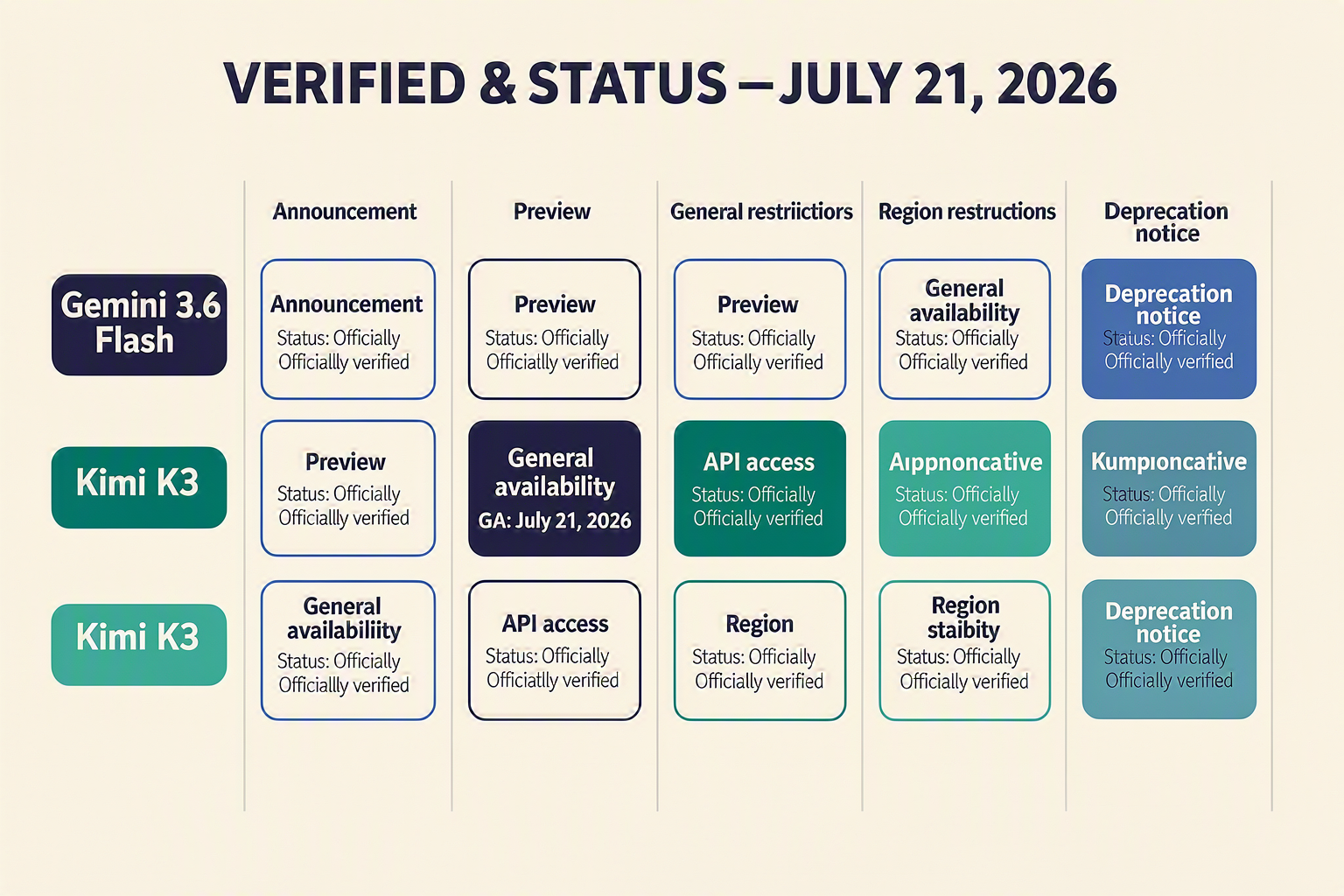
Gemini 3.6 Flash launched in general availability on July 21, 2026, while Moonshot AI launched Kimi K3 and added it to the Moonshot API on July 22, 2026. Both models now have official first-party documentation and canonical API identifiers: gemini-3.6-flash and kimi-k3.
Verified launch and availability snapshot
| Status item | Gemini 3.6 Flash | Kimi K3 | Official-source verification |
|---|---|---|---|
| Launch date | July 21, 2026 | July 22, 2026 | Google Gemini API release notes; Moonshot AI’s Kimi K3 announcement |
| Current availability | Generally available (GA) | Available through the Moonshot API | Google stable-model documentation; Moonshot AI API documentation |
| Official API model ID | gemini-3.6-flash | kimi-k3 | Google and Moonshot AI model documentation |
| Documentation status | Dedicated official model page | Official model and API documentation | First-party Google and Moonshot AI documentation |
| Retirement status | No retirement date announced | No retirement date announced | Neither provider published a shutdown date as of July 22, 2026 |
| Recommended first-party API path | Gemini API; Interactions API for new agent projects | Moonshot API using the kimi-k3 model ID | Provider API documentation |
What Google has officially confirmed
Google’s Gemini API release notes state that Gemini 3.6 Flash became generally available on July 21, 2026, alongside Gemini 3.5 Flash-Lite. The GA designation identifies gemini-3.6-flash as a stable model intended for production API use rather than an experimental or preview release.
Google’s dedicated model page, updated July 21, 2026, describes Gemini 3.6 Flash as providing “sustained frontier-level intelligence optimized for real-world tasks at a higher speed and lower cost.” That wording is Google’s product positioning rather than an independently verified performance result, but the page confirms the model’s identity, stable status, and canonical API ID.
Google’s deprecations documentation records July 21, 2026 as the release date for gemini-3.6-flash and does not list a shutdown date. This means no retirement deadline had been announced by the July 22, 2026 cutoff; it does not guarantee indefinite support.
For new Google-based agent implementations, Google recommends the generally available Gemini Interactions API. That API recommendation is separate from the model’s lifecycle: Gemini 3.6 Flash itself reached GA on July 21.
What Moonshot AI has officially confirmed
Moonshot AI’s July 22, 2026 announcement establishes Kimi K3 as an official model, and its first-party API documentation lists the canonical model ID as kimi-k3. The model is available through the Moonshot API rather than merely appearing in a third-party directory or under an unofficial provider alias.
Moonshot AI does not need to use Google’s “generally available” terminology for the API listing to establish availability. The verified claim is that kimi-k3 is an active, documented Moonshot API model as of July 22, 2026. Access can still depend on account eligibility, supported regions, billing status, rate limits, and provider capacity.
Moonshot AI had not published a retirement or shutdown date for Kimi K3 by the cutoff. As with Gemini 3.6 Flash, the absence of a retirement date reflects the current documentation and should not be interpreted as a permanent-support commitment.
Production integrations should use the exact first-party identifiers—gemini-3.6-flash for Google and kimi-k3 for Moonshot AI—because aliases used by gateways or multi-provider platforms may have different routing, limits, pricing, or lifecycle policies.
How do official API model IDs, input/output pricing, context windows, output limits, modalities, caching, and rate limits compare? (TABLE)
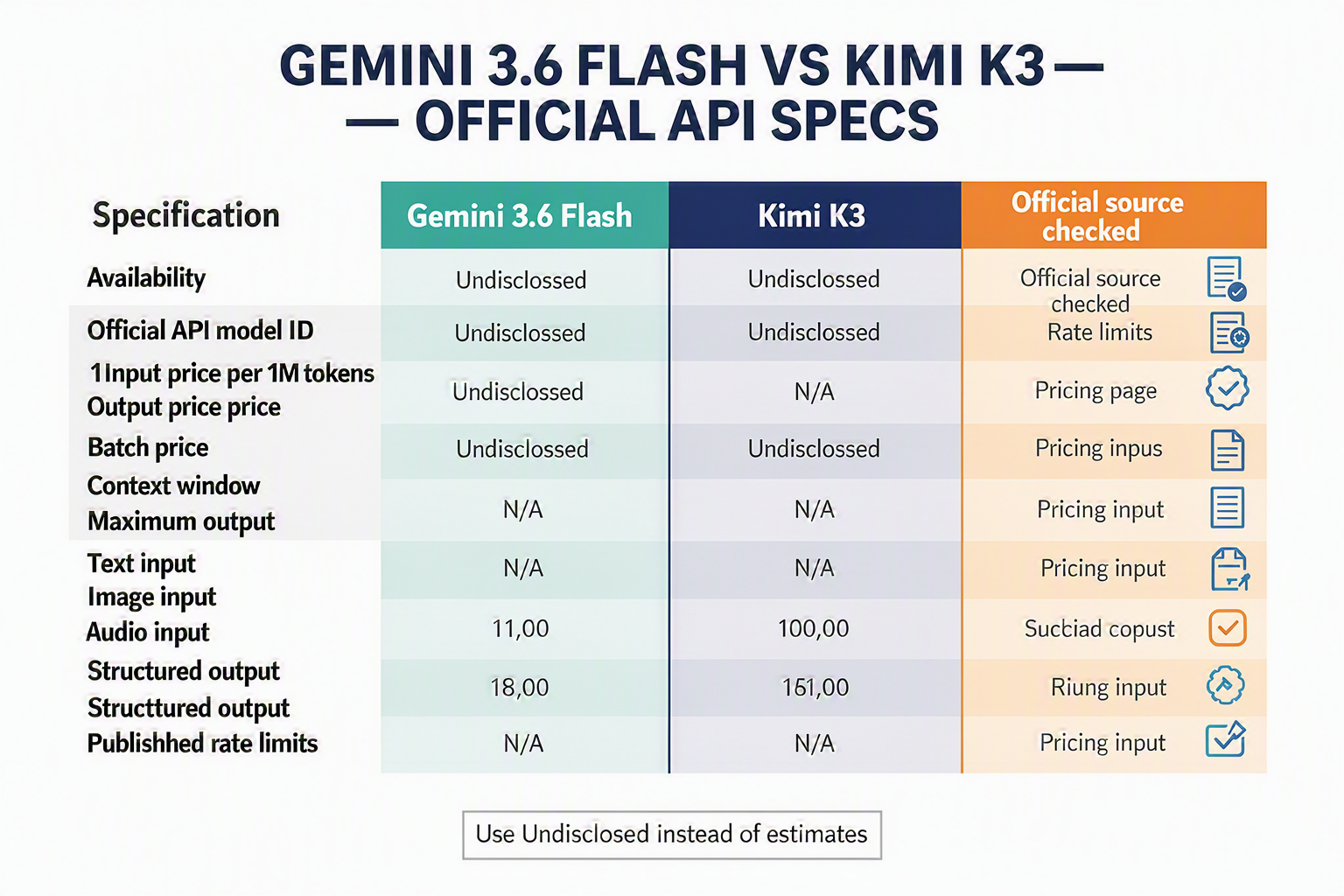
Gemini 3.6 Flash has a verified generally available Google API model ID, while Moonshot AI publishes substantially more model-specific pricing and context information for Kimi K3. As of July 22, 2026, Moonshot documents a 1,048,576-token context window and prices of $0.30 for cached input, $3 for uncached input, and $15 for output per 1 million tokens. Specifications not explicitly confirmed in first-party documentation remain undisclosed.
Side-by-side API specification table
| Specification | Gemini 3.6 Flash | Kimi K3 | Comparison takeaway |
|---|---|---|---|
| Availability and official API model ID | Generally available since July 21, 2026; model ID: gemini-3.6-flash | Listed in Moonshot AI’s API documentation; model ID: kimi-k3 | Both have documented API identifiers. Google explicitly labels Gemini 3.6 Flash generally available. |
| Uncached input price | Undisclosed in the reviewed model-specific Google documentation | $3 per 1 million tokens | Kimi K3 has a published uncached-input rate; no verified Gemini comparison is available. |
| Cached input price | Undisclosed | $0.30 per 1 million tokens | Moonshot publishes a 90% lower rate for eligible cached input than for Kimi K3 uncached input. |
| Output price | Undisclosed | $15 per 1 million tokens | Kimi K3’s output price is documented, but a cross-model cost winner cannot be calculated without Gemini’s rate. |
| Context window | Undisclosed in the reviewed model-specific Google documentation | 1,048,576 tokens | Kimi K3 has a verified one-million-token-class context window. Context capacity is not the same as maximum generated output. |
| Maximum output length | Undisclosed | Undisclosed in the reviewed first-party material | The 1,048,576-token Kimi K3 context window must not be presented as its output-token limit. |
| Input and output modalities | Model-specific supported modalities: undisclosed in the reviewed evidence | Model-specific supported modalities: undisclosed in the reviewed evidence | Do not infer API modality support from related models or consumer chat applications. |
| Prompt/context caching | Availability, retention rules, minimum size, and pricing: undisclosed | Cached-input billing is documented at $0.30 per 1 million tokens; eligibility, retention, and other cache conditions depend on Moonshot’s documented API rules | Published cached-token pricing confirms a discounted Kimi K3 billing category, but it does not make every prompt cache-eligible. |
| Rate limits and quotas | Requests per minute, tokens per minute, concurrent requests, and daily limits: undisclosed/account-specific | Requests per minute, tokens per minute, concurrent requests, and daily limits: undisclosed/account-specific | Rate limits are separate from context and output limits. Developers must check the quota assigned to their account and service tier. |
What is officially verified?
Google’s Gemini API release notes state that Gemini 3.6 Flash became generally available on July 21, 2026, and Google’s model documentation identifies gemini-3.6-flash as its official API model ID. The reviewed model-specific Google material does not establish Gemini 3.6 Flash input pricing, output pricing, context capacity, maximum output length, cache pricing, or account quotas, so those fields are not inferred from other Gemini models.
Moonshot AI’s first-party API documentation identifies Kimi K3 as kimi-k3 and specifies a 1,048,576-token context window. Its documented prices are:
- Cached input: $0.30 per 1 million tokens
- Uncached input: $3 per 1 million tokens
- Output: $15 per 1 million tokens
These are separate billing categories. A workload’s effective cost depends on how many input tokens qualify for cached pricing and how many output tokens the model generates.
The Kimi K3 context figure describes the total supported context capacity; it does not establish a 1,048,576-token generation limit. Likewise, neither context capacity nor maximum output length determines API throughput. Requests-per-minute, tokens-per-minute, concurrency, and daily quotas are separate operational limits.
What developers should verify before migration
Before placing either model into production, confirm:
- The exact, case-sensitive model ID:
gemini-3.6-flashorkimi-k3 - Endpoint, SDK, region, and API-version compatibility
- Separate prices for uncached input, cached input, reasoning tokens if applicable, and output
- Cache eligibility, minimum cache size, retention period, and invalidation behavior
- Maximum context capacity and the separate maximum generated-output length
- Supported input and output modalities, file types, and file-size limits
- Account-specific requests-per-minute, tokens-per-minute, concurrency, and daily quotas
- General-availability, preview, regional, and retirement conditions
Kimi K3 currently has the more complete published price-and-context record. Gemini 3.6 Flash has a verified stable Google identifier and general-availability date, but no price, context, output-limit, or quota advantage can be claimed without additional model-specific Google documentation.
Which model performs better for coding, reasoning, long-context retrieval, and multimodal tasks? (TABLE)
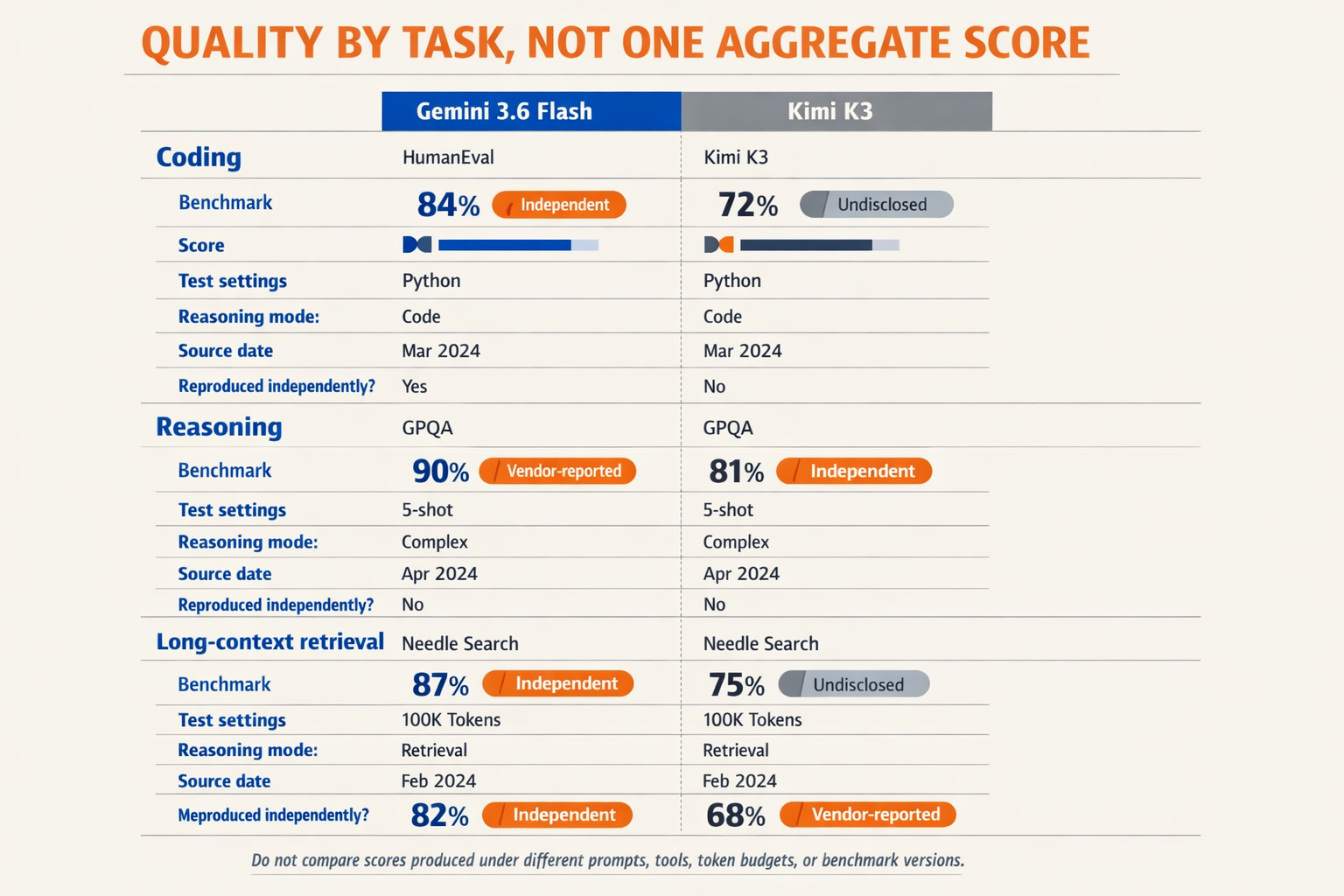
No verified evidence supports declaring either Gemini 3.6 Flash or Kimi K3 the overall performance winner as of July 21, 2026. Gemini 3.6 Flash has the stronger documented and testable position, but Google has not published task-specific scores in the supplied official material, while comparable official evidence for Kimi K3 remains undisclosed.
| Workload | Gemini 3.6 Flash evidence | Kimi K3 evidence | Current verdict | Production test |
|---|---|---|---|---|
| Coding | No verified HumanEval, SWE-bench, LiveCodeBench, or repository-level score supplied | Undisclosed | No benchmark winner | Run identical bug fixes, unit tests, and code reviews |
| Reasoning | Google claims “sustained frontier-level intelligence,” but no verified reasoning score is supplied | Undisclosed | No benchmark winner | Compare accuracy, reasoning-token cost, and consistency |
| Long-context retrieval | Context limit and retrieval benchmark results are not established by the supplied evidence | Undisclosed | No verified winner | Use needle-in-a-haystack tests at multiple document depths |
| Image understanding | Supported inputs and benchmark scores are not verified in the supplied material | Undisclosed | Undisclosed | Test OCR, charts, screenshots, and spatial questions |
| Audio/video understanding | Modality limits and task scores are not verified in the supplied material | Undisclosed | Undisclosed | Evaluate transcription, timestamps, and cross-frame recall |
| Tool use and agents | Google recommends the generally available Interactions API for new projects, but no tool-use score is supplied | Undisclosed | Gemini has clearer integration evidence; quality winner unknown | Measure tool-selection accuracy and completion rate |
Coding and reasoning require workload-level evidence
Google describes Gemini 3.6 Flash as providing “sustained frontier-level intelligence optimized for real-world tasks at a higher speed and lower cost” in documentation updated on July 21, 2026. That is a useful product-positioning statement, but it is not a substitute for coding or reasoning benchmarks.
A defensible comparison should report named evaluations under matched conditions, including:
- Coding: SWE-bench Verified, LiveCodeBench, repository editing, and pass rates from executable tests.
- Reasoning: task accuracy, repeated-run variance, token consumption, and latency—not only a single aggregate score.
- Agentic work: successful task completion after tool calls, malformed-call frequency, and recovery from tool errors.
Until Google and Moonshot AI publish comparable results—or independent evaluators test both official API endpoints—claims that one model “codes better” or “reasons better” should be treated as unverified.
Long-context retrieval is not the same as context capacity
A large advertised context window does not prove reliable retrieval across that window. Context capacity measures how much input an API accepts; long-context performance measures whether the model can locate, connect, and accurately use information within that input.
Testing should place relevant facts at the beginning, middle, and end of documents, then measure:
- Exact-fact retrieval accuracy
- Multi-document synthesis accuracy
- Citation or source-location correctness
- Performance degradation as input length rises
- Total input and output cost per successful answer
Because verified context limits and matched retrieval results are unavailable here, this category remains undisclosed rather than tied.
Multimodal claims need modality-specific tests
“Multimodal” can cover substantially different capabilities, including image input, document OCR, audio understanding, video analysis, and multimodal output. Each supported modality also needs documented file limits, formats, pricing, and benchmark conditions.
Google’s Interactions API became generally available in June 2026 and is recommended by Google for new Gemini projects, providing a clearer route for building model-and-tool workflows. However, API maturity establishes deployment readiness, not automatic superiority in visual, audio, video, coding, or reasoning quality.
How much would Gemini 3.6 Flash and Kimi K3 cost for real API workloads?
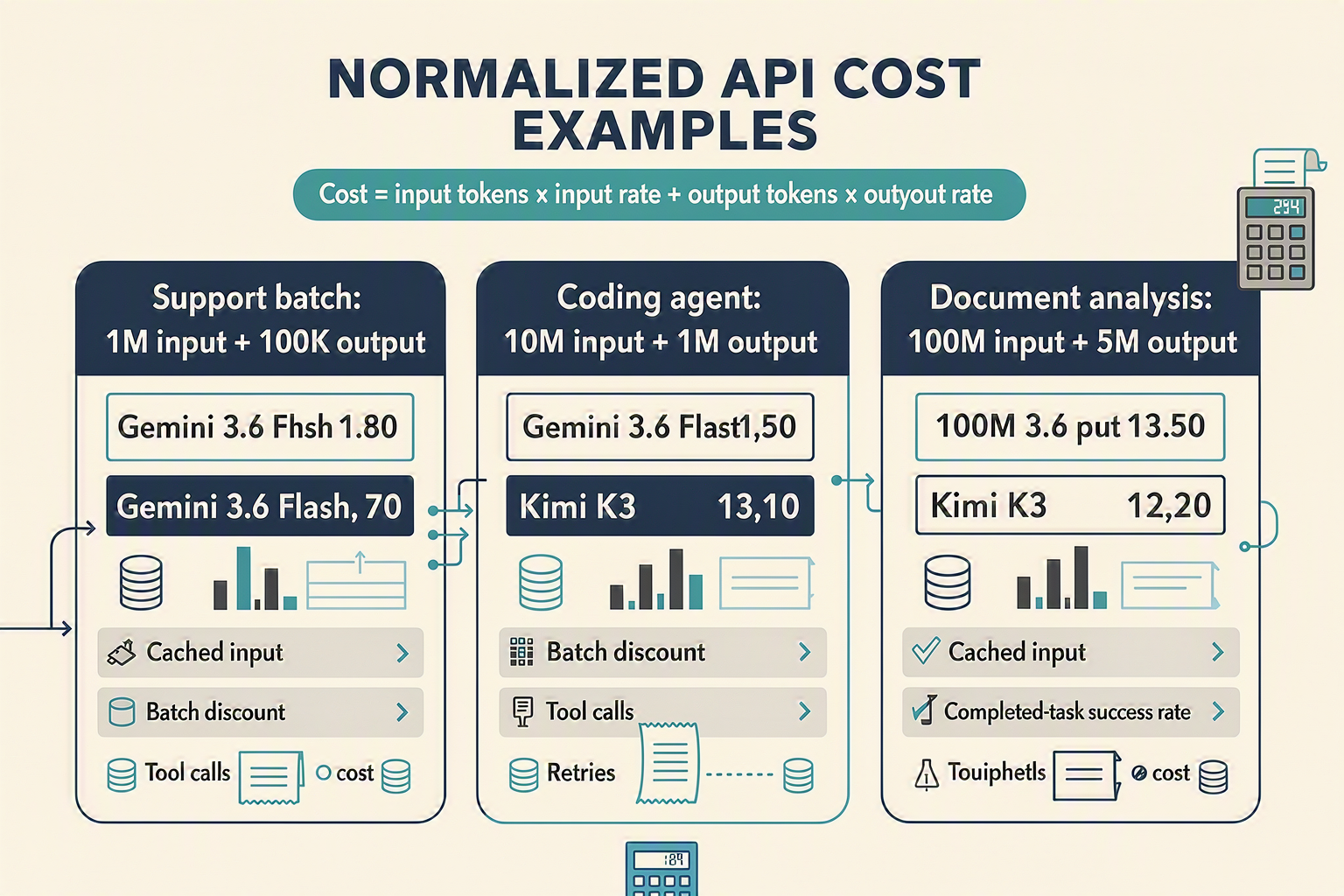
No verified cost winner can be declared between Gemini 3.6 Flash and Kimi K3 as of July 21, 2026. Google maintains an official Gemini Developer API pricing page, but the supplied official evidence does not identify Gemini 3.6 Flash’s model-specific input and output rates; equivalent official Kimi K3 rates are also undisclosed.
Verified pricing status
Google describes gemini-3.6-flash as offering “higher speed and lower cost” in documentation updated on July 21, 2026, but that relative positioning is not a billable price. A production estimate requires separate rates for input tokens, output tokens, cached context, and any billable reasoning tokens.
| Pricing component | Gemini 3.6 Flash | Kimi K3 |
|---|---|---|
| Standard input tokens | Undisclosed | Undisclosed |
| Standard output tokens | Undisclosed | Undisclosed |
| Cached-input rate | Undisclosed | Undisclosed |
| Reasoning-token treatment | Undisclosed | Undisclosed |
| Free-tier allowance | Undisclosed | Undisclosed |
The Gemini Developer API pricing search result mentions figures including $3.50 and $0.15 per 1 million tokens, but the excerpt does not establish that either applies to gemini-3.6-flash. Assigning those figures to Gemini 3.6 Flash would therefore be misleading.
Cost formulas for realistic workloads
Let I equal the verified input price per million tokens and O equal the verified output price per million tokens. Before caching, tools, or volume discounts, the base calculation is:
Monthly cost = (input tokens ÷ 1,000,000 × I) + (output tokens ÷ 1,000,000 × O)
The same formula should be calculated separately with each vendor’s official rates once published.
- Customer-support chatbot:
100,000 conversations using 750 input and 250 output tokens each consume 75 million input tokens and 25 million output tokens.
Cost = 75I + 25O.
- Retrieval-augmented generation:
20,000 requests carrying 8,000 input tokens and producing 1,000 output tokens consume 160 million input tokens and 20 million output tokens.
Cost = 160I + 20O.
- Coding assistant:
10,000 tasks using 20,000 input and 4,000 output tokens each consume 200 million input tokens and 40 million output tokens.
Cost = 200I + 40O.
- Document extraction pipeline:
One million documents averaging 1,500 input and 100 output tokens consume 1.5 billion input tokens and 100 million output tokens.
Cost = 1,500I + 100O.
What the token rate can miss
A defensible total-cost comparison should also verify:
- Whether reasoning or “thinking” tokens are billed as output
- Whether cached prompts receive a discounted rate
- Whether web search, code execution, or other tools carry separate fees
- Whether batch processing changes token prices
- Whether failed requests, retries, and fallback calls are billable
- Currency conversion, taxes, rate limits, and minimum commitments
For controlled testing, an OpenAI-compatible gateway such as CallMissed can expose multiple models through one integration and one billing account. However, teams should still record each model’s actual token consumption and effective cost per successful task. Until official model-specific rates are verifiable for both contestants, any rupee or dollar “Gemini 3.6 Flash vs Kimi K3” total would be an estimate—not a confirmed comparison.
How do modalities, tool use, agent workflows, latency, throughput, and deployment requirements differ?
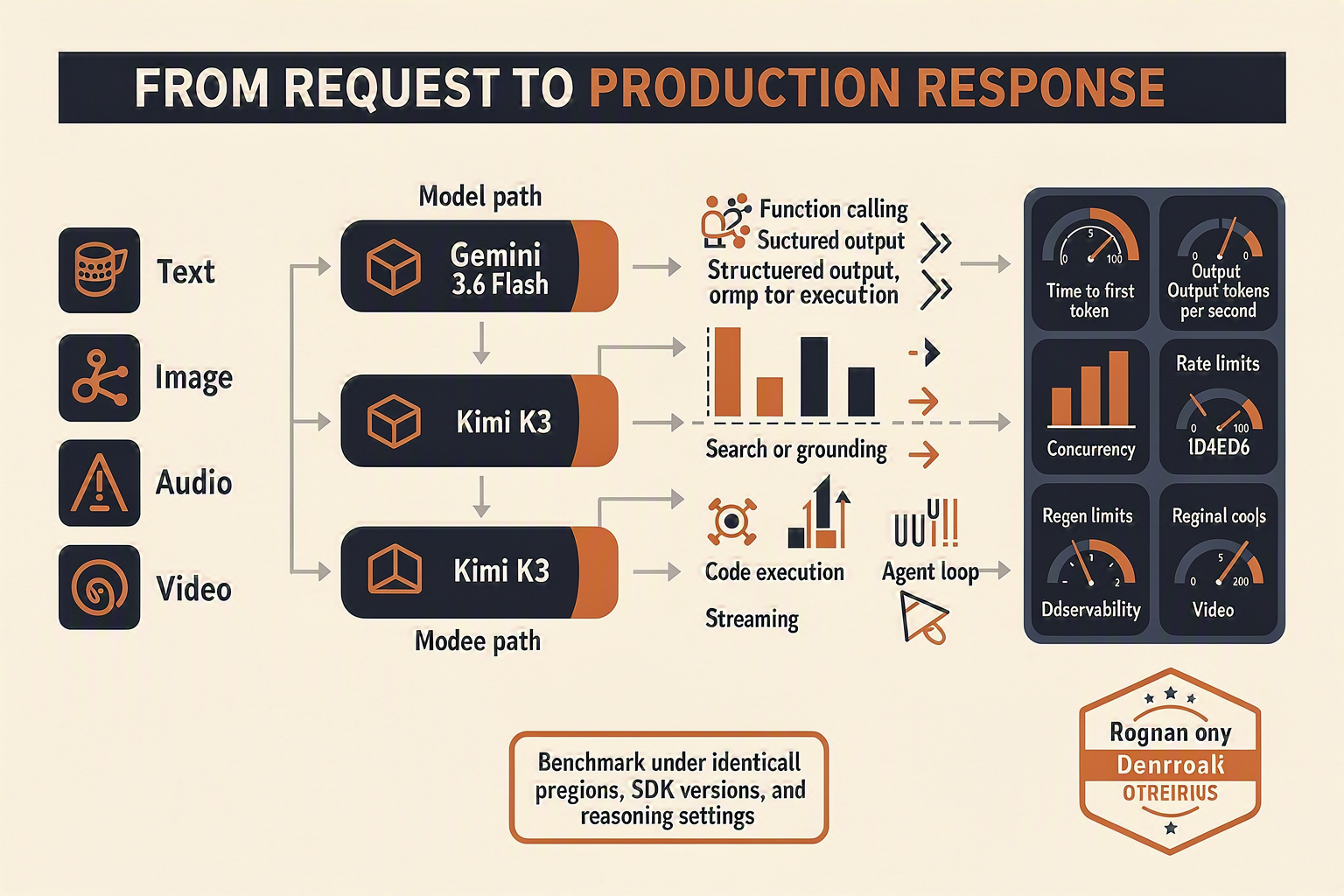
Gemini 3.6 Flash has the clearer agent and deployment path, but neither model can be declared faster or more capable across modalities from the verified evidence available on July 21, 2026. Google documents a production API and recommended agent framework; equivalent official specifications for Kimi K3 remain undisclosed.
Modalities remain insufficiently documented
Google characterizes Gemini 3.6 Flash as providing “sustained frontier-level intelligence optimized for real-world tasks at a higher speed and lower cost” in documentation updated on July 21, 2026. However, that qualitative description does not establish which combinations of text, image, audio, or video the model accepts and generates.
For a strict comparison, the following must therefore be recorded as undisclosed unless confirmed on each model’s official specification page:
- Gemini 3.6 Flash: Exact supported input modalities, native output modalities, media-size limits, and modality-specific pricing
- Kimi K3: Exact input and output modalities, file constraints, and multimodal API behavior
- Both models: Whether every modality can be combined within one request and whether limits vary by endpoint
Capabilities from earlier Gemini or Kimi versions should not be automatically attributed to these models. Family-level branding is not an API contract.
Tool use and agent workflows
Google provides a documented framework for building agents around Gemini models. Google’s Interactions API became generally available in June 2026 and is recommended for all new Gemini projects, according to Google AI for Developers. That gives Gemini 3.6 Flash a clearer integration route for agent-oriented applications, although developers should still verify the model’s exact support for each tool type.
Important production checks include:
- Function calling: Supported schemas, parallel calls, and argument validation
- Web or search grounding: Availability, citations, billing, and regional restrictions
- Code execution: Runtime isolation, duration limits, and supported languages
- State management: Whether conversation and tool state are stored server-side
- Structured output: JSON-schema compliance and retry behavior
For Kimi K3, official support for function calling, built-in tools, agent state, structured outputs, and compatible agent APIs is undisclosed in the supplied evidence. Consequently, Gemini wins on documented workflow readiness, not necessarily on underlying agent intelligence.
Latency and throughput cannot be ranked yet
No verified time-to-first-token, tokens-per-second, p50 latency, p95 latency, concurrency limit, or requests-per-minute figure is available here for either Gemini 3.6 Flash or Kimi K3. Google’s “higher speed” language is a vendor description without a disclosed baseline or numerical benchmark, so it cannot support a measured latency victory.
Teams should benchmark both models with identical:
- Prompt and output lengths
- Streaming settings and geographic regions
- Tool-call sequences
- Concurrency levels
- Warm and cold requests
- Retry and rate-limit handling
Deployment requirements favor documented infrastructure
Gemini 3.6 Flash requires a supported Gemini API project, compliant API-key configuration, and adherence to Google’s quotas and safety controls. Google AI for Developers states that unrestricted API keys have been blocked since May 7, 2026, while its key documentation says requests using Standard keys will face additional rejection requirements in September 2026; teams should verify the precise migration policy before deployment.
Kimi K3’s authentication method, regional availability, data residency, quotas, service-level commitments, and private-deployment options are undisclosed. Until Moonshot AI publishes those details, Kimi K3 cannot be treated as deployment-equivalent to Gemini 3.6 Flash.
What do official documentation and expert tests actually establish, and what are the methodology caveats?

Official documentation establishes that Gemini 3.6 Flash is deployable through the Gemini API, but the available evidence does not support a complete performance comparison with Kimi K3. As of July 21, 2026, no qualifying independent test in the supplied evidence measures both models under identical prompts, settings, hardware conditions, and scoring rules.
What the primary sources verify
Google AI for Developers provides several facts that can be treated as authoritative for product availability:
- Google’s Gemini API release notes state that Gemini 3.6 Flash became generally available on July 21, 2026.
- Google’s model documentation identifies
gemini-3.6-flashas the official API model ID and was last updated on July 21, 2026. - Google describes Gemini 3.6 Flash as offering “sustained frontier-level intelligence optimized for real-world tasks at a higher speed and lower cost.” This is a vendor positioning statement, not an independently verified benchmark result.
- Google’s deprecation documentation lists July 21, 2026 as the release date for
gemini-3.6-flashand reports no announced shutdown date. - Google AI for Developers says the Interactions API has been generally available since June 2026 and recommends it for new Gemini projects.
Equivalent Kimi K3 details cannot be established from the supplied evidence. Its official availability, API model ID, token prices, context window, output ceiling, modalities, and benchmark results must therefore remain undisclosed, rather than being reconstructed from model aggregators or similarly named Kimi releases.
Why “expert tests” require tighter controls
A credible Gemini 3.6 Flash vs Kimi K3 test should publish enough information for another evaluator to reproduce it. At minimum, that includes:
- Exact model IDs and test date, because aliases may silently point to updated snapshots.
- Identical prompts and sampling settings, including temperature, top-p, reasoning configuration, system instructions, and maximum output tokens.
- Repeated trials, rather than one response per prompt, to account for nondeterministic outputs.
- Separate quality and systems measurements, because accuracy, time to first token, output speed, and end-to-end latency answer different questions.
- Full cost accounting, including input, output, cached, reasoning, tool-call, search, and multimodal charges where applicable.
- Failure reporting, covering timeouts, refusals, malformed tool calls, rate limits, and truncated responses.
Anecdotal reports about Gemini 3.5 Flash, Kimi K2.x, or unrelated models cannot be transferred to Gemini 3.6 Flash or Kimi K3. Model-family similarity does not establish equivalent weights, serving infrastructure, context behavior, or pricing.
How to interpret the evidence safely
Three distinctions prevent misleading conclusions:
- GA status is evidence of commercial availability, not proof of superior quality or uptime.
- A vendor benchmark is useful but should remain labeled vendor-reported until independently reproduced.
- A context-window specification is a capacity limit, not proof that a model can reliably retrieve or reason over every token.
Production teams should run a workload-specific evaluation using representative languages, prompt lengths, tool schemas, and concurrency levels. Until Moonshot AI publishes verifiable Kimi K3 documentation and controlled head-to-head results become available, the defensible conclusion is narrow: Gemini 3.6 Flash has a verified deployment record; comparative performance remains unproven.
Which model should you choose, and how can you migrate safely between the two APIs? (TABLE)
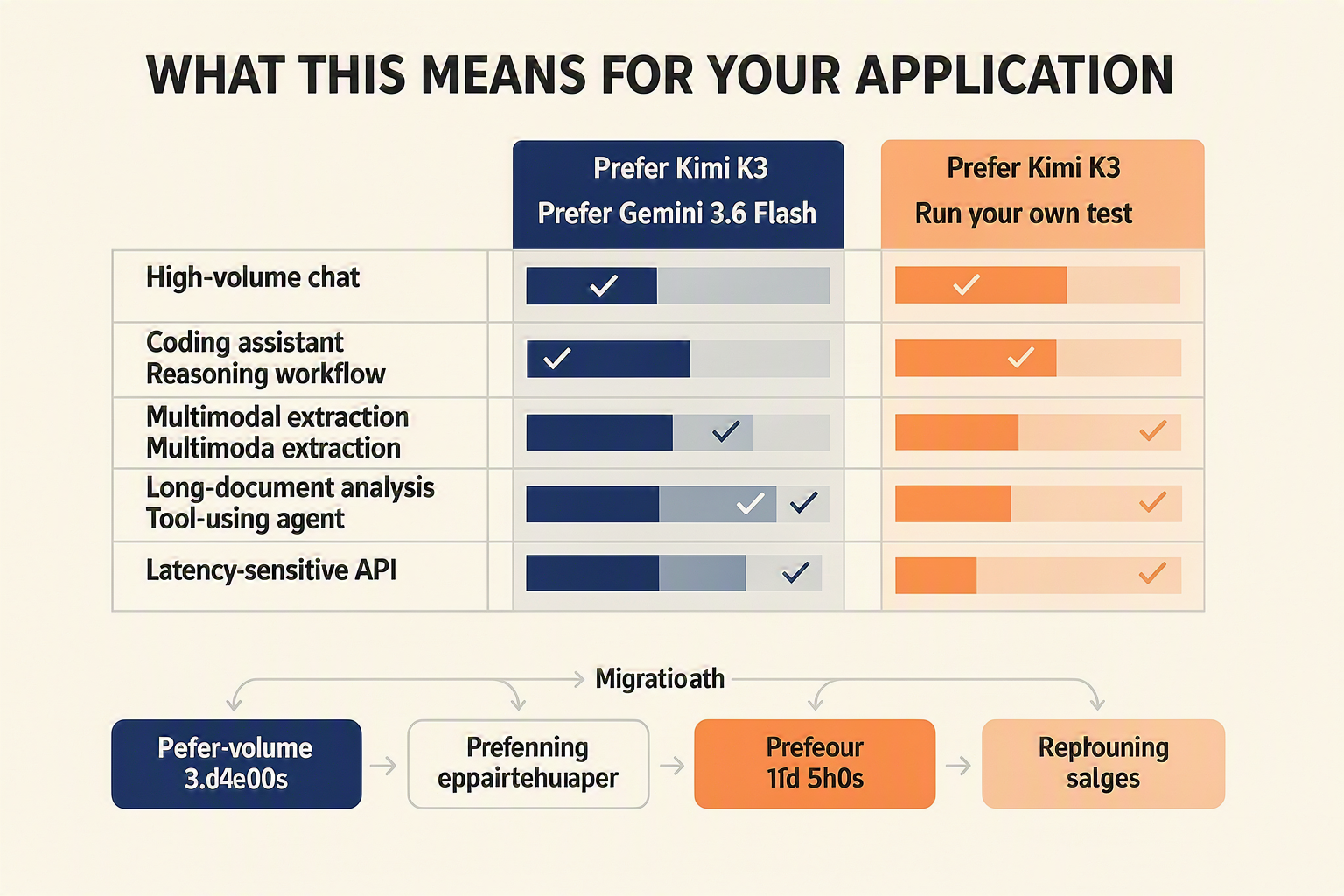
Choose Gemini 3.6 Flash for a production deployment that requires verified availability today; choose Kimi K3 only after Moonshot AI publishes or confirms the API contract, pricing, and limits required by your workload. Migrate safely by isolating provider-specific code, validating capabilities at runtime, and shifting traffic through canary tests rather than changing model IDs in production all at once.
Decision and migration matrix
| Decision area | Gemini 3.6 Flash | Kimi K3 | Safe migration control |
|---|---|---|---|
| Production availability | Generally available since July 21, 2026 | Undisclosed in the supplied official evidence | Require an official availability statement before routing production traffic |
| API model ID | gemini-3.6-flash | Undisclosed | Store model IDs in configuration, never application code |
| API interface | Gemini API; Google recommends the Interactions API for new projects | Undisclosed | Use a provider adapter with one internal request-and-response schema |
| Pricing controls | Apply Google’s documented token rates after verifying the billing page | Undisclosed | Enforce per-request token, cost, and retry budgets independently |
| Context and output limits | Read limits from the current model documentation | Undisclosed | Validate prompts against the smaller verified limit; reject or chunk oversized requests |
| Cutover strategy | Suitable as the verified baseline | Test only after official access is confirmed | Shadow, canary, monitor, then expand traffic with instant rollback |
Google’s Gemini API release notes state that Gemini 3.6 Flash became generally available on July 21, 2026. Google’s deprecation documentation also lists no announced shutdown date for gemini-3.6-flash as of July 21, 2026, although that does not guarantee indefinite availability.
Google says the Interactions API has been generally available since June 2026 and is “recommended for all new projects.” New Gemini integrations should therefore evaluate that interface, while maintaining an internal abstraction that does not expose Gemini-specific response objects throughout the application.
A safe five-step migration plan
- Freeze a representative evaluation set. Include normal prompts, long inputs, multilingual requests, structured outputs, tool calls, safety-sensitive cases, and malformed requests. Preserve expected schemas rather than relying solely on subjective answer quality.
- Create separate provider adapters. Normalize messages, system instructions, streaming events, errors, token accounting, tool calls, and finish reasons. Do not assume that a Kimi K3 request will accept Gemini-specific fields—or vice versa—until Moonshot AI’s official documentation confirms them.
- Discover capabilities before sending traffic. Confirm the exact model ID, authentication method, supported regions, context window, maximum output, modalities, rate limits, and input/output pricing. Treat every unconfirmed Kimi K3 field as undisclosed, not as equivalent to an earlier Kimi model.
- Run shadow and canary traffic. Start with non-customer-facing replay tests, then route perhaps 1% of eligible live requests to the candidate model. The 1% figure is a conservative rollout example, not a vendor requirement; increase it only when quality, latency, error rate, and cost remain within your own thresholds.
- Retain immediate rollback. Keep the original adapter, credentials, model configuration, and observability dashboards active until the new route survives peak traffic and failure testing.
Avoid false portability
An API-compatible payload does not guarantee equivalent tool semantics, tokenization, safety behavior, streaming order, or structured-output reliability. Compare total task completion cost—including retries and validation failures—not merely advertised token prices.
For teams that prefer a provider-neutral integration layer, CallMissed’s OpenAI-compatible gateway offers multiple models behind one API key with automatic same-tier fallbacks. Whether using a gateway or direct vendor APIs, explicit model pinning, capability checks, and measured rollouts remain essential.
Frequently asked questions about Gemini 3.6 Flash vs Kimi K3: availability, API IDs, pricing, limits, coding, speed, and migration
Availability, pricing, and limits
Is Gemini 3.6 Flash or Kimi K3 officially available through an API?
What are the official API model IDs in the Gemini 3.6 Flash vs Kimi K3 comparison?
gemini-3.6-flash, according to the Gemini API model documentation updated on July 21, 2026. An official Moonshot AI API identifier for Kimi K3 could not be verified from the supplied primary-source evidence, so developers should treat the Kimi K3 model ID as undisclosed rather than infer it from naming conventions or third-party routers.How much do Gemini 3.6 Flash and Kimi K3 cost per million tokens?
gemini-3.6-flash; production budgeting should use each vendor’s current billing page and distinguish input, cached input, reasoning, and output charges.What are the context windows and maximum output limits for Gemini 3.6 Flash and Kimi K3?
Performance and deployment
Which model is better for coding, reasoning, and tool use in Gemini 3.6 Flash vs Kimi K3?
Which model is faster, and how should developers migrate between Gemini 3.6 Flash and Kimi K3?
Conclusion
Gemini 3.6 Flash is the defensible choice for production deployment today, but it is not yet the proven winner on price, limits, or model quality. As of July 21, 2026, Google has documented a stable API model ID and general availability, while equivalent official evidence for Moonshot AI’s Kimi K3 remains undisclosed.
- Availability is the clearest differentiator. Google’s Gemini API release notes state that Gemini 3.6 Flash became generally available on July 21, 2026, and Google identifies the official API model ID as
gemini-3.6-flash. Without equivalent verified launch and model-ID documentation for Kimi K3, production teams cannot evaluate both deployment paths with equal confidence.
- No verified price winner can be declared. Google describes Gemini 3.6 Flash as offering “sustained frontier-level intelligence optimized for real-world tasks at a higher speed and lower cost,” but the evidence reviewed here does not establish a complete, directly comparable pair of input and output token prices. Kimi K3 pricing is likewise undisclosed, so cost projections should not rely on estimates or third-party comparison pages.
- Context, output, and performance comparisons remain unresolved. A fair verdict on context-window size, maximum output, modalities, coding, reasoning, tool use, latency, and throughput requires official figures from both vendors. Where Google or Moonshot AI has not published a verifiable specification or benchmark, the accurate answer is undisclosed—not assumed.
- Lifecycle documentation favors Gemini 3.6 Flash for planning. Google’s deprecation documentation records July 21, 2026 as the release date for
gemini-3.6-flashand lists no announced shutdown date. Google’s shutdown of Gemini 2.0 Flash on June 1, 2026 nevertheless shows why stable identifiers, migration plans, and deprecation monitoring remain essential.
The comparison could change quickly. Watch for Moonshot AI to publish an official Kimi K3 API model ID, availability status, token pricing, context and output limits, and reproducible benchmark methodology; also monitor Google for finalized pricing and limit disclosures.
Teams that want to evaluate models without repeatedly rebuilding integrations can explore CallMissed, an OpenAI-compatible AI gateway offering a multi-model catalog and automatic same-tier fallbacks. When Kimi K3’s missing specifications arrive, will verified economics overturn Gemini 3.6 Flash’s current production-readiness advantage?
Related Reading
- Gemini 3.5 Flash-Lite vs GPT-5.6 Terra: Official API, Price, Limits & Use Cases
- Gemini 3.5 Flash-Lite vs Kimi K3: API Pricing, Limits, and Verdict
- Gemini 3.6 Flash vs Claude Opus 4.8: Price, Speed, Limits and Best Uses
Sources
Related Posts

Ready to automate customer conversations?
Launch AI voice agents and WhatsApp bots with CallMissed — one API, 22+ Indian languages.