

Deepgram Nova-3 vs Whisper large v3 turbo accuracy: What the Evidence Actually Shows


Compare Deepgram Nova-3 vs Whisper large v3 turbo accuracy, pricing, streaming, privacy, and benchmark methods to choose the right transcription stack.
Deepgram Nova-3 vs Whisper large v3 turbo accuracy: What the Evidence Actually Shows
Can any public test honestly prove Deepgram Nova-3 vs Whisper large v3 turbo accuracy has one universal winner? Not from the available evidence: no credible, apples-to-apples benchmark using identical audio establishes that either model is consistently more accurate. Deepgram Nova-3 is the managed API option for production streaming, while Whisper large v3 turbo offers a flexible, potentially self-hosted path—so the right choice depends on language, accents, noise, domain vocabulary, privacy, latency, and engineering constraints.
This comparison explains what public evidence can—and cannot—show, why WER (word error rate) must be measured on your own representative recordings, and how to design a fair test with identical audio, normalization, timestamps, and confidence intervals. You’ll also see the practical trade-offs across real-time transcription, infrastructure, pricing, speaker overlap, punctuation, and deployment control before choosing between Deepgram Nova-3 and Whisper large v3 turbo.
Which is more accurate: Deepgram Nova-3 or Whisper large v3 turbo?
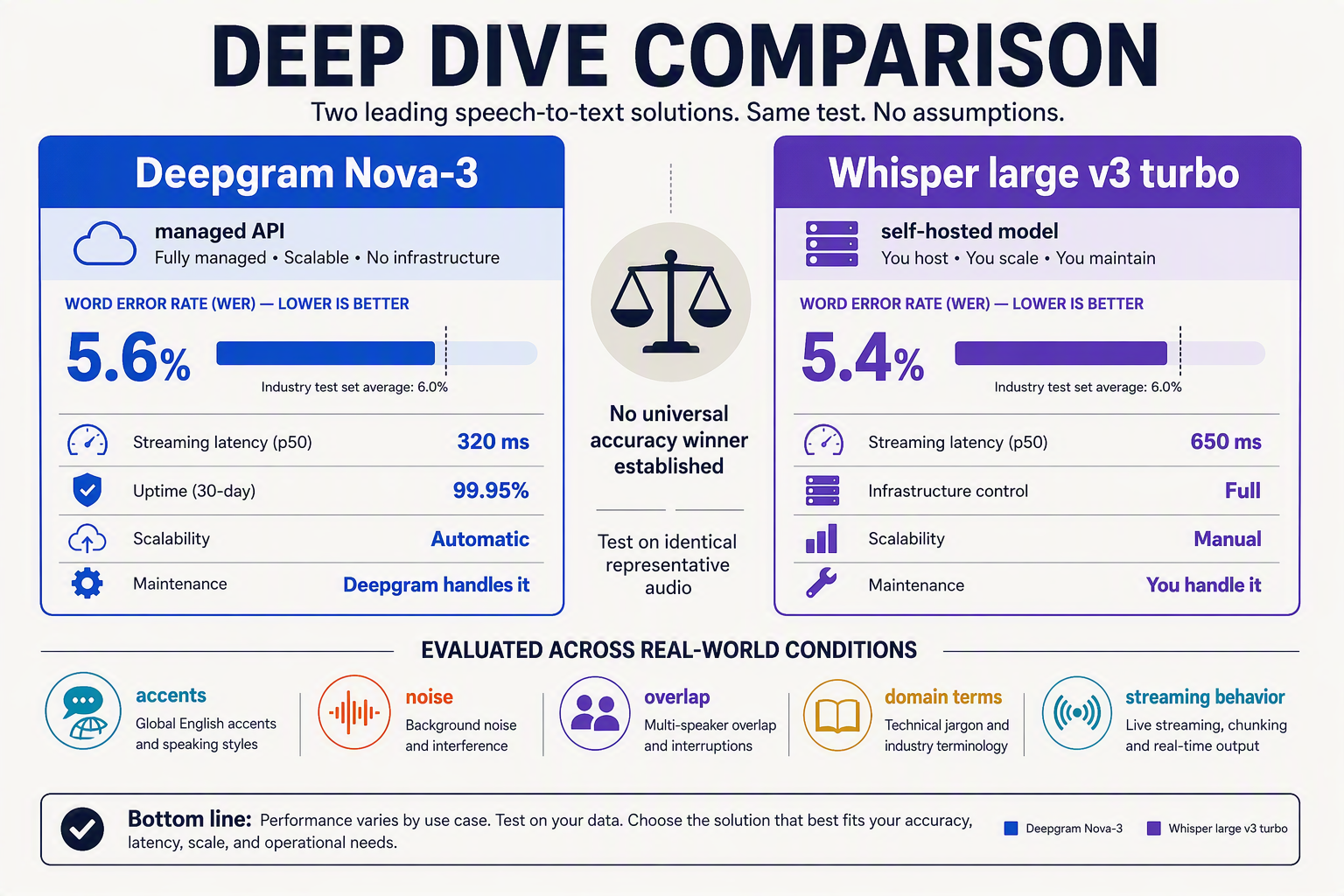
The available evidence does not establish that either model is universally more accurate in Deepgram Nova-3 vs Whisper large v3 turbo accuracy. No credible public, apples-to-apples result identified here tests both systems on the same recordings with identical preprocessing, transcription settings, and scoring; Deepgram Nova-3 is the managed production-streaming choice, while Whisper large v3 turbo is the flexible self-hostable option.
What does the evidence actually prove?
A reliable accuracy verdict requires testing both models on representative audio. Reported Deepgram Nova-3 accuracy or Whisper large v3 turbo accuracy should not be generalized unless the benchmark identifies:
- The dataset, language, accents, and domain
- Background noise, compression, and overlapping speech
- Audio preprocessing and transcription settings
- Punctuation, capitalization, and text-normalization rules
- The scoring method and reference transcript
Without those details, a published WER number may describe a narrow workload rather than real-world performance.
How should accuracy be measured?
Word error rate (WER) is calculated as substitutions plus deletions plus insertions, divided by the number of words in the reference transcript. Lower WER is better, but WER measures recognition—not every part of a speech-to-text system.
A fair comparison should keep the following identical:
- Use the same recordings, audio format, language settings, and decoding conditions.
- Include clean speech, telephone audio, vehicle noise, music, background conversations, and overlapping speakers.
- Represent the actual speaker mix, regional accents, code-switching, proper nouns, and domain vocabulary.
- Compare normalized transcripts under the same punctuation and capitalization rules.
- Report results across repeated samples, with confidence intervals where practical, rather than relying on one aggregate score.
Which accuracy factors matter beyond WER?
- Recognition: Whether spoken words are transcribed correctly.
- Diarization: Whether words are assigned to the correct speaker. Diarization errors should not be counted as recognition errors automatically.
- Formatting: Punctuation, capitalization, numbers, dates, and other presentation choices can affect usability without changing the underlying word recognition.
- Endpointing: How the system detects when a speaker has stopped, which can affect turn-taking and transcript completeness.
- Streaming behavior: Partial transcripts, update timing, and responsiveness are operational characteristics, not WER results.
Noise, accents, multiple speakers, and specialized vocabulary should therefore be evaluated as separate test categories. A model that performs well on clean, single-speaker English may behave differently on regional accents, mixed languages, call-center audio, or industry terminology.
What is the practical verdict?
Choose Deepgram Nova-3 when a managed API and production streaming are the priority. Choose Whisper large v3 turbo when self-hosting, local processing, or greater control over the inference environment matters.
That is a deployment verdict, not a universal accuracy verdict. Teams should run both systems on their own audio and compare WER, diarization quality, formatting, endpointing, streaming responsiveness, infrastructure effort, privacy requirements, and end-to-end latency before selecting one.
What is the verdict at a glance?
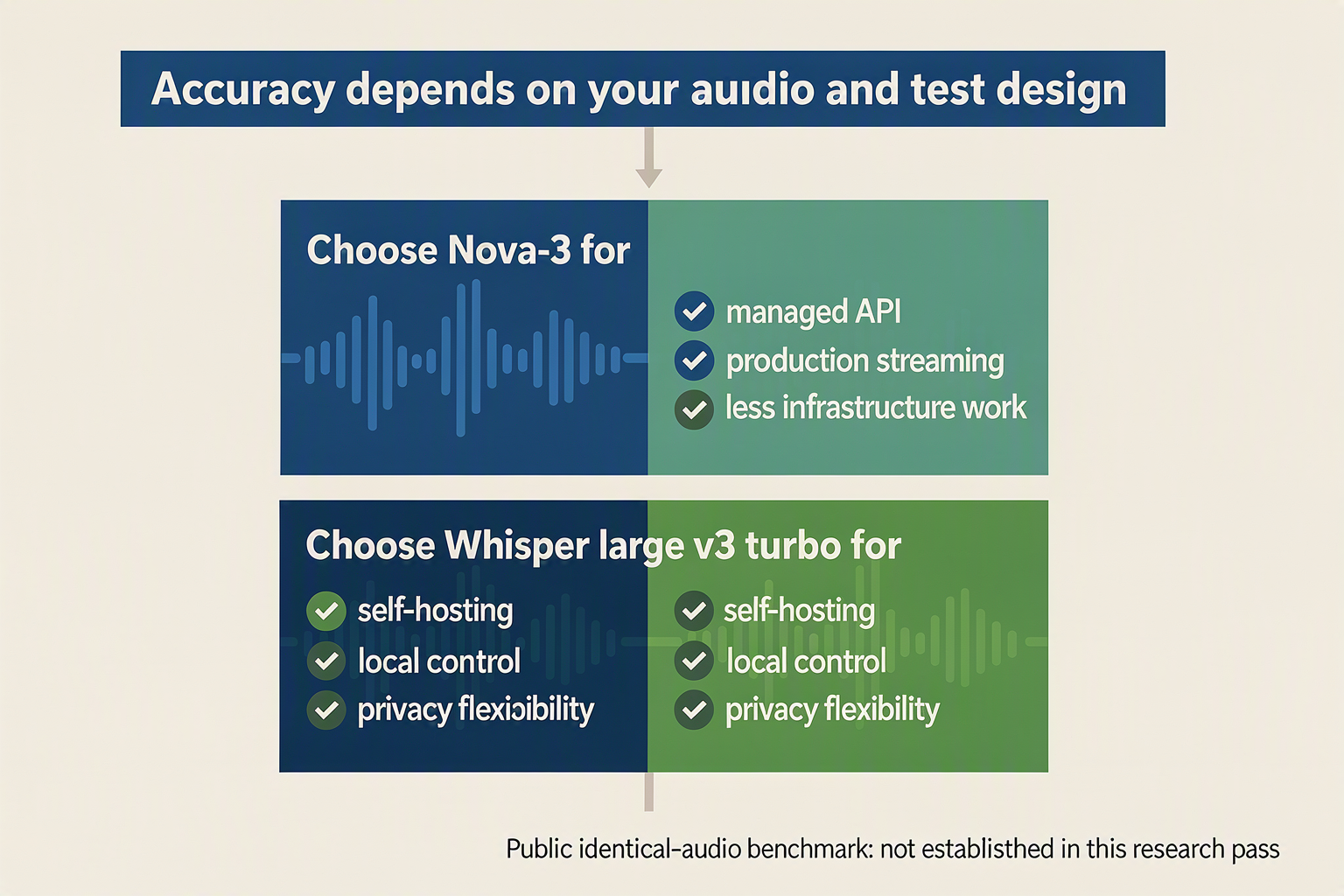
The verdict on Deepgram Nova-3 vs Whisper large v3 turbo accuracy is conditional: the supplied research does not identify a credible public, apples-to-apples benchmark using identical audio and matched evaluation settings. Deepgram Nova-3 is the managed streaming/API option, while Whisper large v3 turbo is the self-hostable option with greater deployment control; the practical winner depends on your audio, language, privacy requirements, latency targets, and engineering capacity.
What does the available evidence actually prove?
The available evidence does not prove that Deepgram Nova-3 or Whisper large v3 turbo is universally more accurate. No reliable public result identified in the supplied research tests both models with the same recordings, preprocessing, language configuration, transcription settings, normalization rules, and scoring methodology.
That distinction matters because aggregate accuracy can conceal workload-specific failures. A model may perform differently on:
- Accented or regional speech
- Background noise and telephone compression
- Overlapping or multiple speakers
- Punctuation, capitalization, and formatting
- Product names, medical terms, legal language, or other domain vocabulary
- Code-switching and multilingual recordings
Word error rate (WER) remains a useful core metric: WER counts substitution, deletion, and insertion errors, and lower WER is better. However, WER alone does not measure diarization, endpointing, punctuation quality, timestamp accuracy, or streaming responsiveness.
How should the two models be evaluated?
Use the same representative audio for both systems and document every variable. A practical comparison should include:
- A balanced test set covering the languages, accents, speaker types, recording devices, and environments found in production.
- Separate samples for quiet speech, background noise, telephone audio, overlapping speakers, and domain-specific vocabulary.
- Identical or explicitly documented rules for audio format, segmentation, language selection, timestamps, punctuation, capitalization, and text normalization.
- WER results reported by scenario rather than only as one overall average.
- Repeated samples or confidence intervals where feasible, so a small difference is not mistaken for a meaningful advantage.
Also measure operational outcomes separately from recognition accuracy: first-token latency, final transcript latency, streaming stability, endpointing behavior, diarization quality, and formatting consistency.
What is the practical trade-off?
- Deepgram Nova-3: A managed API and streaming workflow that can reduce infrastructure, serving, and maintenance work. This is the more direct fit when teams prioritize hosted real-time transcription.
- Whisper large v3 turbo: A flexible self-hosting option that can provide more control over data handling, inference configuration, and deployment. That control comes with responsibility for compute, serving, tuning, scaling, and latency validation.
The defensible recommendation is therefore conditional: choose Nova-3 when managed real-time operation is the priority, and evaluate Whisper large v3 turbo when local deployment, privacy, or inference control matters. Do not declare an accuracy winner until both systems produce measured results on the audio your application actually receives.
How do Deepgram Nova-3 and Whisper large v3 turbo compare? (TABLE)
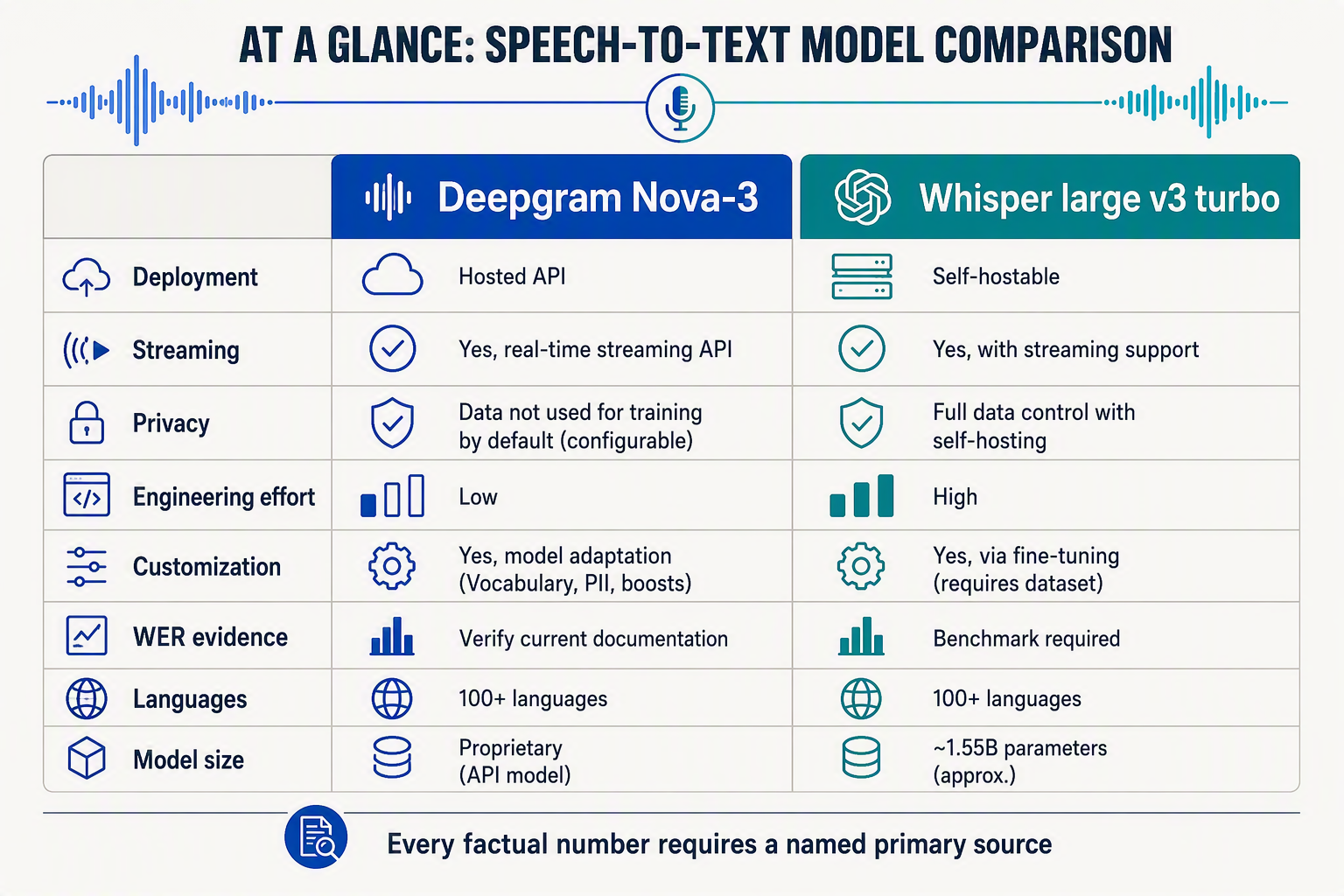
The available evidence does not establish a universal accuracy winner in Deepgram Nova-3 vs Whisper large v3 turbo accuracy. Deepgram Nova-3 is the managed API option for production streaming, while Whisper large v3 turbo offers a more controllable self-hosting path; the right choice depends on the audio, deployment requirements, and evaluation results from your own data.
What does the evidence support?
The supplied research handoff found no credible public benchmark using identical audio, preprocessing, language conditions, and scoring rules for both models. That means a vendor-reported Deepgram Nova-3 accuracy result cannot be fairly compared with an independently measured Whisper large v3 turbo accuracy result unless the full evaluation setup matches.
| Evaluation dimension | Deepgram Nova-3 | Whisper large v3 turbo | Evidence-based interpretation |
|---|---|---|---|
| Accuracy winner | Not universally established | Not universally established | Test both on representative audio |
| Deployment model | Managed API | Self-hostable/open-weight path | Compare engineering trade-offs |
| Real-time workflow | Built for hosted streaming use | Requires serving and latency validation | Measure end-to-end behavior |
| Privacy and control | Audio handling follows vendor service terms | Local deployment may offer greater control | Confirm organizational requirements |
| Cost model | Verify current Deepgram documentation | Compute and serving costs vary by setup | Compare total operating cost |
How should you run a fair accuracy test?
Use the same audio files, human-verified reference transcripts, language settings, timestamps, endpointing rules, and text-normalization policy for both systems. Report word error rate (WER) separately for each test segment; lower WER is better, but WER should not be the only quality measure.
A reproducible evaluation should include:
- Representative audio: Cover the target languages, regional accents, code-switching, pronunciation styles, and realistic recording conditions.
- Acoustic variation: Include clean speech, telephone compression, vehicles, music, background noise, and competing conversations.
- Speaker mix: Test single-speaker and multi-speaker recordings. Score speech recognition separately from diarization, turn segmentation, and speaker attribution.
- Formatting behavior: Evaluate capitalization, punctuation, numerals, dates, currencies, email addresses, and other normalization-sensitive outputs independently from raw WER.
- Domain vocabulary: Include product names, proper nouns, medical or technical terms, abbreviations, and phrases from real conversations.
- Repeated sampling: Use enough recordings to avoid conclusions based on isolated examples, and report variation or confidence intervals where feasible.
What is the practical verdict?
Choose Deepgram Nova-3 when a managed API, hosted streaming workflow, and reduced infrastructure effort are priorities. Evaluate Whisper large v3 turbo when local processing, deployment control, or privacy requirements justify managing compute, serving, decoding, and latency validation yourself.
Neither model should be declared more accurate from unrelated benchmark numbers or transcript previews. The defensible answer to Deepgram Nova-3 vs Whisper large v3 turbo is therefore conditional: benchmark both models on the audio, languages, accents, noise levels, and vocabulary that matter to your application.
How do their prices compare? (TABLE)
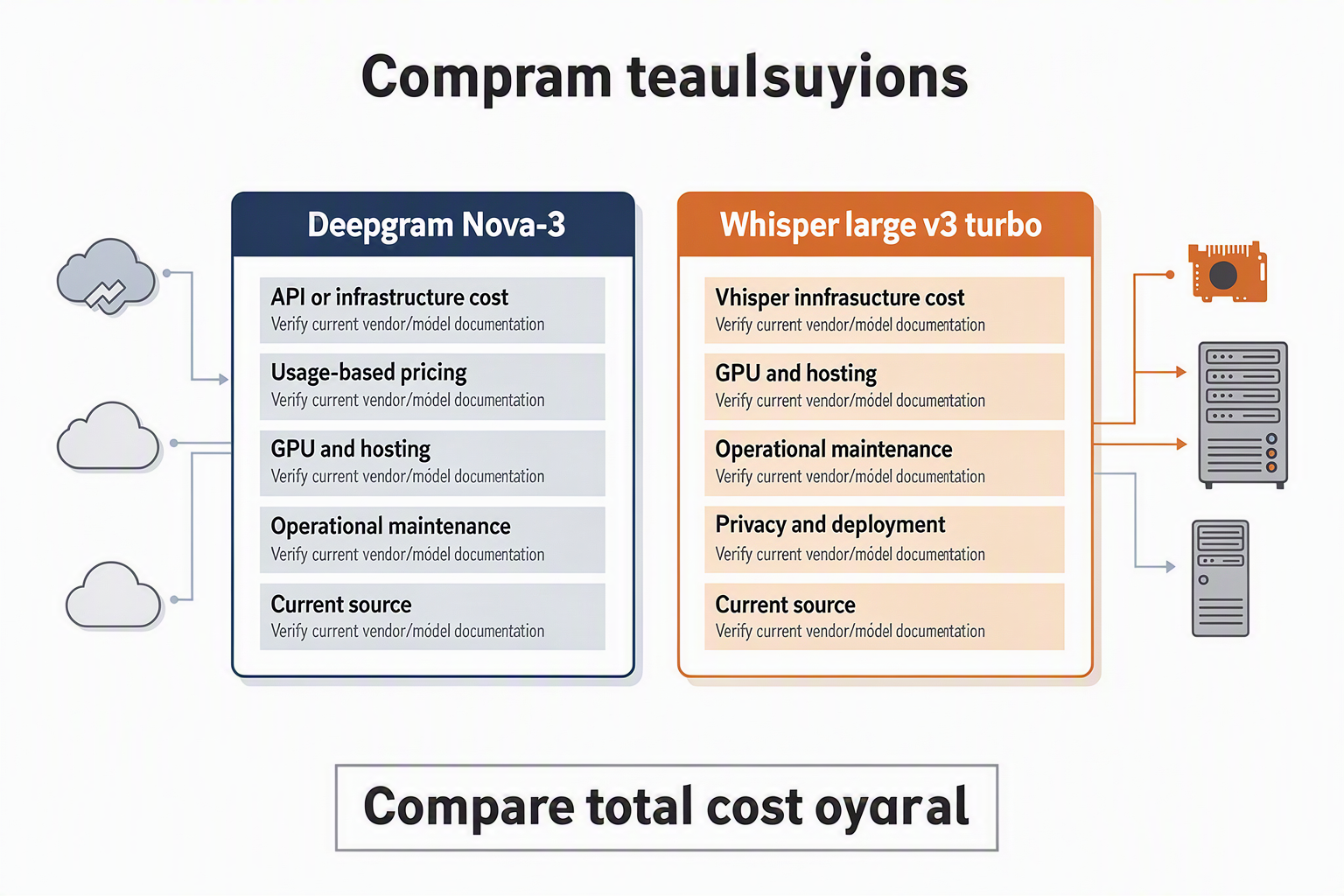
The price comparison is not simply “API rate versus free model”: Deepgram Nova-3 has metered hosted-inference costs, while Whisper large v3 turbo has no model license charge but requires compute and serving infrastructure. The supplied evidence contains no verified, current price figures that support a direct numerical winner.
Pricing snapshot
| Cost factor | Deepgram Nova-3 | Whisper large v3 turbo | What to verify |
|---|---|---|---|
| Model access | Hosted API with usage-based billing | Open-weight model for self-hosting | Current Deepgram pricing and Whisper model license |
| Inference charge | Per-usage rate; exact amount varies by product and billing tier | No per-minute vendor API fee when run locally | Cloud GPU, CPU, or managed-inference rates |
| Infrastructure | Deepgram operates serving infrastructure | Buyer supplies deployment, compute, storage, and monitoring | Hardware utilization and monthly traffic |
| Streaming | Production API workflow; confirm current streaming rate | Requires an inference server and streaming implementation | Streaming support, minimum billing, and latency |
| Scale economics | Predictable usage billing, subject to volume and feature pricing | Potentially favorable at sustained volume, but workload-dependent | Break-even point using real audio volume |
- Deepgram Nova-3: Use the current Deepgram pricing documentation to confirm per-minute rates, streaming charges, volume discounts, and any add-on costs; do not reuse an undated number.
- Whisper large v3 turbo: The Whisper model documentation establishes the self-hostable model option, but “free” excludes GPUs, orchestration, engineering, updates, and operational support.
- Fair comparison: Calculate total cost per 1,000 audio minutes, including transcription, infrastructure, storage, monitoring, retries, and human correction.
- Small workloads: Nova-3 may avoid fixed infrastructure commitments, whereas self-hosting Whisper large v3 turbo can introduce setup overhead before the first transcript.
- Large or sensitive workloads: Self-hosting may improve infrastructure control and privacy, but only a production pilot can establish actual utilization, throughput, and cost.
- Bottom line: Neither option has a defensible universal price advantage without current vendor rates, traffic volume, hardware assumptions, and the same accuracy target.
What are the pros and cons of each model? (TABLE)
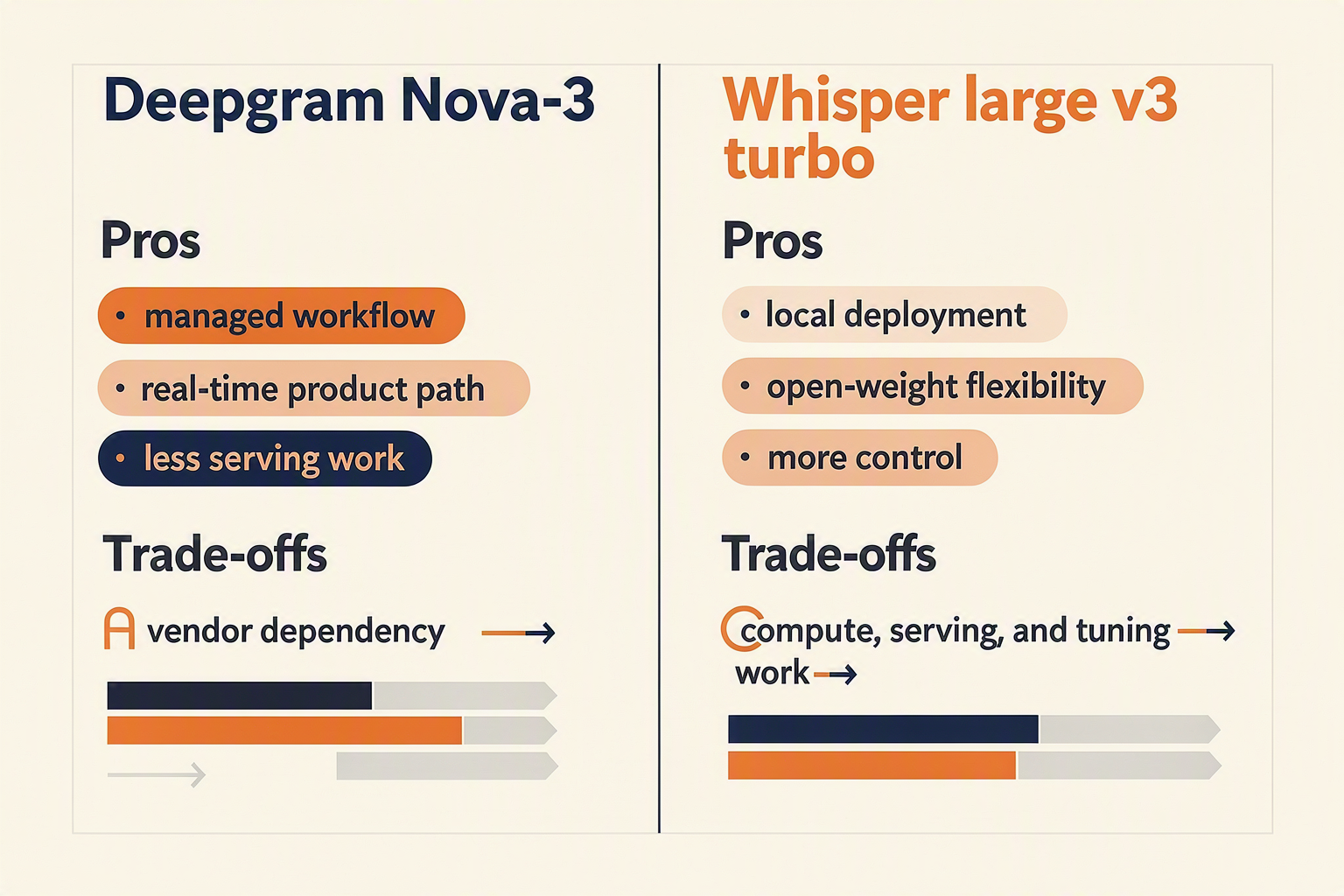
Neither model has a proven universal accuracy advantage: Deepgram Nova-3 vs Whisper large v3 turbo accuracy still depends on the recordings, language, noise, and deployment. Nova-3 favors managed production workflows, while Whisper large v3 turbo favors deployment control and privacy.
At-a-glance comparison
| Dimension | Deepgram Nova-3: advantage | Deepgram Nova-3: trade-off | Whisper large v3 turbo: advantage | Whisper large v3 turbo: trade-off |
|---|---|---|---|---|
| Accuracy evidence | Vendor-managed evaluation and production tooling | Public claims may not match your audio | Reproducible local testing on your data | Results depend on decoding and inference setup |
| Deployment | Hosted API reduces serving and infrastructure work | Requires network access and vendor dependency | Can run in a controlled environment | Requires compute, serving, monitoring, and updates |
| Real-time use | Designed for managed streaming workflows | Validate endpointing and streaming behavior for your use case | Can be adapted to streaming pipelines | Real-time performance depends on hardware and implementation |
| Privacy | Suitable when sending audio to an approved hosted provider | Audio leaves your infrastructure | Local deployment can keep audio on-premises | Security, scaling, and maintenance become your responsibility |
| Customization | API parameters and platform features simplify integration | Less control over model internals | More control over preprocessing and decoding | Tuning requires engineering effort |
| Cost | Usage-based API budgeting can simplify operations | Current rates require verification in Deepgram documentation | Model access may avoid per-minute API fees | Infrastructure and engineering costs still apply |
- Choose Nova-3 when managed streaming, faster integration, and reduced infrastructure ownership matter more than local model control.
- Choose Whisper large v3 turbo when on-premises processing, customization, or offline operation is a priority.
- For accuracy: measure WER, where lower is better; WER counts substitutions, deletions, and insertions against the reference transcription.
- For accents and noise: test each language, regional accent, background condition, and code-switching pattern separately rather than relying on aggregate impressions.
- For production quality: score recognition separately from diarization, punctuation, formatting, endpointing, and streaming latency.
A fair decision requires identical audio, preprocessing, language settings, normalization rules, and reference transcripts. CallMissed’s multi-model AI gateway illustrates the broader production trend: teams increasingly want provider flexibility without rebuilding every integration.
Which should you choose for your transcription workload?
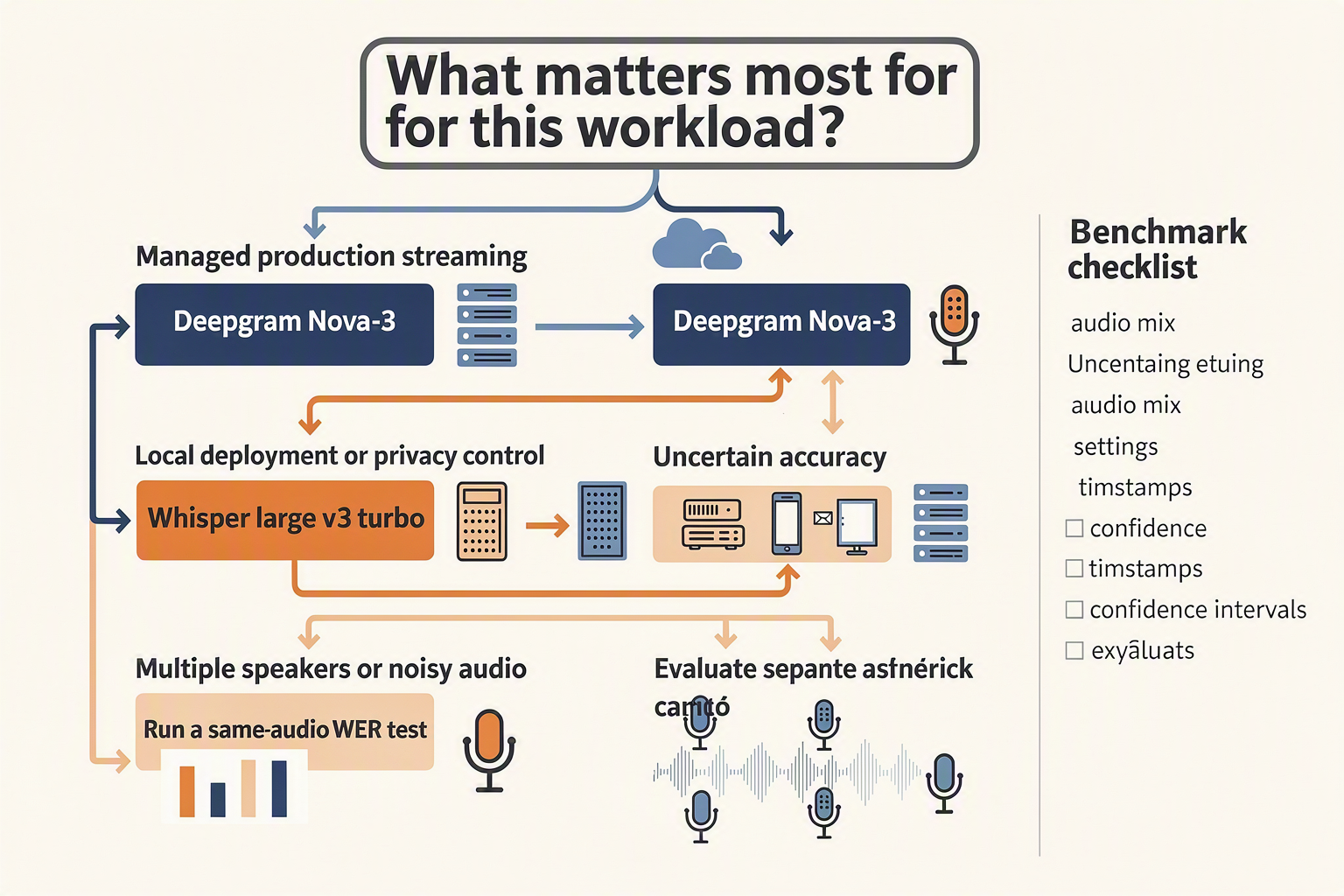
Choose Deepgram Nova-3 when managed real-time delivery and lower infrastructure effort matter most; choose Whisper large v3 turbo when local control, privacy, and deployment flexibility matter more. Neither is a proven universal accuracy winner without testing your own recordings.
Match the model to the workload
- Deepgram Nova-3: Prefer for production streaming workflows where a hosted API, real-time integration, and reduced infrastructure management are priorities; validate current latency, limits, and pricing in Deepgram’s documentation.
- Whisper large v3 turbo: Prefer when self-hosting, local processing, model control, or data-residency requirements justify managing GPU compute, inference serving, scaling, and latency yourself; its “free” status depends on infrastructure and operating costs.
- Accent and language coverage: Test the exact languages, regional accents, and code-switching patterns in your dataset. For Indian-language workloads, platforms such as CallMissed provide Speech-to-Text and Text-to-Speech across 22 Indian languages, offering an alternative when Indic coverage is central.
- Noise and speaker overlap: Compare clean audio, telephone compression, background conversations, vehicle noise, and overlapping speakers separately. Recognition errors, diarization mistakes, and endpointing failures are different measurements.
- Domain vocabulary: Include product names, medical terms, addresses, acronyms, and Indian names in the test set. A lower overall WER can still conceal costly errors in the words your business relies on most.
- Make the decision with WER: Run both systems on identical audio using the same language, preprocessing, normalization, punctuation policy, timestamps, and reference transcripts. Report WER = (substitutions + deletions + insertions) ÷ reference words, with lower values better, plus confidence intervals or repeated-sample results.
- Operational trade-off: Nova-3 may shorten the path from prototype to managed production; Whisper large v3 turbo may provide greater deployment control. Treat these as architecture differences—not proof of superior accuracy—and verify current vendor documentation before committing.
What do readers still ask about Nova-3 and Whisper large v3 turbo accuracy?
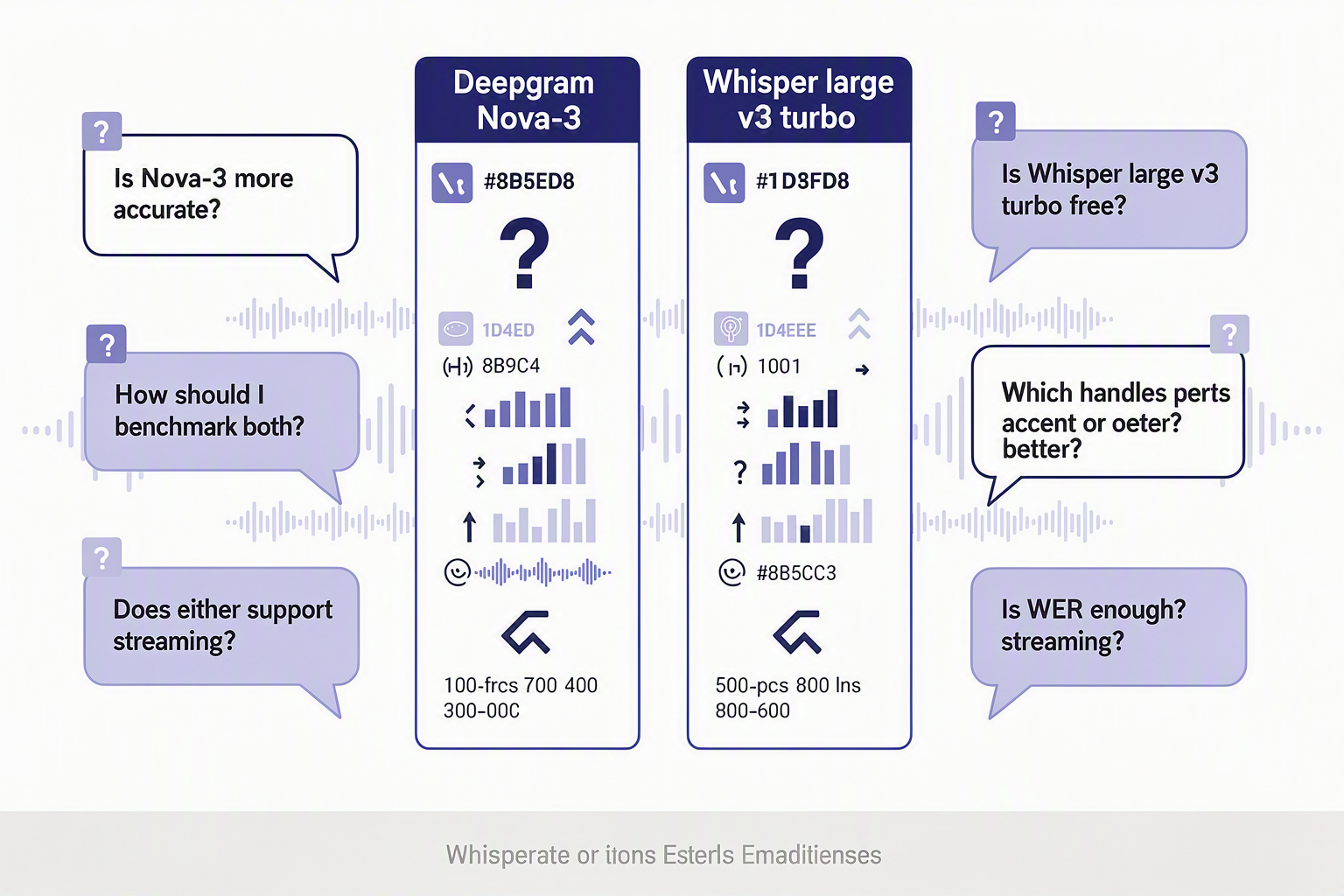
- Q: Is Deepgram Nova-3 more accurate than Whisper large v3 turbo?
A: No universal accuracy winner is established by a credible public benchmark using identical audio and scoring. Test both models on the same recordings, languages, accents, noise conditions, normalization rules, and WER methodology.
- Q: Do Nova-3 and Whisper large v3 turbo support streaming?
A: Nova-3 supports managed real-time streaming, while Whisper large v3 turbo requires chunking and deployment infrastructure for near-real-time use. Validate latency, endpointing, and transcript stability in your production environment.
- Q: Can I self-host Nova-3 or Whisper large v3 turbo?
A: Whisper large v3 turbo can be self-hosted, whereas Nova-3 is primarily accessed through Deepgram’s managed API. Confirm current licensing, deployment options, hardware requirements, and data-governance terms before choosing.
- Q: How should I test WER for Nova-3 versus Whisper large v3 turbo?
A: Run both models on identical, representative recordings and apply the same text normalization and scoring rules. Report word error rate—substitutions, deletions, and insertions divided by reference words—preferably with confidence intervals or repeated samples.
- Q: Which model is better for noisy audio?
A: Neither model is proven universally better across every noise condition. Benchmark telephone audio, background speech, music, reverberation, microphone variation, and overlapping speakers separately rather than relying on one blended score.
- Q: Which model is better for multilingual speech and accents?
A: The better model depends on the specific languages, accents, and code-switching patterns in your audio. Test each target language independently with native-speaker references; for Indian deployments, include relevant regional languages and code-switched speech.
- Q: Is Whisper large v3 turbo cheaper than Nova-3?
A: Not necessarily, because API pricing and self-hosting costs are structured differently. Compare current Nova-3 usage fees with Whisper’s GPU, storage, engineering, monitoring, scaling, and maintenance costs.
- Q: Is WER enough to choose between the two models?
A: No, because WER does not measure punctuation, formatting, diarization, endpointing, latency, or streaming responsiveness. Evaluate those factors alongside accuracy, multilingual coverage, privacy, operational effort, and total cost.
Conclusion
The evidence does not prove a universal accuracy winner in Deepgram Nova-3 vs Whisper large v3 turbo accuracy. The practical verdict is workload-specific:
- Test both on identical, representative audio using WER, normalization, accents, noise, overlap, vocabulary, and confidence intervals.
- Choose Deepgram Nova-3 for a managed production-streaming workflow; choose Whisper large v3 turbo for self-hosting, privacy, and deployment control.
- Watch for stronger apples-to-apples benchmarks across languages and real-world conditions.
As speech systems mature, will your own data—not headline claims—decide the model? Explore this evolution with CallMissed, an AI communication infrastructure platform for voice agents and multilingual chatbots.
Related Reading
Related Posts
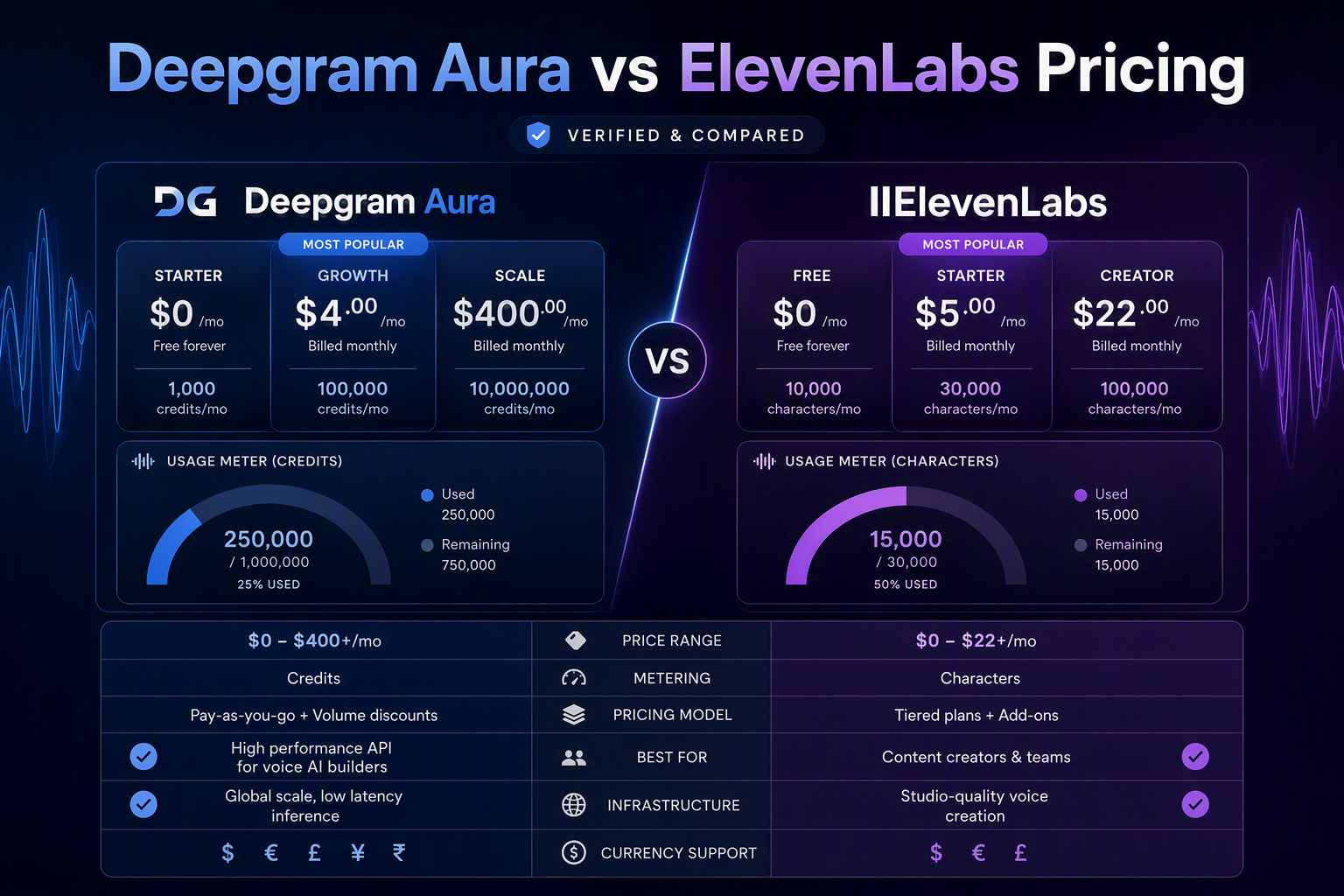
Deepgram Aura बनाम ElevenLabs मूल्य निर्धारण: सत्यापित लागत तुलना
एंटरप्राइज़ TTS के लिए Deepgram Aura-2 बनाम Amazon Polly: विशेषताएँ, मूल्य निर्धारण और निष्कर्ष
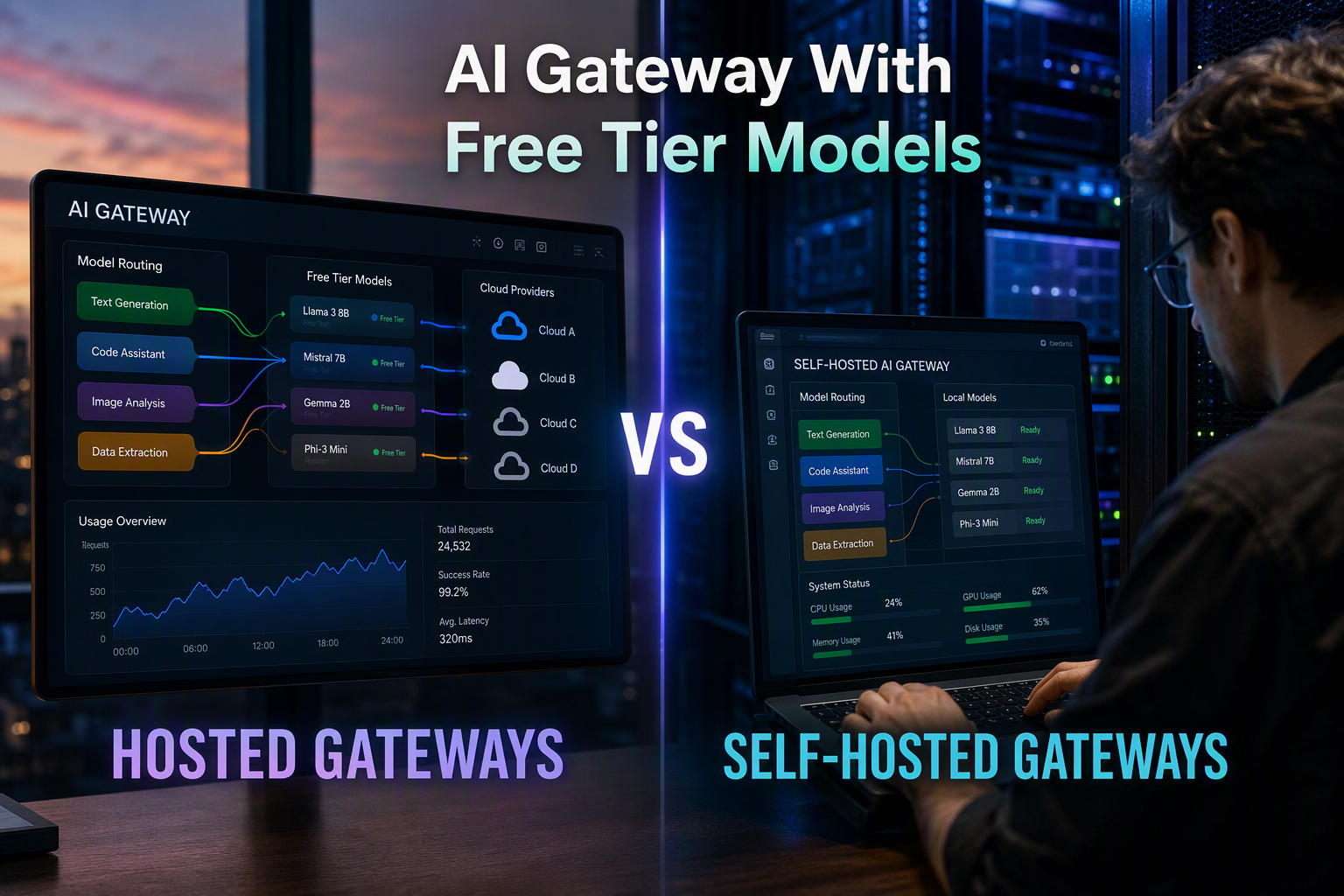
मुफ़्त टियर मॉडल वाले AI गेटवे: परीक्षण, प्रोटोटाइपिंग और प्रोडक्शन के लिए सर्वोत्तम विकल्प
Ready to automate customer conversations?
Launch AI voice agents and WhatsApp bots with CallMissed — one API, 22+ Indian languages.