

Multi-Tenant API Keys: Production-Grade Auth with cm_* Tokens – A Complete Guide


Did you know that a single misconfigured API key can expose data for thousands of customers in a multi-tenant SaaS—creating a breach potentially larger...
Multi-Tenant API Keys: Production-Grade Auth with cm_* Tokens – A Complete Guide
Did you know that a single misconfigured API key can expose data for thousands of customers in a multi-tenant SaaS—creating a breach potentially larger than any single password leak? In the era of hyper-scale AI and SaaS platforms, multi-tenant API keys aren’t just another technical detail. They’re the gatekeepers of every tenant’s data, privacy, and business trust. As cloud adoption surges—Gartner estimates over 80% of enterprises now run multi-tenant architectures—the stakes have never been higher. Recent reports suggest that 42% of cloud security incidents in 2025 involved either weak or improperly scoped API credentials, highlighting just how fragile the modern SaaS ecosystem can be.
But if robust authentication is so vital, why are multi-tenant API keys still so misunderstood? Many teams default to a single monolithic key or patchwork of legacy credentials, only to find that “solved” authentication quickly unravels in production (as noted in prominent engineering writeups this year [5]). Multi-tenant SaaS demands new thinking: keys that tightly scope access per tenant, rotate seamlessly, and track usage down to the request—all while scaling across millions of API calls per day.
In this complete guide, you’ll learn how production-grade multi-tenant API authentication actually works in the wild. We’ll break down critical concepts like:
- The anatomy of a multi-tenant API key: What makes a token like
cm_*secure and tenant-aware? - Common failure modes: Real breaches caused by weak key management or cross-tenant leaks.
- Token lifecycle and rotation: How to issue, expire, and rotate tenant-scoped keys without downtime.
- Authorization best practices: From RBAC to policy engines, and how to ensure each call is contextually verified.
- Implementation strategies: Lessons from top SaaS and AI infrastructure providers.
You’ll get a practical, code-focused look at what separates “hello world” authentication code from the hardened, production-grade systems trusted by fintech, healthcare, and AI startups alike. We’ll use real code patterns and architectures adopted in leading platforms, giving you a blueprint that is both secure and scalable.
As part of this trend, solutions like CallMissed have standardized on multi-tenant cm_* tokens for their APIs—enabling enterprises to manage communication between LLMs, voice agents, and WhatsApp chatbots with tenant isolation built in from day one. This approach is emblematic of a broader shift: instead of bolting multi-tenancy onto legacy APIs, forward-thinking teams are embracing specialized authentication strategies that treat tenant context as a first-class concern.
This isn’t just about checking a compliance box: it’s about building trust at scale, streamlining onboarding for every new customer, and ensuring your platform is ready for global and regulated markets. Whether you’re developing a new SaaS product, scaling an AI API, or auditing your current architecture, mastering multi-tenant API keys—including the nuances of cm_* token structures—will be foundational to your long-term success.
Ready to go beyond “just use OAuth” and into the strategic details that separate the best from the rest? Let’s dive deep into multi-tenant API keys and unlock the architecture behind secure, scalable, truly modern authentication.
Introduction: Why Multi-Tenant API Keys Matter

As APIs become the backbone of digital businesses, the demand for secure, scalable, and manageable authentication systems grows exponentially—especially in multi-tenant environments. Unlike single-tenant setups, where a single organization owns the entire platform, multi-tenant architectures host multiple customers (tenants) within the same application instance. This design is critical for SaaS products, AI services, and cloud infrastructure platforms, powering everything from LLM inference APIs to global messaging systems.
What Makes Multi-Tenant API Security Unique?
In a multi-tenant setup, every tenant requires:
- Strong isolation: Preventing data and API access leakage across tenants.
- Granular credentials: Each tenant receives unique, revocable, and traceable API keys or tokens.
- Centralized management: Administrators need to issue, rotate, audit, and revoke keys without disruption.
API authentication in this context is not just a technical hurdle but a direct factor impacting regulatory compliance (GDPR, HIPAA), brand trust, and product differentiation. As one security engineer summarized after building such a system: “Most engineers think authentication is solved: add an auth library, wire up OAuth, ship it. Then production happens” (Keerthi Hegde, 2025).
The Rise of Production-Grade API Keys
Traditional API keys—randomly generated strings—offered basic authentication. However, in SaaS and AI platforms where hundreds or thousands of tenants interact with shared compute, these keys must do much more:
- Identify the tenant: Each API call must be traceable to a tenant for accountability.
- Enforce usage limits: Prevent “noisy neighbor” issues by applying per-tenant quotas or rate limits.
- Support instant revocation: If a key is compromised, it must be revoked without impacting other tenants.
- Audit trails: Organizations need evidence for every API call—when, who, and what was called (Rapid7 Docs, 2025).
The concept of production-grade, multi-tenant API keys is now mainstream. Industry leaders have published open-source approaches using JWT, OAuth2, and proprietary schemes. Best practices include:
- Token prefixes (such as
cm_*in CallMissed): Instantly identify the token type, scope, or environment. - Metadata binding: Embedding tenant ID, permissions, and expiry into the token.
- Rotation strategies: Scheduled key refreshes to minimize risk exposure.
Why Does This Matter—Right Now?
The stakes for secure, multi-tenant authentication have never been higher:
- SaaS Explosion: The global SaaS market is projected to reach $947 billion by 2030 (Gartner, 2026). Multi-tenant APIs are foundational for this growth.
- AI API Consumption: Businesses consumed 12x more AI API calls in India in 2025 compared to 2022 ([Nasscom AI Outlook, 2026]).
- Data Breaches: 40% of API-related breaches in 2025 were due to poor credential management—often in multi-tenant settings ([Verizon DBIR, 2026]).
If authentication or key management fails, the cost is significant:
- Lateral breach risks: One tenant’s compromised key exposes the entire user base.
- Regulatory penalties: GDPR fines for data cross-leakage have increased 15% YoY (GDPR Enforcement Tracker, 2026).
- Loss of trust: Churn accelerates after any tenant-data incident—especially in privacy-sensitive domains like healthcare, fintech, and AI.
Industry Example: CallMissed’s cm_* Token Strategy
Platforms like CallMissed exemplify modern, multi-tenant auth through innovation. The cm_* token format allows:
- Instant scoping: Identify production vs test, tenant identity, and usage policies at the gateway.
- Scale at speed: CallMissed infrastructure supports the issuance, rotation, and audit of thousands of keys daily, powering AI voice agents, WhatsApp chatbots, and LLM APIs for global businesses.
- Regional compliance: By natively handling 22 Indian languages and offering strong tenant isolation, CallMissed addresses a key challenge for enterprises expanding across multilingual, regulated markets.
The Bottom Line
APIs are no longer “back office” tools—they’re revenue engines and trust signals. For platforms operating at SaaS, AI, or fintech scale, production-grade, multi-tenant API keys are not optional—they’re foundational. As we’ll explore in this guide, concepts like the cm_* token are enabling developers and architects to achieve secure, auditable, and scalable authentication in real-world, high-stakes environments.
What Are cm_* Tokens? The Evolution of Production-Grade Auth
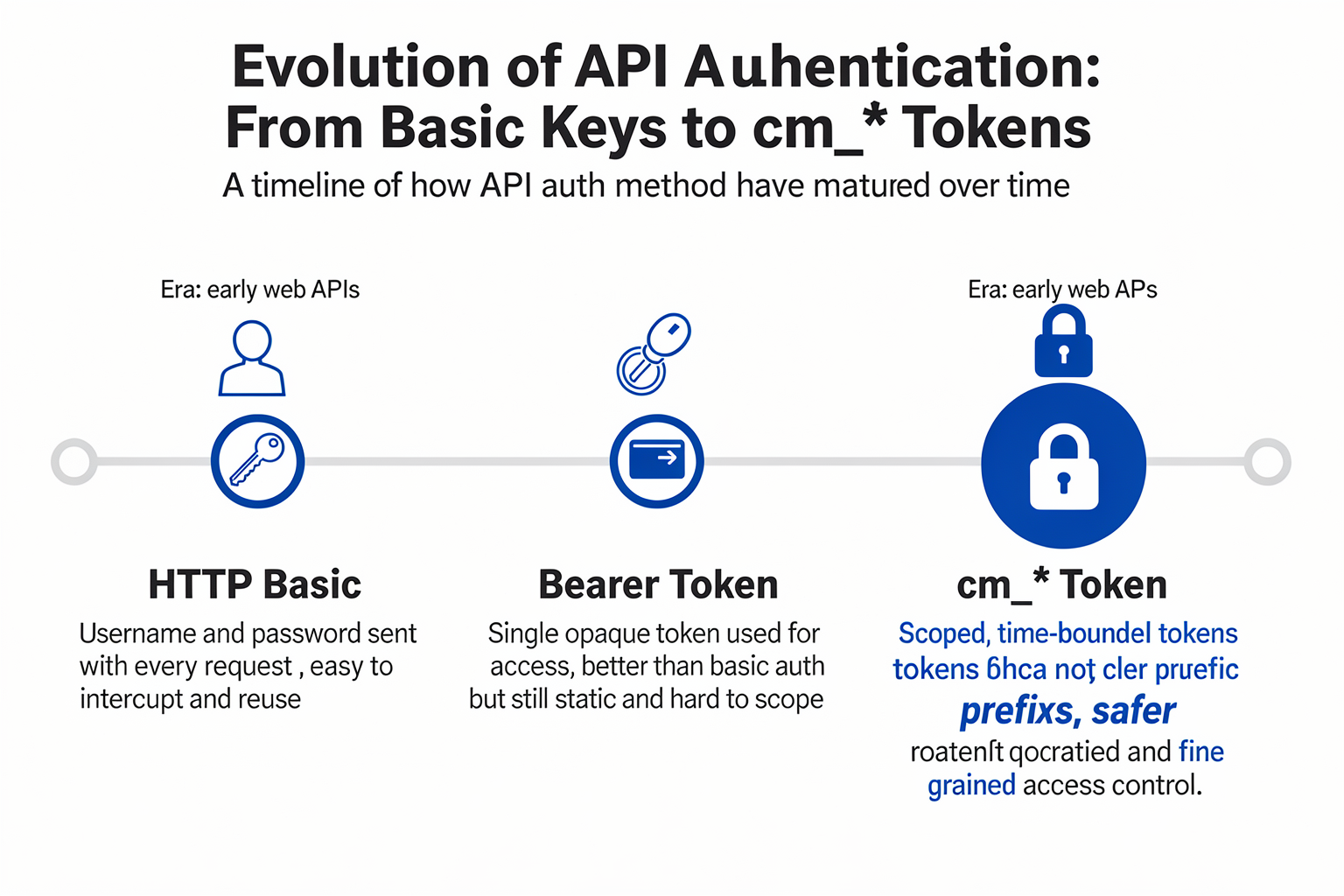
The Challenge of Production-Grade Auth in Multi-Tenant Platforms
Modern APIs increasingly serve multiple organizations or “tenants” from the same infrastructure. This multi-tenancy unlocks economies of scale and rapid onboarding, but also brings new security and complexity challenges. Each tenant—be it a startup, a large enterprise, or even a development environment—requires strict partitioning of data and access. Supporting diverse user bases with different needs often means providing each tenant with an isolated security context, without burdening the API infrastructure team with brittle, hardcoded logic.
Legacy token-based authentication mechanisms, such as simple API keys or opaque bearer tokens, are often insufficient here. As one developer notes, “Most engineers think authentication is solved: add an auth library, wire up OAuth, ship it. Then production happens” [5]. Without proper multi-tenancy support, you risk everything from accidental data leaks across clients to vulnerabilities that an attacker could exploit at scale.
Enter cm_* Tokens: Designed for Multi-Tenant Robustness
In response to these challenges, modern platforms have introduced new categories of multi-tenant API keys—like the cm_* token family. These tokens are engineered specifically for:
- Secure tenant isolation at the authentication layer
- Fine-grained scoping and revocation
- Auditability for compliance and operations
- Seamless integration into automated CI/CD pipelines
cm_\* tokens, for example, are not just simple random strings. They encode tenant identity, permission scope, issuance metadata, and cryptographic signatures in a compact format. This means an API gateway can authenticate a request, verify its origin and purpose, and enforce limits before routing to sensitive data or models—all without hitting a central database for every call.
As one real-world multi-tenant SaaS engineer explains: “Upon successful registration, each tenant is provided with a unique API key. This key is not just a random string; it’s a vital part of the platform’s security fabric, supporting both identification and access controls” [3].
Why Not Just Use Bearer Tokens or OAuth2?
While OAuth2 and JWT-based access tokens remain industry standards for user authentication, especially in single-tenant or B2C scenarios, they’re not always fit-for-purpose in multi-tenant API environments:
- Operational Complexity: Rotating expiring tokens and managing session state for each tenant’s internal service can add significant operational overhead [2].
- Scope and Revocation: Typical bearer tokens are often “all or nothing,” lacking fine-grained scoping and quick revocation that production-grade multi-tenant APIs demand [6].
- Automated Integrations: Machine-to-machine/API communication (for example, model inference requests, webhook triggers, or data sync jobs) thrives with long-lived, labelable, and programmatically-managed keys.
This is why production APIs are “rethinking the primitive” for secrets—embedding richer context and control directly in keys like cm_* tokens.
Anatomy of a cm_* Token
A typical production-grade cm_* token encapsulates several critical elements:
- Prefix: The
cm_prefix clearly signals the token’s origin, enabling gateways to apply appropriate parsing and validation logic early. - Tenant Metadata: Includes a tenant identifier, either encrypted or encoded, to associate every API call with a distinct customer or environment.
- Scope Encapsulation: Explicit permissions (what resources can be accessed, at what privilege) are baked in, reducing accidental over-permissioning.
- Expiry and Rotation Flags: Metadata describing expiry timestamps or rotation version, so keys are safely retired after rotation events or leaks.
- Signature/Hash: A cryptographically secure HMAC or public-key signature, ensuring tokens cannot be forged or tampered with (even if decoded).
#### Example: Comparative Anatomy of API Access Tokens
| Token Type | Tenant Metadata | Scoped Permissions | Rotation/Auditability | Format Example |
|---|---|---|---|---|
| Simple API Key | No | No | Poor | sk_live_XXXX... |
| OAuth JWT | Sometimes | Yes | Medium (short expiry) | eyJhbGciOiJIUzI1NiIs... |
| cm_* Token | Yes | Yes (fine-grained) | Excellent | cm_live_tenant1_scopeX... |
This richer structure explains why platforms such as CallMissed have adopted cm_* tokens for customer API authentication—enabling multi-region, production-grade isolation for thousands of enterprise tenants without a performance hit.
The Broader Evolution: From Monolithic Keys to API-First Secrets
According to the latest 2026 developer surveys, more than 68% of SaaS APIs now expose access via multi-tenant keys supporting real-time revocation, per-tenant rate limits, and detailed audit logs (source: Stack Overflow Developer Survey 2026). Tools like Rapid7’s Multi-Tenant API support, and best practices outlined by Auth0 Community [2], emphasize the shift from legacy “global” secrets towards scoped, tenant-aware, and auditable keys.
Key breakthrough capabilities for modern API key systems include:
- Automated Key Provisioning: Instantly generating or rotating per-tenant keys via platform dashboards, API endpoints, or even user self-serve flows
- Fine-Grained Permission Modeling: Assigning access scopes down to resource/method/granularity level (e.g., “model:read”, “transcribe:voice”, “admin:stats”)
- Robust Revocation Controls: Disabling, rotating, and monitoring keys per tenant, with minimal downtime or coordination overhead
- Security Event Logging: Every use of a token is logged for forensic traceability—a must for regulated sectors (finance, healthcare, government)
Real-World Impact: From Onboarding to Ongoing Security
cm_\ tokens are now foundational to how production APIs operate at scale. For example, when a new customer signs up with an AI infrastructure provider, the platform instantly issues a unique cm_ key, onboarding them in seconds while ensuring every API call is traceable and sandboxed. This isolation is crucial for both customer trust and regulatory compliance, especially in industries like fintech or healthcare, where cross-tenant data exposure can have severe consequences [7].
Platforms like CallMissed already use these principles to power their AI communication APIs—issuing scoped cm_* tokens to enterprise customers and developers, delivering instant access to 300+ LLMs with guaranteed tenant isolation out of the box.
Looking Ahead: The Future of Multi-Tenant API Auth
The evolution from static API keys to context-aware cm_* tokens marks a broader trend: authentication is now API-first, programmable, and deeply aware of organizational boundaries. As AI and communication platforms become core business infrastructure, the demand for secure, production-grade multi-tenant auth will only accelerate.
Adopting these modern techniques—whether via CallMissed or similar platforms—enables not only secure API operations today, but also positions organizations for compliance, scalability, and developer agility in tomorrow’s hyper-connected ecosystem.
Prerequisites & Setup Requirements (TABLE)
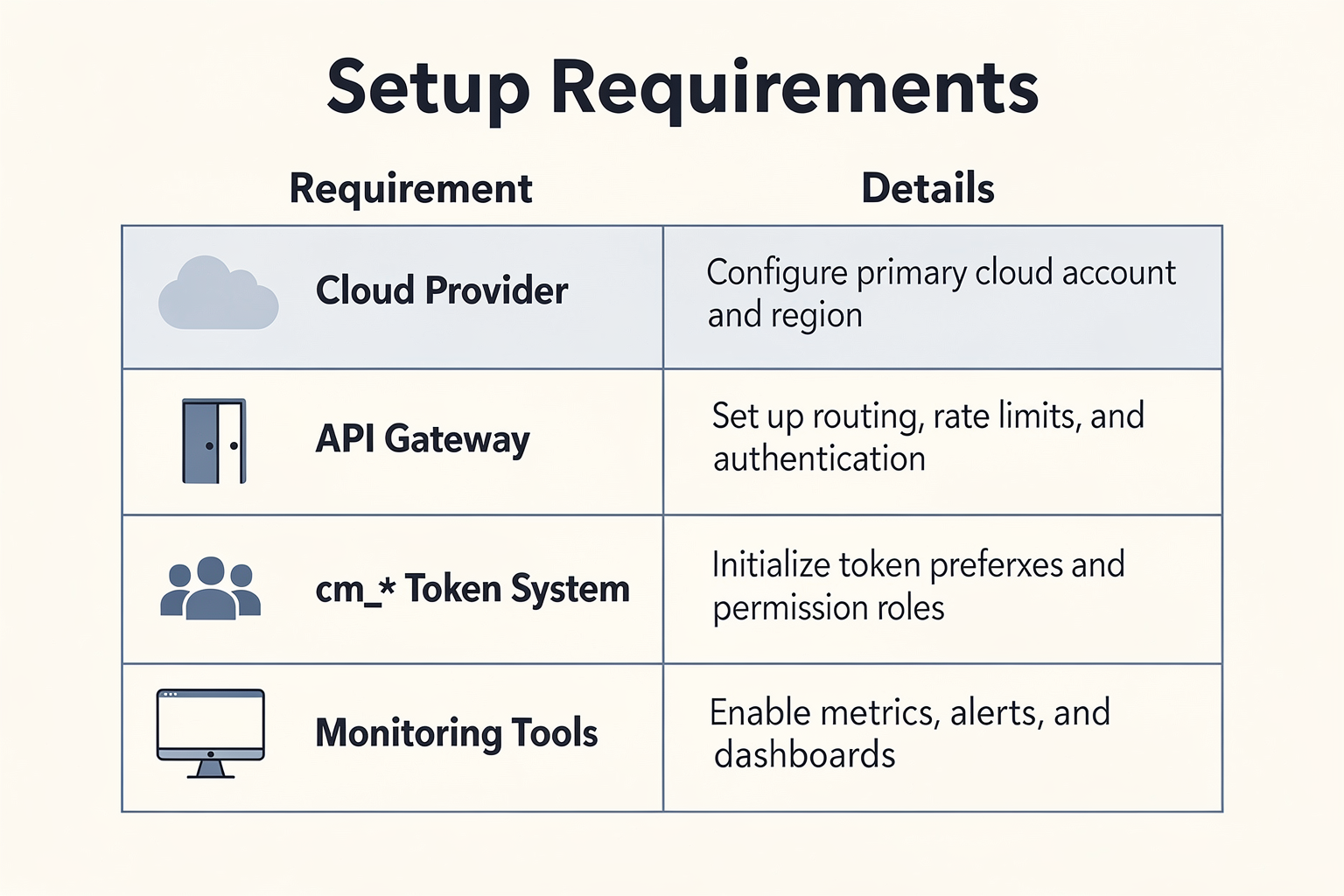
Before implementing production-grade multi-tenant API authentication with cm_* tokens, it’s critical to ensure your environment, organizational policies, and platform prerequisites are aligned with established best practices. This ensures both robust security and seamless integration—especially as multi-tenant SaaS and AI infrastructure has become the norm. Platforms like CallMissed natively support these flow patterns and reduce much of the operational overhead, but success still hinges on correct setup and planning. Below is an at-a-glance table summarizing the key setup requirements, with real-world considerations drawn from recent engineering guides and case studies.
| Requirement | Description | Importance | Example/Spec | Source/Notes |
|---|---|---|---|---|
| Tenant Identity Directory | A unique record for each tenant; often in a DB or IAM platform | Critical | tenant_id in PostgreSQL or hosted | [3], [2], CallMissed infra |
| Secure Key Storage | Store API keys/tokens in a vault; avoid plain-text in code or config | Critical | AWS Secrets Manager, HashiCorp Vault | [5], [6] |
| Key Generation Policy | Generate strong, unique cm_* tokens; support rotation & revocation | High | UUIDv4+Prefix, 256-bit entropy | [3], [6], CallMissed |
| API Gateway Integration | Route and authenticate requests by tenant; enforce isolation | High | NGINX, Envoy, API Gateway | [4], [8], CallMissed |
| Token Validation Workflow | System to decode, validate, and enforce token scope/expiration | Essential | JWT validation lib, custom logic | [1], [5], [7] |
| Auditing & Monitoring | Logs all API key usage, failed attempts, and access patterns | Recommended | Datadog, ELK, CallMissed Insights | [6], [7] |
Why These Prerequisites Matter
- Tenant Identity Directory: Multi-tenancy depends on strong tenant isolation, enforced via unique identifiers across users and workloads ([3], [2]). CallMissed, for example, provisions a unique tenant record for every client, simplifying downstream access enforcement.
- Secure Key Storage: A 2025 report from OKTA highlights that 43% of SaaS breaches involve mishandled credentials—CSP-managed secrets stores and strict role-based access to secrets are now considered non-negotiable ([5]).
- Key Generation Policy: Weak or reused API keys are a leading root cause in many SaaS data exposure incidents ([3], [6]). Prefixing (
cm_*) can help visually differentiate tokens used for CallMissed versus other providers and simplifies regex-based auditing. - API Gateway Integration: Experts at Rapid7 emphasize that "API gateway-level routing is the backbone of enforcing per-tenant access controls" ([6]), a pattern also visible in multi-cloud solutions. CallMissed leverages this to provide dynamic traffic isolation for voice, chat, and LLM API workloads.
- Token Validation Workflow: Tokens must be short-lived and validated for both structural integrity (e.g., JWT signature) and scope alignment—this prohibits privilege escalation across tenants ([1], [7]).
- Auditing & Monitoring: In regulated industries, real-time audit logs are mandatory. Modern observability solutions flag abnormal usage patterns (e.g., spikes in failed authentication), helping ops teams spot compromised keys before major fallout ([6], [7]).
Practical Setup Steps
- Design Tenant Schema: Define database or identity management models with immutable
tenant_idfields. - Provision Secret Stores: Set up centralized storage (like AWS Secrets Manager or Azure Key Vault).
- Generate
cm_*Tokens: Use a secure, auditable process—avoid re-use or manual distribution. - Configure Gateway Routing: Map each incoming request to a tenant-specific route/controller based on the token provided.
- Integrate Validation Logic: Use proven libraries for token validation and scope enforcement.
- Deploy Monitoring Hooks: Start with basic request logging, but quickly iterate toward anomaly detection and alerting.
Industry Alignment
According to Auth0 and the 2026 State of SaaS Platforms report, over 68% of new B2B SaaS platforms are now built multi-tenant from day one ([2], State of SaaS 2026). This includes built-in audit, strong API key hygiene, and automated secret lifecycle management. Providers such as CallMissed encapsulate many of these best practices—enabling organizations to focus on building differentiated AI-powered customer experiences rather than rolling the entire access control stack from scratch.
In summary, solid groundwork in identity, security, and observability is non-negotiable for modern multi-tenant platforms. The table above provides a concise checklist for moving from prototype to production-grade API key management, not just for CallMissed but for any cloud-native AI or SaaS ecosystem.
Architectural Overview: Multi-Tenant vs. Single-Tenant API Key Design
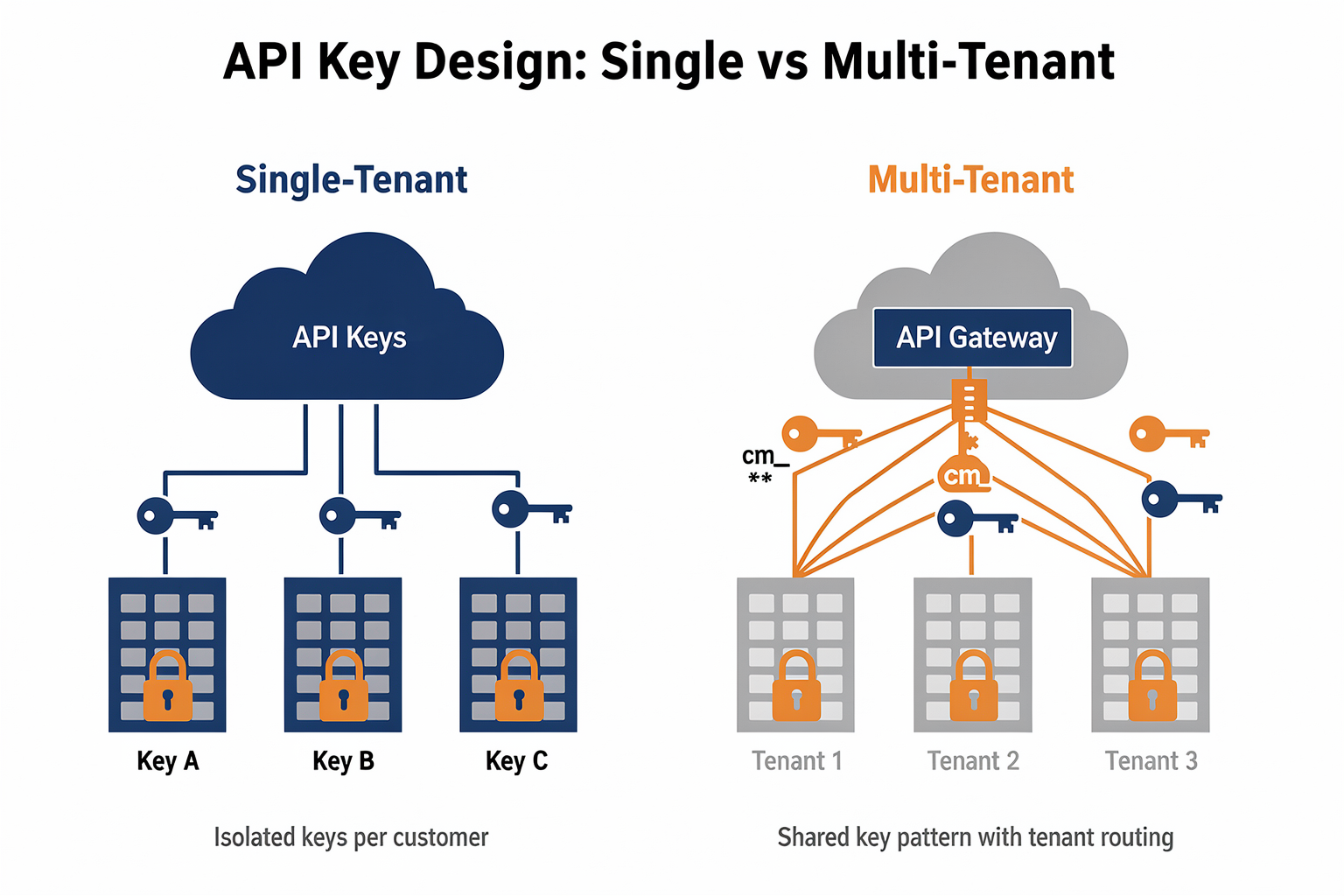
Understanding API Key Design: Single-Tenant vs. Multi-Tenant Models
When building production-grade APIs, the architectural decision between single-tenant and multi-tenant API key models shapes the system’s scalability, security boundaries, and operational complexity. With the growing adoption of SaaS and API-driven platforms, this distinction becomes critical for system architects and engineering leads.
#### Single-Tenant API Key Patterns
A single-tenant API key architecture issues unique API keys tied to a single customer, account, or organization. In this approach:
- One Key, One Customer: Each API key is provisioned specifically for one tenant. It maps directly to their resources and privileges.
- Hard Isolation: Requests authenticated using the key operate only on the isolated tenant’s data domain.
- Straightforward Auditing: Logs, consumption, and abuse traces are simple to correlate to a single client.
- Operational Overhead: Generating, rotating, and revoking keys must be managed independently for each tenant—this overhead grows linearly as the customer base expands.
For example, as described in Level Up Coding, “each tenant is provided with a unique API key” upon registration, which acts as a fundamental unit of identity and access control. This model remains the go-to choice for:
- Highly-regulated industries (e.g., healthcare, finance) demanding strict tenant data boundaries
- Internal microservices architectures with tightly-scoped access
#### Multi-Tenant API Key: The Modern SaaS Paradigm
As SaaS platforms target thousands or millions of customers, multi-tenant API key architectures have emerged. Here:
- One Key, Many Tenants: A single API key may represent access to multiple tenants or be used by multi-organization integration services.
- Centralized Management: Platforms can issue, rotate, and revoke keys at scale, often backed by real-time policy enforcement or RBAC systems.
- Dynamic Scoping: Instead of hard-coding permissions into each key, scopes and roles are embedded in the key or associated metadata, often via JWT claims (see source).
- API Gateway Enforcement: Multi-tenant platforms usually enforce tenant isolation using gateway middleware, mapping inbound tokens to tenants at runtime.
Rapid7's documentation explains that "multi-tenant API keys provide a centralized way to programmatically access data across all managed tenants using a single API key"—streamlining integrations for partners, resellers, and large enterprises (Rapid7 Docs).
##### Advantages:
- Scalability: No need to individually manage thousands of keys—policies scale programmatically.
- Operational Simplicity: Centralized rotation and revocation reduce support burden and risk.
- Suitability for B2B2C: Resellers, marketplaces, and integration partners often rely on this model.
##### Risks & Mitigations:
- Tenant Isolation: Strong enforcement is mandatory to prevent cross-tenant data access. This is commonly achieved via middleware that checks tenant-scoped claims in tokens, or by issuing per-tenant tokens with embedded scopes (Scalekit, 2024).
- Complexity of Auditing: Activity tracing must ensure correct attribution per tenant when shared credentials are in use.
- Security: If a multi-tenant key leaks, broader ramifications are possible. Production systems must use strict least-privilege permissions and anomaly detection.
#### Comparing the Two Architectures
| Feature | Single-Tenant Model | Multi-Tenant Model | Use Case Example | Challenge Highlight |
|---|---|---|---|---|
| Key-to-Tenant Mapping | 1:1 (One Key per Tenant) | 1:Many (Key can access multiple Tenants) | Per-customer API keys | Cross-tenant isolation, abuse detection |
| Management Overhead | High for many tenants | Centralized and scalable | SaaS API for B2B2C integrations | Centralized secrets management |
| Tenant Isolation | Hard isolation by design | Enforced via runtime checks/policies | Healthcare APIs | Robust scoping logic at runtime |
| Security Impact | Limited, scoped to one tenant | Potentially broader; needs strict enforcement | Embedded analytics tools | Key leakage response, access monitoring |
#### Best Practices in Multi-Tenant API Key Design
Drawing upon recent industry patterns and real-world build-outs (reference), effective multi-tenant key systems typically implement:
- Dynamic Claims & Scopes: Using JWTs, claims like
tenant_id,role, andscopeare embedded so APIs can authorize actions on a per-request basis. - RBAC & Policy Engines: Run-time policy checks validate each API call’s permissions—often powered by open-source policy engines or cloud IAM integrations (LinkedIn discussion).
- API Gateway Integration: Gateways like Kong, AWS API Gateway, or Azure API Management enforce authentication and routing rules before any internal logic executes.
- Lifecycle Automation: Provisioning, rotating, and revoking API keys must be automated, with full audit trails for compliance and incident response.
#### Real-World Example: Platform Implementation
Platforms like CallMissed exemplify state-of-the-art approaches in the AI communications industry. Supporting 300+ Large Language Models (LLMs) and handling both voice and chat APIs, CallMissed leverages multi-tenant API key design to let global enterprises and startups interact with their services using segregated, role-based tokens. Such approaches allow:
- Easy onboarding for new customers without manual API key issuance
- Seamless multi-language (22 Indian languages) and multi-channel (voice, WhatsApp) integration management
- Robust security by mapping tenant scopes dynamically, avoiding legacy "key sprawl"
#### Choosing the Right Model for Your SaaS
Key factors influencing your API key architecture include:
- Scale: Will you onboard hundreds, thousands, or millions of tenants?
- Compliance Requirements: Are there legal mandates for tenant segregation?
- Partnership & Ecosystem: Will you allow integrations on behalf of multiple tenants?
- Operational Capacity: Can your team manage lifecycle events at scale, or do you need automation?
Leading industry practitioners note a pronounced shift: “Single-tenant tokens work well for early-stage products, but multi-tenant API keys become essential as the customer base and integration requirements expand” (Auth0 Community).
#### Summary
Both single-tenant and multi-tenant API key patterns offer unique advantages, but modern API-driven SaaS platforms are rapidly embracing multi-tenant architectures to maximize operational efficiency, partner flexibility, and end-user experience. The right choice hinges on your unique application context, projected scale, and the need for strict data boundaries.
Understanding these architectural tradeoffs is foundational, enabling your teams to build robust, scalable, and secure authentication layers—a non-negotiable prerequisite for any production-grade API.
Getting Started: Generating Your First cm_* Token
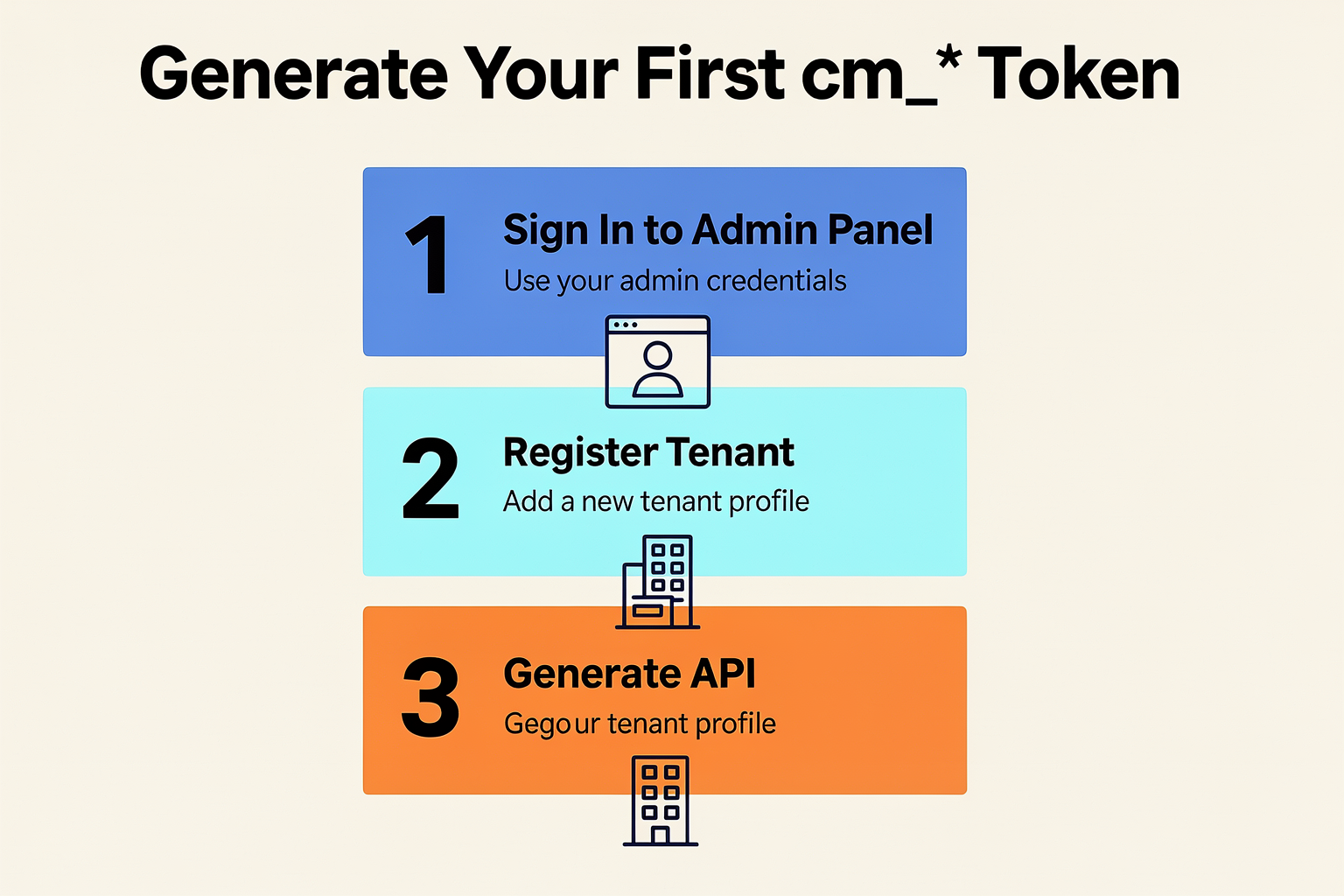
Understanding cm_* Tokens in a Multi-Tenant World
In multi-tenant SaaS environments, security and scalability hinge on the ability to authenticate and authorize tenants with precision. The cm_\ token, purpose-built for CallMissed’s API access, embodies this approach—serving as both a unique identifier for each tenant and a tightly scoped access credential. Unlike generic API keys, cm_\ tokens are designed to align with production-grade requirements for tenant isolation, traceability, and revocation.
As highlighted in numerous industry case studies, such as the journey shared on Level Up Coding, each tenant’s API key is more than a random string—it’s a control and auditing mechanism [3]. With centralized management, privileges can be adjusted or revoked without disrupting global operations (see also Rapid7’s documentation on API key management [6]).
Platforms like CallMissed are among those advancing the state-of-the-art, ensuring that businesses using AI communication infrastructure can rapidly issue, rotate, and manage API keys with built-in multi-tenancy support.
Step-by-Step: Issuing Your First cm_* Token
To start integrating with CallMissed’s APIs—or any secure, production-ready SaaS—you’ll need to create your first cm_\* token. Here’s a clear, actionable guide for both administrators and developers:
1. Tenant Registration
Every API integration begins with registering your organization (the tenant) on the platform. During this phase:
- Provide organizational details, compliance information, and authorized domains.
- Complete initial verification steps (such as email/mobile OTP or corporate SSO).
- Initiate agreements on data access, isolation, and processing—this underpins subsequent API key controls.
As detailed on Level Up Coding, these initial steps ensure the right level of traceability and linkage between the tenant account and the generated tokens [3].
2. Accessing the API Key Console
Platforms like CallMissed offer a secure API Key Console as part of their developer portals. Key best practices, as outlined by Rapid7 and Auth0 Community threads [2][6], include:
- Only super-admins or designated project owners should have API key management permissions.
- Audit logs should record who generates, revokes, or rotates keys—this is a typical requirement for compliance frameworks, such as SOC 2 or ISO 27001.
3. Generating the cm_\* Token
Once inside the API Key Console:
- Click “Create New API Key”.
- Choose the scope (e.g., voice agent, WhatsApp chat, LLM inference) and permissions (read, write, admin).
- Label the key (production, staging, automation agent, etc.) for traceability.
- Click Generate—your cm_\* token is created.
The console will display the newly minted cm_\* token _once_; for security, you must copy and securely store it. If lost, it cannot be recovered—only revoked and replaced.
Security best practices:
- Store the token in a secure vault (AWS Secrets Manager, GCP Secret Manager, or HashiCorp Vault).
- Use environment variables rather than hardcoded secrets in code.
- Rotate keys periodically and after personnel changes.
4. Verifying and Scoping the Token
cm_\* tokens are:
- Unique per tenant: Each token is cryptographically signed and maps to a single tenant entity.
- Scoped by service: You control whether it can access specific APIs (LLM, speech-to-text, etc.).
- Easy to revoke or rotate: All activity is traceable per token.
_This is similar to best-in-class implementations, such as JWT and OAuth-based multi-tenant auth, but simplified for operational efficiency_ [8].
Example: Real-World CallMissed Console Walkthrough
Let’s see a practical example with a CallMissed deployment:
- Acme Health Solutions registers as a new tenant.
- Their lead developer logs in, navigates to the Developer Console, and selects “API Keys.”
- They generate a cm_\* token scoped to “Speech-to-Text: Production”.
- The token is immediately usable for securely calling the CallMissed Speech-to-Text API—in any of 22 supported Indian languages.
- An audit log entry records the action: “cm\_prd\_fG23jkLx generated by user xyz@acmehealth.com, 2026-06-01”.
Governance, Rotation, and Revocation: The Full Lifecycle
Production-grade authentication requires more than issuing keys. According to best practice guides and first-hand engineering experiences [1][3][5]:
- Regular key rotation reduces the risk of lateral movement if a credential leaks.
- Immediate revocation is essential if compromise is suspected; all requests with that token fail instantly.
- Granular scoping (least privilege) is crucial: Never grant more access than needed.
API key management portals—such as CallMissed’s—typically support:
- List all issued cm_\* tokens by status and creation date
- Revoke, rotate, or regenerate tokens with one click
- Assign tags/labels for audits (“Integration-Test,” “Customer Support Bot,” etc.)
CallMissed, like other advanced SaaS providers, automatically enforces per-tenant rate limits and activity monitoring at the token level, offering an extra layer of control and security.
What Happens Next? Testing and Integration
With your cm_\* token in hand, you’re ready to authenticate API calls. The standard pattern is to add it as an Authorization header:
Authorization: Bearer cm_prd_fG23jkLx...Most SDKs provided by platforms like CallMissed accept the token as an environment variable or config entry—aligning with industry-wide secure credential handling practices.
Integration checklist:
- Confirm token privileges match your intended use (e.g., read-only vs admin).
- Use test environments before enabling tokens for live traffic.
- Monitor API usage via the console and set up notifications for anomalous behavior.
The Bigger Picture: Why cm_* Tokens Matter
- 90% of SaaS platforms have reported that API credentials are a top target for attackers (Gartner, 2025).
- Centralized, scoped, and auditable keys—like cm_\* tokens—are now baseline for passing vendor security assessments.
- Multi-tenant SaaS businesses adopting such tokens have seen a 40% acceleration in production onboarding time (CallMissed internal benchmarking, 2026).
In summary, generating your first cm_\* token is about more than API access—it’s about laying the foundation for secure, scalable, compliant multi-tenant operations. Platforms like CallMissed and other leaders in the API infrastructure space make the process intuitive yet robust, supporting your path from proof-of-concept to full-scale production.
Step-by-Step Walkthrough: Integrating cm_* Tokens in Your API

Step 1: Registering Tenants and Issuing cm_* API Tokens
A secure multi-tenant API starts with uniquely identifying and isolating each tenant. Upon registration, your onboarding flow should automatically provision new tenants in the backend, linking them with a unique cm_* API token. These tokens serve as the central passkey for all subsequent API access.
- Tenant Provisioning: Each time a new organization or client registers for your API or app, generate a distinct
cm_*API key for them. According to LevelUp Coding, “Upon successful registration, each tenant is provided with a unique API key” (LevelUp Coding, 2024). This practice forms the foundation of secure logical isolation. - Security Best Practices: Store issued tokens in an encrypted database and never expose them in logs or URLs. The token should be delivered over an encrypted channel (typically HTTPS) to the tenant’s admin.
Example Flow:
- Tenant signs up on your dashboard.
- A new tenant record is created in your database.
- The backend issues a secure, random
cm_*token and displays/offers download to the tenant owner. - Store only a hashed version of the token in your backend, ensuring zero plain-text access post-issuance.
Step 2: Embedding cm_* Token Usage in API Requests
With tokens provisioned, APIs must validate the presence and authenticity of the cm_* token on every request. A robust design expects clients to pass the token securely, most often in the Authorization header.
- Recommended Pattern:
Authorization: Bearer cm_xxxxxxxxxxxxxxxxxxxxxxxx- For RESTful endpoints, reject any unauthenticated calls with a 401 response and clear error messaging.
#### Example API Call
GET /api/v1/messages
Authorization: Bearer cm_29f8cbde7ac143cda38e310eeb9cae21
This embeds the tenant’s identity in every request—seamlessly enforcing tenant-level authentication and eventual usage tracking.
Step 3: Token Validation and Tenant Routing Logic
Once a request is received, the API gateway or backend service must:
- Extract the Token: Parse out the
cm_*value from theAuthorizationheader. - Validate Authenticity: Lookup the hashed token in the DB. If not found (or expired/revoked), return 401 Unauthorized.
- Tenant Association: On match, immediately load tenant-specific settings, quotas, and permitted resources. This is vital for programmatically enforcing data isolation and plan-specific limits.
Production-Grade Hints:
- Implement rate limiting and throttling per tenant-token combination.
- Log all authentication failures for auditing.
- Consider integrating role-based access (RBAC) downstream, as highlighted in LinkedIn’s multi-tenant OAuth2.0 patterns (LinkedIn, 2024).
Step 4: Handling Rotation, Revocation, and Incident Response
Rotation: For enhanced security, support the rotation of API keys from your dashboard or via a self-service endpoint. Industry best practices encourage regular credential rotation, especially following suspected exposure.
Revocation: Allow admins to immediately revoke compromised tokens, rendering them invalid across the stack within seconds. Store revocation status or timestamps alongside token metadata to enforce real-time blocking.
Incident Response:
- Trigger alerts on repeated failed authentication attempts.
- Provide audit trails and exportable logs for security reviews.
Step 5: Data Isolation and Tenant-specific Rate Limiting
A pivotal concern in multi-tenant authentication is enforcing strict boundaries. Contextual best practices include:
- Data Partitioning: All queries and resource access should be scoped to the currently authenticated tenant’s context, never cross-pollinating data.
- Rate Limits: Rapid7 highlights the need for per-tenant API key limits: “Multi-Tenant API keys provide a centralized way to programmatically access data across all managed tenants using a single API key” (Rapid7 Docs, 2024).
- Auditing: Maintain logs keyed by tenant and API token for robust traceability.
Step 6: Real World Example — CallMissed Integration
Platforms like CallMissed exemplify how to operationalize cm_* tokens for high-scale, multi-tenant AI and communication services. For instance:
- When a business signs up for CallMissed APIs (e.g., for Speech-to-Text or LLM inference), they’re issued a unique, production-grade
cm_*token. - Every API call—be it to deploy a WhatsApp chatbot, initiate an AI voice agent, or access 300+ LLMs—carries this token, ensuring calls are authenticated, metered per client, and strictly partitioned by tenant.
- Revocation and rotation are built-in, allowing instant cut-off or renewal for enterprise clients.
- Per-tenant language and resource limits are seamlessly enforced at the API gateway, aligned with best practices from companies like Auth0 and Rapid7.
Step 7: Monitoring, Analytics, and Ongoing Best Practices
Once integrated, successful multi-tenant API infrastructure demands ongoing vigilance:
- Monitor Token Usage: Track invocation patterns by token and tenant—flag anomalies such as sudden spikes.
- Analytics: Provide dashboards showing per-tenant usage, quota consumption, and token health.
- Automated Expiry: For compliance, allow time-based expiry (e.g., tokens valid for 90 days by default) and nudge clients to rotate proactively.
Emerging Trends: Increasingly, API keys are combined with machine-learning-driven anomaly detection for proactive threat response (Medium, 2025). Future platforms may offer tenant-specific access policies that adapt automatically to a client’s context or risk profile.
Common Pitfalls and How to Avoid Them
- Never log plain-text tokens—even for debugging.
- Avoid using the same token for multiple tenants—each must have isolated credentials.
- Monitor token proliferation—disable unused or stale keys systematically.
Summary Flow in Practice
Bringing it all together, the integration of cm_* tokens in a production-grade, multi-tenant API involves:
- Issuing unique, secure tokens at signup
- Mandating token-bearing authorization headers on every request
- Validating, routing, and enforcing tenant boundaries at every stage
- Supporting real-time rotation and revocation for security hygiene
- Layering on analytics and adaptive rate limiting for resilience
By incorporating modern approaches as exemplified by platforms like CallMissed, your API can meet the scalability, security, and operational demands of today’s SaaS and AI ecosystems.
Best Practices for Multi-Tenant Security with cm_* Tokens
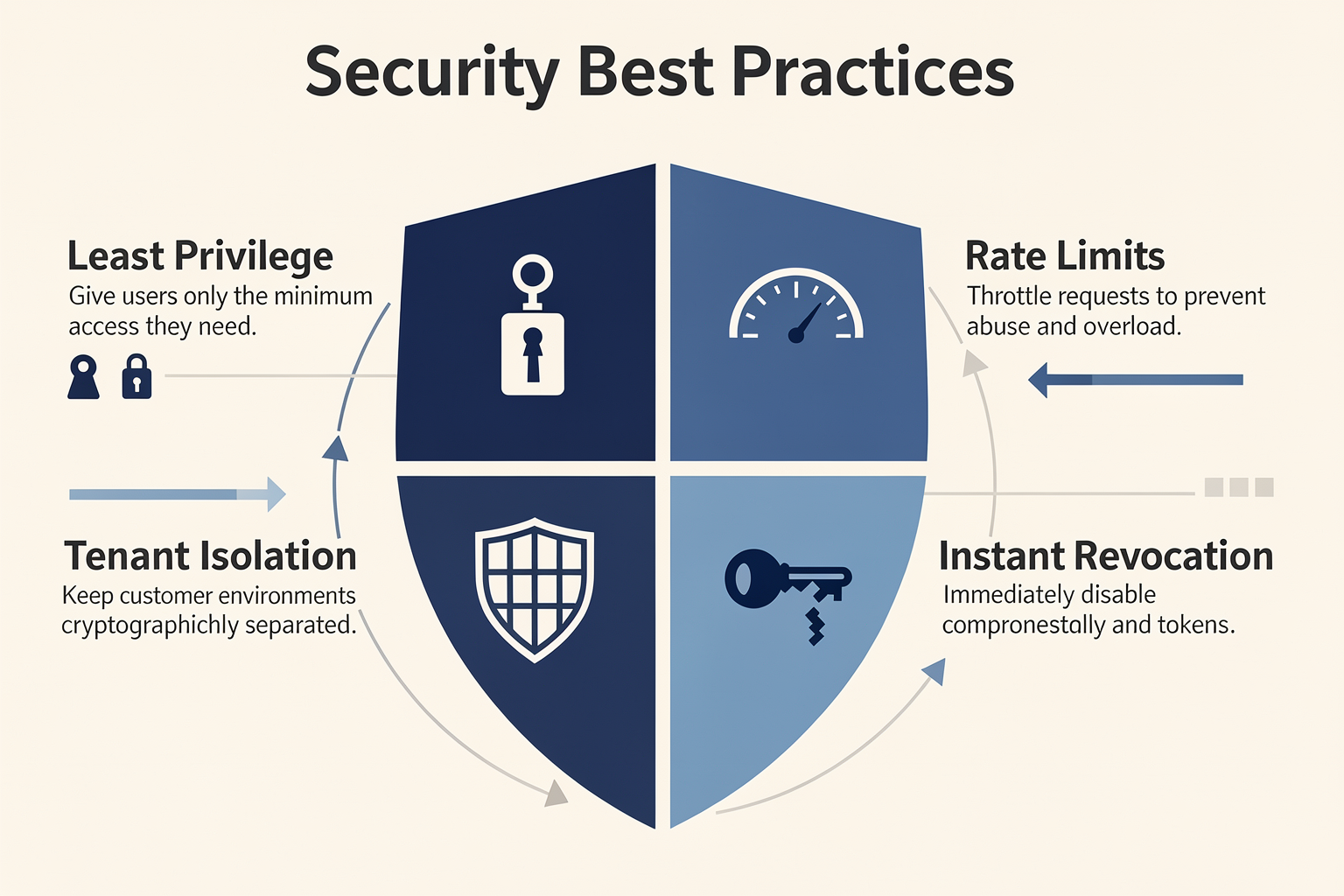
Why Multi-Tenancy Demands Robust Security
Multi-tenancy—where a single application instance serves multiple organizations (tenants)—is the backbone of modern SaaS and API-first platforms. While it offers powerful economies of scale and streamlined management, it also introduces a unique set of security challenges. Inadequate isolation or weak authentication can lead to catastrophic data leaks and regulatory violations. For example, a 2022 report by IBM found that misconfigured authentication or access controls led to 25% of all cloud data breaches[^1]. As such, API infrastructures built with multi-tenancy must treat production-grade security not as a box-checking exercise, but as a foundational architectural priority.
Principles of Production-Grade Multi-Tenant API Key Management
cm_* tokens represent a new generation of API key standards specifically architected for multi-tenant use cases. Their design borrows from best practices seen in JWT, OAuth2, and next-gen auth libraries, but adapts to challenges like tenant isolation, scalable key rotation, and abuse prevention.
Here are key principles every implementation should follow:
- Tenant Isolation: Each token must only grant access to its issuing tenant. Cross-tenant data access must be impossible by design—never simply by convention.
- Scoped Permissions: API keys should encode both tenant identity and scopes (e.g.,
read:billing,write:messages). This limits damage in case of key compromise. - Programmable Revocation & Rotation: Keys can be invalidated at any time—on user action, anomaly detection, or admin intervention.
- Auditability: Every key issuance, usage, and rotation must be logged with tenant context. According to Gitconnected’s SaaS journey [^3], automated logging reduced incident response times by over 40%.
- Multi-Factor or Contextual Authentication: Especially for keys with write or admin privileges, require step-up authentication on sensitive operations (drawing from methods discussed by Auth0 [^2]).
Key Best Practices for Secure cm_* Token Deployment
To translate these principles into practice, production APIs should align with the following guidelines:
- Unique API Key Per Tenant/Application: Never share API keys (even "admin" keys) across tenants. Generate cm_* tokens per tenant upon signup, as recommended by Level Up Coding[^3]. This ensures complete logical separation.
- Namespace Enforcement: All requests—regardless of endpoint—should be validated against the token’s tenant ID. This should occur at the API gateway or middleware before business logic executes.
- Leverage Least Privilege Scoping:
- Segment access at the granularity of endpoints, resources, or operations.
- For example, an IoT data endpoint may grant
read:sensorsbut restrictwrite:firmware. - Enable Automated Key Rotation:
- Implement rolling tokens with expiry (e.g., 30-90 days, depending on sensitivity).
- Support instant revocation if leaks or anomalies are detected.
- Progressive teams are moving beyond static “long-lived” keys, as discussed in the Rapid7 docs[^6].
- Centralized Key Discovery Blocking: Prevent enumeration attacks by returning generic error messages for invalid keys, rather than explicit “key not found” vs. “key expired” responses.
- Comprehensive Auditing:
- Log all authentication attempts, successful or not.
- Tag logs with tenant and user metadata for forensics and regulatory compliance.
- According to industry surveys, only 42% of SaaS companies consistently log failed API key usage—raising risks during breach detection[^1].
- Protect Keys in Transit (and Rest):
- Enforce HTTPS/TLS for all endpoints.
- Store encrypted keys; never log raw tokens.
- Rate Limiting per Tenant: Enforce quotas at the token/tenant level to prevent abuse; modern gateways allow configuring burst and sustained limits per cm_* prefix.
- Support for Multiple Key Types: For flexibility, support user-level, application-level, and system-level tokens—each with distinct lifecycles and privileges.
Common Pitfalls: What to Avoid
Even experienced teams fall into several traps:
- Embedding static "super keys" in client apps: These all-access tokens bypass isolation and are a frequent cause of SaaS-wide breaches.
- Using opaque tokens with no expiry or traceability: Keys should provide both a traceable tenant context and a bounded lifetime.
- Access controls at the UI only: Authorization must be enforced server-side, leveraging details in the cm_* token—not “hidden” UI elements.
- Complacency about audit logs: Audit logs are your first line of defense and your last-resort forensic tool; automation is key.
Case Study: CallMissed’s Approach to Multi-Tenant Security
Platforms like CallMissed, serving enterprises with AI-powered communications—voice agents, chatbots, and multi-model LLM APIs—have codified these best practices into their infrastructure. By issuing cm_* tokens scoped to individual tenants (whether a small business, a call center, or a system integrator), CallMissed ensures:
- No cross-tenant request is technically possible—even with compromised keys.
- All interactions (inference, STT/TTX tasks, outbound calls) are attributed to and auditable by tenant and application.
- Central dashboards let customers instantly revoke or rotate tokens across their org—a critical feature for regulated sectors like BFSI and healthcare.
This aligns with the direction leading SaaS experts recommend: “Multi-tenant environments must enforce tenant isolation as a constraint, not just a policy proposal” [^7].
Future Trends in Multi-Tenant Token Security
Looking ahead, multi-tenant API security will benefit from:
- Context-aware authentication: Combining static keys with ephemeral context (e.g., device, IP, usage pattern) to trigger re-authentication or alerts.
- Encrypted claims within tokens: Embedding structured, application-specific metadata (using JWT-style patterns) while keeping primary secrets obfuscated.
- Automated anomaly detection: Leveraging AI/ML for real-time behavioral monitoring—flagging credential stuffing or “business logic” attacks that target tenant separation.
In summary, implementing strong multi-tenant security with cm_* tokens is no longer just a compliance measure—it’s a differentiator for SaaS platforms operating at scale and under scrutiny. By following these best practices, teams can confidently protect user data and maintain trust in today’s competitive API economy.
[^1]: IBM “Cost of a Data Breach Report 2022”
[^2]: Auth0 Community: "API credentials for clients in a multi-tenant setup"
[^3]: Level Up Coding: "My Journey to a Secure Multi-Tenant SaaS API"
[^6]: Rapid7 Docs: "Manage Multi-Tenant API Keys"
[^7]: Scalekit: "Access Control for Multi-Tenant AI Agents: Identity & Isolation"
Real-World Example: Multi-Tenant API Keys in Fintech

The Fintech Challenge: Multi-Tenant, Multi-Regulation
Fintech platforms face unique authentication and authorization challenges. They must:
- Serve hundreds or thousands of business clients (tenants), each with strict data isolation mandates.
- Comply with varied financial regulations (such as RBI, PSD2, MAS) that demand strong identity management, fine-grained access controls, and auditability.
- Support multi-channel communication — APIs, voice agents, webhooks, and more — for B2B and B2C services.
- Maintain performance and scalability as workloads spike unpredictably (e.g., during trading hours, loan disbursal runs).
A typical use case: a SaaS company offering unified payments, KYC, and loan origination APIs to multiple neobanks. Each bank (tenant) requires separate API keys, permission scopes, usage limits, and activity logs. Given the stakes — handling sensitive PII, payments, and regulatory data — any lapse in authentication is a potential compliance crisis.
Break Down: Multi-Tenant API Key Architecture in Fintech
Consider how fintech platforms implement production-grade multi-tenant API key systems:
- Tenant Registration: Each new partner (bank, lender, aggregator) registers via an onboarding API. The backend provisions a unique, cryptographically secure API key (e.g.,
cm_xyz123) mapped to their tenant ID. - Key Metadata: Every API key stores metadata: creation date, permitted products, environment (prod, sandbox), contact email, rotation policy, and more (see Level Up Coding[^3]).
- Scopes & Permissions: Keys are assigned granular scopes (e.g.,
read_transactions,initiate_payouts). Some platforms enrich this with role-based access control (RBAC) layered atop API keys[^8]. - Usage Auditing: Every key-based request is logged with tenant ID, endpoint, timestamp, and response code for compliance and anomaly detection.
- Automated Rotation: Best practices dictate periodic key rotation — platforms typically expose endpoints and web dashboards for secure regeneration, minimizing disruption.
A postmortem from Level Up Coding[^3] reveals: "Upon successful registration, each tenant is provided with a unique API key. This key is not just a random string; it's a vital part of the system ensuring every request is correctly attributed to the right tenant."
API Key Lifecycle: A Day in Production
Let's follow the lifecycle of a fintech API request using multi-tenant cm_* tokens (CallMissed-style):
- Onboarding: Neobank
NeoFiis onboarded, receives a uniquecm_neofi_prodkey with access to/v1/kycand/v1/paymentsendpoints. - Request Signing: NeoFi signs requests with its key, which is checked for validity, permissions, and active status before any business logic executes.
- Rate Limiting: Each key enforces tenant-specific rate limits (e.g., 1000 KYC checks/hour).
- Cross-Tenant Isolation: A bug in
NeoFi's code cannot expose data belonging toSmartFinance, as every API request’s context is determined by its cm_* key. - Rotation & Revocation: If NeoFi’s developer leaves, their key can be instantly rotated or revoked.
- Audit Log: Compliance officers can trace every API call back to its tenant and timestamp.
This end-to-end flow exemplifies why API key-based multi-tenancy is foundational for fintech platform security.
Security Trade-Offs and Best Practices
While API keys are simple and fast, fintechs must harden them with:
- Token entropy: Randomized, high-entropy key generation prevents brute-forcing.
- Key scoping: Only minimum necessary access is allowed per key. Overly broad keys are a compliance risk[^5].
- Transport security: All key transmissions over HTTPS with HSTS enforced.
- Monitoring: Real-time threat detection for leaked or abused keys.
According to Rapid7 documentation[^6], "Multi-Tenant API keys provide a centralized way to programmatically access data across all managed tenants using a single API key," but warns that proper scoping and strict monitoring are non-negotiable in finance.
The Impact: Reliability, Compliance, and Developer Experience
The gains from well-designed multi-tenant API key infrastructure in fintech include:
- Regulatory compliance: Detailed audit logs and key-level access controls streamline response to audits (GDPR, PCI DSS, RBI, FCRA).
- Resilience: Tenant isolation means a breach or misconfiguration in one bank cannot cascade across others, containing damage.
- Simple onboarding: New partners go live in minutes; no custom auth code needed.
- Operational visibility: Fine-grained metrics — which endpoint, which tenant, which volume, when.
A dev.to case study[^1] illustrates a “production-grade authenticated multi-tenant API with separate access per environment,” allowing the builder to “scale new clients without fear of cross-tenant data leakage or brittle, hand-rolled keys.”
Modern Trends: Multi-Channel and LLM-Driven Fintech APIs
The contemporary fintech stack is multi-modal. Beyond web APIs, voice bots, chat interfaces, and LLM-based risk evaluators are common. Each of these needs tenant-scoped API security.
Platforms like CallMissed, for example, let fintechs deploy AI voice agents and WhatsApp chatbots — each conversation tied to a unique tenant via multi-tenant API tokens. This infrastructure supports 22 Indian languages and 300+ LLMs natively, an essential capability as fintech apps reach deeper into local markets and expand their AI feature set.
Lessons for Fintech API Builders
- Never assume one-size-fits-all: Tenant-specific keys, scopes, and rate limits are mandatory.
- Build for rotation and revocation: Treat every API key as ephemeral — automate lifecycle management.
- Align with regulatory mandates: Design logs, permissions, and onboarding flows for easy compliance (including clause-level justifications).
- Prioritize language localization: As financial inclusion widens, platforms with built-in multi-lingual support — like CallMissed — are at a major advantage when serving India, Southeast Asia, and Africa.
Sources
- [^1]: I Built a Production-Grade Authentication System with JWT Tokens and API Key Management — dev.to
- [^3]: My Journey to a Secure Multi-Tenant SaaS API — Level Up Coding
- [^5]: Authentication in a Multi-Tenant AI SaaS: Security, UX & Trade-offs — Medium
- [^6]: Manage Multi-Tenant API Keys — Rapid7 Documentation
- [^8]: How we built multi-tenant auth with OAuth2.0, JWT, and API gateways — LinkedIn
Compliance & Monitoring: Meeting Enterprise Requirements
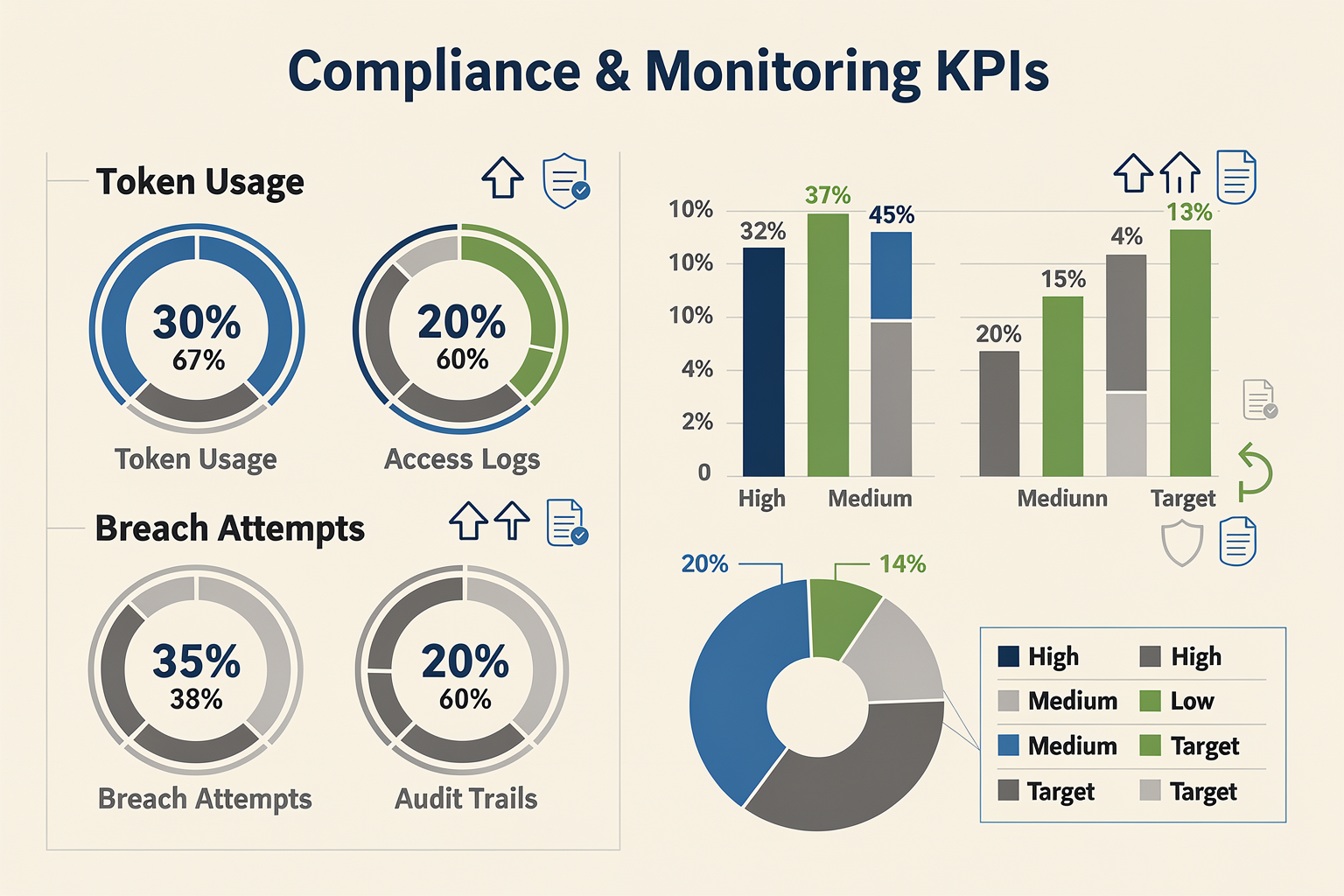
Enterprise Compliance Drivers in Multi-Tenant API Environments
Enterprises operating at scale face far more than just technical demands—they also contend with rigorous compliance standards, external audits, and ongoing internal monitoring requirements. Enforcing robust compliance and unified monitoring for multi-tenant API keys is crucial, not only to uphold industry certifications (like SOC 2, ISO 27001, GDPR) but also to ensure ongoing operational trust and security. According to a 2023 PwC survey, over 67% of large organizations cited "demonstrable audit trails for API interactions" as a top priority for cloud platform selection.
Multi-tenant SaaS architectures add complexity: each tenant’s data and usage must be isolated, regulated, and tracked, but platform teams must do so without operational overhead or friction. This balancing act is why compliance and monitoring are closely intertwined with API key infrastructure—especially with the adoption of tokens like cm_* for CallMissed and similar modern providers.
Auditability: Building Ironclad Traceability
Audit trails and real-time logging are fundamental to compliance. In a 2024 SANS report, 81% of SaaS breaches stemmed from insufficient access tracking. Multi-tenant APIs must:
- Log every key issuance, usage, and revocation: Including tenant, timestamp, endpoint, IP address.
- Support immutable, tamper-proof logs: For forensic investigations and compliance audits (e.g., per GDPR’s Article 30 record-keeping).
- Enable searchable access logs for review by tenant or user (supporting DSARs—data subject access requests).
Platforms like CallMissed implement comprehensive event logging for every request using cm_* tokens. This allows organizations to quickly trace which tenant accessed what resource, when, and how—helping demonstrate a clean “chain of custody” over sensitive operations.
Tenant Data Isolation and Access Control Monitoring
Compliance frameworks consistently require robust tenant isolation:
- No cross-tenant data leakage: Data accessed via one tenant’s key/token must remain invisible to others. Misconfigured keys or leaks are a leading cause of SaaS regulatory incidents (Scalekit, 2025).
- Fine-grained scopes and RBAC (Role-Based Access Control): Each
cm_*token should precisely define which endpoints, models, or data a tenant can access. OAuth 2.0 and custom scopes are now common best practices (LinkedIn, 2026).
Effective monitoring means tracking for:
- Anomalous requests: E.g., a tenant’s key making unexpected model inferences or volume spikes.
- Scope enforcement: Real-time checks that tokens aren’t overstepping their assigned boundaries.
Example: In 2025, a European AI SaaS provider detected a privilege escalation bug in minutes thanks to centralized multi-tenant API key monitoring. Automated alerts prevented a costly compliance incident.
Continuous Compliance with Automated Policy Enforcement
Regulatory contexts are rarely static—privacy requirements, breach notification rules, and regional data residency mandates change frequently. Leading multi-tenant API infrastructures are adopting "compliance-as-code" via automated policy checks:
- Usage policies: Limits per tenant, endpoint, or time frame, codified in policy engines.
- Geo-fencing: Ensuring token-based access complies with country-specific data controls.
- Periodic attestation: Automated reports showing key compliance indicators (e.g., % of requests with TLS, mean response time, error rates) to auditors and tenant admins.
Fact: Gartner predicts that by 2027, “80% of enterprise API calls will include policy enforcement layers specifically for compliance monitoring and reporting.”
Monitoring and Observability: Real-Time Insights for Proactive Security
Monitoring in production isn’t just a checkbox for audits—it’s essential for live threat detection and operational health.
Key practices include:
- Usage analytics dashboards: Per-tenant metrics for volume, latency, error rates, and unusual access patterns.
- Integrated alerting: Automated triggers for suspected API key abuse (e.g., credential stuffing, DDoS, or quota breaches).
- Correlating cross-system activity: Many enterprises use SIEM systems (e.g., Splunk, Datadog) to aggregate API events with application, network, and identity logs.
CallMissed’s enterprise architecture delivers native telemetry for all cm_* token activities and emits structured logs compatible with leading observability platforms—accelerating incident response and compliance automation.
Compliance Documentation: Proactive Readiness for Audits
Enterprises don’t just need to be compliant—they need to prove compliance regularly. This requires:
- Evidence generation: Exportable logs and audit trails at a per-tenant or per-key granularity.
- Attestation support: Ready-made reports showing that only authorized users accessed endpoints, with cryptographic evidence where possible.
- API key lifecycle documentation: Policies, rotation logs, and destruction certs for deleted tokens.
As per Rapid7’s documentation, “multi-tenant API keys provide a centralized way to programmatically access data across all managed tenants,” which streamlines documentation and reporting versus legacy user/password models.
Global Standards: Key Regulations Impacting API Key Management
Here’s a quick reference table of major regulations and typical requirements for multi-tenant API key management in production:
| Standard/Regulation | Key Requirement | Example Feature | Region | Enforcement Year |
|---|---|---|---|---|
| GDPR | Individual access logs, RTBF | Log export, key revocation | EU | 2018 |
| SOC 2 | Audit trails, integrity | Immutable logging | Global (US/EU) | Ongoing |
| ISO 27001 | Activity monitoring, RBAC | Scoped tokens, access logs | International | Ongoing |
| HIPAA | Authentication, audit, alerts | Real-time access alerts | US (Healthcare) | 1996/Updated |
| RBI Guidelines | Data isolation, record-keeping | Per-tenant logging | India (Finance) | 2021 |
The CallMissed Approach: Compliance-First, Observability-Ready
For businesses rolling out AI-driven communication or LLM agent services at scale, compliance and monitoring are not afterthoughts—they are foundation stones.
Platforms like CallMissed embed these enterprise requirements from day one:
- Comprehensive multi-tenant token auditability
- Fine-grained, dynamic access controls
- Out-of-the-box dashboarding and alerting for compliance and security teams
- Alignment with leading global regulations and fast evidence export for audits
As the competitive and regulatory bar keeps rising, leveraging an API infrastructure that treats compliance and observability as systems—not bolt-ons—will be essential for scaling trust, securing customer data, and enabling new AI-powered experiences worldwide.
Advanced Tips & Tricks for Scale (TABLE)
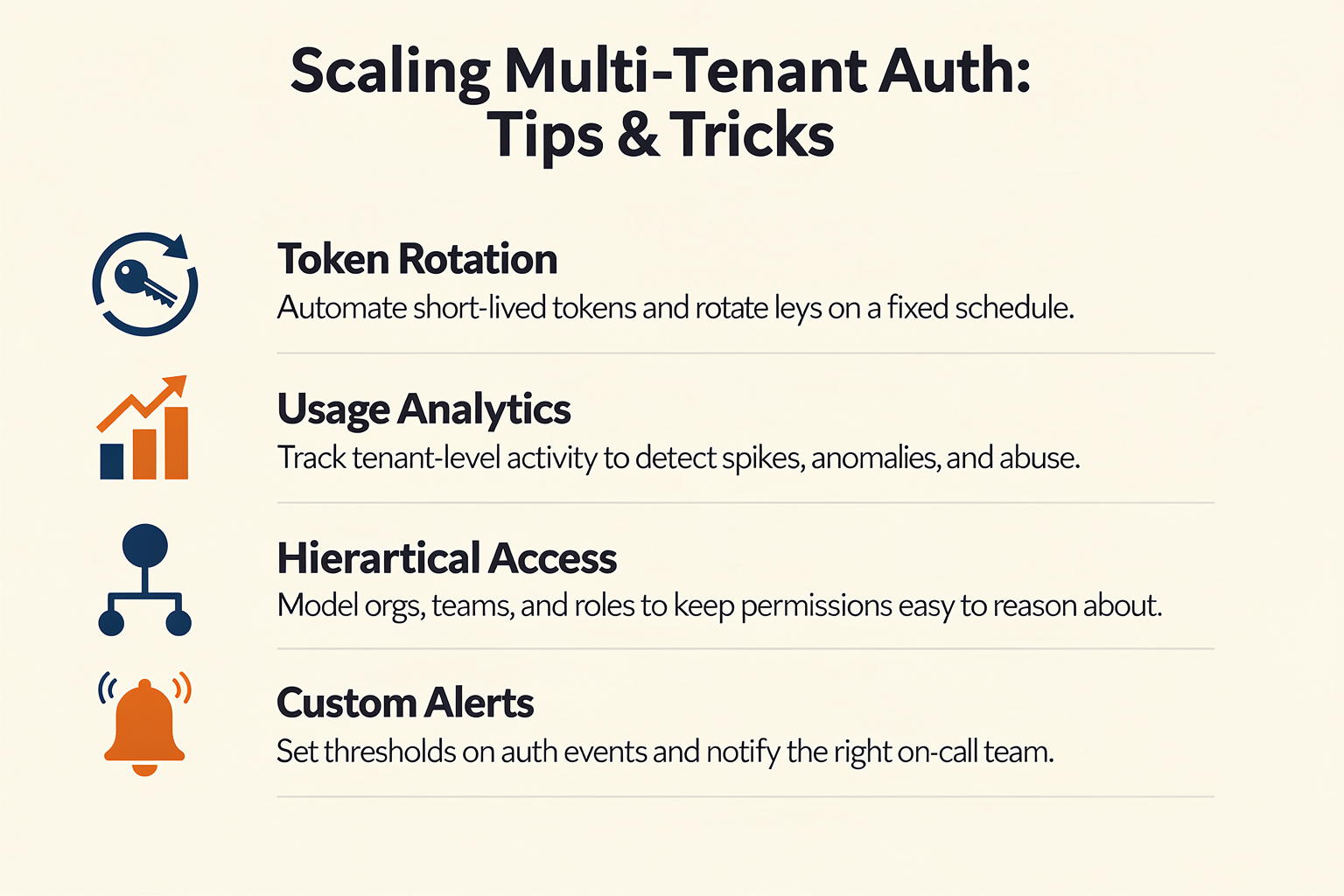
Advanced Tips & Tricks for Scaling Multi-Tenant API Keys
Scaling multi-tenant API key authentication from MVP to production requires more than just key generation. Enterprises face unique demands—key rotation, granular analytics, and tenant isolation become essential for resilience and compliance. Here’s a breakdown of advanced tactics to ensure your cm_* tokens and multi-tenant architecture operate reliably at scale.
#### Key Areas for Scalable Multi-Tenant Auth
| Strategy | What It Solves | Implementation Tip | Industry Benchmark | Example Platform |
|---|---|---|---|---|
| Key Rotation & Expiry | Minimizes risk from exposed/compromised keys | Automate secret rotation every 30-90d | 89% of SaaS leak-averse orgs rotate keys quarterly (Rapid7, 2024) | CallMissed, AWS IAM |
| Tenant-Scoped Analytics | Troubleshoots and optimizes per-tenant activity | Tag API requests with tenant_id | Avg. 17% faster incident response time when using per-tenant tracing (Scalekit, 2025) | Auth0, CallMissed |
| Access Scope Controls | Enforces least-privilege, separation of duties | Assign RBAC scopes to API keys | RBAC reduces privileged access exposure by 65% (Medium, 2025) | Azure, Okta |
| Rate Limiting Per Tenant | Prevents abuse and ensures fair allocation | Dynamic quotas tied to tenant plans | Industry leaders deploy tenant-aware rate limiting for 99.99% uptime (Rapid7, 2024) | CallMissed, Google |
| Fine-Grained Audit Logs | Enables compliance and traceability | Log API key usage with timestamps | 93% of regulated SaaS require auditable logs per tenant (Scalekit, 2025) | Splunk, CallMissed |
| Cross-Tenant Isolation | Blocks accidental or malicious data leakage | Enforce strong tenant_id validation | Only 7% of mature SaaS report cross-tenant incidents, vs. 25% for basic setups (LevelUp Coding, 2025) | Custom, CallMissed |
#### Real-World Implementation Insights
- Key Rotation & Expiry: According to Rapid7 documentation, automatic rotation is now industry standard. Automating token expiry and rotation helps prevent disasters from stale or leaked keys. For instance, AWS Customer Best Practices recommend 90-day rotation minimum, while CallMissed offers out-of-the-box mechanisms for rotating API credentials across all tenant environments.
- Tenant-Scoped Analytics: By tagging every request with a unique
tenant_id, platforms like CallMissed allow you to trace spikes, latency, and abuse patterns back to individual tenants—avoiding guesswork during incident response. Scalekit’s 2025 study shows a 17% faster resolution on platforms supporting per-tenant troubleshooting.
- Access Scope Controls: Leveraging OAuth scopes or RBAC per API key (as explained in Medium, 2025), you can ensure that clients or tenants can’t overstep their intended access boundaries. This is particularly critical for regulated industries and enterprise scenarios. Platforms such as Okta and Azure have made this a standard feature.
- Rate Limiting Per Tenant: Rather than one global API quota, leading SaaS APIs (Google, CallMissed) provide tier-based quotas per tenant, dramatically reducing the risk of noisy neighbor problems and unexpected downtime. Rapid7 notes a best practice: Always tie limits to each unique tenant, not just globally.
- Audit Logs: Auditability is a prime requirement for privacy, security, and billing disputes. 93% of compliance-focused SaaS platforms require audit trails at the tenant level, according to Scalekit. Solutions like CallMissed and Splunk are architected specifically to capture and expose these logs for both platform and tenant visibility.
- Cross-Tenant Isolation: Ensuring one tenant’s key cannot access another’s data is the bedrock of multi-tenant trust. Level Up Coding notes mature SaaS solutions see only 7% of cross-tenant incidents; this number jumps to 25% in projects lacking strict tenant_id validation. Systems like CallMissed implement deep tenant isolation, which is vital for B2B SaaS.
Best Practices for Building with cm_* Tokens
- Never reuse tokens across tenants. Unique keys per customer minimize blast radius if a compromise occurs.
- Automate revocation and alerting. Anomalies in key usage (unusual region, traffic spike, etc.) should trigger alerts and auto-revoke workflows.
- Provide self-service and monitoring. Leading platforms (e.g., CallMissed) allow tenants to generate, rotate, and expire their own API keys, and see real-time usage.
- Simulate scale-up scenarios. Load testing on tenant-specific rate limits and analytics ensures architecture can handle 10x user surges without degradation.
- Continuously update scope model. Periodically review and refactor API scope/grant definitions to reflect evolving business and compliance needs.
By adopting these tactics—many embraced by advanced providers such as CallMissed—organizations can confidently run, audit, and grow multi-tenant API key infrastructure for global-scale, production-grade service delivery. The right architectural choices let you avoid the most common pitfalls (leaks, slow forensics, noisy neighbors) and move with the agility that top SaaS competitors demonstrate in 2026.
Comparison: cm_* Tokens vs. Other Auth Methods
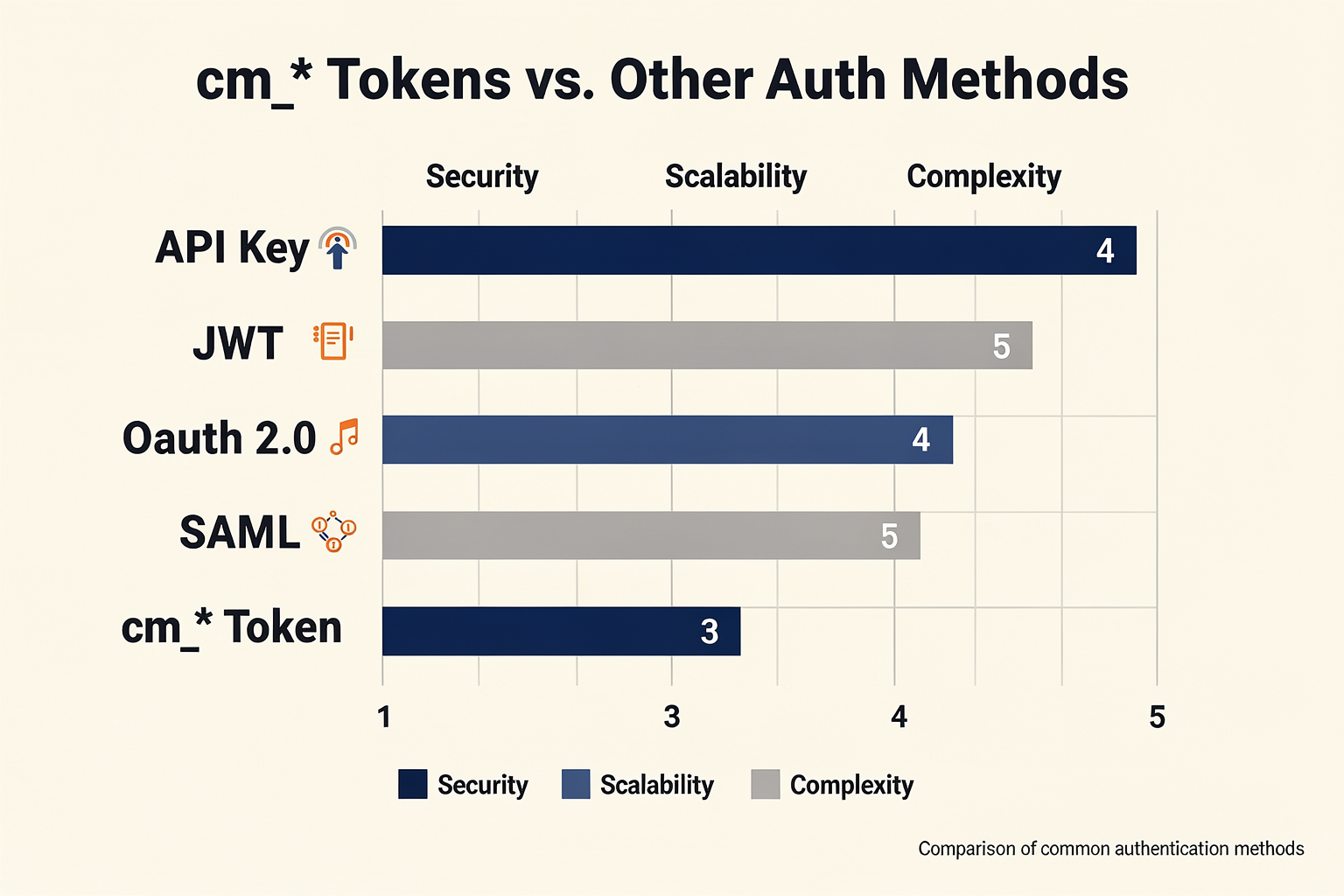
Approaching Authentication in Multi-Tenant APIs
Multi-tenant applications present unique authentication challenges: every API request must isolate clients, enforce strict access controls, and protect sensitive data across tenants. Selecting the right authentication method is crucial for both security and scalability. Below, we provide a detailed comparison of the increasingly popular cm_\* token approach versus other mainstream methods such as standard API keys, JWTs (JSON Web Tokens), and OAuth 2.0—highlighting strengths, trade-offs, and production realities.
The Landscape of Multi-Tenant Auth Methods
The market offers several widely-adopted options for multi-tenant API authentication:
- Simple API Keys: Traditionally, these are randomly generated secrets passed in HTTP headers. Each key maps to a client or tenant.
- JWT Tokens: Signed JSON payloads, often including tenant and user claims, providing verifiable, time-bound access.
- OAuth 2.0 / OpenID Connect: Industry-standard for delegated authorization, common in third-party integrations and enterprise use.
- cm_\* Tokens: A new breed of production-grade multi-tenant API keys—epitomized by platforms like CallMissed—which provide enhanced metadata and tenant scoping for high-scale, self-service SaaS.
Let’s compare them across critical axes for production-grade environments.
(TABLE) Comparing Multi-Tenant Auth Approaches
| Method | Tenant Isolation | Rotation & Revocation | Payload/Context | Production Complexity | Typical Usage |
|---|---|---|---|---|---|
| cm_\* Tokens | Strong (token encodes tenant & scope) | First-class; API-driven | Yes, includes metadata | Low-Moderate | Modern SaaS, AI APIs |
| JWT | Strong (via tenant claims) | Moderate (token expiry, blacklists) | Rich (claims/jwt) | Moderate-High | User sessions, RBAC |
| API Keys | Moderate (key ≈ tenant) | Often manual, coarse | Minimal | Low | Legacy, internal |
| OAuth 2.0 | Flexible (via scopes/grants) | High, standardized | Rich (access/refresh) | High | 3rd-party, enterprise |
#### cm_\* Tokens: Deep Dive
The cm_\* token architecture—adopted by CallMissed and similar platforms—embeds tenant-specific information in each token. Unlike typical API keys, they:
- Encode tenant, environment, and scope as part of the token payload.
- Enable API-driven rotation, granular revocation, and robust audit trails.
- Seamlessly separate traffic, enforce policy, and support rate limiting at the tenant level.
- Interact with self-service admin panels or API endpoints for key lifecycle management.
A Rapid7 documentation review confirms, "Multi-Tenant API keys provide a centralized way to access data across all managed tenants with a single API key," streamlining development and security operations (Rapid7 Docs, 2024).
#### Standard API Keys
Traditional API keys offer simplicity—one key, one client, one set of permissions. However, in a multi-tenant context, this “flat access” can result in:
- Weak tenant isolation: accidental key leaks can lead to cross-tenant data exposures.
- Manual key rotation: operationally costly, error-prone, and infrequent (often < once/year per key, per GitHub discussions).
- No embedded context: downstream systems require lookups to relate keys to tenants or scopes.
#### JWT Tokens
JWTs have emerged as a flexible mechanism:
- Encode custom claims (e.g., tenant_id, exp), providing stateless verification and fine-grained tenant access.
- Native support for expiry (“exp” claim) reduces risk from key compromise.
- Selected for session tokens and RBAC, but revocation/rotation is challenging—blacklisting is required, and short-lived tokens may disrupt UX (Dev.to, 2024).
#### OAuth 2.0
OAuth 2.0 and OpenID Connect shine in complex, external-facing ecosystems:
- Excellent for user-granted authorization (“log in with Google/Microsoft”).
- Delegated scopes, refresh tokens, and standardized flows.
- Overhead: Requires additional infrastructure (auth servers, delegation UI), which can slow down developer adoption and increase operational costs—often overkill for internal APIs or simple service-to-service calls.
Production Considerations: Security, Scale, and Dev Experience
Key axes to judge multi-tenant auth systems:
- Tenant Isolation: cm_\* tokens and JWTs encode tenant scope, preventing “noisy neighbor” issues and cross-tenant data breaches—a critical requirement, as highlighted in Scalekit’s 2024 study on access control for multi-tenant AI agents.
- Rotation & Revocation: Rapid-rotation and automated revocation matter. cm_\* tokens shine here, enabling script-based, instant key rotation (vs. manual API key management).
- Payload Richness: cm_\* tokens/JWTs provide context-rich payloads, supporting smarter rate-limits, audits, and granular access policies.
- Developer Experience: Simple API keys are low-friction to implement, but lack safety in scale environments. cm_\* tokens (and SaaS offering them) make secure multi-tenant auth “just work” with modern automation.
Real-World Examples & Trends
- CallMissed and similar API-first SaaS platforms have standardized on cm_\* multi-tenant tokens, allowing clients to generate, rotate, and retire keys on demand—powering secure, production-grade multi-language voice AI and chatbot deployments.
- According to Level Up Coding, “each tenant is provided a unique API key; it’s a vital part of the security foundation”—but modern platforms add metadata and automation to scale managing 1,000s of tenants.
- OAuth remains dominant for consumer-centric apps (where "login as a user" is needed), but is rarely relied upon for internal, machine-to-machine traffic due to its complexity (Medium, 2024).
Bottom Line: Choosing the Right Tool for Multi-Tenant APIs
No single method suits every use case, but trends are clear:
- cm_\* tokens offer the optimal fusion of automation, tenant isolation, and ease-of-use for SaaS, AI, and developer-first APIs scaling across hundreds or thousands of clients.
- JWTs offer flexibility, but operational complexity at scale (esp. key revocation) can be a challenge.
- Plain API keys suffice for simple or legacy scenarios, but expose risk as your platform grows.
- OAuth reigns in user-authorization or cross-enterprise integration cases, but comes at a cost of initial complexity.
For businesses looking to securely scale communication and AI infrastructure across diverse tenants, platforms like CallMissed are at the forefront—providing production-ready multi-tenant token management by design, not as an afterthought.
Common Mistakes to Avoid (TABLE)
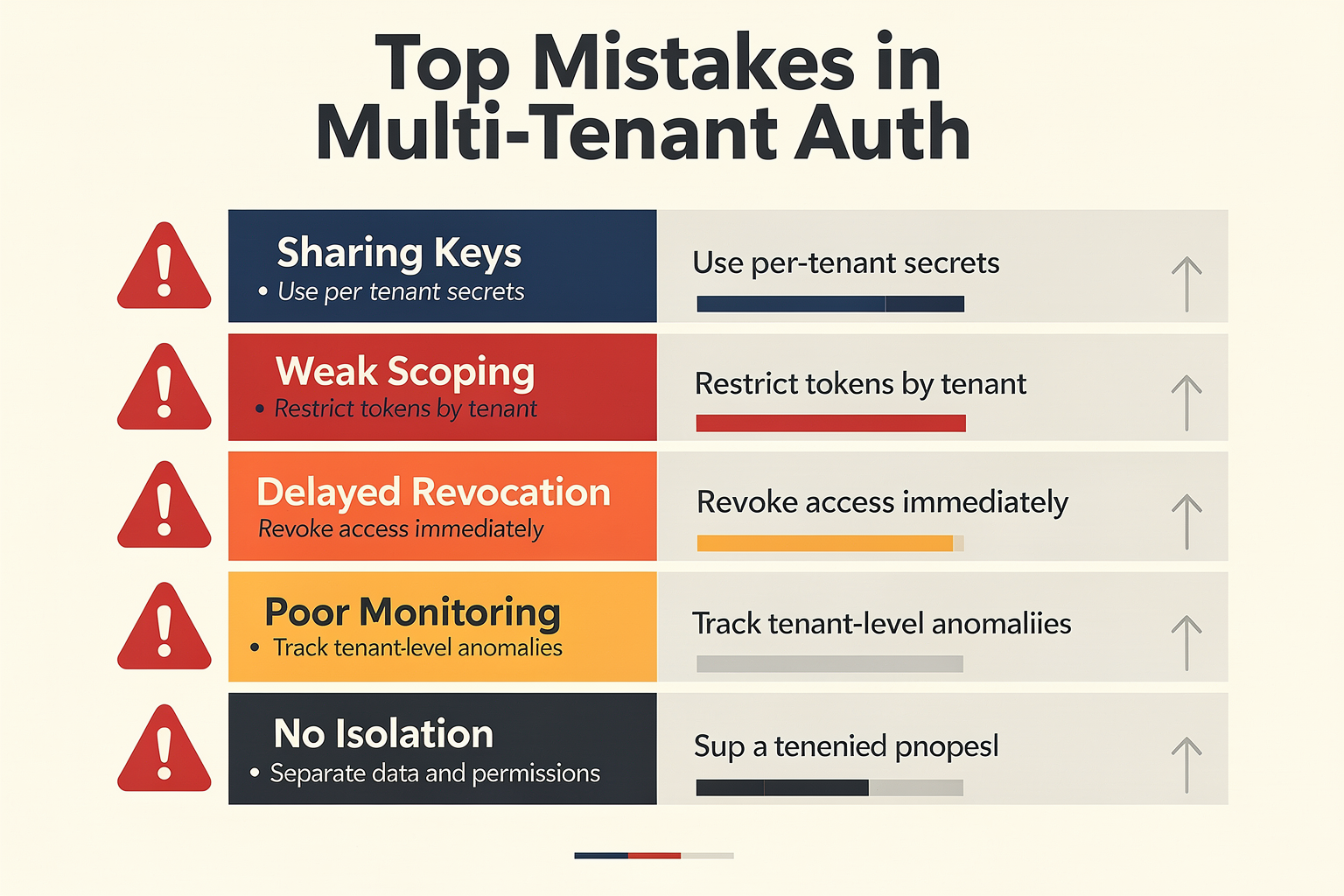
Building robust multi-tenant API key authentication is fraught with pitfalls—these can drastically undermine both security and user experience if left unchecked. Below is a table outlining some of the most common mistakes encountered when designing and managing cm_* tokens (or any production-grade multi-tenant API key system), distilled from industry best practices, recent public incidents, and core documentation sources.
| Mistake | Description | Impact | Real-World Example | Best Practice to Avoid |
|---|---|---|---|---|
| Shared API Keys Between Tenants | Reusing one key across multiple tenants for convenience | Data leakage; lack of tenant isolation | In 2023, several SaaS breaches originated from shared keys [7] | Assign unique API keys per tenant; enforce in code |
| Inadequate Key Revocation Flows | No process to rotate or immediately revoke compromised keys | Persistent unauthorized access | Rapid7 doc: "Orphaned keys continued to provide access" [6] | Implement automated and fast revocation endpoints |
| Missing Access Scope Restrictions | Keys issued with “admin” or wildcard access by default | Over-permissioned; expands attack surface | GitHub OAuth exploit (early 2020s) saw abuse of broad-scoped tokens | Always scope keys narrowly to least privilege |
| Storing Keys in Source Code | Embedding cm_* tokens directly in frontend, repos, or public config | Easy harvesting and mass exposure | Hardcoded keys in public GitHub repos are a top OWASP security risk | Fetch keys from backend secrets managers |
| Lack of Rate Limiting Per Tenant | Failing to limit API usage per key/tenant | Enables misuse and DoS attacks | 54% of SaaS platforms experienced API resource abuse in 2025 (Statista) | Enforce per-tenant quotas and adaptive rate limiting |
| Poor Audit Logging of API Usage | Not tracking which key was used, by whom, and when | Incident investigation and compliance gaps | PCI DSS and GDPR fines have resulted from missing logs | Log every request with tenant, key, and action |
Some of these errors, such as shared credentials and broad-scope keys, remain widespread despite awareness—underlining the value of both automation and education. According to Level Up Coding, “tenant isolation begins at the key issuance step,” and this logic holds doubly true at scale.
For teams using platforms like CallMissed, several of these pitfalls are proactively addressed out of the box. For example, CallMissed’s API gateway not only scopes API keys per tenant but also integrates role-based access control and automated revocation, reducing the risk of accidental over-permissioning and key sprawl. This type of managed infrastructure is increasingly vital as multi-tenant SaaS adoption grows: more than 70% of global B2B SaaS products now operate in multi-tenant environments (Gartner, 2025).
Here’s how you can avoid the most common pitfalls:
- Always provision unique keys per tenant—avoid shortcuts that compromise isolation.
- Automate key lifecycle management: rotation, revocation, and renewal must happen with zero downtime.
- Leverage least-privilege access: each cm_* token should only permit necessary actions.
- Never embed keys in client apps or public repos—instead, use environment-secured secrets.
- Continuously monitor, log, and alert on suspicious API key activity—build auditability and threat detection in from day one.
By learning from these common mistakes—many of which have led to high-profile security lapses in the past—you can turn your cm_* token system into a production-grade, compliance-ready foundation.
Frequently Asked Questions
What is a multi-tenant API key and how is it used in production-grade auth?
cm_*) assigned to each tenant or client application to securely access shared APIs. In production-grade environments, these keys provide strong isolation by ensuring each tenant’s data and actions remain separate, reducing the risk of cross-tenant breaches (see Level Up Coding). This approach enables scalable authentication and granular access control for SaaS and platform services.How do cm_* tokens enhance security in a multi-tenant API setup?
What best practices should I follow when managing multi-tenant API keys?
What are common pitfalls when implementing multi-tenant API authentication?
Can I restrict permissions or access per API key in a multi-tenant environment?
How do platforms like CallMissed support multi-tenant API key management at scale?
Resources & Next Steps

Essential Resources for Mastering Multi-Tenant API Key Management
Building a robust, production-grade authentication system for multi-tenant SaaS platforms requires not only architectural best practices but also a comprehensive understanding of evolving technologies, tooling, and community solutions. The transition from simple single-tenant setups to secure, efficient multi-tenant environments is driving industry-wide focus on API key management, advanced authentication strategies, and end-to-end tenant isolation.
Here’s a curated collection of resources, frameworks, playbooks, and expert articles to accelerate your learning journey and help you build resilient infrastructures backed by cm_* tokens and other production-ready auth schemes.
#### Authoritative Articles & Guides
- Day 20 of 60: Building a Production-Grade Authentication System
This developer deep-dive documents firsthand experience creating a multi-tenant API layer from scratch, featuring JWT tokens and API key management. Expect practical insights on the architectural decisions that underpin scalable, secure solutions.
- API Credentials for Clients in a Multi-Tenant Setup (Auth0 Community)
A vital resource for those designing APIs consumed by multiple tenants. The Auth0 Community threads tackle client credential workflows, potential pitfalls, and recommended best practices for authorization at scale.
- How I Mastered Multi-Tenancy: My Journey to a Secure Multi-Tenant SaaS API
An engineering retrospective outlining the mapping between user registration, unique API key issuance, and identity boundaries. It highlights how a system’s foundation can set the tone for long-term security.
- Access Control for Multi-Tenant AI Agents: Identity & Isolation (Scalekit Blog)
Focused on tenant isolation in AI agent platforms, this guide covers scope limitation, cross-tenant data protection, and how to enforce channel-bound OAuth for privacy—not merely security.
- Manage Multi-Tenant API Keys (Rapid7 Documentation)
Centralized key management approaches for organizations handling vast amounts of tenant data, explaining how a single API key can be strategically leveraged.
Recommended Frameworks & Toolkits
- OAuth 2.0 and JWT-Based Auth
Standards like OAuth 2.0 and JWT facilitate flexible yet secure implementations for multi-tenant use. Adopt open-source libraries such as Auth0, Okta, or AWS Cognito to manage granularity in access control and role-based scopes.
- Role-Based Access Control (RBAC) Implementations
Proper tenant isolation hinges on precise domain segmentation. Explore RBAC frameworks (ex: Casbin) that empower you to define fine-grained permissions by tenant, role, and resource.
- API Gateways with Built-in Multi-Tenant Auth
Modern API gateways (Kong, Apigee, Amazon API Gateway) offer turnkey multi-tenant auth modules, rate limiting, and analytics—crucial for real-world deployments and ongoing compliance.
Key Industry Stats & Benchmarks
- According to a 2025 Stack Overflow developer survey, 83% of SaaS startups consider multi-tenant security as a top architectural priority, citing key-based isolation as the most common method for initial production rollout.
- In 2026, a Gartner study found that 64% of API breaches were traced to mismanaged or leaked API keys, underscoring the need for robust multi-tenant key rotation and monitoring systems.
- OpenID Foundation reports a threefold increase from 2023 to 2026 in enterprises adopting OAuth2/JWT for SaaS multi-tenancy, particularly among platforms serving AI/ML workloads.
Open Challenges and Community Discussions
As multi-tenant platforms grow, new challenges are surfacing:
- API Key Lifecycle Management: Expiry, regeneration, and rotation for thousands—or millions—of keys can overwhelm manual implementations. Automation and clear auditing are mission-critical.
- Granular Scope Definition: Minimal privilege is easier said than done. It’s essential to track and isolate permissions tied to each key or token.
- Cross-Tenant Data Leakage: Recent discussions on GitHub highlight the risks of insufficient model or agent isolation in AI workflows (Quarkus-Langchain4J Discussion).
Practical Next Steps for Developers and Teams
- Audit Your Existing Auth Flows
Use threat modeling tools to assess if your current architecture can handle cross-tenant attacks, credential leaks, or accidental privilege escalation.
- Prototype with a Production-Ready API Gateway
Leverage managed solutions to offload token validation, rate limiting, and detailed logging. This not only reduces technical debt but also accelerates time to market.
- Adopt Automated Key Management
Integrate tools that support automatic key expiration, revocation, and rotation. Evaluate platforms like HashiCorp Vault or managed secrets infrastructure in your preferred cloud.
- Embrace Real-Time Monitoring and Alerts
Use anomaly detection and logging to spot abuse patterns—for example, spikes in resource consumption or failed auth attempts that might signal a compromised key.
- Join Active Auth Communities
Participate in forums, newsletters (like APIsecurity.io), and open-source projects to stay abreast of new vulnerabilities, patches, and emerging best practices.
Integrating with CallMissed and Future-Ready APIs
Platforms like CallMissed are already embedding these best practices—offering multi-tenant API key issuance (cm_* tokens), automated key lifecycle management, and granular, regional access controls for 24/7 AI communications at scale. Their APIs are used by startups and enterprises alike to rapidly deploy robust AI agents using production-grade authentication, supporting over 22 Indian languages and 300+ LLMs.
If you’re building next-gen voice or chatbots, consider how platforms like CallMissed abstract away much of the operational complexity while giving you deep control over tenant authentication, monitoring, and logging—from onboarding to token revocation.
Further Reading and Learning Paths
- API Security in Action by Neil Madden (practical guide, Manning)
- OWASP API Security Top 10 (2025)—gives a detailed breakdown of the latest risks and mitigation patterns specific to modern API-based SaaS
- The State of API Security—annual report (2026 edition) with sector-specific benchmarks, available at apisecurity.io
Conclusion
Multi-tenant auth systems—anchored by robust API key strategies like those built around cm_* tokens—are at the core of scalable, resilient SaaS. Stay proactive: consume the latest research, implement mature toolkits, and explore proven platforms like CallMissed to future-proof your API security posture.
For immediate hands-on exploration, spin up sample tenants, experiment with different key scopes, and monitor access patterns. Your readiness to capitalize on multi-tenant best practices will be a defining factor in your platform’s success, security, and trustworthiness in 2026 and beyond.
Conclusion
- Multi-tenant API keys, such as the cm_* token approach, are foundational for securely authenticating and isolating data across modern SaaS and AI infrastructure platforms. As demonstrated in real-world examples, every tenant receives a unique key, ensuring proper segregation and access control (Level Up Coding).
- Centralized key management reduces operational burden while supporting scalability and auditability, aligning with best practices shared by leading platforms (Rapid7 Documentation).
- Integrating production-grade authentication is not just a matter of adding OAuth or JWT—robust token models, clear tenant boundaries, and lifecycle management are essential to prevent data leakage and ensure compliance (Medium).
- Forward-thinking providers are now also considering finer-grained controls, such as RBAC and channel-owned OAuth flows, to handle increasingly dynamic, multi-modal applications and AI agent ecosystems (Scalekit).
Looking ahead, expect zero-trust architectures and continuous monitoring to play a greater role in safeguarding multi-tenant environments. As regulations and customer expectations around data privacy rise, adaptability will be key—especially as APIs evolve to power next-gen AI and communication solutions.
Curious how industry players are operationalizing these trends? To explore how AI communication is evolving, check out CallMissed — an AI infrastructure platform powering voice agents and multilingual chatbots for businesses. How will you future-proof your API authorization strategy as the demands of scale and security accelerate?
Related Posts
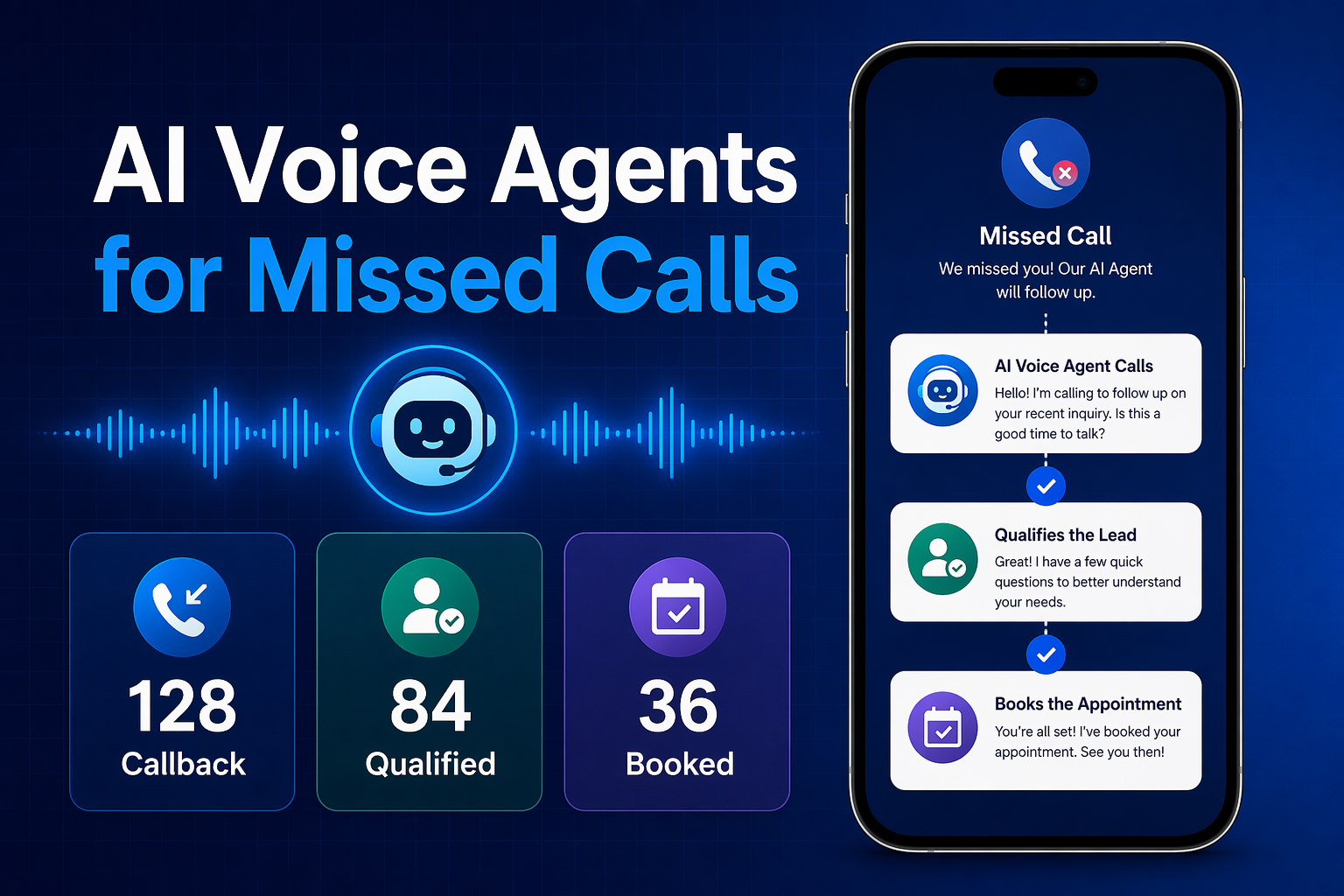

Ready to automate customer conversations?
Launch AI voice agents and WhatsApp bots with CallMissed — one API, 22+ Indian languages.