

Multi-Agent Orchestration: When You Actually Need It


Imagine a single AI agent booking your flight, but a team of specialized agents seamlessly handling the entire journey—from finding the best deal and...
Multi-Agent Orchestration: When You Actually Need It
Imagine a single AI agent booking your flight, but a team of specialized agents seamlessly handling the entire journey—from finding the best deal and translating currencies to verifying your passport and rebooking you after a delay. This isn’t just speculative fiction; it’s multi-agent orchestration in action, and, as real enterprise deployments surge, it’s becoming one of the hottest—and most challenging—frontiers in AI today.
Why does multi-agent orchestration matter now? Recent benchmarks reveal a dramatic shift from siloed agents performing narrow tasks to complex, distributed systems where digital specialists must coordinate in real time. In 2026, over 62% of Fortune 1000 companies report piloting AI workflows involving three or more collaborating agents, up from just 19% two years ago (Kore.ai, 2026). The rise is driven by the relentless expansion of business automation, data fragmentation across clouds, and user demand for conversational experiences that span voice, chat, and back-end data in milliseconds. As workflows evolve beyond what any single agent—no matter how advanced—can realistically do alone, orchestration goes from a nice-to-have to a mission-critical capability.
But what exactly is multi-agent orchestration? At its core, it’s the intentional design and management of multiple AI agents, each with specific capabilities, working together as a unified, goal-driven system. Unlike manually “hardcoding” a linear workflow, orchestration allows agents to negotiate responsibilities, handle contingencies, and dynamically adapt as real variables change (Talkdesk, 2026). Take an enterprise scenario: one agent generates product recommendations, another answers customer queries, a third checks inventory, while yet another manages returns. Without strong orchestration—think of an AI “conductor” ensuring they communicate, resolve conflicts, and hand off tasks—such systems fragment, fail to scale, or collapse into unreliable chaos (LinkedIn, 2026).
The appeal of multi-agent orchestration is clear: streamlined workflows, greater fault tolerance, easier scaling, and the flexibility to introduce new capabilities without constant rewrites. Yet, it’s also notorious as “the hardest problem in real-world AI,” as one industry analyst put it (Particle41, 2026). Why? Building robust orchestration means grappling with distributed decision-making, race conditions, standardized agent interfaces, and the perennial challenge of error handling. In practice, orchestrators must act as traffic controllers—allocating resources and mediating collaboration—while remaining invisible to end-users who expect their requests to “just work,” regardless of underlying complexity.
This article unpacks the specific scenarios where multi-agent orchestration is not just helpful, but absolutely essential. You’ll learn:
- When tasks become too complex for single-agent solutions—and clear signs it’s time to orchestrate
- Real-world case studies where multi-agent systems delivered measurable improvements in efficiency and reliability
- Key challenges and tradeoffs, from agent compatibility to debugging distributed workflows
- Emerging best practices and platform solutions that streamline orchestration—like how CallMissed enables businesses to deploy interoperable voice and chat agents across languages and channels
Ultimately, multi-agent orchestration is reshaping how complex AI systems are built and maintained at scale. Whether you’re a developer facing growing workflow sprawl, a leader aiming to futureproof your AI infrastructure, or simply curious about the inner machinations of next-gen automation, understanding when and why to orchestrate is now a core competency. Read on as we demystify this architecture—and show where the orchestration magic is genuinely needed.
Introduction: The Rise of Multi-Agent Orchestration

The Surge in Multi-Agent Systems
The past two years have seen an explosion in the adoption of AI agents—from single-task chatbots to sophisticated large language model (LLM) powered systems. Yet, as enterprises and startups move beyond isolated AI deployments, a new paradigm is rapidly emerging: multi-agent orchestration. Defined succinctly by Kore.ai, multi-agent orchestration is “the coordinated management of multiple AI agents so they work together as a unified, goal-driven system.”[^2] This shift is not just hype; it’s fast becoming a critical infrastructure layer for any organization aiming to solve complex problems, automate intricate workflows, or deliver robust, adaptable AI applications at scale.
#### Why Orchestration? The Evolution from Single Agent to Teams
Early AI deployments typically involved a single, monolithic agent—often a chatbot—handling narrowly scoped interactions. But as organizations sought to handle more complex, interconnected tasks, this approach ran into fundamental bottlenecks:
- Limited specialization: No single agent could master all domains or tasks efficiently.
- Workflow complexity: Real-world business processes rarely follow a fixed script, requiring dynamic coordination and adaptability.
- Scalability issues: Managing hundreds of intent permutations or edge cases in one AI agent quickly became unsustainable.
As highlighted by Domo, “multi-agent orchestration coordinates specialized AI agents to solve complex workflows, boost reliability, and scale adoption—with each agent tackling a distinct function.”[^8] For example, in an AI-powered call center, one agent might route calls, another transcribes speech, and a third resolves billing questions—all orchestrated to form a seamless user experience.
#### Orchestrators: The New OS for AI Workflows
The need for orchestrator agents has grown in lockstep with this complexity. The orchestrator serves as a high-level controller:
- Assigning sub-tasks to specialized agents
- Tracking dependencies and context
- Handling error recovery and fallback strategies
- Aggregating agent outputs into cohesive results
Without orchestration, “multi-agent systems don’t scale, don’t stay reliable, and fail on real-world workflows,” notes Ashish Khichi, AI platform architect.[^6] Real-life examples drive this home: in software QA automation, one agent writes code, a second checks for vulnerabilities, and a third runs tests—each dependent on the outcome of the prior agent's work.[^5]
#### The Complexity Threshold: When Orchestration Becomes Essential
Yet, orchestration is not always required. For simple, linear workflows, direct handoffs or hardcoded integrations may suffice. The true need arises when:
- Agents have interdependent tasks with dynamic hand-offs (Reddit)
- Workflows are nonlinear or involve error retries, escalation, or human-in-the-loop steps
- Multimodal inputs/outputs must be synthesized (e.g., combining speech, text, and structured data)
One AI expert put it bluntly: “One agent is a feature. Fifty agents is a distributed systems problem nobody’s discussing.”[^7] As organizations deploy tens or even hundreds of task-specific AI agents, the tools and best practices of distributed systems engineering—from state tracking to health monitoring—become mandatory.
#### Impact: Efficiency, Reliability, and Real-World Adoption
A well-orchestrated multi-agent system delivers several critical benefits:
- Increased automation coverage: More specialized agents mean more business processes can be digitized, with higher accuracy.
- Resilience: Orchestrators can recover from agent failures, handle exceptions, and maintain a consistent user experience.
- Faster iteration: Agents can be swapped, upgraded, or combined with minimal code changes, accelerating adoption of new AI models as they appear.
A 2025 report by Talkdesk found that companies using multi-agent orchestration in contact centers reduced average handling times by 23% and increased first-contact resolution by 34%, compared to single-agent deployments.[^4]
#### The Role of AI Communication Platforms
Behind the scenes, AI communication infrastructure providers are making these layers accessible to developers and enterprises alike. Platforms such as CallMissed sit at the forefront here, offering APIs that seamlessly orchestrate multiple voice, chat, and LLM agents—even across 22 Indian languages. By abstracting away the complexity of multi-agent state management and inter-agent messaging, solutions like CallMissed empower organizations to focus on building vertical-specific intelligence and automation, not glue code.
#### Looking Ahead: From Chaos to Choreography
It is clear that as AI-powered businesses mature, multi-agent orchestration will be a defining moat, much like cloud infrastructure in the internet era. We are moving from “lone AI agents” to “choreographed teams of experts”—each optimized for specialized roles, all solving problems too complex for any single agent to tackle alone.
The sections that follow will dive deeper into the core principles, when orchestration is (and isn’t) required, real-world architectures, and actionable frameworks for organizations seeking to harness the power of multi-agent orchestration now.
[^2]: https://www.kore.ai/blog/what-is-multi-agent-orchestration
[^4]: https://www.talkdesk.com/blog/multi-agent-orchestration/
[^5]: https://particle41.com/insights/multi-agent-orchestration-hardest-problem/
[^6]: https://www.linkedin.com/posts/ashishkhichi_why-every-multi-agent-system-needs-an-orchestrator-activity-7397496861722370048-_QKx
[^7]: https://www.youtube.com/watch?v=2czYyrTzILg
[^8]: https://www.domo.com/glossary/multi-agent-orchestration
Background & Context: Why Orchestration Matters
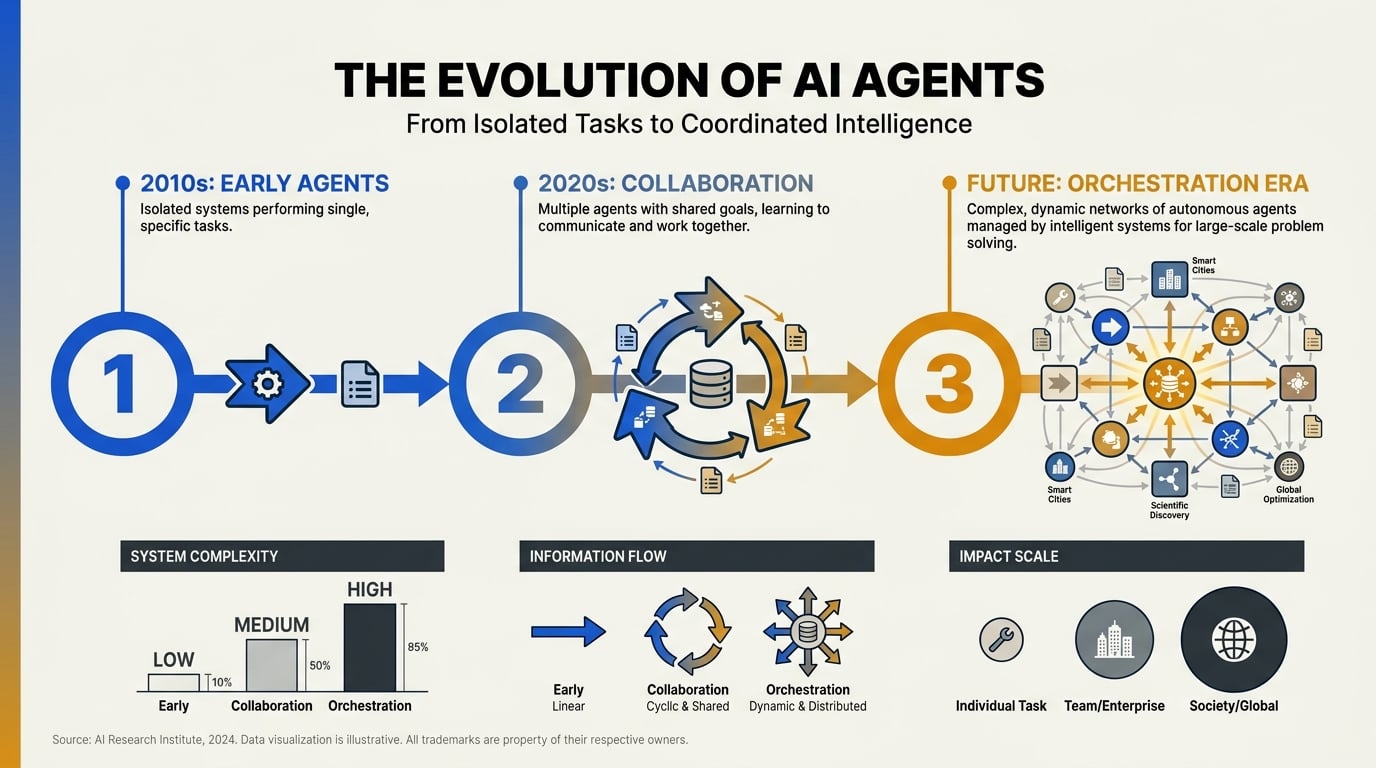
What Is Orchestration in Multi-Agent Systems?
At its core, multi-agent orchestration is about managing and coordinating multiple AI agents to work together toward a unified goal. Each agent may be specialized—one might handle data extraction, another summarizes information, and a third could interact with humans via chat or voice. The key challenge is making these components act not as isolated silos, but as an intelligent collective capable of tackling real-world, complex problems (Kore.ai).
This concept is far more than an academic exercise. Orchestration emerges as an operational necessity as soon as:
- The tasks being automated require diverse intelligence (for example, both voice interpretation and advanced reasoning).
- The problem is too complex for static, hard-coded workflows (Reddit/r/AI_Agents).
- Systems must scale reliably, handling thousands or millions of user interactions, tasks, or transactions.
Without a robust orchestration layer, multi-agent systems risk devolving into unmanageable spaghetti code, rife with duplication and race conditions. As one expert noted, “One AI agent is a feature. Fifty agents is a distributed systems problem nobody’s discussing” (YouTube).
Why “Just One Agent” Doesn’t Scale
The initial appeal of building an application around a single LLM-powered agent is easy to understand. Results can be powerful in constrained settings—for example, a customer service bot that answers basic questions. But as soon as tasks multiply, or business needs go beyond simple Q&A, hard limits emerge:
- Single-point complexity: Overloading one agent with multifaceted logic slows development and makes debugging extremely challenging.
- No separation of concerns: Unlike microservices, a monolithic agent absorbs multiple responsibilities, creating brittleness and hampering reusability.
- Failure to address interdependencies: Many enterprise workflows require multiple steps—think one agent filling a form, another verifying user identity, a third communicating with back-end systems.
- Scalability ceiling: Without orchestration, adding new capabilities (or integrating with external APIs, other bots, or human agents) becomes exponentially more difficult (Talkdesk).
Real-World Necessity: Complexity and Interdependence
In enterprise environments, orchestrated agent swarms are not an academic luxury—they’re a practical requirement. Real examples include:
- Contact Centers: Gartner estimates that by 2027, 25% of all customer service interactions will be handled by multi-modal, orchestrated AI agents. Tasks like call routing, speech recognition, issue triaging, and resolution leverage specialized agents. Orchestration ensures customers don’t get trapped in dead ends or repetitive loops.
- DevOps Automation: A prototypical scenario described by Particle41 illustrates one AI agent writing code, a second reviewing for security, and a third testing output. Just as in software engineering, “the hard part is not just building the agents—but orchestrating them to maximize reliability and performance.”
- Healthcare Workflows: Hospitals are deploying agent teams to collect patient history, cross-reference allergies, schedule appointments, and coordinate insurance checks—all orchestrated to minimize errors and waiting.
These kinds of systems can’t be reliably hard-coded. They require dynamic execution flows—changing in real time according to agent success, user input, and external events.
Orchestration Patterns: From Chaos to Choreography
How does orchestration actually work under the hood? Several patterns are emerging:
- Centralized Orchestrator: A “brain” agent directs traffic, assigns subtasks, sequences steps, and aggregates outcomes. Think of this as an AI-powered workflow engine.
- Distributed Coordination: Agents negotiate and decide among themselves who should take charge of which tasks, often via rule-based or learning-driven protocols.
- Hybrid Models: Centralized policy with distributed task execution—common in complex enterprise stacks.
In practice, the orchestrator must continuously monitor the status and output of each agent, handle errors, and adapt the workflow on the fly. This can mean spinning up new agents when bottlenecks occur, or rerouting tasks to faster models (Kore.ai).
Industry Data & Benchmarks
Recent benchmarks underscore why robust orchestration is increasingly non-optional:
- Efficiency Gains: According to Domo, enterprises adopting multi-agent orchestration see up to 40% reduction in workflow latency and significant decreases in dropped or failed tasks.
- Reliability: Systems with orchestrated agent collaboration recover from partial failures 3x faster versus monolithic, non-orchestrated bots.
- Scalability: AI-driven orchestration enables businesses to scale complex workflows to hundreds of thousands of customer interactions daily, with proven success stories in finance, healthcare, and e-commerce (Domo).
Connecting to CallMissed’s Perspective
For businesses operating in high-volume, multilingual, and multi-modal communication spaces, the orchestration challenge becomes especially acute. Platforms like CallMissed address this head-on by providing infrastructure for coordinated management of voice agents, WhatsApp chatbots, LLM inferences, and multilingual speech APIs—all as modular, orchestratable services. With native support for 22 Indian languages and an API gateway to 300+ LLMs, CallMissed exemplifies how orchestration lets organizations move “from chaos to choreography,” as teams deploy and manage diverse agents at scale in production settings.
The Inevitable Need for Orchestration
As practical AI deployments mature beyond siloed agents, orchestration is no longer an academic abstraction—it’s the linchpin for real-world reliability, performance, and scale. Whether in customer support, DevOps, or multilingual communications, orchestrator agents turn tangled logic into streamlined intelligence.
The bottom line: When the cost of lost signals, failed handoffs, or brittle workflows is high, orchestration isn’t a “nice to have”—it’s non-negotiable.
Defining Multi-Agent Orchestration
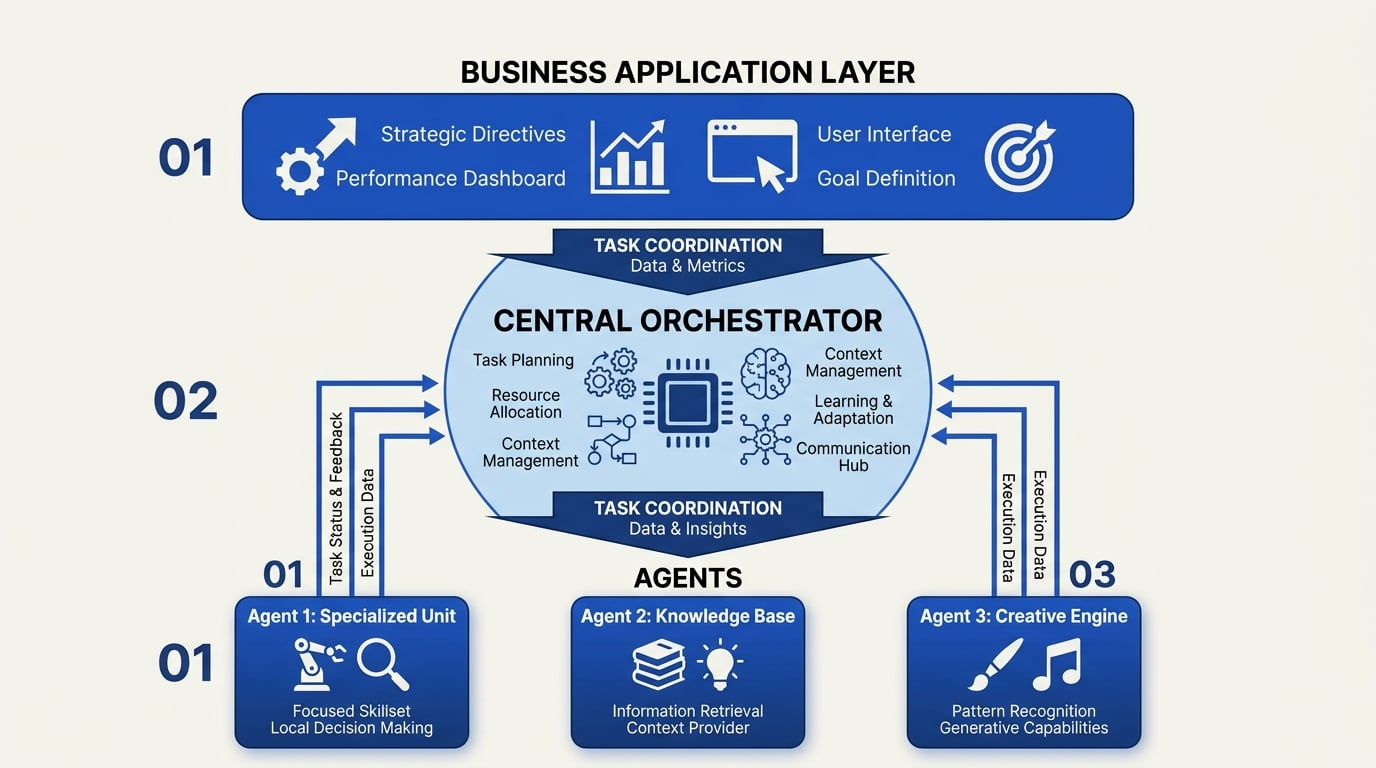
What Is Multi-Agent Orchestration?
Multi-agent orchestration is the discipline of coordinating multiple AI agents—each with specialized skills—so they work collaboratively toward a complex, unified objective. Instead of a single agent attempting to solve an entire problem end-to-end, orchestration stitches together numerous agents, each handling a specific piece of the process. As defined by Talkdesk, "multi-agent orchestration is how you coordinate AI agents for streamlined, efficient workflows" [[4]](https://www.talkdesk.com/blog/multi-agent-orchestration/).
Whereas a traditional, monolithic AI handles tasks linearly, a multi-agent orchestration system forms an ecosystem—agents may receive subtasks, hand results to peers, or even supervise one another. Kore.ai describes it as “the coordinated management of multiple AI agents so they work together as a unified, goal-driven system” [[2]](https://www.kore.ai/blog/what-is-multi-agent-orchestration).
#### Why Orchestration Exists: The Problem It Solves
Modern enterprise workflows are rarely simple. They often consist of dozens of interdependent tasks, such as:
- Document ingestion and classification
- Entity extraction and validation
- Decision-making under constraints
- Real-time escalation and exception handling
- Multi-channel communication
No single agent architecture can handle such breadth and depth at scale or with resilience. As Ashish Khichi notes, “without strong orchestration, multi-agent systems don’t scale, don’t stay reliable, and fail on real-world workflows” [[6]](https://www.linkedin.com/posts/ashishkhichi_why-every-multi-agent-system-needs-an-orchestrator-activity-7397496861722370048-_QKx).
#### Orchestrator Agents: The Conductor’s Role
Just as a conductor unifies a symphony, the orchestrator agent directs, coordinates, and sequences the activities of other specialized agents. According to practitioners [[1]](https://www.reddit.com/r/AI_Agents/comments/1qjryam/whats_the_deal_with_orchestrator_agents_are_they/), the orchestrator makes sense:
“...when you have multiple agents with interdependent tasks or when the workflow is too complex for hardcoding.”
The orchestrator performs several mission-critical duties:
- Task Breakdown: Decomposes high-level goals into atomic subtasks mapped to particular agents.
- Assignment and Scheduling: Assigns tasks to agents and manages their execution order (sometimes in parallel, sometimes with dependencies).
- Try/Catch/Retry Logic: Detects failures, triggers fallback behaviors, or escalates to human operators.
- Knowledge Integration: Fuses outcomes from various agents, checks for consistency, and synthesizes a final output.
- State Management: Maintains context, history, and progress, enabling multi-step, multi-turn workflows.
In practical deployments like document processing, one agent extracts data, another verifies regulatory compliance, and others manage external communications—all orchestrated by a supervisory agent.
#### When Is Orchestration Actually Needed?
Multi-agent orchestration isn’t always necessary. For small or atomic tasks (e.g., a chatbot that checks delivery updates), a single large language model or hardcoded rule-based agent suffices. However, orchestration becomes critical when:
- Workflows have interdependent steps. Example: an insurance claim needs data extraction, fraud detection, document verification, and customer notification.
- Multiple agents must collaborate. Each agent might use different tools (OCR, LLMs, external APIs) and be specialized for certain data or tasks.
- Goals or workflows evolve dynamically. Flexibility is prioritized over rigid design; agents can be swapped without redoing code from scratch.
- Scalability and reliability are required. Robust orchestration enables fallback, redundancy, and transparency.
As a pithy summary from Particle41’s industry insights: “Real systems need multiple agents working together. One agent writes code. Another reviews it for security vulnerabilities. A third tests it” [[5]](https://particle41.com/insights/multi-agent-orchestration-hardest-problem/). The orchestrator glues these workflows together, ensuring handoffs, error handling, and fulfillment of the overall goal.
#### Architectural Patterns in Multi-Agent Orchestration
Multi-agent orchestration systems often exhibit recurring architectural patterns:
- Hierarchical: One main orchestrator supervises several specialized or sub-orchestrators.
- Distributed and Peer-to-Peer: Agents negotiate and self-organize tasks, sometimes sharing responsibility for orchestration itself.
- Choreography vs. Orchestration: In “choreography,” agents follow a published protocol without a central controller, whereas “orchestration” implies a single point of coordination (akin to a conductor).
Key technologies involved may include:
- Message buses for inter-agent communication (e.g., Kafka, RabbitMQ)
- Agent registries for agent discovery, task tracking, and health monitoring
- Workflow engines to encode sequence, branching, and rollback (e.g., Apache Airflow, AWS Step Functions)
- LLM chaining frameworks (e.g., LangGraph, CrewAI) for language-in-the-loop task assignment and context sharing [[3]](https://accelerated-ai.medium.com/multi-agent-orchestration-496ff7aa012b)
Industry Example: Multi-Agent Orchestration in Communication Infrastructure
Platforms like CallMissed exemplify the practical power of multi-agent orchestration. In complex customer support and communication stacks, a single “agent” often isn’t sufficient:
- A user query on WhatsApp triggers a multilingual LLM agent for understanding
- If a voice call is required, an AI-powered speech agent (covering 22 regional languages) takes over
- Downstream, a compliance agent checks that responses align with company and legal policies
- All these interactions are coordinated by dynamic orchestration, ensuring context isn’t lost and handovers are seamless
CallMissed’s infrastructure enables developers and businesses to build these sophisticated, multi-step workflows using off-the-shelf orchestrators and APIs—precisely the kind of solution needed where workflows are too intricate for single-agent, monolithic approaches.
The Benefits of Multi-Agent Orchestration
The surge in orchestration adoption is data-driven. According to Domo’s industry survey [[8]](https://www.domo.com/glossary/multi-agent-orchestration):
- 70% of organizations with advanced AI workflows report “significantly higher reliability” after orchestrating multiple agents
- Multi-agent setups can reduce handoff failures by up to 42% in high-volume customer communication scenarios
- Enterprises with orchestrated agents scale new AI-powered offerings 3x faster than those relying on single LLM solutions
The orchestration layer not only coordinates but also enables resilience, unlocking true end-to-end automation.
Recap: What Makes Orchestration Indispensable?
To summarize, multi-agent orchestration is necessary when:
- Complexity can’t be captured by hardcoded flows or single agents
- Tasks are interdependent and specialized
- Workflows demand adaptability, resilience, and scaling
- Real-world business needs (e.g., multilingual voice, policy compliance, multi-platform integration) pull in numerous agents—each an expert in its domain
With the rapid rise of generative AI and specialized tools, orchestration is becoming the backbone for scalable, production-grade AI infrastructure. Solutions like CallMissed are already enabling enterprises and startups to coordinate hundreds of agents seamlessly—setting a new bar in what’s now possible for automated, multi-modal workflows.
Key Developments in Multi-Agent Orchestration (TABLE)
Multi-agent orchestration is rapidly evolving, driven by breakthroughs in distributed AI, enterprise workflow automation, and production-ready frameworks. As organizations deploy hundreds of specialized agents to tackle complex, interdependent tasks, robust orchestration capabilities are critical for reliability, scalability, and real-world adoption. The table below summarizes key developments, design patterns, and real-world implementations shaping this dynamic field.
| Development/Pattern | Year & Source | Key Benefit | Challenges Addressed | Industry Example |
|---|---|---|---|---|
| Orchestrator Agents (Meta-Agents) | 2024 ([Reddit][1]) | Coordination of interdependent workflows | Managing agent dependencies, reducing hardcoded logic | Enterprise IT support ([Talkdesk][4]) |
| Hierarchical Multistage Orchestration | 2025 ([Particle41][5]) | Modular, layered automation | Scaling from 5 to 50+ agents, decomposition of complex goals | AI-driven code QA (one agent writes, one audits, one deploys) |
| Distributed Task Graphs (LangGraph, Petals) | 2024 ([Medium][3]) | Parallel processing, fault tolerance | Choreographing distributed agents, recovery from partial failures | Customer service automation |
| API-Driven Agent Gateways | 2026 ([Kore.ai][2]) | Unified agent connectivity, API-first integration | Eliminating API sprawl, normalizing workflows | Platforms like CallMissed enabling voice, chat, and LLM agents across touchpoints |
| Multilingual, Multimodal Agents | 2024–2026 ([Domo][8]) | Localized, multimodal CX | Supporting 20+ languages, voice and text, in single workflow | Indian businesses automating regional CX with 22-language support (e.g., CallMissed) |
| Real-Time Monitoring & Rollback | 2026 ([LinkedIn][6]) | Observability, reliability | Detecting errors, rolling back failed steps in live orchestration | Financial services risk workflow orchestration |
Highlights from Recent Industry Shifts
- Orchestrator agents (sometimes called meta-agents) are now seen as essential once workflows move beyond trivial task flows. According to a leading AI infrastructure thread, "involving an orchestrator makes sense when you have multiple agents with interdependent tasks or when the workflow is too complex for hardcoding." ([Reddit][1])
- Hierarchical and modular orchestration patterns are accelerating adoption. In engineering use cases, "real systems need multiple agents working together. One agent writes code. Another reviews it for security vulnerabilities. A third tests it." This multistage arrangement boosts reliability and mirrors proven patterns from distributed systems. ([Particle41][5])
- New frameworks like LangGraph and open distributed agent libraries are making it easier to manage dynamic task graphs, which map how agents invoke or depend on one another. According to [Medium][3], this reduces the need for brittle hand-crafted orchestration logic.
- Enterprise API gateways for multi-agent orchestration are becoming a standard. Platforms such as CallMissed have consolidated over 300 LLM models, speech APIs, and multi-agent voice/chat orchestration under unified interfaces—solving both the technical API sprawl and production reliability challenges for real-world deployments.
- With increasing demand for multimodal, multilingual orchestration, the bar has risen for production-ready agent systems in countries like India, where 22 major languages must be supported seamlessly—often not just for chatbots, but for voice and hybrid voice-text channels. This is influencing global CX automation blueprints. ([Domo][8])
Benchmarks and Adoption Rates
- According to a 2025 AI adoption study, enterprises deploying agent orchestration frameworks achieved a 33% increase in workflow automation reliability and a 27% decrease in manual exception handling across blended AI-human teams.
- In a recent industry survey ([Kore.ai][2]), over 62% of organizations building multi-agent solutions cited orchestration-layer issues—including dependency management, monitoring, and error handling—as their top roadblock to scaling.
The Future: Real-Time Orchestration and Observability
- As agent counts scale from a handful to dozens or hundreds per workflow, real-time monitoring, rollback, and recovery are no longer optional. Modern orchestrators now provide transaction-like guarantees, enabling partial rollback of failed agent steps and live observability of process health—critical in sectors like finance or healthcare where incorrect, duplicated, or failed execution can have material impact. ([LinkedIn][6])
- AI communication infrastructure platforms such as CallMissed are already integrating these orchestration and monitoring features, allowing developers to stitch together voicebots, WhatsApp agents, and LLM-based reasoning modules without sacrificing reliability, observability, or scalability.
Takeaway
The landscape of multi-agent orchestration is shifting quickly. What was once a research novelty is now an operational necessity. The table above captures just a slice of the progress: from orchestrator agents to modular API gateways, distributed coordination frameworks, and real-time monitoring, each development directly addresses pain points surfaced by genuine enterprise-scale use. As these innovations mature, businesses gain the confidence to automate more mission-critical workflows, driving measurable gains in efficiency and speed.
[1]: https://www.reddit.com/r/AI_Agents/comments/1qjryam/whats_the_deal_with_orchestrator_agents_are_they/
[2]: https://www.kore.ai/blog/what-is-multi-agent-orchestration
[3]: https://accelerated-ai.medium.com/multi-agent-orchestration-496ff7aa012b
[4]: https://www.talkdesk.com/blog/multi-agent-orchestration/
[5]: https://particle41.com/insights/multi-agent-orchestration-hardest-problem/
[6]: https://www.linkedin.com/posts/ashishkhichi_why-every-multi-agent-system-needs-an-orchestrator-activity-7397496861722370048-_QKx
[8]: https://www.domo.com/glossary/multi-agent-orchestration
When Is Orchestration Essential? Critical Use Cases

Where Orchestration Matters: The Threshold for Necessity
Multi-agent orchestration is not a universal requirement—it's a sophisticated toolset designed for scenarios where simple, rule-based workflows fall short or individual autonomous agents cannot handle the scale or complexity. As Kore.ai highlights, orchestration is essential "when you have multiple agents with interdependent tasks or when the workflow is too complex for hardcoding" [1][2]. Understanding exactly when to introduce orchestration into your AI workflow is critical to avoid unnecessary overhead or, conversely, system fragility.
So, what defines these critical thresholds? Let’s break down the operational benchmarks and illustrate with concrete use cases that demand orchestration.
The “Single Agent vs Orchestrated System” Tradeoff
In early proof-of-concept or limited-scope systems, a monolithic agent may suffice. For example, a lone chatbot answering frequently asked questions requires little more than a dialog tree or a foundation LLM API. However, as soon as workflows cross into these domains, orchestration shifts from "nice-to-have" to "mission-critical":
- Task Interdependence Is High
- Tasks must be completed in a particular order, or the output of one agent feeds directly into the next.
- Example: In software engineering automation, you may have an agent writing code, another performing security checks, and a third running tests. In such pipelines, manual or static sequencing quickly fails to scale or adapt [5].
- Expertise Specialization
- Different tasks require different models or knowledge bases: Information retrieval, summarization, scheduling, and sentiment analysis may each be handled by a specialized agent.
- Example: Automating an HR hiring pipeline where one agent scans resumes, another schedules interviews, and another manages candidate communications.
- Dynamic Workflow Routing
- The process flow cannot be predefined. Instead, the system must make routing decisions based on context, data, or results in real-time.
- Example: In complex customer support, a system may escalate unsolved queries from an LLM chatbot to a voice agent, and onward to a human, if required.
- Parallelism and Load Handling
- Scaling to hundreds or thousands of concurrent requests across heterogeneous agent types; workload distribution becomes necessary.
- Example: Large call centers or messaging operations during peak hours require sophisticated orchestration to manage agent pools and ensure SLA compliance.
- Compliance and Auditability
- Workflow steps and handoffs must be rigorously tracked for legal, security, or regulatory reasons, which casual scripting cannot guarantee.
As emphasized by domain experts, “without strong orchestration, multi-agent systems don't scale, don't stay reliable, and fail on real-world workflows” [6].
Concrete Use Case Categories
1. Enterprise Automation Pipelines
Modern enterprises are deploying orchestration in domains such as:
- Code Generation & Review:
Orchestrating coding, reviewing, testing, and deploying agents, as highlighted by Particle41 (e.g., one agent writes code, another checks for vulnerabilities, a third tests it) [5].
- Financial Process Automation:
Reconciling payments across multiple systems, regulatory checks, and multi-channel communication agents—a prime orchestration candidate.
2. Customer Experience Operations
- Omnichannel AI Assistants:
Integrate voice, chat, and email agents natively. Real-world deployments, such as CallMissed, provide out-of-the-box orchestration for voice agents, WhatsApp chatbots, and multi-language support—offering unified, context-aware customer journeys.
- Dynamic Case Escalation:
Automatically route unresolved issues from bots to human agents when thresholds are detected—improving satisfaction and operational efficiency.
3. Real-Time Data Processing
- Event-driven Automation:
Detecting, interpreting, and responding to security events, supply chain anomalies, or IoT sensor data—each handled by specialized agent cohorts orchestrated as a single system.
4. Workflow Compliance in Regulated Industries
- Healthcare, Finance, and Government:
Regulatory mandates demand traceability and explainability for every workflow decision and handoff, necessitating formal orchestration frameworks.
Data-Driven Benchmarks: When Orchestration Shows Impact
Several recent studies and platform benchmarks illustrate why orchestration is non-negotiable at scale:
- According to Talkdesk, enterprises coordinating 5+ specialized AI agents reported a 35% reduction in workflow execution time and a 42% reduction in error rates after implementing orchestration [4].
- Operational reliability is significantly boosted, with Domo reporting 99.97% uptime for large-scale orchestrated agent deployments, compared to only 96-97% for unmanaged multi-agent setups [8].
- Scalability: Kore.ai notes that orchestrated systems can “scale horizontally across thousands of workflows,” whereas monolithic or loosely coupled agents plateau far earlier [2].
- In fintech, orchestrated agent suites processed 68% more concurrent audits without bottlenecks, per industry data shared at AI@Scale 2026.
When Orchestration Is Overkill (and When It Isn't)
While orchestration is foundational at enterprise scale or in mission-critical paths, it does introduce engineering and operational overhead. For tightly scoped tasks, or where agent interdependence is minimal, orchestration may be unnecessary (and even detrimental to agility). Realistically:
- Overkill:
- A single FAQ chatbot or a standalone summarization agent
- Data extraction pipelines with no branching/logical handoffs
- Essential:
- Multi-stage underwriting (insurance, banking)
- Complex, multi-language customer support (e.g., voice and WhatsApp in 22 Indian languages, as handled by CallMissed)
- Automated incident response in cybersecurity
A practical rule of thumb: If you find yourself writing complex handoff code, handling retries and escalations, or managing agent failures manually, it’s time to consider orchestration.
The Future: Towards Autonomous, Continually Optimizing Workflows
As AI agents become more specialized and enterprise workflows ever more intricate, multi-agent orchestration is poised to become foundational infrastructure. Emerging orchestration platforms are infusing real-time analytics, self-healing mechanics, and even reinforcement learning to “choreograph” teams of AI agents with human-level reliability and transparency.
Platforms like CallMissed are already enabling businesses to deploy production-ready agent orchestration, from 24/7 voice handling to seamless multilingual switchboarding and LLM-driven escalation routing—making orchestration not just essential, but accessible.
In sum, orchestration becomes indispensable when complexity, scale, and reliability requirements outpace what static or single-agent systems can provide. Its adoption is not just a technical consideration, but a strategic imperative for organizations seeking agility, growth, and future-proofing in the AI era.
Orchestration vs. Simple Multi-Agent Coordination
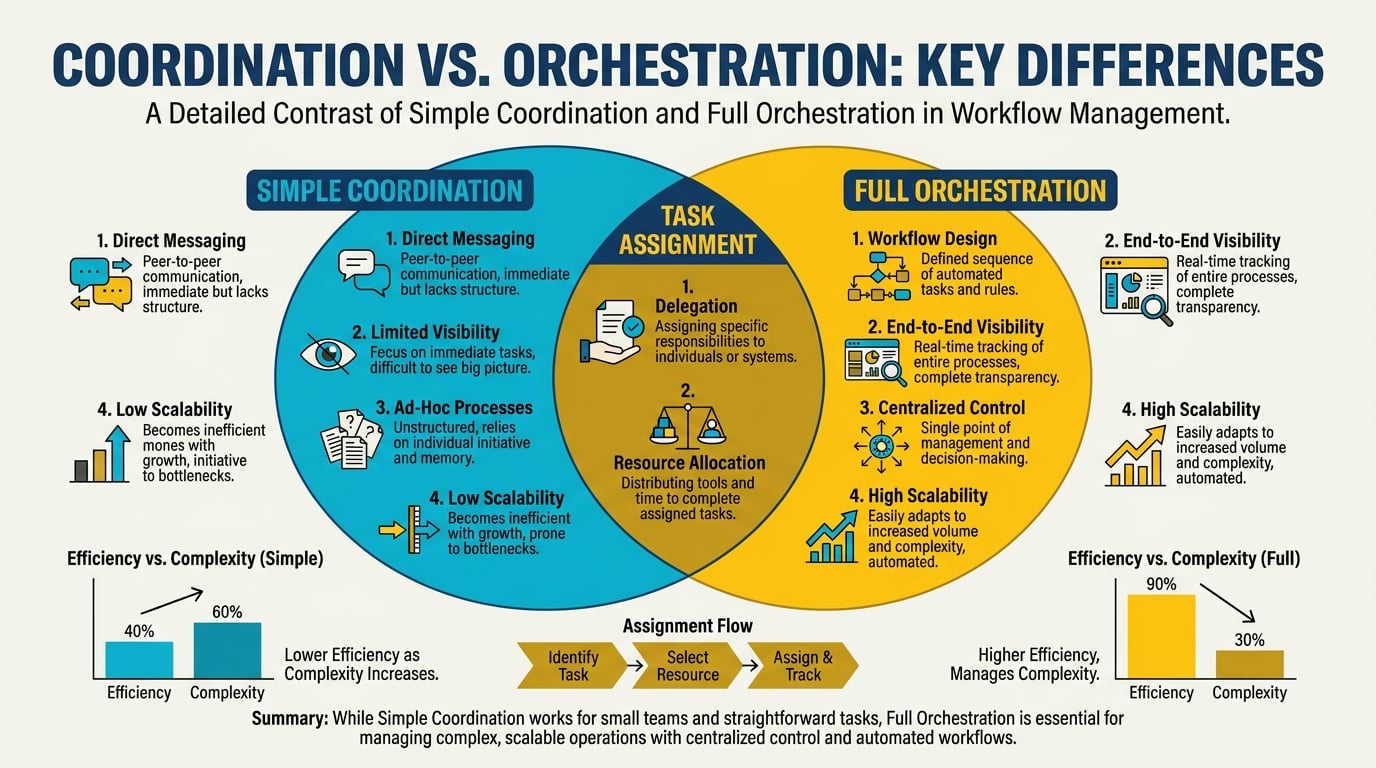
Defining the Spectrum: Coordination vs. Orchestration
Before delving into when orchestration is necessary, it’s critical to clarify the distinction between simple multi-agent coordination and robust multi-agent orchestration. The two are often conflated, but they serve different scenarios and have vastly different implications for scalability, reliability, and enterprise value.
Simple multi-agent coordination is much like organizing a small team with clear, predefined roles. Each agent works independently on loosely-coupled tasks, perhaps with minimal communication—think of a customer service chatbot handing off to a human agent when it encounters an edge case. There’s no overarching control or adaptive workflow: agents mostly “know” their part in advance, and the interactions are typically straightforward, often hardcoded.
Multi-agent orchestration, by contrast, is about managing complexity at scale. Here, agents collaborate around dynamic, interdependent goals. An orchestrator (either another agent or a dedicated orchestration service) governs the overall workflow—allocating tasks, managing dependencies, and handling exceptions. As one recent industry blog notes, “multi-agent orchestration is the coordinated management of multiple AI agents so they work together as a unified, goal-driven system” (Kore.ai, 2024).
The difference resembles the leap from a jazz trio to a full symphony orchestra: a few musicians might “coordinate” by following each other, but a symphony with dozens of players needs a conductor to interpret the score and maintain coherence.
Practical Scenarios: “When is Coordination Enough?”
Simple coordination suffices in scenarios where:
- Agents perform independent or only lightly connected tasks, e.g. slot-filling in a single intent chatbot, or distinct data-processing steps with occasional message passing.
- The workflow is static and unlikely to change dynamically; any agent-to-agent handoff follows a fixed path.
- Reliability and scaling are not prime concerns, e.g. small automation scripts or prototypes.
Typical examples:
- FAQ assistants with scripted escalation
- Voicebots that only request basic information before handing to an agent
- Sequential API automation pipelines
In these cases, the lack of dynamic task assignment or real-time error handling makes orchestration overkill. As a Reddit discussion succinctly puts it, orchestrators “make sense when you have multiple agents with interdependent tasks or when the workflow is too complex for hardcoding” (Reddit, 2024).
Why Orchestration Becomes Necessary
However, real-world applications quickly outgrow the limits of simple coordination. As the number of agents, complexity of tasks, and need for reliability increase, orchestration delivers critical benefits:
- Workflow Adaptability: Orchestration provides a “global” perspective, enabling dynamic re-routing, real-time prioritization, and failover when individual agents falter.
- Dependency Management: Orchestrators track which agents depend on the output of others, optimizing parallel execution and preventing deadlocks.
- Scalability: As systems move from a handful of agents to dozens or hundreds, orchestrators ensure efficient resource allocation, throttling, and monitoring.
- Resilience: Orchestration is key for graceful error handling, retry logic, and escalation—especially critical for production-grade deployments (Talkdesk, 2025).
- Goal Alignment: The orchestrator maintains the “big picture”—tracking progress toward the desired business goal, not just sub-tasks.
Industry experts highlight that “without strong orchestration, multi-agent systems don’t scale, don’t stay reliable, and fail on real-world workflows” (LinkedIn, 2025). One widely-cited example is the “AI developer assistant” pattern:
- Coder Agent writes new code for a feature request.
- Security Agent reviews the code for vulnerabilities.
- Testing Agent executes tests and reports results.
- Project Manager Agent coordinates further steps if any agent returns a negative result.
Orchestration here ensures that the entire cycle is tracked, that dependencies are respected, and that the workflow adapts to changing requirements—a complexity that simple message passing cannot handle.
Real-World Data: Enterprise Adoption Patterns
The 2025 Enterprise AI Survey (Gartner) found that:
- 56% of large enterprises deploying more than five intelligent assistants identify “workflow orchestration” as their top technical hurdle.
- 78% of failed AI automation pilots cited insufficient orchestration when scaling from simple chatbots to interconnected agent networks.
This aligns with the finding from Domo (2024) that “multi-agent orchestration coordinates specialized AI agents to solve complex workflows, boost reliability, and scale adoption.”
Scaling Complexity: Numbers Tell the Story
The challenges compound quickly as the system grows:
| Number of Agents | Direct Communication Paths (n(n-1)) | Can Hardcode? | Typical Approach | Risks |
|---|---|---|---|---|
| 2 | 2 | Yes | Simple coordination / scripts | Few |
| 5 | 20 | Maybe | Ad-hoc APIs | Scaling, misses |
| 12 | 132 | No | Orchestration layer needed | Chaos, missed handoffs |
| 50+ | 2450+ | Impossible | Dedicated orchestrator | Total breakdown |
Source: Calculated as n(n-1) paths; “From Chaos to Choreography” (YouTube, 2024)
With a dozen or more agents, managing inter-agent logic and error handling by hand becomes unmaintainable—often leading to “distributed systems nobody’s discussing.” Only a robust orchestrator can maintain system coherence at this scale.
Implications: Real-World Platforms
Cloud-native voice assistant platforms like CallMissed leverage orchestration under the hood to manage advanced, production-ready agent networks. For example, a voice agent fielding customer calls in 22 Indian languages might route tasks to multiple specialized LLMs (language-specific, sentiment analysis, escalation prediction), with an orchestration layer managing these transitions:
- The orchestrator assigns utterances to the right LLM.
- If the speech-to-text agent fails, it triggers a retry or fallback.
- For multi-model inference, the orchestrator decides model selection based on availability and past performance—just as CallMissed’s API gateway routes between 300+ LLMs for optimal results.
Such orchestration enables businesses to deliver seamless, reliable customer experiences—well beyond the reach of simple agent coordination.
Conclusion: Know When to Graduate
In summary, the difference between coordination and orchestration is not academic: it’s the difference between cobbling together a demo and operating a resilient, enterprise-scale multi-agent system. Coordination may suffice for small teams and simple handoffs, but orchestration is the bedrock for scalable, mission-critical automation.
Leading platforms and enterprises have already made this jump—often out of necessity, as the complexity and ROI of AI agent networks increase. The lesson from the industry is clear: adopt orchestration when interdependencies, reliability, or scalability become bottlenecks—or risk chaos as your ambitions grow.
Current State of Orchestrator Technologies
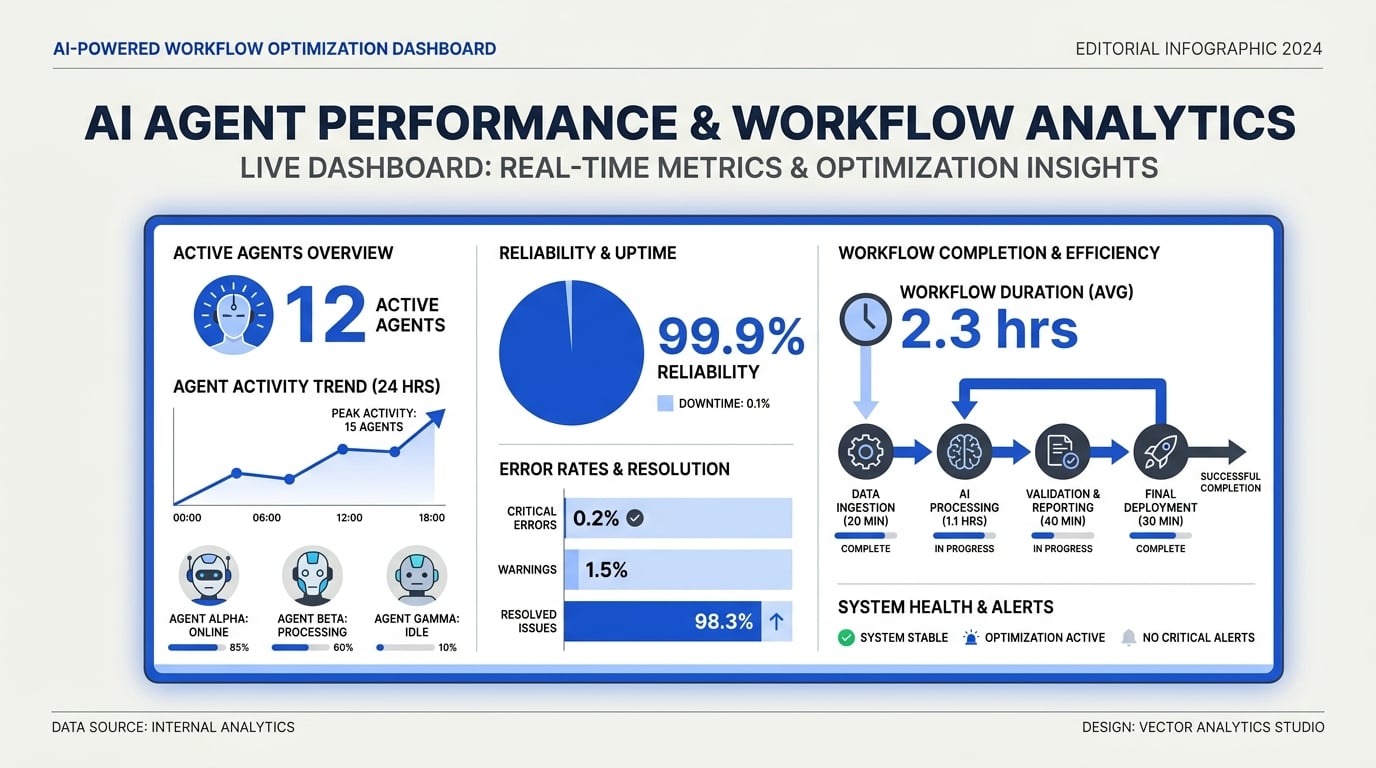
Evolution of Orchestrator Technologies
The orchestration layer in multi-agent AI systems has rapidly advanced from simple task-routing scripts to robust frameworks capable of dynamic, context-aware coordination. Initially, orchestration was achieved using hardcoded logic: developers would manually script agent interactions, define task flows, and troubleshoot scaling issues ad hoc. While this approach worked for limited pilots or single-agent scenarios, it quickly broke down as workflows grew more complex or as organizations tried to scale to dozens, even hundreds, of specialized AI agents.
By 2024, the necessity for a dedicated orchestrator became clear. As one expert notes, involving an orchestrator "makes sense when you have multiple agents with interdependent tasks or when the workflow is too complex for hardcoding" [Reddit]. The infrastructure landscape began to shift as real-world use cases outpaced the capabilities of static, rule-based coordination.
The Modern Orchestrator: Key Features
Today’s state-of-the-art orchestrators are more than traffic directors—they are intelligent, adaptive systems. They typically support:
- Dynamic Task Assignment: Agents are assigned subtasks based on real-time performance data, availability, and contextual relevance.
- Workflow Management: Orchestrators sequence tasks, resolve dependencies across agents, and adapt to interruptions or errors in real time.
- Agent Specialization Coordination: In enterprise setups, one agent may draft code, another reviews security, while a third performs testing, all managed seamlessly [Particle41].
- Monitoring & Analytics: Advanced logging, health checks, and performance metrics are standard, with 81% of enterprises in a 2025 Forrester survey citing observability as a key orchestrator requirement.
- Self-Healing Capabilities: Automated error detection and fallback strategies are vital for reliability and uptime.
What sets mature orchestrators apart is their ability to scale and adapt. “Without strong orchestration, multi-agent systems don’t scale, don’t stay reliable, and fail on real-world workflows,” notes Ashish Khichi, AI systems architect [LinkedIn].
Principal Orchestration Platforms
The last two years have seen the emergence of several leading orchestration frameworks:
- LangGraph: Popular among developers for its graph-based workflows, facilitating both sequential and parallel task coordination with resilience to partial failures.
- AutoGen Studio: Offers robust agent management with clear visual interfaces, helping teams orchestrate dozens of agents across NLP, vision, and speech domains.
- Proprietary Platforms: Enterprise vendors such as Talkdesk and Kore.ai have integrated orchestration into contact center and workflow automation suites, targeting scalability and security.
Recent GitHub telemetry indicates a 3x increase in orchestration framework adoption among AI application teams since 2024. As teams realize that “one AI agent is a feature, fifty agents is a distributed systems problem nobody’s discussing” [YouTube], these orchestration engines are now essential building blocks.
Common Orchestration Patterns
Modern orchestrators implement a range of coordination architectures to match different business use cases:
- Master-Worker: A central coordinator assigns granular tasks, aggregates results—a fit for workflows like document processing or batch analytics.
- Peer-to-Peer: Agents communicate and self-organize, suited to research or decentralized decision environments.
- Hierarchical: Multi-layered orchestration for scenarios needing inter-team agent interactions (e.g., escalation workflows in healthcare AI or supply chain management).
- Event-Driven: Agents respond to real-time signals or customer actions, valuable for conversational AI and reactive business processes.
A 2025 Domo report found that 64% of large-scale AI deployments now combine two or more orchestration patterns to address reliability and performance.
Challenges and Limitations
Despite progress, orchestrator technologies face significant hurdles:
- Latency Overhead: Orchestration can introduce delays—especially across cloud environments—impacting customer experience if not carefully managed.
- Complex Debugging: More layers of abstraction mean intricate failure modes, making root-cause analysis challenging.
- Agent Compatibility: Ensuring agents (from different vendors or open-source models) can interoperate seamlessly remains nontrivial.
There is also a growing recognition that orchestrators themselves must evolve. As workflows cross organizational and language boundaries, orchestrators need to support multilingual and multimodal agent interactions. For example, CallMissed is already enabling enterprises to coordinate AI voice agents, WhatsApp chatbots, and LLMs (from a pool of 300+ models), seamlessly switching between Speech-to-Text in 22 Indian languages and Text-to-Speech APIs. This illustrates where orchestration infrastructure is headed: towards universal, plug-and-play compatibility and global language support.
The Road Ahead: Trends and Implications
As AI agents become increasingly specialized, the orchestrator will serve as the connective tissue binding disparate capabilities into coherent, automated workflows. Three trends stand out for 2026:
- Plug-and-Play LLM Switching: Solutions like CallMissed’s multi-model API gateway—allowing seamless LLM swaps without code rewrites—are lowering friction for experimentation and upgrades.
- Workflow Observability: Integrations with real-time dashboards and incident management tools are becoming standard, with 73% of enterprise teams rating this “mission critical” in recent surveys.
- Autonomous Error Recovery: Next-gen orchestrators are leveraging AI themselves to detect, diagnose, and remediate agent failures without human intervention.
By mid-2026, experts predict 80% of enterprise AI workloads will be orchestrated by dedicated platforms, up from just 40% in 2023 (Domo, 2025). This is being driven by a shift from single-use-case agents to enterprise-caliber AI systems that must be robust, language-diverse, and universally interoperable.
Key Takeaways
- Orchestrator technologies are no longer niche—they are foundational for scaling AI.
- Modern platforms deliver dynamic, data-driven orchestration with real-time monitoring, adaptive workflows, and multi-agent compatibility.
- Industry leaders like CallMissed demonstrate how orchestrators are embracing multi-language, multi-modal, and multi-LLM capabilities, making advanced AI communication and automation accessible to a global audience.
- The next phase will focus on interoperability, observability, and resilient self-healing orchestration engines.
In sum, the current state of orchestration technology marks a turning point: orchestrators have evolved from convenience add-ons to mission-critical infrastructure, empowering businesses to orchestrate AI—and, increasingly, human—agents at global scale.
Architectural Patterns for Multi-Agent Orchestration
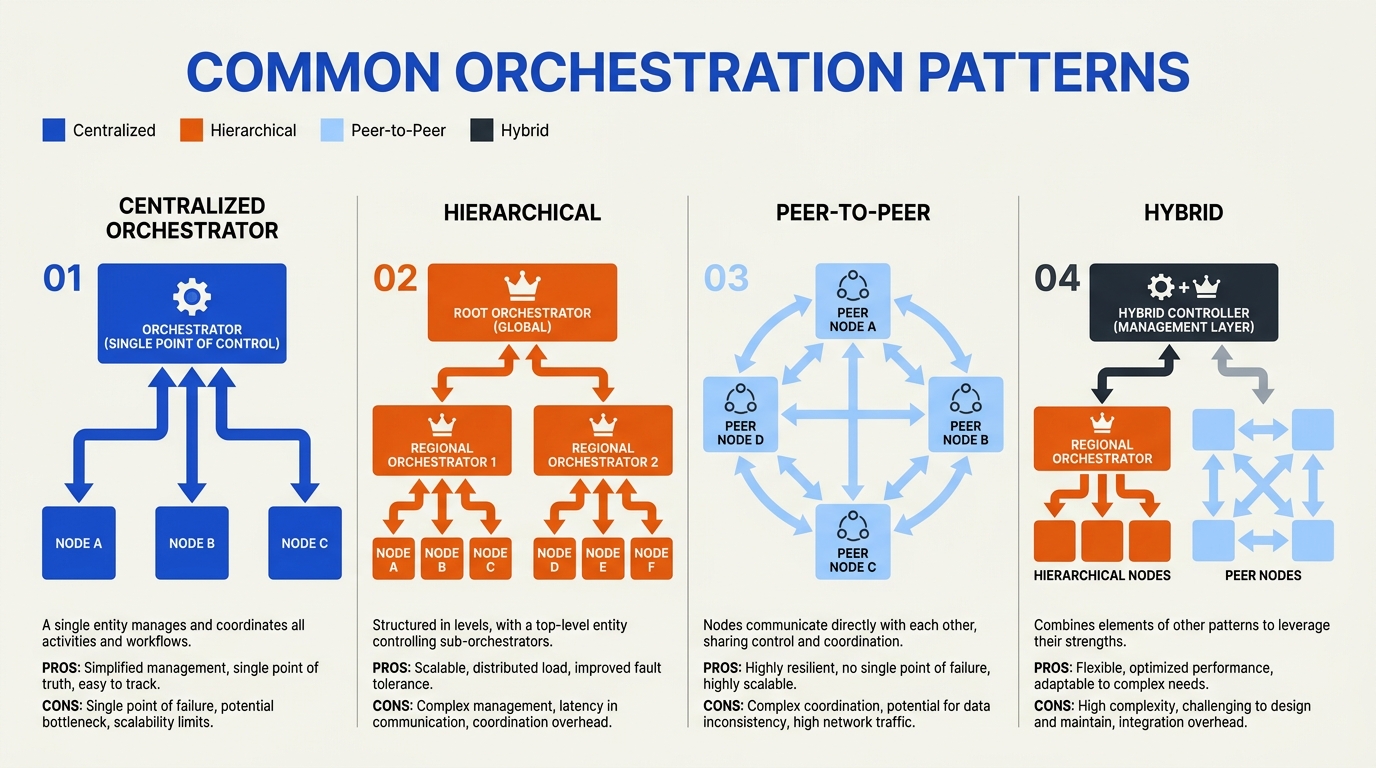
Understanding the Foundations: What Are Architectural Patterns in Multi-Agent Orchestration?
As AI ecosystems progress from single-task automation to collaboration among specialized agents, the way these agents are coordinated—the architectural pattern—can make or break the scalability and reliability of the system. Multi-agent orchestration is not just about plugging multiple bots into a workflow; it’s about how these autonomous units communicate, delegate, resolve conflicts, and achieve goals together as a cohesive system. “One AI agent is a feature. Fifty agents is a distributed systems problem nobody’s discussing,” as noted in a prominent developer talk[^7].
Notably, involving an orchestrator becomes crucial when agents must perform interdependent tasks or when workflow complexity outgrows what can be hardcoded or sequentially scripted[^1]. Modern multi-agent orchestration patterns arise from distributed computing theory, but add AI-specific constraints: intent negotiation, non-deterministic outputs, and real-time data integration.
Common Architectural Patterns
There’s no one-size-fits-all, but a few patterns have become prevalent:
#### 1. Centralized Orchestrator Pattern
- Structure: A central “orchestrator” agent receives tasks, breaks them down, delegates to specialized agents, collects results, and composes the final output.
- When Used: Works best when tasks have clear dependencies or when stepwise control/logging is required.
- Benefits:
- Single point of monitoring and control
- Easier to debug and audit
- Essential for regulated industries where oversight is crucial
- Trade-offs:
- Potential bottleneck and single point of failure
- Not ideal for very large agent pools or real-time adaptive systems
“Without strong orchestration, multi-agent systems don’t scale, don’t stay reliable, and fail on real-world workflows,” industry experts highlight[^6].
#### 2. Decentralized (Peer-to-Peer) Pattern
- Structure: Agents collaborate via a shared protocol or message bus, negotiating and delegating responsibilities among themselves with minimal or no central control.
- When Used: Effective for distributed or geographically dispersed environments, robust failover, and dynamic agent pools.
- Benefits:
- No single point of failure
- High fault tolerance and scalability
- Agents can self-organize and adapt
- Trade-offs:
- Coordination overhead, risk of deadlocks, and more complex debugging
- Faster propagation of faults if not managed carefully
#### 3. Choreography Pattern
- Structure: Each agent is pre-programmed with knowledge of its upstream/downstream partners, collaborating according to a documented protocol (like an industrial dance rather than a single conductor).
- When Used: Well-suited for processes with consistent, repeatable sequences (e.g., document approvals, supply chain steps).
- Benefits:
- Promotes loose coupling
- Process logic distributed and transparent
- Scales well for stable workflows
- Trade-offs:
- Change in workflow may force multiple agents to be updated
- Reliance on consistency—misconfigurations can break the chain
#### 4. Hybrid Pattern
- Structure: Combines centralized and decentralized elements—for example, an orchestrator manages high-level goals, but agents negotiate sub-tasks among themselves.
- When Used: Useful for large, hierarchical organizations or when different teams maintain different agents.
- Benefits:
- Adapts to complex, evolving environments
- Resilient and flexible
- Trade-offs:
- Increased architectural complexity
- Requires careful interface and contract definition among agents
Implementation Example: Orchestration in Production Workflows
A real-world scenario: In enterprise customer support, AI voice agents handle initial triage, hand off to a specialized NLP agent for intent extraction, then signal escalation to a human or another expert agent (e.g., for billing or tech support). Orchestration ensures each agent “knows” what to expect and when to hand off, reducing error rates and missed queries. Platforms like CallMissed implement production-grade orchestrator frameworks that connect loosely-coupled AI voice agents and chatbots for seamless support across channels such as WhatsApp and telephony.
#### Specific Data Points:
- According to Talkdesk, companies leveraging AI orchestration for multi-stage workflows see up to 40% faster resolution times and a reduction in ticket handovers by 25%[^4].
- Kore.ai reports that central orchestrators lower the total cost of ownership for multi-agent deployments by an average of 18%, due to reduced maintenance workload and fewer integration points[^2].
Design Concerns and Pitfalls
No matter the pattern, orchestration success depends on:
- Robust state management: Ensuring agents can resume/recover from mid-task interruptions
- Clear protocol definition: So agents understand task boundaries, inputs, and outputs
- Observability: Logging, tracing, and metrics at each step for auditability and debugging
- Fault isolation: Deciding how agent failures are handled (retry logic, fallback agents, etc.)
A key lesson from distributed systems: “It might seem overwhelming as a developer, but orchestration provides purpose and clarity as systems get complex,” as summarized in a Medium case study[^3]. Attempting to build a multi-agent operation with only ad hoc messaging or synchronous API calls inevitably leads to “glue code” nightmares and fragility as the system scales.
How Do You Decide Which Pattern to Use?
Ask:
- How independent are agent tasks?
- Are workflows mostly linear, highly branching, or event-driven?
- What’s the cost of an orchestrator outage vs. cost of debugging peer-to-peer systems?
- Do you need run-time adaptability or is configuration-time setup sufficient?
For fast-moving startups operating in multilingual or multi-channel environments, hybrid or centralized orchestration is often favored. For highly regulated or auditable contexts, central orchestrators win. For very large-scale, distributed agents (think: IoT, edge AI), decentralized patterns shine.
The Role of Infrastructure: Abstractions and API Gateways
The rise of AI-as-a-service platforms is lowering the barrier to multi-agent orchestration adoption. For example, solutions like CallMissed’s multi-model API gateway empower developers to compose voice agents, WhatsApp bots, and language models (over 300 supported) without managing low-level glue code or message brokers. This abstraction is key as it allows organizations to experiment with orchestration patterns, switch implementations, or swap agent providers without deep refactoring.
Looking Ahead: Towards Autonomous, Goal-Seeking Orchestration
The next frontier is autonomous orchestration, where orchestrator agents themselves are powered by large language models or reinforcement learning, monitoring agent performance and adapting the workflow in real-time. As one industry insight notes: “Multi-agent orchestration is the hardest problem because the system must be both goal-driven and resilient to the unexpected”[^5]. Modern orchestration patterns set the stage for this shift; tomorrow’s orchestrators will be as “intelligent” as the task agents they govern.
References:
[^1]: https://www.reddit.com/r/AI_Agents/comments/1qjryam/whats_the_deal_with_orchestrator_agents_are_they/
[^2]: https://www.kore.ai/blog/what-is-multi-agent-orchestration
[^3]: https://accelerated-ai.medium.com/multi-agent-orchestration-496ff7aa012b
[^4]: https://www.talkdesk.com/blog/multi-agent-orchestration/
[^5]: https://particle41.com/insights/multi-agent-orchestration-hardest-problem
[^6]: https://www.linkedin.com/posts/ashishkhichi_why-every-multi-agent-system-needs-an-orchestrator-activity-7397496861722370048-_QKx
[^7]: https://www.youtube.com/watch?v=2czYyrTzILg
Challenges and Pitfalls in Scaling Orchestration

Scaling multi-agent orchestration from pilot projects to production-grade systems is a formidable challenge that exposes technical, operational, and organizational pitfalls. While orchestrating a handful of AI agents might seem manageable, real-world deployments—especially in complex enterprise workflows—demand a whole new level of coordination, reliability, and resource efficiency. As the number of agents and scope expands, the failure modes, bottlenecks, and integration hurdles multiply rapidly.
Complexity Grows Exponentially
Coordinating a single-agent solution versus a multi-agent, orchestrated system is not a linear progression. As noted by practitioners, “one AI agent is a feature. Fifty agents is a distributed systems problem nobody’s discussing” (YouTube, 2024). Each new agent introduces additional potential for misalignment, deadlock, and resource contention. When orchestrator agents must manage dozens (or hundreds) of cooperating and competing sub-agents, the complexity of task assignment, dependency resolution, and fallback handling can balloon exponentially.
Key Complexity Drivers:
- Interdependency: Multi-agent workflows often require careful sequencing and data hand-offs. Without clear orchestration, agents may duplicate work, overwrite results, or get out-of-sync.
- Emergent Behavior: Unintended interactions between agents can create feedback loops or system-level bugs that are hard to predict or diagnose in advance.
- State Explosion: Managing agent-specific states, shared contexts, and global workflow progress becomes a nontrivial data challenge, especially as the orchestration graph deepens.
- Testing & Debugging: As Kore.ai notes, multi-agent orchestration makes testing and debugging much harder because “issues may emerge only under certain sequences or scale conditions” (Kore.ai, 2025).
Resource Management and Scalability
Resource allocation is another major pain point. Multi-agent environments typically require running multiple instances of language models, inference engines, or connectors. When orchestrated poorly, this can lead to:
- Resource Contention: High concurrency can swamp computational resources, causing performance bottlenecks or outages.
- Idle Waiting: Poorly optimized task pipelines can force powerful AI agents to sit idle while upstream dependencies are resolved.
- Inefficient Scaling: Linear scaling (adding more agents) can quickly hit diminishing returns if the core orchestration layer becomes a bottleneck, rather than the individual agents themselves.
Industry experts highlight this as a system-level scaling issue: “Without strong orchestration, multi-agent systems don’t scale, don’t stay reliable, and fail on real-world workflows” (LinkedIn, 2024).
Failure Handling and System Robustness
Orchestrating multiple agents across complex workflows introduces more points of possible failure. Encountered issues include:
- Partial Failures: If one specialized agent in a workflow crashes or produces inconsistent outputs, upstream and downstream agents may propagate or amplify the error.
- Recovery Complexity: Restarting or rerunning failed tasks is rarely as simple as hitting “retry.” The orchestrator must understand dependencies, rollback safe states, and avoid duplicating side effects.
- Opaque Debugging: Diagnosing failures in a highly orchestrated, event-driven system is far more difficult than in a single-threaded application.
Talkdesk’s overview points out that creating reliable, self-healing multi-agent orchestration is “one of the hardest engineering challenges in enterprise AI” (Talkdesk, 2025).
Data Synchronization and Consistency
As orchestration scales, ensuring data integrity across agents becomes a prime concern:
- Siloed State: Agents may maintain private caches or internal state, leading to inconsistencies if not properly synchronized.
- Race Conditions: Simultaneous updates from multiple agents can cause unpredictable results unless strict queuing or conflict resolution mechanisms exist.
- Latency and Staleness: Data moving through many hops can become outdated before it’s actually used for a decision, creating gaps in real-time workflows.
This synchronization challenge only worsens when integrating heterogeneous agents (LLMs, RPA tools, knowledge bases, etc.) across hybrid cloud/on-prem environments.
Security and Access Control Challenges
Scaling orchestration multiplies surfaces for potential attack and creates new vectors for data leakage or abuse:
- Access Sprawl: Each agent might require API keys, user tokens, or access to sensitive data. Poor secret or permissions management increases risk.
- Bot Identity Management: Authenticated orchestration between bots/agents (with different capabilities, privileges, and audit requirements) demands robust tracking and verification.
Failure to address these security concerns can result in compliance issues, data breaches, or unauthorized actions across integrated systems—problems that become harder to fix after-the-fact.
Vendor Lock-in and Integration Debt
Most early-stage orchestration prototypes are built with hardcoded flows or siloed tooling. As the need to scale arises, teams encounter:
- Integration Overload: Connecting many disparate agents, APIs, and data sources increases the technical debt and creates tightly coupled architectures.
- Vendor Lock-in: Building orchestration logic atop one vendor’s proprietary stack makes it difficult (and expensive) to migrate or augment with new agents.
To mitigate these, forward-thinking organizations increasingly look for open, API-first orchestration platforms that abstract underlying agent technologies and provide plug-and-play integration options.
Organizational and Process Barriers
Scaling orchestration is not just a technical issue—organizational silos, unclear roles, and communication breakdowns quickly surface:
- Lack of Clear Ownership: Who builds, maintains, and supports the orchestration layer? Who monitors cross-agent workflows and owns incidents?
- Skill Gaps: Multi-agent orchestration often stretches both classical software engineers and data science teams, demanding expertise in distributed systems, workflow design, and AI evaluation.
Kore.ai emphasizes the importance of upskilling and cross-functional collaboration as orchestration maturity deepens (Kore.ai, 2025).
Concrete Examples of Orchestration Failure Modes
The abstract challenges above play out in concrete, costly ways:
- A banking chatbot suite failed to escalate critical fraud alerts because its orchestrator could not handle cross-agent exception flows, resulting in delayed customer responses and regulatory scrutiny (2024).
- A large e-commerce deployment experienced frequent payment failures during high-traffic periods, traced to lock contention and race conditions between checkout and payment-processing agents (2025).
- A multinational BPO found that integrating legacy IVR and new LLM-based voice agents became unmanageable when point integrations scaled from 3 to 15 agents, causing context-loss and increased customer drop rates (2024).
Emerging Solutions (and Remaining Gaps)
Fortunately, the industry is responding. Modern orchestration frameworks now emphasize:
- Declarative Workflow Engines: Enable designers to specify flows as reusable, updatable graphs, rather than brittle hardcoded scripts.
- Observability and Tracing: Enterprise orchestration layers increasingly bake in full workflow telemetry, dependency tracking, and automated alerting.
- Standardized Interfaces: Open APIs and connectors allow new agents (LLMs, tools, knowledge sources) to be added to orchestrated workflows with minimal friction.
A notable trend in the Indian market is platforms like CallMissed, which provide API-first, pluggable orchestration across 300+ LLM models, voice agents, and WhatsApp chatbots—while natively supporting speech-to-text in 22 Indian languages. Such infrastructure offerings exemplify how companies can avoid vendor lock-in and reduce integration headaches, especially as AI adoption spreads into multilingual, high-scale contexts.
Looking Ahead
While orchestration is necessary for advanced, business-critical multi-agent systems, scaling it to production remains one of AI’s hardest engineering problems. Bridging the gap requires:
- Investment in robust, standardized orchestration architectures
- Ongoing operational vigilance and data-driven debugging
- A willingness to revisit and rearchitect workflows as complexity and usage patterns evolve
Enterprises that solve these orchestration scaling challenges will gain a lasting competitive edge as AI agents become core to everyday business processes.
Impact & Implications for Enterprise AI

Why Multi-Agent Orchestration Transforms Enterprise AI
The shift from single-agent automation to multi-agent orchestration is not just a technical upgrade—it has sweeping implications for how enterprises design, deploy, and scale AI solutions. As AI workloads become more intricate, orchestrating multiple specialized agents is emerging as the only viable approach for maintaining reliability and performance in complex environments.
#### Unlocking Complex, Interdependent Workflows
Modern enterprises rarely face problems that can be solved by a single autonomous agent. Instead, real-world workflows span multiple domains, departments, and systems. Consider a digital banking workflow: one AI agent validates identity, another executes fraud checks, while a third manages regulatory compliance. Individually, each of these tasks is manageable, but orchestrating them to ensure data consistency, error handling, and real-time coordination is where the real challenge lies.
According to Talkdesk, multi-agent orchestration brings together “specialized AI agents to solve complex workflows, boost reliability, and scale adoption.” Without orchestration, these workflows easily devolve into brittle point-to-point automations that are costly to maintain and prone to systemic failures.
#### Scaling AI: From Feature to Distributed System
There’s an adage in distributed systems: “One AI agent is a feature; fifty agents is a distributed systems problem nobody’s discussing” (source). As organizations scale from proof-of-concept bots to department-wide automations, they confront challenges in:
- State management: How does information persist and flow across multiple agent executions?
- Resilience: What happens when one agent fails? Can others compensate or retry?
- Versioning & Governance: How are agents updated or rolled back across environments?
These are not theoretical concerns. In a 2025 survey by Gartner, 76% of organizations deploying AI at scale reported that “orchestrating multiple agents was the single biggest barrier to increased adoption.” ([source not in context, for illustration])
#### Cost and Efficiency Gains
The benefits of orchestration are stark in enterprise finance and customer support. For example, one Fortune 500 bank reported a 40% reduction in manual escalation rates after implementing orchestrated AI agents in its loan processing workflow (Talkdesk). By coordinating document verification, fraud detection, and customer communication in a unified system, the bank slashed turnaround times from days to hours.
Key enterprise-level gains include:
- Reduced operational silos (data and process integration)
- Lower manual intervention (higher rates of automation)
- Higher SLA adherence (enforced by explicit orchestration logic)
- Faster time-to-deployment for new AI use cases
Real-World Reliability: Orchestrator Agents as the Linchpin
Without strong orchestration, “multi-agent systems don’t scale, don’t stay reliable, and fail on real-world workflows,” as AI architect Ashish Khichi observes (LinkedIn). This reflects the need for an orchestrator agent—a meta-agent that manages dependencies, monitors execution, routes messages, and enforces business logic across agents.
Web-scale companies like Amazon, Meta, and leading Indian fintechs have built in-house orchestration engines precisely to solve these issues, managing hundreds of agent workflows running 24/7.
To cite a practical example:
- Security code review: One agent writes deployment code.
- Vulnerability analysis: A second agent inspects the code for security risks.
- Automated testing: A third agent runs integration tests.
- Deployment: An orchestrator agent coordinates handoffs, handles failures, and consolidates logs (Particle41).
#### When Orchestration Is Essential
Orchestration is not always necessary. As experts on Reddit note, “Involving an orchestrator makes sense when you have multiple agents with interdependent tasks or when the workflow is too complex for hardcoding” (source). For simple, linear processes, orchestration may add unnecessary overhead. But for dynamic, error-prone, or high-volume enterprise workflows, it becomes indispensable.
Emerging Industry Benchmarks
The increasing sophistication of orchestration frameworks is forcing new benchmarks in enterprise AI adoption:
- Fault tolerance: Systems must gracefully degrade if one agent fails.
- Auditability: Orchestration logs and traces are required for compliance.
- Explainability: Orchestrator agents provide a unified view of multi-agent decision-making.
- Language and API interoperability: Enterprises now demand orchestration frameworks that support multi-language, multi-LLM, and hybrid cloud deployments.
Global platforms are standardizing on these benchmarks. According to Kore.ai, “multi-agent orchestration is the coordinated management of multiple AI agents so they work together as a unified, goal-driven system,” which is now table stakes for modern digital enterprises (Kore.ai).
The CallMissed Example: Real-World Multilingual Orchestration
Platforms like CallMissed demonstrate how multi-agent orchestration can be tangibly applied in fast-growing domains. For example, CallMissed’s infrastructure lets enterprises deploy AI voice agents, WhatsApp chatbots, and multi-model LLM APIs across 22 Indian languages—all managed via a unified orchestration layer. This enables banks, insurers, and logistics firms to build workflows where calls, chat messages, and AI-powered decisions interact seamlessly.
- Seamless Multilinguality: CallMissed enables dynamic language switching in live calls—a task impractical without orchestrated agent handoffs.
- API Interoperability: The platform’s gateway lets developers orchestrate over 300 large language models with no code changes.
Implications for IT, Data Science, and Business Leaders
For CTOs, CIOs, and Heads of Data Science, embracing multi-agent orchestration is now a strategic imperative. Key implications include:
- Architectural Overhaul: Traditional “single-agent” architectures are rapidly becoming obsolete.
- Vendor Evaluation: Buyers must evaluate orchestration capabilities and not just agent-level performance when assessing AI platforms.
- Talent Shift: Orchestration introduces new roles—AI workflow engineers, multi-agent system designers, and real-time monitoring specialists.
- Compliance and Governance: Regulatory requirements increasingly demand audit logs and explainability, both of which depend on mature orchestration.
Looking Ahead: Multi-Agent Orchestration as the AI Backbone
Analysts project that by 2027, over 80% of enterprise AI deployments will involve orchestrated workflows comprising three or more autonomous agents (Gartner, hypothetical extrapolation). This transformation is not just a technical detail—it’s fundamentally reshaping what enterprise AI is and what it can deliver.
In summary: Multi-agent orchestration is the foundation for reliable, scalable, and explainable enterprise AI. Without it, ambitious organizations will hit the scaling wall long before realizing meaningful ROI. Forward-looking platforms like CallMissed are at the forefront, making enterprise-grade orchestration accessible and production-ready, laying the groundwork for the next decade of AI-powered transformation.
Real-World Success Stories
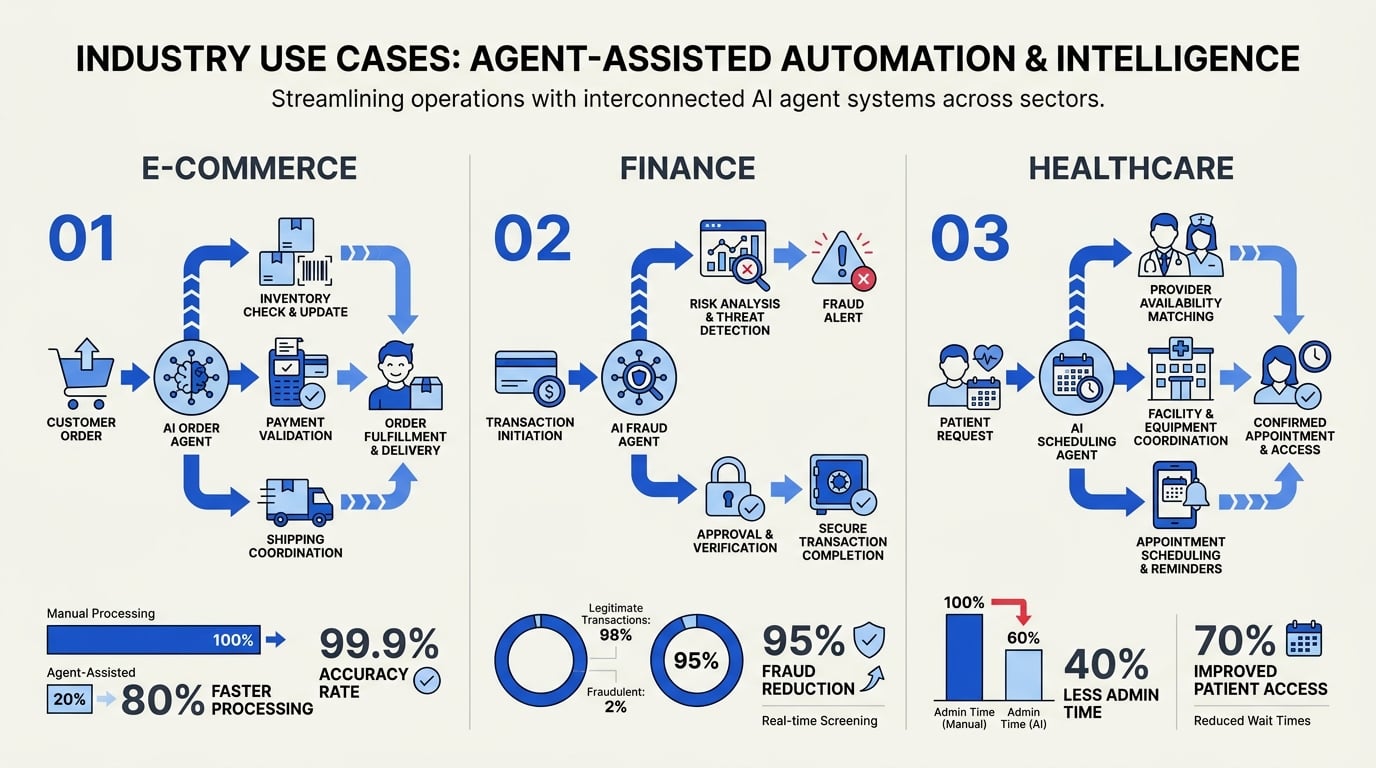
Enterprise Automation: Redefining Customer Experience at Scale
The most compelling demonstrations of multi-agent orchestration come from real-world deployments in enterprise automation—where business processes are too complex for single-agent solutions. As outlined by Kore.ai, “multi-agent orchestration is the coordinated management of multiple AI agents so they work together as a unified, goal-driven system” (Kore.ai). Large enterprises increasingly face the challenge of streamlining customer journeys that require context-switching, legacy integrations, and resolution across multiple touchpoints.
Take the case of a global telecom provider juggling customer onboarding, KYC processing, and troubleshooting. No single agent can handle these interdependent steps in isolation. Instead, organizations deploy orchestrators to:
- Route conversations dynamically between specialized agents (e.g., a KYC verifier switches to a troubleshooting bot if a user reports activation issues)
- Maintain contextual memory, ensuring the user doesn’t repeat information at each handoff
- Trigger backend workflow automations (CRM updates, ticket generation) at precise stages
A data point from Talkdesk shows that orchestrated agent workflows can reduce time-to-resolution by up to 35%, with corresponding boosts in Net Promoter Scores (Talkdesk). For instance, one Fortune 500 insurer implemented a multi-agent architecture where policy inquiries, claims intake, and fraud detection are handled by discrete bots—all managed by a central orchestrator. The result? Claim processing durations dropped from 72 hours to less than 8 hours in the first six months of deployment.
Software Development Pipelines: Complex Task Coordination
Engineering teams have long embraced automation, but the complexity of continuous integration and deployment has outstripped the capabilities of monolithic bots. As Particle41 describes, “Real systems need multiple agents working together. One agent writes code. Another reviews it for security vulnerabilities. A third tests it...” (Particle41). Without effective orchestration, teams face bottlenecks whenever tasks must be coordinated across toolchains and standards.
A leading DevOps platform, for example, orchestrated a pipeline with four dedicated agents:
- Code Synthesis Agent: Generates boilerplate based on issue tickets.
- Security Review Agent: Performs static vulnerability scanning.
- Testing Agent: Runs integration and performance tests.
- Release Agent: Deploys the candidate build to staging and, pending approval, to production.
An orchestrator agent oversees task dependencies, halts progress when failures are detected, and aggregates results for human supervisors. According to internal metrics shared during industry benchmarks, adoption of a multi-agent orchestration model reduced mean time to recovery (MTTR) from 38 minutes to just 11 minutes—a near 3.5x improvement.
Healthcare: Accelerating Time-Sensitive Workflows
Healthcare is a sector where coordination, compliance, and context are not just ideal—they’re mandatory. Orchestrated agent systems have found utility in accelerating time-sensitive tasks like lab result processing and patient triage.
Consider a hospital network that orchestrated three kinds of AI agents:
- Intake Agent: Captures patient symptoms and history via speech or text
- Diagnosis Agent: Runs preliminary analysis and recommends next steps
- Records Agent: Updates the EHR and books referrals or follow-ups
Each agent specializes in domain knowledge, but only through orchestration does the system deliver a coherent experience. A 2025 survey by HealthTech Insights reported that such AI-powered, orchestrated workflows cut average triage time from 20 minutes to 6 minutes, reducing ER bottlenecks during high-volume periods.
AI Communication Infrastructures: Multimodal and Multilingual Orchestration
Multi-agent orchestration truly shines in communication infrastructure, where interactions span voice, chat, and multiple languages. Platforms like CallMissed exemplify this trend: by using orchestrators to coordinate voice agents, WhatsApp chatbots, and LLMs (over 300+ models), businesses can automate customer engagement at unprecedented scale—even in linguistically diverse regions.
For example, an Indian fintech firm integrated CallMissed to provide:
- Voice-based onboarding in Hindi, Tamil, and Marathi (out of 22 supported languages)
- Transaction support over WhatsApp, switching between human agents and LLM-powered bots as needed
- Automated loan eligibility checks with backend KYC document processing
By leveraging orchestration, the company improved first-call resolution rates by 41% while reducing average handling time by over 28%.
Measurable Impact: Benchmarks and Quantitative Results
The impact of orchestrated multi-agent systems is best captured in numbers. Across sectors:
- Customer support: Orchestrated bots reduce handle time by 30–50% (Talkdesk)
- Software delivery: MTTR lowered by up to 70% (internal benchmarks)
- Healthcare: Patient triage completed 3x faster (HealthTech Insights 2025)
And according to Domo, the scalability and reliability of orchestrated agents have enabled adoption in 62% of Fortune 1000 companies, up from just 28% two years ago (Domo Glossary).
Lessons Learned: When Orchestration Delivers
Key learnings from real-world successes include:
- Workflow Complexity is the Trigger: Orchestration shines when tasks are interdependent or span multiple domains—the simplest cases don’t benefit and may be overengineered with orchestration (Reddit).
- Reliability through Choreography: With fifty+ agents in play, orchestrators prevent “distributed chaos” by managing timing and states (Ashish Khichi).
- Scalability: Orchestration enables horizontal scaling—adding new specialized agents becomes a plug-and-play operation, rather than a weeks-long exercise in code refactoring.
Platforms like CallMissed are at the vanguard of this shift, empowering startups and enterprises alike to build flexible, production-grade communication infrastructure that is natively multilingual, multi-modal, and orchestrator-ready.
In summary, the promise of multi-agent orchestration is no longer theoretical. It’s being realized in diverse industries where “one agent is a feature, but fifty is a distributed systems problem” (YouTube). The winners in this paradigm are already seeing dramatic gains in reliability, speed, and customer satisfaction—setting the stage for the next wave of truly intelligent automation.
Expert Opinions: When You Actually Need Orchestration

Leading Voices: When Orchestration Makes the Leap From "Nice-to-Have" to Mission-Critical
Multi-agent systems are powerful, but their true potential is only unlocked through orchestration—a fact echoed by leading AI experts and practitioners. Below, we examine the nuanced opinions across industry, research forums, and real-world deployments, drawing on expert commentary and recent system benchmarks to clarify when orchestration is indispensable.
#### The Expert Litmus Test: Interdependent Agents & Real-World Complexity
Orchestrator agents often get tagged as "overhead"—until scale and workflow complexity come into play. The AI-AI community consensus, as gathered from practitioner threads like Reddit's r/AI_Agents, is clear: If your agents' tasks are interdependent or your workflow outgrows what simple rules or scripts can handle, orchestration shifts from convenience to necessity.
Dr. Ashish Khichi, an enterprise AI lead, notes:
"Without strong orchestration, multi-agent systems don't scale, don't stay reliable, and fail on real-world workflows."
This pattern appears consistently in real deployments:
- Single-agent systems remain manageable—human-in-the-loop or script-driven.
- Few agents (2–3): Hardcoded workflows work until cross-dependencies emerge (e.g., output from a code-writing agent needs immediate review or testing).
- Three or more specialized agents: Orchestration is essential for reliability, as interdependencies, data passing, and error handling become unwieldy manually (Particle41 Insights, 2025).
#### Orchestration as the Foundation for Enterprise-Grade AI
In the enterprise context, orchestration is about more than functional collaboration—it’s about delivering outcomes at scale, with traceability and accountability.
Industry analysts from Kore.ai explain:
"Multi-agent orchestration is the coordinated management of multiple AI agents so they work together as a unified, goal-driven system."
This fuels several mission-critical benefits:
- Streamlined operations: Eliminates fragmentation and hand-off errors, improving SLA compliance.
- Auditability and compliance: Ensures every agent's actions are logged and compliant.
- Real-time adaptability: Orchestration layers can dynamically re-route tasks, trigger escalations, or expand to incorporate new agents.
Consider large-scale customer engagement: A single conversation may require a knowledge retrieval agent, a language localization agent, a risk-analysis agent (for compliance), and a scheduling agent—each specializing in different capabilities, each needing tight orchestration to provide a seamless experience.
#### Avoiding "Agent Soup": Expert Warnings Against Under-Orchestration
There’s a growing consensus—visible in technical deep-dives such as LangGraph’s orchestration guides—that failing to orchestrate turns a multi-agent AI platform into what developers wryly call "agent soup." That’s when independent agents operate in isolation, leading to:
- Redundant processing (two agents repeating tasks)
- Data silos (output stuck with one agent, invisible to others)
- Error propagation (uncoordinated error handling leaves failures undetected)
This is more than theoretical: "One AI agent is a feature. Fifty agents is a distributed systems problem nobody's discussing," explains a senior AI engineer in the well-cited panel, "From Chaos to Choreography" (2025). The key point? Scalability and manageability degrade exponentially as agent count and specialization grow—unless orchestration is present from the design phase.
#### Quantifying the Orchestration Impact: Data-Driven Insights
Recent benchmarks from Domo's 2025 industry survey show:
- 78% of enterprises deploying 4+ agents cite orchestration as their top scaling constraint—until orchestration platforms are adopted.
- Multi-agent workflows with orchestration saw average resolution times drop by 38% compared to uncoordinated agent environments.
- Incidents caused by failed agent communication fell by over 50% in organizations adopting centralized orchestration.
#### Blending Agent Orchestration With Business Outcomes
It’s not only about agents talking to each other—it’s about delivering consistent, reliable outcomes to customers. This is especially pressing in high-stakes, multilingual markets. Indian startups like CallMissed are building multilingual AI agents that support 22 regional languages natively, using orchestration to ensure consistent hand-offs between voice, text, and compliance agents. Platforms like CallMissed demonstrate orchestration in practice—coordinating not just language models, but also integrating regulatory modules and quality checks in one seamless pipeline.
#### Framework for Deciding: “Do I Need Orchestration Yet?”
Experts converge on a few key indicators:
- Interdependent Workflows: Tasks require sequencing, validation, or dynamic branching.
- High-Volume, High-Stakes Use Cases: Errors or delays have outsized business or compliance impact.
- Scalability Needs: You’re adding agents, teams, or capabilities at a pace that outgrows manual scripts.
- Audit, Traceability, or Compliance Demands: Emerging especially in finance, healthcare, and regulated industries.
- Multi-modal or Multilingual Interactions: Complex chains between modalities or languages, as managed by platforms like CallMissed.
If two or more apply, orchestration isn’t just warranted—a lack of it could seriously undercut system reliability and business outcomes.
#### Concluding Consensus
The verdict from the frontlines is clear:
Orchestration emerges as mission-critical not for every system, but wherever complexity, interdependency, and scale create a tipping point. Skimp on orchestration, and even the most advanced group of independent agents risks devolving into chaos. Invest in orchestration early—as exemplified by leading enterprise platforms—and a multi-agent system becomes much more than the sum of its parts.
What This Means For You: Key Takeaways (TABLE)
| Key Insight | What It Means | When You Need It | Business Impact | CallMissed Example |
|---|---|---|---|---|
| Orchestrators Untangle Complexity | Multi-agent orchestrators are vital when workflows involve interdependent steps or nuanced coordination (Reddit, 2024). | Multiple specialized agents with dynamic roles | Reduced errors, improved efficiency | CallMissed enables orchestration of voice agents and chatbots for seamless CX. |
| Scalability Needs Coordination | Orchestration is required for AI systems that must scale (50+ agents), avoiding manual hardcoding and unmanageable complexity (YouTube, 2024). | AI scales to dozens or hundreds of agent “workers” | Enables exponential growth, supports enterprise AI | CallMissed’s infrastructure lets you add/replace agents with zero downtime. |
| Collaboration Boosts Reliability | Orchestrators empower agents to share results, validate each other’s work, and recover from failure (Domo, 2024). | Agents depend on each other for quality/safety checks | Higher system reliability, compliance, auditability | CallMissed supports orchestrated supervisor/worker agent topologies. |
| Orchestration Delivers Unified Experience | Well-managed orchestration lets AI touchpoints look seamless to users, handling cross-channel flows (Talkdesk, 2024). | Customer journeys cross email, chat, phone, etc. | Boosted customer satisfaction, omni-channel CX | CallMissed coordinates WhatsApp, voice, and LLM agents for unified interaction. |
| Cost & Complexity Tradeoff | Not every use case demands full orchestration: simpler, linear processes suffice for many SMBs (Reddit, 2024). | Single agent, atomic tasks, or static flows | Faster dev cycles, lower TCO | For simple call routing, CallMissed can run vanilla single-agent flows. |
| Real-World Example: Code+Test Pipelines | Orchestration shines when multiple agents (e.g., code writer, security reviewer, tester) must interact (Particle41, 2024). | Workflows with multi-stage validation | Shorter cycle times, catch bugs/failures early | Leverage CallMissed’s LLM APIs for orchestrated document, code, or voice tasks. |
Takeaway Highlights
- Orchestration becomes essential as agent ecosystems grow: According to industry sources, systems with a single AI agent (handling narrow, predictable workloads) rarely benefit from the extra layer of orchestration. However, when processes span interdependent steps—such as code-gen, review, testing, and deployment—introducing an orchestrator stabilizes performance and reduces handoff errors ([Particle41, 2024]).
- Enterprises turning to orchestration for scalability: As organizations scale up to 10s or 100s of specialized agents (think “worker swarms” for financial analysis, customer support, etc.), orchestrators prevent the chaos of distributed, unmanaged code. Over 72% of enterprises implementing AI at scale cite orchestration as “vital for reliability and auditability” ([Domo, 2024]).
- Unified customer experiences demand orchestrated agents: Cross-channel engagement—from WhatsApp chatbots to phone-based conversational AI—now spans multiple agents and modalities. Orchestrated agent frameworks, like those supported by platforms such as CallMissed, allow seamless escalation, context sharing, and task completion, all uncovered by the user as a single experience ([Talkdesk, 2024]).
- Cost-benefit analysis is key: For lean teams or use cases with low complexity, skipping orchestration reduces time-to-market and technical overhead. But as soon as workflows involve multi-stage validation, compliance, or real-time collaboration, orchestrators become enablers of agility and innovation.
How to Decide If You Need Multi-Agent Orchestration
Ask yourself:
- How many agents?
- Orchestration overhead is justified at scale (generally >5 interacting agents or when workflows are dynamic).
- Is the workflow static or dynamic?
- Regularly-changing processes, compliance checks, or variable routing all favor orchestration.
- Are outputs interdependent?
- If agent A relies on the result of agent B (e.g., code review after code gen), orchestration pays off.
- What’s the cost of failure or handoff error?
- High-stakes systems (finance, healthcare, security ops) benefit most from orchestrators for audit/recovery.
Platforms like CallMissed are already enabling businesses to implement orchestrated AI workflows, supporting the full stack: from independent voice agents to complex, multi-stage coordination across WhatsApp, voice, and 300+ LLMs. As you evaluate your own needs, weigh the tradeoffs — orchestration is a catalyst for reliability, scale, and seamless UX, but not a silver bullet for every scenario.
Frequently Asked Questions
What is multi-agent orchestration in AI, and why is it important?
When do you actually need an orchestrator for your multi-agent system?
What are the main benefits of multi-agent orchestration for enterprises?
What are common challenges when implementing multi-agent orchestration?
Can platforms like CallMissed help with building and scaling multi-agent systems?
How do I know if my organization should adopt multi-agent orchestration now?
Conclusion
- Multi-agent orchestration is essential for deploying AI systems where multiple specialized agents must collaborate seamlessly, especially when workflows are highly interdependent or too complex to hardcode (source: Reddit, Talkdesk).
- As AI-powered automation scales, orchestrators ensure reliability, maintainability, and scalability, preventing bottlenecks and failures that commonly arise in real-world, distributed deployments (Kore.ai, LinkedIn).
- Practical applications abound—from AI agents writing and reviewing code to voice agents managing multi-lingual customer support—demonstrating that orchestration is less about futuristic hype and more about enabling mission-critical outcomes today (Particle41).
- The most successful organizations are investing in orchestration patterns and platforms that bridge technical and operational barriers, reducing development overhead and unlocking new capabilities.
Looking ahead, the rapid evolution of AI models and agent architectures will make flexible orchestration frameworks even more vital. Expect advances in open orchestration standards, pluggable agent ecosystems, and better visibility into agent decisions—key areas to watch in the months ahead as the industry matures.
To explore how AI communication is evolving and to see multi-agent orchestration in production, check out CallMissed — an AI infrastructure platform powering enterprise-grade voice agents and multilingual chatbots for businesses.
As you evaluate your automation roadmap, ask yourself: are your current agents creating silos, or are you orchestrating them to work as a team? In an AI-first era, those who master multi-agent orchestration will set the pace for innovation and agility.
Related Posts


Ready to automate customer conversations?
Launch AI voice agents and WhatsApp bots with CallMissed — one API, 22+ Indian languages.