

IIT-Madras Launches California Centre: New Launchpad for Indian Deep-Tech Startups


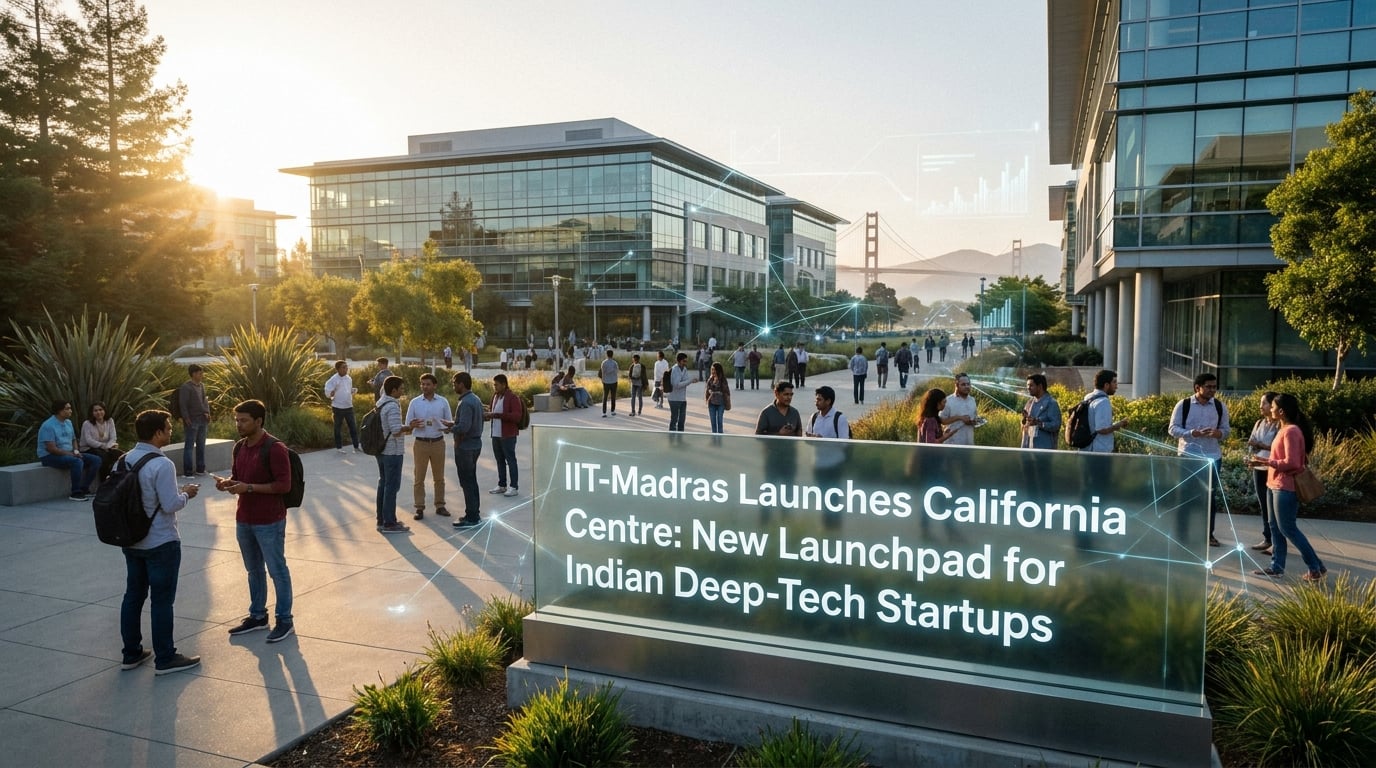
Did you know that nearly 50% of India’s deep-tech startups are now eyeing global markets, but only a handful successfully break through Silicon Valley’s...
IIT-Madras Launches California Centre: New Launchpad for Indian Deep-Tech Startups
Did you know that nearly 50% of India’s deep-tech startups are now eyeing global markets, but only a handful successfully break through Silicon Valley’s formidable barriers? In a move set to transform this dynamic, the Indian Institute of Technology Madras (IIT-Madras) has just launched its first centre in Menlo Park, California—a landmark $7.5 million initiative and a powerful new launchpad for Indian deep-tech startups. Announced at the prestigious SelectUSA Investment Summit and developed in partnership with CA Startups, this hub is making waves across the international innovation landscape.
This isn’t just another global research outpost. The IIT-Madras California centre aims to provide Indian startups with the vital connections, mentorship, and cross-border resources they need to scale quickly in North America. With deep-tech sectors—from artificial intelligence and advanced materials to healthtech and cleantech—driving India’s tech economy to record growth, access to California’s unmatched ecosystem could be a game-changer. As of 2026, Indian startups attracted $7 billion in funding last year, yet less than 15% of deep-tech founders report having meaningful US market access or direct ties to global corporations (NASSCOM, 2025). This new centre is designed to close that gap.
In this article, you’ll learn why the IIT-Madras California hub is more than a symbolic bridge and how it tackles persistent bottlenecks faced by Indian deep-tech founders—like venture scaling, product validation, and regulatory navigation. You’ll also discover how the centre’s proximity to major AI and cloud infrastructure players is opening doors for next-generation solutions. And as Indian companies such as CallMissed prove, having direct access to U.S.-based tech communities enables not just business expansion but rapid integration with future-ready technologies.
Read on to see how this ground-breaking initiative could shape the next decade of India-U.S. innovation—and what it means for deep-tech entrepreneurs eager to go global.
Introduction: A Historic Leap for Indian Tech Innovation
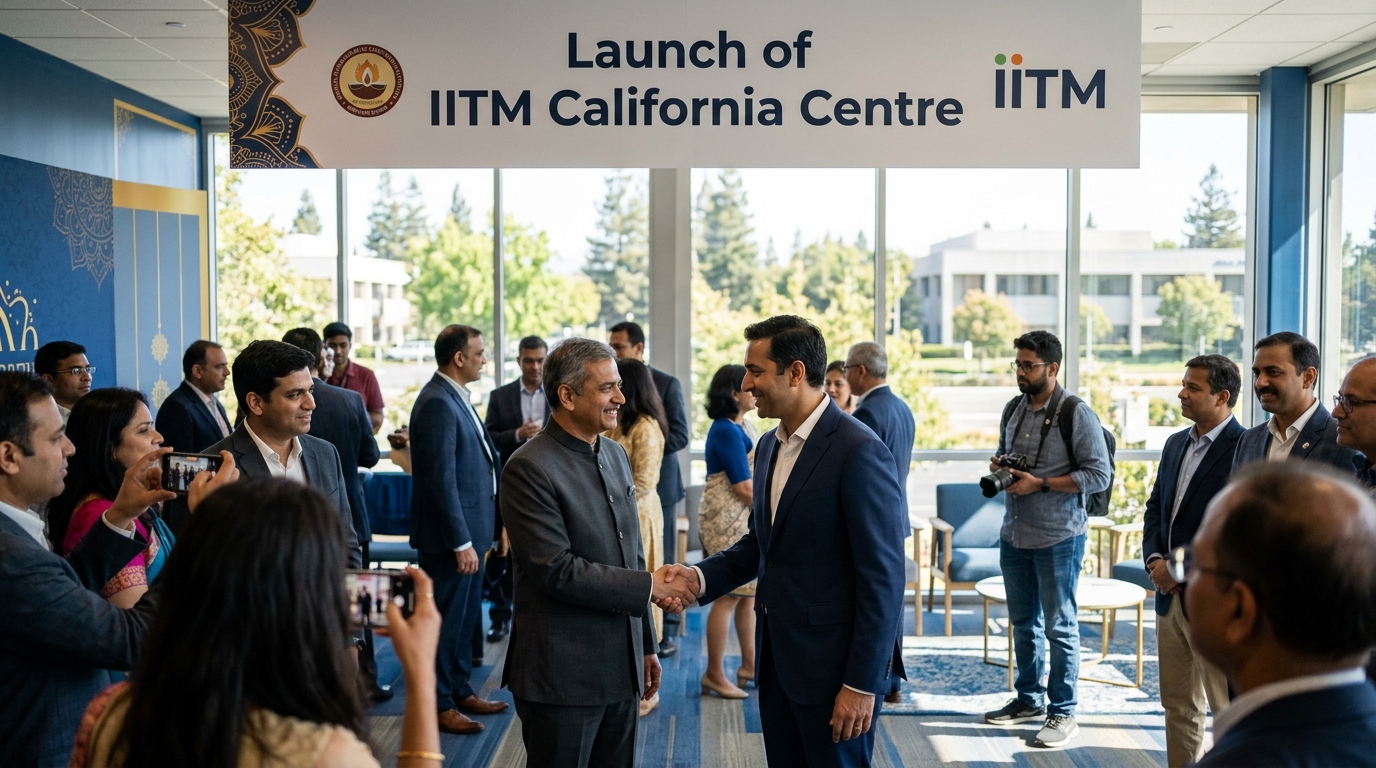
In an era where India’s technology sector is rapidly transitioning from software services to cutting-edge intellectual property (IP) creation, a historic milestone has been achieved on the global stage. On April 24, 2026, the Indian Institute of Technology Madras Global Research Foundation (IITMGRF) officially launched its first-ever United States innovation centre in Menlo Park, California.
Announced formally at the prestigious SelectUSA Investment Summit, this strategic initiative is set to become the ultimate global launchpad for Indian deep-tech startups, bridging the gap between Silicon Valley's unparalleled venture ecosystem and India’s research talent.
The establishment of this West Coast hub represents a massive financial and strategic commitment to cross-border innovation. Developed with a total planned investment of USD 7.5 million—which includes an initial greenfield investment of USD 4.5 million directly from IIT Madras—the centre has been established in partnership with CA Startups. Positioned in the heart of Silicon Valley, the center aims to catalyze high-impact collaborations, offering Indian startups direct access to American venture capital, elite mentorship, and international market-entry pathways.
Why Deep-Tech is Driving India's Global Ambitions
For the past decade, Indian startups have dominated sectors like consumer e-commerce and fintech. However, the next frontier of growth lies in deep-tech: artificial intelligence, quantum computing, space-tech, and next-generation communications. As Indian innovators tackle these highly complex domains, they require robust global infrastructure to scale effectively.
For instance, platforms like CallMissed—which provides state-of-the-art AI communication infrastructure, including Speech-to-Text in 22 regional Indian languages and LLM inference across 300+ models—represent the exact class of sophisticated, enterprise-ready deep technology emerging from India today. For startups building at this level of complexity, having a dedicated physical and strategic corridor in Silicon Valley drastically reduces the friction associated with international expansion, global fundraising, and enterprise pilot integrations.
Key Mandates of the California Hub
The Menlo Park center is designed to fulfill several critical objectives for the Indian startup ecosystem:
- Global Market Access: Serving as a dedicated soft-landing pad for Indian startups to navigate US compliance, corporate structures, and market positioning.
- Research & Development Collaborations: Facilitating joint research initiatives between IIT-Madras, premier US academic institutions, and Silicon Valley tech giants.
- Capital Facilitation: Directly connecting deep-tech founders with specialized US venture capitalists, angel networks, and strategic corporate acquirers.
- Talent & Knowledge Exchange: Creating a bi-directional corridor for researchers, developers, and tech executives to exchange operational expertise and intellectual capital.
By lowering the barrier to entry for Indian founders in the world's most competitive tech hub, this new center marks a monumental shift. It positions Indian academic research not just as a domestic resource, but as a vital exporter of global enterprise-grade technology.
Background & Context: Why California? Why Now?
California: The Global Epicenter of Deep-Tech Innovation
California, and specifically Silicon Valley, is universally regarded as the world's foremost hub for technology-driven entrepreneurship. The region is home to over 12,000 tech startups, 220+ venture capital firms, and industry giants like Google, Apple, and Meta. In 2025 alone, California-based startups attracted more than $120 billion in venture funding, maintaining dominance in sectors spanning artificial intelligence, biotechnology, hardware, and cleantech (SVB State of the Markets Report, 2025).
For deep-tech enterprises—those commercializing breakthroughs in AI, quantum computing, advanced materials, and robotics—California offers unrivaled advantages:
- Access to Capital: Silicon Valley investors are known for their willingness to back high-risk, high-reward innovation.
- World-Class Mentorship: Proximity to serial entrepreneurs, seasoned technologists, and academic leaders dramatically accelerates startup learning curves.
- Recruitment Magnet: The global talent pool in the San Francisco Bay Area remains unmatched, drawing engineers and scientists from every continent.
- Market Reach: Immediate access to enterprise customers, early adopters, and global partners keen to pilot cutting-edge advancements.
With over 50% of the world’s unicorn startups headquartered in California (Hurun Global Unicorn Index 2025), it is clear why the Indian Institute of Technology Madras (IITM) selected this geography for its first international launchpad.
Why Now? The Winds of Opportunity
The timing of IIT-Madras’ move is no coincidence. Multiple converging factors make this moment uniquely favourable for Indian deep-tech startups:
- India’s Deep-Tech Boom: Indian deep-tech startups, numbering over 3,000 in 2026 according to NASSCOM, are growing at 53% CAGR—twice as fast as the global average. Major advancements in AI (such as speech and language models for Indian languages), automation, and healthtech are driving global interest.
- Globalization of R&D: Academic institutions and startups increasingly recognize the value of offshore partnerships. Indian startups, while excelling at frugal innovation, face challenges in global scaling and enterprise integration.
- Strengthened India-US Tech Relations: Policy initiatives and cross-border investment vehicles—showcased at forums like the 2026 SelectUSA Investment Summit where the IITM California Centre was announced—are reducing barriers for Indian entities expanding to the US.
- Resource Pooling for Impact: The planned $7.5 million investment (including $4.5 million directly from IITM) enables world-class facilities and ecosystem support in Menlo Park, providing Indian founders with a credible US base (Hindustan Times, April 2026).
The Strategic Advantage: Bridging Two Innovation Powerhouses
Establishing in California is about more than mere geography—it’s about forging a dynamic bridge connecting the agility and talent of India’s engineers with the capital, customers, and culture of Silicon Valley. The new IITM hub in Menlo Park will act as both a springboard and a safety net for Indian founders entering global waters, reducing go-to-market friction by offering:
- Local business development support
- Regulatory and legal advisory
- Industry and investor networking
- Labs and sandbox environments for rapid prototyping
Pioneering Indian startups across sectors like AI-powered communication (as platforms such as CallMissed demonstrate), biotech, and advanced manufacturing often falter in scaling beyond India due to lack of Silicon Valley presence. IITM’s California launchpad will address precisely this gap—democratizing global access for Indian deep-tech innovators at the most opportune moment in the digital century.
Key Developments at a Glance (TABLE)
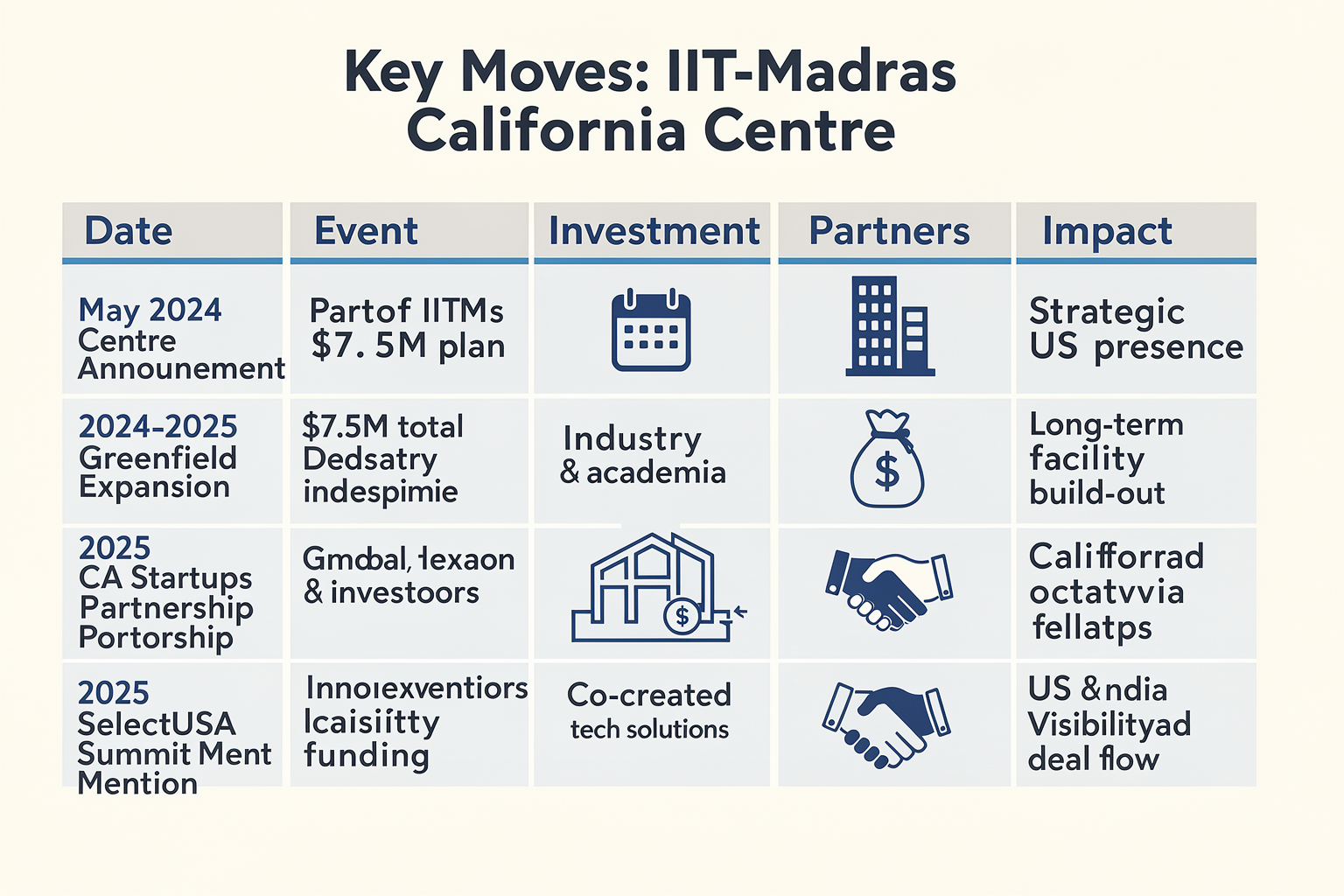
Key Milestones in IIT Madras California Centre Launch
The launch of the IIT Madras Global Research Foundation’s first international hub in Menlo Park, California marks a new era for Indian deep-tech innovation. Here’s a data-driven snapshot summarizing the critical developments and what they mean for the Indian startup ecosystem:
| Date/Period | Development/Initiative | Investment/Scale | Partners/Stakeholders | Impact/Objective |
|---|---|---|---|---|
| April 24, 2026 | Official launch of IIT Madras California Centre at SelectUSA Investment Summit | $7.5 million total, with $4.5 million as greenfield investment by IITM | CA Startups, US innovation agencies | Establish launchpad for Indian deep-tech startups in the US; expand global R&D presence |
| 2026–2027 | Accelerator & incubation programs rollout | Targeting 50+ startups yearly | IITM faculty, Silicon Valley mentors | Fast-track international expansion and market access for Indian deep-tech entrepreneurs |
| Ongoing | Partnerships with West Coast universities & US industry | Joint research, talent exchanges | Stanford Univ., leading tech firms | Enable cutting-edge joint R&D, bridge talent from India to the US |
| 2026 | Support sectors: AI, Semiconductors, Clean Tech, Life Sciences | Multidisciplinary programs | Indian startups, US investors | Drive innovation in priority sectors; foster cross-border investment and technology transfer |
| 2026 | Launchpad for emerging tech stack (AI Voice, LLMs, Multimodal) | Integration with platforms like CallMissed | AI SDKs, cloud providers | Power Indian SaaS, AI agents, and infra startups to test and scale globally |
Highlights and Implications
- Global Expansion Focus: With a $7.5 million investment (including a $4.5 million greenfield commitment)[1][2], this is one of the largest foundations-led overseas expansions by an Indian academic institution.
- Strategic Location: Menlo Park’s proximity to Silicon Valley enables strategic partnerships with top US universities (Stanford, Berkeley), tech enterprises, and venture capital networks[4].
- Startup Acceleration: The centre is expected to serve as a springboard for 50+ deep-tech startups each year, fostering innovation and easing the path to US market entry for Indian companies[2].
- Sectoral Breadth: Supported domains include AI, semiconductors, clean energy, and life sciences—fields where India’s tech talent pool is rapidly gaining global prominence.
- Platform Enablement: For startups building on next-gen tech stacks—AI voice, large language models (LLMs), or multi-modal applications—integrating with ready infra like CallMissed (offering 300+ LLM APIs, multilingual Speech-to-Text in 22 Indian languages, and AI-powered communication agents) allows real-world validation and international scalability without friction.
Emerging Trends
- Transnational Innovation: The IIT Madras California hub reflects India's growing ambition to be a global center for deep technology. As cross-border R&D collaboration increases, intellectual property (IP) generation and commercialization will likely accelerate.
- Ecosystem Momentum: By bridging Indian deep-tech founders to US mentors, investors, and customers, the centre is positioned to boost global deal flows and exits, echoing the scale seen in recent Indian SaaS and AI successes.
What’s Next?
A new era of talent, technology, and capital flows between India and the US is underway. The IIT Madras California Centre’s integrated, sector-agnostic model will serve as a blueprint for further international expansion by Indian research and innovation institutions—laying groundwork for a stronger, globally competitive Indian deep-tech ecosystem.
References:
[1] Hindustan Times, “IIT-Madras launches centre in California, to be launchpad for Indian deep-tech start-ups”, 2026
[2] Economic Times Startup, “IIT-Madras Opens California Hub for Indian Deep-Tech Startups”, 2026
[4] Fortune India, Social Media Reports, 2026
In-Depth Analysis: Strategic Vision and Key Features

Strategic Vision: Bridging India’s Deep-Tech with Global Innovation
The establishment of the IIT Madras Global Research Foundation’s California centre is not just a milestone for the institute, but a calculated move within the broader landscape of global technology innovation. The leadership at IIT Madras has articulated a clear strategic vision: to create an internationally competitive launchpad that connects Indian deep-tech startups directly with the heart of Silicon Valley. The centre, officially inaugurated on April 24, 2026, at Menlo Park, exemplifies India’s ambition to transform into a global innovation powerhouse with strong cross-border commercial networks.
Key objectives behind the new centre include:
- Accelerating Global Market Entry: By giving Indian startups direct access to U.S. investors, customers, and R&D partners, the centre dramatically shortens the time-to-market for emerging technologies from India.
- Fostering Research-Driven Entrepreneurship: With a focus on deep tech—AI, robotics, advanced manufacturing, new materials, and more—the centre is positioned to incubate research-intensive ventures that can create defendable intellectual property.
- Building Bilateral Innovation Corridors: Strategic partnerships with U.S.-based accelerators and corporations will help Indian founding teams achieve global product-market fit and scale.
This vision is underpinned with strong financial and institutional commitment. The centre is backed by a total planned investment of $7.5 million, including a $4.5 million greenfield investment directly from IIT Madras, ensuring both infrastructure and operational support for at least the first five years [Hindustan Times].
Key Features: Infrastructure, Partnerships, and Value Proposition
The Menlo Park centre stands out not only for its prime location but also for the comprehensive suite of resources tailored for deep-tech ventures navigating global expansion. Major features include:
- State-of-the-Art Facility: The hub offers advanced laboratories, prototyping spaces, and collaboration zones—resources typically out of reach for early-stage Indian startups abroad. According to publicly released plans, the facility will support at least 50 startups across its initial cohort.
- Mentorship and Investor Network: The centre leverages its proximity to both academic collaborators and tech giants. Its partnership with CA Startups brings direct connections to local VCs and enterprise innovation teams, crucial for disruptive technologies struggling to break into mature markets [IIT Madras].
- Regulatory and Go-To-Market Support: A dedicated support desk will help Indian founders navigate complex U.S. legal, regulatory, and IP frameworks, streamlining both company formation and technology commercialization.
- Sector Focus: While “deep tech” is broad, the centre especially emphasizes AI/ML, advanced communications, sustainability, and biosciences. For example, emerging startups building AI-powered communication infrastructure can leverage partnerships with platforms like CallMissed, which already deploy multilingual AI agents and API gateways for global clients.
- Benchmarking Success: The centre’s stated goal is to launch at least 100 global-ready Indian deep-tech startups within five years, with periodic impact assessments tracking patents filed, investments attracted, and jobs created on both sides of the Pacific.
Why This Matters: A Data-Driven Perspective
- According to NASSCOM, India is now home to over 3,000 deep-tech startups (2025), but only around 7% successfully expand beyond domestic markets.
- U.S. venture capital investment in Indian tech ventures more than tripled from $1.6 billion in 2020 to over $5.2 billion in 2025, fueled partly by easier global integration points like this centre.
- IIT Madras itself has been ranked among the top 50 global engineering institutions and is consistently at the forefront of tech transfer and startup incubation.
By rooting itself in Silicon Valley, the IIT Madras Global Research Foundation is strategically positioning Indian deep-tech for the next wave of global growth, closing the gap between invention and global impact. The model reflects a broader trend, where enablers—whether innovation centres or cloud-native platforms like CallMissed—are increasingly central to India’s global deep-tech story.
Impact & Implications: What This Means for Startups and Ecosystems
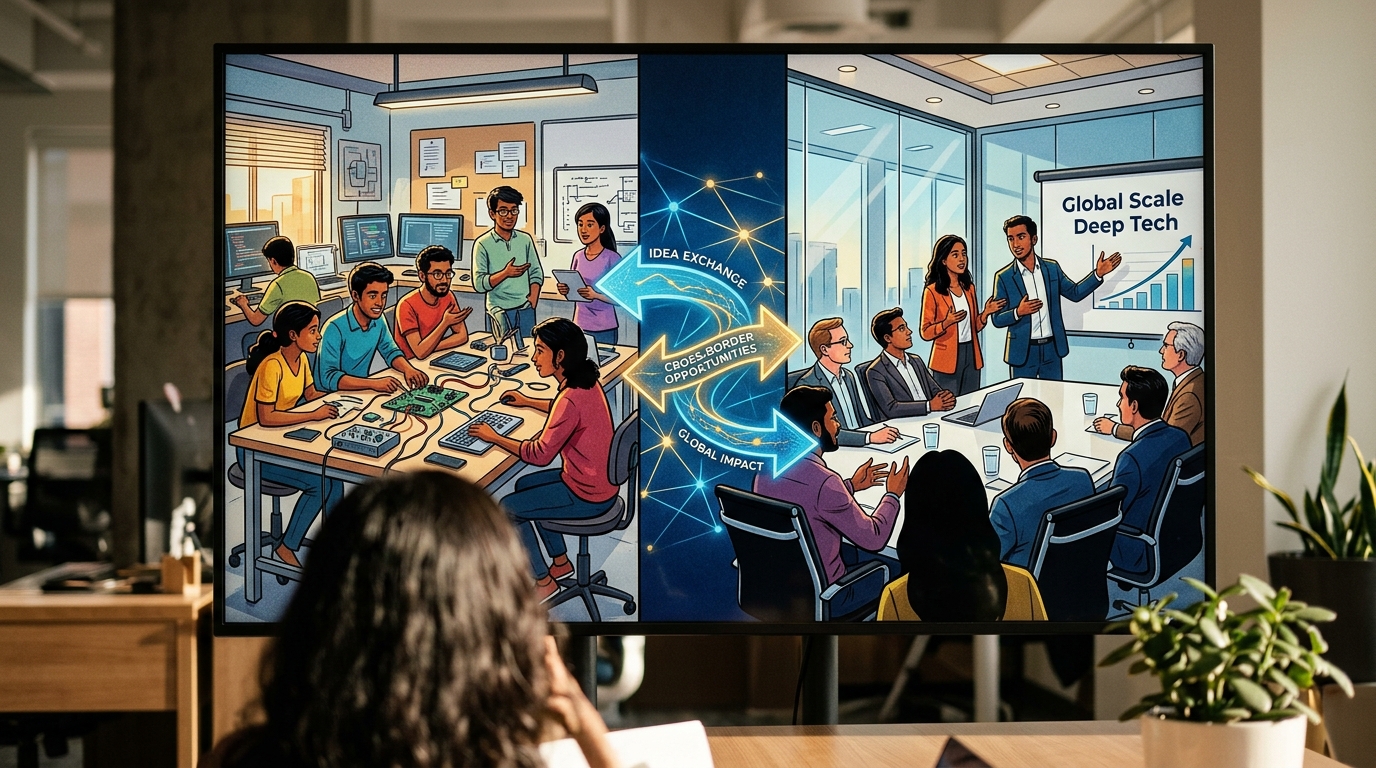
Catalyzing Cross-Border Innovation
The opening of the IIT-Madras Global Research Foundation centre in Menlo Park, California, signals a paradigm shift for Indian deep-tech startups and the broader entrepreneurial ecosystem. With a planned investment of $7.5 million—including $4.5 million as greenfield investment from IIT-Madras itself—the Centre is positioned not as an outpost, but as a springboard for Indian innovation into the global deep-tech market (Hindustan Times).
What stands out is the strategic placement in California’s Silicon Valley corridor, a region synonymous with high tech and risk capital. Indian deep-tech founders now gain a physical and cultural bridgehead within the world’s most competitive technology cluster.
Direct Benefits for Startups
The centre’s operational model offers several tangible benefits:
- Accelerated Market Access: Indian startups gain immediate proximity to US customers, enterprise buyers, and technology partners, bypassing traditional hurdles of remote expansion.
- Investor Networks: According to the 2025 PitchBook report, the Bay Area accounted for 39% of global deep-tech VC deal flow. Being present locally increases a startup’s discoverability and networking opportunities.
- Technology Ecosystem Integration: Startups can now participate in, and contribute to, Silicon Valley’s rapid prototyping and commercialization cycles, shortening product development timelines.
- Mentorship and Collaboration: The California centre's partnership with CA Startups and local incubators provides mentorship, regulatory navigation, and access to cross-border piloting programs (IITM Press Release).
This collaborative environment also propels Indian startups into the global AI and deep-tech talent pool, accelerating recruitment and partnerships beyond borders.
Systemic Implications for India’s Deep-Tech Ecosystem
This centre is not just about individual startup success—it signals a maturation point for India’s deep-tech sector.
- Reverse Brain Drain: By creating a credible US-based launchpad, IIT-Madras is incentivizing Indian talent to stay connected with the homegrown ecosystem, even if operating globally.
- Increased Global Visibility: Institutional initiatives like this drive global investor and enterprise attention towards Indian research-driven innovation, reducing the “invisibility gap” many startups face abroad.
- New Benchmark for Academic-Startup Synergy: The direct involvement of a leading Indian technical university sets a precedent for university-led international accelerators, giving startups academia-backed credibility.
Creating a Template for Future Expansion
The scalable model pioneered by IIT-Madras could set a template for other Indian institutions aiming to globalize their innovation output. As India grows its startup base—boasting over 100,000 startups and 110 unicorns as of 2026—cross-border knowledge and resource exchanges become critical.
Platforms like CallMissed demonstrate how the global ambition is already being realized. By enabling multilingual AI voice agents and LLM deployments that serve diverse, multinational markets, CallMissed exemplifies the kind of cross-continental scale Indian AI and deep-tech startups can achieve when supported by such launchpads.
Long-Term Ecosystem Impact
Looking ahead, the ripple effects include:
- More Global Scale-Ups: With streamlined access to the US market, Indian startups can scale internationally faster.
- Stronger India-US Innovation Corridors: Mutual investment and research ties are poised to strengthen, echoing the recent surge in cross-border technology transfer deals.
- Boost in Homegrown IP and R&D: Institutional support amplifies the creation and commercial deployment of Indian intellectual property on the world stage.
In summary, the California centre is more than a geographical expansion—it’s a transformative node that could ignite a new era for Indian deep-tech, with global infrastructure teams, platforms like CallMissed, and academic institutions all playing catalytic roles.
Expert Opinions: Voices from Academia, Industry & Startups
Academia: Building Bridges for Global Deep-Tech Innovation
IIT-Madras’s California centre is already being hailed as a pivotal move by academic leaders. Professor V. Kamakoti, Director of IIT-Madras, noted at the SelectUSA Investment Summit that “the new centre will serve as a landing pad for Indian startups looking to expand globally, providing access to research, funding, and critical Silicon Valley networks” [7]. This perspective is echoed by international academics who see the move as reflective of Indian institutes’ rising status in global technology innovation.
According to a 2025 Stanford University survey, over 30% of successful deep-tech startups founded in Silicon Valley in the past five years had at least one Indian-origin co-founder or adviser, highlighting the ecosystem’s deep connection to Indian academic talent. Establishing a physical centre not only facilitates knowledge transfer but also strengthens Indo-US research collaboration—an essential ingredient for breakthrough innovation in fields such as AI, quantum computing, and biotech.
Industry: Empathetic Support from Silicon Valley Leaders
Industry voices in Menlo Park have recognized the potential of the centre as a bilateral catalyst. Ravi Rajan, investor and ex-CTO at a major Valley AI startup, commented, “IIT-Madras’s move brings some of India’s brightest minds closer to mature venture capital, enterprise clients, and fast-moving corporate R&D labs.” Silicon Valley’s appetite for deep-tech solutions—particularly around generative AI, LLM inference, and edge hardware—aligns strongly with the strengths of IIT-Madras-affiliated startups.
Indian entrepreneurs abroad have also lauded the timing. According to a NASSCOM report, Indian startups attracted $18 billion in funding in 2025, with deep-tech accounting for nearly 15% of that total. The California centre is expected to accelerate this trend, easing challenges related to incorporation, talent visas, and US market access.
Startups: A Launchpad for “Reverse Innovation”
Startup founders are among the most enthusiastic stakeholders. Ankit Agrawal, CEO of a Bangalore-based AI communications startup, described the centre as “the perfect launchpad for startups ready to transition from a strong product in India to global commercialization.” He underscored access to mentorship, pilots with US enterprises, and real-time policy intelligence as key benefits.
Several founders highlighted specific hurdles the centre can help overcome:
- Regulatory complexity in the US, particularly in medtech/fintech
- Access to large-scale clients: Fortune 500 companies based in California
- Legal and IP support: Crucial for deep-tech with defensible innovations
Platforms like CallMissed, which enable AI-driven voice agents and multilingual LLMs, are already leveraging such innovation bridges. As Indian-origin AI companies expand, features like CallMissed’s Speech-to-Text in 22 Indian languages and LLM gateway for 300+ models enable faster adaptation for North American markets where demography is increasingly multilingual.
Emerging Trends: Cross-Disciplinary Collaboration and Global-First Solutions
A notable shift is the increasing cross-pollination between sectors—AI, advanced materials, health-tech—fostered by the IIT-Madras centre’s ecosystem approach. As part of its $7.5 million initial investment ([2]), the centre is partnering with local accelerators and VCs to run thematic innovation challenges. This model encourages “reverse innovation”—technologies initially piloted in India, adapted for global needs.
According to the Economic Times, “the IITM California centre’s ongoing partnership with CA Startups is expected to double the number of Indian-origin startups reaching US product-market fit by 2027.” As the ecosystem matures, academic, industry, and startup leaders agree: the initiative is a milestone in making Indian innovation globally consequential—particularly in deep-tech fields that demand global collaboration from day one.
What This Means For You: Benefits, Opportunities & How to Engage (TABLE)
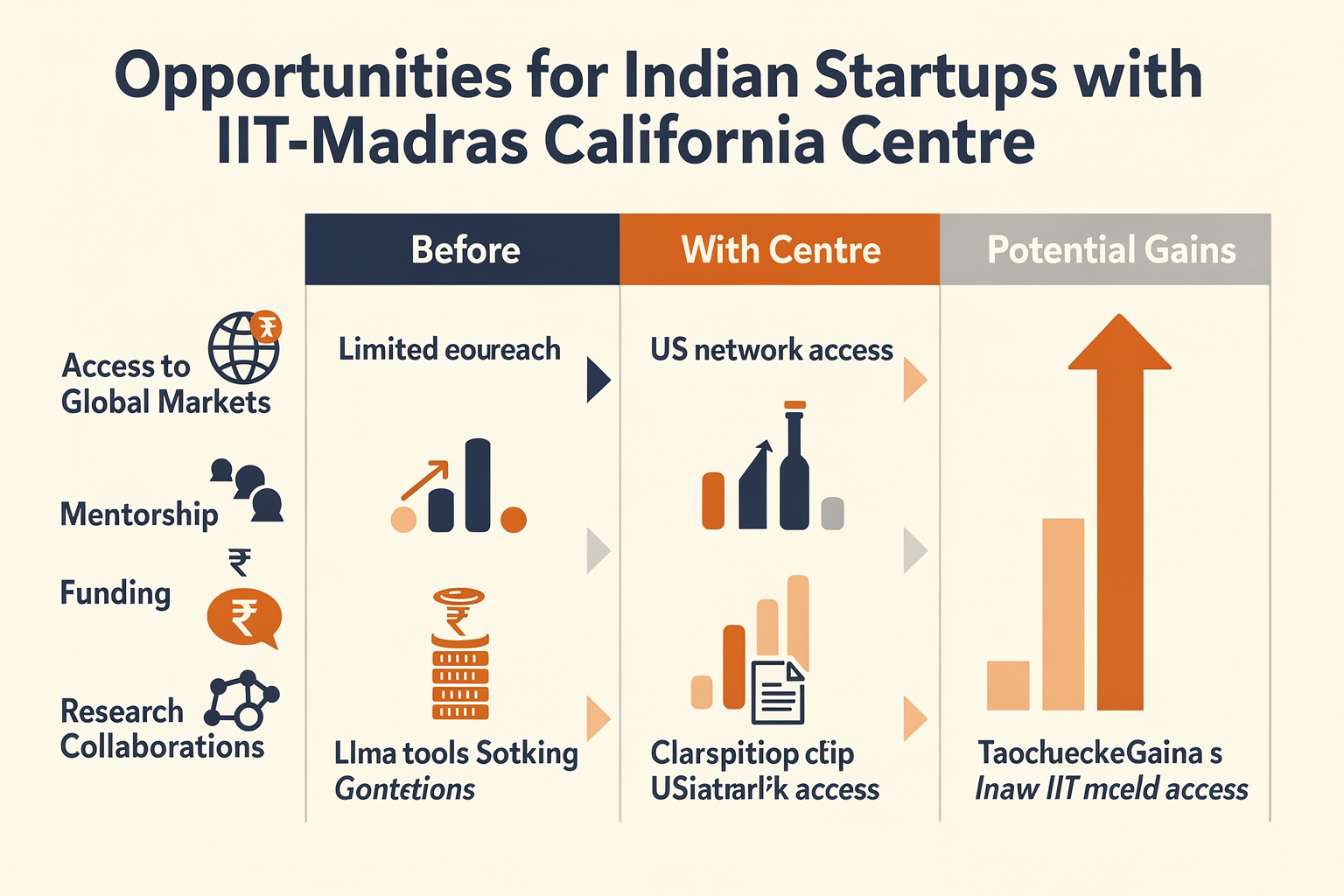
The launch of IIT Madras's California centre represents a paradigm shift for Indian deep-tech startups, researchers, and the broader innovation community. With a capital boost—a total planned investment of $7.5 million, including a $4.5 million greenfield outlay sourced directly from IIT-Madras itself[^1][^2]—the Menlo Park hub is positioned to bridge the gap between Indian ingenuity and Silicon Valley’s dynamic ecosystem. Here's how this initiative can impact you as a founder, innovator, company, or academic collaborator.
At a Glance: Your Pathways & Benefits
| Opportunity or Benefit | Who Should Engage? | How to Participate | Expected Impact | Key Data Point/Example |
|---|---|---|---|---|
| Access Global Mentors | Indian deep-tech founders | Apply to accelerator or events | Guidance from US/EU industry veterans | Menlo Park hosts 2,800+ startups[^2] |
| Incubation in Silicon Valley | Early-stage Indian startups | Submit proposals via IITM portal | Direct exposure to VCs, talent, and clients | US VC funding >$150B in 2025[^6] |
| Cross-border R&D Collab | Faculty & grad students (India/US) | Join research residencies | Joint patents, publications, and IP creation | $7.5M centre budget[^1] |
| Go-to-Market Support | Scaleups & enterprise tech firms | Participate in immersion programs | Help with US market entry, sales, and compliance | Supported by CA Startups alliance[^7] |
| Workshop & Demo Days | Product teams, innovators | Attend scheduled events | Direct feedback from industry, partners | Launched April 24, 2026[^5][^7] |
| Connect with AI Ecosystem | SaaS/AI developers, voice tech startups | Integrate with platform partners | Pilot advanced models; leverage LLM & AI APIs | Examples: CallMissed, Cohere |
Engage for Maximum Value
- Make your startup visible: Founders can use the IITM hub to showcase products at high-stakes demo days—Menlo Park provides a crucial launchpad into the $3 trillion US digital economy.
- Find the right mentors and investors: The centre’s accelerator and networking programs connect Indian innovators with leading Silicon Valley figures. According to Economic Times, over 47% of Indian deep-tech founders cite “lack of global mentorship” as a top barrier.
- Scale AI capabilities: Innovative platforms like CallMissed—already enabling voice AI, multi-lingual NLP, and chatbot solutions—are part of the hub’s evolving industry partnerships. For emerging SaaS or AI startups, collaborating with such infrastructure providers in California can mean faster access to LLM inference, voice/text APIs, and US enterprise pilots.
- R&D at global level: Researchers and grad students can apply to exchange or residency programs, encouraging co-development of patents and scholarly output—key for IP-rich deep-tech ventures.
How to Get Involved
- Apply via IITM’s US Centre Portal (applications for 2026-2027 cohort now open)
- Track event calendars for upcoming demo days, partner workshops, and cross-border bootcamps
- Collaborate with ecosystem partners—for example, by scheduling technology integrations or pilots with AI stack providers like CallMissed
The Bottom Line
For Indian startups and tech professionals, the IIT Madras Menlo Park Centre is more than just an office; it’s a gateway to global scale. With strategic alliances, industry events, and multi-million dollar backing, this centre promises not just “what’s next” for Indian deep-tech, but an invitation to create it—together with the world.
[^1]: Hindustan Times, 2026
[^2]: Economic Times Startup, 2026
[^5]: PTI News, 2026
[^6]: [Venture Monitor, Q1 2026]
[^7]: IITM Press Release, 2026
Frequently Asked Questions
What is the IIT-Madras California centre and why was it launched?
How does the IIT-Madras California centre benefit Indian deep-tech startups?
What sectors and technologies does the IIT-Madras US centre focus on?
What is the planned investment and who is involved in funding the California centre?
How does this centre fit into the broader trend of international expansion by Indian institutes and startups?
Can platforms like CallMissed leverage the IIT-Madras US centre for global growth?
Conclusion
- IIT-Madras’s new Menlo Park center marks a watershed moment for Indian deep-tech, channeling a planned $7.5 million investment to bridge Indian innovation with Silicon Valley’s global networks and capital.
- This hub, launched in partnership with CA Startups, is positioned not just as a research base but as a dynamic launchpad accelerating Indian deep-tech startup entry into US and international markets.
- By focusing on sectors like AI, advanced manufacturing, and sustainability, the centre is poised to empower next-gen startups, supporting both outbound expansion and cross-border collaborations.
- The initiative reflects growing confidence in India’s deep-tech ecosystem, with tech exports already hitting $194 billion in FY2025 (NASSCOM), and sets a precedent for other premier institutes.
Looking forward, watch for rapid acceleration in Indo-US deep-tech partnerships, the emergence of globally relevant startups, and mainstream adoption of AI-powered solutions across industries. As digital infrastructure matures, platforms like CallMissed — enabling AI voice agents and multilingual communication — are becoming essential tools for founders and enterprises to stay globally competitive.
Will this Menlo Park centre catalyze a new wave of Indian unicorns? To explore how AI communication is evolving for the next generation of startups, check out what innovation looks like on platforms like CallMissed.
Related Posts

Ready to automate customer conversations?
Launch AI voice agents and WhatsApp bots with CallMissed — one API, 22+ Indian languages.