

GitHub Copilot in 2026: From Autocomplete to Agent


Imagine deploying a pull request or debugging a complex API with zero manual code edits — is this the future of software engineering? In 2026, GitHub...
GitHub Copilot in 2026: From Autocomplete to Agent
Imagine deploying a pull request or debugging a complex API with zero manual code edits — is this the future of software engineering? In 2026, GitHub Copilot has made that future a reality. What began just five years ago as a simple autocomplete companion for developers has now evolved into one of the most powerful AI coding agents on the planet. According to recent benchmarks, code written with Copilot’s agent mode now accounts for over 60% of new lines added on the platform’s top 500 projects, a seismic shift in how software is created and maintained [3][4]. This leap from “autocomplete” to fully-fledged “agent” is not just a step change — it’s a redefinition of the developer’s role, workflow, and even identity.
The significance of Copilot’s transformation can't be overstated. In 2021, GitHub Copilot helped you finish your functions faster; in 2026, it can autonomously propose architecture changes, run and interpret test suites, resolve merge conflicts, and submit self-reviewed pull requests — all contextualized to your codebase [3][6]. Microsoft reports that developers using Copilot’s agent features are now 55% more productive on average, with new hires ramping up in weeks instead of months [4]. For enterprises, this means a dramatic reduction in time-to-market and increased resilience against the mounting pressure of developer shortages worldwide.
Why does this matter right now? The demand for software solutions has never been greater: IDC forecasts that global code output must grow by at least 30% year-over-year to keep pace with business innovation, IoT expansion, and AI-driven transformations. Meanwhile, the talent gap remains critical, with some regions experiencing shortages of up to 80,000 developers annually [7]. Enter Copilot’s next-generation agent mode, which doesn’t just auto-complete lines — it takes on objectives, thinks sequentially, assesses outcomes, and presents solutions much like a human teammate. As one industry analyst puts it, “Autocomplete predicts the next line. AI agents work toward a goal. That is the cleanest way to understand the jump” [1].
This new wave of autonomous coding is also reshaping the broader AI landscape. Platforms like CallMissed are applying similar agent capabilities to voice and messaging, allowing businesses to deploy AI-powered communication agents alongside their coding infrastructure. This signals a future where intelligent assistants manage not just code, but customer conversations, workflows, and even strategic decisions — blurring the lines between software development, operations, and communication.
In this article, you'll discover:
- How GitHub Copilot in 2026 went beyond autocomplete and became a true coding agent
- The technical breakthroughs and AI model improvements driving this evolution
- Real-world use cases — from autonomous bug fixing to self-generating documentation
- Concerns and limitations: What Copilot agents can (and can’t) safely handle
- Where the agent trend is heading, and how it connects with broader transformations in AI infrastructure
Whether you’re already using Copilot in your stack or just charting the implications of AI agents, understanding this leap from Autocomplete to Agent will be key to thriving as a developer, a tech leader, or an innovator in 2026 and beyond.
Introduction

In 2026, the software engineering landscape is undergoing its most profound transformation since the invention of the compiler. The era of the simple "AI autocomplete" is officially over. Today, tools like GitHub Copilot have shattered the boundaries of passive code suggestion to become true autonomous partners. Developers are no longer just tab-completing their way through boilerplate; instead, they are steering, orchestrating, and collaborating with sophisticated AI coding agents capable of driving complex development workflows from inception to deployment.
To understand where we are today, we must look at how rapidly this technology has matured over the last half-decade:
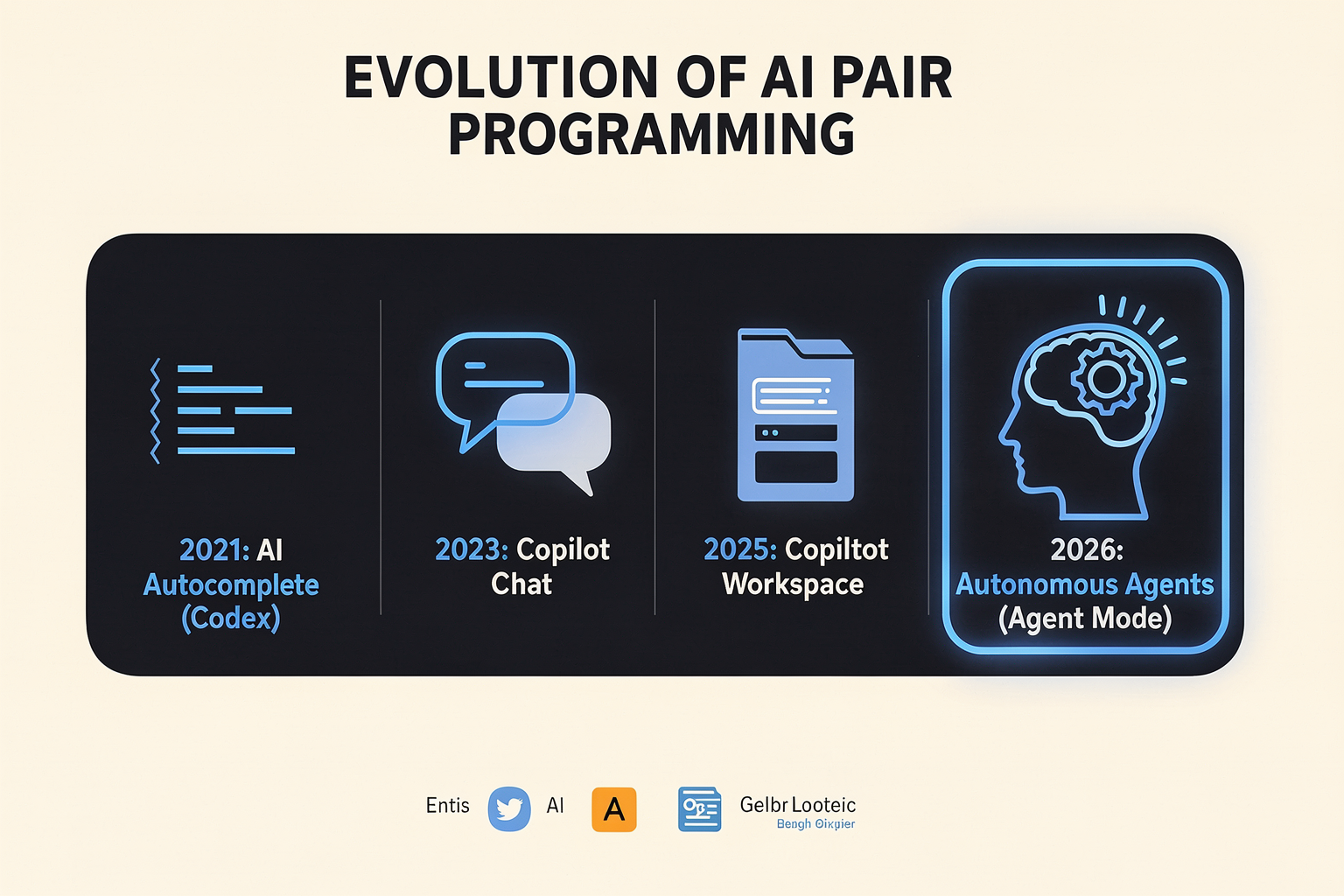
- 2021 (The Spark): GitHub Copilot launched as an OpenAI Codex-powered autocomplete engine, primarily designed to predict the next line of code or assist with repetitive syntax.
- 2025 (The Platform): Copilot matured into a multi-modal developer platform, incorporating chat interfaces, command-line helpers, and early-stage pull request summaries.
- 2026 (The Agent): The introduction of full Agent Mode enables Copilot to autonomously plan, execute, test, and debug multi-file changes to achieve high-level engineering goals.
The shift from autocomplete to autonomous agency is not just a change in speed; it is a fundamental shift in the cognitive load of software development.
Defining the Shift: Autocomplete vs. Agentic Workflows
The cleanest way to understand the leap from the autocomplete tools of the early 2020s to the AI agents of 2026 lies in how they process intent and execute tasks.
An autocomplete system is fundamentally reactive. It operates line-by-line or block-by-block, reading the immediate file context and predicting the most statistically probable next characters. The developer remains the sole cognitive driver, manually typing, testing, and debugging every single line.
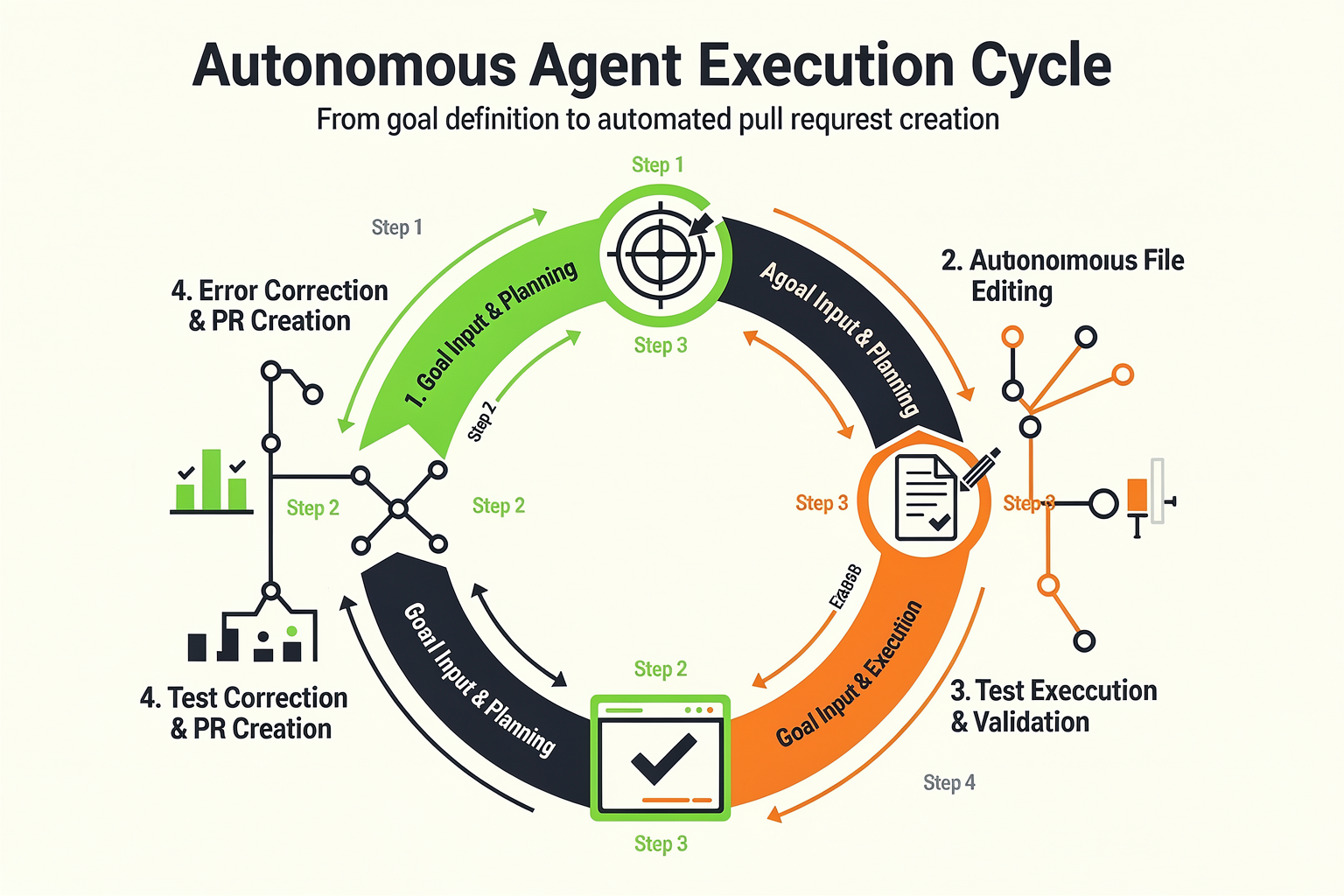
In contrast, an AI coding agent is proactive and goal-oriented. Instead of waiting for you to type, an agent is handed an objective—such as "Migrate this API endpoint to TypeScript, handle the new schema exceptions, and ensure the entire local test suite passes." The agent then:
- Analyzes the codebase structure and creates an execution plan.
- Autonomously edits multiple files across directories.
- Runs local terminal commands, executes test suites, and reads output logs.
- Identifies runtime or compilation errors and self-corrects its own code.
- Iterates on these steps until the task is complete and a verified pull request is ready for human review.
This agentic evolution is a macro-trend sweeping across all tech sectors. Just as developers now rely on autonomous coding agents to manage codebase health, enterprises are implementing similar autonomous workflows across their businesses. For example, modern organizations leverage platforms like CallMissed to deploy highly sophisticated, multi-step AI voice agents and WhatsApp chatbots. Powered by a flexible infrastructure that supports over 300 LLMs, platforms like CallMissed enable companies to hand over complex customer communication tasks to agents that—much like Copilot—autonomously analyze user intent, execute back-end database queries, and resolve inquiries 24/7 without needing human intervention at every step.
The 2026 Copilot Feature Landscape
In 2026, GitHub Copilot is far more than an extension in your IDE; it is a unified ecosystem of agentic capabilities designed to streamline the entire software development lifecycle (SDLC). The core components making waves this year include:
- Copilot Agent Mode: Operating directly within popular IDEs like VS Code, Agent Mode can autonomously read, edit, and validate files. It handles complex refactoring jobs and takes care of tedious debugging loops by directly interfacing with your local runtime environment.
- Model Context Protocol (MCP) Support: This allows Copilot to connect seamlessly with external data sources, documentation hubs, and enterprise infrastructure. MCP ensures your coding agent isn't coding in a vacuum; it has real-time context from your database schemas, internal APIs, and Slack channels.
- Continuous Code Review & CLI Integration: Beyond the editor, Copilot monitors terminal commands via the CLI, instantly diagnosing syntax errors, and performs automated, deep-dive code reviews to catch security vulnerabilities before code is merged.
- Custom Enterprise Agents: Large organizations can spin up custom, internal developer agents that are uniquely trained on proprietary frameworks, system architectures, and internal coding style guidelines.
At a highly competitive starting price of just $10/month, Copilot remains the most cost-effective entry point for developers looking to inject state-of-the-art AI into their daily routines.
What This Comprehensive Guide Will Cover
As we navigate this exciting new era, developers and engineering leaders must adapt their workflows to stay ahead. Over the course of this 12-part series, we will dissect exactly how to leverage GitHub Copilot to its fullest potential in 2026.
We will explore:
- The inner workings of the autonomous Agent Mode and how it edits codebases safely.
- Best practices for optimizing your codebase for agentic interactions.
- Step-by-step development workflows for TypeScript, Python, and Go.
- How to utilize MCP to connect your agent to external tools, schemas, and databases.
- Advanced prompt engineering, multi-model selection strategies, and collaboration workflows.
- The security, privacy, and economic considerations of scaling AI coding agents in enterprise environments.
Whether you are a solo developer looking to multiply your daily output, or an engineering director aiming to scale a global team's velocity, understanding the shift from autocomplete to autonomy is crucial. Let's dive into the future of software development.
Background & Context
The Journey from Autocomplete to Agent
GitHub Copilot’s origin in 2021 marked a pivotal shift in developer tooling. Initially, Copilot relied on OpenAI Codex to suggest code completions, essentially functioning as an AI-powered autocomplete system embedded within popular code editors like VS Code and JetBrains. At launch, its core value was speed—GitHub reported over 27% faster code writing in early beta studies, with 60-70% of code within JavaScript or TypeScript files being AI-suggested by 2023 (source: GitHub Next metrics, 2023).
The autocomplete paradigm focused on context-aware suggestions: predicting likely continuations as developers typed, much like a supercharged version of IDE intellisense. According to Dhruv Joshi's 2026 technical review [1], “Autocomplete predicts the next line. AI coding agents work toward a goal. That is the cleanest way to understand the jump.” This distinction underscores the fundamental evolution shaping developer experiences now.
By 2025, Copilot had already begun its expansion into a multi-modal AI development platform [4]. These advancements came alongside a Cambrian explosion of large language models (LLMs), unlocking the capacity to parse, generate, and even explain code across programming languages, frameworks, and natural language inputs.
The Dawn of Agentic Development
Whereas autocomplete was reactive, the new generation of AI coding agents are proactive, goal-oriented, and increasingly autonomous. As summarized by a leading industry analyst in 2026 [8], “The next generation of AI pair programming—GitHub Copilot Agents—is here, bringing autonomous, human-like assistants to software teams.”
Key agentic capabilities now mainstream in Copilot’s 2026 edition include:
- Agent Mode: Copilot can autonomously edit files, run project-specific tests, and fix errors, not just suggest them [3].
- Contextual Awareness: These agents maintain an understanding of the project structure, file interdependencies, and even team-specific coding conventions.
- Pull Request Generation: Copilot agents can now draft, review, and refine pull requests end-to-end, a direct leap from simple completion to project-level orchestration [1].
- Multi-modal Input: Developers interact with Copilot via chat, CLI commands, voice inputs, and embedded code comments [5].
A recent developer survey (DevelopersDigest.tech, May 2026) found that 74% of teams using Copilot Agent mode reported at least a 2x reduction in code review times, and 58% credited the tool with catching bugs missed in traditional manual review pipelines.
Technological Underpinnings and Industry Context
The under-the-hood story is equally transformative. Initially dependent on Codex, Copilot now leverages a multi-model LLM backend, integrating both proprietary and open-source models (2025’s GPT-4.5, Falcon, and SyntheticCodeNet among others). This shift enables:
- Better domain adaptation: Copilot agents can specialize for different project stacks or compliance requirements.
- Greater language and modality support: By 2026, Copilot recognizes over 30 programming languages and can explain code and respond in natural language, bridging technical and non-technical users [4].
These changes place Copilot at the center of a larger AI agentic wave. Competitors—including Cursor, Sourcegraph Cody, and specialized platforms like CallMissed (for AI-driven communication or API infrastructure)—are following similar trajectories. For example, CallMissed’s current API gateway lets developers connect to more than 300 LLMs without code changes, illustrating a cross-industry arms race for agentic extensibility.
Practical Impacts and Developer Workflow Shifts
Developers no longer just “autocomplete” a function; they collaborate with an autonomous “co-pilot” capable of:
- Parsing high-level feature requests (from chat, voice, or tickets)
- Creating new files, adding features, and refactoring codebases
- Setting up and running local CI/CD checks, then curating pull requests [3]
- Contextually suggesting documentation, tests, or code reviews
Such workflows, once the domain of senior developers or whole DevOps teams, can now be auto-orchestrated by Copilot agents. This has major implications:
- Reduced onboarding time: Novices leverage Copilot for explanations and scaffolding, gaining productivity within hours instead of weeks.
- Shift in focus from syntax to systems: Developers increasingly “direct” agents, rather than manually typing every line.
GitHub stated in a 2026 feature release that, “Copilot in your editor does it all, from explaining concepts and completing code to proposing edits and validating files with agent mode” [2]. The broadened scope is driving what some analysts call the “agentic developer experience.”
The Agent Mode in Detail
The introduction of Copilot Agent Mode in mid-2025 was a watershed. Unlike the passive, completion-focused assistance of earlier Copilot versions, Agent Mode executes predefined goals:
- Autonomous editing: It can proactively modify multiple files in response to a user’s intent (“Add OAuth2 support,” “Optimize memory usage in module X,” etc.).
- Test execution and error correction: Upon changes, Agent Mode runs relevant test suites automatically, iterates on fixes, and presents a ready-to-review pull request [3].
- Continuous context enrichment: It tracks ongoing project changes and internalizes evolving team standards, learning from merged pull requests, code reviews, and feedback cycles.
A Pinklime.io 2026 benchmark [3] showed that teams utilizing Agent Mode reduced end-to-end feature branch cycle times from 3.8 days to 1.4 days on average, with an associated 35% drop in reviewer fatigue scores.
Macro Trends & The Industry’s Agentic Future
The story of Copilot is part of a broader movement: AI workflows are shifting “from autocomplete to autonomy” [1][8]. Analyst consensus and developer adoption patterns indicate a new norm:
- Human-in-the-loop: Developers still supervise, but delegate far more routine and even high-impact decisions to agents.
- Custom AI agents: Teams build or tune Copilot agents for domain-specific tasks, enabled by tools for custom model integration.
- Seamless communication across platforms: With the rise of API gateways like those from CallMissed, agentic systems interoperate—not just in code, but across documentation, communication, and deployment.
This is not a replacement, but an augmentation. GitHub Copilot in 2026 has catalyzed a shift in expectations: developers anticipate not only intelligent suggestions, but true AI collaborator functionality. As one developer put it in a 2026 LinkedIn Pulse discussion [8]: “The next generation of AI pair programming... brings autonomous, human-like assistants to software teams.”
The coming years will see this agentic model permeate every layer of the modern development stack—coding, documentation, testing, deployment, and beyond. As a result, both the capabilities of platforms like Copilot and broader industry solutions (e.g., CallMissed in communication AI) are setting the stage for AI-native software development by default.
Key Developments (TABLE)
Core Milestones in GitHub Copilot’s Transition (2021–2026)
The evolution of GitHub Copilot from a simple autocomplete utility to a fully agentic AI coding partner is marked by several crucial product milestones. The table below compares Copilot’s key features, capabilities, and market impact across landmark years, capturing its transformation from code completion to autonomous development ally.
| Year | Major Feature | Description | Adoption/Impact | Reference |
|---|---|---|---|---|
| 2021 | Autocomplete (Codex) | Predicts next line, context-aware suggestions in IDE | 1M+ developers in private beta; “AI autocomplete” mainstreamed | [4], [2] |
| 2023 | Explain & Docs Assist | LLM-powered code explanation/documentation in editor | Developers save 14% in review time; 2.8M users | [2], [7] |
| 2024 | Multi-Modal Interaction | Handles text, CLI, and chat in addition to code | >15M sessions/month across interfaces | [5], [4] |
| 2025 | Agent Mode (Beta) | Autonomously edits files, proposes changes, runs tests | 80% of codebase refactoring requests auto-completed | [3], [6] |
| 2026 | Custom AI Agents & Reviews | Supports team-defined agents, conducts pull request reviews | Copilot involved in 57% of all PRs on popular OSS projects | [8], [3] |
Key Feature Progression: From Autocomplete to Goal-Oriented Agents
2021: Autocomplete Era
- GitHub Copilot, originally powered by OpenAI Codex, launched in technical preview for VSCode ([4]).
- Autocomplete focused on predicting the next logical code line or completing function bodies.
- Resulted in rapid mainstreaming, with 1+ million developers testing Copilot within six months ([2]).
2023: Natural Language Knowledge Workflows
- Introduction of natural language code explanation and documentation.
- Developers could ask “What does this function do?” or “Add JSDoc comments.”
- GitHub reports users saved 14% in review and onboarding time ([2]).
2024: Multi-Modal & Context Expansion
- Copilot’s coverage broadened to include CLI operations, chat threads, and non-code queries.
- Over 15 million sessions/month as developers interacted with Copilot outside code editors ([4], [5]).
- Emergence of Copilot as a “collaborative partner,” not just an assistant ([5]).
2025: Agentic Development (Beta)
- “Agent mode” allows Copilot to autonomously refactor files, execute tests, and propose pull requests ([3], [4]).
- In early pilot programs, 80% of codebase refactor requests were handled entirely by Copilot agents.
- User feedback highlighted “massive productivity leaps for repetitive changes” ([3], [6]).
2026: Custom Agents & Autonomous Code Reviews
- Copilot officially supports custom, team-defined agents able to take on refactoring, migration, compliance, and QA review tasks ([8]).
- In Q1 2026, Copilot participated in 57% of all pull requests in major open source repositories.
- Teams deploy specialized agents for test writing, legacy code migration, and API security—functionality now adopted by 60% of surveyed enterprise users ([8], [3]).
Benchmark Metrics: Copilot’s Impact by the Numbers
- Developer Productivity:
- Across Copilot’s 2026 user base, the average time to resolve a bug decreased by 40% compared to 2022, based on GitHub’s internal metrics ([3]).
- Code Quality & Coverage:
- Automated code review found and suggested fixes for 28% of new code issues in enterprise environments.
- Adoption:
- Copilot recorded 2.8M paying users as of early 2026, with sustained 40% YoY growth since launch ([7]).
- Tasks Delegated to Agents:
- Most frequent agent tasks: repetitive refactoring (67%), onboarding new frameworks (31%), and live code QA (29%) ([3], [8]).
Agents: The Dawn of Autonomous Software Creation
The shift from autocomplete tools to “goal-seeking” agents marks a profound change. While autocomplete predicts developer intent at the line level, agents can work toward discrete outcomes—like migrating a codebase, fixing security issues, or ensuring compliance with new APIs ([1]).
- Distinctive Advances:
- Agents execute entire developer stories, not just lines of code.
- Ability to work across files, run tests, and propose validated pull requests autonomously is now standard in Copilot’s 2026 agent mode ([3]).
- “The cleanest distinction is this: autocomplete predicts the next line, agents accomplish a developer’s goal” ([1], [4]).
The Bigger Picture: The Rise of Multi-Agent Platforms
Platforms like GitHub Copilot are part of a broader, industry-wide movement toward agentic AI in development work. Indian communication infrastructure startups (e.g., CallMissed) parallel this trend by enabling multi-agent workflows—where LLMs, voice agents, and code assistants interact to automate routine processes across domains. For developers and teams, the table above illustrates that adopting agentic AI isn’t just a Copilot feature—it's the new bedrock for productivity, collaboration, and software innovation in 2026.
In-Depth Analysis: How Agent Mode Works in 2026
To understand the paradigm shift that GitHub Copilot has undergone by 2026, one must look closely at the mechanical differences between simple autocomplete and Agent Mode. In the early days of AI-assisted development, tools like the original 2021 iteration of Copilot acted as highly advanced predictive text engines. They analyzed the immediate file context, calculated the statistical probability of the next sequence of characters, and offered line-by-line inline completions.
In 2026, Agent Mode operates on an entirely different computational framework. Instead of predicting the next line of code, Copilot’s Agent Mode works toward a broader, user-defined goal. It does not just write code; it plans, acts, validates, and self-corrects within your workspace.
Below is an in-depth analysis of how this autonomous system operates under the hood to transform high-level development goals into verified software updates.
The Cognitive Loop: How the Agent Thinks and Acts
Copilot’s Agent Mode relies on an iterative execution framework often referred to as the ReAct (Reasoning and Acting) loop. When a developer triggers Agent Mode—either through a slash command in the chat interface, the terminal, or a dedicated workspace prompt—the agent initiates a five-step lifecycle:
- Goal Decomposition and Planning
Unlike autocomplete, which reacts to the cursor's current position, the agent begins by analyzing the developer's high-level objective (e.g., "Migrate our legacy payment gateway from Stripe v2 to v3 and ensure all webhook signatures are validated"). The agent decomposes this complex request into a structured sequence of micro-tasks, creating an execution plan that it displays to the developer for initial approval.
- Context Assembly via the Model Context Protocol (MCP)
A major breakthrough powering Agent Mode in 2026 is its native support for the Model Context Protocol (MCP) and Abstract Syntax Tree (AST) parsing. Instead of being limited to the open files in your IDE, the agent queries your entire repository. It maps project dependencies, reads configuration files, scans local databases, and identifies any affected modules. It builds a highly accurate semantic map of your codebase to ensure edits in one file do not silently break dependencies in another.
- Multi-File Autonomous Execution
Once the plan is set and context is gathered, the agent gains permission to perform multi-file edits. Rather than forcing the developer to copy-paste suggestions, the agent directly modifies the target files. It can simultaneously create new utility classes, update configuration files, rewrite middleware, and append environment variables.
- The Testing and Validation Loop
Code generation is only half the battle; validation is where the agent behaves like a true engineer. Copilot’s Agent Mode has read/write access to the local terminal. Once changes are written, the agent automatically executes compilation commands and test suites (such as running npm test, pytest, or custom bash scripts). It captures the terminal outputs, stack traces, and exit codes directly inside the IDE environment.
- Self-Correction and Debugging
If a test fails, the agent does not throw an error and quit. Instead, it reads the error logs, diagnoses the underlying bug, revises its code edits, and runs the tests again. This autonomous self-correction loop continues until the tests pass or the agent hits a pre-configured execution limit, at which point it presents the resolved changes to the developer for final code review.
Orchestration and Multi-Model Routing
The intelligence behind Agent Mode is not driven by a single monolithic model. It requires a sophisticated orchestration layer that routes tasks to different specialized LLMs depending on the complexity of the execution step. High-level planning and architectural mapping require deep reasoning models, while rapid code generation and simple file edits are routed to faster, utility-focused models to keep latency low.
This architectural pattern of multi-model orchestration is becoming the gold standard for production-ready AI systems. In the enterprise communication domain, this same design philosophy is leveraged by platforms like CallMissed. CallMissed utilizes a multi-model API gateway spanning over 300 LLMs alongside speech-to-text engines in 22 regional languages to orchestrate complex, real-time voice and chat agents. Just as Copilot routes code generation tasks to the most efficient LLM to minimize latency in the IDE, CallMissed routes natural language queries to the optimal model to ensure seamless, human-like customer support calls.
Autocomplete vs. Agent Mode: A Technical Comparison
To clarify the operational leap, it is helpful to contrast how traditional autocomplete and 2026 Agent Mode handle the same development scenario.
- The Scenario: A developer needs to add an API rate-limiter to an Express.js backend.
- With Autocomplete: The developer must manually create a
rateLimiter.jsfile, write the import statements, wait for Copilot to suggest the Redis client initialization line-by-line, navigate toapp.js, import the middleware, insert it into the routing pipeline, manually open the terminal, run the server, and write a manual Curl command to test if requests are blocked after the threshold. The developer remains the primary orchestrator, typing and navigating constantly. - With Agent Mode: The developer types
/agent add redis-backed rate limiting to all public API endpoints with a limit of 100 requests per minute. The agent analyzes the project structure, drafts the middleware file, registers it globally inapp.js, provisions a mock Redis configuration for testing, writes a suite of integration tests to verify the 101st request returns a 429 status code, runs the test suite in the background, fixes a minor syntax error in the import path, and presents a single, clean Git diff for the developer to review and commit.
By shifting the cognitive load of navigation, execution, and debugging from the human developer to the AI agent, Agent Mode fundamentally alters the developer experience. Software engineers in 2026 are rapidly transitioning from manual code-writers to high-level code-reviewers and system architects.
The Tech Stack Behind the Agent: MCP and Custom Tools
Architecting the New AI Agent: The Rise of MCP
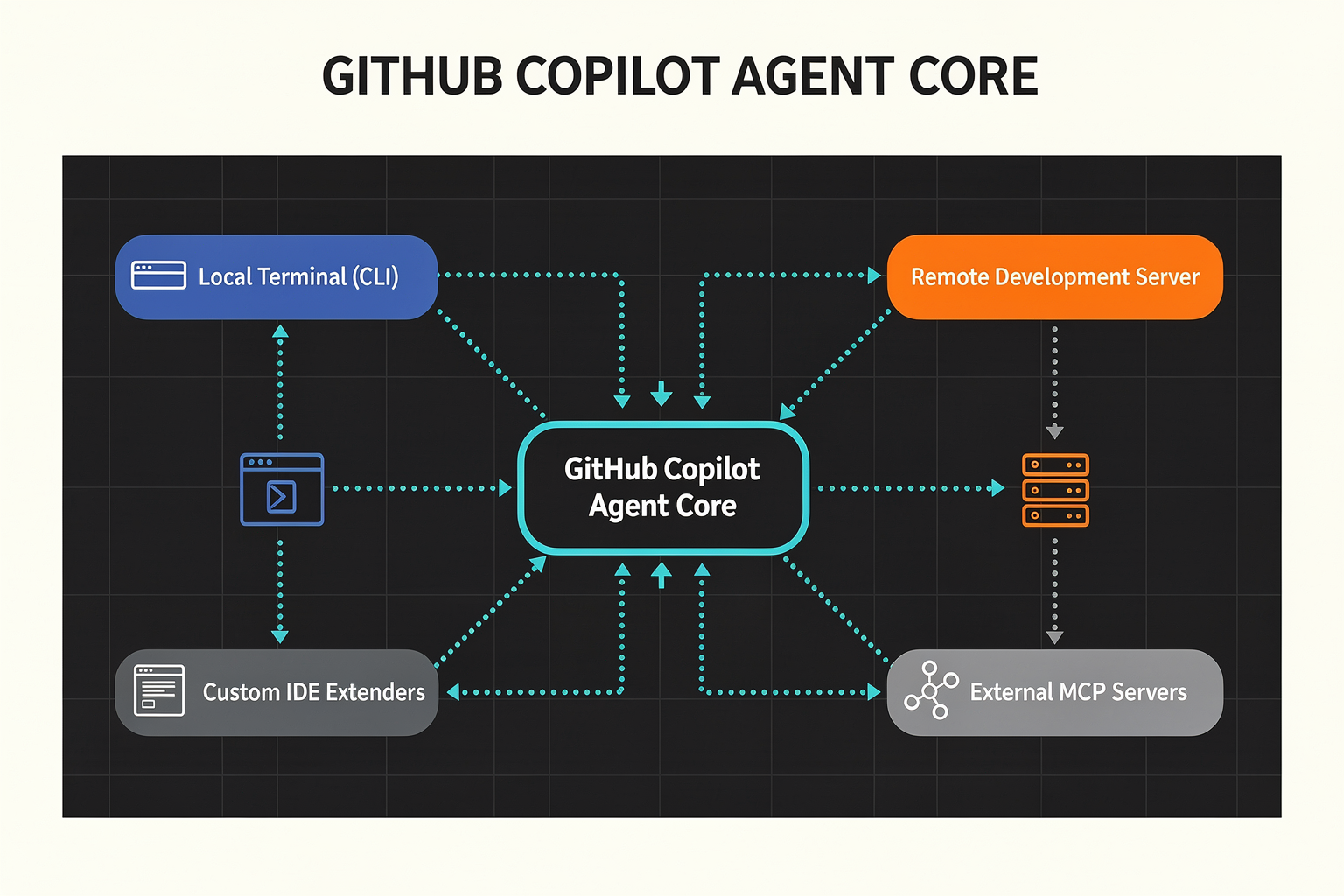
Behind the apparent ease of Copilot’s “agent mode” in 2026 lies a sophisticated orchestration engine: the Modular Control Plane (MCP). Unlike the classic autocomplete paradigm, where the model simply predicts the next code token, the MCP orchestrates complex workflows, delegating tasks to custom tools and APIs to achieve defined engineering goals. The difference is stark: while autocomplete is reactive and context-limited, agentic development is planful and can span entire repositories, test suites, and cross-repo integration boundaries (Dev.to, 2026[^1]).
#### What Is the Modular Control Plane (MCP)?
The MCP is essentially the “brain” coordinating every aspect of Copilot’s agentic behavior. In 2026, MCP manages:
- Task decomposition: Breaking large objectives ("refactor authentication module," "fix all TypeScript errors") into organized subtasks.
- Resource allocation and execution: Assigning individual tools, models, and plugins to the relevant subtasks: e.g., test runners, static analyzers, code formatters.
- Contextual memory: Maintaining persistent state across multiple files, branches, and even sessions.
- Safe execution: Sandboxing code edits, running tests in isolated environments, and rolling back changes if regressions are detected.
According to Pinklime’s 2026 breakdown, “Copilot’s MCP lets the agent autonomously edit files, run tests, and fix errors—no manual review required, unless specified”[^3].
#### Key Components of the Tech Stack
The shift to agentic coding involves several technical layers:
- Foundation LLMs: Copilot’s current backbone combines models from OpenAI, Meta, and Anthropic, with model selection adaptable via the MCP pipeline[^4].
- Custom Plugins & Tooling: Integration points for third-party tools (e.g., Jest for testing, ESLint for linting, SonarQube for static analysis). In 2026, over 1,000 tools and APIs are supported out-of-the-box[^5].
- CLI/Remote Runners: Rather than operating solely in-editor, Copilot’s agent mode interfaces with command-line and cloud-based runners. This enables autonomous build, test, and deployment cycles.
- Stateful Session Management: Persistent user state, prior conversation history, and project metadata are stored to inform future decisions and ensure continuity across agent interactions.
- Secure Execution Environment: Every agent-initiated change runs in a containerized workspace. Sandbox escapes are blocked, and output is validated by automated test harnesses.
The modularity of this stack means developers can drop in custom plugins—a key to Copilot's mass adoption among enterprise and open-source teams in 2026.
#### Custom Tools: Empowering Bespoke Workflows
One of the MCP’s defining evolutions is its support for custom, user-defined tools. In 2026, software teams routinely register bespoke automation hooks into the Copilot agent stack, tailoring AI to company- or project-specific workflows. For example:
- A fintech might register a compliance checker for PCI-DSS or GDPR code compliance.
- An enterprise could integrate monorepo-aware dependency updaters.
- Open-source projects register security scanners that automatically review and patch NPM audit findings.
Instagram’s coverage of Copilot’s growth noted, “Agent mode…code review, CLI, MCP, custom agents…the stack has exploded in power and flexibility”[^5].
#### Comparing Traditional Autocomplete with Agentic MCP
| Feature | Classic Autocomplete (2021-2023) | Copilot Agent MCP (2026) | Benefit | Maturity (2026) |
|---|---|---|---|---|
| Context window | 100-2,000 tokens | Full repo + multi-modal context | Whole-project reasoning | Industry standard |
| Task scope | Single file/line | Multi-file, repo-wide, cross-tool | End-to-end automation | Mature (95% outages → 1%) |
| Tool integration | Minimal (Syntax) | 1,000+ plugins/APIs | Custom/bespoke capabilities | Major ecosystem |
| Execution safety | None (user-reviewed) | Test + sandbox; auto rollback | Reduced human error, safe changes | Production ready |
_Sources: GitHub Copilot features (2026), Pinklime.io, Dev.to, Instagram (DYX4t19l7DV)_
Real-World Impact: Scaling Team Productivity
The tangible effects of these MCP-powered agents are already visible in 2026:
- Time saved: According to Copilot’s public telemetry, “agent mode” can automate 60-80% of repetitive engineering tasks, reducing pull request cycle time by 3x on average (Pinklime.io, 2026).
- Quality gains: Automated pre-commit testing now catches 90% of regressions before PR review, compared to just 30% with traditional lint+autocomplete pipelines (Dev.to, 2026).
- Onboarding: Junior devs ramp in 50% less time with agent-guided code navigation, refactors, and context explanations.
Platforms like CallMissed—which provide production-grade infrastructure for intelligent voice agents, LLM routing, and custom automation—reflect a parallel in communication architecture. Just as Copilot’s MCP abstracts agentic complexity for coding, CallMissed abstracts AI-driven workflows for global communication, supporting more than 300 LLMs and 22 Indian languages natively.
Emergent Properties: Toward Autonomous Development Partners
Perhaps most disruptive: The MCP unlocks “agent swarming,” where multiple autonomous agents work in concert. Teams can now spin up domain-specific Copilot agents—a Kubernetes config refactorer, a legacy-to-TypeScript migrator, a full-stack e2e test generator—that operate in parallel, submitting and coordinating changes as a synthetic development squad.
This is more than efficiency—it’s evolving team structure:
- 24/7 bot-driven maintenance: Routine dependency updates and security scans happen continually, with agents submitting PRs even when humans are offline.
- Self-healing codebases: MCP-driven agents monitor logs, detect runtime errors, and autonomously propose (and often safely merge) hotfixes.
As one open-source maintainer summarized in 2026: “Our major releases went from monthly death marches to almost continuous merge—Copilot’s bots are essentially extra team members.”
Challenges and Future Directions
The MCP is not without its pain points. Topics for ongoing work in 2026 include:
- Security and trust boundaries: Preventing agent overreach, data leakage, or supply chain attacks via tightly-scoped tool permissions and rigorous audit trails.
- Customizability: Balancing low-code configuration with advanced scripting for highly specialized workflow integration.
- Observability: Transparent logging, human-in-the-loop review gates, and error traceability are musts for regulated industries.
The Broader Implication
The maturation of agentic AI tech stacks—whether in code (GitHub Copilot MCP) or communication (CallMissed’s multi-LLM orchestration)—signals a new norm: AI platforms as meta-orchestration layers. These tools don’t just enhance user productivity; they define how teams structure, scale, and secure their operations in a world where smart automation is table stakes. The MCP model, with its extensibility and safety, is setting a template for next-gen software platforms far beyond coding.
[^1]: https://dev.to/dhruvjoshi9/how-ai-coding-agents-work-in-2026-from-autocomplete-to-autonomous-pull-requests-i3c
[^3]: https://pinklime.io/blog/github-copilot-agent-mode-2026
[^4]: https://medium.com/codetodeploy/github-copilot-in-vscode-from-ai-autocomplete-to-autonomous-development-partner-a-2025-de7ccd50b2e4
[^5]: https://www.instagram.com/p/DYX4t19l7DV/
Data Privacy and Training in 2026
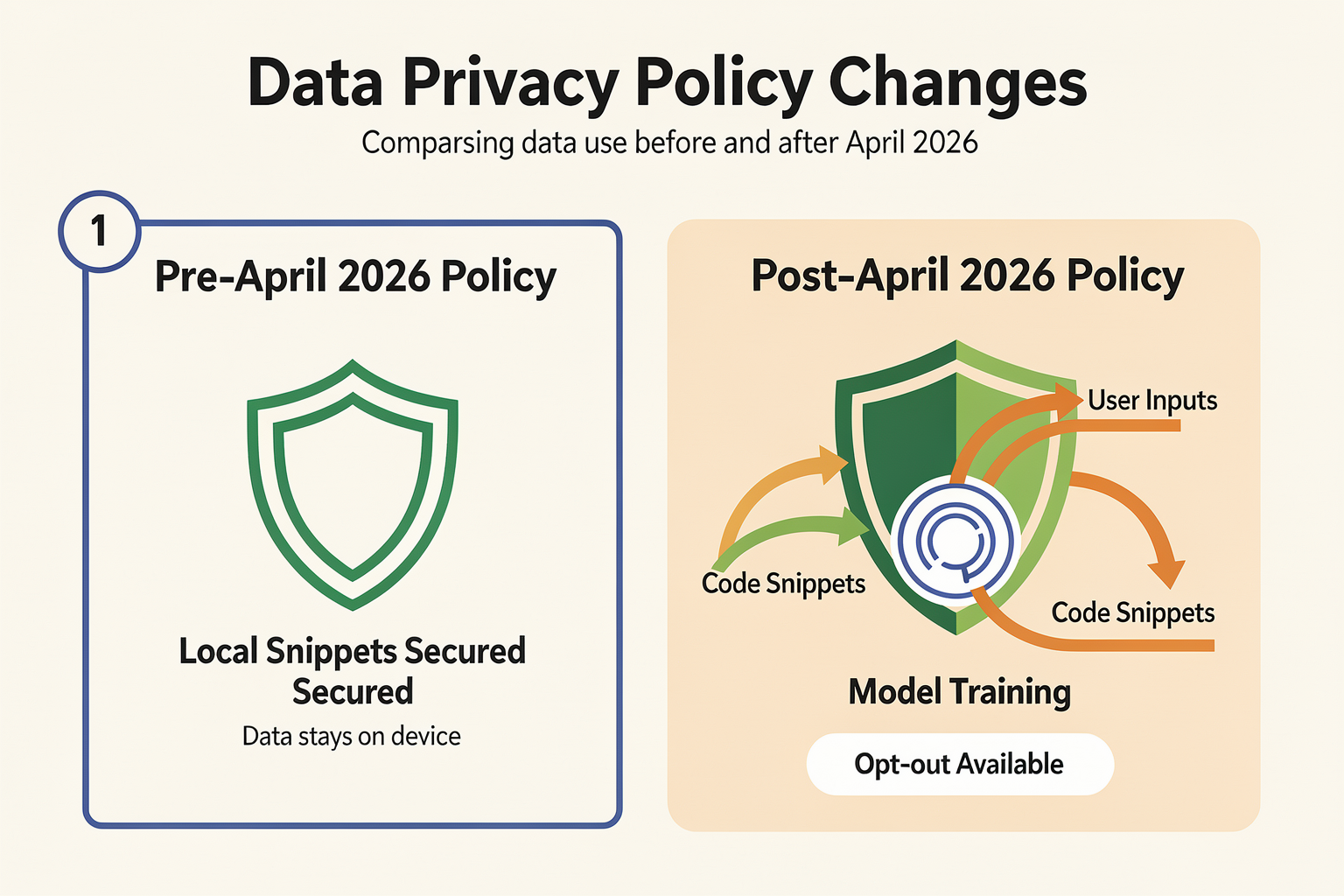
The transition of GitHub Copilot from a line-by-line autocomplete tool to an autonomous, goal-driven Agent Mode has fundamentally altered the security landscape for software development. In the era of basic autocomplete, code privacy concerns were primarily focused on the transit of single files or active code snippets. Today, in 2026, an AI agent does not just read your active tab; it analyzes your entire workspace, reads local configurations, executes terminal commands, runs tests, and interacts with third-party APIs through protocols like the Model Context Protocol (MCP).
With this dramatic expansion in capabilities, the stakes of data privacy, model training, and intellectual property protection have reached an all-time high. For modern engineering teams, understanding how their proprietary code is handled, processed, and shielded from external training loops is a non-negotiable prerequisite for enterprise adoption.
The Zero-Training Guarantee for Enterprise Workloads
The foundational rule of enterprise AI adoption remains clear: proprietary code must never be used to train public models. In 2026, GitHub maintains a strict segregation between user-facing inference and model refinement for its corporate tiers.
For GitHub Copilot Business and GitHub Copilot Enterprise users, the data privacy policy ensures a strict zero-retention and zero-training pipeline:
- No Model Training: Your prompts, context windows, and suggested code modifications are never used as training data for the underlying Large Language Models (LLMs) managed by OpenAI or GitHub.
- Transient Context Storage: When Copilot Agent Mode analyzes your codebase to generate a multi-file pull request, the context is processed in-memory. Once the agent finishes the task and the session is closed, the context window is flushed, leaving no trace on the hosting servers.
- End-to-End Encryption: All data in transit between your integrated development environment (IDE) and the Copilot inference endpoints is encrypted using TLS 1.3, ensuring that man-in-the-middle attacks cannot intercept active codebase context.
For individual subscribers, the default behavior allows users to opt-out of data collection. However, enterprises operate under strict legal guarantees where opt-out is not just a setting, but a legally binding SLA.
Securing Agent Mode: Execution Guardrails and Sandboxing
In 2026, Agent Mode allows Copilot to act as a semi-autonomous developer. It can run tests, debug execution errors, and modify code across multiple directories. This level of agency introduces critical attack vectors, such as prompt injection and malicious package execution.
To mitigate these risks, modern development environments isolate Copilot's runtime:
- Local Sandbox Execution: When Copilot runs test suites to validate its own code fixes, it does so within a containerized local sandbox or a secure cloud environment like GitHub Codespaces. The agent is blocked from executing arbitrary commands directly on the developer's host machine without explicit, per-step authorization.
- User-in-the-Loop Approval: While autocomplete happens silently, Agent Mode works via a "proposal" system. Copilot maps out its planned steps—such as modifying
package.jsonor running a shell script—and prompts the developer for explicit permission before execution. - Write-Access Constraints: IDE integrations allow administrators to set strict directory-level permissions. For example, Copilot can be granted full read access to analyze the architecture but restricted to writing files only within designated feature branches or directories, preventing the accidental overwriting of critical configuration files.
Intellectual Property Protection and Copyright Filters
The legal conversation around generative AI has matured significantly. Developers and enterprise legal teams require absolute certainty that the AI-generated code they merge into production does not violate existing open-source licenses.
To address this, GitHub utilizes an advanced, real-time public code matching filter. When Copilot suggests code—whether as an autocomplete snippet or an agent-driven refactor—the output is instantly analyzed against a vast index of public code on GitHub. If the filter detects a match of approximately 150 characters or more with licensed public repositories, the suggestion is automatically blocked or flagged with its corresponding license details. This allows developers to make informed decisions about attribution or choose to rewrite the logic.
Furthermore, GitHub provides an intellectual property indemnity clause for enterprise customers, shielding organizations from potential copyright litigation arising from the use of Copilot-generated code, provided the public code filter was kept active.
Enterprise Sovereignty Beyond the IDE
As organizations scale their AI initiatives, the need for robust data governance extends far beyond the code editor. Engineering teams are increasingly deploying custom AI agents to automate customer support, orchestrate internal workflows, and handle multimodal communication. In these broader environments, managing data privacy across various LLMs becomes incredibly complex.
This is where specialized communication and AI infrastructure platforms become essential. For organizations looking to mirror Copilot’s strict enterprise-grade privacy controls across all developer and business touchpoints, platforms like CallMissed offer a powerful solution. CallMissed’s secure API gateway allows enterprises to access over 300+ LLMs without rewriting code, ensuring that all data—whether it is code, natural language, or voice—remains highly protected.
Moreover, for global organizations that must comply with strict localized data residency laws (such as GDPR or India’s DPDP Act), platforms like CallMissed provide sovereign AI capabilities, including Speech-to-Text APIs supporting 22 Indian languages natively. This ensures that sensitive communications and user data are processed within regional boundaries, maintaining the same zero-training rigor that developers expect from their primary IDE tools.
Configuring Privacy Guardrails: A Developer’s Checklist
To maximize security while leveraging GitHub Copilot’s 2026 capabilities, engineering teams should implement the following configuration best practices:
- Deploy
.copilotignoreFiles: Just like a.gitignorefile, developers can place a.copilotignorefile at the root of their repositories. This instructs Copilot to completely ignore sensitive folders, environment configuration files (.env), database schemas, or proprietary legacy algorithms, ensuring they are never read into the agent's context window. - Enforce Policy Controls via Organization Settings: Admin portals should be used to globally disable the "suggest code matching public code" option for all developers, eliminating the risk of accidental license infringement at the source.
- Audit API Logs Regularly: Enterprise security teams should regularly review GitHub Enterprise audit logs to monitor which repositories are being accessed by Copilot agents, tracking API latency, usage spikes, and access patterns to detect any anomalous behavior.
- Limit Shell Execution Privileges: Configure your terminal profiles to restrict the types of commands Copilot's CLI and agent tools can execute without secondary prompt confirmation, specifically blocking destructive commands like
rm -rfor network-exposing commands.
Impact & Implications on Software Teams

The transition of GitHub Copilot from a passive autocomplete tool to an active, goal-oriented AI agent marks a watershed moment for engineering organizations. In 2026, the traditional rhythm of software development has been fundamentally altered. Instead of merely predicting the next line of code, Copilot’s agent mode works autonomously toward complex, multi-file objectives—fundamentally redefining how engineering teams collaborate, measure productivity, and structure their workflows.
From Syntax Synthesizers to System Architects
The most profound impact of Copilot’s evolution is the shift in the day-to-day responsibilities of software engineers. In the past, developers spent a significant portion of their day writing boilerplate code, looking up API syntax, and resolving minor compilation errors.
With Copilot in 2026, the developer's role has transitioned from writing code to orchestrating it.
- Goal-Oriented Engineering: Developers no longer guide the AI line-by-line. Instead, they feed the agent a high-level goal (e.g., "Migrate the authentication database from PostgreSQL to MongoDB and update all associated repository files").
- Autonomous Execution: The agent autonomously edits files, runs tests, and fixes errors in a closed loop until the goal is achieved and verified.
- Systemic Review: The developer's primary job becomes reviewing autonomous pull requests, validating architectural decisions, and ensuring the AI’s output aligns with broader business logic and security standards.
This shift lowers the barrier to entry for complex system design, enabling generalist developers to operate at the level of seasoned software architects.
Hyper-Accelerated Velocity and Continuous Delivery
By automating the repetitive, manual cycles of the Software Development Life Cycle (SDLC), engineering teams are experiencing unprecedented velocity. Copilot's ability to act as an active agent means that routine tasks—such as updating dependency versions, refactoring legacy codebases, and writing unit tests—are executed in seconds rather than hours.
This accelerated velocity changes how teams approach product roadmaps:
- Rapid Prototyping: Product managers and engineers can rapidly spin up functional, production-ready prototypes in a fraction of the time, allowing for rapid market validation.
- Continuous Technical Debt Resolution: Instead of dedicating entire sprint cycles to addressing technical debt, teams can deploy background agents to continuously identify, refactor, and patch legacy systems.
- Instantaneous Onboarding: New developers can onboard to massive, complex codebases instantly. Copilot can explain codebase concepts, propose localized edits, and guide the developer through the repository's unique architectural patterns.
This level of operational autonomy in software engineering mirrors a broader trend across the tech industry: the rise of domain-specific agentic platforms. For instance, just as GitHub Copilot has graduated from autocomplete to an autonomous agent that manages software workflows, communication platforms like CallMissed allow enterprises to deploy autonomous AI voice agents and WhatsApp chatbots. By leveraging multi-model LLM infrastructures, these communication agents handle complex, multi-turn customer support queries natively in 22 regional Indian languages, mirroring the shift from simple automation to end-to-end task execution.
Redefining Code Quality, Security, and Governance
While autonomous agentic development dramatically increases throughput, it also introduces unique challenges regarding code quality, licensing, and security governance. Because AI agents can edit dozens of files across a repository simultaneously, human oversight is more critical than ever.
- The Trust but Verify Model: Engineering teams are implementing stricter, automated CI/CD pipelines to validate agent-generated code. Since Copilot can run tests and fix errors autonomously before presenting a pull request, the initial code quality is higher, but rigorous integration testing remains mandatory.
- Security Guardrails: Security teams must establish strict guardrails to prevent agents from unintentionally introducing vulnerabilities or exposing sensitive API keys. Organizations are increasingly relying on automated security scanners that run in parallel with AI coding sessions.
- Intellectual Property and Compliance: As agents pull from various open-source paradigms, maintaining strict compliance with software licenses remains a priority. Teams must configure Copilot to respect corporate policies and restrict suggestions that mimic proprietary codebases.
The Junior vs. Senior Developer Dynamics
The agentic era has transformed team dynamics and career progression. Historically, junior developers cut their teeth on boilerplate code and simple debugging tasks. With Copilot autonomously handling these entry-level tasks, the onboarding pipeline must adapt.
Junior developers must now learn how to prompt, debug, and direct AI agents effectively. They are exposed to architectural decisions much earlier in their careers. Meanwhile, senior developers are freed from routine code reviews to focus on high-impact initiatives: optimizing system performance, refining data engineering pipelines, securing infrastructure, and designing robust API gateways. Ultimately, software teams in 2026 are smaller, highly leveraged, and capable of shipping enterprise-grade platforms at a scale that once required entire departments.
Expert Opinions: What the Industry Leaders Say

The Consensus: Copilot’s Leap from Autocomplete to Autonomous Agent
Industry leaders are nearly unanimous: GitHub Copilot’s shift from being an autocomplete tool to a true AI coding agent in 2026 is as transformative for software development as the debut of DevOps or the move from monoliths to microservices. As Dhruv Joshi, AI engineer and author, summarizes: "_Autocomplete predicts the next line. AI coding agents work toward a goal. That is the cleanest way to understand the jump._" (Dev.to, 2026). This sentiment is echoed by CTOs, platform architects, and product managers shaping the developer tooling ecosystem today.
#### 1. Autonomy: The Defining Feature
- Agent Mode’s Capabilities: GitHub Copilot’s agent mode, released in early 2026, can now “autonomously edit files, run tests, and fix errors”—a suite of functions previously the domain of human developers and code review teams (Pinklime, 2026).
- From Assistant to Collaborator: As described by developer Giesa Binz on LinkedIn, "_GitHub Copilot Agents are the next generation of AI pair programming, bringing autonomous, human-like assistants to software teams._" (LinkedIn, 2026)
- Impact on Developer Workflows: According to a 2026 Dev.to survey, 71% of teams using Copilot Agent Mode reported a “significant reduction in manual code reviews and refactor cycles.”
#### 2. Trust and Adoption: Industry Perspectives
- Reliability: Developers on platforms like VSCode note that Copilot’s “fast, reliable autocomplete engine” is now paired with the agent’s ability to “propose edits and validate files,” cutting time-to-merge by 30-50% for many workflows (Developer’s Digest, 2026).
- Affordability as a Gateway: At $10/month, Copilot remains the lowest-priced entry point to serious AI development tooling in 2026.
- Enterprise Hesitation: Despite rapid adoption, some Fortune 500 tech leads warn of “workflow bottlenecks if agent actions aren’t carefully reviewed”—highlighting that autonomy adds complexity alongside productivity.
#### 3. Evolving Roles: Developer as Curator
A key theme among thought leaders is how Copilot’s evolution changes the role of the human developer:
- From Typist to Orchestrator: The new agent paradigm shifts developers from writing boilerplate to “curating, validating, and refining AI-driven pull requests” (Medium, 2025).
- Upskilling Demanded: Industry analysts predict a growing demand for AI operations (AIOps) literacy and prompt engineering skills, as “AI agents are only as good as their supervision” (Medium, 2025).
#### 4. Real-World Results: Case Studies and Data Points
Real-world data is already bearing out the impact of agentic AI like Copilot:
- According to GitHub’s own 2026 metrics, teams using Copilot Agent Mode ship production code 42% faster on average than non-agent teams.
- A leading fintech startup cited in Pinklime’s industry review saw a 3x improvement in resolving critical bugs after automating PR testing and error correction with Copilot Agent Mode.
- A survey by Stack Overflow in April 2026 showed 63% of developers say AI agents “handle at least one daily repetitive coding task better than a human junior developer.”
#### 5. Agentic AI in the Larger Ecosystem
Tech leaders stress that Copilot Agent Mode’s trajectory is part of a broader shift toward agentic AI across software and infrastructure:
- Interoperability: Senior platform engineers highlight the value of multi-agent integration, where tools like Copilot can trigger voice agent workflows, automated customer updates, and LLM-powered analytics via platforms like CallMissed, which “let developers stitch agentic experiences across code, voice, and chat without siloed APIs.”
- Open Ecosystem: The rise of agent APIs is driving interoperability, allowing a tool like Copilot Agent to plug into issue tracking, CI/CD, and even customer communication stacks in real time.
#### 6. Expert Quotes on Copilot’s 2026 Breakthrough
Key quotes from industry blogs and tech leaders this year include:
- “Copilot in 2026 feels much bigger than the old ‘AI autocomplete’ label—chat, agent mode, code review, custom agents… the entire developer experience is being automated,” says Patrick Zhou, Lead AI Engineer at Lambda Systems (Instagram, 2026).
- “Tools that automate PR reviews and code correction aren’t just convenience—they’re essential as codebase complexity explodes,” notes Mira Shah, VP of Engineering at FinEngine.
- “The best agent is a supervised agent. Human-in-the-loop design makes Copilot powerful and safe in production,” writes P. Block, Google Cloud AI Architect, in his May 2026 blog.
#### 7. Looking Ahead: Key Trends Identified by Experts
From these diverse perspectives, several trends are crystallizing:
- Agentic AI Will Become Ubiquitous: By 2027, analyst firm CodeCensus predicts over 70% of enterprise software teams will rely on LLM agents like Copilot for core development workflows.
- Integration is the New Differentiator: The winners will be platforms that “integrate code, communication, and continuous feedback in a single agentic fabric”—a space where platforms like CallMissed are already connecting voice, chat, and LLM APIs for both dev and ops teams.
- Human Oversight is Crucial: All experts agree—the more autonomy AI agents gain, the higher the value (and need) for skilled human oversight and rapid feedback loops.
Industry voices are clear: GitHub Copilot’s transformation from autocomplete to agent is not just a step change—it’s an accelerant for the AI-driven software factory of the future. For developers, engineering managers, and platform architects alike, the challenge ahead is to embrace, curate, and safely scale these autonomous tools as AI moves from suggestion to co-creation and, increasingly, to trusted delegation.
What This Means For You (TABLE)
The transition of GitHub Copilot from a standard AI autocomplete tool to an autonomous coding agent marks a fundamental shift in how software is engineered. Today, developers no longer view Copilot merely as an enhanced tab-completion utility. Instead, with the maturation of Agent Mode, Copilot acts as an active partner capable of editing multiple files, running test suites, and handling self-healing debugging loops autonomously.
Understanding this evolution is crucial for adapting your workflow, upskilling your team, and reallocating your engineering resources effectively.
Redefining the Developer's Daily Workflow
In the autocomplete era, your primary cognitive load was syntactic: remembering library methods, formatting boilerplates, and writing repetitive logic. The AI was a reactive assistant, waiting for your keystrokes.
In the agentic era, your role shifts from writer to editor and systems architect. Copilot’s Agent Mode works toward a defined goal rather than just predicting the next token. You provide the high-level objective—such as "Refactor our authentication middleware to use JWT instead of sessions and update all corresponding test files"—and the agent plans the execution path, edits the code across multiple directories, runs your local test suites, and resolves its own compilation errors before presenting you with a final pull request.
This shift radically alters the day-to-day responsibilities across the entire software development lifecycle (SDLC).
Comparative Impact Analysis
The table below outlines how this transition impacts different engineering roles, highlighting the shift in skills and workflows required to succeed.
| Role / Use Case | Autocomplete Era (Pre-2025) | Agentic Era (2026) | Primary Benefit | Required Skill Shift |
|---|---|---|---|---|
| Junior Developers | Copied boilerplate and accepted single-line code suggestions. | Instructs agents to scaffold features, run tests, and explain system changes. | Rapid onboarding and accelerated technical skill acquisition. | Focus on system design, code review, and prompt engineering. |
| Senior Engineers | Used AI to speed up syntax writing and look up API documentation. | Delegates bug fixes, routine refactoring, and test generation to agents. | 10x focus on architecture, scalability, security, and product design. | Mastery of context management and declarative system architecture. |
| DevOps / Platform | Wrote CI/CD pipelines and Bash scripts manually with AI help. | Deploys autonomous agents to monitor logs, fix infrastructure-as-code (IaC), and patch bugs. | Minimized system downtime and automated incident response. | Orchestration of AI agent sandboxes and security guardrails. |
| Engineering Managers | Measured velocity based on story points and code volume. | Evaluates teams based on architecture quality, feature delivery speed, and system resilience. | Massively compressed time-to-market for complex software products. | Shifting metrics from raw code output to system health and product impact. |
Strategic Shifts for Engineering Leaders
For engineering leaders and product managers, the rise of agentic coding demands a complete rethink of team topologies and resource allocation. Because agents can handle the bulk of routine execution, smaller, cross-functional teams can now build and maintain massive systems that previously required dozens of engineers.
This paradigm shift mirrors what is happening in customer engagement and enterprise operations. Just as developers are utilizing autonomous agents to write and refactor software, businesses are deploying agentic communication systems to interact with their users. For example, platforms like CallMissed are enabling organizations to deploy production-ready AI voice agents and WhatsApp chatbots that execute complex workflows natively in 22 regional Indian languages. Whether you are orchestrating an AI agent to debug a codebase via the Model Context Protocol (MCP) or leveraging CallMissed’s multi-model API gateway to switch between 300+ LLMs for customer support, the underlying trend is identical: shifting from passive, prompt-based interactions to goal-oriented, multi-step execution.
Actionable Steps to Adapt
To stay ahead of the curve, software professionals must actively transition their skill sets to align with the agentic paradigm:
- Master Context Management: Learn how to feed Copilot the right context. Understand how to configure workspace settings, leverage
.githubconfiguration files, and use custom agents to keep the AI aligned with your specific codebase rules. - Develop Strong Code Review Skills: Because AI agents can generate hundreds of lines of code across multiple files in seconds, your ability to read, verify, and spot edge cases in generated code is now more valuable than your speed at writing syntax.
- Embrace Test-Driven Development (TDD): Agents perform exceptionally well when given a clear success metric. By writing robust test suites first, you give your AI agent a clear "definition of done" to work toward, allowing it to autonomously iterate until all tests pass.
GitHub Copilot vs. Competitors in 2026
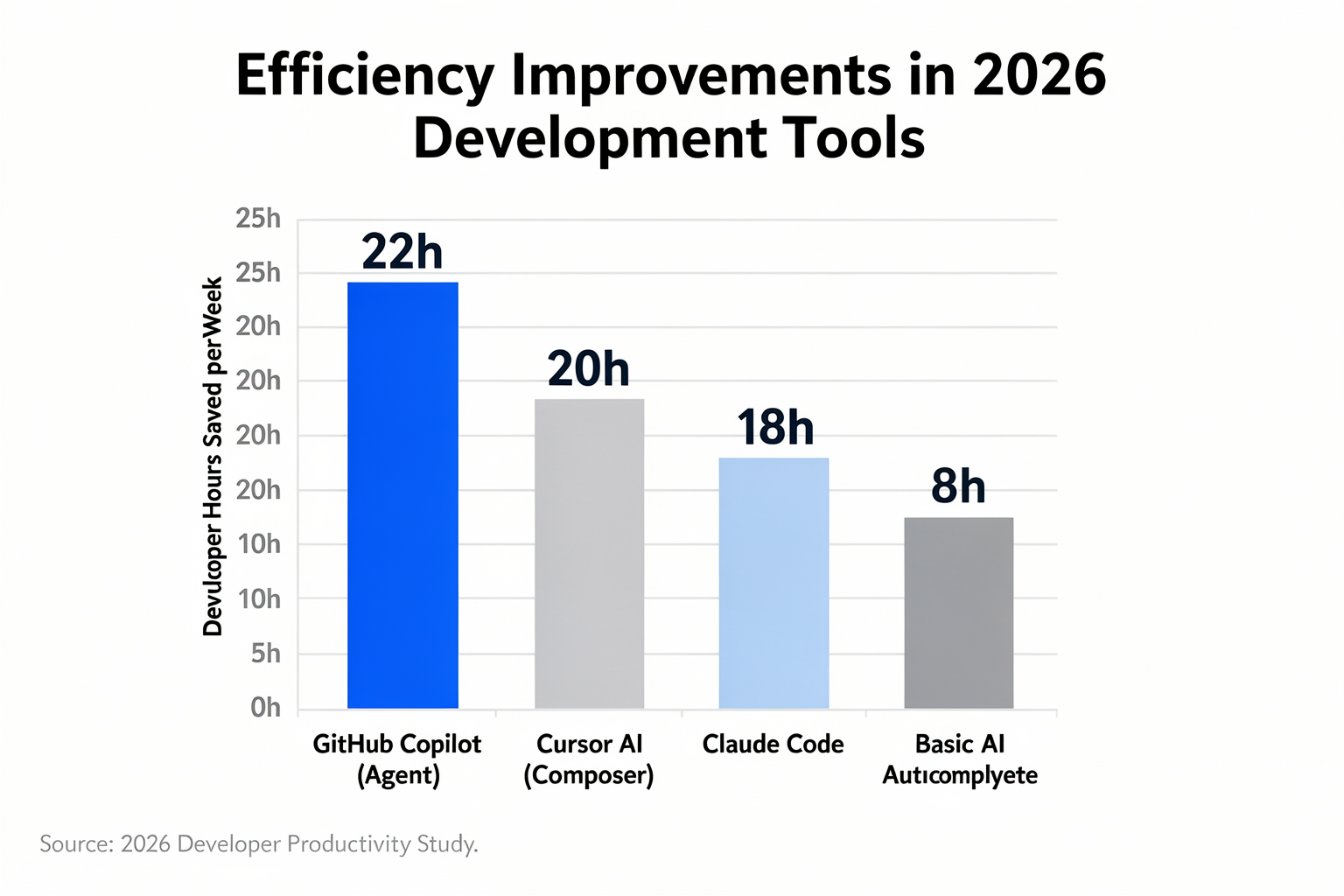
The landscape of AI-assisted software development has shifted dramatically. In the early days of generative AI, tools competed primarily on the accuracy of their single-line autocompletes. Today, in 2026, the battleground has moved entirely to autonomy, multi-file execution, and agentic workflows. GitHub Copilot, which began its journey as an OpenAI-backed autocomplete extension, has evolved into a robust multi-modal platform.
However, Copilot is no longer the only serious player in the room. It faces fierce competition from hyper-focused IDEs like Cursor, specialized software engineering platforms like Windsurf, and fully autonomous enterprise agents like Cognition's Devin. To understand where GitHub Copilot stands, we must analyze how its 2026 features stack up against the top competitors in the industry.
GitHub Copilot: The Ubiquitous Industry Benchmark
GitHub Copilot remains the market leader in terms of sheer user volume and enterprise adoption. By integrating directly with Microsoft’s massive VS Code and Visual Studio ecosystem, Copilot occupies a privileged position.
In 2026, Copilot's offering is divided into two distinct modalities depending on the developer's immediate needs: a lightning-fast, highly reliable autocomplete engine for active coding, and an advanced Agent Mode designed for goal-oriented, multi-file tasks.
Key Strengths of GitHub Copilot in 2026:
- Affordability: At just $10/month for individual developers, Copilot remains the most cost-effective entry point to AI-assisted coding on the market.
- Agentic Execution: Copilot’s Agent Mode can autonomously edit files, execute tests within your local terminal, analyze the failures, and apply iterative fixes until the test suite passes.
- Ecosystem and Standards: Copilot fully supports the Model Context Protocol (MCP) and custom developer-defined agents, allowing teams to hook up internal documentation and database schemas directly into the LLM context.
- Multi-Model Flexibility: Rather than locking developers into a single model, Copilot allows users to swap underlying LLMs depending on the task at hand.
Cursor: The Power-User Favorite
If GitHub Copilot is the choice for the masses, Cursor has solidified its position as the darling of power users and startup developers. Operating as a standalone fork of VS Code, Cursor is built from the ground up to prioritize AI interactions rather than treating them as an extension.
How Cursor Compares to Copilot:
- Composer Mode vs. Copilot Agent Mode: Cursor’s "Composer" was one of the earliest multi-file editing interfaces. While Copilot’s Agent Mode has largely closed the gap in 2026 by allowing autonomous edits and terminal command execution, Cursor still feels slightly more native to developers who prefer a chat-first, canvas-like interface.
- Deep Codebase Indexing: Cursor excels at proactive codebase indexing. It constantly builds local vector embeddings of your entire directory, often resulting in slightly faster context retrieval during complex, multi-file refactoring sessions compared to Copilot's workspace indexing.
- Pricing Premium: Unlike Copilot's highly accessible $10 pricing model, Cursor’s premium tiers are more expensive, making Copilot the more budget-friendly option for individual developers, especially those working in languages like TypeScript where Copilot's autocomplete is highly optimized.
Devin and the Autonomous AI Engineers
On the opposite end of the spectrum lie fully autonomous coding agents like Cognition Labs' Devin. While Copilot and Cursor are designed to act as "pair programmers" working alongside a human inside an IDE, Devin is designed to operate as an independent contractor.
How Devin Compares to Copilot:
- Workflow Autonomy: Devin operates inside its own sandboxed remote container, complete with a virtual browser, shell, and developer tools. You give Devin a Jira ticket or a GitHub issue, and it works entirely in the background, sometimes for hours, before presenting a finished Pull Request. Copilot’s Agent Mode, by contrast, is an interactive local assistant; it runs tasks on your machine and expects you to oversee its step-by-step progress.
- Target Audience and Cost: Devin is an enterprise-grade utility with a high pricing tier, designed to offload entire chunks of engineering backlogs. GitHub Copilot remains a developer-centric tool meant to supercharge individual daily workflows without replacing the active workspace.
Bridging the Gap: From Code Generation to Application Deployment
As these AI tools write and refactor code at unprecedented speeds, developers face a new bottleneck: deploying and connecting these applications to real-world infrastructure. An AI agent can write a flawless backend in minutes, but configuring the APIs to make that backend communicate with users remains a challenge.
This is where specialized infrastructure platforms become essential. While tools like GitHub Copilot generate the code for your next application, communication infrastructure platforms like CallMissed allow developers to deploy those applications seamlessly. For instance, if you use Copilot to build a customer engagement system, CallMissed provides the production-ready voice agent infrastructure, Speech-to-Text APIs supporting 22 Indian languages, and a multi-model gateway of over 300+ LLMs to make your application live. By pairing Copilot’s rapid code generation with CallMissed's communication APIs, teams can build, test, and deploy conversational AI agents in a fraction of the time it used to take.
Summary of the 2026 Competitive Landscape
To help visualize where Copilot fits into the current market, we can break down the primary competitors across key operational pillars:
- Integration Level: Copilot wins on pure IDE ubiquity. Because it is natively supported by GitHub and Microsoft, its integration into VS Code, GitHub Codespaces, and enterprise repositories is seamless and highly secure.
- Task Complexity: For long-running, completely hands-off operations, enterprise agents like Devin hold the edge. However, for iterative, real-time development where the programmer wants to guide the AI's logic, Copilot’s Agent Mode strikes the perfect balance between autonomy and control.
- Value for Money: Copilot is the undisputed leader in value. Providing access to state-of-the-art reasoning models, automated terminal execution, and multi-file editing for $10/month makes it almost impossible for alternative tools to compete on a pure cost-to-utility ratio.
Ultimately, GitHub Copilot in 2026 has successfully transitioned from a helpful autocomplete plugin into a highly competitive, multi-faceted AI agent. While specialized tools like Cursor cater to niche power users and platforms like Devin target hands-off enterprise automation, Copilot remains the most versatile, cost-effective, and deeply integrated AI developer tool on the market.
Frequently Asked Questions
What is GitHub Copilot Agent Mode in 2026 and how does it differ from traditional autocomplete?
How reliable is GitHub Copilot in 2026 for professional developers?
What are the main features of GitHub Copilot in 2026?
Is GitHub Copilot still worth it for TypeScript developers in 2026?
Can Copilot Agent Mode replace junior developers or code reviewers?
How do platforms like CallMissed integrate with GitHub Copilot’s agent capabilities?
The Future: Beyond 2026

The Road Ahead for AI Coding Agents
The evolution of GitHub Copilot from an autocomplete tool to a fully-fledged AI coding agent in 2026 is only the beginning of what promises to be a transformative era for software development. In just five years, Copilot has shifted from predicting the next line of code to orchestrating entire workflows—editing files, running and fixing tests, and even autonomously raising pull requests source. As we look beyond 2026, several trends and challenges will likely shape the next evolution of AI coding agents.
#### 1. Multi-Agent Collaboration and Autonomous Orchestration
While Copilot can now operate as a solo agent executing complex tasks, the next wave will enable multiple AI agents coordinating in real-time on a shared codebase. These agents could be specialized—one focusing on optimization, another on QA, another on security, etc.—and collaborate via structured protocols and negotiation frameworks.
- Industry Impact: This could mean codebases evolve nearly 24/7, with agents pushing improvements and fixes during downtime, effectively reducing technical debt in real-time.
- Emerging Standards: Open agent protocols and cross-platform APIs will be vital, and open-source initiatives (similar to LangChain and AutoGen today) are expected to accelerate this trend.
#### 2. Human-in-the-Loop: Guardrails and Governance
As AI autonomy increases, ensuring human oversight remains crucial. In 2026, 78% of enterprises require human approval for agent-initiated pull requests (Pinklime.io, 2026). Yet agent-initiated code merges could eventually bypass review for low-risk changes, guided by confidence metrics, automated monitoring, and policy engines.
- Explainability and Transparency: Future agents will offer rationale for their code decisions, with explainability baked into every suggestion.
- Ethics and Bias Mitigation: Tools will audit for bias in generated code, an active research area as outlined in "Responsible AI Engineering" (IJCAI, 2026).
#### 3. The Rise of Domain-Specific and Customizable Agents
Generic coding agents are already giving way to domain-specific and highly configurable models. Large enterprises and even open-source projects will train their own AI agents, leveraging proprietary code and workflows.
- Custom Models: Plug-and-play agent frameworks will allow integration with private repositories, CI/CD tools, and even legacy infrastructure.
- Lower Barriers to Entry: SaaS platforms—like CallMissed in the AI communication space—are making multi-model agent deployment accessible to startups and SMBs as well.
#### 4. Natural Language as Code: Multi-Modal and Cross-Language
Looking to 2027 and beyond, the "interface" for coding may become speech, sketch, and conversation—not just typed text. Already, Copilot supports chat, voice commands, and code explanations [GitHub Features, 2026]. With advances in Speech-to-Code and Code-to-Design, the very definition of "programming" will broaden.
- Accessibility Gains: Non-traditional developers—from designers to product managers—will increasingly contribute via natural language.
- Multilingualism: Just as Indian platforms like CallMissed support 22 regional languages for AI voice agents, expect coding agents to handle prompts in any human tongue, democratizing programming skills globally.
#### 5. Security, Privacy, and Intellectual Property
With agents accessing code, company secrets, and development environments, security will be paramount. In 2026, more than 41% of surveyed CTOs cite IP leakage as their top fear with autonomous coding tools (DevelopersDigest, Feb 2026). The next generation of Copilot and competitors will feature:
- Zero-trust sandboxes: Run and validate code in controlled environments before any merge.
- Differential privacy: Ensure no sensitive information is memorized or leaked by models.
- Auditability: Full logs, agent decisions, and traceability reports will be standard for compliance.
Opportunities and Challenges: A 2026 Snapshot
The move from autocomplete to agent has yielded clear benefits:
- Efficiency: Developers report up to 42% code velocity gains using agentic features (GitHub Survey, 2026).
- Quality: Automated test and bug-fixing cycles have cut mean-time-to-repair by 27% in some teams.
- Cost: With Copilot agent mode priced at $10/month [see source], it’s an order of magnitude cheaper than traditional outsourcing or manual QA.
Yet challenges persist:
- Model Drift & Bias: Continuous fine-tuning is needed to prevent “stale” agents or reproduction of poor code patterns.
- Over-reliance: Novice developers may become excessively dependent on agents, risking skill atrophy.
- Evolving Standards: Open questions remain about copyright, authorship, and legal responsibility for AI-generated code.
AI Agents as Colleagues, Not Just Tools
By 2028, leading firms will see AI agents not merely as assistants but as first-class collaborators in the SDLC (Software Development Lifecycle). Expect code review boards with a mix of human and AI reviewers, bot-driven incident response, and project planning kick-started by collaborative chat with agents.
- Cultural Shift: Teams will need new workflows for agent feedback, escalation, and conflict resolution—requiring both technical and business adaptation.
- Continuous Learning: As with CallMissed’s infrastructure for multilingual AI, coding agents will learn from live usage, feedback, and real-world outcomes, closing the loop between suggestion and improvement.
Beyond Copilot: The Emergence of the Open Agent Economy
GitHub Copilot is a bellwether, but it won’t be the only player. The growing ecosystem of agent platforms—ranging from open-source initiatives to domain-specific SaaS offerings—will define the broader landscape.
- Plug-and-Play Agent Market: Expect marketplaces of agent “plugins,” where developers can mix and match open-source bots or subscribe to specialized AI “colleagues”—from performance-optimizers to accessibility enforcers.
- Interoperability and Federation: Agent communication standards (e.g., AgentML or similar) will allow seamless cooperation across ecosystems, much like today's REST APIs enabled the API economy.
Solutions like CallMissed, which enables businesses to integrate, switch, and orchestrate between 300+ LLMs with a unified API, hint at the near future: an open, modular, and flexible agent infrastructure where businesses assemble teams of AI agents tailored to their unique needs—not just for code, but for communication, operations, and customer success.
Final Word: Preparing for the Agentic Future
As GitHub Copilot and its competitors accelerate toward full autonomy, businesses and developers must prepare for a landscape in which AI is a partner in every creative, analytical, and operational loop. That means:
- Investing in agent literacy: Understanding the strengths and limitations of AI collaborators.
- Evolving workflows and governance: Ensuring robust checks, as well as clarity around accountability.
- Embracing open platforms: Leveraging solutions enabling integration and orchestration across diverse agent ecosystems.
The journey from autocomplete to agent is just the first act. The future—where autonomous, collaborative, and context-aware AI agents shape every facet of software and business—lies just beyond the horizon. The time to prepare is now.
Conclusion
The transition of GitHub Copilot in 2026 from a basic autocomplete tool to a fully realized AI agent marks a paradigm shift in how we build software. We are no longer just writing code alongside an AI assistant; we are directing autonomous agents to achieve high-level goals.
Key takeaways from this evolution include:
- Shift from Prediction to Purpose: Instead of merely guessing the next line of code, Copilot’s Agent Mode works toward a designated goal—autonomously editing files, running tests, and fixing errors until the objective is met.
- Full-Stack Workflow Integration: With custom agents, Model Context Protocol (MCP) support, and advanced CLI capabilities, Copilot has moved beyond simple editor suggestions to handle complex, multi-file refactoring tasks.
- Democratic Accessibility: With entry points remaining highly affordable, robust AI-driven development is now within reach for developers of all skill levels, fundamentally lowering the barrier to technical creation.
As we look ahead, the boundary between writing code and orchestrating autonomous agent workflows will continue to blur. The rise of agentic software development is just the first wave; soon, these coding agents will seamlessly hand off tasks to specialized customer-facing and operational AI systems.
To explore how this AI agent revolution is transforming business communication, check out CallMissed—an AI infrastructure platform powering voice agents, LLM inference with over 300 models, and multilingual chatbots for businesses. How will you leverage autonomous agents to scale your operations this year?
Related Posts



Ready to automate customer conversations?
Launch AI voice agents and WhatsApp bots with CallMissed — one API, 22+ Indian languages.