

Claude Sonnet 5 vs Grok 4.5: 2026 Comparison


Claude Sonnet 5 vs Grok 4.5 comparison for July 2026: official status, pricing, coding, agents, safety, benchmarks and buyer guidance.
Claude Sonnet 5 vs Grok 4.5: 2026 Comparison
What if the most important Claude Sonnet 5 vs Grok 4.5 comparison in 2026 is not a benchmark score, but what is officially confirmed? As of July 8, 2026, Anthropic lists Claude Sonnet 5 with $3 per million input tokens, $15 per million output tokens, and a 1M-token context window, while Grok 4.5 remains harder to evaluate where details rely on reports rather than complete official documentation. That matters because developers, founders, and AI infrastructure teams are no longer choosing models for demos—they are choosing them for coding agents, long-context workflows, customer automation, and production API costs. This comparison separates verified facts from claims, then evaluates coding, agentic performance, safety, access, pricing, and role-based fit. For teams using OpenAI-compatible gateways such as CallMissed, these model choices increasingly determine how fast AI products can move from experiment to deployment.
What is the answer-first verdict on Claude Sonnet 5 vs Grok 4.5?
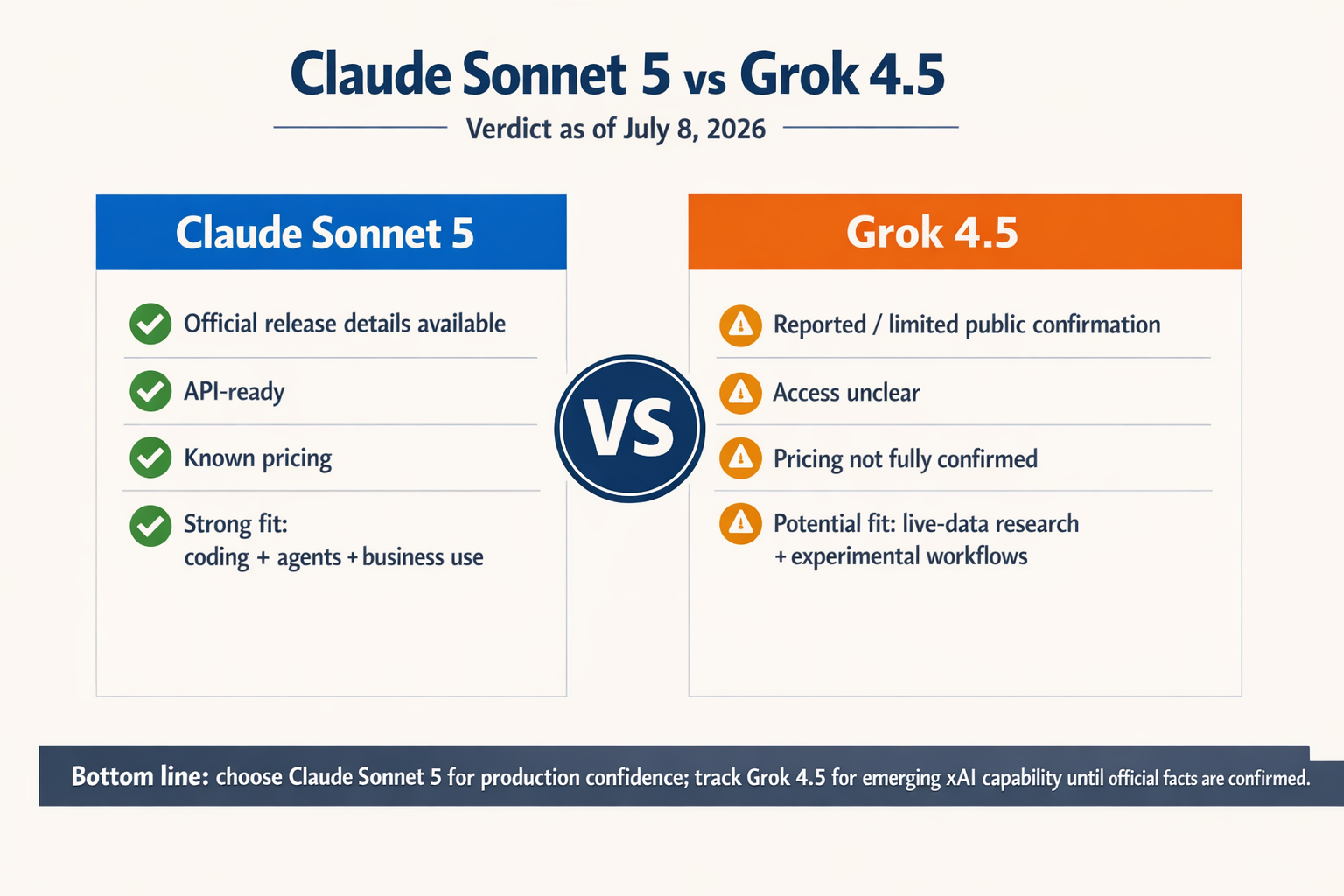
The answer-first verdict for this Claude Sonnet 5 vs Grok 4.5 comparison: Claude Sonnet 5 is the safer production choice as of July 8, 2026 because Anthropic has official pricing, context-window, product, and system-card documentation; Grok 4.5 remains a wait-for-confirmation choice where key buyer facts are still reported rather than fully documented.
Verdict snapshot
- Claude Sonnet 5: Anthropic’s official “What’s new in Claude Sonnet 5” page lists $3 per million input tokens and $15 per million output tokens, unchanged from Claude Sonnet 4.6, which makes budget forecasting easier for API, agent, and procurement teams.
- Claude Sonnet 5: Anthropic’s Claude Sonnet product page describes Sonnet 5 as a hybrid reasoning model for “real-time agents and high-volume work” with a 1M-token context window, giving it a documented advantage for long-document analysis, codebase review, and RAG workflows.
- Claude Sonnet 5: Third-party benchmark coverage is promising but should be labeled carefully. BuildFastWithAI reports a June 30, 2026 launch, 63.2% on SWE-bench Pro, and $2/$10 introductory pricing, but that pricing conflicts with Anthropic’s official $3/$15 listing, so buyers should treat the official Anthropic price as the cleaner planning input.
- Claude Sonnet 5: The credibility edge comes from source depth: Anthropic has public model pages, pricing documentation, and a Claude Sonnet 5 System Card, while OpenRouter describes Sonnet 5 as Anthropic’s “most capable Sonnet-class model” for coding, agents, and professional work.
- Grok 4.5: As of July 8, 2026, Grok 4.5 is harder to evaluate in a production-grade Claude Sonnet 5 vs Grok 4.5 comparison because complete official documentation for pricing, context limits, benchmark methodology, and API availability is not represented in the provided source set.
- SERP context: Search results are still catching up. DocsBot has a Claude Sonnet 5 vs Grok 4 comparison result, while many other ranking pages still focus on Claude Sonnet 4.5, Grok 4, or older model matchups rather than Grok 4.5. That makes a fresh July 8, 2026 buyer-focused Claude Sonnet 5 vs Grok 4.5 comparison more useful when it clearly separates official documentation from reported claims.
- Procurement readiness: In this Claude Sonnet 5 vs Grok 4.5 comparison, Claude currently wins on verifiability: exact token pricing, a named 1M-token context window, and safety documentation are easier to cite in an architecture review, vendor assessment, or internal AI approval workflow.
- Grok 4.5 vs Claude Sonnet 5: Grok 4.5 may still become compelling if official xAI documentation confirms stronger reasoning, coding, latency, availability, or cost advantages. Until those facts are public and citable, teams should avoid treating reported Grok 4.5 claims as production assumptions.
- CallMissed relevance: For teams using OpenAI-compatible gateways such as CallMissed, the practical takeaway is to separate experimentation from deployment readiness: test models broadly, but promote them to production only when pricing, limits, fallbacks, API access, and safety documentation are clear.
- Bottom line: This Claude Sonnet 5 vs Grok 4.5 comparison is not saying Grok 4.5 cannot win later; it is saying Claude Sonnet 5 is the more deployable option right now because its buyer-critical facts are easier to verify.
Which release details are official, and which Grok 4.5 claims remain reported?
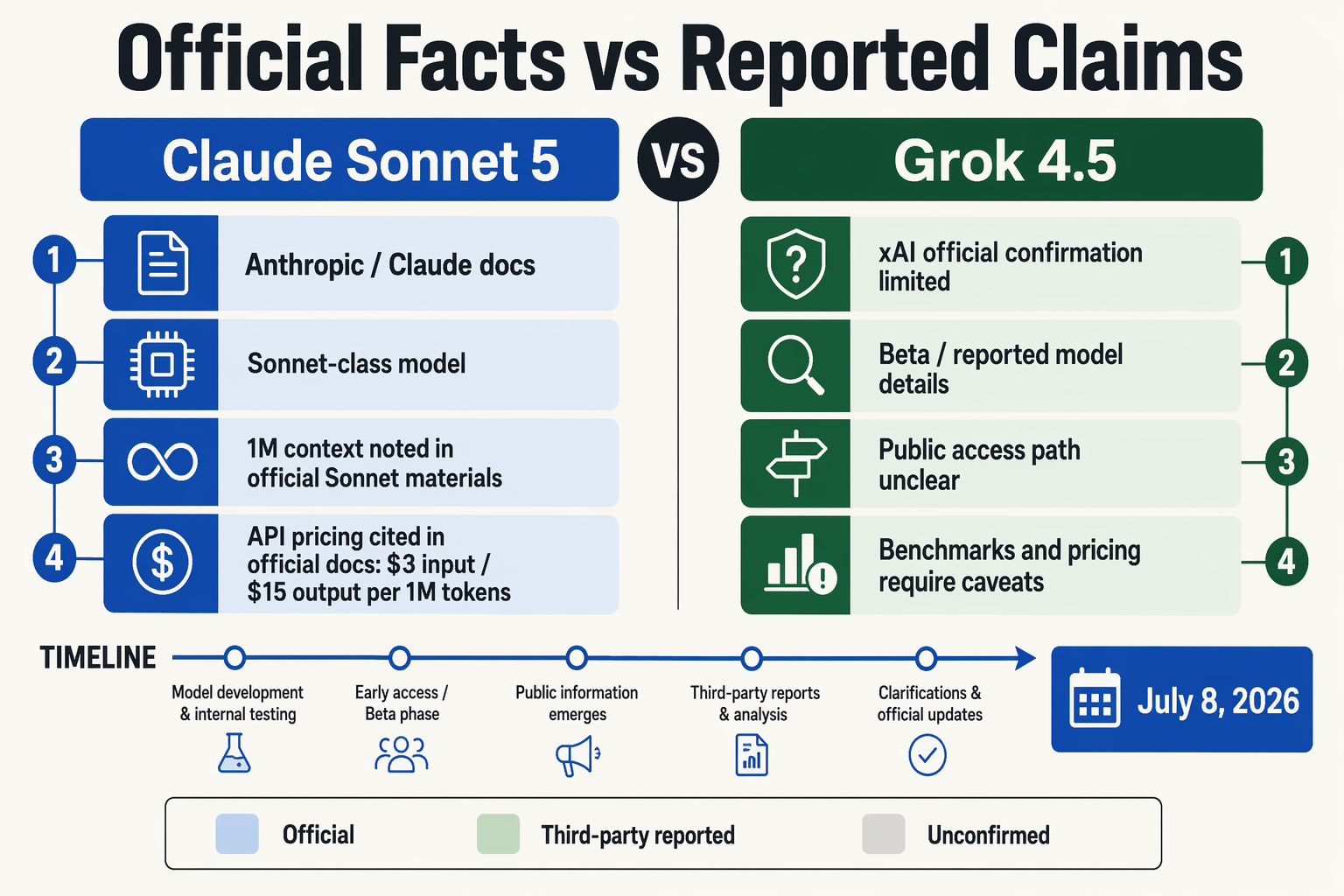
The clean split is: Claude Sonnet 5 has official Anthropic documentation; Grok 4.5 should be treated as unconfirmed unless xAI publishes equivalent pricing, API, context, benchmark, and safety materials.
Official vs reported status
- Claude Sonnet 5: Official source: Anthropic’s “What’s new in Claude Sonnet 5” page states $3 per million input tokens and $15 per million output tokens, unchanged from Claude Sonnet 4.6.
- Claude Sonnet 5: Official source: Anthropic’s Claude Sonnet product page describes Sonnet 5 as a hybrid reasoning model for “real-time agents and high-volume work” with a 1M-token context window.
- Claude Sonnet 5: Official source: Anthropic publishes a Claude Sonnet 5 System Card, giving procurement, security, and AI governance teams a named safety document to review.
- Claude Sonnet 5: Third-party but useful: OpenRouter calls Sonnet 5 Anthropic’s “most capable Sonnet-class model” for coding, agents, and professional work, but this is marketplace positioning, not Anthropic’s own benchmark claim.
- Claude Sonnet 5: Reported claim: BuildFastWithAI says Anthropic launched Claude Sonnet 5 on June 30, 2026 with 63.2% on SWE-bench Pro and $2/$10 introductory pricing; treat the benchmark as reported and the pricing as conflicting with Anthropic’s official $3/$15 page.
- Grok 4.5: As of July 8, 2026, the provided source set contains no complete official xAI documentation for Grok 4.5 pricing, token context, API model ID, output limits, benchmark methodology, or safety card.
- Grok 4.5: Any Grok 4.5 claims about coding, reasoning, context length, speed, or cost should be labeled reported until they can be tied to primary xAI docs, release notes, or API pricing pages.
- Claude Sonnet 5 vs Grok 4.5: For teams routing models through infrastructure such as CallMissed’s OpenAI-compatible gateway, the practical difference is procurement readiness: Claude Sonnet 5 has citable official facts today, while Grok 4.5 needs confirmation before production cost and risk planning.
How do Claude Sonnet 5 and Grok 4.5 compare on features, context, coding, agents, safety, and readiness? (TABLE)
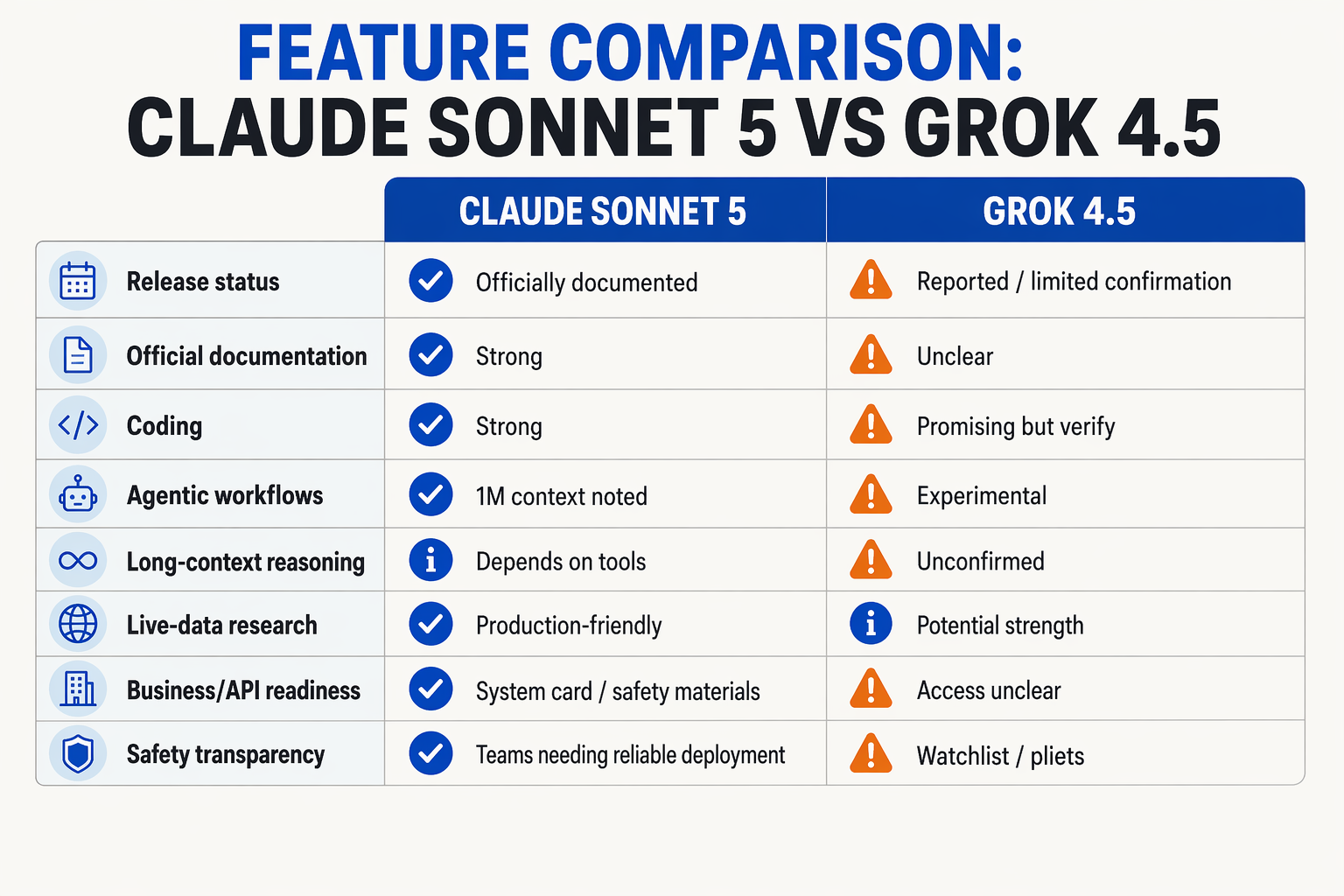
Claude Sonnet 5 is more production-ready on the evidence available because Anthropic documents its pricing, context window, positioning, and safety materials. Grok 4.5 may still become a serious competitor, but as of July 8, 2026, its key production facts should be treated as not officially confirmed in the provided source set.
Feature comparison snapshot
| Category | Claude Sonnet 5 | Grok 4.5 | Production takeaway |
|---|---|---|---|
| Release status | BuildFastWithAI reports a June 30, 2026 launch, while official facts should be checked against Anthropic’s own documentation | Not fully documented in the provided official source set | Claude is easier to verify today; Grok 4.5 needs official confirmation |
| Pricing | Anthropic lists $3 per 1M input tokens and $15 per 1M output tokens | Official pricing not confirmed in provided sources | Claude supports clearer budget planning |
| Context window | Anthropic states Claude Sonnet has a 1M-token context window | Official context limit not confirmed in provided sources | Claude is documented for long-context workloads |
| Coding | OpenRouter describes Claude Sonnet 5 as Anthropic’s “most capable Sonnet-class model” for coding, agents, and professional work | Public coding claims need official confirmation | Claude has stronger sourced coding evidence |
| Agents | Anthropic describes Claude Sonnet as a hybrid reasoning model for “real-time agents and high-volume work” | Agent-readiness details not confirmed in provided sources | Claude is easier to evaluate for workflow automation |
| Safety/readiness | Anthropic provides a Claude Sonnet 5 System Card | Comparable official safety documentation is not in the provided source set | Claude is easier to review for governance and procurement |
Practical differences that matter
- Release confidence: BuildFastWithAI reports that Claude Sonnet 5 launched on June 30, 2026, but that date is a reported claim; for production decisions, teams should prioritize Anthropic’s model docs, pricing page, Claude Sonnet page, and system card.
- Pricing certainty: Anthropic’s official Claude documentation lists $3 per million input tokens and $15 per million output tokens for Claude Sonnet 5. Some third-party pages mention different introductory pricing, but buyers should treat Anthropic’s numbers as the authoritative cost baseline.
- Long-context work: Anthropic states Claude Sonnet has a 1M-token context window, which is directly relevant for codebase review, legal-document analysis, long customer histories, RAG pipelines, and multi-step agent memory.
- Coding and agents: OpenRouter says Claude Sonnet 5 has “frontier performance across coding, agents, and professional work,” while Anthropic positions Claude Sonnet as a hybrid reasoning model for “real-time agents and high-volume work.” Those two sourced claims make Claude easier to shortlist for developer copilots and operational agents.
- Benchmarks need separation: BuildFastWithAI reports 63.2% on SWE-bench Pro for Claude Sonnet 5, but because that is a third-party benchmark claim, it should be cited separately from Anthropic’s official product facts.
- Grok 4.5 remains a verification problem: The issue is not whether Grok 4.5 is capable; the issue is that pricing, benchmark methodology, API access, context limits, and safety documentation are not confirmed in the provided official source set.
What this means for API teams
For developers comparing Claude Sonnet 5 vs Grok 4.5 in 2026, the practical question is not just “which model is smarter?” It is “which model can be safely priced, tested, governed, and shipped?” Platforms such as CallMissed’s OpenAI-compatible AI gateway are built for this kind of multi-model evaluation: teams can integrate once, compare model behavior, and switch providers or tiers without rewriting the application layer.
Best current read: Claude Sonnet 5 leads on documented readiness, long-context support, pricing clarity, and governance materials. Grok 4.5 should be reassessed when official documentation confirms its cost, context window, safety policy, API availability, and benchmark methodology.
How much do Claude Sonnet 5 and Grok 4.5 cost, and which offers better value? (TABLE)
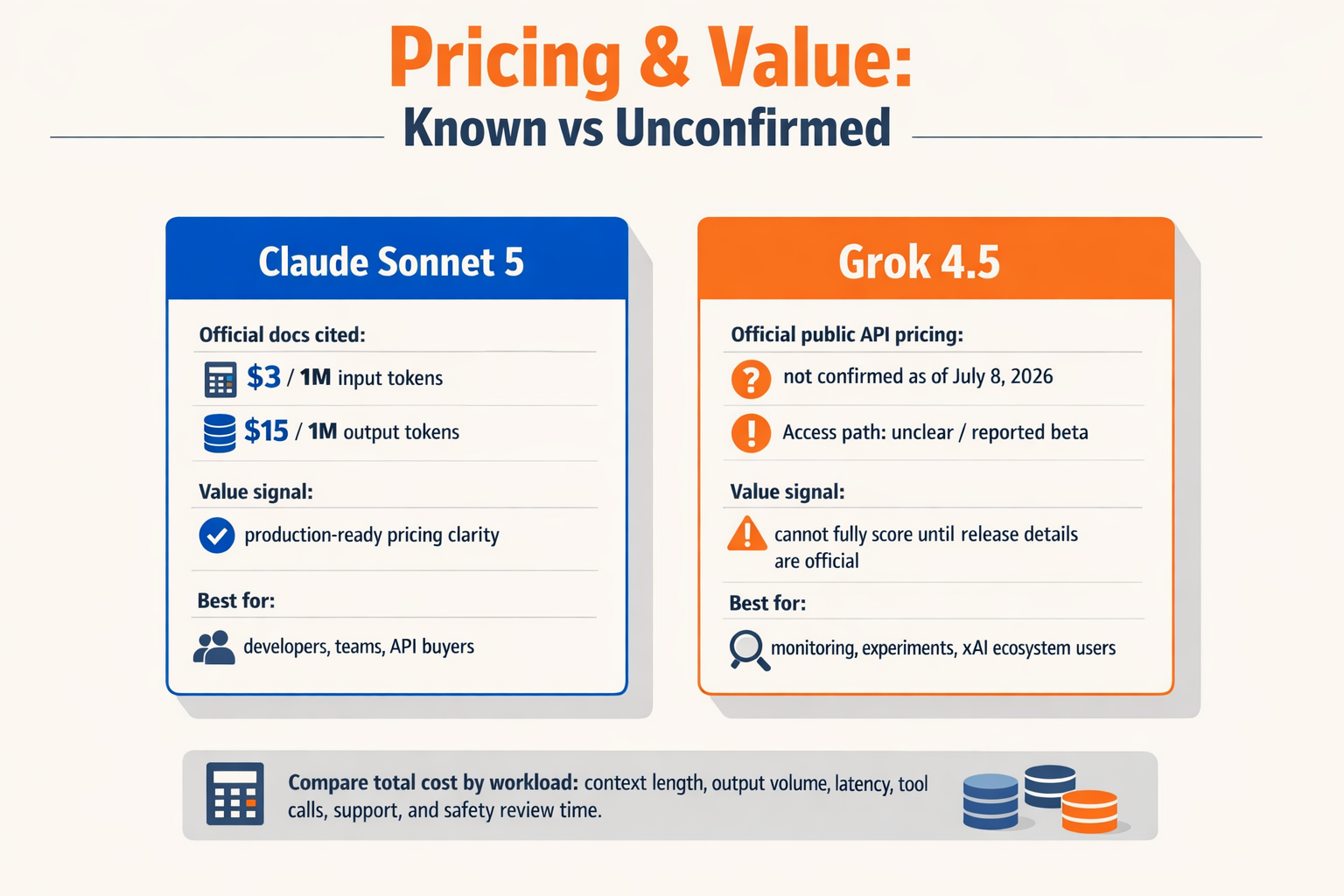
Claude Sonnet 5 offers better price transparency and measurable value today because Anthropic publishes official token pricing and a verified 1M-token context window. Grok 4.5 may still become competitive on cost, but its official pricing, API limits, context window, and output limits are not confirmed in the provided source set as of July 8, 2026.
Cost and value snapshot
| Decision factor | Claude Sonnet 5 | Grok 4.5 | Value read |
|---|---|---|---|
| Official input price | $3 / 1M input tokens, per Anthropic’s “What’s new in Claude Sonnet 5” documentation | Not confirmed in the provided official source set | Claude is easier to budget |
| Official output price | $15 / 1M output tokens, per Anthropic; unchanged from Claude Sonnet 4.6 | Not confirmed in the provided official source set | Claude has clearer production TCO |
| Reported alternate pricing | BuildFastWithAI reports $2 / $10 intro pricing, but this conflicts with Anthropic’s official $3 / $15 listing | Not enough verified data | Use Anthropic’s official pricing for procurement |
| Context window | 1M-token context window, per Anthropic’s Claude Sonnet page | Not confirmed in the provided official source set | Claude has verified long-context value |
| Official output limit | Not confirmed in the provided official source set | Not confirmed in the provided official source set | Avoid planning around unverified max-output claims |
| Cost example | 10M input tokens + 1M output tokens = $45 at official Anthropic rates | Cannot calculate cleanly | Claude enables predictable forecasting |
Practical pricing takeaways
- Anthropic’s official Claude Sonnet 5 documentation lists Claude Sonnet 5 at $3 per million input tokens and $15 per million output tokens as of July 2026. That is the safest number for finance teams, procurement reviews, and internal AI cost calculators.
- Anthropic’s Claude Sonnet page lists Claude Sonnet 5 with a 1M-token context window. For long-codebase review, contract analysis, RAG workflows, compliance review, and multi-step agent memory, that verified context window can reduce chunking complexity and orchestration overhead.
- A Claude Sonnet 5 workload with 1M input tokens and 100K output tokens costs $4.50 at Anthropic’s official rates: $3.00 for input plus $1.50 for output. A larger workload with 10M input tokens and 1M output tokens costs $45: $30 input plus $15 output.
- BuildFastWithAI reports $2 per million input tokens and $10 per million output tokens for Claude Sonnet 5, but that figure conflicts with Anthropic’s official $3 / $15 listing in the provided source set. Treat the $2 / $10 number as reported or potentially promotional unless Anthropic confirms it in official pricing documentation.
- Official Claude Sonnet 5 output limits are not confirmed in the provided source set. For production planning, teams should avoid building around third-party max-output claims unless they can verify the limit directly in Anthropic’s current API documentation.
- Grok 4.5 pricing cannot be compared cleanly yet. The provided source set does not confirm official Grok 4.5 token pricing, API availability, rate limits, context window, or output limits as of July 8, 2026.
Which offers better value?
For teams making a buying decision today, Claude Sonnet 5 offers better measurable value because its official price and 1M-token context are documented. Grok 4.5 remains a model to monitor, especially if xAI later publishes aggressive API pricing, larger context limits, or bundled access through X Premium or developer plans.
For developers using multi-model infrastructure, the practical lesson is to separate model quality from unit economics. Platforms such as CallMissed’s OpenAI-compatible AI gateway can reduce switching friction across LLM providers, but the underlying model’s official token price, context window, output behavior, and rate limits still determine real production cost.
What are the biggest pros and cons of each model for 2026 buyers? (TABLE)
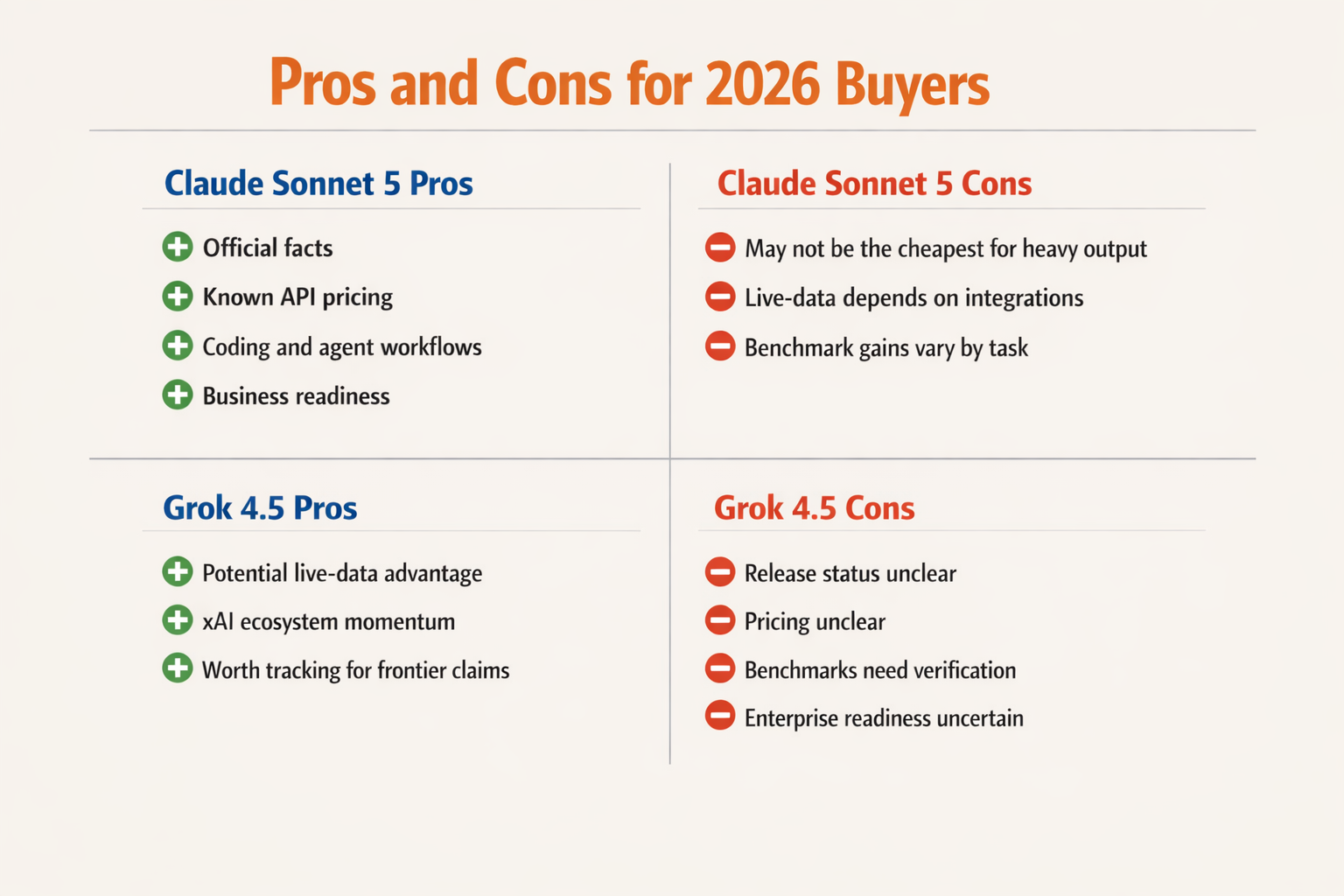
Claude Sonnet 5’s biggest advantage for 2026 buyers is procurement clarity; Grok 4.5’s biggest issue is that too many buyer-critical facts remain unconfirmed in the provided official source set as of July 8, 2026.
| Buyer factor | Claude Sonnet 5 | Grok 4.5 | 2026 buying implication |
|---|---|---|---|
| Official pricing | Anthropic lists $3/1M input tokens and $15/1M output tokens. | Not fully confirmed in the provided official sources. | Claude is easier to budget for production workloads. |
| Context window | Anthropic lists a 1M-token context window for Claude Sonnet. | Not confirmed in the provided source set. | Claude has clearer fit for long-codebase, RAG, and document workflows. |
| Coding evidence | BuildFastWithAI reports 63.2% on SWE-bench Pro, but this is third-party reporting. | No comparable verified figure provided here. | Claude has more usable evidence, but benchmark claims still need source labeling. |
| Safety documentation | Anthropic provides a Claude Sonnet 5 System Card. | Not represented with equivalent documentation in the provided sources. | Claude is easier to approve in regulated or enterprise reviews. |
| API readiness | OpenRouter describes Sonnet 5 as Anthropic’s “most capable Sonnet-class model” for coding, agents, and professional work. | Access details are harder to verify from the supplied context. | Claude is lower-friction for teams planning near-term deployment. |
- Claude Sonnet 5: Best pro is verifiability — Anthropic’s official docs confirm $3/$15 pricing and a 1M-token context window.
- Claude Sonnet 5: Best fit is production AI engineering — coding agents, long-context RAG, enterprise assistants, and cost-modeled API workloads.
- Claude Sonnet 5: Main con is source conflict — BuildFastWithAI and Eden AI mention $2/$10 pricing, but Anthropic’s official listing says $3/$15.
- Claude Sonnet 5: Safety buyers get more review material because Anthropic publishes a dedicated Claude Sonnet 5 System Card.
- Grok 4.5: Best pro is potential upside for teams already invested in the xAI/Grok ecosystem, especially if official access, pricing, and benchmark details mature.
- Grok 4.5: Main con is procurement uncertainty — without confirmed pricing, context limits, and API documentation in the provided sources, ROI modeling is weaker.
- Buyer takeaway: For OpenAI-compatible infrastructure teams, including those routing models through platforms like CallMissed’s multi-model AI gateway, Claude Sonnet 5 is easier to justify today; Grok 4.5 remains a monitor-and-test candidate until official facts catch up.
Which model should developers, product teams, researchers, and executives choose?
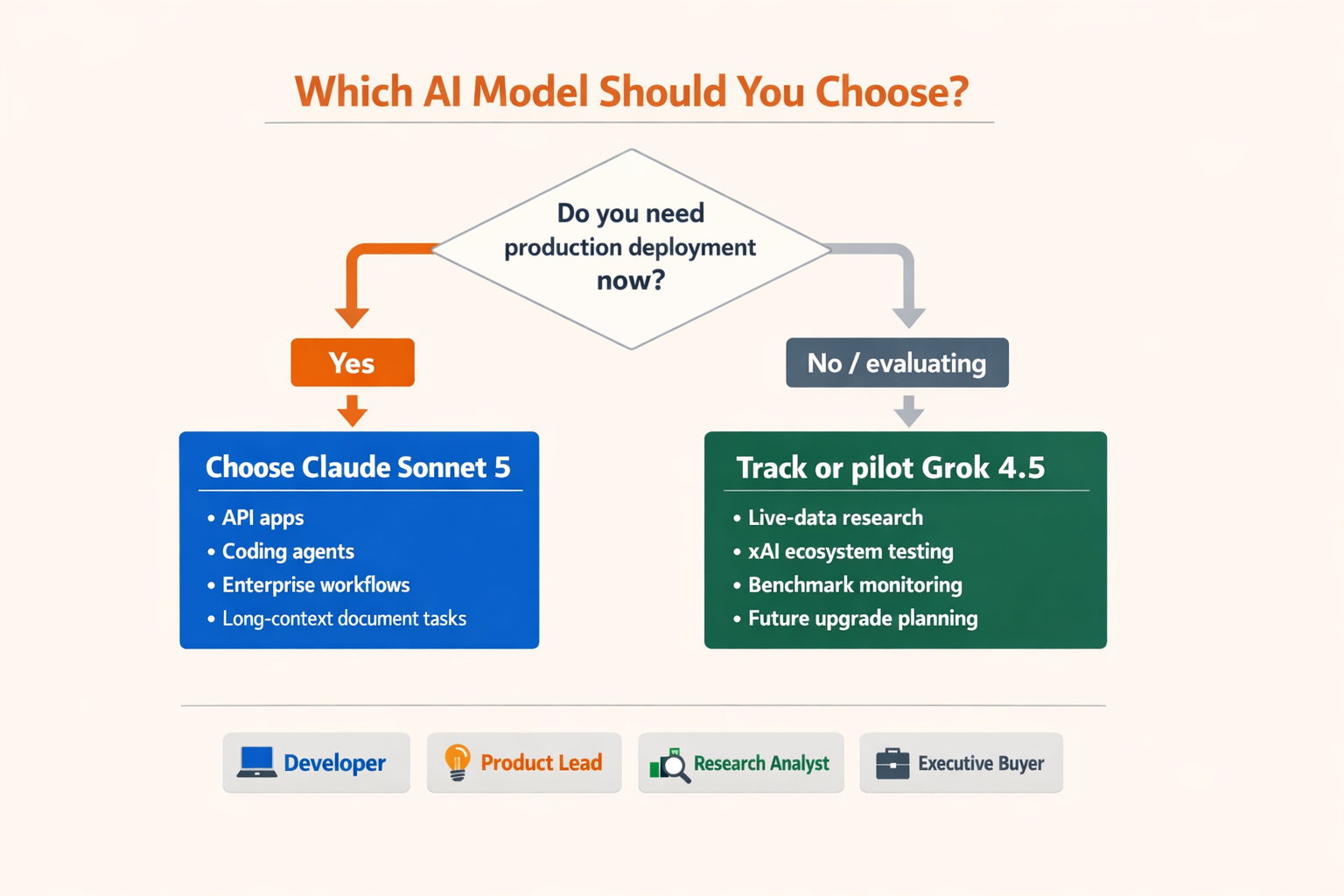
Choose Claude Sonnet 5 when you need production certainty; treat Grok 4.5 as a candidate to re-evaluate once official pricing, context, safety, and API docs are public.
Role-based recommendation
- Developers: Choose Claude Sonnet 5 for coding agents and API builds because Anthropic officially lists $3 per million input tokens, $15 per million output tokens, and a 1M-token context window.
- Product teams: Choose Claude Sonnet 5 for roadmap planning because Anthropic describes it as a hybrid reasoning model for “real-time agents and high-volume work,” which maps cleanly to customer support, workflow automation, and RAG products.
- Researchers: Use Claude Sonnet 5 when you need citable documentation: Anthropic provides model pages, pricing docs, and a Claude Sonnet 5 System Card; use Grok 4.5 only with clear caveats where claims are not officially confirmed as of July 8, 2026.
- Executives: Prefer Claude Sonnet 5 for procurement discussions because finance teams can model usage from official $3/$15 per million token pricing instead of relying on reported or incomplete numbers.
- AI infrastructure teams: Choose Claude Sonnet 5 for long-context workloads because the official 1M-token context window is directly relevant to codebase analysis, legal review, knowledge-base grounding, and enterprise search.
- Benchmark-focused teams: Treat reported Claude figures carefully: BuildFastWithAI reports 63.2% on SWE-bench Pro and a June 30, 2026 launch, but its $2/$10 introductory pricing conflicts with Anthropic’s official $3/$15 listing.
- Grok-first teams: Wait for official Grok 4.5 API pricing, benchmark methodology, context length, output limits, and safety documentation before making it the default production model.
- Multi-model builders: Use an OpenAI-compatible gateway such as CallMissed when you want one integration path for model testing, fallback routing, and production experimentation across LLM providers.
Frequently Asked Questions
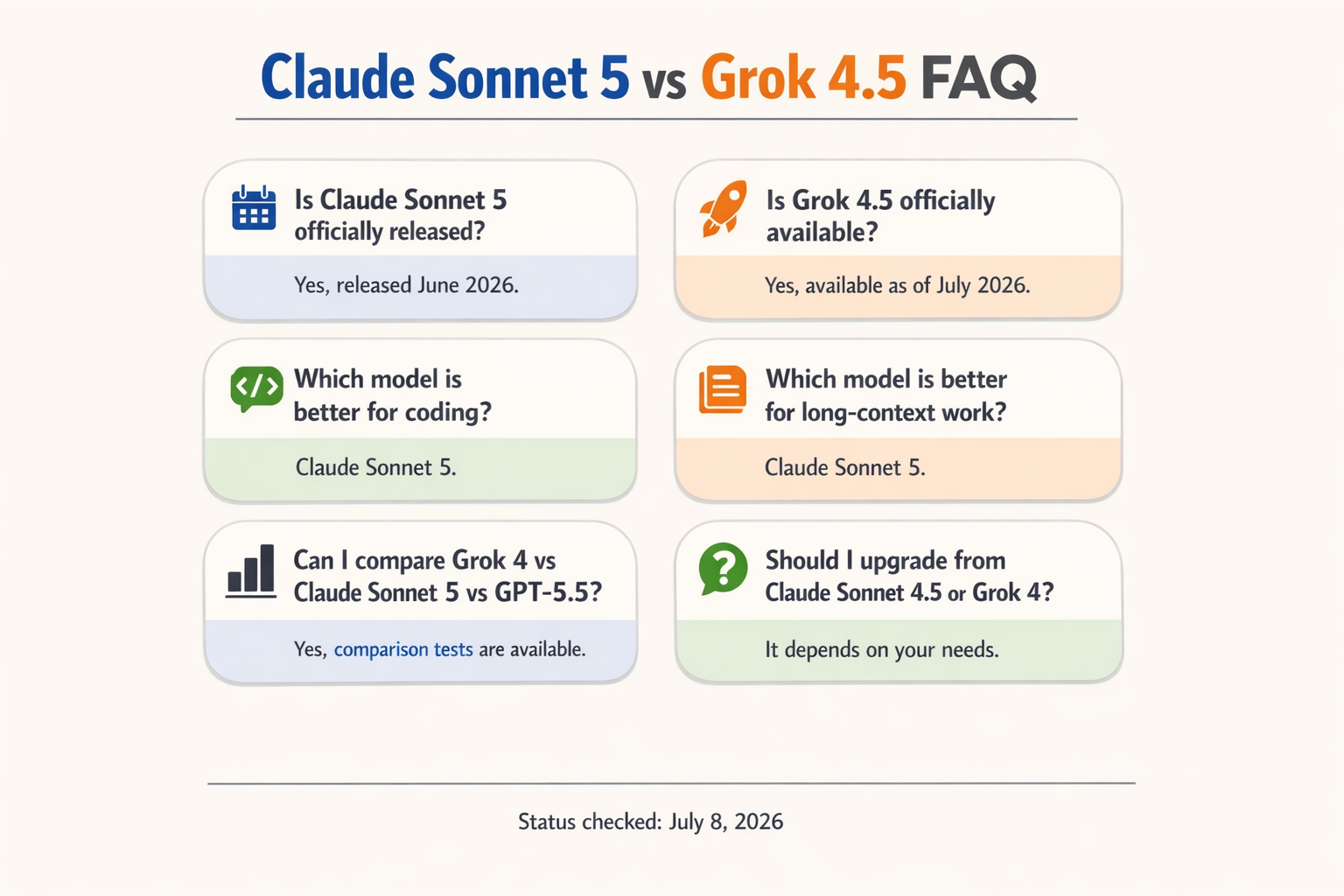
Is Claude Sonnet 5 vs Grok 4.5 a fair comparison in 2026?
Which is better for production API use: Claude Sonnet 5 or Grok 4.5?
What are Claude Sonnet 5’s official context window and pricing?
Did Claude Sonnet 5 launch on June 30, 2026?
Why do some sources show different Claude Sonnet 5 prices?
Which model is better for coding: Claude Sonnet 5 vs Grok 4.5?
Can developers access Claude Sonnet 5 through an OpenAI-compatible gateway?
Conclusion
- Claude Sonnet 5 is more production-ready today: official $3/$15 pricing, 1M-token context, and Anthropic documentation make it easier to evaluate.
- Grok 4.5 needs stronger official confirmation before serious API, cost, and safety comparisons.
- Benchmark claims matter less than verifiable deployment facts for coding agents, RAG, and customer automation.
Watch for confirmed Grok 4.5 docs, pricing, and access details. To stay ahead, explore CallMissed, an AI infrastructure platform powering voice agents and multilingual chatbots for businesses. Which model would you trust in production today?
Related Reading
Related Posts



Ready to automate customer conversations?
Launch AI voice agents and WhatsApp bots with CallMissed — one API, 22+ Indian languages.