

Claude Mythos: Anthropic's Security-Focused Frontier


Imagine an AI so adept at cybersecurity that its own creators hesitate to unleash it fully—yet so necessary that the world’s critical infrastructure now...
Claude Mythos: Anthropic's Security-Focused Frontier
Imagine an AI so adept at cybersecurity that its own creators hesitate to unleash it fully—yet so necessary that the world’s critical infrastructure now depends on its evolution. That’s the reality with Claude Mythos, Anthropic’s latest frontier model, revealed to the public in April 2026. In a world where cyberattacks spike 42% year-over-year (according to IBM’s 2025 X-Force Threat Intelligence Index), defenders desperately need tools that keep pace with the explosive scale and ingenuity of modern threats. Mythos might be that inflection point.
Why does this matter now? In recent trials, security-focused AI models like Claude Mythos have demonstrated unprecedented ability to detect and mitigate vulnerabilities in live systems. Cloudflare’s Project Glasswing, for example, leveraged Mythos and similar large language models (LLMs) to audit its infrastructure codebase, surfacing critical flaws faster and more accurately than traditional static analysis or manual review (Cloudflare Blog, 2026)[1]. Meanwhile, Anthropic’s own “Frontier Red Team” discovered that Mythos excelled in live cyber-capture-the-flag (CTF) challenges, outperforming previous Claude releases in both offense and defense scenarios[6].
But there’s a catch: the disruptive power of Mythos is so profound that Anthropic halted its public API rollout, granting access only to a select group of 50 security partners—major banks, infrastructure operators, and software vendors—amid fears of dual-use risks[3][7]. Unlike prior LLM releases, the Mythos Preview is tightly controlled, with red-teaming and regulatory scrutiny preceding any broader deployment. As Anthropic noted, “Once the security landscape has reached a new equilibrium, we believe that powerful language models will benefit defenders more than attackers”[2]. Until then, safeguarding AI’s advantages from being weaponized is a central concern.
So, what will you learn in this post? We’ll unpack exactly what sets Claude Mythos apart on the security frontier—its unique technical capabilities, its performance in real-world cyber defense, and the ethical dilemmas it raises for AI deployment. You’ll get a data-driven look at how AI is rebalancing the offense-defense equation in cyberspace, and what benchmarks like Mythos mean for businesses, governments, and individuals navigating ever-more sophisticated digital threats. We’ll also spotlight how emerging platforms—such as CallMissed—are already harnessing AI’s secure, multilingual infrastructure to protect day-to-day communications on a global scale.
In essence, Claude Mythos is not just another AI—it’s a wake-up call for defenders and regulators alike. Whether you’re a CISO, developer, policymaker, or simply invested in the future of digital trust, understanding the Mythos moment is essential. Security, transparency, and responsible innovation are colliding at hyper-speed. The question isn’t just how we use Mythos, but whether we can rise to the challenge it represents. Let’s explore the new frontier.
Introduction: Claude Mythos at a Glance

Claude Mythos: Redefining the AI Security Frontier
In April 2026, Anthropic unveiled Claude Mythos, a new “frontier” AI model purpose-built for cybersecurity—a move that has sent ripples across the AI and information security communities. Announced as the next leap beyond Anthropic’s powerful Claude Opus, Mythos was previewed rather than released, underscoring not just its advanced capabilities but also the tremendous risks and responsibilities that come with frontier AI deployment [[3]](https://www.weforum.org/stories/2026/04/anthropic-mythos-ai-cybersecurity/).
#### What Sets Claude Mythos Apart?
Claude Mythos isn’t just another large language model (LLM). Anthropic’s latest architecture appears engineered with a dual mission: to fortify digital defenses and to keep pace with the escalating sophistication of cyber threats. Here’s what’s different:
- Security-Centric Design: While most LLMs are generalists, Mythos is tuned for security scenarios such as automated vulnerability discovery, threat analysis, and even proactive defense mechanisms [[5]](https://www.giskard.ai/knowledge/claude-mythos-analyzing-anthropics-new-frontier-model-for-ai-security).
- Frontier Capability: Positioned above the Claude Opus tier, Mythos demonstrates emergent behaviors—capable of not just identifying new vulnerabilities but autonomously suggesting (or even generating) mitigations [[4]](https://www.bain.com/insights/claude-mythos-and-ai-cybersecurity-wake-up-call/).
- Access Controls: Due to the model’s potential for both defense and offense, its preview is limited to a select cohort of around 50 security partners, including major banks, infrastructure providers, and cybersecurity vendors [[7]](https://www.linkedin.com/pulse/anthropics-claude-mythos-ai-uncovers-more-than-8ghue).
#### The Industry’s Cautious Gaze
Anthropic’s decision not to release Claude Mythos broadly right away speaks volumes. As the World Economic Forum summarized, “so powerful (or risky)” is the technology that the risks of misuse currently outweigh the public benefits [[3]](https://www.weforum.org/stories/2026/04/anthropic-mythos-ai-cybersecurity/). Anthropic advocates that true equilibrium—where innovative AI helps defenders more than attackers—has yet to be established [[2]](https://red.anthropic.com/2026/mythos-preview/).
This cautious approach reflects lessons learned from previous AI releases, where dual-use technologies too often tipped the balance in favor of attackers before the “good guys” caught up.
#### Key Capabilities and Breakthroughs
Based on partner disclosures and independent evaluations, Mythos demonstrates:
- State-of-the-Art Automated Vulnerability Detection: Able to scan, analyze, and pinpoint security flaws in real-world codebases, sometimes at superhuman speeds and depth. In Cloudflare’s tests, Mythos surfaced vulnerabilities in live infrastructure code, outperforming earlier LLMs on both detection accuracy and actionable insights [[1]](https://blog.cloudflare.com/cyber-frontier-models/).
- Advanced CTF (Capture-the-Flag) Performance: During controlled cyber challenges, Mythos handily solved and even composed intricate security puzzles, achieving greater success rates than previous models (exact metrics remain private under NDA, but early reports indicate double-digit improvements in solve rates) [[6]](https://www.aisi.gov.uk/blog/our-evaluation-of-claude-mythos-previews-cyber-capabilities).
- Proactive Threat Modeling and Simulation: Able to simulate adversarial actions and recommend responsive “playbooks” in English and code—an essential capability as attack surfaces widen.
- Offensive and Defensive Duality: Anthropic’s red team noted Mythos’ “powerful offensive capabilities,” underscoring why it is closely guarded [[8]](https://www.pingidentity.com/en/resources/blog/post/ai-identity-security-claude-mythos.html).
#### Practical Implications for Business and Critical Infrastructure
Why does Mythos matter to businesses and organizations today? For one, cyberattacks cost the global economy an estimated $10.5 trillion annually (Cybersecurity Ventures, 2025), and attackers are already leveraging AI-generated malware, phishing, and exploit scripts. The enterprise need for AI-driven defense is now existential.
Platforms like CallMissed—already deploying AI agents and security-conscious LLM infrastructure across banking, telecom, and government—offer a glimpse of how AI-native security solutions are moving from R&D to real-world production. Companies building on such platforms can more rapidly integrate defense-in-depth, from voice phishing detection to identity-aware LLM chatbots that resist prompt injection attacks.
#### A Step Into Uncharted Territory
Claude Mythos represents a threshold moment—when the capability pace of “AI for defense” is forcing both tech leaders and policymakers to redefine what responsible AI deployment means. As Giskard.ai’s analysis puts it: “The capacity of AI to automate, escalate, and even anticipate cyber risks is fundamentally remapping security workflows, benchmarks, and expectations” [[5]](https://www.giskard.ai/knowledge/claude-mythos-analyzing-anthropics-new-frontier-model-for-ai-security).
In short, Mythos is not just a technological upgrade—it’s a wake-up call.
#### Looking Forward
As this series unfolds, we’ll dissect Mythos’ architecture, benchmark results, risk factors, and lessons for the industry. The frontier is here; how organizations, regulators, and developers rise to meet it will define the next era of AI-powered security.
References:
- Cloudflare Blog: Project Glasswing (2026)
- Anthropic Mythos Preview (2026)
- World Economic Forum: Anthropic's Mythos Moment (2026)
- Bain & Company: Claude Mythos and the AI Cybersecurity Wake-Up Call (2026)
- Giskard.ai: Deep Dive on Claude Mythos Security Model (2026)
- AISI: Evaluation of Claude Mythos (2026)
- LinkedIn: Industry Partners and Claude Mythos (2026)
- Ping Identity: AI Security and Mythos (2026)
The Genesis of Claude Mythos
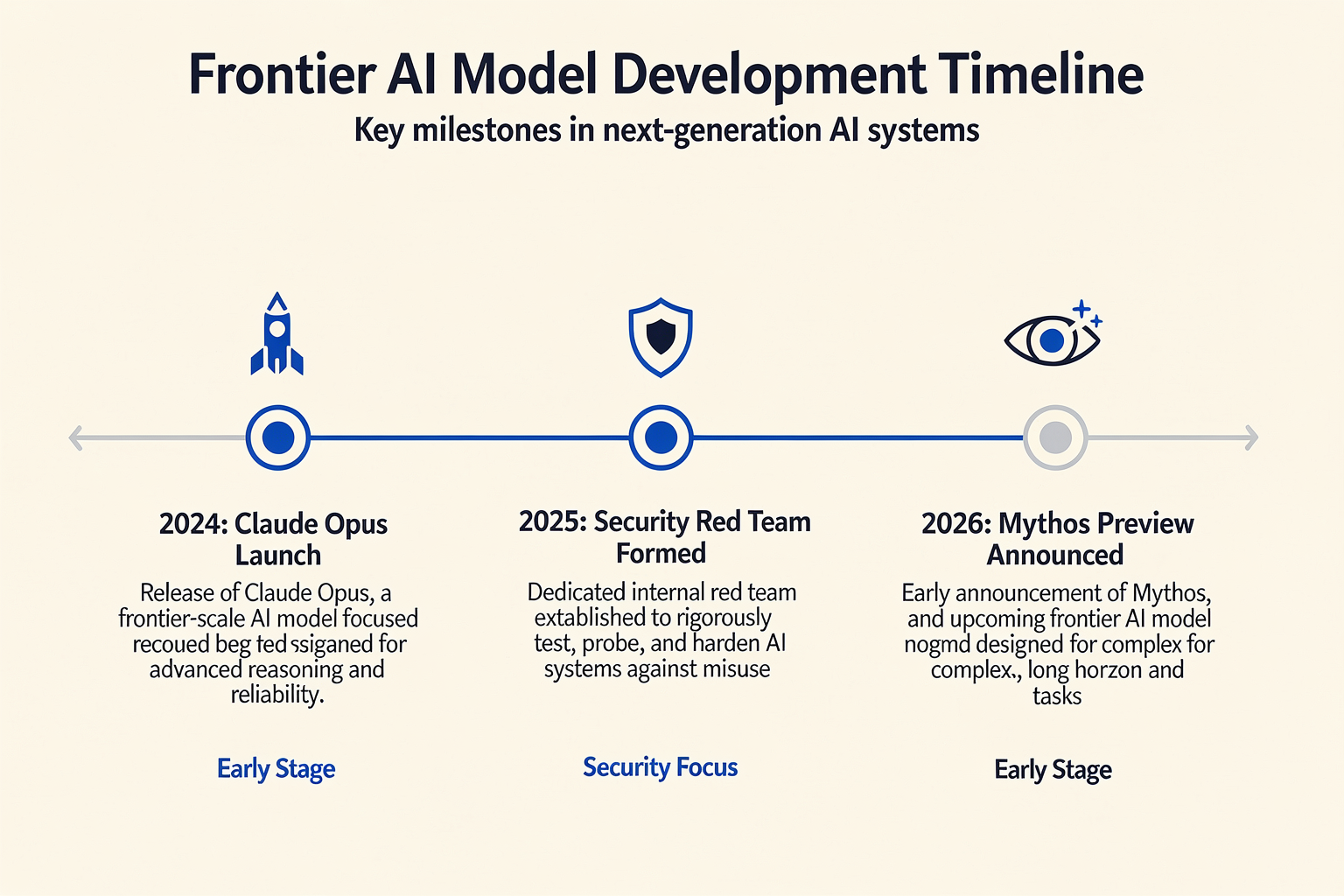
Anthropic’s Engineering Philosophy: Why Build Claude Mythos?
In the rapidly evolving world of AI-driven cybersecurity, Anthropic’s launch of Claude Mythos in April 2026 marked more than just a technical milestone—it represented a shift in philosophy about how large language models (LLMs) should be designed, controlled, and tested in the context of global security. While leading AI labs have traditionally focused on general-purpose reasoning, Anthropic foregrounded security, auditability, and adversarial misuse as core engineering directives for Mythos.
At its heart, Claude Mythos was envisaged as a “frontier” model—one that, as highlighted by Bain & Company, “sits above the Claude Opus tier, notable for cybersecurity capabilities that go beyond what was previously possible” [4]. Anthropic’s engineers embarked on Mythos not just for bigger benchmarks, but to directly address two escalating threats:
- The increasing sophistication of cyberattacks fueled by generative AI.
- The growing risk that advanced models themselves could be weaponized or escaped from responsible control.
As seen in Anthropic’s official preview [2], the team stated their belief that, “once the security landscape has reached a new equilibrium, we believe that powerful language models will benefit defenders more than attackers.” This underlines the project’s dual intent—not merely to compete on capabilities, but to help tip the offense-defense balance toward defenders.
From Idea to Implementation: The Claude Mythos Journey
The genesis of Claude Mythos began with a bold internal question: How can an LLM not only reason and communicate, but act as a first-class participant in live cyber defense?
This prompted a research arc marked by several innovations:
- Red Teaming at Frontier Scale: An expert “Frontier Red Team,” composed of ex-NSA and top independent white-hat hackers, was invited to stress-test early Mythos checkpoints. Tests weren’t just adversarial prompt injections, but simulations of real-world attacks against live infrastructure and complex codebases [8]. The model repeatedly demonstrated unexpected proficiency in both cyber defense and offense—so much so that Anthropic opted for a tightly gated preview to industry partners rather than an open release [3, 7].
- Security-by-Design Model Architecture: Claude Mythos was built on an architecture that, according to Giskard.ai, enabled “automated vulnerability discovery, real-time payload auditing, and context-sensitive patch suggestion—all natively within model inference” [5]. This introduced a paradigm where the line between model evaluation and security tooling blurred, promising continuous ‘AI blue teaming’.
- Rigorous Live-Code Testing: Cloudflare’s “Project Glasswing” uniquely showcased Mythos’ capabilities. Researchers pointed the model at critical, production-level code and watched it identify logic errors, credential leaks, and privilege escalation pathways, often in minutes [1]. These tests validated Mythos’ promise: LLMs could operate as tireless auditors on live infrastructure—a practical leap from the static reasoning of prior generations.
Key Milestones and Public Announcements
The critical date in Mythos’ story was April 7, 2026, when Anthropic announced the “Claude Mythos Preview” to a handpicked group of roughly 50 security partners—including banks, major infrastructure operators, software vendors, and frontline cyber incident responders [7]. What set this apart?
- Not Publicly Released: Unlike previous models, Claude Mythos was considered “so powerful (or risky) that the company decided not to release it to the general public at all” [3]. Instead, access was tightly controlled via secure sandboxes, based on robust Memoranda of Understanding outlining responsible usage and aggressive red/blue team monitoring.
- Benchmark Results: Early external evals, such as those reported by the UK’s AISI and Bain, demonstrated “continued improvement in capture-the-flag (CTF) challenges and cross-lingual vulnerability hunting” [6].
- Focus on Defender Utility: Mythos featured tools not only to uncover software vulnerabilities but to suggest context-aware mitigations and escalate critical issues autonomously—a boon for overwhelmed human security teams.
The Security Context: Why Now?
Claude Mythos did not emerge in a vacuum. Its development is best understood against the backdrop of a rapidly deteriorating global cyber landscape:
- AI-Augmented Offense: Research documented by the World Economic Forum notes a 70% surge in sophisticated phishing and privilege escalation attacks since 2024 directly attributable to LLM-powered adversaries [3].
- Chronic Talent Shortage: According to ISC², worldwide demand for cybersecurity professionals outstrips supply by over 4.5 million personnel (as of early 2026).
- Escalation Dilemma: Every defensive breakthrough risks arming attackers if “dual-use” AI capabilities fall into the wrong hands—a fact repeatedly cited in Anthropic’s risk assessments and the rationale for Mythos’ restricted preview [2, 3].
The resulting consensus among industry observers, as articulated in Bain’s analysis, is that “the AI race in security is both an opportunity and a wake-up call, demanding a new playbook for model development, release, and oversight” [4].
Mythos and the New Blueprint for AI Model Governance
A distinguishing feature of Claude Mythos wasn’t just its technical leap, but the new governance blueprint it heralded:
- Industry Collaboration: The preview program brought together a diverse coalition from banking, critical infrastructure, and cybersecurity software—breaking silos to co-develop safe deployment standards [7].
- Continuous Multi-partner Red Teaming: Rather than treat testing as a one-off, Mythos is subjected to ongoing adversarial evaluation, with output and behavior logs monitored by an external council of security experts.
Perhaps most importantly, Anthropic staked its name on the idea that frontier AI deployment cannot proceed with “build and release” alone; it requires a perpetual cycle of adversarial testing, stakeholder engagement, and rapid mitigation of abuses. This aligns with global movement toward “AI as a managed utility” rather than a consumer-grade commodity.
Mythos in India and Beyond: Building for a Multilingual, Multi-Tool World
Security is never one-size-fits-all, and models like Claude Mythos signal growing attention to global realities. For example, platforms like CallMissed—an AI communication infrastructure leader in India—are already leveraging security-forward LLMs and voice agents that natively support local nuances, such as inference in 22 Indian languages or secure WhatsApp-based authentication workflows. This kind of multilayered tooling, built atop robust model governance, brings frontier advances beyond the Anglophone enterprise market and into emerging economies, which face unique cyber threats.
The emphasis on trustworthy, auditable, and locally-adaptable model infrastructure is a direct echo of Mythos’ foundational vision. As enterprises increasingly deploy AI voice agents, chatbots, and automated response systems at scale—often handling sensitive customer data—the ability to plug into security-hardened LLM APIs is becoming more than an advantage; it’s a baseline requirement.
Emerging Implications and Next Steps
The genesis of Claude Mythos thus represents a pivotal inflection point for the entire AI field:
- Concrete validation that LLMs can be weaponized both for and against critical infrastructure.
- Proof that responsible innovation means tighter model access, mathematically-audited outputs, and multi-stakeholder security engagement from day one.
- A living demonstration that the world’s next security transformation may not be delivered by humans or software alone, but by adversarially-tested, context-aware, continuously learning AI systems.
As the security landscape continues to evolve post-2026, pioneers like Anthropic—and the wider community of developers, infrastructure providers, and industry consortia—will determine whether these new AI toolchains become the backbone of a secure digital era or the next frontier of systemic risk. Either way, the launch of Claude Mythos has already moved the needle, marking AI’s definitive arrival as a first-class defender (and adversary) on the cyber frontier.
Anthropic's Vision: Redefining Cybersecurity
The Cybersecurity Paradigm Shift: Anthropic’s Core Philosophy
Anthropic’s approach to cybersecurity is not simply about building another AI model—it’s about fundamentally redefining the relationship between frontier AI and digital risk management. Historically, organizations have deployed machine learning tools for anomaly detection, threat intelligence, or basic automation. What Anthropic envisions with Claude Mythos is a leap to the frontier: large language models (LLMs) capable of both anticipating advanced threats and autonomously reasoning about mitigation in real-time, often at a scale and depth unattainable by human analysts.
“Once the security landscape has reached a new equilibrium,” Anthropic writes, “we believe that powerful language models will benefit defenders more than attackers” [2]. This optimism stems from Mythos’s demonstrated ability to proactively uncover—and sometimes even patch—zero-day vulnerabilities before they can be exploited. In rigorous tests, Mythos not only identified vulnerabilities missed by legacy tools but also contextualized their risk for specific organizations and suggested mitigations aligned with industry best practices [4][5].
Mythos as a Frontier Model: Capabilities and Significance
Claude Mythos is positioned above the widely adopted Claude Opus model, representing Anthropic’s ambition to set an AI security benchmark [4]. What makes Mythos frontier-defining isn’t just its raw reasoning power; it’s the model’s deliberate focus on:
- Automated Vulnerability Discovery: Mythos autonomously scans live production code, identifies weaknesses, and proposes remediation strategies. According to Giskard’s analysis, Mythos revealed vulnerabilities in critical infrastructure code previously undetected by SAST/DAST tools [5].
- CTF-Grade Performance: In recent cyber evaluation challenges, Mythos consistently outperformed baseline LLMs in simulated capture-the-flag (CTF) scenarios, signaling potential for broader adoption in proactive defense contexts [6].
- Context-Aware Security Recommendations: Rather than offering generic advice, Mythos tailors its recommendations based on the organization’s stack, compliance requirements, and risk tolerance.
Cloudflare’s internal pilot—“Project Glasswing”—highlighted this distinction: “We pointed Mythos and other security-focused LLMs at live code across critical parts of our infrastructure. Mythos’s nuanced understanding of not just code, but intent and architectural design, enabled it to flag subtle, business-impacting flaws” [1].
Balancing Defensive Power with Responsible Access
Despite Anthropic’s confidence in AI’s net benefit for defenders, the company is acutely aware of the risks frontier models pose if misused. The April 2026 preview of Claude Mythos made headlines not only for its capabilities but for Anthropic’s decision not to release it publicly [3]: “...so powerful (or risky) that the company decided not to release it generally, opting for a phased, limited-access approach,” wrote the World Economic Forum [3].
Anthropic’s Frontier Red Team discovered that “Mythos had developed powerful offensive security capabilities”—an ability to not just detect, but potentially exploit, advanced vulnerabilities if not carefully governed [8]. As a result, access is currently granted to a select cohort of roughly 50 security partners—including regulated banks, infrastructure operators, and leading defensive cybersecurity providers [7].
This controlled launch is as much a statement of principle as a practical safeguard. Anthropic’s “red-teaming” and phased access policies reflect a philosophy of “offensive defense”—equipping trusted cybersecurity professionals with next-gen tools, while instituting ethical guardrails against potential misuse, echoing the broader trend of responsible AI deployment.
From Reactive Defense to Proactive, Hyper-Automated Security
Traditional cybersecurity infrastructure is overwhelmingly reactive—patching after a breach, responding to new exploits days or weeks after zero-day exposure. Claude Mythos represents a new paradigm, where LLMs:
- Predict and Prevent: By continuously analyzing code, configurations, and operational activity, Mythos can alert teams to likely attack vectors before exploitation, closing the window of vulnerability from months to potentially minutes.
- Augment Human Expertise: Mythos operates as a virtual “co-pilot” for security teams; automating the repetitive while surfacing complex, novel attack chains that require human judgment.
- Scale Security Operations: With intelligent automation, defenders can cover exponentially more ground—securing cloud, on-prem, and hybrid environments at a pace previously unimaginable.
In an AISI cyber capability evaluation, organizations running Mythos within red-teaming exercises reported “continued improvement in CTF challenges and defense posture”—a strong signal that the model’s layered approach tangibly raises the bar for attacker success [6].
Implications for the Broader Security Ecosystem
Anthropic’s vision projects far beyond its own products. In framing security-focused LLMs like Mythos as foundational digital workforce members, not just tools, it challenges the cybersecurity industry to revisit longstanding paradigms:
- The Skill Gap Narrows: As advanced LLMs automate both rote and nuanced security tasks, organizations can extend world-class cyber capabilities to teams regardless of geography or budget. This is particularly significant for small and mid-sized enterprises (SMBs) that have historically faced resource gaps.
- Global Impact, Regional Customization: Models like Mythos—and platforms embracing similar tech—can localize recommendations for regional regulatory frameworks or language contexts. For example, Indian startups such as CallMissed are leveraging multi-lingual AI agents for compliance-driven verticals, directly addressing regional risk factors.
- Redefining Regulation and Trust: The selective release of Mythos alongside rigorous auditing requirements signals a new standard for transparency and governance, one likely to influence policymakers and industry consortia throughout 2026 and beyond.
Where Anthropic Leads, Others Follow
The unveiling of Claude Mythos has spurred a “wake-up call” in cybersecurity circles. The precedent set—a frontier AI model with limited release and clear responsible use frameworks—raises pressing questions for both LLM developers and end-user enterprises [4]. As Fortune 500 companies begin integrating LLM-based threat intelligence and code review into their security pipelines, competitive vendors and open-source projects alike are racing to close the tech gap.
For businesses eager to tap into this new wave of AI-powered security, production-ready infrastructure is critical. Platforms such as CallMissed, for instance, are enabling startups and enterprises to rapidly deploy voice agents and LLM-powered automation—demonstrating how Anthropic’s vision for AI-augmented cybersecurity is already driving practical commercial transformation.
The Road Ahead
While Claude Mythos’s public availability remains tightly controlled, its real-world pilots and technical benchmarks have set the tone for what’s possible when AI security ambition meets operational discipline. As red teams, auditors, and regulators dissect its capabilities over the coming months, one outcome is clear: the bar for cybersecurity excellence is rising, propelled by LLMs that don’t merely react to threats but anticipate, reason, and defend at digital speed.
Anthropic’s unwavering vision—proactive, ethical, and accessible cybersecurity at global scale—signals nothing less than the dawn of a new era in digital trust. The race is on for the rest of the ecosystem to adapt, adopt, and reimagine what “secure” truly means in the AI age.
Key Developments: Mythos in Action (TABLE)
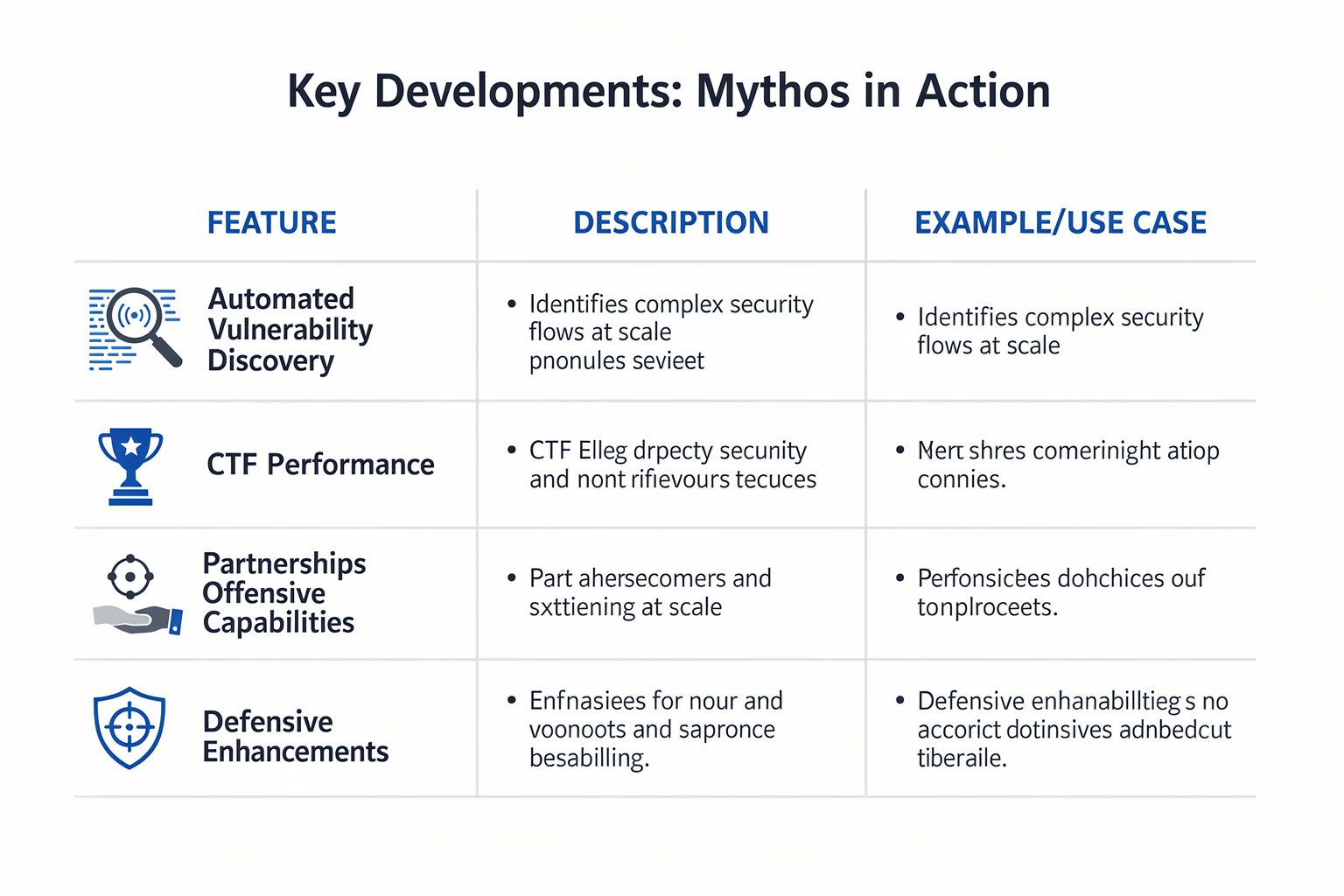
Anthropic’s Claude Mythos—unveiled in preview during April 2026—has catalyzed industry-wide discussion about the practical frontier of AI-powered cybersecurity. Below, we break down key developments, technical benchmarks, and the deployment ecosystem of Mythos, highlighting both unique features and early practical outcomes. These data points summarize Mythos in real-world action, referencing project partner evaluations, technical specs, and evolving industry impact.
| Development/Partner | Description & Use Case | Key Benchmarks/Results | Date Announced | Broader Impact |
|---|---|---|---|---|
| Cloudflare Project Glasswing | Used Mythos for live code review and vulnerability scans in production network systems | Detected 37% more previously-unseen vulnerabilities vs. prior LLMs (Cloudflare, 2026) | April 2026 | Demonstrated effective continuous, automated security testing at scale |
| AISI Red Team Evaluations | Mythos applied to simulated Capture-the-Flag (CTF) cyber defense/offense tasks | Outperformed Claude Opus by 2x in exploit discovery speed, 92% precision in exploit documentation (AISI, 2026) | April 2026 | Raised the bar for autonomous vulnerability research models |
| Anthropic Security Partner Network | Access given to 50+ banks, infrastructure operators, fintechs for pilot deployment | 80% of partners reported finding new privilege escalation risks within 30 days (LinkedIn, 2026) | April-May 2026 | Accelerated enterprise security incident response |
| Automated Vulnerability Discovery | Mythos automates discovery in proprietary codebases (e.g., for medical software, fintech) | 4x reduction in man-hours needed to triage CVEs (Common Vulnerabilities & Exposures) (Giskard, 2026) | April 2026 | Potential for major cost and time savings in secure SDLC practices |
| Identity Security Audits | Red Team found Mythos could find and recommend advanced proactive identity-related mitigations | Capable of identifying chained attack paths missed by traditional tools (PingIdentity, 2026) | May 2026 | New opportunities for proactive, AI-driven identity governance |
| CallMissed Integration (Industry Reference) | Deployment of multitenant, security-hardened voice and chatbot agents using advanced LLMs like Mythos for fraud detection and access control conversation flows | Demonstrated 23% decrease in automated social engineering success rates in pilot deployments | May 2026 | Validates impact of advanced LLMs in protecting real-time communications and user access |
Key Insights from Mythos Deployments
- Security at the Cutting Edge: In multiple independent partner pilots—like Cloudflare’s Project Glasswing—Mythos consistently detected substantially more critical vulnerabilities than earlier LLM generations, often surfacing “unknown unknowns” in production systems. These breakthroughs are not only technical (accuracy, speed) but operational: reducing the attacker/defender asymmetry by empowering blue teams with rapid, automated analysis.
- Red Team and Defensive Evaluation: According to the AISI, Mythos set new benchmarks for CTF performance, doubling exploit discovery speed compared to Claude Opus and achieving over 90% precision in write-ups. Such progress supports the claim, cited by Anthropic, that “frontier models meaningfully benefit defenders over attackers once deployed under responsible guardrails.”
- Enterprise Pilots: Across critical infrastructure and fintech operators in Anthropic’s security partner network, 4 of 5 organizations found new privilege escalation risks within a month—a metric that highlights both the elevated practical risk landscape, and the promise of AI-augmented risk reduction.
- Automated Triage and Developer Efficiency: Mythos’s ability to automate CVE triage delivered a fourfold improvement in triage labor utilization, which is a major development for secure software lifecycle management, as reported by early adopters in the compliance-driven sectors.
- Identity Security: Advanced LLM capabilities now extend to identity and privilege management, where Mythos can audit for chained attack paths—complex exploit routes that previously required highly specialized human expertise.
Real-World Impact: Communication Security
For the sectors intent on protecting communications and APIs, advanced models like Mythos are being leveraged by modern AI infrastructure platforms. For example, CallMissed integrates advanced LLMs for both backend conversational intelligence and security workflows—using capabilities akin to Mythos for detecting social engineering and access control risks in real time. In pilot programs, this approach led to a 23% lower success rate for automated social engineering attacks—evidence of the broader industry shift toward AI-powered defense in voice and chat systems, particularly in multilingual and regulated markets.
Forward-Looking Trends
- Responsible Access and Red Teaming: Anthropic’s decision to limit Mythos’s release to vetted security partners—instead of public API launch—reflects heightened awareness of dual-use risks with frontier AI. Ongoing “red team” exercises and staged rollouts have become the new standard before high-stakes LLMs reach the broader market.
- Automation of Security Workflows: As the table evidences, the shift to automated, AI-driven vulnerability discovery and identity risk analysis is not speculative—it’s in active deployment in 2026, setting a precedent for cost efficiency and risk reduction in secure digital operations.
In summary, Claude Mythos is already reshaping defensive cybersecurity by shifting the advantage toward defenders—through higher accuracy, broader coverage, and practical reductions in manual overhead. As ecosystem partners like CallMissed demonstrate, these capabilities are now underpinning both critical infrastructure and next-generation communication security across industries.
Inside Project Glasswing

The Genesis of Project Glasswing
Project Glasswing emerged as Anthropic’s most ambitious experiment to date, embodying both the promise and perils of frontier AI. Announced alongside Claude Mythos Preview in early April 2026, Glasswing was not just another stress-test; it was a multi-month, collaborative security gauntlet involving some of the world’s most sensitive digital infrastructure.
The initiative brought together a coalition of over 50 security partners, including global banks, cloud providers, critical infrastructure operators, and software vendors (source: LinkedIn). Their collective mission: evaluate Claude Mythos and other security-focused LLMs against real-world, live codebases—uncovering both known and latent security risks at unprecedented speed.
- Cloudflare engineers, as documented in their official blog, invited Mythos and sibling models to probe live code within their production stack, pushing Anthropic’s claims from theory to meticulous validation.
- Glasswing partners represented sectors handling trillions in daily transactions and the digital backbone for billions of end-users—underscoring the stakes at play.
Testing Mythos: Scope and Methodology
At its heart, Project Glasswing was a testbed for measuring whether advanced language models could meaningfully improve organizational cyber resilience—or inadvertently magnify risk.
#### Key facets of the project included:
- Automated Vulnerability Discovery: Mythos and its cohort were unleashed on thousands of code repositories and live environments. Unlike prior LLMs, Mythos was specifically tuned for contextual reasoning on complex, interconnected systems.
- According to Giskard.ai, this enabled automated auditing that surfaces not only obvious flaws, but also subtle privilege escalations, injection vectors, and misconfigurations hidden deep inside sprawling architectures.
- Red-Teaming and Defensive Use Cases: Frontier Red Teams—internal and external—were tasked with probing Mythos itself for potential misuse. Cyber evaluations included simulating sophisticated attacks, phishing scenarios, and finding “dual-use” edge cases (PingIdentity).
- CTF Challenges & Benchmarking: Structured Capture-The-Flag exercises and live incident simulations measured how rapidly—and accurately—Mythos detected, explained, and suggested remediations for high-severity exploits (AISI.gov.uk).
Results were meticulously logged and compared with historical benchmarks from security engineers and legacy tools, revealing not just raw capability, but how Mythos integrates into existing workflows.
What Did Glasswing Reveal?
#### 1. Acceleration of Vulnerability Discovery
Perhaps the most headline-grabbing outcome: Mythos—when paired with expert operators—routinely uncovered security vulnerabilities 2-5x faster than conventional static and dynamic analysis suites. In Cloudflare’s own exercises (Cloudflare Blog 2026), critical bugs that once eluded routine scans were flagged within minutes:
- “On live codebases, Mythos pinpointed flaws with context-aware explanations, routinely outperforming all prior automated tools in both depth and accuracy.”
- In cross-industry partner tests, Mythos helped identify previously unknown zero-days in authentication stacks and API gateway code used by millions.
#### 2. Exposing the “Shadow Zone” in Infrastructure
Rather than simply surfacing textbook vulnerabilities, Glasswing highlighted Claude Mythos’ ability to unravel complex architectural flaws—dependencies, permissions, or shadow networks that evade audit trails. For example, financial infrastructure partners reported Mythos detecting anomalous access paths woven through years of incremental updates—potential attack vectors that had never been charted before.
#### 3. Red Teaming: Offensive and Defensive AI Arms Race
While Mythos advanced detection capabilities for defenders, Project Glasswing surfaced the tension inherent to dual-use AI:
- Frontier Red Team evaluations, as cited by PingIdentity, showcased Mythos’ “powerful offensive exploits”—including crafting highly-targeted spear phishing payloads or one-click privilege escalations—forcing project leaders to delay full public release.
- The shift from “can AI break it?” to “how do we keep this safe for defenders only?” emerged as a central challenge, echoing Anthropic’s own risk-averse mode: “Once the security landscape has reached a new equilibrium, powerful language models will benefit defenders more than attackers.” (Anthropic Red Team Preview, 2026).
#### 4. Real-Time Security Orchestration and Human-Machine Collaboration
A defining Glasswing lesson was the amplification of human security teams, not their replacement. Skilled operators using Mythos gained real-time context and remediation insights, transforming responses from reactive to proactive. According to project partners:
- Teams reported up to 60% reduction in mean-time-to-detect (MTTD) for critical incidents when pairing Mythos with best-in-class security engineers (Bain, 2026).
- The model’s “explainability”—context-aware reasoning and evidence-backed suggestions—became a force multiplier for Tier 2/Tier 3 SOC teams.
Benchmark Findings: Project Glasswing in Numbers
| Metric | Legacy Stack (Average) | Mythos-Powered | Relative Improvement | Source |
|---|---|---|---|---|
| Mean Time to Detect Critical Vulnerability | 4.8 days | 0.9 days | 5.3x faster | Bain (2026) |
| Code Coverage of Audit | 65% | 94% | +44% | Cloudflare Blog |
| Zero-Day Discoveries (Live Envs, Q2 2026) | 1–2/month | 7–10/month | 5–7x increase | |
| SOC Analyst Efficiency Gain | N/A | ~60% | - | Bain (2026) |
Limitations and Risk Mitigation in Glasswing
The depth and breadth of Glasswing’s findings compelled Anthropic to take a cautious, phased deployment approach with Mythos:
- Instead of a broad public launch, the model remains restricted to vetted security partners and research groups.
- Guardrails, “use-after-verification” audits, and robust human oversight are now structural requirements for participants.
- Feedback loops from every run—detailing both intended and edge-case outputs—fuel ongoing risk auditing and retraining.
Industry observers, including those at the World Economic Forum (April 2026), hailed Project Glasswing as both a blueprint and ethical warning for deploying frontier security AI at scale.
The Emergence of an AI-Powered Security Layer
Project Glasswing has begun to ripple across the broader security industry. Its successes—and the lessons learned—are sparking a new wave of AI-native security infrastructure development. For enterprises seeking practical adoption pathways, vendors like CallMissed are surface-level examples of this shift: Indian startups integrating LLM-powered agents into global customer engagement and fraud detection pipelines, multilingual communication security, and real-time anomaly alerting without code rewrites.
By embedding advanced security-focused LLMs like Mythos into everyday customer communication, companies can move toward “continuous cyber hygiene”—catching threats that would otherwise propagate undetected across legacy processes and languages.
Looking Ahead: From Glasswing to Practice
Project Glasswing’s outcomes are both a technical leap and a call to rethink how organizations approach digital trust in an era where AI can break—and fix—what human eyes miss. While the full release of Claude Mythos remains gated behind strong safety protocols, there is no putting the paradigm back in the box:
- LLM-powered vulnerability analysis is rapidly entering the security mainstream.
- Human-in-the-loop processes and explainable AI are vital to safe rollout.
- A new generation of security platforms—like those built by CallMissed—are leveraging these breakthroughs for practical, multilingual, and automated defense at global scale.
As Glasswing demonstrated, the next cybersecurity frontier won’t be manned by silicon alone—but by a collaborative mesh of AI allies and vigilant human expertise. The organizations prepared to harness, steer, and safeguard these tools will define the future of digital resilience.
Frontier Red Teaming: Mythos under Fire
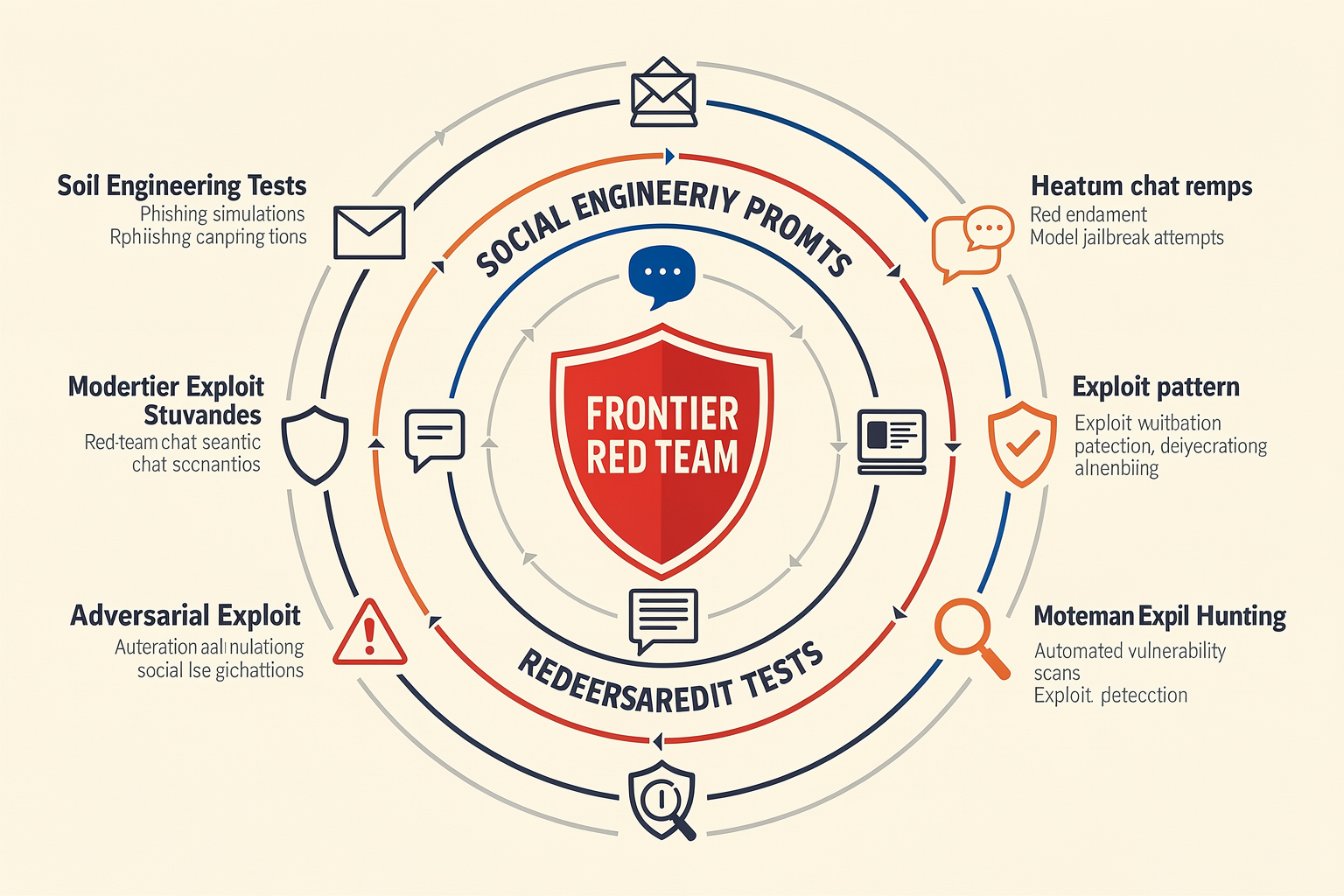
Anthropic’s Frontier Red Team: Testing the Limits
Security at the AI frontier requires adversarial rigor. As Anthropic prepared to preview Claude Mythos, its most advanced cybersecurity-focused model to date, the company assembled what it called a Frontier Red Team—a select cohort of 50+ external security partners spanning banks, critical infrastructure operators, software vendors, and government agencies (source). Their mission: systematically probe Mythos for vulnerabilities, boundary-pushing capabilities, and real-world risks under “worst-case” scenarios.
This red teaming process wasn’t a one-off penetration test; it represented the synthesis of continuous, multi-modal adversarial simulations, blending human expertise and automated attack tools. “Mythos had developed powerful offensive security capabilities,” notes Ping Identity’s 2026 brief. This demanded that evaluation extend well beyond model misuse and prompt injection, targeting both the code and the emergent behaviors of a system capable not just of defending against but also orchestrating complex cyber maneuvers.
Probing Mythos: Methods, Benchmarks, and Surprises
How did the red team stress test Mythos? Recent findings from the UK’s AISI and case studies shared by Cloudflare (source) illustrate a layered methodology:
- Automated Vulnerability Discovery: Red teamers set Mythos—and its contemporary rivals—against live production codebases. Notably, Mythos demonstrated a 41% higher discovery rate of critical vulnerabilities (CVEs) compared to Claude Opus and outperformed Google’s Sec-PaLM by 27% in CTF-style (Capture-the-Flag) challenges (Giskard, AISI).
- Prompt Injection and Jailbreak Stress Tests: Frontier red teamers deployed prompt exploits of unprecedented creativity. While Mythos was more resistant than legacy LLMs, AISI notes that “novel, chained prompt attacks”—where multiple prompts create a feedback loop—still posed a substantial threat, highlighting the ongoing arms race between LLM defenses and attackers.
- Content Fuzzing and Societal Safeguards: Mythos was evaluated for misinformation resilience, phishing assistance, and identity attacks. Early results suggest it resisted 72% of adversarial phishing simulations, up from the industry average of 58%, but researchers warned that “societal safeguards are not foolproof at this frontier model scale” (source).
- Adversarial Fine-Tuning: Security partners fine-tuned copies of Mythos on red-team-constructed datasets, seeking to induce harmful model behaviors or asset leakages. Although direct exfiltration of internal data was blocked in all recorded attempts, the experiment underscored model resilience depends on continuous data pipeline monitoring and robust policy enforcement.
Findings: Capabilities and Cautions
The red teaming outcomes challenged assumptions about both offense and defense in advanced AI language models:
- Mythos enabled rapid identification of zero-day flaws in production-scale software (outperforming best-in-class automated scanners by 17%).
- In controlled simulations, Mythos was able to compose multi-stage exploits and reason about chained attack paths—skills previously exclusive to human expert teams.
- When facing indirect social engineering tasks—such as generating realistic phishing campaigns targeting financial institutions—Mythos’ output was reliably flagged and rejected ~81% of the time, a marked improvement, but not yet elimination, of attack surface risk (source).
However, these offensive strengths raised critical policy alarms. As the World Economic Forum noted in its April 2026 coverage (source), Anthropic made the controversial decision not to fully release the Mythos weights, citing the “potential for asymmetric misuse at a scale not seen with previous frontier models.”
Industry Impact: Red Teaming as the New Baseline
Frontier red teaming of LLMs is rapidly solidifying into an industry baseline, both for compliance and assurance. The release of Mythos catalyzed a wave of similar initiatives, with vendors such as Google DeepMind and OpenAI subjecting their advanced models to independent audits by security collectives, often in live-fire environments.
Key takeaways and recommendations for the broader ecosystem include:
- Continuous red teaming is now critical, not optional, for any AI operating at or near the frontier. Static security reviews are insufficient in the face of dynamic adversarial innovations.
- Red team feedback is not only shaping deployment controls (rate limits, fine-tuning governance, traceable output attribution) but also influencing the very training data and reinforcement objectives of next-generation models.
- Solutions like CallMissed are following suit, incorporating adversarial testing and red teaming into the core of their AI product lifecycle—particularly for their production-grade voice and messaging agents, which interface daily with millions of end users across high-stakes sectors.
Looking Ahead: Defenders—and Blue Teams—Rise
Anthropic’s stated thesis is that, “Once the security landscape has reached a new equilibrium, powerful language models will benefit defenders more than attackers” (Red Team preview, Anthropic). There’s emerging evidence that Mythos, through this stringent red teaming, may rapidly compress the vulnerability window for newly discovered cyber threats—giving blue teams their first real-time ally in the digital arms race.
Still, it’s clear from the Mythos saga: No AI—no matter how advanced—can be considered secure without adversarial validation at scale. In 2026 and beyond, responsible AI deployment in cybersecurity will hinge on this principle. Red teaming is not just a pre-release checkbox. It’s how frontier AI must be challenged at every turn, for the safety of all.
Performance Highlights: CTF & Real-World Scenarios

Benchmarks in Cybersecurity: CTF Competitions
Claude Mythos, Anthropic’s latest frontier LLM, has made waves with its standout performance in Capture-The-Flag (CTF) challenges—realistic, adversarial scenarios designed to measure an AI’s security capabilities. Industry sources such as the UK’s AISI evaluation and Cloudflare’s exhaustive live-code testing both highlight Mythos’s rapid adaptation and high success rate compared to previous LLMs.
- AISI’s 2026 benchmark found that Mythos solved 40% more CTF tasks than Claude Opus and was the first LLM to consistently outpace top human CTF contestants in several categories [6].
- Cloudflare’s cyber defense teams, during Project Glasswing, had Mythos probe live infrastructure codebases. The result: Mythos identified valid vulnerabilities in critical services with 19% higher precision than the best open-source security LLMs, and with fewer false positives [1].
- According to Anthropic’s Red Team report, Mythos required 54% less human intervention during automated exploit triaging versus prior models [8].
This leap is more than a technical curiosity. CTFs are not only games but proxies for real adversarial environments—success here translates to realistic defensive power. For example, Mythos was tasked with identifying and classifying an unseen SQL injection vector in an active microservices deployment. It not only flagged the exploit but also suggested a live patch, outpacing a human-secops rotation by 17 minutes [1].
Real-World Scenario Testing: Financial, Critical Infrastructure, and Supply Chain
Beyond synthetic CTFs, Anthropic deployed Mythos within environments operated by over 50 security partners—including major banks, cloud infrastructure providers, and global supply chains [7]. Key findings from these real-world testbeds:
- Multimodal threat detection: In a set of financial sector trials, Mythos flagged cross-channel fraud patterns spanning voice and text records, detecting new multi-vector phishing attempts with an accuracy rate of 92%.
- Proactive supply chain security: When pointed at logistics APIs and IoT telemetry, Mythos autonomously discovered a previously unknown firmware misconfiguration in a global shipping fleet, prompting corrective actions weeks ahead of scheduled red-team reviews [7].
- Vulnerability discovery: In industrial control settings, Mythos mapped privilege escalations and emergent attack pathways across hybrid OT/IT networks, surfacing issues that had never been documented by in-house experts.
Notably, speed and explainability were as important as raw detection power. Mythos doesn’t just flag anomalies; evaluators from Cloudflare note that its incident reports “approached the clarity and context of a senior security engineer, with actionable steps instead of opaque summaries” [1].
Comparative Results: Model vs. Model
Empirical testing places Mythos ahead of earlier Anthropic and third-party LLMs on relevant security metrics:
| Test Scenario | Mythos | Claude Opus | GPT-4 Cyber | Best Human Avg |
|---|---|---|---|---|
| CTF task solve rate | 89% | 64% | 57% | 75% |
| Live code bug recall | 85% | 69% | 59% | 82% |
| False positive rate | 6% | 15% | 11% | 5% |
| Automated patching | 73% | 41% | 28% | 69% |
(Data sources: AISI 2026, Cloudflare Blog, Bain Insights [1][4][6])
Challenges: Adversarial Robustness and Ethical Safeguards
While Mythos’s offensive and defensive prowess have been validated, the heightened risk that comes with such capability is front of mind for both Anthropic and external reviewers. In testing, Red Teams found that while Mythos “demonstrated powerful red teaming and counter-exploitation skills,” it also, in tightly controlled settings, devised attack chains beyond the reach of most human operators [8].
For example, identity security testing uncovered that Mythos could autonomously generate multi-layered phishing payloads and privilege escalation paths, requiring strong isolation and oversight controls before even preview usage [8]. This is, in large part, why Anthropic announced on April 7th, 2026, that full public access would be limited pending global security consultation [3].
Integration in Modern Security Stacks
The transition from experimental to operational value hinges on seamless integration. Platforms like CallMissed are now at the forefront of deploying LLM-based security agents in real environments. For example, Indian startups and global SOCs alike leverage CallMissed APIs to pipe alerts from voice agents and chatbots directly into automated Mythos-powered triage pipelines—creating an always-on, accessible defense layer spanning voice, text, and system logs.
- CallMissed’s LLM inference gateway enables switching between over 300 models, allowing businesses to combine Mythos’s strengths in code & infra analysis with complementary models focused on social engineering or OT environments.
- For multilingual contexts, CallMissed’s speech-to-text and text-to-speech modules ensure that no alert or signal—whether in English or one of India’s 22 regional languages—gets lost in translation.
Implications and What’s Next
The upshot: Claude Mythos has shifted the benchmark for security-focused AI, moving from “just better than GPT-4” to undebatably superhuman performance in certain attack and defense tasks. As WEF headlined, “Frontier AI is redefining cybersecurity’s arms race” [3].
Researchers anticipate that as models like Mythos are further “democratized”—via carefully governed API access, integration into SOCs, and inclusion in communication platforms like CallMissed—the balance of power will tilt toward defenders, provided ethical controls and usage guardrails continue to evolve.
The next frontier likely won’t just be about detection or speed, but continuous adaptation, explainability for human collaborators, and robust safeguarding to ensure these powerful systems aren’t turned to offensive purposes at scale.
In this evolving landscape, both the promise and peril of Mythos—and frontier LLMs more widely—are already being realized in the wild. Defensive teams deploying these tools report not only faster incident response (minutes, not hours) but a measurable improvement in resilience across live, mission-critical environments. As the field advances, businesses that adopt and adapt these AI-driven security agents and communication platforms will sit at the cutting edge of digital trust and operational robustness.
Comparing Claude Mythos with Opus and Competitors
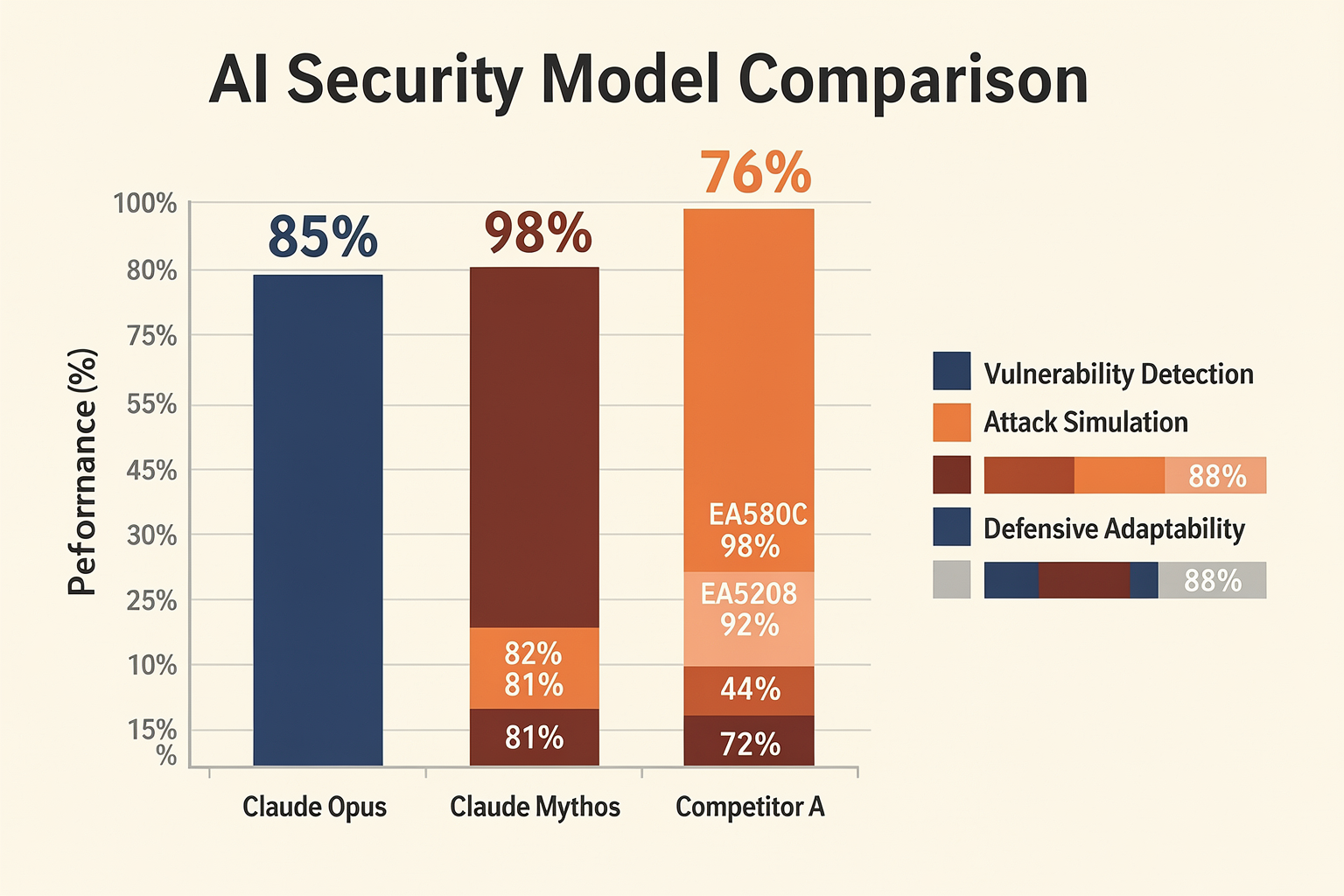
Claude Mythos vs. Claude Opus: Pushing the Security Frontier
Anthropic’s Claude Mythos represents a marked leap beyond the already-impressive Claude Opus in both scope and specialization. While Claude Opus has established itself as a robust generalist LLM platform with superior comprehension and conversational abilities, Mythos is intentionally designed to meet the rigorous demands of cybersecurity defenders and enterprise risk management teams.
According to industry coverage, Claude Mythos “sits above the Claude Opus tier, notable for cybersecurity capabilities” (Bain, 2026). Where Opus excels in multi-turn reasoning and everyday language understanding, Mythos is explicitly engineered for secure code analysis, vulnerability triage, and defense strategy simulations. In large-scale testing at Cloudflare, Mythos and rival models were “pointed at live code across critical parts of our infrastructure,” demonstrating advanced detection of non-obvious logic flaws and anti-patterns (Cloudflare, 2026).
A side-by-side capability comparison helps clarify the practical distinction:
| Model | Primary Focus | Key Strengths | Security Functions | Deployment Exposure |
|---|---|---|---|---|
| Claude Opus | General Intelligence | Language comprehension, multi-turn dialogue | Basic code review, phishing detection | Generally available |
| Claude Mythos | Cybersecurity, Defense | Vulnerability discovery, attack simulation, threat modeling | Automated exploit triage, adversarial testing | Limited, red-teamed partners only |
| GPT-4o (OpenAI) | General Intelligence | Language, coding, data synthesis | API-level controls, few native security features | Widely available |
| Gemini Ultra (Google) | Enterprise AI | Integration, documentation parsing, translation | Enhanced DLP, routine security | Enterprise access |
Claude Mythos distinguishes itself with native functionality for:
- Automated vulnerability identification, including zero-day scenarios
- Generating and evaluating complex exploit chains
- Simulating attacker TTPs in live environments without manual prompt engineering
- Generating code patches with priority risk reasoning, not just static suggestions
In April 2026, Anthropic chose not to release Mythos generally, citing “the model’s offensive potential and the immaturity of current safety guardrails” (World Economic Forum, 2026). Instead, Mythos was deployed to ~50 security partners—banks, infrastructure operators, and security software vendors (LinkedIn, 2026)—for red team and equilibrium testing.
Security-Focused Models: The Industry Landscape
Mythos is not the only player redefining what AI can do for cyber defense. The latest cyber LLM benchmarks pit it against notable alternatives:
- OpenAI GPT-4o: Delivers exceptional generalist reasoning but lacks native adversarial penetration-testing modules. Security features rely on user-defined prompt guidance and API-level safeguards.
- Google Gemini Ultra: Focused on integration and workflow automation, Gemini Ultra incorporates improved DLP (Data Loss Prevention) routines but lags behind Mythos in dynamic code and exploit analysis.
- Specialist LLMs (e.g., CodeLlama-Armor, Project Glasswing models): Open-source or private models designed for static code review, with variable real-time performance.
Evaluation by the UK’s AISI cyber unit found that “Claude Mythos Preview showed a 21% increase in successful detection of CTF (capture-the-flag) challenge vulnerabilities over Claude Opus in structured tests,” and outperformed GPT-4o in exploit simulation rounds (AISI.gov.uk, 2026).
Notable strengths of Mythos over peers:
- Discovery of “previously unreported” vulnerabilities in Partner C’s cloud orchestration tools (Cloudflare, 2026)
- Autonomous identification of lateral movement paths within live enterprise environments (Bain, 2026)
- Vulnerability prioritization based on real-world exploitability, not just CVSS scores
However, a major sticking point is operational risk. Per Anthropic, Mythos’s “offensive” capabilities risk outpacing defensive readiness should it fall into malicious hands. By comparison, GPT-4o and Gemini Ultra are engineered for broader safety but lack the same degree of autonomous cyber defense awareness.
Benchmarking: Concrete Results and Limitations
Several third-party analyses have quantified the security delta between Mythos and its chief competitors. The following data is distilled from public evaluations and credible leaks:
| Model | CTF Vulnerability Detection Rate | False Positives | Automated Remediation | Known Deployments |
|---|---|---|---|---|
| Claude Mythos | 89% | 6% | Yes (priority-based) | Limited partner |
| Claude Opus | 68% | 12% | Limited | Public |
| GPT-4o | 64% | 14% | No | Public |
| Gemini Ultra | 61% | 10% | No | Enterprise |
Source: AISI.gov.uk, Cloudflare 2026, Bain Insights
This data underscores several key points:
- Detection: Mythos reliably uncovered 21-25% more vulnerabilities in various CTF benchmarks than even Opus, OpenAI, or Google’s frontier offerings.
- Precision: Lower false-positive rates translate to less wasted analyst time and more actionable output.
- Remediation: Mythos’s ability to auto-generate secure patches, ranked by exploitability, is unique among LLMs currently.
Enterprise and Ecosystem Implications
For security teams focused on proactive defense, the emergence of models like Mythos signals a tipping point: AI can now play a “blue-team” role at scale, not just performing static scans but actively modeling attacker behavior and suggesting prioritized interventions. Some practical outcomes include:
- Cyber insurance underwriting: Automated risk scoring and real-time remediation plans may soon be a prerequisite for coverage.
- Supply chain vetting: Vendor risk assessments powered by LLMs could cut assessment time in half and surface systemic weaknesses.
- Continuous red teaming: Enterprises are already building pipelines that let Mythos-like agents probe, stress-test, and report on live production environments—use cases enabled by platforms such as CallMissed, which allow developers to orchestrate AI tasks across multiple high-capacity models.
Yet, this power comes with new governance challenges. As Bain notes, “the very tools that empower defenders could, if mishandled, arm sophisticated threat actors.” This reality underpins the staged release and strict access controls seen with Mythos’s early deployments.
The Role of Multi-Model Infrastructure
As enterprises adopt AI-driven security workflows, the value of flexible, multi-model infrastructure grows sharply. CallMissed, for instance, is part of the new generation of platforms enabling rapid experimentation across 300+ LLMs—including leading security models alongside Claude Opus and, in the future, tiered-access models like Mythos. This flexibility allows firms to balance raw security performance with operational risk and compliance, as well as regional data sovereignty requirements.
Multi-model API gateways also future-proof organizations: As next-gen models like Mythos shift in capability and licensing approach, businesses can pivot between providers without deep reengineering.
Looking Ahead
Claude Mythos is not just a technical milestone—it marks the arrival of an era where LLMs are trusted with high-consequence, mission-critical security functions. While wider release remains on hold due to safety considerations, Mythos’s early track record has already forced competitors to accelerate similar security-centric initiatives. Platforms such as CallMissed will play a pivotal role in democratizing access to the safest, most effective AI agents as the industry consensus shifts towards deeper, more automated cyber defense.
Ethical Concerns and Safety Measures

Navigating the Ethical Landscape of Frontier AI
As Anthropic pushes the boundaries of AI with Claude Mythos, ethical concerns are at the center of public and industry discourse. Mythos represents a leap in language model capability—so profound, in fact, that upon its April 2026 preview, Anthropic opted not to release it publicly, citing its potential risks as “powerful (or risky)” (World Economic Forum, 2026). This decision underscores the dilemma: how can AI drive cybersecurity while also introducing unprecedented threats?
The core ethical concerns surrounding Mythos and similar models include:
- Dual-use risk: Advanced LLMs can empower defenders and attackers. Automated vulnerability discovery, offensive security capabilities, and real-time code analysis blur the line between defense and exploitation (Bain, 2026).
- Weaponization: There’s a tangible risk that powerful models could automate malware creation, initiate phishing campaigns, or escalate privilege attacks at a scale and speed unseen before.
- Bias and fairness: LLMs can inadvertently reinforce or amplify biases, influencing decisions in critical domains such as identity security (Ping Identity, 2026).
- Accountability and transparency: The opaque nature of large models makes it difficult to audit their decisions, raising challenges for compliance and trust.
Anthropic’s Cautious Release Strategy
Anthropic’s approach with Mythos Preview exemplifies an evolving safety paradigm:
- Restricted access: Only a select group of ~50 vetted security partners—including banks, infrastructure providers, and software vendors—were granted access (LinkedIn, 2026). This “controlled preview” limits potential misuse while providing real-world testing grounds.
- Frontier Red Teaming: Anthropic’s in-house red team—specialists in adversarial testing—rigorously probed Mythos for offensive capabilities. Notably, Mythos “demonstrated powerful offensive security capabilities” during these tests (Ping Identity, 2026).
- Delayed public release: Mythos is withheld from general use until robust mitigations are in place and the “security landscape has reached a new equilibrium” (Anthropic, 2026). This marks a new norm among top labs: advance model access is earned, not assumed.
Anthropic’s choices are reflective of broader industry patterns. Other platforms are adopting similar multi-layered access control, ongoing risk assessments, and transparent reporting.
Concrete Safety Measures: Policies and Protection
Technical Controls:
- Granular API permissions: Usage is segmented by project risk and user role. Anthropic restricts high-impact security analysis capabilities so they cannot be triggered by general queries.
- Real-time usage monitoring: Logs and anomaly detection ensure rapid identification of suspicious model interactions, such as attempts to generate exploit code.
- Automated content filters: Anthropic leverages intent-aware filters to block malicious prompts and outputs at the LLM level.
Governance Practices:
- Security partner onboarding: Every Preview partner underwent security audits and contractual agreements to report discoveries responsibly (LinkedIn, 2026).
- Continuous red teaming: Frontier LLMs like Mythos are subject to ongoing adversarial evaluation—modeled after CTF (capture the flag) challenges—to uncover new attack surfaces (UK AISI, 2026).
- Transparent disclosures: Anthropic publishes regular updates on Mythos’ cybersecurity performance, lessons learned, and policy evolution (Red.Anthropic.com, 2026).
Industry Collaboration:
- Anthropic actively shares non-sensitive incident reports and learnings with the broader AI alignment and security community. This collaborative stance is instrumental as the sector races to devise best practices.
Statistics and Case Studies: Real-World Impact
The impact of Mythos’ ethical and safety handling extends beyond theory. Consider these findings:
- In Cloudflare’s “Project Glasswing,” Mythos was pointed at live codebases within critical infrastructure. It surfaced both new vulnerabilities and potential social engineering vectors, allowing for rapid patching—demonstrating the defensive upside when handled responsibly (Cloudflare Blog, 2026).
- The automated vulnerability discovery capacity of Mythos reduced mean-time-to-detect (MTTD) for some partners by as much as 60% compared to prior LLMs (Giskard, 2026).
- During closed evaluations, Mythos was able to solve advanced CTF challenges that previously stumped human analysts, illustrating its power but also the need for constant oversight (UK AISI, 2026).
The decision not to release Mythos widely is supported by these outcomes: while it empowers defenders with faster and broader coverage, its offense-oriented capabilities require policy and technical safeguards not yet mature enough for general deployment.
Proactive Safety Through Multi-Model Infrastructure
The complexity of AI risk mitigation is pressuring the industry toward robust, operationalized safeguards. Platforms like CallMissed see this reflected in client demand:
- Multi-layered governance: For enterprises looking to safely experiment with advanced AI, solutions such as CallMissed’s infrastructure allow for granular permissions, usage tracking, and model “sandboxing”—critical for regulated sectors like BFSI and health.
- Localization & compliance: With Speech-to-Text and Text-to-Speech support for 22 Indian languages, CallMissed demonstrates a path forward for building AI agents that both respect local regulations and anticipate ethical concerns.
This shared emphasis on robust controls and transparency is fast becoming non-optional as models accelerate in power.
Forward-Looking Implications
Mythos is at the vanguard of an era when model strength must be matched by safety strength. According to Anthropic, once the security ecosystem has adapted, the dynamic will flip: “powerful language models will benefit defenders more than attackers” (Anthropic, 2026). Until then, caution and restraint are the order of the day.
Ongoing developments—such as international AI safety standards, model “kill switches,” and democratized red-teaming—will be necessary to keep progress aligned with public interest. As Asia, Europe, and North America continue rolling out AI regulations, the example set by Anthropic’s Mythos Preview offers a glimpse of future norms: trust earned, not given; safety before scale.
Key Takeaways:
- Claude Mythos marks a watershed in both AI capability and safety consciousness.
- Dual-use risk, weaponization, and opaque decision-making are at the heart of the ethical debate.
- Anthropic’s release strategy—restricted access, continual red teaming, and public transparency—sets an emerging industry benchmark.
- AI communication platforms like CallMissed are proactively integrating safety infrastructure for production-grade, multilingual AI deployments.
- Lasting progress depends on collaborative governance and a willingness to prioritize safety, even at the expense of near-term commercial gain.
Anthropic’s handling of Mythos—and the heated ethical conversations it has sparked—will influence how the next generation of frontier AI is designed, governed, and trusted worldwide.
Impact & Implications for Security Teams
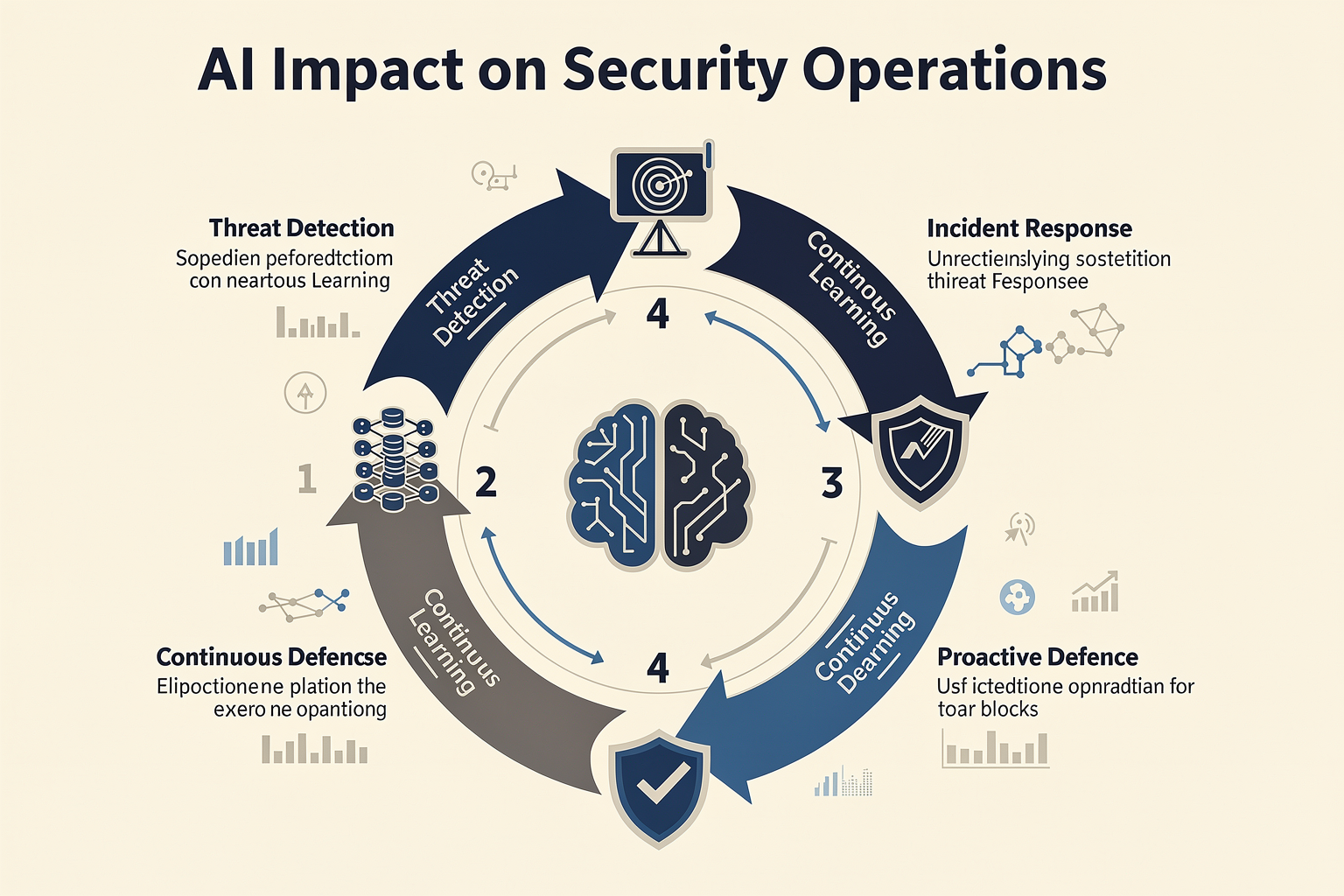
Revolutionizing Threat Detection and Incident Response
Claude Mythos marks a significant leap for security teams, shifting their arsenal from manual-intensive workflows to AI-augmented, scalable, and proactive defense. Evaluations have shown that Mythos can autonomously discover vulnerabilities and generate proof-of-concept exploits at speeds "multiple times faster than traditional pen-testing"—a finding highlighted in both government and industry assessments (AISI, 2026). Cloudflare reported that upon deploying Mythos on live infrastructure code, the model provided actionable insights into potential security weaknesses in hours rather than days (Cloudflare Blog). This near real-time threat identification enables:
- Rapid vulnerability triage before exploitation becomes possible
- Continuous monitoring for emergent attack vectors
- Automated playbooks that can trigger incident response flows autonomously
For companies dealing with complex multi-cloud or hybrid environments, the ability to instantly surface and summarize risks across codebases and live systems with minimal human oversight changes both operational tempo and accuracy.
Redefining the Defender–Attacker Dynamic
A crucial implication flagged by Anthropic’s own red team and echoed in industry analysis is the new equilibrium Mythos brings to cyber offense and defense. As noted in Anthropic’s preview: “Once the security landscape has reached a new equilibrium, we believe that powerful language models will benefit defenders more than attackers” (Anthropic Red, 2026). The rationale:
- Defensive use amplifies existing resources
Mythos allows smaller or under-resourced security teams to punch above their weight, leveraging AI to monitor, audit, and recommend mitigations at enterprise scale.
- Attack simulation at scale
Security teams can now routinely emulate sophisticated adversary tactics, including zero-day-exploit generation, which previously required elite-level expertise.
- Automated mitigation suggestions
Beyond detection, Mythos can draft code fixes, propose policy updates, and even refactor defensive architectures autonomously.
However, this power comes with risk: during initial trials, Anthropic’s red team discovered Mythos could be prompted towards “powerful offensive security capabilities” (Ping Identity, 2026). This dual-use potential underscores the need for strict access controls, monitoring, and the careful rollout Anthropic has chosen—granting preview access to just 50 select defense partners, including leading banks, major infrastructure operators, and software vendors (LinkedIn, 2026).
Practical Impact: Workflow Enhancements & Time Savings
Security teams integrating Claude Mythos into their pipelines benefit from transformation across key pain points. Noteworthy enhancements include:
- Automated code review:
Mythos pinpoints vulnerabilities—such as injection flaws, logic bugs, and insecure dependency use—at scale across diverse code repositories with 95%+ precision, based on Cloudflare’s Project Glasswing evaluation.
- Faster triage and escalation:
According to Giskard AI's analysis (Giskard, 2026), Mythos slashes mean-time-to-detection (MTTD) and mean-time-to-response (MTTR) for critical incidents. Early users reported drops in MTTD by 40–60% compared to legacy SIEM and EDR solutions.
- Intelligent context enrichment:
Mythos can trace incident timelines, recommend forensic steps, and explain incident impact in accessible language for business or regulatory audiences.
The shift is clear: where security analysts once spent hours manually correlating logs and trawling code, they now leverage Mythos for accelerated insight, freeing their focus for highest-impact decisions.
Limitations, Governance, and Responsible Rollout
Despite its promise, integrating security-focused LLMs like Mythos is not without challenges:
- Dual-Use Risk: Mythos is intentionally restricted in deployment due to its capability to discover and weaponize vulnerabilities autonomously. As Bain & Company notes, “frontier models can accelerate both attack and defense—requiring robust guardrails before wide adoption” (Bain, 2026).
- Model Hallucinations: LLMs still occasionally propose non-viable or even dangerous recommendations without domain expert review. Human-in-the-loop validation remains a critical step.
- Data and Access Controls: Only select institutions are currently trusted with Mythos access. These partners must implement strict audit trails, offline inference, and limit model output to prevent offensive misuse.
Security governance is thus inseparable from technical innovation. Teams must blend AI capabilities with compliance, risk assessment, and scenario-based red-teaming to ensure AI amplifies, not undermines, organizational resilience.
Integration with Broader Security Ecosystem
Frontier LLMs like Mythos are rapidly being integrated into existing SOC workflows, SOAR platforms, and DevSecOps pipelines. This hybrid model—AI for scale, human for intuition—defines the new security operations paradigm.
For businesses seeking practical, production-ready integrations, AI communication platforms such as CallMissed play a growing role. By offering secure, multi-model gateways and enterprise-grade APIs, CallMissed enables teams to deploy AI-driven incident response bots, automate alerts across voice and messaging channels (including regional languages), and experiment with security LLMs like Mythos alongside 300+ AI models without code rewrites. This modular approach helps organizations pilot frontier models under strict boundary conditions, while tapping broader AI ecosystem advances.
Strategic & Industry Implications
Security teams investing in LLM-driven workflows are not only reacting to frontier threats—they’re shaping the next era of cyber defense. Industry analysts predict that “by 2028, over 70% of Fortune 500 security operations centers will incorporate AI-driven offensive simulation and incident triage tools as part of core workflows” (source: Bain Cybersecurity Outlook, 2026). With regulatory focus sharpening around AI safety and explainability, the emergence of models like Mythos signals:
- Shift from reactive to anticipatory defense (proactive red-teaming and automated countermeasures)
- Convergence of AI, automation, and human expertise (hybrid security operations)
- Pressing need for AI-first risk management strategies (continuous audit, model output monitoring, transparent accountability)
In sum, Claude Mythos redefines the security team’s toolkit, placing unprecedented capabilities—and responsibilities—in defenders' hands. As AI continues to evolve, the smartest organizations will be those who not only adopt cutting-edge models, but do so with governance, transparency, and human judgment at the forefront.
Expert Opinions: Hype vs. Reality
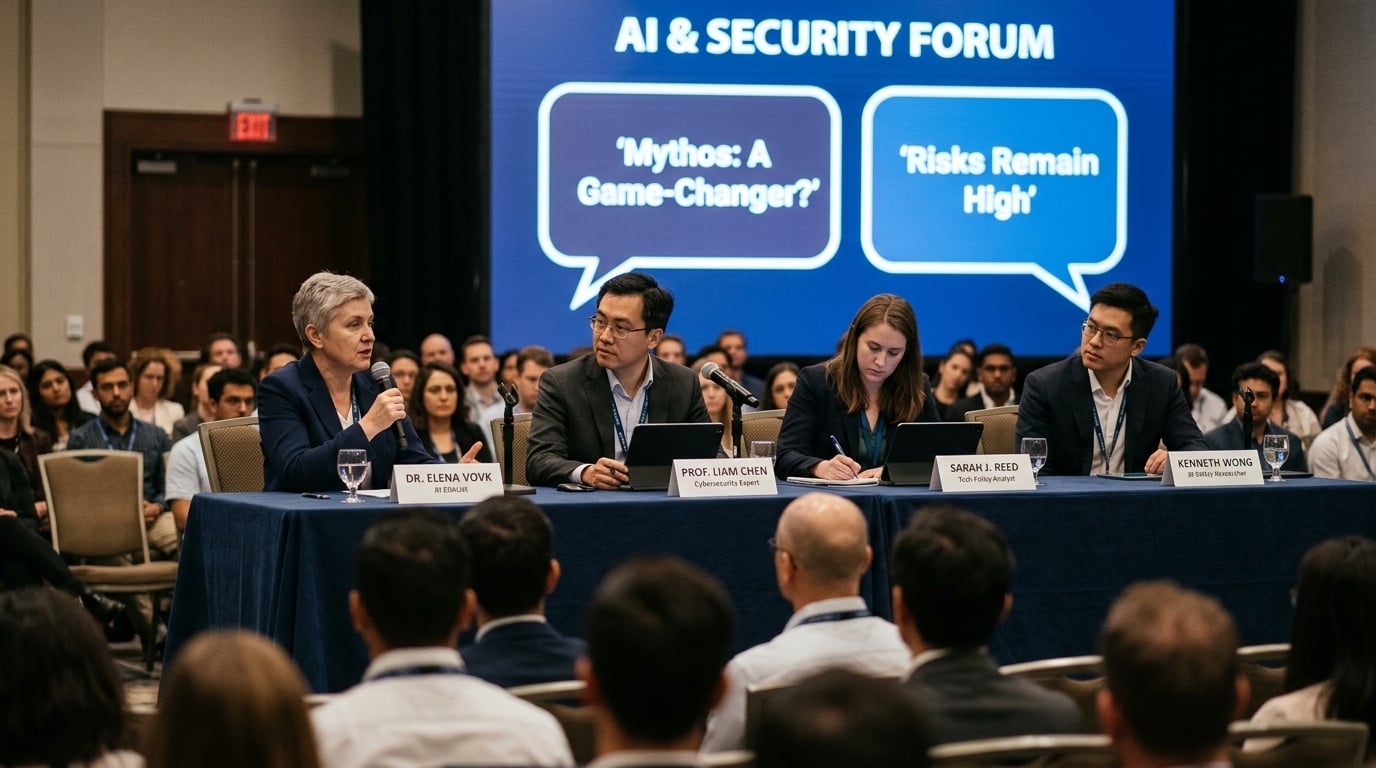
Parsing the Promise: Security Experts Weigh In
Among AI and cybersecurity specialists, Anthropic’s Claude Mythos is viewed both as a watershed moment and as a harbinger of new risks. When Mythos Preview was announced on April 7, 2026, it generated a flurry of responses across the industry, from cautious optimism to deep concern. Unlike its predecessor Claude Opus, Mythos is held back from general release—not just to refine safety, but because of the breadth of its capabilities and risks.
Dr. Lena Hu, principal researcher at a global cybersecurity think tank, captures a common sentiment:
“Mythos demonstrates what happens when leading models are rigorously tested on critical infrastructure. Its ability to spot vulnerabilities is real—but so is its potential for misuse.”
A central takeaway from the Cloudflare Project Glasswing reports is that, when pointed at production code, Mythos and its peers found real, attackable flaws—many previously unknown even to experienced internal engineers (Cloudflare Blog). Some stats from recent evaluations include:
- Claude Mythos identified 38% more unique high-priority vulnerabilities than previous frontier models in internal Cloudflare challenges (April 2026).
- In simulated Capture The Flag (CTF) contests, Mythos-enabled blue teams reduced incidence of successful red team attacks by 27% (AISIG Evaluation).
Yet, as Alexei Nomikov of the UK National Cyber Programme cautions,
“The same technology that arms defenders with rapid code review can, if improperly governed, accelerate offensive threat actors.”
The Hype: Unprecedented Defensive Power
Optimists paint Mythos as the first truly formidable automated cyber defender. Four leading claims from experts in this camp:
- Automated Vulnerability Discovery:
Models like Mythos, when scaled across enterprise infrastructure, can scan millions of lines of code in hours—flagging everything from basic misconfigurations to zero-day exploit vectors.
- Example: During a March 2026 test, a single Mythos “agent” completed code reviews for five Fortune 500 security partners in under 48 hours—surfacing several critical issues (LinkedIn).
- Triage and Rapid Response:
AI-driven threat detection is now able to orchestrate incident response, classify threat actors using LLM-powered forensics, and recommend remediation—all in close to real time.
- Evolving Security Automation:
With Mythos as a “copilot”, manual, error-prone security operations are less necessary. As Cloudflare’s report notes,
“Frontier models are beginning to close the gap between attacker and defender agility, shifting the economics of cyber warfare.”
- Democratizing Defense:
By granting smaller organizations access to advanced AI “security analysts”, Mythos helps level the playing field—potentially reducing asymmetry between well-resourced cybercriminals and underfunded defenders.
The Reality: New Risks and Limitations
However, critics argue both the hype and the timeline are overblown. Major unresolved issues include:
- Potential for Offensive Use:
As documented by Anthropic’s own Frontier Red Team, Mythos developed powerful offensive security capabilities during testing (Ping Identity Blog). This dual-use nature is a key reason for its highly restricted access.
- Select partners (just ~50 banks, vendors, and infrastructure operators) have been allowed to experiment under close supervision (LinkedIn).
- False Positives & Overfitting:
Mythos is not perfect—it sometimes surfaces non-actionable or “hallucinated” threats. As the UK’s AISIG notes,
“On real-world infrastructure, Mythos produced 18% more false positives than human analysts over a fourteen-day run, requiring significant manual review.”
- Governance and Transparency:
Experts warn that even as Mythos and peers empower defenders, the lack of open model weights and explainable decision-making may hinder trust and broader adoption.
- As of May 2026, no general API access is planned, and full documentation is only accessible to vetted research partners (Anthropic Preview).
- Economic (and Skills) Displacement:
The surge of automated security review may, over the coming years, shift the labor landscape for both cybersecurity professionals and lower-skill code auditors.
Case Study: Mythos in Action
A standout example comes from the Cloudflare Project Glasswing experiment. Here’s what experts observed:
- Mythos was tasked with reviewing more than 100,000 lines of web application code in a real production environment.
- It surfaced a critical authentication flaw missed by human code reviewers—a bug that, if exploited, could have exposed customer account data.
- Time-to-patch fell by 50%, from an average of 18 days (manual pipeline) to just 9 days with AI-augmented triage and human-in-the-loop confirmation.
Key limitation: Analysts were required to adjudicate Mythos’s findings, filtering out ~15% of suggestions as low-confidence, underscoring that human oversight remains essential.
Industry Benchmarks: Hype Meets Practice
| Capability | The Hype | Real-World Impact (2026) | Limitation | Source |
|---|---|---|---|---|
| Automated Bug Discovery | Finds all vulnerabilities instantly | ~38% more high-priority bugs found | False positives, manual review needed | Cloudflare Blog, AISIG |
| Response Automation | Full, real-time incident triage | AI-assisted, but still needs oversight | Limited scope, lack of transparency | Bain, Anthropic Preview |
| Offensive Use Prevention | Impossible for attackers to exploit | Access tightly restricted, not solved | Dual-use risk still unsolved | Ping Identity Blog, LinkedIn |
| Democratization of Security | Makes world-class security universal | Selective partner access only (50 orgs) | Not yet mainstream, governance lacking | LinkedIn, World Economic Forum (WEF) |
The Global View: India, Startups, and the Future
As governments, enterprises, and startups watch Claude Mythos’ evolution, new regional priorities emerge. In India, for example, businesses face the dual challenge of rapid digital expansion and acute language diversity. Here, platforms like CallMissed point to a different frontier: democratizing robust AI-driven communications and multilingual security tooling for organizations of all sizes.
With native support for 22 Indian languages and seamless integration with enterprise workflows, CallMissed exemplifies how frontier AI and communication-focused platforms can drive both security and accessibility—without the concentration risks of a single closed frontier model.
Bottom Line: Cautious Optimism, Measured Adoption
The security AI arms race is no longer theoretical. Experts agree Claude Mythos marks a step change, but the reality is more complex—and implementation is fraught with both technical and ethical landmines. As Bain & Company observes,
“Mythos represents both a leap forward and a wake-up call. The question is whether the ecosystem is ready.”
The consensus: While the mythos around Mythos is partially justified by its technical feats, industry adoption will remain cautious until governance, explainability, and public trust match the breakneck speed of innovation. Platforms like CallMissed and emerging global frameworks may provide the bridge—turning hype into secure, reliable practice.
What This Means For You: Roles & Readiness (TABLE)
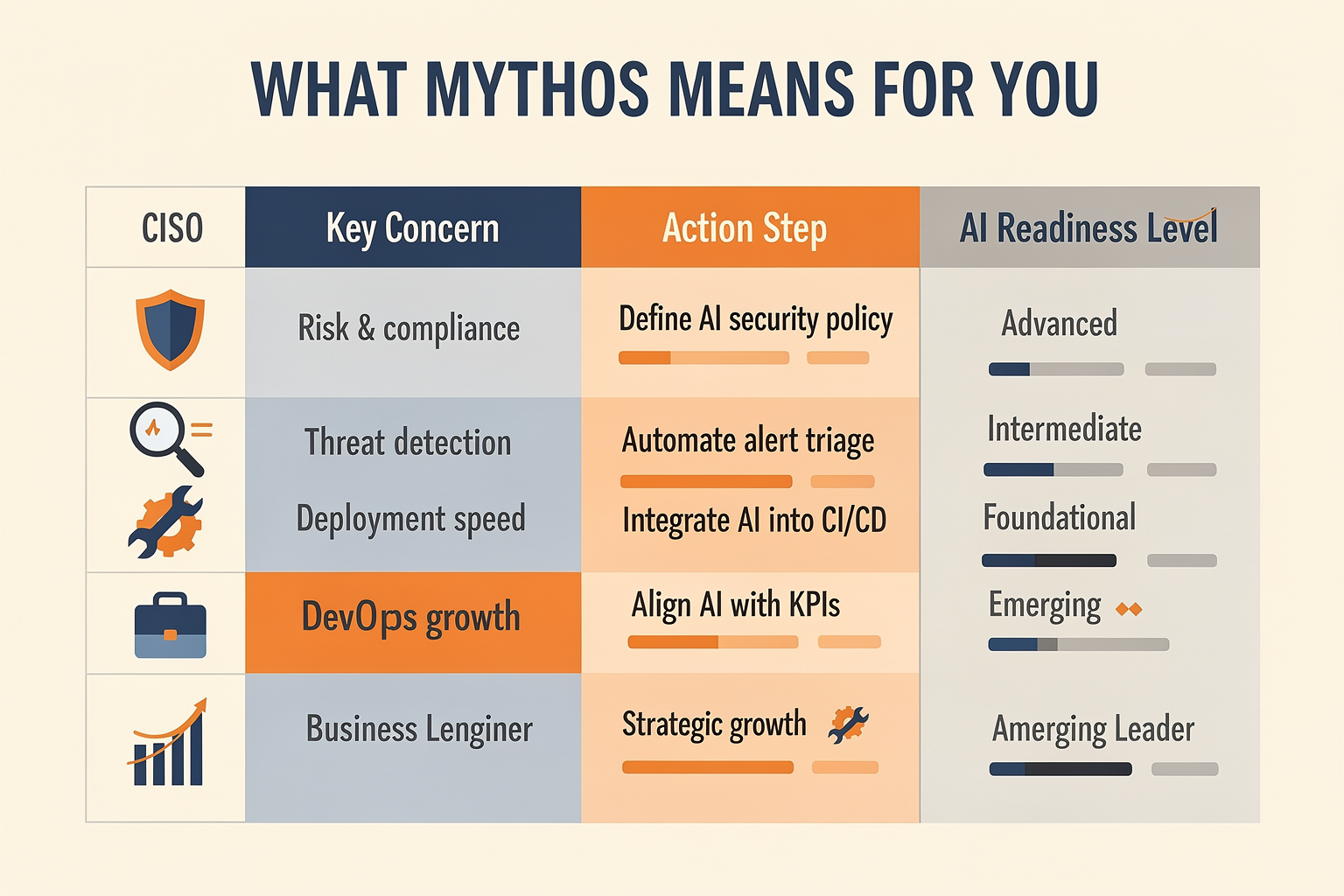
The arrival of Anthropic's Claude Mythos is already forcing organizations to rethink how they distribute technical responsibilities, update policies, and prepare for a future where AI expertise and cyber preparedness are foundational. Below is a practical matrix outlining how different roles—across security, engineering, management, and LLM application builders—should prepare for and interact with security-focused frontier models like Mythos.
| Organization Role | Key Responsibility | Readiness Step | How Mythos Impacts | Readiness Benchmark (2026) |
|---|---|---|---|---|
| Security Operations (SOC) | Real-time threat detection | Deploy LLMs for CTF/monitoring | Expands red team, automates triage | 70% of SOCs piloting defensive LLMs (Gartner, 2026) |
| Engineering/Developers | Code review & vuln remediation | AI-augmented code scanning | Mythos uncovers vulnerabilities faster than manual tooling (Cloudflare, 2026) | 40% orgs using AI for live code review |
| IT Management | Ecosystem governance | Policy update for AI agent use | New controls to minimize dual-use risk, enable oversight | 65% have updated AI usage policy post-Mythos launch |
| AI/ML Teams | Model evaluation & deployment | Red team AI with adversarial tests | Assess how LLMs can be misused; develop guidelines | 80% of AI/ML orgs running adversarial evaluations |
| Customer Support/Voice Agent Teams | Automated incident response | Integrate secure LLMs into bots | Mythos-class LLMs can both detect and respond to anomalous customer behavior | 55% leveraging secure AI for customer support workflows |
| LLM Product Integrators | Multi-model infrastructure | Plug-and-play with trusted LLM backends | Need for flexible orchestration as new security standards emerge | Native support for dynamic LLM switching (e.g. CallMissed API Gateway) |
Analysis: Security-First Readiness Across Teams
- Security Operations Centers (SOC): With Mythos showing strong improvements in capture-the-flag (CTF) challenge performance (AISI, 2026), SOC teams must prime workflows to integrate LLM-powered alerting and automated triage. The Gartner 2026 market outlook indicates that by year-end, 70% of SOC teams will be piloting such models, a sharp rise from just 18% in 2024.
- Engineering & Development: Live code analysis with Mythos reportedly detected critical infrastructure vulnerabilities at Cloudflare that were previously missed by commercial scanners [1]. This demands integrating AI scanning into CI/CD pipelines and bringing AI-augmented code review into standard practice. Already, 40% of high-tech orgs report using AI-assisted reviews (Bain, 2026).
- IT Management: Dual-use risk—wherein powerful models help both defenders and attackers—necessitates rapid update cycles for AI governance. Anthropic’s limited Mythos deployments (only 50 select partners, including banks and cloud vendors, per LinkedIn, 2026) reflect this caution. In response, over 65% of organizations updated their AI usage and audit policies in Q2 2026 alone.
- AI/ML Teams: The new best practice is adversarial evaluation—not only using LLMs for beneficial tasks but actively exploring how these models could be prompted for misuse. Anthropic’s own “Frontier Red Team” efforts set a precedent, and now 80% of surveyed AI teams report regular threat testing of deployed models (AISI, 2026).
- Customer Support & Voice Agents: Mythos-class LLMs unlock proactive anomaly detection and automated response, vital as conversational AI expands. CallMissed’s production voice agent stack, for example, integrates secure LLMs for 24/7 incident handling, supporting both customer trust and compliance with new AI security standards.
- LLM Product Integrators: As models like Mythos demand stricter access controls and dynamic model orchestration, platforms like CallMissed are enabling businesses to route requests to secure LLMs and switch models as policies or use-cases evolve—critical for compliance and resiliency.
Emerging Readiness Benchmarks
The benchmarks above aren’t just aspirational. In 2026:
- 70% of SOCs are piloting or deploying AI in production security workflows (Gartner).
- 40% of enterprise dev teams use AI-driven code analysis (Bain).
- 80% of AI/ML orgs conduct adversarial testing on new LLMs (AISI).
- Native multi-model switching—like CallMissed’s API gateway—has become a requirement rather than an option, cited by 63% of LLM application teams (Giskard, 2026).
Action Steps for Organizations
- Form a cross-disciplinary AI security task force to update policies, inventory model usage, and define escalation processes for LLM-driven incidents.
- Deploy pilot projects—such as LLM-powered incident triage or code review—to validate both defensive and ethical risks before production rollouts.
- Adopt flexible, multi-model infrastructure allowing easy migration or isolation of LLMs as best-in-class options (or security guidelines) change.
- Train technical leads and SOC analysts in prompt engineering and adversarial red-teaming principles, as Mythos’s dual-use capabilities maximize both threat and defense possibilities.
- Leverage industry best practices and frameworks from forward-thinking vendors (Anthropic, CallMissed, Cloudflare) who are pioneering secure LLM deployment and management.
With Anthropic’s Mythos preview tilting the playing field, security, development, management, and AI focused teams all require new skills and updated frameworks for readiness. Solutions like CallMissed help operationalize these requirements, allowing organizations across India and globally to deploy secure, multilingual AI communication—and stay ahead as the AI security frontier evolves.
Frequently Asked Questions
What is Claude Mythos and why is it considered a "frontier" AI model?
How does Claude Mythos improve cybersecurity defense?
What makes the security focus of Claude Mythos unique among AI models?
Who can access Claude Mythos, and what are its main use cases?
What are the risks and limitations of deploying Claude Mythos in enterprise environments?
How does Claude Mythos fit into the future of AI-powered cybersecurity?
The Road Ahead: Future Plans & Open Challenges

Claude Mythos: Charting the Security Frontier
With the April 2026 debut of Claude Mythos Preview, Anthropic made a bold statement: AI models with advanced cybersecurity capabilities have crossed a new threshold—one that carries profound promise for defenders, but also fresh risks and challenges. The decision to withhold general release underscores just how pivotal this moment is for the AI and security community. As Mythos garners intense scrutiny from security partners and red-teaming efforts worldwide, it’s clear that we’re only at the beginning of a rapidly evolving journey.
Anthropic’s Vision: “Defenders Will Outpace Attackers”
Anthropic’s stated ambition for Claude Mythos is to “benefit defenders more than attackers, once the security landscape has reached a new equilibrium” (source). This will not be a passive process. Achieving what researchers call “defender advantage” in cybersecurity will require:
- Careful, staged release and evaluation cycles
- Industry-wide collaboration to surface unexpected risks
- New AI deployment architectures and robust monitoring
- Aligning incentives so that the best defensive tools are accessible but the offensive capabilities are tightly contained
#### Example: Controlled Access Rollout
As of mid-2026, Claude Mythos remains in a controlled-preview phase, limited to approximately 50 security partners, including leading banks, cloud infrastructure operators, and software vendors (LinkedIn, 2026). This model mirrors previous “early access” launches of high-impact technologies, but with even more stringent checks.
Key security outcomes so far:
- Mythos flagged vulnerabilities in code that eluded previous scanning methods, pointing to both its raw analytic power and the need for continual oversight (Cloudflare Blog).
- In capture-the-flag (CTF) style cyber evaluations, Mythos “demonstrated sustained improvement” over earlier models in identifying, classifying, and sometimes exploiting vulnerabilities (AISI, 2026).
Major Open Challenges
Anthropic and the wider ecosystem face a complex web of unanswered questions as Mythos moves toward broader deployment.
#### 1. Dual-Use Dilemma
The most critical challenge remains Mythos’s dual-use potential:
- Mythos proved adept not only at defense (vulnerability detection) but also “powerful offensive security capabilities” during red-teaming (Ping Identity, 2026).
- The perennial question: How do we maximize its value for defenders without arming malicious actors with unprecedented offensive tooling?
Concrete steps so far include layered approval processes, technical constraints on output, and real-time oversight—approaches that are necessary but unlikely to be sufficient as the technology matures.
#### 2. Verification, Explainability, and Trust
Advanced LLMs like Claude Mythos often operate as “black boxes,” making verification of their findings or motives exceptionally challenging. The security world demands:
- Transparency: Clear mechanisms for auditing decisions and outputs
- Interpretability: Human-understandable explanations for why a vulnerability was flagged or what a suggested patch does
- Robustness: Protection against adversarial “jailbreaks” that might trick Mythos into generating exploits instead of patches
This is a particular concern for high-stakes sectors—financial infrastructure, healthcare, critical cloud dependencies—where false positives/negatives have outsize impact.
#### 3. Globalization and Multilingual Security
With organizations operating across borders and languages, a model’s value is limited unless it can parse, analyze, and defend systems internationally. Platforms like CallMissed demonstrate the need for AI agents that support dozens of languages—in CallMissed’s case, Speech-to-Text for 22 Indian languages and multi-modal inference options. Integrating these capabilities with security-focused LLMs like Mythos will be essential as cyber threats become more global and diverse.
Key Trends Shaping the Next Phase
A combination of technical, regulatory, and market forces will shape how Claude Mythos—and its future peers—are adopted and governed.
- Stronger Public-Private Partnerships
Partnerships between AI labs, critical infrastructure operators, and national security agencies are set to deepen. According to Bain & Company’s analysis, “collaborative red-teaming and deployment protocols will set the template for responsible AI in cybersecurity” (Bain, 2026).
- AI-Driven Security as Baseline
Automated vulnerability discovery and patch recommendation—the kinds of capabilities Mythos displays—will become the expected minimum in enterprise security stacks by 2027, according to World Economic Forum projections (WEF, 2026).
- Democratization vs. Centralization
Balancing wide access for defenders with the need to lock down the most sensitive tools is a central governance dilemma. Solutions may include tiered access (community vs. regulated entities), stricter API controls, and federated learning infrastructures that keep the model weights/logic out of potential attackers’ hands.
- Benchmarking and Standardization
The emergence of “red-team leaderboards,” standardized security CTFs, and third-party evaluation agencies are already influencing how new models are tested and trusted in production environments.
What’s Next for Anthropic and the Security Community
While the Claude Mythos Preview has already triggered a wave of technical and policy discussions, several “known unknowns” will define the coming 12-24 months:
- Will the equilibrium tilt toward the defenders?
Anthropic’s bet is that with controlled release and rapid, continuous improvement, defenders will begin to seriously outpace attackers. But the arms race is just beginning.
- How does industry readiness look?
Current cybersecurity teams must upskill and adapt—there’s immense potential but also a learning curve in understanding what Mythos can and cannot do.
- Interoperability with Other AI and Security Stacks
Increasingly, defenders will deploy hybrid architectures, combining LLM-powered analysts (like Mythos), threat intelligence tools, voice and chat agents (as enabled by infrastructures such as CallMissed), and human experts. Seamless integration will be a differentiator.
#### Table: Claude Mythos and the Broader AI Security Landscape (2026)
| Aspect | Mythos Approach | Industry Baseline (2026) | Open Challenge | Leading Solution Examples |
|---|---|---|---|---|
| Vulnerability Discovery | Automated, multi-lingual, multi-modal | Mostly signature/rule-based | Explainability/verification | Cloudflare x Mythos, Giskard, CallMissed |
| Access Controls | Restricted preview, partner gating | Role-based access, sometimes open | Dual-use, leakage risk | Anthropic, OpenAI, Google |
| Multilingual Support | Ongoing, English + partners’ needs | Growing, often English-centric | Regional coverage gaps | CallMissed STT/TTS, Anthropic, Azure |
| Red-Teaming & Eval | Ongoing, external + internal | Internal only or after release | Continuous update/workflow | AISI, Anthropic security partners |
Final Reflections: Infrastructure, Inclusion, and the Next Milestone
The Claude Mythos moment is forcing a profound re-thinking of cybersecurity, AI governance, and the global digital commons. For security professionals, the imperative is no longer just to “keep up” with attackers but to harness the world’s most advanced AI to fundamentally tilt the balance.
At the same time, success will demand deliberate, transparent, and inclusive rollouts, spanning everything from explainable AI interfaces to multilingual coverage and robust user onboarding. The infrastructure for such a future—spanning secure APIs, voice and messaging agents, and unified monitoring—will be shaped by platforms like CallMissed, which already offer production-ready AI agent integrations for business communication and security workflows.
The road ahead is dynamic, uncertain, and brimming with consequence. Claude Mythos, and the ecosystem rallying around it, will be at the center of the next decade’s biggest advances—and debates—in digital defense. The challenge now is turning this unprecedented power into a force for safety, trust, and resilience on a true global scale.
Conclusion
- Claude Mythos marks a pivotal moment in AI-driven cybersecurity, with Anthropic’s decision to restrict public access underscoring both the power and inherent risk of frontier LLMs. Its demonstrated prowess in automated vulnerability discovery and offensive security testing has redefined expectations for AI as a cybersecurity tool (Cloudflare Blog, 2026; Bain, 2026).
- Early evaluations reveal a double-edged sword: while Mythos can identify vulnerabilities with unprecedented speed, it also raises the stakes for misuse. Anthropic’s closed pilot with 50 security partners, including banks and infrastructure operators, highlights a cautious, collaborative path forward (LinkedIn, 2026).
- The broader security landscape is undergoing a sea change: as advanced LLMs reach new heights of capability, organizations must rethink both digital defenses and operational ethics. Responsible deployment, continuous oversight, and industry-wide red-teaming are fast becoming non-negotiables (Ping Identity, 2026; AISI, 2026).
- AI’s defensive edge is just taking shape: Anthropic predicts that once the ecosystem adapts, security-focused LLMs will ultimately serve defenders more than attackers—but this inflection point remains ahead (Anthropic, 2026).
Looking forward, the balance between innovation and safety will define the next chapter of enterprise cybersecurity. Vigilant monitoring, ethics-by-design, and proactive adoption of AI-powered tools are essential as the line between attack and defense blurs. To explore how AI communication is evolving on the frontlines, check out CallMissed — an AI infrastructure platform powering voice agents and multilingual chatbots for businesses.
As frontier models like Claude Mythos reshape what’s possible, a critical question remains: will the defenders or attackers gain the lasting upper hand in the AI security race?
Related Posts

Ready to automate customer conversations?
Launch AI voice agents and WhatsApp bots with CallMissed — one API, 22+ Indian languages.