

AI Voice Agent Vendor Comparison: Choosing the Best Platform for Support, Sales, and Call Centers (2026)


Compare the best AI voice agent platforms 2026. A detailed vendor comparison of Retell AI, Bland AI, Vapi, and Synthflow covering latency, pricing, and key features.
AI Voice Agent Vendor Comparison: Choosing the Best Platform for Support, Sales, and Call Centers (2026)
Did you know that deploying the wrong voice infrastructure can cause latencies over 2.5 seconds, prompting immediate customer hang-ups? In 2026, choosing the right AI Voice Agent Vendor Comparison is no longer just a technical checkbox—it is a critical financial decision, with all-in costs ranging from Retell’s $0.07/minute to Vapi’s $0.30/minute at scale.
As enterprises transition from rigid IVR systems to fluid conversational AI, choosing the best platform for support, sales, and call centers requires matching specific operational pillars with the right architecture. Whether you are optimizing for outbound sales speed-to-lead, enterprise call center concurrency, or sub-600ms latency for appointment scheduling, this buyer's guide breaks down the performance of industry leaders like Vapi, Retell, and Bland AI.
We will contrast the trade-offs of building a custom modular stack against utilizing all-in-one platforms. Along this shift, next-generation platforms like CallMissed are simplifying this landscape by offering production-ready voice agent infrastructure that natively supports multilingual communication. Read on to discover which vendor matches your business requirements, budget, and compliance needs.
Introduction: The State of Voice AI in 2026
The conversational AI landscape has evolved far beyond clunky, button-triggered IVRs. Today, businesses are deploying hyper-realistic, low-latency AI voice agents capable of conducting natural, human-like conversations. However, selecting the right voice vendor requires matching your specific operational workflows against precise platform architectural strengths.
Key Voice AI Operational Pillars
- Customer Support: This use case demands low hallucination risk, strong guardrails, auditability, and secure CRM integrations. Retell AI is highly suited for support environments, offering built-in HIPAA compliance tools and structured data extraction to securely update customer records.
- Outbound Sales & Lead Gen: Outbound operations require strict TCPA compliance, instant speed-to-lead triggering, and reliable voicemail detection. Bland AI is built specifically to handle complex outbound prompt steering and multi-prompt routing pathways, making it highly effective for targeted calling campaigns.
- Appointment Scheduling: Scheduling relies on low latency (~600ms) and robust, real-time calendar API synchronization. Vapi provides extensive developer control and custom pipeline flexibility to optimize database round-trips and minimize conversational lag.
- Enterprise Call Centers: High-volume call centers require robust concurrency capabilities, deep telephony carrier integration, and multi-regional architecture. Infrastructure engines like CallMissed help bridge these enterprise needs by providing production-ready, multilingual voice agent infrastructure that natively supports 22 Indian regional languages alongside a flexible multi-model LLM gateway.
Architecture: Custom Modular Stack vs. All-in-One Platforms
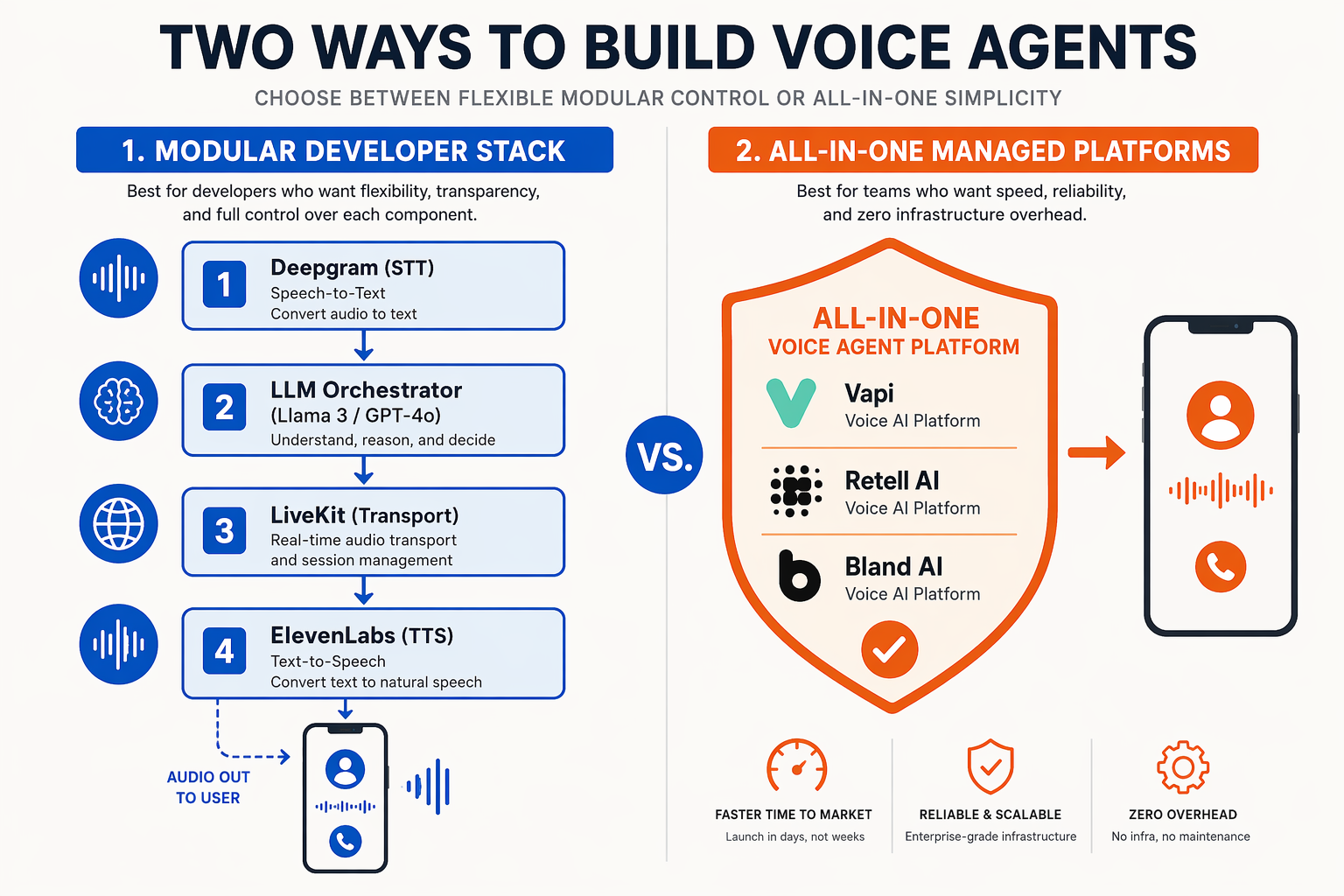
When designing your voice AI infrastructure, you face a fundamental architectural choice: assembling a custom modular stack or adopting an all-in-one managed platform.
- Custom Modular Stack (Deepgram + ElevenLabs + LiveKit + LLM): This approach delivers exceptional control over the underlying model choices and optimization. However, it demands significant engineering overhead, continuous maintenance, and weeks of initial setup to orchestrate the handoffs between speech-to-text, LLM inference, and text-to-speech engines.
- All-in-One Managed Platforms: These platforms provide ready-to-use APIs, built-in telephony, and pre-configured orchestration layers, drastically cutting time-to-market from weeks to days.
Cost and Latency Benchmarks
Pricing models and performance profiles vary across the leading managed platforms, making it critical to align your choice with your budget and technical requirements:
- Retell AI: Features a base rate starting at $0.07 to $0.18 per minute (scaling up to $0.31/min depending on the specific voice chosen). This base rate includes core speech-to-text (STT) and voice orchestration processing, though external telephony or optional add-ons may vary. It is highly regarded for delivering a prompt, competitive ~600ms latency out of the box with minimal engineering configuration.
- Vapi: Generally ranges between $0.10 to $0.30 per minute all-in. While it offers deep pipeline customization for developers, Vapi stacks a fixed platform fee and variable phone number pricing on top of usage, which can increase total cost of ownership at scale.
- Bland AI: Engineered specifically for complex, high-concurrency outbound prompt workflows. Bland AI’s pricing structures are optimized for high-volume enterprise campaigns, making it a highly cost-effective choice for large-scale outbound operations.
At a Glance: Verdict
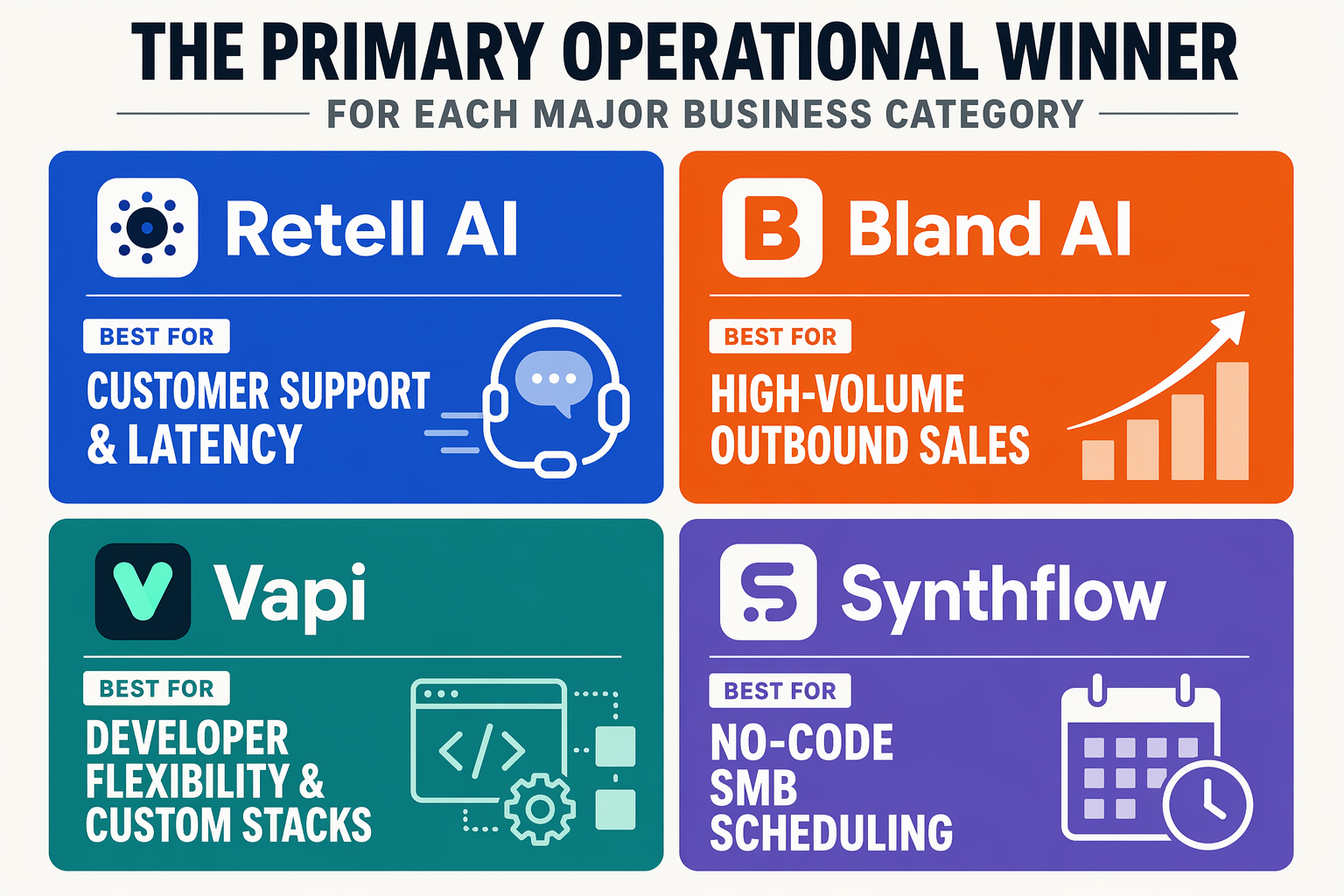
To help you choose the right platform for your operational needs, here is our 2026 executive verdict on how the leading AI voice vendors compare.
The 2026 AI Voice Agent Verdict
- Retell AI: Best for Customer Support due to its fast out-of-the-box setup, native HIPAA compliance, and highly competitive pricing starting at $0.07 to $0.18 per minute.
- Bland AI: Best for Outbound Sales & Lead Gen because of its robust multi-prompt routing pathways, built-in TCPA compliance features, and superior voicemail detection designed for high-velocity outbound calling.
- Vapi: Best for Appointment Scheduling and highly customized developer workflows, offering deep flexibility and sub-600ms latency control, though it requires more engineering configuration and higher all-in costs ($0.10 to $0.30/minute).
- CallMissed: Best for Enterprise Call Centers requiring massive concurrency, multi-regional carrier infrastructure, and native multilingual support across 22 regional Indian languages.
- Synthflow: Best for SMBs seeking a purely no-code interface for simple scheduling tasks, though it lacks the advanced API routing needed for complex enterprise call centers.
Cost Dynamics at Scale: An Illustrative Comparison
When calculating your return on investment, looking only at base per-minute rates can be misleading. To illustrate how these pricing models behave at scale, consider a baseline monthly volume of 10,000 minutes:
- Retell AI Cost Structure: For a 10,000-minute monthly volume, Retell starts around $700 before add-ons/telephony where applicable. While highly cost-effective, organizations should account for additional telephony connection fees or custom LLM tokens depending on their configuration.
- Vapi Cost Structure: At that same 10,000-minute volume, Vapi totals an illustrative all-in production estimate of roughly $1,443. This figure reflects Vapi's multi-layered pricing architecture, which typically stacks fixed platform fees, variable phone number pricing, and separate speech-to-text (STT) surcharges on top of the base per-minute usage.
Ultimately, the cheapest option on paper is not always the most cost-effective in production. While a managed, all-in-one developer platform like Vapi provides unparalleled flexibility for complex engineering workflows, it demands a higher premium. Conversely, Retell AI offers a more predictable baseline for standard inbound support, while enterprise-grade platforms like CallMissed help large-scale call centers bypass multi-layered middleman markups entirely by providing direct LLM inference and built-in, low-latency Speech-to-Text APIs at scale.
Feature Comparison (TABLE)
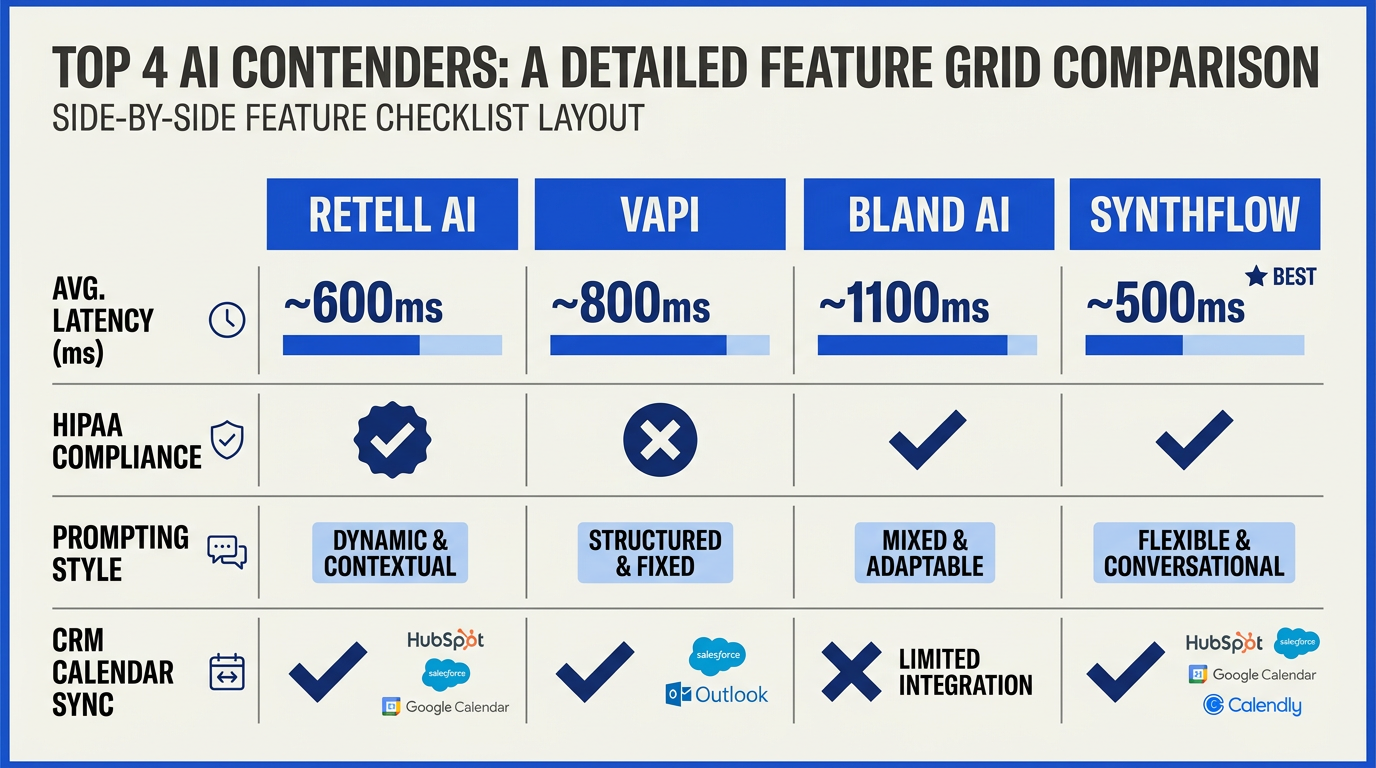
Evaluating the core technical capabilities of each platform helps match operational demands with the right infrastructure. The comparison below outlines the exact performance, pricing, and architectural metrics of the top voice AI providers.
| Vendor | Average Latency | Base Pricing (Per Min) | Key Strength | Target Use Case |
|---|---|---|---|---|
| Retell AI | ~600 ms | $0.07 – $0.18 | Native HIPAA compliance & voice quality | Customer Support & Inbound |
| Vapi | 500 – 800 ms | $0.10 – $0.30 | Developer customization & API flexibility | Appointment Scheduling |
| Bland AI | 800 – 1,200 ms | Variable | Multi-prompt routing & high scale | Outbound Sales & Cold Calling |
| Synthflow | 900 – 1,500 ms | Subscription + usage | No-code setup & SMB templates | Simple Lead Qualification |
| CallMissed | <600 ms | Custom / Volume-scale | Multilingual (22 Indian languages) | Enterprise Call Centers |
Architectural and Operational Trade-Offs
- Pricing: Retell AI offers highly competitive volume pricing starting at $0.07/minute, whereas Vapi adds a platform markup on top of individual model usage, often driving all-in costs to $0.30/minute at lower volumes.
- Outbound Routing: Bland AI provides the most advanced multi-prompt logic for complex, multi-path sales campaigns, though it suffers from slightly higher latency than its counterparts.
- Localization: CallMissed bridges the gap for global and regional enterprises by offering low-latency, production-ready voice agent infrastructure with native speech-to-text and text-to-speech support for 22 regional Indian languages.
- Compliance & Support: Retell AI stands out for high-trust customer support applications due to its strict HIPAA compliance and out-of-the-box structured data extraction tools.
Pricing & Value (TABLE)
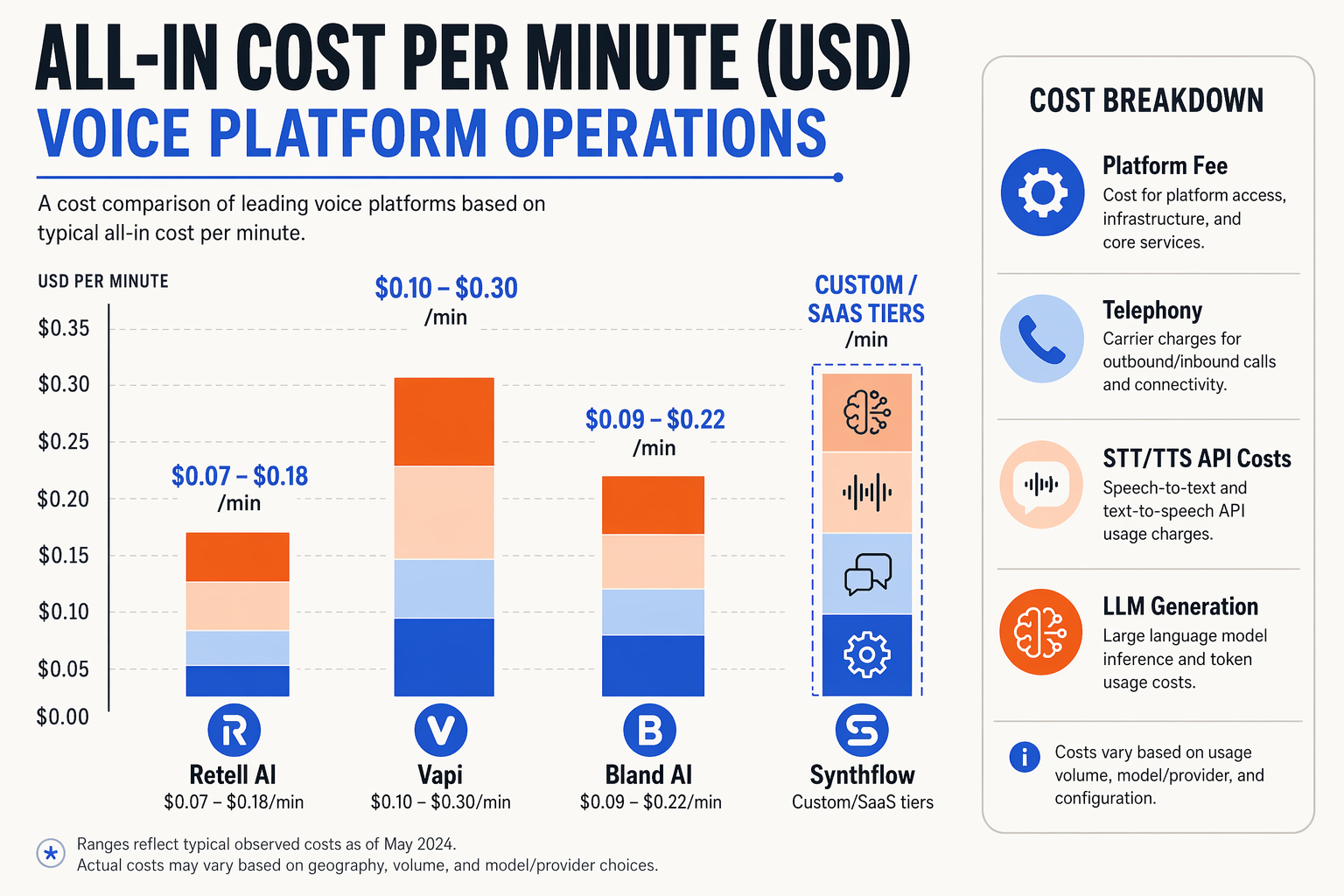
To make an informed financial decision in 2026, you must look beyond raw per-minute platform fees and calculate "all-in" operational costs, which include telephony, speech-to-text (STT) processing, text-to-speech (TTS) synthesis, and custom LLM tokens.
| Vendor | Base Platform Rate | Average All-In Cost / Min | Key Cost Factors | Primary Cost Advantage |
|---|---|---|---|---|
| Retell AI | $0.07 to $0.18 / min | $0.07 to $0.22 / min | Includes STT; variable phone number pricing | Cheapest path for high-quality managed inbound |
| Vapi | $0.05 / min platform fee | $0.10 to $0.30 / min | STT, TTS, LLM, and telephony billed separately | Maximum granular control over modular stack costs |
| Bland AI | $0.09 / min base rate | $0.12 to $0.25 / min | Multi-prompt routing paths; volume-based discounts | Optimized, cost-effective outbound calling at scale |
| CallMissed | Custom volume pricing | $0.05 to $0.15 / min | Multilingual models, built-in TTS/STT, and LLM hosting | Unified global billing; no third-party API markup |
Cost Dynamics & Platform Value Comparison
- Vapi: Imposes a fixed platform fee of $0.05/minute on top of your underlying usage, bringing realistic production costs to $0.10–$0.30/minute once you factor in separate bills for telephony, LLMs, and TTS. While highly flexible, assembling this modular stack can lead to unpredictable pricing at scale.
- Retell AI: Delivers predictable billing by bundling speech-to-text directly into its base rate. For high-volume support, this structure is highly efficient—costing roughly $700 for 10,000 minutes compared to Vapi's ~$1,443 for the same volume when using standard external APIs.
- Bland AI: Focuses its pricing model on high-volume outbound sales and lead qualification infrastructure, rewarding enterprises with steep tier discounts as concurrency and monthly volumes scale.
- CallMissed: Eliminates the complexity of managing multiple vendors by offering unified, high-concurrency billing for global and regional markets. Rather than acting as a middleware wrapper with added markups, CallMissed leverages a vertically integrated architecture. By natively hosting LLM inference, proprietary speech-to-text supporting 22 regional languages, and local telephony routes under a single platform, it dramatically reduces the overhead associated with modular Western stacks. Because there are no third-party API markups for core speech-to-text or translation layers, enterprises can realize substantial, compounding cost savings depending on their call volumes and regional routing requirements.
Pros and Cons (TABLE)
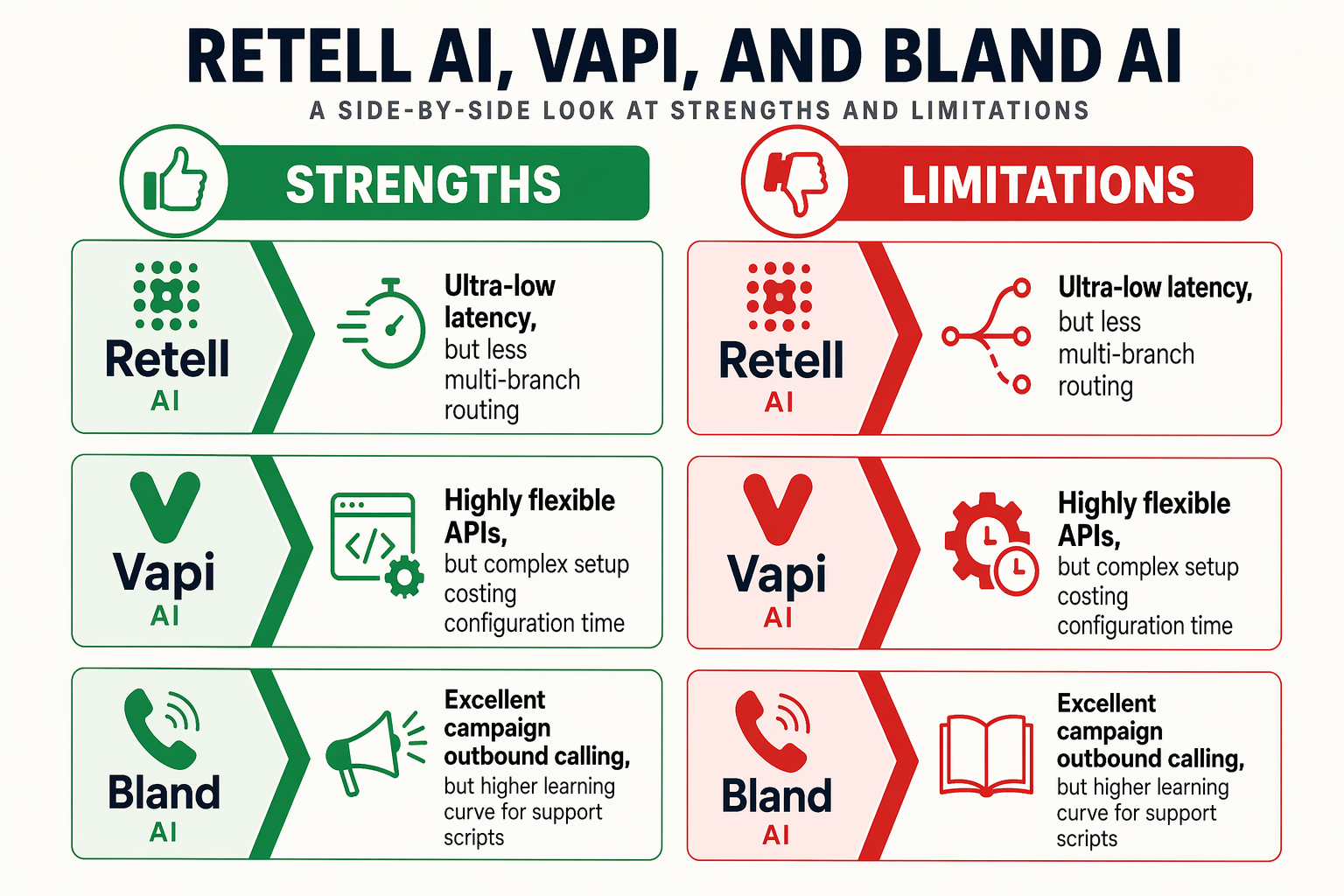
Evaluating the strengths and trade-offs of each leading Voice AI platform helps pinpoint the ideal infrastructure for your specific operational workflows.
Feature and Performance Comparison (2026)
| Vendor | Base Cost / Min | Average Latency | Best Operational Pillar | Key Limitation |
|---|---|---|---|---|
| Retell AI | $0.07 to $0.18 | ~600 ms | Customer Support & Inbound | Less flexibility in raw orchestrator overrides |
| Vapi | $0.10 to $0.30 | Configurable (500-800 ms) | Appointment Scheduling & Custom Dev | High platform fees and complex initial setup |
| Bland AI | $0.09 to $0.25 | ~700 ms | Outbound Sales & High-Volume Leads | High configuration complexity with multi-prompt pathways |
| CallMissed | Custom Enterprise | Sub-600 ms | Enterprise Call Centers & Localized CX | Requires enterprise-level integration onboarding |
Strategic Pros and Cons
- Retell AI Pros: Offers natively compliant HIPAA infrastructure, out-of-the-box structured data extraction, and cost-efficient scaling starting at just $0.07/minute.
- Retell AI Cons: Less developer control over low-level WebSocket pipelines compared to fully modular alternatives.
- Vapi Pros: Maximum developer flexibility with complete orchestrator control, making it perfect for highly customized database round-trips and real-time calendar syncing.
- Vapi Cons: Significantly higher all-in costs (often hitting $1,443 for 10,000 minutes compared to Retell’s ~$700) and stacks variable phone number pricing on top of usage.
- Bland AI Pros: Dominate outbound sales execution with highly customizable, multi-prompt routing pathways optimized for voicemail detection and TCPA compliance.
- Bland AI Cons: Multi-prompt structures increase the surface area for agent logic failures, requiring extensive testing for long, open-ended support conversations.
- CallMissed Pros: Delivers high-concurrency infrastructure natively supporting 22 Indian regional languages with an integrated, multi-model LLM gateway.
- CallMissed Cons: Geared primarily toward regional and enterprise-scale operations rather than rapid, single-agent hobbyist deployments.
Which Should You Choose?
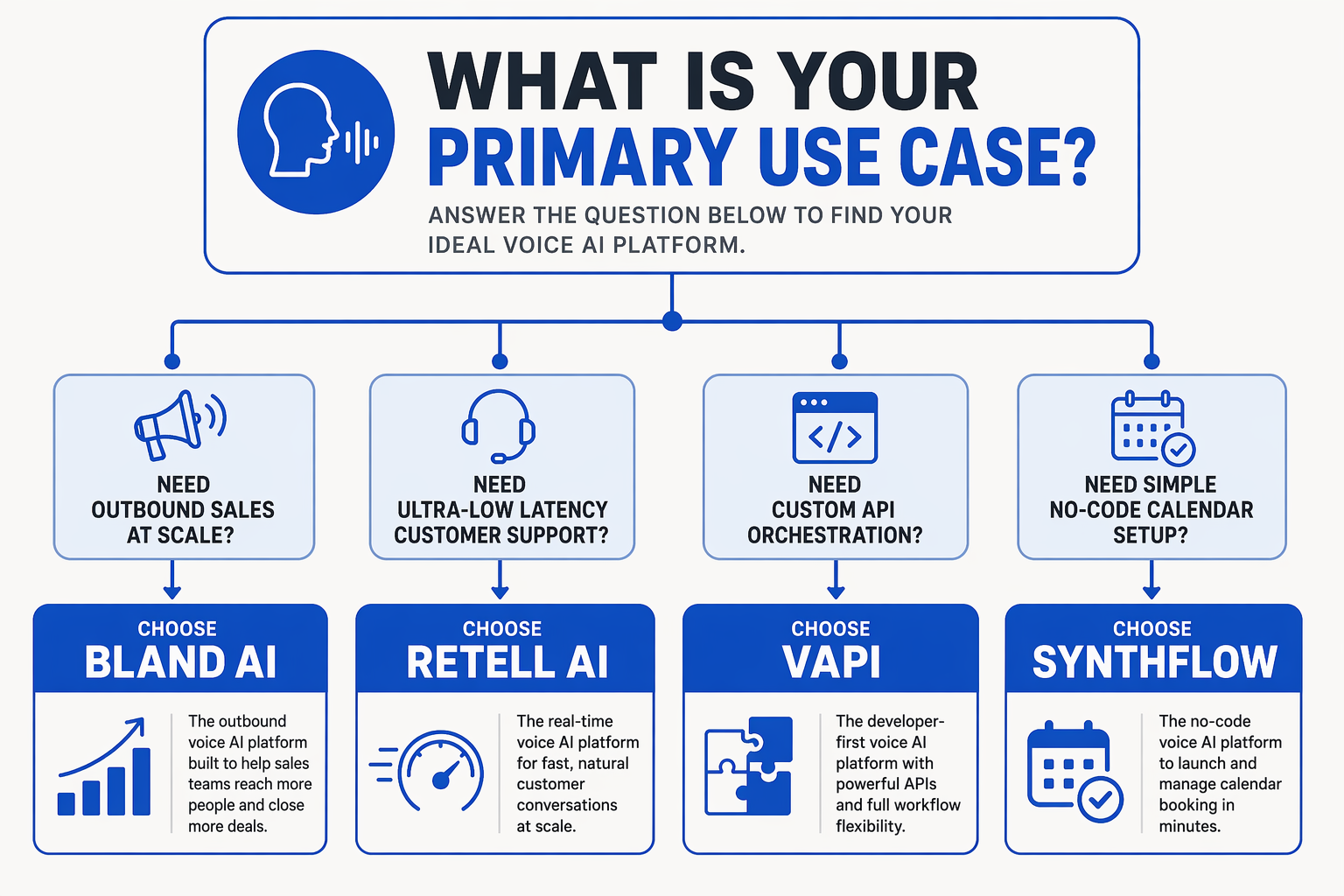
To choose the right voice AI vendor, you must align your specific business priorities—such as cost efficiency, setup speed, or developer control—with each platform's distinct technical architecture.
Strategic Recommendations by Use Case
- For Cost-Sensitive Customer Support: Choose Retell AI, which offers the most economical pathway with base pricing starting at $0.07 to $0.18 per minute, built-in HIPAA compliance, and structured data tools that reduce integration overhead.
- For High-Velocity Outbound Sales: Choose Bland AI, as its architecture is highly optimized for complex, multi-prompt routing pathways, voicemail detection, and rapid outbound calling workflows.
- For Custom Developer Control: Choose Vapi, which operates at $0.10 to $0.30 per minute all-in, offering deep customization and extensive configuration options for engineering teams building custom database integrations.
- For Multilingual & Regional Scale: Choose CallMissed, which bridges the gap for global and regional enterprises by offering a production-ready, highly scalable voice agent infrastructure natively supporting 22 Indian regional languages alongside its multi-model LLM gateway.
- For Ultra-Low Latency Control: Build a Custom Modular Stack (using Deepgram, ElevenLabs, and LiveKit) if your engineering team has the bandwidth to manage complex pipeline orchestrations in exchange for complete vendor independence.
Frequently Asked Questions
Here are the answers to the most common questions decision-makers ask when conducting an AI voice agent vendor comparison:
Which platform offers the lowest cost per minute for an AI voice agent for customer support?
How do Vapi, Retell, and Bland AI compare on conversational latency?
What is the best AI voice agent for sales and high-volume outbound calling?
What is the best AI voice agent for appointment scheduling?
Should an enterprise build a custom modular voice stack or use an all-in-one platform?
What is the best AI voice agent for call centers with high concurrency requirements?
Conclusion
Key Takeaways for 2026
- Align Platform to Use Case: Select Retell for secure inbound support, Bland AI for complex multi-prompt outbound sales, and Vapi for highly customizable, developer-controlled scheduling.
- Balance Cost vs. Control: Weight the raw cost savings of Retell ($0.07 to $0.18/min) against the deep integration flexibility of Vapi ($0.10 to $0.30/min).
- Choose Your Architecture: Opt for managed all-in-one platforms to accelerate time-to-market, or assemble a modular stack (Deepgram + ElevenLabs + LiveKit) if you require total infrastructure control.
Looking ahead, the next wave of voice AI will focus on hyper-local multilingual scaling and deeper cognitive reasoning. Is your business ready to transition from rigid IVR systems to fluid, human-like voice agents?
To explore how AI communication is evolving, check out CallMissed — an AI infrastructure platform powering voice agents and multilingual chatbots for businesses.
Related Reading
Related Posts



Ready to automate customer conversations?
Launch AI voice agents and WhatsApp bots with CallMissed — one API, 22+ Indian languages.