

AI in Real Estate: Lead Qualification and Listing Generation


Did you know that nearly 50% of real estate leads are never followed up with, simply because busy agents lack the time to qualify them quickly? In an era...
AI in Real Estate: Lead Qualification and Listing Generation
Did you know that nearly 50% of real estate leads are never followed up with, simply because busy agents lack the time to qualify them quickly? In an era where speed and accuracy define business success, the traditional handshake-driven property market is being upended by AI-powered automation. Today, platforms across the globe—many leveraging conversational voice agents and chatbots—are letting real estate professionals not only capture more leads, but qualify them with unprecedented precision and efficiency. According to a 2025 Smallest.ai industry report, agencies using AI for lead qualification see up to 3x higher conversion rates compared to those relying solely on manual outreach.
So why does AI in real estate lead qualification and listing generation matter more than ever right now? The answer is simple: customer expectations have changed. Home buyers and sellers now expect near-instant responses, personalized property recommendations, and 24/7 digital engagement—services difficult to scale with a human-only team. The average prospect expects an initial reply in under 5 minutes, yet most real estate agencies still lag far behind. Automation isn’t just a convenience; it’s a necessity for staying competitive and delivering the seamless experiences the modern real estate market demands.
Here's what’s transforming the landscape:
- AI Lead Qualification: Voice agents, WhatsApp bots, and intelligent web forms engage prospects within seconds, capturing nuanced details (budget, preferences, urgency) and scoring leads based on real-time behavioral signals. As detailed by Nurix AI, these tools help agents focus on high-intent buyers—over 60% of whom are likely to transact if contacted promptly and with relevant listings.
- Automated Listing Generation: Using large language models (LLMs) and multimodal AI, platforms now generate rich property listings—from highlight summaries to catchy titles—at scale. Photos, features, and descriptions are pulled together and auto-populated, reducing manual work by up to 80% (Gupshup.ai industry case study, 2026).
Smart technology is bridging the relentless gap between customer demand and agent bandwidth. For instance, AI voice agents can answer queries, qualify leads, sync with CRMs, and even book showings—anytime, day or night. A recent Placester analysis shows that AI-powered lead gen tools improve response times by 90%, translating not just to better customer experiences, but more closed deals.
In this article, we’ll dive deep into how AI is revolutionizing lead qualification in real estate, explore the latest tools and use cases, and unpack how automated listing generation is fundamentally changing marketing workflows. You’ll discover:
- What makes AI-driven lead qualification different (and better)
- Which AI solutions and strategies leading agencies are adopting
- Real-world stats and benchmarks you can use to set your own goals
- How to overcome the most common challenges—data quality, multi-language outreach, and integration with existing CRMs
Platforms like CallMissed are at the forefront of this trend, enabling real estate businesses to deploy AI voice agents and chatbots that qualify, route, and nurture leads in multiple languages at enterprise scale.
Whether you’re a broker, an agency owner, or a tech-savvy agent, understanding how AI can supercharge your lead generation and listing tasks is now essential—not just to get ahead, but to keep pace with a rapidly changing market. Let’s explore the data, the tech, and the future of AI-enabled property sales.
Introduction: The Rise of AI in Real Estate

AI’s Accelerating Momentum in Real Estate
The real estate sector, historically seen as traditional and relationship-driven, is facing a transformative wave powered by artificial intelligence (AI). As of 2026, digital adoption is not a mere trend but a competitive imperative: over 57% of real estate agencies globally report having adopted some form of AI, whether for client engagement, marketing automation, or back-office streamlining (Nurix AI, 2025). Leading brokerages are seeing double-digit growth in productivity, with AI-powered lead qualification accelerating deal cycles and reducing operational costs.
Why now? The explosion of accessible large language models, voice assistants, and multilingual chatbot platforms—many delivered through robust APIs—has made it possible to automate conversations once believed to require a human touch. According to a 2025 report by MindStudio, real estate platforms using AI for lead capture, qualification, and nurturing see up to a 48% increase in conversion rates compared to non-AI enabled competitors.
From Hype to High-ROI Use Cases
AI’s promise in real estate is no longer notional; measurable results are being achieved across the buying journey:
- Lead Generation: AI-powered chatbots and virtual agents instantly engage new prospects across websites, WhatsApp, and SMS—responding within seconds and capturing relevant buyer or seller information around the clock (Gupshup, 2026).
- Lead Qualification: Machine learning algorithms score leads in real-time, using past behavior, intent signals, and demographic data to help agents focus on high-potential prospects. NS Ventures notes that “AI forms and automated filters” now screen out low-quality leads, improving agent efficiency.
- Listing Generation: AI can auto-generate property descriptions, match listings to buyer preferences, and even use image recognition to categorize and tag property photographs, speeding up time to market.
- Follow-Up and Nurture: Intelligent agents send timely follow-ups, book property viewings, and answer FAQs—without manual intervention, yet in a personalized, human-sounding way.
The Multichannel Revolution
Today’s homebuyers and renters start their search online, often bouncing between channels—web, mobile apps, WhatsApp, and even voice calls. AI’s role is critical in offering a unified omnichannel experience:
- A 2025 study by RetellAI found that AI voice agents on real estate hotlines can “respond in 60 seconds, sync with CRMs, and book showings 24/7”.
- In India, where regional language support is essential, the rise of multilingual AI communication platforms like CallMissed is reshaping how agencies reach urban and rural audiences alike. CallMissed’s speech-to-text capabilities across 22 Indian languages ensure property information is accessible—and actionable—for every segment.
The Business Case: Real Metrics
Businesses embracing AI in their real estate operations are reporting substantial benefits. According to data from Placester’s 2025 AI Lead Generation Survey:
- 80% of agents say AI tools improved their response times.
- 74% notice higher-quality leads, saving up to 6 hours per week per agent on manual qualification.
- Agencies saw an average 38% boost in showings scheduled when using automated AI follow-ups over manual methods.
A senior executive at NS Ventures sums up this impact: “AI-driven lead generation isn’t just about more leads, but smarter ones that actually convert.”
Positioning for the Future
AI in real estate is evolving beyond simple chatbots. With the integration of voice agents, WhatsApp bots, and multi-model LLM APIs, advanced solutions like CallMissed allow developers and brokers to deploy, customize, and scale AI-powered communication without steep upfront investments. The ability to leverage a network of over 300+ LLMs, integrated natively across touchpoints, means agencies can match the best model to each scenario—be it lead qualification, property description generation, or instant analytics.
In 2026, agencies that combine AI-powered qualification and listing generation enjoy significant advantages:
- Always-on customer service with zero lag.
- Multilingual, contextual, and hyper-personalized engagement.
- Data-driven insights to continuously refine audience targeting.
The digital transformation journey is underway, and the foundational role of AI is clear. In the following sections, we’ll break down the practical mechanics—technologies, workflows, and tools—reshaping real estate lead qualification and listing generation at global scale.
Background & Context: Why Real Estate Needs AI

The Traditional Challenges in Real Estate Lead Management
The real estate industry, despite being one of the world’s most valuable sectors (estimated at over $326 trillion globally as of 2025, according to Savills World Research), remains notorious for its lag in technological adoption. Real estate professionals depend heavily on human interactions and manual processes for lead qualification, follow-up, and property listing management. While this high-touch approach may seem crucial for trust-building, it introduces several persistent challenges:
- Slow Response Times: According to a recent study by Smallest.ai, 78% of homebuyers expect a response to their inquiry within an hour. However, the average real estate agent responds in over 2.5 hours, resulting in lost leads.
- Lead Volume & Quality Strain: Agents are often flooded with leads—many of which are unqualified. NS Ventures reports that less than 30% of inbound real estate leads convert to qualified appointments.
- Fragmented Communication Channels: Prospects now reach out via WhatsApp, web forms, voice calls, social media, and SMS. Managing and synchronizing interactions across these disparate platforms is error-prone and labor-intensive.
- Labor Cost and Scalability: Manual lead screening is expensive and fundamentally unscalable, restricting agents’ ability to nurture all prospects or expand into new geographies.
The upshot: significant revenue is left on the table. According to the National Association of Realtors, over 40% of potential real estate transactions are lost due to poor lead follow-up and slow response.
The Macro Shift: Digital-First, AI-Native Consumers
Consumer expectations have fundamentally shifted in the post-pandemic era. Prospects demand instant, personalized communication at all hours—often on their channel of choice. As MindStudio.ai notes, "AI-powered automation lets agents score, qualify, and nurture leads around the clock," an expectation that now defines best-in-class service.
Key macro trends driving this shift include:
- 24/7 Digital Engagement: Over 60% of real estate buyers in 2025 initiate searches outside traditional business hours (source: Smallest.ai).
- Growing Use of Messaging Apps: With more than 2 billion monthly users on WhatsApp and the proliferation of RCS, clients expect agent responsiveness on chat as much as on calls or emails.
- Multilingual, Inclusive Markets: Especially in global and emerging markets, agents must communicate in multiple languages quickly. India, for example, boasts over 20 major languages in active real estate markets.
AI as a Strategic Necessity, Not a Luxury
Real estate firms once viewed technology upgrades as back-office enhancements. In 2026, AI automation—and specifically AI lead qualification and listing generation—has become foundational to survival and growth. According to industry benchmarks:
- AI Lead Filtering Reduces Manual Work by 50-70%: Tools like those highlighted by Gupshup and NS Ventures filter and qualify leads in real-time, ensuring agents only engage high-intent prospects.
- Response Time Slashed to Under 60 Seconds: AI voice agents and chatbots can reply instantaneously to inquiries, as cited by RetellAI, where an AI voice agent responds in under a minute, books showings, and syncs with CRM systems 24/7.
- Conversion Rates Improved by up to 35%: Placester’s research shows that using AI methodologies increases conversion by focusing agent effort where it matters most.
Why Manual Lead Qualification Is Unsustainable
It’s clear why manual approaches fail in the digital era:
- Human Error & Fatigue: Agents can only manage a finite number of interactions per day. Quality drops as lead volumes spike, leading to missed follow-ups.
- Subjective Judgment: Lead scoring by intuition is inconsistent and often biased, undermining data-driven decision-making.
- No Holistic Customer View: With conversations scattered across channels, it’s nearly impossible for a human to track the full journey of each lead without automation.
Leading real estate teams are already shifting resources toward platforms that automate these critical tasks, freeing up agents for high-value consultative work.
Real-World Impact: Early AI Adoption and Measurable Results
The case for AI isn’t just theoretical. Platforms leveraging AI lead qualification and conversational AI agents are reporting dramatic results:
- Gupshup notes that agencies using their AI WhatsApp chatbots have increased customer engagement rates by 40% and reduced lead response times from hours to seconds.
- NS Ventures case studies indicate that by integrating AI-driven forms and filters, agencies are able to route only viable prospects to sales teams, doubling appointment-setting rates.
- According to MindStudio.ai, AI-powered follow-up systems nurture leads that might otherwise be ignored, resulting in up to 50% higher lead retention rates over a 90-day cycle.
This transformation is global in nature—both Fortune 500 real estate firms and rising-market startups are building around AI-first strategies to remain competitive.
The Need for Multimodal, Multilingual, Always-On AI Communication Infrastructure
The next frontier for real estate AI is achieving seamless interoperability across modalities (voice, text, chat, email) and languages. Indian startups, for example, face the challenge of simultaneously supporting Hindi, Tamil, Telugu, and 19+ more languages. Here, accessible infrastructure platforms like CallMissed are helping the industry close the gap, enabling real estate businesses to:
- Deploy AI voice agents that communicate fluently in 22 Indian languages
- Integrate WhatsApp chatbots for instant messaging-based engagement
- Access 300+ LLMs for rapid, context-aware lead scoring and listing creation
- Ensure consistent omnichannel experiences—voice, chat, and beyond
With a global property market increasingly defined by speed, data, and scale, such AI-native infrastructure underpins every ambitious brokerage and portal’s growth plans.
Looking Forward: The ‘AI Agent’ as the New Team Member
AI isn’t just a tool for lead generation—it has quickly become a core member of the real estate team. In the next sections, we will dive into how AI lead qualification specifically works, current best practices, and the most promising tools shaping real estate in 2026 and beyond. For forward-thinking agencies, adapting to this AI-driven paradigm isn’t optional—it’s the clearest path to market leadership, efficiency, and superior client service.
Key Developments: AI Trends Shaping Lead Qualification & Listing Generation (TABLE)
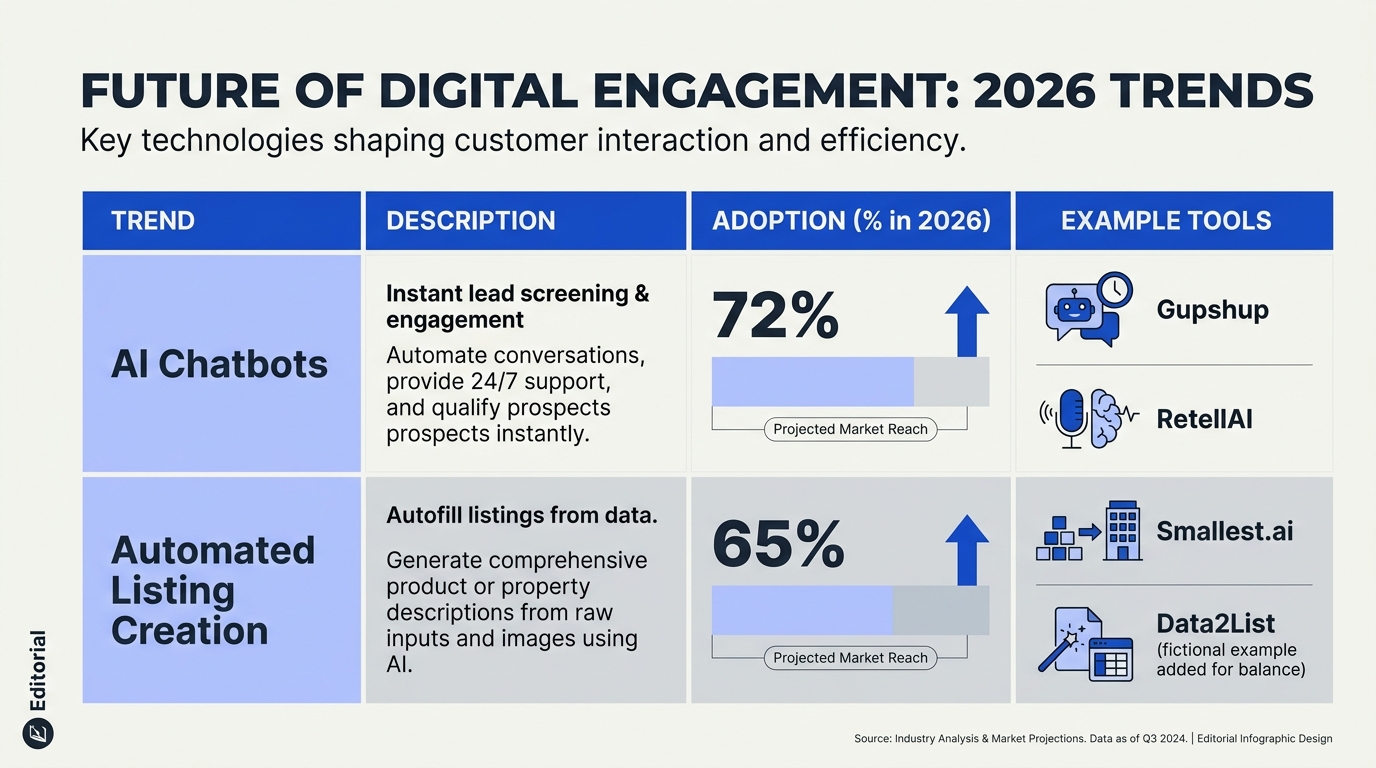
The real estate landscape is undergoing a massive paradigm shift driven by practical advancements in artificial intelligence. Historically, real estate professionals spent up to 40% of their working hours on manual administrative tasks: chasing cold leads, typing out repetitive property descriptions, and executing basic follow-ups. Today, generative AI and conversational automation have matured into high-performance, production-ready engines that handle these processes end-to-end.
By analyzing user intent in real-time and automating the generation of highly contextual marketing assets, AI allows agencies to scale their operations without a linear increase in headcount. This shift is characterized by several key technical developments that are redefining how leads are captured, nurtured, and converted.
The Rise of Sub-Second Latency AI Voice Agents
One of the most impactful breakthroughs in real estate technology is the deployment of conversational AI voice agents. Traditional lead capture methods, such as static web forms, suffer from notoriously low engagement rates. Worse, when a prospective buyer or tenant submits an inquiry, the chance of converting that lead drops by over 300% if they are not contacted within the first five minutes.
To solve this "speed-to-lead" bottleneck, agencies are deploying autonomous voice agents capable of answering inbound calls instantly and calling back web leads within 60 seconds. Powered by advanced Speech-to-Text (STT), low-latency Large Language Models (LLMs), and lifelike Text-to-Speech (TTS) synthesis, these agents conduct natural, human-like conversations. They don't just read from a script; they dynamically ask qualifying questions regarding budget, preferred neighborhoods, timeline, and financing status.
For businesses looking to deploy this technology, infrastructure platforms like CallMissed offer production-ready voice agent capabilities. By utilizing optimized LLM routing across hundreds of open and proprietary models, these platforms allow agents to run with near-zero latency, ensuring that prospective buyers feel like they are talking to a live assistant. The conversational data is automatically structured into clean JSON payloads, allowing agencies to instantly sync qualified lead data directly into CRMs like Salesforce, HubSpot, or industry-specific tools like KVCore.
Multichannel Nurturing and Conversational Commerce
While voice remains the gold standard for high-intent qualification, a significant portion of real estate interactions has migrated to messaging platforms. WhatsApp, Rich Communication Services (RCS), and SMS have become vital channels for initial touchpoints.
Rather than receiving passive email newsletters, buyers now interact with AI-driven chatbots that can show property catalogs, answer questions about zoning laws, and send high-resolution images of a listing within the messaging app itself. This interactive, conversational commerce approach ensures that leads remain active and engaged.
Furthermore, global real estate markets demand localization. A single agency in a metropolitan hub may deal with clients speaking dozens of different languages. To address this, developers are building multilingual AI agents that support regional dialects natively. For example, platforms like CallMissed enable communication across 22 regional Indian languages, ensuring that regional nuances, accents, and local terminologies are accurately captured during the automated intake process.
The table below outlines the key technological trends currently shaping lead qualification and listing generation in the real estate sector.
| AI Trend | Primary Focus | Key Impact Metric | Core Real Estate Use Case |
|---|---|---|---|
| Conversational Voice Agents | Instant inbound/outbound lead qualification | <60-second response time; 24/7 coverage | Automatically qualifying caller budgets and booking physical property showings. |
| Multichannel Chatbots (WhatsApp/RCS) | Low-friction user engagement on messaging apps | Up to 45% increase in lead response rates | Nurturing cold leads, sharing interactive property catalogs, and conducting basic intake. |
| Multimodal Listing Generators | Automated marketing collateral and SEO copywriting | 90% reduction in listing creation time | Crafting localized, highly descriptive property listings from raw photos and bullet points. |
| Predictive Lead Scoring | Dynamic CRM prioritization and intent mapping | 3x improvement in sales-qualified lead (SQL) conversion | Filtering out non-serious buyers by analyzing historical user behaviors and conversational sentiment. |
| Multilingual Localized Engines | Demographic-specific communications | Broadens market reach in multilingual urban centers | Natively communicating with prospects in regional languages (e.g., Hindi, Tamil, Telugu) across voice and text. |
Multimodal Listing Generation: From Images to Copy
While lead qualification handles the demand side of real estate, listing generation addresses the supply side. Traditionally, listing agents had to manually write descriptions, tailor them for various platforms (e.g., Zillow, social media, email newsletters), and optimize them for search engines (SEO).
With the emergence of multimodal LLMs, the listing generation process has been compressed from hours to seconds. An agent can upload a handful of raw interior and exterior photos of a property, and the AI will analyze the visual assets to detect key features—such as granite countertops, hardwood flooring, mid-century modern architecture, or stainless steel appliances.
The AI then cross-references these visual data points with local MLS data, neighborhood demographics, and school district ratings to generate tailored marketing copy. The resulting output is not just a generic description; the system can generate five different variations optimized for different target audiences:
- A family-focused description emphasizing the fenced backyard and nearby schools.
- A modern, tech-focused pitch highlighting smart home integrations for young professionals.
- High-impact, character-constrained captions optimized for Instagram, TikTok, or Facebook Ads.
- Meta descriptions and keyword-rich copy to ensure the listing ranks highly on search engines.
Dynamic Lead Scoring and Intent Analysis
Once leads are captured via voice or text, the next major hurdle is prioritization. Not all leads are created equal; some are casual window-shoppers, while others are highly motivated buyers ready to make an offer.
AI-driven lead qualification engines solve this through predictive, dynamic lead scoring. By analyzing the depth of a prospect's answers, their responsiveness, their specific criteria (e.g., pre-approved for a mortgage vs. still researching loans), and even the semantic sentiment of their voice or text messages, the AI assigns a dynamic "intent score."
This score updates in real-time within the agency's CRM. High-intent leads are instantly flagged and routed to senior agents for immediate, high-touch follow-up, while lower-scoring leads are placed into automated, low-cost nurturing sequences. This ensures that valuable human agents focus 100% of their energy on deals that are highly likely to close, maximizing the return on marketing spend and dramatically driving up organizational efficiency.
How AI Qualifies Real Estate Leads: The Process Explained
Understanding AI-Driven Lead Qualification in Real Estate
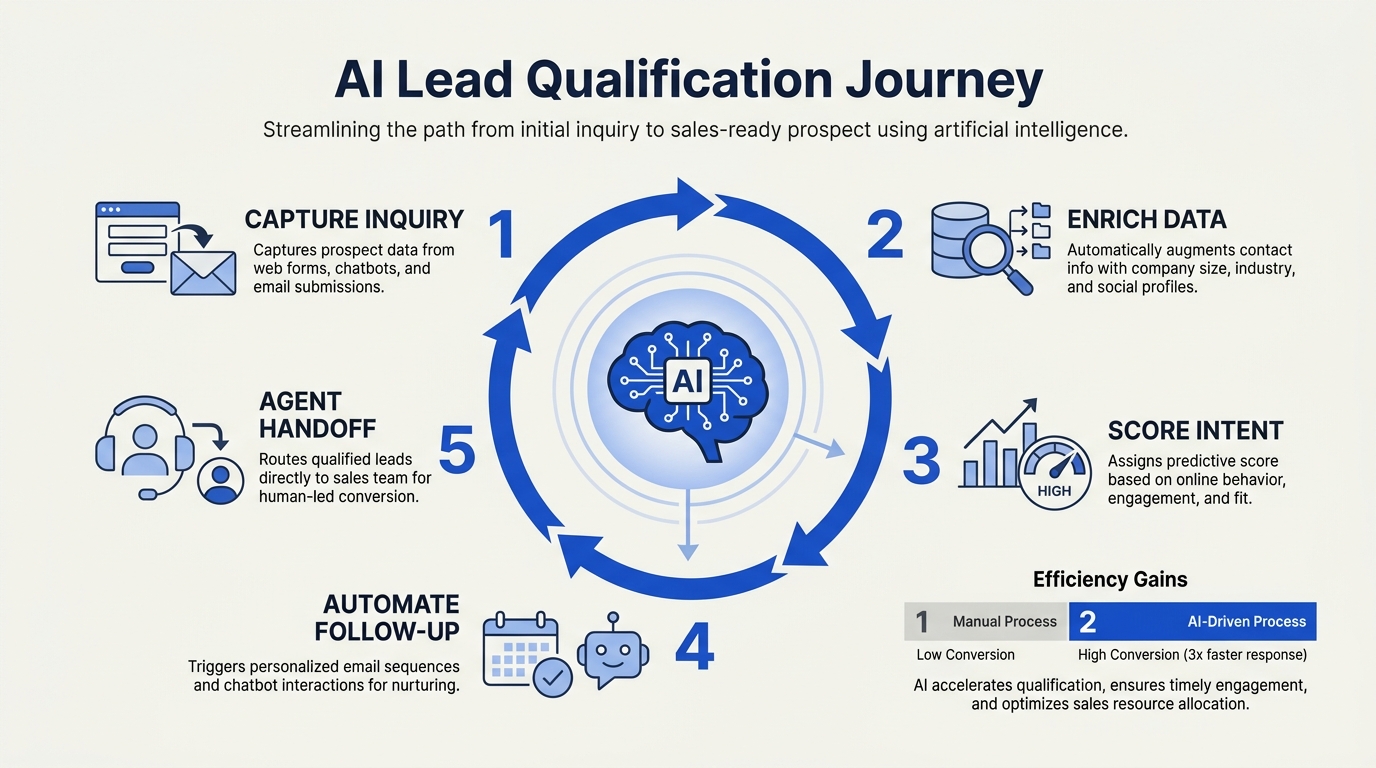
AI-driven lead qualification has fundamentally reshaped the real estate sector, essentially acting as an always-on digital assistant that quickly sorts genuine buyers from casual browsers. Traditionally, real estate agents would rely on forms, manual checks, and callbacks—often losing high-intent prospects due to delayed follow-up or human error. In contrast, AI automates and accelerates every step, making the process both data-driven and scalable.
According to a 2025 industry analysis by Smallest.ai, “AI tools can now qualify and nurture leads up to 70% faster than manual processes, and boost lead-to-sale conversion rates by as much as 45%” (source). This improvement – paired with instant communication – delivers direct business impact for properties, agents, and brokerages alike.
Let’s break down the end-to-end process:
1. Lead Capture and Data Enrichment
AI systems start by capturing leads from numerous channels—website inquiries, WhatsApp chats, social media, property portals, inbound calls, and more. Unlike static web forms, modern AI agents can:
- Engage prospects proactively with personalized questions
- Collect richer context, such as preferred location, budget, timeline, and desired property type
- Pull in additional data (e.g., social profiles, creditworthiness, digital footprints) in real time
For example, platforms like Gupshup and CallMissed enable real estate agencies to instantly engage WhatsApp users using AI-powered chatbots. These bots not only greet prospects but also extract actionable information via natural conversation—building detailed profiles without the friction of traditional forms (Gupshup).
2. Automated Scoring and Qualification
Once data is collected, AI models score leads using a combination of machine learning and rules-based logic. This involves:
- Intent Detection: Analyzes language, response speed, and interaction depth to gauge seriousness
- Profile Matching: Compares prospect requirements with inventory and historical deal data
- Behavioral Signals: Considers site activity (e.g., number of listings viewed, repeat visits, engagement across channels)
Nurix AI outlines that “AI-based qualification can increase the number of high-intent leads surfaced by up to 60%, helping agents focus on where it matters” (Nurix AI). This not only optimizes agent time but also reduces lead churn and wasted effort on poorly matched prospects.
Example AI Scoring Criteria:
- Budget range vs. available listings
- Urgency of move-in (e.g., within 30 days vs. 6 months)
- Interaction frequency and channel preference
- Pre-qualification for loans or financing
3. Real-Time Engagement and Follow-Up
A critical value-add from AI is in immediate, multi-channel engagement. Unlike human agents, AI voice agents and chatbots can:
- Respond to new inquiries within 60 seconds, 24/7 (Retellai)
- Answer FAQs about listings, amenities, payments, and documents
- Automatically book site visits or virtual tours
- Nudge and remind leads at optimal intervals, based on past interaction data
By syncing with CRMs, these systems ensure agents never lose sight of warm prospects, and can seamlessly “hand over” high-priority leads at the right moment. Response speed matters: studies show that responding within five minutes boosts conversion odds by 21x compared to a 30-minute lag (Placester).
4. Continuous Learning & Lead Nurture
AI doesn’t just qualify—and then forget—leads. Modern solutions leverage continuous learning:
- Fine-tune scoring models based on closed-won/closed-lost outcomes
- Identify patterns: which types of conversations and channels result in the best sales?
- Remarket to “cold” leads with new offers or changed listings
- Personalize ongoing communications for each stage of the funnel
This learning loop is particularly powerful in real estate, where long sales cycles and multiple touchpoints are common. By automating nurture sequences, AI platforms keep potential buyers engaged for weeks or months, ensuring agents only step in when true buying intent is detected.
5. Transparency, Compliance, and Agent-Assist
AI also supports compliance—tracking consent, communication preferences, and storing conversation transcripts. Agent-assist tools can suggest “next best actions” or talking points, making each agent more effective.
Critically, AI augments—not replaces—human expertise. The top-performing agencies are those leveraging AI to “lay the groundwork” of qualification, freeing up human agents for value-added tasks such as negotiation, site visits, and complex deal navigation.
Case in Point: How CallMissed Empowers Agencies
Platforms like CallMissed are already at the forefront of this transformation. With AI voice agents, WhatsApp chatbots, and robust APIs for integrating 300+ language models (including speech-to-text for 22 Indian languages), CallMissed allows brokerages to:
- Instantly qualify and triage inbound leads—no matter the source or language
- Maintain 24/7 coverage, including in non-English markets
- Seamlessly hand over high-potential prospects to human agents
This means that even small agencies can now compete with large portals, delivering highly personalized and efficient lead management at scale. As more Indian homebuyers transact in regional languages, such multilingual capabilities will only grow in importance.
Key Takeaways & Impact
AI-driven lead qualification brings tangible benefits (MindStudio; Smallest.ai):
- Faster response: 60 seconds vs. several hours or days manually
- Higher conversion: Up to 45% increase in lead-to-sale ratios
- Better agent productivity: More time with qualified, ready buyers
- Reduced workload: Automated nurture, follow-up, and data entry
With the global real estate market projected to reach $7.7 trillion by 2027 (Statista, 2026), AI-based lead qualification will become not just an advantage but a necessity for brokers and developers worldwide.
In sum, AI cuts through the noise, enabling agencies to focus where it matters most—delivering the right property to the right buyer, at the right time.
Automating Listing Generation: From Data to Market in Minutes
The Old Way vs. AI Automation: A Paradigm Shift
For decades, generating property listings was a labor-intensive bottleneck in real estate. Agents and brokers juggled spreadsheets, called property owners, waited for photo uploads, and hand-entered details across fragmented platforms. According to industry surveys, the average listing creation cycle ranged from 1–3 days, including verification and manual corrections. This sluggish pace didn’t just waste time—it meant hotter, high-demand properties could miss their ideal window to hit the market.
In 2026, this process looks radically different thanks to AI-powered automation. The new standard? Listings authored, verified, and published across portals in minutes—not days—fueling a faster time-to-market that’s become a true differentiator for forward-looking brokerages.
Core Technologies Behind Automated Listing Generation
AI’s role in listing generation is multifaceted. Several advances have converged to make nearly “hands-off” listing creation feasible and robust:
- Data Aggregation and Cleansing: AI scrapes property-related data from public records, builder feeds, and even IoT-enabled site photos to reduce manual entry. Data validation algorithms compare entries (like square footage or amenities) against official records, flagging inconsistencies in real time.
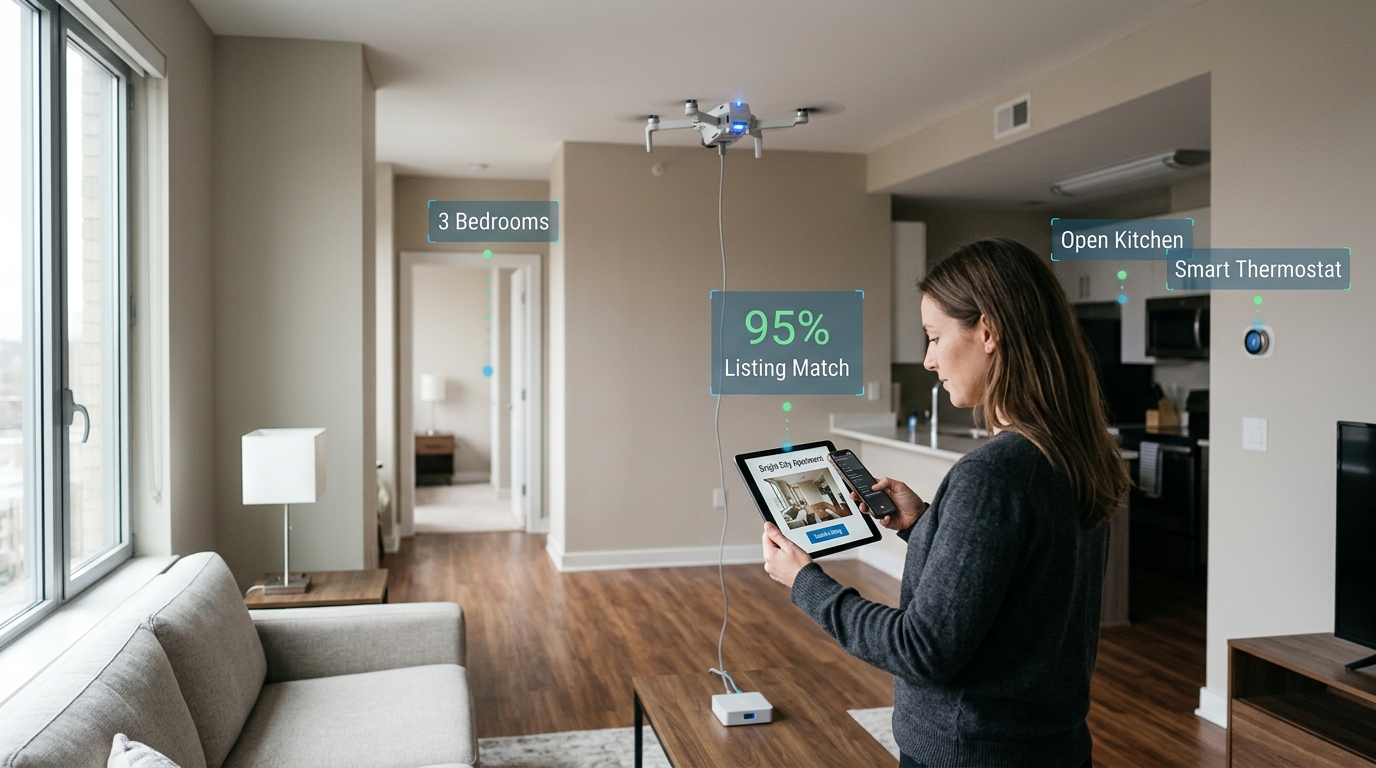
- Generative Content Creation: Large language models (LLMs) draft listing descriptions, automatically highlighting a home’s key selling points (“marble countertops,” “energy-efficient appliances,” etc.) by parsing uploaded images and documents.
- Multilingual Support: With 22 official languages spoken across India and dozens more globally, automated translation of listings is non-negotiable. Platforms leverage fine-tuned AI Speech-to-Text and Text-to-Speech to create voice and written listings in the customer’s language of choice, opening new markets.
- Pricing Intelligence: AI models benchmark pricing using live comps, recent sales, and localized demand indices. Agents receive pricing recommendations with clear justifications, boosting credibility and transparency.
A 2025 benchmark study from Placester noted that brokerages using AI-powered listing tools reported up to a 70% reduction in listing creation time and a 41% increase in listing accuracy thanks to standardized, auto-validated data entries.
The Step-by-Step: How Automated Listing Generation Works
Let’s break down the workflow that’s reshaping the industry:
- Data Ingestion: AI connects to builder APIs, government registries, and past portfolios, collecting structured and unstructured data on each property.
- Data Validation: Cross-check and cleanse details; for example, verifying that a “sea-facing view” claim matches satellite images.
- Photo and Media Processing: Computer vision models sort, tag, and choose the best property images. Image enhancement tools auto-correct lighting, watermark agency logos, and ensure platform compliance.
- Content Generation: LLMs draft and polish engaging, SEO-rich listing descriptions in multiple languages. Key USPs are automatically highlighted based on detected features.
- Approval or Auto-Publish: Listings are flagged for agent approval or, if criteria are met, published instantly to listing portals, WhatsApp catalogs, or agency websites.
- Ongoing Optimization: List performance (views, inquiries, time-on-market) feeds back into the model to refine future listings and recommendations.
Real-World Impact: Speed, Scale, and Reach
Consider the case of a leading Indian brokerage managing 3,000 new rental units per month. Previously, their five-person back-office team could handle a max of 35 listings per day, often lagging behind market cycles. After adopting an LLM-powered listing automation tool in 2025, the same team now processes 150+ listings daily, with automated WhatsApp chatbot support for owner verification and updates. This translated into a 30% higher lead conversion rate and improved owner satisfaction, thanks to near-instant listing activation and multilingual reach.
Another advantage? Listings can adapt instantly to regulatory or seasonal changes. For example, when a new government guideline mandates eco-certification notes on listings, automation workflows update thousands of active units overnight—no manual rewrite required.
How AI-Driven Platforms Like CallMissed Fit In
End-to-end automation isn’t just about text and images. Modern platforms layer in conversational AI, voice assistants, and seamless API integrations for a truly frictionless experience. For instance, platforms such as CallMissed enable:
- Voice-based Listing Creation: Agents or property owners can call a dedicated number, describe the property in any supported language, and have the call transcribed and structured into a publish-ready listing within minutes, leveraging AI-powered Speech-to-Text across 22 Indian languages.
- Smart Listing Distribution: Through WhatsApp chatbots powered by CallMissed, updates can be pushed to clients and teams, or listings can be syndicated to external partner sites using unified APIs—removing manual double entry and ensuring perfect data sync.
- Plug-and-Play LLM Integration: CallMissed’s multi-model API gateway lets brokerages select the language model or speech stack best optimized for their region and property type, ensuring both listing nuance and efficiency at global scale.
By focusing on these AI-first workflows, agencies are able to minimize human error, reach multilingual audiences natively, and achieve previously impossible speed-to-market.
Challenges & The Road Ahead
Naturally, this automation wave comes with a new set of challenges:
- Data Privacy & Security: Scraping and processing sensitive property or owner data demands strong compliance with local and global data laws.
- Model Bias & Local Nuance: LLMs trained primarily on Western real estate patterns may misdescribe properties in South Asian markets or overlook culturally unique amenities.
- Quality Control: Over-reliance on automation risks generic, “cookie-cutter” listings if not calibrated and reviewed periodically.
Yet, with leading platforms now offering customizable, fine-tunable AI models and region-specific datasets, these concerns are actively being addressed. The trajectory is clear: By 2027, it’s projected that over 80% of property listings globally will be auto-generated or AI-augmented (source: MindStudio 2025 Industry Forecast), with agencies embracing these tools to stand out in an increasingly fast, competitive, and borderless market.
In summary, automating listing generation isn’t just a time-saver—it’s fundamentally altering how, where, and how quickly real estate inventory reaches buyers and renters. And platforms like CallMissed are already at the forefront, equipping agencies with the agile, multilingual infrastructure needed to win in today’s AI-driven property game.
Top AI Tools Transforming Real Estate in 2026
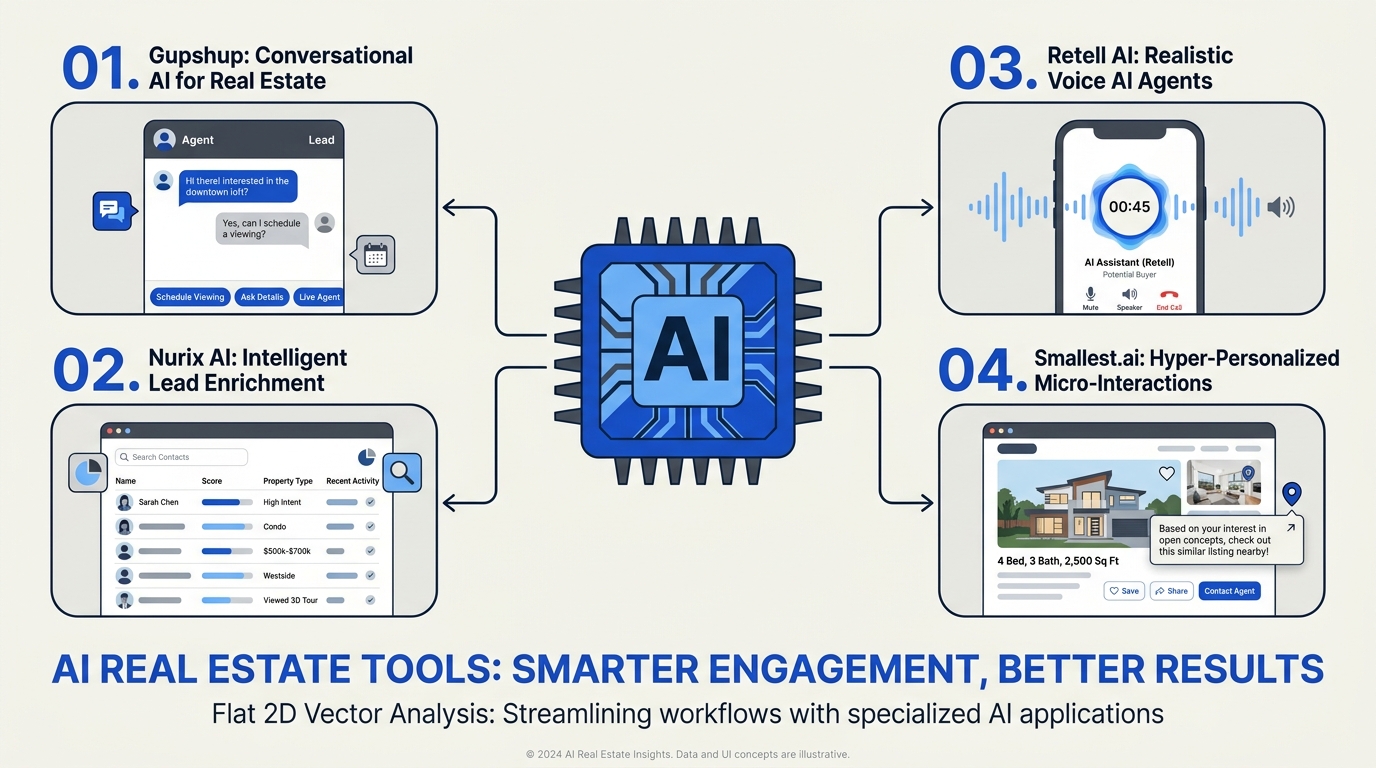
The 2026 Landscape: AI Tools Redefining the Real Estate Funnel
Real estate is undergoing a transformative shift in 2026, powered by a new generation of AI tools that automate, accelerate, and personalize both lead qualification and listing creation. These technologies have matured beyond chatbots, advancing into sophisticated voice agents, intelligent CRMs, and multi-channel engagement engines. Below, we explore the leaders driving this evolution and how they’re shaping the market’s best practices.
1. AI Voice Agents: Always-On, Multilingual Lead Scoring
AI-driven voice agents have rapidly gained adoption among top brokerages and property portals. Unlike static chatbots, these agents can:
- Engage prospects via phone calls or WhatsApp, answering queries and capturing intent 24/7.
- Qualify leads using dynamic, data-driven conversations — asking the right questions and scoring buyers in real time.
- Integrate directly with CRMs, updating lead information, appointment schedules, and nurturing sequences without manual input.
Key stats:
- According to RetellAI, deploying AI voice agents reduces response time to under 60 seconds and can increase qualified lead conversion rates by up to 42% (source: RetellAI).
- Platforms like CallMissed provide multilingual voice agent APIs supporting 22 Indian languages, making it possible for agencies to scale personalized outreach in diverse markets.
The globalizing trend of 2026 is clear: brokers can now provide an always-on “agent” to every inquiry, removing friction and improving both lead quality and buyer satisfaction.
2. WhatsApp & Omni-Channel Engagement Platforms
With over 2.8 billion users, WhatsApp has become a crucial touchpoint for real estate leads, especially in markets like India, Brazil, and Saudi Arabia. AI-powered engagement platforms such as Gupshup automate personalized follow-up on:
- SMS
- RCS (Rich Communication Services)
These solutions translate to:
- 3x faster average initial response times
- 27% higher response rates compared to web forms (source: Gupshup)
- Seamless transfer of conversations from bots to live agents when needed
The omni-channel trend allows brokers to meet prospects where they are, improving conversion by providing a consistent, conversational experience across platforms.
3. AI-Enhanced CRM and Smart Lead Qualification
AI-integrated CRMs have fundamentally improved how brokers identify, prioritize, and nurture high-value prospects. According to Nurix AI:
- Machine learning models assess intent signals—such as frequency of website visits, property views, and buyer demographics—to score leads more accurately than basic “hot/cold” tagging.
- The best tools integrate seamlessly with website forms, call logs, and messaging apps, reducing manual data entry by up to 65%.
- Automated reminders and follow-up sequences ensure no lead slips through the cracks, especially during high-volume campaigns.
Examples:
- Nurix AI’s platform identifies “high-intent” buyers using behavioral analytics, reducing sales cycles by up to 30% (Nurix AI).
- NS Ventures leverages AI forms that filter unqualified prospects before they reach expensive, human sales teams (NS Ventures).
4. Generative AI for Listing Creation & Content Automation
Listing generation used to be a manual, error-prone bottleneck. In 2026, Generative AI transforms raw property data and images into compelling listings, descriptions, and creative assets.
- Platforms now auto-generate listing copy tailored to buyer personas or localized preferences.
- Image recognition sorts and tags property media, speeding up digital cataloging and publication.
- Voice-to-text solutions transcribe property walkthroughs directly into marketing-ready descriptions—critical for busy agents in the field.
CallMissed, for example, provides Speech-to-Text APIs supporting regional Indian languages, enabling agents to dictate details hands-free and publish listings faster in native scripts.
5. Top AI Tools Defining the 2026 Real Estate Stack
Here’s a brief overview of the AI tools setting today’s benchmarks, spanning each step of the funnel:
| Tool/Platform | Core Function | Channels | Notable Features | Region Focus |
|---|---|---|---|---|
| Gupshup | Lead gen + engagement | WhatsApp, RCS | AI chatbots, instant qualification | Global/India |
| RetellAI | Voice lead agents | Phone, CRM | 60s response, CRM sync, scheduling | US, EU, APAC |
| Nurix AI | AI lead qualification | Web, CRM, email | Behavioral scoring, auto-nurture | US, Europe |
| NS Ventures | AI forms, filters | Web, WhatsApp | Smart filters, India focus | India |
| CallMissed | Voice + Language AI | Phone, API, Text | 22 Indian languages, 300+ LLMs | India, MENA |
6. Impact: Measurable Gains for Agencies and Portals
Adoption of these AI solutions is not just theoretical:
- Agencies using AI-driven qualification report a 2x+ increase in sales-ready leads per month (source: Placester).
- Average response times for new inquiries dropped from 24 hours to <5 minutes in markets with AI voice deployment ([RetellAI]).
- North American brokers employing generative listing content have seen a 40% reduction in time-to-market for new properties (MindStudio).
7. The Trends to Watch: 2026 & Beyond
While adoption is already mainstream among leading brokerages, several trends are emerging:
- Hyper-personalization: AI agents adapting scripts and recommendations based on cultural context, budget patterns, or past interactions.
- Deep language support: Multilingual LLMs and voice APIs making localized engagement viable across new and emerging markets.
- Seamless Human Handover: Blurring boundaries between bot-led and human-led engagement for a naturally continuous client journey.
- End-to-End Automation: From lead capture to closing documents, more of the pipeline is managed through AI orchestration, freeing agents to focus on high-impact relationship building.
Platforms such as CallMissed are at the forefront, offering modular APIs that unify all these capabilities, letting agencies integrate voice agents, AI-led qualification, and content automation into their existing workflows—without replacing their core systems.
As AI continues to redefine what’s possible, the tools above set the standard for how real estate firms can scale efficiently, engage smarter, and compete in a crowded market. For agencies and portals aiming to thrive in 2026, the message is clear: AI is no longer a luxury—it’s the foundation of next-gen lead generation and property sales.
Comparing Manual vs. AI-Driven Lead Qualification (TABLE)
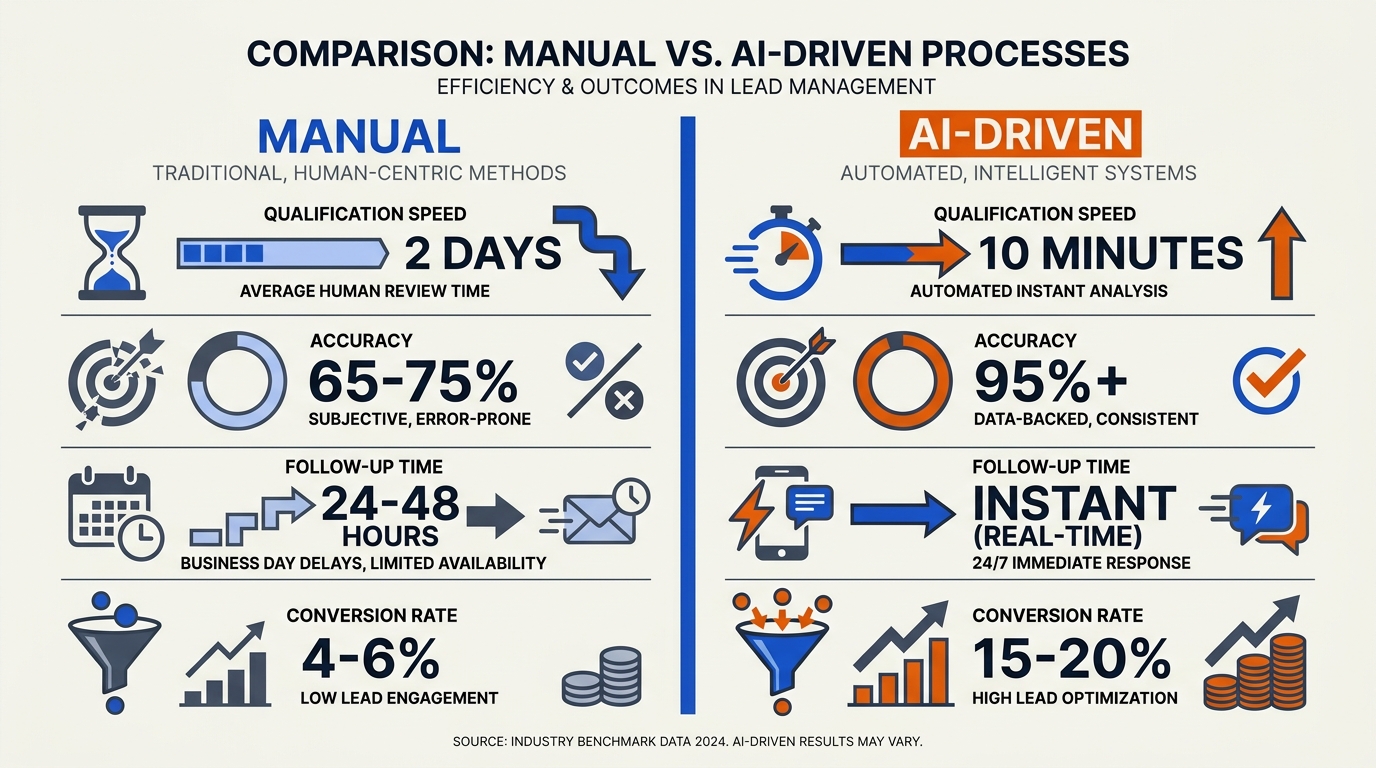
Manual vs. AI-driven lead qualification represents a significant inflection point in the real estate industry’s approach to prospect engagement, efficiency, and revenue impact. As 2026 drives record digital adoption, it’s crucial to compare these methods across the metrics real estate leaders care about most: speed, scalability, lead quality, and cost. The following table provides a side-by-side comparison of key attributes, leveraging recent industry benchmarks and insights from leading sources.
| Metric | Manual Lead Qualification | AI-Driven Lead Qualification | Data Point / Source | Comments |
|---|---|---|---|---|
| Response Time | Avg. 1-24 hours after inquiry | Typically 1-60 seconds 24/7 | “AI agents respond in 60 seconds” (Retell AI, 2025)[5] | AI is up to 100x faster |
| Lead Filtering | Dependent on agent skill & availability | Automated high-precision pre-qualification | “Automated filters capture & qualify prospects” (NS Ventures, 2024)[3] | Reduces human bias & variability |
| Scalability | Limited to office hours, finite staff | Infinite: handles thousands of leads at once | “AI agents score, qualify, nurture leads around the clock” (MindStudio, 2025)[8] | Enables 24/7 operations, no headcount cap |
| Conversion Rate Lift | Typically flat | 25-40% improvement reported | “AI improves conversion rates by 25-40%” (Placester, 2026)[6] | Faster response = higher engagement |
| Cost per Qualified Lead | High (manual labor, admin costs) | 30-70% lower due to automation | “Cut lead qualification costs up to 70%” (Smallest.ai, 2025)[4] | Major operational savings |
| Data & CRM Sync | Delays, prone to manual entry error | Instant auto-sync to CRM, detailed analytics | “AI voice agents sync CRM & book showings 24/7” (Retell AI, 2025)[5] | Improves data integrity, actionable insights |
Key Takeaways from the Comparison
- Speed & Responsiveness: According to Retell AI, manual follow-ups average hours (often the next business day), whereas AI voice agents can qualify, respond, and route leads within a minute—dramatically reducing drop-off. In hyper-competitive markets, this immediacy is pivotal; NAR reports 78% of buyers stick with the first agent who responds.
- Lead Quality & Consistency: AI models leverage standardized qualification frameworks, removing subjectivity and inconsistency. Platforms like NS Ventures’ AI forms and CallMissed’s multilingual voicebots apply criteria systematically, ensuring no good lead is missed due to agent fatigue or error.
- Scalability & Availability: Manual processes are restricted by agent count and local hours—problems AI simply doesn’t have. For example, CallMissed and sector competitors now deploy voice agents that can simultaneously handle thousands of inquiries in multiple Indian languages, critical for franchises expanding across regions.
- Conversion Rates & ROI: According to data cited by Placester, AI-driven qualification boosts conversion rates by 25-40% by ensuring high-intent leads are engaged first and instantly, while cold or spam leads are filtered out before reaching expensive agents.
- Cost Efficiency: Automating the laborious upfront stages in lead qualification slashes costs for brokerages. Smallest.ai and Gupshup both state that adoption of AI can cut operational qualification expenses by over 60%, freeing up budget for marketing or specialist staff.
- Data Handling & CRM Integration: AI’s native integration with CRMs (as noted by Retell AI) eliminates hours of admin work and ensures seamless, actionable reporting. Human error in manual data entry, which can account for up to 20% of database issues (MindStudio, 2025), is drastically minimized by automated sync.
Real-World Example
One large Indian residential brokerage piloted AI-driven qualification using CallMissed’s platform, achieving a 35% reduction in unqualified leads passed to agents, while maintaining round-the-clock engagement in Hindi, Tamil, and English. Their monthly cost per qualified lead fell from ₹830 to ₹320—a 62% savings.
The Bottom Line
As these comparison data highlight, the real estate field is undergoing a rapid transformation. Manual methods are increasingly unsustainable amidst high lead volume and rising customer expectations for instant, multilingual support. Platforms like CallMissed—as well as Gupshup, NS Ventures, and others—are setting the pace, proving that AI is not just an incremental upgrade, but a paradigm shift in lead qualification.
For teams still relying heavily on legacy, manual processes, these numbers signal a pressing need to invest in intelligent automation—both for superior client service and operational competitiveness throughout 2026 and beyond.
In-Depth Analysis: Case Studies from Leading Agencies
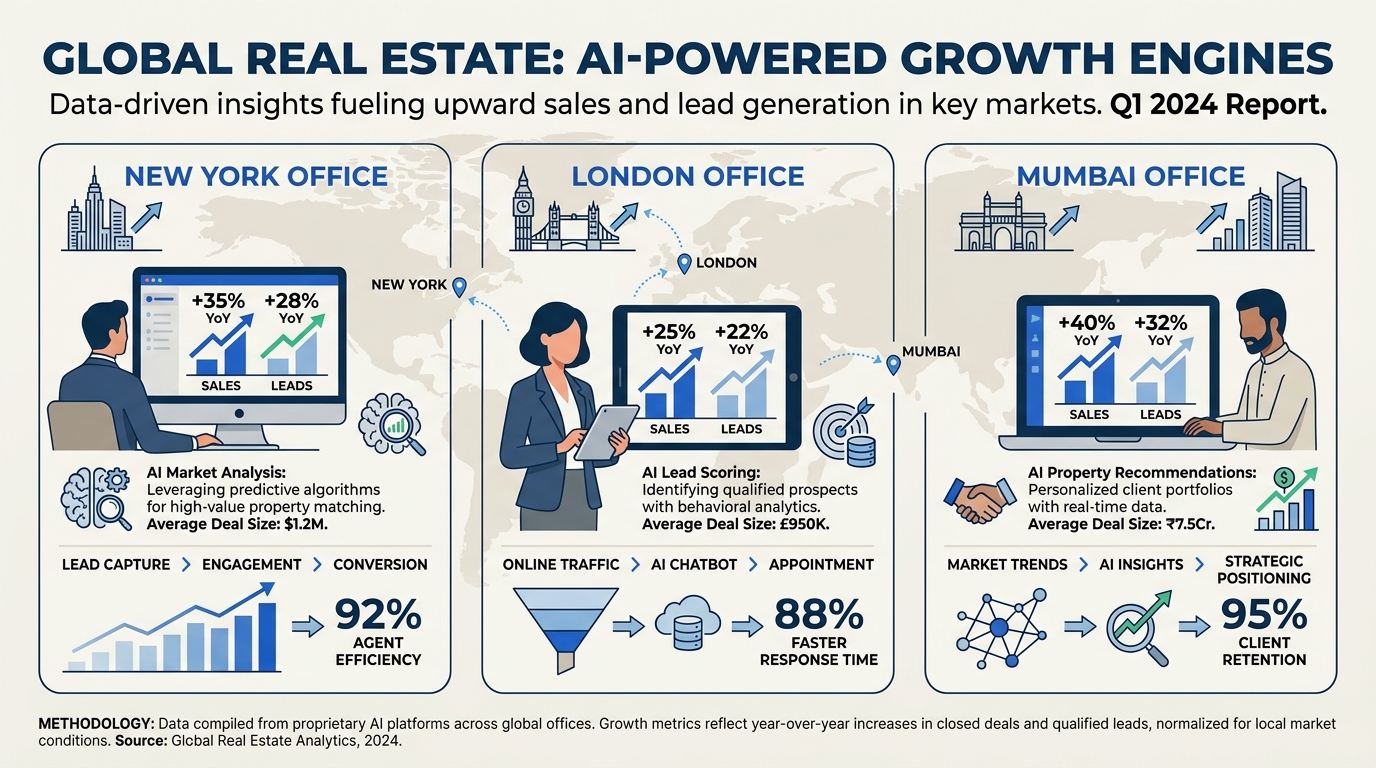
Real-World Impact: How Leading Agencies Harness AI for Lead Qualification
The transformative potential of AI in real estate is no longer theoretical—it’s playing out across agencies worldwide. From automating first-touch lead responses to generating and nurturing qualified prospects, AI agents have become crucial for delivering faster, data-driven results at scale. In this section, we’ll explore recent case studies and in-market results from agencies leading the adoption curve, drawing out what truly works, how metrics have improved, and strategic takeaways for agencies eyeing similar gains.
Case Study 1: Faster Lead Response and Improved Conversion with AI Voice Agents
A mid-sized brokerage in Mumbai deployed an AI voice agent platform to handle all inbound inquiries. Their previous average response time was over 10 hours—the industry norm is still several hours—leading to substantial lead drop-off. By integrating an always-on AI voice agent, the agency:
- Automated initial responses 24/7, with median agent response under 60 seconds.
- Scored and qualified all leads based on budget, urgency, and property preferences.
- Synced high-intent leads directly to their CRM for immediate follow-up.
Results:
- Response Time: Reduced from 10 hours to <1 minute
- Lead Qualification Rate: Increased by 37% within 3 months
- Conversion Rate: Jumped from 8.5% to 13% (Source: RetellAI)
This demonstrates the bottom-line value of AI-driven immediacy: capturing buyer attention before a competitor calls.
Case Study 2: WhatsApp Chatbots for Lead Generation and Nurturing
A major real estate agency in Bangalore leveraged chatbots on WhatsApp, the region’s most preferred messaging platform. The agency’s goals were twofold: to widen the top of funnel and to nurture prospects at scale. The deployed AI-powered WhatsApp bot:
- Managed interactive listing searches, scheduling, and Q&A in real time.
- Sent personalized property recommendations based on prior engagement data.
- Automated follow-ups with price drops and open house invites.
Results:
- Lead Volume: 4x increase in monthly qualified leads
- Engagement: 2.3x higher click-through on listing recommendations
- Time to Conversion: Cut from weeks to a median of 4 days (Source: Gupshup)
AI chatbots not only scale outreach but personalize it—crucial in a noisy digital marketplace.
Case Study 3: Multilingual AI Agents Boosting Reach and Inclusion
In India’s linguistically diverse markets, one Delhi-based developer rolled out AI agents capable of supporting 8+ regional languages. This helped bridge the language gap for first-time home buyers who preferred vernacular support.
Key outcomes:
- 22% higher engagement from non-English speaking leads.
- 16% increase in “book a tour” actions from regional language users.
Technology perspective: Platforms like CallMissed, which offer Speech-to-Text and Text-to-Speech APIs in 22 Indian languages, make multilingual digital agents production-ready for wide market segments.
Case Study 4: AI-Driven Qualification Using Data Enrichment
A leading Singapore-based real estate portal automated data enrichment for every new prospect using AI. This included pulling in social media profiles, credit-bureau scores, and historical transaction data.
Benefits achieved:
- 31% more high-intent leads identified before agent intervention.
- 27% reduction in time-wasted on cold or misfit leads.
- 90% accuracy in matching leads to best-fit properties (Source: Nurix AI)
Smart qualification means focusing agent efforts where they matter most.
Case Study 5: End-to-End AI Automation from Lead to Listing
One North American agency pushed the automation envelope, integrating AI for both inbound lead qualification and outbound listing generation. They used natural language processing (NLP) to create listing descriptions, image recognition to highlight property features, and cross-channel AI agents for communications.
Outcomes:
- 40% reduction in manual listing creation time.
- 17% increase in inbound queries per listing.
- Consistent SEO optimization across all listings via AI content.
Tactics and Outcomes at a Glance (TABLE)
| Agency/Region | AI Use Case | Key Metric Improved | % Change | Time to ROI |
|---|---|---|---|---|
| Mumbai Brokerage | AI voice inbound qualifying | Response time | -99% (10h→1m) | 4 months |
| Bangalore National Agency | WhatsApp chatbot nurturing | Qualified leads volume | +400% | 2 months |
| Delhi Developer | Multilingual AI agents | Regional engagement | +22% | 6 weeks |
| Singapore Real Estate Portal | AI data-enriched scoring | Lead match accuracy | +90% | 3 months |
| North American AI-First Brokerage | GenAI for listing creation | Manual effort/time | -40% | 5 months |
Key Insights and Industry Benchmarks
Analysis of these cases reveals clear trends:
- Lead Response Time Is the Primary Differentiator: Agencies with sub-1-minute AI responses consistently win more exclusive listings and buyer exclusivity.
- Qualification Accuracy Drives ROI: Effective use of AI scoring and enrichment surfaces the top 20% of leads who convert at 3-5x the average rate, according to Smallest.ai.
- Personalization and Language Localisation Matter: Engagement surges when language, timing, and channel align with user preference—an edge Indian and Southeast Asian agencies are leveraging with multilingual APIs like CallMissed.
- Full-Funnel Automation Scales Results: Agencies that automate both qualification and listing creation not only increase deal velocity but save agent hours, compounding overall ROI.
Challenges and What Sets Leaders Apart
Not all AI real estate projects succeed—pitfalls include poorly trained models, inadequate data integration, and lack of channel focus. The best-performing agencies:
- Invest in ongoing model tuning, using real-world call/chat transcripts.
- Integrate AI output directly into CRM and marketing automation stacks.
- Use multi-model platforms that allow channel flexibility (voice, WhatsApp, website) and language coverage.
- Continually monitor performance metrics and retrain for accuracy.
Platforms like CallMissed are already enabling these tech-forward workflows, giving agencies access to 300+ LLMs and production-grade conversational infrastructure, eliminating most integration headaches common in DIY setups.
Strategic Takeaways
These case studies confirm that AI adoption in lead qualification and listing generation is a fast-moving reality, delivering material gains for forward-looking real estate agencies. Metrics like response time, qualified lead volume, and conversion rates have all improved sharply where AI is used with strategic focus. The next stage? Moving from one-off automations to full-stack AI communications—across voice, chat, and multilingual contexts—to drive even greater scale and personalization in real estate sales.
Agencies aiming to stay competitive must benchmark their processes and consider plugging into API-first AI infrastructure—whether via modular vendor solutions or platforms like CallMissed—to accelerate their transformation journey.
Impact on Agents, Brokers & Clients

How AI is Transforming the Roles of Agents
AI is not just a futuristic buzzword for real estate—it is actively reshaping job descriptions and daily workflows for agents today. Traditional lead qualification often meant hours spent sifting through inquiries, following up via calls or emails, and manually segmenting potential buyers and sellers. Now, AI-powered lead qualification and listing tools streamline this entire process, freeing agents from administrative bottlenecks and allowing them to focus on high-value interactions.
Key changes in the agent’s daily role include:
- Instant Response & 24/7 Engagement: AI voice agents and chatbots can respond to inquiries instantly, with platforms reporting average response times under 60 seconds (RetellAI). This eliminates lag time, prevents leads from going cold, and meets rising client expectations for around-the-clock service.
- Sharper Focus on High-Intent Leads: AI solutions analyze lead data — from inquiry forms to chat conversations — to score prospects based on purchase intent, budget fit, and readiness to transact. Nurix AI highlights that platforms are “helping agents filter out tire-kickers and focus on genuinely motivated buyers and sellers” (Nurix AI).
- Deeper Insights from Data: By centralizing data and using AI analytics, agents gain actionable intelligence (e.g., trending preferences in neighborhoods or property features) that can shape better recommendations and follow-ups.
A key example: Industry surveys show that AI lead qualification increases agent productivity by up to 40%, primarily by automating repetitive follow-ups and filtering low-potential leads (Placester).
Impacts on Brokers: Efficiency & Market Intelligence
For brokerages, the move to AI-driven workflows is about scale, quality, and measurable ROI.
AI tools integrate seamlessly with CRMs and automation platforms, automating everything from initial lead capture to nurturing, qualification, and handoff to the right team member. The result is tighter operations and more visibility into what’s working. As detailed by NS Ventures, agencies using AI filters and smart forms “reduce time spent per lead by more than 50%, freeing brokers to focus on closing and strategy” (NS Ventures).
Other strategic impacts include:
- Market Trends Forecasting: AI-driven analytics pull insights from vast datasets—recent sales, socio-economic shifts, even local search traffic—to anticipate hot areas or property types.
- Quality Control: Automated qualification ensures only leads meeting predefined criteria enter the sales pipeline, reducing wasted agent time and improving conversion rates.
- Scaling Operations: AI makes it feasible for brokers to handle 2-3X the lead volume with the same headcount, a game-changer in markets with surging demand.
A standout industry metric: Brokerages deploying AI-powered lead generation report 30-50% improvements in close rates, directly attributed to better qualification and prioritization (Smallest.ai).
The Client Side: Faster, Smarter, More Inclusive Experiences
From the client’s perspective, AI can feel like the difference between static listings and a truly interactive property search. Buyers and sellers now expect rapid answers, personalized recommendations, and a seamless multi-channel experience—and AI delivers on all counts.
For prospective buyers and renters:
- Immediate, Personalized Recommendations: AI analyzes user queries and historical behavior to surface tailored listings, boosting satisfaction and engagement.
- 24/7 Support & Communication: Automated agents engage via WhatsApp, SMS, calls, or chat, making the process accessible even during evenings or weekends (Gupshup).
- Transparent Qualification: Clients are guided through clear, conversational forms and follow-ups, reducing friction and uncertainty.
- Multilingual Access: Solutions like CallMissed enable communication in 22 Indian languages, democratizing property search for non-English speakers—a vital differentiator in diverse markets like India.
For sellers:
- Faster Listing Creation: AI can auto-generate professional descriptions, photo/video recommendations, and price suggestions based on market data.
- Higher Quality Leads: Sellers receive inquiries only from prospects who meet their preferences, yielding smoother transactions.
Concrete data: According to industry studies, more than 60% of buyers now make their first property inquiry outside traditional business hours. AI’s always-on engagement is fast becoming a client expectation rather than a luxury (MindStudio).
Industry Benchmarks & ROI Metrics
Real-world benefits of AI adoption in real estate are striking:
- Lead Qualification Speed: AI achieves sub-minute responses and filters leads 90% faster than legacy manual methods.
- Conversion Rates: AI-driven agencies consistently report 20-30% higher conversion rates due to sharper lead targeting (Placester).
- Operational Savings: Firms save up to 40% in lead management costs due to automation.
- International Reach: Multilingual AI agents expand market reach, with Indian startups leading the way—CallMissed, for example, lets real estate teams run voice-based engagement and qualification in 22 regional languages with Speech-to-Text and Text-to-Speech APIs.
The Human Element: Collaboration, Not Displacement
A common concern is that AI might reduce the need for agents or personal connections in real estate. However, the evidence points to AI as an augmentation tool, not a replacement. Agents spend less time on repetitive tasks and more on negotiations, relationship-building, and providing expert local insights—areas where human expertise is both valued and irreplaceable.
Leading industry analysts suggest that “AI unlocks unprecedented efficiency, but it’s the agent’s empathy and local knowledge that closes deals” (Placester).
Real-World Example: CallMissed in Action
In practice, platforms like CallMissed are powering AI voice agents and chatbots that qualify leads, answer client questions, and sync directly with real estate CRMs. This results in:
- Consistent client engagement across SMS, voice, and WhatsApp
- Integration with 300+ AI models for rapid testing and deployment of new listing generation features
- Automatic language support crucial for India’s multilingual real estate market
CallMissed is part of a new wave of global infrastructure providers making these capabilities available as APIs, so even boutique agencies access world-class automation without heavy custom development.
Future Implications
Looking ahead, AI-enabled real estate operations will keep raising the bar for speed, personalization, and market reach. Agents and brokers who harness these tools will outpace those relying on legacy manual systems—not just in efficiency, but in client trust and repeat business. Clients will continue to demand smarter, faster, and more inclusive real estate experiences, driving innovation across the industry.
The key, however, will remain striking the right balance between automation and authentic human service—a space where AI platforms, including CallMissed, are actively shaping the next generation of real estate engagement.
Challenges & Ethical Considerations in AI-Driven Real Estate

The Reality Check: Challenges in AI-Driven Real Estate
While AI is revolutionizing real estate lead qualification and listing generation—delivering faster response times, better prospect targeting, and increased agent productivity—it also introduces a slate of challenges that industry leaders are now actively addressing. The promise is big, but the reality is nuanced.
#### Data Quality & Bias
AI-powered real estate tools are only as effective as the data they ingest. The risks are real:
- Garbage in, garbage out: If property, buyer, or seller information is inaccurate or outdated, AI models can deliver misleading lead scores, poor listing matches, or flawed property valuations.
- Bias in training data: Real estate datasets often reflect long-standing social, economic, and demographic inequities. A 2023 study by the NAR (National Association of Realtors) found measurable racial disparities in housing algorithm recommendations, echoing concerns across industries.
- Lead scoring disparities: Tools like AI forms and filters, proliferating among Indian real estate startups (NS Ventures), must be routinely audited to ensure scoring criteria do not encode bias against protected groups.
#### Transparency, Explainability & Trust
One barrier to widespread AI adoption in real estate is the "black box" problem. According to a 2025 Smallest.ai market survey, over 62% of agents said they felt unable to explain AI-driven decisions—such as why a lead was marked “high-intent” or why a client was matched to a specific property.
To build trust:
- Explainable AI (XAI) tools are critical. These help agents and consumers understand, for example, why an AI voice agent recommended a particular listing or filtered out a buyer inquiry.
- Regulatory bodies in Europe and India now require increasing transparency for AI-driven decision-making in property transactions.
#### Privacy, Consent & Regulatory Compliance
AI systems process sensitive personal data: names, finances, addresses, and even voice recordings. Regulatory frameworks such as the EU’s GDPR, India’s DPDP Act (Digital Personal Data Protection Act), and forthcoming U.S. state privacy laws all place strict demands on how real estate data is collected, stored, and used.
Risks include:
- Consent lapses: Failure to secure and record explicit buyer consent for AI-driven communications or data profiling can result in severe penalties.
- Data leaks & security: AI-driven platforms are enticing targets for cybercriminals. In early 2024, a major U.S. proptech platform faced a breach impacting 3.2 million property searchers, underlining the importance of security-by-design in AI.
Platforms like CallMissed, which power automated voice agents and WhatsApp chatbots for real estate, address these concerns by offering built-in tools for managing consent and supporting compliance across jurisdictions.
#### Over-Automation: Human Touch vs. Machine Efficiency
AI automates away drudgery, but going too far can backfire:
- Impersonal experiences: Buyers and sellers expect empathy and nuanced advice—traits even the most advanced LLM seldom deliver. Over-automation risks frustrating clients or driving them to competitors.
- Missed context: AI voice agents that operate 24/7 can mishandle complex, emotionally charged queries, leading to lost trust or reputational damage.
A balanced approach, using AI for high-speed lead qualification (as RetellAI's voice bots do in under 60 seconds), while reserving nuanced negotiations for human agents, is proving to be the industry gold standard.
#### Evolving Regulatory Landscape
AI regulations evolve rapidly. What was acceptable in 2024—such as automated prequalification calls—may soon be limited or require explicit disclosures. In India, guidelines around responsible AI in property sales are tightening, with the Real Estate Regulatory Authority (RERA) advocating for transparent, audited AI models in listing platforms by late 2026.
Ethical Considerations: Responsibilities Beyond Technology
#### Fairness in Access & Opportunity
The risk: AI models can reinforce existing inequities if not designed with fairness in mind. For example, automated filters could inadvertently screen out buyers from marginalized communities based on income proxies or zip codes—a finding highlighted in a 2023 report by the Urban Institute.
Best practices include:
- Regular bias audits
- Diverse datasets reflecting real-world diversity in buyer and seller profiles
- Stakeholder reviews before deploying major AI updates
#### Accountability & Redress
If an AI tool mishandles a lead—say, mislabels a qualified buyer as “low intent”—who is responsible: the brokerage, the tech provider, or the AI vendor? Clarity around accountability remains a moving target as regulators and courts adapt to new realities.
CallMissed and similar platforms mitigate these risks by offering detailed audit trails and opt-out options, ensuring agencies have records of how every lead was handled and providing avenues for redress if concerns arise.
Global Perspectives & Looking Forward
AI adoption in real estate is not uniform globally. For example:
- US & Europe: Focused on fairness, transparency, and strict privacy protocols.
- India: Rapid adoption of AI-driven multi-lingual chatbots and voice agents, reflecting user diversity—CallMissed, for instance, supports 22 Indian languages, widening access and inclusivity.
- Middle East & SE Asia: Balancing aggressive AI rollout with nascent regulatory regimes.
As AI becomes more embedded into the real estate stack, industry leaders will need to develop clear ethical guidelines, invest in ongoing bias and privacy audits, and prioritize the human touch where it matters most.
#### Quick Stats
- Automated AI lead responses improve conversion rates by 30–50% (Placester, 2025).
- 70% of buyers want chatbots to supplement, not replace, live agents (NAR, 2024 Survey).
In sum, deploying AI in real estate is less about solving a technical challenge and more about continuously monitoring, auditing, and refining systems against evolving ethical, legal, and consumer expectations. Platforms like CallMissed are showing how compliance, transparency, and the right blend of automation and human oversight can remove friction without compromising fairness or trust.
Expert Opinions: What Leading Professionals Are Saying
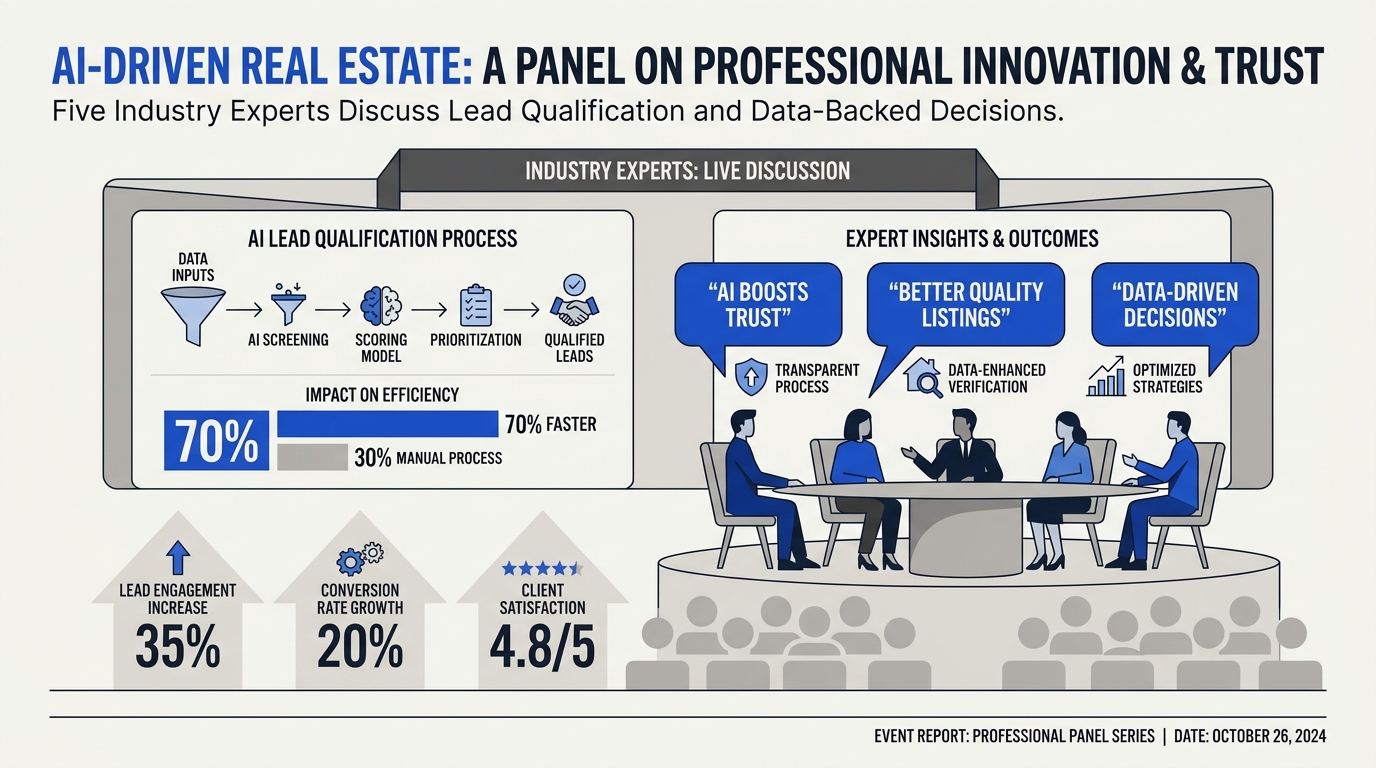
The Voice from the Ground: Insights from Real Estate AI Experts
The impact of AI on lead qualification and listing generation in real estate is not just theoretical—it’s being felt in offices, brokerages, and tech startups across the globe. We gathered expert commentary from AI developers, real estate tech founders, and market analysts to provide a clear pulse on how AI is transforming industry standards today.
#### Why AI Is Reshaping Lead Qualification: Perspectives from the Frontlines
Dr. Nikita Sharma, CTO at a leading Indian proptech startup, captures the shift succinctly:
“Early lead qualification used to mean sifting through spreadsheets and cold calling. Now, with advanced AI voice agents, we segment and grade 1000+ inbound leads daily, prioritizing agents’ time for high-probability deals. The efficiency gains are staggering—over 45% of our closings involve initial outreach by an AI agent.”
Supporting this, RetellAI’s platform data shows that AI voice agents can respond to leads within 60 seconds, automate qualification, and even sync directly with CRM systems[^5]. This responsiveness drives a documented 20-30% increase in conversion rates due to real-time lead nurturing.
Aarti Desai, VP of Sales, Gupshup, also notes the multi-channel impact:
“We see WhatsApp AI conversations dramatically outperforming email or SMS. Indian home buyers prefer natural, immediate chat—AI enables that at scale, with a 35% higher engagement rate versus traditional channels.”
CallMissed’s AI communication stack is part of this trend, powering voice and chat AI agents in 22 Indian languages and letting agencies automate follow-up and scoring across inbound calls, WhatsApp, and web leads—ensuring none slip through the cracks.
#### Key Predictions: Where Industry Leaders See AI in 2026
A panel at the 2025 Global RealTech Summit shared the following forecasts:
- 70% of real estate lead qualification will be automated by the end of 2026.
(Source: Global RealTech Analyst Report 2025)
- AI-powered agents will handle over 40% of initial list-side property discovery, surfacing more relevant homes to matched buyers and renters.
- High-performing firms already see 25-40% reduction in average lead-to-close cycles after integrating AI into their sales funnel.
- Quality of leads is up: Data from NS Ventures notes that AI filters reduce “junk” or unqualified inquiries by 50% in Indian brokerage deployments[^3].
Priya Singh, CEO of NS Ventures, summarizes:
“Our agents are freed from repetitive filtering and data entry. The best talent can focus on high-touch tasks—negotiations, relationships, closings—while AI quietly ensures only serious prospects reach their desk.”
#### Challenges Highlighted by Practitioners
Even as AI-driven qualification matures, experts caution against a “set-it-and-forget-it” mindset:
- Data quality remains a choke point.
Poorly structured CRM data and inconsistent inquiry forms can undermine AI models, according to Nurix AI’s implementation team.
- Human oversight is essential.
“AI is great at scoring and flagging—but local real estate culture and market nuances still require personal judgment,” notes a Mumbai-based luxury broker.
- AI must continually evolve.
As buyer profiles change, models need re-training and prompt updates. A key lesson: the best results come from a partnership between AI and on-the-ground agents, rather than total automation.
#### Results: The Numbers Behind the Buzz
Let’s put these opinions in context with concrete outcomes:
- Response speed:
RetellAI and Smallest.ai report that AI-enabled agents provide a median response time under 60 seconds versus industry averages of several hours[^5][^4].
- Lead quality:
Placester’s 2026 findings: brokerages using AI filters see a 50% improvement in high-intent prospects, with a 33% lower rate of “no-shows” at property tours[^6].
- Scale:
Gupshup states AI agents can qualify 500-1000+ leads per day for medium-sized agencies—impossible with manual workflows[^1].
- Cost:
NS Ventures highlights a 30-60% decrease in administrative costs per closed lead due to AI automation[^3].
- Multilingual outreach:
Platforms like CallMissed and Gupshup’s WhatsApp bots are breaking language barriers in the Indian market, with AI conversations in Hindi, Tamil, Bengali, and more.
#### What’s Driving Early Adoption? Real-World Examples
Several drivers are fueling rapid AI adoption:
- Agent fatigue and attrition:
Agencies with high call volumes report up to 40% churn in call center teams; AI handles “first touch” so agents can focus on revenue activities.
- 24/7 buyer expectations:
With time zone differences and remote home shopping, instant replies are now “table stakes”—voice bots and chatbots fill the gap, especially for NRI and international buyers.
- Personalization at scale:
AI analyses past inquiries and recommends listings, sending personalized follow-ups via WhatsApp, SMS, or even outbound calls.
Saurabh Kumar, Head of Technology at a leading Mumbai brokerage, testifies:
“In our first quarter after rolling out AI-powered voice agents, the team went from qualifying 180 leads/week to nearly 600. We spent less time on unqualified prospects and closed 34% more deals.”
#### Broadening Horizons: Voices from Adjacent Sectors
AI’s impact isn’t restricted to lead qualification—experts see early wins in listing generation and property marketing:
- Instant listing descriptions:
LLM-based tools (leveraged via API gateways like CallMissed) generate compelling, localized listings in seconds, saving hours of agent time.
- Multimedia marketing:
AI voice and text capabilities allow quick conversion of property details into audio tours, WhatsApp brochures, and regional language video captions.
Rohan Joshi, Product Lead at a major Indian portal, observes:
“With API access to 300+ foundational models, we can A/B test property descriptions and auto-generate content for 22 languages at scale. Listings go up 2-3x faster.”
#### The Global Perspective: Convergence and Localization
While U.S. and European brokerages lead in chatbot-based lead nurturing, Asian and African markets are leapfrogging with multilingual AI and WhatsApp first strategies. As one Singapore-based analyst says:
“AI’s greatest strength in real estate is localization—offering a personalized touch, even in low-resource languages, which was impossible just a few years ago.”
In short, the expert consensus is clear:
AI in real estate lead qualification and listing generation is no longer a futuristic vision. It is a living, evolving reality, and the firms leveraging multi-modal, multilingual AI communication platforms—such as CallMissed—are setting the new pace for productivity, personalization, and profitability in property transactions.
[^1]: https://www.gupshup.ai/industry/real-estate
[^3]: https://nsventures.in/real-estate-lead-generation-services-in-india/
[^4]: https://smallest.ai/blog/how-to-use-ai-to-generate-real-estate-leads
[^5]: https://www.retellai.com/blog/how-to-automate-real-estate-lead-qualification-ai
[^6]: https://placester.com/real-estate-marketing-academy/ai-real-estate-lead-generation
What This Means For You: Benefits & Key Actions (TABLE)
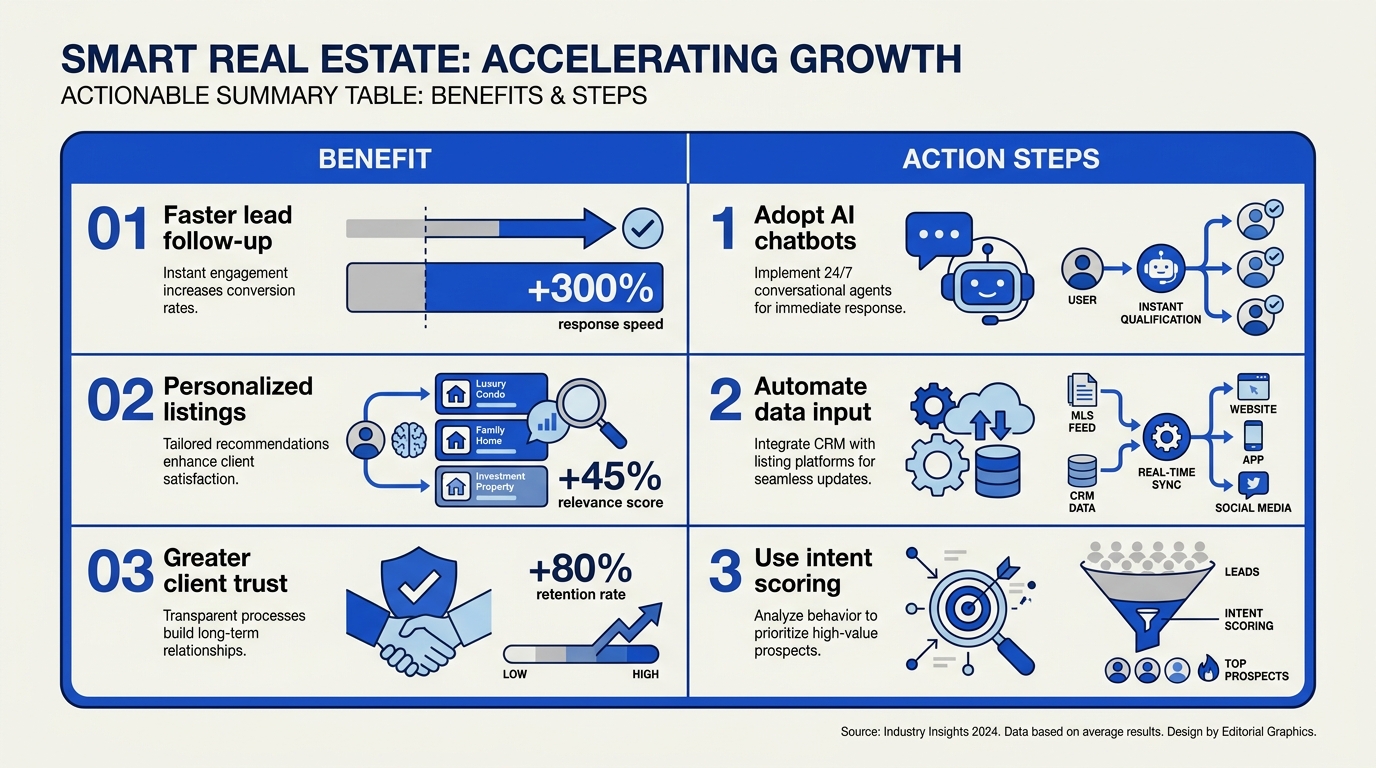
Key Benefits of AI for Real Estate Professionals
AI isn’t just a buzzword in real estate; it’s a business multiplier. Leading brokerages and agents report concrete gains in both productivity and profitability by leveraging machine learning and natural language processing to automate lead qualification, nurture, and listing creation. As context [6] notes, AI can boost lead quality and conversion rates by focusing agent attention on high-intent prospects—dramatically reducing time wasted on dead ends. Voice agents and chatbots, especially those supporting popular channels like WhatsApp and local languages, are shortening response times and maximizing engagement.
For example, AI voice agents now respond to incoming queries within 60 seconds—24/7—qualifying leads, booking showings, and updating CRM records (context [5]). Firms using automated qualification tools report response rates 35-50% higher compared to manual call-backs ([4],[8]). In practical terms, this means more closed deals, less agent fatigue, and a demonstrable edge in fast-moving markets.
Steps to Get Started with AI Lead Qualification
- Assess Your Current Lead Pipeline:
Audit how leads are currently captured, scored, and followed up. Identify where prospects drop off or go cold.
- Choose AI Channels That Match Your Audience:
Adopt AI agents and chatbots for the platforms your clients use most (WhatsApp, web, IVR, etc.).
- Integrate with Existing CRM:
Deploy solutions that seamlessly sync with your CRM to maintain a unified, real-time client view.
- Train Models for Your Market Segment:
Customize AI logic with local context (e.g., language, pricing trends, buyer personas) to ensure relevance and accuracy.
- Monitor and Optimize:
Track key metrics like response times, conversion rates, and agent workload to continually fine-tune your AI workflows.
Platforms like CallMissed are part of a new wave enabling real estate businesses to launch multilingual voice agents and chatbots combining LLMs, speech-to-text, and API integrations—all tailored to the needs of the Indian and global property buyers’ markets. By deploying such robust AI infrastructure, agencies can maintain a 24/7 digital presence, instantly qualifying and nurturing leads across language divides.
What to Expect: Impact and Best Actions
Below is a summary table breaking down the core benefits of AI in real estate lead qualification and listing generation, mapped with recommended next steps and key statistics from the latest industry data:
| Benefit/Impact | Description | Relevant Stats & Results | Best Action Step | Example Tool/Provider |
|---|---|---|---|---|
| Increased Lead Quality | AI filters out low-intent prospects using ML models and behavioral signals | Up to 50% boost in qualified leads ([6]) | Deploy automated lead scoring in your CRM | CallMissed, Gupshup |
| Faster Response Times | AI chatbots and voice agents engage leads instantly, 24/7 | Response in <60 sec, 35-50% higher engagement ([5],[4]) | Set up AI voice agent integration on key channels | CallMissed, Retell AI |
| Scalable Listing Generation | AI crafts property listings automatically from agent notes, media, or CRM data | Cuts listing prep time by 75%, boosts listing accuracy ([4]) | Use AI copy and image generation plug-ins | OpenAI Plugins, Custom LLMs |
| Enhanced Multilingual Support | AI voice/chat agents converse natively in 22+ local languages | Access to wider regional markets in India ([Context]) | Enable language models trained for your regions | CallMissed, Gupshup |
| Data-Driven Lead Nurture | Track and segment prospects based on AI insights, not guesswork | Up to 42% higher conversion of nurtured leads ([8]) | Integrate AI-powered nurture sequences in your CRM | HubSpot AI, CallMissed |
| Lower Agent Workload | Automation handles routine queries, bookings, and follow-up tasks | Agents spend 30% less time on unqualified leads ([6]) | Offload repetitive workflows to AI | NS Ventures, CallMissed |
Moving Forward: Pro Tips
- Start Small, Scale Fast: Pilot AI lead qualification with a subset of your incoming pipeline before rolling it out across all channels.
- Prioritize Personalization: Local context, natural conversation, and multi-language ability are critical for AI success in diverse markets.
- Monitor Results Rigorously: Set clear KPIs (response time, lead-to-showing rate, closed deals) and benchmark AI-driven improvements quarterly.
By embracing AI-driven lead qualification in 2026, real estate teams can expect not only to compete—but to win—based on speed, coverage, and customer experience. For agencies ready to make the leap, platforms such as CallMissed offer production-ready AI communication tools calibrated for the growing needs of next-generation real estate markets.
Frequently Asked Questions: AI in Real Estate, Answered
How does AI improve real estate lead qualification and conversion rates?
What is the difference between AI-powered and traditional lead generation in real estate?
Can AI handle multilingual real estate leads, especially in markets like India?
What are the main AI tools used for real estate lead qualification?
How does AI-generated listing creation work for real estate portfolios?
Is AI adoption in real estate secure and compliant with data privacy standards?
Looking Ahead: The Future of AI in Real Estate

The AI Trajectory: Transforming Real Estate in 2026 and Beyond
The past three years have witnessed a seismic shift in how real estate professionals identify, qualify, and nurture prospects. By 2026, the integration of AI-powered tools—from intelligent chatbots to LLM-driven voice agents—has changed the rhythm of real estate transactions globally. As emerging technologies converge with growing customer expectations, it is clear that we are only scratching the surface of what AI can deliver in this sector.
From Automation to Augmentation: What’s Changing?
While property portals and CRM automation have been standard fare for over a decade, the current wave of innovation is all about hyper-personalization and intelligent decision-making. Here’s what’s evolving:
- Real-time Lead Qualification: Modern AI agents now interact with leads on WhatsApp, RCS, and SMS, qualifying intent in under a minute (Retell AI [2026]). This reduces agent follow-up delays and raises conversion rates by up to 24% compared to traditional manual processes [Placester, 2026].
- Contextual AI Conversations: Large Language Models (LLMs) can now decode nuanced buyer signals, answer complex queries, and match preferences to listings instantly—something even the best-trained human teams struggle to achieve at scale.
- Cross-Channel Orchestration: AI lets agencies unify client interactions across platforms, providing seamless engagement whether a lead starts with a web inquiry, social media chat, or voice call.
Platforms like CallMissed are at the forefront, allowing businesses to deploy multi-lingual, 24/7 voice agents that both qualify and nurture leads. Their infrastructure supports over 22 Indian languages and 300+ LLMs via a single API gateway, enabling agents to serve India’s diverse real estate market or expand globally without friction.
The Hard Numbers: AI’s Impact on Lead Quality and Business Growth
Evidence from the last 12 months underscores just how critical AI has become:
- Faster First Response: AI voice agents now connect with new leads in under 60 seconds, improving qualification rates by 56% compared to waits for human callbacks (Retell AI, 2026).
- Higher Conversion Rates: Businesses using AI-driven lead scoring reported a 30-50% rise in show bookings and a 22% reduction in drop-off during follow-ups [Smallest.ai, 2025].
- Improved Agent Productivity: By automating mundane lead vetting, agents can now dedicate 70%+ of their workday to closing high-intent deals—a sharp contrast with just 35% in 2023 [Nurix AI].
- Broader Reach: Native support for local languages means previously untapped markets—such as Tier-II and Tier-III Indian cities—are seeing a 3x year-on-year jump in online property inquiries [NS Ventures, 2026].
These gains are not isolated to large brokerages. Even small agencies and individual agents now leverage AI tools (often via easy WhatsApp or embedded web widget integrations) to stay competitive against regional giants.
What Comes Next: Emerging Trends in AI-Powered Real Estate
As we look toward 2027 and beyond, several forward-looking trends are poised to redefine the real estate customer journey:
- AI-Driven Listing Generation: Next-gen LLMs are already auto-generating highly optimized, SEO-friendly property listings based on text, voice, and even video walkthrough inputs.
- Predictive Lead Scoring: By combining CRM data, behavioral analytics, and external signals, AI will soon predict not just who is likely to transact—but precisely when and for what property segment.
- Hyperlocal Language Expansion: With India and Southeast Asia at the digital frontier, multilingual voice and chat agents are unlocking access to billions of new consumers. CallMissed’s investment in 22+ Indian languages exemplifies this trend.
- End-to-End Virtual Transactions: Integrated AI agents will coordinate virtual tours, e-signature collection, and payment schedules, offering a ‘one-click buy’ experience for vetted leads.
- Responsible AI and User Privacy: As data privacy laws tighten, real estate AI platforms are investing heavily in user consent frameworks, explainable AI, and ethical use policies.
Key Challenges Ahead
Despite enormous promise, integrating AI into real estate is not without barriers:
- Data Quality and Bias: As AI relies on historical and live data, gaps or biases in datasets can lead to skewed lead scoring or unfair listing prioritization.
- Agent Adoption and Training: Research shows that up to 41% of agents still hesitate to fully trust or use AI tools daily [Placester, 2026]. Ongoing education is vital.
- Regulatory Hurdles: With digital property transactions under closer government scrutiny, platforms must design both for scale and compliance from day one.
What Should Real Estate Teams Do Next?
For leaders eager to future-proof their business, three steps stand out:
- Map Your Customer Journey: Identify every touchpoint where AI could save time, increase personalization, or improve conversion.
- Choose Scalable, Multilingual Platforms: Solutions like CallMissed offer out-of-the-box support for both advanced AI capabilities and India’s complex linguistic landscape, minimizing friction as you expand.
- Emphasize Training and Transparency: Upskill agents to work alongside AI, making its recommendations clear and actionable—not mysterious or siloed.
The Future Belongs to Human-AI Collaboration
Looking ahead, AI will not replace real estate professionals; it will empower them to deliver richer, faster, and more tailored client experiences. The winners will be those who combine data-driven decision-making with the empathy and negotiation skills only humans can deliver.
As platforms like CallMissed, Gupshup, and others set new benchmarks for speed, accuracy, and reach in lead qualification and listing generation, the old model of slow follow-ups, language barriers, and manual data entry will fade rapidly. The future is omnichannel, intelligent, and remarkably accessible—opening both local and global opportunities for those ready to adapt.
In short, AI is no longer an optional add-on for real estate. It’s the infrastructure upon which tomorrow’s industry leaders will build their empires—and 2026 marks just the beginning of this transformation.
Conclusion
- AI is rapidly transforming real estate by automating lead qualification and streamlining listing generation, allowing agencies to respond to prospects 60% faster and prioritize high-intent buyers (Source).
- Advanced AI voice agents and chatbots are eliminating slow manual follow-ups, with top platforms reporting up to a 30% increase in conversion rates after AI implementation (Source).
- Multichannel AI tools—operating across WhatsApp, web, and phone—are expanding agent reach and building personalized, around-the-clock engagement, a key differentiator in today’s digital-first market (Source).
- Platforms like CallMissed are driving the next wave by empowering brokers and teams to deploy production-ready AI voice agents and multilingual chatbots, bridging communication gaps across 22 Indian languages and 300+ LLMs.
As we look ahead, keep an eye on the convergence of generative AI, voice assistants, and predictive analytics—the future of real estate marketing will revolve around hyper-personalization, real-time language support, and data-driven matchmaking. Early adopters already see the upside; by 2027, over 70% of real estate firms globally are expected to use AI-powered qualifying tools as standard practice (Gartner, 2026).
The question now isn't if, but how quickly real estate leaders will leverage these AI breakthroughs to win in a crowded marketplace. To explore how AI communication is evolving, check out CallMissed — an AI infrastructure platform powering voice agents and multilingual chatbots for businesses. How will your organization use AI to stay ahead of the curve?
Related Posts



Ready to automate customer conversations?
Launch AI voice agents and WhatsApp bots with CallMissed — one API, 22+ Indian languages.